
Gajendra Thakur
A PARALLEL HISTORY OF MITHILA & MAITHILI LITERATURE- PART 10
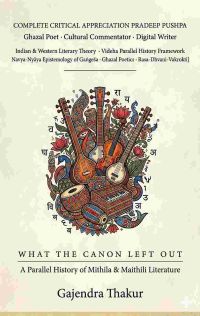
COMPLETE CRITICAL APPRECIATION PRADEEP PUSHPA Ghazal Poet Cultural Commentator Digital Writer Indian & Western Literary Theory Videha Parallel History Framework Navya-Nyāya Epistemology of Gangeśa Ghazal Poetics Rasa-Dhvani-Vakrokti
COMPLETE CRITICAL APPRECIATION
PRADEEP PUSHPA
Ghazal Poet · Cultural Commentator · Digital Writer
Indian & Western Literary Theory · Videha Parallel History Framework
Navya-Nyāya Epistemology of Gaṅgeśa · Ghazal Poetics · Rasa-Dhvani-Vakrokti
I. BIOGRAPHICAL PROFILE
A. Origins and Formation
Pradeep Pushpa (प्रदीप पुष्प) is a Maithili ghazal poet, song-writer, and cultural essayist from Nanour village, Madhubani district, Bihar — the heartland of Mithila's cultural geography. His biographical self-account in 'Apna Kichu Bāt' (अप्पन किछु बात), the author's preface to his ghazal collection Monak Dehairpar (2020), reveals a formation that is characteristic of the Videha Parallel History's democratic literary tradition: literary and musical sensibility nurtured at home, schooling in a semi-rural setting, and discovery of the ghazal form through the internet and the Videha digital community rather than through formal academic training.
Literature and music pervaded his household from childhood. His father (Baba) was his first teacher in both domains. At school, three teachers shaped his literary sensibility: Krishnamohan Jha (Yogibābu, Bhavam), Jayanandan Jha (Hindi teacher), and Basukīnāth Jhā (Nanour). He also acknowledges Prof. Kamar Husain. He began writing songs (gīta) in high school and produced many cassettes in various styles, but found no lasting satisfaction until the ghazal form drew him.
His initial engagement with ghazal was self-taught, through listening to Hindi-Urdu ghazals on Kantipur FM radio during teaching stints in Nanour. Around 2003–2005 he began reading ghazal formally, but remained unaware of its grammar and metre (bahr). In 2008 he first attempted ghazal composition — candidly acknowledging in retrospect that these early attempts were 'not actually ghazals'. In 2012, when mobile internet became accessible, he encountered ghazal shastrā (grammatical theory) systematically.
The decisive turning point was a visit by Umesh Mandal to his village with an invitation to post on 'Videha ī-caubiṭiyā' (the Videha digital platform). This brought him into contact with the core community of Maithili ghazal writers who had been developing the form under Gajendra Thakur's editorial leadership: Gajendra Thakur himself, Ashish Anchinhar, Amit Mishra, Rajiv Ranjan Mishra, Kundan Karṇa, and Omprakash Jhā. Ashish Anchinhar provided extensive help with bahr and prosodic discipline.
B. Family and Location
Pradeep Pushpa's wife Nīlū Pushpa (नीलू पुष्प) is described as the first listener of his ghazals — an acknowledgment that locates the creative process within the domestic sphere rather than in the seminar hall or literary club. His student Jaya Śrīti prepared the manuscript. He dates his author's note from Nanour, Madhubani, 5 March 2020 — the place of both his origin and his ongoing practice, signalling that his ghazal career is rooted in the Madhubani landscape rather than in a metropolitan literary establishment.
His takhallus (pen-name used in the maqta verse) is 'Pushp' (पुष्प) — the Maithili/Sanskrit word for flower. This takhallus, already present in his surname, is lightly worn: it appears in several maqta verses (Ghazal 6: 'Pushpa golak bānhame gherā rahal chī'; Ghazal 10: 'Jā rahal Pushpa sāṛā sapanā lene rinavāsa ker'; Ghazal 11: 'Pushpakeṃ nai fikara ā ne māna mītā') with a characteristic self-referential irony.
C. Videha Archive Presence
Pradeep Pushpa's presence in the Videha digital archive spans multiple Sadeha collected editions:
Videha Sadeha 14 (Prelim_14): One ghazal, page 720.
Videha Sadeha 16 (Prelim_16): Shers, rubaī, ghazals, 'Ghazal ka Ghazal', 'Tūṃ', 'Kaṭhaputerīkeṃ Nāca', 'Yai Ahāṃ', gīta — pages 524–535.
Videha Sadeha 20 (Prelim_20): Essay 'Sinehiyā: Jagā ka Ṭīsa Hṛdayame Keheana Kaṭhora Bhelaum' (pages 16–19); Valentine Special Ghazals and Kichu Ghazal (pages 842–846).
Videha Sadeha 22 (Prelim_22): 'Kichu Ghazal' — pages 674–729 (55 pages — his most substantial Videha appearance).
Videha Sadeha 23 (Prelim_23): Kichu rubaī, kichu ghazal — pages 1196–1200.
Videha Sadeha 24 (Prelim_24): Critical essay 'Gītakāra Rāmlocana Ṭhākura' (pages 133–136).
Videha Sadeha 25 (Prelim_25): Critical essay 'Gītaka Apratima Śilpakāra: Ravīndra Nātha Ṭhākura' (pages 364–367); 2 rubaī and 2 ghazals (pages 382–384).
Videha Sadeha 36 (Prelim_36): Gajendra Thakur's review of Pushpa's ghazal collection Monak Dehairpar listed in contents.
II. WORKS: ANNOTATED CATALOGUE
A. Ghazal Collection
मोनक देहिरपर (Monak Dehairpar — On the Enchanting Threshold)
Pallavi Parkashan, Nirmali/Berma, District Supaul, Bihar. First published 2020. ISBN 978-93-88811-52-1. Price ₹200. 103 pages. Typeset by Manav Arts, Nirmali. Copyright: Pradeep Pushpa.
This is Pradeep Pushpa's first and as yet sole published book — a collection of Maithili ghazals prefaced by Ashish Anchinhar ('Ghazal Pushpa') and the author's own note. The book contains at least 19 numbered ghazals covering the full range of the Videha Maithili ghazal tradition: social protest, political satire, migration and urban alienation, love and betrayal, cultural erosion, village life, and the poet's own artistic self-questioning.
The title Monak Dehairpar (मोनक देहिरपर) deserves analysis. Dehira (देहिर/देहरी) is the Maithili/Bhojpuri word for the threshold, the doorstep — the liminal space between inside and outside, between the domestic and the public, between arrival and departure. Mona(k) (मोनक) derives from mona — the heart/mind/soul. 'On the enchanting threshold' or 'On the threshold of the heart' — the title thus evokes the ghazal's essential quality of liminality: the ghazal always stands at a threshold, between presence and absence, between love fulfilled and love denied, between the private world of feeling and the public world of social critique.
B. Videha Contributions: Prose and Critical Essays
'Sinehiyā: Jagā ka Ṭīsa Hṛdayame Keheana Kaṭhora Bhelaum' (सिनेहिया: जगा क' टीस हृदयमे केहेन कठोर भेलौं) — Videha Sadeha 20, pages 16–19. An essay on the theme of sinehiyā (beloved/dear one) as a literary and emotional concept. The title, 'Having awakened the sting in the heart, how hard you have become', is a ghazal-like utterance in itself — it compresses the entire Maithili ghazal's dominant emotional register into a single vocative phrase.
'Gītakāra Rāmlocana Ṭhākura' (गीतकार रामलोचन ठाकुर) — Videha Sadeha 24, pages 133–136. A critical appreciation of the Maithili song-composer and writer Ramlochan Thakur, demonstrating Pushpa's engagement with the Videha Parallel History's project of documenting the democratic Maithili literary tradition. That Pushpa writes on a gīta-composer (rather than a ghazal-poet) reflects his own formation: he came to ghazal through gīta, and maintains connections to the song tradition.
'Gītaka Apratima Śilpakāra: Ravīndra Nātha Ṭhākura' (गीतक अप्रतिम शिल्पकार: रवीन्द्र नाथ ठाकुर) — Videha Sadeha 25, pages 364–367. A critical essay on Ravindra Nath Thakur as an 'incomparable craftsman of song', situating the Maithili song tradition within a broader aesthetic framework.
C. Rubaīyāt
Pradeep Pushpa has published rubaīyāt (the Persian/Urdu quatrain form) in Videha Sadeha 23 and 25, demonstrating engagement with the full range of the ghazal's related Persian-origin forms as developed in the Maithili Videha tradition. The rubaī (رباعی) — a four-line poem with AABA or AAAA rhyme scheme — is structurally distinct from the ghazal but shares its prosodic framework (bahr) and its takhallus convention.
III. FORMAL ANALYSIS: GHAZAL CRAFT IN MONAK DEHAIRPAR
A. The Maithili Ghazal: Brief Genealogy
Ashish Anchinhar's preface to Monak Dehairpar provides a succinct genealogy of the formal Maithili ghazal tradition as understood within the Videha community. He traces the bahr — specifically the metre 2122+2122+2122+212 (the ḥazaj-based metre dominant in Hindi-Urdu progressive ghazal from Nirālā through Dushyant Kumar) — from its earliest Maithili practitioners to Pushpa's generation. The preface cites Nirālā, Dushyant Kumar, Adām Gondavī, and Hasrat Mohānī as the formative influences, demonstrating that the Videha Maithili ghazal is conscious heir to both the formal Urdu-Persian ghazal tradition and the Hindi 'new ghazal' (nayī ghazal) of the post-Independence period.
Within Videha, the Maithili ghazal was developed by Gajendra Thakur (who pioneered its revival from around 1905 onwards in the Videha framework), and then by Ashish Anchinhar whose 'revival' of the form in the digital era established its contemporary standards. Pradeep Pushpa is explicitly situated by Anchinhar as a member of this second generation of Videha ghazal writers.
B. Bahr (Prosodic Analysis)
Each ghazal in Monak Dehairpar carries a bracketed bahr notation — a feature characteristic of the Videha Maithili ghazal tradition under Gajendra Thakur's editorial practice, which treats metrical transparency as a pedagogical obligation to the reader. The notations use a numerical system (2=dīrgha/long syllable, 1=laghu/short) derived from the classical Maithili prosodic tradition adapted for the Arabic-Persian bahr system.
Ghazal 1 (2222221222): Mixed bahr with internal variation — the 'error' in the third sher (noted by the author as intentional concession) demonstrates honest prosodic self-assessment.
Ghazal 2 (2222222222): Pure 2222222222 per line — likely ḥazaj musaddas with long form; 6 shers with uniform radif 'delauṃ'.
Ghazal 3 (2122 2112 2211 22): Mixed vārṇik-based bahr; 3rd and 4th shers take the first line's ending as long.
Ghazal 4 (222212212222): Variant of ramal bahr; Delhi migration as central motif.
Ghazal 5 (212 12 22): Simple vārṇik bahr — one of the 'simple metre' ghazals Anchinhar identifies as pedagogically oriented.
Ghazal 6 (2122 2122 2122): Standard ḥazaj musaddas — the classic Dushyant-Adām metre; 5 shers including maqta with takhallus 'Pushpa'.
Ghazal 7 (2222222): Short bahr — Dushyant-style two-line shers with political bite.
Ghazal 8 (2222222222): Long 10-syllable per hemistich; political-social protest.
Ghazal 9 (2222222222222): 13-syllable bahr; cultural erosion theme.
Ghazal 10 (22222222222222): 14-syllable longest bahr; 5 shers, maqta with 'Pushpa'.
Ghazal 11 (2122 1222 2122): Mixed bahr; 5 shers, maqta with 'Pushpa'.
C. The Radif and Rhyme System
The radif (refrain) in each ghazal is the most expressive formal choice. Pushpa's radifs reveal his thematic preoccupations: 'lebai hama' (I will do/take) — assertion/action; 'gelauṃ hama' (I went/have become) — journey/transformation; 'rahal jīnagī' (life remains) — endurance; 'rahal chī' (is/am/are) — state of being; 'bala loka' (that/such people) — social critique; 'karatai' (they do/will do) — observation of social behaviour; 'kon gāma chai' (what village is this?) — alienation; 'ker' (of/for) — genitive relation; 'mītā' (O friend!) — intimate address.
The most complex radif is 'ī kon gāma chai' (Ghazal 9) — 'what village is this?' — a six-word radif that enacts the ghazal's central question in its very structure. Each sher poses a feature of the alienated village (no turmeric-market smells, no Sohara or Lagani songs, only DJ noise; old parents abandoned; dog lounging on a sofa) before the refrain delivers its rhetorical question of belonging and estrangement.
IV. THEMATIC ANALYSIS: THE GHAZAL UNIVERSE
A. Social Protest and Political Satire
Pradeep Pushpa's ghazals operate in the tradition of the Hindi progressive nayī ghazal — the tradition of Dushyant Kumar's 'Ho gaī hai pīr parvat-sī pighalanī cāhie' and Adām Gondavī's 'Bhūkha ke aha sāsa ko śe Rosukhan taka le calo'. His Ghazal 7, whose maqla (opening sher) 'Gamakait ghāma bala loka / Camakait cāma bala loka' (Those who sweat in the sun; those whose skin shines) and second sher 'Bhāṣaṇa āmo par dai chai / Thurīṃ latāma balā loka' (Those who give speeches over our mangoes; those who trample the treetops) — cited specifically by Anchinhar in his preface as exemplary — belongs squarely in this tradition. The sardonic contrast between the rhetoric of political speech and the reality of agricultural exploitation is a direct descendant of Dushyant Kumar's ironic juxtapositions.
Ghazal 1 is perhaps the most sustained political poem: its five shers address dowry violence (a daughter's wedding expenses paid by selling the field; petrol drums brought to the courtyard when a girl is burned), hypocrisy (washing others' dirty linen while hiding one's own scandal), administration (the government kept in one's pocket as a toy), and communal politics in the third sher — all compressed into the tight two-line structure with uniform radif 'lebai hama'.
Ghazal 8 is a masterpiece of political layering: the first sher shows a farmer selling his field to fund a daughter's wedding; the second shows a politician who drinks at night and runs anti-addiction campaigns in the morning; the third shows flood victims whose land is destroyed by the embankment; the fourth shows the petty humiliation of those who speak without a patron; the fifth addresses a hungry ruler who divides the nation along religious lines; and the final maqla sher shows the world dancing to the pārthaka (partisan) victory cry — a devastating six-sher indictment of the political economy of rural Bihar.
B. Migration, Urban Alienation and the Delhi Experience
Ghazal 4's radif 'gelauṃ hama' (I have gone/become) structures a meditation on the poet's arrival in Delhi: 'Nai keoa mīta nai prema churache ṭākā / Kī bheṭala āba Dillī ṭhaharī gelauṃ hama' — 'No friend, no touch of love costs a paisa; what did I find? I arrived in Delhi and got stuck.' The sher captures the migrant's disillusionment with the city: the promised richness of human connection reduced to monetary transaction.
The village-Delhi axis is a recurring structural motif. Ghazal 7's final sher — 'Karatai uddhāra Mithilāka / Dillī asāma bala loka' (Those from Delhi and Assam who say they will uplift Mithila) — is a biting observation on the political class that claims to serve Mithila from metropolitan distances while the actual Madhubani-Supaul rural population sustains their claims.
Ghazal 9's entire dramatic structure — 'ī kon gāma chai?' (What village is this?) — is a meditation on the village that has become unrecognisable: the Sohara and Lagani folk songs replaced by DJ noise; the smell of turmeric and curd-rice replaced by Chinese food stalls; old parents abandoned; the courtyard populated by a dog on a sofa. The village has become a simulation of itself, hollowed out by modernity.
C. Love, Betrayal and the Ghazal's Classical Register
Ghazal 2 explores betrayal and the resolution to self-assertion: 'Phaera Ṭhamakala tohara dalāna laṣaga je / Chātī pāthara kaṣa Ḍega sasāri delaum' (Again I stumbled at your courtyard's threshold; crushing the stone on my chest, I will move on). The threshold (dalān) of the beloved's house is the poem's central image — directly echoing the collection's title Monak Dehairpar. The last sher delivers the characteristic ghazal resolution: 'Cāna dhiri pāhuṃcaba nai likhala chala hamrā / Monakeṃ hama Sīṛhīsāṃ utāri delaum' (That we would reach the moon was never written in our fate; I will dismount the heart from its ladder).
Ghazal 6 uses the imagery of spiritual dissolution: 'Bītalāhā bāṭame herā rahal chī' (Lost on a pathless road is this life) with the maqta 'Mana bhelalai bhoja kiratauṃ gāma bharika / Pushpa golaka bānhame gherā rahal chī' (The mind longed to wander village to village; Pushpa is caught in the encirclement of his ball-and-chain). The 'golak bānh' (encirclement of a sphere/prison) is a vivid image of the poet's entrapment — whether in social obligation, urban life, or artistic limitation.
D. Cultural Erosion and the Village
Ghazal 9's radif 'ī kon gāma chai?' operates as a cultural diagnostic. The sher 'Nai soharā nai laganī ā chai nai nacārīka dhuna / Sagaro māṭra Ḍīje bajaia chai ī kon gāma chai' (There is no Sohara, no Lagani, no Nācārī tune; only DJ music plays everywhere — what village is this?) is one of the collection's most resonant cultural observations. The Sohara (birth song), Laganī (wedding processional), and Nācārī (a form of Maithili devotional song) represent the entire life-cycle song tradition of Mithila — exactly the tradition that Hriday Narayan Jha documented as endangered in the Videha Sadeha 1 essay. Pushpa's ghazal connects to that documentation tradition: the poet's complaint is the cultural critic's lament in compressed form.
E. The Poet's Self-Reflection: Art and Commitment
Ghazal 3 is among the collection's most programmatic statements: 'Hama likhait chī loka lae, vidvāna lae naya / Hama gabai chī gāma lae, jajamāna lae naya' (I write for the people, not for the scholar; I sing for the village, not for the patron). This sher articulates the Videha Parallel History Framework's central democratic commitment with rare directness. The contrast loka/vidvān (people/scholar) and gāma/jajamāna (village/patron) is the definitional antithesis of the parallel literary tradition.
Ghazal 11 continues this self-reflective strand: 'Dosarakar gīta ugabai achi cāna mītā / Hamara ghazalo gabai bhūkhaka gāna mītā' (Others' songs are celebrated, O friend; our ghazal too sings the song of hunger, O friend). The poet accepts his marginal position without self-pity, asserting the dignity of the committed art even when it lacks the institutional recognition given to 'celebrated' songs.
V. THEORETICAL FRAMEWORKS
A. Rasa-Dhvani Analysis
Bharatamuni's theory of rasa and Ānandavardhana's dhvani provide the primary Indian critical framework for Pushpa's ghazals. The dominant rasas across the collection are Karuṇa (pathos — the sustained emotional register of loss, migration, and cultural erosion), Vīra (heroic resolve — the determination to write 'for the people', to persist against betrayal), and Hāsya/Raudra in combination in the satirical political ghazals (Ghazals 1, 7, 8). The interplay of Karuṇa and Vīra — suffering acknowledged but not surrendered to — is the characteristic rasa-configuration of the Videha Maithili ghazal tradition.
Dhvani operates most powerfully in the radif choices. The radif 'ī kon gāma chai?' (What village is this?) does not merely ask a question; it dhvanis the entire experience of estrangement, of watching one's native place become unrecognisable, of the grief that accompanies cultural transformation. The question is not answered — it cannot be — and the unanswered refrain is itself the most resonant dhvani in the collection.
B. Vakrokti and Auchitya
Kuntaka's vakrokti (oblique expression) is consistently present in Pushpa's political shers. The apparently straightforward observation 'Bhāṣaṇa āmo par dai chai / Thurīṃ latāma balā loka' (Those who give speeches over our mangoes; those who trample the treetops) operates vakrokti at several levels simultaneously: the literal image (a political speech delivered in a mango orchard, trampling the branches), the metaphorical (the politician using the people's resources as the stage for self-promotion), and the satirical (the sheer incongruity of political rhetoric and the physical reality of the orchard).
Kshemendra's auchitya (contextual propriety) is tested by the collection's range of registers — from the intimate love-ghazal (Ghazal 2, 6) to the didactic political sher (Ghazal 1, 8) to the elegiac cultural lament (Ghazal 9). Each register requires its own auchitya, and Pushpa's skill lies in calibrating tone appropriately: the satirical political shers are terse and direct; the love-ghazals are more imagistic and allusive; the cultural lament ghazals build their argument cumulatively through the sher sequence.
C. Navya-Nyāya and Śabda-Pramāṇa
Gaṅgeśa Upādhyāya's epistemological framework of śabda-pramāṇa (verbal testimony as valid knowledge) is relevant to the ghazal's claim to be a form of knowledge. The ghazal sher, in the Urdu-Persian tradition, is considered a self-sufficient unit of valid utterance — its two lines constitute a complete perceptual-inferential-linguistic act. In the Navya-Nyāya terms that Gaṅgeśa develops in the Tattvacintāmaṇi's Śabda-khaṇḍa, a linguistic utterance is valid (pramā) when it accurately represents reality, when the speaker has the relevant knowledge, and when the communication is undistorted. Pushpa's political shers satisfy all three conditions for śabda-pramāṇa: they represent observed social reality (the farmer selling land for dowry, the politician drinking at night, the DJ replacing Sohara), they come from a positioned knower with direct access to this reality (a Madhubani rural writer), and they communicate without distortion — the sher's compression is not obscurity but precision.
The anumāna structure of Pushpa's satirical ghazals is particularly Navya-Nyāya in character. In Ghazal 8, the hetu (logical reason) of each sher is a specific observed social fact, the vyāpti (universal concomitance) is the connection between that fact and the systemic hypocrisy/injustice it reveals, and the sādhya (proposition to be established) is the critique of the political-social order. The ghazal's sher-sequence thus enacts a series of inferential moves, each building the overall anumāna towards the maqla's devastating conclusion.
D. Videha Parallel History Framework
Pradeep Pushpa is a paradigmatic figure for the Videha Parallel History Framework. His literary formation was entirely digital and community-based: he did not encounter Maithili ghazal in a university or through a print publication, but through the Videha ī-caubiṭiyā platform and through direct mentorship from Ashish Anchinhar and the example of Gajendra Thakur. His book is published by Pallavi Parkashan — a small regional publisher in Nirmali, Supaul, not a Delhi or Patna mainstream press. His themes — migration, village erosion, political hypocrisy, cultural loss — are precisely the themes that the Videha Parallel History privileges as the living concerns of the democratic Maithili community.
Ghazal 3's programmatic statement ('I write for the people, not for the scholar; I sing for the village, not for the patron') is a precise articulation of the Parallel History's alternative aesthetic: it explicitly rejects both the academic establishment (vidvān) and the patronage system (jajamān) in favour of a democratic, community-rooted practice. This is not merely a rhetorical position but a biographical fact: Pushpa teaches at a school in Nanour, Madhubani, and writes ghazals for a community that includes farmers, teachers, and rural professionals.
E. Western Critical Frameworks
Antonio Gramsci's concept of the 'organic intellectual' (Prison Notebooks) precisely describes Pushpa's position. Unlike the traditional intellectual (the pandit, the academic critic) who is detached from the producing class, the organic intellectual emerges from within it and articulates its experiences and aspirations. Pushpa's Ghazal 3 — 'I write for the people, not for the scholar' — is a Gramscian manifesto of organic intellectual identity. His ghazals on farmer distress (Ghazal 8), migration (Ghazal 4), and cultural erosion (Ghazal 9) are the organic intellectual's articulation of the rural Maithili community's lived experience.
Mikhail Bakhtin's theory of heteroglossia (The Dialogic Imagination, 1981) is relevant to Pushpa's ghazals' multi-register quality. Each ghazal contains within itself multiple social voices: the voice of the political satirist, the voice of the migrant worker, the voice of the cultural mourner, and the voice of the committed artist. The radif, repeated across all shers, provides the unifying thread that holds these voices in dialogic tension rather than resolving them into a single monological stance.
Frantz Fanon's analysis of the national intellectual's passage from assimilation through cultural rediscovery to committed creative production (The Wretched of the Earth, 1961) maps onto Pushpa's poetic biography: from the initial assimilation of the dominant (Hindi-Urdu ghazal) form, through the discovery of its Maithili possibilities within the Videha community, to a committed production that deploys the form in service of the Maithili democratic community's self-expression.
VI. CRITICAL SYNTHESIS
Pradeep Pushpa's Monak Dehairpar occupies a specific and significant position in the Videha Maithili ghazal tradition. As a first collection, it shows the characteristic strengths of the form's second generation within Videha: technical competence developed through digital mentorship, strong thematic focus on the social-political realities of rural Bihar, and an honest self-awareness about the limitations and aspirations of the ghazal project. The self-annotating bahr notation in each ghazal is itself a remarkable feature — it turns the collection into a semi-pedagogical document, demonstrating the poet's commitment to metrical transparency and his awareness of his own occasional prosodic licence.
The collection's greatest achievements are the political-satirical ghazals (1, 3, 7, 8) where Pushpa's directness and specificity of observation — dowry violence, flood damage, DJ culture replacing Sohara — give the ghazal form a grounded social reality that is harder to achieve in the more abstracted love-registers. Ghazal 9 ('ī kon gāma chai?') is the collection's most successful single poem, achieving in its sustained radif-driven structure the kind of cumulative emotional and intellectual impact that the best ghazals generate.
Areas for further development include the love-ghazals, where the imagery — threshold, moon, ladder — sometimes tends toward the conventional, and the maqta verses, where the takhallus 'Pushpa' is not always deployed with the full self-critical irony that the best Urdu-Persian and Hindi ghazal traditions bring to the poet's self-naming. But these are the natural growing edges of a first collection, and the Videha community's collective mentorship — Anchinhar's bahr guidance, Thakur's editorial framework, the example of the broader ghazal tradition — gives Pushpa a productive environment for continued development.
VII. SELECT BIBLIOGRAPHY
Primary Sources
Pushpa, Pradeep. Monak Dehairpar (मोनक देहिरपर). Pallavi Parkashan, Nirmali, Bihar, 2020. ISBN 978-93-88811-52-1.
Pushpa, Pradeep. 'Sinehiyā: Jagā ka Ṭīsa Hṛdayame Keheana Kaṭhora Bhelaum.' Videha Sadeha 20, pp. 16–19. www.videha.co.in.
Pushpa, Pradeep. 'Gītakāra Rāmlocana Ṭhākura.' Videha Sadeha 24, pp. 133–136. www.videha.co.in.
Pushpa, Pradeep. 'Gītaka Apratima Śilpakāra: Ravīndra Nātha Ṭhākura.' Videha Sadeha 25, pp. 364–367. www.videha.co.in.
Pushpa, Pradeep. Ghazals in Videha Sadeha 14 (p.720), 16 (pp.524–535), 20 (pp.842–846), 22 (pp.674–729), 23 (pp.1196–1200), 25 (pp.382–384). www.videha.co.in.
Videha Sources
Anchinhar, Ashish. 'Ghazal Pushpa' (preface). In Monak Dehairpar. Pallavi Parkashan, 2020.
Thakur, Gajendra (ed.). Videha Sadeha Vols. 14, 16, 20, 22, 23, 24, 25, 36. ISSN 2229-547X. www.videha.co.in.
Thakur, Gajendra. Review of Monak Dehairpar. Videha Sadeha 36. www.videha.co.in.
Indian Literary Theory
Bharatamuni. Nāṭyaśāstra. Tr. M. Ghosh. Calcutta: Asiatic Society, 1951.
Ānandavardhana. Dhvanyāloka. Tr. K. Krishnamoorthy. Dharwar: KU, 1974.
Kuntaka. Vakroktijīvita. Ed. Krishnamoorthy. Dharwar: KU, 1977.
Gaṅgeśa Upādhyāya. Tattvacintāmaṇi. Tr. S.H. Phillips & N.S.R. Tatacharya. Hackett, 2004.
Western Theory
Bakhtin, Mikhail. The Dialogic Imagination. Tr. C. Emerson & M. Holquist. Austin: UTAP, 1981.
Fanon, Frantz. The Wretched of the Earth. Tr. C. Farrington. New York: Grove, 1963.
Gramsci, Antonio. Prison Notebooks (selections). Tr. Q. Hoare & G.N. Smith. London: Lawrence & Wishart, 1971.
A PARALLEL HISTORY OF MAITHILI LITERATURE
GHAZAL ANALYSIS
PRADEEP PUSHPA
प्रदीप पुष्प
Monak Dehairpar — Close Reading of Selected Ghazals
Indian & Western Literary Theory · Videha Parallel History Framework
Navya-Nyāya Epistemology of Gaṅgeśa · Ghazal Poetics · Rasa-Dhvani-Vakrokti
I. CLOSE READING: TEN GHAZALS
This volume presents close readings of ten ghazals from Pradeep Pushpa's Monak Dehairpar (Pallavi Parkashan, 2020), with metrical analysis, rasa-dhvani-vakrokti annotations, Navya-Nyāya epistemological analysis, English translations, and contextualisation within the Videha Parallel History Framework. The ghazals are presented in order as they appear in the collection.
GHAZAL 1 — Bahr: 2222221222 | Radif: 'lebai hama'
Theme: Dowry violence, political hypocrisy, social protest | Shers: 5 | Maqla with refrain
लगलेमे हीया हारि लेबै हम
छातीमे मुक्का मारि लेबै हम
हमरा नै मिललै चान गगनक तेँ
करबै की डिबिये बारि लेबै हम
खगता किनको नै दऽर दियादक आब
आँगनमे अमती गाड़ि लेबै हम
कलपै बाजै बेटी तिलक कारण
डिब्बा पेट्रोलक ढारि लेबै हम
जेबीमे रखने छी प्रशासन हम
क्यो एगो लेतै चारि लेबै हम □
(2222221222 सभ पाँतिमे। तेसर शेरक अन्तिम लघु छूट तौर पर लेल गेल अछि)
Translation: 'We will beat ourselves in the heart if we lose courage. / We have not found the moon from the sky, so what to do? We will light our own lamp. // No one fears the kinsfolk now; we will plant the bitter neem in our own courtyard. // The daughter cries for dowry; we will pour the petrol drum. // We have kept the administration in our pocket; whoever takes one, we will make four.'
Rasa: The dominant rasa oscillates sharply between Raudra (fury — the petrol drum verse; the political corruption verse) and Karuṇa (pathos — the daughter crying for dowry). This oscillation is the ghazal's emotional logic: the same social system that produces the daughter's dowry-grief produces the political corruption. The two rasas are not in conflict but in causation.
Dhvani: The maqla's 'legaleme hīyā hāri lebai hama' (we will beat ourselves in the heart if we lose courage) is a complex self-address that dhvanis both individual resolve and collective resilience. The first-person plural 'hama' (we) is not confessional but communal: this is the ghazal of a community speaking to itself.
Vakrokti: Sher 4 ('kalpai bājai beṭī tilaka kāraṇa / ḍibbā peṭrolaka ḍhāri lebai hama') is the collection's most vivid vakrokti: the juxtaposition of the daughter weeping and the petrol drum creates a violent, oblique image of dowry murder — the sher does not name the crime directly but places its instruments in devastating adjacency.
Navya-Nyāya: Each sher is a micro-anumāna. In sher 2: hetu = moon not found; vyāpti = when what we seek is unavailable from outside, we make our own; sādhya = we will light our own lamp. In sher 4: hetu = daughter weeps for dowry; vyāpti = the persistence of dowry demands leads to violence; sādhya (unstated but implied by 'ḍibbā peṭrolaka ḍhāri') = the violence of dowry murder. The unsaid sādhya is the dhvani.
GHAZAL 3 — Bahr: 2122 2112 2211 22 | Radif: 'lae naya'
Theme: Democratic artistic commitment | Shers: 5 | Central programmatic statement of the collection
हम लिखैत छी लोक लए विद्वान लए नय
हम गबैत छी गाम लए जजमान लए नय
पेटमे कूदत मूस तहन पागे करतय की
हम खेतै छी भूख लए सम्मान लए नय
हम जनैत छी देव हमर जेबीक लचार
हम पुजैत छी भक्ति लए वरदान लए नय
छैक हमरो लोभ अपन बिन जाइ अहाँक
हम तकैत छी नेह लए पकवान लए नय
भूमिका छैत छोट मुदा नमहर सपना छैत
हम कनैत छी टोल लए खनदान लए नय □
Translation: 'I write for the people, not for the scholar. / I sing for the village, not for the patron. // When mice jump in the belly, what use is rage? / I eat for hunger, not for honour. // I know our god is as poor as our pocket; / I worship for devotion, not for boons. // I too have desire; I cannot live without you; / I seek love, not delicacies. // The role is small but the dream is large; / I cry for the neighbourhood, not for the dynasty.'
Rasa: This ghazal sustains Vīra-rasa (heroic resolve) throughout its five shers, modulated by the Karuṇa of the second sher (hunger) and the Śṛṅgāra of the fourth (love). The overall emotional register is one of principled commitment — the vīra is not military but moral.
Videha Parallel History: The maqla — 'I write for the people, not for the scholar; I sing for the village, not for the patron' — is the most direct articulation of the Videha Parallel History's democratic literary programme in Pushpa's collection. The contrast loka/vidvān directly maps onto the Parallel History's opposition between the democratic tradition and the canonical establishment; the contrast gāma/jajamān maps onto its opposition between community-rootedness and patronage-dependence.
Navya-Nyāya: The anaphoric 'hama X lae, Y lae naya' structure (I do X for [reason A], not for [reason B]) is an epistemological clarity-formula — it distinguishes the speaker's actual motivation (pramā) from false attributions. This is a form of niyāmakadharmī-pratyakṣa (determining-property perception): the speaker's direct perception of his own motivations, distinguished from social misrepresentation.
GHAZAL 7 — Bahr: 2222222 | Radif: 'bala loka'
Theme: Political satire (Dushyant tradition) | Shers: 5 | Short bahr, dense imagery
गमकैत घाम बला लोक
चमकैत चाम बला लोक
भाषण आमो पर दै छै
थुरीं लताम बला लोक
बाँटै दरद सगरो खूब
ई झंडु बाम बला लोक
मौंसो केर हाट लगबै
गाँधीक गाम बला लोक
करतै उद्धार मिथिलाक
दिल्ली असाम बला लोक □
Translation: 'Those who sweat and toil in the sun; those whose skin shines. // Those who give speeches over our mangoes; those who trample the treetops. // Those who distribute pain everywhere generously; those with their Jhandū Bām [pain relief balm, a well-known brand]. // Those who will set up a market even for the monsoon-season; those from the village of Gandhi. // Those who will uplift Mithila; those from Delhi and Assam.'
Rasa: Hāsya (satirical comedy) dominates — the 'Jhandū Bām wala loka' (those with the Jhandū Bām) sher is genuinely funny in its juxtaposition of distributing pain and offering a topical analgesic. But Raudra (controlled fury) underlies the last three shers. The combination is characteristic of the Dushyant-school political ghazal.
Vakrokti: The entire ghazal operates through nominal characterisation — each sher describes a type ('those who...') rather than making an explicit statement. This indirect characterisation is a sustained vakrokti: the criticism is enacted in the description rather than stated in the judgement. The reader fills in the unstated sādhya.
Dhvani: The final sher's dhvani is the most resonant: 'those from Delhi and Assam who will uplift Mithila' — the dhvani is the impossibility of distant metropolitan politicians claiming to serve a region they have abandoned or never inhabited. The distance (Delhi/Assam vs Mithila) is the unstated critique.
GHAZAL 9 — Bahr: 2222222222222 | Radif: 'ī kon gāma chai'
Theme: Cultural erosion and village alienation | Shers: 5 | The collection's masterpiece
भाषा भिन्ने भिन्न बजैत छैत ई कोन गाम छैत
केओ केकरो नै चिन्हैत छैत ई कोन गाम छैत
नै तरुआ तिलकोर नै दही चूड़ा गमिक रहल
गन्ध चाउमिनकेर अबैत छैत ई कोन गाम छैत
नै सोहर नै लगनी आ छैत नै नचारीक धुन
सगरो मात्र डीजे बजैत छैत ई कोन गाम छैत
बूढ़ माए बापकेँ कोन बेटा रखतै संगे
धुर! सभ सबहक मुँह तकैत छैत ई कोन गाम छैत
सून छैत दलान आ भकोभम्म भेल आँगन घर
चिढ़ कऽ सोफा कुकुर हँसैत छैत ई कोन गाम छैत □
Translation: 'Everyone speaks a different language; no one recognises anyone — what village is this? // No fried taros, no tilkor greens, no smell of curd-rice remaining; only the smell of Chinese noodles drifting — what village is this? // No Sohara, no Lagani, not a tune of Nācārī; only DJ music playing everywhere — what village is this? // What son will keep old parents by their side? Everyone just watches everyone else's face — what village is this? // The courtyard is empty, the outer room desolate; a dog perches on the sofa, laughing in contempt — what village is this?'
Rasa: Pure Karuṇa-rasa (pathos), developed cumulatively through five shers of increasing specificity. The final image — the dog laughing on the sofa as the courtyard lies empty — achieves the rasa's peak through a reversal: the animal occupies the domestic space abandoned by humans, an image simultaneously absurd (hāsya) and heartbreaking (karuṇa).
Dhvani: The repeated radif 'ī kon gāma chai?' is the single most powerful dhvani in the collection. Its literal meaning (what village is this?) dhvanis: What has become of my village? Is this still my village? Does this place any longer deserve to be called a village? The question is structurally unanswerable — and the unanswered question is the poem's emotional core.
Cultural Connection: The Sohara and Laganī mentioned in Sher 3 connect directly to Hriday Narayan Jha's essay 'Luptraprāya Maithilī Lokagīta' (Videha Sadeha 1), which identifies these very genres as endangered. Pushpa's ghazal is the creative counterpart to Jha's documentary essay: where Jha catalogues and mourns the loss of folk song genres, Pushpa embeds their disappearance in a ghazal sher that gives it emotional immediacy.
Navya-Nyāya: The anumāna of this ghazal is cumulative. Each sher provides a separate hetu (specific sign of cultural dissolution); the vyāpti is the general principle that when the specific markers of a community's life (food, song, human care, domestic space) disappear, the community itself is dissolving; the sādhya is the unstated conclusion — that this village has ceased to be a village in any meaningful cultural sense.
GHAZAL 11 — Bahr: 2122 1222 2122 | Radif: 'mītā'
Theme: Artistic solidarity and self-commitment | Shers: 5 | Intimate register
दोसरक गीत उगबैत अछि चान मीता
हमर गजलो गबैत भूखक गान मीता
आब रुदल बऽनब ने हम गऽछब किहयो
जरल पेटसँ उठैत ने सुर तान मीता
भेल बटुआसँ तगमाकेँ नीक दोस्ती
बिन टका छी सभा मध्ये आन मीता
जैह देबै अहाँ हम रखबैत हुलिसकेँ
गाय बूढ़ो खपैत विप्र- दान मीता
पाँतमे हम अछोपक छी भोज खाइत
'पुष्प'केँ नइ फिकर आ ने मान मीता □
Translation: 'Others' songs rise like the moon, O friend; / Our ghazal too sings the song of hunger, O friend. // Now I will not cry or weep; / No tune rises from a burning belly, O friend. // My wallet has made good friends with my pocket-lining; / Without money I am a stranger in the assembly, O friend. // Whatever you give, I will hug with joy; / Even old cows are used, O friend, for Brahmin donations. // I sit at the end of the feast row, untouchable; / Pushpa has neither worry nor honour, O friend.'
Rasa: Śānta-rasa (tranquillity arrived at through acceptance) prevails, undergirded by Karuṇa (pathos of poverty, marginalisation). The maqta's takhallus verse — 'Pushpa has neither worry nor honour' — achieves a Śānta-rasa resolution: the complete acceptance of the poet's marginal position, without bitterness, is a form of liberation.
Videha Parallel History: The maqla — 'Others' songs rise like the moon; our ghazal too sings the song of hunger' — positions the Videha ghazal tradition in explicit contrast to commercially successful or institutionally celebrated songs. The ghazal 'of hunger' is not a complaint but a badge of honour — the work that addresses the community's actual experience rather than its aspirational fantasies.
The maqta's 'pāṃtame hama achopaka chī bhoja khāita / Pushpakeṃ nai phikara ā ne māna mītā' (I sit at the end of the feast row, among the untouchables; Pushpa has neither worry nor honour) introduces a striking social image: the 'pāṃta' (feast row) in Mithila's traditional Brahmin feasts has a strict hierarchical seating order, with 'achopa' (untouchable/low-caste) diners at the far end. Pushpa places himself — the Madhubani school-teacher and ghazal-poet — among the marginalized at the feast, asserting both his social solidarity and his artistic independence from the prestige economy.
ANNOTATED GHAZAL ANTHOLOGY
PRADEEP PUSHPA
प्रदीप पुष्प
मोनक देहिरपर — Annotated Bilingual Anthology
Indian & Western Literary Theory · Videha Parallel History Framework
Navya-Nyāya Epistemology of Gaṅgeśa · Ghazal Poetics · Rasa-Dhvani-Vakrokti
EDITORIAL INTRODUCTION
This volume presents ten ghazals from Pradeep Pushpa's Monak Dehairpar (Pallavi Parkashan, Nirmali-Berma, Supaul, Bihar, 2020; ISBN 978-93-88811-52-1) in bilingual annotated form: original Maithili text, literary English translation, and critical annotations covering prosodic form, rasa, dhvani, social context, and connections to the Videha Parallel History Framework. The ghazals are presented in the sequence they appear in the collection.
Editorial note on metre: Each ghazal carries Pushpa's own bahr notation (in brackets at the foot of each poem) using the numerical system standardised in the Videha Maithili ghazal tradition: 2=dīrgha (long/heavy syllable), 1=laghu (short/light syllable). This notation is reproduced as printed. The takhallus 'Pushpa' (पुष्प) appears in the maqta (final sher) of several ghazals.
GHAZAL 1
Bahr: 2222221222 (all lines) — third sher: short ending taken as licensed variation. | Radif: 'lebai hama' (I will take/do) | Shers: 5
MAITHILI TEXT:
लगलेमे हीया हारि लेबै हम
छातीमे मुक्का मारि लेबै हम
हमरा नै मिललै चान गगनक तेँ
करबै की डिबिये बारि लेबै हम
खगता किनको नै दऽर दियादक आब
आँगनमे अमती गाड़ि लेबै हम
कलपै बाजै बेटी तिलक कारण
डिब्बा पेट्रोलक ढारि लेबै हम
जेबीमे रखने छी प्रशासन हम
क्यो एगो लेतै चारि लेबै हम □
ENGLISH TRANSLATION:
If our courage fails at the start, we will beat ourselves in the chest. / Since we couldn't find the moon from the sky, what is there to do? — we will light our own lamp. // No one fears kinsmen anymore; we will plant the bitter neem tree in our own courtyard. // The daughter weeps for the groom's dowry demands; we will pour the petrol drum. // We keep the administration in our pocket; whoever takes one, we will make four.
ANNOTATIONS:
Social context: This ghazal is the collection's most concentrated political protest poem. Sher 1 opens with an internal resolve ('we will not lose courage'). Shers 2–4 depict specific rural Bihar realities: abandonment by kin, the dowry violence epidemic (sher 4's petrol drum — the instrument of bride burning — placed in devastating adjacency to the weeping daughter), and political corruption (sher 5's 'administration in our pocket').
Radif significance: 'Lebai hama' (I will take/do) is an active, volitional radif — each sher ends with the first-person assertion of action. Even in the face of systemic violence, the speaker's agency is asserted. This transforms the social protest poem from a lament into a defiance.
Sher 4 is the collection's most striking vakrokti (oblique expression). The daughter's weeping and the petrol drum are placed in adjacent lines without any explicit causal connection — the reader completes the horrifying logic. This is the ghazal form's compression at its most powerful.
GHAZAL 2
Bahr: 2222222222 (all lines; two hemistich-final shorts taken as licensed variations) | Radif: 'delaum' (I did/gave up) | Shers: 6
MAITHILI TEXT:
फ्रेम टांगल छैत चित्र उखाड़ि देलौं
कानि भरि मोन तोरा बिसारि देलौं
पएर ठमकल तोहर दलान लऽसग जे
छाती पाथर कऽ डेग ससारि देलौं
आस छल जिनगी रचबैत गजल जेना
बहर कठिन छैत हम हिया हारि देलौं
देखल नै गेल पराजय तोहर तेँ
हम अपने अपनाकेँ बजारि देलौं
तूँ पीठेमे चकू भोकबेँ कते
तोरा लेल छाती उघारि देलौं
चान धरि पहुँचब नै लिखल छल हमरा
मोनकेँ हम सीढ़ीसँ उतारि देलौं □
ENGLISH TRANSLATION:
I took down the framed picture and tore it up; crying my fill, I forgot you. // My feet stumbled again at your courtyard's threshold; making my chest into stone, I moved on. // My hope was to compose a ghazal like life itself; but the bahr is hard, and I gave up hope. // Unable to watch your defeat, I sold myself in the marketplace. // How many times will you stab me in the back? — I bared my chest for you. // It was never written that I would reach the moon; I dismounted my heart from the ladder.
ANNOTATIONS:
This is the collection's most sustained love-ghazal. The threshold imagery — 'tuhara dalāna laṣaga' (your courtyard's threshold) — echoes the collection's title Monak Dehairpar (On the enchanting threshold). The beloved's threshold is the liminal space of the ghazal itself: the threshold between arrival and departure, between hope and resignation.
Sher 3 is the collection's most self-referential verse: 'My hope was to compose a ghazal like life; but the bahr is hard and I lost heart.' The ghazal's formal difficulty (bahr) mirrors the difficulty of life itself — a meta-poetic statement embedded in the love register.
The final maqla sher — 'It was never written that I would reach the moon; I dismounted my heart from the ladder' — achieves Śānta-rasa through acceptance. The ladder of aspiration (sīṛhī) is an image of the ghazal's own formal structure: the ascending steps of the sher-sequence, each one a step toward the unattainable. Dismounting is not defeat but wisdom.
GHAZAL 3
Bahr: 2122 2112 2211 22 (mixed; 3rd and 4th shers: first-line ending taken as long) | Radif: 'lae naya' (not for) | Shers: 5
MAITHILI TEXT:
हम लिखैत छी लोक लए विद्वान लए नय
हम गबैत छी गाम लए जजमान लए नय
पेटमे कूदत मूस तहन पागे करतय की
हम खेतैत छी भूख लए सम्मान लए नय
हम जनैत छी देव हमर जेबीक लचार
हम पुजैत छी भक्ति लए वरदान लए नय
छैक हमरो लोभ अपन बिन जाइ अहाँक
हम तकैत छी नेह लए पकवान लए नय
भूमिका छैत छोट मुदा नमहर सपना छैत
हम कनैत छी टोल लए खनदान लए नय □
ENGLISH TRANSLATION:
I write for the people, not for the scholar. / I sing for the village, not for the patron. // When mice jump in the stomach with hunger, what use is rage? / I eat for hunger, not for honour. // I know my god is as poor as my pocket; / I worship for devotion, not for boons. // I have desire too; I cannot be without you; / I seek love, not delicacies. // My role is small but my dream is large; / I cry for the neighbourhood, not for the dynasty.
ANNOTATIONS:
The Videha Parallel History's most direct articulation in Pushpa's collection. The loka/vidvān (people/scholar) and gāma/jajamāna (village/patron) contrasts encapsulate the democratic vs canonical literary opposition that defines the Parallel History Framework.
The anaphoric structure — 'hama X lae, Y lae naya' — repeated five times, creates a cumulative manifesto effect. Each sher adds a new dimension: artistic commitment (sher 1), material reality (sher 2), spiritual honesty (sher 3), personal desire (sher 4), communal solidarity (sher 5).
Sher 5's maqla — 'My role is small but my dream is large; I cry for the neighbourhood, not for the dynasty' — closes the manifesto with a precise calibration of humility and ambition: the poet acknowledges his small social position (chhota bhūmikā) while refusing to limit his commitment to the 'dynasty' (khanadāna — the established literary lineage/institution).
GHAZAL 6
Bahr: 2122 2122 2122 (all lines; maqta: first-line final short taken as long) | Radif: 'rahal chī' (is remaining / I am) | Shers: 5 + maqta with takhallus 'Pushpa'
MAITHILI TEXT:
बीतलाहा बाटमे हेरा रहल छी
ऍँठ छी हम चाह तेँ सेरा रहल छी
पेरलक दैबा भऽ तेना ने कसैया
मेहमे बऽरदे जकाँ पेरा रहल छी
देह भेलैत आब अनमन टाँट सनठी
आगि लागल ऊक सन फेरा रहल छी
मीत मुसकी बीच कननी हैत अलगे
नोर सुख दुखकेर हम बेरा रहल छी
मन भेलैत भोज किरतौं गाम भरिक
'पुष्प' गोलक बान्हमे घेरा रहल छी □
ENGLISH TRANSLATION:
I am lost on a pathless road; / I am hungry with longing, so I am withering away. // Fate has pressed me like the village oil-presser; / I am being pressed like a bullock in the grinding pit. // The body has become dry and brittle like a bamboo stake; / A fire is lit, like a torch I am revolving. // In a friend's smile there is hidden weeping; / I am a blend of tears of joy and sorrow. // The mind wanted to feast the entire village; / Pushpa is caught in the encirclement of his ball-and-chain.
ANNOTATIONS:
This ghazal introduces the takhallus 'Pushpa' in the maqta — one of the collection's most intimate self-portraits. The 'golak bānh' (encirclement of the ball, or prison-ball-and-chain) is an unusually concrete image for the poet's sense of entrapment: social obligation, material poverty, and unrealised aspiration all compressed into a single object.
The imagery across the five shers moves from displacement (lost on a pathless road), through physical exhaustion (oil-press bullock), through emotional ambivalence (tears of joy and sorrow mixed), to the final encirclement of the maqta. This progression traces an arc from spatial disorientation to entrapment — a narrative within the ghazal's otherwise non-linear sher structure.
The bahr 2122 2122 2122 is the standard ḥazaj musaddas — the 'Dushyant metre' as it is known in the Hindi-Urdu tradition. Pushpa's use of this metre in a deeply personal rather than political ghazal demonstrates the form's versatility within the Videha tradition.
GHAZAL 8
Bahr: 2222222222 (all lines; two hemistich-final shorts taken as long variations) | Radif: 'karatai' (they do/will do) | Shers: 6
MAITHILI TEXT:
खेत बेचि कऽ टाकाक ओरियान करतैत
माथ पर बेटी छैत कन्यादान करतैत
जे रातिमे पी कऽ केने छल हो-हल्ला
वैह भोरे नशा-मुक्ति अभियान करतैत
जकरा छैत नइ बाँचल जोत एको धूर
तकरा बाढ़ि-रौदी की नुकसान करतैत
जे अपने कात भऽ बैसि गेल अछोप बिन
ओकरा बारीक किए अपमान करतैत
ओ नेता छैत सत्ताकेर बड़ु भूखल
बाँटि कऽ देश हिन्दु आ मुसलमान करतैत
आइ पार्थक जयघोष पर नाचैत दुनियाँ
समय राधेयक सेहो गुणगान करतैत □
ENGLISH TRANSLATION:
Selling the field to arrange money; / A daughter on their head, and they will give her away in marriage. // The one who drank and raised a commotion at night / Will be running anti-addiction campaigns in the morning. // The one who has not even a clod of land left / — what loss can flood or drought do to them? // The one who silently withdrew and sat outside / — why should anyone bother to humiliate them? // That leader is very hungry for power; / He will divide the country into Hindu and Muslim. // Today the world dances to the victor's victory-cry; / Even Rādheya's [Karṇa's] time will come for singing his praises.
ANNOTATIONS:
This is Pushpa's most ambitious political ghazal — six shers covering farmer distress (sher 1), political hypocrisy (sher 2), the poor's exclusion from even the discourse of loss (sher 3), the erasure of the politically excluded (sher 4), communal politics (sher 5), and the ultimate reversal (sher 6).
Sher 6's reference to Rādheya (Karṇa's name as son of Radha, used in the Mahābhārata) is the collection's most literary allusion. Karṇa is the paradigmatic figure of the underprivileged hero — born to a lower-caste mother, denied recognition throughout his life, but ultimately honoured. The sher suggests that the marginalised (Rādheya) will eventually receive their recognition — a hope or a sarcasm depending on the reader's ironic register.
The grammatical structure of the radif 'karatai' (third person present-future) gives this ghazal a uniquely distanced, observational quality: the speaker watches and reports rather than directly addressing the actors. This positions the poet as witness — a formal choice with epistemological significance (the reliable narrator of social reality, as required by Navya-Nyāya's conditions for valid śabda-pramāṇa).
GHAZAL 9
Bahr: 2222222222222 (all lines; two hemistich-final shorts taken as long variations) | Radif: 'ī kon gāma chai' (what village is this?) | Shers: 5
MAITHILI TEXT:
भाषा भिन्ने भिन्न बजैत छैत ई कोन गाम छैत
केओ केकरो नै चिन्हैत छैत ई कोन गाम छैत
नै तरुआ तिलकोर नै दही चूड़ा गमिक रहल
गन्ध चाउमिनकेर अबैत छैत ई कोन गाम छैत
नै सोहर नै लगनी आ छैत नै नचारीक धुन
सगरो मात्र डीजे बजैत छैत ई कोन गाम छैत
बूढ़ माए बापकेँ कोन बेटा रखतै संगे
धुर! सभ सबहक मुँह तकैत छैत ई कोन गाम छैत
सून छैत दलान आ भकोभम्म भेल आँगन घर
चिढ़ कऽ सोफा कुकुर हँसैत छैत ई कोन गाम छैत □
ENGLISH TRANSLATION:
Different languages spoken differently; no one recognises anyone — what village is this? // No fried taros, no tilkor greens, no smell of curd-rice remaining; only the aroma of Chinese noodles drifting — what village is this? // No Sohara birth-song, no Lagani wedding-song, no Nācārī devotional tune; only DJ music playing everywhere — what village is this? // What son will keep his old mother and father with him? Everyone just watches everyone else's face — what village is this? // The outer hall is empty, the courtyard desolate; a dog perches cross on the sofa, laughing — what village is this?
ANNOTATIONS:
This is Pushpa's finest ghazal and one of the strongest in the Videha Maithili tradition. Its five shers build a cumulative elegy for the cultural identity of the Mithila village through successive observations of specific loss: linguistic community, food culture, musical tradition, family bonds, and domestic space.
The Sohara and Laganī of Sher 3 are exactly the genres identified as endangered by Hriday Narayan Jha in his Videha Sadeha 1 essay 'Luptraprāya Maithilī Lokagīta'. Pushpa's ghazal and Jha's documentary essay are thus two parts of the same cultural testimony — the essay catalogues what is being lost, the ghazal grieves it in the living voice of the community.
The final image — 'ciṛha kaṣa sopā kukura haṃsaita chai' (a dog perches cross on the sofa, laughing) — is the collection's most memorable. The domestic space (sofa, outer hall, courtyard) has been abandoned by humans and occupied by an animal whose laughter (the contemptuous 'haṃsaita') comments ironically on the human abandonment. The dog's laughter is the village laughing at itself.
Radif as dhvani: The six-word radif 'ī kon gāma chai?' (what village is this?) is not merely a formal refrain but the poem's entire thematic question enacted at the formal level. The question cannot be answered: each sher adds evidence of dissolution without providing an alternative identity. The refrain's unanswerability IS the poem's meaning.
GHAZAL 10
Bahr: 22222222222222 (all lines; two hemistich-final shorts taken as long variations) | Radif: 'ker' (of/for) | Shers: 5 | Takhallus: Pushpa
MAITHILI TEXT:
दीप सभटा मिझा गेलैत तोहर मिलनक आस केर
तैयो भिर कऽ रखने छी टाड़ा अपन विश्वास केर
फूँकैत रहैत जे हेमिन धरि शंख जनवादी भेल
आइ ओ नटुआ भेल छैत सोझामे किछु खास केर
नव रहैत व्यापार हमर सुगन्धकेर शिकारी रही
बूझि गुलाब चूमि लेलौं तेँ ठोर हम पलास केर
जे सोझा साष्टांग करैत पान करैत चरणोदककेँ
पीठ पाछू ओ गाबैत खिस्सा हमर उपहास केर
भेँट अन्तिम कऽ ले आबो प्राण छुटि जेतैक हमर
जा रहल पुष्प साड़ा सपना लेने रिनवास केर □
ENGLISH TRANSLATION:
All the lamps have been extinguished of hope for meeting you; / Yet I cling tightly to the rope of my own faith. // The one who kept blowing the populist conch all this time / Has today become a dancer in someone important's court. // Our business was always hunting for fragrance; / Thinking it was a rose, I kissed a palāś flower's lips. // The one who bows in prostration before me and drinks from my feet; / Behind my back the same one sings the story of my ridicule. // Come, take your last meeting before my life departs; / Pushpa is leaving, carrying all his dreams, for the place of debt-repayment.
ANNOTATIONS:
The maqta's 'rinivāsa ker' (for the place of debt-repayment/departure) is the collection's most metaphysically resonant ending. The takhallus verse positions Pushpa as someone leaving with 'all his dreams' intact — the dreams unrealised, but the act of leaving dignified rather than defeated. Rinivāsa (place of repaying debts) carries a double meaning: the Hindu concept of the place where one repays karmic debts (death/afterlife) and the practical sense of migrating to a place where one can repay financial debts.
Sher 3 — 'New was my trade, always hunting for fragrance; / Thinking it was a rose, I kissed the lips of a palāś flower' — is the collection's most beautiful nature-metaphor. The palāś (Flame of the Forest, Butea monosperma) blooms brilliantly orange-red and has no scent — a flower of appearance without fragrance. The sher encapsulates the ghazal's meditation on false promise and misplaced trust.
Sher 2 — 'The one who kept blowing the populist conch all this time / Has today become a dancer in someone important's court' — is a precise portrait of political apostasy: the progressive activist who becomes an establishment functionary. 'Naṭuā' (dancer/performer in a patron's service) is the opposite of the committed artist — the one who performs for whoever pays.
II. GLOSSARY OF GHAZAL TECHNICAL TERMS
For readers approaching the Maithili ghazal tradition for the first time, the following glossary provides definitions of technical terms used throughout this anthology:
Bahr (बहर): The prosodic metre of a ghazal — the pattern of long (dīrgha/2) and short (laghu/1) syllables that must be maintained uniformly across all shers. In the Videha tradition, bahr is notated numerically.
Ghazal (गजल): A lyric poem of Persian-origin form consisting of independent two-line units (shers). All shers share the same metre (bahr), rhyme (radif+qāfiya), and the final sher (maqta) typically contains the poet's pen-name (takhallus).
Maqla (मतला): The opening sher of a ghazal, in which both lines carry the full radif and rhyme.
Maqta (मकता): The closing/final sher, containing the takhallus (pen-name).
Qāfiya (काफिया): The rhyme syllable immediately before the radif.
Radif (रदीफ़): The repeated word or phrase at the end of each sher — the refrain.
Sher (शेर): The individual two-line unit of a ghazal. Each sher should be semantically complete and independent.
Takhallus (तखल्लुस): The poet's pen-name, used in the maqta. Pradeep Pushpa's takhallus is 'Pushpa' (पुष्प).
Vārṇik bahr: A bahr based on syllable-counting (without strict distinction of heavy/light) — simpler to learn and associated with the pedagogical early ghazals in the Videha tradition.
अपन मंतव्य editorial.staff.videha@zohomail.in पर पठाउ।
विदेहमे सभठाम ताकू / Search all Videha
Static full-text search · Pagefindलेखक/शीर्षक/अंक/वर्ष — खोज-विधा। गद्य/पद्य/शोध current/static + पुरान Videha/Sadeha contents खोजैत अछि। पोथी pothi.htm केर पूर्ण listing, श्रव्य-दृश्य Audio_Video.htm केर पूर्ण listing, पञ्जी videha-sadeha/panji-shards GitHub data, आ थेसारस/शब्दकोश videha-ejournal.github.io/data GitHub JSON corpus केँ query करैत अछि आ दूनू Quiz corpus मे dictionary/vocabulary/शब्दार्थ-सम्बन्धी प्रश्नोत्तरी परिणाम सेहो जोड़ैत अछि। Quiz videha-quiz आ GitHub user-site दूनू bilingual quiz corpus खोजैत अछि। Roman/IAST + देवनागरी cross-script search समर्थित। Issue/Year लेल संख्या दिअ। PDF-अभिलेख archive.org/VidehaAndSadeha सूची खोजैत अछि।