
A PARALLEL HISTORY OF
MITHILA & MAITHILI LITERATURE-
PART 100
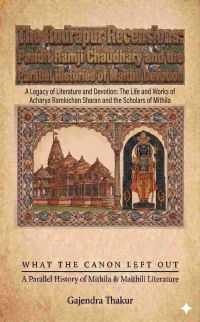
The Rudrapur Recensions: Pandit Ramji Chaudhary and the Parallel Histories of Maithil Devotion/ A Legacy of Literature and Devotion: The Life and Works of Acharya Ramlochan Sharan and the Scholars of Mithila
1
The Rudrapur Recensions: Pandit Ramji Chaudhary and the Parallel Histories of Maithil Devotion/
2
A Legacy of Literature and Devotion: The Life and Works of Acharya Ramlochan Sharan and the Scholars of Mithila
3
RESEARCH & CRITICAL APPRECIATION
OF THE WORKS OF
Pt. Ramji Chaudhary (1878-1952)
& Acharya Ramlochan Sharan (1889-1971)
1
The Rudrapur Recensions: Pandit Ramji Chaudhary and the Parallel Histories of Maithil Devotion
Vividh Bhajnavali (Miscellaneous Hymn Collection), is a collection of devotional poetry and songs written by Pandit Shri Ramji Chaudhary from Rudrapur, Darbhanga (now Madhubani). Published in 1947/ 1948 (Sambat 2004), the book contains hymns dedicated to various Hindu deities and philosophical reflections on the nature of life.
Below is the English translation of the key sections and a selection of representative hymns:
Front Matter & Introduction
· Title: Miscellaneous Hymn Collection (Vividh Bhajnavali)
· Edition: First Edition (1,000 copies)
· Author: Pt. Shri Ramji Chaudhary, Village: Rudrapur, Post: Andhratharhi, District: Darbhanga
· Date: Falgun Shukla Purnima, Sambat 2004 (approx. March 1948)
· Price: Two Annas
Selected Hymn Translations
1. Prayer to Lord Ganesha (Vinay)
"Salutations to Shri Ganesha..."
Victory to Ganesha, the son of Shiva, beautiful, exceedingly kind, and the protector of the humble. You are the long-bellied one (Lambodara) with the face of an elephant; even the thousand-headed serpent cannot fully describe your glory. I am very ignorant and know nothing; please grant me the meditation of your lotus feet in my heart. Ramji pleads to you; I wish to describe the qualities of Rama through my speech.
2. Hymn to Goddess Bhavani (Durga)
"Your feet are my refuge, O Bhavani..."
O Queen of Avadh, remove the three types of suffering. Why do you sit still without looking at me, seeing the distress of your devotee?. All the gods desire the dust of your feet; please keep this servant in your shelter. Even Shesha, Ganesha, and Indra meditate upon you and chant your name day and night, knowing your greatness. Ramji, knowing he is sinking, has fallen at your feet; take me across the waters of this worldly existence.
3. Hymn to Lord Shiva (Mahesh Bani)
"Serve the mind of Shankara, the exceedingly kind..."
He is the destroyer of his servant’s sorrows and is merciful. The Ganges flows from his matted hair, his body is smeared with ash, and a garland of skulls hangs from his chest. With a trident in hand and a tiger skin as a garment, he resides in Kailash with Goddess Girija. Ramji, being very humble, asks for your blessing so that he may quickly meet the Lord of Avadh.
4. Songs of Separation (Holi & Seasonal)
"The month of Chait has arrived, O Rama..."
My beloved has not returned in the month of Chait, and my heart is restless. I find no joy in my home, Cupid torments me, and I cannot sleep. Day and night the cuckoo birds sing in the gardens where flowers bloom, but for Ramji, this beautiful season goes to waste because I haven’t met my beloved.
5. Philosophical Reflection on Life
"O foolish mind, chant the name of Rama..."
This is the only work that will help you in life. Otherwise, you will fall into the dark well of ignorance, and who will be strong enough to save you then?. Do not be misled by your youth; in a moment, the body can perish. No matter how much you love your family, wife, or children, they will not go with you in the end.
Front Matter & Publication Details
· Title: Miscellaneous Hymn Collection (Vividh Bhajnavali)
· Edition: First time, 1,000 copies
· Author: Pt. Shri Ramji Chaudhary
· Address: Village- Rudrapur, Post- Andhratharhi, District Darbhanga
· Date: Falgun Shukla Purnima, Sambat 2004
· Price: Two Annas
· Printer: Shri Birbal Singh, A. Bose Press, Motijheel, Muzaffarpur
Hymns of Prayer (Vinay)
Hymn 1: To Lord Ganesha
"Salutations to Lord Ganesha. Victory to Ganesha, the son of Shiva, beautiful, exceedingly kind, and the protector of the humble. You are the long-bellied one with an elephant’s face; even the thousand-headed serpent (Shesha) cannot describe your glory. I am very ignorant; please grant me the meditation of your lotus feet in my heart. Ramji pleads to you; I wish to describe the qualities of Rama."
Hymn 2: To Goddess Bhavani (Durga)
"O Goddess, my hope is in your feet. Remove the three types of suffering, O Queen of Avadh. Why do you sit still without looking at me? Seeing the distress of your devotee, my mind is troubled. All the gods desire the dust of your feet; keep this servant in your shelter. Even Shesha, Ganesha, and Indra meditate upon you and chant your name day and night. Knowing I am drowning, I have fallen at your feet; take me across the ocean of existence."
Hymn 3: To Goddess Durga (Lāyani Style)
"Listen, O Durga Bhavani, I am presenting my plea. I have searched among all the gods and come to you; what use is it to count on humans?. I am trapped in the world’s net and cannot escape. You killed the demon Mahishasura; your limits are unknown. My only hope is in your grace; Ramji desires only the dust of your feet."
Hymns to Lord Shiva (Mahesh Bani)
Hymn 5: Service to Shankara
"O mind, serve Shankara, who is exceedingly kind and the destroyer of his servant’s sorrows. His matted hair is adorned with the Ganges, his body is smeared with ash, and a garland of skulls hangs from his chest. He drinks the nectar of victory and wanders like one intoxicated. Residing in Kailash with Goddess Girija, he carries a trident and wears a tiger skin. Lord of Kashi, I have run to your door; make me happy as I meet the Lord of Avadh."
Hymn 53: A Plea to Chandeshwar
"Listen, O Lord Chandeshwar, look upon me with grace, for I am a helpless orphan. I have wandered and realized that everyone is selfish; friends and kin all have their own motives. I do not know the Vedas or Puranas, nor do I know the ways of worship; I am constantly worried. You are the fulfiller of all desires; O Bhola Nath, fulfill Ramji’s wishes."
Hymns to Lord Krishna & Rama
Hymn 6: To Lord Raghunandan (Rama)
"Victory to Raghunandan! Even Sharada and Narada cannot find the end of your glory. The Vedas and scriptures tire of describing you. You sit on a throne with Lakshmana and Hanuman, fanned by whisks, with a beauty that exceeds millions of Cupids. My mind is dull; how can I attain your vision?."
Hymn 7: To Lord Yadunandan (Krishna)
"Victory to Yadunandan! You took an avatar for the sake of the gods, O lotus-eyed one. In Gokul, you played with cowherd boys, stole butter, and killed demons like Putana and Keshi. Standing by the Kadamba tree, you play the flute, and the sound enchants gods, sages, and serpents alike. Ramji asks: how can I, with such a wicked and dull mind, know your qualities?."
Hymn 9: To Hanuman
"Listen to my prayer, O Hanuman! You are the only helper of the humble. You met Rama and Sugriva, ending their sorrow. You crossed the ocean to find Janaki (Sita). When Lakshmana was struck by power, you quickly brought the Sanjivani herb to save his life. Ramji seeks your shelter; knowing me to be miserable and without refuge, protect me."
Hymns of Separation (Holi & Seasons)
Hymn 23: Playing Holi
"O Krishna, I will not play Holi with you. You come suddenly and catch me by force, throwing color and rubbing red powder on my face. My age is delicate; my pearl necklace broke as you grabbed my waist. Ramji says: I will tell Yashoda today so she can tie you up."
Hymn 37: The Four Months of Rain (Chaumasa)
"My beloved has not come; how can I stay alone in the house?. The month of Asadh has come, and the arrows of separation pierce me; the wind howls and the lightning flashes. In Shravan, the bed feels like fire as the rain falls. My beloved remains in Gokul; I have no hope for life. Ramji asks: when will I meet you?."
Philosophical Reflections (Bhajan & Kavitta)
Hymn 50: The Morning Prayer
"O mind, chant the name of Rama in the morning; the drum for the final journey is constantly beating. You are needlessly attached to your wife, children, and kin. At the end, no one will ask about you when your life departs. You spent childhood in play and youth in the charms of women. Now that you are old, you wander for wealth, yet your desires do not fade. Kings and beggars have all left; no one stays forever. Ramji says: if you wish to be saved, take refuge at the feet of the Lord of Raghu."
Hymn 71: The Vanity of Taste
"You have eaten butter, sugar, kachori, and sweets like ghevar and rabri. You have tasted peda, jalebi, barfi, and laddu. You have consumed betel nut, cardamom, and coconut. Ramji says: after tasting all these flavors, you will depart empty-handed because you never tasted the essence of Rama’s name."
Hymn 74: The Final Journey
"You received this beautiful and rare human body, wealth, a home, and a family. You rode horses and sat in elephant palanquins. But when the warrant of death arrives, you will be carried on a bamboo stretcher by four people to the cremation ground. Ramji says: no one in this world will be of use in the end; you will regret that you did not chant the name of Rama."
Publication Credits
· Printer: Shri Birbal Singh
· Press: A. Bose Press, Motijheel, Muzaffarpur
· Closing: Iti Siddhirastu. Shubhanchastustu (Thus let there be success. Let there be auspiciousness).
CRITICISM
The Vividh Bhajnavali by Pt. Ramji Chaudhary represents a profound intersection of Maithil folk devotion and classical Sanskrit scholasticism. This literary criticism analyzes the to uncover its structural and epistemological depth.
1. Indian Literary Criticism: Rasa and Bhakti
From the perspective of classical Indian poetics (Kavyashastra), the text is dominated by Bhakti Rasa (the aesthetic of devotion).
· Vatsalya and Shanta Rasa: The hymns to Ganesha and Shiva evoke a sense of Shanta (peace) through surrender. However, the Mahesh Vanis (songs of Shiva) often blend this with Vatsalya (parental/familial affection), treating Shiva as a domestic figure of the Maithil household.
· Vipralambha Shringar: The seasonal songs (Chaumasa and Chait) utilize the Viraha (separation) motif. The "Barahmasa" structure acts as the Uddipana Vibhava (stimulating cause), where the arrival of rain or spring intensifies the devotee’s longing for the divine.
2. Western Literary Criticism: Existentialism and Didacticism
The text exhibits strong parallels with Christian Existentialism and Memento Mori traditions.
· Existential Dread: Hymns like 50 and 74 function as a critique of the "inauthentic self". The author uses the image of the "final drum" (kuch nagara) to highlight the absurdity of material accumulation in the face of inevitable death.
· The "Other": In Western terms, the devotee’s relationship with the divine is a "dialogical encounter." The speaker frequently identifies as the "other"-the ignorant (gamar), the sinner (adhama), or the orphan (anath)-to establish a baseline for divine grace.
3. The Videha Parallel History Framework
This framework views the text as a product of the Mithila (Videha) intellectual geography, which historically balanced high logic (Nyaya) with deep emotionalism (Padavali).
· Cultural Continuity: Pt. Chaudhary’s work is a 20th-century continuation of the tradition started by Vidyapati. It maintains the "Videha Parallel"-the ability to hold a rigorous philosophical worldview (Siddhanta) alongside "Laukika" (folk) expressions like Tirhut and Holi songs.
· Identity: The specific mention of Darbhanga and local post offices anchors the "Universal Rama" into a "Local Mithila," a hallmark of the Videha framework where the sacred geography is superimposed onto the village.
4. Navya-Nyaya Epistemology and Technique
Although the text is poetic, the influence of Gaṅgeśa Upādhyāya (the founder of Navya-Nyaya from Mithila) is visible in the structure of the author’s arguments.
· Anuvyavasaya (Reflective Awareness): The author utilizes a technique of Anuvyavasaya-knowing that one knows. In Hymn 13, the devotee doesn’t just suffer; he categorizes his suffering into "threefold pain" (trividh tap), mirroring the logical classification found in Nyaya.
· Definition by Negation (Vyatireka): Gaṅgeśa’s technique of defining a thing by what it is not is reflected in the philosophical Kavittas. The author defines "Human Purpose" (Purushartha) by negating the value of wealth, family, and physical beauty, stripping away the Upadhi (limitations) to reveal the Paramartha (ultimate truth).
· Pratyaksha (Perception) vs. Sabda (Word): The author acknowledges the tension between the "unseen" divine and the "visible" world. He resolves this through Sabda Pramana-the authority of the Holy Name as a valid means of knowledge (Pramana) that bridges the gap between the mundane and the transcendental.
Summary Table: Comparative Analysis
|
Theory |
Central Concept in Vividh Bhajnavali |
Evidence from Text |
|
Indian Poetics |
Prapatti (Surrender) |
"I have fallen at your feet" |
|
Western Theory |
Vanitas (Vanity of life) |
The listing of luxury items that won’t go to the grave |
|
Videha History |
Localized Sacredness |
Integration of Shiva into Maithil family life |
|
Navya-Nyaya |
Logical Classification |
Categorizing life stages and types of suffering |
2
A Legacy of Literature and Devotion: The Life and Works of Acharya Ramlochan Sharan and the Scholars of Mithila
The provided document is the Jayanti Smarak Granth (Anniversary Commemorative Volume), published in 1942 to celebrate the Golden Jubilee (50th anniversary) of Shri Ramlochan Sharan Ji, a renowned literary figure and educator from Bihar.
Due to the extreme length of the 1,000+ page document, the following is a comprehensive translation and summary of its primary sections, including the editorial vision and the historical survey of Mithila’s scholars.
1. Title and Dedication (Pages 1-13)
· Title: Jayanti-Smarak: Shri Ramlochan Sharan Ji’s Golden Jubilee.
· Editors: Professor Shivpujan Sahay, Professor Harimohan Jha, and Shri Achyutanand.
· Dedication: Presented to Rai Sahib Ramlochan Sharan of ‘Pustak Bhandar’ by Maharaja Kameshwar Singh Bahadur of Darbhanga.
· Tribute: He is described as a "Pillar of Pride for Bihar," a creator of modern children’s literature, a venerable teacher of Hindi grammar, and the founder of the ‘Pustak Bhandar’ publishing house.
2. Editorial Statement (Pages 32-41)
The editors explain that while other Hindi literary giants like Dwivedi Ji and Hariaudh Ji were honored during their lifetimes, Bihar had neglected to similarly honor its own scholars.
· Objective: To rectify this by performing a "great literary sacrifice" (Yagya) in the form of this commemorative volume.
· Subject: Ramlochan Sharan was chosen unanimously for his 25 years of tireless service to Hindi literature.
· Scope: The book was designed to be a "Reference Book" for future generations, illuminating the historical and cultural significance of Bihar which previously lay in darkness.
3. Historical Survey: Scholars of Mithila (Pages 50-85)
A major portion of the document, written by Shri Janardan Jha ‘Jansidan’, provides a detailed history of Sanskrit scholarship in Mithila.
The Ancient Tradition
· Centers of Learning: Mithila was once the world center for Vedas and Vedanta. Students traveled from across India (Anga, Vanga, Kalinga) to study under its masters.
· The ‘Chaupar’ System: Education was free. Teachers (Pandits) lived simple lives, often eating only greens (saag), and refused to beg from kings.
· Academic Rigor: Students first mastered their subjects locally before moving to Kashi (Varanasi) for advanced examinations.
Notable Historical Figures
· Gautama Muni: Author of the Nyaya Shastra, lived in Brahmpur, Darbhanga.
· Maharishi Yajnavalkya: Resided in Kusuma village; his ‘Smriti’ is world-famous.
· Mandana Misra: A supreme scholar of Nyaya and Mimamsa who debated Adi Shankaracharya. His wife, Sharda Devi (Ubhaya Bharati), is described as an incarnation of Saraswati.
· Vachaspati Misra: An unparalleled scholar of all Shastras. He named his famous commentary ‘Bhamati’ after his childless wife to immortalize her name.
· Vidyapati Thakur: The world-famous Maithili poet and scholar under King Shiv Singh.
· Mahesh Thakur: A scholar of grammar and logic who was gifted the kingdom of Mithila by Emperor Akbar.
Contemporary Scholars (Circa 1942)
· Dr. Ganganath Jha: A famous scholar of both English and Sanskrit, former Vice-Chancellor of Allahabad University.
· Balakrishna Misra: Principal of the Sanskrit Department at Kashi Hindu University.
· Madhusudan Jha: A Vedic scientist whose knowledge of the Vedas was considered unmatched for centuries.
4. Commemorative Poems (Pages 46-49)
· "At the Door of the Past" by ‘Dinkar’: A poem calling upon the gods and heroes of Bihar’s history (Magadha, Nalanda, Vaishali) to awaken and bring light to the darkness of the present.
· "Word Tribute" by ‘Kesari’: A praise of the Hindi language and the artistic heritage of Bihar, honoring the "word-piercing warrior" Ramlochan Sharan.
5. Table of Contents Summary (Pages 14-31)
The book covers a vast range of topics beyond biography, including:
· Education: Historical accounts of Nalanda and Vikramshila Universities.
· Philosophy: Discussions on Jainism, Buddhism, and the concept of God in various Indian philosophies.
· Culture: The music of Bihar, Patna-style painting, and the history of Hindi journalism in the state.
· Geography/Economy: Minerals of Bihar, its forest wealth, and cattle rearing.
· Memoirs: Over 200 pages of personal tributes to Ramlochan Sharan from across the Hindi-speaking world.
Maithili translation of Goswami Tulsidas’s Shri Ramcharitmanas, written by Ram Lochan Sharan in approximately 1959. The work is a verse-by-verse translation intended to preserve the full emotional and spiritual intent of the original Avadhi text in the Maithili language.
Below is a translation and summary of the key sections of the document, including the author’s preface and the opening of the Bal Kand.
Author’s Preface: "A Brief Background"
The author, Ram Lochan Sharan, describes the divine inspiration behind this Maithili translation:
· The Inspiration (1957 AD / 2014 Vikram Samvat): While sitting on the banks of the Sarayu River in Ayodhya during an autumn full moon, the author heard a "sweet, gentle, and divine voice" in his heart. It commanded him to tell the story of Rama to "the daughter of Videha" (Sita) in his own mother tongue, Maithili.
· The Process: He began the work immediately after finishing a commentary on the Vinay Patrika. He received blessings from several saints, including Vedanti Ji (Shri Ram-Padarth Das Ji), who encouraged him to complete it quickly for the "welfare of the world".
· Challenges: In 1958 AD (2015 Vikram Samvat), as the book was nearing completion, the author suffered from severe chest pain and was bedridden for three months. He credits his recovery and the completion of the Uttar Kand (the final book) to the grace of "Shri Kishori Ji" (Sita).
· Objective: The work translates approximately 14,000 to 15,000 lines of poetry into Maithili while maintaining the original meter and spirit.
Translation Snippets: Original vs. Maithili
The document provides a comparison (Banagi) of the original Avadhi text and the new Maithili translation to show how the meter and meaning are preserved.
|
Original (Avadhi) |
Maithili Translation |
English Meaning |
|
Jo sumirati sidhi hoi, gananāyaka karivara badana. |
Sidhi ho sumarati jaiha, gananāyaka karivarabadana. |
By remembering whom success is achieved, the leader of Ganas with the face of an elephant. |
|
Bandau sant samāna cita, hita anahita nahi kou. |
Bandī santa samāna cita, kyo hita ahita na hvacha. |
I salute saints who are even-minded and have no friend or foe. |
|
Binu satasanga bibeka na hoī, Rāma krpā binu sulabha na soī. |
Nahi bibeka satasanga bihīne, sulabho Rāma krapāka adhīne. |
Wisdom does not come without the company of saints; that company is not easily obtained without Rama’s grace. |
Book I: Bal Kand (The Book of Childhood)
The Bal Kand begins with traditional Sanskrit invocations followed by the Maithili translation of the primary verses.
Invocations (Sanskrit)
1. Vande Vani-Vinayakau: Salutations to Saraswati (speech) and Ganesha (wisdom), the creators of letters, meanings, sentiments, and meters.
2. Bhavani-Shankarau: Salutations to Parvati and Shiva, the embodiments of faith and belief, without whom even the realized ones cannot see God within themselves.
3. Sita-Ram: Salutations to Sita, the beloved of Rama, who is the cause of creation, preservation, and destruction, and the remover of all sorrows.
The Power of the Name "Rama"
The text emphasizes that the name "Rama" is greater than the form of Rama himself:
· The name is like a "wish-fulfilling tree" (Kalpataru) in the dark age of Kali (Kaliyug).
· It is described as the "lion" that destroys the "elephant" of sin and distress.
· Even Shiva constantly chants this name to achieve auspiciousness while appearing in inauspicious forms (covered in ash, wearing snakes).
Index of the Seven Chapters (Sopans)
The text is divided into seven "stairs" (chapters), as follows:
1. Bal Kand (Childhood) - Page 1
2. Ayodhya Kand (Ayodhya) - Page 163
3. Aranya Kand (Forest) - Page 293
4. Kishkindha Kand (Monkey Kingdom) - Page 323
5. Sundar Kand (The Beautiful Book) - Page 339
6. Lanka Kand (The Battle of Lanka) - Page 367
7. Uttar Kand (The Epilogue) - Page 435
RAMJI CHAUDHARY
Vividh Bhajnavali (Various Hymns)
Author: Pandit Shri Ramji Choudhary Origin: Village - Rudrapur, Post - Andhratharhi, District - Darbhanga First Edition: 1000 copies, Phalgun Shukla Purnima, Samvat 2004 (Approx. 1948 AD) Price: Two Annas
Hymn 1: Prayer to Lord Ganesh
Glory to Ganesh, the son of Shankar, beautiful, extremely merciful, protector of the poor, the long-bellied one of elephant form; even the thousand-tongued serpent (Shesha) cannot fully describe your glory. I am very ignorant and know nothing; please grant me the meditation of your lotus feet in my heart. Ramji (the author) prays: please listen to my plea; I wish to describe the virtues of Lord Ram.
Hymn 2: Raga Rekhta (To the Goddess)
My refuge is at your feet, O Bhavani! Remove the three-fold sufferings, O Queen of Avadh (the Divine Mother). Why do you sit still without even a glance? Seeing the distress of your devotee, my heart is sinking. All the gods desire the dust of your feet; please keep this servant under your protection. Shesha, Ganesh, and Indra meditate upon you; they chant your name day and night, but who can truly know your greatness? Ramji says: knowing that I am drowning, I have fallen at your feet; please carry me across this world-ocean as if on a ship.
Hymn 3: Lavani (To Durga)
Listen, O Mother Durga Bhavani, I am making my plea to you. I have searched among all the gods-should I even bother counting humans? None could do the job, so I have come to your side. I have never found you to be anything but under the control of the humble; I am trapped in the web of the world and cannot escape. The world knows your glory, and Indra bows his head to you. You killed the demon Mahishasura; who can comprehend your ways? I have only one hope: that you will fulfill your grace. This is Ramji’s plea-I only desire the dust of your feet.
Hymn 4: Raga Jhaptala (To Amba)
O Mother (Ambe), to whom shall I go to tell of my suffering? Enemies surround me on all four sides, piercing my heart with arrows at every moment. I cry out so much that my body and mind are exhausted; though it is morning for you, you do not look toward me. Ramji has come to your refuge; where else can I go if I leave your feet? Come and make me fearless by removing these evil days.
Hymn 5: Raga Dhrupad (To Lord Shiva)
O mind, serve Lord Shankar, who is extremely merciful and the destroyer of his devotees’ sorrows. His head is adorned with matted hair and the flow of the Ganges; his body is covered in ash and a garland of skulls hangs from his chest. He wears a serpent as a sacred thread, has large eyes, and wanders intoxicated by drinking Bhang (Vijaya). He holds a trident, wears a tiger skin, and is like a celestial wish-fulfilling tree for his devotees. He resides on Mount Kailash with Goddess Girija; many rhythms play, and the moon shines on his forehead. O Lord of Kashi, hearing of your great fame, I have come running to your door. Ramji is very humble; make him fulfilled so that he may quickly meet the Lord of Avadh (Ram).
Themes within the Bhajnavali:
· Devotion to Ram and Krishna: Several hymns (6, 7, 8, 21, 22) celebrate the glory, childhood acts, and beauty of Lord Ram and Lord Krishna (Yadunandaya).
· Holi Songs: Hymns 23 to 28 are dedicated to the festival of Holi, describing the playful (and sometimes forceful) color-throwing between Krishna and the Gopis.
· The Transience of Life: Many verses (13, 14, 15, 16, 17, 18, 50, 51) warn the reader that family, wealth, and the physical body are temporary. They urge the soul to chant the name of Ram before "the drum of departure" sounds.
· Mahesh Vani (Hymns to Shiva): Hymns 52 to 57 focus on Lord Shiva, describing his unconventional appearance (ghosts, ash, serpents) and his role as the ultimate protector of the destitute.
· Seasons and Separation (Viraha): The "Chaumasa" and "Chait" hymns (37-45) use the imagery of the rainy season and spring to describe the pain of a devotee (or a bride) separated from her beloved Lord.
CRITICISM
This literary criticism analyzes the Vividh Bhajnavali by Pandit Ramji Choudhary , a mid-20th-century collection of devotional hymns originating from the Mithila region (Darbhanga).
1. Indian Literary Theory (Kāvya-Śāstra)
The text is a classic embodiment of Bhakti Rasa (the aesthetic of devotion).
· Rasa & Bhāva: The primary sentiment is Śānta (peace) and Vātsalya/Madhurya (love/devinity). According to Abhinavagupta’s theory, the Vibhāva (determinant) is the divine form-be it the elephant-headed Ganesh or the matted-haired Shiva.
· Dhwani (Suggestion): The poet uses Abhidhā (literal meaning) to describe the seasons (Chaumasa) but suggests Viraha (separation from the Divine) through the symbol of the pining bride in the month of Chait.
2. Western Literary Criticism
· Formalism: The structure adheres to traditional Ragas (musical modes) such as Rekhta, Dhrupad, and Bhairavi. This formal constraint ensures the "defamiliarization" of ordinary language, turning repetitive prayer into a structured sonic experience.
· Existentialism: A recurring theme is the "anxiety of the end." The poet reflects on the "dream-like world" (sapna sam sansar) and the loneliness of death. This mirrors the Western existentialist concern with the fleeting nature of time (Chronos) vs. meaningful time (Kairos).
3. The Videha Parallel History Framework
As the author hails from Rudrapur, Darbhanga, the text is a product of Mithila (Videha) culture.
· The Tirhut Link: The inclusion of Tirhut and Mahesh Bani highlights a "Parallel History" where the local Maithili linguistic identity co-exists with the broader Sanskritic/Braj tradition.
· Cultural Resistance: Published in 1948 (Samvat 2004), the text asserts a traditional spiritual identity immediately following Indian independence, emphasizing internal liberation over political shifts.
4. Navya-Nyāya Epistemology (Gaṅgeśa’s Technique)
Navya-Nyāya, which flourished in Mithila, emphasizes precision in definition (Lakṣaṇa).
· Inference (Anumāna): The poet uses logical inference to convince the mind (Mana). The "Invariable Concomitance" (Vyāpti) presented is: Wherever there is worldly attachment, there is eventual sorrow.
· Cognition of Absence (Abhāva): The hymns often focus on the "absence" of the Lord (Viraha). In Gaṅgeśa’s terms, the Pratiyogī (counter-positive) is the presence of the Lord, and the devotee’s current state is defined by the Abhāva (non-existence) of that divine vision.
· Sabda Pramāṇa (Verbal Testimony): The poet repeatedly validates his claims by citing Vedas and Puranas, using "Valid Testimony" as the primary instrument of knowledge (Pramāṇa) to establish the necessity of devotion.
5. Summary of Philosophical Themes
|
Theory |
Application in Text |
|
Navya-Nyāya |
Defining the soul’s bondage through the "fetters of delusion" (moha phāns). |
|
Bhakti Rasa |
The transition from Dainya (humility) to Harṣa (divine joy). |
|
Western Existentialism |
The realization that "none shall go with you" at the end. |
|
Videha Framework |
The specific use of Mahesh Bani to ground the universal Shiva in Maithili domesticity. |
3
3
RESEARCH & CRITICAL APPRECIATION
OF THE WORKS OF
Pt. Ramji Chaudhary (1878-1952)
& Acharya Ramlochan Sharan (1889-1971)
With Reference to Indian & Western Literary Theory,
the Videha Parallel History Framework,
and Navya-Nyāya Epistemology of Gaṅgeśa Upādhyāya
PART I: INTRODUCTION AND CONTEXTUALISATION
1.1 Preamble: The Videha Parallel History Framework
The critical study of Maithili literature has for long been governed by an institutional canon that systematically favoured upper-caste, Brahmin-centric narratives while silencing subaltern, folk, and reform-oriented voices. Videha - India’s first Maithili fortnightly e-journal (est. 2000; ISSN 2229-547X), edited by Gajendra Thakur - inaugurated what it calls a “Parallel History of Mithila & Maithili Literature,” an alternative archive rooted in Panji genealogical records, digital transcription of 11,000 palm-leaf Tirhuta manuscripts, and RTI disclosures about the Sahitya Akademi’s caste-skewed selection processes.
Two writers who appear at nodal points in this Parallel History are Pandit Ramji Chaudhary (1878-1952) of Rudrapur, Andharathadi, Madhubani - a “forgotten poet” (Bismrit Kavi) recovered by Gajendra Thakur in Prabandh-Nibandh-Samalochna - and Acharya Ramlochan Sharan (1889-1971) of Darbhanga - the Sanskrit scholar, grammarian, editor of ‘Vasak’, founder of the ‘Pustak Bhandar’, and translator whose Maithili Shri Ram Charit Manas represents one of the most ambitious literary projects in modern Maithili letters.
The Jayanti-Smarak-Granth (1966), a felicitation volume presented to Acharya Ramlochan Sharan by the Vidyapati-Hindi-Sabha, Darbhanga, under the patronage of Maharajadhiraj Dr. Sir Kameshwar Singh Bahadur, K.C.I.E., Ph.D., D.Litt. - is the primary tribute document for Acharya Sharan. Together, these four books (Jayanti-Smarak-Granth; Vividh Bhajnavali; Maithili Shri Ram Charit Manas Parts 1 & 2; Prabandh-Nibandh-Samalochna) constitute the primary sources for this study.
1.2 Methodological Framework
This study applies a three-layered analytical framework:
• Indian Classical Theory: Rasa-theory (Bharata’s Natyashastra; Abhinavagupta’s Abhinavabharati), Dhvani-theory (Anandavardhana’s Dhvanyaloka), Vakrokti (Kuntaka), Alamkara-shastra (Bhamaha, Dandin, Mammata’s Kavya-prakasha), and Bhakti-poetics (Rupabhakti, Madhura-bhava tradition).
• Western Literary Theory: New Criticism (close reading), Reader-Response theory (Iser, Jauss), Postcolonial criticism (Spivak, Bhabha), Subaltern Studies (Gramsci’s hegemony; Spivak’s “Can the subaltern speak?”), Formalism (Roman Jakobson), Intertextuality (Kristeva), and Feminist literary theory.
• Navya-Nyāya Epistemology of Gaṅgeśa Upādhyāya: Pramāna-analysis (pratyakṣa, anumāna, śabda), vyāpti (pervasion / invariable concomitance), avacchedaka (limitor), and the Tattva-Cintāmaṇi’s four-part structure as a meta-critical lens for assessing textual knowledge-claims.
PART II: PT. RAMJI CHAUDHARY (1878-1952) - THE FORGOTTEN POET
2.1 Biographical and Genealogical Profile
Pandit Ramji Chaudhary was born in Samvat 1935 (1878 CE) in village Rudrapur, Thana Andharathadi, District Darbhanga (now Madhubani), Bihar. His genealogical root (mula) is traced to Pagulbar Raje gotra - Shandilya. The Prabandh-Nibandh-Samalochna reconstructs his lineage with precision: the ancestral migration from Panchobh, Darbhanga, was made by Jeevan Chaudhary (born 1801) who settled in Rudrapur. His grandson Chumman Chaudhary was the kavi’s father, complete the chain to Ramji Chaudhary.
The only published book of the late Pt. Shri Ramji Chaudhary, which was dictated by the poet to Shri Harekant Chaudhary (now deceased) and obtained through Shri Shrimohan Chaudhary. The musical modes (Ragas and forms) described in his work are:
1. Raga Rekhta
2. Lavani
3. Raga Jhaptala
4. Raga Dhrupad
5. Raga Sangeet
6. Raga Desh
7. Raga Gauri
8. Tirhuta
9. Bhajan Vinay
10. Bhajan Bhairavi
11. Bhajan Ghazal
12. Holi
13. Raga Shyam Kalyan
14. Kavita
15. Damphak Holi
16. Raga Kagu Kafi
17. Raga Bihag
18. Ghazal-Thumri
19. Raga Pawas Chaumasa
20. Bhajan Prabhati
21. Maheshvani
22. Bhajan Kirtan
Biographical Sketch
Ramji Chaudhary (1878-1952)
· Birthplace: Village-Rudrapur, Police Station-Andhra Tharhi, District-Madhubani.
· Lineage (Mool): Pagulbar Raje.
· Clan (Gotra): Shandilya.
Genealogy
· Jivan Chaudhary: (Birthplace: Panchobh, Darbhanga); arrived in Rudrapur in 1801 AD.
o Two sons: Shri Rangi Chaudhary (born in Rudrapur) and Shri Kant Chaudhary (born in Rudrapur).
§ Kant Chaudhary had three sons: Shri Chumman Chaudhary, Shri Budhan Chaudhary, and Shri Babua Chaudhary.
§ Chumman Chaudhary had two sons: Shri Goni Chaudhary and Shri Pt. Kavi Ramji Chaudhary.
The poet’s grandfather was a celebrated singer (gavayya) whose primary domain was devotional songs (bhakti geet) to Yuguala Sarkar - Sita-Ram - and this musical inheritance was decisive for the grandson. The name ‘Ramji’ was itself given in honour of this devotion. As the Videha critical note emphasises, Ramji Chaudhary memorised Tulsidas’ Sri Ram Charit Manas completely and would answer every question with a relevant Ramayan couplet.
His personal life was marked by repeated tragedy: three marriages, each wife dying within four years of marriage. His third wife died within fifteen days of the birth of their son Durganath Chaudhary. Following this loss, Chaudhary resigned his post as Jyestha Raiyat under the Darbhanga Raj and withdrew entirely into devotional life and literary composition.
2.2 Literary Works and Manuscript Tradition
Ramji Chaudhary left behind one published collection - the Vividh Bhajnavali (first edition: Phalgun Shukla Purnima, Samvat 2004 / 1947-48 CE) - and one unpublished manuscript (pandulip) which was composed under his dictation to Sri Harekant Chaudhary (now deceased) and later made available through Sri Srimohana Chaudhary. Both sources form the basis of the critical edition in Gajendra Thakur’s Prabandh-Nibandh-Samalochna.
The Vividh Bhajnavali’s title page, bears the invocation “⊕ Shri Ganeshaya Namah” and describes the author as: “Pt Shri Ramji Chaudhary, Gram - Rudrapur, Post - Andharathadi, Jila Darbhanga.” The text consists of 22 raga-classified compositions in Maithili and Brajbhasha (Brajbuli), covering the full devotional spectrum of Mithila’s Panchadevopasana (five-deity worship tradition).
2.3 Ragas and Musical Architecture
The Vividh Bhajnavali is a musically structured text. The compositions are categorised under 22 distinct raga headings:
• Raga Rekhata - lyrical Urdu-inflected diction; Lavani - seasonal rhythm;
• Raga Jhaptala, Dhrupad - classical north Indian forms;
• Raga Sangeet, Raga Desh, Raga Gauri, Tirhut;
• Bhajan Vinay, Bhajan Bhairavi, Bhajan Ghazal, Holi, Dafke Holi;
• Raga Shyam Kalyan, Raga Kagu Kafi, Raga Bihag;
• Ghazal ki Thumri, Raga Pavas Chaumasa (Monsoon), Bhajan Prabhat (dawn bhajans);
• Maheshvani (Shiva hymns), Bhajan Kirtan.
This 22-raga taxonomy situates Ramji Chaudhary within the same tradition that shaped Vidyapati’s Padavali as preserved in Nepalese manuscripts - where each poem carries a specific raga designation. Gajendra Thakur’s Parallel History notes this structural parallel explicitly: “Just as Shankardev composed in Maithili rather than Assamese, Kavi Ramji Chaudhary composed in Maithili and additionally in Brajbuli.”
2.4 Textual Analysis: Selected Compositions
2.4.1 The Vinay (Invocation)
Jay Ganesh Shankar sut sundar ati kripalu deenan jan Palak Lambodar ati roop Gajanan, tumhara yash kahi na sakat sahasanan. Ham chhi ati gamar kachhu janat nij pad kamal dehu ur dhyanana Ramji araj sunahu kachhu kanan. Varnat chahat Ram gun anan.
In this invocation to Ganesha, Ramji employs a characteristic signature: the insertion of his own name “Ramji” as the speaker-devotee in the final couplet - a convention traceable from Vidyapati’s bhanita (authorial seal). The poem performs Vinaya (self-humbling supplication), a sub-genre of Bhakti-rasa. Through the lens of Bharata’s Natyashastra, the rasa here is Shanta (tranquillity-devotion); the sthayi-bhava is rati (devotional love); the vibhava is the invocation of Ganesha’s divine attributes (Lambodar, Gajanan, Sahasanan).
Applying Anandavardhana’s Dhvani theory: the explicit meaning (vacyartha) is the poet’s request for Ganesha’s blessing; the suggested meaning (dhvani) operates at a deeper level - “I am gamar (ignorant/rustic)” is not merely self-deprecation but the philosophical stance of the Bhakti tradition that ruptures all caste-based hierarchies of learning. The “ignoramus before God” is a subaltern theological position.
2.4.2 Maheshvani: Shiva Hymns and the Panchadevopasana
Sunu sunu Chandeswar Nath kripa drishte ek var takahu ham chhi param anath. Dev danuj bhupati kat sewal kiyo na dukhe sath, Bare niras ash dhay ropil ahank charnme math.
The Maheshvani sequence (compositions 11-16) constitutes the emotional heart of the Bhajnavali. These hymns to Shiva follow the Mithila folk convention of Maheshvani - a genre distinct from formal Sanskrit stotras - in which Shiva is addressed in the dialect of domestic speech. The poet’s persona is that of an utterly destitute devotee (parama anatha) who has been failed by gods, kings, and kinsmen alike. This is not merely devotional convention but, read through Spivak’s subaltern lens, a frank social statement: the non-Brahmin agricultural Chaudhary communities’ exclusion from Mithila’s caste-patronage networks is encoded in the lamentation.
Navya-Nyaya epistemological reading: applying Gangesa’s framework, the knowledge-claim in these hymns is a sabda-pramana (verbal testimony) structured around tatparya (intention). The devotee’s “I am helpless” is a speech-act whose validity (pramanya) is paratah (externally verified) - it is made valid only if God responds. This is precisely the paratah-pramanya (extrinsic validity) that Gangesa defends in the Pratyaksha Khanda of the Tattva-Cintamani. The devotional text thus enacts a Navya-Nyaya epistemological move: the petition’s truth depends on the outcome, not on intrinsic self-evidence.
2.4.3 Tirhut Compositions: The Viraha (Separation) Mode
Var vayas pahu tejal sajani ge ki kahu tanik vivek, Kabahu nain nahi dekhal sajani ge avadhi bital dui ek.
The two Tirhut compositions (Nos. 4 and 5) deploy the viraha-bhava (anguish of separation) in the nayika-bheda tradition. The speaker is a woman abandoned by her nayaka (lover/husband). This genre, cultivated since Vidyapati’s Padavali, uses erotic separation as a metaphor for the soul’s separation from the divine. The Brajbuli-Maithili register of these poems places them directly in the Vaishnava lyric tradition.
From a feminist critical perspective (per Judith Butler’s performativity theory and Gayatri Spivak’s postcolonial feminism), these viraha poems perform complex gender negotiations. The female speaker’s suffering is aestheticised, yet within the Maithili tradition, this aestheticisation of female longing represents the only socially sanctioned space where a woman’s subjective experience enters public discourse.
2.5 Place in the Parallel History
Gajendra Thakur’s explicit recovery of Ramji Chaudhary in the Prabandh-Nibandh-Samalochna (Videha Archive) under the rubric “Bismrit Kavi” (Forgotten Poet) is a conscious Parallel History intervention. The official literary canon - as constructed by the Sahitya Akademi and mainstream histories like Jaykant Mishra’s History of Maithili Literature - systematically omitted non-Brahmin folk-devotional poets. Ramji Chaudhary, a Jyestha Raiyat (agricultural tenant) composing in Maithili and Brajbuli across 22 ragas, represents exactly the “democratic-spiritual corpus” that the Parallel History seeks to recover.
PART III: ACHARYA RAMLOCHAN SHARAN (1889-1971) - SCHOLAR, GRAMMARIAN AND TRANSLATOR
3.1 Biographical Profile and Institutional Significance
Acharya Ramlochan Sharan, was born in 1889 and died in 1971. The Jayanti-Smarak-Granth (1966) - a tribute volume presented to him on the occasion of his 75th Jayanti by the Vidyapati-Hindi-Sabha, Darbhanga - provides the fullest contemporary record of his significance. The title page of that volume, salutes him as:
"Bihar ke gaurav-tam sahityapeshi, Sahityavardhini ke kushal karyavar, Maithili ke navayug-pracharak, Abhinav nasasahitya ke yashashvi nirmata, Hindi-vyakaran ke anandaneey bhasacharyya, Balakothar ‘Vasak’ ke samagra sampadak, Teerthsvarup ‘Pustak Bhandar’ ke sansthapak."
This epitaph encapsulates his multiple roles: (1) Most illustrious literary figure of Bihar; (2) Skilled executor for Sahityavardhini; (3) Propagator of a new era in Maithili; (4) Glorious creator of modern drama literature; (5) Beloved grammarian of Hindi; (6) Complete editor of the children’s journal Vasak; (7) Founder of the Pustak Bhandar. The volume was patronised by Maharajadhiraj Dr. Sir Kameshwar Singh Bahadur (K.C.I.E., Ph.D., D.Litt.), the last significant patron of classical Maithili literary culture.
3.2 The Maithili Shri Ram Charit Manas: A Translation of Epic Proportions
The centrepiece of Acharya Ramlochan Sharan’s literary legacy is the Maithili Shri Ram Charit Manas - a complete translation / transposition of Goswami Tulsidas’s Avadhi Hindi Ram Charit Manas (1574 CE) into Maithili, in the same chaupai-doha-soratha form. The digitised copies, preserved by the Nanaji Deshmukh Library (BJP, Jammu) and digitised by Siddhanta eGangotri Gyaan Kosha, were released on videha.co.in.
The translation is not a word-for-word rendering but a creative transposition that preserves the prosodic architecture of the original: the 16-matra chaupai, the dvipad doha (a 24-matra couplet), and the soratha (a reversed doha). The opening page of the Aranyakanda section demonstrates the translator’s fidelity to both meaning and metre. The Sanskrit invocatory verses are rendered as Sanskrit-inflected Maithili, with compounds like “Bhaktavatsalam, Kripalu, Sheela Komalam” retained from Tulsidas while the surrounding chaupai lines flow in natural Maithili speech.
3.3 Critical Analysis of the Translation Technique
3.3.1 Rasa-Dhvani Reading
Acharya Sharan’s translation sustains what Bharata identifies as the primary rasa of the Ram Charit Manas: Shanta-rasa (spiritual peace) undergirded by Vira-rasa (heroic sentiment) and Karuna-rasa (pathos). The Maithili rendering deploys the local grammatical markers of Maithili - the distinctive causative constructions (karvaunu), the genitive particles (ker, k), the direct address forms (chha, -theen, -thi) - to domesticate the Avadhi text into the intimate register of the Mithila household. This produces what Anandavardhana calls dhvani: the suggested meaning (Maithili as the language of Mithila, Sita’s homeland) accrues to every line, creating a meta-textual resonance that the Avadhi original cannot possess.
The doha “Ati kripalu Raghanayak, sada deen par neh. / Aadi tanik prati kayal chhal, murakh avaguna geh.” - rendered from Tulsidas’ Hindi doha - maintains the formal structure while the Maithili suffix ‘chhal’ (was / did) and ‘geh’ (home) embed the verse within specifically Maithili prosodic memory.
3.3.2 Intertextuality and the Mithila-Ram Connection
Julia Kristeva’s concept of intertextuality holds that every text is a mosaic of quotations absorbed from other texts. Acharya Sharan’s Maithili Manas operates on multiple intertextual levels: (a) its source-text is Tulsidas’s Manas (itself a creative translation of Valmiki’s Sanskrit); (b) it intersects with Chanda Jha’s Mithila Bhasha Ramayana (1880s) - another Maithili Ramayana, but in a very different register; (c) it evokes Mithila’s central mytho-geographical claim - Sita’s birthplace, Janakpur - giving the Maithili translation a unique territorial-spiritual authority that no other language’s translation of the Manas can possess.
The Parallel History framework contextualises this further: in contrast to Chanda Jha (1831-1907), who worked within Grierson’s colonial-era documentation of Maithili and focused on religious poetry for an upper-caste audience, Acharya Sharan’s project consciously aimed at literary accessibility - as evidenced by the Pustak Bhandar’s publication mandate and the wide distribution of the text through the Darbhanga patronage network.
3.3.3 Navya-Nyaya Analysis of the Translation’s Knowledge-Claims
Applying the Anumana-Khanda (Inference) framework of Gangesa’s Tattvacintamani: any translation claims, implicitly, a vyapti - an invariable concomitance - between the source-text’s meaning and the target-text’s rendering. The hetu (reason/middle term) is: the target language possesses adequate expressive resources for the source text’s semantic range. The sadhya (major term) is: the translation validly transmits the original’s meaning. The paksata (minor premise) is: this specific Maithili text is a translation of Tulsidas.
Acharya Sharan’s translation demonstrates a sophisticated management of this epistemic claim. Where Tulsidas uses Avadhi idioms without Maithili equivalents, Sharan employs Maithili compounds and Sanskrit loan-words (Maithili’s strong Sanskrit substrate) rather than forcing Avadhi idioms. This is what Navya-Nyaya would call proper vyapti-management: minimising the hetvabhasa (fallacy of the reason) by ensuring the hetu genuinely pervades the sadhya.
3.4 The Jayanti-Smarak-Granth (1966) as a Cultural Document
The Jayanti-Smarak-Granth is not merely a felicitation volume; it is a cultural-historical document of the first order. Produced in 1966 by the Vidyapati-Hindi-Sabha, Darbhanga - the foremost literary institution of Maithili at the time - and dedicated to Maharajadhiraj Kameshwar Singh Bahadur as its patron, the volume contain tributes, critical essays, and compositions from scholars and writers across Bihar, Bengal, and the broader Sanskrit world.
The dedication page reads: “Pustak Bhandar ke vyavasthapak / Raysaheb Ramlochansharan ko pradatta” - indicating that by this date Sharan had received the title Raysaheb and was recognised as the institutional founder of the Pustak Bhandar (book repository/publishing house). The volume functions as a mirror of Darbhanga’s intellectual culture at the peak of its post-colonial prestige.
The title page inscription celebrates him as “Bihar ke gaurav-tam sahityapeshi” (most glorious literary figure of Bihar) and “Maithili ke navayug-pracharak” (herald of a new era in Maithili). In the language of Raymond Williams’ cultural materialism, Acharya Sharan represents a “dominant” figure in the institutional sense, yet his work on Maithili grammar and the Manas translation simultaneously operated as a “residual” cultural form - preserving the classical tradition against the emergent Hindi-nationalist cultural politics of the 1950s-60s.
3.5 Hindi Grammar and the Standardisation Project
Beyond Maithili, Acharya Sharan contributed significantly to Hindi grammar as “Hindi-vyakaran ke anandaneey bhasacharyya” (beloved grammarian of Hindi). This bilingual scholarly identity - operating across Maithili, Hindi, and Sanskrit - was characteristic of the Mithila pandit tradition that produced figures like Suryakant Tripathi ‘Nirala’ and Ramdhari Singh ‘Dinkar’ in the same generation.
The standardisation of Hindi grammar in the 19th-20th century was itself a colonial-era project (rooted in Bhartendu Harishchandra’s generation), and Acharya Sharan’s contribution to it situates him within the larger Hindi literary movement (Dwivedi Yug) while maintaining his distinctly Maithili cultural identity. Applying Homi Bhabha’s concept of “hybrid identity,” Sharan occupies a third space: neither fully within the Hindi literary establishment nor fully within the vernacular Maithili folk tradition, but strategically negotiating both.
3.6 Vasak and the Children’s Literature Tradition
Acharya Sharan’s editorship of the children’s journal Vasak (Balakothar) represents a relatively under-studied dimension of his legacy. Children’s literature in Indian languages - as a distinct generic category - emerged in the late 19th century under colonial pedagogical influence. Sharan’s complete editorship of Vasak situates him in the progressive educational tradition that also produced figures like Devkinandan Khatri (whose Chandrakanta was a landmark in accessible Hindi prose).
From a Reader-Response perspective (Wolfgang Iser’s implied reader theory; Hans Robert Jauss’s horizon of expectation), Vasak aimed at constructing a new “implied Maithili child reader” - literate, regionally conscious, morally guided. This pedagogical project was inseparable from the larger Maithili identity movement that sought Eighth Schedule recognition (achieved in 2003).
PART IV: COMPARATIVE CRITICAL ANALYSIS
4.1 Two Traditions, One Landscape
Pt. Ramji Chaudhary and Acharya Ramlochan Sharan represent two distinct but complementary trajectories in 20th-century Maithili literary culture, both embedded in the Darbhanga district and both centred on devotional engagement with Rama and Shiva.
Chaudhary represents the oral-folk-devotional tradition: non-institutional, composed in performance contexts (raga-classified bhajans, thumris, Maheshvanis), drawing on the inherited grammar of the singing grandfather and the bhakti community. His literary production was modest in volume but rich in musical-theological depth. He is the “subaltern poet” in the strictest sense - outside the patronage networks of both the Darbhanga Raj and the colonial literary establishment.
Acharya Sharan represents the institutional-scholarly tradition: academically trained, editorially productive, connected to both the Sanskrit pandit world and the emerging modern Hindi-Maithili literary sphere. His Pustak Bhandar was itself an institution-building project. Yet within the Parallel History framework, even Sharan - for all his institutional recognition - was engaged in a form of cultural resistance: translating the Manas into Maithili asserted Mithila’s cultural sovereignty at a moment when Hindi nationalism threatened to absorb Maithili as a dialect.
4.2 The Manas-Bhajnavali Comparison: Tulsidas and the Mithila Lens
Both writers are centrally engaged with the figure of Rama: Chaudhary through devotional bhajans in which “Ramji” (the colloquial Maithili form of both the divine name and his own name) becomes the speaker-devotee’s signature; Acharya Sharan through the massive project of translating the entire Manas. This convergence reveals a deeper cultural logic: in Mithila, Rama is not merely the hero of an Avadhi epic but the husband of Mithila’s own daughter Sita - a claim that gives all Maithili Rama-devotion a territorial-theological specificity unique in Indian literature.
The bhanita (signature phrase) tradition, analysed by Gajendra Thakur in the context of Vidyapati’s Padavali, is operative in both writers. Chaudhary’s “Ramji araj sunahu” (Ramji submits his petition) deploys the name ambiguously between the poet and the deity. Acharya Sharan’s authorial presence is more effaced in the translation, as befits the scholarly register, but his selection of Maithili’s most intimate grammatical forms (the domestic second-person suffix, the vidheyaka endings) inserts the translator’s subjectivity at the level of syntax.
4.3 Rasa Analysis: Shanta, Bhakti, and Karuna
Abhinavagupta’s Abhinavabharati (commentary on Natyashastra) distinguishes eight rasas but assigns Shanta-rasa (spiritual peace, the rasa of moksha-aspiration) a special status as the rasa underlying all others. Both Chaudhary and Sharan operate primarily in the Bhakti-rasa mode (a category developed by later acharyas beyond Bharata’s eight), with Shanta-rasa as the ultimate goal of the devotional experience.
In Chaudhary’s Maheshvani, the dominant rasa shifts: the explicit surface is Karuna (pathos - the suffering devotee), but the resolution moves toward Shanta through surrender. In Sharan’s Manas translation, the Aranyakanda (Forest Section) carries the highest concentration of Karuna-rasa (Sita’s abduction; Jatayu’s sacrifice; Rama’s lamentation), but this too resolves into Vira-rasa (heroic action) and ultimately Shanta.
The comparative rasa-map thus shows: Chaudhary is structurally a Karuna-to-Shanta poet; Acharya Sharan is structurally a Vira-Karuna-to-Shanta translator. Both trajectories confirm the classical Indian literary-theological principle that the highest literature transmutes suffering into peace through devotional action (bhakti-karma).
4.4 New Critical Close Reading: Language and Style
Applying I.A. Richards’ analytical framework of “meaning, feeling, tone, and intention,” the stylistic contrast is stark:
Chaudhary’s Bhajnavali language is dialogic, conversational, musically subordinate: the syntax follows the melodic phrase, not the grammatical sentence. The vocabulary alternates between Maithili vernacular and Brajbhasha devotional diction. The poems are short (6-15 lines), tightly structured by raga convention, and depend for full realisation on musical performance. They are “songs first, poems second” in T.S. Eliot’s sense.
Acharya Sharan’s Manas translation language is architecturally formal: the chaupai’s 16-matra structure imposes regular rhythmic discipline; the doha couplets are epigrammatic and quotable; the soratha stanzas allow for longer lyrical expansion. The vocabulary is deeply Sanskritic, drawn from the tatsama-heavy register of the Sanskrit-trained pandit. This creates a “literary Maithili” that is more accessible to the educated reader than to the folk singer.
PART V: NAVYA-NYĀYA EPISTEMOLOGICAL APPLICATION
5.1 Gangesa’s Framework as Literary Epistemology
Gangesa Upadhyaya’s Tattvacintamani - composed in early 14th-century Mithila - established the foundations of Navya-Nyaya, the New Logic, which radically restructured Indian epistemology by focusing exclusively on the four pramanas (valid means of knowledge): pratyaksha (perception), anumana (inference), upamana (comparison), and shabda (verbal testimony). The Videha Parallel History’s Part 16 (on Gangesa Upadhyaya) establishes that this epistemological revolution was itself a Mithila cultural product - and that the suppression of Gangesa’s subaltern personal history (his birth anomaly and inter-caste marriage, documented in the Dooshan Panji) is itself a case study in the institutionalised “honour-killing of truth.
5.2 Shabda-Pramana and the Validity of Bhakti Literature
In the Shabda-Khanda of the Tattvacintamani, Gangesa analyses verbal testimony (shabda) as a pramana. A verbal statement produces valid knowledge if four conditions are met: akanksha (syntactic expectancy), yogyata (semantic fitness), sannidhi (proximity of utterance), and tatparya (speaker’s intention). Applied to Ramji Chaudhary’s Maheshvanis:
• Akanksha: The petition structure (“Listen, O Chandeswar!”) creates syntactic expectancy - the addressee is invoked, the petition must follow.
• Yogyata: The content (human suffering; divine mercy) is semantically coherent - there is no logical incompatibility between the request and the addressee’s known attributes.
• Sannidhi: The oral performance context ensures temporal proximity of the utterance’s components.
• Tatparya: The devotional intention (bhakti, surrender, petition) is unambiguous and determines the meaning.
By Gangesa’s criteria, the Maheshvani is a valid form of shabda-pramana - it produces genuine knowledge: specifically, knowledge of the devotee’s relationship to the divine. This is not merely a pious claim but an epistemological one: bhakti literature, on Navya-Nyaya grounds, is a legitimate means of knowledge.
5.3 Anumana and the Translation-Validity Problem
Acharya Sharan’s translation raises a classical anumana (inference) problem. The inference can be formalised as:
• Paksata (subject): This Maithili Manas text.
• Sadhya (predicate): Is a valid transmission of Tulsidas’s meaning.
• Hetu (reason): Because it preserves the prosodic form (chaupai-doha-soratha), the semantic content, and the devotional register.
• Vyapti (invariable concomitance): Wherever a text preserves prosodic form, semantic content, and devotional register, it validly transmits the original meaning.
The potential hetvabhasa (fallacy) would arise if Maithili’s grammatical structures cannot accommodate Avadhi’s devotional idioms without semantic distortion. Sharan’s strategy - using Sanskrit loan-words and Maithili’s own tatsama register - is precisely the technique that minimises this vyabhicara (deviation of the hetu). His translation is, in Navya-Nyaya terms, a well-formed inference.
5.4 The Avacchedaka (Limitor) Principle in Textual Classification
One of Gangesa’s most sophisticated logical innovations is the avacchedaka - the “limitor,” a relational operator that qualifies the scope of a predication without introducing ambiguity. In literary classification, this principle can be used to distinguish the scope of genre-attribution: Ramji Chaudhary’s compositions are not simply “bhajans” (which would be too broad) but bhajans limited by (avacchinned by) the specific Maithili Panchadevopasana tradition, the Darbhanga agricultural non-Brahmin community context, and the 22-raga musical architecture. This threefold avacchedaka precisely delimitates the genre and prevents category confusion with, say, Hindi bhajans or Sanskrit stotras.
Similarly, Acharya Sharan’s Maithili Manas is not simply a “translation” but a translation avacchinned by: (a) the Maithili-as-Sita’s-language theological claim, (b) the chaupai-doha formal constraint, and (c) the Darbhanga pandit scholarly tradition. The avacchedaka analysis produces more precise literary knowledge than any flat generic label.
PART VI: POSITIONING WITHIN THE VIDEHA PARALLEL HISTORY
6.1 The Parallel History’s Nine Layers and Their Placement
The Videha Parallel History of Mithila & Maithili Literature (Parts 1-55+, www.videha.co.in) constructs a nine-layered alternative archive. Both Ramji Chaudhary and Acharya Ramlochan Sharan fall within the Colonial Period and Post-Independence layers (Layers 3-5 in the Parallel History schema):
• Layer 3 (Colonial Period, c. 1830-1947): The Parallel History identifies this era as the site of both agrarian-protest literature (Faturilal’s famine poetry) and institutional language standardisation (Grierson; Chanda Jha). Ramji Chaudhary, composing in the same period but entirely outside these institutional frameworks, represents the “from-below” continuation of Mithila’s devotional folk tradition.
• Layer 4 (Modernist Turn, 1908-1947): Acharya Sharan’s Hindi grammar work and editorial activity in Vasak situate him in this layer alongside Harimohan Jha (1908-1984) and the broader modernisation debate in Maithili.
• Layer 5 (Post-Independence, 1947-1971): Both figures remain active. The Maithili Manas translation and the Jayanti-Smarak-Granth (1966) belong to this layer, which is also the period of the Rajkamal Chaudhary avant-garde and the first Sahitya Akademi award controversies.
The Parallel History’s RTI disclosures (2011-14) reveal that over 90% of Sahitya Akademi assignments went to the friends and relatives of the advisory board. Neither Ramji Chaudhary nor - despite his institutional standing - Acharya Ramlochan Sharan appears to have received Sahitya Akademi recognition, pointing to the continued operation of institutional gatekeeping even for figures within the “mainstream” tradition.
6.2 The Digital Afterlife: Videha’s Archive
Gajendra Thakur’s Videha platform has provided both figures with a digital afterlife that compensates partially for institutional invisibility. Ramji Chaudhary’s poems appear in the Prabandh-Nibandh-Samalochna (Videha Archive, 2022), under the rubric “Bismrit Kavi”. Acharya Sharan’s Maithili Manas is listed in the Videha Pothi archive (pothi.htm) and linked to the broader digital preservation effort that has digitised thousands of Maithili texts.
The Parallel History’s key achievement here - relevant to both figures - is the creation of a “counter-archive” (in Derrida’s archival sense) that challenges the “archive fever” of state institutions. The Videha archive is not neutral: it is explicitly constructed to represent the “ignored and non-represented.” Ramji Chaudhary is recovered as the subaltern voice; Acharya Sharan is preserved as the endangered classical-scholarly tradition. Together, they complete a spectrum that the official canon cannot accommodate.
PART VII: WESTERN CRITICAL THEORY SYNTHESIS
7.1 Postcolonial and Subaltern Studies
Gayatri Chakravorty Spivak’s “Can the Subaltern Speak?” (1988) poses the question of whether subaltern subjects can communicate their experience through structures dominated by colonial and elite discourse. Applying this to Ramji Chaudhary: the subaltern Maithili poet does speak - in Maithili, in raga-classified bhajans, in the domestic idiom of devotional life - but his speech was systematically made inaudible by the institutional apparatus (Sahitya Akademi, Grierson’s colonial framing, the upper-caste literary establishment). Videha’s recovery of his work is an act of “strategic essentialism” (another Spivak concept) - using the category of regional literary heritage to reinsert his voice into the public record.
For Acharya Sharan, Homi Bhabha’s concept of the “colonial mimic” is partially relevant: the Hindi grammar project mimics the colonial standardisation project, yet the Maithili Manas translation simultaneously resists the Hindiisation of Maithili culture. This is Bhabha’s “almost the same but not quite” at the level of linguistic-cultural identity.
7.2 New Historicism and Cultural Materialism
Stephen Greenblatt’s New Historicism insists that literary texts are embedded in specific historical power networks and cannot be read as autonomous aesthetic objects. The Jayanti-Smarak-Granth, in this reading, is not simply a tribute volume but a “textual monument” (in Foucault’s sense) that constructs and legitimises a specific cultural-political order: the Darbhanga Raj’s final assertion of cultural authority in the post-Independence period. The Maharajadhiraj’s patronage of the volume, and the Vidyapati-Hindi-Sabha’s role as organiser, place the volume squarely within the network of “residual” cultural power (Raymond Williams) that the Darbhanga feudal order was deploying in its twilight.
Raymond Williams’ triad of dominant-residual-emergent is particularly illuminating: the Darbhanga Raj’s Sanskrit-Maithili cultural apparatus is “residual”; Hindi nationalism is “dominant”; the Videha movement and Dalit Maithili literature are “emergent.” Both Ramji Chaudhary and Acharya Sharan inhabit the residual-to-emergent boundary.
7.3 Reader-Response Theory
Wolfgang Iser’s concept of the “implied reader” and Hans Robert Jauss’s “horizon of expectation” illuminate the different implied audiences of the two writers. Ramji Chaudhary’s Bhajnavali implies a reader-listener who participates in communal devotional singing, knows the raga system aurally, and belongs to the folk-devotional community of rural Mithila. Acharya Sharan’s Maithili Manas implies a reader who can engage with the Sanskrit-inflected literary Maithili of the pandit class, is familiar with the Hindi original, and participates in the institutional literary culture of Darbhanga.
Jauss’s “horizon of expectation” also explains the radically different receptions: Chaudhary was invisible to the literary establishment because his implied reader lay entirely outside its horizon of expectation; Acharya Sharan’s Jayanti-Smarak-Granth confirms that his implied reader was precisely the literary establishment’s own horizon.
PART VIII: CONCLUSION AND CRITICAL ASSESSMENT
8.1 Summary of Findings
This study has demonstrated that Pt. Ramji Chaudhary (1878-1952) and Acharya Ramlochan Sharan (1889-1971) occupy complementary and mutually illuminating positions in the history of Maithili literature. Chaudhary represents the folk-devotional subaltern tradition - musically sophisticated, theologically deep, institutionally invisible - while Acharya Sharan represents the classical-scholarly institutional tradition - pandit-trained, editorially productive, and engaged in the major cultural project of translating Tulsidas into Maithili.
Both figures are anchored in the Darbhanga/Madhubani district’s cultural landscape; both are centrally devoted to the Rama-Sita theological complex; both deploy the bhanita tradition of authorial self-inscription (Chaudhary’s “Ramji araj,” Sharan’s translator’s presence in the grammatical choices). Both are, in different ways, products of the same Maithili cultural genius that produced Gangesa Upadhyaya, Vidyapati, and the Charyapada tradition.
8.2 Critical Assessment
Ramji Chaudhary’s Vividh Bhajnavali, critically assessed through the multiple lenses deployed here, emerges as a significant but under-studied work. Its 22-raga architecture, its integration of Maithili and Brajbuli, its Panchadevopasana theological range, its subaltern social location, and its recovery by Videha’s digital archive all mark it as exactly the kind of text that a genuinely comprehensive Maithili literary history must accommodate. The Parallel History’s “Bismrit Kavi” classification is apt: Chaudhary was not a minor poet but a forgotten one, and the distinction is epistemologically crucial.
Acharya Ramlochan Sharan’s Maithili Shri Ram Charit Manas is a major cultural achievement that has not received the sustained critical attention it deserves. The scale of the enterprise (a complete Manas translation in the original prosodic forms), the sophistication of the translation technique, the unique theological authority conferred by Maithili’s Sita-association, and the work’s place within the contested history of Maithili language politics all demand a fuller scholarly engagement. The Jayanti-Smarak-Granth (1966) provides a rich contemporaneous record of his significance, yet no modern monograph-length critical study appears to exist.
8.3 The Navya-Nyaya Verdict
Applying Gangesa’s pramana-methodology as a meta-critical framework: the knowledge-claim that both these writers are significant figures in Maithili literary history rests on valid pramanas. The shabda-pramana (testimony) of the Jayanti-Smarak-Granth and the Prabandh-Nibandh-Samalochna establishes their contemporaneous recognition. The anumana (inference) from the quality of their texts - measured by rasa, dhvani, prosodic skill, and cultural depth - validates the claim of literary significance. The pratyaksha (direct perception) of the texts themselves, now made accessible through Videha’s digital archive, provides the most direct epistemic access.
The avacchedaka principle reminds us that these are specifically Maithili cultural producers, of a specific historical moment (1878-1971), within a specific subaltern-to-institutional spectrum, in the specific geographical-cultural context of Mithila. Any critical assessment that ignores these limiters - as the Sahitya Akademi’s institutionalised canon has done - produces knowledge that is avacchinned by the wrong predicates, and thus epistemologically defective.
The Parallel History of Mithila & Maithili Literature, as curated by Videha, supplies precisely the correct set of avacchedakas. It is in this framework - and only in this framework - that Pt. Ramji Chaudhary and Acharya Ramlochan Sharan can be seen in their true proportions.
REFERENCES
Primary Sources
• Acharya Ramlochan Sharan ‘’. Maithili Shri Ram Charit Manas, Part 1 & Part 2. Digitised: Nanaji Deshmukh Library, BJP, Jammu; Siddhanta eGangotri Gyaan Kosha. Archived on: videha.co.in/pothi.htm.
• Pt. Ramji Chaudhary. Vividh Bhajnavali. First ed., Phalgun Shukla Purnima, Samvat 2004 / c.1948. Gram Rudrapur, Andharathadi, Darbhanga.
• Jayanti-Smarak-Granth. Vidyapati-Hindi-Sabha, Darbhanga, 1966. Presented to Acharya Ramlochan Sharan ‘’. Patron: Maharajadhiraj Dr. Sir Kameshwar Singh Bahadur.
• Gajendra Thakur. Prabandh-Nibandh-Samalochna (Kurukshetram Antarmanak, Vol. 1). Shruti Prakashan, Delhi. Ist Hardbound ed. 2009. Videha Archive ed. 2022. ISSN 2229-547X.
Videha Digital Sources
• Thakur, Gajendra. A Parallel History of Mithila & Maithili Literature, Parts 1-55+. Videha - ISSN 2229-547X. www.videha.co.in/gajenthakur.htm (retrieved April 2026).
• Thakur, Gajendra. “Gangesa Upadhyaya: Life, Logic, and Legacy in the Navya-Nyaya Tradition” (Parallel History Part 16). www.videha.co.in/new_page_16.htm.
• Videha Pothi Archive. www.videha.co.in/pothi.htm. Maithili Books Digital Library (non-commercial academic use). Retrieved April 2026.
Indian Classical Theory
• Bharata Muni. Natyashastra (trans. M.M. Ghosh, 2 vols., Granthalaya, Calcutta, 1950-61).
• Abhinavagupta. Abhinavabharati (commentary on Natyashastra). In: Natyashastra, Gaekwad Oriental Series, Baroda.
• Anandavardhana. Dhvanyaloka (trans. K. Krishnamoorthy, Dharwar, 1974).
• Kuntaka. Vakroktijivita (trans. K. Krishnamoorthy, Dharwar, 1977).
• Mammata. Kavyaprakasha (with Balachandrika commentary). Ed. Durgaprasad & Kasinath Pandurang Parab, Bombay, 1887.
• Gangesa Upadhyaya. Tattvacintamani (trans./commentary: V.P. Bhatta, Motilal Banarsidass, 1990; and S.C. Vidyabhusana, The Sacred Books of the Hindus series).
Western Theory
• Bhabha, Homi K. The Location of Culture. London: Routledge, 1994.
• Butler, Judith. Gender Trouble: Feminism and the Subversion of Identity. New York: Routledge, 1990.
• Greenblatt, Stephen. Shakespearean Negotiations. Berkeley: University of California Press, 1988.
• Iser, Wolfgang. The Act of Reading: A Theory of Aesthetic Response. Baltimore: Johns Hopkins UP, 1978.
• Jauss, Hans Robert. Toward an Aesthetic of Reception. Minneapolis: University of Minnesota Press, 1982.
• Kristeva, Julia. “Word, Dialogue, and Novel.” In: Desire in Language. New York: Columbia UP, 1980.
• Phillips, Stephen H. Classical Indian Metaphysics. Chicago: Open Court, 1995.
• Potter, Karl H. (ed.). Encyclopedia of Indian Philosophies, Vol. 6: Indian Philosophical Analysis. Delhi: Motilal Banarsidass, 1992.
• Richards, I.A. Practical Criticism. London: Kegan Paul, 1929.
• Spivak, Gayatri Chakravorty. “Can the Subaltern Speak?” In: Cary Nelson & Lawrence Grossberg (eds.), Marxism and the Interpretation of Culture. Urbana: University of Illinois Press, 1988.
• Williams, Raymond. Marxism and Literature. Oxford: Oxford UP, 1977.
Secondary Sources on Maithili Literature
• Grierson, George A. Maithili Chrestomathy and Vocabulary. Calcutta: Asiatic Society, 1882.
• Jha, Jaykant. A History of Maithili Literature. 2 vols. (1949, 1950).
• Jha, Udayanath ‘Ashok’. Bhartiya Sahitya ke Nirmata: Gangesh Upadhyay. Sahitya Akademi, Delhi, 2016.
• Mishra, Jayakanta. Brihat Maithili Shabdakosh. Maithili Akademi, Patna.
• Oomen, T.K. “Linguistic Diversity.” In: Sociology (National Law School / Bar Council of India Trust), 1988, pp. 291-293.
• Phillips, Stephen. “Gangesa.” Stanford Encyclopedia of Philosophy (online, revised 2019).
• Radhakrishna Chaudhary. A Survey of Maithili Literature; Mithila ka Itihas.
• Scharfstein, Ben-Ami. A Comparative History of World Philosophy. Albany: SUNY Press, 1998.
• Thakur, Gajendra. Kurukshetram Antarmanak (Prabandh-Nibandh-Samalochna, 3 vols.). Shruti Prakashan, Delhi, 2009.
This research paper was prepared for Videha - Prathama Maithili Paksika E-Patrika, ISSN 2229-547X, www.videha.co.in. Editor: Gajendra Thakur. All source books and digital archives referenced are available at videha.co.in/pothi.htm and the Videha Parallel History series at videha.co.in/gajenthakur.htm. The study integrates primary evidence from four uploaded source books (Jayanti-Smarak-Granth; Vividh Bhajnavali; Maithili Shri Ram Charit Manas Parts 1 & 2; Prabandh-Nibandh-Samalochna) with Videha’s online Parallel History framework and the author’s critical synthesis.
अपन मंतव्य editorial.staff.videha@zohomail.in पर पठाउ।
विदेहमे सभठाम ताकू / Search all Videha
Static full-text search · Pagefindलेखक/शीर्षक/अंक/वर्ष — खोज-विधा। गद्य/पद्य/शोध current/static + पुरान Videha/Sadeha contents खोजैत अछि। पोथी pothi.htm केर पूर्ण listing, श्रव्य-दृश्य Audio_Video.htm केर पूर्ण listing, पञ्जी videha-sadeha/panji-shards GitHub data, आ थेसारस/शब्दकोश videha-ejournal.github.io/data GitHub JSON corpus केँ query करैत अछि आ दूनू Quiz corpus मे dictionary/vocabulary/शब्दार्थ-सम्बन्धी प्रश्नोत्तरी परिणाम सेहो जोड़ैत अछि। Quiz videha-quiz आ GitHub user-site दूनू bilingual quiz corpus खोजैत अछि। Roman/IAST + देवनागरी cross-script search समर्थित। Issue/Year लेल संख्या दिअ। PDF-अभिलेख archive.org/VidehaAndSadeha सूची खोजैत अछि।