
Gajendra Thakur
A PARALLEL HISTORY OF MITHILA & MAITHILI LITERATURE- PART 17
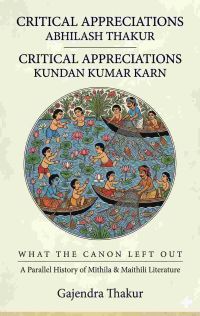
CRITICAL APPRECIATIONS ABHILASH THAKUR CRITICAL APPRECIATIONS KUNDAN KUMAR KARN
CRITICAL APPRECIATIONS
ABHILASH THAKUR
&
CRITICAL APPRECIATIONS
KUNDAN KUMAR KARN
I
CRITICAL APPRECIATIONS
ABHILASH THAKUR
Indian & Western Literary Theory · Videha Parallel History Framework
Navya-Nyāya Epistemology of Gaṅgeśa · Rasa-Dhvani-Vakrokti-Auchitya
I. BIOGRAPHICAL PROFILE
A. Identity and Formation
Abhilash Thakur (अभिलाष ठाकुर) is a Maithili fiction writer and satirist who has contributed primarily in the bīhani kathā (very short story / flash fiction) and satirical micro-essay forms to the Videha archive. His surname Thakur is widely distributed across communities in Bihar and Mithila. His given name Abhilash (meaning 'desire/aspiration') carries a Sanskritic register. His documented contributions in two Sadeha volumes demonstrate a writer whose strengths lie in compression, irony, and contemporary social observation.
B. Videha Archive: Complete Works Catalogue
Videha Sadeha 20 (Prelim_20): Bīhani Kathā — Sāṃṭha Gāṃṭha (साँठ गाँठ — Collusion/Back-scratching) and Noṭabandī (नोटबन्दी — Demonetisation), p. 605. Two bīhani kathā on contemporary social and political themes.
Videha Sadeha 24 (Prelim_24): Ṭakadyāna (टकध्यान — Fixated on Money / Money-Meditation), p. 558. A single bīhani kathā or satirical piece on the theme of monetary obsession.
II. WORKS ANALYSIS
A. Bīhani Kathā as Form
The bīhani kathā (बीहनि कथा) — Maithili's 'very short story' or flash fiction form — is one of the Videha archive's most characteristic contributions to Maithili literary innovation. Developed and championed by Gajendra Thakur as a native Maithili equivalent of the international micro-fiction/flash fiction movement, the bīhani kathā typically runs to a single page or less, uses a sharp narrative compression, and aims at a single striking reversal, revelation, or insight. Its etymology — bīhani meaning 'dawn' or 'first thing/very small' — positions it as the smallest functional unit of narrative fiction.
Abhilash Thakur's contributions to this form are notable for their subject matter: both 'Sāṃṭha Gāṃṭha' (collusion) and 'Noṭabandī' (demonetisation) address contemporary social-political realities. Demonetisation (Noṭabandī) — the November 2016 Indian government decision to demonetise all Rs 500 and Rs 1000 banknotes, affecting the entire informal economy of rural Bihar and Mithila profoundly — is a particularly timely and sharply observed subject for the micro-fiction form. The bīhani kathā's compression is perfectly suited to capturing the instantaneous social disruption of demonetisation: the flash narrative form mirrors the flash policy change.
B. 'Sāṃṭha Gāṃṭha' (Collusion)
Sāṃṭha Gāṃṭha — literally 'joint arrangement' or 'fixing' — is a common Maithili/Hindi idiom for behind-the-scenes collusion between parties who appear to be in opposition. As a bīhani kathā title, it points toward the social-political critique of apparent oppositions that conceal real alliances — a theme with direct relevance to Bihar's political landscape, where caste-based party coalitions frequently involve precisely this kind of collusive arrangement between formally competing interests.
The choice of this term as a narrative title reflects the bīhani kathā's characteristic move: the title itself is a concentrated concept that the story then unpacks or illustrates through a concrete narrative incident. The best bīhani kathā creates a gap between the expected/named and the actual, using narrative reversal to illuminate the social reality that the title names abstractly.
C. 'Noṭabandī' (Demonetisation)
The demonetisation story is Abhilash Thakur's most politically topical contribution. Noṭabandī — the November 2016 demonetisation — had a severe impact on rural Bihar, where cash-based informal transactions constitute the primary mode of economic activity for agricultural communities, daily wage workers, and small traders. The impact on Mithila's agricultural economy — during which queues at ATMs stretched through the night and agricultural transactions ground to a halt — provided material for powerful social observation.
Writing a bīhani kathā about Noṭabandī in Maithili for the Videha archive is a documentarily important act: it captures the social experience of a major policy disruption from the perspective of the Maithili-speaking rural community, in their own language, at a moment when Hindi and English media were focusing primarily on the national political narrative. The bīhani kathā form — with its preference for the specific, concrete incident over the abstract policy analysis — is ideally suited to conveying the human experience of the policy's impact.
D. 'Ṭakadyāna' (Money-Meditation)
Ṭakadyāna (टकध्यान) is a compound of Ṭakā (money/rupee) and Dhyāna (meditation/concentration) — literally 'money-meditation' or 'fixated on money'. The ironic yoking of the sacred concept of dhyāna (meditation in the yogic and Buddhist traditions, the focused meditative state as the path to enlightenment) with the profane concept of Ṭakā (money) is a satirical move consistent with the bīhani kathā's love of the comic-ironic. The compound suggests a person whose entire consciousness is absorbed in money — their 'dhyāna' (meditation, focus) is on Ṭakā rather than on the divine. This is vakrokti in its purest form: the sacred word (dhyāna) placed in sacrilegious adjacency to the profane (Ṭakā) to create a satirical critique of materialist consciousness.
III. THEORETICAL FRAMEWORKS
A. Navya-Nyāya: The Anumāna of Satirical Fiction
Gaṅgeśa's analysis of anumāna (inference) through vyāpti (universal concomitance) provides a framework for understanding satirical fiction's epistemic logic. The satirical bīhani kathā works through an implied anumāna: the hetu (the specific observed social fact — a collusion between political opponents, the human impact of demonetisation, a person's total absorption in money) leads through a vyāpti (the universal principle that the satire assumes — that political collusion is endemic, that economic policy disrupts ordinary people's lives, that modern materialist consciousness displaces the spiritual) to a sādhya (the unstated conclusion — the critique of the social structure that produces these phenomena).
The Navya-Nyāya tradition's concern with the precision of the vyāpti — the universal concomitance that grounds valid inference — is relevant to the satirist's concern with the accuracy of the generalisation that their specific example is meant to illustrate. A satirical piece that rests on a false or poorly generalised vyāpti is bad satire as well as bad logic: it creates the illusion of insight without the substance.
B. Brecht and the Short Form
Bertolt Brecht's theory of the Lehrstück (learning play) and his advocacy of short, defamiliarising narrative forms that interrupt habitual perception and provoke critical thought provides a Western theatrical-literary parallel to the bīhani kathā's aesthetic programme. Brecht's concept of Verfremdungseffekt (estrangement effect) — the technique of making the familiar strange so that it can be critically examined rather than passively accepted — is structurally analogous to the bīhani kathā's characteristic narrative move: a specific incident that makes a familiar social reality suddenly visible and questionable.
The Noṭabandī bīhani kathā's power lies precisely in this defamiliarisation: by narrating the human experience of demonetisation as a specific fictional incident, it makes visible the abstraction 'demonetisation policy' as a set of concrete, embodied disruptions to actual people's actual lives — the Brechtian move from policy to person.
C. Irony and the Maithili Satirical Tradition
The Maithili satirical tradition — with its roots in Harimohan Jha's celebrated comic prose (Kanyādāna, KhaTTar Kakkāka Taraṃg) and the broader tradition of Maithili wit — provides the indigenous critical framework for Abhilash Thakur's satirical micro-fiction. Harimohan Jha's comedy depended on the precise observation of Maithili social pretensions — the gap between the claimed dignity of Maithil Brahmin social norms and the actual petty materiality of their practice. Thakur's Ṭakadyāna and Sāṃṭha Gāṃṭha operate in the same satirical mode: the gap between claimed ideals (spiritual meditation, democratic opposition) and actual practice (money fixation, political collusion) is the structural engine of the satire.
D. Videha Parallel History Framework
Abhilash Thakur's bīhani kathā contributions are emblematic of the Videha Parallel History's championing of the bīhani kathā form as a distinctively Maithili contribution to world micro-fiction. The form's preference for the concrete, politically observed, and satirically sharp over the aesthetically elaborate or culturally nostalgic aligns it perfectly with the Parallel History's democratic orientation. His Noṭabandī piece captures a specific moment of economic disruption in Mithila's history — a moment that would not have been documented in Maithili without Videha's commitment to the full range of Maithili civic experience.
IV. SELECT BIBLIOGRAPHY
Thakur, Abhilash. Bīhani Kathā: Sāṃṭha Gāṃṭha, Noṭabandī. Videha Sadeha 20 (Prelim_20), p. 605. ISSN 2229-547X. www.videha.co.in.
Thakur, Abhilash. Ṭakadyāna. Videha Sadeha 24 (Prelim_24), p. 558. www.videha.co.in.
Gaṅgeśa Upādhyāya. Tattvacintāmaṇi. Tr. Phillips & Tatacharya. Hackett, 2004.
Brecht, Bertolt. Brecht on Theatre. Tr. J. Willett. New York: Hill & Wang, 1964.
Jha, Harimohan. Kanyādāna. Patna: Maithili Sahitya Sansthan, various editions.
Kuntaka. Vakroktijīvita. Ed. Krishnamoorthy. Dharwar: KU, 1977.
Thakur, Gajendra (ed.). Videha Sadeha 20 (Prelim_20), Sadeha 24 (Prelim_24). ISSN 2229-547X. www.videha.co.in.
II
CRITICAL APPRECIATIONS
KUNDAN KUMAR KARN
Indian & Western Literary Theory · Videha Parallel History Framework
Navya-Nyāya Epistemology of Gaṅgeśa · Rasa-Dhvani-Vakrokti-Auchitya
I. BIOGRAPHICAL PROFILE
A. Identity and Formation
Kundan Kumar Karn (कुन्दन कुमार कर्ण) is one of the most prolific and generically innovative ghazal poets in the Videha archive, with confirmed contributions across five Sadeha volumes (Sadeha 7, 14, 15, 16, and 24). His surname Karn (कर्ण) — the Maithili form of Karṇa, the tragic hero of the Mahābhārata — carries resonances of the underprivileged genius, the unrecognised master, the figure of exceptional ability denied proper recognition by the dominant institution. Whether this is the intended register of his surname or not, it acquires meaning within the Videha Parallel History Framework's recurrent theme of excellence marginalised by the canonical establishment.
The given name Kundan (meaning 'refined gold' or 'pure gold') combined with Karn creates a name-compound with a quietly heroic dignity. His Videha contributions demonstrate a poet of considerable formal range: standard ghazal, āzād ghazal (free ghazal without radif constraint), hajal (the comic-satirical hybrid of hazl and ghazal), bāla ghazal (children's ghazal), and the satirical micro-poem 'Āora Chichiyāu'.
B. Videha Archive: Complete Works Catalogue
Videha Sadeha 7 (Prelim_7): Āzād Ghazal 1–3. Free/liberated ghazals — a form that retains the ghazal's sher structure and radif but dispenses with the strict bahr constraint, allowing greater metrical freedom.
Videha Sadeha 14 (Prelim_14): Bāla Ghazal + Ghazal, pp. 496–497. Children's ghazals alongside a standard adult ghazal.
Videha Sadeha 15 (Prelim_15): Kichu Ghazal + Aṃganāme Kucala Kauā (अंगनामे कुचरल कौआ — The Crow Scratching in the Courtyard), pp. 176–178.
Videha Sadeha 16 (Prelim_16): Hajal + Kichu Bāla Ghazal + Kichu Ghazal, pp. 640–657 — his largest single contribution, eighteen pages, including the hajal form which is unique in the archive.
Videha Sadeha 24 (Prelim_24): Āora Chichiyāu (आओर छिछियाउ — Squeal More / Hiss Even More), p. 569. A single satirical poem with a provocative title.
II. GENERIC INNOVATIONS
A. The Hajal: Comic-Satirical Hybrid
Karn's most formally innovative contribution is the hajal (हजल) — a word that blends hazl (Persian/Urdu: jest, satire, comic mode) with ghazal to create a specifically comic-satirical version of the ghazal form. The hajal is not a new form — it has precedents in Urdu literature where Akbar Allahabadi and others used the ghazal form for political and social satire — but its appearance in the Videha Maithili archive in Karn's contributions (Sadeha 7 has 'हजल' in Manu's section, and Sadeha 16 has Karn's own hajals) marks an important moment in Maithili ghazal's generic development.
The hajal's defining characteristic is the deployment of the ghazal's formal rigour (bahr, radif, qāfiya, sher structure) in the service of comic, satirical, or politically ironic content — precisely the content that the dignified classical ghazal traditionally excludes. This formal-content incongruity is itself a major resource of the hajal: the mismatch between the elevated form and the lowered or comic content produces the comic-satirical effect. Ashish Anchinhar references this form in his preface to Pradeep Pushpa's collection as well — confirming its place within the broader Videha ghazal tradition.
B. 'Aṃganāme Kucala Kauā' (The Crow Scratching in the Courtyard)
This piece — whose title is itself a poetic image — belongs to the tradition of Maithili nature poetry that uses birds and animals as vehicles for social and moral observation. The crow (kauā) is one of the most culturally loaded birds in the Indian tradition: associated with ancestors (pitṛpakṣa — the fortnight of ancestral offerings specifically involves feeding crows), with intelligence and cunning, with the liminal space between the domestic and the wild (crows live on human refuse and habitation), and with the subaltern — the scavenger who survives on the margins of the social order.
A crow 'scratching' (kucalana — also meaning 'crushing', 'trampling') in the courtyard (aṃgana) is a richly ambiguous image. The courtyard is the central domestic space of the Maithili household — the locus of ritual, social, and family life. The crow in the courtyard is an intruder — liminal, uncomfortable, uninvited but impossible to ignore. 'Kucalana' adds a further dimension: the crow is not merely present but actively disturbing the order of the courtyard. This is either a naturalistic observation elevated into a social-moral image, or (more likely) a social-moral allegory using the naturalistic image as its vehicle.
C. 'Āora Chichiyāu' (Squeal More / Hiss Even More)
This provocative title — Āora Chichiyāu, literally 'squeal/hiss even more' — is the most direct example of the hajal/satirical mode in Karn's corpus. Chichiyānā (to squeal, to make a high-pitched complaining sound, to protest in a helpless manner) is an onomatopoeic word with comic-derisive connotations in Maithili: it suggests ineffectual protest, the sound of someone who cannot act effectively and can only squeal. 'Āora chichiyāu' — 'squeal even more' — is an ironic address to such a protester: the invitation to continue their ineffectual noise implies that the noise changes nothing.
The satirical target is likely the political complainer — the citizen who protests loudly but ineffectively against social injustice, corruption, or governmental failure. The title's address (imperative form: 'you squeal more') places the reader/addressee in the position of the ineffectual protester, creating an unsettling satirical mirror. This is vakrokti in its most direct form: the unexpected imperative address forces the reader to confront their own complicity in ineffectual protest.
D. Bāla Ghazal: Pedagogy and Form
Karn's bāla ghazal contributions (Sadeha 14 and within Sadeha 16's 'Kichu Bāla Ghazal') place him among the pioneers of this Videha-developed form. The bāla ghazal adapts the ghazal's formal structure — bahr, radif, sher — for a child audience through simpler vocabulary, accessible imagery, playful rhymes, and educational content. The form serves the double purpose of teaching children both literary forms (the ghazal's structure) and language (Maithili vocabulary, rhyme patterns).
The development of a children's ghazal tradition is a significant contribution to Maithili's institutional future: it introduces the ghazal form to children through accessible, enjoyable composition, building a reader and writer base for the adult ghazal tradition. This pedagogical-literary project is entirely consistent with the Videha Parallel History's commitment to developing every register and audience of Maithili literature.
III. THEMATIC ANALYSIS
A. The Hajal's Social Critique
Karn's hajal and satirical contributions engage with social themes through comic-ironic means. The crow in the courtyard, the imperative to 'squeal more', and the titles of his contributions suggest a satirical orientation toward social inertia, political impotence, and the gap between protest and change. This satirical mode is the most socially engaged strand of Karn's work — it connects to the broader Dushyant Kumar tradition of the politically engaged ghazal that Ashish Anchinhar and Gajendra Thakur have championed within Videha.
B. Nature Imagery and the Maithili Ecological
The crow poem places Karn within the Maithili nature poetry tradition that treats specific animals, plants, and landscapes as both literal and figurative presences in the literary imagination. This tradition — practised by Shanti Lakshmi Chaudhary (Tilakora, Bathūā, Kumhar), by the folk song tradition's Koshi River and agricultural cycle imagery, and by the classical poetry's mango groves and monsoon clouds — treats Mithila's specific ecology as the primary substance of literary imagination. Karn's crow is a specific Mithila courtyard crow — not an abstract bird but the bird that every Maithili household knows.
IV. THEORETICAL FRAMEWORKS
A. Navya-Nyāya and the Hajal's Logic
The hajal's satirical logic operates through what Gaṅgeśa's Navya-Nyāya would call an aprasiddha (unexpected/incongruent) vyāpti — an apparently paradoxical connection between things that are supposed to be separate. The hajal connects the dignified form (ghazal) with the undignified content (satire, complaint, social observation) through a vyāpti that the form itself denies: 'wherever there is a ghazal, there is high seriousness' — a vyāpti the hajal violates through its comic content. This violation of expected vyāpti is both the source of the hajal's humour and the mechanism of its social critique.
The satire 'Āora Chichiyāu' operates through the anumāna: hetu = the addressee squeals (protests helplessly); vyāpti = ineffectual protest changes nothing; sādhya = the invitation to squeal more reveals the futility of complaint without action. The inferential structure is the satirical argument.
B. Dhvani and the Crow Image
Ānandavardhana's dhvani (suggestion/resonance) is the appropriate analytical tool for the crow poem. 'Aṃganāme Kucala Kauā' generates multiple dhvani simultaneously: the literal image (a crow scratching in the courtyard), the ancestral resonance (crows as vessels of ancestral presence in Maithili ritual), the social dhvani (the intruder who disrupts the domestic order), and the political dhvani (the subaltern who is always already present in the household's life but whose presence is always uncomfortable). No single meaning exhausts the poem's resonance — the dhvani is inexhaustible, which is precisely Ānandavardhana's criterion for great poetry.
C. Bakhtin: The Carnivalesque Hajal
Bakhtin's carnivalesque provides the framework for the hajal's generic politics. In Bakhtin's analysis, the comic-grotesque tradition (carnival, folk humour, parody) represents the culture of laughter that coexists with and challenges the culture of seriousness — the official literary tradition with its hierarchical norms of form and content. The hajal's deployment of the ghazal's dignified form for comic-satirical content is a Bakhtinian carnivalesque move: it introduces the 'low' (satire, complaint, social observation) into the 'high' (the elevated lyric form) and in doing so challenges the hierarchy that separates them.
D. Videha Parallel History Framework
Kundan Kumar Karn is among the most formally innovative figures in the Videha ghazal archive. His development of the hajal, his sustained contribution to the bāla ghazal tradition, and his deployment of satirical imagery in the crow poem and 'Āora Chichiyāu' demonstrate the breadth of the Parallel History's ghazal community. His āzād ghazal contributions show a poet willing to relax the formal constraints of the tradition when the content demands it, while his standard ghazals and hajals demonstrate mastery of the strict forms. The Parallel History's documentation of his work across five Sadeha volumes over multiple years ensures that this formally innovative and socially engaged poet has a permanent place in the Maithili literary record.
V. SELECT BIBLIOGRAPHY
Karn, Kundan Kumar. Āzād Ghazal 1–3. Videha Sadeha 7 (Prelim_7). ISSN 2229-547X. www.videha.co.in.
Karn, Kundan Kumar. Bāla Ghazal + Ghazal. Videha Sadeha 14 (Prelim_14), pp. 496–497. www.videha.co.in.
Karn, Kundan Kumar. Kichu Ghazal + Aṃganāme Kucala Kauā. Videha Sadeha 15 (Prelim_15), pp. 176–178. www.videha.co.in.
Karn, Kundan Kumar. Hajal + Kichu Bāla Ghazal + Kichu Ghazal. Videha Sadeha 16 (Prelim_16), pp. 640–657. www.videha.co.in.
Karn, Kundan Kumar. Āora Chichiyāu. Videha Sadeha 24 (Prelim_24), p. 569. www.videha.co.in.
Ānandavardhana. Dhvanyāloka. Tr. K. Krishnamoorthy. Dharwar: KU, 1974.
Bakhtin, Mikhail. Rabelais and His World. Tr. H. Iswolsky. Cambridge: MIT, 1968.
Gaṅgeśa Upādhyāya. Tattvacintāmaṇi. Tr. Phillips & Tatacharya. Hackett, 2004.
Kuntaka. Vakroktijīvita. Ed. Krishnamoorthy. Dharwar: KU, 1977.
Thakur, Gajendra (ed.). Videha Sadeha 7, 14, 15, 16, 24. ISSN 2229-547X. www.videha.co.in.
ऐ
रचनापर अपन
मंतव्य
editorial.staff.videha@zohomail.in
पर पठाउ।
विदेहमे सभठाम ताकू / Search all Videha
Static full-text search · Pagefindलेखक/शीर्षक/अंक/वर्ष — खोज-विधा। गद्य/पद्य/शोध current/static + पुरान Videha/Sadeha contents खोजैत अछि। पोथी pothi.htm केर पूर्ण listing, श्रव्य-दृश्य Audio_Video.htm केर पूर्ण listing, पञ्जी videha-sadeha/panji-shards GitHub data, आ थेसारस/शब्दकोश videha-ejournal.github.io/data GitHub JSON corpus केँ query करैत अछि आ दूनू Quiz corpus मे dictionary/vocabulary/शब्दार्थ-सम्बन्धी प्रश्नोत्तरी परिणाम सेहो जोड़ैत अछि। Quiz videha-quiz आ GitHub user-site दूनू bilingual quiz corpus खोजैत अछि। Roman/IAST + देवनागरी cross-script search समर्थित। Issue/Year लेल संख्या दिअ। PDF-अभिलेख archive.org/VidehaAndSadeha सूची खोजैत अछि।