
Gajendra Thakur
A PARALLEL HISTORY OF MITHILA & MAITHILI LITERATURE- PART 18
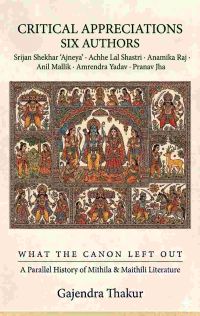
CRITICAL APPRECIATIONS of Srijan Shekhar 'Ajneya' Achhe Lal Shastri Anamika Raj Anil Mallik Amrendra Yadav Pranav Jha
CRITICAL APPRECIATIONS
Srijan Shekhar 'Ajneya' · Achhe Lal Shastri · Anamika Raj · Anil Mallik · Amrendra Yadav · Pranav Jha
Indian & Western Literary Theory · Videha Parallel History Framework · Navya-Nyāya of Gaṅgeśa
SRIJAN SHEKHAR 'AJNEYA' (GANGANAND JHA)
सृजन शेखर 'अज्ञेय' (मूल नाम: गंगानन्द झा)
Committed Song-Writer · Social Gīta Composer · Pseudonymous Identity
Archive Presence & Works
Sadeha 18: Gīta Sāṃ Pahine + Hā̃m + Jīnagī Ke Dastāveza + Saba Maithila Ke Lela + Preme Ke Gīta-Sṛjana + Hamara Gāma + Jīnagī Ke Gīta + Gīta Ego Sapanā (pp. 1228–1245) | Sadeha 19: Dūṭā Kavitā (pp. 1000–1003) | Sadeha 21: Kakarā Abite Jādū Bha̐ Jāya Re (p. 1129)
Srijan Shekhar 'Ajneya' — whose real name is Ganganand Jha (गंगानन्द झा) — adopts a pen-name of remarkable literary-historical resonance: Ajneya (अज्ञेय) is the pen-name of Sachchidananda Hirananda Vatsyayan, one of the greatest Hindi modernist poets of the 20th century, founder of the Tār Saptak anthology tradition and a major figure of the Prayogvāda (Experimentalist) movement. The choice of 'Ajneya' as a Maithili pen-name is a conscious claim to the modernist literary tradition while the 'Srijan Shekhar' (Creator's Summit/Crest) compounds the literary ambition. His Sadeha 18 contribution is his most substantial: eight song-poems whose titles encapsulate his dominant themes — Gīta Sāṃ Pahine (Before the Song, suggesting the pre-literary moment of creative conception), Hā̃m (We/I — the first-person plural assertion), Jīnagī Ke Dastāveza (Documents of Life), and the personal Hamara Gāma (Our Village). Sadeha 21's Kakarā Abite Jādū Bha̐ Jāya Re (When Whom Comes, Magic Happens — literally 'To Whose Coming Does Magic Happen?') is a lyric of expectation and transformation.
Thematic & Critical Analysis
The pen-name Ajneya carries the weight of the entire Hindi modernist project: Vatsyayan's Ajneya was committed to individual consciousness, experimental form, and the rejection of ideological prescription in literature. Ganganand Jha's adoption of this name for Maithili suggests an aspiration to bring the modernist commitment to individual consciousness and formal experimentation into the Maithili literary tradition. Jīnagī Ke Dastāveza (Documents of Life) as a title invokes the documentary-literary tradition — the poem as evidence, the song as historical record. Saba Maithila Ke Lela (For All Maithili People) is the democratic address that characterises the Videha Parallel History's community orientation. The movement from Gīta Sāṃ Pahine (before the song — the creative origin) through the song-sequence to Gīta Ego Sapanā (The Song Is a Dream) traces a creative-philosophical arc from pre-expression through engagement to the dream-status of the literary work.
Theoretical Frameworks
Vatsyayan-Ajneya's modernism as intertextual frame: the pen-name establishes a dialogue between Hindi modernism and Maithili literary aspiration. Dhvani (Ānandavardhana): 'Kakarā Abite Jādū Bha̐ Jāya Re' generates resonant dhvani — the unnamed 'whom' (kakara) can be the beloved, the spring season, the political liberator, or the divine. Navya-Nyāya: 'Jīnagī Ke Dastāveza' — life as the object of a documentary anumāna: from specific life-events (hetu) through the general principle of human experience (vyāpti) to the universal conclusion (sādhya). The Videha Parallel History: the pseudonymous identity question — the real name (Ganganand Jha) vs the literary name (Srijan Shekhar Ajneya) — enacts the tension between biographical and literary identity that the Framework navigates throughout its archive.
Select Bibliography
Jha, Ganganand (Srijan Shekhar 'Ajneya'). Works in Videha Sadeha 18, 19, 21. ISSN 2229-547X. www.videha.co.in. | Ānandavardhana. Dhvanyāloka. KU, 1974. | Gaṅgeśa. Tattvacintāmaṇi. Hackett, 2004. | Vatsyayan, S.H. ('Ajneya'). Tār Saptak. New Delhi: Bharatiya Jnanpith, 1943.
ACHHE LAL SHASTRI
अच्छेलाल शास्त्री
Witness Poet · Shravana 2010 Flood Poet · Raṇabhūmi Critical Voice
Archive Presence & Works
Sadeha 7 (Prelim_7): Kī Dekha Rahala Chī? + Dū Hajāra Dasa Śrāvaṇaka Dṛśya | Sadeha 10 (Prelim_10): Raṇabhūmi Ā Kavitā | Sadeha 30 (Prelim_30): Raṇabhūmi Ā Kavitā — Dū Śabda (p. 1964, critical note)
Achhe Lal Shastri (अच्छेलाल शास्त्री) is a poet whose name carries immediate social significance: 'Achhe Lal' is a common OBC/lower-caste given name in Bihar (literally 'Good Red'), combined with the high-caste Sanskrit title 'Shastri' (one learned in the śāstras/sacred texts) — a combination that either indicates genuine Sanskrit learning in an OBC household, or a social mobility claim through naming. The title Shastri as a pen-name or earned title in an OBC context is itself a democratising statement. His Sadeha 7 poems reveal a poet of immediate social witness: 'Kī Dekha Rahala Chī?' (What Are You Looking At?/What Am I Looking At?) is a direct-address question of witness and complicity; 'Dū Hajāra Dasa Śrāvaṇaka Dṛśya' (A Scene from the Shravana Month of 2010) is a documentary poem specifically dated to the July-August 2010 flood season in Bihar — one of the most devastating recent flood years in Mithilanchal, when the Koshi and other rivers caused catastrophic damage. His 'Raṇabhūmi Ā Kavitā' (Battlefield and Poetry) — appearing in both Sadeha 10 and as a critical discussion in Sadeha 30 — is both a poem and a topic of critical debate.
Thematic & Critical Analysis
The title 'Kī Dekha Rahala Chī?' is among the most Brechtian in the entire Videha archive: it directly interrogates the position of the witness, the act of seeing, and the question of what one does with what one sees. 'Dū Hajāra Dasa Śrāvaṇaka Dṛśya' is flood documentary poetry: the poem as a scene (dṛśya), precisely dated, from a specific moment of natural-social catastrophe. The poem-as-scene is a distinctively visual mode — it asks the reader to see what the poem sees. 'Raṇabhūmi Ā Kavitā' (Battlefield and Poetry) raises the fundamental question of the relationship between violent social conflict and literary production: what is the poet's responsibility in a landscape that has become a battlefield?
Theoretical Frameworks
Brecht's Verfremdungseffekt and witness: 'Kī Dekha Rahala Chī?' is a defamiliarising question that makes the act of seeing strange and demands self-reflection from the reader. Documentary poetics (Charles Bernstein's 'Artifice of Absorption' and the documentary poetry tradition): the dated flood poem as evidence-poetry, the poem as historical document. Navya-Nyāya pratyakṣa: the flood witness's direct perception of the Shravana 2010 catastrophe as the highest form of poetic knowledge — what was seen cannot be unseen. The Videha Parallel History: Shastri's OBC voice, his flood documentation, and his reflection on poetry's relationship to conflict all align with the Framework's commitment to democratic witness.
Select Bibliography
Shastri, Achhe Lal. Works in Videha Sadeha 7 (Prelim_7), Sadeha 10 (Prelim_10), Sadeha 30 (Prelim_30). ISSN 2229-547X. www.videha.co.in. | Brecht, B. Brecht on Theatre. Hill & Wang, 1964. | Gaṅgeśa. Tattvacintāmaṇi. Hackett, 2004.
ANAMIKA RAJ
अनामिका राज
Feminist Poet · Path-Seeker · Subaltern Woman Voice
Archive Presence & Works
Sadeha 7 (Prelim_7): Navakā Bāṭa (New Path) | Sadeha 15 (Prelim_15): Sīmā (p. 32) + Kṣamatāvāna (pp. 283–284)
Anamika Raj (अनामिका राज) writes under a pen-name whose components are both significant: Anamika (अनामिका) means 'nameless' or 'ring-finger' — a name that encodes anonymity and the feminine (the ring-finger is associated with marriage and feminine identity in Indian tradition). Raj (राज) means 'kingdom' or 'rule' — the nameless woman who rules, or the woman who rules through her namelessness, claiming power precisely through the identity that patriarchy has denied her. Her Sadeha 7 piece Navakā Bāṭa (New Path) announces the thematic of path-finding and self-creation that characterises the feminist literary imagination. Her Sadeha 15 contributions — Sīmā (Boundary/Limit) and Kṣamatāvāna (The Powerful/The Capable One) — extend this thematic: 'Sīmā' explores the limits placed on women's lives; 'Kṣamatāvāna' asserts women's capacity and power in defiance of those limits.
Thematic & Critical Analysis
The three pieces together constitute a feminist arc: Navakā Bāṭa (new path — the foundational move of feminist self-creation), Sīmā (the boundary that must be crossed or transformed), and Kṣamatāvāna (the powerful one who can cross or transform the boundary). This is the structure of feminist narrative that Rich identifies: the discovery of the lesbian continuum/woman-identified experience (Shanti Lakshmi's contribution to the same archive) finds its complementary statement in Anamika Raj's path-seeking and power-assertion. Her pen-name's encoding of the 'nameless' woman who claims power through her naming makes her one of the most self-consciously feminist literary identities in the Videha archive.
Theoretical Frameworks
Rich's 'Compulsory Heterosexuality and Lesbian Existence': Anamika Raj's Sīmā (boundary) and Navakā Bāṭa (new path) are the formal statement of what Rich analyses as the central problem of women's existence — the boundaries that constrain, and the paths that resist those constraints. Navya-Nyāya: 'Kṣamatāvāna' as an epistemological claim — the assertion that the woman (or subaltern) is kṣamatāvāna (capable of knowing, acting, transforming) is a claim about the conditions of valid pramāṇa that extend to previously excluded knowers. The Videha Parallel History: Anamika Raj's feminist voice, alongside Shanti Lakshmi Chaudhary's and Munni Kamat's, constitutes the women's strand of the Parallel History's democratic archive.
Select Bibliography
Raj, Anamika. Navakā Bāṭa. Videha Sadeha 7 (Prelim_7). Sīmā + Kṣamatāvāna. Sadeha 15 (Prelim_15). ISSN 2229-547X. www.videha.co.in. | Rich, A. 'Compulsory Heterosexuality.' Signs 5.4 (1980). | Gaṅgeśa. Tattvacintāmaṇi. Hackett, 2004.
ANIL MALLIK
अनिल मल्लिक
Most Prolific Early Videha Ghazal Poet · Grandmother's Song Tradition · Voice of Commitment
Archive Presence & Works
Sadeha 7: Gīta + Āzād Ghazal 1–3 + Hama Kahi Daita Chī + Svīkārokti | Sadeha 9: Dādīka Gīta | Sadeha 10: Hama, Deha Ā Videha...! | Sadeha 11: Ghazal | Sadeha 12: Ghazal 1–2 | Sadeha 13: Ghazal 1–2 | Sadeha 14: Ghazal (p. 596) | Sadeha 15: Ghazal (p. 270)
Anil Mallik (अनिल मल्लिक) has the most sustained continuous presence among all ghazal poets in the Videha archive's early phase, with confirmed contributions across eight Sadeha volumes (7, 9, 10, 11, 12, 13, 14, 15) — making him arguably the most consistently documented ghazal poet in the first fifteen Sadeha volumes. His Sadeha 7 contribution establishes his range immediately: Gīta (song), Āzād Ghazal 1–3 (three free ghazals), Hama Kahi Daita Chī (I Will/Do Say It — an assertion of voice), and Svīkārokti (Confession/Acknowledgement — a philosophically loaded title suggesting the speaker's self-critical admission). His surname Mallik (from the Arabic malik, meaning king/master) is found across communities in Bihar — both Muslim and Hindu — suggesting a diverse communal positioning. Dādīka Gīta (Grandmother's Song) in Sadeha 9 is his most culturally specific contribution: a song in the tradition of the grandmother's oral transmission of folk culture — the role that Maithili's women's oral tradition plays in preserving and transmitting the cultural heritage across generations.
Thematic & Critical Analysis
Anil Mallik's sustained presence across eight Sadeha volumes, combined with Hama Deha Ā Videha (I, Body and Non-Body/Videha) in Sadeha 10 — whose title is a philosophical-literary triple pun (Videha = the Maithili kingdom, videha = bodiless/spiritual, and the journal Videha itself), marks him as one of the most self-aware participants in the Videha project. Hama Kahi Daita Chī (I Will Say It/I Do Say It) is an assertion of speech-act — the poem itself enacts what it names: the speaking. Svīkārokti (Confession) suggests the tradition of the speaker acknowledging their own limitations or errors — a form of lyric humility that is rare in the Maithili ghazal tradition's characteristic assertiveness. Dādīka Gīta connects his work to the women's oral cultural transmission tradition that the Parallel History prizes: the grandmother's song is the repository of the most ancient Maithili folk knowledge.
Theoretical Frameworks
Rasa: Anil Mallik's corpus spans the full rasa range — from the Hāsya of possible satirical pieces to the Śṛṅgāra of love ghazals to the Karuṇa of social observation to the Vīra of Hama Kahi Daita Chī. Navya-Nyāya: 'Hama Deha Ā Videha' — the philosophical distinction between the embodied (deha) and the disembodied (videha) self maps onto Gaṅgeśa's distinction between the ātman as the locus of consciousness and the body as the material substrate of experience. The grandmother's song as śabda-pramāṇa of the deepest kind: the oral transmission across generations carries the accumulated knowledge of the community's experience. The Videha Parallel History: Mallik's eight-volume presence makes him the archive's most consistent early ghazal voice.
Select Bibliography
Mallik, Anil. Works in Videha Sadeha 7, 9, 10, 11, 12, 13, 14, 15 (Prelim_7–15). ISSN 2229-547X. www.videha.co.in. | Gaṅgeśa. Tattvacintāmaṇi. Hackett, 2004. | Bharatamuni. Nāṭyaśāstra. ASB, 1951.
AMRENDRA YADAV
अमरेन्द्र यादव
OBC-Yadav Short Fiction Writer · Satirical Voice · Report-Form Innovator
Archive Presence & Works
Sadeha 33 (Prelim_33): Ṭamaṭamiyāṃ Ghoḍā (p. 626) | Sadeha 34 (Prelim_34): Ripōrṭa (pp. 417–420)
Amrendra Yadav is a Maithili fiction writer in the short-form tradition, with two confirmed Videha contributions in Sadeha 33 and 34. His Sadeha 33 piece 'Ṭamaṭamiyāṃ Ghoḍā' (Tottering/Wobbly Horse) is a title of satirical-comic resonance: the tamaṭamiyāṃ ghoḍā (the horse that totters or wobbles) is both a literal image of an unsteady animal and a metaphor for any unstable system, person, or institution that presents itself as capable of moving forward while visibly failing to do so. His Sadeha 34 piece 'Ripōrṭa' (Report) — a Maithili short fiction piece with an English/Hindi-origin title — is formally innovative in using the bureaucratic-journalistic genre ('report') as a literary frame for fiction, creating a documentary-fictional hybrid.
Thematic & Critical Analysis
The 'tottering horse' image is a classic folk metaphor in rural Bihar-Mithila: the horse (ghoḍā) is an animal of status and aspiration in the village economy, but a tottering horse is a figure of failed aspiration — the status-symbol that cannot support its own weight. This connects to the Bihar political tradition where symbols of power (horses, elephants in political processions) are subject to satirical commentary. 'Ripōrṭa' as a literary title creates a fruitful ambiguity: a 'report' in bureaucratic terms is an objective, fact-based document; a literary 'report' is a subjective narrative that mimics the bureaucratic form. The gap between the claimed objectivity of the report-genre and the lived subjectivity of the literary story is the source of the piece's likely irony.
Theoretical Frameworks
Bakhtin's parody (Problems of Dostoevsky's Poetics): 'Ripōrṭa' is parody in the technical Bakhtinian sense — it takes a non-literary genre (the bureaucratic report) and places it in a literary context where it is both itself and its own ironic commentary. The tottering horse as vakrokti (Kuntaka): the oblique expression of political/social instability through the unexpected image of a failing animal. Navya-Nyāya: the 'report' as a form of śabda-pramāṇa — and the literary parody of the report as an exposure of the conditions under which official testimony is not, in fact, reliable pramāṇa. The Videha Parallel History: Yadav's OBC-Yadav identity and his satirical-documentary mode contribute to the archive's diversity of community voice and genre.
Select Bibliography
Yadav, Amrendra. Ṭamaṭamiyāṃ Ghoḍā. Videha Sadeha 33 (Prelim_33). Ripōrṭa. Sadeha 34 (Prelim_34). ISSN 2229-547X. www.videha.co.in. | Bakhtin, M. Problems of Dostoevsky's Poetics. Tr. Emerson. Minneapolis: UMP, 1984. | Kuntaka. Vakroktijīvita. KU, 1977. | Gaṅgeśa. Tattvacintāmaṇi. Hackett, 2004.
PRANAV JHA (PRANAV KUMAR JHA)
प्रणव झा / प्रणव कुमार झा
Most Prolific Multi-Genre Writer · Dramatist · Memoirist · Fiction Writer · Medical Essayist · Social Critic
Archive Presence & Works
Sadeha 17: Ambara + Tesara Praṇa + Apana Apana Dharma (Saṃsmaraṇa) (pp. 705–715) | Sadeha 19: Lagu Kathā — Nava-Āśā (pp. 309–313) + Alara-Balara (pp. 1342–1346) | Sadeha 20: Sadācāra Ka Tāvīja (Nāṭikā) + Rājā Khānadāna (Saṃsmaraṇa) + Facebook Kē Cakkara + Cakraphāṃsa + Arajala Jamīna + Rakṣitā + Sukhāita Pokhaira Pyāsala Gāma (pp. 546–603) | Sadeha 21: Dosara Biyāha + Canmā + Maithilī Kathāme Strī + Ekaṭā Janmejaya Kathā (pp. 13–35) | Sadeha 22: Lagu Kathā: Giddha + N.P.S. (pp. 43–50) | Sadeha 23: Kī Chai 'DNB' (Medical essay) (pp. from contents)
Pranav Jha (also written as Pranav Kumar Jha) is the most multi-genre writer in the group under consideration, with documented contributions across six Sadeha volumes (17, 19, 20, 21, 22, 23) spanning drama, memoir/saṃsmaraṇa, short fiction (lagu kathā), social satire, Facebook-era commentary, legal-social fiction, medical journalism, and literary criticism ('Maithilī Kathāme Strī' — Women in Maithili Fiction). His single largest contribution is Sadeha 20's 58-page section (pp. 546–603) which includes a nāṭikā (one-act play), a memoir, Facebook commentary, the piece Cakraphāṃsa (Spiral Trap/Vicious Circle), Arajala Jamīna (Contested/Unmapped Land), Rakṣitā (The Protected One/Mistress — a socially provocative title), and Sukhāita Pokhaira Pyāsala Gāma (The Dried-Up Pond, Thirsty Village). The essay 'Maithilī Kathāme Strī' in Sadeha 21 makes him one of the few male writers in the archive who explicitly theorises women's representation in Maithili fiction.
Thematic & Critical Analysis
Pranav Jha's corpus is the Videha Parallel History's most comprehensive single-author documentation of contemporary Maithili society's digital transition: Facebook Kē Cakkara (The Facebook Whirl), Ānalāīna pieces in the same volume, and the engagement with social media all position him as the archive's primary chronicler of the digital social moment. Rakṣitā (The Protected One/Kept Woman) is the most socially provocative title in his corpus — addressing the category of the rakṣitā (a woman kept in a protected but socially ambiguous relationship) raises questions of female agency, social vulnerability, and moral judgment that a male writer must navigate carefully. Cakraphāṃsa (Vicious Circle/Spiral Trap) is a systems-analysis title applied to social reality — the way poverty, education deprivation, and social discrimination form self-reinforcing cycles. 'Maithilī Kathāme Strī' as a critical essay subject places him in the tradition of male feminist criticism — the examination by a male writer of how women are represented in male-authored Maithili fiction. 'Kī Chai DNB' (What Is DNB) is medical journalism — documenting the DNB (Diplomate of National Board) qualification programme for district hospitals — placing him in the tradition of health-rights journalism.
Theoretical Frameworks
Habermas: Pranav Jha's multi-form corpus spans all three of Habermas's rationality domains — instrumental (medical essay, legal-social fiction), communicative (saṃsmaraṇa, drama, fiction), and critical (feminist literary criticism, social satire). The Facebook pieces are an analysis of the new public sphere that social media creates. Navya-Nyāya: 'Cakraphāṃsa' (Vicious Circle) is a formal anumāna structure — the vyāpti of self-reinforcing systemic disadvantage leading to the sādhya of structural critique. Spivak: the essay 'Maithilī Kathāme Strī' is a male intellectual's critical engagement with women's representation — an engagement that is both necessary and problematic, requiring the critical tools that Spivak's question 'Can the Subaltern Speak?' demands. The Videha Parallel History: Pranav Jha's multi-genre, multi-Sadeha presence makes him one of the most comprehensive documenters of the democratic Maithili literary community's social reality.
Select Bibliography
Jha, Pranav Kumar. Works in Videha Sadeha 17, 19, 20, 21, 22, 23 (Prelim_17, 19, 20, 21, 22, 23). ISSN 2229-547X. www.videha.co.in. | Habermas, J. Theory of Communicative Action. Tr. McCarthy. Boston: Beacon, 1984. | Spivak, G.C. 'Can the Subaltern Speak?' in Marxism and Interpretation of Culture. UIUP, 1988. | Gaṅgeśa. Tattvacintāmaṇi. Hackett, 2004. | Bakhtin, M. Dialogic Imagination. UTAP, 1981.
अपन मंतव्य editorial.staff.videha@zohomail.in पर पठाउ।