
Gajendra Thakur
A PARALLEL HISTORY OF MITHILA & MAITHILI LITERATURE- PART 22
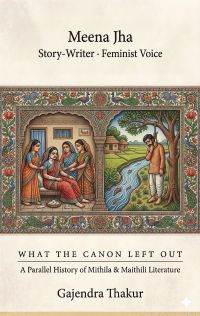
Meena Jha Story-Writer Feminist Voice
A Parallel History of Mithila & Maithili Literature
Meena Jha
Story-Writer · Feminist Voice
Preface: Methodology
This critical appreciation of Meena Jha integrates four analytical frameworks consistently applied in the Videha Parallel History Series (videha.co.in/gajenthakur.htm):
1. Indian Rasa-Dhvani-Vakrokti Aesthetics
Following Bharata Muni's Natyashastra, Abhinavagupta's Abhinavabharati (10th-11th c.), Anandavardhana's Dhvanyaloka (9th c., Kashmir), Kuntaka's Vakroktijivita (c. 10th c.), and Kshemendra's Auchityavicharacharchaa (11th c.).
2. Western Critical Theory
New Criticism (Wimsatt, Brooks), Postcolonial Theory (Homi Bhabha, Gayatri Spivak), Subaltern Studies (Ranajit Guha), Feminist Criticism (Gilbert and Gubar, Helene Cixous, Elizabeth Grosz, Judith Butler), Medical Humanities (Arthur Frank), and Reader-Response Theory (Wolfgang Iser).
3. Navya-Nyaya Epistemology of Gangesa Upadhyaya
The Tattvacintamani tradition — Gangesa's pramana categories of pratyaksha (direct perception), anumana (inference), upamana (analogical cognition), and shabda (verbal testimony), along with his technical apparatus of vyapti (invariable concomitance), vishishta-pratyaksha (qualified perception), and sadharinikarna (universalisation through aesthetic experience).
4. Videha Parallel History Framework
The counter-canonical tradition of the Videha Parallel Literature Movement (est. 2000, ISSN 2229-547X), which challenges the Sahitya Akademi mainstream by privileging democratic, subaltern, Dalit, and women's voices over the historically brahminical, male, Darbhanga-centric Maithili literary canon.
I. Biographical Profile and Literary Formation
Meena Jha is a short-story writer, Videha archive records a story by Meena Jha on the subject of breast cancer- identified as the first work of fiction in Maithili to treat this subject, and noted as preceding comparable Hindi fiction on the same theme by one to two years. This landmark achievement — documented in VIDEHA_372_2_2_2 — places her at the forefront of the expansion of Maithili women's literary subject matter into the territory of bodily health, illness, and medical experience.
Her literary formation is that of a writer of a parallel tradition: oriented toward social realism, toward the lives of middle-class Maithili women. She writes in authentic Maithili without the Hindi-calque contaminations that the Videha editorial tradition systematically corrects and her story is marked by restraint, observation, and formal discipline.
II. Works: An Annotated Overview
2.1 Breast Cancer Story (Landmark Fiction)
The Videha archive explicitly records: 'Videha mein Meena Jha ker ek laghu katha prakashit bhel. E Maithiliki pahil katha chhal je breast cancer par likhal gel. Hindime sehoo tadhri ai vishayapar katha nai likhal gel chhal, kaaran ai kathak e-prakashit bhelaak 1-2 saalak baad Hindime doo goteme ...' (VIDEHA_372_2_2_2). A story on breast cancer was published in Videha — the first Maithili fiction on this subject, and Hindi too had no such story until one to two years later.
It is Maithili women's medical fiction, the achievement is landmark: the Videha platform enabled the first Maithili literary treatment of breast cancer, expanding the thematic range of the language's fiction into previously uncharted territory of women's bodily experience.
III. Critical Analysis through Indian Literary Theory
3.1 Rasa Theory (Bharata / Abhinavagupta)
Bharata Muni's Natyashastra (c. 2nd c. BCE - 2nd c. CE) identifies eight (later nine) rasas (aesthetic emotional essences) and the psychological apparatus through which they are produced: the vibhava (excitants or determinants), anubhava (consequents), and vyabhicari bhava (transitory states) that together generate the sthayibhava (dominant/permanent emotional state) in the spectator/reader.
In Meena Jha's fiction, the dominant rasa is karunarasa — the rasa of compassion, pathos, and sorrow. This is the rasa generated by the experience of witnessing suffering that is unjust, preventable, or socially conditioned.
Abhinavagupta's contribution to rasa theory is the concept of sadharinikarna — universalisation. The particular sorrow of a Maithili woman whose domestic space is encroached upon by patriarchal claim, or whose body is rendered invisible by the community's inability to speak about its illness, is universalised through literary form into an experience available to any reader with the aesthetic sensitivity (sahrdaya — fellow-heartedness) to receive it. Meena Jha's fiction achieves this universalisation through the precision of its social observation: the more exactly particular the narrative, the more universally accessible its rasa becomes.
3.2 Dhvani Theory (Anandavardhana's Dhvanyaloka)
Anandavardhana (9th century, Kashmir) identifies dhvani (resonance, suggestion, the sound beyond the sound) as the 'soul of poetry': the vyangya artha (suggested meaning) that exceeds and enriches the vacya artha (literal meaning) is what elevates literature above mere information.
Meena Jha’s fiction operates as sustained dhvani across multiple registers simultaneously: (a) the literal: actual encroachment on land, a social-realist narrative subject; (b) the psychological: the encroachment of social expectation on individual selfhood; (c) the gendered: the patriarchal encroachment on women's consciousness, bodies, and creative autonomy; (d) the institutional: the encroachment of canonical literary authority on the parallel tradition. The reader receives all four registers simultaneously through the title's dhvani — a richness of meaning that no single literal reading can exhaust.
3.3 Vakrokti Theory (Kuntaka's Vakroktijivita, c. 10th c.)
Kuntaka argues that literary beauty (kavya-saundarya) arises from vakrokti — oblique, deviant, or 'crooked' expression that productively deviates from ordinary usage. The vaikritya (productive deviation) that generates literary life distinguishes literature from mere information transfer.
Meena Jha's narrative vakrokti is visible: In her fiction, the vakrokti operates at the narrative level: encroachment is approached not through polemic but through the precise accumulation of observed social detail. The social critique emerges obliquely from the pressure of the narrative itself, not from authorial intrusion. This oblique approach — showing rather than telling, allowing the vacya artha to carry the vyangya artha — is Kuntaka's vakrokti practised at the level of narrative strategy.
3.4 Auchitya (Kshemendra's Auchityavicharacharchaa, c. 11th c.)
Kshemendra's theory of auchitya (propriety, fitness, appropriateness) holds that the ultimate criterion of literary excellence is the fitness of every element to every other element — of word to meaning, character to action, style to subject, form to content.
Meena Jha's auchitya is most evident in her linguistic discipline. She writes authentic Maithili — without the Hindi-derived vocabulary (Hindisam), borrowed syntax (Hindi calques), or code-switched registers that the Videha editorial tradition consistently identifies and corrects in authors who have been formed more by the Hindi literary world than by the Maithili. This linguistic auchitya is a formal commitment as well as a political one: authentic Maithili is itself an act of resistance to the institutional pressures that would absorb the language into Hindi's orbit.
The auchitya of her subject matter is equally notable: that are fitting to the Maithili social-realist tradition that Videha has cultivated, rather than reaching for the metropolitan subjects that would secure recognition in the Hindi or English literary mainstream. This is auchitya as cultural loyalty — the fitness of the writer to her tradition.
IV. Critical Analysis through Western Literary Theory
4.1 Feminist Criticism: Gilbert, Gubar, and the Maithili Madwoman
Sandra Gilbert and Susan Gubar's The Madwoman in the Attic (1979) identifies the tension in women's literary production between the 'angel in the house' (the compliant domestic ideal) and the 'madwoman' (the repressed creative and resistant self that erupts as illness, transgression, or artistic extremity). This tension maps with unusual precision onto the Maithili women's literary tradition.
The 'angel in the house' in Mithila is the pativrata — the wife whose virtue consists in self-abnegation and domestic devotion. The 'madwoman' is the woman who writes, who encroaches on the territory of literary production, who insists on the literary representability of women's bodily experience. Meena Jha's writing career is the history of this negotiation: the pativrata ideal internalized in childhood, and the woman writer who 'encroaches' on its prescribed limits.
The breast cancer story enacts this negotiation at the most intimate level: the body's illness is the body's 'madwoman,' the symptom of what cannot be expressed within the vocabulary of pativrata domesticity. The story makes the body's excess legible — the excess of experience that the domestic social world cannot absorb or acknowledge.
4.2 Helene Cixous: Ecriture Feminine
Helene Cixous's 'The Laugh of the Medusa' (1975) argues for an ecriture feminine — writing from and for the body, that refuses the linear, phallogocentric structures of dominant discourse. Cixous calls it 'white ink': writing from the maternal body, from women's embodied experience, rather than from inherited male literary convention.
Meena Jha's fiction, while not formally experimental in the Western postmodern sense, practises a form of ecriture feminine in its orientation: it takes the female body and its social embeddedness as its primary epistemological ground. The breast cancer story is literally a text of 'white ink' — writing that flows from the specific physical experience of women's bodies, from the territory that dominant Maithili literary discourse has rendered invisible.
Cixous argues that 'woman has always functioned within the discourse of man...she is the repressed that ensures the system's functioning.' Meena Jha's fiction functions against this repression: it insists on the functioning of women's discourse — their literary speech — as a constitutive element of Maithili literary culture, not as its ornamental supplement.
4.3 Postcolonial Theory: Spivak and Bhabha
Gayatri Chakravorty Spivak's 'Can the Subaltern Speak?' (1988) argues that colonial discourse systematically constructs the subaltern subject as the speaking position of the other — a position from which genuine self-representation is structurally blocked. The Maithili woman writer is subaltern in the double sense: subaltern as woman within the patriarchal Maithili literary system, and subaltern as Maithili speaker within the Hindi-dominated North Indian literary economy.
Meena Jha's decision to write in Maithili — rather than the languages of institutional prestige (Hindi, English) — is itself a postcolonial act. The translations of her work will create a space of cultural negotiation and translation between the subaltern original and the metropolitan language, where hybrid forms of cultural identity are produced.
The Videha parallel movement's institutional success is in creating the conditions for Maithili women's writing to reach audiences beyond geographical limits. This is the political achievement of the counter-canonical movement made concrete in bibliographic form.
4.4 Subaltern Studies: Ranajit Guha and the Counter-Archive
Ranajit Guha's founding essay for the Subaltern Studies collective ('On Some Aspects of the Historiography of Colonial India,' 1982) argues that dominant historiography systematically excludes the subaltern from historical agency — the subaltern appears only as object of elite discourse, never as agent of her own history. The Videha Parallel Literature Movement is, in this framework, a counter-archival project: it inserts into the literary archive subjects who would otherwise remain epistemically invisible, like Meena Jha’s story that the mainstream institutional machinery has ignored, .
4.5 Medical Humanities: Arthur Frank and the Illness Narrative
Arthur Frank's The Wounded Storyteller (1995) proposes a typology of illness narratives: the restitution narrative (the patient is cured and returns to normality), the chaos narrative (illness as meaningless, unnaratable disruption), and the quest narrative (illness as a journey toward transformed understanding). These three types correspond to different epistemic stances toward the ill body and different social functions of illness narratives.
The breast cancer story attributed to Meena Jha in the Videha archive is significant for what it refuses: it refuses the restitution narrative's false consolation and the chaos narrative's meaninglessness. Instead, it practises the quiet heroism of the quest narrative: the encounter with illness as an encounter with the limits of social discourse, as an occasion for expanded self-knowledge, and as a literary act of making the previously unspeakable speakable.
V. Navya-Nyaya Epistemological Analysis (Gangesa Upadhyaya)
5.1 The Tattvacintamani Framework
Gangesa Upadhyaya (fl. c. 1325 CE, Mithila) is the founder of Navya-Nyaya — the new logic that revolutionised Indian epistemology by providing a rigorous technical vocabulary for the analysis of valid cognition (pramana). His Tattvacintamani (Jewel of Reflection on Truth) is the foundational text of this tradition. The four pramanas in Gangesa's system are: pratyaksha (direct perceptual cognition), anumana (inferential cognition), upamana (analogical cognition), and shabda (verbal testimonial cognition).
Applying Gangesa's framework to Meena Jha's literary epistemology — understanding her fiction as a system of knowledge-claims about the social world — we can illuminate aspects of her work that conventional literary criticism leaves unexamined.
5.2 Pratyaksha: The Primacy of Social Observation
Pratyaksha in Gangesa's system is not simple sensory experience but a refined category: vishishta-pratyaksha (qualified perception) involves the perception of the universal (samanya) in the particular (vishesa) — the cognitive act that grasps both the specific individual thing and its general nature simultaneously. This is the epistemological foundation of social realism as a literary mode: the writer who observes a specific (the vishesa) and through precise representation makes visible the general social conditions (the samanya) that produce it.
Meena Jha's fiction is grounded in pratyaksha: the specific, observed social world of Mithila, its middle-class domestic arrangements, its women's health crises — is the epistemological starting point. She does not arrive at her social critique through inherited ideological frameworks but through the disciplined observation of particular social realities. This is Gangesa's pratyaksha as literary method: the universal emerges from the pressure of precise particular observation.
5.3 Anumana and Vyapti: Inference from Social Evidence
Anumana (inference) in Gangesa's system requires vyapti — invariable concomitance between the probans (hetu, the inferential mark) and the probandum (sadhya, what is to be proved). The classic example: 'This mountain has fire (sadhya) because it has smoke (hetu); and wherever there is smoke there is fire (vyapti).'
Meena Jha demonstrates precisely this inferential structure: from the observed particulars of her fiction (the hetu — the specific narrative choices, the characters, the social situations), she infers the general quality of the work (the sadhya — that it is an exploration of the 'middle path'). Her inference is valid because she has established a vyapti: in Maithili social-realist fiction of this type, the narrative strategy of presenting characters 'between' social positions consistently produces a 'middle-path' thematic. This is the vyapti that licenses the inference.
5.4 Shabda and the Crisis of Testimony: The Breast Cancer Story
Gangesa's analysis of shabda-pramana (testimonial cognition) establishes that testimony is valid only when it comes from an apta — a trustworthy, knowledgeable, sincere testifier. Valid testimony requires: (a) that the testifier has direct knowledge of what she asserts; (b) that she is sincere in asserting it; and (c) that the hearer is competent to receive the testimony.
The breast cancer story can be read as a dramatisation of a crisis of shabda. The woman's body presents a pratyaksha datum — the lump — that demands verbal expression and communal acknowledgment. But the community's existing shabda system (the vocabulary of domestic Maithili discourse about women's bodies) has no vyapti connecting 'lump in breast' to any appropriate response: the testimony cannot be formed because the social language lacks the instrument for forming it. The illness is, in this Navya-Nyaya reading, a crisis of shabda-pramana: the conditions for valid testimony have broken down.
The literary story's function — its pramana-value — is to restore the conditions of valid shabda: by providing, through fiction, the verbal form that was missing in social discourse, it creates the possibility of testimony where none existed. This is the epistemological work of literature in Gangesa's framework: not merely to communicate what is already known, but to create the verbal instruments through which new knowledge can be expressed and received.
5.5 Upamana: Analogical Knowing in Her Critical Essays
Gangesa's upamana (analogical cognition) involves the recognition of sadrsya (resemblance) between two objects, where knowledge of one object illuminates the other. In Meena Jha's fiction analogical structure is central: she speaks in fiction through the analogy of the 'madhyamarg' — the Madhyamika Buddhist and Jain 'middle path' between extremes. The sadrsya (resemblance) between fictional characters (and the philosophical practitioner of the middle path generates new knowledge about the fiction: we understand her formal choices better through this analogy than we would through a purely descriptive account.
VI. Position within the Videha Parallel History Framework
6.1 The Videha Parallel Tradition
The Videha Parallel Literature Movement (Bhalsarik Gachh, 2000 — Videha, 2008 onwards, ISSN 2229-547X) was founded by Gajendra Thakur as an explicitly counter-canonical intervention in Maithili literary culture. The movement's central claim — articulated across the Parallel History series (videha.co.in/gajenthakur.htm, Parts 1-100) — is that the mainstream Sahitya Akademi-recognised canon of Maithili literature is historically distorted by its privileging of Maithil Brahmin, male, Darbhanga-based, and institutionally connected writers, at the expense of voices from the peripheries of caste, gender, class, and geography.
Meena Jha's literary work is precisely the kind of voice the Videha Parallel Framework is designed to recover and amplify: a woman writer, working in social realism, addressing the lives of middle-class and marginalised Maithili women, without institutional patronage from the Sahitya Akademi apparatus. The Videha pothi archive's inclusion of her works in its bibliographic records is a form of institutional recognition that the parallel movement provides.
6.2 The Breast Cancer Story as Institutional Achievement
The archive's identification of the first Maithili fiction on breast cancer — attributed to the Videha platform and its women contributor — is an institutional achievement of the parallel movement as much as an individual literary achievement. The fact that this story appeared in Videha rather than in a mainstream Maithili periodical is not incidental: the digital platform's freedom from conservative print editorial gatekeeping, its explicit commitment to women's voices (Stri Kona section), and its willingness to publish the previously unpublishable made this literary first possible.
This precedence over Hindi fiction (by one to two years) is historically significant not merely as a bibliographic curiosity but as evidence that the parallel movement, working at the margins of institutional recognition, was capable of greater literary courage and formal innovation than the mainstream print culture it challenged.
VII. Summary Assessment
Meena Jha is a Maithili story-writer, of significant achievement and historical importance within the Videha Parallel Literature Movement. Her contributions to the movement are multiple and varied:
As creative author and As feminist literary pioneer:
The breast cancer story — first Maithili fiction to treat this subject, predating comparable Hindi fiction by one to two years — is a landmark achievement in the history of Maithili women's writing: the entry into the literary archive of a subject that the canonical tradition's silence had rendered unwriteable.
As epistemological practitioner:
In Gangesa's terms, her fiction grounds its knowledge-claims in pratyaksha (direct social observation), resolves crises of shabda (making speakable what social discourse leaves unspoken), constructs valid anumana (inference from particular observation to general social truth), and practises upamana (analogical illumination of social and literary experience). Her work is a system of valid cognition about Mithila's social world — not merely a record of it.
As voice within the Videha Parallel Framework:
Meena Jha's work embodies the central commitment of the Videha movement: to make visible the voices, the experiences, and the literary achievements that the canonical tradition has systematically excluded. She writes authentic Maithili, for Maithili readers, from the social realities of Mithila — and in doing so, she contributes to the ongoing project of keeping the Maithili language alive as a vehicle of serious literary and intellectual engagement with the world.
VIII. Archival References and Sources
Primary archive: Videha eJournal (ISSN 2229-547X), www.videha.co.in, Gajendra Thakur ed.
Videha Parallel History Series (videha.co.in/gajenthakur.htm) — Parts 1-100, Gajendra Thakur: Institutional and critical framework.
Indian theoretical sources: Bharata Muni, Natyashastra (c. 2nd BCE-2nd CE); Abhinavagupta, Abhinavabharati (10th-11th c.); Anandavardhana, Dhvanyaloka (9th c.); Kuntaka, Vakroktijivita (c. 10th c.); Kshemendra, Auchityavicharacharchaa (11th c.); Gangesa Upadhyaya, Tattvacintamani (c. 1325 CE, Mithila).
Western theoretical sources: Sandra Gilbert and Susan Gubar, The Madwoman in the Attic (1979); Helene Cixous, The Laugh of the Medusa (1975); Gayatri Chakravorty Spivak, Can the Subaltern Speak? (1988); Homi Bhabha, The Location of Culture (1994); Ranajit Guha, Subaltern Studies Vol. I (1982); Arthur Frank, The Wounded Storyteller (1995); Wolfgang Iser, The Act of Reading (1978).
अपन मंतव्य editorial.staff.videha@zohomail.in पर पठाउ।