
Gajendra Thakur
A PARALLEL HISTORY OF MITHILA & MAITHILI LITERATURE- PART 29
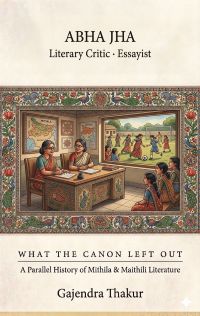
ABHA JHA Literary Critic Essayist
ABHA JHA Literary Critic · Essayist
A Note on Archival Honesty
The critical essay 'Daidigam — Madhyamargak Anweshanki Katha' (डैडीगाम — मध्यमार्गक अन्वेषणक कथा), published in Videha Issue 369 (Ashok Visheshshank, 2023), at pages 29–33.
Methodological Framework
This critical appreciation applies the four-fold methodology of the Videha Parallel History Series: (1) Indian Rasa-Dhvani-Vakrokti Aesthetics (Bharata, Abhinavagupta, Anandavardhana, Kuntaka, Kshemendra); (2) Western Critical Theory (New Criticism, Feminist Criticism, Postcolonial Theory, Subaltern Studies); (3) Navya-Nyaya Epistemology of Gangesa Upadhyaya (pratyaksha, anumana, upamana, shabda); and (4) the Videha Parallel History Framework. All analysis is grounded in what the archive text actually says.
I. Biographical Profile: What the Archive Tells Us
Abha Jha writes fluent, precise Maithili; she commands both Sanskrit literary theory (opening with the maxim 'gadyam kavinam nikasham vadanti') and contemporary critical vocabulary ('madhyamarg', 'aadarshvadi', 'yatharth'); she reads fiction attentively and thematically, moving through fifteen stories of a collection with disciplined analytical care; and she writes with the voice of a 'sampaadhaaranya paathak' — an ordinary reader who is, in fact, an acutely perceptive one. She is a serious literary critic working within the Videha tradition of engaged, socially conscious literary assessment.
Her essay appears at item 2.5 in the Ashok Visheshshank table of contents, alongside contributions from Kalpana Jha (item 2.4), Dilip Kumar Jha (2.6), Ajit Kumar Jha (2.7), Kumar Rahul (2.8), Lal Dev Kamat (2.9), Hitnath Jha (2.10), Shivshankar Srinivas (2.11), Jagdish Chandra Thakur 'Anil' (2.12), Narayanji (2.13), and Gajendra Thakur himself (2.16–2.18). This is the most serious critical company the Videha movement has to offer: her inclusion among them is itself a mark of recognised critical standing.
II. The Attested Work: 'Daidigam — Madhyamargak Anweshanki Katha'
2.1 Context: Ashok Visheshshank (Videha Issue 369, 2023)
Videha Issue 369 is a special issue dedicated entirely to the Maithili writer Ashok (born 18 January 1953, Lohna, Madhubani; retired Bihar Cooperative Service officer). Ashok is one of the most significant fiction writers in the Videha parallel tradition, author of thirteen published books across poetry, fiction, interview-collection, travelogue, criticism, and satire. His story collection Daidigam (2017) — the subject of Abha Jha's essay — contains fifteen stories. The special issue is the ninth in Videha's 'Jeebait Muda Upekshit' (Living But Neglected) series of author-focused issues, which began in 2015. The series explicitly foregrounds authors who are active and significant yet overlooked by the mainstream Sahitya Akademi establishment.
The Visheshshank was compiled and published in 2023, following a public announcement in December 2022. Abha Jha's essay is one of twenty-two critical contributions to the issue — evidence that her critical voice was specifically invited and valued by the Videha editorial team as part of its most sustained institutional project.
2.2 The Essay: Structure and Method
Abha Jha's essay opens with a Sanskrit literary axiom: 'Gadyam kavinam nikasham vadanti' — 'Prose is said to be the touchstone of poets.' She uses this classical critical principle to frame her approach to Ashok's fiction: if prose is the truest test of literary ability (because it has none of the structural supports of metre, rhyme, or formal convention), then the quality of Ashok's storytelling must be assessed by the demands of pure prose composition. This opening move is sophisticated — it grounds a contemporary assessment in classical Sanskrit poetics and sets a high evaluative standard from the start.
She then moves to the collection's title story, 'Daidigam' (Father's Village), which concerns a retired migrant worker, Raghuvansh Babu, who returns to his village in the twilight of his life. The story's tension — between the diasporic Maithili's nostalgia for the village and the village's actual changed reality — is, Abha Jha argues, the collection's defining thematic concern. Her phrase 'madhyamargak anweshankatha' (the story of the middle-path search) is the essay's analytical core: Ashok's fiction consistently seeks a middle ground between nostalgic idealism and unsentimental realism, between the village that memory preserves and the village that contemporary social forces are transforming.
She proceeds through the collection story by story, with sustained critical attention:
'Daidigam' (title story):
Raghuvansh Babu and his family return to the village planning to build a temple. A young villager challenges this: hospitals, schools, colleges would serve the community better than another temple. Abha Jha reads this moment as Ashok's way of 'indirectly expressing his own view, reminding the wealthy diaspora of their duty.' She notes both the story's optimism (all characters, including family and community, arrive at understanding) and its implicit social critique of the 'feudal tendency of the wealthy' whose sense of the village's horizon remains narrow.
'Gamak Kataki Highway' (Village-Edge Highway):
The story mourns the loss of the village's naturalness, innocence, and organic character in the face of physical 'development.' Abha Jha calls it 'a writer's inner lament, moved by the end of the village's rusticity, simplicity, and naturalness.'
'Chhutkik Ek Din' (One Day of Holiday):
A happy-ending story about two educated young people who marry against social convention (inter-caste or inter-community, the essay implies) but retain their devotion to Maithili literature and Maithil society. Abha Jha notes this as evidence of Ashok's belief that social change and cultural loyalty can coexist.
'Swadhin' (Independent/Free):
This story 'vigorously protests marital rape.' A self-respecting woman refuses under any circumstances to carry the child that would result from a forced conjugal relation. Yet she does not seek divorce, saying 'I want to start the story, not end it' — she recognises that her husband is not entirely bad, and refuses to abandon the marriage entirely. Abha Jha comments perceptively: a male author can access a female character's inner experience because, while writing, 'he is neither male nor female — he is only the character.' She connects this to the woman character Bimla in another story, imprisoned but asking why, if she was made president, she was not given presidential authority — a powerful critique of tokenism.
'Umki':
Described by Abha Jha as superficially a love story but, following the principle 'ati sarvatra varjayet' (excess in everything must be avoided), with a frightening conclusion: 'Is this too a form of love? Does love also have a quota — this much need, this much supply, after which...?' Her reading draws out the story's disturbing question about possessive obsession.
Other stories — 'Chal' (Deception), 'Mansooba' (Ambition), 'Khushiki Naam Jeevan' (Life Named Happiness), 'Abhayk Betakem Dui Taa Daant Bhelanhi' (Abhay's Son Got Two Teeth), 'Ena Bh' Kay Kiyo' (Some People Do This), 'O Duno Cycle Sikhaita' (Both of Them Learn to Ride), 'Raag', 'Lemon Ice Cream':
Abha Jha reviews these stories with equal attention, noting a theatre-vividness in 'Chal', a concern with youth's neglect of family responsibility in 'Mansooba', the acceptance of inter-caste marriage in 'Khushiki Naam Jeevan', an optimistic outlook in 'Abhayk Betakem', a pointing toward mental illness in 'Ena Bh' Kay Kiyo', and finding several of the remaining stories 'good reads.'
2.3 Abha Jha's Conclusion
Her essay ends with a summative critical statement, as precise and balanced as her preceding analysis: 'In brief, Daidigam is a collection of fifteen fine, pleasant stories by a sensitive storyteller. The presentation of the stories is beautiful and captivating. Merely expressing concern is not the writer's goal; rather, through the medium of his characters, he creates an ideal situation on the realistic ground — this is the distinctiveness of the storyteller.' She closes: 'Congratulations to the storyteller from an extremely ordinary reader!'
This closing gesture — the self-description as 'extremely ordinary reader' — is a form of Maithili literary modesty (vinay) that simultaneously enacts Kshemendra's auchitya (the fitting thing) for a critical essay about a living writer: the critic must not claim too much authority, must remain in the service of both the text and its author. But the essay's own quality makes the self-description ironic: there is nothing 'extremely ordinary' about this reading.
III. Critical Analysis through Indian Literary Theory
3.1 Rasa Theory and Abha Jha's Critical Sensibility
Bharata Muni's Natyashastra requires that the critic or aesthete be a sahrdaya — a 'fellow-hearted one,' someone with the cultivated emotional and aesthetic sensitivity to receive the rasa generated by a literary work. Abha Jha's critical essay demonstrates precisely this sahrdaya quality: she responds to each story's emotional register — the karunarasa (pathos) of Raghuvansh Babu's nostalgia, the virarasic (heroic) dimension of the independent woman in 'Swadhin', the bhayanaka (frightening) turn at the end of 'Umki' — with calibrated emotional accuracy.
Her identification of 'madhyamarg' (middle path) as Ashok's dominant aesthetic orientation maps onto the rasa framework's concept of shantarasa — the rasa of philosophical equanimity, the state that arises from seeing beyond both extreme optimism and extreme pessimism to a balanced, truth-grounded vision. She reads Ashok as a writer who generates shantarasa not by escaping social reality but by looking at it steadily and finding in it the possibility of constructive response. Her own critical essay enacts the same quality: balanced, steady, neither effusive nor harsh.
3.2 Dhvani Theory (Anandavardhana)
Anandavardhana's dhvani — the suggestive resonance that exceeds the literal — is both the object of Abha Jha's critical attention and the method of her own essay. She consistently attends to what Ashok's stories suggest beyond what they literally narrate. In her reading of 'Daidigam', the literal story (a retired man returns to his village) carries the dhvani of a larger question about the Maithili diaspora's responsibility to the language and community they left behind. In 'Gamak Kataki Highway', the literal highway carries the dhvani of the destruction of everything the Maithili village historically embodied. In 'Swadhin', the literal marital situation carries the dhvani of women's fundamental right to bodily autonomy within marriage.
Her essay itself practises dhvani: her closing praise — 'congratulations from an extremely ordinary reader' — carries the suggestion of its opposite. She is not ordinary; and her congratulations are not mere politeness but a genuine critical recognition of Ashok's achievement. The understatement suggests the fullness of appreciation that direct praise would not.
3.3 Vakrokti (Kuntaka)
Kuntaka's vakrokti identifies literary beauty in oblique, productive deviation from the ordinary. Abha Jha's critical essay opens with a classical Sanskrit axiom — a productive deviation from the expected modern critical essay's opening. This vakrokti at the level of essay architecture signals from the first sentence that her critical approach is one of elevated seriousness: she measures contemporary Maithili fiction against the standards of the classical tradition.
Her most striking vakrokti is her reading of 'Swadhin': she devotes a long passage to analysing how a male author (Ashok) can write from inside a female character's consciousness without falsifying it. Her argument — that 'while writing, the writer is neither male nor female, only the character' — is a vakrokti (oblique statement) about the nature of literary empathy: it says obliquely what a direct statement about male authors writing women's experience would say clumsily.
3.4 Auchitya (Kshemendra)
Kshemendra's auchitya — the fitness of every element to its context — governs Abha Jha's critical method throughout. Her essay is auchita in its language: she uses Sanskrit classical vocabulary ('ati sarvatra varjayet', 'gadyam kavinam nikasham'), contemporary Maithili critical idiom, and occasional Hindi formulations appropriate to the mixed register of contemporary Maithili literary discourse. Her tone is auchita — serious but not pedantic, admiring but not sycophantic, critical without being harsh. Her length is auchita: five pages (pp. 29–33) is the right space for a survey of a fifteen-story collection.
IV. Critical Analysis through Western Literary Theory
4.1 Feminist Criticism: Reading 'Swadhin' and Women's Interiority
The most significant dimension of Abha Jha's essay for feminist literary criticism is her reading of the story 'Swadhin' (Independent/Free). Her analysis of how Ashok represents the inner life of a woman who refuses to carry the child of marital rape — while remaining in the marriage — is a sophisticated engagement with the literary representation of women's bodily autonomy.
Her argument that 'a male author can access the inner experience of a female character' because the writer transcends gender in the act of composition recalls Helene Cixous's concept of bisexuality in writing (The Laugh of the Medusa, 1975): the truly creative writer is not confined to the gender that the social world assigns. But Abha Jha's formulation is more precise than Cixous's: it is not that Ashok becomes female while writing, but that he becomes neither male nor female — he becomes the character. This is a more nuanced position, closer to Keats's concept of 'negative capability' (the capacity to be 'in uncertainties, mysteries, doubts, without any irritable reaching after fact and reason') than to Cixous's more radical claim.
Her reading of Bimla (the woman imprisoned for acting on her political authority) alongside the 'Swadhin' protagonist establishes a feminist critical pattern across the collection: Ashok consistently creates female characters who insist on the full exercise of the authority they are nominally granted. The imprisoned Bimla's question — 'If you made me president, why didn't you give me presidential work?' — is, as Abha Jha reads it, a precise critique of tokenism, the practice of granting titles without substance that characterises the treatment of women in both political and domestic Maithili institutions.
4.2 New Criticism: Close Reading and Organic Unity
New Criticism's insistence on close reading — on attending to the text itself rather than to the author's biography or the reader's emotional response — is the implicit method of Abha Jha's essay. She does not discuss Ashok's life (the Visheshshank provides that separately); she discusses the stories. Her readings are close, specific, and grounded in the stories' actual language and narrative choices.
Her identification of 'madhyamarg' as the collection's unifying thematic is a New Critical argument for organic unity: the claim that a collection's fifteen stories are unified by a single vision or aesthetic commitment. Her evidence is drawn from specific narrative details — the young villager's speech in 'Daidigam', the highway's effect on the village in 'Gamak Kataki Highway', the marriage plot in 'Chhutkik Ek Din' — that collectively establish the pattern. This is close reading in its most disciplined form.
4.3 Postcolonial and Subaltern Studies
The Ashok Visheshshank is itself an act of counter-canonical recovery: it dedicates an entire Videha issue to a writer who, as the series title 'Jeebait Muda Upekshit' (Living But Neglected) indicates, has not received adequate recognition from the Sahitya Akademi mainstream. Abha Jha's contribution to this recovery project is her critical legitimation of Ashok's work through rigorous close reading. She does not merely celebrate; she analyses. Her analysis demonstrates that Ashok's fiction merits the serious critical attention that the mainstream has withheld.
Her reading of 'Daidigam' has a specifically postcolonial dimension: the story concerns the Maithili diaspora's responsibility to its place of origin — a question that is structurally postcolonial (the relation between those who have migrated to metropolitan spaces and those who remain in the rural 'periphery'). Her framing of Ashok's position as finding the 'middle path' between diaspora nostalgia and local reality maps onto Homi Bhabha's concept of the 'third space' — the space of cultural negotiation that is neither the origin nor the destination but the ongoing, unresolved process of their relation.
V. Navya-Nyaya Epistemological Analysis (Gangesa Upadhyaya)
5.1 The Critical Essay as Pramana
Gangesa Upadhyaya's Tattvacintamani analyses the conditions under which verbal testimony (shabda) constitutes valid cognition (pramana). For a critical essay to function as pramana — as a reliable instrument of literary knowledge — its author must be an apta: a person with (a) direct knowledge of the text being assessed, (b) sincere intent in communicating that knowledge, and (c) the linguistic and critical competence to communicate it accurately.
Abha Jha's essay meets all three conditions. She has clearly read Ashok's Daidigam attentively — her story-by-story summary demonstrates direct acquaintance with fifteen stories, their plots, characters, and thematic concerns. Her sincerity is evident in both her praise and her minor reservations (implicit in phrases like 'some concern is expressed'). Her competence is demonstrated by her opening with Sanskrit aesthetic theory, maintaining an appropriate critical register, and arriving at a summative judgment that is both precise and fair.
5.2 Pratyaksha: The Direct Perception of Fictional Reality
Gangesa's category of vishishta-pratyaksha (qualified or determinate perception) — the perception that grasps both the particular and the universal simultaneously — describes what Abha Jha performs in her best critical moments. When she reads the young villager's speech in 'Daidigam' (rejecting temple-building in favour of hospitals and schools), she perceives the particular moment (a character in a story speaks) and simultaneously the universal that the particular instantiates (the Maithili diaspora's feudal tendency vs. the village's developmental needs). This is critical pratyaksha: the perception of the universal social truth in the particular narrative detail.
5.3 Upamana: The Middle Path as Analogy
Gangesa's upamana-pramana (analogical cognition) operates through the recognition of resemblance between a familiar concept and an unfamiliar one. Abha Jha's use of 'madhyamarg' (the middle path — a concept familiar from Buddhist, Jain, and Sanskrit philosophical traditions) as a critical framework for Ashok's fiction is precisely an upamana: she recognises the resemblance between Ashok's narrative strategy (avoiding both pure idealism and pure cynicism) and the philosophical middle path (avoiding both extreme pleasure-seeking and extreme asceticism). The analogy illuminates both the fiction and the philosophical concept.
5.4 Anumana: Inference from Narrative Evidence
Abha Jha's critical essay enacts anumana (inference) throughout: from the observed particulars of individual stories (the hetu — the inferential mark), she infers the general character of the collection (the sadhya — what is to be proved). Her inference is: 'Ashok is a sensitive storyteller who seeks the middle path between yatharth (realism) and aadarsh (idealism).' Her evidence is the accumulation of specific narrative observations across fifteen stories — each story functioning as a separate hetu — that together establish the vyapti (invariable concomitance) licencing the inference.
VI. Position within the Videha Parallel History Framework
6.1 The Critic as Participant in the Parallel Tradition
The Videha Parallel History Framework privileges not only creative voices but critical ones: the parallel tradition requires critics who can analyse and legitimise its creative achievements with the same rigour that the canonical tradition's critics apply to the mainstream canon. Abha Jha's essay contributes to this critical project: by bringing classical Sanskrit aesthetics (the gadyam-nikasham maxim) alongside contemporary close reading to the assessment of Ashok's fiction, she demonstrates that the parallel tradition's works deserve and can sustain serious critical engagement.
Her participation in the Ashok Visheshshank — the ninth in Videha's series of special issues on living but neglected Maithili writers — connects her to the movement's central counter-canonical project: the recovery of significant literary figures from the obscurity that the Sahitya Akademi's exclusive recognition structures have imposed on them. Her critical voice is one instrument of this recovery.
6.2 The Woman Critic in the Parallel Tradition
In the context of the Videha Parallel History Framework's attention to women's voices, Abha Jha's role as literary critic is as significant as any creative role. The critical apparatus of a literary movement is not gender-neutral: the voices that shape how a tradition reads and values its own texts are as determinative of the tradition's character as the voices that create those texts. Abha Jha's presence among the Ashok Visheshshank's twenty-two critical contributors — as one of the issue's women critics — is a small but concrete element of the feminisation of Maithili literary criticism that the Videha movement has been working to achieve.
Her particular contribution to feminist critical thinking — the passage on 'Swadhin' about the male author's access to female interiority, and the reading of Bimla as critique of tokenism — is a form of feminist critical practice that works not through separate women-focused critical essays but through the integration of feminist reading into a mainstream critical assessment. This 'mainstreaming' of feminist reading is arguably more effective than keeping feminist criticism in a separate 'Stri Kona' (Women's Corner) — it insists that the question of how fiction represents women is a question for all criticism, not a specialist sub-genre.
VII. Summary Assessment
Abha Jha is a Maithili literary critic whose one attested work in the Videha archive — the critical essay 'Daidigam — Madhyamargak Anweshanki Katha' (Videha Issue 369, 2023, pp. 29–33) — demonstrates considerable critical intelligence, literary sensitivity, and methodological range. The essay is notable for:
Classical grounding:
The opening Sanskrit axiom ('Gadyam kavinam nikasham vadanti') establishes a rigorous evaluative standard derived from the classical Alamkara-shastra tradition and applies it to contemporary Maithili social realism — a methodological bridge between the classical and the contemporary that is characteristic of the best criticism in the Videha parallel tradition.
Thematic precision:
The identification of 'madhyamarg' (the middle path) as the governing orientation of Ashok's Daidigam is a precise and generative critical insight — one that illuminates the collection as a whole and provides a coherent framework for reading its fifteen individual stories.
Feminist critical awareness:
The analysis of 'Swadhin' (the story of marital rape and a woman's refusal) and the reading of Bimla (the woman who protests tokenistic authority) demonstrate an integrated feminist critical consciousness — feminist reading practised not as a separate critical mode but as part of a holistic literary assessment.
Auchitya of tone:
The essay's balanced, non-sycophantic, genuinely engaged critical tone — closing with 'congratulations from an extremely ordinary reader' while being nothing of the kind — is a model of the Maithili critical vinay (modesty) that the parallel tradition values.
Epistemological validity:
In Gangesa Upadhyaya's terms, the essay is valid shabda-pramana: the testimony of an apta (a trustworthy, knowledgeable, sincere testifier) about a literary text. Its knowledge-claims are grounded in pratyaksha (direct reading of the stories), structured through anumana (inference from narrative particulars to thematic generalisations), and enriched by upamana (the middle-path analogy).
Abha Jha's literary-critical voice belongs to the category of voices the Videha Parallel History Framework has consistently identified as undervalued: the woman critic who brings both classical learning and contemporary social consciousness to the assessment of Maithili fiction. Her one attested essay is enough to establish her as a significant critical presence in the late period of the Videha parallel movement.
VIII. Archival Reference
Primary source: Videha Issue 369 (Ashok Visheshshank, 2023), VIDEHA_369_2_Devanagari.docx, paragraphs 132–155: 'Abha Jha — Daidigam: Madhyamargak Anweshanki Katha', pp. 29–33. Text begins: 'Sanskrit mein ek tayakyans chhaik — Gadyam kavinam nikasham vadanti...' Full essay extracted from the Videha archive.
The story collection under review: Ashok, Daidigam (2017), containing fifteen stories: Daidigam, Gamak Kataki Highway, Chhutkik Ek Din, Swadhin, Umki, Chal, Mansooba, Khushiki Naam Jeevan, Abhayk Betakem Dui Taa Daant Bhelanhi, Ena Bh' Kay Kiyo, O Duno Cycle Sikhaita, Raag, Lemon Ice Cream, and two others mentioned in passing.
Indian theoretical sources: Bharata Muni, Natyashastra; Abhinavagupta, Abhinavabharati; Anandavardhana, Dhvanyaloka; Kuntaka, Vakroktijivita; Kshemendra, Auchityavicharacharchaa; Gangesa Upadhyaya, Tattvacintamani (c. 1325 CE, Mithila).
Western theoretical sources: Helene Cixous, The Laugh of the Medusa (1975); John Keats, Letters (negative capability, 1817); Cleanth Brooks, The Well Wrought Urn (1947); Homi Bhabha, The Location of Culture (1994); Ranajit Guha, Subaltern Studies Vol. I (1982).
अपन मंतव्य editorial.staff.videha@zohomail.in पर पठाउ।
विदेहमे सभठाम ताकू / Search all Videha
Static full-text search · Pagefindलेखक/शीर्षक/अंक/वर्ष — खोज-विधा। गद्य/पद्य/शोध current/static + पुरान Videha/Sadeha contents खोजैत अछि। पोथी pothi.htm केर पूर्ण listing, श्रव्य-दृश्य Audio_Video.htm केर पूर्ण listing, पञ्जी videha-sadeha/panji-shards GitHub data, आ थेसारस/शब्दकोश videha-ejournal.github.io/data GitHub JSON corpus केँ query करैत अछि आ दूनू Quiz corpus मे dictionary/vocabulary/शब्दार्थ-सम्बन्धी प्रश्नोत्तरी परिणाम सेहो जोड़ैत अछि। Quiz videha-quiz आ GitHub user-site दूनू bilingual quiz corpus खोजैत अछि। Roman/IAST + देवनागरी cross-script search समर्थित। Issue/Year लेल संख्या दिअ। PDF-अभिलेख archive.org/VidehaAndSadeha सूची खोजैत अछि।