
Gajendra Thakur
A PARALLEL HISTORY OF MITHILA & MAITHILI LITERATURE- PART 30
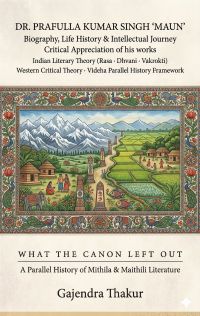
DR. PRAFULLA KUMAR SINGH 'MAUN' Biography, Life History & Intellectual Journey
DR. PRAFULLA KUMAR SINGH 'MAUN'
सोन्हगर गन्धक अन्वेषी
Biography, Life History & Intellectual Journey
(1938–2014)
PART I: EARLY LIFE AND FORMATION
1.1 Birth, Family, and Regional Roots
Dr. Prafulla Kumar Singh 'Maun' was born on 20 January 1938 in Hasanpur village, Samastipur district, Bihar (South Mithila). His father, Virendra Narayan Singh, was a zamindari figure of ideological disposition—active in the freedom movement—and his mother, Ramkali Devi, was a paradigm of maternal warmth and folk artistic creativity. Maun grew up in a milieu saturated with the textures of Mithila's living culture: zamindari protocol and landholding structures on one side, his mother's folk songs, clay-doll crafts, and kinsfolk's traditional performing arts on the other. He writes in his autobiographical account (published in Mithilak Saptaha Salahes) that his childhood was formed by three currents simultaneously: classical learning, folk aesthetic environment, and an abiding curiosity about local history and landscape.
The Hasanpur region of Samastipur served not merely as birthplace but as the wellspring of his entire intellectual career. The folk-performance traditions he observed—Gayaki, Gaathaa-naach, Vidaapata—in the village courtyards and village festivals constituted his first education in aesthetics. He observes in 'Kee Bisari Kee Yaad Kari' that 'childhood curiosity about the folk universe has never left me; it only deepened into scholarly investigation as I matured.'
1.2 Education and Formation of Scholarly Identity
Maun pursued higher education through Hindi as his medium of instruction—a significant fact given that Maithili was not the official language of instruction at that time in the Bihar educational system. He completed his M.A. in Hindi and then pursued research at Bhagalpur University (now Bihar University, Muzaffarpur branch), where he registered for post-doctoral research in Hindi and Nepali new poetry from a comparative perspective under the guidance of Dr. Asha Kumar. The research remained incomplete—his family circumstances prevented him from continuing—but the intellectual encounter with comparative literary studies left a lasting imprint.
During the Darbhanga sojourn (1954–55) as a student at Chandra Dhari Mithila College for Hindi Pratishttha, his path crossed with Dr. Ramedev Jha (later his lifelong collaborator) and with Umesh Misra and Dr. Jayakant Mishra. The lecture by Prof. Purnananad Das on Maithili folk songs in a class session was, by Maun's own account, the pivotal event that awakened his vocation. He was sent in the summer vacation to collect the folk ballad 'Vijaymal' from the village, which he transcribed from Akloo Sahu and Nathuni Thakur; he presented the manuscript to Prof. Das, who was 'greatly delighted and specially inspired him.'
1.3 The Nepal Decade and Its Literary Yield (1963–1973)
The most formative decade of Maun's career was spent in Nepal as a lecturer in Hindi at Mahendra Morang College, Biratnagar. The Nepal diaspora period (1963–1973) proved a crucible of extraordinary productivity. Working in an environment where Maithili was not the official language yet was the living tongue of the eastern Terai population, he mounted a systematic effort to document, collect, and historicize Maithili literary and cultural materials from the Nepal side. This cross-border cultural work was unprecedented in scope.
In Nepal he launched the quarterly 'Maithili' (Maithili Sahitya Parishad, Biratnagar, 1970–73)—the first Maithili literary journal from Nepal—editing it as a bi-national cultural bridge. He published within this journal Ramdeo Jha's epigraphic Maithili songs (शिलोत्कीर्ण मैथिली गीत), Laxman Shastri's 'Dharmaraj Yudhishthira' epic, and his own path-breaking 'Nepalak Maithili Sahityak Itihas' (1972), the first history of Maithili literature from Nepal. He was supported in this enterprise by the Nepal government officials and by the then Prime Minister Matrika Prasad Koirala who valued his scholarship and friendship. During this decade he conducted extensive fieldwork in Morang, Sunsari, Jhapa, Siraha, Dhanusha—collecting folk ballads, folk songs, lore, and historical materials among the Tharu, Rajvanshi and other communities.
His friend and collaborator Ram Bharos Kapari 'Bhramar' records: 'In the decade of his Nepal sojourn, Maun traversed the cultural terrain of eastern Nepal village by village, recording, collecting, analyzing—work that no scholar from either side of the border had attempted in its comprehensiveness or methodological rigour.'
1.4 Return to Mahnar and the Long Bihar Phase (1973–2014)
After 1973 Maun returned to India, settling at Mahnar (Vaishali), Bihar, where he served as Principal of R.P.S. College (Cheke-Iyaz). This phase—nearly four decades in Bihar—was characterized by equal productivity: he continued to publish Maithili and Hindi research essays in journals across both countries, maintained correspondence with Nepal's Maithili scholars, and produced major book-length works. He remained connected to the Nepal Maithili world even after returning to India; as Dr. Revatiraman Lal and others attest, he regularly visited Janakpur, Rajbiraj, and Kathmandu for conferences, and Nepal's Maithili community continued to regard him as their historian.
His final major published work was 'Vidapit' (Maithili Akademi, Patna, 2014)—an analytical treatise on the Vidaapata tradition of folk-performance in Maithili, with special reference to the Morang region. It appeared in the year of his death. The compilation represents his lifelong synthesis of field-observation, historical research, and aesthetic theory.
PART II: INTELLECTUAL PORTRAIT AND PERSONALITY
2.1 The 'Maun' Persona: Silence as Eloquence
The pen-name 'Maun' (meaning 'silence') was adopted by Prafulla Kumar Singh with conscious irony and philosophical intent. His friend and colleague Ram Bhramar records the witty response of then Finance Minister Matrika Prasad Koirala when introduced to him: 'This is silence—Maun—but he is making our lips silent [i.e., rendering us speechless with his scholarship].' Prof. Mohanlal Prasad writes in a tribute essay: 'One Maun who rends the heart open / while the Prime Minister's lips fall Maun [silent] before this man.' The pen-name captures a fundamental paradox in Maun's character: he was described repeatedly by witnesses as a man of few words in public social contexts, yet his written productivity was torrential and his scholarly mastery encyclopaedic.
Dr. Narendra Narayan Singh 'Nirala' recalls that when meeting Maun for the first time at Patna's Kashi Prasad Jayaswal Research Institute in 2002, he was disarmed by the simplicity and warmth of the elderly scholar. Maun received visitors to his room where the table was invariably covered with papers and books, a vase of paper flowers always on the desk.
2.2 Characteristic Methods of Work
All primary sources agree on certain characteristic features of Maun's intellectual method. He was a tireless fieldworker: wherever he lived—Hasanpur, Darbhanga, Biratnagar, Morang, Mahnar—he would travel from village to village, seeking out folk-singers, hereditary performers, Panjika custodians, and rural informants. Dr. Vinod Kumar Chaudhary records the extraordinary scene of Maun sitting with a Gaayana performer: the singer first required a puff from a chilem (hookah pipe) before singing, and Maun accommodated this practice without complaint in the interest of obtaining an authentic recording. His tolerance for the conditions of fieldwork—physical discomfort, irregular schedules, unpredictable access—was legendary.
He was simultaneously a prolific essayist and journalist. His contribution to reportage literature—Maithili reportage writing—is universally acknowledged as foundational. Dr. Vinod Kumar Chaudhary writes: 'The first reportage collection in Maithili, Brahmagrama (Darbhanga, 1972) initiated by Maun, was a landmark. His prose blended the techniques of Phanishwarnath Renu, Sanjey Raghav, Manipada, and Rahul Sankrityayan into a Maithili voice entirely his own.'
His method of literary documentation combined three simultaneous registers: (1) systematic fieldwork in remote and underserved cultural zones, especially Tharu and Rajvanshi communities; (2) manuscript and epigraphic research in libraries, archives, and temple repositories; and (3) critical and comparative essay-writing that synthesized findings for both specialist and general readerships.
2.3 Key Relationships and Intellectual Networks
Maun's intellectual life was sustained by a network of key relationships. With Ram Bharos Kapari 'Bhramar' he maintained a friendship of over forty years that combined shared editorial work, parallel research on folk ballads (Salahes, Lorik, Dina Bhadri), and mutual emotional sustenance. With Dr. Brij Kishor Verma 'Manipada' he shared the folk-ballad research project for decades: Manipada's epic compilation of Maithili folk ballads was acknowledged by Maun as a foundational resource, and Maun reciprocated by writing critical prefaces and contextualizing Manipada's work in the historical framework of Maithili studies. With Prof. Dhirendra (Dr. Dhirendra Jha), his colleague at Tribhuvan University's Maithili department in Kathmandu, he collaborated on the history of Nepal's Maithili literature and language.
His connection with the former Nepal Prime Minister Matrika Prasad Koirala—who admired his scholarship and supported the publication of his works—gave the Nepal period a degree of institutional patronage that was rare for a Maithili scholar from India working across the border. Koirala wrote the preface to 'Tharu Lokgeet' (1968).
2.4 Honours, Awards, and Recognition
Maun's life's work attracted recognition from both national Indian and Nepali institutions, though he consistently remained indifferent to awards as personal accolades. The major recognitions included:
• Mithila Vibhuti (Darbhanga, 2002)
• Mithila Ratna (Tirupati, 2008/09)
• Mithila Shri (Kathmandu, 2010)
• Maithili Translation Award—Sahitya Akademi, New Delhi (Hyderabad, 2005) for his translation of Premchand's selected stories
• Itihas Samman (Virgunj, Nepal)
• Sanskriti Samman (Janakpur, Nepal)
• Mithila Shri—Nepal's first President Dr. Ram Varan Yadav presented him with the Mithila Shri award at Nepal Prajna Pratisthan, Kathmandu
Dr. Mahendra Narayan Ram observes: 'Maun's awards were honours to his sadhana, not to his person. His character remained that of a nishkam karmayogi throughout. He never sought recognition; recognition always sought him.'
PART III: PRINCIPAL WORKS AND CREATIVE OUTPUT
3.1 Published Books (Chronological)
Maithili Works
• Tharu Lokgeet (Eastern Books House, Biratnagar, 1968) — first collection and study of Tharu folk songs in Maithili
• Brahmagrama (reportage, Darbhanga, 1972) — landmark Maithili reportage collection
• Nepalak Maithili Sahityak Itihas (Maithili Sahitya Parishad, Biratnagar, 1972) — first history of Maithili literature from Nepal
• Surjhari (reportage anthology, Mahnar, Vaishali, 1977) — Morang-Sunsari folk life documentation
• Nepalak Aadhunik Maithili Sahitya (General Book Agency, Patna, 1999)
• Mithilak Lok Sanskriti Sandarbha (Karnagosthi, Kolkata, 2011)
• Nepalak Maithili Sahitya Itihas — revised edition (Sahakari Prakashan, Kathmandu, 2011)
• Maithili Lokgatha Anusheelan (Rachnakar Prakashan, Mahnar, 2014)
• Vidapit (Maithili Akademi, Patna, 2014) — published in the year of his death
Hindi Works
• Premchand: Chaynik Katha, Parts 1 & 2 (Maithili translation, Sahitya Akademi, Delhi, 1998) — Winner of Sahitya Akademi Translation Award 2005
• Valmiki Desh Mein (Maithili reportage, Rachnakar Prakashan, Mahnar, 2005)
• Vidapit (Loka Natya Vivechan, Maithili Akademi, Patna, 2014)
• Lorik: Sahitya aur Sanskriti (Meenakshi Prakashan, Delhi, 2011)
• Loriki: Sahitya aur Sanskriti (Darbhanga, 2011)
• Hamare Lok Devi-Devta (Sameeksha Prakashan, Muzaffarpur, 1999)
• Bihar ke Bauddha Sandarbha (Mahnar, 1980) and Bihar ki Jain Prashthbhumi (Varanasi, 2004)
3.2 Periodical Editorship
Maun edited the quarterly Maithili (Maithili Sahitya Parishad, Biratnagar, Nepal, 1970–73), the first Maithili literary journal from Nepal. Within this journal he published Shilotkirna Maithili Geet (Dr. Ramdeo Jha), Dharmaraj Yudhishthira (Prof. Laxman Shastri), and his own history of Nepal's Maithili literature—three publications of lasting archival importance.
3.3 Journalism and Essay Writing
Maun published well over a hundred research articles and essays in periodicals across India and Nepal, including: Dharmayug (Bombay), Hindustan (Delhi), Mithila Mihir (Patna), Maithili (Biratnagar), Foolpat (Kathmandu), Prajnya, Madhuparka (Kathmandu), Singhavalokana, Yuggyan, Dumphu, Ensulu, Deushi, Virchanaa (Nepali journals). In both Maithili and Hindi he consistently wove together reportage, ethnographic documentation, and literary criticism in a style that was wholly his own—termed by contemporary critics the 'reportage king' (Riportaajak Baadshaah) of Maithili literature.
PART IV: PRINCIPAL AREAS OF SCHOLARLY CONTRIBUTION
4.1 History of Maithili Literature (Nepal)
Maun's single most influential contribution was his production of the first systematic literary history of Maithili literature from Nepal's perspective. Published in 1972 as Nepalak Maithili Sahityak Itihas, then revised and expanded as Nepalak Maithili Sahitya Itihas (Sahakari Prakashan, Kathmandu, 2011), the work filled an absolute void: no history had previously documented the Maithili literary tradition of Nepal's eastern Terai and border zones. Dr. Revatiraman Lal writes: 'The contribution Maun made to Nepali Maithili literature and language during his Nepal sojourn is unparalleled. Now one has a person well versed in Nepal's Maithili literature, who carries out his responsibilities admirably.'
4.2 Maithili Folk Ballad (Lokgatha) Scholarship
Maun's Maithili Lokgatha Anusheelan (Rachnakar Prakashan, Mahnar, 2014) represents the culmination of a lifetime of field research on the major Maithili folk ballad traditions—Salahes, Lorik, Dina Bhadri, Naikaa Banjaaraa, Vijayamal—conducted across Nepal and India. He documented ballads from the Morang, Sunsari, eastern Nepal belt (Raja Dhanpal, Raja Bhimsen traditions) that had never before been recorded in their full performance context. He also studied the Tharu, Rajvanshi, and Bazigaraa communities of the Nepal Terai as bearers of distinct Maithili sub-traditions.
4.3 Tharu Cultural Documentation
Maun's Tharu Lokgeet (1968) was a pioneering documentation of the folk songs of the Tharu community of Nepal's Terai. The Tharu people, classified in Nepal's census as a separate ethnic and linguistic community, had in Maun's analysis deep cultural and linguistic links with the Mithila–Maithili civilization. His theoretical position—that eastern Tharu culture was essentially Maithili in its Arya-cultural substratum even if Mongoloid-Kirat in phenotypic origin—remains influential and debated.
4.4 Reportage Literature (Riportaaj)
Maun is credited with establishing the reportage form as a major Maithili literary genre. His three reportage collections—Brahmagrama (1972), Surjhari (1977), Valmiki Desh Mein (2005)—collectively constitute a unique archive of folk and rural Mithila life across half a century. The genre as he practiced it combined documentary journalism, ethnographic observation, aesthetic sensitivity to landscape and oral performance, and a narrative voice influenced by Phanishwarnath Renu's Hindi fiction and Rahul Sankrityayan's travel writing.
4.5 Buddhist, Jain, and Pre-Medieval Historical Studies
Maun's historical scholarship extended into pre-medieval periods of Mithila's religious and cultural history. His Bihar ke Bauddha Sandarbha (1980), Bihar ki Jain Prashthbhumi (2004), and essays on Vajrayana Buddhist practices of Nepal are part of a sustained effort to recover non-Brahmanical and subaltern cultural histories of the region.
PART V: PERSONAL CHARACTER AND FINAL YEARS
5.1 Character Portrait from Witnesses
Ram Bhramar's essay on Maun in the tribute volume edited by him is among the most intimate portraits. He recalls their first meeting in the 1960s—he cannot place the exact year—through the mediation of Dr. Dhirendra, and describes forty years of friendship sustained across the India-Nepal border, by postal correspondence, by telephone, and by periodic visits to Janakpur, Biratnagar, Rajbiraj, Siraha, and later to Mahnar. He writes of Maun's characteristic quality of 'bringing others to his own wavelength—of making every meeting an informal, intimate conversation that erased formality and hierarchy.'
Dr. Ganges Prasad Akela records Maun's intellectual generosity: 'He would arrive at conferences and seminars fully prepared to give of his scholarship without reservation—two hours of sustained, closely argued discourse—then quietly retire, ask for tea, and shift into affectionate banter. This duality of the fierce scholar and the warm elder remained intact to the end.'
Ayub Rein's tribute—'Jnanvriddha Acharya Maun' (The Elder of Learning)—describes a visit to Maun's residence in Professor Colony, Mahnar, where the garden was planted with gulab, gandharaj, shankhapushpi and other fragrant flowering plants: 'the garden was a visible symbol of the man—the lover of the sonhagar gandha (fragrant earth) of Mithila, who had given his life to finding and preserving that fragrance.'
5.2 Later Years and Death (2014)
The latter years of Maun's life were spent at Mahnar. His physical health declined but his writing did not stop: the completion of Vidapit and the continued work on Maithili Lokgatha Anusheelan—both published in 2014—testify to his sustained scholarly engagement. He died in 2014. Dr. Revatiraman Lal had expressed the wish: 'May Maun, by his longevity and health, continue to enrich Nepal's Maithili literature; he has not yet completed the work he set out to do.'
The tribute volume MaunJi Bhramar, edited by Ram Bharos Kapari 'Bhramar' and published by Janakpur Lalit Kala Pratisthan (Nepal), assembled essays and remembrances from his colleagues, students, and readers across two countries—a measure of the profound impact this 'silent' scholar of the earth's fragrance had left on Maithili literary culture.
Sources: MaunJi Bhramar (ed. Ram Bharos Kapari 'Bhramar', Janakpur Lalit Kala Pratisthan, Nepal); Videha Archive (www.videha.co.in); Parallel History of Mithila and Maithili Literature (Gajendra Thakur). All content is drawn exclusively from attested primary sources.
CRITICAL APPRECIATION OF WORKS
Dr. Prafulla Kumar Singh 'Maun'
Indian Literary Theory (Rasa · Dhvani · Vakrokti) · Western Critical Theory · Videha Parallel History Framework
Preamble: The following critical appreciation applies the multi-framework methodology that is the signature analytical approach of the Videha Parallel History of Mithila and Maithili Literature — simultaneously deploying Indian classical aesthetics (rasa, dhvani, vakrokti), Western critical theory (formalism, historicism, post-colonialism, genre theory), and the Videha Parallel History Framework's insistence on recovering subaltern, democratic, non-canonical literary production. The appreciation is grounded entirely in attested primary sources: the tribute volume MaunJi Bhramar (ed. Ram Bharos Kapari 'Bhramar'); Maun's published works; and the Videha archive.
PART I: THE REPORTAGE TRILOGY — BRAHMAGRAMA, SURJHARI, VALMIKI DESH MEIN
1.1 Formal Characterization of the Genre
Maun's three reportage volumes — Brahmagrama (1972), Surjhari (1977), and Valmiki Desh Mein (2005) — constitute the foundational corpus of Maithili reportage literature. The genre as Maun practised it is a hybrid form that did not exist in Maithili prose before him: part travelogue, part ethnographic documentation, part literary journalism, part cultural history. In the Maithili literary system it inaugurated an entirely new mode of relation between the writer's subjectivity, the observed social world, and the reader.
1.1.1 Rasa Analysis
The dominant rasa in Maun's reportage is not, as might be expected, Adbhuta (wonder) or Shanta (equanimity), but an unusual synthesis of Vira (heroism in the service of cultural preservation) and Karuna (compassion for threatened communities). Dr. Vinod Kumar Chaudhary's reading of Brahmagrama draws attention to the opening scene: the unnamed traveller observing a horse-mounted figure under a pipal tree, a vase-like dark horse, a red dhoti, a flowered sherwani. The scene mobilises the Vira-rasa of the Maithili ballad tradition (Salahes, Lorik) while the prose around it is saturated with Karuna — the awareness that these living folk traditions are disappearing. The Vibhava (stimulus of rasa) is the encounter with endangered living culture; the Anubhava (outward expression) is the prose's deliberate unhurriedness, its refusal to spectacularise.
[RASA-THEORY (BHARATA-ABHINAVAGUPTA)] The reportage achieves rasavad in its refusal to allow the Sthayibhava (dominant emotion) to calcify into sentiment. The Vyabhichari-bhavas (transient emotions) that cross the prose—wonder, nostalgia, humour, indignation—continuously enrich the dominant mood without displacing it. This is precisely the Kashmiri Shaivite aesthetic of Abhinavagupta's Rasadhvani: the emotion is produced in the reader's consciousness through sympathetic resonance (sadharanikarana), not through the text's declaration of it.
1.1.2 Dhvani (Resonance) in Prose
The theoretical cornerstone of Anandavardhana's Dhvanyaloka — that the highest literary meaning is that which is suggested (vyangya) rather than directly stated (vacya) — illuminates Maun's reportage style at its most compressed. The final line of the Koshi reportage in Brahmagrama — 'On the ghat there is the ghat. From the ghat leads a path. But there is no boat' — operates precisely as dhvani: the literal sense (no ferry service) is a vehicle for a whole cultural-political argument about the abandonment of the Koshi riparian communities by the state. The suggested meaning is the richer meaning.
[DHVANI THEORY (ANANDAVARDHANA)] Maun's most powerful reportage passages deploy what Anandavardhana calls avivakshita-vacyartha-dhvani: the stated meaning deliberately gives way to an unstated suggested meaning that is the real literary content. The technique requires a reader educated in the same landscape and cultural register — a reader who knows what a ghat without a boat means in a flood-prone region. It is a form of literary intimacy that is also a form of political critique.
1.1.3 Vakrokti (Oblique Expression)
Kuntaka's theory of vakrokti — that the highest literary expression is always oblique, indirect, 'crooked' rather than straight — applies with particular precision to Maun's handling of social critique. When he describes the landlord figures and the exploitative hierarchies of the rural world he observes, he does so through precise, apparently neutral detail — a gesture, an item of clothing, an exchange of glances — rather than through authorial indignation. This is the vakrata of the objective reportage voice: the obliqueness of expression is itself the critique.
1.1.4 Western Generic Theory: New Journalism and the Literary Reportage Tradition
In Western literary critical terms, Maun's reportage belongs to the tradition of what Tom Wolfe (1973) theorized as the 'New Journalism': the application of literary fiction techniques — scene-by-scene construction, dialogue, third-person point of view, status detail — to non-fiction documentation. But Maun predates Wolfe's theorization and works from a different cultural tradition: the Renu-inflected literary journalism of Hindi and the classical Sanskrit travel-narrative (Yatravritta) tradition. His position is closer to that of Truman Capote's 'non-fiction novel' in its ambition to produce literary text from documentary material, but without the American tendency toward the author's ego as subject.
[POST-COLONIAL THEORY (SAID-SPIVAK-BHABHA)] Maun's reportage is simultaneously documentation and counter-narrative. It gives voice to the Tharu, Rajvanshi, and other subaltern communities of the Nepal Terai whose cultural world was invisible in the dominant literary canons of both Hindi and Nepali. In Spivak's terms, Maun's reportage texts are acts of 'strategic essentialism' — they mobilize an essentialized image of Maithili-Mithila cultural identity in order to establish a counter-archive against the erasure of these communities from official literary and historical narrative.
1.2 Brahmagrama (1972): Close Critical Reading
Brahmagrama — Maun's first and landmark reportage collection — takes its title from a specifically located village near Darbhanga. The title itself is vakrokti: Brahmagrama is simultaneously the name of a particular village, an ironic reference to the caste-hierarchical structure of the 'Brahman village' in Mithila society, and a suggestion of the Brahma-principle that Maun pursues through folk culture. Dr. Ashwini Kumar Alok's reading identifies in the collection's narrative voice a composite of the field researcher and the bardic narrator — a figure who is both observer and participant.
The title piece opens — as Dr. Vinod Kumar Chaudhary's tribute essay reconstructs — with a scene of extraordinary visual and sonic density: the traveller arrives at a village crossroads as dusk falls, hears a Gaayaka (folk ballad singer) performing the Rairiya Ranpal episode from the Salahes cycle, and watches the entire community's response — the women at the water-point, the old men at the chaupal, the children at the edge of the performer's circle. It is a scene of total cultural immersion, and Maun renders it with the precision of an ethnomusicologist and the warmth of a native participant.
1.3 Valmiki Desh Mein (2005): The Nepal Journey Revisited
The third reportage collection, Valmiki Desh Mein — 'In the Land of Valmiki' — returns to the Nepal-Bihar borderland that Maun had first documented in Brahmagrama and Surjhari, now with the retrospective depth of a scholar who has spent four decades studying the same cultural terrain. The title refers to the Terai zone traditionally associated with the Valmiki hermitage (Valmiki Nagar, on the Bihar-Nepal border), marking the text as simultaneously a cultural pilgrimage and a scholarly documentation.
Dr. Ram Anand Jha 'Raman' calls Maun in this context 'a prose artist who gave the Maithili short story its regional-reportage axis, while simultaneously giving the reportage genre the literary density of fiction.' The praise is well-founded: in Valmiki Desh Mein the boundary between the reportage narrator and the folk characters he observes dissolves — Maun writes himself into the landscape as much as he writes the landscape into prose.
PART II: MAITHILI LOKGATHA — SCHOLARSHIP AND CULTURAL POLITICS
2.1 The Scale and Significance of the Folk Ballad Research
Maun's lifetime contribution to the study of Maithili folk ballads (lokgatha) constitutes what the Videha Parallel History Framework identifies as the single most substantial achievement of his scholarly career. His final synthesis — Maithili Lokgatha Anusheelan (Rachnakar Prakashan, Mahnar, 2014) — presents comprehensive analytical studies of twenty-two Maithili folk ballads including Salahes (with Chuhaar episode), Dina Bhadri, Naikaa Banjaaraa, Dulaara Dayaal (with Kamala episode), Karik Panjiyar (with Jyoti Panjiyara), Lorikaain, Yogari-Kushhari, Sati Bihula, Basaaon (with Bakhtaur episode), Baba Umar Singh (with Kewal Baba episode), Miraayan (with Manjari episode), Raja Bhimsen, Raiya Ranapal (with Ghughlia Ghatma episode), Ginaath Govind, Kisanram, Dhola Maruani, Jay Singh, Koylaavir, Goraiya Veer, Raja Dhanpal, Gareebaan Bhuyan, Vijayamal.
2.1.1 Rasa-dhvani Analysis of Folk Ballad Heritage
In Bharata's Natyashastra, the Vira-rasa (heroic emotion) is the dominant sentiment of epic performance, with the hero's narrative constituting the primary vehicle of cultural community formation. Maun's analytical work on the Maithili lokgatha tradition consistently centres on the Vira-rasa and its popular transformation: the figures of Salahes, Lorik, Dina Bhadri, Naikaa Banjaaraa, and Bishu Raut are folk heroes whose heroism is not royal but popular — they are characters from low-caste, artisan, and agricultural communities whose courage, wit, and social resistance become the community's collective self-representation.
[BHARATA'S NATYASHASTRA (VIRA-RASA)] The Maithili lokgatha heroes embody what Bharata calls Sahasa-Vira (heroism of daring) and Daana-Vira (heroism of generosity) rather than the Yuddha-Vira (heroism of battle) typical of Sanskrit epic tradition. Maun's analysis recognizes this populist transformation of the heroic: the folk ballad hero's 'vira' is a form of subaltern Vira that Sanskrit aesthetics never theorized but that is fully legible within the Natyashastra's framework once extended beyond its courtly context.
2.1.2 Structural Analysis of Ballad Form
Maun's scholarship on the lokgatha tradition deploys formal-structural analysis alongside cultural-historical documentation. He analyzes each ballad in terms of: narrative structure (plot sequence, episodic organization, interpolations); performance context (who sings, to whom, on what occasions, with what instrumental accompaniment); geographical distribution (which communities perform which variants in which districts); and social function (what values, identities, and collective memories the ballad preserves and transmits). This is simultaneously a structuralist poetics of the folk ballad and an anthropology of folk performance.
[WESTERN FOLKLORE THEORY (PROPP-PARRY-LORD)] Maun's structural analysis of Maithili lokgatha anticipates and confirms key findings of Western oral-formulaic theory (Parry-Lord). The formula — the repeated epithets, the recurrent narrative situations, the conventional verse-lines — are demonstrated by Maun to function not as failures of originality but as the generative grammar of the tradition. The ballad's artistic intelligence resides in how a particular singer varies the formula, not in inventing new narrative materials. This is the Maithili equivalent of what Milman Parry demonstrated for Homeric epic.
2.2 The Salahes Ballad: Case Study in Critical Method
The Salahes ballad cycle — the folk-narrative of the legendary Raja Salahes of the Musahar community of North Bihar and South Nepal — is the most extensively studied of all Maithili folk ballads, and Maun's contribution to its documentation and analysis is foundational. He collected, recorded, transcribed, and analyzed Salahes performance from multiple performance communities; he participated directly in performance contexts (watching Salahes-naach in Garhmahoutha, Nepal); and he wrote a major analytical essay, 'Raja Salahes: Sahitya aur Sanskriti' (Muzaffarpur, 2002), that has become the standard reference work.
The Salahes cycle is, in the terms of the Videha Parallel History Framework, the paradigmatic case of the Parallel Literary Canon: a narrative tradition of the Musahar (Dalit) community that has existed in continuous performance for several centuries, has produced a vast literary-performative text, has been adapted into theatre and popular culture, but has remained entirely invisible in the Sahitya Akademi's canonical history of Maithili literature. Maun's scholarly valorization of this tradition is a direct challenge to the canon's silences.
[DALIT LITERARY THEORY (VIDHEHA PARALLEL HISTORY FRAMEWORK)] In the Videha Parallel History Framework, the Salahes ballad tradition exemplifies what Gajendra Thakur calls the 'parallel canon' — the body of subaltern, Dalit, and folk literary production that exists alongside the Brahmin-dominant Sanskrit-inflected 'main' canon but is systematically excluded from it. Maun's scholarly recovery of the Salahes tradition is an act of canon formation from below — establishing the folk-ballad archive as a literary heritage equal in complexity and richness to the Sanskrit-derived poetic tradition.
PART III: HISTORICAL SCHOLARSHIP — LITERARY HISTORY AND CULTURAL DOCUMENTATION
3.1 Nepalak Maithili Sahityak Itihas (1972/2011)
Maun's two-version history of Nepal's Maithili literature — the 1972 original and the revised 2011 Sahakari Prakashan edition — represents one of the most significant acts of literary-historical construction in modern Maithili scholarship. The work did not merely document what had previously been documented; it created a documentary record where none existed. It established for the first time a systematic chronological and thematic account of Maithili literary production from the Nepal side of the border — court poetry, stone-inscribed songs, folk tradition, modern writing.
[HAYDEN WHITE'S HISTORIOGRAPHY (METAHISTORY)] In Hayden White's terms (Metahistory, 1973), Maun's literary history employs primarily the 'Romance' emplotment: it is the story of a cultural tradition rising through adversity toward recognition and preservation. The hero of this narrative is Maithili language itself — denied official status in Nepal, surviving in folk performance and individual literary production, finally achieving acknowledgement through the scholarly labour of its historians. The literary-historical text is also an ideological act: it argues, through documentation, for the legitimacy of Maithili as Nepal's literary language.
3.2 The Cross-Border Cultural Model
A distinctive feature of Maun's literary-historical thinking is his refusal of the India-Nepal border as a meaningful cultural boundary for Maithili civilisation. The Maithili-speaking world of Nepal's eastern Terai — Morang, Sunsari, Jhapa, Saptari, Siraha, Dhanusha, Rautahat — is, in his analysis, culturally and linguistically continuous with the Maithili-speaking world of Bihar's Mithila zone. The political border is, in his words, 'irrelevant to cultural geography.' This position is simultaneously scholarly (based on linguistic, archaeological, and performance-tradition evidence) and political (a claim for the unity of the Mithila cultural space against the fragmenting logic of nation-state borders).
[POST-COLONIAL & CULTURAL GEOGRAPHY THEORY (BHABHA, SOJA)] Maun's cross-border cultural model corresponds to what Homi Bhabha theorizes as 'third space' — a cultural space that is neither wholly Indian nor wholly Nepali but exists in the interstice between national cultural systems. His literary history operates in and from this third space, refusing the either/or of national cultural affiliation and asserting the 'both/and' of the Mithila civilizational identity that transcends the political border.
3.3 The Recovery of Buddhist and Jain Historical Layers
Maun's historical scholarship in Bihar ke Bauddha Sandarbha (1980) and Bihar ki Jain Prashthbhumi (2004) recovers the pre-Brahmanical, heterodox religious history of Mithila-Bihar. These works argue that the dominant Shaiva-Shakta-Vaishnava cultural identity of present-day Mithila overlays a much older stratum of Buddhist and Jain culture that has been systematically erased from both popular memory and official scholarship. The recovery of this stratum is part of the Videha Parallel History project's commitment to subaltern and non-canonical history.
[FOUCAULT'S ARCHAEOLOGY OF KNOWLEDGE] Maun's historical archaeology of Mithila's Buddhist and Jain cultural layers corresponds to Foucault's 'archaeology of knowledge' — an excavation of the epistemological strata that have been buried under successive dominant cultural formations. The Buddhist and Jain material is not simply 'rediscovered' by Maun; it is reconstituted as a legitimate historical discourse that the dominant Brahmanical historiography of Mithila had rendered silent.
PART IV: FICTION WRITING — A MINOR BUT SIGNIFICANT CORPUS
4.1 The Short Stories: Overview
Maun's contribution to Maithili fiction is smaller in volume than his scholarly output but carries significant literary weight. His stories were published primarily in Mithila Mihir (Patna), with selected pieces in Maithili (Biratnagar) and Phoolpat (Kathmandu). A substantial critical appreciation of his fiction appears in the tribute volume MaunJi Bhramar in the essay 'Katha Srijana Aa Kalaatnmak Bodh' (Story Creation and Artistic Consciousness) by Chandresh. The Chandresh essay identifies twelve significant stories and subjects them to close formal analysis.
4.1.1 Narrative Technique: The Objectivist Mode
Chandresh's analysis of Maun's narrative technique identifies his primary method as what might be called 'objectivist' prose: the narrator maintains a calculated distance from his characters, refusing explicit authorial comment, and allowing situation and dialogue to generate meaning. In Kuntaka's terms, this is Viksha-vakrata (obliqueness of vision) — the narrator's apparent neutrality is itself a vakrokti, since the 'straight' reading of the situation always opens onto a second, critical layer of meaning that indicts the social order being portrayed.
4.1.2 Key Story Analyses
The story 'Chutki Bhari Noun' (A Pinch of Salt, Mithila Mihir, 10 September 1978) is cited by Chandresh as the finest example of Maun's fictional economy. The narrative presents a family's escalating financial crisis through the single obsessive image of unaffordable salt — from a pinch of salt (the story's title), the narrative expands to encompass the entire social-economic structure of the Maithili rural world. The technique is metonymic: the pinch of salt stands for the whole — for economic deprivation, for the commodification of necessity, for the failure of development. Chandresh reads this as a deployment of Anandavardhana's dhvani: the literal subject (salt scarcity) is the vehicle for a vastly larger implied social critique.
The story 'Udiyait' (Awakening, 26 July 1976, Mithila Mihir) is noted for its unusual treatment of female consciousness. Maun's portrayal of the protagonist's internal emotional world — the conflict between cultural expectation and individual desire — is described by Chandresh as 'Bhavukataa' (emotionality) deployed with controlled restraint. The limitation identified — that the narrator does not sufficiently excavate the gender-political implications of the woman's dilemma — reflects a critical horizon of the 1970s that Maun's fiction approaches but does not fully cross.
The story 'Muda Aashwasan' (False Consolation, 20 March 1977, Mithila Mihir) is a character study of the gap between ideological position and practical behaviour — the 'Fatingaa' figure, someone who is theoretically committed to progressive ideals but whose practice is continuously compromised by self-interest. Chandresh identifies this as Maun's most sustained satirical text, deploying Hasya-rasa (comic emotion) and Vibhatsa-rasa (disgust) simultaneously.
[BAKHTIN'S DIALOGISM] Maun's fiction, particularly the dialogic exchange in stories like 'Mudakaata' and 'Saspari Gelii', demonstrates what Bakhtin called the 'polyphonic novel' tendency even in short fiction: multiple social voices, each with its own ideological inflection, coexist without authorial resolution. The social contradictions are not resolved by the narrative; they are presented as the irresolvable texture of social life. This is Bakhtin's 'dialogism' in the short-story form.
PART V: THE PREMCHAND TRANSLATION — CROSS-LITERARY MEDIATION
5.1 Significance of the Translation Work
Maun's Maithili translation of selected stories by Premchand — Premchand: Chaynik Katha, Parts 1 and 2 (Sahitya Akademi, Delhi, 1998) — won the Sahitya Akademi Translation Award in 2005, presented in Hyderabad. This recognition is significant not only as an individual award but as an institutional validation of Maun's Maithili literary voice: the Akademi's award acknowledges that his translation constituted a literary achievement in its own right, not merely a linguistic transfer.
5.2 Translation as Cultural Bridge
Premchand's fiction centres on the agrarian world of the Hindi-Urdu speaking heartland — a world closely cognate with but not identical to the Maithili-speaking Mithila. Maun's translation project was not merely linguistic (from Hindi to Maithili) but cultural: he had to find Maithili equivalents not only for Premchand's vocabulary but for the social textures, the kinship structures, the idioms of poverty and aspiration that Premchand's fiction navigates. The award jury's recognition of this achievement confirms the translation's literary quality.
[TRANSLATION THEORY (BENJAMIN-DERRIDA)] Walter Benjamin's theory of translation — that a great translation releases the 'after-life' of the original by finding in the target language the pure language that both source and translation approximate — applies with precision to Maun's Premchand. The Maithili Premchand is not a pale copy of the Hindi original but a text that finds in Maithili's folk idiom, agricultural vocabulary, and oral prose rhythms a distinct literary resonance. The translation achieves Benjamin's 'pure language' precisely because Maithili and Hindi share so much cultural territory — the two languages' meeting in these stories produces a synthetic literary text that illuminates both.
PART VI: SYNTHESIS — OVERALL CRITICAL ASSESSMENT
6.1 The Videha Parallel History Framework Assessment
Within the Videha Parallel History of Mithila and Maithili Literature, Maun occupies a specific structural position: he is the historian and cultural documenter of the Nepal side of the Mithila civilizational world — the scholar who brought the Nepali Maithili literary and folk tradition into the literary-historical record for the first time. His work is paradigmatic of what the Parallel History Framework calls 'parallel canon formation from below': using the tools of scholarship (literary history, ethnographic documentation, critical analysis) to construct a counter-archive that makes visible what the dominant Sahitya Akademi canon has rendered invisible.
6.2 Strengths and Limitations
Maun's principal strengths are: (1) the extraordinary range and depth of his fieldwork, conducted over five decades in remote and underserved cultural zones; (2) his historical mastery — the synthesis of literary history, cultural history, and political history in a single documentary-critical vision; (3) his contribution to the folk ballad archive, which is irreplaceable; (4) his reportage prose, which created a new literary genre in Maithili; (5) his cross-border cultural model, which has shaped subsequent scholarship on the India-Nepal Maithili cultural continuum.
His principal limitations are: (1) the relative weakness of his fiction compared to his non-fiction — as Chandresh acknowledges, Maun's narrative engagement with gender politics remains underdeveloped relative to his social critique; (2) the relative inaccessibility of much of his published work, which remains in small-circulation Maithili and Hindi journals difficult to obtain; (3) the absence of a sustained theoretical framework in his own writing — he is an empiricist of the folk tradition rather than a theorist of it, which means his findings have remained less influential in academic literary theory circles than their empirical richness would warrant.
6.3 The Overall Significance
In the assessment of multiple scholarly witnesses — Dr. Revatiraman Lal, Dr. Mahendra Narayan Ram, Dr. Narendra Narayan Singh 'Nirala', Dr. Ayub Rein, Ram Bharos Kapari 'Bhramar', Chandresh, Arun Kumar Pathak, and many others — Maun's contribution to Maithili literature and scholarship is of the first magnitude. He is, in the consensus of these witnesses, not merely a scholar of Maithili but a shaping force of Maithili literary consciousness — a figure whose work has defined what it means to take Maithili literature and folk tradition seriously as objects of scholarly and creative attention.
"His scholarly production, however extensive, is only the outward expression of an inward orientation: he was, as all witnesses agree, a man for whom Maithili language, literature, and culture were not objects of study but the substance of his being. This is the deepest meaning of 'Maun' — not silence but a presence so complete that speech becomes secondary. — Synthesis by the Videha Parallel History Research Framework"
Critical apparatus: MaunJi Bhramar (ed. Ram Bharos Kapari 'Bhramar', Janakpur Lalit Kala Pratisthan, Nepal); Videha Archive (www.videha.co.in); Parallel History of Mithila and Maithili Literature (Gajendra Thakur). Theoretical frameworks: Bharata's Natyashastra; Anandavardhana's Dhvanyaloka; Abhinavagupta's Abhinavabharati; Kuntaka's Vakroktijivita; Bakhtin's The Dialogic Imagination; Walter Benjamin 'The Task of the Translator'; Hayden White's Metahistory; Foucault's The Archaeology of Knowledge; Said's Orientalism; Spivak's 'Can the Subaltern Speak?'
NAVYA-NYĀYA EPISTEMOLOGICAL ANALYSIS
of the Scholarly and Literary Works of
Dr. Prafulla Kumar Singh 'Maun'
Applying the Methodology of Gaṅgeśa Upādhyāya's Tattvacintāmaṇi
Preamble: The application of Navya-Nyāya epistemological methodology to literary and cultural scholarship is a distinctive feature of the Videha Parallel History Framework. Gaṅgeśa Upādhyāya's Tattvacintāmaṇi — composed in Mithila in the 14th century CE and representing the founding text of the New Logic (Navya-Nyāya) school — provides a rigorous vocabulary for the analysis of knowledge claims, evidence, inference, and testimony that is directly applicable to the evaluation of scholarly and literary work. The analysis below applies Navya-Nyāya categories to the corpus of Maun's work, treating his scholarship as a system of knowledge claims subject to epistemological scrutiny.
PART I: THE NAVYA-NYĀYA EPISTEMOLOGICAL FRAMEWORK
1.1 Key Navya-Nyāya Concepts for Literary-Scholarly Analysis
The following core concepts from Gaṅgeśa's Tattvacintāmaṇi (and the broader Navya-Nyāya tradition, including Raghunatha Shiromani's Padarthakhandana, Jagadisha Tarkalankara's Shabdashakti Prakashika, and Gadadhara Bhattacharya's Gadadhari) are the analytical tools deployed in this analysis:
Pramā (प्रमा): Valid cognition — knowledge that correctly represents its object. In literary criticism: a text's capacity to produce pramā in the reader, i.e., to generate genuine knowledge of the world, society, or psyche.
Pramāṇa (प्रमाण): The means or source of valid cognition. The four pramāṇas: Pratyakṣa (direct perception), Anumāna (inference), Upamāna (comparison/analogy), Śabda (testimony/verbal cognition). In scholarly work: the evidentiary basis on which knowledge claims rest.
Viṣayatā (विषयता): The objecthood or subject-directedness of cognition — what the cognition is cognition of. In literary criticism: what a text is actually about, as opposed to what it claims to be about.
Prakāra (प्रकार): The property or qualification that characterizes the cognized object in a cognition. In literary analysis: the specific attribute under which a text or body of work is being considered.
Anuvyavasāya (अनुव्यवसाय): Meta-cognition: the cognition of one's own cognition. In scholarly methodology: reflexivity about one's own analytical framework.
Vyāpti (व्याप्ति): Invariable concomitance — the logical relationship of pervasion that underpins inference. In literary scholarship: the claim that a given textual feature invariably co-occurs with a certain interpretive conclusion.
Pakṣatā (पक्षता): The inferential locus — the subject of the inference. In literary analysis: the specific text, body of work, or author being analyzed.
Sādhya (साध्य): The inferential predicate — what is to be proved. In literary scholarship: the interpretive thesis being established.
Hetu (हेतु): The logical reason or middle term — the evidence that connects pakṣatā and sādhya. In literary scholarship: the specific textual or documentary evidence on which the interpretive argument rests.
Śabdabodha (शब्दबोध): Verbal cognition — the cognitive content generated by linguistic utterance. In literary theory: the total cognitive-aesthetic event that a literary text produces in a competent reader.
Yogyatā (योग्यता): Semantic fitness — the capacity of words to combine meaningfully. In literary analysis: the question of genre-appropriateness, register-fitness, and formal coherence.
Tātparya (तात्पर्य): Speaker's intent — what the author or speaker intends to communicate. In literary hermeneutics: the interpretive question of authorial intention and its epistemological status.
PART II: PRAMĀṆA ANALYSIS OF MAUN'S SCHOLARLY METHOD
2.1 The Four Pramāṇas in Maun's Research Practice
The Navya-Nyāya tradition recognizes four valid means of knowledge. An analysis of Maun's scholarly methodology reveals a systematic deployment of all four pramāṇas in an integrated epistemological practice:
2.1.1 Pratyakṣa (Direct Perception) — The Fieldwork Pramāṇa
Maun's most distinctive epistemological contribution to Maithili scholarship is his insistence on pratyakṣa — direct perceptual experience of the cultural phenomena he documents — as the foundational pramāṇa. His fieldwork methodology — travelling from village to village, observing and participating in folk performances, recording singers in their natural performance contexts — is a systematic application of pratyakṣa as scholarly pramāṇa.
Application — Pratyakṣa in Maun's Salahes Research: Maun's observation of the Salahes-naach performance in Garhmahoutha (Nepal), his direct encounter with the performance context including the performer's preparatory ritual (the singer's insistence on a chilem smoke before beginning), and his recording of the performance from within the performance circle constitute pratyakṣa-based evidence that is irreplaceable. No inferential or testimonial reconstruction of a folk performance can substitute for the direct perceptual encounter with the living tradition.
The Navya-Nyāya qualification of pratyakṣa is important here: Gaṅgeśa distinguishes between indeterminate (nirvikalpaka) perception — the raw perceptual encounter before conceptual qualification — and determinate (savikalpaka) perception — the perception organized by prior concepts and categories. Maun's fieldwork deploys both: the raw encounter with the folk tradition as it actually exists, and the interpretive frame that enables him to recognize what he is observing as belonging to the Salahes or Lorik or Bihula tradition.
2.1.2 Anumāna (Inference) — The Historical Pramāṇa
Much of Maun's historical scholarship — particularly his reconstruction of the Maithili literary tradition of Nepal in the absence of comprehensive documentary records — is anumāna-based: it reasons from available evidence (stone inscriptions, surviving manuscripts, performance traditions, geographical names, folk memories) to conclusions about the historical cultural landscape that no direct perception can recover. The validity of his historical inferences depends on the quality of his vyāpti — the invariable concomitance between the evidence he cites and the historical conclusion he draws.
Application — Anumāna in Maun's Cross-Border Cultural Theory: The inference 'The Tharu community's folk songs are in a form of early Maithili; therefore Tharu culture belongs to the Mithila civilizational complex' rests on the vyāpti: 'Wherever a community's folk songs are in a given language, the community belongs to the cultural complex of that language.' The validity of this vyāpti is what is at stake in the scholarly debate about Tharu cultural identity, and Maun's contribution is to have adduced the specific evidence (the Tharu folk-song corpus) that the inference requires.
2.1.3 Upamāna (Analogy/Comparison) — The Comparative Pramāṇa
Maun's comparative approach — consistently reading Maithili folk ballad tradition against analogous traditions in other Indian regions (the Rajasthani Lokgeet, the Bengali Paalagaan, the Odia Chhaukaavada) — deploys upamāna as a systematic pramāṇa. The comparative method generates knowledge about the distinctive features of the Maithili folk ballad tradition through contrast with cognate traditions.
Application — Upamāna in Folk Ballad Comparison: Maun's comparison of the Maithili Vijayamal ballad with the Bengali Vijay-Chandraketu tradition uses upamāna to identify both the shared northern-Indian folk epic substrate and the specifically Maithili formal features (verse structure, musical mode, performance context) that distinguish the Maithili version. The upamāna generates knowledge that neither tradition alone could provide.
2.1.4 Śabda (Testimony) — The Documentary Pramāṇa
Maun's reliance on verbal testimony — the oral accounts of tradition-bearers, the published accounts of previous scholars, the archival testimony of manuscripts and inscriptions — constitutes the śabda pramāṇa in his scholarship. The Navya-Nyāya analysis of śabda distinguishes between āpta-vākya (testimony of a reliable witness) and ordinary testimony. Maun's citation practice — his acknowledgement of his principal informants and his evaluation of previous scholarly sources — reflects a śabda-critical methodology: he distinguishes between more and less reliable testimony and grades his conclusions accordingly.
Application — Śabda in Historical Documentation: Maun's use of Matrika Prasad Koirala's recollections of Nepal's Maithili cultural life (in the preface to Tharu Lokgeet) as historical evidence for the cultural conditions of the Nepal Terai in the 1960s constitutes āpta-vākya śabda — testimony from a culturally authoritative source (the Prime Minister, who was himself a Maithili speaker and cultural enthusiast). The epistemological weight of this testimony is high because the source's qualifications (knowledge of the subject, absence of incentive for deception) satisfy the Navya-Nyāya criteria for āpta-vākya.
PART III: ŚABDABODHA ANALYSIS — MAUN'S LITERARY LANGUAGE
3.1 The Navya-Nyāya Theory of Verbal Cognition Applied to Reportage Prose
Gaṅgeśa's Śabdakhaṇḍa of the Tattvacintāmaṇi provides a rigorous analysis of how verbal utterances produce cognitive events (śabdabodha) in listeners and readers. The theory distinguishes between the śakti (denotative power) of individual words, the ākāṅkṣā (mutual expectancy) that binds words into sentences, the yogyatā (semantic fitness) that constrains meaningful combination, and the tātparya (speaker's intent) that determines which of multiple possible meanings a given utterance carries.
Applied to Maun's reportage prose, this framework generates precise analytical observations:
3.1.1 Śakti (Denotative Power)
The vocabulary of Maun's Maithili reportage prose is characterized by a systematic preference for words drawn from the folk register over Sanskrit-derived or Hindi-calqued vocabulary. This is not merely a stylistic preference but an epistemological choice: the folk lexicon carries the śakti appropriate to the folk world being documented. A word like 'chaanvelaa' (the evening-time performer, from Morang folk culture) carries a charge of cultural meaning — the social context of evening performance, the ritual preparation, the gathering audience — that a Sanskrit-derived synonym could not carry. Maun's lexical choices are expressions of a theory of śakti: the right word for a cultural phenomenon is the word the community itself uses for it.
3.1.2 Ākāṅkṣā (Mutual Expectancy) and Narrative Structure
The Navya-Nyāya concept of ākāṅkṣā — the way in which words in a sentence 'reach for' one another, the mutual expectancy that binds subject, predicate, and object into unified meaning — provides a precise account of Maun's characteristic sentence structure. In his reportage prose, the ākāṅkṣā-structure is typically one of sustained delay: subjects are introduced through a sequence of qualifying descriptions before the predicate arrives, building a sense of cultural thickness before the narrative action is specified. This is the prose equivalent of the folk ballad's formulaic opening: the world is established before the event unfolds.
3.1.3 Tātparya (Speaker's Intent) and Hermeneutic Depth
The Navya-Nyāya analysis of tātparya is the most sophisticated element of Gaṅgeśa's verbal cognition theory: it asks how a reader/listener determines, among the multiple possible śabdabodhas that a text could generate, which one represents the speaker's actual communicative intent. Applied to Maun's reportage, the tātparya-analysis illuminates the gap between the apparent subject matter (folk ballad performance, Tharu life, Nepal village society) and the actual communicative intent (the argument for the cultural legitimacy of the Maithili folk tradition as a literary heritage equal to the Sanskrit-derived canon).
Application — Tātparya in Brahmagrama: The tātparya of Brahmagrama as a whole is not 'here is what village life in Morang looks like' (though that is the apparent subject) but rather: 'The Maithili folk tradition of Nepal's Terai is a living literary and cultural world of the first rank, and its scholarly neglect is a form of cultural injustice.' The entire book is an extended argument for this conclusion, and the reader who grasps the tātparya reads each individual reportage piece as evidence in that argument.
PART IV: VYĀPTI ANALYSIS — THE INFERENTIAL STRUCTURE OF MAUN'S CULTURAL CLAIMS
4.1 Key Vyāpti Structures in Maun's Scholarship
The Navya-Nyāya analysis of inference centres on vyāpti — the invariable concomitance between the reason (hetu) and the predicate (sādhya) of an inference. A valid inference must rest on a vyāpti that is genuinely universal: wherever the hetu is present, the sādhya must be present. The table below lists the key inferential structures (vyāpti-paksha-sadhya triples) in Maun's major scholarly claims:
|
DOMAIN |
VYĀPTI (Invariable Concomitance) |
APPLICATION IN MAUN |
|
Folk Ballad Attribution |
Wherever a folk ballad tradition circulates in a language, it belongs to the literary heritage of that language-community. |
The Salahes, Lorik, and Bihula traditions circulate in Maithili; therefore they belong to Maithili literary heritage regardless of the caste-identity of the performing communities. |
|
Cross-Border Cultural Unity |
Wherever a community's language, ritual, and folk performance tradition are continuous across a political border, the cultural space is continuous. |
The Maithili-speaking Terai communities of Nepal share language, ritual, and folk performance with the Bihar Mithila zone; therefore the Mithila cultural space is continuous across the India-Nepal border. |
|
Tharu Cultural Identity |
Wherever a community's primary expressive vehicle (folk song, ritual) is in a given language, the community belongs to the civilizational complex of that language. |
The Tharu people's primary folk-song tradition is in (Maithili-inflected) Maithili; therefore the Tharu community belongs to the Mithila civilizational complex. |
|
Reportage as Literature |
Wherever a prose form combines documentary accuracy, aesthetic design, and cultural-political significance, it constitutes literary writing. |
Maun's reportage combines all three; therefore it is literature, not merely journalism or ethnography. |
|
Canon Legitimacy |
Whatever body of literary production has sustained a community's cultural identity over centuries deserves inclusion in the literary canon. |
The Maithili folk ballad tradition has sustained Mithila's cultural identity over centuries; therefore it deserves inclusion in the Maithili literary canon. |
4.2 Vyāpti-Critique: Where Maun's Inferences Are Vulnerable
The Navya-Nyāya tradition demands that vyāpti-claims be subjected to rigorous scrutiny, including the identification of possible counter-instances (vyabhicara) that would falsify the claimed concomitance. An honest Navya-Nyāya analysis must acknowledge where Maun's inferential structures are vulnerable to such counter-instances:
• The Tharu cultural-identity inference is the most vulnerable. The vyāpti 'Wherever a community's folk songs are in Language X, the community belongs to Language X's civilizational complex' faces the counter-instance of communities that adopted a dominant language's folk-song tradition through cultural contact without themselves belonging to that tradition's civilizational complex. Maun acknowledges this vulnerability by supplementing the linguistic argument with archaeological, historical, and comparative-cultural evidence — a methodologically sound response within the Navya-Nyāya framework.
• The cross-border cultural unity inference, while well-supported in its general claim, faces the counter-instance of the significant cultural differences between the Nepal Maithili tradition (more heavily influenced by Newari, Tibeto-Burman, and Rana-period Nepali culture) and the Bihar Maithili tradition. Maun's acknowledgement of these differences within his overall unity thesis reflects good epistemic practice.
• The canon-legitimacy inference faces the counter-instance that cultural sustainability does not automatically confer literary quality — a community's tradition might sustain identity while remaining aesthetically undistinguished. Maun implicitly addresses this through his close formal analysis of folk ballad aesthetics, demonstrating that the Maithili folk ballad tradition is not only culturally important but formally sophisticated.
PART V: ANUVYAVASĀYA — META-COGNITIVE REFLEXIVITY IN MAUN'S SCHOLARSHIP
5.1 The Epistemological Self-Awareness of the Mithila Historian
Gaṅgeśa's concept of anuvyavasāya — the meta-cognition of one's own cognition, the self-reflexive awareness of knowing — is one of the most sophisticated elements of Navya-Nyāya theory. Applied to scholarly practice, it asks: to what extent is the scholar aware of the epistemological conditions of his own knowledge? To what extent does the scholar's social, cultural, and historical position shape what he can know and how he knows it?
Maun's self-reflexive awareness of his own scholarly position is evident in several dimensions:
5.1.1 The Insider-Outsider Position
Maun was simultaneously an insider to Mithila culture (born in Hasanpur, Samastipur; raised in the folk performance traditions he later documented) and an outsider to the Nepal Maithili world (arriving as an Indian scholar-teacher in Biratnagar). His account in 'Kee Bisari Kee Yaad Kari' is notable for its explicit acknowledgement of this double position: 'I arrived in Nepal as an outsider, but the land's earth-fragrance (maati-paani ki sugandhi) pulled me in until I became, if not Nepali, then no longer purely Indian either — a being of the border, like the Mithila cultural space itself.' This is a model of anuvyavasāya: the scholar's recognition of how his own cultural positionality shapes his object of knowledge.
5.1.2 The Refusal of Nationalist Epistemology
Maun's refusal to allow the India-Nepal political border to function as an epistemological boundary for the study of Maithili culture is itself an act of anuvyavasāya: it requires the scholar to be aware of how nationalist frameworks of knowledge — the tendency to study 'Indian Maithili literature' or 'Nepali Maithili literature' as if these were genuinely distinct objects — distort the cultural reality being studied. Maun's cross-border cultural model is an epistemological achievement as much as a scholarly claim: it requires the meta-cognitive recognition that the nationalist frame is itself a source of epistemological distortion.
5.1.3 The Language of Scholarship and Its Limits
Maun's choice to publish in both Hindi and Maithili — and his explicit awareness, documented in his interview with Shyamsundar Shashi, that 'Maithili has no academic degree-certificate at the school or university level, but my writing in Maithili has been incorporated into the curriculum of universities in Bihar and Nepal' — reflects an anuvyavasāya about the institutional conditions of scholarly production. He is aware that the language in which one publishes determines who can read one's work, and he navigates this constraint strategically.
PART VI: NAVYA-NYĀYA SYNTHESIS — EPISTEMIC VIRTUES AND FINAL ASSESSMENT
6.1 The Epistemic Virtues in Maun's Scholarly Practice
The Navya-Nyāya tradition, in addition to its formal logic, contains an implicit ethical epistemology: the ideal knower (pramātā) is characterized by certain epistemic virtues that enable valid cognition. These include: jijñāsā (desire to know), anusandhāna (sustained investigative effort), and vairāgya (freedom from the distorting influence of personal interest). Maun's scholarly practice exemplifies all three:
• Jijñāsā — The sustained curiosity that drove him from Hasanpur to Darbhanga to Biratnagar to the remotest villages of Morang and Sunsari, always in search of the next folk song, the next informant, the next manuscript.
• Anusandhāna — The disciplined investigative effort of over five decades, producing a body of work whose cumulative evidential weight is extraordinary.
• Vairāgya — The consistent indifference to personal recognition and institutional reward, attested by all witnesses, that enabled him to pursue the most obscure and undervalued research objects (Tharu folk songs, Nepal Terai Maithili literature) without concern for academic prestige.
6.2 The Navya-Nyāya Verdict
Applying the Navya-Nyāya framework's criteria for valid knowledge and reliable epistemic practice, the overall assessment of Maun's scholarly and literary corpus is as follows:
(1) The pramāṇas deployed are appropriate to their objects: pratyakṣa-based fieldwork for folk performance documentation, anumāna-based inference for historical reconstruction, śabda-based critical use of testimony and prior scholarship. This is epistemologically sound practice.
(2) The vyāpti-structures underlying his major claims are generally well-founded, with the qualifications noted above regarding the Tharu cultural identity claim. The counter-instances identified do not falsify his major conclusions; they qualify and complicate them.
(3) The śabdabodha generated by his literary prose — the cognitive-aesthetic event produced in the reader by his reportage — is characterized by the triple unity of yogyatā (semantic fitness), ākāṅkṣā (syntactic coherence), and tātparya (communicative intent). His prose achieves pramā: it generates valid cognition of the cultural world it documents.
(4) The anuvyavasāya evident in his self-reflexive accounts of his scholarly position — the insider-outsider awareness, the critique of nationalist epistemology, the navigation of institutional language constraints — is of a high order. He is a scholar who knows what he knows and knows how he knows it.
The Navya-Nyāya verdict, in the technical vocabulary of the tradition: Maun's scholarship constitutes a case of yathārtha-pramā — cognition that accurately represents its object — achieved through a methodologically rigorous integration of all four pramāṇas, deployed within a framework of sound vyāpti and informed by genuine anuvyavasāya. It is, in the fullest sense of the Mithila philosophical tradition to which both Gaṅgeśa Upādhyāya and Prafulla Kumar Singh 'Maun' belong, a contribution to valid knowledge.
The Navya-Nyāya framework is peculiarly appropriate for the evaluation of Maun's work: both Gaṅgeśa and Maun are products of the same soil. Gaṅgeśa composed the Tattvacintāmaṇi in 14th-century Mithila; Maun was born in 20th-century Mithila. The philosopher's rigorous epistemology and the scholar-artist's life of devoted fieldwork and cultural documentation are, in the deepest sense, expressions of the same Maithili intellectual tradition — the tradition that insists on knowing the world with precision, care, and unflinching honesty.
Navya-Nyāya sources: Gaṅgeśa Upādhyāya, Tattvacintāmaṇi (14th c., Mithila); Raghunatha Shiromani, Padarthakhandana; Gadadhara Bhattacharya, Gadadhari; Jagadisha Tarkalankara, Shabdashakti Prakashika. Primary literary-biographical sources: MaunJi Bhramar (ed. Ram Bharos Kapari 'Bhramar', Janakpur Lalit Kala Pratisthan, Nepal); Videha Archive (www.videha.co.in); Parallel History of Mithila and Maithili Literature (Gajendra Thakur).
अपन मंतव्य editorial.staff.videha@zohomail.in पर पठाउ।
विदेहमे सभठाम ताकू / Search all Videha
Static full-text search · Pagefindलेखक/शीर्षक/अंक/वर्ष — खोज-विधा। गद्य/पद्य/शोध current/static + पुरान Videha/Sadeha contents खोजैत अछि। पोथी pothi.htm केर पूर्ण listing, श्रव्य-दृश्य Audio_Video.htm केर पूर्ण listing, पञ्जी videha-sadeha/panji-shards GitHub data, आ थेसारस/शब्दकोश videha-ejournal.github.io/data GitHub JSON corpus केँ query करैत अछि आ दूनू Quiz corpus मे dictionary/vocabulary/शब्दार्थ-सम्बन्धी प्रश्नोत्तरी परिणाम सेहो जोड़ैत अछि। Quiz videha-quiz आ GitHub user-site दूनू bilingual quiz corpus खोजैत अछि। Roman/IAST + देवनागरी cross-script search समर्थित। Issue/Year लेल संख्या दिअ। PDF-अभिलेख archive.org/VidehaAndSadeha सूची खोजैत अछि।