
Gajendra Thakur
A PARALLEL HISTORY OF MITHILA & MAITHILI LITERATURE- PART 31
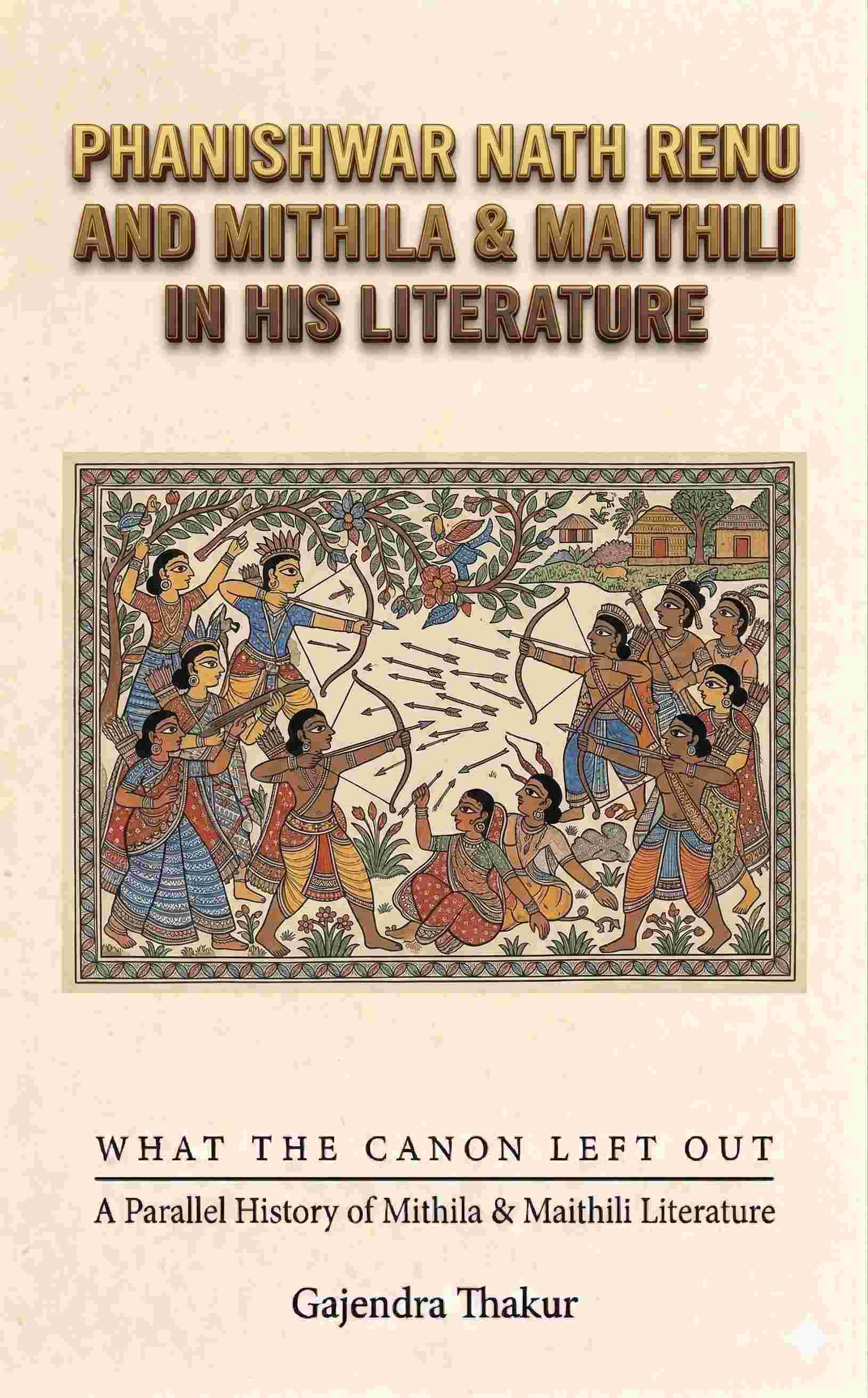
Phanishwar Nath Renu
and
Mithila & Maithili in His Literature
Phanishwar Nath Renu (1921–1977), one of the most towering figures of modern Hindi literature, occupies a singular position in Indian letters for his transformative contribution to the 'Aanchalik' (regional) tradition of fiction. Born and raised in the Forbesganj region of what is today Bihar's Purnia district a landscape steeped in the cultural, linguistic, and spiritual heritage of Mithila Renu's literary imagination was indelibly shaped by the soil, people, and idioms of this ancient land. His works, particularly the landmark novel Maila Aanchal (1954), represent not merely a stylistic departure in Hindi prose but a profound philosophical assertion: that the rural hinterland, long neglected by metropolitan literary discourse, is a universe complete in itself, worthy of the fullest artistic and humanistic attention.
This chapter undertakes a comprehensive examination of how Renu wove the cultural fabric of Mithila and the linguistic texture of Maithili into the body of his Hindi literature. Through close readings of his major novels and short stories, the chapter traces the ways in which Renu deployed Maithili words, phrases, folk songs (lokgeet), proverbs, myths, seasonal rituals, and castecommunity dynamics to create a literary geography that transcends regionalism to speak universally. The chapter also situates Renu's work within the broader sociopolitical context of postPartition, postIndependence India, exploring how his regional consciousness intersected with questions of nationalism, development, marginalization, and identity. Ultimately, the chapter argues that Renu's engagement with Mithila and Maithili is not ornamental but structural it is the very foundation upon which his literary vision is built.
1. Introduction: Renu, Mithila, and the Question of Literary Geography
2. Biographical Context: The Making of a Mithila Writer
3. Mithila as Literary Landscape in Renu's Fiction
4. The Role of Maithili Language in Hindi Prose
5. Folk Culture, Ritual, and Oral Traditions
6. Maila Aanchal: A Deep Reading
7. Parti Prasang and Other Works
8. Renu's Short Stories and the Maithili Sensibility
9. SocioPolitical Dimensions: Caste, Gender, and Power in Mithila
10. Renu's Place in the Aanchalik Sahitya Tradition
11. Critical Reception and Scholarly Debates
12. Legacy and Continuing Relevance
13. Conclusion
14. Bibliography
1. Introduction: Renu, Mithila, and the Question of Literary Geography
In the vast and variegated landscape of modern Hindi literature, few writers have so fundamentally altered the relationship between language, place, and narrative as Phanishwar Nath Renu. The publication of Maila Aanchal in 1954 sent a seismic tremor through the Hindi literary establishment not only because of its raw, unsparing depiction of rural life, but because it insisted that the village of Meridian, nestled in the Purnea district of Bihar, was as worthy a subject of literary investigation as the cities and salons that dominated the Hindi prose of the day.
The concept of 'Aanchal' literally, the corner or border of a sari, but metaphorically the periphery, the margins became the defining trope of Renu's literary career. He was not writing about the margins apologetically; he was claiming them as the centre. In doing so, he drew heavily on the specific cultural world of Mithila: its ancient Brahmanical traditions, its earthy lowercaste vitality, its women's songs (Sohar, Samachakwa, Bidesia), its festivals (Chhath, SamaChakeva, Madhushravani), its folk epics rooted in the Ramayana tradition of Sita's homeland, and above all, its language Maithili, one of the oldest and most literary languages of the Indian subcontinent.
This introduction sets out the central questions of this chapter: How does Renu use Mithila as both setting and symbol? What functions does the Maithili language perform within his Hindi prose? How does the regional operate as a vehicle for the universal in his fiction? And what does Renu's example tell us about the possibilities and the tensions of writing in Hindi about a world that thinks, sings, and grieves in Maithili?
2. Biographical Context: The Making of a Mithila Writer
2.1 Early Life and Cultural Formation
Phanishwar Nath Renu was born on 4 March 1921 in Aurahi Hingna village, Forbesganj tehsil, Purnia district (now in Bihar, then in Bengal Presidency). The PurniaKosi region in which he grew up was and remains a liminal space: geographically flat, seasonally flooded by the Kosi river (known as the 'sorrow of Bihar'), ethnically diverse, and socially complex. It was a region where Maithili, Bhojpuri, and Hindi all coexisted, where highcaste Maithil Brahmin culture of Mithila proper was inflected by the tribal and lowercaste cultures of the Kosi plains.
Renu's own caste background he belonged to the Kayastha community, traditionally associated with literacy and administration gave him access to the Brahmanical literary culture of Mithila without fully belonging to its priestly hierarchy. This ambivalent positioning was perhaps formative: it allowed him to observe and love Mithila's culture from a certain outsideness, to be simultaneously an insider and a critical observer.
2.2 Education, Politics, and the Literary Turn
Renu received his early education in Araria and later studied at Virat Nagar in Nepal. His political formation was deeply shaped by the Quit India Movement of 1942, in which he participated actively, and later by his involvement in the armed people's revolution in Nepal (1950–51) against the Rana oligarchy. These experiences of direct political action left a lasting mark on his literary sensibility: he never became a detached aesthete; his fiction always carries the weight of historical urgency.
It was only after returning from Nepal that Renu turned with full commitment to literary writing. He had already published some short stories, but the years 1952–54 saw the composition and publication of Maila Aanchal, which was initially greeted with bewilderment by some critics before being widely recognized as a landmark. The Nobel laureate Jainendra Kumar's comparison of Maila Aanchal to Phanishwar Gorky's works, and Rajendra Yadav's championship of Renu within the 'Nayi Kahani' movement, helped establish his canonical status.
2.3 The Kosi Flood Region as Renu's Literary World
The recurrent floods of the Kosi river are not merely backdrop in Renu's fiction they are a shaping force, both literal and metaphorical. The Kosi's unpredictability, its capacity to destroy and renew, its designation as the 'River of Sorrow' all of this feeds into Renu's vision of a world in which human life is perpetually subject to forces larger than individual will. The flooded Kosi plain is also a world of extraordinary natural beauty: its birds, its fish, its seasonal transformations, its silences all rendered with a sensory precision in Renu's prose that recalls the best of regional nature writing.
3. Mithila as Literary Landscape
3.1 The Ancient Kingdom of Mithila
Mithila is one of the oldest cultural regions of the Indian subcontinent, with a history stretching back at least three millennia. In the Hindu epic tradition, it is the kingdom of King Janaka philosopherking, author of the Ashtavakra Gita, and father of Sita. The Ramayana's account of Sita's birth, her childhood in Mithila, and her svayamvara (selfchoice marriage) at Janakpur has given the region a mythological stature that continues to be felt in its folk culture, its women's songs, and its art (the famous Madhubani/Mithila painting tradition).
Geographically, Mithila corresponds roughly to the northern plains of Bihar and adjoining parts of Nepal (the Terai region), bounded by the Gandak river to the west, the Mahananda to the east, the Himalayas to the north, and the Ganga to the south. This is the heartland of Maithili language and culture. Renu's native PurniaKosi district sits on the eastern edge of this cultural zone a borderland that absorbs Mithila's cultural influence while also being shaped by tribal and Bengali cultural currents.
3.2 Mithila's Cultural Geography in Renu's Imagination
In Renu's fiction, Mithila is not a nostalgic idyll. He does not romanticize the region in the manner of a cultural nationalist preserving a dying heritage. Rather, he depicts it with the full complexity of a living world: its beauty and its brutality, its cultural richness and its social stagnation, its creative vitality and its oppressive hierarchies. The festivals, songs, and rituals of Mithila appear in his fiction not as anthropological data but as lived experience felt in the body, embedded in memory, contested and reinvented by each generation.
"Renu saw in Mithila not a museum piece to be preserved but a living, breathing contradiction a world ancient and modern, pure and corrupted, singing and weeping, all at once." Literary scholar on Renu's regional vision
The landscape itself the flat plains, the maize fields, the mustard flowers, the bamboo groves, the ponds thick with lotus is rendered with an almost painterly attentiveness in Renu's prose. His descriptions of the Kosi floods, with their simultaneous terror and beauty, give his fiction a quality of elemental grandeur that lifts his village narratives into the realm of myth.
4. The Role of Maithili Language in Hindi Prose
4.1 Maithili: An Ancient Literary Language
Maithili is one of the oldest and most distinguished literary languages of South Asia. Its greatest classical poet, Vidyapati (c. 1352–1448 CE), wrote devotional lyrics (padavali) in the voice of Radha and Krishna that continue to be sung across Mithila, Bengal, and Nepal to this day. Maithili was also one of the first vernacular languages to develop a sophisticated prose tradition. In 1967, Maithili was included in the Eighth Schedule of the Indian Constitution as a recognized language; in 2003, it was formally included in the schedule, making it one of the 22 officially recognized languages of India.
Despite this ancient and distinguished literary heritage, Maithili has long existed in a politically subordinate relationship to Hindi in the postIndependence Indian state. The designation of Hindi as the official language of Bihar, and the subsequent marginalization of Maithili in education and administration, created a situation in which Maithili speakers were required to write in Hindi for any official or literary purpose. Renu navigated this situation with characteristic creativity: he wrote in Hindi, but saturated his Hindi prose with Maithili.
4.2 Maithili Words and Phrases as Stylistic Signatures
One of the most immediately recognizable features of Renu's prose style is its pervasive use of Maithili words, phrases, and idioms. These are not mere localcolour insertions but functional elements of his narrative. They carry semantic and emotional freight that standard Hindi cannot easily bear; they locate the narrative precisely in a social and cultural space; and they create a distinctive literary texture at once accessible and estranging that forces even the nonMaithili Hindi reader to slow down, to listen differently.
Common Maithili elements in Renu's prose include: kinship terms (Babuji, Kaka, Bhaujai, Jethaini), terms of endearment and address, folk exclamations and expletives, agricultural and occupational vocabulary, names of local birds, plants, and places, and fragments of Maithili folk songs interpolated into the narrative flow. These insertions function both realistically (characters speak as they would speak) and poetically (the Maithili fragment introduces a sonic and emotional register that Hindi cannot reproduce).
4.3 The Question of Linguistic Politics
Renu's use of Maithili in Hindi prose was not without political dimension. Writing in a period when the Maithili language movement was gathering strength demanding recognition, official status, and educational medium rights Renu's literary practice was itself a form of advocacy, demonstrating that Maithili could enrich and transform Hindi rather than being suppressed by it. At the same time, Renu's choice to write primarily in Hindi rather than Maithili has been debated: some Maithili literary activists have seen it as a concession to the dominant literary culture, while others have recognized it as a strategic choice that brought Mithila's world to a vastly larger readership.
5. Folk Culture, Ritual, and Oral Traditions
5.1 The World of Folk Songs (Lokgeet)
Perhaps no aspect of Renu's fiction is more distinctive or more demanding of the reader than his extensive use of folk songs. Maithili lokgeet (folk songs) are woven into the fabric of virtually all his major works, and they perform multiple narrative and thematic functions. They provide a counterpoint to the main narrative, commenting on events in oblique or ironic ways; they create emotional atmospheres that dialogue cannot achieve; they carry the voices of women who are often the most oppressed characters in Renu's world into a literary space that might otherwise silence them; and they testify to the depth and richness of an oral tradition that existed long before and will outlast the printed word.
The songs Renu uses span the full range of Maithili folk song traditions: Sohar (birth songs), Vivah geet (wedding songs), Bidesia (songs of absent husbands/seasonal migrants), Samachakwa (songs of the SamaChakeva festival), Jhumar, Kajri, and Chhath songs. Each song type carries specific cultural associations and emotional registers, and Renu deploys them with great precision. A Sohar at a crucial moment in the narrative, for instance, can transform a scene of individual joy into a communal celebration or, ironically, into a bitter contrast with the characters' actual suffering.
5.2 Festivals and Ritual Calendar
Mithila has one of the richest festival traditions in India, and Renu's fiction is organised, in part, around the ritual calendar. The great festivals Chhath Puja (the worship of the sun god and his wife, performed at rivers and ponds by women fasting in waistdeep water), SamaChakeva (a festival celebrating the return of migratory birds and, symbolically, the return of absent family members), Madhushravani (a women's festival involving the worship of snakes), and Makar Sankranti appear not as picturesque backdrop but as structuring events in the narrative, moments when the community assembles and its internal tensions and solidarities become visible.
Chhath Puja, in particular, holds special significance in Renu's fiction. The festival which involves elaborate rituals of fasting, bathing, and sunworship performed at the water's edge becomes in his work a symbol of the community's relationship to the natural world, its capacity for collective devotion, and the centrality of women to the spiritual and social life of the village. The beauty of the Chhath rituals, described with extraordinary vividness in Maila Aanchal and other works, stands in poignant contrast to the poverty and illness that often surrounds the characters who perform them.
5.3 Madhubani Art and Visual Culture
Mithila is also the home of Madhubani (or Mithila) painting, a folk art tradition of extraordinary antiquity in which geometric and figurative designs depicting deities, natural motifs, and scenes from the Ramayana are painted on walls and floors by women. Renu does not directly describe Madhubani painting in his fiction with any frequency, but the aesthetic sensibility that informs the art its rich colour, its symbolic use of natural imagery, its integration of the divine and the everyday is very much present in his literary style. Several scholars have noted the 'painterly' quality of Renu's prose descriptions, particularly his use of colour and visual detail.
6. Maila Aanchal: A Deep Reading
6.1 The Novel and Its Historical Context
Maila Aanchal, Renu's first and most celebrated novel, was published in 1954 just seven years after Indian Independence. The novel is set in the fictional village of 'Merigan gaon' (based on Simrauni village in Purnia district), in the period 1946–1947, the tumultuous years of Independence and Partition. It follows the young doctor Prashant Kumar, who comes from Patna to serve as a rural medical officer in this remote village, and falls in love with the beautiful, spirited Kamla a woman caught between the worlds of tradition and modernity, caste loyalty and human feeling.
But to describe Maila Aanchal as a love story or even primarily as a story of its main characters would be to miss its most radical formal achievement: the novel's true protagonist is the village itself the aanchal, the margin, the borderregion. Renu gives voice to an astonishing range of characters Brahmin priests, lowercaste weavers, Bihari Muslims, progressive activists, opportunistic politicians, suffering women, bewildered elders and shows their lives as simultaneously local and historical, embedded in the specific culture of Mithila and caught up in the great currents of Independence, land reform, and social change.
6.2 Mithila's Cultural World in the Novel
The cultural world of Mithila saturates every page of Maila Aanchal. The novel opens with a description of the village during the Chhath festival, immediately establishing the ritual calendar as a structuring principle. The folk songs sung at weddings, at births, at work in the fields, at moments of grief create a sonic landscape that is inseparable from the narrative. The Maithili language emerges through dialogue, exclamation, endearment, and argument, giving each character a distinctive voice rooted in their social position and cultural inheritance.
The caste structure of Mithila with its elaborate hierarchy of Brahmin subgroups, Kayastha scribes, merchant castes, artisan castes, and socalled 'untouchable' communities is rendered in its full complexity. Renu neither sentimentalizes nor demonizes any community; he shows the caste system as a living, contested, and internally diverse social order, in which individuals both reproduce and resist their assigned positions. The Maithil Brahmin characters, with their pride in learning and their sometimesoppressive authority, are drawn with particular complexity neither villains nor saints, but human beings shaped by a tradition that is simultaneously beautiful and unjust.
6.3 The 'Dirty Border' as Metaphor
The title Maila Aanchal 'The Soiled Border' or 'The Dirty Hem' is among the most resonant in Hindi literary history. The aanchal (the border/hem of a sari or dupatta) is a feminine symbol associated with women's clothing, women's bodies, and the domestic sphere. To call it 'maila' (soiled, dirty, stained) is to acknowledge that this feminine, marginal world has been dirtied by poverty, by exploitation, by the failures of the postIndependence state, by disease and ignorance.
"Mera yeh aanchal maila hai, par hridaya nahi (My border is soiled, but not my heart)." Renu, in the author's note to Maila Aanchal
This statement, which Renu himself offered as a gloss on his title, encapsulates his entire literary programme: an insistence on the dignity and integrity of the rural poor, even especially in their suffering. The soiled hem of the village woman becomes a symbol for the village itself: materially impoverished, socially marginalised, politically neglected, but alive with a vitality, a beauty, and a moral depth that the clean, urban world cannot match.
7. Parti Prasang and Other Major Works
7.1 Parti Prasang (1956)
Renu's second novel, Parti Prasang (1956), is less wellknown than Maila Aanchal but equally remarkable in its engagement with the Mithila region. Set against the backdrop of the Kosi flood control projects the massive statesponsored engineering works undertaken in the 1950s to tame the destructive Kosi river the novel explores the collision between the traditional agrarian world of Mithila and the new forces of state development, modern technology, and political mobilisation.
The Kosi floodcontrol project, with its thousands of migrant labourers, its corrupt contractors, its wellmeaning but confused government engineers, and its devastating impact on the traditional village life it was meant to save, becomes in Renu's hands a symbol of the ambiguous legacy of Independence: development as disruption, modernity as loss. The traditional Mithila village culture its folk songs, its seasonal rituals, its caste solidarities and conflicts is shown being eroded by the same forces that are supposed to bring progress and relief.
7.2 Juloos (1965)
Juloos, Renu's third novel, shifts the focus from rural to urban specifically to the world of smalltown political life in Bihar. But even here, the Mithila cultural world is present in the characters' speech, their songs, their memories of village life, and their continued embeddedness in caste and community networks. The novel is a sharp, satirical study of the corruption of the democratic political process in postIndependence India, with Renu showing how the idealism of the Independence generation has been replaced by a cynical pursuit of power and patronage.
7.3 Kitne Chaurahe (1966)
Kitne Chaurahe (How Many Crossroads) continues Renu's exploration of the moral disorientation of postIndependence Bihar, focusing on the lives of young people caught between traditional values and the lures of the new consumer society. The title's image of multiple crossroads captures Renu's sense of a society that has lost its way or rather, a society in which the old roads have been washed away by the floods of change without new ones being clearly marked.
8. Renu's Short Stories and the Maithili Sensibility
8.1 The Short Story as Form
Alongside his novels, Renu wrote approximately fifty short stories (kahaniyan) that are among the finest in the Hindi language. In these shorter works, the Maithili cultural world is often rendered with even greater intensity and concentration than in the novels. The stories range from lyrical evocations of folk festivals to sharp political satires, from tender portraits of village women to devastating critiques of caste oppression.
8.2 Landmark Stories
Among Renu's most celebrated stories, several are particularly notable for their engagement with Mithila and Maithili culture. Panchlight (1957) perhaps his most anthologized story depicts the arrival of a petromax lamp in a rural village and the way this small technological event becomes a stage for caste dynamics, gender politics, and community solidarity. The story is set in a recognizable Mithila village and uses Maithili folksong fragments and idiomatic speech to extraordinary effect.
Ras Priya (1959) is a masterpiece of compressed lyricism, following a Jyoktika (folk musician) as he plays the nagara drum during the Holi festival in a village that has been torn apart by political conflict. The story uses the frame of the traditional festival and its music to explore themes of artistic integrity, community belonging, and the corrupting effects of political power with the Mithila festival culture providing both the narrative occasion and the thematic counterpoint.
Thabir Jogi and Lal Pan Ki Bibi are further examples of stories in which Renu uses the specific social and cultural world of Mithila to explore universal themes of love, loss, exploitation, and resistance. In each case, the Maithili language and cultural tradition are not decorative but constitutive they make the story what it is.
9. SocioPolitical Dimensions: Caste, Gender, and Power
9.1 Caste in Renu's Mithila
The caste system of Mithila is among the most elaborate and rigorously maintained in India. The Maithil Brahmin community in particular has historically been renowned for its pride in ritual purity, genealogical recordkeeping (the famous panjis or genealogical registers), and the maintenance of strict rules of commensality and endogamy. Renu grew up in a world shaped by these structures, and his fiction both documents and critiques them.
What distinguishes Renu's treatment of caste from that of many other Hindi writers is his refusal of simple villainy and victimhood. The Brahmin characters in his fiction are not onedimensional oppressors; they are people shaped by a tradition that gives them real cultural authority and genuine learning even as it restricts and diminishes them. The lowercaste characters the weavers, the landless labourers, the Musahar (ratcatcher) community are depicted not as passive sufferers but as agents with their own cultural vitality, their own strategies of survival and resistance, their own beauty.
9.2 Women and Gender in Renu's Fiction
Renu's female characters are among the most complex and memorable in Hindi literature. The women of his Mithila fiction inhabit a world of extreme patriarchal constraint child marriage, widow restrictions, purdah (seclusion), economic dependence but they are far from passive. They sing, they resist, they love with full hearts, they carry the community's spiritual and cultural life on their bodies and in their voices.
The folk song tradition which in Mithila is overwhelmingly a women's tradition gives Renu's female characters a voice that the patriarchal social order cannot entirely suppress. The songs they sing at festivals, weddings, and work are full of irony, longing, celebration, and grief. Renu renders these songs with deep respect and careful attention, treating them as serious literary texts rather than mere folklore.
Figures like Kamla in Maila Aanchal, the LalPanKiBibi of his eponymous story, and the women protagonists of his Sohar stories are drawn with a psychological depth and emotional complexity that was unusual in Hindi fiction of the period. They desire, they suffer, they assert themselves, they fail and endure in ways that challenge both the patriarchal social world they inhabit and the literary conventions that had previously constrained the representation of rural women.
9.3 Politics and Development
A recurring theme in Renu's fiction is the betrayal of the rural poor by the postIndependence state. The promises of Independence land reform, poverty eradication, democratic participation are shown being systematically frustrated by a combination of uppercaste inertia, political corruption, bureaucratic indifference, and the structural disadvantages of an economy organised against the interests of the landless poor. The development projects of the 1950s and 1960s irrigation works, flood control, the Green Revolution are depicted not as unambiguous goods but as contested interventions that often serve the interests of the powerful at the expense of the weak.
10. Renu's Place in the Aanchalik Sahitya Tradition
10.1 Defining Aanchalik Sahitya
'Aanchalik Sahitya' (regional literature) is the critical term most commonly used to classify Renu's work, and it is a term he himself used to describe Maila Aanchal in his author's preface to the novel. But the term requires careful unpacking. It does not simply mean literature that is set in a particular region, or literature that uses regional dialect virtually all literature has some regional basis. Rather, Aanchalik Sahitya in Renu's sense involves a specific literary stance: one that valorises the regional against the metropolitan, that insists on the integrity and complexity of local cultural worlds, and that refuses to see the village or the small town as a mere backdrop for the drama of urban modernity.
In this sense, Renu's Aanchalik Sahitya has affinities with regional literary traditions in other world literatures: the American regionalism of Willa Cather and William Faulkner, the Russian provincial fiction of Nikolai Leskov and Alexander Ostrovsky, the Latin American magical realism of Gabriel Garcia Marquez (whose Macondo has often been compared to Renu's Merigan gaon). These comparisons illuminate Renu's achievement: he created, in Hindi, a literary geography as vivid and as humanly complex as any in world literature.
10.2 Renu's Predecessors and Contemporaries
In the Hindi tradition, Renu's immediate predecessor is Premchand, whose village fiction of the 1920s1930s set the stage for serious engagement with rural life in Hindi prose. But Premchand's village is primarily a stage for ideological conflicts between tradition and modernity, caste oppression and human dignity, feudalism and nascent democracy. Renu's village is more densely textured, more sensorially and culturally specific, more comfortable with moral ambiguity and cultural complexity.
Among Renu's contemporaries, the closest parallel is perhaps Shailendar in Bhojpuri literature, or the writers of the 'GangaJamuni' tradition who sought to represent the cultural hybridity of the North Indian plains. But none of them achieved quite Renu's synthesis of political engagement, cultural celebration, lyrical beauty, and unflinching social critique.
11. Critical Reception and Scholarly Debates
11.1 Initial Reception
The initial critical reception of Maila Aanchal was, famously, mixed. Some of the Hindi literary establishment accustomed to the urbane, psychologically sophisticated prose of the Nayi Kahani movement found Renu's novel excessively dialectal, plotless, and difficult to categorize. Others recognised it immediately as a landmark. The critic and novelist Jainendra Kumar was among the first to hail it as a masterpiece, comparing it to the great works of world realist fiction. The Hindi literary world gradually came around, and by the 1960s Renu's canonical status was secure.
11.2 Later Scholarly Work
Subsequent decades have seen a rich tradition of scholarly work on Renu's fiction, both in Hindi and in English. Key debates in this scholarship include: the question of how to classify Renu's literary use of Maithili (as dialect writing, as codeswitching, as literary bilingualism, or as something sui generis); the relationship between his fiction and the Maithili language movement; the politics of gender in his representation of village women; and the extent to which his Aanchalik vision constitutes a coherent political programme or merely a cultural romanticism.
11.3 Renu and World Literature
In recent decades, there has been growing interest in situating Renu within the context of world literature. His affinities with magical realism (particularly Gabriel Garcia Marquez) have been extensively discussed, though scholars like Francesca Orsini have cautioned against seeing these affinities as mere influencerelations rather than parallel responses to comparable historical situations (colonial/postcolonial societies undergoing rapid modernisation). Renu's work has also been read in relation to postcolonial theory, subaltern studies, and the politics of language in multilingual societies.
12. Legacy and Continuing Relevance
12.1 Influence on Subsequent Writers
Renu's influence on subsequent Hindi literature has been immense, though often indirect. The generation of Hindi writers who came after him including Shrilal Shukla (Raag Darbari), Vinod Kumar Shukla, and many others have engaged, sometimes critically, with the Aanchalik tradition he founded. The distinctive technique of incorporating folk songs and regional idioms into Hindi prose which Renu pioneered has been widely imitated, though rarely with Renu's mastery. He also had direct influence on Maithili literature, inspiring a generation of Maithili writers to take their own cultural world as serious literary material.
12.2 The Mithila Cultural Renaissance
Renu wrote during a period of significant cultural and political ferment in Mithila, and his fiction both reflected and contributed to that ferment. The Maithili language movement, which achieved constitutional recognition in 2003, drew on the cultural prestige that Renu's work had helped to create. The growing international recognition of Madhubani painting, which began in the 1960s, paralleled and intersected with Renu's literary celebration of Mithila. In recent years, the creation of the state of Jharkhand (2000), the growing demands for a separate Mithila state, and the continuing vitality of Maithili literature in print and digital media all speak to the ongoing relevance of the cultural world Renu depicted.
12.3 Renu in the Age of Globalization
It might seem that in an age of globalisation, digital culture, and rapid urbanisation, the world Renu depicted the flooded Kosi plains, the Chhath rituals at the water's edge, the songs of absent husbands, the complex negotiations of caste and kinship would have receded into nostalgic irrelevance. In fact, the opposite appears to be the case. The Chhath festival has become perhaps the most widely observed diaspora festival among Bihari and Maithili communities across India and the world. Madhubani painting has achieved global recognition. And Renu's fiction continues to attract new readers who find in it not only a documentary record of a vanished world but a living artistic vision that speaks to the experience of displacement, marginality, and the struggle for dignity.
13. Conclusion
This chapter has argued that Phanishwar Nath Renu's engagement with Mithila and Maithili is not a peripheral feature of his work but its very foundation. The cultural world of Mithila its landscape, its folk songs, its ritual calendar, its caste and gender dynamics, its ancient literary heritage in the Maithili language provides Renu with not only his material but his forms, his aesthetics, and his ethics.
Renu demonstrates, through the body of his fiction, that the regional is not the opposite of the universal but its necessary condition. It is only by being fully, uncompromisingly Maithili embedded in the specific sights, sounds, smells, and struggles of the Kosi plain that his fiction achieves its claim on readers everywhere who have ever felt themselves to be from the margin, to be made of the soiled hem rather than the clean centre.
In the Hindi literary tradition, Renu stands as the writer who most completely made a specific regional culture into a vehicle for the deepest human questions. His Mithila is both a real place and a literary achievement: a world that exists in the imagination of every reader who has passed through his pages, and that continues to expand with each new reading.
"Maine apni dharti ko apni bhasha mein likhne ki koshish ki hai. Aur yahi mera sahitya hai. (I have tried to write my land in my language. And this is my literature.)" Phanishwar Nath Renu
14. Bibliography
Primary Sources
Renu, Phanishwar Nath. Maila Aanchal. Patna: Rajkamal Prakashan, 1954.
Renu, Phanishwar Nath. Parti Prasang. Delhi: Rajkamal Prakashan, 1956.
Renu, Phanishwar Nath. Juloos. Delhi: Rajkamal Prakashan, 1965.
Renu, Phanishwar Nath. Kitne Chaurahe. Delhi: Rajkamal Prakashan, 1966.
Renu, Phanishwar Nath. Thumpnama: Sampurna Kahaniyan (Complete Stories). Delhi: Rajkamal Prakashan, 2002.
Renu, Phanishwar Nath. The Soiled Border [Maila Aanchal, trans. Rimli Bhattacharya]. New Delhi: Penguin Books, 2016.
Secondary Sources
Bhattacharya, Rimli. 'Introduction: Reading Renu.' In The Soiled Border. New Delhi: Penguin, 2016.
Gaur, Madan. Renu ka Aanchalik Sahitya. Patna: Bihar Rastrabhasha Parishad, 1974.
Govind, Nikhil. 'Renu's Literary Geography and the Politics of Aanchalik Sahitya.' Modern Asian Studies, vol. 48, no. 3, 2014.
Jha, Makhan. The Ecology of a Festival: Chhath and the Mithila World. Delhi: Manohar, 1997.
Kumar, Arun. Renu: Ek Adhyayan. Delhi: Vani Prakashan, 1990.
Misra, V.N. The Maithili Language and Literature. Patna: Mithila Institute, 1976.
Orsini, Francesca. The Hindi Public Sphere 1920–1940. New Delhi: Oxford University Press, 2002.
Pandey, Gyanendra. 'The Village and the Region in Modern Hindi Fiction.' In The Prose of History. Delhi: Oxford University Press, 2009.
Ramvilas Sharma. Phanishwar Nath Renu ke Upanyas. Delhi: Rajkamal Prakashan, 1967.
Singh, Namwar. Kahani: Nai Kahani. New Delhi: Rajkamal Prakashan, 1966.
Srivastava, Harish. Renu ka Lokjeevan. Varanasi: Vishwavidyalaya Prakashan, 1981.
Tharu, Susie and K. Lalita, eds. Women Writing in India, Vol. 2. New Delhi: Oxford University Press, 1993.
Vidyapati. Songs of Vidyapati, trans. Deben Bhattacharya. London: Allen & Unwin, 1963.
अपन मंतव्य editorial.staff.videha@zohomail.in पर पठाउ।
विदेहमे सभठाम ताकू / Search all Videha
Static full-text search · Pagefindलेखक/शीर्षक/अंक/वर्ष — खोज-विधा। गद्य/पद्य/शोध current/static + पुरान Videha/Sadeha contents खोजैत अछि। पोथी pothi.htm केर पूर्ण listing, श्रव्य-दृश्य Audio_Video.htm केर पूर्ण listing, पञ्जी videha-sadeha/panji-shards GitHub data, आ थेसारस/शब्दकोश videha-ejournal.github.io/data GitHub JSON corpus केँ query करैत अछि आ दूनू Quiz corpus मे dictionary/vocabulary/शब्दार्थ-सम्बन्धी प्रश्नोत्तरी परिणाम सेहो जोड़ैत अछि। Quiz videha-quiz आ GitHub user-site दूनू bilingual quiz corpus खोजैत अछि। Roman/IAST + देवनागरी cross-script search समर्थित। Issue/Year लेल संख्या दिअ। PDF-अभिलेख archive.org/VidehaAndSadeha सूची खोजैत अछि।