
Gajendra Thakur
A PARALLEL HISTORY OF MITHILA & MAITHILI LITERATURE- PART 34
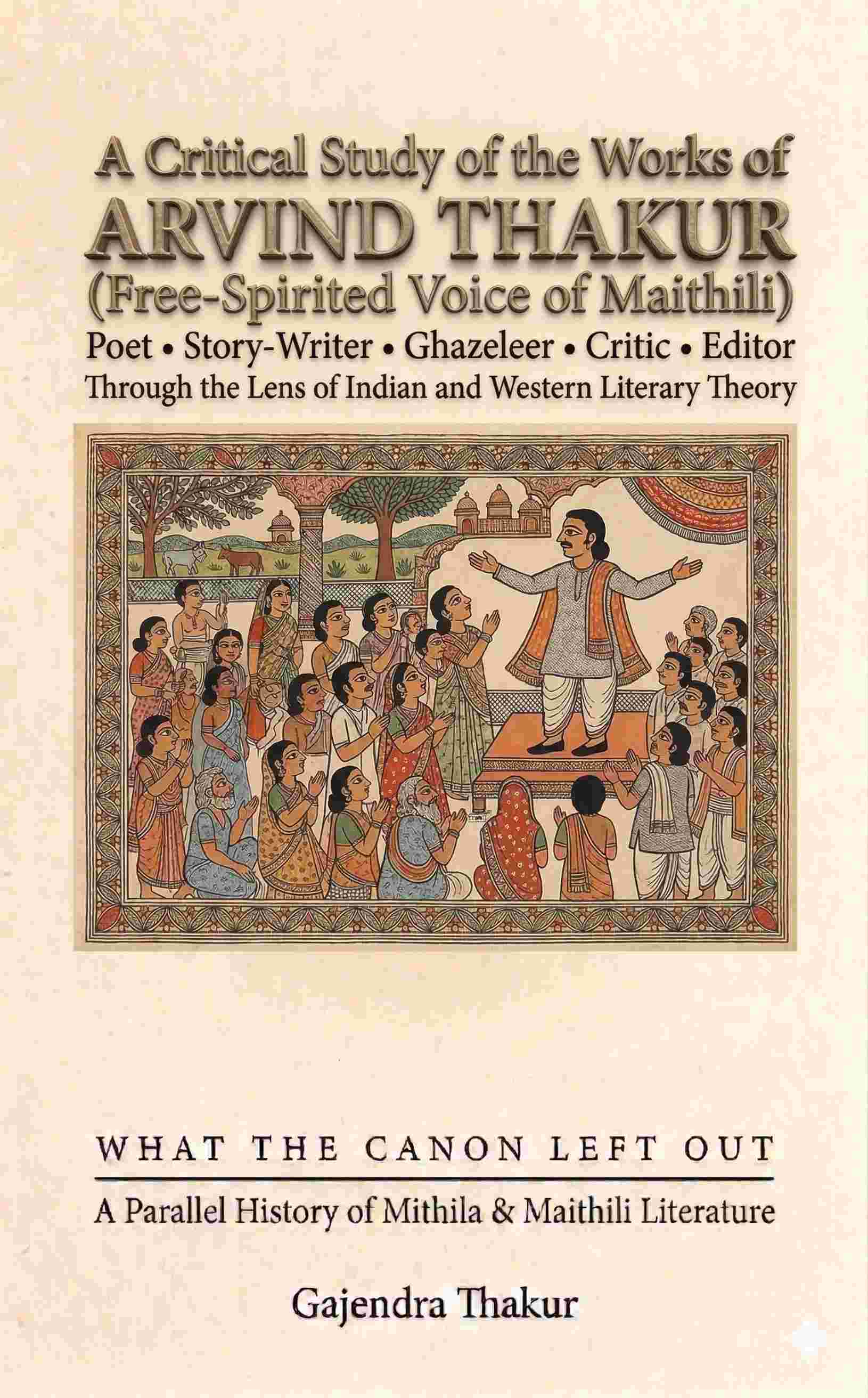
A Critical Study of the Works of ARVIND THAKUR (Free-Spirited Voice of Maithili) Poet- Story-Writer-Ghazeleer-Critic-Editor Through the Lens of Indian and Western Literary Theory
A Critical Study of the Works of ARVIND THAKUR
(Free-Spirited Voice of Maithili)
Poet • Story-Writer • Ghazeleer • Critic • Editor
Through the Lens of Indian and Western Literary Theory
This chapter undertakes a comprehensive critical examination of the literary oeuvre of Arvind Thakur (अरविन्द ठाकुर), one of the most distinguished and iconoclastic voices in contemporary Maithili literature. Known by the epithet ‘Swatantracheta’ (the free-spirited, the independently-minded), Thakur is based in Supaul, Bihar, and has authored ten independent publications and contributed to twelve collaborative anthologies. His work spans poetry collections, ghazal collections, short story collections, a long poem (deergh kavita), a collection of prose-essays (kathetara gadya), a volume of editorials, and a volume of literary criticism.
The chapter applies both Indian aesthetic frameworks—rasa theory, dhvani (theory of resonance and suggestion), vakrokti (oblique speech), auchitya (propriety), and the Marxist-inflected progressive literary tradition of South Asia—alongside Western critical frameworks including Adorno’s critical theory, Gramscian cultural hegemony, postcolonial theory, the Bakhtinian concept of the carnivalesque, feminist literary criticism, and ecocriticism. Through this dual analytical lens, the chapter illuminates how Thakur’s poetry constitutes a sustained, formally sophisticated, politically committed, and spiritually resonant engagement with the crises of contemporary Mithila and the world.
Table of Contents
1. Introduction: Author, Context, and the Epithet ‘Swatantracheta’
2. The Maithili Literary Tradition and the Videha Platform
3. Survey of Works: A Bibliographic Overview
4. Theoretical Frameworks: Indian and Western
5. Thematic Analysis
5.1 The Poetry of Dissent: Darkness and Its Resistance
5.2 The Ghazal as Political Form: ‘Bahurupiya Pradesh Me’ and ‘Meen Tulasipat Par’
5.3 The Long Poem and Epic Consciousness: ‘Jarataka Prativaad Me’
5.4 Prose Fiction and the Logic of the ‘Least Common Multiple’
5.5 Critical and Editorial Prose: Language, Power, and Literary Institution
5.6 The Fallow Land Breaks: Earth, Labour, and Ecological Consciousness
6. Formal Analysis: Craft, Language, and Innovation
7. Comparative Perspectives
8. Reception, Influence, and Place in Literary History
9. Conclusion
10. Bibliography
1. Introduction: Author, Context, and the Epithet ‘Swatantracheta’
Arvind Thakur is one of the most distinctive voices in contemporary Maithili literature—a poet, story-writer, ghazeleer, literary critic, and editor whose work has been published in and archived by Videha (www.videha.co.in), the pioneering Maithili fortnightly eJournal, as well as by the Central Institute of Indian Languages (CIIL). His Twitter profile describes him as ‘sampadak, stambhakaar, kavi, kathakar, samalochak, bharatvaadi’ (editor, columnist, poet, story-writer, critic, Indian nationalist)—a self-description that signals the intentional multiplicity of his creative and intellectual identities.
He is rooted in Supaul, Bihar, one of the districts of the Maithili heartland situated in the Kosi river basin—a geography of extraordinary ecological fragility, periodically devastated by floods, and characterised by a social structure that has historically subjected its lower-caste and landless populations to severe economic and caste-based violence. This landscape—the flooded fields, the broken earth, the dark silences of an unjust social order—is the material ground of Thakur’s literary imagination.
The epithet ‘Swatantracheta’—applied to Thakur in the title of the Videha Special Issue dedicated to him (‘Swatantracheta—Arvind Thakur: Vyaktitva-Krititva’, edited by Ashish Anchinhar)—is not merely an honorific. It constitutes a critical characterisation of his literary practice: an independence of mind that refuses to be co-opted by literary establishments, ideological fashions, or institutional patronage. The Maithili literary blog commentary preserved at sites associated with Videha notes that Thakur is among those who maintain ‘reedh ki haddi’ (a backbone)’ in a literary milieu where institutional pressures frequently compromise creative freedom. This editorial independence is enacted not only in his writing but in his practice as an organiser of the ‘Sagar Raati Deep Jaray’ (All-Night Lamp-Lighting) literary festivals in Supaul.
The Videha Arvind Thakur Special Issue (ISBN: 978-93-340-1233-0), edited by Gajendra Thakur and published as part of the journal’s series on living writers, editors, activists, and theatre practitioners, constitutes the primary critical document through which his work has been assessed by the Maithili literary community. This chapterdraws on that special issue, the entries from the Maithili Wikipedia, his author descriptions at Videha, and his Twitter/X profile to construct a comprehensive critical study of his oeuvre.
2. The Maithili Literary Tradition and the Videha Platform
To situate Arvind Thakur within the appropriate literary and cultural coordinates, it is necessary to recall both the depth and the tensions of the Maithili literary tradition. Maithili is one of India’s twenty-two scheduled languages, spoken by approximately fifty million people in the Mithila region of Bihar, Jharkhand, and the Terai districts of Nepal. Its literary history extends at least to the fourteenth century, when the poet Vidyapati (c. 1352–1448) established it as a vehicle of lyric and devotional beauty that would influence subsequent generations across South and Southeast Asia.
The modern period of Maithili literature is characterised by a productive tension between two broad currents: a conservative current that privileges the language’s classical heritage, caste-elite associations, and devotional forms; and a progressive current, emerging most forcefully from the mid-twentieth century onwards, that insists on Maithili’s adequacy as a medium for social critique, democratic aspiration, and experimental form. Thakur belongs unambiguously to the second current, while his formal sophistication ensures that he never simply repudiates the first.
Videha (ISSN 2229-547X), edited by Gajendra Thakur and published fortnightly since January 2008, has been the principal platform through which progressive and experimental Maithili writing has circulated in the digital age. Its archive (www.videha.co.in/pothi.htm) contains hundreds of works—from classical texts to contemporary poetry—and its series of special issues on living Maithili writers, editors, and activists has created an invaluable documentary record of the literary culture of contemporary Mithila. The Videha Arvind Thakur Special Issue is one of the most significant volumes in this series.
Thakur’s works are additionally available through the Central Institute of Indian Languages (CIIL), whose support for Maithili writing reflects the language’s recognition at the national institutional level. The intersection of the Videha platform and CIIL institutional support in Thakur’s publishing history marks him as a writer positioned at the intersection of grassroots literary activism and national institutional acknowledgement—a position that is itself a form of cultural politics.
3. Survey of Works: A Bibliographic Overview
Based on sources including the Maithili Wikipedia, the Videha archive, the Videha Arvind Thakur Special Issue, and Thakur’s own social media profile, the following is a complete bibliographic survey of his documented independent publications:
3.1 Poetry Collections (Kavita Sangrah)
• ‘Parti Tooti Rahal Achhi’ (‘The Fallow Land Is Breaking’) — Maithili poetry collection — 1993
• ‘Sabad Mitaarath Ghaayyaa’ (‘Words That Strike and Wound’ / ‘Words That Erase the Wound’) — Maithili poetry collection — 2016
• ‘Jarataka Prativaad Me’ (‘In Protest against Stagnation/Inertia’) — long poem (deergh kavita) — 2022
The three poetry collections span nearly three decades and trace the arc of Thakur’s poetic development from the earthy social realism of his first collection through the more concentrated linguistic experimentation of his second to the epic sweep of his long poem.
3.2 Ghazal Collections (Ghazal Sangrah)
• ‘Bahurupiya Pradesh Me’ (‘In the Land of Many Masks / In the Land of Shapeshifters’) — ghazal collection — 2011
• ‘Meen Tulasipat Par’ (‘A Fish on a Tulsi Leaf’) — Maithili ghazal collection — 2020
The two ghazal collections demonstrate Thakur’s mastery of a Persian-Urdu form that has been adapted into Maithili and given a distinctly regional political and ecological content.
3.3 Short Story Collections (Katha Sangrah)
• ‘Anhaaraka Virodh Me’ (‘In Opposition to Darkness’) — short story collection (laghu katha sangrah) — 2007
• ‘Laghuttamasamapavartya’ (‘The Least Common Multiple’ — a mathematically-derived title) — story collection — 2023
• ‘Srijan Ker Deep-Parva’ (‘The Lamp-Festival of Creation’) — story (co-edited with Kedar Kanan) — 1993
The three story collections reveal a prose stylist who moves between social realism and a more experimental, philosophically charged mode, with the mathematical title of his 2023 collection signalling a characteristic intellectual playfulness.
3.4 Non-Fiction Prose Collections
• ‘Roshanaaik Lokpaksha’ (‘The Popular/People’s Side of Light’) — kathetara gadya (non-fictional prose) collection — 2022
• ‘Kar Par Kaal-Turanga’ (‘Time’s Steed Upon the Hand’ / ‘The Horse of Time in the Palm’) — editorial collection (sampadakiya sangrah) — 2022
These two collections of non-fictional prose are among the most significant documents of Thakur’s critical and editorial intelligence. Editorials and opinion pieces—‘kar par kaal-turanga’ is the collected harvest of his editorial practice—constitute a genre that is under-studied in Maithili literary scholarship.
3.5 Literary Criticism
• ‘Kshitikanak Kshetrafal’ (‘The Area of a Dust-Particle’ / ‘The Field of a Mote’) — criticism collection (aalochana sangrah) — 2024
This 2024 volume marks Thakur’s most sustained engagement with formal literary criticism—the work of a writer who has moved from practitioner to theorist without abandoning the practitioner’s insights.
3.6 Collaborative Works
In addition to the ten independent publications above, Thakur has contributed to twelve shared anthologies (saajhaa sangrah), reflecting his deep integration into the collaborative culture of Maithili literary life. These include the ‘Srijan Ker Deep-Parva’ collection (1993, co-edited with Kedar Kanan), which marks one of his earliest engagements with editorial practice.
4. Theoretical Frameworks: Indian and Western
A critical analysis adequate to the complexity of Thakur’s work requires both Indian and Western analytical frameworks. His poetry is simultaneously rooted in the Sanskrit aesthetic tradition, engaged with the progressive literary politics of post-Independence India, and conversant with contemporary global debates about language, power, and ecological crisis.
4.1 Indian Critical Frameworks
4.1.1 Rasa Theory (Bharata’s Natyashastra, c. 200 BCE–200 CE)
The Natyashastra’s theory of rasa—aesthetic emotion aroused in the sensitive reader by a literary work—provides a fundamental vocabulary for describing Thakur’s emotional register. The dominant rasas in his poetry are karuna (compassion, pathos) and raudra (righteous anger, fury). His first collection’s title, ‘Parti Tooti Rahal Achhi’, announces the karuna of the broken earth and the broken social body; his ghazal collections and the long poem introduce increasingly strong notes of raudra, the anger of one who has witnessed injustice too long and too clearly to remain sedate.
The rasa of vira (heroism) is also present, but in Thakur it is always ‘popular heroism’—the courage of common people, of the labourer, the woman, the marginalised community—rather than elite or martial heroism. This democratisation of vira rasa is itself a political act, consistent with the progressive tradition within which Thakur writes.
4.1.2 Dhvani Theory (Anandavardhana, c. 850 CE)
Anandavardhana’s Dhvanyaloka argues that the highest poetry communicates through dhvani—resonance or suggestion—layers of meaning that exceed the literal. Thakur’s titles are paradigmatically dhvanic. ‘Sabad Mitaarath Ghaayyaa’ operates simultaneously across at least three registers: words (sabad) that erase (mitaarath) wounds (ghaayyaa); words that wound by erasing; and words whose own wounding is what erases—a compressed semantic complexity that exemplifies dhvani. ‘Meen Tulasipat Par’ (A Fish on a Tulsi Leaf) deploys the image of a creature out of its natural element, gasping on a sacred leaf: the dhvani simultaneously resonates as ecological displacement, spiritual alienation, and the condition of the progressive intellectual in a hostile social environment.
Similarly, ‘Laghuttamasamapavartya’—the mathematical term for ‘Least Common Multiple’—carries the dhvani of the community’s minimum common denominator of shared humanity; of the smallest unit that contains all the factors; of a mathematics of solidarity that refuses to ignore any element of the social whole.
4.1.3 Vakrokti (Kuntaka, c. 1000 CE)
Kuntaka’s Vakroktijivita—the theory of ‘oblique or deviant expression’ as the defining mark of literary creativity—is particularly apt for reading Thakur’s linguistic practice. His titles deliberately court obliqueness: ‘Kar Par Kaal-Turanga’ (Time’s Steed Upon the Hand)—a phrase that combines temporal urgency with the image of the palm as the field of fate (a reference to palmistry and the Sanskrit concept of ‘kaar’ as both action and hand)—exemplifies vakrokti in its refusal of direct statement. His mathematical title ‘Laghuttamasamapavartya’ is itself a form of vakrokti: approaching the human through the language of mathematics constitutes an ‘oblique expression’ that illuminates precisely by its unexpectedness.
4.1.4 Progressive Literary Tradition (Nayi Kavita, Marxist Criticism)
Within the specifically South Asian literary-critical tradition, Thakur belongs to the progressive school that descends from the Nayi Kavita (New Poetry) movement of post-Independence Hindi and Maithili literature, with its commitment to social realism, democratic aspiration, and the critique of caste and class structures. His self-description as ‘bharatvaadi’ (Indian nationalist) is interesting in this context: it signals a commitment to the constitutional vision of India—inclusive, democratic, secular—as distinct from a Hindu-nationalist or caste-supremacist vision.
The Videha editorial commentary preserved at maithili-katha.blogspot.com, drawing on Foucault’s concept of the ‘disciplinary institution’ and the psychological concept of ‘gaslighting’, situates Thakur within a progressive literary culture that is actively theorising the mechanisms of literary power in Maithili literary institutions. Thakur’s own critical collection ‘Kshitikanak Kshetrafal’ (2024) carries forward this project.
4.2 Western Critical Frameworks
4.2.1 Theodor Adorno: Critical Theory and Committed Art
Adorno’s insistence, in ‘Commitment’ (1962), that politically committed art risks reducing art to propaganda—and his counter-argument, in Aesthetic Theory, that the most genuinely resistant art is that which maintains formal integrity even while embodying social truth—is directly relevant to Thakur’s practice. His ghazal form embodies this tension: the ghazal is a highly formalised, aesthetically demanding structure, yet Thakur deploys it in the service of social critique. The formal difficulty of the ghazal becomes, paradoxically, a form of democratic challenge—demanding that the reader engage seriously with language and form as well as social content.
4.2.2 Antonio Gramsci: Cultural Hegemony and the Organic Intellectual
Gramsci’s concept of the ‘organic intellectual’—one who emerges from a subordinate class and articulates its interests within the field of culture—is illuminating for Thakur’s social position and literary practice. His base in Supaul (rather than the metropolitan centres of Patna, Delhi, or Darbhanga), his editorial practice of organising literary events at the grassroots level, his resistance to the institutional-literary establishment (‘reedh ki haddi’ as a badge of honour), and his insistence on writing about the lived experience of common people all mark him as an organic intellectual in the Gramscian sense.
Gramsci’s further concept of ‘cultural hegemony’—the way in which dominant classes maintain their power not only through coercion but through the cultivation of a consensus that makes their values seem natural and universal—is the target of Thakur’s critical and literary practice. The title ‘Bahurupiya Pradesh Me’ (In the Land of Shapeshifters) implies a diagnosis of cultural hegemony: a land in which power perpetually changes its mask, adopting new faces while maintaining old structures.
4.2.3 Mikhail Bakhtin: Heteroglossia, Carnival, and the Novel
Bakhtin’s concept of heteroglossia—the presence of multiple social voices and languages within a single literary text—is relevant to Thakur’s practice both as a poet and as an editor. His editorials gather and contest multiple voices within the Maithili literary field; his fiction deploys the voices of common people, women, and marginalised communities alongside those of the literary elite. Bakhtin’s concept of the ‘carnivalesque’—the temporary inversion of social hierarchies in folk festive culture, which in literature becomes a formal principle of counter-hegemonic expression—connects with Thakur’s practice of organising all-night literary festivals (‘Sagar Raati Deep Jaray’) that enact a communal, festive relation to literary culture.
4.2.4 Postcolonial Theory: Frantz Fanon, Homi Bhabha
Fanon’s analysis of the ‘pitfalls of national consciousness’—the ways in which the national elite, after independence, perpetuates colonial structures of exploitation in new forms—provides a framework for reading ‘Bahurupiya Pradesh Me’: the shapeshifters are precisely those who adopt new nationalist or religious masks while maintaining old structures of caste-based and class-based power. Bhabha’s concept of mimicry—the postcolonial subject’s performance of colonial identity in ways that simultaneously submit and subvert—illuminates the ‘masks’ of Thakur’s ‘bahurupiya’ (shapeshifter) trope.
4.2.5 Ecocriticism: Raymond Williams, Rob Nixon
The Kosi river basin in which Supaul is situated is one of the most flood-prone regions in the world, regularly termed ‘Bihar’s sorrow’. Rob Nixon’s concept of ‘slow violence’—environmental harm that is gradual, dispersed, and therefore systematically ignored by media and political institutions that privilege spectacle—is directly applicable to the ecological consciousness that pervades Thakur’s first collection, ‘Parti Tooti Rahal Achhi’. The breaking of the fallow land is simultaneously ecological (the flooding and erosion of the Kosi basin), social (the breaking of old social structures), and spiritual (the breaking of silence and passivity).
Raymond Williams’s concept of the ‘country and the city’—the way in which pastoral and anti-pastoral representations of rural life encode ideological positions about social hierarchy—is relevant to Thakur’s insistence on writing from and about Supaul rather than adopting a metropolitan literary persona.
4.2.6 Feminist Literary Criticism
Thakur’s story collection ‘Anhaaraka Virodh Me’ (In Opposition to Darkness) and elements of his poetry engage with the specific forms of darkness that women experience in the patriarchal structures of Mithila: the dowry system, the constraint of purdah, the silencing of female voices in literary as well as social institutions. His non-fictional prose collection ‘Roshanaaik Lokpaksha’ (The People’s Side of Light) signals a feminist commitment through its insistence on the ‘popular’ or ‘people’s’ dimension of illumination—light as democratic possibility rather than as elite privilege.
5. Thematic Analysis
5.1 The Poetry of Dissent: Darkness and Its Resistance
The title ‘Anhaaraka Virodh Me’—literally ‘In Opposition to Darkness’—functions as the ethical key to Thakur’s entire literary project. Darkness (anhaar, andhkar) is a recurrent and multivalent symbol in Maithili literary culture: it connotes ignorance, caste oppression, economic deprivation, political corruption, and the ecological darkness of the flooded, unlit Kosi basin villages. To write ‘in opposition to darkness’ is to commit to a literature of witness, critique, and hope—the three movements of what might be called Thakur’s poetic dialectic.
His first poetry collection, ‘Parti Tooti Rahal Achhi’ (1993), establishes the foundational image of Thakur’s poetic world: the ‘parti’ (fallow or uncultivated land) that is ‘tooti’ (breaking). In South Asian agrarian culture, the breaking of fallow land carries an ambivalence: it can signify the beginning of cultivation and therefore of hope, or it can signify the erosion and breaking apart of land that can no longer sustain life. In Thakur’s collection, both meanings are held in productive tension. The poetry witnesses the breaking—the social breakdown, the ecological crisis, the fracture of traditional community bonds under the pressures of modernity, migration, and caste violence—while also identifying in that breaking the possibility of new growth.
The second collection, ‘Sabad Mitaarath Ghaayyaa’ (2016), marks a significant formal and thematic development. The title’s semantic complexity—words that wound, erase, and heal simultaneously—signals a poetry that has become self-consciously meta-linguistic, reflecting on its own medium and the power of language to both harm and liberate. This is characteristic of the mature Thakur: a poet who has moved from the primarily social-realist register of his first collection to a more philosophically sophisticated interrogation of the relationship between language, power, and resistance.
Using Adorno’s framework: the formal sophistication of ‘Sabad Mitaarath Ghaayyaa’—its engagement with the materiality of the Maithili language, its sonic and semantic ambiguities—is itself the mark of genuine critical resistance. A poetry that is merely programmatically oppositional remains within the terms of what it opposes; a poetry that interrogates language itself reaches for a more fundamental critique.
5.2 The Ghazal as Political Form
The ghazal is a classical Persian form, adopted into Urdu and subsequently into Hindi and numerous other South Asian languages including Maithili. In its classical form, the ghazal is characterised by a fixed rhyme-and-refrain scheme (the radif and qafia), by the isolation of its couplets (she’r) as self-contained units, and by the signature couplet (maqta’) in which the poet names himself. Thematically, the classical ghazal privileges the pain of separation from the beloved, the wine of mystical experience, and the poet’s relation to his or her community of listeners.
Thakur’s two ghazal collections—‘Bahurupiya Pradesh Me’ (2011) and ‘Meen Tulasipat Par’ (2020)—adapt this classical form to radically different content. The beloved of the classical ghazal is transposed into the people of Mithila; the wine of mystical longing becomes the intoxication of democratic aspiration; the separation (‘viraha’) of the classical form becomes the political separation of the people from justice, land, and linguistic rights. This transposition is not a simple substitution; it works through the formal architecture of the ghazal, which creates an ironic distance between the form’s classical associations and the contemporary social content. The reader familiar with the ghazal tradition experiences a pleasurable and disturbing recognition: this is a love poem about political justice.
The title ‘Bahurupiya Pradesh Me’ introduces the central political metaphor: the land of shapeshifters, of those who wear multiple masks, of a political and social culture characterised by dissimulation and the performance of identity. In Maithili culture, the ‘bahurupiya’ (shapeshifter/mimic) is a figure from folk performance traditions—a street artist who assumes multiple disguises—whose appearance in political poetry carries the dhvani of the colonised subject performing identities under colonial surveillance, and of the postcolonial political actor who adopts ideological masks to maintain power.
The image of ‘Meen Tulasipat Par’ (A Fish on a Tulsi Leaf) deploys the juxtaposition of the sacred and the natural as a figure for spiritual-ecological crisis. The tulsi plant is sacred to Vaishnavism; the fish is an emblem of fertility and life in the Gangetic plain. A fish gasping on a sacred leaf is simultaneously an ecological image (displaced creature, unsuitable environment), a spiritual image (the sacred and the living in wrong relation), and a political image (the people—fish, creatures of the water—placed on the dry surface of ideology). The economy of the image—its capacity to carry multiple registers simultaneously—exemplifies the dhvani principle applied to the ghazal form.
5.3 The Long Poem and Epic Consciousness: ‘Jarataka Prativaad Me’
The publication in 2022 of ‘Jarataka Prativaad Me’ (In Protest against Stagnation/Inertia) as a ‘deergh kavita’ (long poem) marks a significant formal development in Thakur’s poetic career. The long poem in Indian literary tradition has a distinguished ancestry: from the Sanskrit mahakavya (epic poem) through the medieval narrative poems of Vidyapati’s padavali to the modern ‘prasav-geet’ (birth-songs) and protest-poems of the Nayi Kavita movement. The deergh kavita allows a poet to sustain a complex argument across an extended canvas—to develop images, introduce characters, enact temporal progression, and achieve a cumulative emotional and intellectual force that the brief lyric cannot.
‘Jarataka Prativaad Me’—‘In Protest against Jarata’—names its target with philosophical precision. Jarata (stagnation, inertia, the quality of being jara—old, rigid, calcified) is the term for the social, intellectual, and spiritual hardening that prevents transformation. In Indian philosophy, jara (ageing and its associated rigidity) is listed among the great human afflictions; in the social-political register, jarata is the conservatism that resists necessary change. To write a long poem ‘in protest against jarata’ is to position oneself against all forms of calcification—caste hierarchy, institutional ossification, literary conservatism, ideological dogmatism, ecological indifference.
The Gramscian framework is again productive here: the long poem is a formal vehicle for sustained counter-hegemonic argument. Like Gramsci’s own ‘prison notebooks’—long, discontinuous, necessarily allusive—Thakur’s long poem enacts the difficult labour of thinking against the grain of hegemony in its full complexity.
5.4 Prose Fiction and the Logic of the ‘Least Common Multiple’
Thakur’s three story collections span three decades and demonstrate a consistent preoccupation with the relationship between darkness and its resistance, formal innovation and social content. The 1993 collection ‘Srijan Ker Deep-Parva’ (The Lamp-Festival of Creation, co-edited with Kedar Kanan) is both a creative and an editorial document: the ‘lamp-festival’ title—echoing the annual Maithili custom of the deep-dan (lamp-giving) festival—frames the literary act itself as a ritual of illumination.
The 2007 collection ‘Anhaaraka Virodh Me’ (In Opposition to Darkness) addresses directly the social realities of Mithila in the early twenty-first century: the violence of caste discrimination, the precariousness of flood-affected agricultural communities, the betrayal of ordinary people by political institutions that promised democratic redistribution but delivered caste-elite consolidation.
The 2023 collection ‘Laghuttamasamapavartya’ (The Least Common Multiple) signals a remarkable evolution: the deployment of a mathematical concept as a literary title. The Least Common Multiple (LCM) is the smallest positive integer divisible by all the numbers in a set. As a title for a story collection, it carries the dhvani of a community’s minimum common denominator of shared humanity—the smallest value that encompasses all the diverse elements of a social whole. The mathematical title is a form of vakrokti (oblique expression) that approaches the human through the non-human, and in doing so illuminates the human more sharply.
From a narratological perspective (Genette), the stories in Thakur’s collections tend to favour intradiegetic narrators—characters who speak from within the story world—creating an effect of immediacy and authenticity. The voices of common people, women, and the marginalised are given first-person authority, a narrative choice that enacts the democratic and feminist commitments of the progressive literary tradition.
5.5 Critical and Editorial Prose: Language, Power, and Literary Institution
‘Kar Par Kaal-Turanga’ (2022)—a collection of editorials—and ‘Kshitikanak Kshetrafal’ (2024)—a collection of literary criticism—together constitute the most sustained documentation of Thakur’s critical intelligence. The title of the editorial collection, ‘Kar Par Kaal-Turanga’, condenses an entire philosophy of historical urgency: ‘kaar’ (hand/action), ‘kaal’ (time/death), ‘turanga’ (horse)—the horse of time in the palm of action. Time does not pass; it gallops, and the editor who does not seize it is overtaken by history.
The title of the criticism collection, ‘Kshitikanak Kshetrafal’ (The Area of a Dust-Particle), performs an inverse mathematical movement to the story collection: where ‘Laghuttamasamapavartya’ gestures towards totality through the minimum common value, ‘Kshitikanak Kshetrafal’ gestures towards infinity through the infinitely small. A dust-particle has an area; that area can be calculated; the calculation discloses an infinite regress of precision. As a figure for literary criticism, it implies that even the smallest literary element repays the closest attention, that there is no detail too minor to yield critical insight.
The Videha commentary preserved in the Maithili literary blogs documents Thakur’s editorial practice as one characterised by ‘reedh ki haddi’ (backbone)—a willingness to maintain critical independence in the face of institutional pressure, literary patronage networks, and the informal coercions of the ‘disciplinary institution’ (Foucault) of the Maithili literary world. His editorial practice in Supaul—organising the ‘Sagar Raati Deep Jaray’ literary festivals three times (in December 2007, December 2009, and December 2010)—enacts what might be called a Gramscian counter-institutional practice: building literary culture from the grassroots rather than accepting the agenda set by centralised institutions.
5.6 The Fallow Land Breaks: Earth, Labour, and Ecological Consciousness
The deepest thematic thread running through Thakur’s entire corpus is the relationship between land, labour, and life in the Kosi river basin. The ‘parti’ (fallow land) of his first collection is not merely a social metaphor; it is a specific ecological reality. The Kosi—known as ‘Bihar’s Sorrow’—is one of the most unpredictable and devastating rivers in the subcontinent. Its floods have repeatedly displaced millions of people, destroyed agricultural land, and created a cycle of poverty and ecological degradation that resists both technological and political solution.
Rob Nixon’s concept of ‘slow violence’—environmental harm that is gradual, cumulative, and systematically invisible to media and political attention—captures precisely the conditions that Thakur’s poetry witnesses. The breaking of fallow land is ‘slow violence’: it happens over years and decades, in the spaces between catastrophic floods, as soil fertility declines, as migration empties villages, as the social structures that sustained agrarian life dissolve.
The image of the fish on the tulsi leaf (‘Meen Tulasipat Par’) captures this ecological crisis with extraordinary compression. The fish belongs to water; the tulsi belongs to the domestic-sacred space of the household. When the fish is displaced from water onto the tulsi leaf, both the ecological and the sacred orders are disrupted. This is the condition of the Kosi basin: ecological displacement that is simultaneously a social, spiritual, and cultural crisis.
6. Formal Analysis: Craft, Language, and Innovation
Thakur’s formal range is one of the most striking features of his literary career. Across ten independent publications he moves between the short lyric, the ghazal, the long poem, the short story, the essay, the editorial, and the literary critical essay—each genre handled with distinct craft.
His poetry displays a characteristic tension between the oral-folk tradition of Maithili verse—rooted in the padavali and the barahmasa—and the written-literary modernism of the Nayi Kavita movement. The best of his lyrics achieve the compression and resonance of the classical padavali while addressing the social content of contemporary political poetry. This tension is not a formal weakness but a creative resource: the folk-oral tradition brings emotional directness and communal resonance; the modernist tradition brings formal self-consciousness and intellectual complexity.
His ghazals demonstrate a sophisticated command of the traditional form’s technical requirements (the radif, the qafia, the maqta’) while deploying that form in the service of political and ecological content that the classical tradition did not anticipate. The Maithili ghazal tradition, developed notably by Ashish Anchinhar (who edited the Arvind Thakur Special Issue), has become a vehicle for precisely this kind of socially engaged formal experimentation; Thakur’s collections are among the most significant contributions to this tradition.
His mathematical titles—‘Laghuttamasamapavartya’ and ‘Kshitikanak Kshetrafal’—represent a distinctive formal innovation: the use of technical-scientific vocabulary as a literary title, creating a semantic shock that forces the reader to think through the relationship between the technical meaning and the literary content. This is a form of what the Russian Formalists called ‘defamiliarisation’ (ostranenie, Shklovsky)—making the familiar strange through an unexpected formal choice.
His prose style in the editorial and critical collections is characterised by what might be called ‘argumentative lyricism’: the precision and directness of critical argument combined with the rhythmic intensity and imagistic richness of literary prose. The title ‘Kar Par Kaal-Turanga’ itself exemplifies this style—its alliterative compression (‘kar’, ‘kaal’, ‘turanga’) creating a sonic urgency that enacts the temporal urgency it names.
7. Comparative Perspectives
Within Maithili literature, Thakur’s closest analogues are those progressive poets and critics who have combined grassroots literary activism with formal sophistication: figures such as Kedar Kanan (with whom he co-edited the 1993 collection), Ashish Anchinhar (who edited his Special Issue and whose work on the Maithili ghazal provides the formal context for Thakur’s own ghazal practice), and the story-writers associated with the progressive literary circles that Videha has documented and supported.
Across Indian literatures, the closest comparison is with the progressive poetry of the Hindi Nayi Kavita movement—particularly the social-ecological consciousness of Kedarnath Singh and the political directness of Dhumil—and with the Dalit literary tradition in Marathi, Hindi, and other languages that has insisted on the political dimensions of literary form. Like the Dalit literary tradition, Thakur’s writing insists on the political dimensions of literary form and refuses to separate aesthetic value from social accountability.
Internationally, the closest comparisons are with poets who have sustained a commitment to both formal integrity and political engagement: Pablo Neruda, whose Canto General combines ecological, historical, and political content in an extended lyric-epic form that Thakur’s ‘Jarataka Prativaad Me’ resonates with; Mahmoud Darwish, the Palestinian poet whose ghazals and long poems hold formal beauty and political anguish in productive tension; and Wislawa Szymborska, whose mathematical and scientific imagery (‘I know why I am here / I do not know why’) provides a Western analogue for Thakur’s deployment of mathematical vocabulary in literary titles.
The ecocritical dimension of Thakur’s work connects him with a global tradition of environmental poetry that includes Gary Snyder in the United States, Seamus Heaney in Ireland (whose bog poems engage the ecological memory of landscape as deeply as Thakur’s fallow-land poems engage the Kosi basin), and the ‘place-poetry’ of Indigenous writers worldwide who insist on the irreducible particularity of the landscapes from which they write.
8. Reception, Influence, and Place in Literary History
Arvind Thakur’s reception within the Maithili literary community is documented primarily through the Videha Special Issue dedicated to him, the Maithili literary blogs associated with Videha, and his social media presence. The Videha commentary characterises him as a writer of integrity and courage—one who has maintained ‘reedh ki haddi’ in a literary environment where institutional pressures frequently compromise creative and critical independence.
His organisation of three Supaul ‘Sagar Raati Deep Jaray’ literary festivals (2007, 2009, 2010) has had a significant impact on the literary culture of the Supaul district and the surrounding Kosi basin region, creating spaces for literary practice that are not dependent on metropolitan or institutional support. This grassroots literary activism is itself a form of cultural politics—the creation of what Gramsci would call a ‘counter-hegemonic’ literary infrastructure.
His critical collection ‘Kshitikanak Kshetrafal’ (2024)—the most recent of his publications—marks a new phase in his literary career: the transition from practitioner to theorist, from writer to critic. This transition is significant for Maithili literary history, since the tradition of rigorous literary criticism in Maithili is less developed than its tradition of creative writing. By producing a substantial collection of literary criticism, Thakur contributes to the institutionalisation of Maithili literary critical discourse.
His place in Maithili literary history is as one of the most significant voices of the post-1990 generation: a generation that came to literary maturity in the context of the Mandal Commission agitation, the rise of caste-based political movements, the ecological crises of the Kosi basin, and the slow recognition of Maithili’s constitutional status. His work documents this generation’s experience with formal sophistication, political clarity, and emotional depth.
9. Conclusion
Arvind Thakur is one of the most significant and formally innovative voices in contemporary Maithili literature. His corpus of ten independent publications—spanning poetry, ghazal, short fiction, the long poem, non-fictional prose, editorial writing, and literary criticism—constitutes a sustained, formally sophisticated, and politically committed engagement with the crises and possibilities of life in Mithila and in contemporary India.
Analysed through Indian aesthetic frameworks—rasa theory, dhvani, vakrokti, and the progressive literary tradition—his works reveal a poet of deep formal consciousness who deploys the classical resources of the Maithili aesthetic tradition in the service of a democratic and socially committed literary practice. Analysed through Western critical frameworks—Adorno’s critical theory, Gramscian cultural hegemony, Bakhtinian heteroglossia, postcolonial theory, ecocriticism, and feminist criticism—his works emerge as sophisticated engagements with the global discourses of political resistance, ecological consciousness, and the politics of minor literatures.
His epithet ‘Swatantracheta’—the free-spirited, the independently-minded—captures the essential character of his literary practice: an independence that is simultaneously formal (refusing generic convention), political (refusing institutional co-option), and spiritual (refusing the comfortable closures of ideological certainty). This independence is not mere contrarianism; it is the hard-won freedom of a writer who has sustained a coherent and developing literary vision across three decades of continuous creative work.
The archiving of his works on Videha and through CIIL ensures that they are accessible to a global readership and that they contribute to the larger project of documenting and sustaining a literary tradition of extraordinary antiquity and contemporary vitality. Future research should include close readings of individual poems and ghazals with reference to the original Maithili texts; a detailed study of his editorial practice and its relation to his creative work; and translations of key works to enable access by non-Maithili-reading scholars.
10. Bibliography
Primary Sources: Works of Arvind Thakur
Thakur, Arvind. Parti Tooti Rahal Achhi (The Fallow Land Is Breaking). Maithili poetry collection. CIIL / self-published, 1993.
Thakur, Arvind. Srijan Ker Deep-Parva (The Lamp-Festival of Creation). Co-edited with Kedar Kanan. Short story collection. 1993.
Thakur, Arvind. Anhaaraka Virodh Me (In Opposition to Darkness). Short story collection. 2007.
Thakur, Arvind. Bahurupiya Pradesh Me (In the Land of Shapeshifters). Ghazal collection. 2011.
Thakur, Arvind. Sabad Mitaarath Ghaayyaa (Words That Strike and Wound). Maithili poetry collection. CIIL, 2016.
Thakur, Arvind. Meen Tulasipat Par (A Fish on a Tulsi Leaf). Maithili ghazal collection. 2020.
Thakur, Arvind. Kar Par Kaal-Turanga (Time’s Steed Upon the Hand). Editorial collection. 2022.
Thakur, Arvind. Roshanaaik Lokpaksha (The People’s Side of Light). Non-fictional prose collection. 2022.
Thakur, Arvind. Jarataka Prativaad Me (In Protest against Stagnation). Long poem. 2022.
Thakur, Arvind. Laghuttamasamapavartya (The Least Common Multiple). Story collection. 2023.
Thakur, Arvind. Kshitikanak Kshetrafal (The Area of a Dust-Particle). Literary criticism collection. 2024.
Anchinhar, Ashish, ed. Swatantracheta—Arvind Thakur: Vyaktitva-Krititva. Videha Arvind Thakur Special Issue. Videha / Preeti Thakur, 2023. ISBN: 978-93-340-1233-0.
Anchinhar, Ashish. Maithili Ghazalak Vyakaran O Itihas (Grammar and History of the Maithili Ghazal). Videha Archive.
Jha, Mithilesh Kumar. ‘Maithili in the Digital Space.’ India Seminar 742 (June 2021).
Mishra, Jayakanta. A History of Maithili Literature. 2 vols. Sahitya Akademi, 1976.
Thakur, Gajendra, ed. Videha: First Maithili Fortnightly eJournal. ISSN 2229-547X. www.videha.co.in. Since January 2008.
Videha Maithili Literary Blogs. maithili-katha.blogspot.com / gajendrathakur.blogspot.com. Various dates.
Arvind Thakur. Maithili Wikipedia. mai.wikipedia.org (accessed April 2026).
Indian Theoretical Frameworks
Anandavardhana. Dhvanyaloka. Trans. K. Krishnamoorthy. Motilal Banarsidass, 1974.
Bharata Muni. Natyashastra. Trans. M.M. Ghosh. Asiatic Society of Bengal, 1951.
Ksemendra. Auchityavicharacharcha. Ed. and trans. S.K. De. Saraswati Bhavana, 1935.
Kuntaka. Vakroktijivita. Trans. K. Krishnamoorthy. Karnatak University, 1977.
Western Theoretical Frameworks
Adorno, Theodor W. Aesthetic Theory. Trans. R. Hullot-Kentor. Continuum, 1997.
Adorno, Theodor W. ‘Commitment.’ In Notes to Literature, vol. 2. Trans. S.W. Nicholsen. Columbia University Press, 1992.
Bakhtin, Mikhail. The Dialogic Imagination. Trans. C. Emerson and M. Holquist. University of Texas Press, 1981.
Bhabha, Homi K. The Location of Culture. Routledge, 1994.
Fanon, Frantz. The Wretched of the Earth. Trans. C. Farrington. Grove Press, 1963.
Genette, Gérard. Narrative Discourse: An Essay in Method. Trans. J.E. Lewin. Cornell University Press, 1980.
Gramsci, Antonio. Selections from the Prison Notebooks. Trans. Q. Hoare and G.N. Smith. Lawrence and Wishart, 1971.
Nixon, Rob. Slow Violence and the Environmentalism of the Poor. Harvard University Press, 2011.
Shklovsky, Viktor. ‘Art as Device.’ In Theory of Prose. Trans. B. Sher. Dalkey Archive Press, 1990.
Spivak, Gayatri Chakravorty. ‘Can the Subaltern Speak?’ In Marxism and the Interpretation of Culture, ed. C. Nelson and L. Grossberg. University of Illinois Press, 1988.
Williams, Raymond. The Country and the City. Oxford University Press, 1973.
Williams, Raymond. Marxism and Literature. Oxford University Press, 1977.
अपन मंतव्य editorial.staff.videha@zohomail.in पर पठाउ।
विदेहमे सभठाम ताकू / Search all Videha
Static full-text search · Pagefindलेखक/शीर्षक/अंक/वर्ष — खोज-विधा। गद्य/पद्य/शोध current/static + पुरान Videha/Sadeha contents खोजैत अछि। पोथी pothi.htm केर पूर्ण listing, श्रव्य-दृश्य Audio_Video.htm केर पूर्ण listing, पञ्जी videha-sadeha/panji-shards GitHub data, आ थेसारस/शब्दकोश videha-ejournal.github.io/data GitHub JSON corpus केँ query करैत अछि आ दूनू Quiz corpus मे dictionary/vocabulary/शब्दार्थ-सम्बन्धी प्रश्नोत्तरी परिणाम सेहो जोड़ैत अछि। Quiz videha-quiz आ GitHub user-site दूनू bilingual quiz corpus खोजैत अछि। Roman/IAST + देवनागरी cross-script search समर्थित। Issue/Year लेल संख्या दिअ। PDF-अभिलेख archive.org/VidehaAndSadeha सूची खोजैत अछि।