
Gajendra Thakur
A PARALLEL HISTORY OF MITHILA & MAITHILI LITERATURE- PART 37
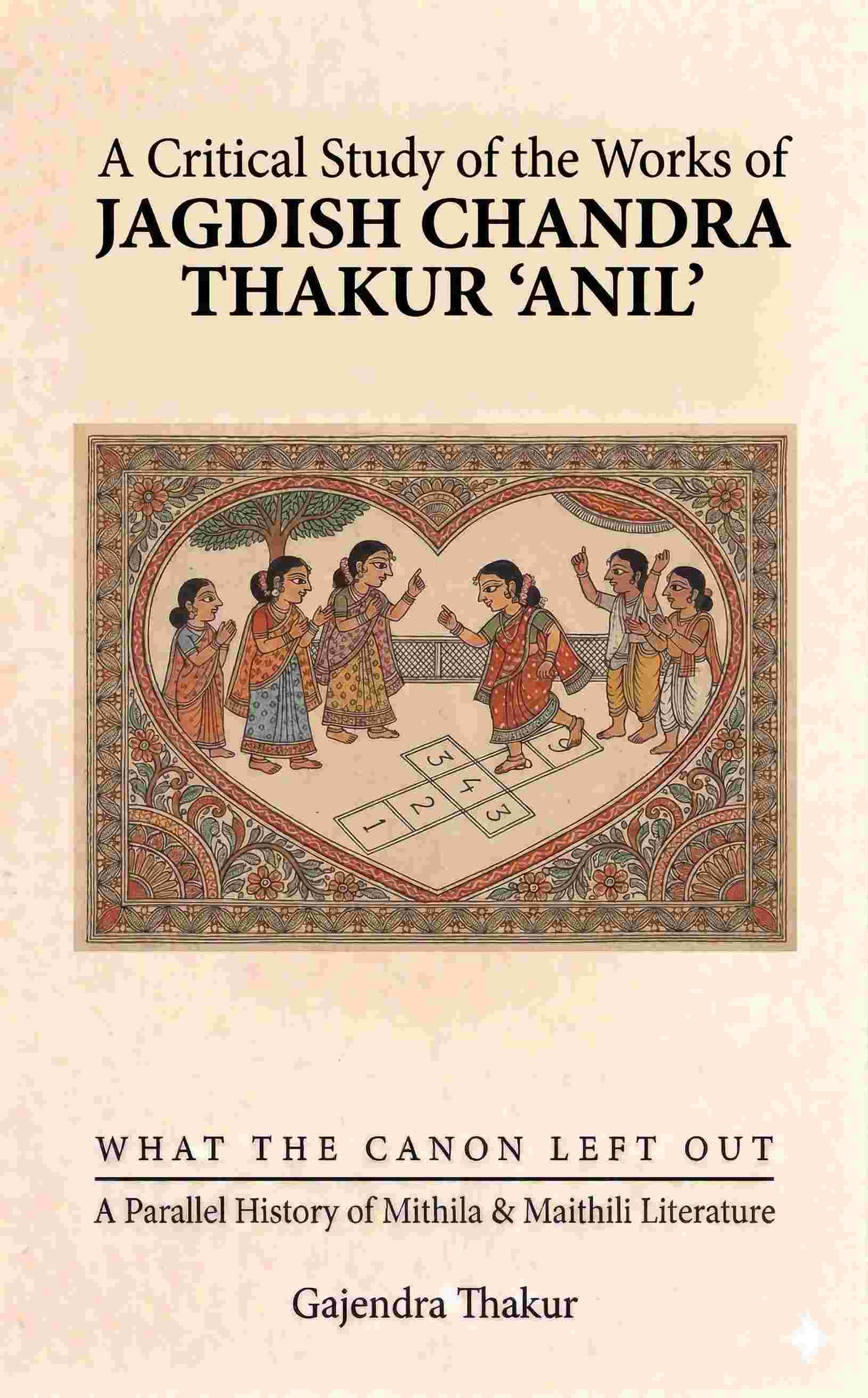
A Critical Study of the Works of
JAGDISH CHANDRA THAKUR 'ANIL'
Jagdish Chandra Thakur 'Anil' stands as a significant figure in contemporary Maithili literature — a poet, lyricist, and ghazal-composer whose work spans multiple genres and whose literary career has been intimately intertwined with the Videha movement. Associated with the Videha eJournal (ISSN 2229-547X, www.videha.co.in), the first Maithili fortnightly eJournal established in the early 2000s, 'Anil' represents a generation of writers who embraced both the classical lyrical traditions of Mithila and the democratic, digital-age ethos championed by the Parallel Literature Movement.
His pen name 'Anil' (अनिल — meaning 'wind' or 'air' in Sanskrit) is itself emblematic of the lyric impulse that defines his work: his verse moves with natural grace, carrying the fragrances of Mithila's soil, the emotional landscapes of love and longing, and a political awareness of the marginalised. Videha dedicated its 191st issue (1 December 2015) entirely to 'Anil', an honour that marks his stature in the contemporary Maithili literary world. His books available through Videha's archive at videha.co.in/pothi.htm include a long poem (dīrgha kavitā), two song collections, a ghazal collection, and an autobiography, testifying to his range as a creative artist.
This chapter undertakes a comprehensive study of Jagdish Chandra Thakur 'Anil': his life, literary career, creative philosophy, and the full corpus of his published work. It then applies multiple Indian and Western critical frameworks — rasa theory, dhvani poetics, the Parallel Literature paradigm, postcolonialism, feminist theory, ecocriticism, New Criticism, and narratology — to evaluate and interpret his contribution to Maithili letters.
2. Life and Literary Biography
2.1 Biographical Profile
Jagdish Chandra Thakur 'Anil' is a Maithili poet, lyricist, and creative writer from the Mithila region. While detailed biographical data in the public domain is sparse — a characteristic shared by many writers within the Videha Parallel Literature Movement, who deliberately resist the canon-forming machinery of the Sahitya Akademi establishment — the contours of his literary identity are traceable through his published work and his sustained association with Videha.
His name 'Jagdish Chandra' carries a classical resonance: Jagdish (Lord of the universe) and Chandra (moon), suggesting a traditional Maithil brahmin or upper-caste naming convention. Yet his work, particularly his engagement with the Videha democratic literary platform, aligns him with a progressive literary politics that transcends caste boundaries. The adoption of the pen name 'Anil' signals a creative self-fashioning: the wind metaphor evokes both freedom and the capacity to traverse all spaces, high and low, carrying fragrance and carrying dust equally.
2.2 Association with the Videha Movement
Videha, established as the first Maithili fortnightly eJournal, represents a revolutionary moment in Maithili literary history. It democratised publication, bypassing the gatekeeping institutions — Sahitya Akademi, university departments, traditional press — that had, in the estimation of its editors, systematically marginalised democratic, folk-rooted, and subaltern literary voices. 'Anil' published children's poetry in Videha from its 50th to 100th issues, indicating an early and sustained engagement with the journal. Three of his children's poems were later anthologised in the Videha Shishu Utsav (Children's Festival) collection, two of which were poems about 'baby child' — a tender, intimate lyric mode that underscores the poet's sensitivity to vulnerability.
The dedication of Videha Issue 191 (1 December 2015) to 'Anil' is a landmark in his literary recognition. These special issues, which Videha has devoted to writers including Ram Bharos Kapari 'Bhramar', Shivshankara Shrinivas, Hitnath Jha, and others, function as the primary site of critical appraisal within the Parallel Literature tradition, substituting for the absence of mainstream critical attention.
Additionally, 'Anil's autobiography Aankhime Chitra Ho Maithili Ker (आँखिमे चित्र हो मैथिली केर — 'May there be pictures of Maithili in my eyes') was being serialised in Videha at its 331st issue, demonstrating ongoing creative productivity and an autobiographical impulse to reflect on a lifetime of literary engagement.
2.3 Language and Cultural Context
Maithili, one of the twenty-two scheduled languages of India's Eighth Schedule (recognised in 2003), is the language of the Mithila region — a cultural zone covering parts of Bihar and the Terai of Nepal. It has a literary tradition spanning over a millennium, from the Charyapadas of the Buddhist Siddhas through the foundational poetry of Vidyapati (c. 1352–1448) to a rich modern literature. 'Anil's work participates in this long tradition while addressing contemporary themes.
The Mithila region carries deep associations with music, lyric poetry, the Madhubani painting tradition, the Tirhuta (Mithilakshara) script, and a complex social world shaped by both Brahminical patriarchy and counter-hegemonic folk traditions. 'Anil's song collections and ghazals are rooted in this cultural landscape — drawing on the imagery of the angana (courtyard), the Ganga river, the seasons — while his long poem and autobiography engage with more critical, contemporary concerns.
3. Literary Works: A Descriptive Survey
The following works by Jagdish Chandra Thakur 'Anil' are documented in the Videha archive (videha.co.in/pothi.htm) and related publications:
3.1 Dhar Kai Oi Par (धारक ओइ पार) — Long Poem / Dīrgha Kavitā
Dhar Kai Oi Par (Across the Threshold / Beyond the River-bank) is a dīrgha kavitā — a long poem, a genre that in contemporary Maithili, as in Hindi (where practitioners include Nagarjun, Kedar Nath Singh, and Sarveshwar Dayal Saxena), represents an ambition to sustain poetic concentration over extended philosophical, narrative, or lyric terrain. The title is spatially evocative: 'dhar' in Maithili can mean threshold, bank, edge, or stream; 'oi par' means 'on that other side' or 'beyond.' The title thus conjures a liminal poetics — a reaching toward what lies beyond immediate experience, whether that be death, transcendence, the unreachable beloved, or an idealized Mithila.
The dīrgha kavitā as a form draws on both Sanskrit mahākāvya (epic poetry) tradition and Western modernist long poem traditions (Whitman's Song of Myself, Eliot's The Waste Land, Neruda's Canto General). In the Maithili context, it extends the lyric occasion beyond the single moment of a pada or geet into a sustained meditation.
3.2 Geet Ganga (गीत गंगा) — Song Collection
Geet Ganga (River of Songs) is a collection of geet — the Maithili lyric song genre that has its roots in the classical padas of Vidyapati, the devotional tradition, and the rich folk music of Mithila. The Ganga (Ganges) as a title metaphor is significant: rivers are central to Maithili cultural imagination, and the Ganga in particular carries connotations of purification, flow, time, and the interpenetration of the human and the sacred. The choice of 'ganga' — river — rather than a more static 'sangrah' (collection) suggests that 'Anil' conceives of lyric as living, moving, confluent.
'Anil's songs in Videha demonstrate a mastery of the geet form: melodic construction, internal rhyme, imagistic economy, and the capacity to carry emotional weight through apparently simple diction. His published geet draw on the imagery of the angana (inner courtyard), seasonal change (particularly monsoon and spring), and the emotional registers of viraha (separation) and milana (union).
3.3 Ghazal Ganga (गजल गंगा) — Ghazal Collection
The ghazal, originally an Arabic and Persian form entering Maithili through Urdu and Hindi literary exchanges, has found remarkable creative expression in contemporary Maithili. Figures like Ashish Anchinhar have developed the theoretical framework of Maithili ghazal prosody (Ghazalsastram), and 'Anil's Ghazal Ganga represents his contribution to this tradition. Published ghazals from Videha Issue 129 (2013) show 'Anil' working in the standard ghazal form with Maithili matla (opening couplet with both hemistichs rhyming), radīf (refrain), qāfiyā (rhyme), and maqta (closing couplet with pen-name).
His ghazal imagery combines classical Maithili lyric tropes — the beloved's face, monsoon evenings, the flame and moth, the sound of water — with contemporary political consciousness: the 'drunk' in the ghazal is sometimes the oppressed subject who has been made 'drunk' on false promises, and the 'wine-house' becomes a political space.
3.4 Tora Angana Me (तोरा अंगना मे) — Song Collection
Tora Angana Me (In Your Courtyard) is 'Anil's second documented song collection. The angana (courtyard) is one of the most symbolically charged spaces in Mithila's literary imagination: it is at once a domestic space, a woman's space, a performance space (for folk rituals, paintings, songs), and a liminal space connecting the interior of the house to the world beyond. The repeated use of 'tora' (your / informal second person) establishes intimacy — the poem addresses a beloved, a mother, the Maithili language itself, or the land of Mithila.
Videha holds two versions of this collection: a primary version and a 'mool' (original/source text) version, suggesting that the text underwent editorial evolution or that both print and digital versions were archived. This archival care reflects Videha's commitment to literary preservation.
3.5 Aankhime Chitra Ho Maithili Ker (आँखिमे चित्र हो मैथिली केर) — Autobiography
'May There Be Pictures of Maithili in My Eyes' is the title of 'Anil's autobiography, serialised in Videha. The title is a statement of identity and aspiration: the poet desires that his very vision, his inner landscape, be constituted by Maithili — its language, its culture, its people. This is not mere regionalism but a form of what Edward Said called 'belonging': a deliberate affiliation with a language and culture as an act of love and political choice.
Autobiographical writing (ātmakathā) in Maithili is a relatively recent genre, with Shefalikal Varma's Kist Kist Jeevan and Kusum Thakur's Pratyavartan representing significant contributions. 'Anil's autobiography enters this tradition, presumably narrating his life as a Maithili writer across decades that saw the language's struggle for recognition, the rise of the digital publishing revolution, and the emergence of the Parallel Literature Movement.
3.6 Children's Poetry in Videha
'Anil's children's poetry — published across Videha issues 50 to 100 and later anthologised in the Videha Shishu Utsav collection — represents a socially significant dimension of his work. Maithili children's literature has historically been underdeveloped relative to Hindi and Bengali, and contributions to this genre carry both pedagogical and cultural preservation importance. Two of his anthologised children's poems focused on the 'baby child', suggesting a tender engagement with infancy and growth as metaphors for both personal memory and cultural continuation.
3.7 Ghazals in Videha Issue 129
Issue 129 of Videha (May 2013) contains a sequence of four ghazals by 'Anil'. These include politically charged compositions employing the motif of the road strewn with thorns (ओ रस्तापर कांट छिटैए ओकरा लेल जहल चाही — 'on that road where thorns are scattered, a prison is needed for those who strew them'), indicating that his ghazal practice does not shy from social critique. One of his ghazal lines invokes Mahishasura (अहिल्याक संताप हरैले' नयनमे गंगाजल चाही — 'to relieve Ahilya's anguish, the Ganga's water is needed in the eyes'), connecting classical mythological reference (Ahilya, the wronged woman of the Ramayana) with contemporary feminist consciousness.
4. Critical Analysis Using Indian Literary Theories
4.1 Rasa Theory (रसशास्त्र) — Bharatamuni's Nāṭyaśāstra
The Nāṭyaśāstra of Bharatamuni (c. 200 BCE – 200 CE) establishes the theory of rasa — the aesthetic experience of emotion — as the foundation of all literary appreciation. The eight (later nine) rasas — śṛṅgāra (love), hāsya (humour), karuṇa (pathos), raudra (fury), vīra (heroism), bhayānaka (terror), bībhatsa (disgust), adbhuta (wonder), and śānta (serenity) — are not emotions in the ordinary sense but are the transmuted, aestheticised forms of emotion (sthāyibhāva) that arise from the conjunction of vibhāva (stimulus), anubhāva (response), and vyabhicāribhāva (transient emotions).
In 'Anil's song collections (Geet Ganga, Tora Angana Me), śṛṅgāra rasa predominates. The angana of the title functions as the alambana vibhāva (the stimulating object of love): the beloved's courtyard is the space of longing and the space of presence. The Maithili lyric tradition since Vidyapati is overwhelmingly śṛṅgāric, and 'Anil works within and extends this tradition. However, the viraha (separation) mode of śṛṅgāra — which Bharatamuni identifies as ten stages (daśāvasthā) from hope through madness to death — is 'Anil's primary emotional register. His songs are songs of longing: for the beloved, for the homeland, for the language itself.
His ghazals activate karuṇa rasa alongside śṛṅgāra. The image of Ahilya's anguish (Ahilya, turned to stone by her husband Gautama and released only by Rama's touch, is one of Maithili's most resonant feminine suffering figures) in his Videha Issue 129 ghazal generates a complex emotional response where sympathy and indignation commingle — what Abhinavagupta would call the āhlāda (delight) that transcends ordinary empathy.
The dīrgha kavitā Dhar Kai Oi Par potentially activates multiple rasas across its extended form — beginning perhaps in adbhuta (wonder at threshold experience), moving through śṛṅgāra (love), karuṇa (pathos), and arriving at śānta (serenity beyond duality). This multi-rasa arc, what the rhetoricians termed rasabhāva-parampara, would make it a work of considerable aesthetic complexity.
4.2 Dhvani Theory (ध्वनि) — Ānandavardhana's Dhvanyāloka
Ānandavardhana's Dhvanyāloka (c. 850 CE) articulates the theory of dhvani — resonance or suggestion — as the supreme principle of poetic excellence. Where vyañjanā (suggestion) outperforms abhidhā (denotation) and lakṣaṇā (indication), the poem achieves its highest power. The resonant meaning — the dhvani — is what vibrates in the reader's consciousness after the words have been read, like the sound that lingers after a bell is struck.
'Anil's title Tora Angana Me is a masterpiece of dhvani. The word 'angana' (courtyard) resonates beyond its literal denotation. In Maithili cultural memory, the angana is: the site of the Kohbar painting (drawn at marriage); the space where women sing the sohar (birth songs) and saman (wedding songs); the threshold between domestic interior and public exterior; the space of childhood memory; and — in the broader literary imagination — the symbol of the language's own interior landscape. 'In your courtyard' thus suggests simultaneously: I am in the space of the beloved; I am in the space of Maithili culture; I am in the space of memory; I am at home.
Similarly, the autobiography's title Aankhime Chitra Ho Maithili Ker deploys dhvani superbly. 'Chitra' means both 'picture/image' and (in a classical secondary sense) the Madhubani paintings for which Mithila is globally renowned. 'Aankhime' (in the eyes) evokes the act of seeing, of visionary experience, and also the idea that the beloved's image is lodged in the lover's eyes (a standard trope from the Vidyapati tradition). The title thus says simultaneously: 'May my eyes see Maithili'; 'May Maithili's image be inscribed in my eyes as Madhubani painting is inscribed on walls'; and 'May I carry within my vision the beloved that Maithili is to me.'
4.3 Vakrokti Theory — Kuntaka's Vakroktijīvita
Kuntaka's Vakroktijīvita (c. 950 CE) proposes vakrokti (oblique/striking expression) as the life-force of poetry. Where ordinary language proceeds straightforwardly, poetic language swerves — it makes the familiar strange, the simple complex, the transparent opaque. This obliquity is not obscurity but a heightened expressiveness that opens language to multiple meanings simultaneously.
'Anil's ghazal practice is fundamentally vakroktic. The ghazal form itself, with its detached couplets (ash'ār) each complete in itself yet connected through the radīf-qāfiyā framework, demands oblique meaning-making. The maqta's use of the pen-name 'Anil' in the closing couplet creates a vakrokti where the poet speaks of himself in the third person, a self-distancing that paradoxically intensifies self-expression. His political imagery — prisons for those who strew thorns, the need for Ganga-water in the eyes — operates through vakrokti: the literal image is social critique; the suggested image is spiritual aspiration.
4.4 Aucitya Theory — Kshemendra's Aucityavicāracarcā
Kshemendra (c. 1050 CE) argued that aucitya (propriety, fittingness, contextual appropriateness) was the supreme literary virtue. A poem achieves greatness when every element — word, image, emotion, metre, figure — is exactly right for its context. Aucitya does not mean correctness by rule but rightness by judgment.
'Anil's choice of genre is itself an exercise in aucitya. He writes geet for the beloved and for the homeland — a form with deep cultural roots in Mithila's performative traditions. He writes ghazal for social-political themes and for complex emotion — a form historically suited to urban sophistication and emotional nuance. He writes dīrgha kavitā for philosophical meditation. Each genre is fitting for its subject matter. His use of the Ganga metaphor for both song collection and ghazal collection is aucita (appropriate): both forms flow, both accumulate meaning as they move, both are nourishing.
4.5 The Parallel Literature Movement Framework
The Parallel Literature Movement (samānāntar sāhitya āndolan), as theorised through the Videha platform, challenges the hegemony of the Sahitya Akademi canon and its preference for works compliant with standard literary prestige markers. The Parallel Literature Movement argues for a democratic literary sphere that includes folk forms, oral traditions, digital publications, subaltern voices, and regional writers who have been systematically excluded from the mainstream.
'Anil's association with Videha places him squarely within this tradition. His children's poetry — a genre typically undervalued by the literary establishment — his serialised autobiography, and his ghazals all represent modes of writing that the Parallel Literature framework validates and promotes. The very fact that his primary archive is digital and free-to-access at videha.co.in embodies the democratic-access philosophy of the movement.
From this framework, 'Anil's most significant literary act is his sustained lyric engagement with the Maithili language itself as a beloved — the autobiography's title declares the language the object of the poet's deepest vision. This mirrors the movement's broader politics of linguistic love: where the establishment treats Maithili as a minor regional language, the Videha writers treat it as the supreme medium of their interior lives.
5. Critical Analysis Using Western Literary Theories
5.1 New Criticism: Organic Unity and Irony
New Criticism, developed by I.A. Richards, Cleanth Brooks, W.K. Wimsatt, and others, demands close reading of the literary text as a self-sufficient artefact. Key concepts include organic unity (all elements of the poem cohere into a unified whole), irony (the poem holds contradictions in tension), paradox, and ambiguity as virtues.
Applied to 'Anil's ghazal form, New Criticism reveals productive tensions. The ghazal is generically anti-organic: its couplets are deliberately independent, resisting the smooth narrative flow of Western lyric poetry. Yet within each sher (couplet), there is intense organic coherence. The apparent paradox — a form that is fragmented at the macro level but unified at the micro level — is itself an instance of the New Critical virtue of holding contradictions in tension. Each sher of 'Anil's ghazals is a poem complete in itself; the collection as a whole is a mosaic.
The title Dhar Kai Oi Par exhibits New Critical paradox: a 'threshold' (dhar) is defined by what it divides, yet the poem aspires to go 'beyond' (oi par) — to transcend the very boundary that defines the poem's situation. The poem is thus simultaneously about limitation and transgression.
5.2 Structuralism: Binary Oppositions and Literary Systems
Structuralist literary theory, derived from Saussure's linguistics and developed by Lévi-Strauss, Roland Barthes, and Tzvetan Todorov, analyses literature in terms of underlying structures, binary oppositions, and the system of signs through which meaning is produced.
In 'Anil's song collections, a fundamental binary opposition operates: angana (interior/domestic/feminine) versus the world outside (exterior/public/masculine). Tora Angana Me positions the lyric subject outside the beloved's courtyard, looking in — the reverse of the patriarchal domestic arrangement in which women are confined to the angana. This structural inversion carries a feminist charge: the poem expresses the male lover's longing to enter the feminine interior space, recognising it as the locus of value.
The title Geet Ganga employs the structuralist binary of river/land — the Ganga as the flowing, continuous, uncontainable element that resists being fixed, versus the settled bank of tradition. 'Anil's songs are the river, not the bank; they carry but do not remain. This structural metaphor encodes his poetic philosophy: song as movement, not monument.
5.3 Postcolonial Theory
Postcolonial theory, particularly the work of Frantz Fanon, Edward Said, Homi Bhabha, and Gayatri Chakravorty Spivak, addresses the cultural, psychological, and political dimensions of colonial and postcolonial experience. In the Indian regional context, postcolonial theory illuminates the double colonialism experienced by minority-language writers: colonial dispossession by British imperialism and continued postcolonial marginalisation by the Hindi-dominant national culture.
'Anil's autobiography, with its title's declaration that Maithili should fill his eyes, is a postcolonial act of what Fanon called 're-humanisation': the recovery of selfhood through the reclamation of indigenous language and culture. For a Maithili writer in Bihar, where Hindi dominates education, media, and government, writing in Maithili is a political choice — an insistence on speaking in one's own tongue rather than the tongue of the dominant power.
Homi Bhabha's concept of the 'third space' — the hybrid, liminal space between colonial and indigenous cultures where new meanings are produced — is useful for understanding 'Anil's ghazal practice. The Maithili ghazal occupies a third space: it borrows the form of Arabic-Persian-Urdu literary culture (itself a symbol of a different colonialism — the Mughal imperial culture), translates it into the Maithili linguistic and cultural context, and produces something new. The ghazal in Maithili is neither purely Urdu-derivative nor purely Maithili-indigenous; it is a hybrid form that generates meanings neither language alone could produce.
Said's concept of 'imaginative geographies' — the way cultures construct spatial maps of self and other — illuminates the recurrent river imagery in 'Anil's titles. The Ganga and the unnamed 'dhar' (river-bank/threshold) in his titles construct a Maithili imaginative geography: a landscape defined by rivers, by boundaries, by the tension between here and there, belonging and longing.
5.4 Feminist Theory
Feminist literary theory — from Virginia Woolf through Simone de Beauvoir, Judith Butler, and the Indian feminist tradition represented by Susie Tharu, K. Lalita, and Uma Chakravarti — analyses literature for its representation of women, its inscription of gender ideology, and its potential for feminist counter-discourse.
'Anil's invocation of Ahilya in his Videha Issue 129 ghazal is a significant feminist gesture. Ahilya's story in the Ramayana tradition — a woman punished (turned to stone) for an act of adultery that she either consented to or was deceived into — has been read both as a story of male vengeance and as a story of female resilience (her 'stone' state as a form of resistance, her liberation by Rama as a type of feminist redemption). 'Anil's ghazal line 'Ahilya's anguish must be relieved — Ganga-water is needed in the eyes' reads Ahilya's story through karuṇā (compassion) rather than through judgement, positioning the poet in solidarity with the wronged woman.
The repeated angana imagery in Tora Angana Me can be read through feminist spatial theory. The angana is simultaneously a space of women's confinement and a space of women's power: it is where women create Madhubani paintings, sing Maithili songs, and conduct rituals that sustain cultural memory. By making the angana the central symbol of his lyric, 'Anil acknowledges the angana as the centre of cultural production — a feminist revaluation of domestic space.
5.5 Ecocriticism
Ecocriticism, developed in the 1990s through the work of Lawrence Buell, Cheryl Glotfelty, and Indian ecocritics like Ranjan Ghosh, examines the representation of the natural world in literature and the ethical implications of those representations. In the Indian context, ecocriticism intersects with political ecology: environmental degradation in Mithila (flooding, deforestation, agrarian crisis) is inseparable from questions of caste, poverty, and state neglect.
'Anil's river imagery — Geet Ganga, Ghazal Ganga, Dhar Kai Oi Par — can be read ecocritically. The Ganga is not a neutral or static symbol; it is a river under ecological threat. Bihar and the Mithila region are particularly vulnerable to flooding, and the rivers of Mithila — Kosi, Bagmati, Kamla, and the Ganga itself — have been both sources of life and agents of devastation. When 'Anil names his song collection 'Geet Ganga', he inscribes the river into his literary identity in a way that carries this ecological weight. Song is identified with a river that is simultaneously sacred and endangered.
The image of Ahilya's need for 'Ganga-water in the eyes' also carries an ecocritical resonance: to heal the wronged woman, the poet reaches for the river — nature as healer, water as restorative force. This gestures toward an ecology of care that connects human suffering and natural resources.
5.6 Reader-Response Theory
Reader-response theory, associated with Wolfgang Iser, Stanley Fish, and Hans Robert Jauss, shifts critical attention from the text itself to the interaction between text and reader. Iser's concept of 'implied reader', Jauss's 'horizon of expectations', and Fish's 'interpretive communities' are useful analytical tools.
'Anil's work implies multiple, overlapping audiences. His children's poetry in Videha implies a young Maithili-literate audience learning to love their language through accessible, playful verse. His geet imply a musically literate audience familiar with the Maithili lyric tradition — an audience that will hear the melodic possibilities of his lines. His ghazals imply an audience conversant with ghazal conventions (radīf, qāfiyā, maqta) who can appreciate his deployment and creative modification of the form. His autobiography implies the broadest audience — any Maithili reader interested in the personal history of a writer's engagement with the language.
Jauss's 'horizon of expectations' is particularly illuminating. A reader approaching 'Anil's Ghazal Ganga with expectations formed by the Urdu ghazal tradition (Mir, Ghalib, Faiz) will find both familiar and unfamiliar: familiar formal architecture, unfamiliar linguistic material (Maithili sounds, lexicon, cultural references). This productive defamiliarisation — what Jauss calls the 'aesthetic distance' between existing horizon and new work — is central to the pleasure and significance of 'Anil's ghazal practice.
5.7 Psychoanalytic Criticism
Psychoanalytic literary criticism, drawing on Freud's concepts of the unconscious and repression, Lacan's theory of language and desire, and object-relations theory, reads literary texts as expressions of unconscious dynamics.
The recurrent 'other shore' (oi par) imagery in Dhar Kai Oi Par is amenable to psychoanalytic reading. Lacan's concept of the objet petit a — the unattainable object-cause of desire, the 'more-than-real' thing that cannot be possessed because possessing it would dissolve desire itself — illuminates the poem's structure. The 'other shore' is always already beyond: to cross the threshold (dhar) would be to lose the very desire that animates the crossing. The poem is thus a meditation on desire as structured absence.
'Anil's autobiography, with its title's declaration that 'Maithili' should be the picture in his eyes, can be read as an account of literary sublimation: the displacement of personal desire onto the language and culture of Mithila. Freud's concept of sublimation — the transformation of libidinal energy into cultural production — finds a literary instance in the writer who channels longing into love of language.
5.8 Narratology and Genre Theory
Narratology (Gérard Genette, Roland Barthes, Mieke Bal) analyses the structures of narrative. Applied to 'Anil's autobiography, it illuminates his use of analepsis (flashback), prolepsis (anticipation), and the complex relationship between story-time (the life narrated) and discourse-time (the narrating act).
The title Aankhime Chitra Ho Maithili Ker establishes the autobiography as a genre of visual narration: the self is constructed through what the eyes have seen. This is a form of homodiegetic narration (the narrator is the protagonist) with a retrospective perspective. The autobiography's serialisation in Videha — an eJournal published fortnightly — means that it was produced in instalments, creating a diachronic narrative experience for readers who followed it across issues. This serialisation links the autobiography to a tradition going back to Victorian serial fiction (Dickens, Thackeray) and forward to contemporary digital narrative practice.
6. Synthesis: 'Anil's Place in Maithili Literature
Reading 'Anil's work through these multiple critical lenses reveals a writer of considerable range, depth, and cultural significance. Several defining characteristics emerge:
6.1 The Lyric Core
'Anil is fundamentally a lyric poet. Whether writing geet, ghazal, or dīrgha kavitā, his primary mode is lyric: the expression of heightened emotional experience through musical language. This aligns him with the central tradition of Maithili literature since Vidyapati, which has always privileged the musical word. His contribution to this tradition is the introduction of the social-political charge — particularly visible in his ghazals — that has characterised the post-Independence Maithili lyric.
6.2 The Multilingual Cultural Position
Writing in Maithili for a Videha readership that is often bilingual (Maithili-Hindi) or trilingual (adding English or Nepali), 'Anil occupies a multilingual cultural position. The ghazal form itself is a bridge form: its Urdu-Persian origins give Maithili-speaking readers a form they may recognise from Hindi-Urdu cultural contexts, while its Maithili content asserts linguistic distinctiveness. This bridge function — making Maithili poetry accessible to readers who might otherwise default to Hindi literary forms — is a significant cultural contribution.
6.3 The Democratic Digital Aesthetic
The fact that 'Anil's archive is primarily digital — housed at videha.co.in, freely downloadable, read across the globe by the Maithili diaspora in India, Nepal, and beyond — gives his work a democratic accessibility that print publication in a minority language could never achieve. This digital aesthetic — light, accessible, non-monumental — suits his lyric mode. A song wants to be sung and heard, not preserved behind glass.
6.4 The Autobiographical Impulse
The autobiography Aankhime Chitra Ho Maithili Ker is perhaps his most ambitious project: a sustained act of literary self-examination and cultural testimony. In documenting his life as a Maithili writer, 'Anil bears witness not only to personal experience but to the history of the Maithili language's survival, struggle, and digital renaissance in the early twenty-first century.
7. Conclusion
Jagdish Chandra Thakur 'Anil' is a distinctive voice in contemporary Maithili literature: a lyric poet who deploys the traditional forms of geet and ghazal with both technical mastery and creative independence, a dīrgha kavitā practitioner engaged with philosophical and existential themes, and an autobiographer documenting a life devoted to the Maithili language and the Mithila cultural heritage.
His work embodies the central paradox of the Parallel Literature Movement: it is rooted in classical tradition (Vidyapati's lyric inheritance, the Sanskrit rasa aesthetic, the Mithila folk tradition) while being simultaneously forward-looking, politically conscious, and digitally democratised. The critical frameworks applied here — rasa theory, dhvani poetics, Parallel Literature, postcolonialism, feminism, ecocriticism, reader-response, psychoanalysis, and narratology — all yield productive insights, confirming the multi-layered richness of his texts.
The dedication of Videha Issue 191 to 'Anil' is a testament to his significance within the community of Maithili writers that Videha represents. As the Maithili language continues its struggle for visibility and recognition in the twenty-first century — on digital platforms, in Sahitya Akademi award lists, in school curricula, in the global Maithili diaspora — the work of writers like 'Anil' constitutes the living proof that the language's lyric heart continues to beat with full force.
Further research on 'Anil's work would benefit from textual analysis of the full manuscripts of Dhar Kai Oi Par, Geet Ganga, Ghazal Ganga, and Tora Angana Me (available at videha.co.in/pothi.htm), interviews with the author, and systematic comparison with other contemporary Maithili lyric poets including Ram Bharos Kapari 'Bhramar', Shivshankara Shrinivas, and younger Videha contributors. Such research would establish 'Anil's precise place in the genealogy of the Maithili lyric and the broader South Asian poetic tradition.
8. Select Bibliography
Primary Sources
Jagdish Chandra Thakur 'Anil': Works at videha.co.in/pothi.htm
Dhar Kai Oi Par [धारक ओइ पार] (Long Poem / Dīrgha Kavitā). Archived at Videha eJournal, www.videha.co.in.
Geet Ganga [गीत गंगा] (Song Collection). Archived at Videha eJournal, www.videha.co.in.
Ghazal Ganga [गजल गंगा] (Ghazal Collection). Archived at Videha eJournal, www.videha.co.in.
Tora Angana Me [तोरा अंगना मे] (Song Collection). Archived at Videha eJournal, www.videha.co.in.
Aankhime Chitra Ho Maithili Ker [आँखिमे चित्र हो मैथिली केर] (Autobiography, serialised). Videha, Issue 331 onwards.
Selected Ghazals. Videha, Issue 129 (May 2013).
Children's Poetry (Three poems). Anthologised in Videha Shishu Utsav Collection. www.videha.co.in.
Jagdish Chandra Thakur 'Anil' Special Issue. Videha Issue 191 (1 December 2015). www.videha.co.in.
Indian Literary Theory
Ānandavardhana. Dhvanyāloka (c. 850 CE). Trans. K. Krishnamoorthy. Dharwar: Karnatak University, 1974.
Bharatamuni. Nāṭyaśāstra (c. 200 BCE–200 CE). Trans. Manomohan Ghosh. Calcutta: Manisha Granthalaya, 1951.
Kshemendra. Aucityavicāracarcā (c. 1050 CE). Ed. S.K. De. Calcutta: Royal Asiatic Society, 1961.
Kuntaka. Vakroktijīvita (c. 950 CE). Trans. K. Krishnamoorthy. Dharwar: Karnatak University, 1977.
Abhinavagupta. Abhinavabhāratī (commentary on Nāṭyaśāstra). Ed. Ramakrishna Kavi. Baroda: Oriental Institute, 1926–64.
Anchinhar, Ashish. Maithili Ghazalka Vyakaran O Itihas [मैथिली गजलक व्याकरण ओ इतिहास]. Archived at videha.co.in/pothi.htm.
Western Literary Theory
Bhabha, Homi K. The Location of Culture. London: Routledge, 1994.
Brooks, Cleanth. The Well Wrought Urn: Studies in the Structure of Poetry. New York: Harcourt, Brace, 1947.
Buell, Lawrence. The Environmental Imagination: Thoreau, Nature Writing, and the Formation of American Culture. Cambridge: Harvard University Press, 1995.
Fanon, Frantz. The Wretched of the Earth. Trans. Constance Farrington. New York: Grove Press, 1963.
Iser, Wolfgang. The Act of Reading: A Theory of Aesthetic Response. Baltimore: Johns Hopkins University Press, 1978.
Jauss, Hans Robert. Toward an Aesthetic of Reception. Trans. Timothy Bahti. Minneapolis: University of Minnesota Press, 1982.
Lacan, Jacques. The Four Fundamental Concepts of Psychoanalysis. Trans. Alan Sheridan. New York: Norton, 1981.
Said, Edward. Culture and Imperialism. New York: Knopf, 1993.
Spivak, Gayatri Chakravorty. 'Can the Subaltern Speak?' In Marxism and the Interpretation of Culture, ed. Cary Nelson and Lawrence Grossberg. Urbana: University of Illinois Press, 1988.
Maithili Literary History and Context
Choudhary, Radhakrishna. A Survey of Maithili Literature. New Delhi: Sahitya Akademi, 1976.
Mishra, Jayakanta. A History of Maithili Literature. 2 vols. New Delhi: Sahitya Akademi, 1976.
Thakur, Gajendra. Parallel History of Maithili Literature. Serialised in Videha eJournal. www.videha.co.in/gajenthakur.htm.
Videha eJournal. ISSN 2229-547X. www.videha.co.in. [Primary source archive].
अपन मंतव्य editorial.staff.videha@zohomail.in पर पठाउ।
विदेहमे सभठाम ताकू / Search all Videha
Static full-text search · Pagefindलेखक/शीर्षक/अंक/वर्ष — खोज-विधा। गद्य/पद्य/शोध current/static + पुरान Videha/Sadeha contents खोजैत अछि। पोथी pothi.htm केर पूर्ण listing, श्रव्य-दृश्य Audio_Video.htm केर पूर्ण listing, पञ्जी videha-sadeha/panji-shards GitHub data, आ थेसारस/शब्दकोश videha-ejournal.github.io/data GitHub JSON corpus केँ query करैत अछि आ दूनू Quiz corpus मे dictionary/vocabulary/शब्दार्थ-सम्बन्धी प्रश्नोत्तरी परिणाम सेहो जोड़ैत अछि। Quiz videha-quiz आ GitHub user-site दूनू bilingual quiz corpus खोजैत अछि। Roman/IAST + देवनागरी cross-script search समर्थित। Issue/Year लेल संख्या दिअ। PDF-अभिलेख archive.org/VidehaAndSadeha सूची खोजैत अछि।