
Gajendra Thakur
A PARALLEL HISTORY OF MITHILA & MAITHILI LITERATURE- PART 4
The Revitalization of Maithili Ghazal: The Anchinhar Aakhar Movement
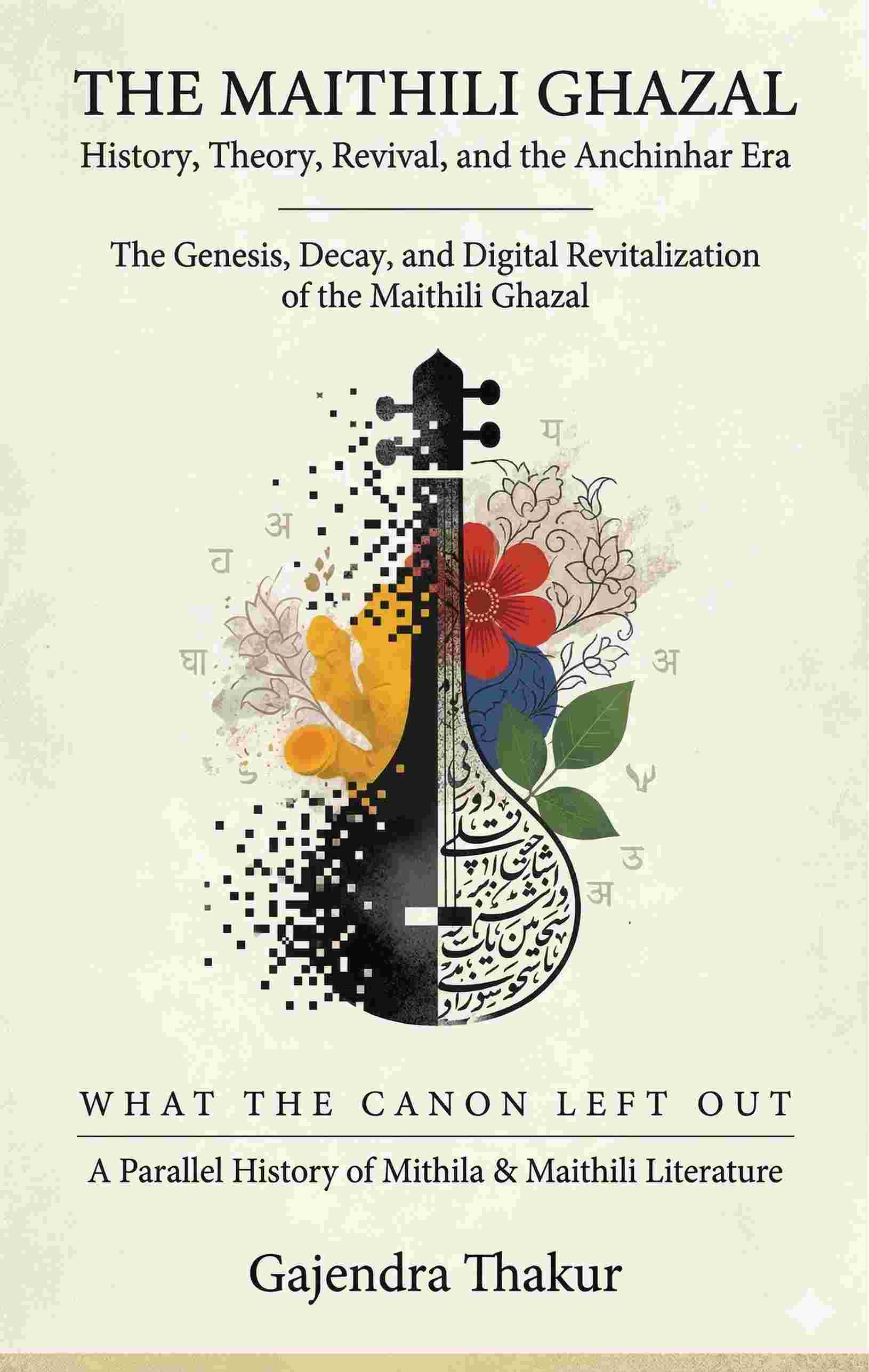
THE MAITHILI GHAZAL
History, Theory, Revival, and the Anchinhar Era
The Genesis, Decay, and Digital Revitalization of the Maithili Ghazal
Preface
This chapter covers: the Arabic and Persian genealogy of the ghazal form; its journey through Urdu into Maithili; the lineage of correct practice from Pandit Jivan Jha through the Anchinhar era; the specific rupture of the "dark interlude" of grammatically incorrect ghazal writing and the erasure of legitimate poets; the theoretical foundations of Ghazalsastram; the formal architecture of the Maithili ghazal in technical detail; the Anchinhar Aakhar movement's revitalisation programme and digital democratisation strategy; the construction of new Maithili Bahars; the expansion of the genre into Bal (Children's) and Bhakti (Devotional) sub-forms; the structural reconvergence of ghazal with Maithili drama in 2026; the role of Wikipedia in archival preservation; the institutional context of the Videha Parallel Literature Movement; the relationship between formal prosody and democratic anti-caste poetics; and a comparative analysis of the Maithili case against other Indian regional-language ghazal movements.
The chapter, wherever possible, the formal conventions of the ghazal - bahr, qafiya, radif, matla, maqta, sher - are explained in concrete technical terms, so that the chapter may function not merely as a literary history but as an accessible introduction to the prosodic knowledge that the Anchinhar movement has striven to democratise.
Summary
This chapter documents the 500-year journey of the Ghazal form into Maithili, identifying a critical rupture in the late twentieth century when grammatical rigour (Behr and Qaafiyaa) was abandoned, leading to a "weak era" of the form. It documents the corrective Anchinhar Aakhar (Unfamiliar Word) movement, the creation of the first theoretical manual (Ghajalsastram), and the expansion of the genre into Bal (Children's) and Bhakti (Devotional) Ghazals. The Maithili Ghazal has undergone a structural reconvergence with drama (2026) and achieved digital democratisation via Wikipedia, establishing itself as a parallel literary history against caste-based exclusion.
Key findings of this chapter:
• The Maithili ghazal has a documented correct lineage from Pandit Jivan Jha (early 20th century) through Kavivara Sitaram Jha, Kashikant Mishra 'Madhup', Vijaynath Jha, and Yoganand Heera.
• A "dark interlude" of grammatically incorrect ghazal writing erased Vijaynath Jha and Yoganand Heera from literary history; their restoration is a structural act of literary justice.
• The Anchinhar Aakhar movement, launched on April 11, 2008, restored formal standards through the Ghajalsastram - the first comprehensive Maithili-language theoretical account of the ghazal. It brought 350 to 400 new and previously marginalised writers into the literary mainstream within a single decade.
• Gajendra Thakur, recognised as Maithili's first "Aruji" (scholar of ghazal prosody), authored the first Ghajalsastram. Ashish Anchinhar published Maithili Ghazalak Vyakarana o Itihasa (Grammar and History of Maithili Ghazal), providing the systematic theoretical framework.
• Ashish Anchinhar is credited with constructing new Bahars specific to Maithili phonetics, expanding the genre into Bal and Bhakti sub-forms, and the reconvergence of ghazal with drama (2026).
• The digital-first strategy - blog, Wikipedia, online mushaira - has democratised access to formal ghazal knowledge, bypassing caste-based institutional gatekeeping.
• RTI data compiled by Vinit Utpal and Ashish Anchinhar (2011–2014) reveals that the Sahitya Akademi excluded women, effectively silencing their contribution to the literary canon. The Anchinhar Aakhar movement acted against this by giving precedence to women in award citations.
Part I: A Brief History of the Ghazal - Arabia to Mithila
1.1 The Nasib, the Qasida, and the Birth of the Ghazal (7th–8th Century CE)
The ghazal emerged in Arabia during the seventh century CE not as a new invention but as an act of poetic surgery. The pre-Islamic qasida - the long ode of the desert tribes - had always begun with a nostalgic, amorous overture called the nasib: a lament for the abandoned campsite, the vanished beloved, the receding youth. Poets and audiences both recognised this opening passage as the most emotionally charged section of the qasida, more immediate and personal than the praise-sections or boast-sections that followed. Gradually, poets began composing the nasib alone, stripped from its context in the longer ode and given an independent existence.
The Arabic word ghazal (غزل) is thought to derive from a root associated with the act of spinning yarn or thread - a metaphor for the weaving of words - and has also been interpreted as the sound of a dying gazelle, an image consonant with the form's characteristic register of pain, longing, and martyrdom-in-love. The earliest Arabic ghazal poets include Jamil ibn Ma'mar of the Banu Udhra tribe, who gave his name to the "Udhri" tradition of chaste, self-sacrificial love: loving unto death, with no expectation of physical consummation. The opposing tradition - urban, worldly, playful, and erotic - was exemplified by 'Umar ibn Abi Rabi'ah of the Quraysh (d. c. 712 CE), who treated love as pleasurable social comedy rather than metaphysical catastrophe.
These two poles - Udhri asceticism and Hejazi worldliness - established the emotional range within which all subsequent ghazal poetry would operate. The Sufi tradition, which came to dominate the Persian ghazal, is in some sense a synthesis of both poles: it takes the self-annihilating devotion of Udhri love and applies it to the divine, while retaining the sensuous imagery of the Hejazi tradition as a language of earthly metaphor for transcendent experience.
1.2 Persia: Rumi, Hafiz, and the Sufi Ghazal (10th–14th Century)
When the ghazal reached Persia in the wake of the Arab conquests - carried by cultural exchange, diplomatic contact, and the personal movement of poets between courts - it found a soil extraordinarily hospitable to its growth. Persian literary culture had its own rich tradition of love poetry, and the synthesis of Arabic prosodic rigour with Persian lyric sensibility produced, within two centuries, a ghazal tradition of unrivalled depth and sophistication.
Sana'i of Ghazna (d. c. 1131 CE) was the first major Persian poet to use the ghazal systematically as a vehicle for Sufi spiritual teaching. His successor 'Attar deepened this vein. But it was Jalal ud-Din Rumi (1207–1273) who made the ghazal into a vehicle of ecstatic mysticism - his Divan-i Shams-i Tabrizi contains approximately 3,500 ghazals, composed often in states of spiritual intoxication, the poem becoming itself an enactment of the longing it described. Rumi's ghazals typically end not with a takhallus (pen name) but with a sudden turn or silence - a formal enactment of the mystic's inability to speak the inexpressible.
Sa'di Shirazi (d. 1291) formalised and classicised the ghazal, establishing the convention of the takhallus in the maqta (final couplet) and developing a tone of elegant, worldly wisdom. He was among the first to write ghazals of consistent technical perfection in all their formal elements simultaneously: a musical bahr, a clear and consistent qafiya, an appropriate radif, a doubled matla, and a takhallus-bearing maqta.
Hafiz Shirazi (c. 1315–1390) represents the apex of the Persian ghazal tradition. His collected Divan has been among the most-printed books in the history of Islamic civilisation, and his ghazals are still used for divination (fal-e Hafiz) in Iran today. Hafiz perfected the art of iham - the deliberate double meaning in which every word carries simultaneously an earthly and a Sufi spiritual interpretation. A line apparently about wine and the beloved could equally be read as an account of divine intoxication and the soul's union with God. This ambiguity was not a weakness but the form's greatest strength: it allowed the ghazal to speak simultaneously to the uninitiated lover and the Sufi adept, the courtier and the mystic, the lover of beauty and the seeker of truth.
The formal features of the Persian ghazal that passed into Urdu and eventually Maithili are: the mono-rhyme (qafiya) appearing at the end of the second line of every sher; the radif (identical refrain word or phrase) following the qafiya; the matla in which both lines carry qafiya and radif; the self-contained, independent sher as the fundamental unit of composition; and the takhallus in the maqta. These conventions, developed over three centuries of Persian ghazal writing, arrived in India structurally intact.
1.3 The Sufi Route to India: Amir Khusrau and the Vernacular Turn (12th–13th Century)
The ghazal's arrival in the Indian subcontinent was not primarily a courtly event but a spiritual one. The great Chishti Sufi masters - Mu'inuddin Chishti at Ajmer, Nizamuddin Auliya at Delhi, Qutbuddin Bakhtiyar Kaki - established hospices (dargahs) that became centres of vernacular musical culture. The sama (spiritual listening) sessions held at these dargahs used Persian and increasingly Hindavi (the nascent vernacular of north India) ghazals as vehicles of devotional transport.
Amir Khusrau (1253–1325), court poet of several Delhi sultans and most intimately associated with Nizamuddin Auliya, stands at the junction of Persian literary tradition and Indian vernacular innovation. His bilingual compositions - sometimes Persian above, Hindavi below - are among the earliest examples of the ghazal in an Indian vernacular. He is credited with such innovations as the khayal form in music, the qawwali, and the ghazal in Hindavi. In doing so, he established the template for all subsequent Indian-language ghazal writing: the structural conventions of the Persian ghazal transplanted into an indigenous linguistic and musical context.
The Deccan Sultanates - Bidar, Golconda, Bijapur - became the next major site of ghazal development. Muhammad Quli Qutb Shah (1565–1611), Sultan of Golconda, composed ghazals in what scholars call Dakhni Urdu - a southern variety of the emerging vernacular, rich in Telugu, Marathi, and Kannada loanwords. The Dakhni tradition established the ghazal as the prestige lyric form of the Urdu-medium literary world.
The decisive turning point for the Urdu ghazal in northern India came around 1700, when Wali Muhammad Wali Dakkani visited Delhi. His divan of Hindavi/Rekhta ghazals - technically accomplished, emotionally sophisticated, and available in the vernacular that Delhi's poets had been trained to look down upon - electrified the city's literary establishment. Within a generation, Delhi's Persian-trained poets had redirected their energies into Urdu ghazal composition, setting the stage for the golden age of the eighteenth century.
1.4 The Golden Age of Urdu Ghazal: From Mir to Ghalib (18th–19th Century)
The eighteenth century saw the Urdu ghazal reach a peak of formal sophistication and emotional range that has never been surpassed. Mir Taqi Mir (1722–1810), who experienced the sack of Delhi in 1739 by Nadir Shah and again by Ahmad Shah Durrani in 1757, wrote ghazals of extraordinary immediacy and intimacy - often in a simple, almost conversational idiom that somehow carried immense emotional weight. He is known as "Khuda-e Suk'han" (God of Poetry) in the Urdu tradition, and his couplets have become proverbs in the sub-continental literary imagination.
The Lucknow school - associated with poets such as Insha, Jurrat, Atish, and Nasikh - developed a more ornate, technically fastidious style in contrast to Delhi's emotionally direct manner. Lucknow poets were connoisseurs of verbal felicity, grammatical precision, and the pleasures of the mazmun (conceits): elaborate metaphysical comparisons that demonstrated the poet's ingenuity. The tension between Delhi's emotional directness and Lucknow's technical virtuosity has been a productive fault-line in Urdu ghazal writing ever since.
Mirza Ghalib (1797–1869) transcends this binary. Writing in the twilight of the Mughal Empire - he witnessed the catastrophic events of 1857 from within Delhi - Ghalib pushed the ghazal to its philosophical limit. His poetry is famous for its difficulty: multiple simultaneous interpretations, grammatically ambiguous constructions, philosophical paradoxes folded into a single sher. Ghalib wrote of God, death, wine, love, and the ache of consciousness itself - and treated all these subjects with a complex, rueful irony that makes his work inexhaustible. His letters, written in Urdu prose, are as celebrated as his poetry; together they constitute one of the richest individual literary personalities in any South Asian language.
After Ghalib, the Urdu ghazal democratised. The mushaira - the public poetry recital - became an institution in which poets of all backgrounds competed for audience approval with technically accomplished, emotionally accessible ghazals. Daag Dehlvi (1831–1905) was the great populariser of this era: his ghazals were melodious, clear, emotionally immediate, and ideally suited to musical performance. The twentieth century saw the ghazal enter the gramophone and radio age: Begum Akhtar, Mehdi Hassan, Ghulam Ali, and Jagjit Singh each built mass audiences for the form, transforming it from a literary into a popular cultural institution while largely preserving its classical formal requirements.
Faiz Ahmed Faiz (1911–1984) represents the convergence of the classical ghazal tradition with modern political consciousness: his ghazals use the classical vocabulary of love, separation, and longing as a transparent metaphor for political imprisonment, state violence, and revolutionary hope. His language moves between Persian high diction and accessible Urdu idiom with an ease that makes his ghazals simultaneously classical and modern, personal and political.
1.5 The Ghazal in Other Indian Languages: The Comparative Frame
Alongside its development in Urdu, the ghazal was being adapted - imperfectly at first, then with growing assurance - into several of India's regional languages. Each adaptation faced the same fundamental challenge: how to transplant a prosodic system derived from the quantitative metrics of Arabic-Persian into a language with a different phonological structure, different natural rhythms, and different literary traditions.
In Bengali, the ghazal arrived via the intellectual and cultural ferment of nineteenth-century Calcutta. Atul Prasad Sen (1871–1934) and Kazi Nazrul Islam (1899–1976) are the foundational Bengali ghazal poets. Nazrul, whose personal biography combined Muslim and Hindu cultural inheritance, was temperamentally suited to the ghazal's synthesis of erotic and spiritual themes. His Bengali ghazals maintain bahr discipline while deploying a Bengali diction and musical sensibility that makes them feel entirely native to the language. Shamsur Rahman and others continued the Bengali revival. The Bengal region's shared medieval Sultanate Persian influence - including the famous correspondence between Sultan Ghiyasuddin Azam Shah and Hafiz - meant the ghazal was not entirely foreign to the Bengali literary imagination even before Atul Prasad Sen formalised Bengali ghazal composition.
In Gujarati, the ghazal tradition spans approximately a century. The Saurashtra region and the literary circles of Ahmedabad produced a continuous succession of ghazal poets: Balashankar Kantharia, the romantic poet Kalapi (Surashatasinhji Takhtsinhji), Barkat Virani "Befaam", and the prodigiously prolific Asim Randeri. The Gujarati ghazal is closely tied to mushaira culture and to the Bohra and Khoja Muslim communities who maintained connections with Urdu literary tradition while composing in Gujarati.
In Marathi, Suresh Bhat (1932–2003) is the pivotal figure. Known as "Ghazal Samrat" (Emperor of Ghazals), Bhat encountered Urdu ghazals through self-study around 1955, and spent the remainder of his life demonstrating that the form could be written with full formal rigour in Marathi. His first collection Roopgandha (1961) included only seven ghazals among 72 poems; by Elgar (1983) and Jhanjhawat, ghazals dominated his output entirely. He published six major collections comprising 532 poems, approximately 260 of which were ghazals. Like a classical Ustad, he guided and corrected students, established a pedagogical lineage, and - crucially - maintained technical standards even as he expanded the form's thematic range to include social protest, Ambedkarite critique, and personal anguish. His conversion to Buddhism and explicit alignment with Ambedkarite thought places the Marathi ghazal within the tradition of counter-canonical, anti-caste literary activism - a parallel to the Maithili movement's democratic commitments. His best-known verses were set to music by Hridaynath Mangeshkar and sung by Lata Mangeshkar and Asha Bhosle, giving Marathi ghazal a mass cultural reach comparable to the recorded Urdu ghazal tradition.
In Hindi, Dushyant Kumar (1931–1975) performed an analogous though differently inflected role. Writing in the shadow of post-1857 Partition anxieties about the Hindi-Urdu divide, Dushyant used the ghazal as a vehicle for what he called "New Poetry" in the popular idiom: his collection Saaye Mein Dhoop (1975, published just before his death at 44) directed the classical ghazal's formal architecture toward political satire and social outrage. His line about even the shade of trees scorching became a defining image of post-independence disillusionment, widely quoted in political movements including the 2011 anti-corruption agitation. Dushyant had to navigate not merely the technical challenge of adapting Arabic-Persian prosody to Hindi phonology, but the ideological minefield of a literary tradition weaponised in partition violence. Adil Mansuri, Bashir Badr, and others developed the Hindi ghazal further.
In Telugu, the ghazal represents an even more radical linguistic transplant: from an Indo-Aryan prosodic tradition into a Dravidian language. Ghazal Srinivas pioneered Telugu ghazal writing, requiring substantial theoretical innovation to accommodate the quantitative bahr system to Telugu's agglutinative morphology and phonological patterns.
Part II: The Maithili Ghazal - Classical Phase, Dark Interlude, and the Disrupted Lineage
2.1 The Emotional Soil: Vidyapati and Pre-Ghazal Sensibility
To understand the Maithili ghazal's arrival, one must understand the literary landscape into which it arrived - and the ideology that resisted it. Maithili's greatest poet, Pre-Jyotirishwar Vidyapati [different from Samskrit and Avahatta Vidyapati (c. 1352-1448)], had already established a lyric tradition of extraordinary emotional depth and formal sophistication long before the ghazal as a named form appeared in the language. Vidyapati's padavali - his collection of songs celebrating the love of Radha and Krishna - fused erotic shringara rasa with Vaishnava bhakti in ways that established a template for Maithili lyric consciousness that persists to the present.
Vidyapati's declaration "Desil bayana sab jan mittha" - "The language of the land is sweet to all" - was not merely a linguistic preference but a literary-political manifesto: the assertion that vernacular Maithili, not Sanskrit, was the appropriate vehicle for the deepest human and spiritual experience. This vernacular assertion has a structural parallel with the ghazal's own history: the form that began in Arabic was taken up by Persian Sufis as a vehicle for speaking truth in the living language, rather than the classical tongue.
Vidyapati's padavali explores the full emotional range of shringara rasa: sambhoga (joy of union), vipralambha (the pain of separation), viraha (the ache of absence). These are the emotional materials of the ghazal. The nayika waiting for her beloved, the poet who transforms personal suffering into art, the beloved who is simultaneously present in memory and absent in reality - this emotional triangle is as central to Vidyapati's world as to Hafiz's. When the ghazal arrived in Maithili, it found an audience already formed by six centuries of this lyric tradition; the emotional resonance was immediate and deep.
The nachari (devotional songs to Shiva) and Maheshvani traditions associated with Vidyapati and continued by later Maithili poets including Kashikant Mishra 'Madhup' add a further dimension of consonance: the devotional tradition of addressing a transcendent, sometimes absent divine beloved in the language of human longing maps naturally onto the Sufi ghazal's spiritual register. The Anchinhar movement argues that Vidyapati's emotional sensibility (sringar rasa) was a proto-ghazal feeling, waiting for the Persian structural container. Thus, the Maithili Ghazal is not an import but a nativisation of an imported form.
The Maithili lyric's own tradition of the radif-like refrain - in which the closing word or phrase of each pada echoes across the song - creates a prosodic environment that is hospitable to the ghazal form's insistence on radif. Vidyapati's Bhanita practice (inserting the poet's name in the closing stanza) parallels the maqta convention. And the independence of individual sher within a ghazal - each couplet complete in itself, not requiring narrative continuity - resonates with the tradition of standalone lyric stanzas in the Padavali.
The resistance to the ghazal was also ideological. For much of the institutional Maithili literary establishment - centred on upper-caste Brahmin cultural organisations in Darbhanga and Sahitya Akademi circles - the ghazal was associated with Urdu and, by extension, with a Muslim cultural tradition that these custodians of the Sanskrit-inflected Maithili canon were reluctant to embrace. Yet the suppressed history of Maithili has always involved contact with Arabic and Persian elements: Jyotirishwar's Varnanaratnakara uses Arabic and Persian loanwords, the Muslim weavers' dialect (Jolahiboli) - the Maithili of Muslim weavers, heavily inflected with Arabic, Persian, and Urdu - had long provided a vernacular bridge between the ghazal's cultural world and the Maithili speech community. The Muslim population of Tirhut (particularly in Darbhanga, Saharsa, and Purnea) spoke this dialect, and the Ain-i-Akbari mentions the Nachari songs of Mithila - suggesting a centuries-old interface between the Persian-influenced Mughal court culture and the vernacular lyric traditions of Mithila. The formal revitalisation of the Maithili ghazal in the twenty-first century is therefore less a rupture than a recovery of a suppressed cross-cultural strand.
Maithili's lyric tradition - grounded in Vidyapati's Padavali, the Nachari, the Maheshvani, and the Samadauni - was so deeply rooted in Sanskrit prosody, Prakrit moraic metres, and devotional modes that the qafiya-radif structure of the ghazal appeared alien to the tradition's formal self-understanding. The Anchinhar Aakhar blog's section on ghazal forms in other Indian languages makes the counter-argument: that there are structural homologies between the Maithili lyric tradition and the ghazal form that make Maithili a particularly apt language for ghazal composition. The 'Anchinhar Aakhar' Ghazal movement has demonstrated that Maithili can handle the most complex Behr. The Maithili soil was, in multiple senses, already prepared.
2.2 The Golden Period: Pandit Jivan Jha and the Dramatic Debut
The Maithili Ghazal began correctly, adhering to the prosody of Behr (meter) and Qaafiyaa (rhyme scheme: AA, BA, CA...). The first documented Maithili ghazals were composed by Pandit Jivan Jha and incorporated into his play Sundar-Samyog (also rendered Sunder-Sanyog). This fact carries multiple layers of significance.
First: these were grammatically correct ghazals - observing bahr and qafiya in their proper classical senses. Pandit Jivan Jha had clearly absorbed the formal principles of the ghazal from the Urdu tradition and successfully applied them to Maithili. Second: the choice of a dramatic context for the ghazal's Maithili debut connects to a tradition reaching back through the Ankiya Naat and Kirtaniya dramatic forms of Mithila, which had themselves used lyric inserts - song-poems embedded within dramatic structure - as a primary vehicle of emotional expression.
This conjunction of ghazal and drama at the origin point of Maithili ghazal writing is not an accident. It reflects a deep structural affinity between the ghazal as a lyric form and the requirements of Maithili theatrical expression. The ghazal's self-contained shers, each a complete emotional unit, function naturally as a lyric insert within a larger dramatic structure. A character in emotional extremity can sing or recite a ghazal in which each sher expresses a different facet of her or his feeling; the independence of the shers allows for dramatic flexibility, and the repeated radif creates the music of obsessive emotion appropriate to dramatic climax. The Maithili ghazal thus began not as a printed lyric form but as a performed dramatic element, embedded in the living theatrical tradition of Mithila.
2.3 Kavivara Sitaram Jha and Kashikant Mishra "Madhup"
Following Pandit Jivan Jha, the classical phase of Maithili ghazal was carried forward by Kavivara Sitaram Jha (1891–1975) and Kashikant Mishra 'Madhup' (1906–1987). Both composed ghazals that were structurally sound - bahr and qafiya correctly observed. Kavivar Sitaram Jha was a distinguished scholar of Sanskrit and a master of the intricacies of Chhanda Shastra (prosody). While the influence of Madhup Ji is undeniable, Sitaram Jha expanded the horizon of the Maithili Gazal, surpassing his contemporaries through both prolific output and a remarkable diversity of thematic content. He occupies a seminal position in our literary history as the pioneer of the political Gazal; furthermore, his contributions serve as the foundational wellspring for both children's poetry (Baal) and devotional (Bhakti) compositions within this specific form.
Kashikant Mishra 'Madhup' stands as one of the towering personalities of modern Maithili literature. His epic Radha-Viraha earned him the Sahitya Akademi Award in 1970 - the highest literary recognition in India. His nachari tradition maintained the devotional dimension of Maithili lyric inherited from Vidyapati, while his engagement with the ghazal form showed the same formal discipline. Madhup belonged to the generation of Maithili writers - along with Pt. Chandranath Mishra 'Amar', Harimohan Jha, Kanchinath Jha 'Kiran', and Surendra Jha 'Suman' - who collectively produced what is now recognised as the golden age of modern Maithili literature in the mid-twentieth century.
The significance of Madhup's engagement with the ghazal cannot be overstated: it gave the form the institutional prestige of association with the Akademi-winning mainstream of Maithili literary culture. When the ghazal was written by Madhup - a poet of his standing - it could not be dismissed as an Urdu import. It was part of the Maithili literary mainstream, demonstrating what a rigorous, formally disciplined Maithili ghazal could achieve.
2.4 The Correct Sequence of Maithili Ghazal Writers
Based on structural accuracy and chronological sequence, the legitimate lineage of Maithili ghazal writers - those who wrote with correct Behr and Qaafiyaa - is:
1. Pandit Jivan Jha (first experiment; dramatic debut in Sundar-Samyog)
2. Kavivar Sitaram Jha
3. Kashikant Mishra 'Madhup'
4. Vijaynath Jha
5. Yoganand Heera
A Literary Restoration of the Maithili Ghazal
Writers unversed in the rigorous constraints of prosody and meter frequently assert that the inaugural collection of Maithili Ghazals surfaced in 1981. Yet, a discerning critique reveals that the compositions within that volume align more closely with the traditions of song and verse than with the specific architecture of the Ghazal. In truth, the authentic genesis of the Maithili Ghazal collection occurred in 2008 with the publication of Vijaynath Jha’s seminal work, Ahink Lel (For You).
Following the emergence of specialized categories such as the 'Bal Ghazal' (Children’s Ghazal) and 'Bhakti Ghazal' (Devotional Ghazal), those lacking technical mastery of the craft began to inhabit these genres as well. While they claim that collections of such Ghazals have been published, these works—much like their predecessors—are merely poems or songs masquerading as Ghazals.
Beyond this contested lineage, there arose the 'Anchinhar Aakhar'—unrecognized voices emerging from a landscape once hostile to the disciplined, grammatical Ghazal. The effort to rectify this historical sequence is far more than a simple bibliographic adjustment; it is a structural act of literary justice. In the wake of Ashish Anchinhar’s influence, Kundan Kumar Karn and Abhilash Thakur have taken up the mantle, utilizing the modern forums of Facebook and WhatsApp to apprentice a new generation of writers. They are joined in this mission by Pradeep Pushp, Chandan Jha, and Rajeev Ranjan Mishra, all of whom serve as vital mentors to those aspiring to master this venerable art form.
2.5 The Era of Weakness: The Dark Interlude of Grammatically Incorrect Ghazal
Between the classical phase and the Anchinhar renaissance lies a period that might charitably be called the interlude of incorrect ghazal - or, in the terminology of the research documents, the "Era of Weakness." A significant decline occurred when weaker poets emerged who wrote ghazals without grammar, ignoring meter and rhyme. Poets began composing and publishing verse under the name ghazal that lacked the form's essential structural features: no consistent bahr, no correctly functioning qafiya, sometimes no proper matla. Collections of such verse were published, given the imprimatur of print publication, and circulated through Maithili literary networks.
The consequences were multiple and damaging. First, the reading public - especially those without deep knowledge of Urdu prosody - lost the ability to distinguish correct from incorrect ghazal. If published collections presented grammar-deficient verse as ghazal, readers had no reason to doubt that this was what ghazal looked like. Second, the critical apparatus of Maithili literary culture - journals, reviewers, literary gatherings - failed to identify and correct the error. The gatekeepers of literary quality, whether through ignorance or indifference, allowed the incorrect tradition to establish itself.
This led to a crisis: poets who did follow grammar - specifically Vijaynath Jha and Yoganand Heera - were erased from literary history by the dominant weak poets. The erasure was accomplished not through any formal critical dismissal - no one appears to have engaged with their work and found it wanting on technical grounds - but through the sheer displacement effect of a flood of incorrect ghazals that occupied the available institutional space. When the dominant conception of "Maithili ghazal" shifted toward metrically incorrect verse, the poets who were writing correctly became invisible: they did not fit the new, degraded definition, and the institutions that might have recognised their work had themselves been captured by the incorrect tradition. Consequently, entire collections of grammatically incorrect ghazals were published, flooding the market.
This period has left an institutional legacy that the Anchinhar movement continues to confront. Even today, poetry labelled "ghazal" in Maithili contexts sometimes exhibits the formal deficiencies of the dark interlude era. The separation was also exacerbated by historical pretenders who lacked mastery over the technical rigors of Beher-Kafiya (prosody and rhyme). By mislabelling standard poems and songs as "Ghazals" to secure their own historical legacies, these figures diluted the genre's technical integrity, causing a functional rift between the structural precision of the Ghazal and the narrative flow of Drama. The movement's insistence on formal standards is therefore not pedantry but a necessary act of cultural recovery.
Part III: The Formal Architecture of the Maithili Ghazal
3.1 The Arabic-Persian Prosodic System: Bahr and Aruz
The ghazal's metrical system - the bahr - is derived from the Arabic 'aruz (prosody), attributed to the eighth-century scholar al-Khalil ibn Ahmad al-Farahidi, who classified the meters of Arabic poetry into a system of fifteen (later extended to sixteen) fundamental bahrs or "seas." Each bahr is defined by the arrangement of its fundamental metrical feet (arkan, singular rukn), which are themselves defined by patterns of long (long syllable = guru = 2) and short (short syllable = laghu = 1) syllables.
As the system passed into Persian and then Urdu, it underwent considerable adaptation. The Persian and Urdu aruz tradition acknowledges approximately nineteen principal bahrs in common use, with numerous sub-varieties (zihafat) produced by the addition, subtraction, or modification of feet from the basic patterns. The most important bahrs for Urdu ghazal include: Bahr-e-Hazaj (base pattern 1222, associated with Urdu's most melodious ghazals), Bahr-e-Ramal (base pattern 2121), Bahr-e-Rajaz (base pattern 2212), Bahr-e-Khamil (base pattern 1212 12), and Bahr-e-Mutaqarib (base pattern 221). The well-known "Bahere Asam" (Bahr-e-Asam, matrakram 2122-1222-2122) cited in Anchinhar Aakhar blog posts for specific ghazals exemplifies how this numerical notation system makes bahr identification and teaching practically accessible.
The taqti (scansion) process involves breaking every word of a ghazal into its constituent syllables, assigning a 1 (short/light, laghu) or 2 (long/heavy, guru) value to each, and verifying that the resulting numerical sequence matches the claimed bahr throughout every line of the poem. A ghazal in which any line fails to match the bahr - even by a single syllable - is metrically incorrect, regardless of how beautifully its content is expressed. This is the standard against which Anchinhar measures all ghazal composition. The methodology relies on the adjustment of Rukn (metrical feet) to suit the Deergh (long) and Laghu (short) syllable patterns natural to Maithili speech.
The adaptation of the ghazal to Maithili required significant formal negotiation. The standard ghazal structure - minimum five couplets (sher/bayt), a consistent metrical pattern (bahr) with the same mora count in every line, an opening couplet (matla) in which both misras carry the qafiya and radif, subsequent couplets where only the second misra carries these elements, and a closing couplet (maqta) bearing the poet's takhallus - had to be mapped onto a language whose prosodic conventions were built on Sanskrit-derived varna (syllable) metres and Prakrit-derived matra (moraic) metres rather than the Arabic-derived aruz system of Urdu ghazal.
3.2 The Formal Elements Table
|
Element |
Classical Requirement |
Maithili Implementation (Anchinhar) |
|
Sher |
Self-contained couplet of two misras; each sher emotionally complete and independent (wahdat al-bayt); minimum five shers per ghazal. |
Fundamental compositional unit; independence strictly maintained; poets annotate bahr explicitly in publications. |
|
Behr (Meter) |
Fixed quantal pattern of long (guru/2) and short (laghu/1) syllables; derived from Arabic aruz; ~19 principal bahrs in Urdu tradition. |
19 identified Maithili Bahars including newly constructed ones (Bahar-e-Videha, Bahar-e-Govinda, etc.); numerical matrakram notation used for teaching; short bahr (chhoti bahar) especially cultivated. |
|
Qaafiyaa (Rhyme) |
Systematic phonological recurrence of consonant-vowel pattern in word immediately before Radif; strict rules catalogued in aruz manuals. |
Vowel-consonant precision in Maithili script; common errors identified and catalogued in Ghazalsastram; surface rhyme without correct phonological patterning rejected. |
|
Radif (Refrain) |
Identical word or phrase following Qaafiyaa at end of every second misra; muraddaf (with radif) or gair-muraddaf (without); creates incantatory effect. |
Adapted to Maithili postpositions (e.g., -ke, -e); resonates with the teka (refrain) tradition of Maithili devotional music. |
|
Matla (Opening couplet) |
Both misras must carry full Qaafiyaa + Radif; establishes sonic and metrical framework for entire poem. |
Strictly enforced as formal foundation; failure to double the rhyme in matla considered a fundamental error. |
|
Maqta (Closing couplet) |
Poet's takhallus (pen name) conventionally embedded; personal and reflexive quality; poet's signature on the work. |
'Anchinhar' used as takhallus; Maithili-inflected pen names drawn from native semantic field (nativisation of takhallus). |
|
Independence of each sher; couplets need no narrative or logical connection; unified by bahr and rhyme alone. |
Formally theorised in Ghazalsastram as the ghazal's most structurally distinctive feature; enables dramatic multi-tonal deployment. |
The Anchinhar Aakhar blog's live ghazals show poets annotating their metres explicitly: the ghazal by Jagadanand Jha 'Manu' published on the blog in January 2026 notes its metre as 'bahre asam, matraakram 2122-1222-2122' (an asymmetric metre), while his earlier ghazal from the same month is annotated '1222-112-2222-112 sab panti-me' (a different matra pattern consistent across all lines). This practice of explicit metrical notation - unusual in most vernacular ghazal traditions - signals the seriousness with which the Maithili ghazal community is theorising its own formal practice.
3.3 Translating Bahr to Maithili: The Phonological Challenge
The application of the bahr system to Maithili presents genuine phonological challenges that Ashish Anchinhar's theoretical work has addressed systematically. Maithili is a language of the Magadhi-Prakrit branch of the Indo-Aryan family, spoken across northern Bihar and the Terai of Nepal. Its phonological features include: a rich system of front vowels (including the distinctive Maithili schwa-like vowels), nasalisation patterns (including chandrabindu and anusvara whose distribution differs from Hindi), consonant gemination, a distinctive verbal morphology, and certain tonal features in its northern dialects. Maithili phonetics favour extended "Deergh" (long) sequences. By formalising structures like 22-22-22-22-21, the poet is granted more flexibility to use Maithili vocabulary without "forcing" words into foreign rhythmic moulds.
In the Arabic-Persian bahr system, syllable weight is determined by the structure of the syllable: a syllable ending in a short vowel is "light" (1); a syllable ending in a long vowel, a diphthong, or a consonant is "heavy" (2). The challenge arises because Maithili words may have syllabic weight patterns that do not map cleanly onto any of the nineteen classical bahrs. A bahr that scans perfectly in Urdu - whose vocabulary is enriched by long-vowelled Persian and Arabic loanwords - may require significant phonological contortion when applied to Maithili's native vocabulary.
Anchinhar's analytical approach addresses this in three ways: First, identifying which of the nineteen classical bahrs can be applied to Maithili without distorting the language's natural rhythmic patterns; Second, examining how other Indian languages (Bengali, Gujarati, Marathi, Telugu, Hindi) have adapted the bahr system to their phonological needs, deriving comparative lessons; Third, proposing modified or new Maithili-specific bahrs where no classical bahr accommodates natural Maithili speech rhythms.
The blog's pedagogical approach - illustrated by using bahr analysis of familiar Hindi film songs and bhajans as teaching tools - makes this abstract prosodic system tangible and learnable. Since many Maithili speakers know popular Hindi film music, hearing that a familiar song corresponds to, say, Bahr-e-Ramal gives the learner an embodied sense of what that meter sounds like before they encounter it in abstract notation. This approach - the Hindi Filmi Geet me Bahr (Bahr in Hindi Film Songs) section of the blog - is among its most pedagogically ingenious contributions.
3.4 Qafiya: The Grammar of Rhyme
The qafiya (rhyme) in the ghazal is not simply an end-rhyme in the English poetic sense. It is a systematic and technically demanding phonological requirement with specific rules about what counts as correct rhyme. In the classical Arabic-Persian-Urdu tradition, qafiya is analysed in terms of the specific consonant and vowel patterns that must recur. "Rudad-al-qafiya" (rhyme defects) - the technical errors in rhyme construction - are catalogued in classical manuals of aruz: including errors of syllabic correspondence (ta'asuf), errors of vowel correspondence (iqa'), and repetition of the same word in the rhyming position (ikfa').
In the Maithili context, the most common qafiya error in incorrect ghazals is the use of words that rhyme on a surface level (same final vowel, for example) but do not share the correct phonological patterning of a true qafiya. The Anchinhar movement's insistence on correct qafiya is therefore not a matter of aesthetic preference but of formal integrity: a poem without correct qafiya is simply not a ghazal, whatever label it carries. Another key question was the takhallus. In the Urdu tradition, the pen name incorporated into the maqta is often an Arabic or Persian word with literary resonance. In Maithili, poets have adopted Maithili-inflected takhallusei: Anchinhar ('the unrecognised one'), Manu (the name of the mythic lawgiver but also a common Maithili name), and others whose pen names are drawn from the language's own semantic field. This nativisation of the takhallus is emblematic of the broader project of domesticating the ghazal form within a Maithili cultural imaginary.
3.5 Radif: The Incantatory Refrain
The radif (refrain) is the feature that gives the ghazal its most distinctive sonic character: the hypnotic repetition of an identical word or phrase at the close of each sher's second line. The radif can be a single word ("aaj" - today), a phrase ("dekh nahin sakta" - cannot see), or even a grammatical ending. The effect of the radif depends on the paradox of sameness-in-difference: the same words appear at the end of every sher, but each sher places those words in a new context, illuminating the radif from a new angle. The result is a cumulative emotional and semantic enrichment - the repeated word becoming more complex and resonant with each new sher.
This structural feature has deep affinities with the musical forms of Mithila - particularly the Dhumal and devotional kirtan traditions, in which a refrain line (teka) is repeated as a community response to each verse of a longer composition. The Maithili ghazal's radif can be experienced as a formalisation of this communal refrain tradition: every reader/listener "sings" the refrain internally after each sher, participating in the poem's communal movement.
Part IV: The Anchinhar Aakhar Movement - Revitalisation and Digital Democracy
4.1 The Name and Its Significance
"Anchinhar Aakhar" - literally, "Unknown Letters" or "Unrecognised Script" - is a name of considerable resonance in the context of the Maithili ghazal revival. In Maithili, 'anchinhar' means 'unrecognised' or 'unfamiliar,' and 'aakhar' means 'letters' or 'words.' On one level, it evokes the literal condition of Tirhuta (Mithilakshar), the indigenous script of Mithila, which has been rendered "unknown" to most contemporary Maithili speakers by the dominance of Devanagari in education and administration. On another level, it evokes the condition of the correct ghazal tradition itself in the period before the movement: a tradition rendered invisible - "unrecognised" - by the dominance of incorrect practice. And on a third level, it speaks to the movement's constituency: poets and readers who are "new" to the ghazal's formal vocabulary, who approach it as unknown letters whose meaning must be learned. This dual resonance - simultaneously aesthetic and political - is characteristic of the Parallel Literature Movement's sensibility.
The movement began on April 11, 2008, with the launch of the "Anchinhar Aakhar" (A-Aa) blog by Ashish Anchinhar, later co-edited by Gajendra Thakur. This era, often termed the "Anchinhar Era" of Maithili Ghazal, utilised the internet to bypass traditional publishing gatekeepers, successfully bringing 350 to 400 new and previously marginalised writers into the literary mainstream within a single decade. The blog's subtitle - "A Research Blog on Maithili Ghazal and Sher-o-Shayari" - makes the scholarly orientation explicit. This is not primarily a creative writing platform (though it publishes creative work); it is a research and educational institution in digital form, dedicated to the systematic study and dissemination of knowledge about the ghazal form.
The movement had two primary goals: (1) To restore the classical Behr and Qaafiyaa. (2) To reintroduce complex, unfamiliar, and precise vocabulary lost in the "weak era." For decades, despite poets like Vijaynath Jha and Yoganand Heera writing correctly, there was no means to learn Ghazal writing in Maithili. No textbooks, no grammar manuals, no ilm-behr (science of meter) existed. The Anchinhar movement solved this by moving online, creating digital tools and a Wikipedia presence, thus democratising access to the form.
4.2 The Architecture of the Anchinhar Aakhar Blog
The Anchinhar Aakhar blog is organised into a comprehensive set of sections, each addressing a different dimension of ghazal knowledge. The structure of the blog itself constitutes a curriculum - a systematic progression from theoretical foundations to practical creative work. This architecture mirrors the structure of a classical Ustad-Shagird (master-disciple) literary institution, in which the master provides theoretical grounding, critical feedback, creative models, and performance opportunities. The difference is that the Anchinhar Aakhar blog does this publicly, in digital form, accessible to anyone with internet access - the opposite of the exclusionary guru-shishya system that historically restricted literary knowledge to social elites.
Key sections of the blog include:
• Ghazal Sastra Aalekh (Theoretical Articles on Ghazal): Systematic expositions of bahr, qafiya, radif, matla, maqta, takhallus, and other formal elements, in Maithili. This section constitutes the Ghazalsastram - the first body of Maithili-language theoretical writing on the ghazal form.
• Hindi Filmi Geet me Bahr (Bahr in Hindi Film Songs): A pedagogically ingenious section that maps the abstract numerical notations of the bahr system onto familiar popular songs, making prosody learnable through embodied familiarity.
• Bhajan par Ghazal ka Prabhav (The Influence of Ghazal on Bhajans): Exploring deep historical connections between the devotional song tradition of Mithila and the ghazal's formal features.
• Anya Bharatiya Bhasha ke Ghazal me Bahr (Bahr in the Ghazals of Other Indian Languages): Comparative section examining Bengali, Gujarati, Marathi, Telugu, and Hindi ghazal traditions, providing both models and cautionary examples for the Maithili project.
• Samiksha/Alochana/Samalochana (Criticism and Review): Maintaining critical standards necessary for a living literary tradition; reviews of published Maithili ghazal work, identification of formal errors, praise of correct practice.
• Ghazalkar Parichay Shrinkhala (Ghazalkar Introduction Series): Systematic introductions to individual Maithili ghazal poets - including historical figures, contemporary practitioners, and poets from the wider Sher-o-Shayari tradition.
• Vishva Ghazalkar Parichay Shrinkhala (World Ghazal Poet Introduction Series): Situating Maithili ghazal practice within the global ghazal tradition.
• Chhanda Sastra (Prosody): Broader discussions of prosodic principles across traditions.
• Ghazal ka Iskool (School of Ghazal): The most directly pedagogical section - structured teaching materials for aspiring ghazal writers; a democratic pedagogical resource making formal rules accessible to any Maithili writer regardless of traditional Sanskrit-prosody education.
• Anchinhar Aakhar ki Rachana Sansar (Ashish Anchinhar's Creative World): The poet's own creative output.
• Online Mushaira: The digital mushaira platform, allowing poets from across the Maithili-speaking world to participate in the communal performance dimension of ghazal culture.
The most extensive criticism of the Maithili Ghazal to date has been written through the medium of Anchinhar Aakhar.
4.3 Digital Democratisation and the Maithili Diaspora
The decision to operate primarily through a blog platform was not merely a practical convenience but a structural choice with profound implications for who could participate in the Maithili ghazal tradition. The Maithili-speaking world is geographically dispersed: Bihar, Nepal's Madhesh region, Kolkata, Delhi, Mumbai, and the global Maithili diaspora in the United States, Canada, the UK, and the Gulf. Print publication - the traditional medium of literary legitimation - requires physical distribution infrastructure that cannot reach all these communities equitably.
The blog dissolves this geographical barrier. A ghazal published on Anchinhar Aakhar is simultaneously accessible in Darbhanga, Janakpur, Kolkata, and New York. A poet in the Terai of Nepal can participate in the online mushaira as a full equal of a poet in Patna. Critical feedback from Ashish Anchinhar can reach a new poet in the diaspora within minutes of submission. The 'Anchinhar Aakhar' Ghazal movement extends as far as Nepal. The digital medium thus enacts in practice the democratic literary culture that the Parallel Literature Movement advocates in theory.
Furthermore, the digital medium bypasses the caste-based gatekeeping that has characterised Maithili print literary institutions. The Akademi-affiliated journals, publishing houses, and literary organisations have historically been dominated by upper-caste (particularly Brahmin and Kayastha) literary figures. Submission to these institutions has required not just literary quality but social connections and cultural capital that are unevenly distributed. The Anchinhar Aakhar blog and the Videha eJournal accept submissions on the basis of literary quality alone - specifically, on the basis of formal correctness in the ghazal's case. This criterion, while demanding, is in principle equally accessible to any poet willing to learn the form's requirements.
4.4 Prominent Ghazal Writers from the Anchinhar Aakhar Movement
Some of the prominent ghazal writers who emerged from Anchinhar Aakhar include:
• Jagdish Chandra Thakur 'Anil'
• Kundan Kumar Karn (Nepal)
• Rajeev Ranjan Mishra
• Chandan Jha
• Pradeep Pushpa
• Jagdanand Jha 'Manu' (active contributor 2024–26; ghazals published with explicit matrakram annotation)
• Om Prakash Jha
• Abhilash Thakur
• Shantilaxmi Choudhry
Part V: Ashish Anchinhar - "The Other Name of Maithili Ghazal"
5.1 Portrait of a Literary Movement
Ashish Anchinhar - the pen name of the poet, blogger, and critic who is most closely identified with the revitalisation of the Maithili ghazal - has been described, in a widely circulated characterisation, as "the other name of Maithili ghazal." Based in Kolkata (a city with a significant Maithili diaspora), Anchinhar has since the 2010s emerged as both a practitioner and a theorist of the ghazal form in Maithili. His blog, Anchinhar Aakhar (anchinharakharkolkata.blogspot.com), is described in its header as "A Research Blog On Maithili Ghazal and Sher-o-Shayari," and its extensive contents - spanning formal analysis, historical research, criticism, poet profiles, audio-video archives, and online mushairas - constitute the most comprehensive single resource on Maithili ghazal in the digital age. His sustained commitment - maintained over many years, without the institutional support of a university position, literary foundation, or Akademi affiliation - has been remarkable in its range and consistency.
As a poet, Anchinhar is known particularly for ghazals composed in short bahrs (chhoti bahar) - the technically most demanding category, because the shorter the metrical unit, the less room there is for the small phonological liberties (inaccuracies in syllable weight) that longer bahrs can absorb. His shers are characterised by a lapidary compression: few words, sharp images, concentrated emotional force. He composes in multiple modes: classical love ghazal, Bhakti ghazal, Bal ghazal (for children), and social-commentary ghazal.
As a theorist, his contributions to Ghazalsastram are original and systematic. No Maithili scholar had previously produced a comprehensive account of how the bahr system should be applied to Maithili - which bahrs work, which need modification, which new frameworks may be needed. This theoretical work is not abstract; it is practically oriented toward enabling correct composition. The blog's numerical notation system for bahr (matrakram) is itself a pedagogical innovation: it makes the meter learnable from a written page, rather than requiring years of immersion in a traditional guru-shishya relationship.
As an archivist and cultural historian, his book Maithili Web Patrakaritak Itihas (A History of Maithili Web Journalism, Shashi Prakashan, 2023) provides the most comprehensive account available of how Maithili literary culture found its primary institutional home in the digital medium from the 1990s onwards. The book situates the ghazal revival within the broader narrative of Maithili's digital renaissance, ensuring that this history is preserved and interpretable.
His collaboration on Maithili Wikipedia and with Gajendra Thakur and Videha (which played a crucial role in the Wikipedia project between 2008 and 2013) demonstrates the institutionally collaborative nature of his work: he has consistently understood his project as collective rather than individual, building an ecosystem rather than a personal reputation.
5.2 Ashish Anchinhar's Five Central Contributions
6. Authoring Maithili Ghazalak Vyakarana o Itihasa (Grammar and History of Maithili Ghazal) - providing the systematic theoretical framework for contemporary poets.
7. Constructing new Bahars specific to Maithili phonetics.
8. Reviving and restoring the forgotten poets Vijaynath Jha and Yoganand Heera to their proper place in the correct lineage.
9. Reconverging Ghazal with Maithili drama (2026).
10. Leading the Wikipedia digitisation - preventing the historical erasure suffered by Vijaynath Jha and Yoganand Heera from recurring.
"Ashish Anchinhar is the other name of Maithili gazal. His gazals are mostly of small width (bahar) though sharp ones. They have a valuable contribution in removing the notion that Ghazal style as the real heritage of Urdu. Maithili will always remember them for this."
Part VI: Theoretical Foundation - Ghazalsastram
A critical contribution of the Anchinhar Aakhar movement was the introduction of strict prosody and grammatical discipline to the Maithili Ghazal. Prior to this revival, many writers ignored the formal rules of the genre. To address this, Gajendra Thakur, recognised as Maithili's first "Aruji" (scholar of ghazal prosody), authored the first Ghajalsastram (Maithili Ghazal Poetics). Furthermore, Ashish Anchinhar published Maithili Ghazalak Vyakarana o Itihasa (Grammar and History of Maithili Ghazal), which provided a systematic theoretical framework for contemporary poets.
The term Ghazalsastram - combining the Persian-Arabic "ghazal" with the Sanskrit "sastra" (systematic knowledge, theory, science) - captures the distinctive intellectual project of the Anchinhar era: the creation of a rigorous, systematic, Sanskrit-rooted theoretical framework for a form that arrived from the Arabic-Persian literary tradition. This is itself a significant cultural act: it claims the ghazal for the Sanskrit sastra tradition, asserting that the form's formal demands are not "foreign" impositions but can be domesticated within Mithila's own deep tradition of systematic linguistic and literary knowledge - a tradition that gave the world Navya-Nyaya philosophy and the Panini-derived grammatical tradition.
The movement's masterstroke was the creation of Ghajalsastram (The Grammar of Ghazal). For the first time in Maithili history, this text provided comprehensive coverage of the following:
• The definition and history of the ghazal form, situating Maithili practice within the global tradition
• A systematic account of the bahr system and its adaptation to Maithili phonology, including identification of which classical bahrs work in Maithili and proposals for modified or new frameworks where necessary
• The rules of Behr (meters like Mutaqarab, Hazaj, Ramal)
• The rules of Qaafiyaa (end rhyme) and Radif (the repeating word/phrase); a rigorous account of qafiya and its proper functioning in Maithili, with examples of correct and incorrect practice
• An account of radif, its history, its varieties, and its emotional and semantic functions
• The formal requirements of the matla, maqta, and takhallus
• The criterion of wahdat al-bayt (independence of each sher) and its relationship to the ghazal's structural logic
• The typology of ghazal sub-forms (muraddaf, gair-muraddaf, Bhakti ghazal, Bal ghazal)
• A comparative account of ghazal prosody in other Indian languages
• A structural guide to distinguish a true Ghazal from a mere lyric
This body of theoretical writing - distributed across the Anchinhar Aakhar blog's "Ghazal Sastra Aalekh" and "Chhanda Sastra" sections - constitutes the first comprehensive Maithili-language theoretical account of the ghazal. Its existence transforms the status of the Maithili ghazal from a creative practice transmitted informally to a formally theorised discipline with explicit, teachable standards. This transformation is the precondition for the pedagogical project - the "Ghazal ka Iskool" - that the movement conducts through the blog.
Part VII: Construction of New Maithili Bahars - Analysis by Ashish Anchinhar
7.1 Conceptual Framework: Nativisation of Prosody
The formalisation of new rhythmic structures (Bahars) specifically tailored for Maithili literature represents one of Ashish Anchinhar's most technically significant contributions. The core thesis of this movement is the nativisation of prosody: transitioning away from strictly Persian or Urdu nomenclature and structural constraints to reflect the phonetic reality of the Maithili language and honour its literary icons.
The methodology relies on the adjustment of Rukn (metrical feet) to suit the Deergh (long) and Laghu (short) syllable patterns natural to Maithili speech. While classical meters provide a foundation, the specific "flow" of Maithili requires unique syllable weight distributions - often involving clusters of long syllables that are less common in traditional Urdu Ghazals. Anchinhar's framework analysis identified three categories of Bahars in Maithili ghazal: Bahars borrowed from Arabic/Persian (Classical); Bahars adapted from Maithili folk songs (Indigenous); and Hybrid Bahars unique to Maithili syntax.
7.2 The Newly Constructed Maithili Bahars
|
Bahar Name |
Rhythmic Pattern (Matrakram) |
Rationale & Etymology |
|
Bahar-e-Videha |
22-22-22-22-21 or 22-22-22-22-22-1 |
Named after the Videha e-journal and the ancient name of Mithila. Focuses on a heavy start with a laghu (short) resolution. |
|
Bahar-e-Govinda |
1-22-22-22-22 |
An inversion of Videha. Named after Pandit Govinda Jha, architect of modern Maithili grammar. |
|
Bahar-e-Lochan |
22-22-22-22-121 |
Features a short-long-short (121) cadence. Named after the influential litterateur Ramlochan Thakur. |
|
Bahar-e-Pradeep |
212-212-1222 |
A modification of Khafif Musaddas. Named after the lyricist Maithiliputra Pradeep. |
|
Bahar-e-Roop |
Based on 2221 |
A rhythmic foot harmonised for Maithili satire. Named after the satirist Roopkant Thakur. |
7.3 Linguistic Significance and Cultural Reclamation
Phonetic Compatibility: The Maithili phonetics favour extended "Deergh" sequences. By formalising structures like 22-22-22-22-21, the poet is granted more flexibility to use Maithili vocabulary without "forcing" words into foreign rhythmic moulds. This is the central linguistic justification for constructing new bahars rather than simply importing classical ones.
Cultural Reclamation: By naming meters after figures like Govinda Jha and Roopkant Thakur, the framework creates a "literary map" within the structure itself. It transforms the Ghazal from a borrowed form into a native Maithili vessel. The Videha Influence: The significance of Bahar-e-Videha highlights the role of modern digital platforms (like the Videha e-journal) in stabilising and documenting new linguistic standards.
The "Construction of New Bahars" by Ashish Anchinhar represents a significant step in the evolution of the Maithili Ghazal. It moves beyond mere imitation, establishing a technical and symbolic framework that is authentically Maithil. This approach ensures that the "rhythm" of the language is preserved while honouring the giants of its literary history.
Part VIII: Expanding the Genre - Bal Ghazal and Bhakti Ghazal
8.1 Bal Ghazal: The Ghazal Speaks to Children
The Bal (Children's) ghazal is among the most creative formal innovations of the Anchinhar era. The classical ghazal - in every language in which it has been written - is an adult form: its dominant themes (erotic longing, spiritual anguish, the pain of separation, the intoxication of love) and its characteristic emotional register presuppose an adult consciousness. Even the Bhakti ghazal, devotional in content, is addressed to adult devotional experience. The Anchinhar Aakhar movement is credited with birthing the Bal-Ghazal (Children's Ghazals) as a distinct sub-genre, with Videha Issue 111 dedicated entirely to this form.
To compose a Bal ghazal - maintaining full formal correctness in bahr and qafiya while adapting content, vocabulary, and emotional register to a young audience - requires creative solutions to several simultaneous constraints. The bahr must be maintained: no concession to prosodic correctness is made simply because the subject matter is childhood. The vocabulary must be accessible to children but still poetically resonant. The emotional content must be warm, engaging, and age-appropriate, without condescension. Light meters and child-friendly themes characterise this sub-genre.
The Bal ghazal's formal innovations have both creative and pedagogical dimensions. Creatively, they expand the ghazal's thematic range into territory that the classical tradition never explored, demonstrating the form's adaptability without sacrificing its integrity. Pedagogically, Bal ghazals can introduce younger readers to the ghazal form through subjects they recognise and emotions they experience - their own world made formally beautiful, rather than the adult world of longing and loss that dominates classical ghazal. The cultivation of Bal ghazal is also a demographic investment in the future of the Maithili ghazal tradition: by creating ghazals that speak to children, the movement builds a constituency for the form among the next generation of Maithili speakers.
8.2 Bhakti Ghazal: The Devotional Reconvergence
The Bhakti ghazal draws on the deepest roots of Maithili literary culture. The Maithili devotional tradition - shaped by Vidyapati's nachari (songs to Shiva) and Vaishnava padavali, and continued by poets including Madhup - is characterised by an intense, personal, emotionally direct relationship with the divine. The devotee addresses God in the language of human love - as beloved, as friend, as absent lord - with a directness and intimacy that parallels the Sufi ghazal's spiritual register. Under the Anchinhar framework, the Ghazal was no longer confined to secular love (ishq) or wine (sharaab). The Bhakti-Ghazal (Devotional Ghazals) reintegrated spiritual themes into the ghazal structure, with Videha Issue 126 exemplifying this sub-genre.
The Bhakti ghazal synthesises these two traditions: it brings the ghazal's formal architecture (bahr, qafiya, radif, matla, maqta) into service of the devotional imagination native to Mithila. The effect is a form that is simultaneously structured and fervent, classical and immediate, Persian in its prosody and Maithili in its spirit. Ashish Anchinhar's own Bhakti ghazals - noted in the blog's monthly summaries - demonstrate this synthesis in practice. The blog section titled "Bhajan par Ghazal ka Prabhav" (The Influence of Ghazal on Bhajans) explores this relationship historically, showing how the ghazal's formal features have influenced the bhajan tradition even outside the explicit context of ghazal composition. This historical argument - that the ghazal and the Maithili devotional song tradition have been in dialogue for longer than the explicit practice of Maithili ghazal writing acknowledges - further supports the claim that the ghazal is not a foreign import but a form with deep indigenous resonance. The devotional tradition of using the language of spiritual love for divine (Sufi-metaphysical Behr) maps naturally onto Maithili bhakti sensibility.
Part IX: Institutional Independence, Awards, and the Silencing of Women
9.1 Independence from the Akademi System
The Maithili literary establishment - centred on the Sahitya Akademi's Maithili wing, the Maithili Akademi of Bihar, and associated print publishers - has historically operated within social and ideological structures that the Parallel Literature Movement regards as fundamentally compromised. The Akademi system has been criticised for: awarding recognition primarily to upper-caste male authors; privileging Sanskrit-influenced, "classical" literary registers over vernacular, folk, and subaltern traditions; maintaining an informal blacklist of authors associated with progressive or politically inconvenient literary positions; and failing to represent the full geographic and social diversity of the Maithili-speaking world.
As part of its mission to establish a "parallel" institutional identity, the Anchinhar Aakhar movement created the "Ghazal Kamla-Kosi-Bagmati-Mahananda Samman." This was the first independent award specifically dedicated to the ghazal genre in Maithili, reflecting the movement's broader struggle against the "onslaught on dignity" by state-funded academies which parallel historians argue have historically marginalised non-elitist genres. The Anchinhar-Videha network has consistently maintained its independence from the Akademi system. Its criteria of value - formal correctness in the case of the ghazal, literary quality and originality more broadly - are explicitly different from the institutional criteria of the Akademi system, which have been influenced by social and political considerations.
This independence is not merely principled but strategic: a movement that sought recognition from the Akademi system would necessarily internalise the Akademi's criteria and social values, gradually becoming indistinguishable from the institution it sought to reform. By maintaining complete institutional independence - publishing in its own digital platforms, developing its own award structures, cultivating its own community of poets and readers - the movement preserves the integrity of its alternative literary vision. The Anchinhar movement also created parallel institutions: online mushairas (poetry gatherings), digital qaafiyaa dictionaries, and the Ghajalsastram press. This is institutionalisation without physical hegemony.
9.2 Women in the Maithili Ghazal Tradition
Despite a rich history dating back to the 18th century, women's writing remains an "invisible" canon due to institutional neglect. RTI data compiled by Vinit Utpal and Ashish Anchinhar (2011–2014) reveals that the Sahitya Akademi excluded women, effectively silencing their contribution to the literary canon. The relationship between the Maithili ghazal and women's literary voices is complicated by Mithila's powerful patriarchal social structure. The Mithila Brahminical social order - with its emphasis on the Panjika genealogical system, gotra endogamy, and strict gender roles - has historically constrained women's participation in formal literary culture. The literary gatherings (mushairas and kavita sammelans) of the traditional Maithili literary establishment were predominantly male spaces. Women's literary production was often confined to the domestic sphere - folk songs (such as the Sohar, Kajri, and Saumang traditions) performed at life-cycle rituals - which, while culturally vital, were systematically excluded from the formal canon.
The Anchinhar Aakhar movement actively fought against the silencing of women in Maithili poetry. In the Ghazal Award certificates, honorific titles were given to women first and then to men; this was one of several steps taken toward this end. By establishing institutional independence outside the traditional (male-dominated) Videha network, the movement created a safe, rule-governed space for female ghazal writers to emerge and be recognised. The digital medium itself has structural advantages in this regard: a woman poet can submit a ghazal to an online platform without the social exposure and potential vulnerability of presenting at a physical literary gathering; her work is evaluated on its formal merits without the filter of social propriety that might discourage female participation in traditional literary institutions.
The Videha eJournal's editorial policy - which explicitly welcomes work from poets of all castes and communities - extends this democratic commitment. Gajendra Thakur's sustained editorial effort to publish women authors of Maithili has made Videha one of the most gender-inclusive Maithili literary platforms in existence. For the ghazal specifically, this inclusion means that the Maithili tradition is developing women's voices in the form at the same time as it is establishing the form's formal standards - a simultaneity that gives the tradition a democratic character from its revival phase onwards, rather than having to retrofit inclusion after the fact.
Part X: Structural Symbiosis of Maithili Ghazal and Drama - A Century of Divergence and the 2026 Reconvergence
10.1 The Shared Genesis and the Dramatic Tradition
At the dawn of the 20th century, modern Maithili drama and the Maithili Ghazal were inextricably linked, often birthed by the same authors within the same textual space - most significantly by Pandit Jivan Jha in Sundar-Samyog. The relationship between the Maithili ghazal and Maithili drama is one of the most intellectually stimulating structural facts in the tradition's history. Maithili drama has a rich heritage. The Ankiya Naat tradition of Assam (which has deep connections to the Vaishnavism that Vidyapati helped inspire) uses lyric inserts - padas and songs - as primary vehicles of emotional expression within a dramatic frame. The Kirtaniya Naat tradition specific to Mithila develops this further: it is a form of musical drama in which narrative and lyric are interwoven, and in which the performance of songs (geet) provides emotional counterpoint to the dramatic action. In both these theatrical traditions, the lyric insert functions as the drama's emotional climax - the moment when feeling exceeds what prose or narrative can contain, and the character breaks into song.
The ghazal's formal structure makes it particularly well-suited to this dramatic function. Each sher, being self-contained and emotionally complete, can express a different facet of a character's feeling without requiring narrative coherence between them. A character in the extremity of loss can sing a ghazal in which each sher approaches that loss from a different angle - through memory, through futility, through anger, through resignation - without the shers needing to tell a coherent story. A five-couplet Ghazal provides a director with five distinct emotional "shifts." This structural autonomy mirrors the evolving moods and physical movements of a play, allowing for a more nuanced and dynamic integration of music and text than a single-themed poem can provide. The radif's repetition creates the music of obsessive emotion appropriate to dramatic climax; the matla establishes the emotional key in which the scene will be played.
10.2 A Century of Divergence (1920s–2020s)
Following the nascent period of shared genesis, a significant divergence occurred. For over a century - from the 1920s through the 2020s - drama and ghazal remained distinct forms. Drama became action-oriented; ghazal became lyric-oriented. This separation was exacerbated by the historical pretenders who lacked mastery over the technical rigors of Beher-Kafiya. By mislabelling standard poems and songs as "Ghazals" to secure their own historical legacies, these figures diluted the genre's technical integrity, causing a functional rift between the structural precision of the Ghazal and the narrative flow of Drama. The Ghazal's forms diverged: drama developed through its own channels, without the ghazal as a systematic element. The creation of modern Maithili plays and ghazals, once unified by the same author, became increasingly separate endeavours.
10.3 The 2026 Reconvergence: Case Study of Sakha
The 120-year hiatus of this inter-disciplinary union concluded on February 17, 2026. The staging of the play Sakha - penned, directed, and performed by Pawan Jha (Kashyap Kamal) and featuring Sunitha Jha - integrated a contemporary Ghazal ("Apan aukat anurupe vidhata taki lene chhi" of Ashish Anchinhar) as a core narrative element. This production, spearheaded by the Achhinjal team, represents a milestone in reclaiming the "Aroozi" (prosodic) traditions within a theatrical framework.
The 2026 reconvergence - the reintegration of grammatically correct Maithili ghazal into dramatic performance - recovers this original relationship and, crucially, does so with the formal rigour that the Anchinhar era has established. Ghazals embedded in a 2026 Maithili drama are correctly metered, correctly rhymed - because the standards of correct ghazal practice are now established and teachable, whereas they were obscured during the dark interlude. In a parallel reference from the documents, Jeevan Jha's Sunder-Sanyog, the Modern is described as a contemporary adaptation of Jeevan Jha's original play, deliberately reintegrating the Ghazal into the dramatic structure, restoring the original symbiosis and completing a 100-year cycle.
10.4 Theoretical Framework: Structural Efficacy of the Ghazal in Theatre
The argument for the Ghazal as a superior theatrical tool rests on a comparative analysis of its internal architecture against that of the traditional poem (Kavita) or song (Geet):
• Linearity vs. Independence: Traditional songs are generally bound to a singular emotional arc or theme, which can limit a director's ability to pivot within a scene.
• The Multi-Vocality of the Sher: In contrast, the Ghazal is composed of independent couplets (Shers). Each Sher is a self-contained unit of thought and emotion. A five-couplet Ghazal provides five distinct emotional "shifts," matching the evolving moods and physical movements of a play.
• The Lyric Insert Tradition: The "lyric insert within drama" structure - a character's intensely felt moment expressed in a formally distinct lyric mode - appears across world theatrical traditions: the aria in European opera, the pada in Sanskrit drama (Natya Sastra), the song in Elizabethan drama. The Maithili ghazal's reintegration into drama places it within this universal theatrical structure, while marking it as distinctively Maithili in its formal character.
Several empirical questions must be addressed by practitioners and witnesses (referred to as the "Sanjayas" of the performance) as this reintegration develops: What is the quantifiable impact of a structurally sound Ghazal on audience reception compared to traditional lyrical forms? How can theatrical training be updated to help directors distinguish between authentic Beher-Kafiya Ghazals and pseudo-Ghazals? What interventions are required to improve the orthography and phonetics of Ghazal singers to meet the demands of high-quality theatrical acoustics?
The "meeting" of genres witnessed in 2026 is not merely a nostalgic revival but a technical necessity for the evolution of Maithili literature. By restoring the Ghazal to the stage, creators can leverage its inherent structural flexibility to enhance the emotional depth and movement of Maithili drama.
Part XI: Maithili Ghazal and Wikipedia
The relationship between the Maithili ghazal revival and the Maithili Wikipedia is a distinctive feature of the movement's digital character. According to Ashish Anchinhar's Maithili Web Patrakaritak Itihas, the systematic creation of Maithili Wikipedia content - including articles on Maithili literature, literary figures, and cultural history - created a permanent, publicly accessible, Maithili-language encyclopaedic reference infrastructure.
The movement leveraged Wikipedia to create a permanent, verifiable archive. Key contributions included pages for Maithili Ghazal, Ghajalsastram, and Anchinhar Aakhar; standardised romanisation and scansion of Maithili Behr; and documentation of the correct lineage of poets. This prevented the historical erasure - suffered by Vijaynath Jha and Yoganand Heera - from happening again. You are also invited to contribute to the Wikipedia article on Maithili Ghazal (mai.wikipedia.org).
This Wikipedia work matters for the ghazal revival in several ways. First: encyclopaedic articles on Maithili ghazal history - on Pandit Jivan Jha, Sitaram Jha, Madhup, Vijayanaatha Jha, Yogananda Hira, and Ashish Anchinhar himself - create a documented historical record accessible to any internet user. The ghazal tradition, previously at risk of being entirely erased from institutional memory, acquires the permanence of encyclopaedic documentation. Second: the Wikipedia platform's editorial standards - which require verifiability and neutral point of view - provide a different kind of legitimacy than the self-publication of the blog or the institutional legitimacy of the Akademi. A Maithili Wikipedia article about the Anchinhar movement can be cited by students, scholars, and journalists, becoming part of the evidentiary record of Maithili cultural history. Third: the multilingual nature of Wikipedia - its articles are linked across languages through Wikidata - means that a Maithili Wikipedia article on the ghazal tradition connects to Arabic, Persian, Urdu, Bengali, Marathi, and English Wikipedia articles on related topics. This cross-linking situates the Maithili ghazal within the global encyclopaedic narrative of world literature, giving it a comparative context and an international visibility that no single-language platform can provide.
Part XII: The Parallel Literature Movement and Videha - Institutional Context
To understand the ghazal revival, one must first understand the movement within which it occurred. The Videha Maithili Literature Movement, initiated by Gajendra Thakur (born 1971) through his blog 'Bhalsarik Gachh' from 5 July 2004 onwards - rechristened as the fortnightly e-journal Videha (ISSN 2229-547X) from 1 January 2008 - represents the most significant intervention in Maithili literary culture since the colonial-era journals of the early twentieth century. Thakur, a palaeographer and lexicographer who had earlier deciphered 11,000 palm-leaf Panji inscriptions in Tirhuta script, launched Videha explicitly as a 'parallel' literary platform: parallel to the Sahitya Akademi-aligned institutional Maithili literature, which he and others accused of being dominated by a narrow upper-caste Brahmin network that systematically excluded Dalit, lower-caste, and non-traditional voices.
The concept of 'Parallel Literature' in Maithili - articulated by Gajendra Thakur and documented extensively in his blog posts - draws on the broader Indian Dalit and subaltern literary movements of the 1970s–90s, but contextualises it within Mithila's specific caste topology. The parallel stream includes not only Dalit and OBC writers (Jagadish Prasad Mandal, Rajdeo Mandal, Umesh Paswan) but also writers who formally and aesthetically challenged the orthodoxies of the dominant tradition - including the ghazal writers, whose choice of form was itself an act of cultural transgression. The Videha institution represented the established caste-dominated mainstream, yet the Anchinhar movement operated as a Parallel Literature Movement, rejecting the gatekeeping while borrowing its archival rigor. This created a healthy dialectic: one traditional, one structuralist-digital.
As Mithilesh Kumar Jha documents in India Seminar (2021), Videha 'provided an excellent platform to new and emerging Maithili writers, the most notable among them Jagadish Prasad Mandal, Rajdeo Mandal, Umesh Paswan, Munnaji, Ashish Anchinhar, Chandan Kumar Jha, among others.' The naming of Ashish Anchinhar alongside these authors is significant: it places the ghazal movement squarely within the parallel literary tradition rather than as a separate aesthetic development.
Videha's scale of achievement, as documented in its archives, is extraordinary: over 400 published issues by 2026; more than 30,000 pages (approximately one hundred lakh words) of Maithili literature in print and digital form; transcription of over 11,000 Tirhuta manuscripts; publication in four scripts (Devanagari, Tirhuta/Mithilakshar, Braille, and IPA); and a 50,000-word Maithili-English vocabulary database. These figures place Videha among the most significant Maithili literary institutions of any era, not merely of the digital period. While Videha (the long-standing Maithili literary journal) provided institutional memory, it failed to teach Behr or Qaafiyaa. The Anchinhar movement created parallel institutions: online mushairas, digital qaafiyaa dictionaries, and the Ghajalsastram press.
The Parallel Literature Movement's central intellectual argument - that the Sahitya Akademi's canonical history of Maithili literature has systematically marginalised Dalit, women, and non-Brahmin literary traditions - has driven its editorial choices across two decades. By publishing Dalit authors alongside Brahmin authors, folk poetry alongside classical poetry, women's writing alongside men's, oral traditions alongside written literature, and literature from the Terai alongside literature from Bihar, Videha has enacted in practice the "parallel history" of Maithili literature that it advocates in theory. The ghazal revival's location within this institutional context gives it a political and literary dimension that extends beyond the form itself.
The Videha e-journal has published ghazals since its early issues, and the blog Anchinhar Aakhar was closely associated with the Videha network from its inception - the blog itself listing Videha as its institutional home page and Gajendra Thakur as a guiding presence. The Parallel Literature Movement's has also contributed ghazals and rubais to the tradition. His published collection Dhangi Baat Banebaak Daam Agoobaar Pene Chan includes Maithili ghazals and rubais, and his Wikipedia page documents his contribution to the genre within the Videha corpus. Active contributors to Anchinhar Aakhar in recent years include Jagadanand Jha 'Manu,' whose ghazals (published through 2024–26) show the mature form of the Maithili ghazal as it has developed within this tradition.
Part XIII: Maithili Ghazal as Parallel History - Caste, Form, and Democratic Poetics
The ghazal's encounter with Mithila's caste structure is a microcosm of the larger tensions within the Maithili Parallel Literature Movement. Mithila - with its elaborate Brahminical social order, its Panjika genealogical records, its tradition of Sanskrit scholarship and Navya-Nyaya philosophy - is one of the most rigidly hierarchical social formations in the Indian subcontinent. Literary culture in this context has historically reflected and reinforced these hierarchies: the Maithili canon, as constructed by the Sahitya Akademi and its predecessors, is overwhelmingly the canon of Brahmin male authors writing in a Sanskritic literary register. Historically, formal prosody (chhand-shastra) in Mithila was a Brahminical preserve (Jha, Mishra).
The Nachari, the Padavali, the Maheshvani - the classical Maithili lyric forms - are deeply embedded in Sanskrit aesthetic convention, the Brahmin court culture of Mithila, and the devotional cults of Shaivism and Vaishnavism. Their subject matter (the loves of Radha-Krishna, the marriage of Shiva-Parvati, devotion to the goddess) and their formal conventions (Sanskrit-derived metres, the court bhanita tradition) encode a particular cultural hierarchy. The ghazal, by contrast, enters the Maithili lyric tradition from the cultural world of Urdu - a language historically associated with Muslim patronage, syncretic literary culture, and the urban marketplace rather than the Sanskrit Brahmin academy.
The ghazal, when it arrived in Maithili, was itself initially a high-caste import: poets who could compose correctly in bahr and qafiya needed knowledge of Urdu prosody, and Urdu education was predominantly available to educated upper-caste men with access to traditional literary networks. The founding figures of the Maithili ghazal - Pandit Jivan Jha, Sitaram Jha, Madhup - were themselves Maithil Brahmins, products of this educational tradition.
The Anchinhar movement's achievement has been to detach the ghazal's formal requirements from this social base by making formal knowledge publicly and freely accessible. The Ghazalsastram - documented on the blog, available to anyone - means that a Dalit poet in Madhubani or an OBC poet in Sitamarhi can learn to compose a correct Maithili ghazal without requiring social access to an upper-caste literary network. By insisting on strict form, it paradoxically broke caste barriers: form became a leveller. Anyone who could master Behr could write; lineage became irrelevant. It made Behr available to non-Brahmin, women, and Dalit poets. The digital medium and the freely available theoretical content collectively function as a social equaliser: they redistribute the cultural capital that formal ghazal knowledge represents.
When Dalit and lower-caste Maithili writers, or writers from the Maithili diaspora in Kolkata and other urban centres, adopt the ghazal form, they are not merely making an aesthetic choice. They are choosing a form whose cultural pedigree sits outside the Brahmin-dominated canon of classical Maithili, thereby signalling their refusal of that canon's exclusive authority. The parallel between this move and the adoption of free verse (muktakakavya) in modern Maithili - itself a challenge to Sanskrit metrical convention - is instructive.
The Anchinhar Aakhar blog's section 'Ghazal ke Iskul' (School of Ghazal) functions as a democratic pedagogical resource: making the formal rules of ghazal accessible to any Maithili writer who wishes to compose in the form, regardless of whether they have the traditional Sanskrit-prosody education that was once the prerequisite for serious Maithili literary composition. This democratisation of formal knowledge - enabled by the internet and the digital presence of Videha and Anchinhar Aakhar - is itself one of the most significant developments in twenty-first-century Maithili literary culture.
This redistribution is, however, partial and ongoing. Access to the internet - while dramatically expanding - is still not universal in the Maithili-speaking region. Literacy in Devanagari (the script of the blog and the eJournal) is higher among urban, educated populations. The oral-performative dimension of ghazal culture - the mushaira - remains predominantly physical, and physical mushairas are still largely organised through social networks with their own hierarchies. The democratic project of the Anchinhar era is real and significant; it is also incomplete, and its completion will require sustained institutional effort over generations.
Part XIV: Parallels with Other Indian Language Ghazal Movements
14.1 Bengali: The Nazrul Legacy
The Bengali ghazal tradition offers the closest geographical and linguistic parallel to the Maithili case. Bengali and Maithili are sister languages of the Magadhi-Prakrit branch, and the Bengal region shared with Mithila a history of deep engagement with Persian literary culture under the medieval Sultanate of Bengal (1352–1576) - including the famous correspondence between Sultan Ghiyasuddin Azam Shah and Hafiz. Nazrul Islam's achievement in Bengali ghazal writing is particularly instructive: like Ashish Anchinhar, Nazrul brought to his work a deep knowledge of both the classical Urdu ghazal tradition and the native literary and musical culture of his language. He demonstrated that formal correctness and linguistic authenticity are not in tension. Bengali ghazal, though less formally rigorous than some counterparts, was continued in the twentieth century by Shamsur Rahman and others.
14.2 Marathi: Suresh Bhat and the Mission of Formal Correctness
Suresh Bhat (1932–2003) occupies in Marathi ghazal history a position analogous in several important respects to Ashish Anchinhar's in Maithili. Both are poets who combined intense creative engagement with the ghazal form with a systematic commitment to demonstrating and maintaining formal standards. Both worked with relative institutional independence, maintaining their commitment to formal correctness against the pressure of a literary environment that might have been content with lesser standards. Both developed a pedagogy - Bhat through his direct correction (islah) of students' work, Anchinhar through the blog's systematic teaching sections. The differences are equally instructive: Bhat worked primarily through print publication and physical mushairas in a Maharashtra with an extensive print literary infrastructure; Anchinhar works primarily through digital media. This comparison suggests that the Maithili ghazal's digital-first character is a response to linguistic-community conditions, not merely a preference.
14.3 Hindi: Dushyant Kumar and the Political Ghazal
Dushyant Kumar (1931–1975) transformed the Hindi ghazal from an imitative echo of Urdu practice into an original and politically powerful literary form. His achievement - building a bridge between Urdu and Hindi ghazal by demonstrating that the form could be written in a Hindavi idiom accessible to Hindi speakers without Urdu literary training - is a feat of cultural diplomacy as much as literary artistry. The Hindi ghazal's encounter with the Hindi-Urdu divide adds a dimension absent from the Maithili case. Adil Mansuri and Bashir Badr developed the tradition further.
14.4 What Makes the Maithili Case Distinctive
What distinguishes the Maithili ghazal movement from its counterparts in larger Indian languages is its connection to the Parallel Literature Movement. In Hindi, the ghazal revival was primarily an aesthetic-nationalist project; in Maithili, it is simultaneously a formal experiment, a democratic cultural assertion, and a reclamation of the cross-cultural history of Mithila that the dominant Brahmin-Sanskrit literary canon had suppressed. The Maithili ghazal is not simply a new form in an old language - it is a form through which the language's suppressed histories (of Muslim cultural influence, of lower-caste creativity, of diaspora experience) find their literary expression.
Chaudhary's survey of Maithili literature, written in 1976 and updated for the 2010 edition, does not discuss the ghazal. Its silence is historically understandable - the Maithili ghazal movement had not yet taken its current shape - but it is also symptomatic of the classical survey's blind spots. Any comprehensive parallel history of Maithili literature in the twenty-first century must include the ghazal revival as one of the most intellectually and culturally significant developments of the post-Eighth Schedule era.
Comparative summary across Indian regional ghazal traditions:
|
Language |
Movement / Key Figure |
Parallel to Maithili (Anchinhar Era) |
|
Bengali |
Kazi Nazrul Islam; Atul Prasad Sen |
Closest linguistic parallel (Magadhi-Prakrit branch); shared medieval Bengal Sultanate Persian influence; Nazrul maintained bahr discipline and Bengali authenticity simultaneously - same dual achievement as Anchinhar. Shamsur Rahman also contributed to revival. Less systematic theoretical codification. |
|
Gujarati |
Sher-O-Shaayari; Asim Randeri; Barkat Virani "Befaam" |
Similar borrowing from Urdu; close ties to mushaira culture and Bohra/Khoja Muslim communities. Lacks a systematic Ghazalsastram equivalent. |
|
Marathi |
Suresh Bhat, "Ghazal Samrat" (1932–2003) |
Strongest structural parallel: Bhat combined creative engagement with formal pedagogy and institutional independence, as Anchinhar does. Six major collections, 260 ghazals. Strong feminist/Ambedkarite thread; Buddhist conversion; mass cultural reach via Lata Mangeshkar recordings. Lacked digital Wikipedia archiving. Worked primarily through print; larger linguistic community. |
|
Hindi |
Dushyant Kumar (Saaye Mein Dhoop, 1975) |
Transformed ghazal into vehicle for political satire and social outrage; navigated Hindi-Urdu ideological divide. Political use of form parallels Anchinhar's anti-caste democratic poetics. Pioneer: Adil Mansuri, Bashir Badr, others continued. |
|
Malayalam |
Arabi-Malayalam tradition |
Hybrid metrical systems in Dravidian phonological context. No parallel to Bal or Bhakti ghazal sub-genres; less formal theoretical documentation. |
|
Telugu |
Ghazal Srinivas |
Most radical linguistic transplant (Dravidian); required substantial theoretical innovation to accommodate bahr system to agglutinative morphology. |
|
Maithili (Anchinhar) |
Ghazalsastram & Digital Revival |
UNIQUE distinctions: (1) First regional Indian language to codify ghazal grammar into a Sastram. (2) First to create Bal (Children's) ghazals as a formal sub-genre. (3) First to use Wikipedia systematically for revival and prevention of historical erasure. (4) First to reconverge ghazal with drama (2026). (5) Deepest documented correct historical lineage. (6) Explicit embedding within counter-canonical democratic political project. |
Conclusion
The history traced in this chapter is a history of loss and recovery, erasure and reassertion, marginalisation and democratic renaissance. The Maithili Ghazal presents a unique case study in literary revival. Born correctly (Jeevan Jha), corrupted by weak poets who erased grammarians like Vijaynath Jha and Yoganand Heera, it was revived not by nostalgia but by structural theory (Ghajalsastram), digital archiving (Wikipedia), and genre expansion (Bal/Bhakti). The Maithili ghazal - historically associated with upper-caste literary culture - is being simultaneously recovered (in its formal correctness) and democratised (in its social reach) through the Anchinhar-Videha collaboration. This dual project - recovery and democratisation - reflects the movement's broader understanding that formal excellence and social justice are not competing values but complementary ones: only a formally correct ghazal is a real ghazal, and only a socially democratic literary culture is a real literary culture.
The recovery has been more than a restoration of the past. The Anchinhar era has added to the tradition: new sub-genres (Bal ghazal, Bhakti ghazal), new theoretical frameworks (Ghazalsastram, new Maithili bahars named after Maithili literary icons), new pedagogical innovations (the numerical matrakram notation, the blog-based ghazal school, bahr analysis through Hindi film songs), new institutional collaborations (Wikipedia, Videha, the online mushaira), and a new democratic social base (extended through the digital medium to poets of all castes, both sexes, and multiple geographical communities). Led by Ashish Anchinhar, the movement has not only restored classical Behr and Qaafiyaa but has also used strict form as a tool for democratic, anti-caste poetics.
The 2026 reconvergence with drama marks the formal closure of a century-long divergence, establishing the Maithili Ghazal as a mature, independent, and theoretically robust literary system. The 2026 moment - marked by the reconvergence of the ghazal and Maithili drama - completes one arc of this history and begins another. The form has demonstrated its formal legitimacy (it can be written correctly in Maithili), its emotional authenticity (it speaks to Maithili listeners and readers in a voice that feels native), its theoretical rigour (it has a systematic prosodic foundation), and its social reach (it extends through the digital platform to Maithili speakers everywhere).
The description of Ashish Anchinhar as "the other name of Maithili ghazal" reflects a historical truth of the present moment. One hopes - and the institutional infrastructure that the movement has built makes it possible to hope - that the next generation of Maithili ghazalkars will make that description obsolete, not by superseding Anchinhar but by building on his work a tradition so rich, so diverse, and so formally accomplished that no single name can stand for the whole.
STOP PRESS:
The Catalyst: Similar to how the Protestant movement acted as a disruptor for traditional religious institutions, parallel literature movements are now challenging the literary establishment.
The Reaction: The Sahitya Akademi is being portrayed as a conservative body forced into a "Counter-Reformation" of sorts—adapting its focus to include formal structures like Bahar (Chhand) that it may have previously overlooked.
Ashish Anchinhar [Videha Sadeha 23]
A Maithili Ghazal that Changed the History of Maithili Music
Every influence in society affects another (though imitation cannot be called true influence). These influences can be both positive and negative. Literature is a product of society, as are its various genres. It is common for a great work in one genre to be inspired by another. Similarly, a work is often transformed from one genre into another; this is a healthy process. However, the crucial point is that the audience should be aware of this. For example, the dramatic adaptation of Madhup Ji's poem 'Ghasal Atthanni' exists, but it is always advertised beforehand as a play based on his poem.
Unfortunately, this "Maithili Ghazal" never received such fair treatment. It is a work that "changed the history of Maithili music," yet writers and musicians have not done it justice. It is a Ghazal, yet it is promoted as a Geet (song). What could be sadder for a literary genre?
I am not saying this for the common people. I understand that when a great work becomes popular, words get shuffled and genres are overlooked. My complaint is against the so-called scholars and those who call themselves "great singers" for failing this Ghazal. For nearly 90 years, readers and listeners have been misled, even though the composition follows the grammar of a Ghazal. Even though the creator identified it as a Ghazal, this is the current state of affairs.
The influence of this Ghazal is so vast that every singer who performed it either sang it incorrectly or created parodies based on it. There are three reasons for this:
1. The Weakness of Modern Maithili Song Genre: In the modern era, the Geet genre lost its definitive foundation in Maithili. The lyricists are responsible for this—those who considered any rhyming lines a "song" and were more interested in being honored on stage with a Paag (traditional headgear). To this day, the Maithili song genre lacks its own critics.
2. The Lack of Knowledge: Alleged Ghazalkars in Maithili have often acted as "sycophants." Wherever they saw a stage, they sought a meal, yet their knowledge of Ghazal grammar remained zero. How could they recognize this work as a Ghazal?
3. The Overwhelming Influence: If we speak of the influence of any work after Vidyapati’s songs, this Ghazal’s name would be at the top.
I am not here to discuss the song genre, but to clear the confusion spread over 90 years by "weak lyricists" and "weak singers." Many singers claim they composed based on a "vibe" (bhaas). But I ask: which vibe? The very vibe that belongs to this Ghazal. They take the words of this Ghazal, shuffle them, and sing them incorrectly.
Kavivar Sitaram Jha’s Suktisudha (First Point) was first published in 1928. In this collection, the poet presented one of his compositions specifically as a Ghazal, which I am providing below:
Jagat me thaki Jagdambe ahink path aabi baisal chhi Hamar kyau ne sunaiye ham sabhak gun gaabi baisal chhi
Na kailon dharm seva wa na devaradhane kaukhan Kuteba mein chhalon lagal takar phal paabi baisal chhi
Daya swatik ghanmala jakan apnek bhutal mein Lagaune aas ham chatak jakan munh baabi baisal chhi
Kahu ki Amba apne san phuraiye baat ne kichhuo Apan aparadh san chupki laga jee daabi baisal chhi
Karai yadi dosh balak tan na ho man rokh mata kain Ahin vishwas kain keval hriday mein laabi baisal chhi
The above composition is a Ghazal, written in Sitaram Ji’s own orthography. Singers consistently sing this incorrectly. I have detailed the grammar of this Ghazal in my book, 'The Grammar and History of Maithili Ghazal.' Many call this a Bhagwati Geet, whereas it should be called a 'Bhagwati Ghazal.' It is the pride of the "Anchinhar Akhar" team to have coined the term 'Bhakti Ghazal' (Devotional Ghazal) in Maithili (by Amit Mishra on August 7, 2012). Thus, Kavivar Sitaram Jha is the first writer of the 'Bhakti Ghazal' in Maithili.
Regarding the "vibe" mentioned earlier: because this Ghazal is nearly 100 years old (8 years to go), its structure has become a "cult" classic. People now use its meter for parodies and stubbornly claim they aren't copying. I suspect this Ghazal faded from the sight of many, including Dr. Ramdev Jha, who cited other Ghazals by Sitaram Jha in a 1984 article but missed this devotional one.
A list of some renditions that distorted the original or turned it into a parody (including both amateurs and famous names):
1. Neelkamal Jha: Got the author's name wrong and shuffled the original words. He credited Upendra Thakur 'Mohan' as the lyricist, which is objectionable.
2. Sanjay Jha: Sang based on the meter/vibe.
3. Maithili Thakur: Shuffled and altered the original words in her rendition.
4. Aditya Nath: Created a parody.
5. Bhavya Rani: Shuffled the original words.
6. Uma Jha: Shuffled the original words.
7. Premsagar: Created a "third-class" parody.
Pradeep Pushpa Ji is an exception; though not a professional singer, he posted a correct recitation of the Ghazal on Facebook.
It is clear that Sitaram Ji’s Ghazal deeply permeated the song genre. Several factors are responsible: the Beher (meter) and Kaafiya (rhyme), the Shakta tradition of Mithila, and the simple vocabulary. Its success lies in the fact that it reached the heights of a popular song while remaining a Ghazal.
It is now our duty—out of respect for the author and the genre—to ensure this work is sung with the correct lyrics, identified by its correct genre, and credited to the rightful creator. Otherwise, the Ghazal genre is no longer "weak"; it knows how to claim its rightful place.
I urge all "Ghazal activists" to struggle for the proper recognition of Kavivar Ji and his Ghazal. We must comment on these platforms to correct the genre and the creator's name. I have already started by commenting on Neelkamal Jha’s link.
(Photos below)
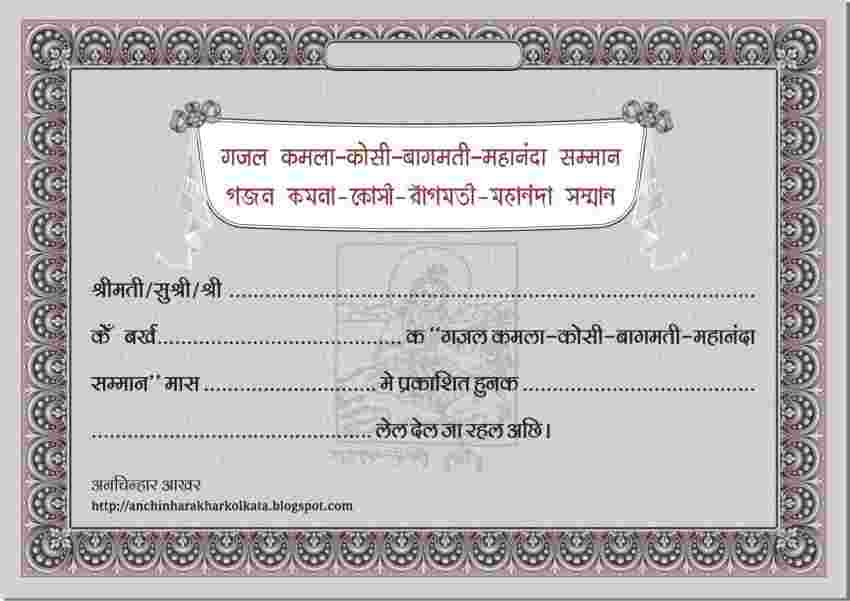
Wikipedia link related to Maithili Ghazal.
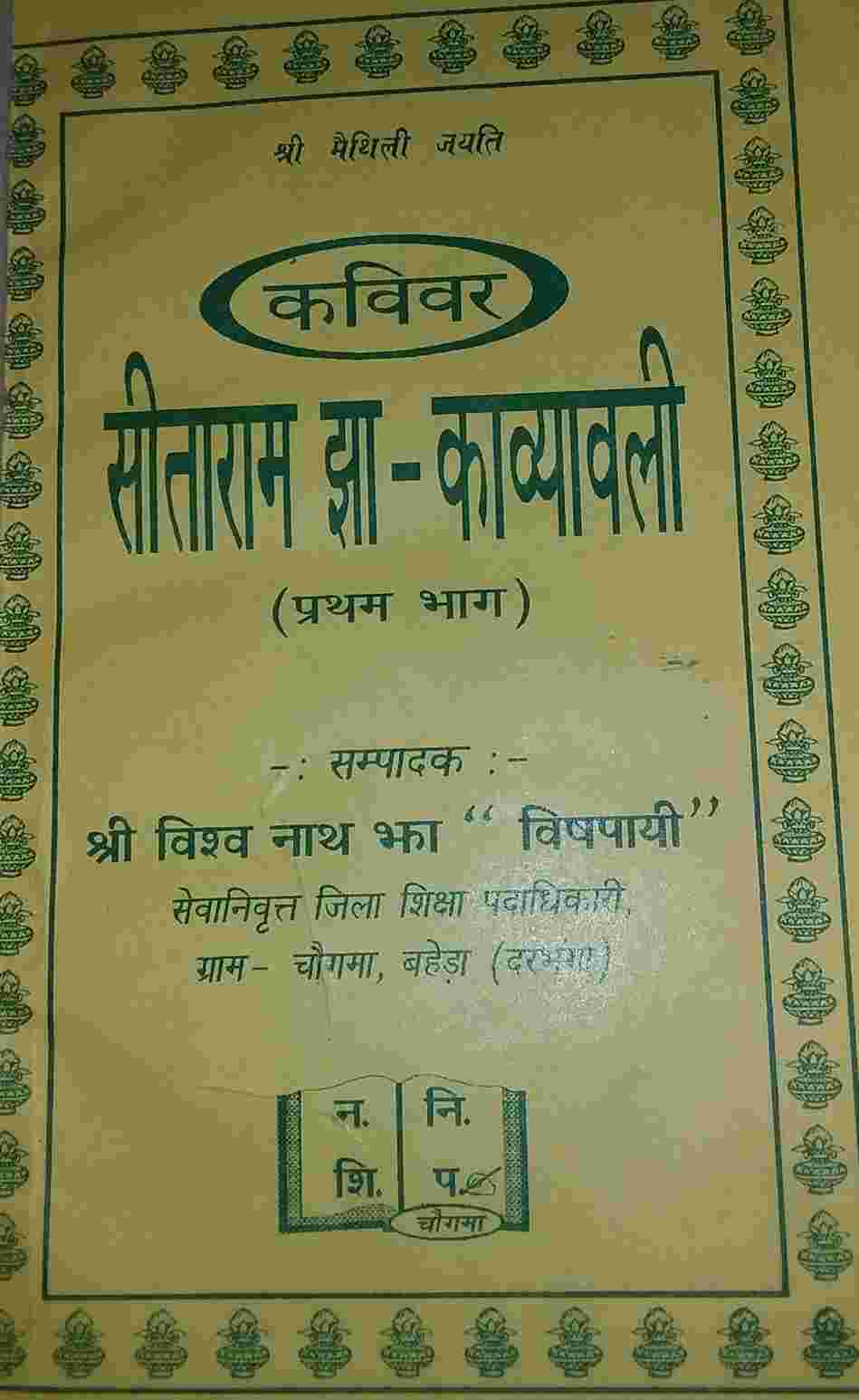
अपन मंतव्य editorial.staff.videha@zohomail.in पर
पठाउ।
विदेहमे सभठाम ताकू / Search all Videha
Static full-text search · Pagefindलेखक/शीर्षक/अंक/वर्ष — खोज-विधा। गद्य/पद्य/शोध current/static + पुरान Videha/Sadeha contents खोजैत अछि। पोथी pothi.htm केर पूर्ण listing, श्रव्य-दृश्य Audio_Video.htm केर पूर्ण listing, पञ्जी videha-sadeha/panji-shards GitHub data, आ थेसारस/शब्दकोश videha-ejournal.github.io/data GitHub JSON corpus केँ query करैत अछि आ दूनू Quiz corpus मे dictionary/vocabulary/शब्दार्थ-सम्बन्धी प्रश्नोत्तरी परिणाम सेहो जोड़ैत अछि। Quiz videha-quiz आ GitHub user-site दूनू bilingual quiz corpus खोजैत अछि। Roman/IAST + देवनागरी cross-script search समर्थित। Issue/Year लेल संख्या दिअ। PDF-अभिलेख archive.org/VidehaAndSadeha सूची खोजैत अछि।