
Gajendra Thakur
A PARALLEL HISTORY OF MITHILA & MAITHILI LITERATURE- PART 42
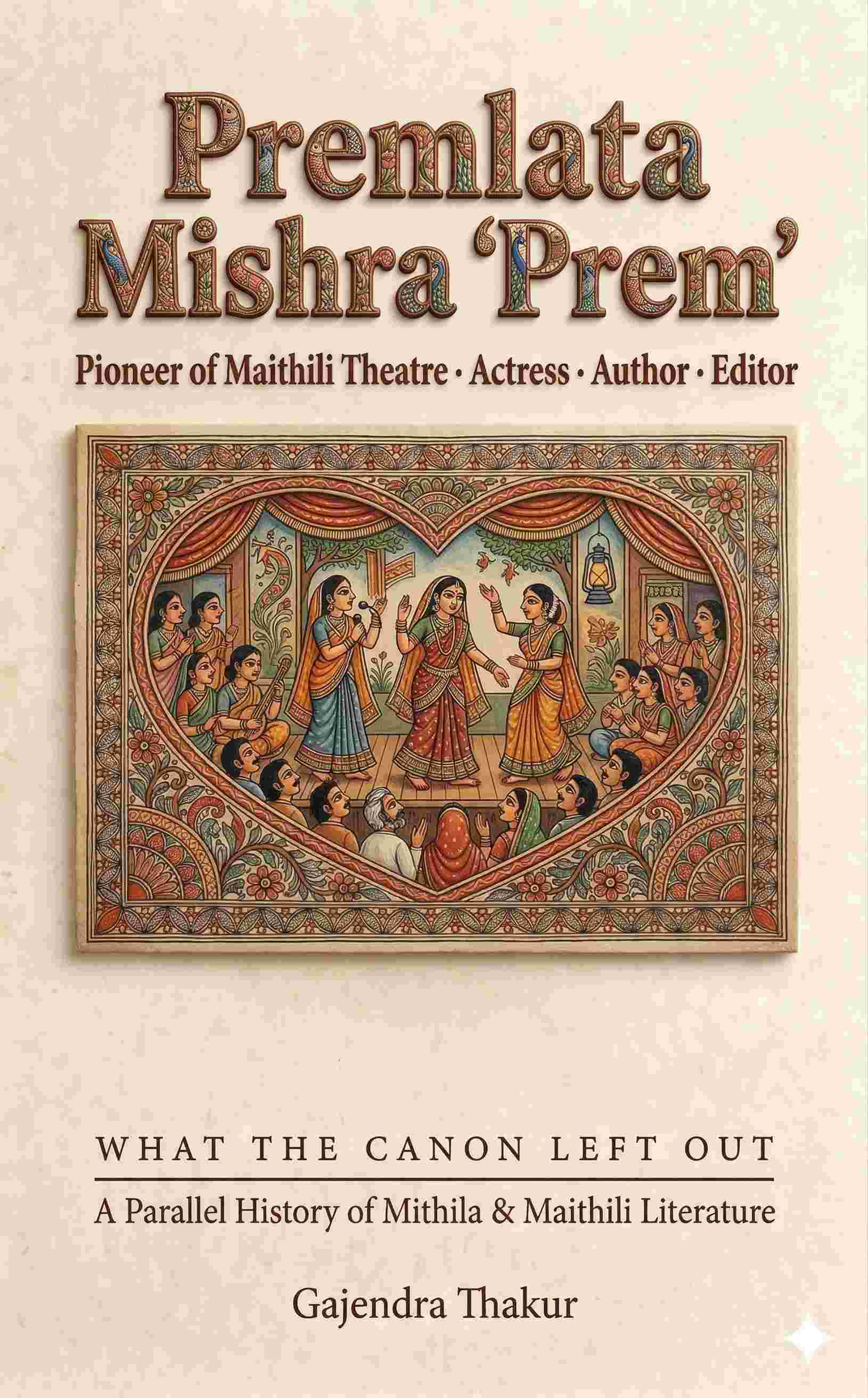
Premlata Mishra 'Prem' Pioneer of Maithili Theatre Actress Author Editor
Premlata Mishra 'Prem'
Pioneer of Maithili Theatre · Actress · Author · Editor
1. Biographical Overview
Dr. (Smt.) Premlata Mishra 'Prem' (born 29 September 1948, Rahika, Madhubani, Bihar) is the pre-eminent pioneer of modern Maithili theatre, a prolific stage and screen actress, short-story writer, memoirist, research scholar, and editor. Her career in performance, literature, and cultural institution-building spans over six decades, making her one of the most consequential figures in the cultural history of the Mithila region in the post-Independence era.
She is the first and most transformative powerful female stage artist of Maithili theatre, credited with normalising and championing women's presence on the Maithili stage at a time when even female roles were performed by men. She has appeared in over 250 Maithili stage productions as well as radio dramas, television serials, and films in Maithili, Hindi, and Bhojpuri. Among her most celebrated film appearances is her role in Mithila Makhaan (directed by Nitin Chandra), which won the Best Maithili Film award at the 63rd National Film Awards (2016) — the first Maithili film from Bihar and Jharkhand to receive a National Award. She also appeared in Prakash Jha's National Award-winning film Damul (1985), one of the most acclaimed Indian political films of its era.
In 2022, she was conferred the Sangeet Natak Akademi Award — India's highest national recognition in the performing arts — for her contribution to Indian theatre as an actor. Videha (ISSN 2229-547X), the first Maithili fortnightly e-journal, dedicated its entire Issue 357 (November 2022) to her as part of the 'Jibait Muda Upekshit' (Living but Neglected) series.
1.1 Personal Details
|
Full Name |
Dr. (Smt.) Premlata Mishra 'Prem' |
|
Born |
29 September 1948 |
|
Birthplace |
Rahika, Madhubani District, Bihar |
|
Marital Home |
Sirasi, Sitamarhi District, Bihar |
|
Mother |
Late Vrinda Devi |
|
Father |
Pt. Dinanath Jha (Vaidyaji — renowned local physician) |
|
Husband |
Late Maheshwar Mishra (schoolteacher in Rahika; d. 2018) |
|
Sons (3) |
Manmohan Mishra — Intelligence Bureau; Ravi Ranjan Mishra — Vice President, ILFS Finance; Satyajit Mishra |
|
Daughter |
Anupama — MA Music, singer |
|
Daughters-in-law |
Prabha Mishra, Neelima Mishra, Nutan Mishra |
|
Grandchildren |
Mahendra, Manas, Mukund (grandsons); Meghna, Piyushi (granddaughters) |
|
Residence |
L-2/33, PIC Colony, Kankarbagh, Patna – 800020, Bihar |
|
|
premlatamishraprem@gmail.com |
|
Mobile |
09931024819 |
1.2 Education
Premlata Mishra passed her Matriculation examination with First Division in 1963 from Rahika High School, Madhubani. She came to Patna in 1964. Subsequently she earned a Postgraduate degree in Maithili, a B.Ed., and a Ph.D. (Doctor of Philosophy). Her doctoral research was on the work of playwright and editor Sudhanshu Shekhar Chaudhary, later published as the monograph Shekhar Prasang.
1.3 Professional Career
She served as a Lecturer in Maithili at Bankipur Rajkiya Balika Dwadashiya Vidyalaya (Government Girls' Higher Secondary School), Golhar, Patna, from which she retired in September 2008. Her teaching career was conducted in parallel with her theatre and literary career across four decades.
According to a biographical note published by Manoj Jha in the Videha special issue, her late husband Maheshwar Mishra was also a schoolteacher in Rahika and was deeply supportive of the arts — attending literary gatherings and cultural events, purchasing journals, and encouraging their children in music and performance. Their son Satyajit Mishra studied tabla at the graduate level; two sons sang; their daughter is a performing singer in sugam and folk music.
2. Theatre Career
Premlata Mishra's contribution to Maithili theatre is foundational and transformative. She appeared in over 250 plays across radio theatre, stage theatre, television serials, and films over a career that began in the early 1960s. More than the sheer volume, it was her role in normalising and championing women's presence on the Maithili stage that secured her permanent legacy.
In her own words (from the interview conducted by Jagdish Chandra Thakur 'Anil' published in this issue): her teachers at Rahika High School — particularly Headmaster Chandrika Prasadji, himself an artist — encouraged all students to participate in cultural programmes on Republic Day, Independence Day, and Saraswati Puja. Though she was prepared for a play there, social opposition in the village prevented her from performing. However, that preparation proved invaluable when she reached Patna, where it enabled her to enter radio drama and stage theatre with ease.
She came to All India Radio (Patna) in 1964 through the legendary Maithili poet Nagarjun (her 'Yatri Kaka'), who introduced her to Hindi producer Madhukar Gangadhar. She began performing in both the Maithili programme 'Bharati' and the Hindi programme 'Chaupaal', appearing in two plays per month. Chekhov-style naturalistic acting, modern lighting technique (used by director Kunal), and an ensemble of educated Patna artists formed the milieu of her early career.
Premlata Mishra's contribution to Maithili theatre is both foundational and epoch-making. She was described by Shubhnarayan Jha in the Videha special issue as 'मैथिली रंग मंच के पितामही' (grandmother of Maithili stage) — a title capturing both her seniority and her generative role in the tradition.
2.1 Early Years and Path to the Stage
Premlata Mishra grew up in Rahika, a village historically known as a centre of drama, in Madhubani district. Her headmaster at Rahika High School, Chandrika Prasad (himself a theatre-maker), actively encouraged students to perform on Republic Day, Independence Day, and Saraswati Puja. She was prepared for a play written by Govind Babu, 'Basat' (The Wind), but social opposition in the village prevented her from performing. This preparation, however, laid the foundation for everything that followed.
In 1964 she came to Patna, and the poet Nagarjun ('Yatri Kaka' — a paternal relation) took her to All India Radio Patna, introducing her to Hindi producer Madhukar Gangadhar. She quickly joined the AIR drama unit. Biographies in the Videha issue confirm that she was married young — at age 12 per traditional custom — and came to Patna after marriage, with her husband's encouragement. The city provided the institutional and social infrastructure her village had denied her.
A milestone moment in the structural history of Maithili theatre arrived in 1972: from that year onwards, the Chetna Samiti (Patna's foremost Maithili theatre institution, founded by Nagarjun in 1954) began casting women in female roles. Premlata Mishra was at the vanguard of this change. She made her stage debut in the play Dhuwait Lok at Chetna Samiti. Her presence on stage at a time when it was socially exceptional was itself an act of cultural politics.
2.2 Radio Theatre
Her radio theatre work was prolific across All India Radio's Maithili programmes 'Bharati' and Hindi programme 'Chaupaal', performing two plays per month. She performed in plays by Sudhanshu Shekhar Chaudhary, Gauri Kant Chaudhary 'Kant', Bhagya Narayan Jha, and others, as well as the landmark Maithili serial Sinhasana Battisi (by Rabindranath Thakur) and several other serials.
|
Author |
Plays |
|
Sudhanshu Shekhar Chaudhary |
Aankh ka Parda, Jay Somnath, Chakri, Bahattar, Parivar, Sukh-Sihanta, Kahaan Jaiti Vagare-Vagare, Sonak Tukdi, Padal Kaaj; also: Uthan-Khatola, Ufaanti, Nai Aankh (20-Point Programme) |
|
Gauri Kant Chaudhary 'Kant' |
Maharshi Vishwamitra |
|
Bhagya Narayan Jha |
Sonak Mamata, Pahili Tarikh |
|
Rabindranath Thakur (serial) |
Sinhasana Battisi (Maithili radio serial) |
2.3 Stage Theatre
Her stage performances at Chetna Samiti, Arpan, and Bhangima (all Patna) covered works by Maithili's most prominent dramatists. The following is a consolidated list of documented stage productions:
Plays by Sudhanshu Shekhar Chaudhary
• Lagak Duri
• Pahil Saanjh
• Bhafait Chahak Jingni
• Letait Aanchal
Plays by Prof. Harimohan Jha
• Graduate Putoh
• Bikat Pahan
Plays by Govind Jha
• Lodhanath
• Antim Pranam
• Patak Manukh
• Rukmini-Haran (performed 17 times)
Other Playwrights
• Lal Paag (Rajkamal)
• Dhuwait Lok (Digambar Jha) — her debut stage play
• Ek Kamal Noreme, Kath ke Lok (Mahendra Malangia)
• Prayashchit / Sunu Janaki (Vatraanand Singh Jha 'Bachuk Bhai')
• Phagun, Chano Dai (Usha Kiran Khan)
• Anhar Jangal, Aagi Dhadhaki Rahal Achi (Dr. Arvind Akku)
• Esagar-Esagar (Late Jyotsna Chandram)
• Plays by Vibhuti Anand and Kumar Shailendra
2.4 Television Work
She appeared in multiple Doordarshan Bihar serials in Hindi: Parva Bhara Mithila, Veer Kunwar Singh, Viplav, and Ek Kahani, among others. In Bhojpuri she featured in the serial Sanchi Piritiya.
2.5 Film Career
Her film work spans Maithili, Hindi, and Bhojpuri cinema across a period of approximately four decades:
Maithili Films
• Mamta Gabay Geet — her first film
• Sasta Jingni Mahag Sinur (released 1999; successful at the Maithili box office; songs by Md. Aziz, Sadhana Sargam, Udit Narayan, Deepa Narayan)
• Lal Paag
• Mithila Makhaan — directed by Nitin Chandra; won Best Maithili Film at the 63rd National Film Awards (2016)
• Babeetiya
Mithila Makhaan was a landmark production in Maithili cinema history. Produced by Neetu Chandra (Champaran Talkies) and directed by her brother Nitin Chandra, it was shot across the USA, Canada, India, and Nepal — the first Maithili film shot on that scale and budget. The National Award jury was headed by filmmaker Ramesh Sippy. It is the first Maithili film from Bihar and Jharkhand ever to receive a National Award. Playback singers included Udit Narayan, Hariharan, Suresh Wadkar, and Sonu Nigam. Premlata Mishra played a central maternal role. Munni Kamat writes in the Videha special issue that her performance in this film is etched permanently in the viewer's consciousness.
Hindi Films
• Damul (1985) — directed and produced by Prakash Jha. A landmark Hindi-language film on bonded labour in rural Bihar; won the National Film Award for Best Feature Film (1984) and the Filmfare Critics Award. The film was also invited to competition sections at the Montreal, Chicago, and Moscow film festivals. It remains one of the most respected Indian social-realist films.
• Katha Madhopur Ki — tele-film on Panchayati Raj
• Maryada, Jahaan Chah Wahan Raah, Dehati Duniya, Ragini — tele-films
Bhojpuri Films
• Dulha Ganga Paar Ke
• Babuaa Hamar
2.6 Institutions and the Architecture of Maithili Theatre
In her interview in Videha Issue 357, Premlata Mishra provided a detailed institutional history of modern Maithili theatre, of which she is a living repository:
• Chetna Samiti, Patna: Founded by poet Nagarjun ('Yatri') in 1954; the oldest and most foundational Maithili literary and cultural organization. She made her stage debut here. From 1972, women began performing female roles in Chetna Samiti productions — a historic shift in which she was central.
• Arpan, Patna: Under Mantreshwar Jha's leadership, Arpan greatly expanded Maithili theatre's reach, organising international Natya Saptah (Drama Week) festivals with participating groups from Kolkata, Delhi, Virajnagar (Nepal), Janakpur, Jamshedpur, and Begusarai.
• Bhangima, Patna: Established on 4 August 1984 by committed theatre workers committed to Mithilanchal's cultural heritage; registered under the Societies Registration Act (Registration No. 655/1986). She served as editor of its irregular theatre journal and as a performer.
• Mailorang (Prakash Jha): Active contemporary Maithili theatre group; Delhi-based.
• Mithilaangan (Mahendra Malangia) and Barahmaasa: Contemporary active groups she described in her interview as sustaining the tradition.
3. Literary Works
3.1 Published Books
|
Title |
Year |
Genre |
|
Ego Valik Sineh (एगो वलीह सिनेह) |
2005 |
Short Story Collection (Maithili) |
|
O Din O Pal (ओ दिन ओ पल) |
2005 |
Memoir / Reminiscence Collection (Maithili) |
|
Shekhar Prasang (शेखर प्रसंग) |
— |
Research Monograph / Doctoral Work (Maithili) |
3.2 Critical Notes on Her Books
Gajendra Thakur's extensive critical essay in the special issue ('Premlata Mishra Prem'k Bahanne') offers the most detailed published evaluation of her three books:
Shekhar Prasang (शेखर प्रसंग)
This research monograph, based on her doctoral work, studies the playwright, director, and editor Sudhanshu Shekhar Chaudhary — the most significant figure in Maithili radio theatre and one of its leading stage directors. The study has four chapters: personality and body of work (Ch. 1), textual literary criticism (Ch. 2), Hindi writings (Ch. 3), and conclusions (Ch. 4). Among notable observations in the monograph is the account of how Chaudhary wrote — composing entire plays mentally and setting them down in a single draft, without revision, a creative discipline compared by Gajendra Thakur in the Videha issue reminiscent of George Bernard Shaw's shorthand-and-dictation method. The monograph also documents the role of the Mithila Mihir journal in building a generation of Maithili writers.
O Din O Pal (ओ दिन ओ पल)
This memoir collection of 12 pieces is the book most extensively commented upon in the Videha special issue — by Hitanath Jha, Abha Jha, and Gajendra Thakur. It came close to being an autobiography before resolving into a looser memoir form. Its most discussed piece is the memoir 'Hamar Kakka: Yatriji' (My Uncle: Nagarjun), which documents their relationship and Nagarjun's progressive domestic practice: he divided household cooking duties equitably, giving Premlata and his daughter-in-law a full day off per week (with his eldest daughter-in-law Shobha cooking on that day) — an act she records as her first conscious experience of rights. The memoir is also notable for its accounts of cultural Patna in the 1960s and 1970s. Other memoirs include accounts of her relationship with theatre luminaries including Sudhanshu Shekhar Chaudhary, and vivid portraits of early Maithili radio theatre life. Vibha Rani's essay in the special issue provides an extended literary-critical reading of this book. Abha Jha's essay in the issue is dedicated to this book's literary analysis, treating it as a landmark in Maithili women's life-writing.
The Memoir 'O Din O Pal': A Literary Landmark
Several contributors to the special issue comment specifically on her memoir collection. Abhaa Jha's essay is titled 'Rangkarmi Premlata Mishr'k Sahityik Vahi — O Din O Pal' (The Literary Register of Theatre Artist Premlata Mishra — O Din O Pal), and provides an extended reading of the book as a landmark in Maithili women's life-writing. Hitanath Jha's essay is also named after the same book.
The memoir is valued not just for its personal content but for its sociological documentation: it records the social life of Patna's Maithili-speaking intelligentsia in the 1960s and 1970s, the emergence of women in the public cultural sphere, and the internal dynamics of theatre and radio institutions at a formative period.
Ego Valik Sineh (एगो वलीह सिनेह)
Her short-story collection in Maithili. Gajendra Thakur notes in the special issue that several stories surprised him with their quality and range, establishing her not merely as a theatre practitioner who also writes, but as a genuine literary voice in the short-story form.
3.3 Editorial Work
• Sandhya Goshti (सांध्य गोष्ठी) — irregular periodical, which she began editing from 2008 after retirement; her primary ongoing editorial project.
• Bhangima (भंगिमा) — the theatre-focused irregular journal of the Bhangima group; she served as its editor for a period.
• Janaki (जानकी) — the souvenir of the Maithili Mahila Sangh (Maithili Women's Association), Patna.
4. National Recognition: Sangeet Natak Akademi Award 2022
The most significant of all the national honours accorded to Premlata Mishra is the Sangeet Natak Akademi Award for 2022, India's highest national recognition in the performing arts, conferred by India's National Academy of Music, Dance and Drama under the Ministry of Culture, Government of India. The award carries a cash prize of ₹1,00,000 along with a Tamrapatra (copper plaque) and an Angavastram (traditional stole). The Akademi Awards have been conferred since 1952 and are among the most prestigious honours in the Indian performing arts.
The official PIB citation for the award describes her as follows:
"Born on 29 September 1948 in Bihar, Premlata Mishra is considered a pioneer of Maithili theatre. Her journey began in the 1960s, promoting Maithili dramas through Akashvani (All India Radio) before transitioning these to the stage. Known for her over 250 lead roles in Maithili dramas, she has also acted in films and television serials. Her impact extends beyond the stage as she played a crucial role in shifting societal views towards [women in theatre]. Through her dedication to promoting Maithili language and culture through theatre, Mishra has garnered widespread recognition. As a doyenne of Maithili theatre, she has not only enriched the artistic landscape but... Shrimati Premlata Mishra receives the Sangeet Natak Akademi Award for the year 2022 for her contribution to Indian theatre as an actor."
The award was conferred by the President of India at a ceremony held at Vigyan Bhawan, New Delhi. It was the culmination of a body of work spanning over six decades in Maithili theatre and film.
5. Institutional Affiliations
She has served as President, Vice-President, Secretary, and Treasurer at various points in the following organisations:
• Chetna Samiti, Patna — Maithili's oldest and most prestigious literary and cultural institution
• Bhangima, Patna — Maithili theatre group; active since 4 August 1984
• Arpan, Patna — cultural organisation instrumental in spreading Maithili theatre
• Maithili Mahila Sangh (Maithili Women's Association), Patna
• Vandana Rani Kendra, Patna
• Bihar Sangeet Natak Akademi, Patna — Member, Executive Committee
• Maithili Akademi, Patna — Member, Cultural and Folk Stage Committee
She has also broadcast numerous stories, talks, and discussions on All India Radio and Doordarshan (the national broadcaster).
6. Awards and Honours — Complete Record
The following comprehensive table records all documented awards. National-level awards are highlighted; entries include source notes where independently verified.
|
Year |
Award / Honour |
Awarding Body / Source |
|
1985 |
Special Contribution to Maithili Theatre (Videha 357) |
Chetna Samiti, Patna |
|
1987 |
Honour for Maithili Theatre contribution (Videha 357) |
Mithila Vikas Parishad, Kolkata |
|
1988 |
Shailabala Puraskar (Videha 357) |
Chetna Samiti, Patna |
|
1988 |
Joint Honour (Videha 357) |
Akhil Bharatiya Mithila Sangh, Delhi & Arpan, Patna |
|
1992 |
Anil Kumar Mukherjee Pratham Shikhar Samman (Videha 357) |
Bihar Art Theatre, Patna |
|
1992 |
Kalashri Title (Videha 357) |
Bihar Pradesh BNS, Patna |
|
1992 |
Best Character Actress Award (7th Natya Competition) (Videha 357) |
Bhanu Kala Kendra, Virajnagar (Nepal) & Arpan, Patna |
|
1996 |
Pataliputra Award (theatre contribution) (Videha 357) |
Hindi Rangmanch Prangan, at 12th Pataliputra Mahotsav |
|
2000 |
Mithila Vibhuti Samman (Videha 357) |
Vidyapati Seva Sansthan, Darbhanga |
|
2000 |
Mithila Vibhuti Samman (Videha 357) |
Prayag Sanskritik Sangam, Allahabad |
|
2004 |
Honour: Social Service through Theatre (Videha 357) |
Rotary Patna Midtown, Patna |
|
2007 |
Honour at International Maithili Conference (Videha 357) |
International Maithili Conference, Delhi |
|
2007 |
Kalakaksha Samman (Videha 357) |
Kala Kaksha, Patna |
|
2009 |
Noor Fatima Award (Videha 357) |
Hindi Naatya Manch 'Prayas', Patna |
|
2011 |
First Jyotirishwar Rangshirsh Samman (Videha 357) |
Maillorang Theatre Group, Delhi |
|
2011 |
Honour at 4th International Maithili Conference (Videha 357) |
Mithila Sanskritik Samanvay Samiti, Guwahati |
|
2012 |
Mahendra Jha Samman (Videha 357) |
Maithil Samaj, Rahika |
|
2012 |
Mithila Vibhuti Samman (Videha 357) |
Akhil Bharatiya Mithila Sangh, Delhi |
|
2013 |
Bhikhari Thakur (Rangmanch) Varishtha Puraskar (Videha 357) |
— [Senior Theatre Award] |
|
2016 |
Contribution to Film Development Award (Videha 357) |
Bihar Rajya Film Vikas aur Vitta Nigam, Patna |
|
2018 |
Bhamati Stri Samman (Videha 357) |
Sanskritik Samiti, Andhrathadi |
|
2021 |
Lifetime Achievement Award (Videha 357) |
Shivam Productions Pvt. Ltd. |
|
2022 |
Navraj Samman (Videha 357) |
— |
|
2022 |
Honour: Outstanding Participation (Videha 357) |
Maithili Sahitya Kala, Rangmanch Mahotsav |
|
2022 |
Sangeet Natak Akademi Award — for contribution to Indian Theatre (Actor) (Sangeet Natak Akademi (National)) |
Sangeet Natak Akademi, Govt. of India — highest national performing arts award |
7. Critical and Scholarly Assessment
7.1 As Pioneer of Maithili Women's Theatre
The most transformative aspect of Premlata Mishra's contribution was structural rather than merely performative: she broke, through personal example and active mentorship, the convention that kept Mithila's educated women off the public stage. Manoj Jha writes in the Videha special issue that in the era when she entered theatre, women going on stage were viewed negatively by society; she faced direct opposition in her own village on multiple occasions. Yet she persisted, and by doing so changed the terms of what was possible. 'She was perhaps born on this earth to transform society's thinking,' Jha observes.
Her entry into Chetna Samiti in the early 1970s, coinciding with the institution's decision from 1972 to cast women in female roles, was a turning point not just for her but for Maithili cultural life. Munni Kamat writes: 'She encouraged more and more women to get involved in stage productions. Before her, society would continue to watch men in female roles. Premlata Mishra Prem was perhaps born to change society's thinking.' Shubhnarayan Jha's title for her — 'मैथिली रंग मंच के पितामही' (Grandmother of Maithili Stage) — has become the recognised honorific.
7.2 Gajendra Thakur's Extended Critical Essay
Gajendra Thakur's essay 'Premlata Mishra Prem'k Bahanne' (Videha 357, pp. 85–98) is the most substantial and analytically ambitious piece in the special issue, combining literary criticism of her three books with a wider critique of the institutional politics of Maithili cultural life. A key passage concerns the Sahitya Akademi Yuva Puraskar 2022, for which Premlata Mishra served as one of three jurors (alongside Keskar Thakur and Rajan Kumar Singh). Thakur documents that the jury voted, not on literary merit, but along caste lines, resulting in the rejection of Munni Kamat's poetry collection Antatah — which Thakur regards as clearly the superior work — in favour of a candidate whose primary qualification was caste affiliation and institutional connectivity.
Thakur's analysis of Premlata Mishra's vote is nuanced and ethically rigorous: he does not simply condemn her, but anatomises the structural pressure on a woman artist within a system dominated by caste networks, noting that 'all must pay a price' — in her case, the price of her vote as a juror. He observes that she surrendered both her identity as a woman and her identity as an artist in that moment, becoming instead an instrument of caste consensus. This is not a minor observation in an issue otherwise devoted to celebrating her achievements; it is a marker of Videha's editorial commitment to honest assessment over hagiography.
7.3 The Memoir as Feminist Document
Vibha Rani's essay — titled 'Rangmanch mein Raja Kiyo Nahin Hoit Hai' (There Are No Kings on Stage) — provides a feminist reading of Premlata Mishra's life and theatre work. The title points toward the democratic and non-hierarchical ethos of theatre as a practice, which Vibha Rani reads as a key feature of Premlata Mishra's practice: on stage, social rank collapses, and the actor's skill is the only currency. Abha Jha's essay treats O Din O Pal as a landmark in Maithili women's life-writing, a document of the cultural Patna of the 1960s and 1970s as experienced by a woman artist navigating between social convention and creative ambition.
7.4 Maithili Theatre in Cultural-Historical Context
Understanding Premlata Mishra's significance requires understanding the specific cultural-historical moment of post-Independence Maithili theatre in Patna. Chetna Samiti, founded by Nagarjun in 1954, was the nucleus of Maithili literary and cultural life, producing writers, editors, and theatre practitioners. The radio programme 'Bharati' on AIR Patna was one of the principal public spheres for Maithili performance. The city of Patna was home to a Maithili-speaking educated community of government servants, academics, and professionals — the audience and participants of this cultural world.
Within this milieu, the presence of women on stage was socially contested well into the 1960s. The Wikipedia article on Maithili literature notes that as late as 1958, when Harimohan Jha's wife Subhadra Jha entered Chetna Samiti as a stage performer, it was considered 'not less than a phenomenon for Maithil ladies.' Premlata Mishra came onto this stage in the early 1970s, and through her decades of work became the figure who made it normal. Her memoir O Din O Pal is one of the principal archives of this transformation.
8. Key Films in Context
8.1 Mithila Makhaan (2016, National Award)
Mithila Makhaan, directed by Nitin Chandra and produced by Neetu Chandra (Champaran Talkies), is the only Maithili film in over 50 years of Maithili filmmaking to have won a National Film Award. It received the Best Maithili Film award at the 63rd National Film Awards (2016), with the jury headed by Ramesh Sippy. The film was shot in USA, Canada, India, and Nepal; it depicts the emotional and political landscape of Bihar's Mithila region through the return of a Bihari engineer from Toronto to his ancestral village. Premlata Mishra played a central maternal role in the film.
Despite the National Award, the film struggled to find theatrical or OTT distribution, eventually being released on the makers' own platform bejod.in after Bollywood stars including Hrithik Roshan, Nawazuddin Siddiqui, Manoj Bajpayee, Vidya Balan, and Jackie Shroff promoted it publicly. Hrithik Roshan called it 'the first ever Maithili film from Bihar to win the National Award.' The film has since been widely recognised as a landmark in the history of Maithili cinema.
8.2 Damul (1985, National Award — Best Feature Film)
Damul (meaning 'Bonded Until Death') was written and directed by Prakash Jha. It is based on the story Kaalsootra by Shaiwal, set in rural Bihar in 1984, and focuses on the feudal system of bonded labour (panha), caste oppression, and rural migration. The film starred Annu Kapoor, Sreela Majumdar, Manohar Singh, and Deepti Naval in lead roles. It won the National Film Award for Best Feature Film (1984) and the Filmfare Critics Award for Best Movie (1985). It was invited to competition sections at the Montreal, Chicago, and Moscow international film festivals.
Premlata Mishra appeared in a supporting role in Damul. The film is one of the most critically acclaimed works of Indian social-realist cinema, and her association with it marks one of the significant moments in her crossover from Maithili stage and radio to nationally distributed Hindi cinema.
9. The Videha Special Issue (No. 357, 2022)
Videha's Issue 357 (01 November 2022) is the journal's seventh 'Jibait Muda Upekshit' (Living but Neglected) special issue, and its first dedicated to a woman. Announced in August 2022, it was assembled by Gajendra Thakur and presents 22 contributions focused exclusively on Premlata Mishra. The editorial note observes that this is not an abhinandan granth (a commemorative felicitation volume) — Videha's special issues deliberately make room for critical and even adversarial assessments alongside appreciative ones. It is the most comprehensive scholarly resource on her life and work assembled to date.
|
|
Title / Topic |
Contributor |
|
2.1 |
Editorial note on the special issue context |
Gajendra Thakur / Videha |
|
2.2 |
Biographical profile of Dr. Premlata Mishra 'Prem' |
Presented by Jagdish Chandra Thakur 'Anil' |
|
2.3 |
Poem: Premlata Mishra 'Prem' |
Kunal |
|
2.4 |
Hamar Bachchi Mausi (My Aunt) |
Kanupriya |
|
2.5 |
Maithili'k Sashakt Rangkarmi Premlata Mishra Prem |
Munni Kamat |
|
2.6 |
Hamra Lel Premlata Di |
Jaya Jha |
|
2.7 |
Hamar Bachchi (Premlata) |
Usha Kiran Khan |
|
2.8 |
O Din O Pal: Premlata Mishra 'Prem' |
Hitanath Jha |
|
2.9 |
Maithili Rang Manch ke Pitamahi Premlata Mishra 'Prem' |
Shubhnarayan Jha |
|
2.10 |
'Rangmanch mein Raja Kiyo Nahin Hoit Hai' |
Vibha Rani |
|
2.11 |
Mithila'k Vidushi Parampara'k Anupam Stambha |
Dr. Shiv Kumar Mishra |
|
2.12 |
Kala lel Varishtha Nai, Dakshata Mapdand Hai |
Ashish Anchinhar |
|
2.13 |
Rangkarmi Premlata Mishr'k Sahityik Vahi — O Din O Pal |
Abha Jha |
|
2.14 |
Nari Sashaktikaran ke Agradoot, Pahil Sashakt Mahila... |
Manoj Jha |
|
2.15 |
Dr. Premlata Mishra 'Prem': Mithila'k Vilakshan Vidushi... |
Prem Kant Chaudhary |
|
2.16 |
Mithilaputri (Poem) |
Kamlendra Jha 'Kamal' |
|
2.17 |
Premlata Bahin |
Lakshman Jha Sagar |
|
2.18 |
Premlata Mishra 'Prem'k Bahanne (Critical Essay) |
Gajendra Thakur |
|
2.19 |
Maithili Rangmanch'k Preranashrot: Premlata Mishra Prem |
Ajit Kumar Jha |
|
2.20 |
Interview with Premlata Mishra 'Prem' |
Jagdish Chandra Thakur 'Anil' (interviewer) |
|
2.21 |
Premlata Prasang |
Uday Chandra Jha 'Vinod' |
|
2.22 |
Maithil Nari'k Sanskritik-Sahityik Svar — Premlata Mishra Prem |
Pradeep Pushpa |
10. Historical Significance
Premlata Mishra's life and career sit at the intersection of several of the major cultural forces of post-Independence Mithila. She represents:
• The democratisation of Maithili cultural space: Her generation were the first to insist that women belonged on the Maithili stage as performers, not merely as audiences. She created the conditions for all subsequent generations of Maithili women in theatre.
• The documenter of a vanished cultural world: Her memoir O Din O Pal is an irreplaceable record of Patna's Maithili-speaking cultural intelligentsia of the 1960s and 1970s — a social world built around AIR Patna, Chetna Samiti, the literary journal culture, and the city's Maithili-medium schools.
• The embodiment of Nagarjun's cultural legacy: Her relationship with Nagarjun ('Yatri Kaka') was foundational — he brought her to AIR, shaped her early cultural formation, and modelled in his domestic practice the progressive attitudes toward women that she later wrote about. She is one of the direct human embodiments of his cultural and social vision.
• A bridge across media: Her career — spanning radio drama, stage, Doordarshan, Maithili cinema, Hindi art cinema, and Bhojpuri film — gives her a breadth of cultural reach and visibility that no other Maithili woman artist of her generation can match. Her appearance in Damul (1985) and Mithila Makhaan (National Award, 2016) connected Maithili cultural life to national and international audiences.
• A contested figure at the intersection of art and institutional politics: As Gajendra Thakur's essay in Videha makes clear, the history of Maithili cultural institutions is one of caste dominance and institutional gatekeeping. Premlata Mishra's career navigated this landscape, sometimes with independence and sometimes with compromise. The Videha special issue is the most detailed account of both her achievements and the structural pressures that shaped her.
11. Bibliography and Sources
Primary Source: Videha Special Issue
• Videha Visheshank (Special Issue) No. 357, 01 November 2022 (Year 15, Month 179). First Maithili Fortnightly eJournal. ISSN 2229-547X. Editor: Gajendra Thakur. Available: videha.co.in
Key Contributions in Videha 357
• Thakur, Gajendra. 'Premlata Mishra Prem'k Bahanne.' Videha 357 (2022), pp. 85–98.
• Thakur, Jagdish Chandra ('Anil'). 'Dr. Premlata Mishra Prem'k Parichay.' Videha 357 (2022), pp. 15–22.
• Thakur, Jagdish Chandra ('Anil') [interviewer]. 'Premlata Mishra Prem'se Sakshatkar.' Videha 357 (2022), pp. 104–108.
• Kamat, Munni. 'Maithili'k Sashakt Rangkarmi Premlata Mishra Prem.' Videha 357 (2022), pp. 29–31.
• Rani, Vibha. 'Rangmanch mein Raja Kiyo Nahin Hoit Hai.' Videha 357 (2022), pp. 46–52.
• Jha, Hitanath. 'O Din O Pal: Premlata Mishra Prem.' Videha 357 (2022), pp. 38–42.
• Jha, Shubhnarayan. 'Maithili Rang Manch ke Pitamahi Premlata Mishra Prem.' Videha 357 (2022), pp. 43–45.
• Jha, Abha. 'Rangkarmi Premlata Mishr'k Sahityik Vahi — O Din O Pal.' Videha 357 (2022), pp. 60–66.
• Jha, Manoj. 'Nari Sashaktikaran ke Agradoot...' Videha 357 (2022), pp. 67–72.
Works by Premlata Mishra 'Prem'
• Mishra, Premlata. Ego Valik Sineh [Maithili short stories]. 2005.
• Mishra, Premlata. O Din O Pal [Maithili memoirs]. 2005.
• Mishra, Premlata. Shekhar Prasang [Research monograph on Sudhanshu Shekhar Chaudhary].
Web Sources Consulted
• Sangeet Natak Akademi Awards 2022–23. Government of India / PIB. URL: static.pib.gov.in. (Accessed April 2026.) — Official citation for Premlata Mishra's SNA Award.
• 'Mithila Makhaan.' Wikipedia. en.wikipedia.org. — 63rd National Film Award, Best Maithili Film.
• 'Neetu Chandra's Mithila Makhaan wins Best Maithili Film National Award.' Times of India. 2016.
• 'A Rare Maithili Film Release Finds Promoters in Hrithik Roshan, Vidya Balan...' Outlook India. 2020.
• 'Damul.' Wikipedia. en.wikipedia.org. — National Award-winning film, directed by Prakash Jha (1985).
• 'Prakash Jha.' Wikipedia. en.wikipedia.org.
• 'A Journey Through Maithili Literature with Kathakar Ashok.' Outlook India, 2024. — On Chetna Samiti, founded by Nagarjun in 1954.
• 'Bhangima.' bhangima.in. — History and mission of Bhangima theatre group, Patna.
• 'Remarks on Maithili Literature.' saxonianfolkways.wordpress.com. — Harimohan Jha, Subhadra Jha, and women in Chetna Samiti.
• 'Maithili Cinema.' Wikipedia. en.wikipedia.org. — History of Maithili film industry.
अपन मंतव्य editorial.staff.videha@zohomail.in पर पठाउ।
विदेहमे सभठाम ताकू / Search all Videha
Static full-text search · Pagefindलेखक/शीर्षक/अंक/वर्ष — खोज-विधा। गद्य/पद्य/शोध current/static + पुरान Videha/Sadeha contents खोजैत अछि। पोथी pothi.htm केर पूर्ण listing, श्रव्य-दृश्य Audio_Video.htm केर पूर्ण listing, पञ्जी videha-sadeha/panji-shards GitHub data, आ थेसारस/शब्दकोश videha-ejournal.github.io/data GitHub JSON corpus केँ query करैत अछि आ दूनू Quiz corpus मे dictionary/vocabulary/शब्दार्थ-सम्बन्धी प्रश्नोत्तरी परिणाम सेहो जोड़ैत अछि। Quiz videha-quiz आ GitHub user-site दूनू bilingual quiz corpus खोजैत अछि। Roman/IAST + देवनागरी cross-script search समर्थित। Issue/Year लेल संख्या दिअ। PDF-अभिलेख archive.org/VidehaAndSadeha सूची खोजैत अछि।