
Gajendra Thakur
A PARALLEL HISTORY OF MITHILA & MAITHILI LITERATURE- PART 43
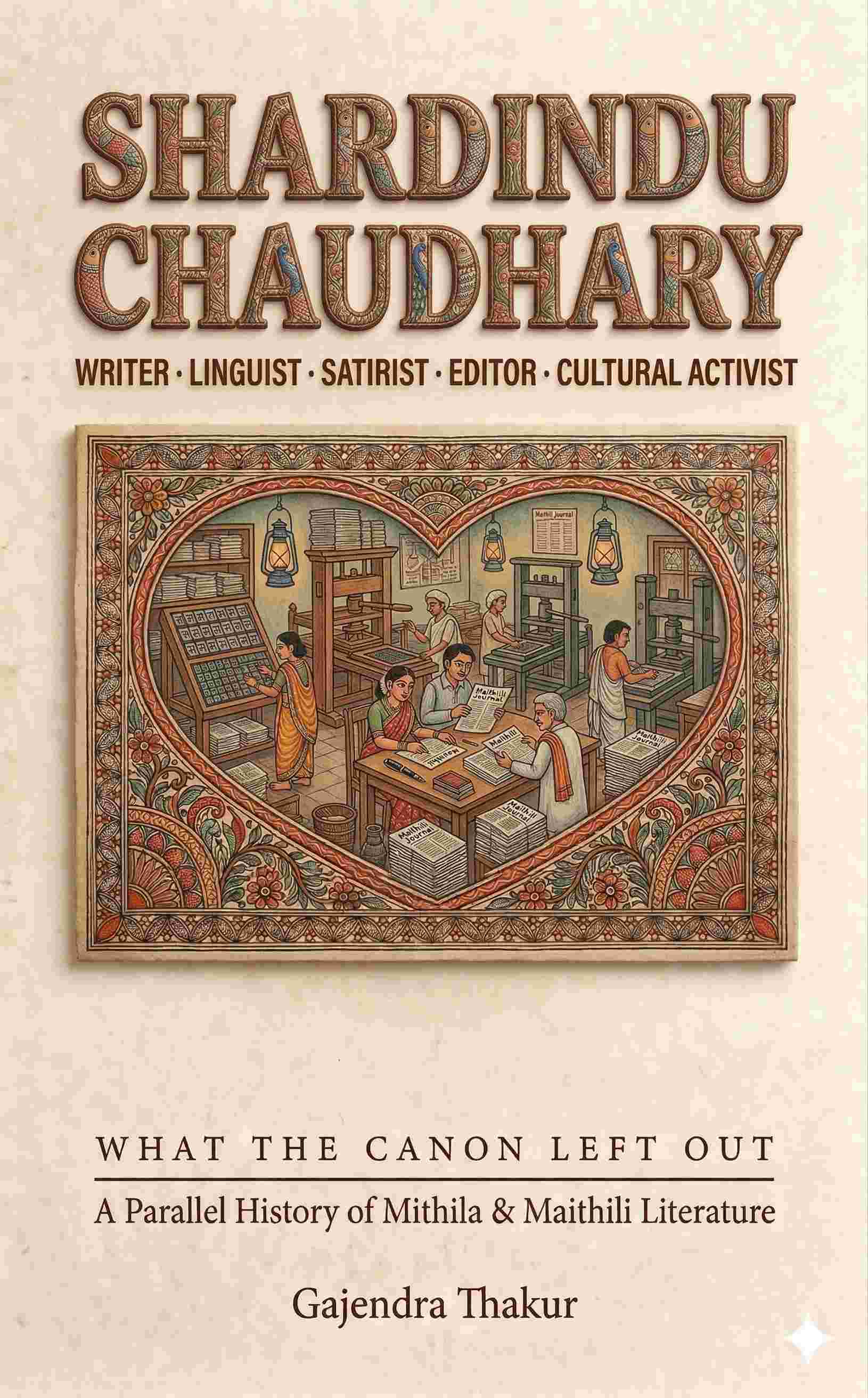
Shardindu Chaudhary Writer Linguist Satirist Editor Cultural Activist
Shardindu Chaudhary
Writer · Linguist · Satirist · Editor · Cultural Activist
1. Biographical Profile at a Glance
The following facts are drawn from the formal profile in Videha 358 (presented by Jagdish Chandra Thakur 'Anil', pp. 15–20), the interview (pp. 21–25), and corroborating cross-references across the Videha archive.
|
Full Name |
Shardindu Kumar Chaudhary (also: Sharadindu Chaudhary / Shardu Ji) |
|
Affectionate Address |
'Shardu Bhaiya' (elder brother Shardu) — used by peers including Kedar Kanan and Vibha Rani |
|
Language |
Maithili — the classical language of Mithila (north Bihar & Terai Nepal), 8th Schedule of the Indian Constitution |
|
Primary Genres |
Satirical prose (vyangya), comic memoir (hasy-sansmaran), short story, journalism, literary editing |
|
Editorial Role |
Editor, Samay-Sal — a significant Maithili periodical |
|
Archive Association |
Videha: Pratham Maithili Paksik eJournal (www.videha.co.in), ISSN 2229-547X — close association as contributor and archive facilitator |
|
Archive Courtesy |
Three works of Shivshankar Srinivas archived in Videha with joint courtesy of 'Shivshankar Srinivas and Shardindu Chaudhary' |
|
Videha Special Issue |
Videha No. 358, 15 November 2022 — an entire issue dedicated to him during his lifetime |
|
Public Reception |
Readers on social media declared this issue more significant than Sahitya Akademi / Lalit Kala Akademi / Sangeet Natak Akademi awards (recorded by editor Gajendra Thakur, p. 1) |
|
Key Literary Period |
Active primarily from the late 20th century through the early 21st century; Kariya Kakkak Coramin published 2016 |
2. The Videha Special Issue 358: Context and Significance
Videha (www.videha.co.in), founded in 2000 by Gajendra Thakur as 'Bhalsarik Gachh' and formally named Videha from 1 January 2008, is the first Maithili internet periodical (ISSN 2229-547X). It has been published twice monthly since its inception and has become the primary platform of the Videha Maithili Sahitya Aandolan — the Videha Maithili Literature Movement — which positions itself as a 'parallel tradition' running independently of the institutional mainstream.
Within this movement, the practice of publishing living-writer special issues (visheshank) has been a key mode of recognition. Issue 358 (15 November 2022, Year 15, Issue 179) is dedicated to Shardindu Chaudhary. The editor Gajendra Thakur records in the editorial that readers on social media declared this special issue more meaningful than awards from the Sahitya Akademi, Lalit Kala Akademi, or Sangeet Natak Akademi — India's three premier cultural institutions. This reception itself is a significant critical statement about the relative value placed on peer recognition versus institutional endorsement within the Maithili literary community.
The issue contains twenty-two dedicated essays, a profile, an interview, and three extended critical analyses by Gajendra Thakur — spanning pages 11 to 134 of the issue — making it the most comprehensive documentary source on Shardindu Chaudhary's life and work.
2.1 Contributors and Their Essays: Full Index
The following essays constitute the Shardindu Chaudhary Visheshank:
• 2.1 — Context of the special issue (pp. 12–14)
• 2.2 — Jagdish Chandra Thakur 'Anil': Profile of Shardindu Chaudhary (pp. 15–20)
• 2.3 — Jagdish Chandra Thakur 'Anil': Interview with Shardindu Chaudhary (pp. 21–25)
• 2.4 — Kalpana Jha: 'Maithili Sahityak Sewak Nahin, Maithili Bhasak Sewak: Shardindu Chaudhary' (pp. 26–30)
• 2.5 — Ram Bharos Kapadi 'Bhramar': 'Hamar Gyan-Pipashak Srot: Shardindu Chaudhary' (pp. 31–34)
• 2.6 — Jagdish Chandra Thakur 'Anil': 'Ohina Nahin Tamasait Chhathi Shardindu Chaudhary' (pp. 35–38)
• 2.7 — Vibha Rani: 'Shardu Bhaik Gambhir Siddhantapriyata!' (pp. 39–44)
• 2.8 — Dr. Narayanji: 'Visangatik Viruddha Pratirodhak-Swar' (pp. 45–47)
• 2.9 — Munni Kamat: 'Bhashavid Shri Shardindu Chaudhary' (pp. 48–50)
• 2.10 — Gaurinath: 'Shardindu Chaudhary Helak Maane' (pp. 51–55)
• 2.11 — Jagdish Chandra Thakur 'Anil': 'Kathya, Tathya Aa Satyak Chintan' (pp. 56–62)
• 2.12 — Ajit Kumar Jha: 'Samay-Sal Ken Akanait: Shardindujik Sampadan O Sampadakiya' (pp. 63–69)
• 2.13 — Ashok: 'Shardindu Ji' (pp. 70–73)
• 2.14 — Shivshankara Srinivas: 'Jehne Madhur Tehne Dridh' (pp. 74–78)
• 2.15 — Kedar Kanan: 'Hamar Shardu Bhaiya' (pp. 79–82)
• 2.16 — Ashish Anchinhar: 'Maithili Sahityame Shardindu Chaudhary Ker Yogdan' (pp. 83–87)
• 2.17 — Gajendra Thakur: Critical analysis of memoir series Baat-Baat Par Baat (I–IV) (pp. 88–98)
• 2.18 — Gajendra Thakur: Critical analysis of Ja Ham Janitahun (pp. 99–106)
• 2.19 — Gajendra Thakur: Critical analysis of three satirical collections — Bad Ajagut Dekhal, Goharaganesh, Kariya Kakkak Coramin (pp. 107–112)
• 2.20 — Lakshmana Jha Sagar: 'Khanti Maithilist Shardu Ji!' (pp. 113–118)
• 2.21 — Jagadananda Jha 'Manu': 'Satya Dekhal' (pp. 119–124)
• 2.22 — Shrivaram: 'Shardindu Kumar Chaudhary Ker Sahitya: Swarth Laagi Karaphu Sab Priti' (pp. 125–134)
3. Works of Shardindu Chaudhary: A Comprehensive Catalogue
The following catalogue is compiled from critical analyses in Videha 358, the Videha pothi.htm archive, and the IJCRT academic survey of 21st-century Maithili short stories (October 2025, Bijayendra Jha). Where exact publication years are given in sources, they are noted; otherwise the approximate period of activity is given.
3.1 Works Table
|
Year/Period |
Title |
Genre |
Notes |
|
c. 2010s |
Baat-Baat Par Baat — Vol. I |
Memoir-essay |
Sansmaran (reflective memoir); vol. 1 of 4-volume series |
|
c. 2010s |
Baat-Baat Par Baat — Vol. II |
Memoir-essay |
Vol. 2 of 4-volume series |
|
c. 2010s |
Baat-Baat Par Baat — Vol. III |
Memoir-essay |
Vol. 3 of 4-volume series |
|
c. 2010s |
Baat-Baat Par Baat — Vol. IV |
Memoir-essay |
Vol. 4; analysed Videha 358 pp. 88–98 by Gajendra Thakur |
|
c. 2015–20 |
Ja Ham Janitahun |
Satirical memoir |
Title phrase: 'Had I known...' — comic-retrospective memoir; analysed Videha 358 pp. 99–106 |
|
c. 2015 |
Bad Ajagut Dekhal... |
Satire (vyangya) |
'I saw a great absurdity' — social satirical collection; analysed Videha 358 pp. 107–112 |
|
c. 2015 |
Goharaganesh |
Satire (vyangya) |
Satirical collection; title invokes the comic archetype 'Gohara Ganesha'; analysed Videha 358 pp. 107–112 |
|
2016 |
Kariya Kakkak Coramin |
Satire / Short story |
Cited in IJCRT survey 2025; analysed Videha 358 pp. 107–112; cross-ref. Videha 352 p. 101–106 |
|
ongoing |
Editorials of Samay-Sal |
Periodical editorials |
Analysed by Ajit Kumar Jha, Videha 358 pp. 63–69 as a substantial literary body of work |
3.2 The Satirical Collections: Critical Analysis
Gajendra Thakur's extended essay in Videha 358 (pp. 107–112) is the most detailed analysis of Shardindu Chaudhary's three satirical collections. They represent the sustained deployment of a comic-critical worldview across a significant body of work.
3.2.1 Bad Ajagut Dekhal...
The title Bad Ajagut Dekhal — 'I saw a great/big absurdity' — announces the satirist's stance from the outset: the writer as observer, astonished by social, cultural and institutional absurdities. The ellipsis in the title itself is a gesture of open-endedness — the list of absurdities is infinite. The satirical-observer mode has deep roots in Maithili comic writing, going back to Harimohan Jha's (1908–1984) Khattar Kakak Tarang, in which the fictional 'uncle' Khattar Kaka systematically dismantles religious and social orthodoxies. Shardindu Chaudhary works in this same tradition of the sharp-eyed commentator who sees through convention.
3.2.2 Goharaganesh
The title invokes the figure of 'Gohara Ganesha' — a comic type associated with overconfident self-assertion and blundering officiousness. This title frames the collection as a series of portraits of such figures in contemporary Maithili and broader Indian social life. The use of mythological-folkloric reference as a framework for contemporary satire is characteristic of the best Maithili satirical writing.
3.2.3 Kariya Kakkak Coramin (2016)
This is the most widely cited of Shardindu Chaudhary's works outside the Videha ecosystem. The IJCRT academic survey (Bijayendra Jha, October 2025, Vol. 13, Issue 10, ISSN 2320-2882) lists it among the significant short story / satirical collections of the period 2015–2020, placing Shardindu Chaudhary alongside Sahitya Akademi-awarded writers and other established names in a scholarly survey of more than 300 published collections. The title — Kariya Kakkak Coramin, meaning approximately 'the stomach-medicine of Black Uncle' — is characteristically comic, using the physical image of a purgative as metaphor for social cleansing or the discomfort of honest observation.
The Videha 358 critical essay by Gajendra Thakur (pp. 107–112) analyses all three collections as a unified body of satirical work, arguing for Shardindu Chaudhary's place in the first rank of Maithili satirists of his generation.
3.3 The Memoir Series: Baat-Baat Par Baat (I–IV)
Gajendra Thakur's critical essay (Videha 358, pp. 88–98) analyses the four-volume memoir-essay series Baat-Baat Par Baat — a title meaning 'Word upon Word' or 'Point by Point.' This extended series of reflective autobiographical-essayistic prose tracks Maithili cultural life, literary friendships, institutional politics, and personal experience over several decades. The four-volume structure suggests an ongoing, cumulative engagement with the memoir form rather than a single completed work.
The editor of Videha connects this memoir-writing to a broader valorisation of the sansmaran (memoir) genre, noting that the Nobel Prize in Literature in 2022 was awarded to Annie Ernaux specifically for her memoir writing — a pointed claim that Shardindu Chaudhary's sustained memoir-essay practice belongs to an internationally significant literary mode, even if it has been overlooked by institutional bodies closer to home.
3.4 Ja Ham Janitahun
Analysed in Videha 358 (pp. 99–106), this satirical memoir collection takes its title from the Maithili expression 'Ja Ham Janitahun' — 'Had I known [this would happen]...' — a phrase charged with retrospective irony. The comic memoirs in this collection use the form of personal reminiscence inflected by the satirist's eye: the self becomes both the subject and the satirical object. This self-deprecating irony is a mark of the highest comic writing, since it requires the writer to turn the critical gaze inward without becoming purely self-indulgent.
3.5 Editorial Work: Samay-Sal
Ajit Kumar Jha's essay 'Samay-Sal Ken Akanait' (Videha 358, pp. 63–69) is the primary critical account of Shardindu Chaudhary's editorial work. Samay-Sal was a Maithili literary periodical; its name — 'Time-Tree/Season-Tree' — evokes both temporal awareness and rootedness in a cultural landscape. Ajit Kumar Jha argues that Shardindu Chaudhary's editorials deserve to be read as a substantial body of literary non-fiction in their own right — a claim that positions editorial writing as a primary literary genre rather than a secondary administrative function. Good editorial writing in Maithili has historically been under-recognized as a form of literary production, and Ajit Kumar Jha's essay is notable for treating Shardindu Chaudhary's editorials as substantive texts worthy of critical attention.
The history of Maithili literature has always been bound up with periodical culture. Major journals including Mithila Mihir, Vaidehi, Abhivyanjana, and Videha itself have been vehicles not just for carrying literary work but for forming taste, creating intellectual community, and articulating aesthetic positions. Samay-Sal occupies a place in this tradition.
4. Life, Personality and Intellectual Formation
4.1 Temperament: Equanimity and Principled Firmness
The portrait of Shardindu Chaudhary that emerges from the 22 essays in Videha 358 is unusually consistent. Multiple contributors across different generations and literary positions converge on a character defined by two seemingly opposed qualities: great personal warmth and absolute principled firmness. Shivshankara Srinivas captures this in his essay title 'Jehne Madhur Tehne Dridh' — 'As Sweet as He Is Resolute.'
Jagdish Chandra Thakur 'Anil's essay 'Ohina Nahin Tamasait Chhathi Shardindu Chaudhary' — 'Shardindu Chaudhary does not get irritated like that' — describes a temperament that resists provocation and maintains steadiness. This quality is significant in a literary world where institutional politics, caste dynamics, and generational rivalries frequently generate heated controversy. Shardindu Chaudhary's ability to remain engaged without becoming irritable is presented as itself a form of moral and intellectual practice.
Vibha Rani's essay title 'Shardu Bhaik Gambhir Siddhantapriyata!' — 'Shardu Bhai's serious attachment to principles!' — is marked by an exclamation of admiration. The 'serious attachment to principles' she identifies is not puritanism but intellectual integrity: a commitment to saying what is true and correct regardless of social pressure.
Kedar Kanan's affectionate essay 'Hamar Shardu Bhaiya' — 'My Shardu Bhai' — presents a warmer, more fraternal picture. The use of the familial address 'Bhaiya' (elder brother) by a younger writer indicates the way Shardindu Chaudhary has functioned as a mentor and elder within the Maithili literary world, offering encouragement, guidance, and intellectual companionship.
4.2 The Linguistic Identity: Servant of the Language, Not Just the Literature
The most theoretically significant characterisation of Shardindu Chaudhary in the special issue is Kalpana Jha's: 'Maithili Sahityak Sewak Nahin, Maithili Bhasak Sewak' — 'Not a servant of Maithili literature, but a servant of the Maithili language.' This distinction is crucial and carefully drawn. A servant of the literature is a writer who produces texts; a servant of the language is someone for whom the language itself — its survival, health, correctness, and vitality — is the primary concern.
Munni Kamat reinforces this in her essay title 'Bhashavid Shri Shardindu Chaudhary' — 'Linguist Shri Shardindu Chaudhary.' The term bhashavid (literally 'knower of language') positions him in the tradition of Maithili linguistic scholarship — a tradition with deep roots, from Sir George Grierson's systematic documentation of Maithili in the late nineteenth century, through to figures like Dr. Ramamtar Yadav (the subject of Videha's own special issue No. 396), who have devoted their work to understanding the structure, history, and contemporary situation of the language.
This linguistic orientation explains why Shardindu Chaudhary is not easy to categorise as simply a 'writer' in the narrow sense. His concern with language correctness, with the editorial work of Samay-Sal, with facilitating the archiving of other writers' texts — all these activities make sense as expressions of a primary commitment to the language as a living cultural system, not merely as a medium for literary self-expression.
4.3 Intellectual Influences and Peer Network
The structure of the Videha 358 special issue reveals something important about Shardindu Chaudhary's place in the Maithili intellectual world: the writers who contribute tributes are themselves significant figures across the full range of contemporary Maithili literature.
Ram Bharos Kapadi 'Bhramar' — whose own prolific output spans drama, fiction, poetry, ghazal, travel writing, and cultural documentation — calls Shardindu Chaudhary the source of his intellectual thirst (Gyan-Pipashak Srot). This is an extraordinary tribute from a major writer: it positions Shardindu Chaudhary not as a peer but as an intellectual formative influence.
Shivshankara Srinivas — born 2 July 1953 in Lohana, Madhubani, and the author of story collections including Trikona, Adahan, Mati, Guna Katha, and Gamak Lok, as well as the critical study Badalait Swar — is a close peer and literary ally. Their relationship is documented in the Videha archive's joint-courtesy arrangement for archiving Srinivas's major works. In The Wire interview (May 2025), Srinivas speaks of how the support of friends and fellow writers was invaluable to his own development — the kind of literary friendship that Shardindu Chaudhary exemplifies.
Ashok (Ashok Kumar Jha, born 18 January 1953) — described by Outlook India (December 2023) as one of the most prominent figures in Maithili literature, winner of the Yatri Chetna Samman and Kiran Purashkar — contributes the personal essay 'Shardindu Ji.' Ashok's own literary range (fiction, criticism, travel writing, satire, editorship) mirrors the broad scope that characterises Shardindu Chaudhary's activity.
4.4 The Interview (Videha 358, pp. 21–25)
The interview conducted by Jagdish Chandra Thakur 'Anil' and published in Videha 358 (pp. 21–25) is the only extended first-person document of Shardindu Chaudhary's voice in the special issue. The interview's presence in the special issue is itself significant: it places Shardindu Chaudhary's own articulations of his literary aims, his understanding of the Maithili situation, and his views on language and culture at the centre of the documentary record.
5. Critical Reception: Detailed Analysis of Tribute Essays
5.1 Jagdish Chandra Thakur 'Anil' — Three Contributions
Jagdish Chandra Thakur 'Anil' is the most prolific single contributor to the special issue, writing the profile (pp. 15–20), the interview (pp. 21–25), the essay 'Ohina Nahin Tamasait Chhathi Shardindu Chaudhary' (pp. 35–38), and the essay 'Kathya, Tathya Aa Satyak Chintan' (pp. 56–62). The multi-pronged engagement — biographical, conversational, temperamental, and thematic — reflects a close and long-standing relationship with the subject. The essay on 'Kathya, Tathya Aa Satyak Chintan' (Reflection on Content, Fact and Truth) addresses the epistemological dimension of Shardindu Chaudhary's satirical practice: the relationship between the satirist's comic distortion and the underlying reality he is trying to illuminate.
5.2 Ram Bharos Kapadi 'Bhramar' — 'The Source of My Intellectual Thirst'
Ram Bharos Kapadi 'Bhramar' is among the most prolific and versatile figures in contemporary Maithili literature. His works archived in the Videha pothi.htm page include: Mahishasur Murdavad evam anya Natak (drama, 1997), Lok Natya: Jat Jatin (folk theatre research, 2007), Huguli upar Bahait Ganga aa an Katha (fiction, 2008), Bhramar Maithili Deergh Kavita (poetry, 2009), Maithili Lok Sanskriti (Nepali, 2009), Bhaiya Aelai Apan Soraj (drama, 2010), Gharmuha (novel, 2012), Anhariyak Chan (ghazal collection, 2013), China je Ham Dekhal (travel memoir, 2014), Suli par Ijot (drama, 2015), Seema ke Aar-Paar (travel memoir, 2016), Yudhbhumik Esgar Yodha (poetry, 2017), Antivirus (fiction, 2019), Korona ke Santrasm (lockdown diary, 2020), Mithilak Lokjeevan Loksandarbha (2022).
That such a writer calls Shardindu Chaudhary the source of his intellectual thirst ('Hamar Gyan-Pipashak Srot') is one of the most significant testimonies in the special issue. It suggests that Shardindu Chaudhary has functioned as an intellectual catalyst and reference point for a writer whose own work spans an extraordinary range of genres and concerns.
5.3 Vibha Rani — 'Serious Attachment to Principles'
Vibha Rani is a major figure in both Maithili and Hindi literature, known for her drama, fiction, and cultural commentary. Her essay 'Shardu Bhaik Gambhir Siddhantapriyata!' focuses on the principled dimension of Shardindu Chaudhary's character. The exclamation mark in the title suggests admiration tinged with affectionate exasperation — the recognition of someone who takes principles seriously even when it might be socially easier not to. This essay positions his intellectual integrity as itself a kind of cultural contribution, modelling a mode of engagement that the Maithili literary world needs.
5.4 Dr. Narayanji — 'A Voice of Resistance Against Incongruity'
Dr. Narayanji's essay 'Visangatik Viruddha Pratirodhak-Swar' (A Voice of Resistance Against Incongruity/Absurdity) is the most politically inflected reading in the special issue. The term visangati (incongruity, incoherence, absurdity) points both to the social absurdities that satire targets and to a more systemic condition: the incongruity between professed ideals and actual practice in cultural, institutional, and political life. Shardindu Chaudhary's satirical voice, on this reading, is not merely entertaining but critical and resistant — a counter-voice to the normalisation of absurdity.
5.5 Gaurinath — 'The Meaning of Being Shardindu Chaudhary'
Gaurinath's essay 'Shardindu Chaudhary Helak Maane' — 'The Meaning of Being Shardindu Chaudhary' — is the most philosophically ambitious of the tributes. To ask what it means to be a particular person is to ask what values, practices, and relationships constitute that person's existence as a cultural actor. Gaurinath's essay treats Shardindu Chaudhary as an exemplar — someone whose mode of inhabiting the Maithili literary world is itself a model or lesson for others.
5.6 Ashish Anchinhar — 'His Contribution to Maithili Literature'
Ashish Anchinhar — the Maithili poet, ghazal specialist, and literary-historical critic, whose works archived in the Videha pothi.htm include Sandarbha Sahit (ghazal criticism), Preeti Karan Setu Banhal, Setusham: Vibrant Maithili, Maithili Gazalek Vyakaran O Itihas (grammar and history of Maithili ghazal), and Maithili Web Patrakaritaak Itihas (history of Maithili web journalism) — brings a systematising critical perspective to his essay 'Maithili Sahityame Shardindu Chaudhary Ker Yogdan' (pp. 83–87). Anchinhar's expertise in Maithili literary history and genre history gives his assessment of Shardindu Chaudhary's contribution its particular authority.
5.7 Shridharam — Vidyapati's Verse as Critical Lens
The essay by Shrivaram applies a verse of Vidyapati — the classical Maithili poet (c. 1350–1435) — as a critical lens: 'Swarth Laagi Karaphu Sab Priti' (All love is for the sake of self-interest). Used ironically, this citation from Maithili's greatest poet suggests that Shardindu Chaudhary's literary practice represents an exception to this cynical observation — a form of love for the language and literature that genuinely transcends self-interest. The use of Vidyapati as a touchstone places Shardindu Chaudhary's work within the long arc of Maithili literary tradition.
5.8 Lakshmana Jha Sagar — 'Genuine Maithilist'
Lakshmana Jha Sagar's essay 'Khanti Maithilist Shardu Ji!' uses the term 'Maithilist' — a neologism denoting someone deeply, genuinely and authentically committed to the Maithili language and culture. The qualifier khanti (genuine, authentic, unadulterated) distinguishes this commitment from the performative or opportunistic invocations of Maithili identity that are common in the political and cultural landscape. This essay is, in effect, a certification of authentic commitment.
6. Place in the Maithili Literary Tradition
6.1 The Satirical-Comic Tradition: Harimohan Jha and Beyond
Maithili's most celebrated comic-satirical writer is Harimohan Jha (1908–1984), variously described as the 'monarch of wit and satire,' 'incarnation of humour,' and 'Vidyapati of Maithili Prose.' His major work Khattar Kakak Tarang — originally published in the periodical Mithila Mihir and later collected — created a new genre: a dialogic satirical form in which the fictional 'uncle' Khattar Kaka systematically dismantles religious and social orthodoxies through comic scriptural exegesis. The stories were added to the Bihar matriculation syllabus in the 1980s, testifying to their canonical status. Jha was awarded the Sahitya Akademi award posthumously in 1985. His novel Kanyadan was translated into English as 'The Bride' in 2022.
Shardindu Chaudhary inherits and extends this tradition. His three satirical collections — Bad Ajagut Dekhal, Goharaganesh, and Kariya Kakkak Coramin — work in the same mode of the sharp-eyed observer of social absurdity, though their targets are the absurdities of contemporary (post-independence, post-globalisation) Mithila rather than specifically religious orthodoxy. The comic tradition in Maithili is not merely entertaining; it has always been a vehicle for social criticism.
6.2 The Periodical Tradition
Maithili literary culture has always been inseparable from its periodical culture. As documented in the Videha pothi.htm archive and the 'Ham Mithilawasi' blog, the major journals that shaped modern Maithili writing include: Mithila Mihir (Darbhanga/Patna), Vaidehi (Kashi/Sitamarhi/Darbhanga), Abhivyanjana (Patna/Saharsa), Mithila Darshan, Akhar, Dainik Swadesh, and many others. Harimohan Jha's Khattar Kaka was first published in Mithila Mihir; Rajkamal Chaudhary's first Maithili story was published in Vaidehi (1954).
Shardindu Chaudhary's editorship of Samay-Sal places him squarely in this tradition of editor-writers. The Videha journal itself, launched in 2000/2008 by Gajendra Thakur, is the latest and most extensive expression of this tradition, now operating in the digital medium. His relationship with Videha as a contributor, archive facilitator, and subject of the special issue positions him at the intersection of the older periodical tradition and its contemporary digital continuation.
6.3 Memoir and Essayistic Prose
The genre of sansmaran (memoir) in Maithili has not received the same critical attention as fiction or poetry, but it represents a significant tradition of reflective prose. The memoir series Baat-Baat Par Baat and the collection Ja Ham Janitahun both engage with this genre in a comic-satirical mode that is distinctive. The comparison drawn by Gajendra Thakur with Annie Ernaux's Nobel Prize-winning memoir writing — however hyperbolic it might seem from an institutional standpoint — captures something real about the literary mode: that memoir inflected by wit, self-irony, and acute social observation is a demanding literary form.
6.4 The Parallel Tradition and Videha
The Videha Maithili Sahitya Aandolan, as described in the Videha archive, positions itself as a 'parallel tradition' (samanantar parampara) to the institutional mainstream represented by the Sahitya Akademi and Maithili Akademi. This parallel tradition values innovation, range, and genuine literary merit over institutional affiliation or caste/political networking. Shardindu Chaudhary's close association with this movement — as contributor, archive facilitator, and the subject of a landmark special issue — marks him as a significant figure within this alternative canon-formation project.
6.5 Shivshankar Srinivas: The Archive Connection
The Videha archive's listing of three works by Shivshankar Srinivas — Maithili Upanyasak Aalochana (criticism of the Maithili novel), Chayanit Katha (selected stories), and Mati (Hindi translation by Susmita Pathak) — with the joint courtesy 'Shivshankar Srinivas and Shardindu Chaudhary' is a concrete demonstration of Shardindu Chaudhary's role as cultural custodian. The Videha pothi.htm page contains several cross-references to Shardindu Chaudhary beyond the special issue. Notably, the archive of Shivshankara Srinivas's major critical work Maithili Upanyasak Aalochana is made available with the joint courtesy of Shivshankara Srinivas and Shardindu Chaudhary — indicating his role as a facilitator and co-custodian of Maithili literary archives. Shivshankar Srinivas (born 2 July 1953, Lohana, Madhubani), whose five story collections have been widely acclaimed and whose Maithili Katha Sanchayan (2004) was published by the National Book Trust — the most institutionally prestigious of publishers — is himself a figure of major importance. The archiving of his works with Shardindu Chaudhary's name attached to them suggests a relationship of deep mutual trust and shared commitment to the preservation of Maithili literary heritage. Ashok's essay-volume and the Kedaranath Chaudhary special issue (Videha 352) also reference him, establishing him as a recurring figure in the critical conversations documented by Videha.
7. Thematic Analysis of His Writing
7.1 The Absurd as Social Critique
The recurring term ajagut (absurdity, incongruity, something out of place) in the title Bad Ajagut Dekhal signals a philosophical-aesthetic stance: the writer as someone who perceives the distance between the world as it is and the world as it presents itself. This is the fundamental operation of satire. Dr. Narayanji's characterisation of Shardindu Chaudhary as a 'voice of resistance against incongruity' (visangatik viruddha pratirodhak-swar) deepens this: the perception of absurdity is not passive but active, a form of refusal to accept the normalisation of the abnormal.
7.2 Language as Political and Cultural Terrain
Kalpana Jha's framing of him as a servant of the language rather than the literature points to a dimension of his work that goes beyond aesthetics into cultural politics. Maithili, as one of the languages in the Eighth Schedule of the Indian Constitution and the language of a population estimated at 30–50 million, faces ongoing pressures from Hindi and English. The commitment to linguistic correctness, to the health of Maithili usage, and to the preservation of the language's distinctive vocabulary and grammar is, in this context, a political act as well as a scholarly one.
This orientation connects Shardindu Chaudhary to the broader Maithili language movement — the decades-long campaign for constitutional recognition (achieved in 2003), for official use of Maithili in Bihar administration, and for Maithili-medium education. His work as editor and linguist is inseparable from this political-cultural context.
7.3 Self and Society: The Comic-Autobiographical Mode
The memoir series Baat-Baat Par Baat and the collection Ja ham Janitahun represent a sustained engagement with the autobiographical mode inflected through comic irony. The use of satire within personal memoir creates a double perspective — the self as both subject and satirical object.
The memoir series and Ja Ham Janitahun both deploy the comic-autobiographical mode — the genre in which the writer turns the satirical eye on their own life and experience. This is a difficult mode to execute well: it requires simultaneously inhabiting the narrator's perspective and maintaining enough critical distance to see that perspective's limitations and absurdities. The title Ja Ham Janitahun — 'Had I known...' — is a perfect emblem of this mode: the retrospective wisdom that arrives too late, and whose belated arrival is itself comic.
7.4 Memory, Community and Cultural Transmission
The four-volume Baat-Baat Par Baat, as an extended memoir-essay series, is also a work of cultural memory. It documents a world — the Maithili literary world of the late twentieth and early twenty-first century — through the accumulated details of personal experience, literary friendship, intellectual debate, and cultural occasion. In this respect it performs a function analogous to the oral tradition of katha (storytelling) in Maithili culture: the preservation and transmission of a community's experience through the medium of language.
7.5 Cultural Integrity and Principled Commitment
Multiple contributors note his resistance to compromise on matters of principle — whether in language use, editorial standards, or cultural positioning. Vibha Rani's essay on his 'Gambhir Siddhantapriyata' (serious attachment to principles) and the characterization by Shivshankara Srinivas as 'as sweet as he is resolute' together point to a writer for whom integrity is both a personal and a literary value.
8. Overall Significance
Shardindu Chaudhary's significance in contemporary Maithili culture operates at several interrelated levels:
• As a satirist, he extends and renews the great tradition of Maithili comic-critical prose, descending from Harimohan Jha through to his own generation, giving it contemporary social targets and a distinctive personal voice.
• As a memoirist, his multi-volume Baat-Baat Par Baat and the collection Ja Ham Janitahun constitute a substantial and distinctive body of reflective prose that merits comparison with the best in Indian-language memoir writing.
• As an editor of Samay-Sal, his editorial vision and the editorials he wrote represent an intellectual contribution to Maithili periodical culture whose significance has been articulated by Ajit Kumar Jha in Videha 358.
• As a linguist and language activist, his primary commitment to the health and survival of the Maithili language (not just its literature) situates him in a distinguished tradition of Maithili language scholarship and cultural activism.
• As a mentor and intellectual presence, his influence on younger and contemporary writers — documented across numerous essays in the special issue —As a mentor and interlocutor, his influence on younger Maithili writers — documented in the warm personal essays by Kedar Kanan, Ashok, and others in the special issue represents a form of cultural transmission and community-building that is irreplaceable.
• As an archive facilitator, his role in enabling the preservation and dissemination of other writers' works (most concretely in the case of Shivshankar Srinivas's three archived works) ensures the continuity of Maithili literary heritage.
• As the subject of Videha 358, his recognition by the Maithili literary community through one of the most significant parallel-tradition platforms in the language is itself a cultural-historical fact of importance.
The editor of Videha articulates the significance of the special issue itself: in the Maithili world, recognition by living peers and by a committed readership is, in many ways, more meaningful than institutional awards. The fact that Videha readers responded with such enthusiasm to this issue suggests that Shardindu Chaudhary's contribution is genuinely felt, not merely acknowledged it reflects something real about the relative values at play in contemporary Maithili literary culture: that authentic community recognition, rooted in actual engagement with the work, carries a weight that formal institutional prizes sometimes cannot match.
9. Associated Figures: The Literary World of Shardindu Chaudhary
Understanding Shardindu Chaudhary requires understanding the literary world he inhabits. The following figures appear across the Videha archive and are connected to him either as contributors to his special issue or as literary peers whose works are archived in close association with his.
9.1 Writers Who Contributed to Videha 358
• Jagdish Chandra Thakur 'Anil' — profile writer, interviewer, essayist; one of the most versatile figures in contemporary Maithili non-fiction.
• Kalpana Jha — essayist; also known for translations (Shephalika Varma's Yayavari into Hindi) and collection of folk songs. Her works (Gosaunik Geet, Nashamukti Git, Niniya) are archived in Videha pothi.htm.
• Ram Bharos Kapadi 'Bhramar' — arguably the most prolific living Maithili writer across genres; his 15+ books span drama, fiction, poetry, ghazal, travel writing, and folk culture documentation. All archived in Videha pothi.htm.
• Vibha Rani — prominent Maithili/Hindi dramatist and fiction writer; two plays archived in Videha pothi.htm.
• Dr. Narayanji — poet and essayist; author of Digantse Uthait Lahari (poetry) and Sanjhbati (fiction), archived in Videha pothi.htm.
• Munni Kamat — poet and essayist; author of Sukhal Mon Tarsal Aankhi (poetry/prose), Antatah, Chukka (children's stories), and Matik Suwas (novel), archived in Videha pothi.htm.
• Gaurinath — essayist and cultural commentator.
• Ajit Kumar Jha — author of Jatbe Bujhalahu Tatbe Likhalaahu (archived in Videha); essayist and literary critic.
• Ashok (Ashok Kumar Jha, born 1953, Lohna Tol, Madhubani) — winner of Yatri Chetna Samman and Kiran Purashkar; author of Chakravyuh, Ohi Raatik Bhor, Maatbar, Daddy Gaam, and critical works; all archived in Videha pothi.htm. Profiled in Outlook India (December 2023).
• Shivshankara Srinivas (born 1953, Lohana, Madhubani) — author of Trikona, Adahan, Mati, Guna Katha, Gamak Lok; critical study Badalait Swar; editor of Maithili Katha Sanchayan (National Book Trust, 2004). Profiled in The Wire (May 2025) and Scroll.in (September 2024).
• Kedar Kanan — poet and editor; his name appears across multiple Videha issues.
• Ashish Anchinhar — ghazal poet, literary historian; extensive archive in Videha pothi.htm including Maithili Gazalek Vyakaran O Itihas and Maithili Web Patrakaritaak Itihas.
• Gajendra Thakur — editor of Videha; novelist and critic; author of Sahasrabadhani, Sahasrashirsha and other works archived in Videha pothi.htm.
• Lakshmana Jha Sagar — poet and essayist.
• Jagadananda Jha 'Manu' — fiction writer; his works appear in multiple Videha issues.
• Shridharam — critic and essayist.
10. The Maithili Literary Context: A Brief Orientation
Shardindu Chaudhary's work can only be fully understood against the backdrop of Maithili literary history and the contemporary situation of the language. The following orientation draws on the Videha archive, the 'Ham Mithilawasi' blog, the Darbhanga Tower blog, and the IJCRT academic survey.
10.1 Maithili Language and Its Status
Maithili is the classical literary language of the Mithila region — comprising major districts of north Bihar (Darbhanga, Madhubani, Saharsa, Supaul, Muzzafarpur, Sitamarhi, Purnia) and parts of Jharkhand and Nepal's Terai. With an estimated 30–50 million speakers, it is among the largest Indian languages without a separate state. It was added to the Eighth Schedule of the Indian Constitution in 2003, giving it official recognition — a long-sought achievement of the Maithili language movement. Its script, Tirhuta (Mithilakshara), is of great antiquity; Google's Noto Fonts project has provided open-source digital fonts for Tirhuta, Kaithi, and Newari, all linked from the Videha pothi.htm.
10.2 The Satirical Tradition: Harimohan Jha
Harimohan Jha (1908–1984) is the towering figure of Maithili comic writing. Born in Vaishali, Bihar, and a professor of Philosophy at Patna University, he innovated the form of Khattar Kakak Tarang — a dialogic satirical genre in which the fictional uncle Khattar Kaka, 'enjoying himself after a drink of badam thandai,' dismantles religious and social orthodoxies through comic scriptural exegesis. As the Darbhanga Tower blog records, Jha was hailed as 'monarch of wit and satire,' 'incarnation of humour,' and 'Vidyapati of Maithili Prose.' He was awarded the Sahitya Akademi award posthumously in 1985.
10.3 The 21st Century: A Golden Age of Maithili Short Fiction
The IJCRT academic survey (Bijayendra Jha, October 2025) documents that more than 300 Maithili short story collections have been published in the last two and a half decades. Seven have received Sahitya Akademi awards: Nirja Renu's Ritambhara (2003), Vibhuti Anand's Kath (2006), Pradeep Bihari's Sarokar (2007), Manmohan Jha's Gangaputra (2009), Prof. Manmohan Jha's Khisa (2015), Shyam Darihare's Badki Kaki Eta Haat Mail Dat Com (2016), and Prof. Veena Thakur's Parineeta (2018). Shardindu Chaudhary's Kariya Kakkak Coramin (2016) is listed in this survey alongside these award-winning collections, situating him within this flourishing contemporary moment.
Relationship with Maithili Fiction and Short Stories
Academic scholarship (IJCRT, 2025, 'A Critical Analysis of Maithili Short Stories: Twenty First Century') places Shardindu Chaudhary's short story 'Kariya Kakkak Coramin' (2016) among the significant contributions to twenty-first century Maithili fiction. This scholarly recognition situates him not merely as a humorist but as a contributor to the more formal tradition of Maithili katha (short story) alongside Sahitya Akademi-awarded writers.
10.4 Periodical Culture and Literary Formation
The Maithili literary world has always been sustained by its periodical culture. Major journals include Mithila Mihir (Darbhanga/Patna), Vaidehi (Kashi/Sitamarhi/Darbhanga), Abhivyanjana (Patna/Saharsa), and now Videha (www.videha.co.in, since 2000/2008). Samay-Sal, which Shardindu Chaudhary edited, belongs to this tradition of literary periodicals that shape taste, form intellectual community, and carry the ongoing conversation of Maithili letters.
11. Bibliography and Sources
11.1 Primary Sources: Videha Special Issue 358
• Videha No. 358, 15 November 2022 (Year 15, Issue 179). Ed. Gajendra Thakur. ISSN 2229-547X. Shardindu Chaudhary Visheshank. Archive: https://archive.org/download/videha-262/VIDEHA_358.pdf
11.2 Videha Archive PDFs (videha.co.in/pothi.htm / archive.org)
• Videha Sadeha 11 (archive.org, videha-shishu-utsav). 2012 collection of Maithili prose and verse; ed. Gajendra Thakur & Umesh Mandal.
• Videha No. 352 (15 August 2022). Kedaranath Chaudhary Visheshank. Includes reference to Shardindu Chaudhary at pp. 101–106 (Ashok's essay). https://archive.org/download/videha-262/VIDEHA_352.pdf
• Videha No. 370 (Ram Bharos Kapadi 'Bhramar' Visheshank). https://archive.org/download/videha-262/VIDEHA_370.pdf
• Videha No. 369 (Ashok Visheshank). https://archive.org/download/videha-262/VIDEHA_369.pdf
• Ram Bharos Kapadi 'Bhramar' — full works archive: includes Gharmuha, Anhariyak Chan, Antivirus, Mithilak Lokjeevan, and others. videha.co.in/pothi.htm
• Shivshankar Srinivas — Maithili Upanyasak Aalochana, Chayanit Katha, Mati (Hindi tr. Susmita Pathak). All archived with courtesy of Shivshankar Srinivas and Shardindu Chaudhary. https://archive.org/download/maithili_202209/
• Ashok — full works archive: Chakravyuh, Trikon, Ohi Raatik Bhor, Maatbar, Sanvad, Baat-Vichar, Daddy Gaam, Katha-Path, Neek Dinak Bioscope, Pratiman, Sandhaan. videha.co.in/pothi.htm
• Ajit Kumar Jha — Jatbe Bujhalahu Tatbe Likhalaahu. https://archive.org/download/maithili_202209/Ajit%20Kumar%20Jha%20Jatbe%20Bujhlahu.pdf
• Ashish Anchinhar — Preeti Karan Setu Banhal, Setusham, Sandarbha Sahit, Maithili Gazalek Vyakaran O Itihas, Maithili Web Patrakaritaak Itihas. videha.co.in/pothi.htm
11.3 Web Sources
• Bijayendra Jha, 'A Critical Analysis of Maithili Short Stories: Twenty First Century.' IJCRT Vol. 13, Issue 10, October 2025. ISSN 2320-2882. https://www.ijcrt.org/papers/IJCRT2510038.pdf
• Ashutosh Kumar Thakur, 'A Journey Through Maithili Literature With Kathakar Ashok.' Outlook India, December 2023 / updated February 2024. https://www.outlookindia.com/culture-society/a-journey-through-maithili-literature-with-kathakar-ashok-weekender_story-335481
• Ashutosh Kumar Thakur, 'Interview: Tracing Maithili Writer Shivashankar Shrinivas's Literary Journey.' The Wire, May 2025. https://m.thewire.in/article/books/interview-tracing-maithili-writer-shivashankar-shrinivass-literary-journey
• Ashutosh Kumar Thakur, 'Translated short fiction: Read Soil by Maithili-language writer Shivshankar Srinivas.' Scroll.in, September 2024. https://scroll.in/article/1072445
• Arun Kumar Jha, 'Hari Mohan Jha: A Phenomenon in Maithili Short Story Writing.' Darbhanga Tower (blog), April 2013. https://darbhangatower.wordpress.com/2013/04/28/hari-mohan-jha/
• 'Dictums of the Scriptures: A Khattar Kaka Tale / Harimohan Jha.' Gulmohur Quarterly. https://www.gulmohurquarterly.com/short-fiction/dictums-of-the-scriptures-a-khattar-kaka-tale-harimohan-jha-issue-02
• 'Maithili Literature & Famous Maithili Writers.' Ham Mithilawasi (blog), August 2012. http://hummithilawasi.blogspot.com/2012/08/maithili-literature-famous-maithili.html
• S. K. Mishra, 'Translation Strategies and Challenges for Translating Maithili Idioms and Proverbs into English.' RESEARCH REVIEW International Journal of Multidisciplinary 9(4), 2024. https://rrjournals.com/index.php/rrijm/article/view/1210
Videha: Pratham Maithili Paksik eJournal. www.videha.co.in; Archive: www.videha.co.in/pothi.htm
अपन मंतव्य editorial.staff.videha@zohomail.in पर पठाउ।
विदेहमे सभठाम ताकू / Search all Videha
Static full-text search · Pagefindलेखक/शीर्षक/अंक/वर्ष — खोज-विधा। गद्य/पद्य/शोध current/static + पुरान Videha/Sadeha contents खोजैत अछि। पोथी pothi.htm केर पूर्ण listing, श्रव्य-दृश्य Audio_Video.htm केर पूर्ण listing, पञ्जी videha-sadeha/panji-shards GitHub data, आ थेसारस/शब्दकोश videha-ejournal.github.io/data GitHub JSON corpus केँ query करैत अछि आ दूनू Quiz corpus मे dictionary/vocabulary/शब्दार्थ-सम्बन्धी प्रश्नोत्तरी परिणाम सेहो जोड़ैत अछि। Quiz videha-quiz आ GitHub user-site दूनू bilingual quiz corpus खोजैत अछि। Roman/IAST + देवनागरी cross-script search समर्थित। Issue/Year लेल संख्या दिअ। PDF-अभिलेख archive.org/VidehaAndSadeha सूची खोजैत अछि।