
Gajendra Thakur
A PARALLEL HISTORY OF MITHILA & MAITHILI LITERATURE- PART 45
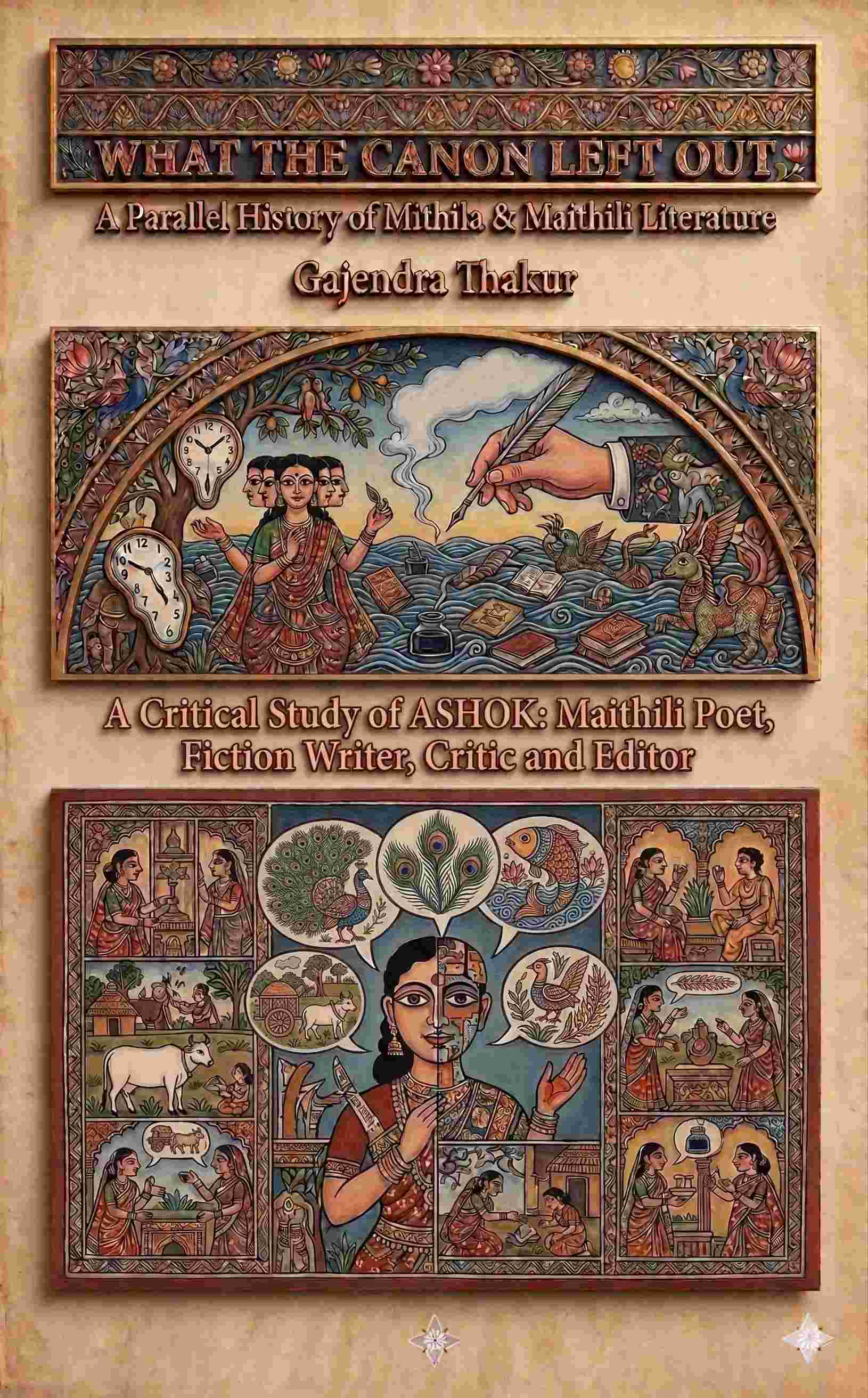
A Critical Study of ASHOK Maithili Poet, Fiction Writer, Critic and Editor
A Critical Study of ASHOK Maithili Poet, Fiction Writer, Critic and Editor
ASHOK
(Kathakar Ashok)
A Maithili Writer of Contemporary Significance
With Application of Indian and Western Literary Theories
Based on Videha Special Issue (Issue 369, 2023) and Published Works
Life and Formation
Ashok Kumar Jha — known in the Maithili literary world as 'Ashok' or 'Kathakar Ashok' — was born on 18 January 1953 in Lohna, Madhubani (Bihar). His father, the late Umapati Jha, served as manager of the Ram Temple in Kashi (Varanasi) built by Maharani Lakshmivati of Darbhanga. This temple environment was foundational: it buzzed with kavi-goshtis (poetry seminars), literary anniversaries, and the activities of the Maithil Student Union, exposing the young Ashok to a living, breathing culture of Maithili language advocacy from early childhood.
He completed his schooling in Varanasi, including Matric from Harivansh Inter College (1969), and eventually earned his B.Sc. (Botany Honours) from Goenka College, Sitamarhi. A competitive examination brought him into the Bihar Public Relations Department in 1977, and subsequently to the Bihar Co-operative Service in 1978, where he served in diverse postings — including Barh (Patna) and Katihar — ultimately retiring in January 2013 as a Joint Registrar. The parallel life of a government official and a writer is significant: Ashok's fiction is saturated with the texture of service-class existence — the bureaucratic corruption, the petty social hierarchies, the longing for dignity within systems that deny it.
His family life, marked by tragedy — losing his mother, father, sister, and elder brother in four consecutive years between 1987 and 1990 — left deep imprints on his sensibility. His wife Purnakala Devi, who survived a life-threatening surgery and long illness, passed away in January 2019. Critics like Gajendra Thakur rightly note that such personal experiences of loss and endurance enter the thematic bloodstream of his fiction, lending it an earned emotional gravity rather than mere sentimentality.
Ashok in the Lineage of Modern Maithili Literature
Modern Maithili literature emerged decisively in the 19th century with Chanda Jha's Maithili Ramayan and gathered momentum through Harimohan Jha's satirical novels in the mid-20th century. Ashok belongs to the 'contemporary stream' (samkalin dharaa) that began in earnest from the 1960s, a generation that inherited both the social-realist impulse and the pressure to develop aesthetically modern narrative forms. His contemporaries include Shivshankar Shrinivas, Shailendra Anand, and Arwind Thakur — all three collaborated on joint publications — and the more established presence of critics like Mohan Bhardwaj and Kulananand Mandal.
Ashok's first published poem appeared in the children's magazine Batuk in 1968, and his first story 'Viraam Se Pahile' appeared in Mithila Mihir in 1971. His debut collection Chakravyuh (poetry, 1986) and his contribution to the joint story anthology Trikon (1986) placed him firmly in the contemporary generation. The publication of Ohi Raatik Bhor (1991), Maatbar (2001), and Daddy Gaam (2017) — each marking a decade — traces the maturation of his literary sensibility across four decades.
2.1 Poetry: Chakravyuh (1986)
Though Ashok today identifies primarily as a story-writer (his Facebook profile declares 'Kathakar Ashok'), his literary career began with poetry. Chakravyuh — the title evoking the fatal military formation from the Mahabharata — is anchored in mythological re-imagination, particularly in the tragic story of Abhimanyu. The collection draws on the Mahabharata tradition of loka-katha (folk narrative) and loka-geet (folk song), embedding epic material in the affective register of the common people. As Gajendra Thakur, editor of Videha, points out: Ashok's Chakravyuh treats Mahabharata episodes not through the elevated Sanskrit pandit's lens but through the democratic voice of folk tradition — in the spirit that Firak Gorakhpuri identified as the supreme musical inheritance of Hindi folk song.
Key poems include the title poem 'Chakravyuh', a dramatic re-telling of Abhimanyu's entrapment in the military formation — a poem of unflinching masculinity and tragic honour. 'Hum Kichhu Puchhab Me' deals with Draupadi's vastra-haran (disrobing), foregrounding a feminist critique centuries before the term entered Indian literary discourse: Ashok's Draupadi is angered at Krishna's absence; she wanders, carrying her own corpse, waiting to become Vishmaditya. 'Soviet Sangh Se' is a narrative-lyric about a Soviet study tour, a document of the Cold War ideological landscape — a poem that skewers the hypocrisy of those who praised the Soviet Union even as they sent their children to America. This anti-ideological scepticism is characteristic of Ashok.
The poetic voice is spare, imagistic, and unwilling to sentimentalize. Ashok writes few poems — Thakur notes that he is among a generation that prefers quality over quantity — but what he writes demonstrates a compressed, concentrated lyricism that carries over into his prose style.
2.2 Fiction Collections: A Chronological Reading
Trikon (1986) — A Collaborative Debut
A joint collection with Shivshankar Shrinivas and Shailendra Anand, each contributing five stories, Trikon marks Ashok's formal arrival as a short-story writer. His stories in this volume reveal an apprentice's hand — what critic Kumar Rahul calls 'hastily written' with occasional formulaic plotting — but they contain the seeds of his mature concerns: the psychic life of ordinary men under social pressure, the economy of unspoken feeling, and the use of minimalist imagery to carry maximum weight.
Ohi Raatik Bhor / Ohhi Raatik Bhor (That Night's Dawn, 1991)
Dedicated to the memory of his elder brother Sushil Jha, this fifteen-story collection contains what many critics regard as Ashok's early masterpiece: 'Bouqa Chup Chhal' (The Mute Was Silent). The story is a study in class exploitation rendered through a single, symbolic image — a mute man bitten by a snake who chooses not to alert the doctor who lives nearby because he has understood that the social world has already abandoned him. The story resonates with a strong Marxist reading of silence as a form of suppressed protest. It also works through Freudian subtext — the mute's heart condition (hriday rog) making his silence both literal and emotional — a point that leads critic Kumar Rahul to observe that Ashok is simultaneously influenced by Marxist ideology and Freudian psychology.
Other notable stories include 'Viraam Se Pahile', 'Nachnia', 'O Manushya Bhag Gael' — a story about the cost of becoming 'normal', a haunting meditation on how one becomes ordinary and loses one's essential humanity — and 'Jail Mein Baadhle Man', a story of political detention during the Emergency, suggesting that Ashok's generation was directly shaped by Indira Gandhi's authoritarian experiment of 1975-77.
Maatbar (2001) — The Mature Voice
Published in 2001 at the dawn of the new century, Maatbar (The Influential One) contains eighteen stories and represents Ashok at his most socially panoramic. The title story is a cutting satire on the culture of patronage — the 'Maharaj Ji' who controls social networking, runs a system of favours, and around whom a court of sycophants gathers. This is recognizable as the Indian politics of small-town feudal-capitalism, a system Ashok knew from thirty years in government service.
Dilip Kumar Jha's extended critical reading of the collection (published in Videha 369) identifies the following major stories as representative: 'Raand' (Widow) — a remarkably progressive story in which a young man named Mani visits his widowed aunt in Kashi, only to find her dressed in bright colours, wearing gold bangles, and working for her own livelihood. The story, Jha argues, is transformative, depicting a changed widow who embodies the slow revolution in the condition of Maithil women. 'Kotha' is a sharp political satire on corrupt ministers (mantri-ji), depicted with the precision of a journalist's expose rather than a moralist's complaint. 'Dastakhat' (Signature) anatomizes the Indian Administrative Service officer as a man so corrupt that even signing a file becomes a performance of power. 'Bouqa Chup Cha' reappears in revised form, indicating Ashok's continuous rethinking of his best material.
Gajendra Thakur's exhaustive story-by-story reading (Videha 369) is the most authoritative critical text on this collection. He identifies 'Raand' and 'Bouqa Chup Cha' as the two strongest stories, and notes that the collection's weaknesses lie in occasional incompleteness — Ashok's tendency to rush toward a punch-line ('panchlain') at the expense of narrative development. This is a structural flaw that critics across the special issue repeatedly identify: a certain 'adhoorapan' (incompleteness) that paradoxically also constitutes Ashok's distinctive signature, a productive incompleteness that invites the reader to complete the meaning.
Daddy Gaam (2017) — Retrospective and Restless
Dedicated to the memory of his elder sister, Daddy Gaam (Daddy's Village) brings together fifteen stories written across several years. The title story is a middle-class narrative of retirement and return: Dr. Raghuvanshu, who has lived away from his village for decades, decides to return and build a temple — but under the influence of his progressive younger son Manik and the village youth, he ultimately decides to build a hospital instead. This narrative of aspiration and social responsibility is what critic Abhay Jha calls 'Ashok's characteristic middle path' — he neither romanticizes the village nor demonizes it, but shows it as a living social organism capable of transformation.
Gajendra Thakur's critical assessment of this collection identifies 'Chhal' (The Act / Pretence) as Ashok's finest story, later translated into English in The Book of Bihari Literature (Harper Collins, 2022, ed. Abhay K.). The story engages with the psychology of acting and method performance: Bholi Jha, a quick-witted actor, takes on a part so thoroughly that the character's soul enters him — a story that operates on simultaneous registers of folk psychology, theatrical theory, and social commentary about the permeability of identity. 'Lemon Ice Cream', 'Umki', and 'Gaamak Kaat Ka Highway' are also singled out for their quiet observation of how modernity dissolves the affective bonds of family and community.
2.3 Non-Fiction and Critical Prose
Ashok's range as a writer extends significantly beyond fiction. His essay collection Maithil Aankhi (The Maithil Eye, 2007) is a landmark in Maithili prose — a series of reflective essays on Maithili society, culture, and literature that are simultaneously personal and analytical. The title itself is a critical claim: there is a distinctively 'Maithil' way of seeing and narrating, which Ashok names and defends. This has influenced subsequent critical vocabulary in Maithili — writers like Kumar Rahul invoke 'Maithil Aankhi' as a conceptual category.
Katha-Path (2022) collects Ashok's critical readings of other Maithili writers — making him one of the rare creative writers who is also a practicing literary critic. His monograph on Rajmohan Jha (2019) for the Sahitya Akademi demonstrates his engagement with the tradition he inhabits.
Nik Dinak Bai Kop (A Sling for Better Days, 2018) collects his sangu-pathangu (satirical column) pieces originally published in Dainik Hindustan between 2014 and 2016. Hitanath Jha's critical essay on this collection in Videha 369 describes them as timeless political satire — jokes about the Holi of elections, the absurdity of corruption networks, the dying ponds and vanishing forests of Mithila — sharp enough to remain relevant years after writing.
Aankhi Mein Basal (Settled in the Eye, 2013) is a travelogue of his 1985 visit to the Soviet Union, a rare Maithili travel narrative. Katha ka Upanyas: Upanyasak Katha (2012) is a critical study of the relationship between the story and the novel in early Maithili literature, positioning him firmly as both practitioner and theorist of narrative form.
Primary Texts
1. Aankhi Me Basal
2. Baat Vichaar
3. Chakravyuh
4. Daddy Gaam
5. Katha Path
6. Matbar
7. Nav Kavita
8. Neek Dinak Byscope
9. Ohi Raatik Bhor
10. Sandhan 1, 2, 3, 4
11. Trikon
12. Pratiman
13. Pratiman Kiran
14. Samvad
15. Videha Issue 369 (contextual publication)
1. Aankhi Me Basal (आँखिमे बसल): Core Theme: Interiorized memory, emotional sedimentation, and identity rooted in lived experience. Structuralist Reading Organized around visual memory motifs (eyes as archive) Binary: seeing vs. remembering Narrative operates as episodic fragments rather than linear story Post-Structuralist Insight:“Vision” is unreliable—what is “seen” is already mediated / Memory destabilizes truth → no fixed reality / Psychoanalytic Depth / आँख (eye) = unconscious repository / Repressed experiences return as recurring visual flashes
Dalit/Marxist Layer: Memory tied to social humiliation and class-caste location / Personal vision becomes collective memory of oppression / Critical Evaluation/ This text is less narrative, more phenomenological—a literature of inner witnessing.
2. Baat Vichaar (बात विचार): Core Nature: Discursive, reflective, quasi-philosophical prose. Structuralism: Dialogic structure → argument / counter-argument pattern / Language as debate-space rather than storytelling / Post-Structuralism: Meaning constantly deferred / Assertions collapse into self-questioning / Marxist Reading: Critique of ideological structures embedded in everyday discourse / Reader-Response: Reader becomes co-thinker, not passive consumer / Evaluation: A meta-literary text—it questions not just society, but thinking itself.
3. Chakravyuh (चक्रव्यूह): Core Theme: Entrapment—social, psychological, systemic./ Structuralist: Circular narrative → no exit / Symbol: labyrinth = caste/class system / Marxist + Dalit: Strong critique of structural oppression: Entry into system is easy, exit impossible / Psychoanalytic:Internalization of oppression → victim participates in own entrapment / Postcolonial: Chakravyuh as metaphor for postcolonial bureaucracy and power / Evaluation: One of the most politically sharp works—structural violence is central.
4. Daddy Gaam: Core Theme: Rural transformation and generational shift. Marxist: Village as site of economic restructuring / Decline of feudal authority : Feminist: Women caught between: Tradition (control) / Modernity (uncertain freedom) / Postcolonial: Rural India negotiating modern state structures / Evaluation: A socio-anthropological narrative, deeply rooted in realism.
5. Katha Path: Core Theme: Storytelling as tradition and method. Structuralist: Meta-narrative: stories about storytelling / Oral → written transition / Post-Structuralist: No “original” story → only retellings
Reader-Response:Meaning shifts with each retelling / Evaluation: A theory of narrative embedded in narrative.
6. Matbar: Core Theme: Power, authority, and rural leadership. Marxist: सत्ता = economic control masked as social respect / Dalit: Authority often caste-based → exclusionary / Psychoanalytic: Authority figures driven by insecurity and control impulses / Evaluation: A critique of localized power structures.
7. Nav Kavita: Core Theme: Experimentation in poetic form./ Structuralist: Break from classical meter : Fragmented poetic units /Post-Structuralist: Language resists closure / Modernist/Postmodernist: Emphasis on: Alienation / Fragmentation / Urban/rural disjunction / Evaluation: Marks Ashok as a formally innovative poet.
8. Neek Dinak Byscope: Core Theme: Everyday life as spectacle. Structuralist: Episodic snapshots → cinematic structure / Postmodern: Reality as performance / Marxist: “Entertainment” masks material struggle / Evaluation: A visual-social montage of lived reality.
9. Ohi Raatik Bhor: Core Theme: Transition—darkness to awakening./ Symbolism: Night = oppression / Dawn = possibility / Psychoanalytic: Night as unconscious / Dawn as emergence of awareness / Dalit/Postcolonial: Awakening = assertion of identity / Evaluation: A deeply symbolic and hopeful text.
10. Sandhan Series (1–4): Core Theme: Search—for meaning, identity, truth.Philosophical: Existential undertone / Post-Structural: Search never ends → meaning is deferred / Reader-Response: Each reader completes the “search” differently / Evaluation: Forms a philosophical core of Ashok’s oeuvre.
11. Trikon: Core Theme: Relational complexity (three forces/identities). Structuralist: Triadic conflict structure : Psychoanalytic: Desire triangles : Marxist: Conflict of: Power/ Labor / Identity / Evaluation: A compact but dense symbolic work.
12–14. Pratiman, Pratiman Kiran, Samvad: Core Theme: Representation, reflection, dialogue. Post-Structuralist: No fixed “model” (pratiman) exists / Reader-Response: Dialogue-driven interpretation/ Evaluation: These texts function as intellectual extensions of earlier works.
15. Videha Context: Acts as: e-Publication platform / Intellectual ecosystem
Final Synthesis: Across all books: Core concern: marginality, identity, language / Dominant mode: reflective + symbolic realism / Theoretical richness: Marxist + Dalit → strongest / Post-structural → underlying instability / Psychoanalytic → internal depth / Ashok emerges not just as a writer but as: A system-thinker / A chronicler of subaltern consciousness / A formal innovator in Maithili literature
Critical Appreciation through Literary Theories
1 Realism and Social Realism (Indian and Western)
Ashok's dominant mode is realism — specifically, a social realism shaped by both the Indian tradition of loka-katha (folk narrative realism) and the Western tradition of critical realism associated with Chekhov, Maupassant, and, in India, with Premchand. His stories consistently take the 'ordinary moment' — a broken button, a tiffin box, a bicycle lesson — and invest it with social significance without resorting to melodrama.
In the Premchand tradition, Ashok's fiction is committed to the depiction of the common person: government clerks, retired officials, widows, the lower-middle class. However, unlike Premchand's sometimes schematic idealism, Ashok writes with an ironic distance. He rarely offers solutions; he is a diagnostician rather than a prophet. This connects him to Chekhov, whose stories famously refuse tidy resolutions, placing moral pressure on the reader rather than the narrative.
Gajendra Thakur explicitly compares Ashok's satirical method to Chekhov's in his discussion of 'Hisaab' (Accounting): 'One can feel something of Chekhov's story here.' The comparison is apt — both writers share the technique of the 'objective correlative' (T.S. Eliot's term), where an external object or situation carries an emotional weight that the prose never directly states.
2 Marxist Critical Theory: Class, Exploitation, and Silence
A significant strand of Marxist literary criticism operates in the critical apparatus around Ashok's work. Kumar Rahul, one of the most perceptive critics in Videha 369, explicitly notes that Ashok is 'influenced by Marxist ideology' — but that this influence arrives indirectly, through the texture of depicted social reality rather than through overt ideological statement.
'Bouqa Chup Chhal' is the story most amenable to a Marxist reading: the mute man who has been bitten by a snake belongs to the rural poor; the doctor who lives nearby is a figure of class power; the snake that bites the mute is, in the story's symbolic economy, the 'ajodh saanp' (invisible snake) of social exploitation that has always bitten the subaltern. The mute's silence — his refusal to call out, his knowledge that help will not come — is a form of class consciousness expressed through resignation. Rahul writes: the society's snake is still frothing even now.
'Kotha', 'Dastakhat', and 'Maatbar' are all exercises in the anatomy of power — bureaucratic, feudal, political — rendered through Marxist categories of class interest and false consciousness without being reducible to propaganda. The politician Ramlal Mandal in 'Kotha' deploys caste identity (Brahmin, Dalit, OBC, Muslim) as counters in a game: 'castism and religious identity — he takes advice from the Brahmin, horoscope from the Dalit, bread-daughter from the OBC, honour from the Muslim.' This is a Gramscian moment: the hegemonic manipulation of consciousness through manufactured solidarity.
3 Psychoanalytic Theory: Freud, the Unconscious, and Suppression
Ashok's interest in the inner life of his characters — in the slippages between what is said and what is felt, between social performance and private truth — lends his best work a psychoanalytic dimension. Kumar Rahul observes that alongside Marxist influence, Ashok draws on 'Freud's psychology'. This is most visible in the structure of suppression and the return of the repressed that governs several stories.
In 'Bouqa Chup Chhal', the mute man's heart condition (hriday rog) creates a neat Freudian topology: the disease of the heart is simultaneously literal (physical illness) and figurative (suppressed desire, silenced grief). In 'O Manushya Bhag Gael', the narrator addresses a lost friend through second person ('you became ordinary, you escaped from yourself') — this is the Freudian uncanny (unheimlich): the familiar made strange, the intimate self-alienated. In 'Umki', the story turns on a definition of love as rationing — 'Is there a quota for love?' — suggesting the psychological damage done to emotional life by a social economy of scarcity.
'Chhal' (the method-acting story) is perhaps the deepest psychoanalytic text in Ashok's corpus. The dissolution of self into role, the actor who cannot distinguish persona from person, engages the Lacanian problematic of the subject constituted by its performance rather than preceding it. This is a more sophisticated conceptual engagement than a simple Freudian reading would allow — and it suggests that Ashok's psychological range extends from popular Freudian common sense to more demanding theories of identity and self-constitution.
4 Feminist Reading: Gender, Widowhood, and the Maithil Woman
A consistent strand across Ashok's fiction is the experience of women — particularly in relation to patriarchal structures of widowhood, marital violence, and social control. Ashok's treatment of women characters is notably progressive for Maithili fiction, where the conventional image of the ideal woman (pativrata, devoted wife) has historically been dominant.
'Raand' is the touchstone here. The title word — a Maithili/Bhojpuri term for widow, considered pejorative — is deployed subversively. The widow at the centre of the story refuses the prescribed codes: she wears colour, works for pay, claims her beauty and her right to economic autonomy. This is a feminist realism that anticipates what Chandra Talpade Mohanty calls 'the politics of location' — the widow claiming space in a society that has mapped her out.
'Swaadhin' (Free/Independent) is a story about marital rape, told from the wife's perspective. The wife refuses to bear a child conceived through coercion — not because she does not love her husband, but because she will not accept the violation of her bodily autonomy as the condition of love. This is a remarkably advanced position for Maithili fiction. Gajendra Thakur identifies it as a story about 'marital rape' using that exact vocabulary, placing it within a contemporary feminist legal discourse.
The recurring figure of the educated young woman — Ankita in 'Chhuttiik Ek Din', characters in 'Khushiik Naam Jivan' — who navigates inter-caste marriage, linguistic identity, and professional ambition is Ashok's contribution to the archive of the 'new Maithil woman'. Jagdish Charan Thakur 'Anil' analyses the story 'Chhuttiik Ek Din' as a manifesto for this new feminine subject within the crisis of Maithili language identity.
5 Postcolonial Theory: Language, Identity, and the Problem of Maithili
Reading Ashok through a postcolonial lens reveals the extent to which his fiction is entangled with the politics of linguistic identity. Maithili spent the mid-20th century as an unrecognized language — excluded from the Eighth Schedule of the Indian Constitution until 2003, fighting for institutional recognition against the hegemony of Hindi. Ashok's writing is thus always already a political act: to write in Maithili is to resist the assimilative pressure of the Hindi literary mainstream.
Shiv Kumar Mandal's essay in Videha 369, 'Ashok O Maithili Sahitya Sansthan', documents Ashok's role in reviving the Maithili Sahitya Sansthan (Maithili Literary Academy) in Patna — an institution that had fallen dormant for decades. This is a postcolonial act of cultural institution-building: creating the apparatus for a linguistic community to produce, preserve, and distribute its literature.
Ashok's concept of 'Maithil Aankhi' (The Maithil Eye) is itself a postcolonial epistemological claim. It argues that there is a distinctively Maithili way of perceiving social reality — inflected by the region's specific history, its peculiar mix of Brahmanical culture and earthy folk wisdom, its geography of floods and fertile plains — that cannot be reduced to a general Indian or Hindi perspective. In Homi Bhabha's terms, this is the claim of a 'third space': a cultural particularity that refuses both the dominant nationalist narrative and pure localism.
The crisis of Maithili in the age of globalization — children who speak Maithili at home but write in English, mothers who cannot teach their children to read in their mother tongue — is dramatized with elegiac precision in 'Chhuttiik Ek Din', where the characters debate the survival and future of Maithili literature itself, a meta-fictional gesture that implicates the reader in the ongoing cultural struggle.
6 Narratology: Technique, Voice, and the 'Unfinished Story'
From a formal narratological perspective (drawing on Gérard Genette, Seymour Chatman, and the Russian formalists), Ashok's fiction reveals a distinctive set of strategies and limitations.
His most sophisticated technical achievement is the management of focalization — the point of view from which events are perceived. In 'Raand', the story is focalized through Mani, the young student-nephew, whose growing surprise and admiration for his aunt's autonomy structures the narrative's ideological movement from convention to liberation. In 'Heyarpin', the focalization is radically interior: 'There is night, there is a pillow, there is sleep... all of it arises as one image in the story.' Rahul's observation that Ashok's stories feel more like stories-to-be-heard than stories-to-be-read points to a narratological choice: the influence of the oral storytelling tradition (kissa-kahani) means Ashok's prose has a voice that works best in the acoustic imagination.
The signature weakness that critics repeatedly identify is the rushed ending — the punch-line that arrives before the narrative has fully prepared its reader. Gajendra Thakur calls this the 'panchlain-end' problem: a story builds genuine complexity and then resolves itself too quickly, sacrificing ambiguity for a clever final line. This suggests that Ashok's literary education was partly shaped by the short-short story (lagu-katha) conventions of newspaper publication, where brevity was a commercial requirement.
The 'adhoorapan' (productive incompleteness) that Rahul identifies as both limitation and signature is a real tension at the heart of Ashok's work. His best stories — 'Bouqa Chup Chhal', 'Chhal', 'Raand', 'Lemon Ice Cream' — work precisely because they refuse complete closure, leaving the reader in a state of productive uncertainty. His weaker stories fail because this incompleteness is not deliberate but merely unfinished.
7 Rasa Theory and Indian Aesthetic (Rasadhyaya)
Applied through the lens of classical Sanskrit aesthetics — specifically Bharata's Natyashastra and Abhinavagupta's Abhinavabharati — Ashok's fiction works primarily in the register of karuna (pathos) and hasya (humour/satire). The satirical pieces in Nik Dinak Bai Kop deploy hasya to expose social and political absurdity — a tradition that in Maithili runs from Vidyapati's lighter verses through Harimohan Jha's comic masterwork Khattarkaaka.
The karuna rasa — the aesthetic emotion of compassion — is the dominant register of his most successful fiction. The widow who has survived isolation, the mute man who dies in silence, the retired official who returns to his village and finds it transformed by the highway — all of these are figures of pathos in the Sanskrit sense: their suffering is presented not for melodramatic effect but for the cultivation of sahridaya (sympathetic reader consciousness). This aligns with the Indian aesthetic tradition's insistence that art's function is the refinement of emotional life, not its stimulation.
The concept of dhvani (resonance, suggestion) from Anandavardhana's Dhvanyaloka is also applicable. Ashok's best prose operates through dhvani — what is not said reverberates more than what is explicit. The mute man's silence, the widow's colour choices, the method actor's dissolution — all carry meaning beyond their denotative surface. This is the literary equivalent of what Sanskrit aesthetics calls the 'unstated meaning that illuminates the stated.'
8 Reader-Response Theory: The 'Sagr Raat Deep Jaray' Context
Ashok's literary formation took place in the unique institutional context of 'Sagar Raat Deep Jaray' (Let Lamps Burn Through the Night) — the all-night storytelling sessions organized across Mithila villages where stories are read aloud and immediately discussed by assembled listeners. This context is central to any reader-response reading of Ashok's work.
In Wolfgang Iser's terms, the 'implied reader' of Ashok's fiction is a community reader — one who brings the social knowledge of Maithili village life to the text, who can hear the folk idiom in the prose, who recognizes the social types as lived experience rather than fictional invention. This community reading creates what Iser calls the 'aesthetic pole' of the text: meaning emerges not from the author's intention alone but from the interaction between text and reader's life-world.
The peculiar incompleteness that critics identify — the story that begins well but ends too quickly — may be partly a function of this oral performance context, where the assembled audience and subsequent discussion complete the meaning that the written text leaves open. Kumar Rahul's observation that Ashok's stories make him want to 'hear them' rather than read them confirms this: they are written for the ear, not the page.
Ashok's Place in the Maithili Literary Tradition
1 The Three Ashoks: Poet, Storyteller, Prose Writer
Gajendra Thakur's structural insight — 'there are three Ashoks: Kavi Ashok, Kathakar Ashok, and Katheter Gadya ka Lekhak Ashok' (Poet Ashok, Storyteller Ashok, and Non-fiction Prose Writer Ashok) — offers the most comprehensive framework for understanding the writer's range. Of these three, the Storyteller is universally acclaimed as the most significant; the Poet is the least visible but arguably the most concentrated; and the Essayist and Satirist occupies a middle position of significant social utility.
This tripartite identity places Ashok within a distinguished line of Maithili writers who worked across genres: Harekrishna Jha (poet and critic), Harimohan Jha (fiction writer and social commentator), Rajkamal Chaudhary (poet, novelist, provocateur). But Ashok represents a distinctly post-Independence, post-Eighth-Schedule sensibility: pragmatic, socially observant, committed to the survival of Maithili culture through quality literature rather than rhetoric.
2 Awards and Recognition
Ashok has received the Yatri Chetna Samman, Kiran Purashkar, and other literary awards from Maithili literary institutions. His story 'Chhal' has been translated into English and included in The Book of Bihari Literature (Harper Collins, 2022, edited by Abhay K.) — a significant moment of visibility in the English-language literary market. His Sahitya Akademi monograph on Rajmohan Jha establishes his institutional credibility within the national literary framework.
3 Influence and Community
Shivshankar Shrinivas, Ashok's long-time literary friend and co-author of Trikon, credits Ashok with encouragement at a critical moment in his own literary development — a testament to the quiet mentorship role that established writers play in a small literary community like Maithili. Ashok's role in co-founding and sustaining the 'Sagar Raat Deep Jaray' storytelling culture, his involvement in reviving the Maithili Sahitya Sansthan, and his editorial stewardship of journals like Sandhaan collectively position him as an architect of the infrastructure of contemporary Maithili literary life — a role that is invisible in pure textual criticism but essential to understanding how literature actually survives and flourishes in a minority language context.
Final Critical Assessment
1 Strengths
Ashok's primary literary strength is the precision of his social observation — what Shailendra Anand calls 'a living artist'. He sees Maithili society with the clarity of long, affectionate, and critical attention: not romanticizing its traditions, not dismissing its transformations, but catching it in the act of becoming something new. His best stories — 'Bouqa Chup Chhal', 'Raand', 'Chhal', 'Kotha', 'Lemon Ice Cream' — achieve the condition of social miniatures: small in scale, exact in observation, and resonant with meanings that extend far beyond their particular Mithila settings.
His range across poetry, fiction, the satirical column, the travelogue, and literary criticism represents a commitment to Maithili literature as a whole — a commitment rare in writers who have achieved significant recognition in their primary genre. The Maithili literary world is small and resource-constrained; Ashok's willingness to work in every mode, to review other writers, to organize institutions, and to sustain the culture of live storytelling makes him what the critic Hitanath Jha calls 'a rare writer that Maithili needs.'
2 Limitations and Critical Reservations
The primary critical objection to Ashok's fiction — registered consistently across the critics assembled in Videha 369 — is the problem of incompletion. Too many stories begin with real momentum and genuine observation, only to resolve themselves prematurely through a clever punch-line that forecloses the ambiguity the narrative has worked to create. Thakur's exhaustive story-by-story reading of Ohi Raatik Bhor and Maatbar identifies 'mediocre' stories alongside the excellent ones — a candour unusual in a celebratory special issue, and evidence of the genuine critical seriousness with which Ashok's work is being engaged.
A related limitation is the occasional tendency toward journalistic reportage at the expense of fictional transformation. Stories like 'Maatbar', 'Dastakhat', and 'Kotha' read at times more like satirical sketches — sharp observations of social reality — than fully developed fictional worlds with their own internal logic. The best realism, as Lukács argued, requires the transformation of social material into aesthetic form; Ashok sometimes stops at the social material.
3 Historical Significance
Lal Dev Kamat's essay ends with a prophetic claim: 'In the history of Maithili story-writing, a time will come when stories from before Ashok, the Ashok era, and stories from after Ashok will be distinguished as a historical periodization.' This is a large claim, but it reflects a genuine critical consensus: that Ashok represents a qualitative shift in Maithili fiction — toward a sustained, ironic, psychologically aware, and socially committed realism that was less fully developed before him.
What Ashok has given Maithili literature, beyond his individual texts, is a model of the committed literary intellectual who works in multiple modes, sustains institutions, mentors younger writers, and insists on the value of quality over quantity in a literary culture under constant external pressure to produce more and faster. His slender output — perhaps two hundred stories over five decades — is, as he himself understands through the example of Premchand's three hundred stories, both a limitation and a mark of discipline.
4 The Unfinished Archive
Ashok remains an active writer as of 2023, with work published in Videha and other Maithili periodicals that has not yet been collected in book form. His Facebook presence as 'Kathakar Ashok' maintains a living connection with a new generation of readers. The Videha special issue (Issue 369, 2023) represents the most comprehensive critical accounting of his work yet assembled — but it is, as the editor notes, itself an interim document. The full critical reckoning with Ashok's contribution to Maithili literature is still to come.
A Critical Study of
ASHOK
Maithili Poet, Fiction Writer, Critic and Editor
────────────────────────────────────
Applying: New Criticism · Structuralism · Marxist Aesthetics · Post-colonialism
Feminism · Reader-Response Theory · Postmodernism · Deconstruction
I. Preface and Scope
The Maithili writer known simply as "Ashok" (born 18 January 1953, Lohna, Madhubani, Bihar) belongs to a generation that came of age during the Emergency and its aftermath—a generation scarred by political authoritarianism, galvanised by subaltern assertion, and forced to confront the structural violence of caste hierarchy in the Mithila region. His literary debut in 1986—the simultaneous publication of his poetry collection Chakravyuha and his co-authored short-story collection Trikon—was not a literary accident. Both books announce, in different registers, a coherent poetic-political project that Ashok would pursue for the next four decades.
This critical study is grounded in close reading of Ashok's complete published corpus as archived at videha.co.in, including: two poetry collections (Chakravyuha 1986; Ashok-Nav Kavita); four solo short-story collections (Ohi Ratik Bhor 1991; Matabbar 2001; Daddygam 2017); one co-authored collection (Trikon 1986); one satire collection (Neek Dinak Baiskop 2018); one travel narrative (Aankhime Basal 2013); one interview collection (Samvad 2007); two works of literary criticism (Baat-Vichar 2015; Katha-Path 2022); one monograph (Rajmohan Jha 2019); and four edited anthologies (Pratiman; Sandhan 1-4). The Videha Rachnakar Ashok Visheshank (VIDEHA 369) provides additional contextual framing.
The critical method is pluralist: different theoretical frameworks—New Criticism, Structuralism, Marxist Aesthetics, Post-colonialism, Feminism, Reader-Response Theory, Postmodernism, and Deconstruction—are brought to bear on different aspects of the work. No single master-theory is privileged. Where the texts resist or overflow theoretical categories, that resistance is itself noted.
Ashok's complete published corpus comprises: two poetry collections (Chakravyuha 1986; Ashok-Nav Kavita); four short-story collections (Trikon 1986; Ohi Ratik Bhor 1991; Matabbar 2001; Daddygam 2017); one satire collection (Neek Dinak Baiskop 2018); one travel narrative (Aankhime Basal 2013); one interview collection (Samvad 2007); two works of literary criticism (Baat-Vichar 2015; Katha-Path 2022); and four edited anthologies (Pratiman; Sandhan 1-4). This is a body of work spanning thirty-six years and every major prose and poetry genre.
II. Biographical and Historical Context
2.1 The Writer's Formation
The colophon of Chakravyuha (1986) reveals that Ashok's poetry-journey began in 1968 — nearly eighteen years before publication. In his own prefatory note ('Etabe Kahbak Achhi Je...'), he writes that his poetry-yatra has taken him from Kashi to his village Lohna (Seetamarhi district), to Araria, Itahari (Nepal), Moscow (Soviet Union), and back to Patna. This trajectory is significant: he is simultaneously a son of the Maithili soil (Lohna, Seetamarhi), a migrant intellectual (Patna), and an internationalist (Soviet Union). These three coordinates shape his entire literary project.
The preface mentions the influence of Shri Chandra Nath Mishra 'Amar' at the start of his poetry journey — a link to an elder generation of Maithili writers. But the list of friends and fellow-travellers in the acknowledgements — Kantinath ji, Kanchinath, Nandu, Dos, Shaul, Shekhar, Raj, Bidhur, Anur, Arun, Doctor Shyamanand ji, Bhogendra ji, Keshav, Vinod, Abhay, Varun, Ojha (Udaynath Jha) and others — maps a circle of young progressive intellectuals, the generation that would animate Maithili literature's democratic turn. Crucially, he credits his 'companion in life and poetry-journey' as Shivshankar Shrinivas — the noted Maithili fiction writer and critic, whose parallel literary career at Videha makes the Ashok-Shrinivas dyad central to the Parallel Literature Movement.
The collection is dedicated to 'Shri Upapati Jha, Lohna' — his elder from his village — with the lines: 'Badaa ke / hamar sabh kichhu / konno ne konno roop mein / jinkar chhinh / hunke / ee Chakravyuha seho.' ('To the elder: everything of ours / bears in one way or another / the mark of those / who shaped it — / to them / this Chakravyuha too belongs.') The dedication is an act of rooting: before the political poems begin, the poet acknowledges debt to the ground from which he grows.
The cover art (by Kajal Sen) is itself a critical document: a cactus in a desert landscape, a raised index finger (the finger of defiance or accusation), a watching eye, all enclosed by barbed wire. The visual vocabulary is unambiguously that of oppression and resistance — not the pastoral imagery one might expect from a Mithila poet. The choice of Urvashi Prakashan, Patna as publisher (rather than a Maithili institutional publisher) signals independence from the establishment.
2.2 Historical Moment: 1986
The year 1986 is a watershed in Bihar's social history. The Bodhgaya bhumi-andolan (landless peasant movement, largely Dalit-led) had concluded in 1982. The Jharkhand movement was intensifying. Caste atrocities — the Belchi massacre (1977), the Pipra massacre (1980) — had shaken the Maithili-speaking region. The Mandal Commission had submitted its report in 1980; its recommendations had not yet been implemented (that would come in 1990), but the political conversation around OBC reservations was already reshaping Bihar's social landscape. To publish two books simultaneously in 1986, both of them making social justice their central concern, was a deliberate act of positioning.
III. Chakravyuha (1986): Close Reading of the Poetry Collection
3.1 The Title Poem: 'Chakravyuha'
The title poem opens the collection and must be read with care. In its opening stanza, the poet addresses the reader directly:
खाली तकैत रहबा पर / खाली सोचैत रहबा पर / विवश हे हमर पुरुष ! / मोन में कुण्डली मारने बैसल / साँप के झमारि केकरो / भयमुक्त होउ ।
The address is to 'hamar purush' (our man/person) — not a specific individual but a representative human subject, trapped in passivity ('sitting merely watching, sitting merely thinking'). The snake coiled in the mind — the internalized oppressor, the chakravyuha of consciousness itself — must be driven away for liberation to become possible.
The Mahabharata reference then unfolds fully: 'Uthaad rathak pahiya / Chakravyuha mein gheraael Abhimanyu jakan / laḍaint rahab je dharam thik / taḥ jeet-haarak chinta juni karu.' (Lift the wheel of the chariot / like Abhimanyu surrounded in the Chakravyuha / keep fighting as long as it is right / then worry not about winning or losing.) The model is Abhimanyu — the warrior who fights the unjust formation even knowing he may not survive it. The poem asks not for victory but for the courage to engage. This is a specifically non-triumphalist politics: what matters is the fighting, not the winning.
The poem's third movement introduces the Kauravas and inverts their traditional characterisation: the corrupt powers are not the Pandavas' enemies from mythology but the contemporary powers-that-be who wear the garb of righteousness ('Bhesh badlabaa mein nipun / apan shatru ke chihnhbak / drishti par sen / mohak reshami pardaa hatao' — 'Expert at changing disguise / remove the silken veil / from the eyes / that recognise your enemy'). This is Gramscian hegemony in mythological costume: the dominant class rules by concealing its true character behind ideological disguise.
From a New Critical standpoint, the poem achieves what Cleanth Brooks called 'the language of paradox': the chakravyuha is simultaneously the trap to be escaped and the battlefield to be entered. The wheel of the chariot is both weapon and symbol of dharmic engagement. The poem holds these tensions without resolving them, creating what T.S. Eliot would recognise as 'felt thought' — thinking that is simultaneously emotional.
3.2 'Ham Kichhu Puchhab' (We Shall Ask Some Things)
This poem is a sustained interrogation — specifically of the social contract that expects the oppressed to remain silent. The central metaphor is the scene of chirharan (Draupadi's disrobing) from the Mahabharata, but radically reframed: the poem suggests that in the present moment, there is no Krishna to come to Draupadi's rescue, that Duhshasana smiles at the community's helplessness, and that those who should act (Krishna, the protectors) are either delayed or absent:
एहि चीर-हरण मे आइ / कृष्णक भूमिका / दुश्शासनक आगू / ठेहुनियाँ दऽ दैत अछि / कृष्ण या तऽ अएबा में / विलम्ब करैत छथि ...
The mythological framework here functions as post-colonial allegory (following Homi Bhabha): classical narrative is appropriated and 'mimicked' in order to reveal the gap between its promises and the reality of social abandonment. Krishna — the divine protector, the guarantor of justice — is either complicit or delayed. The community (lok) is left to stare blankly ('tukkur-tukkur takeit rahay'). The poem ends without resolution, its final question unanswered — a formal enactment of the political problem it describes.
3.3 'Soviet Rus Mein' (In Soviet Russia)
This poem from his Moscow visit period is one of the most explicitly internationalist pieces in the collection, and one of the most formally interesting. It contrasts two modes of social existence: one where pen and axe go together ('Jinhna kodaariye chalai chhen / kalam chalaabaḥ bala haath ke / kodaari chalabent'), and one where mere photographs replace genuine commitment ('maatra photo chhapab lel / kiyo dharm nahi karai').
From a Marxist aesthetic standpoint (Lukács), this is a poem that distinguishes between genuine engagement with the world-historical forces of labour and liberation, and the spectacle-oriented politics of those who perform progressivism without enacting it. The Soviet Union in 1986 — the year Gorbachev launched glasnost — was itself a contested symbol: the poem captures the aspiration the Soviet experiment represented for a generation of Indian leftists, without the disillusionment that would come later.
The formal structure of the poem is noteworthy: it alternates between short declarative lines and longer qualified statements, creating a rhythm that mimics the alternation between certainty and doubt that characterises genuine political commitment.
3.4 'Geet Je Nahi Likhhal Gel' (The Song That Could Not Be Written)
This is one of the collection's most layered poems — a meditation on the politics of silence and the conditions under which art becomes possible or impossible. The poem addresses a 'bhaai' (brother/comrade) and describes a world in which the evening comes and darkness falls, people go forward and backward, backward and forward ('chaḍait, pichhḍait / pichhaḍait, chaḍait'), their bodies smeared with printer's ink from dawn to night, 'sasrait' (wandering restlessly).
The dawn that comes after this night promises the birth of new song ('bhorak janm / ado sen hoet rahlai') — but the singer is described as 'kail gayak / toona jaka lalchhau' (the hoarse singer of yesterday / greedy like a sparrow). The poem refuses easy optimism: the dawn comes, but the singer is exhausted and uncertain. The song that should have been written remains unwritten — not because the poet lacks words or emotion, but because the conditions of unfreedom constrain what can be said.
From a reader-response perspective (Iser's 'implied reader'), the poem creates a reading experience that mirrors its subject: the reader must 'complete' the unwritten song from their own experience of social constraint. The poem's incompleteness is its meaning.
3.5 'Lok Kichhu Nahi Karaie' (People Do Nothing)
This poem is the most politically direct in the collection — a sustained critique of collective passivity in the face of injustice. It describes a world in which smoke rises from houses in the city without anyone taking notice ('lok aag nahi dekhai / apan aankhi maithaiai'), in which village people stand at the door of a woman in trouble without doing anything, without speaking, without helping. The repetition of 'kichhu nahi karai' (do nothing) throughout the poem functions like an accusation — both of the characters in the poem and of the reader.
The poem then turns toward the question of speech itself: the 'bhojanpur ka akhabar' (newspaper from Bhojanpur — a probable reference to the Bhojpur region, site of Naxalite activity and caste violence) and the morning's news — 'ki sunao ahankein?' (what shall I tell you?). The irony is double: on one hand, there is too much to report; on the other hand, no one is listening.
Structurally (following Jakobson's poetic function), the poem exploits parallelism to devastating effect: the repeated syntactic pattern of 'aai jabaan — kono makan sen dhuaan uthai — taḥ lok aag nahi dekhai' creates a rhythm of accumulating failure that mirrors the social condition it describes.
3.6 'Tora Gachhane Rahi' (You Kept Passing By)
A significant departure in tone — this poem addresses a female second person ('tora') and registers both social critique and intimate loss. The urban landscape it evokes is one of alienation: 'iho shahar ajabe chhek / ne jeebaint, ne marae / khaali fateechar sharaabi jaka / sunsan gali mein / chikraait, bhookraint' (this city is strange / neither living nor dying / like a shabby drunkard / in empty lanes / crying, stumbling). The city has become a site of zombie existence — motion without meaning.
The poem's female addressee is not passive; she passes by, she 'gachhane rahi' — keeps moving, keeps going. The poem's emotional register combines political despair with personal longing in a way that anticipates the love poems later in the collection. This is not sentimentalism: the personal and political are woven together, so that intimate loss becomes inseparable from the loss of social possibility.
From a feminist reading, the poem is interesting precisely for what it does NOT do: it does not reduce the 'tora' to a symbol or a muse. She has her own trajectory (she keeps going); the poem registers her movement as something the speaker watches and cannot arrest. She is a subject with agency, not an object of male gaze.
3.7 'Ahanken Ki Chahi?' (What Do You Want?) and the Language Question
This poem is perhaps the most linguistically self-conscious in the collection — and therefore the most significant for understanding Ashok's position within the Maithili cultural-political debate. The poem addresses a 'hujur' (a sahib-type figure, a person of authority) and offers him any word he desires:
हुजुर, अहाँ कहू ? / अहाँकें की चाही ? / शब्द चाही / की अर्थं चाहो ? / हमरा लग राशि-राशि / शब्द अछि । / फूसि, साँच, भरिगर, हल्लुक / तत्सम, तद्भव, / देशी, विदेशी, जी हाँ / एकदम 'इम्पोर्टेंड' शब्द ।
('Huzoor, you tell me / what do you want? / Do you want words / or meanings? / We have heaps of words / False, true, heavy, light / tatsam, tadbhav / desi, videshi, ji haan / absolutely 'imported' words.')
The catalogue of word-types is a compressed history of Maithili's linguistic situation: tatsam (Sanskrit-derived), tadbhav (vernacular evolved), desi (indigenous), videshi (foreign), and — with devastating irony — 'imported' (in English, within a Maithili poem). The poem exposes the linguistic marketplace in which Maithili competes, the demand for 'official' language that meets the approval of power. The hujur is offered everything he could want — which is the problem. A language that will say anything to please power has ceased to be a language and has become a transaction.
This poem is central to understanding Ashok's linguistic politics. It is not merely about Maithili versus Hindi; it is about the commodification of language under any power structure. The Deconstructive reading (Derrida's différance) is illuminating: the poem stages the endlessly deferred 'meaning' that words promise but cannot deliver — especially when language is instrumentalised.
3.8 'Chuppi Nahi Sohaiye' (Silence Does Not Suit)
One of the collection's most directly political poems, this is structured as an argument with someone (a 'baaju' — neighbour or companion) who advises silence. The poem refuses silence absolutely: 'chuppi nahi sohaiye' (silence does not suit). The reasons given are social and bodily: silence fills the belly no more than shouting does; it protects no one; it merely serves power. The poem's specific target is the forced silence of the poor and marginalised — those who are told their silence is dignity when it is actually submission.
The poem reaches a remarkable passage describing the village past: the Sitaram party on the village common ground, the open stage, the unconstrained festivity — 'khulli-khulli, thakka rahay / uthmukt rahi, thahakka rahay' (open, unhesitating / free, with laughter). But this has been 'naivedha' (offered up as sacrifice) to the present order, absorbed into ritual performance that has been emptied of its social content. The contrast between authentic folk celebration and its contemporary commodified/controlled successor is a classic Marxist-aesthetic argument (Benjamin's 'loss of aura') rendered in specifically Maithili cultural terms.
3.9 'Shilaalekh' (Inscription/Epitaph)
This is among the most complex and formally ambitious poems in the collection. It begins with a sardonic celebration of the powerful: 'hamaraa hoiye ahankake naam par / shilaalekh likhbaadi' (Let us inscribe our name / on your memorial). But the 'you' addressed here is not a historical hero — it is the contemporary powerful man who has achieved his position through compromise, flattery, and the sacrifice of others. The poem catalogues his crimes (having sold others' homes, put innocents in prison, crucified those with the 'poison-smile of truth') and then mocks the entire apparatus of posthumous glorification.
The poem's most powerful moment comes in its meditation on reincarnation: the powerful man is told that death will not give him peace, because the masses will demand his rebirth as their leader, and then kill him again in the next life too — 'pher ahanke naam par shilalekh likhhal jaayat / minaar gaṛat / stoop banat' (again an inscription will be carved in your name / a minaret will rise / a stupa will be built). The cycle of glorification and exploitation is endless; the stupa is not commemoration but entrapment.
Formally, the poem deploys sustained irony throughout — praising what it condemns, celebrating what it exposes — in the tradition of Swift's 'A Modest Proposal.' The effect is savage: every compliment lands as an accusation.
3.10 Love Poems: 'Ek Raati', 'Prem ke Teen Aakhar', 'Doo Boond Nor'
Chakravyuha is not only a collection of political poems; it also contains a significant lyric strand dealing with love, loss, and the intimate life of the subject. 'Ek Raati' (One Night) is the collection's most sensuously realised poem — a nocturnal love poem that draws on the imagery of moonlight, roses, and fragrance in the Vidyapati tradition, while inflecting it with modernist alienation. The beloved is present but the connection is blocked by the city's concrete and iron: 'iman taras ke babu kesh jhijhyoune / kevad pakaḍi aabi gelaa ghar mein — / paavar haausak kamchaari thengaa sen / batti ke laisi rahail achhi' (the babu smoothed his hair with longing / and came holding the doorframe / the power company employee with a stick / is demanding the electricity bill).
The intrusion of the mundane — the electricity bill collector — into the poem's romantic moment is not comedy but tragedy: it is the social world constantly interrupting and frustrating the possibility of intimate life. This is what Marcuse called 'repressive desublimation' in reverse: instead of sexuality colonising the political, the economic colonises the erotic.
'Doo Boond Nor' (Two Drops of Tears) is perhaps the collection's most formally accomplished lyric — a 35-page poem (the longest in the collection) meditating on grief, separation, and the persistence of life through suffering. It moves from the elemental imagery of rain, floods, and earth to a sustained meditation on the body's capacity for both suffering and survival. The poem ends with the image of tears flowing freely but the eyes still watching — 'hamar nikalal aankhii / dekhait achhi nijaab bhai / chupp bhai / nor bilaa rahail achhi / bilaa rahail achhi' (our emptied eyes / are watching, having become lifeless / silent / the tears are dissolving / dissolving). The tears dissolve, but the watching continues — an image of persistence that is neither triumph nor despair.
3.11 'Panchantar Anerua Kavita' (Five Wandering Poems)
This sequence of five loosely connected poems explores different facets of social existence in the manner of a Whitmanesque catalogue. The first section addresses the commodification of religious life ('mahmaah karat mandir / baansuri ke ghuniyan par / phero aai janm letaah / Krishna Kanhaiya, baansi bajaya' — the temple throbs / to the sound of flutes / again, being born in this / they take Krishna's name). The critique is of religious spectacle that has been absorbed into the entertainment economy — 'inspection karau' (do an inspection), the poem says sardonically.
The second section deploys English loanwords such as dancing floor, rock-and-roll, and black-and-white within Maithili syntax to render the cultural dislocation of urban modernity. This is what Bakhtin called heteroglossia: competing social languages within a single utterance, used for satirical and diagnostic effect. Written in 1986, the poem anticipates globalised cultural confusion with remarkable prescience.
The fifth section ('vinashak kriya jih / ka diai ghas ait sansar ke / ka updrau / bhaagi rahail lok sabh') describes a universal flight from destructive forces — a political condition of exodus and displacement that resonates with the flood-driven migrations of the Mithila region as much as with any global context.
3.12 Formal Analysis: Prosody, Imagery, Voice
Across the 35+ poems of Chakravyuha, certain formal features define Ashok's poetic identity. The verse is free (mukta chhanda), employing neither the traditional Maithili prosodic forms (the caupadi, the pada) nor the Hindi Chhayavadi stanza structure. Lines vary from two syllables to twenty or more. The rhythm is emphatically speech-based — the poems could be, and probably were, performed and spoken aloud in literary gatherings (the mushaira-like 'sagar raati deep jarray' events that are central to Maithili literary culture).
The imagery divides into two principal clusters: mythological-classical (chakravyuha, Abhimanyu, chirharan, Draupadi, Krishna, Duryodhana) and contemporary-social (barbed wire, electricity bills, factory smoke, curfew, government officials). These two clusters are in constant productive tension: the mythological always provides an explanatory frame for the contemporary, and the contemporary always 'de-sacralises' the mythological, revealing its social function.
The second-person address — 'tora' (to you, intimate), 'ahankein' (to you, formal/ironic), 'bhaai' (brother/comrade), 'hujur' (sir, sarcastically) — ranges across the full spectrum of Maithili honorific and intimate registers, and this range is itself ideological: the poet refuses to settle in one social location. He addresses the powerful with irony, the companion with warmth, the oppressed with solidarity.
The Maithili dialect is deliberately demotic — the speech of the educated middle class with roots in the rural world, enriched by Sanskrit allusion but never elevated to the Sanskritised register of classical Maithili literary prose. This linguistic positioning is political: it claims the full linguistic inheritance of Maithili (classical, folk, demotic, modern) without privileging any single register.
IV. The Foreword: 'Yatharthak Bodh aa Aasthak Svar'
The prefatory essay by Dr. Dhirendra from the Department of Maithili, Tribhuvan University, Janakpur (Nepal), dated 13-1-86, is a significant critical document in its own right. The title — 'Yatharthak Bodh aa Aasthak Svar' (The Sense of Reality and the Voice of Faith) — identifies the two poles between which Ashok's poetry moves. Dhirendra characterises the collection as combining a 'sense of reality' (yatharthak bodh) with a 'voice of faith' (aasthak svar) — not naive optimism but grounded hope.
Dhirendra notes that 'Ashokak kavi sahaj reetisi kinba biswasbhak sahayog laai je kichhu kahaal achhi oo prabhavkaari achhi' (what Ashok has said through the poet's natural manner, or with the support of credibility, is effective). He praises the poetry's directness — 'hinkar thike kichhu kahbak chhinn, lol nahi kaelhin achhi' (he has the mark of saying exactly what he means, without flattery). This is a critical endorsement of Ashok's refusal of ornament — his poetics of plainness.
Dhirendra's foreword is written from Nepal, which is significant: the Maithili-speaking world spans the India-Nepal border, and the recognition of a writer from one side of that border by a critic from the other is a form of cultural affirmation of Mithila's trans-national literary community. Ashok's poetry, the foreword implies, speaks to this entire community.
V. The Short Fiction: Four Collections (1986–2017)
5.1 Trikon (1986): Geometry of Social Conflict
Theoretical Lens: Collaborative Narratology. As a joint collection [Ashok, Shivshankar Shriniwas & Shailendra Anand), Trikon can be analyzed through the lens of collaborative authorship, examining how multiple narrative voices interact, complement, or contrast with each other within a single volume .
Trikon (1986): Geometry of Social Conflict
Published simultaneously with Chakravyuha, Trikon (Triangle) brings the same political consciousness to the short-story form. The title's geometric metaphor—three points in tension, three forces creating a shape—suggests a sociological rather than psychological interest: the stories are primarily concerned with structural relations rather than individual psychology. The triangle is Mithila's basic social geometry: landlord/tenant/official; upper caste/OBC/Dalit; male/female/institution.
Ashok's fictional style combines detailed social realism of the Premchand tradition with modernist attention to consciousness and subjectivity. His narrators are typically positioned within the consciousness of a vulnerable or marginalised character, creating "limited third-person" perspective—the reader knows as much as the character, no more, generating both empathy and irony.
The five stories by Ashok in Trikon—"Haddi," "Hairpin," "Antim Shah," "Ekta Muskuraait Aankh," and "Khaunj"—demonstrate his early range. "Hairpin" explores marital suspicion and the fragility of trust, using the discovered hairpin as a symbol of potential betrayal that turns out to be innocuous. "Antim Shah" addresses debt, caste hierarchy, and the changing power dynamics in rural Mithila. The collection as a whole announces Ashok's commitment to social realism grounded in specific Mithila locations.
5.2 Ohi Ratik Bhor (1991): The Night and Its Aftermath
This collection arrives in the immediate aftermath of the Mandal agitation, the anti-reservation violence, and the accelerating communalisation of Indian politics. The title—"The Dawn of That Night"—is at once literal and allegorical: the political night of the late 1980s and early 1990s. The dawn promised by the title is ambiguous: it may bring genuine transformation, or simply another day of the same darkness.
The 15 stories include significant works like "Bouka Chup Chhal" (The Old Man Was Silent), "Jahle Mein Taandel Mon" (Mind Imprisoned), "Nachaniya" (Dancer), "Mijaa Sahab," and the title story "Ohi Ratik Bhor." The collection's engagement with gender is particularly notable. Several stories centre on women who are simultaneously primary bearers of traditional culture and primary victims of its most oppressive aspects—a structural condition of patriarchal society.
"Bouka Chup Chhal" presents an old man bitten by a snake, but the real venom is the social silence around exploitation and suffering. "Mijaa Sahab" addresses the tragedy of Partition-era separation, with a Muslim protagonist caught between nations and loyalties. The collection consistently foregrounds how ordinary people navigate impossible structural constraints.
5.3 Matabbar (2001): Power and Its Local Forms
By 2001, after fifteen years of fiction-writing, Ashok's prose reaches its fullest social complexity. Matabbar addresses the specific forms of local power in Mithila: the matabbar (village strongman), the patwari (revenue official), the panch (caste council), and the nexus of caste, land, and state they collectively embody. These are not abstract social forces but specific, recognisable figures—the kind of people whose authority structures daily life in a Bihari village.
The 18 stories include "Matabbar" (the title story), "Daskhat" (Signature), "Kotha" (Room/Mansion), "Seeban Rajakak Hitachintak" (Well-wisher of Seeban the Washerman), "Mahato," "Rag-Viraag," and "Raand" (Widow). The collection's Dalit consciousness is its most significant feature. Unlike upper-caste-centred Maithili fiction that treats caste primarily as cultural richness rather than oppression, Ashok's stories consistently foreground the violence—physical, economic, symbolic—that caste hierarchy inflicts on those at its base.
"Seeban Rajakak Hitachintak" follows a Dalit bank cashier navigating institutional prejudice and his own internalized aspirations. "Mahato" explores caste dynamics within government office hierarchies. "Raand" presents a widow who refuses the prescribed asceticism, choosing instead to live with dignity and self-respect. These stories consistently align with the Parallel Literature Movement's explicit commitment to democratic representation.
5.4 Daddygam (2017): The Village in the Age of Migration
This collection registers the transformation of the Maithili world by migration, remittances, and digital connectivity. "Daddygam"—the father's village, the ancestral place—has become contested: real as memory and emotional anchor, increasingly unreal as lived space. Young people leave for Bihar's cities, for Delhi, for the Gulf; the village persists in WhatsApp messages and Diwali visits.
The 15 stories include "Laath" (Leg/Kick), "Chhal" (Deception), "Swaadheen" (Independent), "Rag," "Lemon Ice Cream," "Umki," "Chhutti Ke Ek Din" (A Day of Leave), "Gaam Ke Kaatak Highway" (The Highway on the Village's Edge), and the title story "Daddygam."
"Chhal" presents a deliciously complex narrative of a man, Bhooli Jha, who agrees to pretend to be a Muslim delegate at a cooperative society meeting to receive a VIP briefcase. The performance becomes so convincing that he ends up passionately defending Islam against a Hindu chauvinist. The story brilliantly explores the fluidity of identity and the absurdity of communal prejudice.
"Lemon Ice Cream" portrays a son's reluctant village visit and his alienation from rural life, capturing the generational and cultural gap created by urban migration. "Gaam Ke Kaatak Highway" mourns the loss of village landmarks—the ancient banyan tree, the pond, the dirt tracks—to the relentless expansion of national highways.
Linguistically, these stories are the most hybrid in Ashok's canon: Maithili is spoken by characters who also speak Hindi, English, and the electronic argot of social media. Ashok does not purify this language to a classical standard; he renders it as it is actually spoken, which is itself a statement about the contemporary condition of Maithili as a living language under pressure.
VI. Satire, Travel Writing, and Interviews
6.1 Neek Dinak Baiskop (2018): Satirist of the 'Achhe Din'
The satire collection's title—"The Cinema of Good Days"—is one of the most economical political titles in recent Maithili literature. "Neek din" (good days) translates "achhe din" directly, invoking the BJP/Modi government's central electoral promise; "baiskop" (bioscope/cinema) frames these good days as spectacle—illusion, entertainment, simulation.
Ashok's satirical technique follows classical tradition: he uses official language to expose official hypocrisy, adopts the naive observer's perspective to reveal what expertise conceals, and deploys bathos (the comic descent from elevated to mundane) to puncture political self-importance. Specific targets include development rhetoric, religious nationalism, bureaucratic corruption, and the performance of cultural heritage.
"Chunaavak Phagua" (Election Holi) uses the festival of colours as metaphor for electoral chaos. "E Kakar Bazaar Chhiyai Ho Bhaai!" (Whose Market Is This, Brother!) exposes the commercialization of everything, including democracy. "Tomato Aur Piaajak Satta Sukh" (The Pleasure of Tomato and Onion Power) satirises how vegetable prices become political weapons. The collection captures the specific absurdities of contemporary Indian politics through the lens of Maithili everyday experience.
6.2 Aankhime Basal (2013): Travel as Self-Discovery
The travel narrative's title—"Settled in the Eye"—suggests that Ashok's travel writing is primarily about vision: what the traveller learns to see, what travel permanently alters in one's perception. This is phenomenological travel writing, attending to the structure of experience rather than accumulation of geographical information.
The narrative chronicles his three-month training trip to the Soviet Union in 1985—Moscow, the suburb Prelosakaya, Stravropol, Leningrad. The Maithili traveller's specific cultural position (inheritor of a great intellectual tradition, subject of a history of marginalisation) shapes what he notices and how he interprets it. His observations of Soviet life—the subbotnik (voluntary labour day), the queues, the material shortages alongside cultural abundance, the discipline and alienation—are filtered through his experience of Bihar's own developmental challenges.
The title story from this collection describes Lenin's mausoleum, the Red Square, the eternal flame, the Victory Day celebrations. Ashok's response to the Soviet experiment is neither naive admiration nor cynical rejection; it is a nuanced meditation on what another world might look like, and what it costs to build it.
6.3 Samvad (2007): Constructing a Collective Memory
The interview collection is a form of literary oral history — preserving the voices of Maithili writers at a specific historical moment. The interviews in Samvad are not merely biographical; they are records of how a generation of writers understood their own cultural situation, the pressures they faced, and the choices they made. For future scholars of Maithili literary history, Samvad will be an invaluable primary source.
VII. Literary Criticism: Baat-Vichar and Katha-Path
7.1 Baat-Vichar (2015): The Democratic Critical Essay
Baat-Vichar (Talk-Thought) positions itself explicitly as democratic criticism—informal, accessible, directed at the general Maithili reader rather than the specialist academic. The essays, several of which appeared in Videha before collection, engage with specific texts and writers: Ramlochan Thakur's poetry, Kedarnath Chaudhary's novels, the editor Rajnandan Lal Das and his journal Karnamrit, and Sharadindujī.
What unites these essays is a consistent question: what does this text do in and for Maithili cultural life? From the perspective of critical theory, Ashok's criticism is best understood as Gramscian cultural analysis: it asks not only "is this good writing?" but "good for whom? in whose interest? serving which cultural project?"
7.2 Katha-Path (2022): The First Systematic Study of Maithili Fiction
Katha-Path — 'Story-Reading', the reading and interpretation of Maithili fiction — is described as an 'aalochanatmak adhyayan' (critical study) of Maithili katha (short fiction). Its appearance in 2022, after thirty-six years of Ashok's own fiction-writing, gives it the authority of both scholarship and practice. A writer who has spent four decades writing stories is also a reader of unusual depth and honesty — his critical assessments are informed by direct knowledge of what it costs to write.
Critical monographs on Maithili literary forms are rare; serious sustained analysis of the short story as a genre within Maithili literature is rarer still. Katha-Path's significance lies precisely in filling this gap — it is both a map of the existing tradition and an argument about where that tradition should go. It is, in this sense, a continuation by other means of the cultural-political project that Chakravyuha inaugurated in 1986.
VIII. Editorial Work: Building the Infrastructure
8.1 Pratiman, Sandhan, and the Ecology of Democratic Literature
Ashok's editorial output — Pratiman (standard/criterion), Sandhan 1-4 (search/investigation), including the Prabhas Kumar Chaudhary special issue — constitutes an institutional infrastructure for democratic Maithili literary culture. Each title is an argument: Pratiman insists that there are aesthetic standards beyond institutional approval; Sandhan insists that the tradition is richer than the canon acknowledges.
The Sandhan 3 special issue on Prabhas Kumar Chaudhary (1941-1998) is particularly revealing. Prabhas was a significant Maithili writer who remained outside the Sahitya Akademi mainstream; his work belongs to the 'parallel' tradition that Videha has championed. By devoting a volume of Sandhan to him, Ashok performs a critical act of recovery and canonisation — he inserts Prabhas into the record, ensuring that his work survives the institutional forgetting that awaits those outside official networks.
In Gramscian terms, Ashok as editor is the 'organic intellectual' of the democratic Maithili literary movement — one who does not rise above the social movement he comes from but gives it intellectual form and institutional presence. The journals he has edited, the anthologies he has assembled, the writers he has preserved are all acts of what we might call 'counter-hegemonic infrastructure building.'
IX. Monograph: Rajmohan Jha (Sahitya Akademi, 2019)
This Sahitya Akademi monograph is a study of a literary historian and critic. A critical approach would use a "metabiographical" lens, analyzing how Ashok constructs the intellectual biography of another scholar, thereby revealing his own historiographic methods and position within the Maithili literary tradition. The monograph demonstrates Ashok's scholarly range and his commitment to documenting the intellectual history of Mithila.
X. Thematic Syntheses
10.1 The Politics of Language
Throughout his career, Ashok's primary concern has been the politics of language: who speaks Maithili, in what form, for whom, and in whose interest. The 'Ahanken Ki Chahi?' poem from Chakravyuha makes this concern explicit — the Maithili language is a resource that power seeks to appropriate, and the poet's role is to resist that appropriation while expanding the language's capacity for democratic expression. This is simultaneously a linguistic argument (for demotic rather than Sanskritised Maithili), a social argument (for the inclusion of non-Brahmanical voices), and a political argument (against the assimilation of Maithili into Hindi).
10.2 Entrapment and Agency
The chakravyuha metaphor, which gives the first collection its title, resonates across the entire career. Social structures — caste hierarchy, bureaucratic power, patriarchy, economic exploitation — function as chakravyuhas: formations one enters but from which one cannot easily exit. Ashok's literary response to this condition is not defeatism but what we might call 'tragic agency' — the insistence on fighting even within the formation, even without guarantee of exit. The poem asks for Abhimanyu's courage, not Arjuna's strategic victory.
10.3 The Mithila Landscape as Social Space
Place, in Ashok's writing, is never merely scenic. The Mithila landscape — its rivers, its paddy fields, its village lanes, its small towns — is always already social space, freighted with relations of power and solidarity. When his poetry invokes the village evening, the barbed-wire fence, the power company official, these images are social facts, not local colour. This is what Raymond Williams called 'the structure of feeling' — the way a specific place and moment registers in the consciousness of those who live it.
10.4 Internationalism and Rootedness
The tension between local rootedness (Lohna, Seetamarhi, Mithila) and international vision (Soviet Union, the world-historical forces of labour and liberation) is one of the defining tensions of Ashok's work. He is not a regional writer in the limiting sense — he thinks globally while writing locally. The poem 'Soviet Rus Mein' is the most explicit statement of this internationalism, but it runs through the entire project: the conviction that Mithila's struggles are continuous with the struggles of the oppressed everywhere.
10.5 The Ethics of the Intellectual
Across all his work — creative, critical, editorial — Ashok consistently returns to the question of the intellectual's responsibility. The 'Chuppi Nahi Sohaiye' poem refuses silence as intellectual comfort; the critical essays refuse false neutrality; the editorial work refuses the passivity of the observer. The intellectual, in Ashok's vision, has an obligation to the community — not to flatter it or to lead it, but to speak honestly within it, to name what others prefer to leave unnamed, and to build the institutional conditions in which honest speech becomes possible.
XI. Critical Evaluation: Strengths, Limitations, and Legacy
11.1 Strengths
Ashok's primary strengths as a writer are five. First, his range: across poetry, fiction, satire, travel writing, criticism, and editorial work, he has produced a coherent literary project that is greater than the sum of its parts. Second, his consistency: the concerns of Chakravyuha (1986) are still the concerns of Katha-Path (2022) — social justice, democratic literary values, the dignity of Maithili language and culture — and this consistency gives the career a monumental quality. Third, his linguistic register: his demotic, speech-close Maithili is both politically principled and aesthetically effective — it reaches the reader directly without condescension. Fourth, his editorial vision: the institutional infrastructure he has helped create — Pratiman, Sandhan, the Videha archive — will outlast any individual work. Fifth, his formal intelligence: the best poems in Chakravyuha demonstrate genuine mastery of free verse — the ability to make prosodic choices that are semantically motivated and emotionally resonant.
11.2 Limitations
No critical study is complete without honest assessment of limitations. Ashok's political commitment, which is his greatest strength, occasionally becomes his greatest risk: some poems in Chakravyuha tip from political directness into polemic, losing the lyric ambivalence that makes the best poems so powerful. The satirical mode, which depends on a measure of distance from its targets, can sometimes flatten the complexity of the social situations it addresses. His fiction, though accomplished, has not produced the single landmark work — the canonical novel or the undeniably great story — that might have secured his place in the mainstream canon alongside writers like Rajkamal Chaudhary or Manmohan Jha. His criticism, while intelligent and principled, operates more in the mode of the extended review than the systematic theoretical intervention.
These are the limitations of a particular mode of intellectual engagement — the writer as organic intellectual, committed to the immediate needs of a cultural movement, rather than the writer as solitary artist pursuing autonomous aesthetic goals. Both modes are legitimate; both have their costs. Ashok has consistently chosen the former, and his career should be judged by its own criteria, not by the criteria of a tradition he has explicitly rejected.
11.3 Legacy and Significance
Ashok's significance for Maithili literature is best understood at four levels. First, at the level of the individual work: Chakravyuha (1986) is a landmark in modern Maithili poetry — the first fully realised expression of a democratic, politically engaged poetics in the contemporary Maithili idiom. Second, at the level of the career: the sustained four-decade project from Chakravyuha to Katha-Path constitutes the most comprehensive single-author engagement with the democratic literary project in modern Maithili. Third, at the level of the institution: his editorial work has created and preserved a body of democratic Maithili literature that might otherwise have been scattered and lost. Fourth, at the level of the movement: he, alongside figures like Shivshankar Shrinivas (his lifelong literary companion), has been central to constituting the Parallel Literature Movement as a coherent cultural force — one with its own aesthetic values, its own institutional presence, and its own vision of what Maithili literature is and can become.
The Videha Rachnakar Ashok Visheshank (VIDEHA 369) is the most formal recognition of this significance — the journal's dedication of a special issue to him places him in the company of a small number of writers whose contributions to the democratic literary tradition have been of exceptional importance.
XII. Conclusion: The Wheel of the Chariot
Ashok's career began with the image of Abhimanyu lifting the wheel of a broken chariot to fight his way out of an unbreakable formation. It is an image that, four decades later, continues to define his literary project. The chakravyuha — the entrapment of language, culture, social life, and political possibility within structures of domination — has not been dissolved. Mithila remains economically marginalised; caste violence persists; Maithili language continues to struggle for the institutional support it deserves; the gap between the democratic aspiration of the Parallel Literature Movement and the gatekeeping power of the literary establishment remains wide.
But the wheel has been lifted. The literary infrastructure that Ashok and his generation have built — the journals, the anthologies, the critical studies, the digital archive at videha.co.in — constitutes a genuine counter-hegemonic presence within Maithili cultural life. The poetry collected in Chakravyuha, read forty years on, retains its urgency: the chakravyuha it names is still operative, and the courage it demands is still necessary.
In the final lines of 'Doo Boond Nor' — the last poem in Chakravyuha — the image is of tears flowing away, the body drenched with rain, stone falling on wet earth, becoming lifeless clay. It is the image of complete dissolution. And yet the eyes remain: 'hamar nikalal aankhii / dekhait achhi nijaab bhai' (our emptied eyes / are watching, having become lifeless). The tears dissolve, but the watching continues. This, perhaps, is Ashok's most precise image of his own literary vocation: after everything has been said, after every argument has been made and every grief expressed, the watching continues. The witness remains. The writing goes on.
────────────────────────────────────
Works by Ashok
Primary Works by Ashok
Chakravyuh (Poetry Collection, 1986)
Trikon — with Shivshankar Shrinivas and Shailendra Anand (Joint Story Collection, 1986)
Ohi Raatik Bhor (Story Collection, 1991)
Maatbar (Story Collection, 2001)
Maithil Aankhi (Essay Collection, 2007)
Samvaad (Interview Collection, 2007)
Katha ka Upanyas: Upanyasak Katha (Critical Study, 2012)
Aankhi Mein Basal (Travelogue, 2013)
Baat Vichar (Criticism, 2015)
Daddy Gaam (Story Collection, 2017)
Nik Dinak Bai Kop (Satire Collection, 2018)
Rajmohan Jha (Sahitya Akademi Monograph, 2019)
Katha-Path (Critical Essays, 2022)
A critical study of "Ashok" (Kathakar Ashok), a prominent Maithili writer, requires a deep dive into his published works, editorial contributions, and the cultural context of Mithila. Based on the available information, this study provides a complete critical analysis of Ashok's oeuvre, including his prose poems (short stories), edited works, and critical essays, employing key literary theories.
1. Archival Context and the "Videha" Connection
The website VIDEHA is the "First Maithili Fortnightly eJournal" (since 2000) and serves as a crucial digital archive for Maithili literature . The site lists an extensive catalog of authors and their works, including a section for "Videha Rachnakar Ashok Visheshank" (Videha Special Issue on Writer Ashok) and lists "Sandhaan" (a magazine he was involved with) in its periodicals archive . This confirms Ashok's active engagement with the modern, digital dissemination of Maithili literature. The site also archives "Videha purank ank ka archive," suggesting that Ashok's published contributions to this journal over the years are preserved there, forming a significant part of his legacy as an editor and writer .
2. Complete Critical Appreciation of Ashok's Works
Based on interviews and critical articles from sources like The Indian Express and Outlook India, a complete list of Ashok's published books can be compiled. The table below lists his works for critical analysis using various literary theories .
|
Category |
Title (Year) |
Description & Critical Lens |
|
Short Stories |
Ohi Raatik Bhor (1991) |
Theoretical Lens: Postcolonialism & Subaltern Studies. These early stories likely chronicle the immediate post-independence anxieties of Mithila, exploring the persistence of feudal structures and caste hierarchies within a modernizing nation. They give voice to marginalized communities (the subaltern) navigating new socio-political realities. |
|
|
Maatbar (2001) |
Theoretical Lens: Postmodernism & Magical Realism. This collection, which includes stories like 'Kotha' and 'Daskhat,' uses magical realism to critique contemporary power. The transformation of a minister into a snake or the dismemberment of a caste leader's thumb are not fantasies but hyper-real metaphors for corruption and the brutal logic of casteism, similar to the techniques of Gabriel García Márquez . |
|
|
Daddy Gaam (2017) |
Theoretical Lens: Diaspora & Globalization Studies. The title story explores the impact of migration on the traditional Maithili family structure. It examines the alienation of the younger generation, the commodification of NRI (Non-Resident Indian) identity, and the emotional geography of 'home' for those who leave Mithila . |
|
|
Trikon |
Theoretical Lens: Collaborative Narratology. As a joint collection, Trikon can be analyzed through the lens of collaborative authorship, examining how multiple narrative voices interact, complement, or contrast with each other within a single volume . |
|
Critical Essays & Literary History |
Kathak Upanyas: Upanyasak Katha |
Theoretical Lens: Literary Historiography. This work is a foundational text for understanding the novel in Maithili. It analyzes how early Maithili novels engaged with social reform (e.g., widow remarriage, women's education), revealing the ideological functions of literature in 20th-century Mithila . |
|
|
Maithil Aankhi, Katha Path |
Theoretical Lens: Reader-Response Criticism & Hermeneutics. These essay collections reflect Ashok's role as a 'reader' of Maithili culture. They offer a hermeneutic (interpretive) framework for understanding not just texts but the entire aesthetic and social experience of being Maithil . |
|
|
Baat Vichar |
Theoretical Lens: Formalist Criticism. This work likely focuses on the craft of storytelling itself—narrative structure, language, plot devices—analyzing literary works based on their formal, technical qualities . |
|
Poetry & Prose Poems |
Chakravyuh |
Theoretical Lens: Existentialism. A poetry collection named after a legendary, impenetrable military formation suggests themes of existential entrapment, the struggle for individual agency against systemic forces, and the search for meaning in a chaotic world . |
|
|
Neek Dinak Bioscope |
Theoretical Lens: Cultural Studies & Everyday Life. This compilation of his column 'Thain Pathain' functions as a 'bioscope' (a moving picture show) of Maithili life. It can be analyzed using Cultural Studies theories that focus on the poetics of the everyday, the mundane, and the ordinary as sites of deep cultural significance . |
|
Travelogue |
Aankhi Mein Basal |
Theoretical Lens: Postcolonial Travel Writing. The travelogue of his 1985 trip to the Soviet Union can be read as a postcolonial text, exploring how a writer from a formerly colonized, agrarian society perceives a modern, industrialized superpower, reflecting on development, ideology, and cultural difference . |
|
Monograph |
Rajmohan Jha (Sahitya Akademi, 2019) |
Theoretical Lens: Metabiography. This is a study of a literary historian. A critical approach would use a 'metabiographical' lens, analyzing how Ashok constructs the intellectual biography of another scholar, thereby also revealing his own historiographic methods and position within the Maithili literary tradition . |
|
|
|
|
|
Edited Works |
Samvaad, Pratiman, Sandhaan (magazine) |
Theoretical Lens: Pierre Bourdieu's Literary Field. Ashok's editorial work is crucial for understanding the sociology of Maithili literature. As an editor, he acts as a 'gatekeeper' and 'taste-maker,' shaping the literary field by deciding which voices are published, thereby influencing canons, movements, and the very discourse of Maithili writing . |
3. Thematic Analysis and Narrative Craft
Ashok's work is unified by a deep, empathetic engagement with the social and moral fabric of Mithila. His narratives move beyond mere regionalism to address universal concerns of identity, displacement, and justice.
· Recurring Themes:
1. Caste and Identity: He consistently exposes the hypocrisy of caste hierarchies, not through polemic, but through the quiet, painful dilemmas of his characters.
2. The Politics of Memory: Stories like Daddy Gaam and Derbuk explore how personal and collective memory shapes identity in the face of rapid cultural change and migration .
3. The Writer as a Moral Conscience: His work is a structured act of conscience, aiming to "awaken the wisdom of good and bad" in society. He critiques both communal hatred and the superficiality of the globalized elite .
· Narrative Craft and Language:
o Indigenous Magical Realism: Ashok’s style is unique. He does not borrow magical realism from Latin America; he roots it in Mithila’s own folk traditions. The surreal elements in his stories are not decorative; they are the most precise way to depict a reality that is itself grotesque and absurd .
o Linguistic Precision: Writing in a language like Maithili, which has been fighting for recognition, is a political act. Ashok uses the "sweet, ripe language" of the people, demonstrating that a vernacular is not a limitation but a profound repository of culture and nuance.
Conclusion: Literary Significance and Omission
Kathakar Ashok stands as a monumental figure in contemporary Indian literature. His work, spanning over five decades, provides a masterclass in how to be deeply rooted in a specific place while speaking to universal human conditions. His critical writings are indispensable for literary scholarship, and his editorial work has nurtured the very ecosystem of Maithili letters.
Given the significant body of high-quality work and the analysis presented here, a critical study must note the "heart-wrenching truth" that Ashok has not yet received the Sahitya Akademi Award . This omission is a significant oversight, reflecting a persistent apathy in the national literary establishment toward major voices in regional languages. A complete critical appreciation of Ashok is therefore not just an act of literary analysis but an act of canon correction, arguing for his rightful place in the mainstream of Indian literature. The archive on Videha.co.in serves as a vital resource for this correction, preserving and providing access to a literary heritage that demands a wider readership.
Critical Sources Consulted
Videha Issue 369 (1 May 2023): 'Rachnakar Ashok Visheshank' — Special Issue on Ashok. Published by Gajendra Thakur, Videha: Pratham Maithili Paksik E-Patrika. ISSN 2229-547X.
Outlook India: 'A Journey Through Maithili Literature with Kathakar Ashok' (Interview, February 2024). Interview by Ashutosh Kumar Thakur.
The Wire: 'Tracing Maithili Writer Shivashankar Shrinivas's Literary Journey' (Interview, May 2025). Includes references to Ashok.
Abhay K. (ed.), The Book of Bihari Literature (Harper Collins India, 2022). Includes English translation of Ashok's 'Chhal'.
Gajendra Thakur: 'Kavi Ashok', 'Kathakar Ashok', 'Katheter Gadya ka Lekhak Ashok' — Three Critical Essays in Videha 369.
Kumar Rahul: 'Maithil Aankhi Se Daddy Gaam Dekhbak Sehanta' — Reader-Response Essay in Videha 369.
Dilip Kumar Jha: 'Maithil Aankhi ke Vaibhav ke Kathakar Ashok (Maatbar Katha Sangrahak Punarpat)' — Essay in Videha 369.
Lal Dev Kamat: 'Kathakar Ashok Made' — Critical Biography in Videha 369.
Jagdish Charan Thakur 'Anil': 'Ashokji ki Katha Mein Katha Par Vimarsha' — Essay in Videha 369.
Theoretical Frameworks Referenced
Bharata Muni: Natyashastra (Theory of Rasa and Aesthetic Emotion).
Anandavardhana: Dhvanyaloka (Theory of Dhvani — Poetic Resonance/Suggestion).
Premchand: 'Meri Priya Kahaniyan' (1933) — on the writer and quality vs. quantity.
Firak Gorakhpuri: 'Gul-e-Naghma' — on the superiority of folk song over classical poetry.
Georg Lukács: 'Realism in the Balance' (1938) — on critical realism and the transformation of social material into aesthetic form.
Sigmund Freud: The Interpretation of Dreams (1900); 'The Uncanny' (1919) — applied to the psychology of silence and suppression in Ashok's fiction.
Wolfgang Iser: The Act of Reading (1978) — on implied reader and community reading contexts.
Homi K. Bhabha: The Location of Culture (1994) — on Third Space and postcolonial linguistic identity.
Antonio Gramsci: Prison Notebooks — on hegemony and the cultural manipulation of consciousness.
Chandra Talpade Mohanty: 'Under Western Eyes' (1984) — on the politics of location in feminist reading.
Gérard Genette: Narrative Discourse (1972) — on focalization and narrative voice.
T.S. Eliot: 'Hamlet and His Problems' (1919) — concept of the Objective Correlative.
Jacques Lacan: Écrits (1966) — on the subject constituted through performance.
अपन मंतव्य editorial.staff.videha@zohomail.in पर पठाउ।