
Gajendra Thakur
A PARALLEL HISTORY OF
MITHILA & MAITHILI LITERATURE-
PART 46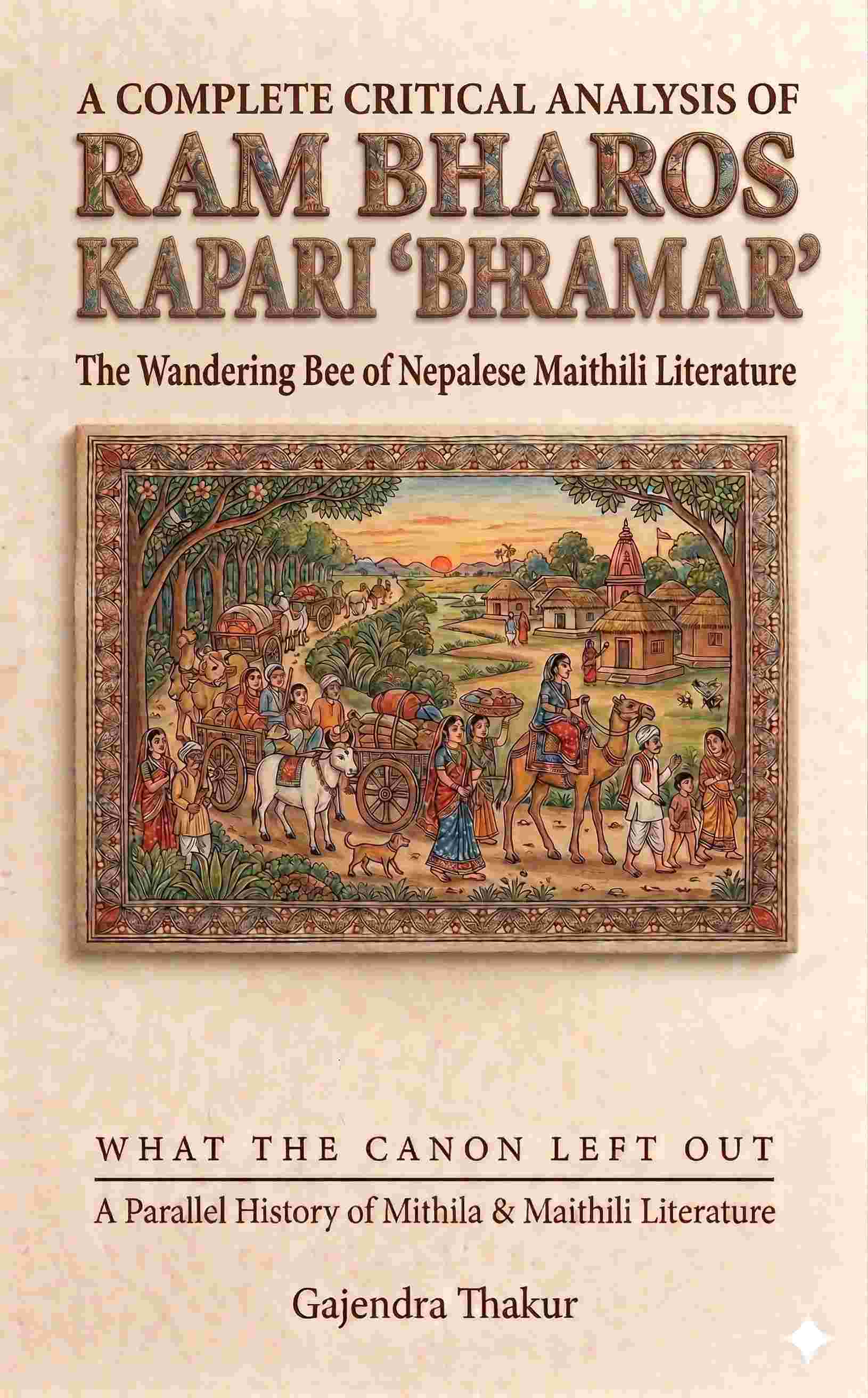
A COMPLETE CRITICAL ANALYSIS of RAM BHAROS KAPARI 'BHRAMAR' The Wandering Bee of Nepalese Maithili Literature
A COMPLETE CRITICAL ANALYSIS
of
RAM BHAROS
KAPARI 'BHRAMAR'
The Wandering Bee of Nepalese Maithili Literature
With Application of Indian and Western Literary Theories
Based on Videha Special Issue 370 (2023) and Published Works
PART I: Biographical and Historical Context
1.1 Life, Origins, and Formation
Ram Bharos Kapari 'Bhramar' — the pen name 'Bhramar' (the bumblebee) chosen with deliberate poetic intent — was born on 22 Sawan 2008 Vikram Samvat (corresponding to 5 May 1951 CE) in Baichawa village, Dhanusha district, Janakpur zone, in the Madhesh region of southern Nepal. His father, the late Ramgulam Kapari, was a respected community leader and village headman (pradhan panch) who served three consecutive terms — a man of substantial landholding, village influence, and social prestige whom the community addressed as 'Adhikari'. His mother was the late Dukhani Devi. The family was among the most prosperous in the area, a material security that would later free Bhramar from the obligations of salaried employment and allow him to pursue full-time literary work — making him, as he himself noted, 'the only full-time writer in Maithili literature.'
Bhramar's early education began in the village chaatsaar (traditional school) with a teacher named Ganesh Lal Karna, who taught him the alphabet in the earth itself — writing with a finger in soil and on slates, a pedagogic image of earthy rootedness that runs through all his later folk-culture scholarship. After three years at the Belhi Middle School near Baichawa, he moved to Janakpur's Saraswati High School for his SLC (School Leaving Certificate), and then to Ramswayrup Ramsagar Bahumulkhi Campus in Janakpur — an affiliate of Tribhuvan University — for his IA, BA, and finally his MA in Maithili, which he completed in the first batch (first division) when the postgraduate programme was established there through the efforts of Dr. Dhireshwar Jha 'Dhirendra'.
The most decisive formative influence was Dr. Dhireshwar Jha 'Dhirendra', who lived near his home in Janakpur, taught at the campus, and became both a literary mentor and a kind of surrogate intellectual father. Bhramar himself states categorically: 'If Dr. Dhirendra had not been there, I would probably not have become a writer.' It was Dhirendra who redirected his early Hindi-language story draft into Maithili — recognizing the boy's gift and insisting on the mother tongue as the medium. Bhramar's first published work, a children's story called 'Imaandaar Balak' (The Honest Child), appeared in the prestigious Maithili weekly Mithila Mihir in 1964, when he was just twelve years old. From that moment, he signed all his work with the pen name 'Bhramar.'
Bhramar married Daltiya Devi from Bhagwanpatti village in Dhanusha district during his adolescence — a detail that speaks to the region's social customs of early marriage. They have three sons: Ram Narayan Kapari (editor of the Janakpur Express daily and a political activist), Pradeep Kumar Kapari (employed with Nepal Food Corporation), and Sandeep Kumar Kapari (a computer graphics expert running his own business). Two daughters are also married. His wife's attachment to Janakpur (and resistance to moving to Kathmandu) is actually an autobiographical thread that surfaces in his fiction, most notably in the story collection Anti-Virus.
1.2 Professional Career: The Independent Literary Life
Bhramar made a decisive choice: despite completing a Master's degree in Maithili — the qualification that would have made him a university professor — he rejected academic employment. This was not penury but principle. As he explains in his interview with Vijay Kumar Mishra (Videha 370): 'I chose journalism, independent writing, research, and travel. Because I had economic sufficiency, the thought of a job never entered my mind. I am a free spirit and chose to live independently.'
His journalism career began in 2026-27 Vikram Samvat as a representative of the Vaidehee Weekly in Janakpur. After the political changes of 2046 BS (1989 CE), when multiparty democracy was established and private media began to flourish, he became Kantipur Daily's Janakpur correspondent, a position he held for five years. Through his editorial efforts, he produced the Maithili journal Archana from 2030 BS — the first Maithili periodical dedicated purely to literary content in Nepal — which ran continuously for over twelve years (62 issues are documented). He went on to edit Anjuli (monthly, Nepali) and Aanjur (bimonthly, Maithili), and most significantly, founded Gamhar Maithili Weekly in 2039 BS — Nepal's first and still-running Maithili newspaper, now approaching four decades of continuous publication. He also founded Janakpur Express, a Nepali daily, in 2055 BS, whose editorial direction passes to his son Ram Narayan.
His institutional career reached its apex when the Nepali government appointed him as the first Madhesi President of Sajha Prakashan (the state publishing house in Lalitpur) — a historic appointment that broke the existing Nepali-language hegemony of that institution. Under his brief tenure, he introduced Maithili publications into Sajha's catalogue for the first time. He subsequently served as a member of the Pragya Parishad (Nepal Academy's Council) for four years. He currently serves as Chairperson of the Madhesh Pragya Pratisthan, established by the Madhesh Province government to promote regional languages and cultures.
1.3 The Name 'Bhramar' and Its Significance
The pen name 'Bhramar' (the bumblebee) was adopted at the time of his Matric examination, when he attempted to include it on his official form — an attempt that his headmaster rejected with the dismissive comment 'everyone wants to become a poet.' The rejection became the catalyst: Bhramar turned the name into a lifelong commitment, a declarative identity. The bee is a creature that wanders (bhramar = wanderer, also = bumblebee), pollinates, and produces honey. It is also associated in Sanskrit aesthetics with the bee that hovers around a lotus — a classical image of the devotee/lover in search of beauty and nectar. This double resonance — the wandering explorer of diverse literary fields who also produces the 'honey' of art — is entirely apt for a writer who has worked across every conceivable genre for six decades.
1.4 Bhramar in the Context of Nepalese Maithili Literature
Maithili literature in Nepal has existed in a doubly marginalised position: excluded from the mainstream of Indian Maithili literature (which is institutionally centred in Bihar) and simultaneously under-recognised within Nepal, where Nepali language has historically dominated cultural institutions. Bhramar has been the most prominent voice advocating for the recognition of Nepalese Maithili writers by India's Sahitya Akademi — a structural inequity where Nepal's Maithili authors are systematically excluded from the national literary awards and anthologies that their Indian counterparts receive. As he stated to the Himalayan Times, Madhesh Province 'allocates Rs. 250-300 million for road projects, but has not even allocated Rs. 40 million for the protection and promotion of languages.' His five decades of work represent the most sustained single-person effort to build the infrastructure of Maithili literary and cultural life on the Nepali side of the border.
PART II: Works — A Comprehensive Survey
2.1 Poetry
Bann Kothari Aunait Dhuaan (Smouldering Smoke in a Closed Room, 2029 BS / 1972 CE)
Bhramar's debut poetry collection takes its title from an image of oppression and suppressed anger: smoke that cannot escape a sealed room, burning the very person it was meant to warm. This is the foundational metaphor of his early poetics — the trapped human condition under social exploitation. Critic Ashwini Kumar Alok reads this collection as saying: 'People understand that those responsible for their exploitation and oppression will be brought down on the day that the torch of resistance and revolution is lit. But this cannot happen easily. The fire in a person smoulders inside them, burns them, and their body stands helpless like a sealed room, their smoke tormenting them.' This is the vocabulary of a social-realist poetry that blames systemic oppression for the individual's inward burning.
Nahi, Ab Nahi (No More, No More) — Long Poem, 2036 BS / 1979 CE),
This long poem (deergh kavita) is possibly Bhramar's most widely known individual work. It was translated into Nepali as 'Bhayo Ab Bhayo' by the distinguished Nepali poet Manu Bajracharya, and into Hindi as 'Bas Ab Nahin' — multiple translations testifying to its cultural reach. The poem is a sustained expression of accumulated human fatigue and rebellion: the repeated refrain of 'no more' captures the moment at which the tolerated becomes intolerable, when suffering crosses its threshold and demands transformation. It was published in the Nepal Academy's journal Pragya and in Archana, Bhramar's own journal. Chanresh's essay in Videha 370 characterises this as emblematic of Bhramar's poetics — 'the honest courage to put one's viewpoint clearly' — a poetry that is simultaneously personal lament and collective call.
Momak Pahlait Adhar (Lips Melting Like Wax, 2047 BS / 1990 CE) — Geet-Ghazal Collection
This collection of songs and ghazals demonstrates Bhramar's lyrical range: the erotic and the romantic — the lips melting with desire — in contrast to the political anger of his earlier poetry. From his student days, Bhramar compiled a songbook called 'Jawaaniik Din' (Days of Youth) at age fourteen, and several of his songs became widely popular: notably a holi song for the Nepali film 'Sita', and 'Sakhi He Saawan ke Bunn Jhisi' from the Maithili telefilm 'Ekta Aor Basant', which became a significant hit. His music video album 'Arripen' (Nine Songs) was also produced.
Apan Anachinhaar (My Unknown One, 2047 BS / 1990 CE) and Yudhbhoomik Esgar Yoddha (Lone Warrior on the Battlefield of Life, 2075 BS / 2017 CE)
These two collections bracket the arc of his poetic career. Apan Anachinhaar belongs to his mature mid-career — the search for the beloved/self through the category of the unknown, the unrecognised. Yudhbhoomik Esgar Yoddha is his most recent major poetry collection, published in 2017, marking six decades of literary output. The title is a self-portrait: the lone fighter on life's battlefield.
Anhariyak Chaan (Moon in Darkness, 2070 BS / 2013 CE) — Ghazal Collection
The ghazal, a form of Arabic-Persian origin adopted widely into Urdu, Hindi, and through Bhramar's work into Maithili, operates through the strict formal requirements of the radif (refrain), qafia (rhyme), and the beloved/divine addressee. Bhramar's Maithili ghazals represent a significant formal experiment — bringing the ghazal's traditional themes of love, wine, and mystical longing into a Maithili linguistic and cultural idiom. Critic Vinay Bhushan (Videha 370) specifically analyses these ghazals as 'lighting the lamp of hope' — ghazals that carry simultaneously personal affect and social aspiration. One representative ghazal from the Nepal Academy's journal Kavita reads: 'Gazal gayiki ho tarang zindagiko / Bhav hanita ho tarang zindagiko' (Ghazal singing is the wave of life / Feeling and yearning is the wave of life). The ghazal here is reframed not as personal romantic complaint but as the surge of life itself.
2.2 Fiction
Tora Sange Jaibau Re Kujba (I Will Go with You, Dear Cuckoo, 1987 CE)
Bhramar's first story collection was published — significantly — by the Maithili Academy of Bihar, India (not a Nepali institution), a milestone he claims makes it 'the first modern Maithili story collection from Nepal published by a Bihar government institution.' The title evokes the kujba (the cuckoo), a bird associated in Maithili folk culture with the arrival of spring and the yearning of love. The stories deal with the social realities of the Mithila region: village life, interpersonal relationships, the tensions of modernity.
Hoogli Upar Bahait Ganga (The Ganga Flowing Above the Hooghly, 2065 BS / 2008 CE)
The paradoxical image of the Ganga 'flowing above' the Hooghly is a geographical and poetic impossibility used metaphorically — the sacred above the secular, the ideal above the actual. Critics describe this collection as showing Bhramar's characteristic sensitivity (gharniya samvedana) and the changing face of the village (badlait gamak swarup). The stories are set in the Mithila countryside — its social structures, its negotiations with urbanisation and modernisation.
Anti-Virus (2076 BS / 2019 CE)
Bhramar's third story collection bears a deliberately contemporary title: the antivirus program that detects and eliminates digital viruses becomes a metaphor for literature's function in detecting and neutralising social pathologies. Dr. Ramdayal Rakesh's detailed critical reading (Videha 370) examines the collection story by story:
The title story 'Anti-Virus' is semi-autobiographical: a couple in Kathmandu, where the writer has come for institutional work, navigates the city together. The wife refuses to go to Kathmandu at all — 'not even a cup of tea could she find joy there' — while he worries about the 'virus' that threatens domestic life: another woman cooking in his kitchen. The virus of marital jealousy is presented with wry humour.
'ICU' draws on the experience of a seriously ill brother in a Darbhanga hospital — the agony of watching a loved one between life and death. 'Amrit Paan' (Drinking Nectar) dramatises the social-cultural dimension of the Madhesh Movement: the inability to send festival messages home, the sweetness of tilwa and chivda in contrast to the bitterness of political disruption. 'Parivatan' (Change) depicts marital conflict with an acute study of divergent cultural expectations between rural and urban. 'Muniya Tea Stall' is a folk-realistic story of a beautiful tea stall owner whose customers come as much for her as for the tea, until she runs off with a young man — 'the most talked-about event in the village.' Its resolution through folk comedy is deft.
The collection's masterpiece (master-piece) is identified by Rakesh as 'Annadhan Lakshmi' — a story of a rural woman made pregnant through deception, abandoned, and then victimised again. The story's power lies in its portrayal of feminine suffering and social double-standards without sentimentalising: the woman is simultaneously betrayed by a man and victimised by another woman's jealousy. Yet the story ends hopefully — a deliberate sukhant (happy ending) that Rakesh identifies as a feature of Bhramar's story-telling philosophy: the light at the end of the tunnel. 'Sona' depicts the India-Nepal border as a zone of shared family pain: 'a white pillar that stares at them like a ghost.'
2.3 Novel: Gharmuha (The One Who Yearns for Home, 2069 BS / 2012 CE)
Bhramar's only novel to date is his most politically significant work. Published in 2012 — the same year as six other major Maithili novels — Gharmuha is the first Nepalese Maithili novel set against a contemporary political event: the Madhesh Movement of 2006-07. As the acclaimed writer and critic Rajendra Vimal writes in his preface: 'Narrative writer Bhramar, eager to tell his generation's authentic story to future generations, has turned this novel into the vocal sibling of mute history. On the ground of political events, using imagination like clay, mortar, sand, and stone, he has created a living portrait of contemporary Madhesh society whose raga of social relationship-bonds has been poured in — and it is heart-touching.'
The novel's title Gharmuha is a Maithili word meaning 'one who faces toward home' — someone in exile who is always mentally oriented toward return. The novelist himself explains: 'The central character's mental state, his attachment and love for his birthplace, and despite displacement, his extraordinary enthusiasm and vitality to return home whenever the opportunity arises — this gives saaarthakta (meaningfulness) to the word Gharmuha.' The novel is dedicated, through its emotional architecture, to the proposition that home (ghar) is defined not by ethnicity or caste but by human affection, relationships, and love.
The plot unfolds during the Madhesh agitation: Ramesh Upadhyay, a schoolteacher of Pahadi (hill-origin) identity living in the Madhesh for decades, finds himself trapped between his genuine support for the movement's goals and the violence of criminal elements who have infiltrated it under its cover. His daughter Kiran, who is in love with Rajiv — the son of Kameshwar Singh, a locally respected man who is secretly the criminal mastermind behind kidnapping and extortion — is abducted. The ransom demand of ten lakhs forces the teacher to sell his home. Rajiv, discovering his father's crimes, works through his mother to pressure Kameshwar into releasing Kiran. Eventually, through the mediation of Jagmohan — Ramesh's Madhesi friend — the teacher is brought home, the kidnapping resolved, and the two young lovers given the blessing of both families.
Rajendra Vimal's critical reading emphasises the novel's political documentary value: it records the specific dates of failed negotiations (1 June 2007, 25 July, 28 July, 5 August 2007, and the 30 August agreement on 26 points) with a journalist's precision — making it 'an historical document' as much as a novel. The language is described as deploying Madhesh-Mithila folk vocabulary ('lallhka', 'labhka', 'badhka', 'khusingh') that gives the narrative 'natural, authentic, and innovative' quality. The narrative pace is cinematic — 'not the difficult mountain path, but the straight smooth plain road that reaches its destination flowing easily.'
The novel has been translated into Hindi (by Dr. Prfull Kumar Singh 'Maun'), Bhojpuri (by Uma Shankar Dwivedi), and is understood to exist in Nepali translation as well. The Ganki Dhuswaan Basundhara Prize of Rs. 50,000 was awarded specifically for this novel.
2.4 Drama
Bhramar's theatre is among his most celebrated contributions. He has written over a dozen plays — short and long, historical and contemporary, experimental and folk-derived — and his drama represents a sustained attempt to establish a viable Maithili theatrical tradition in Nepal.
Rani Chandravati (2045 BS / 1988 CE) is a historical drama. The title character is a historical Maithil queen. Ekta Aor Vasant (One More Spring, 2052 BS / 1995 CE) became Bhramar's most widely performed play — it was staged at Nepal Rajkiya Pragya Pratisthan (Nepal Academy) and has gone through three editions. A telefilm based on it was broadcast on Nepal Television. Mahishasur Murdabad (Death to Mahishasura, 2054 BS / 1997 CE) is a political play whose title invokes the demon from Hindu mythology as a metaphor for contemporary oppressive power. Bhaiya Aelai Apan Soraj (Brother Has Come for His Own Dawn, 2067 BS / 2010 CE) is a play about political rights and liberation. Suli Par Ijot (Light on the Gallows, 2072 BS / 2015 CE) — a profound and evocative title suggesting martyrdom and illumination simultaneously — has been described as worthy of international recognition.
Bhramar also writes monodramas (one-character plays) — including one on 'Muniya Tea Stall Wali', a character drawn from his fiction. His collected plays were translated into Nepali by Dharmendra Jha 'Vivhal' as 'Bhramaraka Sarvashreshtha Natakaharu' (Bhramar's Best Plays, 2064 BS / 2007 CE). A significant anthology of Maithili plays, Maithili Natak Sangra (2067 BS), was also published under his editorship.
2.5 Folk Culture Scholarship and Research
Bhramar's most distinctive contribution to Maithili literature may be his deep scholarly engagement with folk culture, folk art, and folk mythology — an engagement that spans decades of fieldwork and over a dozen research publications.
His research monographs include: Janakpurdham Ra Nyaas Kshetraka Sanskritic Sampada (Cultural Heritage of Janakpur and Its Environs, 2056 BS), Cultural Heritage of Janakpur (English, 2062 BS), Lok Naatya: Jat-Jatin (Folk Drama: Jat-Jatin, 2064 BS) — a study of the classic Maithili folk performance tradition, Maithili Lok Sanskriti Alekh Sangra (Maithili Folk Culture Essay Collection, 2066 BS), Mithilak Saput: Raja Salhesh (Hero of Mithila: King Salhesh, 2075 BS), Maithil Lok Sanskriti: Vividh Aayam (Maithil Folk Culture: Various Dimensions, 2075 BS) — a Nepal Academy publication.
His most recent major work, Mithilak Lokjeevan: Lok Sandarbha (Mithila's Folk Life: Folk Reference), launched in Janakpur with distinguished guests from Patna, Kolkata, Darbhanga, and Kathmandu, represents the culmination of four decades of fieldwork and research. Bhimnath Jha's essay in Videha 370 describes this work as 'encyclopaedic' — a work that Maithili expatriates around the world can use as 'a Mithila directory,' covering literature, culture, history, politics, natural heritage, and the lives of folk deities (Salhesh, Dinabhari, Raja Bharthari) within one unified cultural cartography.
2.6 Travelogues, Diaries, and Miscellany
Bhramar's travelogue Cheen Je Ham Dekhal (China As I Saw It, 2070 BS / 2013 CE) documents his visit to China — a rare example of Maithili travel writing about East Asia. Seemaa Mein Aar-Paar (Across the Border, 2073 BS / 2016 CE) explores the Nepal-India borderland and its human geography. Koronaak Sanwaas Mein Ojhrayal Jindagi (Life Tangled in the Breath of Corona, 2020 CE) is a lockdown diary — a literary response to the COVID-19 pandemic that joins a growing global archive of pandemic writing. Ahaan Je Kahluhun (Whatever You Said, 2071 BS) is an interview collection.
PART III: Critical Appreciation through Literary Theories
3.1 Social Realism and Progressive Literature
Bhramar belongs firmly to the tradition of progressive (pragativaadi) literature — the movement associated in Hindi and Maithili with the influence of the Progressive Writers' Association (1936), Marxist politics, and the commitment to depicting the lives of the oppressed and the exploited. Chanresh's essay in Videha 370 describes his vision as consistently directed toward 'the exploited and oppressed society — the truth of their experience — awakening human sensitivity to moral values.'
In his poetry collection Bann Kothari Aunait Dhuaan, the imprisoned smoke is the consciousness of the exploited class: it knows its oppressors but cannot act. In 'Nahi, Ab Nahi', the accumulated negation is the historical moment of revolutionary refusal — the poem of the subaltern who says 'enough.' This situates Bhramar squarely within what Georg Lukács called 'critical realism' — a literature that maps social reality with sufficient fidelity to reveal the structural conditions of oppression, rather than merely depicting surface events. Unlike 'naturalism' (which Lukács critiques as recording detail without interpretation), Bhramar's realism carries interpretation within its imagery: the sealed room, the moon in darkness, the gallows with its light.
His story collection Anti-Virus extends this realism into the contemporary moment: the corruption of political movements by criminal opportunism ('Sona', 'Amrit Paan'), the economic pressures on remittance families ('Udaan', 'Dahej'), the commodification of gender ('Muniya Tea Stall', 'Annadhan Lakshmi'). The antivirus metaphor itself is a contribution to progressive aesthetic vocabulary: literature as the program that identifies and purges social pathology.
3.2 Postcolonial Theory: Language Rights, Linguistic Marginalisation, and the Madhesh
Perhaps the most productive theoretical lens for Bhramar's work is postcolonial theory — specifically, the theory of linguistic colonialism and the politics of cultural survival for minority language communities. Maithili in Nepal occupies a doubly subaltern position: marginalised both by the Nepali-language national culture and by the India-centric Maithili literary establishment that largely ignores Nepalese Maithili writers.
Bhramar's entire literary project can be read as an act of cultural decolonisation — the systematic construction of an infrastructure for Maithili literary life in Nepal. His founding of Archana, Gamhar, and Aanjur; his editions of poetry anthologies and folk culture collections; his presidency of Sajha Prakashan where he introduced Maithili publications; his advocacy for Maithili recognition as a provincial official language — all constitute what Ngugi wa Thiong'o called the 'decolonisation of the mind,' the reclamation of a suppressed cultural identity through the medium of the suppressed language.
His complaint to the Himalayan Times about Madhesh Province's Rs. 40 million allocation for language promotion versus Rs. 250-300 million for roads is a precise formulation of what Frantz Fanon identified as the characteristic investment pattern of postcolonial states: infrastructure over culture, roads over tongues. Bhramar's political activism around Maithili recognition translates directly into his literary theory: a language without institutional support cannot sustain a literary culture. Homi Bhabha's concept of the 'Third Space' — the location of cultural negotiation between dominant and subordinate — is visible in Bhramar's practice: he works simultaneously in Maithili (India and Nepal), Nepali, and Hindi, navigating between national literary systems while asserting Maithili identity within all of them.
The novel Gharmuha is the most direct literary engagement with this postcolonial condition. The Madhesh Movement — a movement for the recognition of Madhesi (Terai) identity, language, and rights within Nepal's federal structure — is the novel's political substrate. The hill-origin teacher Ramesh Upadhyay, though himself an ethnic outsider, has been absorbed into the Madhesh's social fabric: the movement's violence threatens this earned belonging. The novel's resolution — the two families uniting across the Pahadi-Madhesi divide — is an act of utopian postcolonial imagining: the possibility of a multicultural belonging not based on ethnic purity.
3.3 Subaltern Studies and the Politics of Representation
Bhramar has explicitly identified himself as a representative of the non-Brahmin (Brahmannetar) community within Maithili literature — a literary culture whose canonical voices have historically been Brahmin-caste. As Dinesh Yadav's essay (Videha 370) notes with admiration: 'The way in which someone from a Brahmannetar community has asserted presence in Maithili literature, which has been historically dominated by Brahminism, is not only unequalled but matchless.' This is a Dalit/OBC politics of representation that does not require Bhramar to be anti-Brahmin but simply demands the recognition of non-Brahmin voices and subjects within the literary mainstream.
The Subaltern Studies framework of Ranajit Guha and Gayatri Spivak is relevant here. Spivak's question 'Can the subaltern speak?' finds a partial but important answer in Bhramar's work: yes, but only through sustained institutional labour — founding journals, establishing publishing infrastructure, building cultural institutions. The subaltern can speak, but requires platforms that are not controlled by the hegemonic group. Bhramar spent five decades building those platforms.
His folk culture scholarship is itself an exercise in recovering subaltern knowledge: the oral traditions of Salhesh (a folk deity worshipped primarily by Musahar and other lower-caste communities), Dinabhari (another folk epic), and Jat-Jatin (a folk performance tradition) are all cultural expressions that exist outside the Brahmin-Sanskritic literary canon that has historically defined 'Maithili culture.' By documenting, analysing, and publishing these traditions, Bhramar performs what Michel Foucault called 'counter-memory' — the recovery of suppressed historical experience against the dominant archive.
3.4 Feminist Theory: Women, Agency, and Voice
Bhramar's engagement with women's experience is significant across genres. His research monograph 'Rajkamal ki Katha Sahitya Mein Naari' (Women in Rajkamal Chaudhary's Fiction, 2064 BS) positions him as a critical reader of feminist themes in Maithili's most rebellious modern writer. Chanresh notes of his early fiction: 'in his previous compositions, he can be called an expert on female psychology (naari manobhaav).' The erotic directness of Momak Pahlait Adhar speaks to a non-prudish literary sexuality — the body as site of beauty and longing, not shame.
In the Anti-Virus collection, 'Annadhan Lakshmi' is the central feminist text: a woman abandoned after being made pregnant, betrayed by a man at work, and then victimised by another woman's jealousy at a deeper level. The story's moral universe is unsparing about patriarchal complicity — both male and female — in women's subordination. Yet its 'sukhant' (happy ending) represents a refusal of the feminist tragedy narrative: these women survive, and some emerge with agency.
'Parivatan' (Change) in the same collection depicts marital conflict through two voices — a wife who has fully assimilated the expectations of a 'modern' marriage, and a husband who is simultaneously modern in aspiration and traditional in execution. The domestic is political, in the classic feminist formulation. The 'virus' of 'Anti-Virus' title story — the wife's anxiety about another woman in their domestic space — is rendered with psychological acuity rather than moralising.
3.5 Rasa Theory and Indian Aesthetic (Bharata's Natyashastra)
Bhramar's drama — perhaps his most formally conscious literary practice — is most productively read through the Indian aesthetic tradition of Rasa theory. The eight rasas of Bharata's Natyashastra — shringara (love/beauty), hasya (humour), karuna (compassion/sorrow), raudra (fury), veer (heroism), bhayanaka (fear), bibhatsa (disgust), and adbhuta (wonder) — all find expression across his dramatic works.
Ekta Aor Vasant (One More Spring) is primarily a play of shringara and karuna: the spring that returns despite oppression, the love that persists through difficulty. The title's double meaning — spring as season, spring as political renewal — operates through the Sanskrit aesthetic principle of 'dhvani' (resonance, suggestion), where multiple meanings are generated from a single image. Suli Par Ijot (Light on the Gallows) works through the Veer (heroic) and Adbhuta (wondrous) rasas: the gallows become a symbol of sacrificial heroism, and the light upon them — rather than darkness — generates aesthetic wonder. Mahishasur Murdabad deploys Raudra (fury) against the demonic social order.
His ghazals, particularly in Anhariyak Chaan, operate through the classical Shringara rasa — but inflected with Karuna: the moon in darkness is both erotic image (the beloved's face) and social image (hope in adversity). The aesthetic pleasure of the ghazal form — its strict formal requirements, its makhta (signature verse), its traditional topoi — is harnessed to social content, creating what the Sanskrit tradition calls 'lokottara' (transcendent) aesthetic experience: that which goes beyond the ordinary.
3.6 Narratological Analysis: Journalism and Fiction
A significant structural feature of Bhramar's fiction — particularly Gharmuha — is the interpenetration of journalistic documentary technique and novelistic narrative. Rajendra Vimal identifies this as both a strength and a distinctive character: the novel records specific dates of political negotiations, names actual protest leaders (Upendra Yadav), and deploys the factual precision of the reporter within the emotional latitude of the novelist.
In narratological terms (drawing on Gérard Genette and Seymour Chatman), Bhramar works with a cinematic narrative mode — rapid scene-changes, dramatic dialogue, physical action that carries ideological weight. Vimal's cinematic metaphor — 'like a reel unrolling from beginning to end' — captures the narrative's external orientation: Bhramar is not an interior monologue novelist but a storyteller who relies on action, dialogue, and social event. This is consistent with his journalistic training and his theatre background: both arts that privilege the external, the visible, the spoken.
Chanresh's essay identifies a hierarchy within Bhramar's multi-genre identity: 'I know him as fundamentally a poet and then a story-writer.' This suggests that the internal architecture of his fiction — its imagery, its rhythmic prose, its symbolic titles — is essentially poetic, even when the surface is realistic and journalistic. Henry David Thoreau's aphorism, quoted by Chanresh in the context of Bhramar — 'The greatest artist is one who makes their life the subject of art' — points toward the autobiographical dimension: Bhramar's travels, his institutional battles, his cultural advocacy all become material for his writing.
3.7 Oral Tradition, Folk Literature, and the Bhakti Connection
Bhramar's deep engagement with folk culture — Salhesh, Dinabhari, Jat-Jatin — places him in a tradition of Maithili writers who have insisted on the primacy of the oral and the popular over the written and the elite. This connects him to the Bhakti movement's democratic aesthetics: just as Kabir, Vidyapati, and the sants sang in the vernacular to make the divine accessible to all, Bhramar documents and celebrates the divine of the Madhesh poor — the folk deities who protect the lowest castes, the performance traditions that give them voice.
Bhimnath Jha's essay (Videha 370) places Bhramar's Mithilak Lokjeevan in this tradition: 'The scholar discusses medieval song traditions with concern while also swaying to the rhythm of Tirhutiya songs. On one side he searches for traditional kirtan traditions in Mithila, while on the other he shows various forms of children's songs (shishu-geet). He shares the joy of seasonal songs — rain, holi, and spring — then introduces us to the cultural importance of the Ganga and Kamala rivers.' This is the methodology of the folk scholar as cultural activist: documentation in service of preservation and revitalization.
The folk deity Salhesh is particularly significant. Worshipped primarily by Musahar (a Scheduled Caste community considered among the most marginalised in both India and Nepal), Salhesh represents a counter-canonical religious tradition — a divine figure who belongs not to the Sanskrit-Puranic mainstream but to the oppressed. By publishing two volumes of research on Salhesh (Mithilak Saput: Raja Salhesh and Loknayak Salhesh, two volumes), Bhramar performs an act of cultural decolonisation: he inserts the religious imagination of the Dalit-Madhesi into the archive of 'Maithili culture.'
3.8 Reader-Response Theory: The Literary Community
Bhramar's most sustained institutional contribution — the founding and maintenance of journals — can be analysed through a reader-response framework. Wolfgang Iser and Stanley Fish both emphasise that texts are completed through their readers; but Bhramar understands that before a text can be completed, the reader must exist and be given the infrastructure to engage. His journals — Archana, Gamhar, Aanjur, Janakpur Express — are not merely distribution channels but community-building mechanisms. They create readers, not just reach them.
This is what distinguishes Bhramar's role from that of a mere author: he is, in Raymond Williams's terms, a 'cultural worker' who understands that literature is not a private transaction between author and reader but a social practice embedded in institutions. His comment that 'there is no reading culture here' — pointing to the gap between Maithili's large speaker population and its small reading community — is both a diagnosis and a call to action that has structured his entire career.
The interview form, which appears prominently in Videha 370 (interviews with Vijay Kumar Mishra and Dinesh Chandra Gopal), is itself a reader-response instrument: it positions the author as a speaking, responsive, historically situated person rather than an abstracted authorial 'voice.' Bhramar's willingness to be extensively interviewed, to explain his choices, to respond to critics — this openness is itself a democratic gesture consistent with his progressive literary politics.
PART IV: Bhramar's Place in Maithili and Nepalese Literature
4.1 The Cultural Bridge: India and Nepal
Ashwini Kumar Alok's essay in Videha 370 explicitly describes Bhramar as 'the cultural bridge between India and Nepal.' This is not a casual metaphor but a precise description of his institutional role: he has organised three major International Maithili Conferences in Kathmandu and Janakpur; he is a regular presence at major Maithili events in Darbhanga, Patna, and Kolkata; he has advocated for cross-border literary recognition at the institutional level.
The geographic and cultural reality of Mithila — a region that the Nepal-India border cuts through the middle, separating families, folk traditions, and literary communities that share a common language and heritage — makes Bhramar's bridge-building both necessary and meaningful. His travelogue Seemaa Mein Aar-Paar (Across the Border) is the literary expression of this identity: the border as both a physical reality and a cultural wound that literature can, if not heal, at least refuse to honour.
4.2 First Among Firsts: Historical Significance
Chanresh's essay enumerates Bhramar's 'firsts' with the precision of a cultural historian: first recipient of the Mayadevi Pragya Puraskar (2052 BS, Rs. 50,000); first Nepal-published Maithili story collection recognised by Bihar's Maithili Academy ('Tora Sange Jaibau Re Kujba'); author of the first Nepalese Maithili novel set on contemporary political events (Gharmuha); first Madhesi President of Sajha Prakashan; first Maithili writer to become a member of Nepal Pragya Pratisthan's Praagya Parishad; co-founder of Gamhar — Nepal's first and continuously published Maithili newspaper.
These 'firsts' are not vanity: they constitute the material record of a culture's struggle for institutional recognition. Each 'first' is a breach in a wall — the wall of Nepali-language hegemony, or Brahmin-caste cultural gatekeeping, or the India-centric definition of 'Maithili literature.' Bhramar's career is a sustained act of wall-breaching, performed through cultural production and institutional persistence across six decades.
4.3 Awards and Recognition
Bhramar has received over a dozen significant awards: Nepal Rajkiya Pragya Pratisthan's first Mayadevi Pragya Puraskar (Rs. 50,000); Mithila Vibhuti Samman from the Vidyapati Seva Sansthan, Darbhanga; Shekhar Samman from Shekhar Prakashan, Patna; Vaidehi Pratibha Puraskar from Maithili Sahitya Parishad, Janakpur; Mithilaratna Samman from the International Maithili Conference, Mumbai; Madhurima Samman; Yatri Chetna Puraskar from Chetna Samiti, Patna; Sajha Lok Sanskriti Puraskar 2068 BS; Nepal Vidyapati Bhasha Sahitya Puraskar 2069 BS (Rs. 2 lakhs — the largest Maithili literary prize); Mithila Vibhuti Samman from Raipur, Chhattisgarh; Keshav Lal Dhakhwa Sirpa Katha Puraskar 2070 BS; Ganki Dhuswaan Basundhara Puraskar (Rs. 50,000) for Gharmuha; Parvati Samman from Sisodia Salaahi; and others.
PART V: Final Critical Assessment
5.1 Strengths
Bhramar's primary literary strength is his extraordinary range — across every conceivable genre — combined with a consistent political and ethical orientation toward the marginalised. From the compressed political lyricism of his early poetry to the folk-realistic stories of Anti-Virus, from the historical documentary novel Gharmuha to the encyclopaedic scholarship of Mithilak Lokjeevan, he maintains a coherent vision: literature as cultural survival, as social protest, and as the documentation of lives that would otherwise disappear unrecorded.
His contribution to Maithili institutional culture — journals, publishers, newspapers, cultural organisations — is arguably more significant than any single literary work. He is a cultural ecosystem builder, not merely a writer. In a minority-language literary community with weak institutional infrastructure, this is the most important contribution possible. As Bhimnath Jha notes: 'His literary field is abundant. Like a field that yields crops in every season... the fields of those we call 'Sone ki Tukdi' (golden pieces) — all aspects are resplendent in his field.'
His folk culture scholarship fills a genuine lacuna: the documentation of Nepalese Mithila's oral traditions, folk deities, and performance cultures was largely unaddressed before his sustained fieldwork. This scholarly contribution will outlast critical fashions.
5.2 Limitations and Critical Reservations
The same critics who celebrate Bhramar's range also note that prolific output across fifty genres can dilute individual works. Chanresh observes that 'writing a large number of books in any genre is not a special quality in itself.' Some works, Rakesh suggests, are 'commissioned' (farmaishi) — written under external pressure — and show it in their flatness. The Anti-Virus collection's weaker stories lack the social precision of the best work; the 'Ijoriya Raatuk Sapna' story is noted as having appeared in so many collections that its inclusion in a new volume is questionable.
The novel Gharmuha, while politically significant, is described by critics as narratively 'linear' — the 'straight, smooth plain road' metaphor is both a compliment (accessible, fluent) and a mild critique (uncomplicated, without the mountainous difficulty of the greatest novels). The political documentary drive sometimes overwhelms the novelistic character development: the dates and negotiations are historically precise, but the inner lives of characters can feel schematic.
The absence of a sustained engagement with Bhramar's work by major critical institutions — Sahitya Akademi India, for instance — is both an injustice (that he himself has protested) and a gap in the critical record. Most critical writing on his work comes from within the Maithili community (Videha, the journals he has himself edited) rather than from outside. A truly external critical perspective on his work remains to be developed.
5.3 The 'Bhramar' as Literary Figure
There is a productive irony in the pen name Bhramar. The bumblebee wanders (bhraman) and pollinates — it is the agent of cross-fertilisation between different plants, different literary traditions, different languages. Bhramar has crossed between Maithili and Nepali, between folk and modern, between journalism and fiction, between India and Nepal, between the literary canon and the oral subaltern. This cross-fertilising function — the bee that carries pollen from one cultural tradition to another — may be his most distinctive contribution.
In traditional Indian poetics, the bhramar was also the devotee figure: the bee that seeks the lotus of the divine, hovering and murmuring (bhramar-geet). Bhramar's own ghazal collection Anhariyak Chaan (Moon in Darkness) positions him in this tradition: seeking light in darkness, finding beauty in the most difficult conditions. The moon in the darkness is both the beloved's face and the hope of the oppressed — the persistence of cultural beauty against political adversity.
5.4 Historical Legacy
Dinesh Yadav's hyperbolic but revealing epithet — 'the Shakespeare of Maithili' — signals the scale of Bhramar's ambition and recognition within his community. Whether this comparison holds analytically is secondary to what it tells us: within the Nepalese Maithili literary world, Bhramar is the central, defining figure of the modern era. His career spans from 1964 (first published work) to 2023 and beyond — sixty years of uninterrupted literary production in the most challenging institutional conditions possible for a minority language.
What is certain is that the history of Maithili literature in Nepal cannot be told without Ram Bharos Kapari 'Bhramar.' He is simultaneously its most productive author, its most important institution-builder, its most consistent cultural advocate, and — through his folk-culture scholarship — its most dedicated archivist. These four functions together constitute a literary career of extraordinary historical significance, regardless of the final aesthetic judgment on any individual work.
Bibliography and Primary Sources
Primary Works by Bhramar (Selected)
Bann Kothari Aunait Dhuaan (Poetry Collection, 2029 BS / 1972 CE)
Nahi, Ab Nahi (Long Poem, 2036 BS / 1979 CE) — also translated into Nepali as 'Bhayo Ab Bhayo' and Hindi as 'Bas Ab Nahin'
Tora Sange Jaibau Re Kujba (Story Collection, 1987 CE, Maithili Academy, Bihar)
Rani Chandravati (Play, 2045 BS / 1988 CE)
Momak Pahlait Adhar — Geet-Ghazal (2047 BS / 1990 CE)
Apan Anachinhaar (Poetry Collection, 2047 BS / 1990 CE)
Ekta Aor Vasant (Play, 2052 BS / 1995 CE)
Mahishasur Murdabad Evam Anya Natak (2054 BS / 1997 CE)
Rajkamal ki Katha Sahitya Mein Naari (Research, 2064 BS / 2007 CE)
Lok Naatya: Jat-Jatin (Research, 2064 BS / 2007 CE)
Bhramaraka Sarvashreshtha Natakaharu — Nepali Translation (2064 BS / 2007 CE)
Hoogli Upar Bahait Ganga (Story Collection, 2065 BS / 2008 CE)
Bhaiya Aelai Apan Soraj (Play, 2067 BS / 2010 CE)
Gharmuha (Novel, 2069 BS / 2012 CE) — translated into Hindi, Bhojpuri
Cheen Je Ham Dekhal (Travelogue, 2070 BS / 2013 CE)
Anhariyak Chaan (Ghazal Collection, 2070 BS / 2013 CE)
Suli Par Ijot Evam Anya Natak (2072 BS / 2015 CE)
Seemaa Mein Aar-Paar (Travelogue, 2073 BS / 2016 CE)
Yudhbhoomik Esgar Yoddha (Poetry Collection, 2075 BS / 2017 CE)
Mithilak Saput: Raja Salhesh (Research, 2075 BS / 2018 CE)
Maithil Lok Sanskriti: Vividh Aayam (Research, Nepal Academy, 2075 BS / 2018 CE)
Anti-Virus (Story Collection, 2076 BS / 2019 CE)
Korona ke Sanwaas mein Ojhrayal Jindagi — Lockdown Diary (2020 CE)
Mithilak Lokjeevan: Lok Sandarbha (Folk Life Research, 2022 CE)
Critical Sources Consulted
Videha Issue 370 (15 May 2023): 'Ram Bharos Kapari Bhramar Visheshaank' — Special Issue. Edited by Gajendra Thakur. Videha: Pratham Maithili Paksik E-Patrika. ISSN 2229-547X.
Bhimnath Jha: 'Lokjeevan Par Samekshit Aalok' (Integrated Light on Folk Life) — Essay in Videha 370.
Vijay Kumar Mishra: 'Rambharos Kapari Bhramarji Ke Sang Sakshatkaar' (Interview with Bhramar) — Videha 370.
Dinesh Chandra Gopal: 'Maithili Patrakarita Aayane Mein Apna Anuhar Dekh Dekh Khush Hoeba Le' (Interview with Bhramar) — Videha 370.
Ashok: 'Rambharos Kapari Bhramar Ka Upanyas Gharmuha' — Critical essay in Videha 370.
Lal Dev Kamat: 'Dr. Ram Bharos Kapari Bhramar: Ek Vyaktitwa' — Critical biography, Videha 370.
Ajay Anuragi: 'Maithili Bhashaak Sahityakaar Bhramar Harek Bidha mein Pustak Prakashan' — Essay, Videha 370.
Ashwini Kumar Alok: 'Rambharos Kapari Bhramar: Bharat-Nepalak Sanskritic Setu' — Essay, Videha 370.
Chanresh: 'Rambharos Kapari Bhramar: Vichar, Samvedana Aa Chetna' — Essay, Videha 370.
Dr. Rajendra Vimal: 'Rambharos Kapari Bhramar Ka Upanyas Gharmuha — Prabhav Aa Pratikriya' — Essay, Videha 370.
Dr. Ramdayal Rakesh: 'Pustak Je Ham Padhal — Anti-Virusak Kathatmak Sansar' — Critical reading of Anti-Virus, Videha 370.
Dinesh Yadav: 'Lok Maithili Ker Vibhuti Bhramar' — Essay, Videha 370.
Vinay Bhushan: 'Ijotak Aash Jagbait Bhramarak Ghazal' — Essay on ghazals, Videha 370.
The Himalayan Times: 'Nepali Remains Lingua Franca of All Provinces' (July 2022) — quotes Bhramar on Madhesh language policy.
Propad Maithili Blog / Sagar Rati Deep Jaray Blog: 'Sahitya Akademi — Festival of Shame 2014' — Gajendra Thakur on Bhramar's complaint about Nepalese Maithili writers' exclusion.
Scribd Archive: Multiple Bhramar texts available including 'Gharmuha' (Upanyas), 'Ab Bas Nahin' (Hindi Anuwad), 'Anhariyak Chaan' (Gajal Sangrah).
Theoretical Frameworks Referenced
Bharata Muni: Natyashastra — Rasa theory, applied to drama and ghazal.
Anandavardhana: Dhvanyaloka — Theory of dhvani (poetic resonance/suggestion).
Georg Lukács: 'Realism in the Balance' (1938) — Critical realism vs. naturalism.
Frantz Fanon: The Wretched of the Earth (1961) — Postcolonial analysis of cultural marginalisation.
Ngugi wa Thiong'o: Decolonising the Mind (1986) — Writing in the mother tongue as cultural decolonisation.
Homi K. Bhabha: The Location of Culture (1994) — Third Space, cultural negotiation.
Ranajit Guha and Gayatri Spivak: Subaltern Studies (1982-) — Applied to Dalit-Madhesi cultural representation.
Michel Foucault: The Archaeology of Knowledge (1969) — Counter-memory applied to folk culture scholarship.
Raymond Williams: Marxism and Literature (1977) — 'Cultural worker' concept.
Wolfgang Iser: The Act of Reading (1978) — Reader-response analysis of Bhramar's journals.
Gérard Genette: Narrative Discourse (1972) — Narratological analysis of Gharmuha.
Henry David Thoreau: Quote on art and life — cited by Chanresh in context of Bhramar.
Stanley Fish: Is There a Text in This Class? (1980) — Interpretive communities, applied to Maithili reading culture.
अपन मंतव्य editorial.staff.videha@zohomail.in पर पठाउ।