
Gajendra Thakur
A PARALLEL HISTORY OF MITHILA & MAITHILI LITERATURE- PART 49
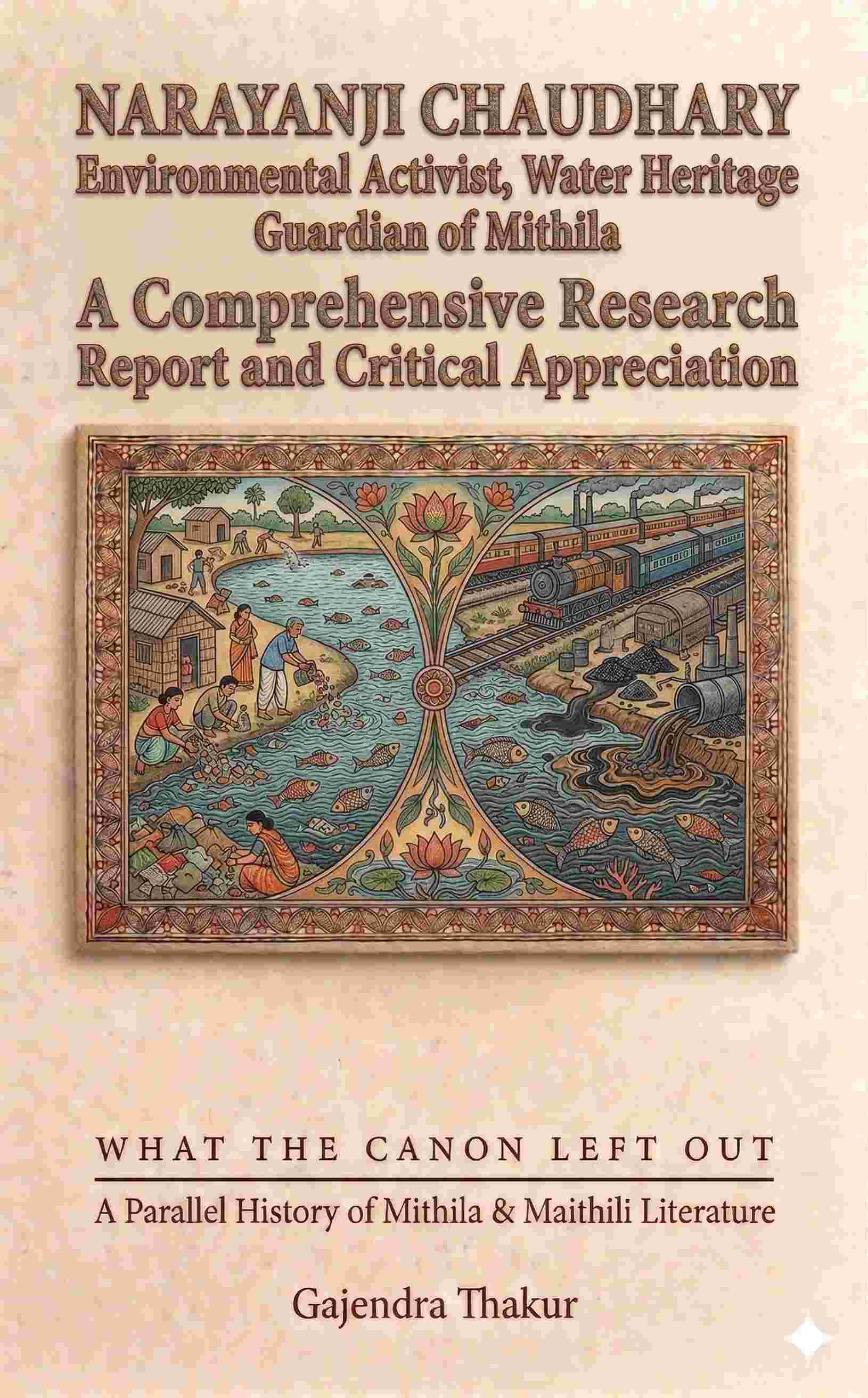
NARAYANJI CHAUDHARY Environmental Activist, Water Heritage Guardian of Mithila A Comprehensive Research Report and Critical Appreciation
NARAYANJI CHAUDHARY
Environmental Activist, Water Heritage Guardian of Mithila
A Comprehensive Research Report and Critical Appreciation
1. Introduction and Context
Narayanji Chaudhary (born 30 August 1959) is one of the most consequential grassroots environmental activists in contemporary Bihar. A native of Isahpur village, Pandaul, Madhubani district, he has devoted over two decades of his life to a singular, urgent mission: saving the traditional ponds (pokhars) and water bodies of the Mithila region from illegal encroachment, pollution, and administrative neglect. The Talab Bachao Abhiyan (Save Ponds Campaign) — the civil society movement he founded and leads through the Mithila Gram Vikas Parishad — has become one of the most cited examples of community-led water-body conservation in northern India.
Videha eJournal, the pioneering Maithili fortnightly digital journal (ISSN 2229-547X, founded 2000, www.videha.co.in), dedicated its 419th issue (01 June 2025) to Narayanji Chaudhary as a full Visheshank (special issue). This is the 36th special issue in Videha's sustained series of living-person visheshanks, which Videha's editor Gajendra Thakur initiated in 2015 with the declared purpose of documenting and critically appreciating individuals who are actively shaping Mithila's cultural, literary, and ecological landscape. The present report draws primarily on the content of that issue, supplemented by major web sources.
The Mithila region — covering the districts of Darbhanga, Madhubani, Sitamarhi, Samastipur, Supaul and others in northern Bihar — has historically been defined by an exceptional density of ponds and water bodies, encapsulated in the traditional proverb: 'Pag-pag pokhar, macch-makhan' (every step a pond, fish and makhana). The disappearance of these ponds in recent decades is both an ecological crisis and a cultural loss that Narayanji Chaudhary has fought to halt, document, and reverse.
2. Biographical Profile
|
Full Name |
Narayan Ji Chaudhary (नारायणजी चौधरी) |
|
Date of Birth |
30 August 1959 |
|
Native Village |
Isahpur, Pandaul (Pandaul Police Station), Madhubani District, Bihar |
|
Education |
B.Com (Honours) |
|
Occupation / Vocation |
Social Work (Saamaajik Kaaj) |
|
Organisation |
Mithila Gram Vikas Parishad (Mithila Village Development Council) |
|
Campaign / Abhiyan |
Talab Bachao Abhiyan (Save Ponds Campaign); later expanded to Jalashay Bachao Abhiyan (Save Water Bodies Campaign) |
|
Father |
Late Pt. Vaidyanath Chaudhary |
|
Mother |
Panchmukhi Devi |
|
Grandfather |
Late Jeewach Chaudhary |
|
Current Spouse |
Kalita Chaudhary |
|
First Wife (deceased) |
Late Indu Chaudhary |
|
Children |
Aayu Chaudhary, Rahul Chaudhary, Aashu Chaudhary |
|
Brothers |
Raman Ji Chaudhary, Gopal Ji Chaudhary, Kanhaiya Chaudhary |
2.1 Early Career and Formative Experience
Narayanji's biographical arc is one of return and recommitment. Before founding his water conservation movement, he spent formative years working in tribal welfare in Jhabua and Bastar districts of Madhya Pradesh (1984–1990), gaining experience in grassroots development work with Adivasi communities — a period that shaped his understanding of how ecological resources and community welfare are inseparable. After returning to Bihar in 1991, he established the Mithila Gram Vikas Parishad and engaged in social work in the Mithila region.
The moment that catalysed his pond conservation work came around 2002–2005 when handpumps near his office in Darbhanga began to run dry. Investigating the cause, he traced the groundwater depletion to the rapid disappearance of ponds that had historically recharged the aquifer. He also recalled witnessing a similar water supply crisis in the Munirka locality of Delhi around 1982–83, and resolved to act. He travelled to Rajasthan to meet Rajendra Singh ('Jalpurush'), the renowned water conservationist, learning water harvesting techniques before launching a survey of 24 ponds in Darbhanga — including the Neem Pokhar and Man Pokhar — and submitting a memorandum to the administration. This received no response, but it marked the formal beginning of what would become the Talab Bachao Abhiyan.
3. The Talab Bachao Abhiyan: Origins, Methods, and Scope
Talab Bachao Abhiyan (TBA) — Save Ponds Campaign — was launched by Narayanji Chaudhary through the Mithila Gram Vikas Parishad as an organised civil society movement to resist the systematic encroachment, filling, and destruction of ponds in Darbhanga and the wider Mithilanchal region of northern Bihar. The campaign has expanded over time into the broader Jalashay Bachao Abhiyan (Save Water Bodies Campaign), encompassing rivers, wetlands, and other water bodies locally known as chaur.
3.1 Methods of Intervention
Narayanji Chaudhary and the TBA have operated across multiple registers simultaneously:
Street and community mobilisation: The TBA has organised numerous dharnas (sit-in protests), signature campaigns, poster and photo exhibitions during popular festivals such as Durga Puja and Chhath Puja, protest marches, jan sabhas (public meetings), and door-to-door awareness outreach. Over 50 villages have been covered in awareness campaigns. Student groups, political party workers, doctors, engineers, scientists and university faculty have all been drawn into the movement.
Legal and quasi-legal action: Chaudhary filed cases before the National Green Tribunal (NGT) against encroachment on three heritage ponds — Harahi, Dighi, and Ganga Sagar — in Darbhanga, which are estimated to be approximately 600–900 years old. The NGT issued orders to ban illegal construction around them and appointed an inspection committee. When Darbhanga Railway Station was found to be continuously discharging sewage into the Harahi and Dighi ponds, Chaudhary filed a complaint with the NGT that resulted in the Bihar State Pollution Control Board (BSPCB) imposing a fine of Rs 1.61 crore on the Railway Station in early 2025. He also challenged the Kosi Mahasetu (dam/embankment) before the Supreme Court and then the High Court, contending that the structure was dangerously undersized — a case that achieved partial results.
Documentation and evidence building: Chaudhary has systematically compiled evidence of encroachment, including drone photographs, survey data, government records, and legal documents, working with collaborators including the late Anidya Banerjee (documentation support) and advocate Kamlesh Kumar Mishra (Supreme Court lawyer, legal support). The TBA was also involved in the listing of natural heritage sites in Darbhanga and Madhubani districts through the INTACH (Indian National Trust for Art and Cultural Heritage) Darbhanga Chapter, established in 2016.
Institutional partnerships: Chaudhary has worked with the Maithili Sahitya Sansthan (Patna), the Maharajadhiraj Laxmishwar Singh Sangrahalaya (Darbhanga), INTACH, and individual scientists and academics including the late Padma Shri Dr Manas Bihari Verma (retired DRDO scientist and associate of former President A.P.J. Abdul Kalam), Prof Vidyanath Jha, IAS officer Gajanan Mishra, and river specialist Dinesh Kumar Mishra.
3.2 Key Achievements
The following achievements are documented across the primary and secondary sources consulted for this report:
NGT order and Rs 1.61 crore fine (2022–2025): The NGT ordered the removal of encroachments around Harahi, Dighi, and Ganga Sagar ponds. Following an BSPCB inquiry triggered by an NGT order, the Darbhanga Railway Station was fined Rs 1.61 crore for polluting Harahi and Dighi ponds with sewage discharge (February 2025). This was described in the Videha Visheshank as one of the most significant court-driven environmental compensation orders ever issued in Bihar for pond protection.
University pond and Vice-Chancellor penalised: When the administration of Lalit Narayan Mithila University (LNMU) undertook a "beautification" project that damaged the Kameshwar Nagar campus pond, Chaudhary filed a case before the NGT. The court ordered the pond enclosure to be restored and the Vice-Chancellor was penalised.
Makhnaahi and other community successes: In 2023, a 10-decimal pond in Makhnaahi was saved from encroachment after local communities, energised by TBA awareness campaigns, confronted the land mafia. In Bajitpur (Manigachi), a 15-acre pond (Suryahi Pokhar) was saved in 2024 when residents filed a police complaint after encroachment began.
Chief Minister's announcement: Following sustained pressure from TBA and allied groups, the Bihar Chief Minister announced Rs 75 crore for the integration and beautification of the Harahi, Dighi, and Ganga Sagar ponds. Whether these funds will be properly utilised remains a subject of watchful concern for the movement.
Recognition and honours: In October 2024, TBA and Chaudhary were formally honoured at Maharaja Laxmishwar Singh Memorial College, Darbhanga, in a programme co-organised by the College and INTACH Darbhanga Chapter. In January 2025, he was honoured by the Maithili Sahitya Sansthan, Patna, on the occasion of Maithili Day.
4. The Ecological Crisis: Ponds of Mithila in Historical Perspective
Understanding Chaudhary's campaign requires grasping the severity of the ecological transformation underway in Mithila. The historical and statistical picture assembled from Videha 419 and corroborated by external sources is stark:
1964: The Darbhanga District Gazetteer recorded over 300 ponds in Darbhanga town alone.
1989: A research survey by Prof. S.H. Bajmi of Millat College, Darbhanga found 213 ponds remaining — a decline of 87 in 25 years.
2016: The Darbhanga Urban Body's official data showed only 84 ponds remaining.
2024: Estimates now put the number at less than 100, with many of those encroached, polluted, or barely functional.
Statewide: Bihar's government has acknowledged that of the state's 1.99 lakh water bodies, at least 12,027 have been encroached upon by powerful land-mafia–administration nexuses.
The causes of this crisis are interlocking: rapid and poorly regulated urbanisation; a nexus between land mafia, property dealers, and local officials who profit from converting pond land to construction sites; administrative indifference; and a loss of cultural awareness of the ecological and cultural value of ponds. The consequences are equally multi-dimensional: groundwater depletion (Bihar's groundwater table has dropped 10–15 feet since 2005, with 60% attributed to pond loss according to Down to Earth); seasonal waterlogging in formerly well-drained areas; loss of biodiversity (approximately 20% of Mithila's fish species have been lost according to Down to Earth 2024); devastation of the livelihoods of Mallah (fishing) communities and makhana producers; and the erasure of the cultural rituals — Chhath, Durga Puja, community festivals — that were traditionally associated with these water bodies.
As scholar Pranav Jha writes in Videha 419: "The encroachment of ponds in Mithila over the last two to two-and-a-half decades has been rapid and systematic. Land mafia has filled ponds with soil and debris, constructing houses, shops and buildings on them. This has spread across virtually every district of Mithila, bringing the region's water wealth into crisis."
5. Critical Appreciation: Significance, Strengths, and Limitations
5.1 The Significance of the Man and the Movement
Narayanji Chaudhary's significance operates simultaneously at the personal, social, ecological, and civilisational levels.
As a moral exemplar: Multiple contributors to the Videha Visheshank — including Dr Shiv Kumar Mishra, Hitanath Jha, Dr Dhankar Thakur, Dr Kailash Kumar Mishra, and Ajit Kumar Jha — independently emphasise what may be the most striking feature of Chaudhary's career: that he acts without political office, financial incentive, or institutional backing. He has faced death threats, physical intimidation, and false FIRs filed against him and his associates by land mafia networks. A collaborator was killed in 2015 while saving the Betagami pond. Despite all of this, Chaudhary has continued his work with, as several writers describe it, the quality of a bataahpani — a productive, almost reckless devotion — a quality he himself humorously acknowledged is a prerequisite for heritage conservation work.
As a legal innovator: Chaudhary's decision to use the National Green Tribunal as a strategic tool — filing public-interest-style complaints about specific ponds — represents an important innovation in grassroots environmental activism in Bihar. Rather than relying solely on street protest or media advocacy, he built evidentiary dossiers and engaged the courts. The Rs 1.61 crore fine imposed on the Darbhanga Railway Station is described in the primary sources as likely the first time a railway establishment in Bihar has been financially penalised for damaging a pond ecosystem. The broader NGT jurisprudence on ponds in Darbhanga has set important precedents for the entire Mithilanchal region.
As a cultural conservator: Chaudhary frames his work not merely in environmental or legal terms but explicitly in cultural-civilisational terms. Ponds such as Harahi, Dighi, and Ganga Sagar are not just water bodies — they are 600–900-year-old living archives of Mithila's cultural life. They are sites for Chhath Puja, Durga Puja, and other rituals; they sustained the fisheries and makhana cultivation that defined Mithila's agrarian identity; and they embody a sophisticated traditional water management system whose engineering logic — seasonal recharge, flood buffering, microclimate regulation — is now confirmed by modern hydrology. Dr Kailash Kumar Mishra compares Chaudhary's significance to that of Sundarlal Bahuguna (Chipko movement) and Kailash Satyarthi (Bachpan Bachao Andolan): ecological-cultural activists whose work transcends narrow environmentalism to touch the foundations of a civilisation.
As a catalyst for civic discourse: Dr Shiv Kumar Mishra's essay in Videha 419 documents how Chaudhary's 2019 seminar at the Maithili Sahitya Sansthan — presided over by Padma Shri Manas Bihari Verma — brought together water specialists, IAS officers, academics, journalists, and civil society representatives in a structured discussion of Mithila's water crisis. The media coverage of that event sparked similar discussions across Mithila-related institutions. The Videha Visheshank itself, by devoting 97 pages to Chaudhary's work, is an act of canonical inscription: it places this socially marginal activist within the official archive of Mithila's intellectual life.
5.2 Strengths of the Movement
Grassroots credibility: The TBA is not an NGO with external funding or a political front. It emerged organically from the community's experience of water scarcity and has maintained its independence from political parties — a quality that has allowed it to appeal across caste, community, and political lines. The Hindu-Muslim co-ownership visible in the heritage of Mithila's ponds (the Mirza Khan Talab was built by a Muslim community, the Harahi by a Hindu king, but both are used by all communities) is reflected in the movement's composition, which includes Mohammed Tashim Nawab as a leading collaborator.
Scientific backing: Unlike many grassroots movements that operate on cultural or emotional grounds alone, TBA has actively sought scientific validation. The involvement of DRDO scientist Manas Bihari Verma, Bihar Water Resources Department official Gajanan Mishra, botanist Sunil Kumar Mishra, and various university faculty members gives the campaign a credibility in scientific and administrative circles that street protests alone cannot provide.
Adaptive broadening: The evolution from Talab Bachao Abhiyan (focused on ponds) to Jalashay Bachao Abhiyan (covering all water bodies — rivers, ponds, wetlands/chaur) reflects a learning organisation. The 2018–2019 water crisis in Darbhanga and neighbouring districts demonstrated that individual ponds cannot be saved in isolation from the broader hydrology of the region, and Chaudhary's movement adapted accordingly.
5.3 Limitations and Challenges: A Candid Assessment
A critical appreciation demands honest engagement with the movement's limitations alongside its achievements. Several contributors to the Videha Visheshank themselves offer candid assessments:
Structural power asymmetry: The land mafia–administration–political nexus that Chaudhary confronts is deeply entrenched. Despite NGT orders, encroachments continue. False FIRs are filed against activists. Chaudhary himself acknowledges to Videha that even after two decades, no person in Darbhanga has been successfully prosecuted for pond encroachment, and that the movement's impact on the ground remains limited despite its success in courts and media. The movement wins orders; the administration fails to implement them.
Scale and resource constraints: The TBA is essentially a movement of volunteers with minimal infrastructure. The scale of the pond destruction — across thousands of ponds in multiple districts — vastly exceeds the capacity of a single civil society initiative, however dedicated. Dr Kailash Kumar Mishra, while celebrating Chaudhary's contribution, explicitly calls for replication at every district, sub-district, block, and gram panchayat level, and for social accounting of water body management. Without institutional and state-level systemic change, individual heroism can only partially arrest the crisis.
Media and public attention: While TBA has received coverage in national outlets (The Hindu, Mongabay India, Down to Earth, NewsClick, Hindustan Times, IANS, Jagran), the movement has not achieved the national visibility or policy impact of comparable movements (Chipko, Narmada Bachao Andolan, Tarun Bharat Sangh). Ajit Kumar Jha's essay in Videha 419 begins with the striking admission that on first encountering Chaudhary's name in the Visheshank announcement, he assumed it must be a literary figure, because Chaudhary's social renown had not yet penetrated the educated Maithili reading community. This is both a criticism of public awareness and a tribute to Videha's value as a knowledge commons.
Institutional recognition gap: Multiple contributors — notably Dr Kailash Kumar Mishra — call explicitly for Narayanji Chaudhary to be awarded the Padma Shri or equivalent national honour, arguing that his decades of selfless work deserve at least the recognition given to Sundarlal Bahuguna. The absence of such recognition is partly a reflection of the marginalisation of ecological activists from Tier-2 cities in India's national awards discourse.
6. The Videha Visheshank: Structure, Contributors, and Editorial Significance
Videha Issue 419 (01 June 2025) is a Visheshank (special issue) of 97 pages devoted entirely to Narayanji Chaudhary. It is the 36th special issue in Videha's living-person/institution series, initiated in 2015. The editorial framework for these special issues is described by editor Gajendra Thakur in an extended methodological note: Videha's visheshanks aspire to offer five simultaneous registers — the flavour of a magazine special, of a critical monograph, of a research thesis, of a Sahitya Akademi monograph, and (where applicable) of a dual-subject evaluation when both a person and their spouse are writers. Thakur also notes that Videha visheshanks have become a reference point for doctoral researchers in Maithili studies, as each issue provides a multi-perspectival, densely referenced profile of its subject that would otherwise not exist in the academic literature.
6.1 Contributors and Their Perspectives
The Visheshank includes the following substantive contributions:
Hitanath Jha (Editor's commentary, pp. 1–2): Provides an overview, situating the Chaudhary Visheshank within Videha's editorial tradition and commending its departure from literary subjects to honour a water conservationist. Jha specifically praises the inclusion of research-quality essays by Dhankar Thakur, Kailash Kumar Mishra, and others.
Brief biography / परिचय (pp. 30–31): Factual profile providing key biographical data, career trajectory, and family details, reproduced with photo documentation.
List of TBA collaborators (pp. 32–34): Documents over 40 grassroots and intellectual collaborators of the Talab Bachao Abhiyan — from village-level workers to Supreme Court advocates and DRDO scientists — along with a tribute to the late Anidya Banerjee and others who have passed on.
Randhir Jha, 'Water Rich Mithila then, Water Crisis in Mithila Now!' (pp. 35–44): An English-language analytical essay placing Mithila's water crisis in historical and hydrological context, detailing the causes of groundwater depletion, the destruction of traditional water management systems, and the emergence of Chaudhary's campaign as a model civil society response. This is the most comprehensive English-language document in the issue.
Dr Shiv Kumar Mishra, 'Mithilak Dharoharr Abhiyaani Narayan Ji Chaudhary' (pp. 45–52): A personal essay in Maithili drawing on Mishra's experience as Director of the Maharajadhiraj Laxmishwar Singh Sangrahalaya, Darbhanga. Mishra recounts his collaboration with Chaudhary from 2017 onwards, the events leading to the NGT orders, the Padma Shri Manas Bihari Verma seminar of 2019, and the INTACH citation of 2024. Written with scholarly detachment and personal warmth.
Pranav Jha, 'Mithila me Pokhark Atikraman aa "Talab Bachao Abhiyan"' (pp. 53–64): An analytical essay in Maithili that provides the most detailed statistical and historical account of pond loss in Mithila, with specific data on Darbhanga and Madhubani districts, case studies of specific ponds, and documentation of the mafia's operational methodology (nocturnal filling, fake land registration, enclosure construction). Cites Down to Earth, Mongabay, and government data.
Hitanath Jha, 'Jal Sanrakshan aa Narayanji Chaudhary' (pp. 65–69): An essay tracing Chaudhary's personal motivation and the structural causes of Mithila's water crisis, with testimony from retired IAS officer Gajanan Mishra and historian-botanist Prof Vidyanath Jha.
Dr Dhankar Thakur, 'Pokharr Bachao Abhiyaank Mithila Nayak — Narayan Chaudhary' (pp. 70–71): A personal tribute in Maithili from a prominent Maithili cultural activist, situating Chaudhary's work in the tradition of Mithila's water stewardship heroes.
Ajit Kumar Jha, 'Mithilak Sanskritic Dharoharr ke Rakshak: Narayan Chaudhary' (pp. 72–77): A reflective essay that begins with an honest admission of prior ignorance of Chaudhary's work and proceeds to articulate a powerful argument for why Chaudhary — a non-literary, non-political activist — is precisely the kind of 'real hero' that Mithila needs to celebrate.
Dr Kailash Kumar Mishra, 'Narayan Chaudhary aa Jalkar Sanrakshan ker Samaajik Sarokaar' (pp. 78–85): The most intellectually ambitious essay in the issue, weaving together Vedic philosophy (the Prithvi Sukta from the Atharvaveda), anthropology of Kashyap gotra's turtle conservation practices, cultural ecology, and direct analysis of the TBA's methods. Calls explicitly for Padma Shri recognition, national replication of Chaudhary's model, and doctoral research on his work.
Ashish Anchinhar, 'Pokharrak Vaktavya' (pp. 86–94): A Maithili poem first written in 2005, presented as a long-delayed personal tribute that was composed even before Anchinhar was aware of Chaudhary's campaign — suggesting the poem as a kind of premonitory voice of the ponds themselves.
References (pp. 95–97): 23 references including government documents, NGT orders, media reports, academic surveys, and Facebook links.
7. National and Comparative Significance
Down to Earth (India) has cited Narayanji Chaudhary's Talab Bachao Abhiyan in multiple reports on urban wetland conservation as one of the most sustained community-led pond conservation efforts in northern India. Mongabay India's 2020 profile — 'Saving Darbhanga's wetlands from encroachment and apathy' — described TBA as one of the rare cases where local civil society pressure has succeeded in pushing judicial intervention to protect urban water bodies. India Water Portal has published two profiles of TBA (2014 and 2024). NewsClick carried multiple reports between 2019 and 2024.
Down to Earth's 2021 feature on India's urban wetlands explicitly cited the Mithilanchal campaign as a model for community-led conservation, alongside Shweta Hule's 'Swamini' self-help group's mangrove conservation work in Maharashtra — placing Chaudhary in the national wetland conservation conversation.
The comparison drawn by contributors to the Videha Visheshank — Chaudhary alongside Sundarlal Bahuguna, Rajendra Singh ('Jalpurush'), and Kailash Satyarthi — is not mere rhetorical flourish. Each of these figures worked through the same combination of direct action, legal intervention, coalition building, and non-violent resistance. Chaudhary's contribution is geographically more circumscribed — focused on Darbhanga and Mithilanchal rather than a national-scale movement — but within his region, his impact on public discourse and pond conservation policy has been analogous. He is, as Prof Gajanan Mishra of the Bihar Water Resources Department states in Videha 419: "among local people, known as a protector of ponds, as he put the issue in public discourse and mobilised people to fight for the conservation of ponds."
8. Conclusion
Narayanji Chaudhary's career embodies a model of citizenship that is rare in any society and especially in contemporary India's civic landscape: sustained, non-institutional, financially unrewarded, physically courageous, and scientifically grounded environmental stewardship. He has worked without political party backing, without major donor funding, without the visibility of a national media platform, and in the face of organised criminal intimidation. He has created a civil society archive of Mithila's disappearing water bodies that now has a presence in the NGT, the BSPCB, the national press, and — through Videha Issue 419 — in the permanent record of Mithila's intellectual culture.
The Videha Visheshank dedicated to him is itself a significant act. By placing a grassroots environmental activist alongside the literary and cultural figures that constitute the normal subject matter of Maithili literary journals, editor Gajendra Thakur has enacted precisely the kind of canon-broadening that characterises Videha's Parallel Literature Movement. The Visheshank demonstrates that the defence of a pond is as much a cultural act as the composition of a ghazal — that ecology and culture are, in Mithila as everywhere, inseparable.
Several tasks remain. The sustainability of the TBA beyond its founding figure is uncertain; the movement needs institutionalisation and replication. Chaudhary's work lacks the doctoral and policy research attention it deserves. And as Dr Kailash Kumar Mishra's essay argues compellingly, the national awards apparatus has yet to recognise a figure whose work has prevented environmental damage worth orders of magnitude more than any financial calculation can express. In the meantime, the movement continues. As of February 2025 — the month of the most recent sources consulted — TBA members were still being threatened by land mafia groups, still filing complaints with district magistrates and SSPs, and still fighting, in Chaudhary's own characterisation, a 'difficult task' made necessary by "the apathy of government and local administration."
It is that combination of clear-eyed assessment of the odds and undimmed commitment to the work that makes Narayanji Chaudhary not merely an activist, but a model of what civic engagement looks like at its best.
9. References
Primary Sources
[1] Videha Issue 419, Narayanji Chaudhary Visheshank (01 June 2025). Videha: Pratham Maithili Pakshik E-Patrika. ISSN 2229-547X. Editor: Gajendra Thakur. Print-on-demand: ISBN 978-93-342-9767-6. Available at: www.videha.co.in
[2] Randhir Jha, "Water Rich Mithila then, Water Crisis in Mithila Now!" In: Videha Issue 419, pp. 35–44.
[3] Dr Shiv Kumar Mishra, "Mithilak Dharoharr Abhiyaani Narayan Ji Chaudhary." In: Videha Issue 419, pp. 45–52.
[4] Pranav Jha, "Mithila me Pokhark Atikraman aa 'Talab Bachao Abhiyan'." In: Videha Issue 419, pp. 53–64.
[5] Hitanath Jha, "Jal Sanrakshan aa Narayanji Chaudhary." In: Videha Issue 419, pp. 65–69.
[6] Dr Dhankar Thakur, "Pokharr Bachao Abhiyaank Mithila Nayak — Narayan Chaudhary." In: Videha Issue 419, pp. 70–71.
[7] Ajit Kumar Jha, "Mithilak Sanskritic Dharoharr ke Rakshak: Narayan Chaudhary." In: Videha Issue 419, pp. 72–77.
[8] Dr Kailash Kumar Mishra, "Narayan Chaudhary aa Jalkar Sanrakshan ker Samaajik Sarokaar." In: Videha Issue 419, pp. 78–85.
[9] Ashish Anchinhar, "Pokharrak Vaktavya" (poem). In: Videha Issue 419, pp. 86–94.
[10] Videha Issue 419, "Sandarsh" (References), pp. 95–97. Lists 23 references.
Secondary Sources — Web and News Media
[11] Mongabay India. "Saving Darbhanga's wetlands from encroachment and apathy." 4 November 2020. URL: https://india.mongabay.com/2020/11/saving-darbhangas-wetlands-from-encroachment-and-apathy/
[12] India Water Portal. "Protectors of the lost ponds of Darbhanga." March 2014 (updated September 2024). URL: https://www.indiawaterportal.org/articles/protectors-lost-ponds-darbhanga
[13] NewsClick. "Bihar: Three 900-Year-Old Ponds in Darbhanga Get New Lifeline as NGT Bans Illegal Construction." 9 December 2022. URL: https://www.newsclick.in/Bihar-Three-900-Year-Old-Ponds-Darbhanga-Get-New-Lifeline-NGT-Bans-Illegal-Construction
[14] NewsClick. "How Ponds in Darbhanga Town Are Vanishing into Thin Air." 15 November 2019. URL: https://www.newsclick.in/Darbhanga-Town-Encroachment-Ponds-Bihar-Government
[15] Down to Earth. "Bihar: BSPCB fine for Darbhanga Railway Station worth Rs 1.61 crore for polluting two ponds." 3 February 2025. URL: https://www.downtoearth.org.in/water/bihar-bspcb-fine-for-darbhanga-railway-station-worth-rs-161-crore-for-polluting-two-ponds
[16] Down to Earth. "Pond 'stolen' in Bihar's Darbhanga: No action so far, locals allege such encroachments rampant." 10 March 2024. URL: https://www.downtoearth.org.in/governance/pond-stolen-in-bihar-s-darbhanga-no-action-so-far-locals-allege-such-encroachments-rampant-93693
[17] Down to Earth. "The state of India's urban wetlands and why they need to be protected urgently." 13 August 2021. URL: https://www.downtoearth.org.in/environment/the-state-of-india-s-urban-wetlands-and-why-they-need-to-be-protected-urgently-78456
[18] Down to Earth (Hindi). "Story of water warrior Narayanji Choudhary." URL: https://hindi.downtoearth.org.in/water/story-of-water-warrior-narayanji-choudhary-69192
[19] The Daily Pioneer. "Bihar's water crisis is man-made." 2 July 2019. URL: https://www.dailypioneer.com/2019/india/bihars-water-crisis-is-man-made.html
[20] Hindustan Times. "Talab Bachao Abhiyan in Bihar expresses concern over beautification of pond on LNMU campus." 2021. URL: https://www.hindustantimes.com/cities/patna-news/talab-bachao-abhiyan-in-bihar-expresses-concern-over-beautification-of-pond-on-lnmu-campus-101630640419527.html
[21] Hindustan Times. "NGT orders restoration of three historical ponds in Bihar's Darbhanga town." 2023. URL: https://www.hindustantimes.com/cities/patna-news/ngt-orders-restoration-of-three-historical-ponds-in-bihar-s-darbhanga-town-committee-constituted-to-address-observations-and-recommendations-made-in-inspection-report-101680775366055.html
[22] Deshaj Times. "Darbhanga Talab Bachao Abhiyan sent open letter to VC of LANAMIVI." URL: https://deshajtimes.com/news/bihar/darbhanga/darbhanga-talab-bachao-abhiyan-sent-open-letter-to-vc-of-lanamivi/47781/
[23] SANDRP (South Asia Network on Dams, Rivers & People). "WWD 2024: Both Wetlands and Human Beings Remain Neglected." 31 January 2024. URL: https://sandrp.in/2024/01/31/wwd-2024-both-wetlands-human-beings-remain-neglected/
[24] Indian Wetlands. Research document on Mithila water bodies. URL: https://indianwetlands.in/wp-content/uploads/library/1734695442.pdf
[25] Darbhanga District Gazetteer, 1964. [Cited in Videha 419 and India Water Portal sources; not directly available online.]
[26] S.H. Bajmi, Millat College, Darbhanga. Survey of Darbhanga ponds, 1989. [Cited in Videha 419.]
अपन मंतव्य editorial.staff.videha@zohomail.in पर पठाउ।