
Gajendra Thakur
A PARALLEL HISTORY OF MITHILA & MAITHILI LITERATURE- PART 50
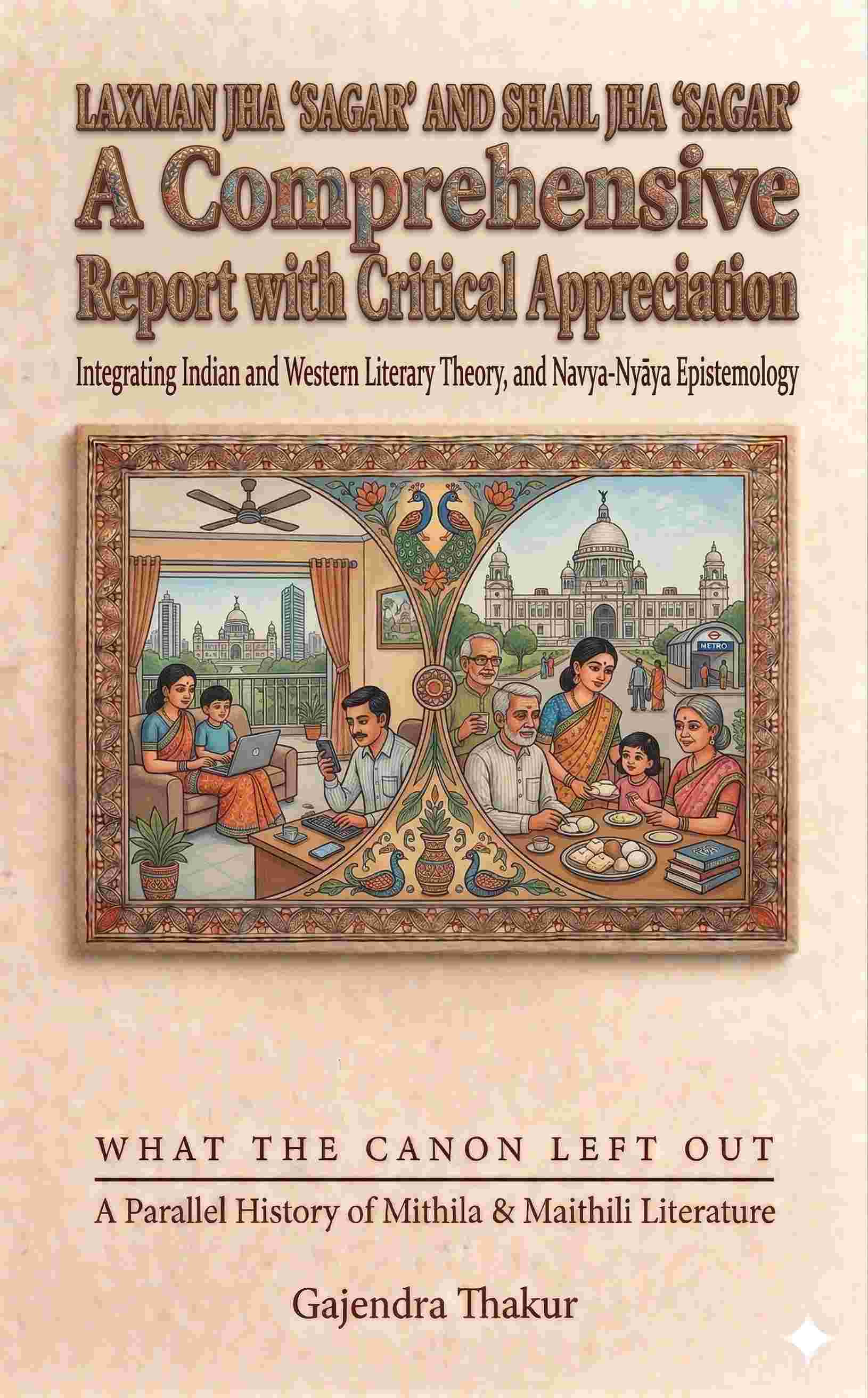
LAXMAN JHA 'SAGAR' AND SHAIL JHA 'SAGAR' A Comprehensive Research Report with Critical Appreciation Integrating Indian and Western Literary Theory, and Navya-Nyāya Epistemology
LAXMAN JHA 'SAGAR' AND SHAIL JHA 'SAGAR'
A Comprehensive Research Report with Critical Appreciation
Integrating Indian and Western Literary Theory, and Navya-Nyāya Epistemology
Abstract
This research report offers a comprehensive critical study of two significant contributors to contemporary Maithili literature: Laxman Jha 'Sagar' (born 1 April 1953, Dhakbahtiya, Ghoghardiha, Madhubani, Bihar) and his wife Shail Jha 'Sagar', a poet-writer in her own right. Drawing primarily from Videha e-Journal's special issue No. 382 (15 November 2023) dedicated to Laxman Jha 'Sagar', and supplemented by broader web sources, this report examines their literary contributions across multiple genres — poetry, short story, interview-collection, varta-katha, and critical essay — within the parallel literary tradition of Maithili. The report critically appreciates their work through a syncretic framework drawing on (i) Indian aesthetic theory (Rasa, Dhvani, Vakrokti); (ii) Western critical theory (New Criticism, Post-Colonial theory, Reader-Response, Feminist theory); and (iii) the Navya-Nyāya epistemology of Gangesa Upadhyaya (14th century, Mithila), with its pramāṇa-based analysis (pratyakṣa, anumāna, upamāna, śabda) applied as a framework for evaluating literary truth-claims and the authenticity of literary testimony. The report argues that both writers exemplify a committed, place-rooted literary practice in the tradition of Babu Saheb Choudhary's Mithila-Maithili movement, deploying satire, social realism, and linguistic authenticity as modes of resistance and cultural preservation.
Contents: 1. Introduction and Background | 2. Biographical Profiles | 3. The Videha Literary Tradition | 4. Published Works and Genres | 5. Critical Appreciation: Indian Frameworks | 6. Critical Appreciation: Western Frameworks | 7. Critical Appreciation: Navya-Nyāya Epistemology | 8. Shail Jha 'Sagar': A Feminist Reading | 9. The Literary Partnership | 10. Reception and Significance | 11. Conclusion | 12. References
1. Introduction and Background
1.1 The Maithili Literary Landscape
Maithili, one of India's 22 constitutionally scheduled languages (admitted to the Eighth Schedule in 2003 under Prime Minister Atal Bihari Vajpayee), is one of South Asia's oldest literary languages. Its literary tradition extends back to at least the 12th century CE, with the poet Jyotirishwar Thakur (c. 1290–1350) authoring 'Varnaratnakara', considered the first prose encyclopedia in any north Indian language. The tradition reached its classical apex with the poet Vidyapati (c. 1352–1448), the 'Maithil Kavi Kokil,' whose padavali influenced Bengali, Odia, and Assamese literary traditions and whose linguistic position has been compared — both by scholars and by writers in the Videha movement — to that of Dante in Italy or Chaucer in England.
Contemporary Maithili literature must be understood within the context of a centuries-long struggle for linguistic recognition, institutional support, and the preservation of Tirhuta (Mithilakshara) script alongside Devanagari. The Maithili literary revival of the 19th–20th centuries was catalysed by journals such as Mithila Mihir and Mithila Darshan (Calcutta), by the organizational work of figures such as Babu Saheb Choudhary, and by the scholarship of figures like Dr. Jayakant Mishra. The inclusion of Maithili in the Eighth Schedule gave constitutional recognition but did not resolve questions of primary-school medium of instruction, state patronage, or the digital preservation of the language.
It is within this contested, richly historical context that Laxman Jha 'Sagar' has spent more than five decades as writer, cultural activist, and institutional memory-keeper. His significance lies not only in his literary output — which spans poetry, short fiction, interview-anthology, and critical essay — but in his embodied commitment to the cause as a diasporic Maithili living in Kolkata's industrial-commercial milieu, far from the heartland of Mithila in Bihar and Nepal's Terai region.
1.2 Videha e-Journal and the Parallel Tradition
The primary source for this report is Videha e-Journal (ISSN 2229-547X), edited by Gajendra Thakur and available at www.videha.co.in. Videha is the first and longest-running Maithili-language fortnightly e-journal, having originated as 'Bhalsarik Gachh', the first Maithili blog, on 5 July 2004, and rechristened as Videha from 1 January 2008. It has published over 390 issues and has been instrumental in digitally preserving and promoting Maithili literature across all genres, with particular emphasis on what it terms the 'parallel tradition' — literary voices that fall outside the mainstream academic and governmental patronage networks of institutions such as Sahitya Akademi, Delhi, or the Maithili Akademi, Patna.
The parallel tradition, as articulated by Videha's editorial philosophy, references the counterculture of Maithili letters: voices that address the quotidian, the socially critical, the provincial-yet-cosmopolitan experience of Maithili-speaking communities in diaspora — in Kolkata, Guwahati, Mumbai, Delhi, and abroad. Laxman Jha 'Sagar' is both a product and a champion of this tradition.
2. Biographical Profiles
2.1 Laxman Jha 'Sagar': Life and Formation
Laxman Jha 'Sagar' was born on 1 April 1953 in the village of Dhakbahtiya, Ghoghardiha, Madhubani district, Bihar. His father was Sri Tarkeshwar Jha (also known as Sri Bhola Jha); his mother was Smt. Ganga Devi. He spent much of his childhood in his maternal home at Belaunchha. His grandfather served as Headmaster of Tamuriya High School and subscribed to Mithila Mihir, Aryavarta, and Indian Nation newspapers, ensuring that the household was saturated with literary and nationalist culture from early childhood.
Sagar's first published work appeared in Hindi in 1968 in 'Aryavarta'; in the same year his first Maithili composition was published in 'Mithila Mihir'. This dual early debut — in Hindi and Maithili, in the same year, at age fifteen — is emblematic of his subsequent career: a writer deeply committed to Maithili, yet fully bilingual, operating across linguistic borders without surrendering the priority of the mother tongue.
Sagar came to Kolkata on 1 January 1974 to pursue Chartered Accountancy, residing initially in the hostel at Raja Bazaar. The trajectory of his Kolkata years was profoundly shaped by his relationship with Babu Saheb Choudhary (full name: Babu Saheb Choudhary), the patriarch of Kolkata's Mithila-Maithili movement. When Sagar's CA studies were interrupted by financial hardship — he was evicted from his lodging on the night of 19 September 1974 — Choudhary intervened directly, securing accommodation and support. This encounter consolidated Sagar's lifelong alignment with Choudhary's philosophy of cultural-linguistic activism over institutional careerism.
From 1983 to 1997 Sagar worked in Guwahati, Assam, where he not only continued his literary work but founded 'Mithila Sanskritik Samanvay Samiti' and associated with the founding of 'Purvattar Maithil', Assamese Maithili's first colour-printed quarterly journal — under the leadership of the late Satyanand Pathak and Sri Premkant Choudhary. This period in Assam, including the threat of ULFA (United Liberation Front of Asom) militancy against him, tested his resolution and ultimately led to his return to Kolkata in 1997. There he joined Neo Metaliks (a company in the Rupa & Co. group), from which he retired as Senior Purchase Manager in 2012 but continued as consultant. His permanent address is 3B, Tista Apartment, 94 Avenue South Road, Santoshpur, Kolkata-65.
Sagar holds the CA (Inter) qualification, First Group (1976). He has received twelve major literary and cultural honours between 2017 and 2023, including the Babu Saheb Choudhary Samman (Akhil Bharatiya Mithila Sangh, Delhi, 2017), the Dr. Inrarkant Jha Samman (Vidyapati Seva Sansthan, Darbhanga, 2018), and the Mithila Vibhuti Samman (Karnataka Mithila Sanskritik Manch, Bengaluru, 2022), recognising both his literary work and his institutional contributions to the Maithili cause.
2.2 Shail Jha 'Sagar': Profile and Significance
Shail Jha 'Sagar' (née: family name Thakur before marriage) is both a writer in Maithili in her own right and the life-partner of Laxman Jha 'Sagar'. The Videha special issue makes explicit its editorial rationale for including her work: within Maithili literary culture there exists a notable tradition of literary couples (dampati lekhak), and Shail Jha is one of its living representatives. Her inclusion also reflects an important feminist-editorial principle: if hundreds of pages can be devoted to the male writer, then a few pages devoted to the woman who has been equally present — as co-creator, first reader, and independent author — is not a supplement but a correction.
Shail Jha's work presented in the Videha special issue spans three genres: a short story ('Pati Parmeshwar' — 'The Husband as God'), a literary letter-cum-review ('Ekta Patra: Ekta Samiksha — Kist Kist Jivan' — 'One Letter: One Review — Life in Instalments'), and a poem ('Beti' — 'Daughter'). These three pieces together constitute a remarkably coherent feminist voice, addressing in different registers the constraints of patriarchal expectation, the loneliness of the elderly, and the paradoxical status of daughters in Maithili society.
Shail Jha is described by multiple contributors to the Videha issue as a 'sagar pathika' — an attentive reader of Maithili literature — and as a co-participant in the cultural-activist dimension of Sagar's work. As Nabonarayan Mishra notes, Sagar's family home is distinguished by its exclusive use of Maithili as the domestic language — a remarkable commitment given that the family lives in a Bengali-dominant metropolitan environment.
3. The Videha Literary Context and the Babu Saheb Choudhary Tradition
Laxman Jha 'Sagar's literary identity is inseparable from the organizational and ideological legacy of Babu Saheb Choudhary, whose philosophy he invokes repeatedly in his autobiography and whose collected memorial volume he was preparing at the time of this publication. Babu Saheb Choudhary (whose full name appears in different forms in the sources) was the founding figure of Kolkata's Maithili literary and political mobilization, pioneering the publication of Mithila Darshan and engaging prime ministers in the cause of Maithili recognition. His dictum — quoted by Sagar — that an organization which neither agitates nor creates literature is a mere 'kirtaniya-mandali' (singing troupe) remains one of Sagar's foundational critical principles.
This tradition continues in the Videha movement's parallel literary philosophy. Gajendra Thakur's Videha project, which began in 2000 and was formally launched as a fortnightly e-journal in 2008, represents the digital culmination of this tradition: decentralized, non-institutional, committed to all voices regardless of caste, gender, or geography, and technically innovative in its use of both Devanagari and Tirhuta (Mithilakshara) scripts, Unicode, and Braille. It is significant that Gangesa Upadhyaya — the 14th-century logician of Mithila whose Tattvachintamani founded the Navya-Nyāya school — appears in Videha's discourse not only as a historical figure but as a legitimating ancestor: Gajendra Thakur authored the Maithili short story 'Shabdashastram' (The Science of Words), based on true Panji records of Gangesa Upadhyaya, which was translated into English and published in Sahitya Akademi's Indian Literature journal (Vol. 58, No. 2, 2014). This suggests that the Videha movement consciously situates itself within the deep epistemological tradition of Mithila.
4. Published Works and Genres
4.1 Laxman Jha 'Sagar': Published Works
Sagar's published literary corpus comprises four books:
(1) Uchharr Baisu Kaua (Sit Down, Crow! — Poetry Collection, 2010): His debut collection, published from Guwahati. The title — an injunction to a crow to perch — is deliberately anti-lyrical, subverting the classical Maithili poetic convention of the koil (cuckoo) as the emblem of the literary voice. The choice of the crow signals Sagar's allegiance to the everyday, the blunt, the unheroic — a poetics of social realism over aestheticized romanticism.
(2) Ekah Gadhbere Me (At the Same Jackfruit Time — Poetry Collection, 2020): His second collection, whose title again employs a demotic temporal idiom ('gadhber' = the time of eating jackfruit, a colloquial evening hour) to anchor the lyric in the specific rhythms of Maithili rural-urban life.
(3) Nisoh (Varta-Katha, 2021): A collection of varta-katha, a hybrid Maithili genre that blends the conversational story, the anecdote, and the social essay. The title 'Nisoh' (loosely: 'without support' or 'independent') gestures toward the solitary integrity of the moral and literary witness.
(4) Jena O Kahlakan (As They Said — Interview Collection, 2021): A collection of seven extended interviews with major figures of the Maithili movement: Babu Saheb Choudhary (31 Dec 1976), Dr. Jayakant Mishra (21 July 1979), Sri Pitambar Pathak (7 Oct 2001), Sri Rajnandan Lal Das, Dr. Virender Malik, Sri Mahendra Malangiya, and Sri Ashok Jha. These interviews, conducted without tape recorder or notes — drawn from memory and later transcribed — document the institutional, political, and literary history of the Maithili movement across five decades.
Additionally, Sagar has extensive unpublished manuscripts including essay collections, memoirs, story collections, a literary criticism volume, and a biography collection. He has served twice as guest editor of 'Purvattar Maithil' (the Maithili quarterly published from Guwahati) and has been editor of a memorial volume for Babu Saheb Choudhary.
4.2 Shail Jha 'Sagar': Works Presented
The three works published in the Videha special issue represent three distinct registers of Shail Jha's authorial identity. 'Pati Parmeshwar' (The Husband as God) is a short story set in urban Kolkata, tracing the parallel loneliness of an elderly woman (Kaki) and the narrator through the lens of changing family structures. The story's social-realist mode and understated irony (the title is a traditional phrase that the story quietly interrogates through the figure of an old woman abandoned by successful sons) places it squarely within the Maithili progressive short-story tradition.
The letter-essay 'Ekta Patra: Ekta Samiksha — Kist Kist Jivan' is addressed to the autobiographical author of 'Kist Kist Jivan' (Life in Instalments), and operates as both review and confession. Shail Jha writes that reading the book moved her to uncontrollable tears from the first page; she calls it a 'viral rachna' (rare composition) and urges its translation into international languages. This piece demonstrates a sophisticated reader-response: the letter locates its emotional authority precisely in the domestic, feminine position ('a household woman reading it') that literary criticism often marginalizes.
The poem 'Beti' (Daughter) is structured as an eight-stanza refrain poem: 'Ham beti chhi, ham beti chhi / Ham ahi samaajak beti chhi' (I am a daughter, I am a daughter / I am daughter of this very society). Each stanza enumerates a social role — the beloved ('dulri'), the playmate of brothers, the daughter-in-law locked in a trunk — before concluding with the paradox that without daughters there is no son, no path to heaven, yet daughters remain the least-valued. The poem is formally simple but socially sharp, exemplifying what feminist critics of Indian poetry have termed 'subversive domesticity'.
5. Critical Appreciation: Indian Literary Frameworks
5.1 Rasa Theory (Bharatamuni / Abhinavagupta)
Classical Indian aesthetics from Bharatamuni's Natyashastra onwards organizes literary experience around rasa: the aesthetic emotions (shringara-love, hasya-comedy, karuna-pathos, vira-heroism, etc.) that are universalized from specific emotional states (sthayibhava) through the transaction of vibhava (determinants), anubhava (consequents), and vyabhicharibhava (transitory states). Abhinavagupta's 10th-century elaboration in Abhinavabharati locates rasa as a form of brahmananda — not mere pleasure but a form of spiritual universalization of the self through the literary object.
Laxman Jha 'Sagar's poetry is predominantly governed by karuna (pathos), vira (heroism of language and social commitment), and hasya shading into satira (satirical comedy). In 'Uchharr Baisu Kaua', the crow — as emblem of the overlooked, the scavenging intelligence, the unheroic commentator — provokes a karuna-vira synthesis: the pathos of cultural marginalization channelled into the heroic act of writing in and for the mother tongue. The poem extract cited by Surendra Thakur — 'Sahityak thekedar jahan faank bhi jaai chhai / Tan bad dukh hoyi chhai' (When the literary contractor's book becomes a wastepaper / Then great sorrow comes) — deploys hasya to produce a karuna that is politically activated: the pathos is not passive but functions as protest.
Shail Jha's 'Beti' operates through sthayibhava of shoka (grief-sorrow) but its refrain structure — 'Ham beti chhi' — converts private grief into collective assertion. Abhinavagupta's concept of sadharanikarana (universalization, the literary mechanism by which particular emotion becomes universal) is precisely what this poem achieves: the speaker's 'I am a daughter' becomes every daughter's statement, and the poem's emotional resonance in performance (it is designed for recitation) confirms this universalizing function.
5.2 Dhvani and Vakrokti
Anandavardhana's Dhvanyaloka (9th century) argues that the soul of poetry lies in dhvani — the resonant suggestion that exceeds the literal meaning. Kuntaka's Vakroktijivita (10th century) locates poetic power in vakrokti — the oblique expression that deviates from the ordinary (svabhavokti) through deliberate aesthetic choice.
Sagar's varta-katha in 'Nisoh' exemplifies the dhvani principle: the surface is that of a quiet, often humorous anecdote, but the suggested meaning — the erosion of Maithili culture, the betrayal of the language by its own educated class — reverberates beneath every domestic scene. Similarly, the title 'Nisoh' operates dhvanically: the word's literal meaning (without support) suggests both the author's solitary position and the condition of the language itself.
The title 'Uchharr Baisu Kaua' demonstrates vakrokti at the macro-structural level: the whole book is a vakrokta — a literarily deviant utterance — because it displaces the classical Maithili kavi (poet) who addresses the kokil (cuckoo) with a plain man who addresses the kaua (crow). This structural irony operates as what Kuntaka would call 'vakrokti in genre selection': the deviation from convention is itself the vehicle of meaning.
5.3 Riti and the Question of Linguistic Authenticity
The Riti school (Vamana, 8th century) evaluates poetry through the excellence of its linguistic style (riti) — defined not as ornamentation alone but as the coalescence of guna (qualities: clarity, sweetness, force) with alankar. Multiple contributors to the Videha special issue praise Sagar's Maithili for its deployment of ṭheṭha (core, pure) Maithili vocabulary — the endangered lexical stratum of rural, pre-urbanized Maithili that is disappearing under the pressure of Hindi and Bengali. As Surendra Thakur writes in his extended critical appreciation, Sagar deliberately excavates 'herayal-bhutiaayal shabd' (lost and forgotten words) — reclaiming them for literary use and thereby performing an act of linguistic preservation through aesthetic practice. This is Riti theory applied to a socio-political context: the qualities of Maithili writing are inseparable from the political question of which Maithili is written.
6. Critical Appreciation: Western Literary Frameworks
6.1 New Criticism and Close Reading
The New Critical paradigm (I.A. Richards, Cleanth Brooks, Robert Penn Warren) insists on the autonomy of the literary text and the centrality of close reading — attending to irony, paradox, tension, and the organic unity of form and content. Applied to Sagar's poetry, New Criticism reveals a sophisticated management of tonal paradox: the crow-poem's surface bluntness contains layers of self-conscious irony about the social position of the writer. In 'Ekah Gadhbere Me', the domestic temporal marker ('gadhber' time) performs a kind of New Critical 'tension' — between the urgency of social address and the deliberate, unhurried cadence of domestic time.
Shail Jha's 'Beti' rewards New Critical attention to its refrain structure: the identity phrase 'Ham beti chhi' does not simply repeat — it accumulates. With each stanza, the daughter is a 'dulri', then a 'bhurli', then a 'toki jaka', then a locked-up 'peti' (trunk), then a 'hira moti' (pearl and diamond), then a 'roṭi' — food itself, the sustainer. The poem's paradox: the daughter is simultaneously the most precious and the most consumed. The New Critical unity consists in this paradox being not resolved but held in productive tension.
6.2 Post-Colonial Theory
Homi Bhabha's concept of the 'third space' — the liminal cultural space produced by colonial encounter and its afterlives — is illuminating for understanding the position of the diasporic Maithili writer in Kolkata. Sagar inhabits a third space between Mithila (the origin, the cultural homeland) and the Bengali-dominant metropolis. His writing is neither fully rooted in Mithila's classical literary tradition nor accommodated within the dominant cultural-linguistic system of Kolkata. It is precisely this third space — where the mother tongue is maintained against dominant-language pressure, where Maithili is spoken at home in a Bengali city — that generates the political and literary charge of his work.
Frantz Fanon's analysis in 'The Wretched of the Earth' of the intellectual who returns from the colonial metropole to reclaim the suppressed language and culture is also relevant: Sagar's career narrative — CA student abandoning professional advancement for cultural activism, returning repeatedly to Maithili organizations, using his industrial corporate position as a resource for cultural work rather than an alternative to it — mirrors Fanon's 'native intellectual' who turns from European models to rediscover and reinvent the national culture.
Edward Said's concept of 'affiliation' versus 'filiation' offers a further lens: Sagar's literary identity is built on affiliation — a chosen loyalty to the Maithili tradition and the Babu Saheb Choudhary legacy — rather than mere filiation (inherited belonging). This makes his commitment epistemologically stronger and politically more conscious.
6.3 Reader-Response Theory
Wolfgang Iser's concept of the 'implied reader' — the reader constructed by the text — and Stanley Fish's notion of 'interpretive communities' are useful for understanding the specific readership that Sagar's work both addresses and constructs. His writing presupposes an ideal reader who is: (i) Maithili-literate in both Devanagari and ideally Tirhuta; (ii) aware of the cultural-political stakes of the language; (iii) living in diaspora and therefore particularly sensitive to the erosion of linguistic identity; and (iv) committed to what Sagar calls 'sachcha Maithili' — genuine, engaged Maithili writing as opposed to institutional performance.
Shail Jha's letter-essay to Shefalika (author of 'Kist Kist Jivan') performs a meta-reader-response criticism: it is itself an account of reading, of how a text operates on a specific reader (a 'gharelo mahila', household woman) in a specific context (during the Mahakumbh period, as neighbours go on pilgrimage). This meta-critical move — criticism as enacted reading — anticipates the concerns of contemporary Reader-Response theory while remaining embedded in a specifically Maithili domestic-literary context.
6.4 Feminist Theory
Sandra Gilbert and Susan Gubar's concept of the 'anxiety of authorship' — the specific pressure on women writers who must negotiate a patriarchal literary tradition that does not recognize their subjectivity — applies directly to Shail Jha's literary position. The Videha editorial team's explicit justification for including her work — 'if hundreds of pages can be devoted to the man, why can't a few pages be devoted to the woman who has been equally present?' — reveals exactly the structural marginalization that feminist theory describes. Shail Jha's three texts collectively negotiate this position: the short story critiques patriarchal family structures (the 'pati-parmeshwar' principle); the letter performs intellectual authority through domestic positioning ('I, a household woman, read this before my husband'); and the poem names and interrogates the daughter's condition directly.
Elaine Showalter's concept of 'gynocriticism' — the study of women's literature as a distinct tradition — suggests that Shail Jha's work should be read not only in relation to her husband's oeuvre but as part of the tradition of Maithili women's writing that includes figures like Chandrakala Devi, Rajni Anil, and the growing cohort of women writers in Videha's pages. Her three pieces demonstrate formal range and thematic coherence that merits independent critical attention.
7. Critical Appreciation: Navya-Nyāya Epistemology of Gangesa Upadhyaya
7.1 Gangesa Upadhyaya and the Tattvachintamani
Gangesa Upadhyaya (c. first half of 14th century) was born and lived in the Mithila region — specifically in the village of Karion, twelve miles southeast of Darbhanga — and is thus a specifically Maithili intellectual ancestor. His Tattvachintamani ('The Jewel of Reflection on Truth about Epistemology') founded the Navya-Nyāya ('New Logic') school and remained the foundational text of Indian logic and epistemology through the 18th century. As Keith observed, 'the logic of Nyāya attained its final shape' through Gangesa's work, and as Radhakrishnan noted, every system of Hindu thought accepts the fundamental principles of Nyāya logic and uses Nyāya terminology even when criticizing it.
The Tattvachintamani is organized around the four pramāṇas — valid sources of knowledge: pratyakṣa (perception), anumāna (inference), upamāna (comparison/analogy), and śabda (testimony/word). Gangesa's significant innovation was to treat epistemology and logic as the primary philosophical disciplines, 'divesting Nyāya of its metaphysical appendages.' He also advanced an 'extrinsicality' thesis: although putative perceptions are automatically taken as veridical, their confirmation as genuine knowledge requires a separate cognitive act. This means that knowledge-claims must be tested against external criteria — a profoundly critical epistemological stance.
Crucially, the Navya-Nyāya of Mithila later influenced the development of methodology across Sanskrit disciplines including grammar, poetics (Kavya-Sahitya), and other darshanas. The application of Navya-Nyāya methodology to literary criticism is therefore not a mere methodological transplant but a historically grounded possibility — one that the Videha movement itself implicitly acknowledges through Gajendra Thakur's 'Shabdashastram' story.
7.2 Pratyakṣa (Perception) and Literary Testimony
In Navya-Nyāya, pratyakṣa (perception) is the most direct pramāṇa: veridical cognition arising from direct sensory contact with an object. Applied to literary criticism, the pratyakṣa criterion asks: does the work present experience in a manner that commands immediate assent — does it feel true? This is closely related to what Wordsworth called 'the spontaneous overflow of powerful feelings recollected in tranquillity' and what Keats theorized as 'negative capability': the capacity to hold uncertainty without reaching after fact or reason.
Sagar's autobiographical essay ('Apan Aatmakathya') demonstrates high pratyakṣa validity: the specific, named, dated account of his early life in Kolkata — the eviction on the night of 19 September 1974, sleeping hungry, walking on foot with a chest on his head to the Rajendra Hostel, weeping before the Kali temple — carries the phenomenological vividness of direct sensory recall. The Navya-Nyāya critic would say that such writing generates cognition of the anubhava kind (consequent emotion) that confirms the vibhava (causal circumstance) as genuine: the reader does not merely believe these events happened but perceives their truth through the writing.
Shail Jha's 'Pati Parmeshwar' demonstrates similar pratyakṣa quality: the story's Kolkata domestic setting — the multi-floor apartment, the son working in Delhi and Bangalore, the medical episodes of the ageing couple — is rendered with the specificity of direct observation. The narrative detail of Kaki's knee injury, the son who sends money but does not return, the doctor's instruction to avoid stress: these are recognitions, not inventions.
7.3 Anumāna (Inference) and the Social-Critical Mode
Anumāna in Nyāya is inferential cognition based on the vyapti — the universal pervasion or invariable concomitance between a hetu (reason/mark) and the sadhya (probandum). The classic form: 'There is fire on the hill because there is smoke, and where there is smoke there is fire.' Applied to literature, anumāna becomes the mechanism by which the text moves from the particular to the general, from the individual case to the social law.
Sagar's satirical mode — what multiple contributors to the Videha issue identify as his nishedhatmak (critical-negative) mode — operates through social anumāna. In 'Ekah Gadhbere Me', the poem fragment 'Sahityak thekedar' (literary contractor) infers from the particular observation (contractor's books becoming wastepaper) to a general social probandum: the corruption of Maithili literary institutions by careerist self-interest. The hetu (specific symptom) licenses the anumāna (general diagnosis). This is what makes Sagar's satire not mere personal complaint but social analysis.
Similarly, Shail Jha's poem 'Beti' moves through anumāna: from the particular enumeration of a daughter's social roles (hetu) to the invariable conclusion (sadhya) that daughters are both essential and undervalued in this society — a vyapti (universal concomitance) that the poem establishes as social law through accumulated evidence.
7.4 Upamāna (Comparison/Analogy) and Intertextual Meaning
Upamāna in Nyāya is the pramāṇa of comparison — knowledge arising from the recognition of similarity between an unfamiliar object and a familiar one. In literary terms, upamāna operates through simile, metaphor, and intertextual reference.
The most striking upamāna in the Videha special issue is Sagar's own title: 'Uchharr Baisu Kaua' (Sit Down, Crow!). The crow is placed in comparative relation to the canonical Maithili kokil (cuckoo) — but via antithesis: the hitherto unfamiliar (the crow-poet) is recognized through similarity-with-difference to the familiar (the cuckoo-poet). This meta-poetic upamāna establishes Sagar's entire aesthetic programme as 'oppositional comparison': his writing is like classical Maithili poetry insofar as it is poetry — and unlike it in every substantive respect.
Shail Jha's letter performs upamāna explicitly: 'Sagar Ji aahaan tak tulna Mahadevi Verma, Mahasweta Devi vagairah sain karait chhi' (Sagar [meaning her husband Laxman] compares you [Shefalika] to Mahadevi Verma and Mahasweta Devi). The comparison is a pramāṇa for the value of 'Kist Kist Jivan' — its validity derived from recognized excellence in comparable literary figures.
7.5 Śabda (Testimony) and the Authority of the Interview Tradition
Śabda in Navya-Nyāya is the pramāṇa of linguistic testimony — knowledge derived from reliable, authoritative utterance. Gangesa's analysis of śabda is particularly nuanced: he distinguishes between the reliability of the speaker (vaktr-visvasa) and the well-formedness of the utterance (shabda-tatparya), arguing that śabda is valid only when both conditions are met. This has direct implications for Sagar's most significant literary project: 'Jena O Kahlakan' (As They Said).
The interview collection is built entirely on śabda — the testimony of seven major figures of the Maithili movement, recorded from memory (significantly, without tape recorder or written notes at the time of utterance) and later reconstructed as written text. The Navya-Nyāya critic must evaluate: (i) Were the witnesses (Babu Saheb Choudhary, Dr. Jayakant Mishra, et al.) reliable (apta) — authoritative speakers whose testimony is varidical? The answer is clearly yes: these are recognized figures, identified by name and institutional affiliation. (ii) Is Sagar's mediation of their words a faithful act of transmission? Hitanath Jha's review in the Videha issue addresses this directly: he notes that the interviews were reconstructed without mechanical recording, making Sagar's cognitive integrity the sole guarantee of their accuracy. The Navya-Nyāya framework suggests we assess this through anumāna: the consistency, specificity, and cross-verifiable details in these accounts provide evidential grounds for their reliability.
This epistemological question — whether literary testimony, transmitted through human memory and reconstructed through writing, constitutes valid śabda — is not merely academic. It is central to the entire project of the parallel Maithili literary tradition, which has often been preserved through oral transmission and personal memory when institutional archives and official records were absent or inaccessible. Sagar's interview method performs, at the literary-methodological level, exactly what Gangesa's Navya-Nyāya performs at the epistemological level: a rigorous examination of the conditions under which transmitted knowledge can be trusted.
7.6 The Extrinsicality Thesis and Literary Self-Correction
Gangesa's 'extrinsicality' (paratahpramanya) thesis holds that knowledge's validity is not self-certifying but requires external confirmation — though putative cognitions are automatically taken as true in ordinary life. This provides a critical tool for evaluating the reception of Sagar's work. Several contributors to the Videha special issue note that Sagar 'divides opinion': his directness, his tendency toward frank criticism of persons and institutions, his uncompromising advocacy of Maithili has made him some adversaries. The Navya-Nyāya extrinsicality thesis suggests that this is not merely a social phenomenon but an epistemological one: the reception of committed literary testimony requires external criteria — institutional recognition, independent corroboration, the passage of time — to move from presumptive acceptance to confirmed knowledge-claim. The multiple awards from diverse institutions (Delhi, Darbhanga, Kolkata, Bengaluru, Ahmedabad) constitute exactly such external confirmation, validating through collective social agreement what was initially a individually-asserted literary position.
8. Shail Jha 'Sagar': A Feminist Reading
Reading Shail Jha's work as an independent corpus, rather than as an appendage to her husband's, reveals a writer who navigates the specific contradictions of the educated middle-class Maithili woman in urban diaspora. Her three pieces collectively address three axes of feminine constraint:
(1) The generational axis ('Pati Parmeshwar'): Kaki embodies the woman who has organized her life around the traditional patriarchal contract — husband first, sons second, self never. The story's quiet subversion is that this contract has failed her: the sons are in Delhi and Bangalore, the grandchildren in 'crèche', and Kaki — who has done everything right — is alone. The protagonist-narrator observes this with a complexity that is neither sentimental nor bitter: she draws an analogy between Kaki's situation and that of the 'Parmeshwar' (servant) who fifty years ago worked alongside his wife in the fields as equals. The story's political point — that the 'backward caste' worker has a more humane domestic partnership than the successful nuclear family of the educated middle class — is made through juxtaposition, not argument.
(2) The domestic-intellectual axis ('Ekta Patra'): Shail Jha's letter claims the authority of the domestic reader — 'a household woman' — as a literary-critical subject. This is a deliberate feminist move: she positions her reading of 'Kist Kist Jivan' not despite but through her domestic position. 'Gharelu naari hevak karane e labh ham uţhailung, hunkaa sar pahine hamheen padhi gailung' (Being a household woman, I took this benefit; I read it before him). The domestic is reframed as a site of literary knowledge, not its absence.
(3) The structural axis ('Beti'): The poem addresses the daughter's paradoxical position in a formal register that moves between the lyric and the social essay. The refrain 'Ham beti chhi, ham ahi samaajak beti chhi' becomes increasingly ironic as the poem accumulates the daughter's roles: she is precious ('hira moti'), yet locked in a trunk; she is food ('roṭi'), yet without her there is no heaven. The poem's feminist achievement is to make the contradiction visible and audible without offering a facile resolution — the refrain at the end is not triumph but statement.
This analysis suggests that Shail Jha's literary identity deserves a dedicated scholarly study, one that situates her within the tradition of Maithili women's writing alongside Lilawati Devi, Usha Kiran Khan, and Vibha Rani, and within the broader context of South Asian women's literature in regional languages.
9. The Literary Partnership: Dampati Lekhak
The concept of the 'dampati lekhak' (literary couple) has a notable if understudied history in Maithili literature. The Videha editorial note explicitly locates the Sagars within this tradition. What makes their partnership distinctive is its organizational as well as literary dimension: Sagar maintains a strict personal rule that he will not attend any literary function without Shail Jha (as Kameshwar Jha 'Kamal' notes approvingly: 'He made a rule: if I go to any literary programme, I will not go without Shail Ji'). This is not a mere social convention but an implicit feminist commitment — the refusal to be visible in the public sphere of literature without simultaneously making the woman writer's presence required.
In Navya-Nyāya terms, this practice performs a form of vyapti (universal concomitance) at the social level: wherever Sagar appears as a literary actor, Shail Jha is also present — not as accompaniment but as co-presence. Over decades, this sustained co-presence has contributed to a normalization of women's participation in Maithili literary events that has broader cultural consequences.
Multiple contributors to the Videha special issue invoke the formula: 'Sagar Ji ki safaltaa mein unki dharmapatni Shail Jha 'Sagar' Ji ka pramukh yogdan rahlak chhi' (In Sagar Ji's success, his wife Shail Jha 'Sagar's contribution has been primary). This acknowledgment, made by men writing in tribute to a male writer, is itself a significant feminist gesture within the conventions of the genre.
10. Reception and Significance
The critical reception of Laxman Jha 'Sagar' in the Videha special issue is unanimously positive but not uncritical. Several contributors offer assessments that correspond to what Navya-Nyāya would call 'motivated cognition' (the sahridaya's favorable reading) as well as to more distanced evaluation. Virendr Jha identifies Sagar as a 'spashtvadi sahityakar' (plain-speaking writer) whose social-realist mode, sociological content (joint family dissolution, elder neglect, caste and social custom), and commitment to upcoming writers constitute a distinctive contribution. Jagdish Chandra Thakur 'Anil' locates the interview collection 'Jena O Kahlakan' as a document of unique historical importance — an archive of oral testimony from seven figures whose first-hand accounts of the Maithili movement's institutional history would otherwise be lost.
Chandana Datt offers perhaps the most balanced appreciation: she praises Sagar's 'nibhik, spasht aur imandar lekhnee' (fearless, clear, honest writing) while situating it within the socio-political context of Maithili in Kolkata — the Bengali-dominant metropolis where Maithili speakers are constantly pressured to abandon their linguistic identity.
Vibha Rani's account is distinctive in its focus on personality: she notes Sagar's personal warmth, his insistence on making time for literary encounters, his colourful kurtas (shirts), his resistance to the social expectation that elderly men should wear dull clothes and recite prayers at home — a small but telling detail of a personality that refuses the shrinkage of age.
As of 2023, Sagar's standing in the Maithili literary world is as a figure who has received recognition from institutions spanning the full geographic range of the Maithili diaspora — Delhi, Darbhanga, Kolkata, Bengaluru, Ahmedabad — suggesting a national significance that transcends regional or factional alignments. His planned memorial volume for Babu Saheb Choudhary is awaited as a significant contribution to the institutional history of the movement.
11. Conclusion
Laxman Jha 'Sagar' represents a model of the committed regional-language writer in the post-Independence, post-liberalization Indian context: a professional who has sustained a parallel literary life across five decades, in exile from the homeland, under the double pressure of economic necessity and cultural marginalization. His significance is not only literary but epistemological — in the deep sense intended by Gangesa Upadhyaya's Navya-Nyāya: his work constitutes a claim to knowledge, a set of testimonies about the Maithili world that require the full apparatus of pramāṇa-critique to evaluate.
The application of Navya-Nyāya's four pramāṇas to Sagar's work yields productive results: pratyakṣa validates the experiential authenticity of his autobiographical writing; anumāna licenses the social inferences drawn by his satire; upamāna illuminates his meta-poetic programme; and śabda — the pramāṇa of testimony — provides the epistemological framework for the interview collection that may be his most lasting contribution to Maithili cultural memory.
Shail Jha 'Sagar' emerges from this analysis as an independent literary voice whose work merits sustained critical attention. Her three pieces — the short story, the letter-review, and the poem — demonstrate formal range, social acuity, and feminist consciousness that are inadequately recognized when she is read only as an adjunct to her husband's literary career. The dampati lekhak tradition that they embody is itself a cultural form worth studying: the household as a laboratory of literary production, resistance, and mutual recognition.
The Videha e-Journal's special issue on Laxman Jha 'Sagar' is itself a significant document in the history of Maithili parallel literature: an act of collective critical recognition, coordinated by a digital institution that has served the language since 2004. That this recognition is enabled by digital technology — a medium that bypasses the gatekeeping institutions of print culture, governmental patronage, and academic prestige — is consistent with the epistemological commitments of both the Navya-Nyāya tradition and the parallel literary tradition: knowledge is not established by authority alone, but by the convergence of multiple pramāṇas — perception, inference, comparison, and trustworthy testimony — evaluated by critically alert readers.
The legacy of Gangesa Upadhyaya, who established the conditions for rigorous knowledge-claim evaluation in 14th-century Mithila, finds an unexpected but coherent resonance in the contemporary practice of writers like Laxman Jha 'Sagar' and Shail Jha 'Sagar', who daily negotiate the question of what constitutes valid cultural memory, authentic linguistic practice, and trustworthy literary testimony in a world that constantly pressures the minor language and its speakers toward absorption and silence.
12. References
Primary Sources
[1] Videha e-Journal, Issue No. 382, 15 November 2023 (Year 16, Issue 191, No. 382). Ed. Gajendra Thakur. ISSN 2229-547X. ISBN: 978-93-340-3822-4. www.videha.co.in. [Laxman Jha 'Sagar' Special Issue — Laxman Jha 'Sagar' Visheshank]. This is the primary source for all biographical and literary material on both subjects.
[2] Jha 'Sagar', Laxman. Uchharr Baisu Kaua [Sit Down, Crow! — Poetry Collection]. Guwahati: [Publisher], 2010.
[3] Jha 'Sagar', Laxman. Ekah Gadhbere Me [At the Same Jackfruit Time — Poetry Collection]. [Kolkata/Darbhanga]: [Publisher], 2020.
[4] Jha 'Sagar', Laxman. Nisoh [Varta-Katha]. [Kolkata/Darbhanga]: [Publisher], 2021.
[5] Jha 'Sagar', Laxman. Jena O Kahlakan [As They Said — Interview Collection]. [Kolkata/Darbhanga]: [Publisher], 2021.
[6] Jha 'Sagar', Shail. 'Pati Parmeshwar' [short story]; 'Ekta Patra: Ekta Samiksha — Kist Kist Jivan' [letter-review]; 'Beti' [poem]. Published in Videha e-Journal, Issue 382, 2023.
[7] Jha 'Sagar', Laxman. 'Apan Aatmakathya' [Autobiographical Statement]. In Videha e-Journal, Issue 382, 2023.
Secondary Sources — Videha Special Issue
[8] Thakur, Jagdish Chandra 'Anil'. ''Sagar' san Mahāsāgar Dharr' ['From Sagar to the Ocean']. In Videha 382, 2023. pp. 65–69.
[9] Jha, Virendr. 'Laxman Jha Sagar: Spashtvaadi Sahityakaar' ['Plain-Speaking Writer']. In Videha 382, 2023. pp. 70–71.
[10] Mishra, Nabonarayan. 'Sarvaguna Sampanna Sagarji' ['Sagar Ji, Endowed with All Virtues']. In Videha 382, 2023. pp. 72–77.
[11] Jha, Hitanath. 'Jena O Kahlavan' [review]. In Videha 382, 2023. pp. 78–79.
[12] Datt, Chandana. 'Adaraniya Laxman Jha Sagar' ['Revered Laxman Jha Sagar']. In Videha 382, 2023. pp. 57–59.
[13] Rani, Vibha. 'Telaauns Deh Par Jyaan Bichhalayt Paavan' ['Like Holy Water on an Oil-Anointed Body']. In Videha 382, 2023. pp. 60–64.
[14] Jha 'Kamal', Kameshwar. 'Sri Sagarji San Pahil Bhoant, Takar Baad Aai Dharr' ['First Meeting with Sagar Ji, and from Then Till Today']. In Videha 382, 2023. pp. 100–108.
[15] Thakur, Surendra. 'Sagarji' [critical essay]. In Videha 382, 2023. pp. 86–99.
Works on Maithili Literature and Videha
[16] Thakur, Gajendra, ed. Videha e-Journal (ISSN 2229-547X). www.videha.co.in. Issues 1– (2008–present).
[17] Thakur, Gajendra. 'Shabdashastram' [short story, Maithili, English translation: 'The Science of Words']. Indian Literature, Sahitya Akademi. Vol. 58, No. 2 (280), March/April 2014. pp. 78–93.
[18] Thakur, Gajendra. Parallel Literature in Maithili and Videha Maithili Literature Movement. Blog post. https://gajendrathakur.blogspot.com/2023/02/parallel-literature-in-maithili-and.html
[19] Choudhary, Radhakrishna. A Survey of Maithili Literature. [Standard reference work cited in Videha sources].
[20] Singh, Prem Shankar. 'Maithili: Writers at Work'. Indian Literature, Vol. 13, No. 4 (December 1970). pp. 60–63. [JSTOR: https://www.jstor.org/stable/24157159]
[21] Wikipedia (English). 'Gajendra Thakur'. https://en.wikipedia.org/wiki/Gajendra_Thakur [Accessed April 2026].
Works on Indian Aesthetics and Philosophy
[22] Bharatamuni. Natyashastra. Trans. Manomohan Ghosh. 2 vols. Calcutta: Asiatic Society, 1950–1967.
[23] Abhinavagupta. Abhinavabharati (Commentary on Natyashastra). Ed. M. Ramakrishna Kavi. Baroda: Oriental Institute, 1926–1964.
[24] Anandavardhana. Dhvanyaloka. Trans. Daniel H.H. Ingalls, Jeffrey Moussaieff Masson, M.V. Patwardhan. Cambridge, MA: Harvard University Press, 1990.
[25] Kuntaka. Vakroktijivita. Ed. and trans. Krishnamoorthy. Dharwar: Karnataka University, 1977.
Works on Navya-Nyāya / Gangesa Upadhyaya
[26] Gangesa Upadhyaya. Tattvachintamani ['Jewel of Reflection on Truth']. Ed. Kamakhyanath Tarkavagisa. Calcutta: Baptist Mission Press, various volumes. [Also available at Internet Archive: archive.org]
[27] Phillips, Stephen H. and N.S. Ramanuja Tatacharya. Epistemology of Perception: Commentary of Gangesa's Tattvacintamani — Pratyaksha-Khanda. New Delhi: Motilal Banarsidass, 2004.
[28] Phillips, Stephen H. 'Gangesa' [encyclopedia entry]. Stanford Encyclopedia of Philosophy. https://plato.stanford.edu/entries/gangesa/ [Accessed April 2026].
[29] Wikipedia (English). 'Navya-Nyāya'. https://en.wikipedia.org/wiki/Navya-Ny%C4%81ya [Accessed April 2026].
[30] Wikipedia (English). 'Gangesa'. https://en.wikipedia.org/wiki/Ga%E1%B9%85ge%C5%9Ba [Accessed April 2026].
[31] Internet Encyclopedia of Philosophy. 'Nyāya'. https://iep.utm.edu/nyaya/ [Accessed April 2026].
[32] WisdomLib. 'Gangesa Upadhyaya (12th/14th century)'. In Nyaya-Vaiseshika Critical and Historical Study. https://www.wisdomlib.org/hinduism/essay/nyaya-vaisheshika-critical-and-historical-study/ [Accessed April 2026].
Works on Western Literary Theory
[33] Brooks, Cleanth. The Well-Wrought Urn: Studies in the Structure of Poetry. New York: Harcourt, Brace, 1947.
[34] Bhabha, Homi K. The Location of Culture. London: Routledge, 1994.
[35] Said, Edward. The World, the Text, and the Critic. Cambridge, MA: Harvard University Press, 1983.
[36] Fanon, Frantz. The Wretched of the Earth. Trans. Constance Farrington. New York: Grove Press, 1963.
[37] Iser, Wolfgang. The Act of Reading: A Theory of Aesthetic Response. Baltimore: Johns Hopkins University Press, 1978.
[38] Fish, Stanley. Is There a Text in This Class? The Authority of Interpretive Communities. Cambridge, MA: Harvard University Press, 1980.
[39] Gilbert, Sandra M. and Susan Gubar. The Madwoman in the Attic: The Woman Writer and the Nineteenth-Century Literary Imagination. New Haven: Yale University Press, 1979.
[40] Showalter, Elaine. 'Toward a Feminist Poetics'. In Women's Writing and Writing About Women. Ed. Mary Jacobus. London: Croom Helm, 1979.
अपन मंतव्य editorial.staff.videha@zohomail.in पर पठाउ।