
Gajendra Thakur
A PARALLEL HISTORY OF MITHILA & MAITHILI LITERATURE- PART 52
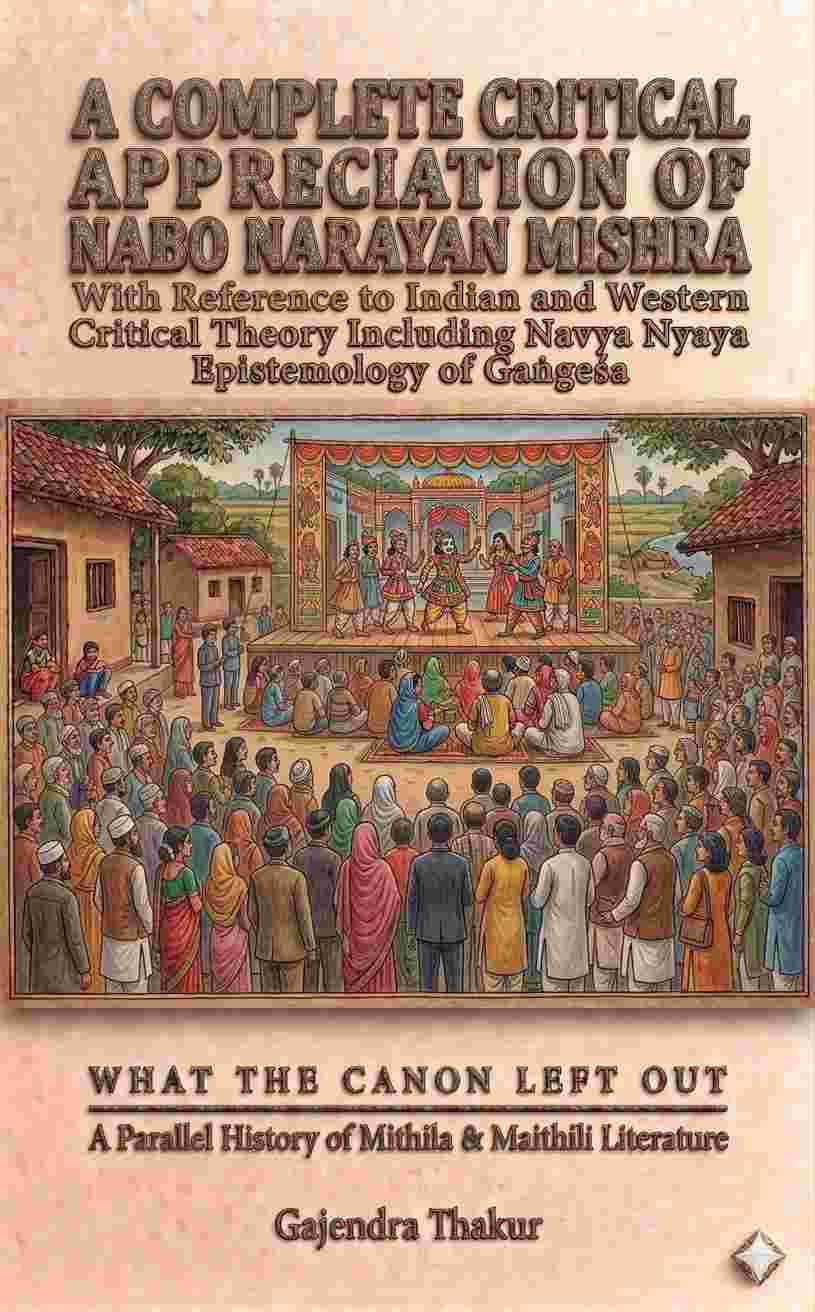
A COMPLETE CRITICAL APPRECIATION OF NABO NARAYAN MISHRA With Reference to Indian and Western Critical Theory Including Navya Nyaya Epistemology of Gangeśa
A COMPLETE CRITICAL APPRECIATION OF
NABO NARAYAN MISHRA
(b. 7 May 1955, Kushmaul, Madhubani)
With Reference to Indian and Western Critical Theory
Including Navya Nyaya Epistemology of Gaṅgeśa
TABLE OF CONTENTS
I. Preface and Scope of the Study
II. Biographical Overview
III. The Samagra: Structure and Contents
IV. Analysis of Interviews (Sakshatkaar)
V. Analysis of Essays (Aalekh)
V.A Essays on Literary Personalities
V.B Essays on Institutional History
V.C Essays on Maithili Theatre
VI. Analysis of Stories (Katha)
VII. Analysis of Poetry (Padya)
VIII. Narrative Craft and Stylistic Features
IX. Western Critical Perspectives
IX.A New Criticism and Formalism
IX.B Structuralism and Narratology
IX.C Postcolonial and Subaltern Theory
IX.D Marxist and Sociological Criticism
X. Indian Critical Perspectives
X.A Rasa Theory (Bharata and Abhinavagupta)
X.B Dhvani Theory (Anandavardhana)
X.C The Navya Nyaya Epistemology of Gangesa Upadhyaya
X.D Applying Navya Nyaya to Nabo Narayan Mishra
XI. Nabo Narayan Mishra in the Maithili Literary Context
XII. Critical Assessment: Strengths and Limitations
XIII. Conclusion
XIV. References and Bibliography
I. PREFACE AND SCOPE OF THE STUDY
Nabo Narayan Mishra occupies a distinctive and important, if relatively underexplored, position in contemporary Maithili literature. Born on 7 May 1955 in Kushmaul village, Nagadih-Balain post, Madhubani district, Bihar, he spent a formative part of his adult life as a Maithili cultural activist in Kolkata, where he served for two decades as Secretary of the Kokil Manch, one of the most active Maithili literary and theatrical organisations in the diaspora. After retirement from service, he returned to his native village, where he continues his literary engagement.
The publication of Nabo Narayan Mishra Samagra (2026), edited by Ashish Anichhinhar and made available through the Videha e-journal platform (www.videha.co.in/pothi.htm), represents the first systematic collection of his scattered creative and critical output. The 199-page volume brings together three interviews he conducted with distinguished Maithili figures, fifteen essays on literary personalities and institutional history, eleven short stories, and seventeen poems, together with a biographical appendix and facsimiles of two handwritten essays. The volume is dedicated to the Creator (Srijanhaar) and opens with an invocation from the Shanti Mantra of the Yajurveda, setting a tone of cultural rootedness that runs through Mishra's entire oeuvre.
The present critical appreciation examines this Samagra in depth, applying both Western critical frameworks (New Criticism, narratology, postcolonialism, Marxist criticism) and Indian critical traditions (Rasa theory, Dhvani theory, and, centrally, the Navya Nyaya epistemology of Gangesa Upadhyaya of Mithila). The purpose is not merely to describe but to evaluate: to assess where Mishra's work achieves genuine literary distinction and where it reflects the constraints of the Maithili diaspora literary milieu in which it was produced.
II. BIOGRAPHICAL OVERVIEW
Nabo Narayan Mishra was born on 7 May 1955 in Kushmaul, a village in Nagadih-Balain, Madhubani district, Bihar, to Shri Govind Mishra (deceased) and Shrimati (deceased). He completed his education and subsequently took up employment in a private firm in Kolkata, where he settled and remained for most of his professional life.
In Kolkata, he became deeply embedded in the Maithili cultural network. He joined the Kokil Manch, the Maithili theatrical and cultural organisation founded under the leadership of Ganga Jha, and served as its Secretary for an unbroken period of twenty years. During this tenure, he was instrumental in organising annual theatrical productions, poetry gatherings (Kavigoshti), and cultural programmes at venues including the Mahajati Sadan, Netaji Subhash Institution, and other Kolkata stages.
His literary connections were wide. He was a close associate of the poet-playwright Ramlochan Thakur (b. 18 March 1949, Baabu Paali, Madhubani), whom he accompanied to various literary events until Thakur's final years. He knew Rajanandan Lal Das, the long-serving editor of Karnamrit; Prof. Prabodh Narayan Singh, the Maithili movement leader in Kolkata; Pitambar Pathak, the movement activist; Lakshman Jha Sagar, the poet; and Sumangshu Shekhar Choudhary, the editor and playwright. He also interviewed Kishorikant Mishra (former president, Mithila Sanskritik Parishad, Kolkata) and Dr. Virendra Mallick for Videha.
In 2020, Mishra retired from service and returned to his native village. The Samagra, published in 2026, collects his lifetime output, much of which was published across various Maithili periodicals in scattered form. His hobbies are listed as organisation work, theatre, literary and social activities.
III. THE SAMAGRA: STRUCTURE AND CONTENTS
The Nabo Narayan Mishra Samagra is structured in four principal divisions, preceded by dedication and prefatory matter and followed by appendices.
Prefatory Matter
The book opens with the Tirhuta script symbol (the auspicious marker), followed by the Yajurveda Shanti Mantra invoking peace in all realms. The editorial preface by Ashish Anichhinhar provides the rationale for the collection: that Mishra never aspired to be recognised as a "writer" in the conventional sense, producing work not for recognition but out of inner compulsion; that of contemporary Kolkata-based Maithili writers, Mishra has written most extensively on Kolkata and Kolkata-related subjects on a proportional basis; and that the Samagra gives readers access to a body of work that was otherwise lost in the scattered pages of various periodicals.
Division I: Prose — Interviews (Sakshatkaar)
Interview 1: Kishorikant Mishra (former President, Mithila Sanskritik Parishad, Kolkata). Conducted for Videha. Covers the history of the Parishad, the census agitation for Maithili, the standardisation of Maithili script and vocabulary, and the contribution of Kolkata to the Maithili literary movement.
Interview 2: Sri Ramlochan Thakur (conducted for Videha on the occasion of his receiving the Samanantar Sahitya Akademi award). Covers Thakur's engagement with Maithili theatre, his literary journey, his poetry and its reception, and his reflections on the Maithili movement.
Interview 3: Dr. Virendra Mallick (conducted for Videha, prepared for the proposed Virendra Mallick special issue which was ultimately not published). Contains 16 substantive questions covering poetic theory, the state of Maithili literature, institutionalisation, caste dynamics in literary organisations, and intergenerational responsibility.
Division II: Prose — Essays (Aalekh)
Fifteen essays covering literary personalities (Ramlochan Thakur, Rajanandan Lal Das, Prof. Prabodh Narayan Singh, Lakshman Jha Sagar, Pitambar Pathak, Babu Saheb Choudhary, Ajay Singh, Prabhash Choudhary) and institutional/cultural histories (Mithila Vikas Parishad Kolkata, Kolkata ka Maithili Andolan aur Mithila Darshan, Mithila Mihir aur Sampadaki, Hari Anant Hari Katha Ananta on Ramlochan Thakur, Maithili Rangmanch aur Kolkata). Also includes two essays on Maithili folk literature.
Division III: Prose — Stories (Katha)
Eleven short stories: Ehno Hoit Chhai, Ekata Pakal Aam, Yatraak Feri, Kaalachakra, Aadarsh Vivah, Paropkaarark Phal, Karod-patiik Kamaatha, Maithliii Maryaadaa, Sundar-Sanyog, Yugadharma, and Ghamandak Phal.
Division IV: Poetry (Padya)
Seventeen poems: Nav Varshaak Sandarbh Me (his first published poem, 1977), Prithviik Bhaar, Ee Kirtiimaan Banal, Navageet, Bidambanaa, Anant Yatraak Yaatri, Phagua, Kaniyaan Mahaaraaniik Aarti, Ekta Saahitiik Diip, Shraddhanjali, Bhagwati Vandanaa, Kichhu Lok, Sveekaar Karu Prem Aaslingan, Ee Nij Uchit Vichaar, Maithilik Ukti: Santaanak Prati, Maithili Mahootasav, Phaguak Premopahaar.
Appendix
The Appendix contains facsimiles of two handwritten essays by Mishra, offered so that future readers may see his handwriting. The author biography (Lekhak Parichay) gives his name, birth date (7 May 1955), father's name (Govind Mishra), publication record, interests, profession (retired), and permanent address (Kushmaul, Nagadih-Balain, Madhubani).
IV. ANALYSIS OF INTERVIEWS (SAKSHATKAAR)
The three interviews represent Mishra's most formally structured literary contribution. He comes to the interview not as a critic or academic but as a cultural witness and activist: someone who knew these figures personally, participated in the events being discussed, and uses the interview form to preserve institutional and personal memory.
The Kishorikant Mishra Interview
This interview is historically valuable as a document of the Maithili language movement in Kolkata from 1956 onwards. Key issues addressed include: the arrival of Kishorikant Mishra in Kolkata in June 1956 with the purpose of earning and studying; the census agitation (from 1951) for Maithili to be recorded as the mother tongue of Maithil speakers; the Sahitya Akademi recognition of Maithili; the standardisation of Maithili vocabulary and orthography under the Parishad (notably the correction of the text of Vidyapati's portrait); the publication of the Maithili Ramayan; and the dynamics of Maithili organisations.
As an interviewer, Mishra is methodical and respectful. He follows a chronological logic, moving from Kishorikant Mishra's arrival in Kolkata to his engagement with the movement, to specific institutional contributions. The interview preserves important historical detail that would otherwise be lost.
The Ramlochan Thakur Interview
This interview, conducted for Videha on the occasion of Thakur's Samanantar Sahitya Akademi award, reveals a warm and admiring relationship between interviewer and subject. Mishra allows Thakur to range across his theatrical career, his literary evolution, his connections with the Maithili movement, and his views on the state of Maithili writing. Thakur's observation that in Maithili, awards cause writers to stagnate rather than progress is a pointed critique that Mishra's interview draws out effectively.
Mishra's own relationship with Thakur is documented extensively in his essay "Hari Anant Hari Katha Ananta," where he describes accompanying Thakur to literary events in Thakur's final years and his grief at Thakur's loss to Alzheimer's disease. The interview must be read alongside this essay as complementary testimony.
The Virendra Mallick Interview
The most substantive of the three, this interview contains Mallick's reflections on: the philosophical basis of fire poetry (agni-kavita); the problem of awards stagnating writers; Dalit representation in Maithili literary organisations (negligible, Mallick argues, because of Brahminical dominance); the question of the Darbhanga Peetha versus the emerging Saharsa Peetha; the ideological evolution from Marxism through Maoism; the value of ideological commitment in literary writing; and aspirations for Kolkata's youth. Mallick's comment that the Maoist slogan "Aadhaar baadi, tohar baadi, Naxalbadi" once galvanised him is an important marker of the ideological climate of Kolkata's Maithili literary world in the 1970s-80s. Mishra's 16 questions are incisive and well-prepared.
V. ANALYSIS OF ESSAYS (AALEKH)
V.A Essays on Literary Personalities
Hamra Najorimi: Shri Ramlochan Thakur
This essay (published in Videha's Ramlochan Thakur Special Issue, No. 319, April 2021) is Mishra's tribute to Thakur. It is written in a personal, warm register: Thakur as an icon and encyclopedia of Kolkata's Maithili world, as the co-ordinator of Samparak (a literary gathering where writers present new work for peer response), as a revolutionary figure whose couplets attacked social hypocrisy with razor sharpness. Mishra cites Thakur's famous satirical couplet on Buddhinath Mishra: "Buddhiinath Mishraak sakal rachna arthapraDhaan / Hindi me tain gawait chahi sohar aa samdaaun" — a biting critique of a writer who writes in Maithili but then performs folksongs in Hindi for patronage. The essay also describes Samparak, the informal literary group, as functioning without a permanent president or secretary — a democratic model Mishra clearly admires.
Yugpurush: Shri Rajanandan Lal Das
Two essays on Rajanandan Lal Das (published in Videha's Rajanandan Lal Das Special Issue, No. 333, November 2021) establish him as the editor of Karnamrit for thirty-six years, as a social-minded editor who published memorial issues of eighteen departed luminaries, as a playwright (Santo) and author of institutional histories. Mishra's admiration is genuine and the essays provide important primary information about Karnamrit's editorial philosophy and its progressive, anti-casteist stance.
Mithila-Maithilik Prabal Pakshdhara: Prof. Prabodh Babu
The essay on Prof. Prabodh Narayan Singh (published in Karnamrit, January-March 2006) is an institutional biography of the man who founded Mithila Darshan in 1953 from Kolkata and led the Maithili movement from the city. Mishra describes his own visit with Singh at his Lake Gardens residence — the rare privilege of sitting with the movement's elder statesman and hearing accounts of the "golden era" of Maithili in Kolkata. The essay contains a poem of tribute: "Simhanaad swargahu san sunab / Jakhaan bhetait Probodh Sahitya Sammaan."
Sarvaguna Sampanna Sagarji
The essay on Lakshman Jha Sagar (published in Videha's Sagar Special Issue, No. 382, November 2023) traces a friendship that began in 1990 when Mishra joined Kokil Manch. Sagar is described as a multi-genre writer (poetry, stories, essays, criticism, interviews) who combines traditional values with modern thought and whose wife Shail Jha Sagar is also a writer. The essay praises his poetry collection Ucharri Baiso Kauaa and his subsequent works.
Pitambar Pathak and Babu Saheb Choudhary
The essays on Pitambar Pathak and Babu Saheb Choudhary document the Maithili movement activists of an earlier generation in Kolkata. Pathak is remembered for his agitational role — his son Vijay Pathak suffering a police baton charge in Patna during demonstrations for Maithili's Eighth Schedule recognition. Choudhary is remembered as a theatre icon who wanted to play the role of Chanakya once more in Chandraguptas Kolkata performance, who supported Kokil Manch, and who spoke bitterly of the failure to honour living writers in their lifetimes.
V.B Essays on Institutional History
The essays on Mithila Vikas Parishad Kolkata (published in Videha Special Issue No. 408, December 2024), Kolkata ka Maithili Andolan aur Mithila Darshan, and Mithila Mihir aur Sampadaki together constitute a primary-source institutional history of the Maithili movement in Kolkata from 1933 onwards. Mishra traces the founding of Maithil Sammelan in 1933 by Pandits Kunjji Jha, Markandeya Mishra, and Babua Mishra; the emergence of Mithila Lok Sangh; the bifurcation into Akhil Bharatiya Mithila Sangh and Mithila Sanskritik Parishad; the publication of Mithila Darshan from 1953; the census agitation of 1951; and the eventual inclusion of Maithili in the Eighth Schedule in 2003.
These essays are important primary documents precisely because Mishra writes from lived participation. He attended the Delhi demonstrations; he was present at Probodh Sahitya Samman events; he knows the internal tensions between organisations. His account of how Kokil Manch eventually distanced itself from Mithila Vikas Parishad after 2006 — following a dispute over the conduct of a national seminar from which Kokil Manch was excluded — is candid institutional testimony.
V.C Essays on Maithili Theatre
The essay "Maithili Rangmanch aur Kolkata" is the most comprehensive account available of Kokil Manch's theatrical history. It records twenty-four consecutive annual theatre productions from 1991 (Lethaait Aanchar by Sumangshu Shekhar Choudhary, directed by Ganga Jha, Mahajati Sadan, 14 November 1991) through 2006 (Pahil Saanjh, same director and venue), listing playwright, venue, director, and date for each production. This is an invaluable primary document for the history of Maithili theatre.
VI. ANALYSIS OF STORIES (KATHA)
The eleven short stories in the Samagra range from comic social observation to moral allegory to autobiographical memory. As a group, they reflect the sensibility of an educated Maithil professional living in Kolkata who maintains deep emotional and cultural connections with his native Mithila village, and who observes the social world around him with gentle irony and occasional moral indignation.
Ehno Hoit Chhai (This Also Happens)
A social comedy built around Mohanji, a well-meaning man with a short temper ("Durvasa Rishi") who is persuaded by his friend Raghav to attend a cinema in Madhubani. The story moves from the planning of the outing through its comic complications. The characterisation of Mohanji — helpful, socially engaged, but irascible — is warm and specific. The story's title carries an implicit irony: unexpected, absurd events are the texture of everyday life.
Ekata Pakal Aam (A Ripe Mango)
A brief, affecting story built around a five-year-old's request that his share of the single ripe mango their father has brought home be shared with his cousin Shankar, because "eating alone is not nice to me." The child's ethical intuition — that good things must be shared — is contrasted with the adult world of calculation and competition. The story achieves its effect through economy and restraint.
Yatraak Feri (Journey's Round Trip)
A story of the migrant worker's complicated relationship with home. The narrator, employed in a private firm in Kolkata whose leave requests cause his manager great pain, plans to return to his native village at Holi and Durga Puja. The story captures the psychology of the Maithili diaspora: the persistent pull of the village, the anxiety of separation from family, the complications of travel (a stalled train, a journey through rain and mud on foot through the night). The autobiographical resonance is strong.
Yugadharma (The Dharma of the Age)
The most substantial and socially engaged of the stories. Lalbihhari, the eldest brother who has sacrificed his youth to educate and settle his younger siblings, now faces old age with a marriage-aged daughter, an unemployed son, and siblings who ignore him. The story shows, in a single winter night, the arc of Lalbihhari's life: his sacrifice, his reputation, and his current abandonment. The metaphor of the cold (jaad: winter cold, numbness) runs through the story, as does the warmth of the communal fire around which the village gathers. The final image of Lalbihhari huddled in a quilt, unresponsive as the villagers debate the worth of eldest sons, is quietly devastating. This story shows Mishra at his best: socially observant, emotionally restrained, and structurally controlled.
Ghamandak Phal (The Fruit of Arrogance)
A moral tale about Badri Babu, a government servant who is the only educated member of his family and consequently arrogant. The story traces the consequences of pride through the education and eventual unemployment of his only son, the successful marriage of his daughter, and his eventual humbling. The story employs a traditional moral arc — pride precedes a fall — and is executed with economy.
Kaalachakra, Aadarsh Vivah, and Sundar-Sanyog
Three stories exploring marriage customs and social change in Maithili society. Kaalachakra (Wheel of Time) and Aadarsh Vivah (Ideal Marriage) both engage with the tensions between tradition and modernity in matrimonial arrangements, while Sundar-Sanyog (Beautiful Coincidence) is a narrative of an unexpectedly auspicious matchmaking. The Aadarsh Vivah story is especially rich, drawn from autobiographical experience of attending a wedding ceremony in Madhubani, with a detailed rendering of the negotiations, rituals, and human comedy of a Maithili marriage.
VII. ANALYSIS OF POETRY (PADYA)
Mishra's poetry is devotional, socially engaged, elegiac, and, occasionally, satirical. It does not aspire to modernist experiment; it works within established Maithili lyric traditions (navageet, padya) and employs regular metre, rhyme, and clear diction. Its primary values are sincerity, communal feeling, and ethical seriousness.
Nav Varshaak Sandarbh Me (In the Context of the New Year)
His first published poem (1977, in a Lalit Smriti Granth), this poem mourns the passing of a Maithili luminary ("Lalit Babu") at the New Year. Its yearning — "Mann hoi, jaan vigyan joday taar-fon, / Karitahu anuroDh, puni aabiti oi dev" (I wish science could connect a telephone wire, so I could request him to return, that god) — is deeply felt and establishes his characteristic elegiac mode.
Prithviik Bhaar (The Weight of the Earth)
A social-protest poem (published in Mithila Darshan, January-March 2004) addressed to a "brother" (a Maithili literary figure, identified from context as Ramlochan Thakur). It catalogues the failures of Maithili society and institutions: ambitious power-seekers, ingratitude toward predecessors, the fragility of literary organisations, and the loneliness of genuine service. The poem ends with a rallying affirmation: service-oriented life alone is meaningful.
Navageet (New Song) and Bidambanaa (Irony/Predicament)
The Navageet is a political poem with the refrain "Neta afsar ghus-khor, ee maani kai chalu" (Knowing that leaders and officials are corrupt, move on). Its regular metre, parallel structure, and folk-song rhythms align it with the navageet tradition initiated by Nagarjun/Yatri — a debt Mishra acknowledges explicitly in his poem "Ee Nij Uchit Vichaar," which is a tribute to Virendra Mallick characterised as Yatri's "ananya anuyaayi" (devoted follower). Bidambanaa is a pointed political poem on Kashmir and the treatment of Kashmiri Pandits, employing the acrostic-like repetition of its refrain with increasing indignation.
Anant Yatraak Yaatri (The Traveller of the Infinite Journey)
An elegy for Nagarjun/Yatri on his death (published in Karnamrit, July-December 1999). The poem plays on "Yatri" (traveller) as both the pen name and the metaphor: "Yatriik anant yatra / aaj saahityaakaash san / samaadhi tak bheal chhai" (Yatri's infinite journey / has today gone from the literary sky / to the grave). It also touches on the bitter irony that the government that could not provide medicine during his life now offers a "state honour" at his funeral.
Sahaityaik Diip (A Literary Lamp), Shraddhanjali (Tribute), and Bhagwati Vandanaa (Devotional Hymn)
Three poems in the devotional-elegiac mode. Saahityaik Diip mourns the passing of Prabhash Choudhary, editor of Mithila Mihir, using the metaphor of a lamp that burns without ghee or wick — exhausted, extinguished. Shraddhanjali is an acrostic tribute in which the first letters of each couplet spell the name of the departed. Bhagwati Vandanaa is a conventional devotional hymn with a self-critical quality: the speaker acknowledges personal failings and inadequacies before the goddess.
Phagua and Phaguak Premopahaar (Holi Poems)
Two festive poems on the Holi celebration, employing the traditional dhamar-style rhythm of the phagua genre. Kaniyan Maharaaniik Aarti is a playful bhajan-parody for the Holi season, in which the "kaniyaan maharaani" (the beloved) is addressed with mock-devotional fervour. These poems show Mishra's facility with established folk-lyric forms.
VIII. NARRATIVE CRAFT AND STYLISTIC FEATURES
Across his essays, stories, and poems, Nabo Narayan Mishra's style is characterised by six distinctive features:
1. The Witness Voice
Mishra writes consistently as a witness — someone who was present, who knew the people involved, who participated in the events described. This witness position gives his essays documentary authority and his stories autobiographical warmth. The cost is occasional sacrificing of aesthetic distance: essays sometimes read as reports rather than critical assessments. But the authenticity of the witness voice is undeniable.
2. Chronological Discipline
Both his interviews and his institutional essays follow a strict chronological order. He moves from the subject's arrival in Kolkata, through their engagement with the Maithili movement, to their specific contributions, to their current situation or posthumous legacy. This chronological discipline produces clarity and coherence, though it limits the analytical depth that a more thematic organisation might achieve.
3. Oral Register
His prose has a strong oral quality: the rhythms of Maithili speech, the use of direct address, the frequent invocation of remembered conversations. His stories in particular are narrated in a voice close to that of a skilled Maithili storyteller (kathakar), with the warmth and immediacy of oral narration. This oral register connects his work to the folk narrative tradition that Maithili literature has always valued.
4. Ethical Seriousness
Running through all his writing is a consistent ethical seriousness: concern for the treatment of elders and predecessors, anger at ingratitude and arrogance, admiration for self-sacrifice and community service, anxiety about the survival of Maithili language and culture. This ethical seriousness gives his work coherence and purpose, even when individual pieces are slight.
5. Institutional Consciousness
Unlike many creative writers, Mishra has a strong sense of literary institutions: how organisations are founded and sustained, what makes a journal last, why some cultural initiatives succeed and others fail. This institutional consciousness makes his essays valuable primary sources for the history of Maithili literature in Kolkata and Bihar.
6. Elegy as Dominant Mode
Both his poetry and his essays return repeatedly to elegy — the mourning of departed friends and mentors, the anxiety about the survival of a literary tradition, the sense that a golden era has passed. This elegiac consciousness shapes the Samagra as a whole: it is a work of memory and tribute, a document of a generation's literary activism now passing into history.
IX. WESTERN CRITICAL PERSPECTIVES
IX.A New Criticism and Formalism
New Criticism (Cleanth Brooks, Robert Penn Warren) insists on close reading of the literary text as an autonomous artefact, attending to its internal structure, imagery, tension, and resolution. Applied to Mishra's stories, New Critical analysis reveals varying degrees of formal achievement. In "Ekata Pakal Aam," the single ripe mango functions as a resonant symbol of scarcity and sharing; the five-year-old's request to include the cousin is a formally elegant resolution of the story's central ethical proposition. In "Yugadharma," the winter cold functions as an objective correlative (in T. S. Eliot's sense) for Lalbihhari's emotional state — his numbness, his abandonment, his withdrawal from the communal warmth he once generated.
However, many of Mishra's stories fall short by New Critical standards: they are too explicitly didactic (the moral is stated rather than embodied), characters are insufficiently individualised (the arrogant Badri Babu in "Ghamandak Phal" is a type rather than a person), and structural resolution is often achieved through coincidence or sentiment rather than internal necessity. The essays, as non-fiction, lie outside New Criticism's primary domain, but the poems show some capacity for the controlled tension and resolution that New Criticism values — especially in the elegies, where the tension between loss and tribute is productively sustained.
IX.B Structuralism and Narratology
Applying Gerard Genette's narratological framework: Mishra's stories are predominantly homodiegetic or autodiegetic — the narrator is either a participant in or the protagonist of the story. This choice of narrative position suits the witness voice but limits narrative flexibility. The stories rarely employ the kind of complex temporal manipulation (analepsis, prolepsis) that marks sophisticated modern fiction; they are predominantly linear, moving from situation through complication to resolution.
Vladimir Propp's morphology of the folktale is relevant: several stories follow the Proppian sequence with remarkable fidelity — initial equilibrium, disruption, complication, resolution, and restoration. "Ghamandak Phal" is almost a textbook Proppian structure. This folk-tale morphology is not a weakness — it reflects Mishra's deep roots in the oral storytelling tradition — but it does constrain the stories' capacity for the kind of ambiguity and open-endedness that characterises modernist fiction.
IX.C Postcolonial and Subaltern Theory
The Samagra is deeply postcolonial in its cultural politics: its subject is the struggle of Maithili — a language marginalised by Hindi nationalism and Sanskritised Brahminism alike — to claim recognition, representation, and institutional support. The interviews with Kishorikant Mishra and Virendra Mallick are primary documents of this struggle: the census agitation, the Sahitya Akademi recognition, the Eighth Schedule inclusion, the internal politics of literary organisations.
Virendra Mallick's observation — that Maithili literary organisations are dominated by Brahmins and Kayasthas, with negligible Dalit participation — is an important critique that Mishra records without distancing himself from it. This critical consciousness aligns with the subaltern studies tradition initiated by Ranajit Guha and extended by Gayatri Spivak. Mishra himself, though not from a Dalit background, demonstrates in his writing a consistent concern for the excluded and overlooked: the migrant worker (in "Yatraak Feri"), the selfless elder brother (in "Yugadharma"), the unrecognised cultural servant (in the essay on Pitambar Pathak).
IX.D Marxist and Sociological Criticism
Mishra's politics are clearly left-leaning, shaped by the Kolkata cultural milieu of the 1970s-80s where Marxism and the Naxalite movement were powerful intellectual forces. Virendra Mallick's interview documents this explicitly: Marxism, then Maoism, then a qualified disillusionment. Mishra's Navageet is explicitly a protest song against corruption and political cynicism. His stories show solidarity with the exploited: the migrant worker trapped by an unsympathetic employer, the selfless brother abandoned by the siblings he raised.
A Lukácsian analysis (Georg Lukács's theory of realism) would find in Mishra's best stories — "Yugadharma" above all — a creditable attempt at typification: Lalbihhari as a representative figure whose individual fate illuminates broader social contradictions. The story avoids both sentimental romanticisation and naturalist pessimism; it presents, with restraint, the human cost of social transformation.
X. INDIAN CRITICAL PERSPECTIVES
X.A Rasa Theory (Bharata and Abhinavagupta)
The Natyashastra of Bharata (c. 2nd century BCE) identifies eight primary rasas (emotional essences) that literary art can produce in its audience: shringara (love), vira (heroism), karuna (compassion), adbhuta (wonder), hasya (comedy), bhayanaka (fear), bibhatsa (disgust), and raudra (fury). Abhinavagupta (c. 1000 CE), in the Abhinavabharati, adds shanta (tranquillity) as a ninth rasa and deepens the theory by arguing that rasa is not merely the representation of emotion but its transformation through the aesthetic medium into a universal, impersonal experience (saadharanikaran).
In Mishra's Samagra, karuna (compassion/pathos) is the dominant rasa, especially in the elegies, the memorial essays, and stories like "Yugadharma." Hasya (comedy) tempered by social observation marks "Ehno Hoit Chhai." Vira (heroism) is present in the essays on Pitambar Pathak and the Maithili movement activists — heroes not of the battlefield but of cultural resistance. Shringara appears, gently, in the Holi poems and the marriage stories. Shanta (tranquillity) is the rasa toward which the elegies ultimately move — not consolation exactly, but the acceptance of loss as part of the cosmic order (as the Shanti Mantra opening the book itself enacts).
X.B Dhvani Theory (Anandavardhana)
Anandavardhana (c. 850 CE) in the Dhvanyaloka argues that the highest poetry operates through dhvani — resonance or suggestion — where the unstated meaning is more powerful than the stated. The poem "Nav Varshaak Sandarbh Me" works by dhvani: the New Year celebration, normally a time of joy, is charged with grief for the departed "Lalit Babu" without this grief ever being stated as such. The festive occasion becomes the site of personal mourning, and this contrast creates the dhvani. Similarly, in "Prithviik Bhaar," the cataloguing of Maithili's institutional failures speaks, by dhvani, to the sacrifices of those who have given their lives to the language.
In the stories, dhvani is less consistently deployed. "Ekata Pakal Aam" achieves a degree of dhvani: the single ripe mango suggests, without stating, the scarcity and sharing ethics of the Maithili village world. "Yugadharma's" winter cold resonates with more than meteorological significance. But many stories remain at the level of explicit statement, sacrificing dhvani for direct moral articulation.
X.C The Navya Nyaya Epistemological Framework of Gangesa Upadhyaya
Gangesa Upadhyaya (c. 1325 CE) of Mithila — the same region that produced Mishra — founded the Navya Nyaya (New Logic) school with his masterwork Tattvachintamani (Jewel of Reflection on the Truth). Divided into four chapters treating the four pramanas (valid sources of knowledge) — pratyaksha (perception), anumana (inference), upamana (comparison), and shabda (testimony/verbal authority) — the Tattvachintamani provides the most rigorous Indian epistemological framework ever developed.
Gangesa's epistemology insists that all cognition is relational — structured by the visheshana-visheshya (qualifier-qualificand) relation. We know a thing not as an isolated object but as qualified by attributes and situated in a network of relations. This relational epistemology, applied to literary analysis, asks: how does the text produce knowledge? Through what cognitive structures? And how does the reader come to know (or believe they know) the textual world?
Pratyaksha (Perception) Applied to Mishra
Gangesa distinguishes nirvikalpaka pratyaksha (non-conceptual, pure sensory awareness before categorisation) from savikalpaka pratyaksha (conceptual perception, already structured by categories). Mishra's prose operates almost entirely in savikalpaka mode — his descriptions of the Mahajati Sadan audience, the winter cold in "Yugadharma," the ripe mango, are already conceptually organised, already saturated with cultural meaning. But his best passages reach toward the nirvikalpaka: the smell of rain in the journey story, the precise body language of Lalbihhari huddled by the fire, the specific quality of Thakur's handshake at their final meeting. These moments of near-perceptual vividness are where Mishra's prose is most alive.
Gangesa's analysis of perceptual error (bhrama) is relevant to Mishra's essays on institutional history, where he shows how organisations and individuals are systematically misperceived — Virendra Mallick seen as a "casteist," Kokil Manch excluded from a national seminar it helped to build. Mishra's essays function as corrections of such bhrama, offering the witness's testimony to restore accurate perception.
Anumana (Inference) Applied to Mishra
For Gangesa, valid inference requires a vyapti — a reliable pervasive relation between the inferential mark (hetu) and the inferred conclusion (sadhya). In Mishra's stories, characters reason inferentially — and often fallaciously — about each other. Badri Babu infers his own superiority from his education; the villagers infer Lalbihhari's happiness from his social success. These are hetvabhasas (pseudo-inferences): the pervasion does not hold. Education does not imply superiority; social success does not imply happiness. Mishra's stories expose these fallacious vyaptis, showing the human costs of reasoning from unreliable general rules.
Gangesa's distinction between valid and invalid inference is precisely the distinction Mishra's social realism exploits: the gap between how things appear (the fallacious inference) and how they are (the corrective perception offered by the story).
Upamana (Comparison) Applied to Mishra
Upamana — knowledge through comparison and analogy — is Mishra's central critical instrument as an essayist. His essays consistently work by comparison: Ramlochan Thakur is compared to an icon and an encyclopedia; Prabhash Choudhary is compared to a lamp burning without oil; Maithili literature is compared to a fire that periodically blazes and then subsides. These comparisons (upamanas) are not mere ornament; they constitute the cognitive structure by which Mishra arrives at his evaluations. The lamp-without-oil image for Prabhash Choudhary is an upamana that captures both his exhaustion and his continuing luminosity — a richer cognition than any direct description could achieve.
Shabda (Testimony) Applied to Mishra
For Gangesa, shabda — verbal testimony — is a valid pramana when it comes from an apta (reliable, truthful speaker). The entire Samagra rests on the epistemic claim that Mishra is an apta — that his testimony about literary figures, events, and institutions is reliable because he was present, because he participated, because he knew the people involved personally. The interviews are shabda-based cognition: the testimony of Kishorikant Mishra, Ramlochan Thakur, and Virendra Mallick, transmitted through Mishra's questions and framing, as valid testimony about Maithili literary history.
Gangesa's conditions for valid shabda include the reliability of the speaker and the absence of defect (dosha) in the transmission. Mishra's editorial preface acknowledges the possibility of incompleteness (much was "scattered in various periodicals") and partial recovery (he collected "as much as could be sent and preserved"). This honest acknowledgment of the limits of testimony is itself a Navya Nyaya-aligned epistemic virtue: cognising one's own limitations as a means of avoiding overconfident claims.
The Visheshana-Visheshya (Qualifier-Qualificand) Structure in Mishra's Characters
Gangesa's most technically refined contribution is the analysis of cognition as structured by the qualifier-qualificand relation: we know Lalbihhari not as an abstract figure but as qualified by his role as eldest brother, his sacrifices, his social reputation, his current abandonment, his physical position huddled by the fire. These qualifiers constitute what Lalbihhari is, epistemologically speaking. Mishra's characterisation — especially in "Yugadharma" — is instinctively Navya Nyaya in structure: characters are known through their relational and social qualifiers rather than through psychological depth. This reflects both a limitation (insufficient interiority) and an insight (the social embeddedness of human identity).
XI. NABO NARAYAN MISHRA IN THE MAITHILI LITERARY CONTEXT
Nabo Narayan Mishra belongs to the generation of Maithili writers who came of literary age in Kolkata in the 1980s, alongside Ramlochan Thakur (poet and playwright), Lakshman Jha Sagar (multi-genre writer), Rajanandan Lal Das (editor and playwright), and Sumangshu Shekhar Choudhary (playwright and editor). This generation was formed by the Maithili movement — the struggle for Eighth Schedule recognition — and by the leftist intellectual culture of Kolkata, which inflected Maithili writing with socialist values and a concern for the marginalised.
Within this generational context, Mishra occupies a specific niche: the activist-writer rather than the primary creative writer. He is more productive as an essayist and memoirist than as a fiction writer or poet, more valuable as an institutional historian than as an aesthetic experimenter. His stories are earnest and socially engaged but do not achieve the psychological complexity of Ramlochan Thakur's poetry or the satirical edge of the best Maithili comic tradition (represented by Harimohan Jha's Khattar Kaka). His poems are sincere and formally competent but do not aspire to the innovation of Nagarjun/Yatri, whom he explicitly reveres.
What makes Mishra distinctive — and valuable — is precisely what makes him unusual: his sustained, two-decade engagement with Kokil Manch, his meticulous recording of institutional history, his preservation of the testimony of mentors and contemporaries, and his willingness to be a secondary figure — a secretary, an organiser, a witness — in service of a larger cultural cause. In Maithili literary culture, where primary creative work attracts the lion's share of critical attention, Mishra's Samagra is a reminder of the indispensable work of cultural preservation.
The editor Ashish Anichhinhar's comparison is apt: of Kolkata-based Maithili writers, on a proportional basis, Mishra has written more about Kolkata and its Maithili cultural life than anyone else. The Samagra makes this scattered testimony legible as a coherent archive.
XII. CRITICAL ASSESSMENT: STRENGTHS AND LIMITATIONS
Strengths
The documentary and testimonial value of the Samagra is high. The interviews with Kishorikant Mishra, Ramlochan Thakur, and Virendra Mallick are primary sources of considerable importance for the history of the Maithili movement in Kolkata and Bihar. The institutional essays — on Kokil Manch, Mithila Vikas Parishad, Mithila Darshan, Mithila Mihir, Samparak — constitute the fullest account available of Kolkata's Maithili cultural infrastructure. The theatrical record in "Maithili Rangmanch aur Kolkata" is invaluable.
The stories show a genuine talent for social observation and an ear for Maithili spoken dialogue. "Yugadharma" demonstrates structural command and emotional restraint. "Ekata Pakal Aam" achieves its modest effect through economy. The Holi poems and the devotional hymns show facility with traditional folk-lyric forms. The elegies are sincere and, at their best, formally controlled.
The ethical consistency of the work is also a strength: across all genres, Mishra maintains a coherent set of values — solidarity with the overlooked, gratitude toward mentors, commitment to cultural service — that gives the Samagra its moral texture.
Limitations
As a creative writer, Mishra's limitations are significant. His stories are predominantly moral allegories rather than psychologically complex fiction: characters are types (the arrogant government servant, the selfless eldest brother, the irascible but good-natured Mohanji) rather than individuals. Narrative structure is frequently formulaic. Psychological interiority is superficial. The stories rarely challenge the reader's assumptions or generate the productive ambiguity that marks major fiction.
His poetry, while competent and sincere, does not reach the aesthetic distinction of the best Maithili lyric tradition. It lacks the dhvani-density of Ramlochan Thakur's verse or the formal innovation of Nagarjun. The navageet is technically competent but rhetorical rather than resonant.
The essays, while documentarily valuable, are often more celebratory than critical. Mishra writes about figures he admires, and his admiration sometimes overwhelms his analytical capacity. A more critical assessment of, say, the internal politics of Kokil Manch or the ideological limitations of the Maithili movement's leadership would be more demanding but also more illuminating.
XIII. CONCLUSION
Nabo Narayan Mishra's Samagra is, above all, an act of cultural memory. It gathers the scattered creative and documentary output of a lifetime spent in service of Maithili language and culture — as an activist, as a theatrical organiser, as an interviewer, as an essayist, and as a storyteller and poet. Its primary value is testimonial: it preserves the voices of a generation of Maithili cultural workers (Ramlochan Thakur, Kishorikant Mishra, Virendra Mallick, Rajanandan Lal Das, Prabodh Narayan Singh, Pitambar Pathak) and reconstructs the institutional history of the Maithili movement in Kolkata.
Assessed against Western critical frameworks, the Samagra is a mixed achievement: some stories and poems of genuine quality, a body of essays of considerable documentary value, and a consistent ethical seriousness that gives the whole work moral coherence. Against Indian critical frameworks, the dominant rasa is karuna (compassion), deepened by shanta (tranquillity) in the elegies, and the dhvani of the best pieces resonates beyond their explicit statements.
The Navya Nyaya framework of Gangesa Upadhyaya — born, like Mishra, in Mithila — provides perhaps the most illuminating critical lens. Mishra's writing is fundamentally testimonial: it proceeds by pratyaksha (the witness's perception), by anumana (the inference from what he observed to what it means), by upamana (the comparison that illuminates), and by shabda (the testimony he transmits and the testimony he records). His characters and institutional figures are known through their visheshana (social qualifiers) rather than through psychological depth — a relational epistemology that reflects both his cultural world and his aesthetic instincts.
The Samagra is dedicated to "Srijanhaar" — the Creator. It is itself a creative act: the creation of an archive that would otherwise not exist. For Maithili literary history, and for anyone seeking to understand the cultural life of the Mithila diaspora in Kolkata across the late twentieth and early twenty-first centuries, Nabo Narayan Mishra's Samagra is an indispensable resource.
XIV. REFERENCES AND BIBLIOGRAPHY
Primary Source
Mishra, Nabo Narayan. Nabo Narayan Mishra Samagra. Ed. Ashish Anichhinhar. Videha/Pothi.com, 2026. 199 pp. Language: Maithili. Available: www.videha.co.in/pothi.htm
Essays and Interviews in the Samagra (by Section)
Mishra, Nabo Narayan. "Sakshatkaar: Kishorikant Mishra Ji Se." In Samagra, pp. 5-19.
Mishra, Nabo Narayan. "Sakshatkaar: Ramlochan Thakur Se." In Samagra, pp. 11-25.
Mishra, Nabo Narayan. "Sakshatkaar: Dr. Virendra Mallick Ji Se." In Samagra, pp. 17-34.
Mishra, Nabo Narayan. "Hamra Najorimi: Ramlochan Thakur." Videha Issue 319 (April 2021). Repr. Samagra pp. 27-29.
Mishra, Nabo Narayan. "Yugpurush: Rajanandan Lal Das." Videha Issue 333 (November 2021). Repr. Samagra pp. 31-33.
Mishra, Nabo Narayan. "Yug Pravarttak: Raj Nandan Lal Das." Karnamrit. Repr. Samagra pp. 38-39.
Mishra, Nabo Narayan. "Mithila-Maithilik Prabal Pakshdhara: Prof. Prabodh Babu." Karnamrit, January-March 2006. Repr. Samagra pp. 40-44.
Mishra, Nabo Narayan. "Sarvaguna Sampanna Sagarji." Videha Issue 382 (November 2023). Repr. Samagra pp. 45-50.
Mishra, Nabo Narayan. "Mithila Vikas Parishad, Kolkata: Jena Ham Dekhal." Videha Issue 408 (December 2024). Repr. Samagra pp. 51-54.
Mishra, Nabo Narayan. "Maithili Aandolanak Naayak: Pitambar Pathak." Samagra pp. 55-57.
Mishra, Nabo Narayan. "Kalkata ka Maithili Aandolan aur Mithila Darshan." Samagra pp. 58-71.
Mishra, Nabo Narayan. "Hari Anant Hari Katha Ananta." Samagra pp. 86-101.
Mishra, Nabo Narayan. "Maithili Rangmanch aur Kolkata." Samagra pp. 102-116.
Contextual and Secondary Sources
Thakur, Gajendra (ed.). Videha e-Journal. www.videha.co.in. ISSN 2229-547X. (Since 2000.)
Anichhinhar, Ashish. "Yatra: Ek Ehan Lekhak ke Rachna Jinkaa Lekhak Banana Ka Laul Nahin Chhin." Editorial Preface. Nabo Narayan Mishra Samagra. 2026.
"A Critical Analysis of Maithili Short Stories: Twenty First Century." IJCRT (2025). IJCRT2510038.
"A Journey Through Maithili Literature with Kathakar Ashok." Outlook India, February 2024.
Mishra, Jayakanta. A History of Maithili Literature. Allahabad: Tirabhukti Publishers, 1949.
Indian Critical Theory
Bharata Muni. Natyashastra [c. 2nd century BCE]. Trans. Manomohan Ghosh. Asiatic Society, Calcutta, 1951.
Abhinavagupta. Abhinavabharati [c. 1000 CE]. Commentary on Natyashastra.
Anandavardhana. Dhvanyaloka [c. 850 CE]. Trans. Daniel Ingalls. Harvard University Press, 1990.
Kuntaka. Vakroktijivita [c. 10th century CE].
Gangesa Upadhyaya. Tattvachintamani [c. 1325 CE].
Phillips, Stephen H. and N.S. Ramanuja Tatacharya. Epistemology of Perception: Gangesa's Tattvachintamani, Pratyaksha-Khanda. Motilal Banarsidass, 2004.
"Gangesa." Stanford Encyclopedia of Philosophy. plato.stanford.edu/entries/gangesa/
"Navya-Nyaya." Wikipedia. en.wikipedia.org/wiki/Navya-Ny%C4%81ya
Western Critical Theory
Brooks, Cleanth. The Well Wrought Urn. Harcourt Brace, 1947.
Eliot, T.S. "Hamlet and His Problems." The Sacred Wood, 1920.
Genette, Gerard. Narrative Discourse: An Essay in Method. Trans. Jane E. Lewin. Cornell UP, 1980.
Lukacs, Georg. Studies in European Realism. Merlin Press, 1950.
Propp, Vladimir. Morphology of the Folktale. Trans. Laurence Scott. University of Texas Press, 1968.
Spivak, Gayatri Chakravorty. "Can the Subaltern Speak?" Marxism and the Interpretation of Culture. Eds. Nelson and Grossberg. University of Illinois Press, 1988.
Guha, Ranajit (ed.). Subaltern Studies. Oxford University Press, 1982-onwards.
Reference on Maithili Literature and Culture
Chakrabarti, Kisor Kumar. Classical Indian Philosophy of Mind: The Nyaya Dualist Tradition. State University of New York Press, 1999.
Grokipedia. "Vidyapati." grokipedia.com/page/Vidyapati. 2026.
"Navya-Nyaya." Internet Encyclopedia of Philosophy. iep.utm.edu/nyaya/
Potter, Karl H. and Sibajiban Bhattacharyya (eds.). Encyclopedia of Indian Philosophies Vol. VI: Nyaya-Vaisesika from Gangesa to Raghunatha Siromani. Motilal Banarsidass.
अपन मंतव्य editorial.staff.videha@zohomail.in पर पठाउ।
विदेहमे सभठाम ताकू / Search all Videha
Static full-text search · Pagefindलेखक/शीर्षक/अंक/वर्ष — खोज-विधा। गद्य/पद्य/शोध current/static + पुरान Videha/Sadeha contents खोजैत अछि। पोथी pothi.htm केर पूर्ण listing, श्रव्य-दृश्य Audio_Video.htm केर पूर्ण listing, पञ्जी videha-sadeha/panji-shards GitHub data, आ थेसारस/शब्दकोश videha-ejournal.github.io/data GitHub JSON corpus केँ query करैत अछि आ दूनू Quiz corpus मे dictionary/vocabulary/शब्दार्थ-सम्बन्धी प्रश्नोत्तरी परिणाम सेहो जोड़ैत अछि। Quiz videha-quiz आ GitHub user-site दूनू bilingual quiz corpus खोजैत अछि। Roman/IAST + देवनागरी cross-script search समर्थित। Issue/Year लेल संख्या दिअ। PDF-अभिलेख archive.org/VidehaAndSadeha सूची खोजैत अछि।