
Gajendra Thakur
A PARALLEL HISTORY OF MITHILA & MAITHILI LITERATURE- PART 54
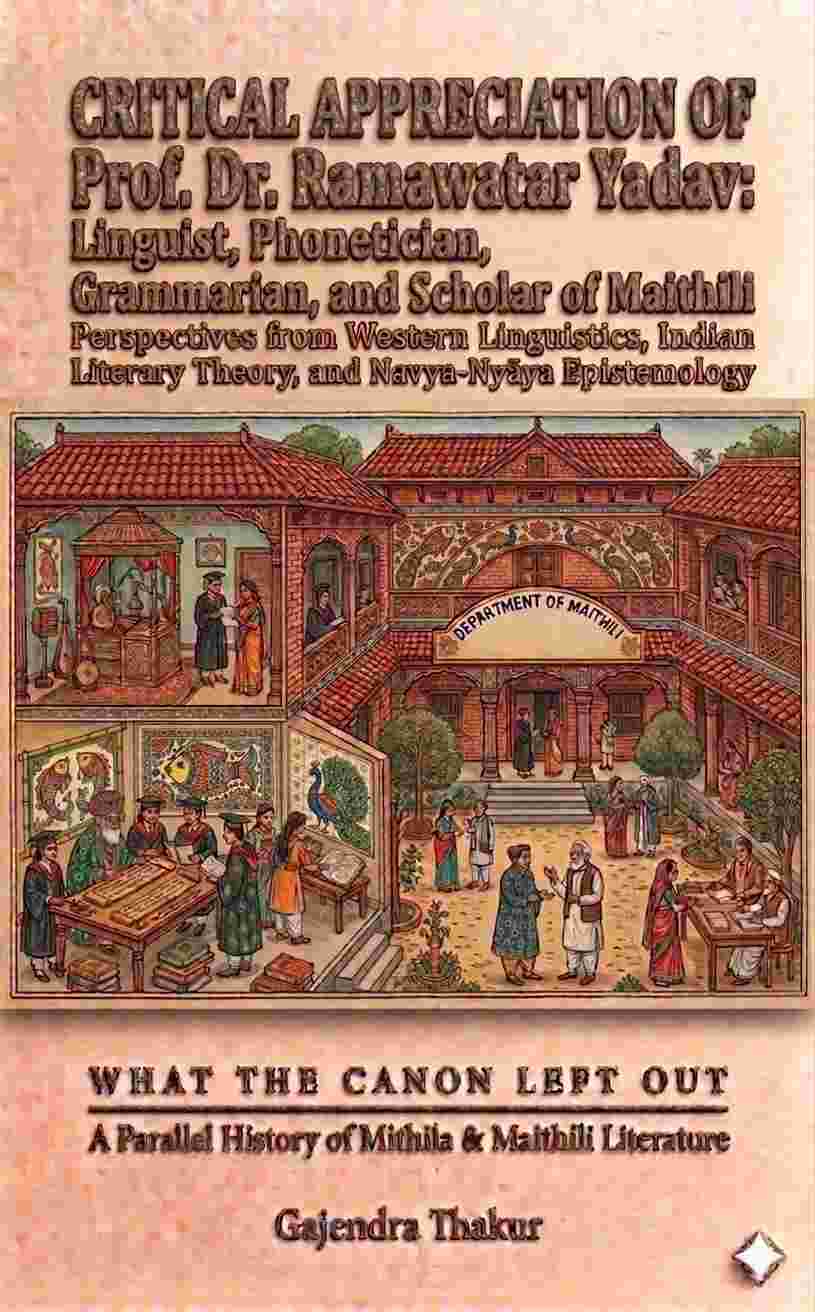
CRITICAL APPRECIATION OF Prof. Dr. Ramawatar Yadav: Linguist, Phonetician, Grammarian, and Scholar of Maithili Perspectives from Western Linguistics, Indian Literary Theory, and Navya-Nyāya Epistemology
CRITICAL APPRECIATION OF
Prof. Dr. Ramawatar Yadav
(1942–)
Linguist, Phonetician, Grammarian, and Scholar of Maithili
Perspectives from Western Linguistics, Indian Literary Theory, and Navya-Nyāya Epistemology
Preface
The present volume constitutes a comprehensive critical appreciation of the life, scholarship, and intellectual legacy of Professor Dr. Ramawatar Yadav — one of the most distinguished linguists to emerge from the Mithila region and the foremost descriptive grammarian of the Maithili language in the modern era. Born in 1942, Yadav's scholarly journey took him from the Terai of Nepal to the universities of Kansas, Mainz, Kiel, and Kentucky, before culminating in a long and productive career at Tribhuvan University, Kathmandu.
This critical appreciation draws upon the four source documents provided by the Videha archive — namely, A Reference Grammar of Maithili (Mouton de Gruyter, 1996), Videha Issue 396 (the special Ramawatar Yadav issue, 2024), RamawatarYadav_AalekhSanchayan (a collection of his scholarly articles), as well as a wide range of secondary materials gathered from international linguistic publications. The analysis proceeds through multiple theoretical lenses: Western structural and generative linguistics (Saussure, Chomsky, Halliday, Fries), Indian grammatical theory (Pāṇini, Bhartrhari, Mīmāṃsā), and the Navya-Nyāya epistemological tradition of Gaṅgeśa Upādhyāya, which constitutes a distinctive and underrecognized conceptual ground for evaluating Yadav's treatment of honorificity, śabda (verbal testimony), and meaning-making in Maithili.
Part I: Biographical and Intellectual Profile
1.1 Life and Institutional Trajectory
Ramawatar Yadav was born in 1942 in the Mithila region. His early academic formation was within the teaching of English language and literature, which he practiced at the College of Education and Patan College from 1965 to 1973. This pedagogical grounding in English gave him a dual vantage point — that of a native speaker of an endangered yet classical Eastern Indo-Aryan language, and that of a trained practitioner of English linguistics, including phonetics and phonology. From 1973 to 1990, he taught English phonetics, phonology, and theoretical and applied linguistics to MA students at Tribhuvan University.
Yadav received his MPhil (1977) and PhD (1979) in linguistics from the University of Kansas, Lawrence, USA, where his doctoral dissertation, Maithili Phonetics and Phonology, established him as a leading voice in experimental phonology and the acoustic analysis of South Asian languages. He subsequently held a prestigious Alexander von Humboldt Postdoctoral Research Fellowship at the Department of Indology, University of Mainz, Germany (1983–84), and a Senior Fulbright Visiting Scholarship at the Linguistics Program, University of Kentucky, Lexington, USA (1989). A second Alexander von Humboldt fellowship followed at the Department of General and Indogermanic Linguistics, University of Kiel, Germany (1989). These fellowships provided the institutional conditions for completing the definitive reference grammar.
He held multiple educational administrative positions at Tribhuvan University, eventually becoming one of its most senior linguists. Throughout his career, he maintained close scholarly ties with Werner Winter (Kiel), Gregory T. Stump (Kentucky), and Georg Buddruss (Mainz). Stump's engagement with the manuscript of A Reference Grammar of Maithili and his incisive editorial contributions are acknowledged in the grammar's preface as indispensable.
1.2 The Scholarly Vocation: Language Advocacy and Scientific Rigour
Yadav's intellectual project was simultaneously a scientific and political one. From the outset, a dual commitment shapes his entire corpus: the application of rigorous modern linguistic methodology to a language that had historically been misclassified, and the restoration of Maithili's standing as an autonomous, complex, and fully grammaticalized natural language.
As he documented in the opening chapter of the reference grammar, Maithili had been variously treated — by John Beames (1872–79), by Hoernle (1880), and by Grierson (1883–87) — as a dialect of Bengali, Eastern Hindi, or the spurious grouping called 'Bihari.' Yadav systematically dismantled this misclassification, demonstrating through synchronic morphology, syntax, phonology, and semantics that Maithili possesses independent systemic features — notably the near-total loss of the Old Indo-Aryan gender system, the absence of grammatical number in modern Maithili, and above all, the extraordinary complexity of its honorificity distinctions and verbal agreement morphology — that set it apart decisively from all neighbouring languages.
The Videha Issue 396 (2024), a special issue dedicated to Yadav as bhāṣāvid (language scientist), also highlights his role in drawing attention to the sociolinguistic dimension of caste in Maithili grammar: he was, in the words of Subhash Chandra Yadav, 'the only linguist who gave even a little thought' to the Dalit Maithili, to the pacpanniyā Maithili — the Maithili of the lower castes, distinct in its vocabulary and morphology from the Brahmanical standard tacitly assumed by all previous grammarians.
Part II: Major Works and Their Critical Assessment
2.1 Maithili Phonetics and Phonology (PhD Dissertation, University of Kansas, 1979; published 1984)
This doctoral dissertation constitutes the first book-length study of the phonetics and phonology of Maithili and was published in 1984 (Seldan and Tamm). Its five chapters trace a path from theoretical introduction, through segmental phonology, to instrumental phonetics: a fiberoptic study of voicing and aspiration, and acoustic analyses of both oral and nasalized vowels, followed by a study of word stress.
The theoretical framework is generative phonology as developed in the tradition of Chomsky and Halle's The Sound Pattern of English (1968). As early as 1976, Yadav had applied this framework to the question of aspirated consonants in colloquial Maithili, arguing against the 'unit' interpretation in favour of a cluster interpretation, a position elaborated in a series of papers (1976, 1979, 1980, 1982, 1984). His 1979 paper on the influence of aspiration on vowel duration in Maithili (South Asian Languages Analysis) and his 1982 study of the acoustic characteristics of vowel nasalization in Maithili (Indian Linguistics) drew on experimental phonetics to illuminate structures inadequately captured by purely distributional analysis.
The fiberoptic study of voicing and aspiration is particularly significant: at the time of writing, instrumental phonetic research on South Asian languages was rare, and Yadav's use of fiberoptics to study the laryngeal phonetics of Maithili consonants placed this work in dialogue with the finest experimental tradition in phonetics, represented by scholars like Peter Ladefoged. The methodology anticipates what would later become standard in the field of laboratory phonology.
The theoretical implications of this work intersect with a fundamental question raised within Indian grammatical thought by the Mīmāṃsakas and Vaiyākaraṇas: what is the minimal phonological unit of language? The Mīmāṃsakas held the varṇa (phoneme) as primary; the Vaiyākaraṇas held the sentence (vākya); the Naiyāyikas held the pada (word). Yadav's experimental approach essentially locates this question in acoustic-phonetic measurement, grounding the abstract in the articulatory and auditory evidence. This is, in methodological spirit, deeply compatible with Gaṅgeśa's insistence on pramāṇa — valid epistemic evidence — over received classification.
2.2 A Reference Grammar of Maithili (Mouton de Gruyter, Berlin/New York, 1996)
This is Yadav's magnum opus. Published in the prestigious Trends in Linguistics: Documentation series (Vol. 11) of Walter de Gruyter, it constitutes the definitive synchronic description of the Maithili language. At 414 pages, it covers: (1) a century of Maithili grammatical tradition; (2) the sound system and script; (3) the noun and noun phrase; (4) pronouns; (5) adjectives, modifiers, determiners, and numerals; (6) the verb and verb phrase; (7) adverbs, postpositions, clitics, interjections, and particles; (8) sentence types; and (9) the syntax and semantics of simple and complex sentences.
2.2.1 The Grammatical Tradition Survey
The opening chapter is itself a contribution to the historiography of Maithili linguistics. Yadav surveys, with discriminating judgment, the traditional grammarians (Dinabandhu Jha's Mithilā-Bhāṣā-Vidyotana, 1946, written in the Pāṇinian sūtra tradition; Govind Jha's Laghu Vidyotana, 1963), the historical grammarians (Grierson, Hoernle, Chatterji, Jeffers, Thiel-Horstmann), the pedagogical grammarians, and the structural-descriptive scholars. His critique of the traditional grammars is sharp but fair: the Sanskritic superimposition, he argues, 'tends to distort the facts of Maithili, and even skews the conclusions drawn about it' — a point of critical importance for all subsequent work.
This critique resonates with the broader tradition of postcolonial linguistics as theorized by scholars like Braj Kachru and Robert Phillipson: when a language is described through the grammatical categories of a prestigious neighbour (Sanskrit, Hindi, or English), the distinctive structures of the target language are rendered invisible. Yadav's decision to use modern structural and generative categories rather than Pāṇinian ones is itself an act of methodological decolonization — though one that simultaneously draws on the sophistication of the Western comparative and typological tradition.
2.2.2 The Phonology Chapters
Chapter 2 provides a comprehensive inventory of Maithili phonemes, covering vowels (including a detailed treatment of vowel nasalization and length), consonants (with the critical treatment of aspirated consonants), consonant clusters, vowel clusters, stress and intonation, morphophonemics, and script. The phonemic inventory distinguishes Maithili clearly from Hindi, Bengali, and Nepali, and the morphophonemic rules — particularly the schwa deletion rule and the stem-internal alternation between a and ā — are described with exemplary precision and illustrated with hundreds of glossed examples.
The treatment of nasalization is especially notable. Nasalization in Maithili operates at the phonemic level — a distinction between oral and nasal vowels is grammatically significant — and Yadav's acoustic evidence (1982) demonstrated that nasal coarticulation patterns in Maithili differ measurably from neighbouring languages. This is relevant to the classical debate in Indian phonology between the anunāsika (nasal resonance) theorists and the strict segmentalists: Maithili provides empirical data that bridges the phonemic and phonetic levels in ways that illuminate this theoretical controversy.
2.2.3 The Noun, Case, and Honorificity System
Chapter 3 on the noun and noun phrase identifies one of Maithili's most typologically unusual features: the near-total loss of grammatical gender. While Sanskrit has three genders (masculine, feminine, neuter) and Hindi retains two (masculine, feminine), modern Maithili's gender system is, as Yadav documents, 'governed mainly by the sex of the animate object; it is not grammatical as in Sanskrit and Hindi.' This is a major structural innovation in the history of Indo-Aryan morphology.
The case system of Maithili, detailed in section 3.3, presents a rich postpositional morphology. Yadav identifies and analyses the nominative, accusative-dative, genitive, locative, ablative, and instrumental cases, along with the complex of postpositions that extend this system. His treatment of the 'dative subject' construction — wherein an experiencing subject takes what looks like accusative-dative case marking, while the verb agrees with a non-nominative argument — is particularly sophisticated, and anticipates later work in relational grammar and case theory.
Chapter 4 on pronouns reveals Maithili's most structurally distinctive feature: a four-way honorificity distinction in the second and third person pronoun system (high honorific, honorific, mid-honorific, non-honorific), with the first person being indeterminate as to honorificity. This complexity, for which the standard abbreviations HH, H, MH, and NH are used throughout, is without parallel in the Indo-Aryan family.
2.2.4 The Verb and Agreement System: The Central Contribution
The verbal morphology and agreement system constitute the single most important contribution of the grammar. Chapter 6, the longest in the book, analyses the structure of the verb phrase, verb agreement, causative, compound and conjunct verbs, passive, modal, auxiliary verbs, and non-finite forms.
Yadav's central theoretical claim — elaborated in the grammar (1996) and in his collaborative paper with Gregory Stump (1988) — is that Maithili has a two-dimensional agreement system: primary agreement (in which the verb copies the person and honorific features of the subject) and secondary agreement (in which the verb simultaneously encodes the honorific features of the object, or of other participants, through a separate layer of morphology). This produces, at maximum, portmanteau agreement morphemes that encode up to three participants simultaneously — subject, object, and addressee — in a single verbal ending.
This analysis has become a touchstone in the typological literature on agreement. It is cited in cross-linguistic surveys of honorificity by Bickel, Bisang, and Yadava (1999), in formal treatments of allocutive agreement (agreement with the addressee as a non-argument), and in recent minimalist work on left-periphery agreement. Maithili, by virtue of Yadav's description, has entered the canon of languages that challenge the assumption that agreement encodes only nominative subjects.
From the perspective of Pāṇinian grammar, Yadav's treatment of agreement morphology engages with the question of kāraka — the grammatical roles (kartā, agent; karma, patient; sampradāna, dative; etc.) — and the way verbal endings encode these. Pāṇini's system, as interpreted through the tradition of aṣṭādhyāyī, uses vibhakti (case endings) and verbal suffixes (tiṅ) to encode syntactic role and person/number. Yadav's description shows that Maithili's system extends this beyond the nominative argument, encoding the social relationship between speaker, subject, object, and addressee within the verbal morphology itself — a feature the Pāṇinian tradition did not need to theorize but which Indian pragmaticists (the alamkāra theorists) recognized implicitly in the concept of vācya (the matter of speech) and its differential registers.
2.2.5 Compound and Conjunct Verbs
Section 6.5 on compound and conjunct verbs is particularly rich. Yadav identifies a set of vector verbs — highly grammaticalized secondary verbs (jā- 'go', le- 'take', de- 'give', ā- 'come', paṛ- 'fall') — that follow a main verb stem and add aspectual, directional, or evaluative nuance. This analysis contributed to the growing comparative literature on South Asian 'light verb' constructions, and aligns with the general typological insight, made explicit in Haspelmath (1993) and Butt (2003), that complex predicates in South Asian languages encode a systematic interface between lexical semantics and grammatical aspect.
Within the framework of Bhartrhari's Vākyapadīya, the concept of sphota — the unanalysed unity of the sentence as the primary bearer of meaning — is relevant here. Yadav's analysis of compound verbs reveals precisely that the 'meaning' of a Maithili compound verb is not compositional but holistic: the combination of V1 + V2 produces a semantic unit whose sense cannot be predicted from the sum of its parts. Bhartrhari would recognise this as an instance of vākya-sphota — sentence meaning that exceeds and precedes its analytical decomposition.
2.2.6 Syntax: Word Order, Subordination, and Conditionals
Chapter 9, on the syntax and semantics of simple and complex sentences, is the culmination of the descriptive project. Yadav establishes Maithili as a consistent SOV (Subject-Object-Verb) language with postpositions, a typological profile consistent with Greenberg's universal correlates for head-final languages (Universal 4: SOV languages tend to have postpositions rather than prepositions). The chapter analyses negation, causativization, passivization, coordination, and subordination in systematic detail.
The treatment of conditional clauses (section 9.6.3.8) is exemplary. Yadav distinguishes 'reality' conditionals (where both clauses are marked for tense in the normal way) from 'counterfactual' or 'unreal' conditionals (where both verbs take the conditional mood marker -it), a distinction familiar from the typological literature and from the philosophical tradition of indicative vs. subjunctive conditionals. The Maithili data is illustrated with precisely glossed examples (sentences 1547–1561), providing a basis for formal semantic analysis.
From the perspective of Navya-Nyāya logic — the tradition founded by Gaṅgeśa Upādhyāya in his Tattvacintāmaṇi (14th century) — Yadav's conditional analysis engages implicitly with the Naiyāyika account of vyāpti (pervasion, the invariable concomitance that underlies inference). In the Navya-Nyāya framework, a conditional statement of the form 'if p then q' is analysed as a case of vyāpti between two properties: whenever the hetu (reason) is present, the sādhya (probandum) is present. Yadav's data on Maithili conditionals shows that the language encodes this logical distinction morphologically — through the presence or absence of the conditional mood marker — providing empirical material for the Naiyāyika's analysis of valid inference (anumāna) and its linguistic expression.
Part III: Theoretical Frameworks and Critical Appreciation
3.1 Western Linguistics: Structural, Generative, and Functional Frameworks
The Videha Issue 396 editorial preface (by Gajendra Thakur) situates Yadav's work explicitly within the comparative framework of traditional, structural, and modern linguistics — drawing on the Chinese comparative paper by Jijian Li and Jiming Li (EMCS 2015), which the journal includes in Maithili translation. This framework maps directly onto the theoretical horizon within which Yadav worked throughout his career.
3.1.1 Saussurean Structuralism
Ferdinand de Saussure's foundational distinctions — langue/parole, syntagmatic/paradigmatic, synchronic/diachronic — provide the methodological scaffolding for Yadav's reference grammar. The grammar is explicitly synchronic, describing the structure of Maithili as it was spoken in the late 1970s and 1980s. By choosing synchrony, Yadav aligned his project with the Saussurean programme of structural linguistics, which held that the value of a linguistic element is defined by its systemic relations with other elements, not by its historical derivation.
This is significant because the alternative, the historical-comparative method of Grierson and Hoernle, had consistently subordinated Maithili to its Sanskrit etymons and Magadhi Apabhraṃśa antecedents. By privileging synchrony, Yadav was able to demonstrate that modern Maithili has its own coherent systemic organization — the honorificity distinctions, the absence of grammatical gender, the compound verb system — that can only be seen clearly when freed from the presupposition that the current state of a language must mirror its historical origin.
3.1.2 Generative Grammar and Control Agreement
In his collaborative paper with Gregory Stump (CLS 1988), Yadav deployed the theoretical machinery of Lexical-Functional Grammar (LFG) to analyze Maithili verb agreement within the framework of the 'control agreement principle' developed by Joan Bresnan and colleagues. The paper demonstrated that Maithili's complex secondary agreement could be formally captured within LFG's feature-unification apparatus, and that the phenomena posed interesting challenges to then-prevailing theories of agreement that assumed a single agreement controller (typically the nominative subject).
The broader implications for Chomskyan generative grammar are also significant. Yadav's data shows that the 'nominative island constraint' — the assumption that only nominative subjects trigger agreement — does not hold universally. Maithili is, in this sense, a language that challenges the parameter settings assumed by early Principles-and-Parameters theory, and anticipates the 'free agreement' typology later elaborated in the minimalist programme.
3.1.3 Hallidayan Systemic-Functional Grammar
M.A.K. Halliday's systemic-functional grammar, with its emphasis on language as a social-semiotic resource, provides another lens through which to appreciate Yadav's contribution. For Halliday, grammar simultaneously encodes three meta-functions: ideational (representing the world), interpersonal (enacting social relations), and textual (organizing information). Yadav's analysis of the Maithili honorificity system is, within this framework, an analysis of the interpersonal meta-function of Maithili grammar: the complex of agreement morphemes that encodes the social relationships between speaker, subject, and addressee is precisely the grammaticalization of Halliday's 'tenor' of discourse — the power and solidarity relations between interactants.
The sociolinguistic observation noted in Videha Issue 396 — that Yadav was alone among Maithili linguists in paying attention to the pacpanniyā Maithili of the lower castes, including the use of 'tõ' (the non-honorific second person) to address 'lower' jāti persons — is, in Hallidayan terms, an observation about the social semiotics of honorificity: the grammar does not merely describe social hierarchy, it constitutes and reproduces it. Yadav's empirical note (p. 376 of the grammar) that by 1996 the practice of addressing 'lower' jāti people with 'tõ' had begun to change among younger urban speakers marks a sociolinguistic shift in the interpersonal meta-function of Maithili.
3.1.4 Fries's Structural Linguistics and Prescriptivism
The Videha Issue 396 editorial (Gajendra Thakur) explicitly cites Charles Fries's distinction between prescriptive and descriptive grammars, quoting Fries's criticism that 'prescriptive and scholarly grammars belong to a prescientific era.' This citation is placed in direct dialogue with the history of Maithili grammatical tradition, noting that the pedagogical grammarians of Maithili (Ramanath Jha, B. Jha 'Vyathit', D. Jha, Y. Jha) operated within a prescriptive tradition that privileged the Brahmanical 'standard' of Madhubani Maithili over the varieties spoken by other social groups.
Yadav, by contrast, adopts the descriptive stance of modern linguistics: his grammar describes what Maithili speakers of the Terai varieties actually say, not what educated Brahmins of Mithila prescribe. This represents a significant methodological and political choice — one that aligns his work with the democratic and inclusive impulse of Videha's Parallel Literature Movement, which champions the subaltern literary tradition against the Sahitya Akademi canon.
3.2 Indian Literary and Grammatical Theory
3.2.1 Pāṇini and the Aṣṭādhyāyī Tradition
The Pāṇinian tradition provides both a foil and a resource for evaluating Yadav's grammar. The Aṣṭādhyāyī is the most compact and comprehensive grammar of any natural language in pre-modern times, describing Sanskrit morphology through a system of rules (sūtra), metalinguistic abbreviation (anuvṛtti), and zero-morpheme analysis that anticipates many features of modern generative phonology and morphology. The Videha editorial (Gajendra Thakur) reflects on the Vaiyākaraṇas' conception of śabda-brahman — the notion that language (in its ultimate form) is identical with Brahman, the absolute reality — and traces its four stages: parā (undifferentiated), paśyantī (visionary), madhyamā (intermediate, in the mind), and vaikharī (articulated speech).
Yadav's phonetics work engages with the vaikharī level — the level of articulated, acoustically measurable speech — through fiberoptic and acoustic methods. His morphophonemic analysis engages with the interface between madhyamā (the cognitive, pre-articulatory representation) and vaikharī (the phonetic surface form), a relationship that generative phonology theorizes as the mapping between underlying representation and phonetic output. Yadav's morphophonemic rules — the schwa deletion rule, the a/ā alternation — are, in Pāṇinian terms, sandhi rules that operate at the morpheme boundary, though Yadav correctly notes that Maithili sandhi is less extensive than Sanskrit sandhi.
The pedagogical grammarians of Maithili, as Yadav observes, devoted an average of nine pages each to the description of sandhi rules — an imposition of the Sanskrit grammatical model on a language whose sandhi processes are minimal. This is precisely the kind of distortion that the Pāṇinian approach, applied without adjustment to a non-Sanskrit language, produces. Yadav's descriptive approach corrects this by treating Maithili morphophonemics on its own terms.
3.2.2 Bhartrhari's Philosophy of Language
Bhartrhari's Vākyapadīya (c. 5th century CE) offers a philosophy of language in which the sentence (vākya) rather than the word or phoneme is the primary unit of meaning. The concept of sphota — the holistic, unanalysed meaning-bearer that underlies the sequence of phonemes — is Bhartrhari's solution to the problem of how sequential sounds can convey unified meaning. The Videha editorial notes that Bhartrhari stands between the Mīmāṃsakas (who prioritize the word) and the Naiyāyikas (who prioritize the sentence), and that Derrida's grammatology, while superficially resembling Buddhist conventionalism about language, actually brings Derrida closer to Bhartrhari's grammar-philosophy than to Nāgārjuna.
For Yadav's grammar, the sphota doctrine is most relevant in understanding compound and conjunct verbs. As noted above (section 2.2.5), the meaning of a Maithili V1+V2 compound cannot be predicted from the sum of its parts — just as, for Bhartrhari, sentence meaning (pratibhā) arises as an immediate flash of understanding that is not analytically derivable from word meanings. Yadav's careful documentation of the semantic nuances of vector verbs (the 'completive', 'adversative', 'benefactive' readings of the same V1 with different V2s) is an empirical contribution to what a sphota-theorist would call the description of the pratibhā of Maithili compound verbal expressions.
3.2.3 The Alaṃkāra Tradition and Honorificity as Rasa
The alaṃkāra (rhetoric and poetics) tradition of Indian literary theory — from Bharata's Nāṭyaśāstra through Ānandavardhana's Dhvanyāloka and Abhinavagupta's Abhinavabhāratī — provides a framework for understanding the social and aesthetic dimensions of Yadav's honorificity analysis. In this tradition, rasa (aesthetic emotion/flavour) is evoked through dhvani (resonance, suggestive power) — the way a text or utterance carries meanings beyond its literal denotation.
The Maithili honorificity system is, from this perspective, a grammaticalized form of social dhvani: every verbal ending in Maithili resonates with social information about the relative status of speaker, subject, object, and addressee. The choice of 'tõ' (non-honorific) versus 'ahāṃ' (high honorific) in addressing an interlocutor is not merely a referential choice but a speech act with affective and social resonance — the grammar itself is a site of vīra-rasa (heroic emotion) or bībhatsa-rasa (disgust) depending on its social deployment. Yadav's empirical observation that educated young Brahmins in 1996 had begun to stop using 'tõ' to address lower-jāti people is, in this framework, a shift in the social rasa of Maithili grammar — a democratic evolution of the language's affective vocabulary.
3.3 Navya-Nyāya Epistemology of Gaṅgeśa Upādhyāya and Ramawatar Yadav's Linguistics
The Navya-Nyāya school, inaugurated by Gaṅgeśa Upādhyāya of Mithila (c. 14th century CE) in his Tattvacintāmaṇi (Jewel of Reflection on the Truth about Epistemology), represents the most technically sophisticated system of logical and epistemological analysis in the Indian philosophical tradition. The Tattvacintāmaṇi is organized around the four valid means of knowledge (pramāṇa): pratyakṣa (perception), anumāna (inference), upamāna (comparison/analogy), and śabda (verbal testimony). The fourth section, on śabda, is directly relevant to linguistics.
It is a matter of deep cultural significance — noted in the Videha editorial — that both Gaṅgeśa Upādhyāya and Ramawatar Yadav emerged from the Mithila region, and that Yadav's grammar of Maithili is, in a sense, the modern scientific counterpart to Gaṅgeśa's philosophical analysis of śabda-pramāṇa. Where Gaṅgeśa asked: what are the conditions under which verbal testimony yields valid knowledge? — Yadav asks: what is the structure of the linguistic system that makes verbal communication possible in Maithili?
3.3.1 Śabda-Pramāṇa and the Analysis of Meaning
In Navya-Nyāya, śabda-pramāṇa is the valid cognition arising from a reliable speaker's utterance. The analysis of how an utterance conveys meaning involves the technical concepts of śakti (the denotative power of a word), lakṣaṇā (secondary/metaphorical meaning), and vyañjanā (suggestive meaning, important in the alaṃkāra tradition). Gaṅgeśa's analysis of the śabdakhanda of the Tattvacintāmaṇi addresses the relationship between a word-token (pada) and its meaning (padārtha), taking up the Mīmāṃsaka-Naiyāyika debate on whether the relationship between word and meaning is eternal (nitya) or conventional (aupādhika/ākṛti).
Yadav's contribution to this debate is indirect but real. His analysis of the Maithili case system and postpositions — showing how the ablative, locative, and genitive meanings are encoded by specific morphemes that may combine with verbs to yield idiomatic meanings not predictable from the sum of their semantic components — is empirical data relevant to the question of śakti: what exactly is the semantic 'power' of a morpheme, and how does it compose with others? The Naiyāyika answer — that the denotative power of a word-token is fixed by smitisamskāra (habit of use established through prior acquaintance) — is compatible with the distributional approach of structural linguistics, which defines the meaning of a morpheme by its distribution in the language.
3.3.2 Anumāna (Inference) and Syntactic Analysis
The Navya-Nyāya analysis of anumāna (inference) proceeds through the identification of vyāpti (invariable concomitance): the inference from 'there is smoke on the hill' to 'there is fire on the hill' depends on the established vyāpti that wherever there is smoke, there is fire. The Navya-Nyāya logicians developed an extraordinarily precise meta-language (Navya-Nyāya paribhāṣā) for expressing these relations, using compounds like vahninā vyāpya-dhūmatva (the property of being smoke, which is pervaded by fire) with great technical precision.
Yadav's syntactic analysis, especially his treatment of the conditions governing secondary verb agreement in Maithili, has a structural parallel with Navya-Nyāya inference. His claim that secondary agreement is triggered if and only if specific conditions hold (the object NP being honorific, the subject being third person, the verb being in a specific aspectual form) is logically equivalent to specifying the vyāpti that holds between the contextual properties of the utterance and the morphological form of the verb. The technical precision of Yadav's feature specifications — encoded in interlinear glosses such as 'PST-(3NH + 3H)' — is, in its own way, a formal paribhāṣā for Maithili grammar, just as Navya-Nyāya paribhāṣā was a formal meta-language for Indian logic.
3.3.3 Pratyakṣa (Perception) and Experimental Phonetics
In the Navya-Nyāya epistemology, pratyakṣa (perception) is the most direct form of valid knowledge. Gaṅgeśa's analysis of perception in the first section of the Tattvacintāmaṇi distinguishes nirvikalpaka pratyakṣa (indeterminate, pre-conceptual perception) from savikalpaka pratyakṣa (determinate, conceptually articulated perception). The former is pure sensory awareness without categorization; the latter involves the application of jāti (universal/kind) to the perceived particular.
Yadav's experimental phonetics — the fiberoptic study of stop production, the acoustic analysis of vowel nasalization and word stress — operates at the level of nirvikalpaka pratyakṣa: it records the physical signal of speech without pre-imposing linguistic categories. The phonemic analysis that follows, identifying the units of the sound system and their distinctive features, corresponds to savikalpaka pratyakṣa: the categorization of the perceptual data under linguistic universals (the phoneme, the distinctive feature). This parallelism suggests that Yadav's empirical methodology — ground the abstract in the physical, then ascend to the categorical — follows a logical structure deeply consonant with Navya-Nyāya's graduated epistemology.
Part IV: Yadav's Place in the History of Maithili Linguistics and Indian Language Studies
4.1 Before and After Yadav: A Historiographic Assessment
Prior to Yadav's contributions, Maithili linguistics stood in a peculiar state: grammatically described by colonial administrators (Grierson) through the lens of 'Bihari dialect studies'; historically traced by Subhadra Jha (1958) in the most exhaustive diachronic study to that date; and pedagogically codified by native Brahmanical grammarians whose prescriptivism concealed the language's true structural complexity. None of these traditions had produced a comprehensive, theoretically informed, synchronic description of the entire grammatical system of Maithili.
Yadav's 1996 grammar filled this gap definitively. Within the scholarly literature, it is the standard citation for Maithili grammar: it is cited in the World Atlas of Language Structures (WALS), in comparative surveys of Indo-Aryan languages (Masica 1991, Cardona and Jain 2003), in formal linguistic analyses from minimalism to LFG, and in sociolinguistic studies of language endangerment. It has been the basis for subsequent doctoral dissertations (Bal Krishna Jha, University of Poona, 1984; and many since), and it has shaped the understanding of Maithili in every major reference work in South Asian linguistics.
After the grammar, the field of Maithili linguistics became significantly more sophisticated. Bickel, Bisang, and Yadava (1999) built directly on Yadav's description of the agreement system to develop a cross-linguistic typology of 'face vs. empathy' in verb agreement. Yadava's government-binding thesis (1983/1998) extended the syntactic analysis into transformational-generative territory. Recent minimalist work on allocutive agreement in Maithili cites Yadav's description as foundational data.
The 2024 Videha special issue (Issue 396) adds a further dimension: the reception of Yadav's work in Nepal — including the installation of life-size posters of Yadav alongside Yogendra Prasad Yadav at the New Delhi World Book Fair 2024, in the Language Pavilion — marks the recognition of Yadav's scholarship as a cultural-political achievement for the Maithili-speaking communities of both India and Nepal. In the Videha editorial framework, this recognition is inseparable from the Parallel Literature Movement's project of restoring the dignity and visibility of Mithila's intellectual heritage.
4.2 Sociolinguistic Contribution: Caste, Dialect, and Democratic Linguistics
The sociolinguistic dimension of Yadav's grammar deserves special emphasis. As Subhash Chandra Yadav observes in the collection included in Videha Issue 396, Yadav's grammar is the only major description of Maithili to address — even briefly — the language of the lower-caste communities: the pacpanniyā Maithili, the Maithili of the fifty-five artisan and serving jātis of Mithila. The observation (grammar, p. 376) that some uneducated/semi-educated Brahmin youth used 'tõ' to address lower-jāti adults — a form of linguistic caste violence — and that this practice was changing by 1996 represents a rare moment in formal grammar where the social ethics of language use is made explicit.
From the perspective of critical linguistics and language ideology theory (Woolard and Schieffelin 1994; Irvine and Gal 2000), Yadav's observation can be read as a documentation of iconization — the process by which linguistic differences are understood as direct reflections of social distinctions — and its beginning dissolution under conditions of urbanization and social change. The grammar thus serves not only as a description of Maithili structure but as an archive of the social-semiotic conditions of language use in the late twentieth century.
Yadav's article on the sociolinguistics of Maithili (1999) extended this analysis, discussing the internal dialectal variation of Maithili along regional, caste, and socioeconomic lines. His observation that the standard of spoken Maithili is 'tacitly identified with the speech of the towns of Madhubani in Bihar and Rajbiraj in Nepal' is itself a piece of ideological analysis: the 'standard' is the speech of the educated upper-caste urban centres, projected as a neutral norm while erasing the diversity of Maithili as actually spoken by its more than 24 million speakers.
4.3 Selected Published Articles (AalekhSanchayan): Key Contributions
The AalekhSanchayan (Article Collection) comprises Yadav's published research articles spanning over three decades. Key articles include:
'Generative Phonology and the Aspirated Consonants of Colloquial Maithili' (1976): The first application of generative phonological theory to Maithili, establishing the 'cluster interpretation' of aspirated consonants and demonstrating the inadequacy of earlier 'unit' analyses.
'A Fiberoptic Study of Stop Production in Maithili' (1979): Pioneering use of instrumental phonetics for an Eastern Indo-Aryan language, analyzing the laryngeal behaviour of Maithili stop consonants with direct physical evidence.
'Acoustic Characteristics of Vowel Nasalization in Maithili' (1982): The first acoustic study of nasalization in Maithili, establishing the measurable phonemic contrast between oral and nasal vowels.
'Maithili Verb Agreement and the Control Agreement Principle' (with Gregory Stump, 1988): The theoretical high point of Yadav's syntactic work, demonstrating within LFG that Maithili's complex secondary agreement can be formally captured and that it challenges nominative-centric theories of agreement.
'Clitic versus Affix: Maithili e and o' (1999): A nuanced morphosyntactic analysis of the clitics e and o in Maithili, distinguishing their clitic properties from fully inflectional affixes — a contribution to the typology of clitics across South Asian languages.
'Maithili' in The Indo-Aryan Languages (ed. Cardona & Jain, Routledge, 2003): A comprehensive synthesizing chapter that served as the definitive reference article on Maithili for an international audience, presenting the language's phonological, morphological, and syntactic profile within a comparative South Asian context.
'Maithili Linguistic Research: State-of-the-Art' (2000): A comprehensive review article charting the entire tradition of Maithili linguistic research, from Grierson through the late 1990s, identifying gaps and setting an agenda for future research.
Part V: Critical Evaluation — Strengths, Limitations, and Open Questions
5.1 Achievements
Comprehensiveness: The reference grammar is the most comprehensive description of Maithili ever produced, covering all levels of grammar (phonology, morphology, syntax, semantics) with exemplary detail and hundreds of glossed examples.
Methodological sophistication: The combination of experimental phonetics, generative phonology, structural morphology, and syntactic theory places Yadav's work at the intersection of multiple theoretical traditions, ensuring its relevance across research paradigms.
Cross-linguistic significance: By placing Maithili's agreement system, phonological system, and syntactic structures in comparative perspective, Yadav's work has contributed to general linguistic typology in ways that extend far beyond the immediate community of Maithili scholars.
Historical self-awareness: The opening survey of the grammatical tradition is itself a contribution to the historiography of South Asian linguistics, providing a critical account of both the native Pāṇinian tradition and the colonial Western tradition.
Sociolinguistic sensitivity: The attention to caste variation, dialectal diversity, and the politics of standardization, though brief in the grammar, is present and significant, and was extended in the 1999 sociolinguistics article.
5.2 Limitations and Open Questions
Dialect coverage: The grammar primarily describes the Nepal Terai variety of Maithili, and the Darbhanga variety of Bihar — the most populous dialect region — has been shown in subsequent research (e.g., Kumari 2023) to have agreement restrictions not present in Yadav's description. A full account of Maithili dialectal variation remains to be written.
Dalit Maithili: Despite the note at p. 376 regarding caste-based use of pronouns, the grammar does not systematically describe the phonology, morphology, or lexicon of the Dalit varieties of Maithili. As Subhash Chandra Yadav and the Videha editorial board have argued, this gap reflects not a personal failing of Yadav but the structural constraints of a scholarly tradition that equated 'standard language' with upper-caste urban speech. A grammar of Dalit Maithili remains a major desideratum.
Pragmatics and discourse: The grammar is primarily a sentence-grammar, and the discourse-level and pragmatic dimensions of Maithili — topic-comment structure, information packaging, politeness strategies beyond honorificity morphology — are not treated systematically. A Hallidayan systemic-functional grammar of Maithili, building on Yadav's description, would be a significant contribution.
Lexicography: Yadav himself identified lexicography as the most neglected area of Maithili linguistics. The vocabulary chapters of the grammar are descriptive rather than comprehensive. A historical dictionary of Maithili — linking the classical vocabulary of Vidyāpati (c. 1360–1448) to the modern language — remains to be compiled.
Conclusion: The Linguist as Savant and Servant of Language
In the Videha editorial introducing the special issue, Gajendra Thakur describes Yadav as a niṣkāma karmayogī (a selfless practitioner of righteous action) for the Maithili language — a figure who, like the ideal described in the Bhagavadgītā, acts without attachment to personal reward, dedicating himself to the preservation and scientific description of a threatened linguistic heritage. This characterization, which draws on the deepest resources of the Mithila cultural tradition, captures something essential about Yadav's scholarly ethos.
Seen through Western linguistic theory, Yadav is a structuralist-generativist-phonetician of high competence and wide influence. Seen through the Pāṇinian tradition, he is the modern vṛttikāra — the commentator who extends and corrects the inherited grammatical tradition in the light of new evidence and new methods. Seen through the Navya-Nyāya epistemology of Gaṅgeśa Upādhyāya — his great predecessor from the same region — Yadav is an exemplary pramātā (knower), one who applies the full range of pramāṇa (valid epistemic instruments) — perception (through experimental phonetics), inference (through formal analysis), analogy (through cross-linguistic comparison), and verbal testimony (through the collected speech of Maithili speakers) — to produce valid, well-grounded knowledge of the Maithili language system.
The recognition accorded to Ramawatar Yadav by the Videha Parallel Literature Movement — placing him in the company of Gaṅgeśa Upādhyāya, Vidyāpati, and the great Mithila savants — is, from the perspective of this critical appreciation, fully warranted. His A Reference Grammar of Maithili stands as one of the finest achievements of post-Independence Indian linguistics: a work of scientific rigour, historical depth, and — in its quiet attention to the speech of those previously excluded from the grammatical tradition — genuine democratic commitment.
Future research on Maithili — in phonology, syntax, sociolinguistics, and discourse — will for generations be built on the foundations that Ramawatar Yadav has laid. That is the measure of a truly foundational scholarly contribution.
Select Bibliography
A. Works by Ramawatar Yadav
Yadav, Ramawatar. 1976. 'Generative Phonology and the Aspirated Consonants of Colloquial Maithili.' Contributions to Nepalese Studies 4/1: 77–91.
Yadav, Ramawatar. 1979a. 'The Influence of Aspiration on Vowel Duration in Maithili.' South Asian Languages Analysis 1: 157–65.
Yadav, Ramawatar. 1979b. Maithili Phonetics and Phonology. Doctoral Dissertation, University of Kansas, Lawrence, USA.
Yadav, Ramawatar. 1980. 'Some Stress Placement Rules in Maithili.' Contributions to Nepalese Studies 8/1: 181–8.
Yadav, Ramawatar. 1981. 'Maithili Language and Linguistics: Some Background Notes.' Kailash: A Journal of Himalayan Studies 8/1–2: 71–87.
Yadav, Ramawatar. 1982. 'Acoustic Characteristics of Vowel Nasalization in Maithili.' Indian Linguistics 43/1–2: 1–8.
Yadav, Ramawatar. 1984. Maithili Phonetics and Phonology. Published edition. Seldan and Tamm.
Yadav, Ramawatar & Gregory T. Stump. 1988. 'Maithili Verb Agreement and the Control Agreement Principle.' Papers from the 24th Annual Regional Meeting of the Chicago Linguistic Society, Parasession on Agreement in Grammatical Theory 2: 304–21. Chicago: CLS.
Yadav, Ramawatar. 1996. A Reference Grammar of Maithili. Berlin / New York: Mouton de Gruyter. (Trends in Linguistics: Documentation, 11.)
Yadav, Ramawatar. 1999. 'Clitic versus Affix: Maithili e and o.' In Yadava & Glover (eds.), Topics in Nepalese Linguistics. Kathmandu: Royal Nepal Academy. 174–84.
Yadav, Ramawatar. 2000. 'Maithili Linguistic Research: State-of-the-Art.' Contributions to Nepalese Studies [CNAS journal], Vol. 27/1.
Yadav, Ramawatar. 2003. 'Maithili.' In George Cardona & Dhanesh Jain (eds.), The Indo-Aryan Languages. London/New York: Routledge. 477–97.
B. Western Linguistics and Theory
Bickel, Balthasar, Walter Bisang & Yogendra P. Yadava. 1999. 'Face vs. Empathy: The Social Foundation of Maithili Verb Agreement.' Linguistics 37: 481–518.
Bresnan, Joan (ed.). 1982. The Mental Representation of Grammatical Relations. Cambridge, MA: MIT Press.
Chomsky, Noam & Morris Halle. 1968. The Sound Pattern of English. New York: Harper & Row.
Chomsky, Noam. 1957. Syntactic Structures. The Hague: Mouton.
Fries, Charles C. 1959. The Structure of English. London: Longman.
Halliday, M.A.K. 1985/2014. An Introduction to Functional Grammar. London: Edward Arnold / Routledge.
Saussure, Ferdinand de. 1916 [1959]. Course in General Linguistics. New York: McGraw-Hill.
Grierson, George Abraham. 1903 [1968]. Linguistic Survey of India. Vol. V, Part II: Eastern Hindi. Calcutta: Superintendent of Government Printing. [Reprint: Delhi: Motilal Banarsidass.]
Masica, Colin. 1991. The Indo-Aryan Languages. Cambridge: Cambridge University Press.
C. Indian Grammatical Theory and Philosophy of Language
Bhartrhari. Vākyapadīya (c. 5th century CE). Ed. and trans. K. Raghavan Pillai. Delhi: Motilal Banarsidass, 1971.
Gaṅgeśa Upādhyāya. Tattvacintāmaṇi (c. 14th century CE). Trans. Stephen H. Phillips, Jewel of Reflection on the Truth about Epistemology. Bloomsbury Academic, 2020.
Bhatt, V.P. 2005. Word: The Śabdakhanda of Tattvacintāmaṇi. 2 vols. Delhi: Eastern Book Linkers.
Jha, Dinabandhu. 1946. Mithilā-Bhāṣā-Vidyotana. Darbhanga: Maithili Sahitya Parishad.
Jha, Subhadra. 1958. The Formation of the Maithili Language. London: Luzac.
Phillips, Stephen H. 2020. 'Gangesa.' Stanford Encyclopedia of Philosophy (Summer 2020 Edition). Ed. Edward N. Zalta. https://plato.stanford.edu/archives/sum2020/entries/gangesa/
Vidyabhushana, Satis Chandra. 1921. A History of Indian Logic. Calcutta: Calcutta University.
D. Videha Sources
Thakur, Gajendra. 2024. 'Nūtana Aṅka Sampādakīya: Vaiyyākaraṇācārya, Śabda Pramāṇa (Nyāya): Jñāna ā Tattvamīmāṃsā — Bhāṣāvid Rāmāvatāra Yādava.' Videha 396 (15 June 2024). ISSN 2229-547X. www.videha.co.in
Yadav, Subhash Chandra. 'Pacpanniyā Maithilī.' Included in: Gulo: Kalā ā Bhāṣā. 2022.
Anchinhar, Aashish. 2024. 'Viśiṣṭa Ālekhsaṃcayana Ker Sāmānya Paricaya.' Videha 396: 191–199.
Various Contributors. 2024. Videha 396: Bhāṣāvid Rāmāvatāra Yādava Viśeṣāṃka. Videha (ISSN 2229-547X), www.videha.co.in. [Contains essays by Udayanarayan Singh 'Nachiketā', Dhirendra Jhā 'Maithil', Ram Raittanya Viraj, Dr. Banakar Ṭhākura, Ayodhyanath Rauhari, Dr. Śiva Kumāra Miśra, Kedar Kānan, Santosh Kumar Miśra, Kavi Rājīva Jhā 'Ekānt', Śailendra Miśra, Kundan Kumar Khā, and others.]
अपन मंतव्य editorial.staff.videha@zohomail.in पर पठाउ।
विदेहमे सभठाम ताकू / Search all Videha
Static full-text search · Pagefindलेखक/शीर्षक/अंक/वर्ष — खोज-विधा। गद्य/पद्य/शोध current/static + पुरान Videha/Sadeha contents खोजैत अछि। पोथी pothi.htm केर पूर्ण listing, श्रव्य-दृश्य Audio_Video.htm केर पूर्ण listing, पञ्जी videha-sadeha/panji-shards GitHub data, आ थेसारस/शब्दकोश videha-ejournal.github.io/data GitHub JSON corpus केँ query करैत अछि आ दूनू Quiz corpus मे dictionary/vocabulary/शब्दार्थ-सम्बन्धी प्रश्नोत्तरी परिणाम सेहो जोड़ैत अछि। Quiz videha-quiz आ GitHub user-site दूनू bilingual quiz corpus खोजैत अछि। Roman/IAST + देवनागरी cross-script search समर्थित। Issue/Year लेल संख्या दिअ। PDF-अभिलेख archive.org/VidehaAndSadeha सूची खोजैत अछि।