
Gajendra Thakur
A PARALLEL HISTORY OF MITHILA & MAITHILI LITERATURE- PART 55
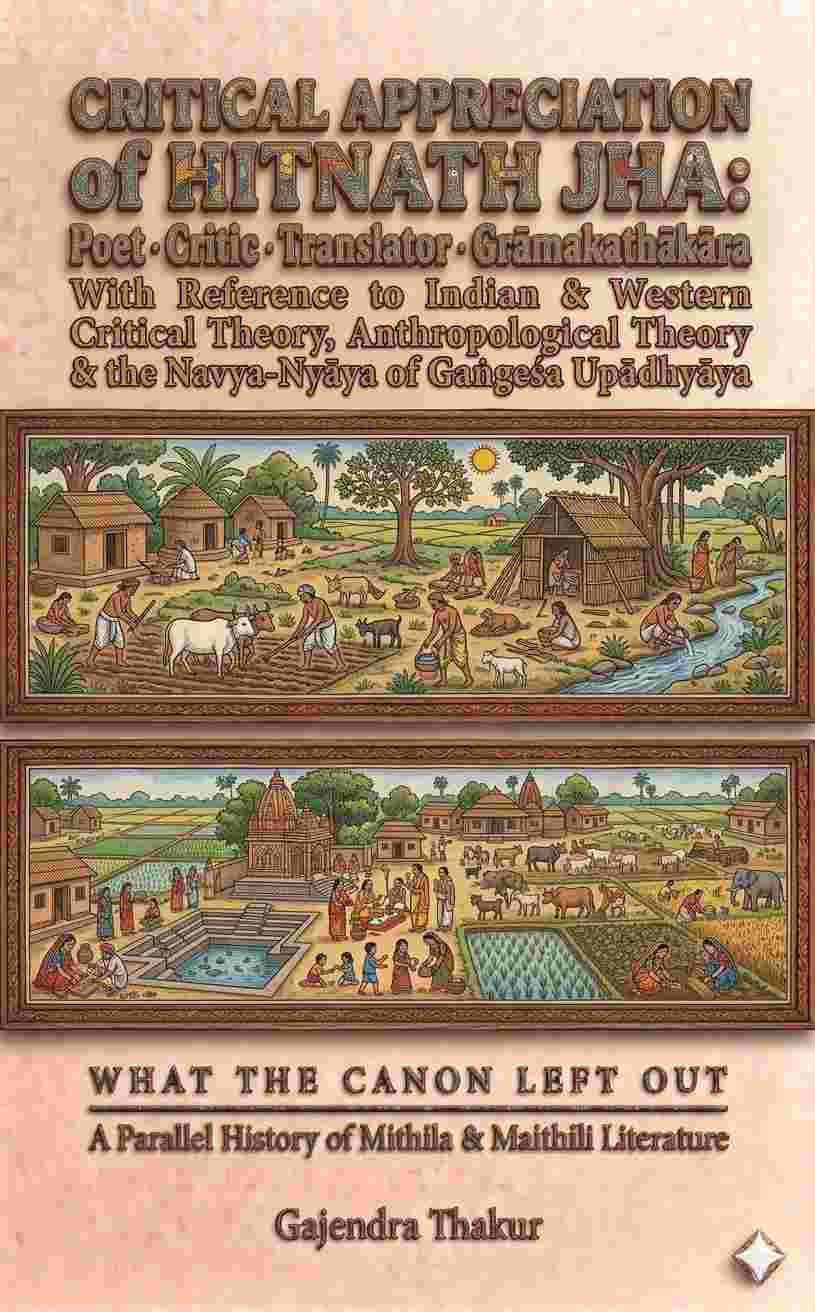
CRITICAL APPRECIATION of HITNATH JHA Poet Critic Translator Grāmakathākāra With Reference to Indian & Western Critical Theory, Anthropological Theory & the Navya-Nyāya of Gaṅgeśa Upādhyāya
CRITICAL APPRECIATION
of
HITNATH JHA
Poet · Critic · Translator · Grāmakathākāra
With Reference to Indian & Western Critical Theory,
Anthropological Theory & the Navya-Nyāya of Gaṅgeśa Upādhyāya
─────────────────────────────
Table of Contents
I. Preface: Method and Materials
II. Biographical Introduction and Cultural Context
III. The Literary Corpus: A Survey
IV. Hitnath Jhā as Poet: Śambhu Bādal Translations and Original Verse
V. Hitnath Jhā as Critic and Reviewer: Lekh-Rekh
VI. Hitnath Jhā as Grāmakathākāra: Koilakh and the Village-Biography
VII. Hitnath Jhā as Translator: Theory and Practice
VIII. Critical Frameworks I — Indian Poetics: Rasa, Dhvani, Aucitya
IX. Critical Frameworks II — The Navya-Nyāya of Gaṅgeśa Upādhyāya
X. Critical Frameworks III — Western Literary Theory
XI. Critical Frameworks IV — Anthropological and Ethnographic Theory
XII. Hitnath Jhā in the Maithili Literary Tradition
XIII. Social Media, Retirement, and the Late-Flowering Writer
XIV. Limitations and Areas for Further Research
XV. Conclusion
XVI. Bibliography and References
I. Preface: Method and Materials
This critical appreciation of Hitnath Jhā (हितनाथ झा) is grounded in the primary texts made available through the Videha digital platform (www.videha.co.in), India's first and longest-running Maithili fortnightly e-journal (since 2000, ISSN 2229-547X), edited by Gajendra Thakur. The primary sources consulted include: (1) Koilakh (ग्रामगाथा, 2017), a village-biography and gram-itihas; (2) Lekh-Rekh (लेख-रेख, Pothi Prasaṅg, Pāṭhakīya, 2023), a collection of critical and reader-responses covering nearly sixty works of Maithili literature; (3) Kavitā: Śambhu Bādalaka (कविता: शम्भु बादलक, 2023), Maithili translations of the Hindi progressive poet Shambhu Badal; (4) Triveni (त्रिवेणी, 2020), a collection of appreciations of writers honoured by the Trivenikaant Thakur Sahitya Samman; (5) Maithilī Itihāsk Rekhānkan (मैथिली इतिहासक रेखांकन, 2003), a historical survey co-edited with Dr. Chandreshwar Kavi; and (6) the Videha Issue 405 (November 2024), a landmark 28-article special issue devoted entirely to Hitnath Jhā.
The critical methodology applied here is deliberately interdisciplinary, bringing together four frameworks in a structured dialogue: (a) the classical Indian poetic tradition of Rasa-Dhvani-Aucitya, as systematised by Bharata, Ānandavardhana and Kṣemarāja; (b) the Navya-Nyāya epistemological method pioneered in Mithila by Gaṅgeśa Upādhyāya (fl. c. 1325 CE) in his Tattvacintāmaṇi; (c) western literary theory from Aristotle through the Russian Formalists, New Critics, postcolonial theory and ecocriticism; and (d) cultural anthropology and ethnographic theory, particularly as developed by Clifford Geertz, Bronisław Malinowski, and the tradition of thick description.
The choice of Navya-Nyāya as an analytical lens is not merely decorative. Gaṅgeśa Upādhyāya was himself a Maithil philosopher, born at Chadana in the Mithila region and living at Karion, twelve miles south-east of Darbhanga — the very geographical heartland from which Hitnath Jhā's ancestral village Koilakh draws its deepest cultural identity. To apply the Navya-Nyāya's pramāṇa-centred epistemology (based on pratyakṣa — perception; anumāna — inference; upamāna — comparison; and śabda — testimony) to the literary corpus of Hitnath Jhā is therefore not an anachronistic imposition but a homecoming of ideas across centuries.
II. Biographical Introduction and Cultural Context
A. Vital Facts
The following biographical data is drawn primarily from the परिचय section of Videha Issue 405 (November 2024):
|
Full Name |
Hitnath Jhā (हितनाथ झा) |
|
Date of Birth |
6 June 1956 |
|
Native Village |
Koilakh, Pubar Tol, Madhubani District, Mithila (Bihar) |
|
Residence |
Hazaribagh, Jharkhand |
|
Father |
Late Taranath Jhā (b. 1933) — editor of the handwritten Maithili journal Prabhāt (1933) |
|
Mother |
Bhāgīrathī Devī |
|
Brothers |
Prof. Bhīmnāth Jhā; Late Mitranāth Jhā |
|
Education |
B.Sc. (Science Graduate) |
|
Profession |
Retired Senior Branch Manager, Bank (government banking sector) |
|
Wife |
Śrīmatī Nīrū Jhā |
|
Children |
Dhanañjaya Jhā (son); Rītu Jhā (daughter) |
|
Gotra |
Kaśyapa (Khauvāḍe Nāhis line — vide Bhīmnāth Jhā's vaṃśāvalī) |
|
|
hitanathjha@gmail.com |
|
Honour |
Pañ. Babuā Jhā Memorial Trust, Koilakh |
B. Family and Cultural Lineage
Hitnath Jhā belongs to a family with a deep tradition of Maithili intellectual engagement. His father Taranath Jhā (1933) was the editor of Prabhāt, a handwritten Maithili periodical — a remarkable act of cultural custodianship in an era when Maithili print culture was still nascent. His elder brother, Prof. Bhīmnāth Jhā, is a well-known Maithili scholar. The vaṃśāvalī (genealogical poem) composed for the Videha special issue by Bhīmnāth Jhā traces the family lineage through twenty-nine generations back to the ancient scholar Vācaspati (the name resonates with Vācaspati Miśra, the celebrated 9th-century Mithila philosopher), underscoring the deep rootedness of the family in the Maithil brahmin intellectual-literary tradition.
This lineage is not merely ornamental. As Ashish Anchinhār observes in his biographical essay in Videha 405, to understand Hitnath Jhā's literary sensibility one must understand the dual inheritance: the village of Koilakh (which has produced multiple scholars, doctors and administrators) and the diasporic existence in Hazaribagh (Jharkhand). The creative tension between the rooted village-self and the displaced professional-self is the generative engine of his literary project.
C. Literary Emergence: Retirement as Second Birth
Hitnath Jhā's literary career flourished almost entirely after his retirement from the banking sector. This is a pattern noted and celebrated in multiple articles in Videha Issue 405. Pravīṇ Kumār Jhā writes in his essay "Soaśal Mīḍiyāk Sadupayogasam Riṭāyarmenṭak Bād Banal Sāhityakār Hitnath Jhā" that rather than retreating into the passivity of old age, Hitnath Jhā deployed social media — particularly Facebook — as a vehicle for literary engagement, criticism, and community building. He began posting reviews and appreciations of Maithili books on Facebook, which attracted the attention of scholars including the retired IAS officer Dhīrendra Mohan Jhā, who encouraged him to deepen his critical output.
Kalpanā Jhā in her essay for the same special issue places Hitnath Jhā in a pointed contrast to a common post-retirement literary temptation: "Retirement ke bād kichhu log Maithilī mẽ kathā-kavitā likha lāgait chhai je ki mātr puraskār o maṃcak lel hoet chai. Ekr viprit Hitnath Jhā riṭāyarmenṭak bād apan lekhan lel grām itihas evam pāṭhakīya likhab chunalāh je ki ekṭā anirvāy kāj chai sāhitya lel." (Translation: "After retirement, some people begin writing stories and poems in Maithili only for awards and stages. In contrast, Hitnath Jhā chose after retirement to write gram-itihas and reader-responses, which are an indispensable service to literature.") This observation encapsulates the distinctive ethic of Hitnath Jhā's literary practice: service over self-promotion.
III. The Literary Corpus: A Survey
Hitnath Jhā's published output, though relatively compact, represents an extraordinary range of literary forms and functions. The corpus as documented in the Videha परिचय section (2024) is as follows:
1. Maithilī Itihāsk Rekhānkan (मैथिली इतिहासक रेखांकन, 2003)
Co-edited with Dr. Chandreshwar Kavi, this historical survey of Maithili literature is the earliest major publication and establishes Jhā's scholarly credentials. It situates Maithili literary history within its broader cultural and sociological matrix, anticipating the anthropological approach that would define his later Koilakh.
2. Koilakh (कोइलख, ग्रामगाथा / ग्रामेतिहास, 2017)
Koilakh is arguably Hitnath Jhā's most significant and discussed work. It is a gram-gāthā (village-narrative) and gram-itihās (village-history) of his ancestral village Koilakh in Madhubani district. The work documents the geography, demography, cultural heritage and intellectual heritage of Koilakh, a village that has produced remarkable scholars across centuries — including the great Maithili Akademi scholars Pt. (Prof.) Khuddi Jhā and Pt. Babuājī Miśra (the first and second professors of Maithili at Calcutta University), Śrīkānta Ṭhākur Vidyālaṅkāra (first president of Maithili Akademi, Patna), Pt. (Mahākavi) Kāśīkānta Miśra 'Madhup', and the social reformer Vāṇī Candrāvatī.
Reviewed extensively in the Videha special issue, Koilakh draws comment from nine scholars. Siyarām Jhā "Saras" calls it a "vilakṣaṇ abhilekh" (remarkable record) of gram-gāthā. Dr. Kailāsh Kumār Miśra's essay "Sārsvat Paricāyikā: Koilakh" documents the work's demographic and sociological data (the village population c. 8,500 in 2011 Census), while also noting that the book's silence on non-brahmin castes is a limitation that future scholarship must address — a critique voiced also by Prof. Maheśvarlāl Dās.
3. Triveni (त्रिवेणी, 2020)
Triveni is a 128-page collection of appreciations of literary figures honoured by the Trivenikaant Thakur Sahitya Samman, Hazaribagh. It represents Jhā's work as a literary facilitator and curator of recognition, bringing together assessments of contemporaries in a format that blends biographical essay with critical appreciation. The title "Triveni" — the confluence of three sacred rivers — is symbolically apt for a work that brings together biography, criticism, and commemoration.
4. Lekh-Rekh (लेख-रेख, Pothī Prasaṅg Pāṭhakīya, 2023)
This is perhaps Hitnath Jhā's most formally innovative work. Lekh-Rekh presents pāṭhakīya (reader-responses) and brief critical reviews of works across Maithili literature. According to its Preface (by Dr. Laliteś Miśra), this is very likely the first Maithili book to present in a single volume the detailed review and description of one entire author's corpus — covering 9 novels, 8 story collections, 19 poetry books, 2 essay collections, 5 memoirs, 6 critical books, 1 play, and 1 autobiography, in addition to reviews of 70+ individual titles from the broader Maithili literary field. Multiple reviewers in Videha 405 (Udaya Candra Jhā Vinoda, Kumār Vikramāditya, Kalpanā Jhā) note that the pāṭhakīya form as practised in Lekh-Rekh occupies a space between casual reading-note and formal samīkṣā (review), performing a distinctive critical function in a literary ecosystem that is chronically under-reviewed.
5. Kavitā: Śambhu Bādalaka (कविता: शम्भु बादलक, 2023)
This is a Maithili translation of 29 Hindi poems by the progressive Hindi poet Prof. Shambhu Badal (Professor Emeritus, Hindi Department, Vinoba Bhave University, Hazaribagh — a National Sahitya Akademi member, 2008–2013, whose poems had previously been translated into Bengali, Telugu, Gujarati and English). The selection took Hitnath Jhā approximately fifteen years to complete, and reflects his sustained engagement with the craft of literary translation. The work contains prefaces by Kīrtināth Jhā and Kedar Kanan.
6. Rājāpotā Balagara (राजापोता बलगर, बाल कविता संग्रह, 2024)
A collection of 46 children's poems, this work reveals an altogether different creative register — that of the bāl-sāhityakāra (children's literature writer). Ābhā Jhā and Ujjval Kumār Jhā, reviewing it in Videha 405, note that Jhā brings to children's poetry the same ethnographic attentiveness to landscape, folk memory and village life that characterises Koilakh, producing verse that is simultaneously local and universal.
IV. Hitnath Jhā as Poet: Translation and Original Verse
A. The Translation of Shambhu Badal: Poetics and Ethics
The translation of Shambhu Badal's poems into Maithili (Kavitā: Śambhu Bādalaka, 2023) is the most concentrated demonstration of Hitnath Jhā's poetic sensibility. Shambhu Badal belongs to the tradition of progressive Hindi poetry that draws its energy from adivasi life, exploitation, and resistance — themes centred in the Jharkhand-Bihar borderland that Hitnath Jhā has himself inhabited during his professional life in Hazaribagh.
In his translator's preface ("Anuvād Prasaṅg: Dū Ākhar"), Jhā articulates a clear translation ethics: the translator's primary obligation is to preserve the mūl bhāvanā (original emotional core) of the poem while finding, in the target language, words that carry the same weight of lived experience. He writes that he began translating Koilhā Mocī (a poem about a cobbler) at a public reading event in Hazaribagh in 2019, where Badal's poem was read aloud, and found that translating it into Maithili came to him as a felt necessity rather than a scholarly exercise.
Dr. Ābhā Jhā, in her essay "Bhāṣāntarak Utkṛṣṭ Prayās — Kavitā Śambhu Bādalak" (Videha 405), applies the Sanskrit concept of anuvāda-dharma (the ethics of translation) to evaluate the work. She argues that Hitnath Jhā successfully navigates the central paradox of literary translation — fidelity to the source versus readability in the target — by choosing Maithili lexical equivalents that are rooted in common usage rather than Sanskritised registers, thereby preserving Badal's class-conscious voice. Kīrtināth Jhā's prefatory essay "Śambhu Bādalak Kavitā: Jīṅgīk Rośanī" praises the translations as illuminating the original rather than merely reproducing it.
B. The Poems of Shambhu Badal: Social Vision and Aesthetic Form
The 29 poems selected for translation by Hitnath Jhā represent the core of Shambhu Badal's political and humanist vision. Kedar Kanan, in his essay "Kavitā Śambhu Bādalak: Nav Svar, Nav Sandhān" (Videha 405), identifies the central impulse of Badal's verse as the desire to break yathāsthiti (the status quo) — to speak for the śoṣit (exploited) majority against the forces of economic exploitation, state betrayal and communal false consciousness. This vision, notes Kanan, is expressed through a deceptively simple poetic language, one whose accessibility is a political choice rather than a literary limitation.
Kumār Manīś Arvind's long essay "Kavitā Śambhu Bādalak: Hazāribāg Parisarak Viśiṣṭ Sugandhi se Mahamahāit Kavitā Sabhakẽ Paṛhait" (Videha 405) provides the richest reading of the translated poems, noting how Badal's vision of Hazaribagh — its forests, its adivasi communities, its coal mines and their aftermath — finds in Maithili a second home. Arvind argues that Hitnath Jhā's selection privileges poems in which landscape functions not merely as backdrop but as protagonist: Hazaribag, Mā, Shikar (Hunting), Gujarā (Passing), Gāy (Cow), Prachanakār evam Janatā (Writer and People).
Applying the rasa theory of Bharata's Nāṭyaśāstra to Badal's poems (as translated by Jhā), one observes a dominant karuṇa-rasa (pathos) shot through with sustained vīra-rasa (heroic determination) — the combination that defines committed social poetry across traditions. The poems do not fall into sentimentality because their language is stripped of ornament: this corresponds to the aucitya (propriety) principle of Kṣemarāja, wherein the fitness of language to content is itself the aesthetic achievement.
C. Rājāpotā Balagara: The Children's Poet
The 46 children's poems in Rājāpotā Balagara represent a significant lateral movement in Hitnath Jhā's output. Ābhā Jhā's review in Videha 405 notes that these poems draw on the same village ecology as Koilakh — birds, ponds, seasons, the rhythms of agricultural life — but refracted through a child's perceptual frame. This use of the child-persona to recover a sense of wonder at the natural world connects to a broader tradition in Maithili children's literature going back to Vidyāpati's lighter compositions, while also engaging with the pan-Indian tradition of bāl-kavitā.
V. Hitnath Jhā as Critic and Reviewer: Lekh-Rekh
A. The Form of Pāṭhakīya
Lekh-Rekh is the most formally significant of Hitnath Jhā's contributions to Maithili literary culture. The pāṭhakīya — a "reader's note" or reader-response — occupies an intermediate critical space that Indian literary theory does not systematically address but which has a long informal existence in Sanskrit commentary culture (the vṛtti, the ṭīkā, the āhvāna). Āśīṣ Ancinhār's essay in Videha 405, "Pāṭhakīya Vidhā evaṃ Hitnath Jhā," provides the most careful theoretical account of this genre.
Ancinhār draws a careful distinction between pāṭhakīya, samīkṣā (review), ālocanā (criticism) and samālocanā (critical analysis), arguing that the pāṭhakīya is the most intellectually honest of these forms precisely because it foregrounds the reader's subjectivity rather than claiming the false objectivity of the formal reviewer. In Lekh-Rekh, this subjectivity is disciplined: Jhā's responses are informed by wide reading, comparative awareness and a principled literary ethics, but they never pretend to the authority of the professional ālocanā.
B. Structure and Scope of Lekh-Rekh
The book covers the following categories of Maithili literary production: novels by Nandipati Dās (Bangaṭ Bābūk Aṅgrejī), Kedarnath Chaudhary (Ayinā), Namonaath (Dosar Ahalyā), Subhāṣcandra Yādav (Maḍar), Kumār Manīś Arvind (Micchhāmī Dukkaaṃ), Pankaj Parāśar (Jalaprantar), Bhaveścandra Miśra 'Śivāṃśu' (Sonicaṛaiyā), Dhīrendra Kumār Jhā (Uttarārdha), and Dilīp Kumār Jhā (Sirāur). Additionally, the book covers short story collections, poetry volumes, and critical works, as detailed in the book's index. The range is striking: it covers both established senior writers (Nandipati Dās, Kedarnath Chaudhary) and younger voices (Kumār Manīś Arvind, Pankaj Parāśar), demonstrating a democratic critical sensibility.
Udaya Candra Jhā Vinoda, in his Videha 405 essay "Lekh-Rekh: Anuśīlanaka ek Vilakṣaṇ Bānagī," calls Lekh-Rekh a "specimen of critical cultivation" (anuśīlanaka bānagī), arguing that the work's greatest achievement is its consistent maintenance of analytical distance: Hitnath Jhā never allows personal friendship or institutional affiliation to distort his assessments. This independence of judgment is itself a form of critical virtue rarely seen in small literary communities where most critics are also friends, rivals and colleagues of those they review.
C. Critical Principles in Lekh-Rekh
Reading across the pāṭhakīyas in Lekh-Rekh, one can reconstruct Hitnath Jhā's implicit critical principles: (1) Accessibility — does the work communicate with a wide reading public without condescending to it? (2) Yathārtha (realism) — does the work engage honestly with the social, material and emotional realities of Maithili life? (3) Bhāṣā-śuddhi (linguistic propriety) — does the author deploy Maithili with craft and care, avoiding both unnecessary Sanskritisation and careless colloquialism? (4) Navaprāyogitā (formal innovation) — does the work extend the possibilities of its genre rather than simply reproducing convention?
These principles, while never explicitly stated by Jhā, are consistent with the aucitya theory of Kṣemarāja, which holds that the fitness of each element — language, form, content, emotional register — to its context is the ultimate measure of literary value. They are also consistent with the engaged criticism of the progressive Indian critical tradition represented by figures like Ramacandra Shukla in Hindi and Taranand Viyogi in Maithili (whose Karmadharaya is the most comparable recent work of Maithili literary criticism).
VI. Hitnath Jhā as Grāmakathākāra: Koilakh and the Village-Biography
A. The Gram-Gāthā as Literary Form
Koilakh represents Hitnath Jhā's most ambitious literary achievement and his most original formal contribution. The gram-gāthā (village-narrative) or gram-itihās (village-history) is not a new form — Sanskrit literature has its sthala-māhātmya (sacred geography) tradition, and modern Indian literature has produced village-centred chronicles — but Jhā's Koilakh is distinctive in combining rigorous historical documentation with the literary warmth of a memoir and the analytical precision of sociological writing.
The work covers: the geographical setting and historical origins of Koilakh; its notable alumni across the centuries (from Umāpati Upādhyāya of the 16th century to modern doctors, scholars and administrators); its social structure and caste composition; its educational history; and its embedded relationship with the intellectual culture of Mithila. As Siyarām Jhā "Saras" writes in Videha 405: in a single volume, the reader gains access to Koilakh's history, geography, current demographic data (c. 8,500 in 2011 Census), the intellectual genealogy of the Pārijāt Hariṇ of Umāpati Upādhyāya, the first two professors of Maithili at Calcutta University, the Śāstravartā Mārttaṇḍa Puṭṭī Jhā, and a procession of exceptional Maithil intellectuals across half a millennium.
B. Critical Assessments of Koilakh
Nine scholars contribute reviews of Koilakh in Videha 405, making it the most reviewed work in the special issue. The assessments identify both the work's extraordinary strengths and its acknowledged limitations. Among the strengths: the meticulous archival research (the book draws on oral history, documentary sources and family genealogies); the graceful prose style that makes historical information accessible; and the evident affective investment of the author, whose love for his village animates every page without distorting the historical record.
Among the limitations identified: Prof. Maheśvarlāl Dās notes that the book contains no mention of non-brahmin jātis (castes) of Koilakh, asking whether this is a deliberate choice or an inadvertent blind spot — and arguing that a truly comprehensive village biography must represent all the village's people. Dr. Kailāś Kumār Miśra notes with concern that the village's literacy rate as of 2018 stands below 60%, a fact that sits uncomfortably alongside the celebration of the village's intellectual traditions. These critiques are important and represent precisely the kind of honest, engaged commentary that Hitnath Jhā himself practises in Lekh-Rekh.
C. Āśīṣ Ancinhār's Theoretical Supplement
Āśīṣ Ancinhār's essay "Sthānavibhanā, Nagaravibhanā, Grāmavibhanā (Mithilāk sandarbhame)" in Videha 405 provides a theoretical supplement to Koilakh, arguing that the deficiency of formal literary categories — "sthāna-description," "nagara-description," "grāma-description" — in Maithili criticism has led to an under-theorisation of the gram-gāthā form. His essay proposes a framework for evaluating such works on three axes: demographic inclusivity, historical depth, and affective authenticity. By these criteria, Koilakh scores very high on the latter two and requires expansion on the first.
VII. Hitnath Jhā as Translator: Theory and Practice
Translation is the site where Hitnath Jhā's multiple roles — poet, critic, cultural worker — converge most productively. His Maithili translation of Shambhu Badal's Hindi poems constitutes a significant act of cultural bridging, connecting two neighbouring literary traditions that share geographical and social realities but are separated by language and critical infrastructure.
The theoretical stakes of literary translation have been debated in Indian aesthetics from at least the time of the poetic manuals (kāvyaśāstra) that discussed the concept of anuvāda (repetition/translation) in relation to the original (mūla). Eugene Nida's distinction between "formal equivalence" and "dynamic equivalence" in translation theory (Toward a Science of Translating, 1964) provides a useful Western comparative frame. In Jhā's translations of Badal, one observes a commitment to dynamic equivalence: the priority is to produce in the Maithili reader the same experiential response that the Hindi original produces in the Hindi reader, rather than to reproduce formal features at the expense of effect.
Dr. Ābhā Jhā's analytical reading of specific translated poems demonstrates concretely how this principle operates. In Badal's poem "Koilhā Mocī" (Cobbler), the Hindi language's directness of social statement is preserved in Maithili through the choice of everyday Maithili vocabulary rather than literary Maithili — a choice that keeps the poem anchored in the lived world of labour and community. In the poem "Hazāribāg," the specificity of the Jharkhand landscape — its forests, hills, and the sounds of its rivers — translates into Maithili without loss because Maithili has its own rich vocabulary of the natural world rooted in the Mithila ecosystem, which shares ecological registers with the Chota Nagpur plateau.
VIII. Critical Frameworks I — Indian Poetics: Rasa, Dhvani, Aucitya
A. The Rasa Theory (Bharata, Abhinavagupta)
The rasasūtra of Bharata's Nāṭyaśāstra — vibhāva + anubhāva + vyabhicāribhāva → rasa — provides the foundational category for evaluating the affective achievement of literary work in the Indian critical tradition. Applied to Hitnath Jhā's corpus, one observes a dominant emotional palette centred on śānta-rasa (serenity, equanimity) as the foundational register, with karuṇa-rasa (pathos) activated in the social poems and translations, vīra-rasa (heroic resolve) in the critical writing, and adbbhuta-rasa (wonder) in the nature-centred passages of Koilakh and the children's poems.
What is particularly notable is the absence of the raudra-rasa (fury) and vībhatsa-rasa (disgust) that characterise more aggressively political writing. Hitnath Jhā's critical and creative work maintains a fundamental equanimity even when addressing social injustice, caste exclusion and literary neglect. This śānta-rasa foundation corresponds, in his personal literary ethics, to the principle identified by Laxman Jhā "Sagar" in Videha 405: Hitnath Jhā practises a form of literary sattva (purity of motive) that resists the corruption of commercial ambition and factional literary politics.
B. Dhvani Theory (Ānandavardhana)
Ānandavardhana's Dhvanyāloka (9th century CE) establishes dhvani — resonance or suggestion — as the "soul of poetry" (kāvyasya ātmā dhvaniḥ). The theory holds that the greatest poetry operates on three simultaneous levels: vācya (literal meaning), lakṣyārtha (implied meaning) and vyañjanā (suggested or resonant meaning). Applying this framework to Hitnath Jhā's translations of Shambhu Badal, one finds that the best of the translated poems successfully preserve the dhvani of the originals — a test that is far more demanding than simple semantic accuracy.
In Badal's poem "Mā" (Mother), the literal subject is the poet's mother, but the dhvani extends outward to encompass the mother-tongue (Jharkhand's adivasi languages, Hindi, Maithili in Jhā's translation), the motherland (the Chota Nagpur landscape), and the primordial nurturing force that capitalism and development discourse perpetually threaten. Hitnath Jhā's Maithili translation preserves all three levels of meaning, making visible in the process the deep structural resonances between Maithili and Bhojpuri-Hindi literary cultures.
C. Aucitya (Kṣemarāja) and Sāhitya-Darpaṇa (Viśvanātha)
Kṣemarāja's theory of aucitya (propriety, or the fitness of each element to its context) provides a precise tool for evaluating the critical writing in Lekh-Rekh. Hitnath Jhā's pāṭhakīyas are characterised by exactly this propriety: the vocabulary, length, tone and analytical depth of each response is calibrated to the nature of the work under consideration. A slender volume of children's poetry receives a different — shorter, lighter, more impressionistic — response than a densely argued novel.
Viśvanātha Kavirāja's Sāhitya-Darpaṇa (14th century) defines sāhitya (literature) as the unity of śabda (word) and artha (meaning) infused with rasa. This holistic definition proves useful in evaluating Koilakh, which operates simultaneously as a śabda-text (a carefully composed prose narrative) and as an artha-text (a historically documented account of real persons and places). The fusion of these two dimensions — the aesthetic and the archival — is what gives Koilakh its distinctive authority.
IX. Critical Frameworks II — The Navya-Nyāya of Gaṅgeśa Upādhyāya
A. Gaṅgeśa: The Mithila Connection
The application of Navya-Nyāya epistemology to literary criticism requires first a recognition of the profound historical connection between the Navya-Nyāya school and the Mithila region. Gaṅgeśa Upādhyāya (fl. c. 1325 CE) — the founder of the school — was born in Chadana village in Mithila and lived and worked at Karion (twelve miles south-east of Darbhanga). His sole surviving work, the Tattvacintāmaṇi ("The Thought-Jewel of Truth"), also known as Pramāṇacintāmaṇi, initiated what Satis Chandra Vidyābhūṣaṇa identifies as the "Modern Period" of Indian logic. Hitnath Jhā's ancestral village Koilakh is itself situated in the Madhubani district of the same Mithila region, and the intellectual culture that Koilakh documents is inseparable from the Navya-Nyāya tradition that shaped Mithila's scholarly self-image for six centuries.
Gaṅgeśa's Tattvacintāmaṇi systematises knowledge around four pramāṇas (valid means of knowledge): pratyakṣa (perception), anumāna (inference), upamāna (comparison/analogy) and śabda (verbal testimony). The Navya-Nyāya school developed, beyond Gaṅgeśa, a sophisticated technical language for precision analysis, involving concepts such as viśeṣya (the qualified), viśeṣaṇa (the qualifier), sambandha (relation), avacchedaka (limitor) and pakṣatā (inferential focus). This apparatus, while designed for logical and epistemological analysis, offers unexpected resources for literary criticism — particularly for the evaluation of what critics know, how they know it, and how their knowing is structured.
B. Pratyakṣa (Direct Perception) in Literary Reading
In Navya-Nyāya, pratyakṣa (direct perception) is the foundational pramāṇa — the immediate, unmediated encounter with the object. Applied to literary criticism, pratyakṣa corresponds to the direct reading experience: what the text does to a reader in the act of reading, prior to interpretation. Hitnath Jhā's pāṭhakīyas in Lekh-Rekh are remarkable for their fidelity to pratyakṣa — to the actual experience of reading the text, before theoretical frameworks are applied. His responses begin with "I read this and it felt like..." rather than "According to theory X, this text is..." This phenomenological honesty is rare in institutionalised literary criticism and corresponds precisely to the Navya-Nyāya insistence on anchoring all knowledge in perception before moving to inference.
C. Anumāna (Inference) in Critical Reasoning
Anumāna — inference from evidence — is the second pramāṇa and the one that receives the most elaborate treatment in Gaṅgeśa's Tattvacintāmaṇi. The classic Nyāya inferential schema: Pakṣa (subject of inference), Sādhya (what is to be proved), Hetu (the reason/evidence), Vyāpti (invariable concomitance), and Dṛṣṭānta (example). Applying this schema to Hitnath Jhā's critical judgments:
Pakṣa: The pāṭhakīya in Lekh-Rekh maintains critical independence from institutional literary politics.
Sādhya: This independence reflects a principled literary ethics.
Hetu: The reviews cover both celebrated and marginalised authors, praising and critiquing each on grounds internal to the work.
Vyāpti: Works that assess literary quality on grounds internal to the text rather than on the basis of author's reputation are invariably independent.
Dṛṣṭānta: The review of a debut novelist is given the same analytical care as the review of an established senior writer.
This schema makes visible the logical structure of Hitnath Jhā's critical practice in a way that mere impressionistic description cannot. The Navya-Nyāya insistence on explicit articulation of the hetu (reason) and vyāpti (invariable concomitance) demands that the critic show their logical workings — a demand that Hitnath Jhā's most rigorous pāṭhakīyas do in fact meet, even when the vocabulary is discursive rather than formal.
D. Upamāna (Analogical Comparison) in Literary Evaluation
Upamāna — knowledge derived from comparison and analogy — is the third pramāṇa and corresponds in literary criticism to comparative method: understanding a text by comparing it to others of similar type, different type, or in different traditions. Hitnath Jhā deploys upamāna most explicitly in Lekh-Rekh, where individual works are consistently evaluated in relation to the broader corpus of Maithili literature and (implicitly) to pan-Indian standards of the form.
In the preface to Lekh-Rekh, Dr. Laliteś Miśra makes explicit use of upamāna in locating the book's significance: it is compared to other forms of Maithili critical writing (the editorial preface, the foreword, the scholarly review-article) and found to occupy a sui generis position. This comparative locating is precisely the function of upamāna as Gaṅgeśa describes it: knowledge of a new object through its resemblance to and difference from known objects.
E. Śabda (Verbal Testimony) and the Authority of the Literary Record
Śabda — knowledge derived from reliable verbal testimony (āptavacana) — is the fourth pramāṇa and corresponds in literary criticism to the authority of the textual record, the scholarly tradition, and the testimony of earlier critics. Hitnath Jhā's Maithilī Itihāsk Rekhānkan (2003) is the most sustained exercise in śabda-pramāṇa: it assembles, evaluates and synthesises the verbal testimony of the Maithili literary tradition from its earliest period to the modern.
The Navya-Nyāya school, following Gaṅgeśa, insists that the reliability of śabda depends on the trustworthiness of the source (āptatva) and the clarity of its expression (abhihitatva). In Maithilī Itihāsk Rekhānkan, Hitnath Jhā and his co-editor Dr. Chandreshwar Kavi apply implicit criteria of āptatva in selecting which literary-historical sources to cite and synthesise, demonstrating a śabda-critical faculty that is the practical equivalent of the Navya-Nyāya epistemologist's evaluation of testimony.
F. Pakṣatā and Vyāpti in Critical Writing
Two further Navya-Nyāya concepts prove particularly generative for literary criticism. Pakṣatā refers to the "inferential focus" — the specific locus of doubt or inquiry that motivates an inference. In literary criticism, pakṣatā corresponds to the critical question that organises a piece of writing: "Is this poem successful?" "Does this novel achieve its stated goals?" "Is this translation faithful to its original?" The discipline of identifying a clear pakṣatā before proceeding to critical analysis is something that the best of Hitnath Jhā's pāṭhakīyas exemplify and that the weakest analytical writing (in any language) lacks.
Vyāpti — the invariable concomitance between the hetu (reason) and the sādhya (conclusion) — demands that critical generalizations be supported by consistent evidence. When a critic says "Maithili fiction of the twenty-first century is characterised by psychological depth," the vyāpti requires that this claim hold across all or most relevant instances. Hitnath Jhā's characteristically modest, provisional formulations in Lekh-Rekh — "In this work it seems to me that..." — are a safeguard against premature vyāpti-claims: they acknowledge the reader's particular experience rather than claiming universal application.
X. Critical Frameworks III — Western Literary Theory
A. Formalism and the Structure of Meaning
The Russian Formalist distinction between "device" (priyom) and "material" (material) — developed by Viktor Shklovsky, Roman Jakobson and others in the 1910s and 1920s — provides a useful analytical lens for Hitnath Jhā's translation practice. Shklovsky's concept of ostranenie (defamiliarisation) — making the familiar strange through artistic technique — applies directly to the translation of Badal's poems: the act of reading a Hindi poem in Maithili produces exactly this defamiliarisation effect, forcing the Maithili reader to encounter the social realities of Jharkhand's adivasi and working-class communities with fresh eyes, as if for the first time.
The New Critical insistence on close reading — on the primacy of the text as a verbal object — is consonant with the pratyakṣa emphasis of Navya-Nyāya and with the best of Hitnath Jhā's critical practice. I. A. Richards' distinction between "sense," "feeling," "tone" and "intention" as the four dimensions of any utterance (Principles of Literary Criticism, 1924) provides a framework that maps productively onto Hitnath Jhā's pāṭhakīyas, which regularly attend to all four dimensions even without naming them explicitly.
B. Postcolonial and Subaltern Theory
Hitnath Jhā's gram-itihās Koilakh is illuminated by postcolonial and subaltern theory, particularly the Subaltern Studies project's insistence on recovering histories from below — histories of communities and regions that colonial and nationalist historiography had marginalised or erased. Ranajit Guha's argument (in Elementary Aspects of Peasant Insurgency in Colonial India, 1983) that the peasant and the village community are historical subjects with their own epistemic frameworks resonates strongly with the project of Koilakh, which documents a village culture that produces remarkable scholars and citizens while remaining invisible to mainstream Indian literary and historical discourse.
Homi K. Bhabha's concept of the "third space" — the hybrid cultural space produced by colonial and postcolonial encounter — is relevant to Hitnath Jhā's own cultural position as a Maithil from Hazaribagh, perpetually negotiating between the Maithili homeland culture of Mithila and the Jharkhand diaspora context. This cultural in-between-ness, rather than producing rootlessness, generates a dual vision that enriches both his gram-itihās writing (where Mithila is seen through the lens of distance) and his translation work (where the Jharkhand of Shambhu Badal is seen through the lens of cultural kinship).
C. Reader-Response Theory
Hitnath Jhā's practice of pāṭhakīya is most directly illuminated by the reader-response tradition in Western literary theory: Hans Robert Jauss's aesthetics of reception (Rezeptionsästhetik) and Wolfgang Iser's theory of the implied reader (Der Implizite Leser, 1972). Jauss argues that a literary work's meaning is not fixed in the text but is produced in the interaction between the text and its historically situated reader. Iser argues that the reader is always also a co-author, filling the "gaps" and "indeterminacies" of the text with their own experience and imagination.
Hitnath Jhā's pāṭhakīyas are explicit enactments of this reader-response dynamic. They do not claim to deliver the meaning of the text but to record one reader's encounter with it — an encounter shaped by the reader's biography, cultural position, reading history and aesthetic sensibility. This is not relativism (all readings are equally valid) but perspectivism (every reading is situated, and the best readings acknowledge their situatedness). Āśīṣ Ancinhār's theoretical account of the pāṭhakīya in Videha 405 arrives at essentially the same position from within the Maithili critical tradition.
D. Ecocriticism and the Literature of Place
Both Koilakh and the Shambhu Badal translations invite ecocritical analysis — the study of the relationship between literature and the natural environment (as theorised by Lawrence Buell in The Environmental Imagination, 1995, and The Future of Environmental Criticism, 2005). Koilakh is as much a biography of a landscape as of a community: the ponds, groves, fields and water-bodies of the village are documented with the same affective care as its human inhabitants. The poem cycle of Badal translated by Jhā is similarly grounded in the specific ecology of the Chota Nagpur plateau — its sal forests, its rivers, its monsoon rhythms.
Buell's criteria for "ecocentric" literature — that the nonhuman environment is present not merely as a frame but as a presence; that human interest is not the only interest; that human accountability to the environment is part of the text's ethical orientation — are met in both Koilakh and the Badal translations. This ecocentric orientation connects the literature of Hazaribagh-Jharkhand to the broader pan-Indian environmental literature tradition documented by Ramachandra Guha and others.
XI. Critical Frameworks IV — Anthropological and Ethnographic Theory
A. Thick Description: Geertz and Koilakh
Clifford Geertz's concept of "thick description" — the interpretive method that reads cultural behavior as a text, attending to layers of meaning rather than bare behavioral facts (The Interpretation of Cultures, 1973) — is the most directly applicable anthropological framework for Koilakh. Geertz argues that the anthropologist's task is not to describe behavior (thin description: "he winked") but to interpret the layered cultural meanings that make a behavior intelligible within a specific community (thick description: "he performed a parody-wink as part of a rehearsed burlesque, knowing his audience would recognize it as such").
Koilakh practices thick description of village life: the annual cycle of festivals is not merely listed but embedded in the agricultural calendar, the kinship structure and the mythological cosmology that gives each festival its meaning. The biographies of notable Koilakh alumni are not mere curriculum vitae but thick narratives that locate each life in the social, economic and intellectual currents of its time. This thickness of description is what distinguishes Koilakh from a mere topographical or genealogical directory, and it is what makes the work a significant contribution to the anthropology of the Maithil brahmin community.
B. Malinowski and Participant Observation
Bronisław Malinowski's method of participant observation — the anthropologist's sustained immersion in the community being studied — is relevant to understanding Hitnath Jhā's relationship to his subject matter. Jhā is not an outside observer of Koilakh: he is a native son of the village, deeply embedded in its kinship networks, its oral traditions and its living memory. Yet his professional life in Hazaribagh provides exactly the productive distance that allows him to see what those who never left cannot see: the village's distinctiveness, its historical significance, and its vulnerabilities.
This combination of insider knowledge and outside perspective is the ethnographer's ideal condition, described by James Clifford in The Predicament of Culture (1988) as the productive tension between "dwelling" and "traveling." Hitnath Jhā dwells in the memory of Koilakh while traveling (literally and culturally) in the professional and intellectual spaces of Hazaribagh and the Maithili literary diaspora. Koilakh is the literary crystallisation of this productive tension.
C. Victor Turner and the Social Drama
Victor Turner's concept of the "social drama" — the sequence of breach, crisis, redressive action and reintegration that characterises conflicts within communities (The Ritual Process, 1969) — provides a structural lens for reading the narratives embedded in Koilakh. The histories of Koilakh's notable figures are, in many cases, social dramas: the scholar who left the village to seek education in Calcutta, the administrator who returned to serve the region, the reformer who challenged caste orthodoxy. These are not merely biographical data but structural narratives about the relationship between the individual and the community, the local and the national.
D. Benedict Anderson and Imagined Communities
Benedict Anderson's theory of the "imagined community" (Imagined Communities, 1983) — the argument that nations and cultural communities are produced through shared practices of reading, narration and commemoration rather than being natural or primordial entities — illuminates both Koilakh and the broader cultural project of Maithili literature in which Hitnath Jhā participates. The Maithili literary community is precisely such an imagined community: it exists through the shared practice of writing, reading and critiquing in Maithili, sustained by journals like Videha and by critics like Hitnath Jhā who keep the tradition's memory alive and growing.
Koilakh itself is an act of community-imagining: it gathers into a single textual space the dispersed memories and achievements of a village community, making them available to future generations who may never have lived in the village but who can now participate in its imagined identity. The Videha special issue on Hitnath Jhā is similarly an act of community-imagining: 28 scholars contributing from different parts of India and the diaspora, assembling a collective portrait of one writer as a way of affirming the community's shared values and histories.
XII. Hitnath Jhā in the Maithili Literary Tradition
A. The Long Literary Heritage
Maithili literature traces its origins to the 10th century CE, with the earliest significant prose work — Jyotirishwar Thakur's Varṇaratnākara — appearing in the early 14th century. The towering figure of Vidyāpati (c. 1352–1448), known as the "Maithil Kavi Kokil" (the Cuckoo Poet of Maithili), dominates the medieval period. In the colonial and modern period, figures such as Chanda Jhā (who revolutionised Maithili by freeing it from exclusively devotional and amatory registers), Harimohan Jhā, Yatri (Nagarjun), Kanchinath Jhā "Kiran," Rājkamal Chaudhary, Surendra Jhā "Suman," and Chandranath Miśra "Amar" have defined the tradition's direction.
Hitnath Jhā enters this tradition at a moment of paradox: Maithili has more writers and publications than at any previous point in its history, yet its critical infrastructure — the apparatus of reviews, scholarly monographs and institutional recognition — remains chronically underdeveloped. The Sahitya Akademi recognised Maithili in 1965, the 8th Schedule of the Constitution included it in 2004, and the state of Jharkhand recognised it in 2017; yet Bihar, the homeland of Maithili, has not yet granted it official language status. In this context, the work of critics and reviewers like Hitnath Jhā is not supplementary but foundational: without critical reflection, a literature cannot develop self-awareness.
B. Hitnath Jhā and the Tradition of the Grāmakathākāra
Within the Maithili tradition, the closest predecessor to Hitnath Jhā's Koilakh is the grāma-māhātmya tradition of Sanskrit literature, which documented the sacred geography and cultural heritage of specific places. In modern Maithili literature, Jagadīś Prasād Maṇḍal's Gamak Jīṅgī and related works of village-centred fiction have explored similar territory, but in the mode of imaginative literature rather than historical documentation. Hitnath Jhā's achievement in Koilakh is to create a new hybrid form: the grāma-itihās-gāthā, which is simultaneously documentary history, cultural anthropology and literary memoir.
C. The Reviewer as Cultural Worker
In the Maithili context, Hitnath Jhā's work as a reviewer and pāṭhakīya-writer fills a structural vacuum. Taranand Viyogi's Karmadharaya (the most substantial piece of Maithili literary criticism in recent decades) operates at a more theoretical and comprehensive level than Lekh-Rekh, but its scope is necessarily limited by the demands of scholarly argument. Hitnath Jhā's pāṭhakīyas operate at the level of the informed general reader, performing the crucial cultural function of keeping new books in view, creating a sense that literary production is being noticed and responded to, and thereby sustaining the motivation of writers who might otherwise feel they are writing into a void.
Dr. Kailāś Kumār Miśra's essay in Videha 405, "Hitnath Jhā Samarpita Pāṭhak ker Sākāṅkṣa Pratinidhi," characterises Hitnath Jhā as "the representative of the dedicated reader" — a term that captures something essential about his cultural function. He is not the professional critic who pronounces from a position of institutional authority, but the exemplary reader who shows by example what committed, careful, generous reading looks like.
XIII. Social Media, Retirement, and the Late-Flowering Writer
One of the most striking aspects of Hitnath Jhā's literary career is its timing: the great bulk of his published work appeared after his retirement from the banking sector, and his initial literary emergence came through Facebook rather than through traditional print channels. Pravīṇ Kumār Jhā's essay in Videha 405 documents this trajectory in detail, arguing that Hitnath Jhā's career represents a model for how retired professionals can use social media platforms as a bridge between their professional expertise and literary vocation.
The Facebook-to-publication pipeline that characterises Jhā's output is worth examining carefully. His practice of posting brief reader-responses and book notices on Facebook served multiple functions: it tested ideas in a responsive public forum; it built a readership that already existed before the books appeared; and it created a network of literary interlocutors (the retired IAS officer Dhīrendra Mohan Jhā, the publisher Kedar Kanan, the critic Āśīṣ Ancinhār) who encouraged and supported his literary development.
Comparing this trajectory to comparable examples in other Indian literary contexts, one is reminded of Walter Benjamin's argument (in "The Storyteller," 1936) that the death of the storyteller in industrial modernity is mourned precisely because the storyteller was always the person whose life-experience was rich enough to be worth sharing — and that this richness typically came with age. Hitnath Jhā's late literary flourishing is a vindication of Benjamin's implicit argument: the retired bank manager who has spent decades reading Maithili literature, observing village life and professional culture, and navigating the complexities of a diasporic identity, has a wealth of experience that only needs the right formal vehicle to become literature.
Hitnath Jhā's advice to young writers, quoted in Pravīṇ Kumār Jhā's essay, is characteristically grounded: "Apanā sabhakẽ sadai apan parivārak ādhārī rahbāk cāhī" (One should always remain anchored to one's family). This insistence on familial rootedness as the foundation of literary life connects to the anthropological insight that cultural production is always embedded in social networks — that the writer does not spring fully formed from individual genius but from communities of care, memory and obligation.
XIV. Limitations and Areas for Further Research
Any critical appreciation, to be useful rather than merely celebratory, must identify its own limitations and the gaps in its subject's corpus. Several such limitations present themselves in the case of Hitnath Jhā:
First, the caste and class constitution of Koilakh as documented in the book represents primarily the brahmin intellectual tradition of the village, as multiple reviewers note. A comprehensive anthropological account of Koilakh would require documentation of all its communities — Yadav, Teli, Dhobi, Musahar and other communities whose presence in the village is presumed but undocumented. Hitnath Jhā himself does not claim comprehensiveness in this regard, but future extensions of the gram-itihās project must address this gap.
Second, the Maithilī Itihāsk Rekhānkan (2003) and Triveni (2020) : The critical appreciation's engagement with these works is based on secondary sources and brief textual references only.
Third, Hitnath Jhā's own original poetry — as distinct from his translations of Shambhu Badal — receives relatively limited treatment in this appreciation, partly because the original poetic output available is limited to what appears in the Videha special issue. A more comprehensive assessment of his poetic voice would require access to his Facebook posts and any journal publications.
Fourth, the application of Navya-Nyāya categories to literary criticism developed in this essay is exploratory and suggestive rather than technically rigorous in the manner of a specialist in Indian logic. A collaboration between a Navya-Nyāya specialist and a Maithili literary scholar would be needed to develop this analytical method to its full potential.
XV. Conclusion
Hitnath Jhā's literary career represents an important and distinctive contribution to contemporary Maithili literature. His significance can be summarised under four headings, corresponding to his four primary roles:
As a grāmakathākāra, Koilakh establishes him as the founder of a new hybrid literary form — the gram-itihās-gāthā — that combines historical documentation, cultural anthropology and literary memoir in a synthesis that has no precise precedent in Maithili writing. The work's dense evocation of Koilakh's intellectual heritage, its honest acknowledgment of the village's continuing challenges (low literacy, incomplete social inclusion), and its affective richness make it a model for how literature can serve the work of community memory.
As a pāṭhakīya-writer and reviewer, Lekh-Rekh fills a structural gap in Maithili's critical infrastructure. By demonstrating what committed, independent, generous reading looks like, Jhā performs a cultural service that is simultaneously humble (he claims only to be a reader, not a scholar) and consequential (he keeps new writing in view and creates the conditions for literary accountability).
As a translator, his Kavitā: Śambhu Bādalaka brings the progressive social poetry of Jharkhand into Maithili, creating a literary bridge between two communities whose lives are geographically adjacent but culturally separated. The translations are successful precisely because they prioritise dynamic equivalence over formal fidelity — they aim to move the Maithili reader as the originals move the Hindi reader, rather than to reproduce the surface features of the source text.
As a literary historian and critical-biographical essayist, his work in Maithilī Itihāsk Rekhānkan and Triveni extends the project of Maithili self-documentation that is essential to the survival and development of a literary tradition that has historically been under-documented and under-valued in the institutional structures of Indian literary culture.
Applied across these four roles, the critical frameworks deployed in this appreciation — the Indian rasa-dhvani-aucitya tradition, the Navya-Nyāya pramāṇa-analysis of Gaṅgeśa Upādhyāya, Western literary theory from Formalism through postcolonial and ecocritical approaches, and the cultural anthropology of Geertz, Malinowski and Turner — converge on a common judgment: that Hitnath Jhā's literary work is characterised by intellectual honesty, formal conscientiousness, cultural service and a deep rootedness in the landscape, language and community of Mithila. These are not small virtues. In a literary culture that often rewards the spectacular over the substantial, the institutional over the independent, and the ornate over the honest, Hitnath Jhā's example is quietly exemplary.
The Videha special issue on his work (Issue 405, November 2024), with its 28 essays by scholars spanning multiple generations and disciplines, constitutes a collective act of recognition that is itself a landmark in Maithili critical culture. To be the subject of such rigorous, diverse and honest attention — including criticism as well as celebration — is the highest form of literary recognition that a community can offer one of its own.
XVI. Bibliography and References
A. Primary Sources (Works by Hitnath Jhā)
Jhā, Hitnath. Maithilī Itihāsk Rekhānkan (मैथिली इतिहासक रेखांकन). Co-edited with Dr. Chandreshwar Kavi. Supaul: Kisun Sankalp Lok, 2003.
Jhā, Hitnath. Koilakh (कोइलख: ग्रामगाथा, ग्रामेतिहास). Supaul: Kisun Sankalp Lok, 2017.
Jhā, Hitnath. Triveni (त्रिवेणी: Trivenikaant Thakur Sahitya Samman Viśeṣāṅka). Supaul: Kisun Sankalp Lok, 2020.
Jhā, Hitnath. Lekh-Rekh (लेख-रेख: Pothī Prasaṅg, Pāṭhakīya). Supaul: Kisun Sankalp Lok, 2023.
Jhā, Hitnath (trans.). Kavitā: Śambhu Bādalaka (कविता: शम्भु बादलक). Supaul: Kisun Sankalp Lok, 2023.
Jhā, Hitnath. Rājāpotā Balagara (राजापोता बलगर: Bāl Kavitā Saṅgraha). Supaul: Kisun Sankalp Lok, 2024.
B. Secondary Sources: Videha Special Issue 405 (November 2024)
Thakur, Gajendra (ed.). Videha Issue 405 (Hitnath Jhā Viśeṣāṅka). ISSN 2229-547X. www.videha.co.in, 1 November 2024.
[Contains essays by: Gajendra Thakur; Praṇav Kumār Jhā; Kalpanā Jhā; Jagadīś Candra Thakur "Anil"; Āśīṣ Ancinhār; Vinayānand Jhā; Dr. Dhanākar Thakur; Dr. Kailāś Kumār Miśra; Pandit Bhavanāth Jhā; Siyarām Jhā "Saras"; Prof. Maheśvarlāl Dās; Śrīmatī Nīlam Jhā; Udaya Candra Jhā Vinoda; Kumār Vikramāditya; Kalpanā Jhā; Dr. Ābhā Jhā; Dr. Kīrtināth Jhā; Kedar Kanan; Kumār Manīś Arvind; Ujjval Kumār Jhā; Āśīṣ Ancinhār (multiple essays); Lakṣmaṇ Jhā Sāgar; Pravīṇ Kumār Jhā; Nārāyaṇ Jhā; Dr. Kailāś Kumār Miśra; Bhīmnāth Jhā.]
C. Indian Critical and Philosophical Sources
Ānandavardhana. Dhvanyāloka. Ed. and trans. Daniel H. H. Ingalls, Jeffrey Moussaieff Masson, and M. V. Patwardhan. Cambridge MA: Harvard University Press, 1990.
Bharata. Nāṭyaśāstra. Trans. Manomohan Ghosh. Calcutta: Granthalaya, 1967.
Gaṅgeśa Upādhyāya. Tattvacintāmaṇi. Ed. Kamakhyanath Tarkavagisa. Calcutta: Baptist Mission Press, 1884–1901.
Phillips, Stephen H., and N. S. Ramanuja Tatacharya. Epistemology of Perception: Transliterated text, Translation, and Philosophical Commentary of Gaṅgeśa's Tattvacintāmaṇi. Delhi: Motilal Banarsidass, 2004.
Vidyabhusana, Satis Chandra. A History of Indian Logic: Ancient, Mediaeval and Modern Schools. Calcutta: Calcutta University Press, 1921.
Viśvanātha Kavirāja. Sāhitya-Darpaṇa. Ed. and trans. P. D. Mookerjee. Calcutta: Asiatic Society, 1875.
D. Western Literary Theory and Cultural Anthropology
Anderson, Benedict. Imagined Communities: Reflections on the Origin and Spread of Nationalism. London: Verso, 1983.
Benjamin, Walter. "The Storyteller: Reflections on the Works of Nikolai Leskov." In Illuminations, trans. Harry Zohn. New York: Schocken Books, 1969 [1936].
Bhabha, Homi K. The Location of Culture. London: Routledge, 1994.
Buell, Lawrence. The Environmental Imagination: Thoreau, Nature Writing, and the Formation of American Culture. Cambridge MA: Harvard University Press, 1995.
Clifford, James. The Predicament of Culture: Twentieth-Century Ethnography, Literature, and Art. Cambridge MA: Harvard University Press, 1988.
Geertz, Clifford. The Interpretation of Cultures. New York: Basic Books, 1973.
Guha, Ranajit. Elementary Aspects of Peasant Insurgency in Colonial India. Delhi: Oxford University Press, 1983.
Iser, Wolfgang. The Implied Reader: Patterns of Communication in Prose Fiction from Bunyan to Beckett. Baltimore: Johns Hopkins University Press, 1974.
Jauss, Hans Robert. Toward an Aesthetic of Reception. Trans. Timothy Bahti. Minneapolis: University of Minnesota Press, 1982.
Malinowski, Bronisław. Argonauts of the Western Pacific. London: Routledge, 1922.
Matilal, Bimal Krishna. The Navya-Nyāya Doctrine of Negation: The Semantics and Ontology of Negative Statements in Navya-Nyāya Philosophy. Cambridge MA: Harvard University Press, 1968.
Nida, Eugene A. Toward a Science of Translating, with Special Reference to Principles and Procedures Involved in Bible Translating. Leiden: Brill, 1964.
Richards, I. A. Principles of Literary Criticism. London: Routledge, 1924.
Turner, Victor. The Ritual Process: Structure and Anti-Structure. Chicago: Aldine, 1969.
E. Further Reading on Maithili Literary Culture
Jha, Mithilesh Kumar. "Maithili in the Digital Space." India Seminar 742 (June 2021).
Jha, Pankaj. A Political History of Literature: Vidyapati and the Fifteenth Century. Delhi: Oxford University Press, 2019.
Viyogi, Taranand. Karmadharaya (मैथिली साहित्य की आलोचना). Patna: Maithili Akademi, 2010.
अपन मंतव्य editorial.staff.videha@zohomail.in पर पठाउ।
विदेहमे सभठाम ताकू / Search all Videha
Static full-text search · Pagefindलेखक/शीर्षक/अंक/वर्ष — खोज-विधा; शेष बटन विदेह-खण्ड फिल्टर। Author/Title/Issue/Year are search modes; the remaining buttons filter indexed Videha sections. Static Pagefind index — no search server. रोमन/IAST शब्दक ठीक परिणाम नहि भेटलापर ध्वन्यात्मक (phonetic) फॉलबैक स्वतः चलत। PDF-अभिलेख बटन archive.org/VidehaAndSadeha क जीवन्त सूची (सभ अंक + सदेह) मे ताकत — अंक-संख्या (जेना ४४५) लिखितहि सोझे PDF भेटत।