
Gajendra Thakur
A PARALLEL HISTORY OF MITHILA & MAITHILI LITERATURE- PART 56
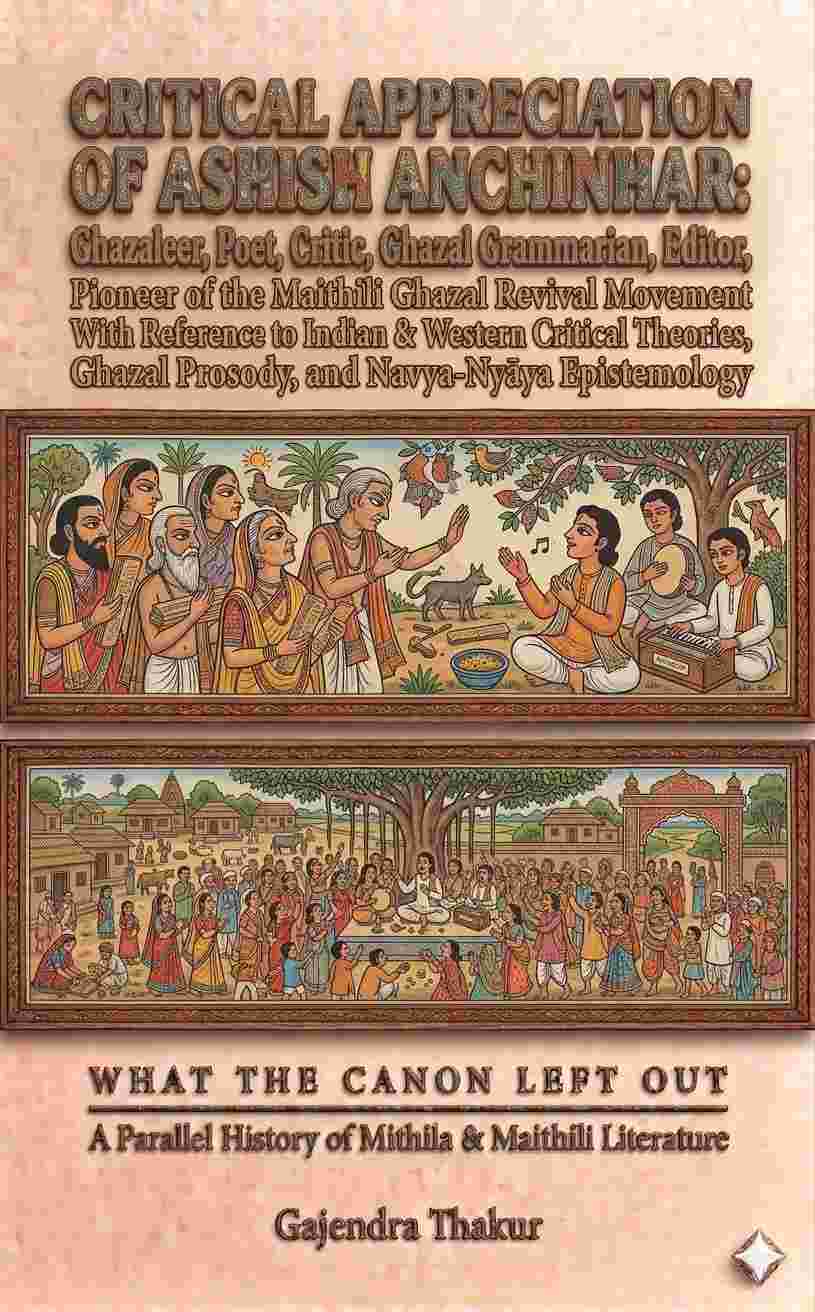
CRITICAL APPRECIATION OF ASHISH ANCHINHAR Ghazaleer, Poet, Critic, Ghazal Grammarian, Editor Pioneer of the Maithili Ghazal Revival Movement With Reference to Indian & Western Critical Theories, Ghazal Prosody, and Navya-Nyāya Epistemology
CRITICAL APPRECIATION OF
ASHISH ANCHINHAR
Ghazaleer, Poet, Critic, Ghazal Grammarian, Editor
Pioneer of the Maithili Ghazal Revival Movement
With Reference to Indian & Western Critical Theories,
Ghazal Prosody, and Navya-Nyāya Epistemology
TABLE OF CONTENTS
FOREWORD
This critical appreciation of Ashish Anchinhar (आशीष अनचिन्हार), born Ashish Kumar Mishra on 4 December 1985 in Bhatra Ghat, Bisfi, Madhubani (Mithila) Bihar, represents a sustained attempt to situate his contribution to Maithili literature within the interlocking frameworks of classical Arabic-Persian ghazal poetics, modern Indian literary criticism, Western critical theory, and the epistemological rigour associated with the Navya-Nyāya tradition of Mithila — particularly as codified by Gaṅgeśa Upādhyāya in the Tattvacintāmaṇi. Anchinhar's work is inseparable from the Videha Parallel Literature Movement spearheaded by Gajendra Thakur through the Videha eJournal (ISSN 2229-547X, www.videha.co.in), the first Maithili fortnightly eJournal, which has served since 2000 as the primary institutional vehicle for democratising Maithili literary production against the hegemony of the Sahitya Akademi canon.
The books consulted for this study include Anchinhar's own published volumes available through the Videha archive: Anchinhar Aakhar (2011, Shruti Publication, Delhi), Maithili Ghazalak Vyakaran O Itihas, Sandarbh Sahit, Maithili Ghazal: Aagaman O Prasthan Bandh (co-edited with Gajendra Thakur), Maithilīk Pratinidhi Ghazal 1905-2022 (co-edited with Gajendra Thakur), Swatantracheta Arvind Thakur (edited), and the major critical appreciation volumes Preeti Karan Setu Banhal (edited) and Setusham: Vibrant Maithili (edited). These primary sources are read alongside the Videha archive and the broader tradition of Maithili, Urdu, Persian, Arabic, and comparative literary scholarship.
The study is organised into seven major sections: (I) biographical and intellectual context; (II) the ghazal form and Anchinhar's formal innovations; (III) thematic and ideological dimensions of his poetry; (IV) his contribution as a critic and theorist; (V) reading Anchinhar through Indian critical traditions; (VI) Western critical frameworks applied to his work; and (VII) Navya-Nyāya epistemology as a meta-critical lens for his poetics of evidence, inference, and literary sabda-śakti.
I. BIOGRAPHICAL AND INTELLECTUAL CONTEXT
Around 2008, a proposal was made to Ashish Anachinhar to become the Sub-Editor of Videha. However, he did not accept the position; instead, he became a collaborator of Videha anonymously and continues to be a collaborator to this day. From time to time, Ashish Anachinhar keeps providing many creative ideas for Videha, which reach the readers through the medium of the publication.
People from the "mainstream" and the Sahitya Akademi harbor a sense of resentment toward Ashish Anachinhar's work. The reason is that his work publicly exposes the incompetence of both the mainstream and the Akademi. Consequently, apart from the Samanantar Dhara (Parallel Stream), he remains excluded from the lists of any other awards.
1.1 Life and Formation
Ashish Anchinhar was born on 4 December 1985 in Bhatra Ghat, Bisfi, Madhubani district of Bihar - the heartland of Mithila. His father Shri Krishna Chandra Mishra and mother Srimati Gambhira Mishra nurtured him in a region that has been, since at least the era of Pre-Jyotirishwar Vidyapati [different from Vidyapati (1350-1435)], the crucible of Maithili literary sensibility. His pen name Anchinhar (अनचिन्हार, meaning 'unrecognised' or 'unfamiliar' one who is not yet known) carries with it both a manifesto and a challenge: to give voice to that which has been passed over, silenced, or misrecognised by the hegemonic apparatus of Sahitya Akademi-sanctioned literature.
He began writing Maithili ghazal and sher-o-shairi on the internet platform Anchinhar Aakhar (http://anchinharakharkolkata.blogspot.com/) from around 2000, making him one of the earliest consistent practitioners of the ghazal form in Maithili in the digital era. His formal debut as a published poet came with Anchinhar Aakhar (2011), a collection of Maithili ghazal, ruba'i, and kata - a volume distinguished by its strict adherence to Arabic-Persian bahr (metre) and its programmatic refusal to permit formally defective compositions to pass as ghazal.
Anchinhar received the Videha Bhasha Samman (the Videha equivalent of the Sahitya Akademi Award, the so-called 'Samaantar Sahitya Akademi Samman') for the year 2014 for Anchinhar Aakhar, awarded by Pankalal Mandal. This recognition, conferred by the Videha Parallel Literature Movement, is itself a political and aesthetic statement: the Videha movement deliberately constitutes an alternative canon-building institution, rewarding work that the Sahitya Akademi ignores or marginalises.
Through Videha, Anchinhar established himself as a collaborator of Gajendra Thakur in multiple co-edited volumes. His editorial work on Swatantracheta Arvind Thakur (2020, Shashi Prakashan, Kalikapur, Supaul) a revised edition of the Videha special issue on the poet Arvind Thakur demonstrates his engagement with the broader Mithila subaltern literary project.
1.2 The Videha Ecosystem and the Parallel Literature Movement
To understand Anchinhar's significance, one must understand Videha. Founded by Gajendra Thakur through the blog Bhalsarik Gachh (2000) — which constitutes the oldest surviving Maithili presence on the internet — and later institutionalised as Videha (since 1 January 2008), the eJournal publishes fortnightly and has accumulated an archive of over 258 web captures from 2004 to 2016 alone (Wayback Machine data). Its motto — Mānuṣīmahi Saṃskṛtām (from the Atharvaveda: 'Glorifying the human feminine/cultural') — announces its counter-hegemonic, subaltern-inclusive, gender-sensitive orientation.
The Videha Parallel Literature Movement, of which Anchinhar is a central figure, operates on several simultaneous axes: (a) formal correctness — insisting on proper prosodic standards against the laxity that has permitted formally defective compositions to circulate as ghazal; (b) linguistic purification — privileging authentic Maithili lexicon and morphology over Hindi-influenced hybridisation; (c) ideological intervention — amplifying Dalit, subaltern, feminist, and non-Brahminical voices; (d) digital preservation — creating a permanent, publicly accessible, freely downloadable archive of Maithili literature; and (e) institutional rivalry — the movement explicitly positions itself against the Sahitya Akademi's canon-gatekeeping function.
Anchinhar's own books, all available through the Videha archive (www.videha.co.in/pothi.htm), embody this programme at every level, from formal prosodic rigour to the politics of recognition.
1.3 Published Works: An Overview
The following are Anchinhar's principal published works:
(1) Anchinhar Aakhar (अनचिन्हार आखर) — Ghazal, Ruba'i and Kata. Shruti Publication, New Delhi, 2011. ISBN 978-93-80538-48-8. This is his debut collection and the work that won the Videha Bhasha Samman 2014.
(2) Maithili Ghazalak Vyakaran O Itihas (मैथिली गजलक व्याकरण ओ इतिहास) — The Grammar and History of Maithili Ghazal. A comprehensive technical and historical monograph in 25 chapters covering ghazal grammar from Arabic-Persian-Urdu sources adapted for Maithili phonology, metre (bahr), rhyme (qafiya), refrain (radif), and a full history of the Maithili ghazal tradition from 1905 to the present.
(3) Sandarbh Sahit (संदर्भ सहित) — A collection of Anchinhar's critical essays, reviews, and analytical pieces on ghazal, ghazal prosody, and the question of what does or does not constitute a genuine ghazal in Maithili. This volume argues for strict formal standards against what Anchinhar calls 'kathit ghazal' (so-called ghazal) — compositions that bear the name but lack the formal substance.
(4) Maithili Ghazal: Aagaman O Prasthan Bandh (मैथिली गजल: आगमन ओ प्रस्थान बन्ध) — Co-edited with Gajendra Thakur. A critical anthology bringing together criticism, review, and analytical writing on ghazal by multiple critics including Om Prakash Jha, Amit Mishra, Jagdanand Jha 'Manu', Jagdish Chandra Thakur 'Anil', and Muzna Ji. This is described as the first book in Maithili devoted exclusively to ghazal criticism.
(5) Maithilīk Pratinidhi Ghazal 1905-2022 (मैथिलीक प्रतिनिधि गजल) — Co-edited with Gajendra Thakur. A representative anthology of Maithili ghazal from 1905 (the year of the earliest documented Maithili ghazal by Pandit Jivan Jha) to 2022, divided by period and by formal category (Arabic bahr vs. simplified/folk metre).
(6) Swatantracheta Arvind Thakur (स्वतन्त्रचेता अरविन्द ठाकुर) — A monograph on the poet Arvind Thakur; edited work, 2020.
(7) Forthcoming/e-published: Jangha Jodi (जंघाजोड़ी), Kumari Ichchha (कुमारि इच्छा), Shabd-Arth-Shakti (शब्द-अर्थ-शक्ति — the first standalone Maithili ghazal criticism book), Maithili Ghazal Ready Reckoner.
He has edited Preeti Karan Setu Banhal: Redefining Maithili (2023, ISBN 978-93-340-0956-9) and Setusham: Vibrant Maithili (2026, ISBN 978-93-5717-358-2), the major critical appreciation volumes celebrating the literary contributions of Gajendra Thakur and Preeti Thakur.
II. THE GHAZAL FORM: TRADITION, INNOVATION, AND ANCHINHAR'S CONTRIBUTION
2.1 The Classical Architecture of the Ghazal
The ghazal is among the most ancient and technically demanding of the lyric forms that migrated from Arabic through Persian and Urdu into the vernacular literatures of South Asia. In Arabic poetics, the form derives from the qasida tradition; the ghazal as an independent genre with its distinctive formal requirements crystallised during the Umayyad period (661-749 CE), with significant contributions from poets such as 'Umar ibn Abī Rabī'a (643-711 CE) and Jamīl Buthaynā (d. 701 CE). The Persian ghazal reached its classical pinnacle in the work of Hafiz Shirazi (1315-1390 CE), Sa'di, Rumi, and later Saba, Waqif, and Ghanī Kashmīrī. The form entered the Urdu literary tradition through Amīr Khusrau and was perfected by Mīr Taqī Mīr, Ghālib, and Momin.
The formal requirements of the classical ghazal, as articulated by Anchinhar in the Maithili Ghazalak Vyakaran O Itihas, are strictly defined. The ghazal must consist of a minimum of five and a maximum of seventeen she'r (verses/couplets); later practice has extended this range. Each she'r is formally complete and independent — this is the principle of beher-e-ghair-musalsal, the unconnected ghazal — though the musalsal (connected) variant also exists. The maqta' (closing couplet) traditionally contains the poet's takhallus (pen name). The matla' (opening couplet) establishes both the qafiya (rhyme) and the radif (refrain), with both hemistiches of the matla' carrying the qafiya and radif. All subsequent she'r carry the qafiya and radif only in the second hemistich. The bahr (metre) must be consistent throughout the ghazal; this is the most technically demanding requirement, as the bahr system is derived from Arabic prosody (arūḍ) which operates on a complex pattern of long (dīrgha) and short (laghu) syllables quite distinct from the syllabic-accentual patterns of Sanskrit vṛtta.
In Maithili, as Anchinhar demonstrates with painstaking analysis in the Vyakaran O Itihas, the application of Arabic-Persian bahr requires careful attention to Maithili-specific phonological features: the treatment of anusvara (nasalisation) and chandrabindu (nasal vowel modification), the status of conjunct consonants (saṃyuktākṣara) in syllable weight, and the disambiguation of certain phonological categories (the distinction between e/ai and o/au) that have no exact parallel in either Sanskrit or Urdu phonology.
2.2 The Maithili Ghazal Tradition Before Anchinhar
Anchinhar, in his co-edited Maithilīk Pratinidhi Ghazal (1905-2022), provides the most comprehensive available history of the Maithili ghazal tradition. The earliest documented Maithili ghazal is attributed to Pandit Jivan Jha (active ca. 1905), whose ghazals show approximately 70-80% conformity to classical metre (bahr) — a remarkable achievement for the pioneering phase of a form whose technical requirements were being adapted from an entirely different language family. Anchinhar notes that even those earliest compositions that fall short technically nonetheless show awareness of the principle: 'jote bahan tatbahr se tat prakash jha ka ghazal se baher o bhaav noo si paripurn achhi.'
The period 1931-1970 saw contributions from Kavivara Sitaram Jha and Kashikant Dharm 'Madhup'. After 1970 through 2008, Jagdish Chandra Thakur 'Anil', Yoganand Hira, and Vijanath Jha made significant contributions. The post-2008 phase, coinciding with the expansion of the Videha platform, saw the emergence of a systematic ghazal movement led by Anchinhar, Gajendra Thakur, Om Prakash Jha, Amit Mishra, Jagdanand Jha 'Manu', Pankaj Chaudhary 'Navalshri', and others.
Anchinhar's own historical survey identifies a persistent problem: from 1970 through approximately 2008, many Maithili literary figures published compositions they labelled 'ghazal' but which failed to meet the basic formal requirements of bahr, qafiya, or radif. His Sandarbh Sahit is partly a systematic critique of this tendency — a book he himself describes as the 'third book in Maithili devoted to ghazal criticism' (the first two being Gajendra Thakur's Maithili Samikshashstra and Anchinhar's own Shabd-Arth-Shakti).
2.3 Anchinhar's Formal Poetics
The defining characteristic of Anchinhar's own ghazals in Anchinhar Aakhar is strict formal correctness. In his brief introduction to the collection, he explains the word ghazal itself — derived from Arabic, with primary meanings of 'fine dust' (as when grain is threshed, the purest flour separates) and 'amorous conversation' — and reads these two meanings together as a formal-aesthetic programme: the ghazal is the art of separating the pure from the impure through a discipline of the word (ākhara), analogous to threshing, and it is simultaneously the articulation of desire in its most refined form — not merely physical but spiritual, the discourse of the ātman as premi (beloved) with the paramātman as lover.
One of his characteristic ghazals from Anchinhar Aakhar illustrates his formal mastery:
Ahã
sanga prema karabāpara birata hama
apatī Khetame marabāpara birata hama
The second misra' (hemistich) carries the radif 'par birat ham' and the qafiya follows the long-ā vowel rhyme pattern ('karbā', 'marbā'). The bahr is sustained throughout. This precision marks a deliberate contrast with the formally lax compositions he critiques as 'kathit ghazal' (so-called ghazal).
His use of Maithili-specific vocabulary and morphology — the verbal forms 'birat', 'marbā', 'karbā' — rather than Hinduised or Sanskritised alternatives, marks his adherence to what the Videha movement identifies as authentic Maithili linguistic identity. The choice of 'apaṭī khet' (the threshing field, or figuratively, the field of death/rites) connects the semantic field of the ghazal etymology (dust/threshing) to a Maithili cultural landscape.
2.4 The 'Anchinhar Formula' for Literary Evaluation
One of Anchinhar's most significant theoretical contributions is what he himself (with characteristic self-deprecating irony) calls the 'Anchinhar Formula' — a three-part evaluative criterion for judging any literary composition. The formula, articulated in the ghazal criticism preface to Maithili Ghazal: Aagaman O Prasthan Bandh, proposes three axes of evaluation:
First, Shakti-Kadrат (strength/power of relevance): Does the composition engage with power? If it addresses a contemporary figure or institution, how much 'distance' (rī, from Arabic) is there between the writer and the subject? A composition that criticises distant targets (e.g., international figures) at no personal risk to the writer demonstrates less courage than one that confronts proximate power. A journalist who exposes local corruption and risks their life demonstrates more rī than a writer who attacks a foreign leader safely.
Second, Vishay Kadrat (subject-based relevance): Has the writer made an obscure subject or genre available and beloved to their readers? Has the writer expanded the literary horizon? Anchinhar himself qualifies under this criterion: he has made the technically demanding ghazal form, previously confined to a small coterie, accessible to Maithili readers through systematic pedagogy.
Third, Tatya Kadrat (factual/evidentiary relevance): Does the composition rest on evidence? Are names named? Can the claims be verified? Anonymous or generalised social criticism is weaker than named, documented, verifiable criticism.
This formula is explicitly epistemological in character. As we shall see in Section VII, its structure resonates remarkably with Navya-Nyāya categories of inference and testimony.
III. THEMATIC AND IDEOLOGICAL DIMENSIONS
3.1 The Critique of 'Kathit Ghazal' and the Politics of Form
The bulk of Anchinhar's critical writing in Sandarbh Sahit is devoted to what he calls kathit ghazal — so-called ghazal — compositions that circulate under the name but fail to meet the formal requirements. His analyses of individual collections (he names Baikuntha Jha, Suhangshu Shekhar Chaudhary, Narendra, Baba Baidyanath, and others) are conducted with forensic precision: he examines each composition for bahr (metre), qafiya (rhyme), radif (refrain), and the specific Maithili phonological requirements he has established in the Vyakaran O Itihas. His conclusions are unsparing — a composer who has written ghazals for fifty years without mastering bahr has, in Anchinhar's assessment, simply not written ghazal.
This insistence on form is not mere formalism. It is ideological. The claim that any emotionally resonant rhymed composition qualifies as ghazal is, for Anchinhar, not democratic but anarchic — it destroys the very thing it claims to celebrate. His formula is: 'Anushasan + Virodh = Parivartan: Anushasan-hinta + Virodh = Arajkata' (Discipline + Protest = Change: Lack of Discipline + Protest = Anarchy). This formula articulates a political aesthetic: genuine protest requires formal discipline; undisciplined protest merely produces noise.
3.2 Social and Ethical Dimensions of the Ghazal
Anchinhar's ghazals are not merely formal exercises. The thematic range of Anchinhar Aakhar — ghazals, ruba'i, and kata — engages with social inequality, political cowardice, the compromised position of the intellectual in contemporary India, and the specific predicament of the Maithili-speaking people whose language has been systematically marginalised. Several ghazals address the experience of displacement, labour, and political disenfranchisement with an economy of language typical of the classical sher. In the preface to his ghazal criticism, he advances an ethics of the writer: the distance between a writer's life-praxis (kamma) and their creative praxis (lekhan) must be minimised. A writer who exploits women in personal life but celebrates women in poetry fails the ethical standard of rī. Anchinhar invokes the example of journalists killed in Bihar and Maharashtra — those killed faced proximate power, hence demonstrated real rī.
The ideological implication is significant: Anchinhar demands that ghazal — traditionally conceived as a form of intimate, self-contained lyric — bear public testimony. This extends the form's traditional ambit (the private discourse of love-yearning) into a register of civic responsibility.
3.3 Language Politics: Maithili Against Hindi Hegemony
Throughout his critical and creative work, Anchinhar is insistent on authentic Maithili morphology and phonology. His analysis of bahr for Maithili insists that conjunct consonants (saṃyuktākṣara) must be treated according to the established rules of classical Maithili grammar (as documented in sources like the Mithila Bhasha Vidyotan), not according to Sanskrit or Hindi convention. He draws a sharp distinction between the chandrabindu (which indicates a nasalised vowel, short in duration) and the anusvara (which adds length). These distinctions are not pedantic; they are load-bearing, because in bahr-based composition, a single misplaced laghu or dīrgha syllable ruins the metre.
This insistence connects Anchinhar's poetics to the Videha movement's broader project of Maithili linguistic sovereignty — its refusal to allow Maithili to be absorbed into Hindi as a mere dialect, and its insistence on the language's independent grammatical and literary history going back to Vidyapati and beyond.
IV. ANCHINHAR AS CRITIC AND THEORIST
4.1 The Maithili Ghazalak Vyakaran O Itihas: A Scholarly Assessment
The Maithili Ghazalak Vyakaran O Itihas is Anchinhar's most substantial scholarly contribution. Its 25 chapters cover: the definition and etymology of the ghazal; the origin and development of the form in Arabic literature from the Jāhiliyya period through the Umayyad; the entry of the ghazal into Persian and its transformation; the coming to India through Amīr Khusrau and the Mughal period; the development of Urdu ghazal through Mīr, Ghālib, and others; and the parallel history of the Maithili ghazal from Pandit Jivan Jha (1905) to 2022.
The technical chapters on metre (bahr) constitute perhaps the most systematic codification of ghazal prosody for a Bihari vernacular language ever attempted. Anchinhar works through all the major Arabic baḥr (metres) — ḥazaj, ramal, kāmil, wāfir, basīṭ, ṭawīl, madīd, munsariḥ, khafīf, muḍāri', muqtaḍab, majzūʾ variants — and demonstrates Maithili examples for each, with careful notation of syllable weight using the laghu-dīrgha system adapted from Sanskrit prosody. He notes the points of tension between Sanskrit prosodic practice (vṛtta) and Arabic prosodic practice (arūḍ), particularly regarding the treatment of saṃyuktākṣara (where traditional Maithili prosodists like the compiler of Mithila Bhasha Vidyotan hold that conjunct consonants add weight to the preceding short syllable), and argues for a phonologically grounded Maithili position rather than blind adherence to either Sanskrit or Urdu precedent.
The historical section (Chapter 25) is the most important historical survey of Maithili ghazal yet produced, drawing on sources from the Videha archive and locating the Maithili ghazal within the broader context of the Mithila literary tradition and the cultural history of the Kosi-Kamla-Bagmati river region.
4.2 Sandarbh Sahit: The Critical Method
Anchinhar's critical method in Sandarbh Sahit deserves examination as a critical methodology in its own right. His method is forensic rather than impressionistic. He does not offer impressionistic or evaluative responses to the emotional effect of a composition; he examines it formally, names its defects with precision, and draws conclusions. His approach is in explicit contrast to what he calls 'antya-purush bhasha mein alochana' — criticism written in the third person, so vague that it is impossible to determine who or what is being criticised. He insists on naming names.
This methodological commitment to nominative criticism — the requirement to name the subject of critique — is both a critical principle and an ethical one. It is anti-feudal in the context of Maithili literary culture, where the entanglement of caste, community, kinship, and patronage has historically made open criticism of senior figures dangerous or professionally costly. Anchinhar's willingness to critique senior figures by name — including recipients of major awards — is itself a political act.
4.3 The Maithili Web Journalism History
In Maithili Web Patarkaritak Itihas (History of Maithili Web Journalism), Anchinhar documents the emergence and development of Maithili digital literary journalism, centred on the Videha project. This work establishes a genealogy of the Maithili digital literary movement: from the Bhalsarik Gachh blog (2000, the oldest surviving Maithili internet presence), through the establishment of the Videha eJournal (2008), to the proliferation of Maithili digital platforms in subsequent years. The work is both a historical record and a polemical document, arguing for the centrality of digital publishing to the democratisation of Maithili literary production.
V. INDIAN CRITICAL FRAMEWORKS
5.1 Rasa Theory and the Ghazal
The rasa system — the eight (later nine) aesthetic emotions (rasa) identified by Bharata in the Nāṭyaśāstra and elaborated by Ānandavardhana, Abhinavagupta, and others — provides one of the most productive Indian frameworks for reading Anchinhar's ghazals. The dominant rasa of the ghazal tradition is śṛṅgāra (erotic love), but its actualisation in the ghazal is almost always in the mode of vipralambha (love in separation/yearning) rather than sambhoga (love in union). This structural preference for loss, longing, and non-fulfilment is not accidental: it encodes a metaphysics in which the beloved (traditionally the divine, or more proximately, the unattainable human beloved) remains always at a remove, and the poem is the speech of that irremediable distance.
Ānandavardhana's theory of dhvani (resonance/suggestion) — the idea that the most powerful literary meaning operates not through the primary denotative function of words (abhidhā) but through their suggestive or evocative power (vyañjanā) — is particularly relevant to the ghazal. The she'r is a compressed unit that must achieve its full meaning within two lines, and the mechanism by which it achieves this is almost always dhvani: the literal surface meaning carries a secondary or tertiary meaning that is the poem's real concern. Anchinhar's own definition of the ghazal invokes this mechanism: the first meaning of the word ghazal (dust/threshing) suggests a process of purification through separation; the second meaning (amorous discourse) suggests desire's economy of proximity and distance. The interplay between these two meanings — formal and thematic — is precisely the dhvani structure.
Abhinavagupta's concept of sādhāraṇīkaraṇa (generalisation or universalisation of aesthetic experience) is also relevant: the personal grief or desire expressed in a she'r is not merely personal but is aesthetically universalised, accessible to all receptive readers as an emotional archetype. This is why the ghazal she'r can be extracted from its original context and sung, quoted, or misapplied without losing its power.
5.2 Vakrokti and the Economy of the Sher
Kuntaka's theory of vakrokti (oblique expression, in the Vakroktijīvita) offers another productive framework. Kuntaka argues that the distinguishing mark of poetic language is not its denotation but its obliqueness — its power to mean more than, and other than, what it literally says. The she'r is quintessentially vakrokti: its compressed two-line structure forces meaning through compression, juxtaposition, and the management of the semantic tension between the two hemistiches (one leading to a disjunction, the other to a resolution or reversal).
Anchinhar's critical insistence on formal correctness — on bahr, qafiya, radif — can be read in Kuntaka's terms as an insistence on the formal conditions that make vakrokti possible. A formally defective she'r — one in which the bahr collapses, or the qafiya is forced — cannot achieve the compression and obliqueness that constitute the she'r's aesthetic meaning. Formal defects are not merely technical imperfections; they are aesthetic failures that destroy the conditions of possibility for poetic experience.
5.3 The Mithila Navya-Nyāya Tradition and the Question of Śabda-Śakti
Anchinhar's book Shabd-Arth-Shakti (Word-Meaning-Power) — described as the first standalone Maithili ghazal criticism book — takes its title from a concept central to both Sanskrit poetics and the Navya-Nyāya logical tradition: the relationship between śabda (word), artha (meaning), and śakti (power/capacity). This is not a coincidence. The Maithili literary tradition is rooted in Mithila, the epicentre of the Navya-Nyāya school; any serious Maithili scholar is inevitably in dialogue with the epistemological and semantic tradition that runs from Gaṅgeśa Upādhyāya (ca. 14th century) through Raghunātha Śiromaṇi and Jagadīśa Tarkālaṃkāra.
In Navya-Nyāya semantics, śabda-śakti is the inherent power of a word to convey its meaning. The analysis of this śakti is conducted with extreme precision: Navya-Nyāya distinguishes between the primary denotative power (mukhyavṛtti or śaktimūla), the secondary or transferred power (lakṣaṇā), and the suggestive power (vyañjanā) — a tripartite scheme that corresponds to Ānandavardhana's poetic framework but is formulated with the rigour of logical analysis. The Navya-Nyāya tradition insists that every semantic claim must be grounded in a valid pramāṇa (source of knowledge): pratyakṣa (perception), anumāna (inference), or śabda (verbal testimony — itself subdivided into vedic and secular sources).
Anchinhar's 'Anchinhar Formula' can be read as a prosaic translation of pramāṇa-theory into literary evaluation: the three axes of his formula (shakti-kadrat, vishay-kadrat, tatya-kadrat) map roughly onto the Nyāya pramāṇa categories of (respectively) anumāna (inference from power/distance), vyāpti (pervasion/scope — the subject's generative capacity), and pratyakṣa/śabda (evidential verification by named, observable testimony).
5.4 Subaltern Literary Theory and the Dalit Canon
Anchinhar's work must also be situated within the broader framework of subaltern literary theory as it has developed in the Indian context. The Videha Parallel Literature Movement's explicit commitment to publishing Dalit, tribal, and marginalised voices — including translated work from Telugu, Gujarati, and Odia Dalit literatures — establishes a clear ideological alignment with the Dalit literary movements associated with figures like Namdeo Dhasal, Bama, Durgabai Vyam, and the broader tradition of ambedkarite literary thought. Anchinhar's own critical criteria — especially his insistence on rī (the proximity between writer and target as a measure of literary courage) — implicitly echoes ambedkarite demands that intellectuals be accountable to the communities they claim to speak for or about.
The concept of 'parivarik rachna' (familial composition — writing that flatters one's own community and attacks others from a safe distance) is, in Anchinhar's critical vocabulary, the aesthetic counterpart of what Ambedkar called 'graded inequality' — a system in which proximity to power determines the permitted range of critique.
VI. WESTERN CRITICAL FRAMEWORKS
6.1 New Criticism and the Autonomy of the Text
The New Critical tradition — associated with I.A. Richards, William Empson, Cleanth Brooks, and Robert Penn Warren — championed close reading and the autonomy of the literary text, insisting that poems be read on their own terms without recourse to biographical, historical, or intentionalist interpretations. At first glance, this appears aligned with the ghazal's own formal ethic: the she'r is self-contained, formally complete, and semantically autonomous. Anchinhar's formal criticism — his analysis of bahr, qafiya, and radif as the structural conditions of the ghazal's aesthetic success — shares with New Criticism a commitment to intrinsic rather than extrinsic analysis.
However, Anchinhar's critical practice departs from New Criticism in precisely the dimension that the Videha movement most prizes: the commitment to naming, to accountability, to the writer's life-praxis as an element of critical judgment. New Criticism's bracketing of the biographical is, from the perspective of the 'Anchinhar Formula', a form of critical cowardice — a refusal to engage with the rī between the writer and their subject.
6.2 Mikhail Bakhtin: Dialogism, the Chronotope, and the Novelistic Word
Bakhtin's concept of dialogism — the idea that every utterance is in dialogue with previous utterances, that meaning is always situated in a multi-voiced conversational field — provides a productive framework for reading Anchinhar's critical project. The ghazal, with its she'r that can be quoted independently, applied in conversation, and mis-applied or re-applied in new contexts, is structurally dialogic: each she'r is, as it were, an autonomous utterance that enters into dialogue with every other deployment of the same qafiya-radif pattern, and with the entire tradition of the form.
Anchinhar's insistence on formal correctness can be read in Bakhtinian terms as a defence of the dialogic vitality of the ghazal tradition: a formally defective 'ghazal' that disrupts the bahr is not merely aesthetically weak; it disrupts the dialogic chain that connects each new ghazal to the tradition of Hafiz, Ghalib, and Pandit Jivan Jha. The 'kathit ghazal' is, in Bakhtinian terms, a monologic imposition — a unilateral claim to participate in a dialogic tradition without submitting to the discipline that makes that dialogue possible.
6.3 Harold Bloom: The Anxiety of Influence
Harold Bloom's theory of the anxiety of influence — the idea that every strong poet must struggle against the overwhelming presence of their precursors through strategies of creative misreading (clinamen, tessera, kenosis, daemonization, askesis, apophrades) — provides a useful lens for reading Anchinhar's relationship to the Arabic-Persian-Urdu ghazal tradition. Anchinhar's formal insistence on bahr is a tessera — a completion and antithesis — with respect to the Urdu ghazal tradition: he honours the formal requirements of the tradition while insisting on their adaptation to Maithili phonology, thereby simultaneously claiming and transforming the inheritance.
His critique of 'kathit ghazal' composers can be read as a defensive manoeuvre against poetic kenosis — the emptying-out of the form that occurs when secondary poets abrogate the formal requirements that constitute the tradition's power. The 'Anchinhar Formula' is, in Bloom's terms, a critical daemonization: a systematic attempt to re-establish the demon (the formal requirement) that earlier practitioners had banished.
6.4 Foucault: Discourse, Archive, and the Politics of Literary Recognition
Michel Foucault's concept of discourse — a system of knowledge/power that determines what can be said, who can say it, and what counts as legitimate literary production — is directly applicable to the institutional politics within which Anchinhar's work operates. The Sahitya Akademi constitutes a discursive regime in Foucault's sense: it determines the canon of legitimate Maithili literature, controls access to prizes and recognition, and has historically privileged certain caste, class, and aesthetic formations over others.
The Videha Parallel Literature Movement's strategy of creating a parallel archive — a counter-memory in Foucauldian terms — that documents and preserves work excluded by or invisible to the official canon is itself a Foucauldian genealogical project: an excavation of the suppressed, marginalised, and unofficial literary tradition. Anchinhar's own pen name — Anchinhar, the unrecognised — encodes this Foucauldian self-positioning: he writes from outside the regime of recognition, making a virtue of institutional invisibility.
6.5 Jacques Derrida: Différance, the Supplement, and the Text
Derrida's concept of différance — meaning as constituted by difference and deferral, never fully present but always displaced — finds an unexpected resonance in the structural logic of the ghazal. The she'r operates through a logic of deferral: the first hemistich (misra'-e-ulā) sets up a semantic field that is modified, reversed, or transcended by the second hemistich (misra'-e-thānī). The radif — the recurring refrain — is the locus of this deferral: repeated in every she'r, it never means exactly the same thing, because each she'r's first hemistich recontextualises it. The radif is, in Derridean terms, a supplement that is always both excess and lack: each repetition adds to the meaning of the preceding occurrences while simultaneously deferring the final, complete meaning that will never arrive.
Anchinhar's emphasis on radif as an obligatory structural element (required in all she'r except the matla') and on the distinction between takhallusi radif (internal rhyme-refrain) and conventional radif points to his awareness of the structural complexity of the refrain's semantic function — even if his discourse is that of prosody rather than deconstruction.
6.6 Edward Said: Orientalism and the Counter-Tradition
Said's Orientalism — the thesis that Western representations of the 'Orient' constitute a discursive formation that serves imperial power — has a specific relevance in the context of the Maithili ghazal's relationship to its Arabic-Persian origins. The history of the ghazal's transmission to South Asia is inseparable from the history of Islamicate cultural influence, and Anchinhar's project of adapting Arabic-Persian prosody for a Hindu-Maithili literary context is itself a complex negotiation between what Said would identify as the pressures of an 'origin' culture (Arabic-Persian-Urdu) and the resistances of a 'receiving' culture (Maithili-Hindu-Mithila).
Anchinhar's insistence on formal correctness — on honouring the formal requirements of the Arabic bahr even while adapting them for Maithili — can be read as a refusal of both orientalist condescension (the idea that Indian vernacular literatures cannot sustain the formal rigour of Arabic-Persian prosody) and nativist rejection (the idea that the ghazal is a foreign form that should be abandoned for 'purely Indian' alternatives). He occupies the in-between: a practitioner who claims the form in full formal dignity.
VII. NAVYA-NYĀYA EPISTEMOLOGY AND ANCHINHAR'S POETICS OF EVIDENCE
7.1 Gaṅgeśa Upādhyāya and the Navya-Nyāya Tradition
Gaṅgeśa Upādhyāya (ca. 14th century, Mithila) — whose Tattvacintāmaṇi constitutes the foundational text of the Navya-Nyāya school — was himself a Maithili from the same cultural heartland that produced Vidyapati, and from which Anchinhar comes. The Navya-Nyāya school, as codified by Gaṅgeśa and extended by Vardhamāna, Pakṣadhara Miśra (Jayadeva), Raghunātha Śiromaṇi, and Jagadīśa Tarkālaṃkāra, constitutes the most rigorous system of formal epistemology produced in the Sanskrit philosophical tradition. Its influence on later Indian logic, linguistics, and literary theory — through figures like Jagannātha Paṇḍitarāja, who brought Navya-Nyāya concepts into Sanskrit poetics — is pervasive.
The core epistemological project of the Tattvacintāmaṇi is the analysis of pramāṇa — the valid sources of knowledge. Gaṅgeśa examines pratyakṣa (perception), anumāna (inference), upamāna (comparison), and śabda (verbal testimony) with unprecedented analytical precision, using the Navya-Nyāya technical vocabulary of viśeṣyatā (qualificand-hood), prakāratā (qualificand-ness), saṃsargitā (relational-hood), and the complex notation system for representing cognitive content that later scholars have compared to modern symbolic logic.
7.2 The 'Anchinhar Formula' as Pramāṇa Theory
The structural parallel between Anchinhar's evaluative formula and Gaṅgeśa's pramāṇa theory is striking and, given the Maithili cultural context, unlikely to be entirely accidental. The three axes of the 'Anchinhar Formula' — shakti-kadrat, vishay-kadrat, tatya-kadrat — can be mapped onto pramāṇa categories as follows:
Tatya-kadrat (factual evidence): corresponds most directly to śabda-pramāṇa in the empirical sense — the requirement for named, verifiable testimony. In Navya-Nyāya terms, this is the demand that the vyāpara (operative function) of literary knowledge-claims be grounded in a datable, nameable, traceable source. Anchinhar's demand that critics name their subjects maps onto the Navya-Nyāya demand that every inferential claim be grounded in a specifically identified pakṣa (subject of inference) and sādhya (property to be proved).
Shakti-kadrat (power proximity): corresponds to anumāna (inference) in a specific sense — the inference of a writer's actual commitment from observable evidence of risk-taking. In Navya-Nyāya, anumāna is grounded in vyāpti (invariable concomitance): the claim 'this writer is courageous' is inferred from 'this writer names powerful proximate targets.' The vyāpti — naming powerful targets → risk → courage — is an empirically grounded universal that Anchinhar invites us to apply case by case.
Vishay-kadrat (subject expansion): corresponds most closely to the Navya-Nyāya concept of viśeṣa-siddhi (the achievement of something specific) — the capacity to generate new, distinctive knowledge rather than simply reorganise the known. Anchinhar's criterion asks whether the writer has expanded the domain of the known, made accessible what was previously obscure. This is a form of semantic innovation — new śabda-śakti — that parallels the Navya-Nyāya interest in distinguishing genuine novelty of knowledge from mere rearrangement.
7.3 Śabda-Śakti in Navya-Nyāya and the Ghazal
The concept of śabda-śakti — the power of the word — receives its most rigorous analysis in the Navya-Nyāya tradition, particularly in the Śabdaśakti-prakāśikā of Jagadīśa Tarkālaṃkāra. The Navya-Nyāya analysis identifies śakti as the relation between a word token and its referent — not an intrinsic property of the word-type but a conventionally established relation (nimittā) that grounds the word's capacity to generate linguistic cognition (śābdabodha).
The concept of tātparya (speaker's intention/purport) in Navya-Nyāya semantics — the idea that understanding a sentence requires grasping not merely the meanings of individual words but the speaker's overall communicative intention — is directly applicable to the ghazal she'r. The she'r is structured precisely around the tension between individual word-meanings and overall tātparya: the skill of the ghazalgo consists in constructing a she'r whose individual words are transparent but whose tātparya is oblique, multiple, or transcendent. Anchinhar's title Shabd-Arth-Shakti invokes this semantic structure: word (śabda) → meaning (artha) → power (śakti) is not a simple linear progression but a recursive loop in which the power of meaning gives new meaning to the word.
The Navya-Nyāya concept of upādhi (adventitious condition) — a condition that appears to be part of the vyāpti but is not, because it is merely a coexisting accidental property — is useful for Anchinhar's distinction between ghazal and kathit ghazal. The kathit ghazal has certain surface properties (rhyme, a two-line structure, romantic or social subject matter) that resemble the formal properties of the ghazal but are in fact upādhi — adventitious conditions that happen to co-occur with genuine ghazals but are not part of the essential definition. Anchinhar's formal analysis is, in this sense, a Navya-Nyāya project of distinguishing the essential (vyāpaka) from the adventitious (upādhi) in the definition of the ghazal.
7.4 The Suppressed Tradition and the Politics of Pramāṇa
Just as the Navya-Nyāya tradition in Mithila suffered from the suppression of the Dooshan Panji (the record of scholarly lineages and debates that documented the tradition's intellectual history), the Maithili ghazal tradition — as Anchinhar documents — suffered from the suppression of its earliest practitioners and the misattribution of formal standards. The analogy is exact: in both cases, the suppression of historical record (the Dooshan Panji in one case, the proper formal genealogy of the Maithili ghazal in the other) served the interests of later claimants to authority who wished to displace the original standards.
Anchinhar's project of recovering and documenting the full history of the Maithili ghazal from 1905 — against the claims of those who would rewrite the history in their favour — is thus precisely analogous to the Navya-Nyāya scholarly project of recovering the suppressed tradition through archival research. The epistemological commitment is the same: truth requires historical evidence; claims to authority must be grounded in datable, nameable, verifiable testimony.
VIII. ASSESSMENTS AND CRITICAL RESPONSES
8.1 Recognition and Awards
The Videha Bhasha Samman (2014) for Anchinhar Aakhar represents the most significant formal recognition of Anchinhar's work to date. The samman — explicitly described as a 'Samaantar Sahitya Akademi Samman' — is awarded by the Videha Parallel Literature Movement and carries the ideological weight of the movement's anti-canonical programme. Its significance lies precisely in its refusal of the official recognition system: it rewards work that the Sahitya Akademi does not and has not recognised.
8.2 Critical Controversies
Anchinhar's critical practice has not been without controversy. His forensic critique of named individuals — including figures like Baikuntha Jha, whose ghazals he analyses as formally defective despite the poet's long experience — has generated resentment. His Sandarbh Sahit records several critical exchanges in which his interlocutors (including 'Hira Premesh Ji') contest his standards, argue that he is applying impossible criteria, or accuse him of personal animus. Anchinhar's responses are characteristically direct: he insists that the formal criteria are not his personal invention but are derived from the classical tradition, and he backs every claim with specific textual analysis.
The exchange over the concept of bahr in relation to Maithili phonology — particularly the treatment of saṃyuktākṣara — is substantive and ongoing. Some practitioners argue that the imposition of Arabic-Persian prosodic criteria on a fundamentally different phonological system is inherently problematic; Anchinhar acknowledges the adaptation required but insists that the formal minimum — a consistent syllabic pattern — is achievable in Maithili.
8.3 The Question of Legacy
The legacy question must be approached in two dimensions. As a poet, Anchinhar's standing rests on the collections published under his name — Anchinhar Aakhar, Jangha Jodi, Kumari Ichchha — and on the systematic quality that distinguishes his ghazals from those of the 'kathit ghazal' tradition he critiques. His own ghazals meet every formal criterion he applies to others, and they combine formal precision with thematic seriousness in a way that validates his critical claims through practice.
As a critic and theorist, his legacy is more secure and more immediately visible. The Maithili Ghazalak Vyakaran O Itihas is, without question, the most comprehensive technical monograph on the Maithili ghazal and the most systematic adaptation of Arabic-Persian bahr theory for a Bihari vernacular language. It is a work that serious students of Maithili ghazal will have to engage with for the foreseeable future. Sandarbh Sahit establishes a model of forensic literary criticism — named, evidenced, formally grounded — that represents a genuine methodological innovation in Maithili critical discourse. The co-edited Maithilīk Pratinidhi Ghazal 1905-2022 provides the definitive anthology of the tradition.
IX. CONCLUSION: THE PLACE OF ANCHINHAR IN MAITHILI LITERARY HISTORY
Ashish Anchinhar occupies a unique position in the literary history of Mithila and of the ghazal tradition in Indian vernacular languages. He is at once a creative practitioner of the ghazal form (a poet whose own compositions meet the strictest formal criteria he applies to others), a systematic theorist of the form (the author of the first comprehensive grammar and history of the Maithili ghazal), a forensic critic (whose named, evidenced literary critiques establish a new standard of accountability in Maithili critical discourse), a digital activist (whose work through the Videha platform has helped to preserve and disseminate Maithili literary heritage), and an institutional innovator (whose collaborative work with Gajendra Thakur has produced the foundational texts of the Videha Parallel Literature Movement's ghazal programme).
His work is best understood not as the achievement of an isolated individual but as the product of a collective intellectual project — the Videha Parallel Literature Movement — that has set itself the task of creating a democratic, subaltern-inclusive, formally rigorous Maithili literary culture against the hegemony of the Sahitya Akademi and its canonical formations. Within this project, Anchinhar's specific contribution is to have given the ghazal tradition its formal spine: the grammar, the history, the critical standards, and the model compositions that future practitioners will inherit.
Read through the frameworks assembled in this study — Ānandavardhana's dhvani, Kuntaka's vakrokti, Navya-Nyāya pramāṇa theory, the political aesthetics of the subaltern tradition, Bakhtinian dialogism, Foucauldian archaeology, Derridean différance, and Bloomian influence-anxiety — Anchinhar's project acquires its full theoretical depth. What might appear at first to be a narrow prosodic concern (the correct application of Arabic bahr to Maithili ghazal composition) reveals itself, under sustained critical scrutiny, as a comprehensive epistemological, political, and aesthetic programme: a programme that demands rigour in evidence, accountability in criticism, authenticity in language, and formal dignity in literary practice.
In the tradition of Mithila — the land of Gaṅgeśa Upādhyāya's Navya-Nyāya, Vidyapati's verse, and the Pañji system's meticulous genealogical record-keeping — Anchinhar is a figure who takes the scholarly and creative inheritance with full seriousness: who insists that words have weight, that forms have requirements, that claims must be evidenced, and that the unrecognised (anchinhar) can, through disciplined labour, become the recognised. The Videha archive that preserves his work is itself a testimony to the epistemological principle that grounds everything he has written: that knowledge, to be valid, must be recorded, accessible, and free.
❋ ❋ ❋
SELECT BIBLIOGRAPHY
Primary Sources (Works by Ashish Anchinhar)
Anchinhar, Ashish. Anchinhar Aakhar [अनचिन्हार आखर: Ghazal, Ruba'i, Kata]. Shruti Publication, New Delhi, 2011. ISBN 978-93-80538-48-8.
Anchinhar, Ashish. Maithili Ghazalak Vyakaran O Itihas [मैथिली गजलक व्याकरण ओ इतिहास]. Videha Archive, 2022. www.videha.co.in.
Anchinhar, Ashish. Sandarbh Sahit [संदर्भ सहित: Ghazal Criticism]. Videha Archive, 2022. www.videha.co.in.
Anchinhar, Ashish. Jangha Jodi [जंघाजोड़ी: Ghazal Collection]. Videha Archive, 2022.
Anchinhar, Ashish. Kumari Ichchha [कुमारि इच्छा: Ghazal Collection]. Videha Archive, 2022.
Anchinhar, Ashish. Shabd-Arth-Shakti [शब्द-अर्थ-शक्ति: Maithili Ghazal Criticism]. Videha Archive, 2022.
Anchinhar, Ashish. Maithili Web Patarkaritak Itihas [मैथिली वेब पत्रकारिताक इतिहास]. Videha Archive, 2022.
Anchinhar, Ashish (Ed.). Swatantracheta Arvind Thakur [स्वतन्त्रचेता अरविन्द ठाकुर]. Shashi Prakashan, Kalikapur, Supaul, 2020.
Anchinhar, Ashish (Ed.) : A Bridge Built for the Sake of Love: Focusing on the literary works of Gajendra Thakur and Preeti Thakur in the Maithili language.], Delhi 2023
Anchinhar, Ashish (Ed.) : Setusham: Vibrant Maithili: Focusing on the literary works of Gajendra Thakur and Preeti Thakur in the Maithili language- 2nd Volume, Delhi 2026
Co-edited Works (with Gajendra Thakur)
Thakur, Gajendra & Anchinhar, Ashish (Eds.). Maithili Ghazal: Aagaman O Prasthan Bandh [मैथिली गजल: आगमन ओ प्रस्थान बन्ध]. Videha Archive, 2022.
Thakur, Gajendra & Anchinhar, Ashish (Eds.). Maithilīk Pratinidhi Ghazal 1905-2022 [मैथिलीक प्रतिनिधि गजल]. Videha Archive, 2022.
Classical and Sanskrit Sources
Abhinavagupta. Abhinavabhāratī (Commentary on the Nāṭyaśāstra). Ed. Ramakrishna Kavi. Gaekwad Oriental Series. Baroda, 1926-1964.
Ānandavardhana. Dhvanyāloka. Trans. Daniel Ingalls, Jeffrey Moussaieff Masson & M.V. Patwardhan. Harvard University Press, 1990.
Bharata Muni. Nāṭyaśāstra. Ed. & trans. Adya Rangacharya. Munshiram Manoharlal, New Delhi, 1996.
Gaṅgeśa Upādhyāya. Tattvacintāmaṇi. Ed. Kamakhyanath Tarkavagish. Bibliotheca Indica, Calcutta, 1884-1901.
Kuntaka. Vakroktijīvita. Ed. & trans. K. Krishnamoorthy. Karnatak University, Dharwad, 1977.
Jagadīśa Tarkālaṃkāra. Śabdaśaktiprakāśikā. Bibliotheca Indica. Calcutta, 1909.
Mammata. Kāvyaprakāśa. Ed. Kedarnath. Nirnaya Sagar Press, Bombay, 1902.
Arabic and Persian Sources and Secondary Literature on Ghazal
de Bruijn, J.T.P. Persian Sufi Poetry: An Introduction to the Mystical Use of Classical Themes. Curzon Press, 1997.
Meisami, Julie Scott. Medieval Persian Court Poetry. Princeton University Press, 1987.
Schimmel, Annemarie. A Two-Colored Brocade: The Imagery of Persian Poetry. University of North Carolina Press, 1992.
Sharma, Sunil. Amir Khusraw: The Poet of Sultans and Sufis. Oneworld Publications, 2005.
Thiesen, Finn. A Manual of Classical Persian Prosody. Harrassowitz, 1982.
Zipoli, Riccardo. The Technique of the Ghazal: With Special Reference to the Works of Rumi. Brill, 1993.
Urdu Ghazal and Indian Poetics
Faruqi, Shamsur Rahman. Early Urdu Literary Culture and History. Oxford University Press, 2001.
Naim, C.M. Urdu Texts and Contexts: The Selected Essays. Permanent Black, 2004.
Petievich, Carla. Assembly of Rivals: Delhi, Lucknow, and the Urdu Ghazal. Manohar, 1992.
Russell, Ralph & Islam, Khurshidul. Ghalib: Life and Letters. Harvard University Press, 1969.
Western Critical Theory
Bakhtin, Mikhail. The Dialogic Imagination. Trans. Caryl Emerson & Michael Holquist. University of Texas Press, 1981.
Bloom, Harold. The Anxiety of Influence: A Theory of Poetry. Oxford University Press, 1973.
Brooks, Cleanth. The Well Wrought Urn: Studies in the Structure of Poetry. Harcourt, Brace & World, 1947.
Derrida, Jacques. Of Grammatology. Trans. Gayatri Chakravorty Spivak. Johns Hopkins University Press, 1976.
Foucault, Michel. The Archaeology of Knowledge. Trans. A.M. Sheridan Smith. Pantheon Books, 1972.
Empson, William. Seven Types of Ambiguity. Chatto & Windus, 1930.
Said, Edward. Orientalism. Pantheon Books, 1978.
Spivak, Gayatri Chakravorty. Can the Subaltern Speak? In: Cary Nelson & Lawrence Grossberg (Eds.), Marxism and the Interpretation of Culture. University of Illinois Press, 1988.
Navya-Nyāya and Indian Epistemology
Ganeri, Jonardon. Indian Logic: A Reader. Curzon Press, 2001.
Ingalls, Daniel H.H. Materials for the Study of Navya-Nyāya Logic. Harvard University Press, 1951.
Matilal, Bimal Krishna. The Navya-Nyāya Doctrine of Negation. Harvard University Press, 1968.
Wada, Toshihiro. Invariable Concomitance in Navya-Nyāya. Sri Satguru Publications, 1990.
Shaw, J.L. The Nyāya on Existence, Knowability and Nameability. Journal of Indian Philosophy, 1977.
Maithili Literary History and Cultural Context
Jha, Subhadra (Ed.). The Formation of the Maithili Language. Luzac & Company, 1958.
Thakur, Gajendra. Parallel History of Maithili Literature. Videha Archive, 2022. www.videha.co.in.
Thakur, Gajendra (Ed.). Videha — First Maithili Fortnightly eJournal. ISSN 2229-547X. www.videha.co.in. Since 2000.
Dasgupta, S.N. A History of Sanskrit Literature. University of Calcutta, 1947.
अपन मंतव्य editorial.staff.videha@zohomail.in पर पठाउ।