
Gajendra Thakur
A PARALLEL HISTORY OF MITHILA & MAITHILI LITERATURE- PART 58
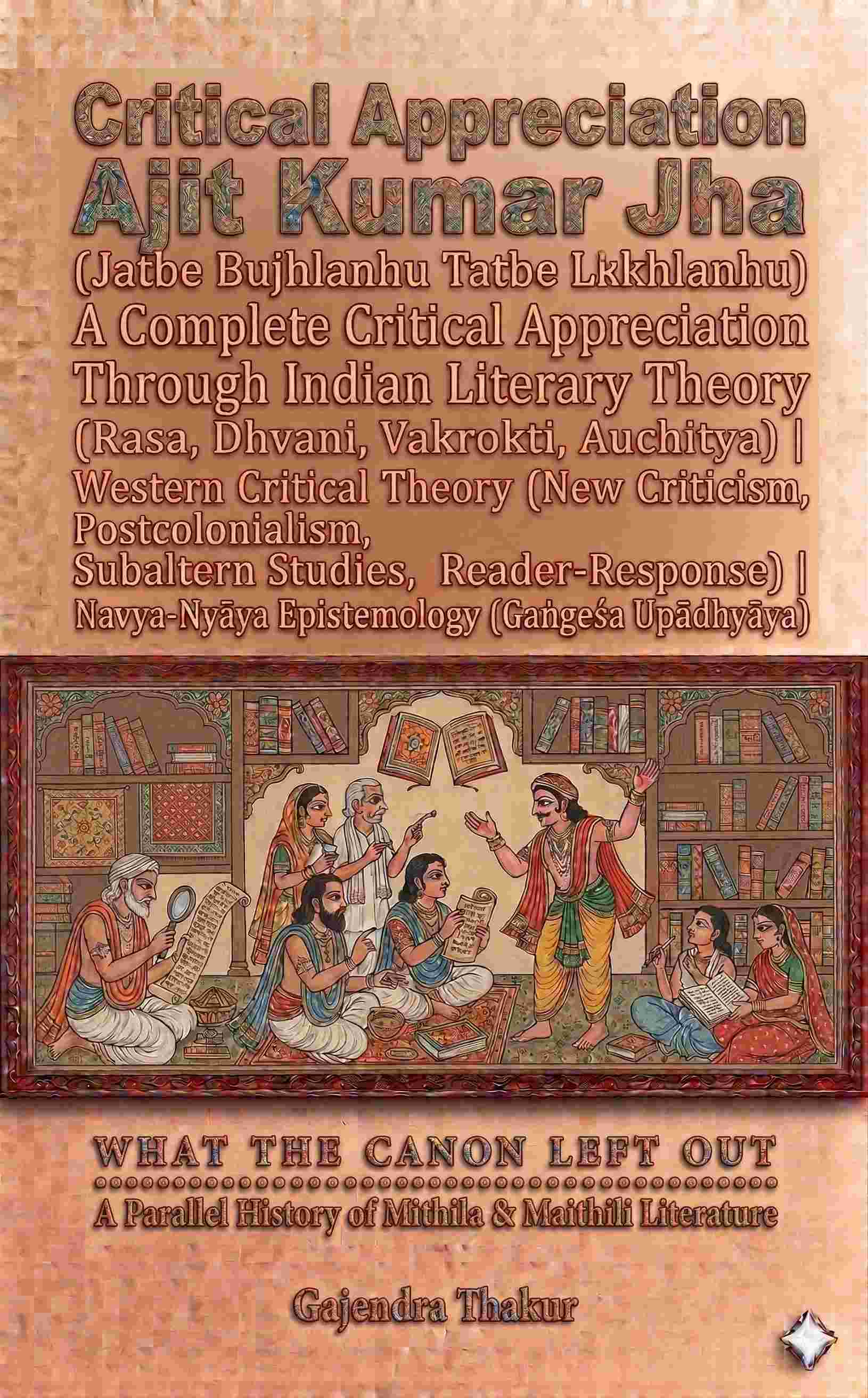
Critical Appreciation Ajit Kumar Jha (Jatbe Bujhlanhu Tatbe Likhlanhu) A Complete Critical Appreciation Through Indian Literary Theory (Rasa, Dhvani, Vakrokti, Auchitya) | Western Critical Theory (New Criticism, Postcolonialism, Subaltern Studies, Reader-Response) | Navya-Nyāya Epistemology (Gaṅgeśa Upādhyāya)
Critical Appreciation
(Jatbe Bujhlanhu Tatbe Likhlanhu)
A Complete Critical Appreciation
Through Indian Literary Theory (Rasa, Dhvani, Vakrokti, Auchitya) |
Western Critical Theory (New Criticism, Postcolonialism, Subaltern Studies, Reader-Response) |
Navya-Nyāya Epistemology (Gaṅgeśa Upādhyāya)
I. Biographical Profile and Literary Formation
Ajit Kumar Jha (born 6 July 1967, Calcutta; permanent address: Village-P.O. Yajuar, Muzaffarpur, Bihar-843360) is a Maithili literary critic, essayist, and micro-fiction writer whose first and, to date, only published book — जतबे बुझलहुँ ततबे लिखलहुँ (Jatbe Bujhlanhu Tatbe Likhlanhu, Videha eJournal Publication, 2026, ISBN 978-93-5635-145-5) — appeared after three to three-and-a-half decades of active engagement with Maithili literature. His biography is that paradox: thirty years of writing, one book.
Born and educated in Calcutta (BSc, Calcutta University), Jha enlisted in the Indian Air Force, where technical training and postings to nine stations over twenty years shaped an itinerant sensibility intimately familiar with the Maithili diaspora. After service retirement he worked briefly in the private sector in Pune before joining Life Insurance Corporation (LIC), where he is currently posted at Muzaffarpur Branch-1. His literary formation is thus deeply diasporic: Maithili was not his daily spoken medium but an affective and ideological commitment — a voluntary return to motherland through language.
His mentors include the late Rajanandan Lal Das (Karnaamrit), the late Ramlochan Thakur, and the late Premchandra Mishra (Head, Maithili Department, Lalit Narayan Mithila Vishwavidyalaya, Muzaffarpur). The Karnaamrit journal, founded by Rajanandan Lal Das, was Jha's gateway to Maithili literary culture from 1987 onward — a journal he distributed personally among friends, colleagues, and strangers in the tradition of small-press Maithili distribution. He began writing poetry and short fiction (laghu katha) while in the Air Force, published in various Maithili periodicals, and from 2021 became a regular contributor to the Videha eJournal under the mentorship of Ashish Anchinhar.
The book's title — जतबे बुझलहुँ ततबे लिखलहुँ, meaning 'As much as I understood, so much I wrote' — encodes its epistemological humility. It is not the declaration of a system-builder but of an honest percipient: the limit of writing is the limit of understanding, and both are acknowledged as provisional.
|
Biographical Detail |
Information |
|
Full Name |
Ajit Kumar Jha (अजित कुमार झा) |
|
Date of Birth |
06 July 1967 |
|
Birthplace |
Calcutta (Kolkata) |
|
Native Village |
Yajuar (Yazuar), Muzaffarpur, Bihar |
|
Education |
BSc, Calcutta University; Diploma in Electrical Engineering, Indian Air Force |
|
Career |
Indian Air Force (technical, ~20 yrs); private sector Pune; LIC Muzaffarpur Branch-1 |
|
Literary Mentors |
Rajanandan Lal Das, Ramlochan Thakur, Premchandra Mishra |
|
Published Book |
Jatbe Bujhlanhu Tatbe Likhlanhu (2026, ISBN 978-93-5635-145-5) |
|
Genres |
Literary criticism/appreciation, essay, micro-fiction (laghu katha), poetry |
|
|
jha.ajitkumar67@gmail.com |
II. The Book: Architecture, Contents, and Occasion
2.1 Genesis and Editorial Circumstances
The book was assembled not by the author but by Ashish Anchinhar, editor of Anchinhar Akhar and associate editor of Videha, who collected Jha's articles published in Videha over four years, compiled them into book form, and presented the author with a fait accompli. This unusual genesis — a book willed into existence by an editor before the author had willed it — is itself a critical datum. It testifies to the dispersed, collaborative nature of contemporary Maithili literary production, where the distinction between author, editor, and institutional catalyst is fluid.
Jha writes in his preface (Duu Aakhar): 'I never imagined my name would ever appear on a book, and that my first book would be a collection of essays — this is even more astonishing.' He identifies himself not as a writer but as a reader (paathak): 'I consider myself a reader, not a writer.' This performative self-abnegation, in the tradition of Maithili literary modesty, is nonetheless contradicted by the quality and commitment of the essays themselves.
2.2 Structure and Contents
The book contains fourteen essays (aalekh) and one reader's response (paathkiy pratikriya), all previously published in Videha special issues. The essays are organized around specific persons — living and recently deceased figures of Maithili literature, journalism, theatre, and cultural activism — and together constitute a portrait gallery of the Maithili parallel literary tradition.
|
|
Essay Title / Subject |
Publication Source (Videha) |
|
1 |
Van Main Aami — Rajanandan Lal Das |
Issue 333, 01 Nov 2021 |
|
2 |
Mithila Maithili Aandolanak Pathey — Ravindra Thakur |
Issue 348, 15 Jun 2022 |
|
3 |
Abaaraa Nahitan: Ek Anupam Kriti (Kedar Nath Chaudhary) |
Ashok Special Review |
|
4 |
Maithili Rangmanchak Prernaasrot — Smt. Premlata Mishra 'Prem' |
Videha Special |
|
5 |
'Samay-Saal' ke Akanait — Shardinduju Chaudhary's editorial journal |
Issue 358, 15 Nov 2022 |
|
6 |
Daidigan: Ek Apratim Katha Sangrah (Ashok — Katha Sangrah) |
Issue 369, 01 May 2023 |
|
7 |
Gharmuha — Madheshi Aandolan document (Ram Bhorosa Padi 'Bhramar') |
Novel review |
|
8 |
Ghataatop Anhaariya me Ummiidak Kiran — Mithila Students Union |
MSU Special |
|
9 |
Sagar Ji — Yatha Naam, Tatha Kaam |
Videha Special |
|
10 |
Maithilik Succha Sevak — Gajendra Thakur Ji |
Gajendra Special |
|
11 |
Mithilaak Arthashaastri — Sri Narendra Jha |
Videha Special |
|
12 |
Mithilaak Samskritik Dharohar ke Raksak — Narayanji Chaudhary |
Videha Special |
|
13 |
Shivshankar Srinivas Ji: Gaamak Lok (village and modernity) |
Issue 424, 15 Aug 2025 |
|
14 |
Videha Bhavanath Jha Visheshank par Paathkiy (reader's response) |
Issue 428, 15 Oct 2025 |
2.3 Thematic Architecture
The fourteen essays collectively enact a single large project: the documentation and critical valuation of the Maithili parallel literary tradition — the democratic, non-canonical, subaltern tradition that the Videha Parallel Literature Movement has been excavating since 2000. Each essay is simultaneously a character portrait, a literary-critical assessment, and a cultural history. The subjects range from editors (Rajanandan Lal Das, Shardinduju Chaudhary) to lyricists and performing artists (Ravindra Thakur), theatrical directors (Premlata Mishra), fiction writers (Ashok, Ram Bhorosa Padi 'Bhramar'), scholars (Gajendra Thakur, Narendra Jha, Bhavanath Jha, Narayanji Chaudhary), and cultural organizations (MSU, Sagar Ji).
III. Critical Analysis through Indian Literary Theory
3.1 Rasa Theory (Bharata's Natyashastra and Abhinavagupta's Abhinavabharati)
Bharata Muni's Rasa theory, as elaborated by Abhinavagupta (10th-11th century), holds that the aesthetic experience (rasaanubhava) arises from the successful communication of the sthayibhava (permanent emotional state) through the vibhava (excitants), anubhava (consequents), and vyabhicaari bhava (transitory states). Applied to Jha's criticism, the dominant rasa is karunarasa (the rasa of pathos/compassion) — the compassion of a diaspora writer for the unrecognised labourers of Maithili culture.
This is most visible in the essay on Rajanandan Lal Das ('Van Main Aami': 'A One-Man Army'), where Jha narrates a personal encounter with Das — their meeting during a train journey, Das's post-brain-haemorrhage return to Maithili work, his insistence on using the meagre honorarium for a book publication rather than a ceremony, his death-defying commitment. The vibhava here is the scene of Das standing personally at a bus stop to receive a junior writer (Jha himself); the anubhava is Jha's overwhelming shame (lajjaa) that such a senior figure should wait for him; the sthayibhava is shoka (grief) for a tradition that must labour in obscurity. Abhinavagupta would identify the saadharanikaran (universalization) that allows the particular emotion to become shared aesthetic experience: Jha's prose achieves precisely this.
Similarly, in the essay on Ravindra Thakur — the lyricist of the first Maithili film who never received adequate recognition — the underlying rasa is a combination of vira (heroism) and karunarasa: heroic dedication under conditions of pathos. Jha quotes at length the songs of Ravindra Thakur, including the deeply moving dirge for Maithili motherhood ('Janma delanhi maay Mithilaak, seho kane sochu'). The rasaasvada (tasting of rasa) is achieved through the specificity of the lyrics rather than through abstract praising — a technique fully consistent with Bharata's prescription that rasa must arise through concrete representation, not assertion.
3.2 Dhvani Theory (Anandavardhana's Dhvanyaaloka)
Anandavardhana (9th century, Kashmir) identified dhvani (resonance/suggestion) as the soul of poetry: the suggested meaning (vyangya artha) exceeds and transcends the literal meaning (vaachya artha). While Jha writes prose criticism, his best essays operate through a strong dhvani dimension — the suggested meaning is invariably larger than the stated argument.
In the essay on Gajendra Thakur ('Maithilik Succha Sevak'), the literal level describes Thakur's contributions to Maithili digital literature. But the dhvani is a meditation on the nature of service (seva) in a tradition where seva goes unrecognized: the phrase 'succha sevak' (genuine/pure servant) resonates against the unstated background of those who serve Maithili for social prestige or institutional reward. The suggestion is that genuineness is verified by the absence of institutional recognition — a profoundly counter-canonical epistemological claim made through suggestion rather than argument.
In the essay on Shardinduju Chaudhary's journal Samay-Saal, Jha's discussion of what he calls the journal's lapse into obscenity (the pseudonymous 'Latika' column) works through dhvani: his criticism of the column is mild in denotation but the resonance of the critique is that small-press Maithili journals have consistently undermined their own dignity, gesturing toward the structural problem of Maithili literary self-sabotage without naming it.
3.3 Vakrokti Theory (Kuntaka's Vakroktijivita, c. 10th century)
Kuntaka's theory of vakrokti (oblique/deviant expression) holds that literary beauty arises from a productive deviation from ordinary usage — the twist (vaikritya) that makes language literarily alive. In Jha's prose, vakrokti operates at the level of title and structure rather than at the lexical level. The title जतबे बुझलहुँ ततबे लिखलहुँ is itself a vakroktis: it appears to be a modest disclaimer but it is actually a sophisticated epistemological statement — the equivalence of understanding and writing implies that writing is not a transcription of pre-existing knowledge but the very act of understanding. The twist in this statement is that it converts a limitation into a theory of composition.
Similarly, the essay on Kedar Nath Chaudhary ('Abaara Nahitan') narrates a near-suicide, a chance encounter with fried sweets (jelebis and chaudhary) — the absurd proximity of death and snack — that saved both Chaudhary and the first Maithili film. This is Kuntaka's vakrokti at the narrative level: the oblique approach to a serious subject (the founding of Maithili cinema) through a comic episode that is also genuinely moving.
3.4 Auchitya Theory (Kshemendra's Auchityavicharacharchaa, c. 11th century)
Kshemendra's theory of auchitya (propriety, appropriateness) holds that the ultimate criterion of literary excellence is the fitness of every element to every other element — word to meaning, character to action, style to subject. Applied to Jha's criticism, auchitya becomes both a critical tool and a problematic. The essays on living persons (Gajendra Thakur, Narendra Jha, Narayanji Chaudhary) raise the auchitya question acutely: is it 'fitting' to write extended critical appreciation of living persons, where the normal institutional machinery for critical distance does not apply?
Jha himself raises this question implicitly when he notes that Maithili critics have traditionally praised their own circle and avoided criticizing those with whom they disagree. He claims Ajit Kumar Jha is 'baacha' (free) from this fault — a claim that the essays themselves largely sustain. The essay on Shardinduju Chaudhary's journal is notably the most critically honest: Jha praises the editorial quality while explicitly criticizing the obscene last-page content. This balance is precisely what Kshemendra means by auchitya: the critical essay must sustain proportionality between praise and reservation, and must not sacrifice truth for friendship or flattery.
IV. Critical Analysis through Western Literary Theory
4.1 New Criticism: Intentional Fallacy, Organic Unity, and Close Reading
New Criticism, as articulated by W.K. Wimsatt and Monroe Beardsley ('The Intentional Fallacy,' 1946; 'The Affective Fallacy,' 1949) and Cleanth Brooks (The Well Wrought Urn, 1947), insists on the autonomy of the literary text from both the author's intention and the reader's emotional response. Applied to Jha's criticism, New Criticism exposes a fundamental tension: Jha's essays are explicitly autobiographical and testimonial, grounding textual evaluation in personal encounter and emotional response. The 'intentional fallacy' is, in Jha's criticism, not a fallacy but a methodology.
Yet Jha's strongest essays achieve something close to the New Critical ideal of 'organic unity' — the sense that every element of the work is functionally integrated. His analysis of the short story collection Daidigan ('Ghost-village') by the writer known as 'Ashok' demonstrates this: Jha traces the thematic coherence of the collection's fifteen stories through their shared concern with the dying Maithili village, social change, and the gap between modernity and tradition. His summary of the final story — in which the NRI returnee Raghuvans decides, upon seeing a local health crisis, to build a hospital rather than a temple — demonstrates Jha's capacity for organic reading: the story's ending resolves all the collection's tensions (tradition vs. modernity, religious identity vs. civic duty, self-interest vs. community) in a single gesture.
The limitation of applying New Criticism to Jha's work is that it would necessarily amputate the social-historical context that is the very substance of the essays. Jha's criticism is always criticism of persons-in-context: the literary text is never abstracted from the institutional and social conditions of its production. This is not a failure of New Criticism's terms but a recognition of their limits.
4.2 Postcolonial Theory: Bhabha, Spivak, and the Subaltern Voice
Homi Bhabha's concept of the 'third space' (The Location of Culture, 1994) — the liminal, hybrid space produced by colonial encounter — maps suggestively onto Jha's biographical and critical situation. Jha is a Maithili by birth and affiliation who spent most of his adult life in Hindi-dominant institutional environments (Indian Air Force, LIC); his Maithili writing is a reclamation performed across this hybrid space. The Air Force section of his preface — where he describes how the Maithili 'dalan' (gathering place) atmosphere was recreated in barrack conversations among soldiers from Mithila — is precisely Bhabha's 'third space': a cultural production that is neither metropolitan Hindi nor provincial Maithili but a new formation emerging from displacement.
Gayatri Chakravorty Spivak's formulation 'Can the Subaltern Speak?' (1988) resonates powerfully with the cultural project of the entire book. The subjects of Jha's essays — Rajanandan Lal Das, Ravindra Thakur, Premlata Mishra, the Mithila Student Union activists — are precisely the subalterns of the Maithili literary system: individuals who laboured for the language without institutional support, without Sahitya Akademi recognition, without publication in the mainstream Hindi-English literary market. Jha's essays perform the counter-archival work Spivak identifies as necessary: they inscribe into the record subjects who would otherwise be epistemically invisible.
The essay on Ram Bhorosa Padi 'Bhramar' and his novel Gharmuha — a novel about the Madheshi political movement in Nepal — explicitly engages postcolonial questions: the 'Madheshi' identity of Terai Maithili-speakers in Nepal is itself a postcolonial formation, the product of the border drawn between India and Nepal by colonial cartography. Jha's analysis of the novel as a document of both political movement and social harmony is precisely the kind of reading Bhabha encourages: attending to ambivalence and hybridity rather than to simple resistance narratives.
4.3 Subaltern Studies: Ranajit Guha and the Archive
Ranajit Guha's founding essay for the Subaltern Studies collective ('On Some Aspects of the Historiography of Colonial India,' 1982) argues that colonial and nationalist historiography systematically excludes the subaltern from historical agency. The subaltern appears in the archive only as object of elite discourse. Jha's critical project is, in this framework, a counter-archival intervention: by writing detailed appreciation essays on living but unrecognised cultural workers, he inserts them into the literary archive as agents rather than objects.
The essay on the Mithila Students Union ('Ghataatop Anhaariya me Ummiidak Kiran' — 'A Ray of Hope in the Dense Darkness') is paradigmatic in this regard. Student organizations, specifically those of subaltern and lower-caste Maithili communities, have been almost entirely absent from mainstream Maithili literary history. Jha's essay argues that the MSU represents a democratic energy that the established literary institutions cannot generate — a Gramscian 'organic intellectual' formation from below. His praise for the MSU is critically calibrated: he acknowledges the organizational challenges and the risk of political co-option, while insisting on the movement's literary-cultural significance.
4.4 Reader-Response Theory: Iser, Fish, and the Reading Event
Wolfgang Iser (The Act of Reading, 1978) and Stanley Fish (Is There a Text in This Class?, 1980) locate meaning not in the text but in the transaction between text and reader, in the 'reading event.' Jha's entire critical stance is reader-response in orientation: the preface explicitly identifies him as a paathak (reader) rather than a writer, and each essay recounts not an abstract textual analysis but a specific, datable reading event — a conversation with Rajanandan Lal Das in 1987, reading Ashok's stories in the Videha archive, receiving a copy of Ravindra Thakur's songbook through his father.
This autobiographical reader-response mode has a specific political function in the Maithili context: it democratizes criticism. Academic Maithili criticism has been largely the province of university-employed professors and Sahitya Akademi-affiliated scholars. Jha's criticism comes from an Air Force technician, an LIC insurance officer — a demonstration that literary sensibility is not the monopoly of the credentialed professional. This is, in Stanley Fish's terms, an intervention in the 'interpretive community': Jha is asserting the validity of a non-academic interpretive community grounded in ordinary reader experience.
4.5 Marxist and Cultural Materialist Analysis
Raymond Williams's concept of 'structures of feeling' (Marxism and Literature, 1977) — the pre-reflective, lived experience of a cultural moment that literature captures before it crystallizes into explicit ideology — illuminates the deepest layer of Jha's criticism. The essays repeatedly gesture toward a structure of feeling that has no adequate name in Maithili literary discourse: the mixture of pride, grief, helplessness, and stubborn hopefulness that characterizes the lived experience of committed Maithili cultural workers in the twenty-first century. The phrase 'jatbe bujhlanhu tatbe likhlanhu' is precisely a naming of this structure of feeling: the writing is constrained by the understanding, and the understanding is constrained by what it is possible to know from a position of marginality.
Terry Eagleton's argument (Criticism and Ideology, 1976) that literary criticism is always already ideological — always in the service of some social formation — applies to Jha's work with full force. His criticism is consciously in the service of the Videha Parallel Literature Movement's democratic, anti-canonical project. But unlike much ideologically committed criticism, Jha's work does not sacrifice critical discrimination to programmatic loyalty: the Samay-Saal essay shows him capable of identifying the weaknesses of a journal he clearly admires.
V. Navya-Nyāya Epistemological Analysis
5.1 Gaṅgeśa's Framework: Pramāṇa and Vyāpti
Gaṅgeśa Upādhyāya (c. 1300-1360 CE, Mithilā) — whose birthplace Nawadadhi in Madhubani district is approximately one hundred kilometres from Jha's ancestral village Yajuar in Muzaffarpur — developed in the Tattvacintāmaṇi the most rigorous formal epistemology in medieval world philosophy. His central achievement was the rigorous analysis of the conditions for valid cognition (pramāṇa) — particularly anumāna (inference) and its operative principle, vyāpti (invariable concomitance, pervasion).
Navya-Nyāya analysis of a text asks: what are the valid cognitive claims being made? On what pramāṇa (perceptual, inferential, analogical, testimonial) do these claims rest? What is the vyāpti (if A, then always B) underlying each evaluative judgment? And is that vyāpti itself well-founded, or does it conceal a hetvābhāsa (logical fallacy)?
5.2 Jha's Epistemology of Criticism: Pratyakṣa as Foundation
Jha's most fundamental epistemological commitment is to pratyakṣa (direct perception) as the primary pramāṇa for literary evaluation. His judgments are grounded in direct experience: 'I have been reading Karnaamrit since 1987' (of Rajanandan Lal Das); 'I have seen Ravindra Thakur perform ten to fifteen times' (of the lyricist); 'I downloaded and read Ashok's stories from the Videha archive last night' (of the fiction writer). This is a systematic privileging of the perceiver's own cognitive history over the śabda-pramāṇa (testimonial authority) of institutional criticism.
From a Navya-Nyāya standpoint, Jha's pratyakṣa-grounded criticism has both strength and limitation. The strength is epistemic directness: the claim 'this song moved me to tears fifteen times' is a robust pratyakṣa claim that is harder to contest than 'this is a great song' (which requires the unstated vyāpti 'great songs move people to tears'). The limitation is that pratyakṣa is inherently particular: it grounds claims about the perceiver's experience, not claims about the text's objective properties.
5.3 Vyāpti Analysis: The Underlying Invariable Concomitances
Jha's critical essays operate through several implicit vyāptis (if-then structures) that can be extracted and examined:
Vyāpti 1: Genuine Maithili cultural contribution → absence of institutional recognition (and vice versa: institutional recognition → suspect motivation)
This is the deepest and most ideologically loaded vyāpti in the book. It reflects the Videha movement's counter-canonical epistemology. In Navya-Nyāya terms, this vyāpti risks becoming an atīvyāpti (over-wide pervasion) — it would make all institutional recognition automatically suspect. Jha's own essay on Gajendra Thakur partially corrects this: he praises Thakur as a genuine servant precisely because his institutional recognition (the Videha Samman itself) was self-created rather than externally bestowed. The distinction, however, requires clearer articulation than Jha provides.
Vyāpti 2: Sustained commitment over time → literary value (time-tested contribution is better contribution)
This vyāpti is more defensible. Jha repeatedly invokes longevity of commitment as a criterion: Rajanandan Lal Das worked for Maithili for thirty-five years; Ravindra Thakur composed Maithili songs across five decades; Ram Bhorosa Padi 'Bhramar' has served Maithili for nearly five decades from Nepal. In Navya-Nyāya terms, the vyāpti 'sustained commitment → quality' is a probabilistic rather than universal claim — there are counter-examples (sustained mediocrity). But Jha correctly uses it as a heuristic, not as a logical necessity.
Vyāpti 3: Personal witness → valid critical testimony (having met someone → authorized to evaluate their contribution)
This is Jha's most distinctive epistemological claim and the most problematic from a strict Navya-Nyāya standpoint. The claim is that having personally met Rajanandan Lal Das in 1987 authorizes a valid critical judgment about Das's contribution. In Navya-Nyāya terms, this confuses the pramāṇa for a psychological fact (having met someone produces certain feelings) with the pramāṇa for an evaluative claim (the person's work has such-and-such literary value). The meeting establishes the vivid emotional reality of the encounter; it does not establish the quality of the work independently of that encounter.
However, Jha himself partially acknowledges this when he says his essays are 'aloochana-sameeksha' (criticism-reviews) but that readers should judge for themselves. This epistemic humility is consistent with the Navya-Nyāya recognition that criticism is inference (anumāna), not perception (pratyakṣa), and that inference can be fallible.
5.4 Hetvābhāsa: The Fallacies of Canonical Criticism
Jha's implicit critique of mainstream Maithili criticism — its tendency to praise the critic's own circle and ignore the rest — is, in Navya-Nyāya terms, a diagnosis of hetvābhāsa (fallacious reasoning). The fallacy identified is savyabhicāra (irregular concomitance): the mainstream critic's vyāpti 'literary merit → Sahitya Akademi recognition' is violated by countless counter-instances, but the fallacy is maintained because the selection committee is itself constituted by those who have already been recognized. This is the self-referential epistemological circle that the Videha movement — and Jha's criticism within it — tries to break open.
The title's epistemological claim — 'as much as I understood, so much I wrote' — is in Navya-Nyāya terms a statement of epistemic limitation (jñānasya sīmā) that is itself a pramāṇa claim: the claim that honest epistemic limitation is more valuable than false certainty. Gaṅgeśa's own Tattvacintāmaṇi proceeds through a similar acknowledgment of the limits of each previous analysis before proposing its own refinement. Jha's title, consciously or not, places him in this tradition of calibrated epistemic modesty.
5.5 Pakṣatā and the Subject of Maithili Criticism
In Navya-Nyāya, pakṣatā refers to the property (dharma) that is attributed to the subject (pakṣa) in an inferential claim. A central Navya-Nyāya debate concerns the conditions under which a subject can be a valid pakṣa for a given inference. Applied to Jha's criticism: the 'subject' of each essay (Rajanandan Lal Das, Ravindra Thakur, etc.) must have the relevant properties to be a valid subject of the claim being made.
One of Jha's most important epistemological contributions is his insistence on the correct identification of pakṣa. He explicitly resists the mainstream practice of evaluating a person's literary contribution in abstraction from their institutional and biographical situation. For Rajanandan Lal Das, the correct pakṣa is not 'the literary canon of Maithili' but 'the living infrastructure of Maithili distribution networks' — the pakṣa for which Das is uniquely qualified. By correctly identifying the pakṣa, Jha avoids the atīvyāpti that would result from comparing Das to, say, a Sahitya Akademi awardee on the same terms.
VI. Genre, Style, and Linguistic Character of the Essays
6.1 The Essay Form in Maithili
The literary essay (nibandha or aalekh) in Maithili has a relatively thin history compared to poetry and fiction. The Videha Parallel Literature Movement has been one of the primary vehicles for developing the Maithili essay as a sustained critical form. Jha's essays belong to a specific sub-genre: the critical portrait or 'parichay-nibandha' (introduction-essay), a hybrid form that combines biographical narrative, textual analysis, and personal testimony.
Within Indian literary history, this form is closest to the 'vyakti-chitran' (character-portrait) tradition of Hindi and Bengali criticism, and to the English tradition of the 'literary portrait' from Samuel Johnson's Lives of the Poets to Virginia Woolf's essays in The Common Reader. The connecting thread is the insistence that literary value is inseparable from the human life that produces it — a resistance to the formalist's tendency to abstract the text from its biographical conditions.
6.2 Linguistic Register
Jha writes in a distinctively modern, conversational Maithili — far from both the Brahminical Sanskrit-inflected Maithili of traditional pandits and the heavily Hindi-influenced 'practical Maithili' that the Videha movement criticizes. His sentences are typically medium-length, paratactic, and direct. He uses idiomatic Maithili expressions that ground the writing in vernacular authenticity: 'yatha naam, tatha kaam' (as the name, so the work) for the essay on Sagar Ji; 'succha sevak' (genuine servant) for Gajendra Thakur; 'van main aami' (a one-man army) for Rajanandan Lal Das.
This idiomatic richness is precisely what Kshemendra's auchitya demands: the style is appropriate to the subject. Jha does not write about folk musicians and grassroots cultural workers in the ornate, Sanskritized register of formal literary criticism. His language is calibrated to honor the democratic, non-elite subjects of his essays.
6.3 The Use of Direct Quotation
Jha's most technically accomplished critical move is his use of extended quotation as argument. In the essay on Ravindra Thakur, rather than arguing abstractly that the lyricist's songs are culturally significant, Jha quotes song after song, allowing their accumulation to constitute the argument. This technique — borrowed from journalism but used here with literary discipline — demonstrates a sophisticated understanding of the dhvani principle: the songs resonate more powerfully in their juxtaposition than any analytical statement about them could.
The use of long quotation from Shardinduju Chaudhary's editorials in the Samay-Saal essay is equally effective: the ten editorial extracts (spanning 2003-2007) constitute a social history of Bihar and Mithila across a critical period. The method is essentially montage — letting the archive speak directly, with minimal editorial intervention. This is both a critical modesty and a critical strength.
VII. Critical Assessment of Selected Essays
7.1 'Van Main Aami' — On Rajanandan Lal Das
This is the book's most personally vivid essay and its critical centrepiece. The phrase 'van main aami' (a one-man army) — which Jha reports Das's editorial column title as his dying wish for Maithili ('Maithili ke ekta aur Bhagiratha chaahi' — 'Maithili needs one more Bhagiratha') — is both a lament and a manifesto. Das emerges as the archetype of the Videha movement's ideal: total selflessness, zero institutional recognition, lifetime dedication. The essay succeeds in making Das's absence (he is deceased by the time of writing) palpable. The Navya-Nyāya principle of anupalabdhi (non-perception as a valid pramāṇa for absence) is here literarily enacted: the essay is the record of Das's felt absence from the current Maithili scene.
7.2 'Abaara Nahitan' — On Kedar Nath Chaudhary and the First Maithili Film
This essay is the book's most narratively accomplished piece. The near-suicide-by-drowning, the rescue by the smell of fried sweets, the meeting with 'Kauwali Babu' (an older mentor), the subsequent making of the first Maithili film 'Mamta Gaabay Geet' — the narrative has the coherence and surprise of good fiction. Jha's critical instinct is to let the story do the work: he introduces the film, provides context, and then largely steps back. The result is that the reader understands the film's significance not through assertion but through identification with the improbable chain of events that brought it into being. This is reader-response criticism at its most effective.
7.3 'Daidigan' — On Ashok's Short Story Collection
This is the book's most formally accomplished piece of literary criticism. Jha systematically works through all fifteen stories, identifying for each its central subject, its structural feature, and its thematic contribution to the collection's whole. His summary of the title story — in which an NRI returning to his ancestral village chooses to build a hospital rather than a temple — demonstrates genuine critical insight: he identifies the story's resolution as the key to the entire collection's vision of Maithili village society in transition. The essay demonstrates that Jha, when working with a text rather than a person, can sustain the critical distance that the essays on living persons sometimes lack.
7.4 'Samay-Saal ke Akanait' — On Shardinduju Chaudhary's Editorial Journal
This is the book's most intellectually honest essay. Jha praises Samay-Saal unreservedly as a journal of political and social consciousness while openly criticizing its recurring last-page content (the 'Latika' column) as inconsistent with the journal's dignity. The use of the word 'ashleelta' (obscenity) — mild but unmistakable — in relation to a journal he clearly admires and a figure he respects is the most critical gesture in the book. In the context of a Maithili critical tradition notorious for in-group protectionism, this is a notable act of critical honesty.
7.5 'Maithilik Succha Sevak' — On Gajendra Thakur
The essay on Gajendra Thakur, editor of Videha and the book's own publisher, is inevitably the most delicate in terms of critical independence. Jha navigates this with reasonable skill, focusing largely on the institutional contribution (the Videha eJournal, its archives, its role in Maithili literature) rather than on specific texts. The phrase 'succha sevak' is intended as the highest compliment; it is also, in the specific context of the Videha movement's counter-canonical project, a precise critical category: the servant who does not seek recognition is distinguished from the critic-politician who does. The essay's weakness is that it does not engage with any specific published work of Thakur's — an omission that leaves the critical claim insufficiently grounded.
VIII. Significance, Limitations, and Place in the Maithili Critical Tradition
8.1 Significance
Jatbe Bujhlanhu Tatbe Likhlanhu is a significant contribution to Maithili literary criticism for four reasons. First, it represents the democratic extension of critical discourse to a non-academic, non-institutionally affiliated practitioner — validating the claim that literary criticism can be practiced from any social position, not only from the university. Second, it performs systematic counter-archival work, inscribing into the record cultural workers who would otherwise disappear from literary history. Third, it demonstrates the viability of the personal, testimony-based critical essay as a Maithili literary form. Fourth, and most consequentially, it constitutes a collective self-portrait of the Videha Parallel Literature Movement's human infrastructure — the people who have built the democratic Maithili literary project one small act at a time.
The book's publication itself is significant: it appeared under the Videha eJournal imprint (with Ashish Anchinhar as the initiating force) and is available on the Videha pothi (book) portal at www.videha.co.in — embodying the movement's principle that digital, open-access publication is the appropriate vehicle for democratic Maithili literature.
8.2 Limitations
The book has notable limitations. The essays on living persons (especially Gajendra Thakur, Narendra Jha) are not fully critically independent; the affective bonds of the Videha community are visible in the tonal register of these essays. The absence of any essay on a figure who is not already within the Videha-affiliated network raises the question of whether the book's 'democratic' critical agenda is in fact a community self-portrait — a parallel canon that is as self-enclosed as the mainstream canon it critiques.
The critical methodology is also uneven: the close reading of Ashok's Daidigan is not sustained across all essays. Several essays remain at the level of biographical appreciation without achieving the analytical distance that would make them fully critical. The essay on the Mithila Students Union, while politically important, is the least analytically precise: it operates through enthusiasm rather than argument.
From a Navya-Nyāya standpoint, the most persistent limitation is the conflation of pratyakṣa (personal experience) with anumāna (evaluative inference) — the tendency to assert that 'I was moved by this' is equivalent to 'this is important.' The title's epistemic modesty ('as much as I understood') gestures toward this limitation but does not fully resolve it.
8.3 Place in Maithili Critical Tradition
In the longer history of Maithili literary criticism, Jha's essays belong to a tradition of practitioner-critics who have written about their contemporaries with passion and commitment: Ramanath Jha (as historical counterexample — canonical, exclusionary), Harimohan Jha (as the wit-essayist of social satire), and more recently the Videha movement critics themselves (Ashish Anchinhar, Gajendra Thakur). Jha's distinctive contribution to this tradition is the combination of personal testimony, social awareness, and critical honesty that marks the essays at their best.
The closest Western parallel is perhaps William Hazlitt's The Spirit of the Age (1825) — essays on the significant literary and intellectual figures of Hazlitt's own time, combining acute critical judgment with the vivid texture of personal acquaintance. Like Hazlitt, Jha is writing criticism as cultural history in real time, capturing a moment before it crystallizes into official record.
IX. Conclusion: A Voice from the Margins of the Archive
Ajit Kumar Jha's Jatbe Bujhlanhu Tatbe Likhlanhu arrives — after thirty years of scattered publication — as an act of cultural testimony. It is the record of a Maithili reader who was shaped by the language's parallel tradition, who served that tradition through distribution and writing rather than through institutional position, and who found in the Videha eJournal a platform adequate to his critical vision. The book's modest title is its most truthful statement: this is a writer who wrote exactly as much as he understood, neither more nor less.
Read through the lens of Indian rasa theory, the book achieves karunarasa with disciplined restraint, never lapsing into sentiment while never pretending to false detachment. Read through Western postcolonial and subaltern theory, it performs the necessary work of counter-archiving the democratic margins of Maithili literary culture. Read through Navya-Nyāya epistemology, it demonstrates — with characteristic Mithilā directness — that the valid pramāṇa for literary criticism is not institutional authority but the honest record of a perceiving mind's encounter with cultural production.
The book's deepest claim is its title's claim: that writing and understanding are the same act, that the limit of the one is the limit of the other, and that this limitation is not a weakness but the ground of honesty. In an age of inflated critical claims and institutional self-promotion, this epistemological modesty is both a literary virtue and a political commitment.
जतबे बुझलहुँ ततबे लिखलहुँ — as much as I understood, so much I wrote. In the Maithili literary tradition, that has always been enough.
X. References and Bibliography
Primary Source
Jha, Ajit Kumar. जतबे बुझलहुँ ततबे लिखलहुँ (Jatbe Bujhlanhu Tatbe Likhlanhu). Videha eJournal Publication, 2026. ISBN 978-93-5635-145-5. Available: https://www.videha.co.in/pothi.htm
Prefaces and Editorial Apparatus
Anchinhar, Ashish. 'Teen Dashaksan Laikhaait Lekhakak Pahil Pothi' (Prefatory essay). In: Jha 2026, pp. 2-4.
Jha, Ajit Kumar. 'Duu Aakhar' (Author's preface). In: Jha 2026, pp. 5-8.
Videha Special Issues Referenced in the Book
Videha Issue 333, 01 Nov 2021. Rajanandan Lal Das Visheshank. Ed. Gajendra Thakur. ISSN 2229-547X.
Videha Issue 348, 15 Jun 2022. Ravindra Naath Thakur Visheshank. Ed. Gajendra Thakur. ISSN 2229-547X.
Videha Issue 358, 15 Nov 2022. Shardinduju Chaudhary Visheshank. Ed. Gajendra Thakur. ISSN 2229-547X.
Videha Issue 369, 01 May 2023. Ashok Visheshank. Ed. Gajendra Thakur. ISSN 2229-547X.
Videha Issue 424, 15 Aug 2025. Shivshankar Srinivas Visheshank. Ed. Gajendra Thakur. ISSN 2229-547X.
Videha Issue 428, 15 Oct 2025. Bhavanath Jha Visheshank. Ed. Gajendra Thakur. ISSN 2229-547X.
Indian Critical Theory
Bharata Muni. Natyashastra (c. 2nd century BCE – 2nd century CE). Trans./ed. various.
Anandavardhana. Dhvanyaaloka (c. 850 CE). Trans. K. Krishnamoorthy. Deccan College, 1974.
Abhinavagupta. Abhinavabharati (commentary on Natyashastra, c. 1000 CE).
Kuntaka. Vakroktijivita (c. 10th century CE). Trans. K.K. Raja. Deccan College, 1977.
Kshemendra. Auchityavicharacharchaa (c. 11th century CE).
Western Critical Theory
Wimsatt, W.K. and Beardsley, Monroe. 'The Intentional Fallacy.' Sewanee Review 54 (1946): 468-488.
Brooks, Cleanth. The Well Wrought Urn: Studies in the Structure of Poetry. New York: Reynal & Hitchcock, 1947.
Iser, Wolfgang. The Act of Reading: A Theory of Aesthetic Response. Baltimore: Johns Hopkins, 1978.
Fish, Stanley. Is There a Text in This Class? The Authority of Interpretive Communities. Cambridge: Harvard UP, 1980.
Bhabha, Homi K. The Location of Culture. London: Routledge, 1994.
Spivak, Gayatri Chakravorty. 'Can the Subaltern Speak?' In: Nelson, C. and Grossberg, L. (eds). Marxism and the Interpretation of Culture. Urbana: University of Illinois Press, 1988.
Guha, Ranajit. 'On Some Aspects of the Historiography of Colonial India.' Subaltern Studies I. Delhi: OUP, 1982.
Williams, Raymond. Marxism and Literature. Oxford: OUP, 1977.
Eagleton, Terry. Criticism and Ideology. London: Verso, 1976.
Hazlitt, William. The Spirit of the Age. London: Henry Colburn, 1825.
Navya-Nyāya Sources
Gaṅgeśa Upādhyāya. Tattvacintāmaṇi (c. 1300-1360 CE). Critical edition and translation: various. For modern scholarship see: Wada, Toshihiro. Various papers on Navya-Nyāya; Shaw, J.L. Various papers on Navya-Nyāya logic.
Maithili Literary Context
Thakur, Gajendra. Parallel History of Maithili Literature. Videha eJournal Archives. https://www.videha.co.in
Jha, Mithilesh Kumar. 'Maithili in the Digital Space.' India Seminar 742 (2021). https://www.india-seminar.com/2021/742/742_mithilesh_kumar_jha.htm
Videha eJournal (since 2000). ISSN 2229-547X. https://www.videha.co.in
अपन मंतव्य editorial.staff.videha@zohomail.in पर पठाउ।
विदेहमे सभठाम ताकू / Search all Videha
Static full-text search · Pagefindलेखक/शीर्षक/अंक/वर्ष — खोज-विधा। गद्य/पद्य/शोध current/static + पुरान Videha/Sadeha contents खोजैत अछि। पोथी pothi.htm केर पूर्ण listing, श्रव्य-दृश्य Audio_Video.htm केर पूर्ण listing, पञ्जी videha-sadeha/panji-shards GitHub data, आ थेसारस/शब्दकोश videha-ejournal.github.io/data GitHub JSON corpus केँ query करैत अछि आ दूनू Quiz corpus मे dictionary/vocabulary/शब्दार्थ-सम्बन्धी प्रश्नोत्तरी परिणाम सेहो जोड़ैत अछि। Quiz videha-quiz आ GitHub user-site दूनू bilingual quiz corpus खोजैत अछि। Roman/IAST + देवनागरी cross-script search समर्थित। Issue/Year लेल संख्या दिअ। PDF-अभिलेख archive.org/VidehaAndSadeha सूची खोजैत अछि।