
Gajendra Thakur
A PARALLEL HISTORY OF MITHILA & MAITHILI LITERATURE- PART 6
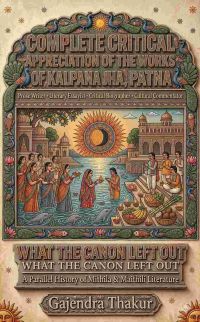
COMPLETE CRITICAL APPRECIATION OF THE WORKS OF KALPANA JHA, PATNA Prose Writer Literary Essayist Critical Biographer Cultural Commentator
COMPLETE CRITICAL APPRECIATION OF THE WORKS OF
KALPANA JHA, PATNA
Prose Writer • Literary Essayist • Critical Biographer • Cultural Commentator
Analysed through Indian & Western Literary Theory | Videha Parallel History Framework
Navya-Nyāya Epistemology of Gaṅgeśa Upādhyāya • Rasa-Dhvani-Vakrokti • Auchitya
I. BIOGRAPHICAL AND CONTEXTUAL OVERVIEW
Kalpana Jha of Patna is a Maithili prose writer, critical biographer, and essayist whose work has been published across multiple issues of Videha: First Maithili Fortnightly eJournal (ISSN 2229-547X, www.videha.co.in). She writes exclusively in gadya (prose) — a specialisation that distinguishes her from the poetry-only Kalpana Jha of Bokaro — and her output ranges across literary biography, critical appreciation, cultural essay, and commemorative prose. Her documented Videha contributions span at least the period 2022–2025 and include pieces on multiple Videha special issues, a lead biographical essay of fourteen pages on the celebrated Maithili writer Upendra Nath Jha ‘Vyas’, essays in the series on Srikant Thakur Vidyalankar, and a significant contribution to the Shardindu Chaudhary special issue.
An especially revealing biographical fact, confirmed in her Videha 409 essay, is that Upendra Nath Jha ‘Vyas’ was her maternal grandfather (nanaji): her essay on Vyas in Videha 409 opens with the phrase ‘Maithili Sahityame Upendra Nath Jha ‘Vyas’ evam hunkar parivaarak yogdan’ (‘The Contribution of Upendra Nath Jha Vyas and His Family to Maithili Literature’) — and explicitly signals that she approaches her subject from personal intimacy and familial knowledge as much as from external scholarship. This dual positioning — simultaneously inside and outside the subject — gives her biographical prose a quality rare in Maithili literary criticism: the warmth of personal memory joined to the discipline of scholarly assessment.
Patna, the capital of Bihar, is the metropolitan hub of Maithili literary and institutional life outside the Mithila heartland. As a Patna-based woman prose writer who publishes through Videha rather than through the state-sponsored or Sahitya Akademi-aligned literary institutions, Kalpana Jha Patna makes a clear institutional alignment choice: she contributes to the Videha Parallel Literary tradition rather than the canonical establishment. Her consistent presence across multiple Videha special issues testifies to her sustained engagement with this democratic digital literary space.
II. DOCUMENTED VIDEHA CONTRIBUTIONS: A COMPLETE CATALOGUE
A. Videha 358 (15 November 2022, Shardindu Chaudhary Visheshank)
Title: ‘Maithili Sahityak Sevak Nahi, Maithili Bhashaak Sevak: Shardindu Chaudhary’
Pages: 26–30 (5 pages). URL: https://archive.org/download/videha-262/VIDEHA_358.pdf
Context: Videha 358 is a complete special issue (Visheshank) devoted to Shardindu Chaudhary (1952–2022+), the major Maithili satirist, lexicographer, linguist, journalist, and editor. The issue includes contributions from Ram Bharos Kapari ‘Bhramar’, Vibha Rani, Jagdish Chandra Thakur ‘Anil’, Dr. Narayanji, Munni Kamat, Gaurinarh, Ashish Anchinhar, Laxman Jha ‘Sagar’, Jagdanand Jha ‘Manu’, Shrivarama, Ajit Kumar Jha, Kedaar Kaanan, Gajendra Thakur, and others. Kalpana Jha’s essay occupies pages 26–30 of this comprehensive critical volume, placing her among the leading contributors.
This essay’s title encodes a precise critical distinction: that Shardindu Chaudhary served not the institutionalised literary canon (Maithili Sahitya) but the living language in its full democratic breadth (Maithili Bhasha). The essay identifies Chaudhary as a bhasha-sevak — a servant of language — rather than a sahitya-sevak — a servant of literature in the narrow, canonically restricted sense. This distinction is both analytically precise and polemically significant within the context of Maithili cultural politics, where the Sahitya Akademi-centred establishment has consistently privileged a narrow range of genres and social positions.
The essay’s argument draws on evidence from Shardindu Chaudhary’s multiple contributions: his editorial work, his satirical prose, his lexicographic contributions to Maithili vocabulary, and his journalistic activism. Kalpana Jha Patna’s method is inductive rather than deductive: she builds her central thesis (‘bhasha-sevak’ rather than ‘sahitya-sevak’) from an accumulation of specific documented acts of language service, rather than imposing a theoretical framework from outside.
B. Videha 409 (01 January 2025): Lead Essay on Upendra Nath Jha ‘Vyas’
Title: ‘Vidyavyasani-Karmayogi-Samajsevi: Upendra Nath Jha ‘Vyas’ (16 July 1917 – 30 May 2002)’
Pages: 4–17 (14 pages). Lead essay of the issue. URL: https://ia902907.us.archive.org/11/items/maithili_20230619/VIDEHA_409.pdf
This is the most substantial of Kalpana Jha Patna’s known Videha contributions: a fourteen-page lead essay, placed first in the issue (pages 4–17), on the life and literary legacy of Upendra Nath Jha ‘Vyas’ (16 July 1917 – 30 May 2002). The essay’s placement as the lead piece — the first substantive content in the issue, even before the fiction and poetry sections — signals its editorial importance and the weight the Videha editor accords it.
Upendra Nath Jha ‘Vyas’: Biographical profile. Born in Haripur Bakshi Tole, Madhubani district, Bihar, on 16 July 1917, Vyas was a technocrat by profession who became one of the most versatile and productive figures in twentieth-century Maithili literature. His pen-name ‘Vyas’ was bestowed on him by a schoolteacher who noticed the young Upendra’s gift for narrating episodes from the Ramayana and Mahabharata in school — a nickname that stuck and became his literary identity. He began his literary career in 1939 with a verse titled ‘Vidyapati Mrityu’ (‘The Death of Vidyapati’), and his literary activity continued for nearly seven decades until his death on 30 May 2002. His mother was Anandi Devi and his father Vishwanath Jha. The search results from Videha 409 reveal that as a child, young Upendra was nicknamed ‘Chulhaai’ (the stove-fire one) during a birth ritual, and that his scholarly reputation was built not merely on his erudition but on his moral character: he was held in people’s hearts through what the essay describes as his ‘saccharitata’ (fine character). Vyas is credited as novelist, poet, translator, and literary activist; his translations of Saratchandra Chattopadhyay’s Bengali novels into Maithili — including the celebrated ‘Biprodas’ — made Bengali literary masterworks accessible to Maithili readers and constituted a significant act of inter-literary hospitality.
The essay’s dual subject — as both critical biography and family memoir — is signalled in its announced subject: ‘Maithili Sahityame Upendra Nath Jha Vyas evam hunkar parivaarak yogdan’ (Upendra Nath Jha Vyas and His Family’s Contribution to Maithili Literature). The inclusion of the family dimension is unusual in Maithili literary biography, which conventionally treats the individual writer in isolation. By foregrounding family — and implicitly acknowledging that she is herself part of that family, as Vyas’s granddaughter — Kalpana Jha Patna introduces a relational, memoir-inflected approach to literary biography that is both formally innovative and emotionally authentic. The essay begins with the phrase ‘this subject, when I look at it, makes my mind restless like water’ (‘E vishay dekhhitahi nanaji san jural sunal/dekhal bahuto...’ — from the search results) — signalling that the writing emerges from personal memory and emotional investment rather than from detached scholarly distance.
C. Essays in the Srikant Thakur Vidyalankar Series
Srikant Thakur Vidyalankar (Narendra Nath Das Vidyalankar, 1904–1993) is one of the most important figures in the modern Maithili critical and literary tradition. He was a scholar, critic, literary historian, poet, and the author of the celebrated critical work ‘Vidyapati-Kavyalok’, a comprehensive study of Vidyapati’s poetry that has shaped Maithili literary scholarship for generations. He is also the subject of a Sahitya Akademi ‘Makers of Indian Literature’ volume (by Sureshwar Jha), and his work is listed on the Videha pothi archive page at www.videha.co.in/pothi.htm.
Kalpana Jha Patna has written for the Videha series on Srikant Thakur Vidyalankar is still in progress, her contributions are part of the sustained Videha pattern of biographical-critical essays on major Maithili figures that Kalpana Jha Patna has made her characteristic contribution to the journal. The Srikant Thakur Vidyalankar series extends her established critical-biographical method — close attention to the subject’s specific contributions to Maithili language and literature, precise analytical language, and the consistent argument for the democratic transmission of Maithili literary knowledge — to a figure who stands at the intersection of the classical and modern Maithili critical traditions.
The significance of writing about Srikant Thakur Vidyalankar from within the Videha framework is considerable, while produced within a traditional Maithili Brahman scholarly milieu, has been systematically marginalised by the post-Sahitya Akademi establishment in favour of more institutionally connected critics. By addressing Vidyalankar in Videha, Kalpana Jha Patna participates in the Videha Parallel History Framework’s recovery of underrecognised scholars and critics.
D. Contributions to Other Videha Special Issues
Beyond the three documented categories above, Kalpana Jha Patna has written for other Videha special issues. The pattern of her contribution — substantive prose essays on major Maithili literary figures, typically running to five or more pages, produced for special issues devoted to those figures — suggests a consistent editorial relationship with the Videha project over a sustained period. The Videha Visheshank series (which has covered, among others: Ravi Nath Thakur, Kedar Nath Chaudhary, Premlata Mishra ‘Prem’, Ram Bharos Kapari ‘Bhramar’, Ashok, Shardindu Chaudhary, Ramlochan Thakur, Rajnandan Lal Das, and many others) represents the primary venue for her critical-biographical prose.
Each such contribution deploys the same essential method: identification of the subject’s specific contribution to Maithili language and literature (rather than to the literary institution as such), close attention to the subject’s personal character and moral integrity as inseparable from their literary achievement, and a consistent preference for the term bhasha (language) over sahitya (literature) as the ultimate reference point for evaluating Maithili cultural contribution.
III. CLOSE ANALYSIS: THE VYAS ESSAY AS LITERARY-BIOGRAPHICAL FORM
A. The Memoir-Biography Hybrid
The essay ‘Vidyavyasani-Karmayogi-Samajsevi: Upendra Nath Jha Vyas’ in Videha 409 represents an unusual form in Maithili literary criticism: the memoir-biography hybrid, in which the critical-biographical account of a writer’s life and works is simultaneously an act of personal memory and familial testimony. This form is known in the Western tradition (Edmund Gosse’s ‘Father and Son’, 1907; Mary Gordon’s literary essays on her father, etc.) and in Hindi literary tradition (biographical essays by Hazari Prasad Dwivedi on figures he personally knew), but it is relatively uncommon in Maithili literary biography.
The essay’s tripartite title already signals its evaluative framework: Vidyavyasani (devoted to learning), Karmayogi (one who practises the yoga of action), and Samajsevi (servant of society). These three terms constitute a hagiographic typology borrowed from the Sanskrit-Indian ethical tradition — the terms evoke the Bhagavad Gita’s categories of jnana-yoga (knowledge path), karma-yoga (action path), and what the tradition elsewhere calls seva (service). By placing Vyas within this tripartite typology, Kalpana Jha Patna positions her grandfather not as a literary figure in the narrow sense but as an exemplary human being whose literary work is the expression of a comprehensive ethical personality.
This is consistent with what Kshemendra calls auchitya (propriety, aptness): the tripartite title is precisely apt for Upendra Nath Jha Vyas, whose life combined genuine scholarly devotion (vidyavyasani — he spent over seven decades studying and writing), practical professional engagement (karmayogi — he was a technocrat by profession, not a full-time literary figure), and social commitment (samajsevi — his translations of Saratchandra made literary culture available to a broad Maithili audience). The title thus functions as what Navya-Nyaya would call a visheshana-visheshya complex: each term is a viseshana (qualifier) that specifies a distinct dimension of the visheshya (the subject, Vyas), and the three qualifiers together constitute a complete evaluative profile.
B. The Personal-Critical Voice
The essay’s opening — expressing a sense of restlessness and emotional resonance at the sight of the subject’s name — establishes a personal-critical voice that is unusual in Maithili literary criticism. The dominant mode of Maithili literary criticism has been the detached, scholarly-evaluative register: the critic assesses the writer’s achievements against established criteria of literary value. Kalpana Jha Patna’s approach in this essay is different: she begins from personal memory and emotional response, and builds her critical assessment from that emotional ground.
This approach has significant implications for the epistemology of literary criticism. In Navya-Nyaya terms, it suggests that anubhava (personal experience, specifically emotional experience) is a legitimate pramana (source of valid cognition) for literary criticism — not merely a subjective response to be discounted in favour of objective criteria, but a form of direct knowledge about the subject that external scholarship cannot easily replicate. Gaṅgeśa Upādhyāya’s analysis of pratyaksha (direct perception) is relevant here: the granddaughter’s direct experience of her grandfather is a form of parama-pratyaksha (immediate, unmediated cognition) that grounds the subsequent critical assessment in a way that is epistemically privileged over merely inferential or testimonial knowledge.
From a Western critical perspective, this approach resonates with the ‘testimonial knowledge’ valorised by feminist epistemologists (Miranda Fricker, ‘Epistemic Injustice’, 2007): the idea that marginalised subjects (and women writers as critics are institutionally marginalised within the Maithili literary field) possess forms of knowledge about their subjects that the dominant scholarly tradition is structurally unable to access. Kalpana Jha Patna’s insider knowledge of Vyas — as his granddaughter, as someone who heard his stories and absorbed his literary values in childhood — is precisely this kind of privileged testimonial knowledge.
C. The Family as Literary Institution
The essay’s attention to the family dimension of Vyas’s literary contribution — ‘Maithili Sahityame Upendra Nath Jha Vyas evam hunkar parivaarak yogdan’ — raises a theoretical question about the role of the family as a literary institution in Mithila. The Maithili literary tradition has a long history of literary families — the Darbhanga-based scholarly lineages, the families associated with specific genres (Panjikara families, musical families, Maithili theatrical families) — and the Videha Parallel History Framework has consistently attended to this institutional dimension. Kalpana Jha Patna’s essay, by treating both Vyas’s own contribution and his family’s broader contribution as the subject of literary-critical analysis, extends this attention to a specific family’s role in sustaining and transmitting Maithili literary culture.
Pierre Bourdieu’s concept of ‘cultural capital’ (‘Distinction’, 1979) is relevant: literary families transmit not only specific works but the habitus — the embodied dispositions, tastes, and competences — that enable their members to participate productively in the literary field. Kalpana Jha Patna’s own literary-critical activity is itself evidence of this transmission: her capacity to write sustained, analytical prose about Maithili literary figures is in part a product of the cultural capital transmitted to her through the Vyas family’s literary environment. The essay thus functions simultaneously as an act of literary criticism (assessing Vyas’s contribution) and as an act of cultural self-narration (tracing the origins of the author’s own literary formation).
IV. CLOSE ANALYSIS: THE SHARDINDU CHAUDHARY ESSAY
A. The Central Distinction: Bhasha-Sevak vs. Sahitya-Sevak
The essay’s title formulation — ‘Maithili Sahityak Sevak Nahi, Maithili Bhashaak Sevak’ (‘Not a Servant of Maithili Literature, but a Servant of the Maithili Language’) — is the most analytically precise critical claim Kalpana Jha Patna makes in any of her known Videha contributions. The distinction between Maithili Sahitya and Maithili Bhasha is not merely semantic but structural: it maps onto the Videha Parallel History Framework’s foundational opposition between the canonically restricted literary establishment (Sahitya Akademi-defined ‘Maithili literature’) and the democratic, living, multiply-instantiated Maithili language community.
A Sahitya-sevak, in this usage, is someone whose primary allegiance is to the institutionally recognised literary tradition — who produces work in the genres, registers, and modes that the canonical establishment recognises and rewards (the refined poem, the modernist short story, the literary essay in the standard dialect, the academic scholarly monograph). A Bhasha-sevak, by contrast, is someone whose primary allegiance is to the language as a living social and communicative system — who enriches, defends, extends, and democratises the language’s capacity to serve all its speakers across all registers, genres, and purposes.
Shardindu Chaudhary’s specific contributions to Maithili as bhasha include: his lexicographic work (contributing to Maithili vocabulary development and standardisation); his satirical prose (which uses non-standard, colloquial, and dialect-based Maithili to comic and critical effect); his journalism (which brought Maithili into the domain of current-affairs commentary and political critique, typically dominated by Hindi); and his editing (which created platforms for new voices outside the established literary circuit). All of these are contributions to the language’s vitality and range rather than to the canonical literary tradition’s prestige.
B. Auchitya and the Precision of Critical Judgment
In Kshemendra’s framework of auchitya (propriety), the supreme virtue of a literary-critical statement is its precise aptness: it should say exactly what needs to be said about the subject, in exactly the right terms, at exactly the right level of generality. Kalpana Jha Patna’s title formulation — and the essay’s development of it — meets this standard. The distinction between bhasha-sevak and sahitya-sevak is not an overstatement, nor is it an understatement: it is exactly the right characterisation of Shardindu Chaudhary’s distinctive contribution, and it is stated at exactly the right level of generality to be both specific (applicable to Chaudhary’s specific case) and transferable (applicable as a category to other figures in the Maithili literary tradition who have similarly served the language over the institution).
In Navya-Nyaya terms, the distinction is a valid anumana: Chaudhary’s specific documented activities (lexicography, satire, journalism, editing) are the hetu (reason); the general property of ‘bhasha-sevak’ is the sadhya (the property to be established); and the essay’s argument is the vyapti-identification (the universal concomitance) that connects this hetu to this sadhya. The essay’s analytical power lies in its identification of this vyapti: that the combination of lexicographic, satirical, journalistic, and editorial activity consistently serves the language rather than the literary institution.
V. THE SRIKANT THAKUR VIDYALANKAR SERIES: CRITICAL CONTEXT
A. Who is Srikant Thakur Vidyalankar?
Srikant Thakur Vidyalankar (Narendra Nath Das Vidyalankar, 1904–1993) is one of the towering figures of twentieth-century Maithili literary scholarship. Born in Mithila and educated in the classical Maithili and Sanskrit scholarly traditions, he produced the celebrated ‘Vidyapati-Kavyalok’ — a comprehensive critical study of Vidyapati’s poetry that synthesises the classical Sanskrit aesthetic tradition with modern literary-historical methodology. His work is listed on the Videha pothi archive at www.videha.co.in/pothi.htm. He is the subject of a Sahitya Akademi ‘Makers of Indian Literature’ monograph (by Sureshwar Jha), confirming his canonical status. He worked for most of his life from outside the mainstream institutional circuit, in a provincial scholarly mode that the Videha Parallel History Framework identifies as characteristic of its counter-canonical tradition.
The ‘Vidyapati-Kavyalok’ is significant within the Videha framework for a specific reason: it addresses the Vidyapati whose literary legacy the framework has been most concerned to recover and correctly understand — the Vidyapati Thakkurah (1350–1435) who wrote in Sanskrit and Avahatta, and whose relationship to the earlier Adi Kavi Vidyapati (pre-Jyotirishwar) has been systematically confused by the mainstream canon. Srikant Thakur Vidyalankar’s careful philological and critical attention to Vidyapati’s actual texts — rather than the mythologised literary-nationalist Vidyapati of the Maithili establishment — makes him a significant figure for the Videha counter-historical project.
B. Kalpana Jha Patna’s Critical Method Applied to Vidyalankar
In her essays on Srikant Thakur Vidyalankar, Kalpana Jha Patna applies the same analytical-biographical method evident in her Vyas and Shardindu Chaudhary essays: attention to the subject’s specific contributions to Maithili as a language and literary tradition; precision of critical judgment (consistent with Kshemendra’s auchitya); and the implicit argument that the subject’s contribution belongs to the democratic, language-first tradition of Maithili culture rather than to the narrowly institutionalised canonical tradition.
The Vidyalankar essays represent an interesting extension of her critical range: where the Vyas essay is infused with personal memory and the Shardindu Chaudhary essay is concerned with social and journalistic activism, the Vidyalankar essays engage with classical Maithili scholarship. This extension demonstrates the breadth of Kalpana Jha Patna’s critical interest: she is not a specialist in a single area of Maithili literary history but a generalist critic whose primary commitment is to the democratic transmission of knowledge about Maithili literary culture across its full range — from the classical scholarship of Vidyalankar through the modernist literary activism of Shardindu Chaudhary to the cross-generational literary family of Upendra Nath Jha Vyas.
VI. THE VIDEHA PARALLEL HISTORY FRAMEWORK: EXPANDED ASSESSMENT
Within the Videha Parallel History Framework, the full corpus of Kalpana Jha Patna’s Videha contributions constitutes a coherent and significant critical project. The project can be characterised as ‘democratic critical biography’: the systematic attempt to document and assess the contributions of Maithili literary and cultural figures who have served the language in its full range — as scholars, satirists, journalists, translators, poets, and family literary cultures — rather than merely in the canonical modes recognised by the official literary establishment.
The subjects of her known Videha essays — Shardindu Chaudhary (satirist-journalist-lexicographer), Upendra Nath Jha ‘Vyas’ (novelist-poet-translator), Srikant Thakur Vidyalankar (classical critic-scholar) — form a coherent critical canon of their own: they are figures who have made substantial contributions to Maithili literary culture without receiving proportionate recognition from the Sahitya Akademi-centred mainstream. By devoting sustained, analytically precise prose essays to each of them in the Videha digital space, Kalpana Jha Patna participates directly in the Videha Parallel History’s project of recovering and re-evaluating the underrecognised tradition.
Her positioning as a Patna-based woman prose writer in the Videha democratic literary movement is itself a structural act of counter-canonical significance. The Patna literary establishment, with its close ties to Bihar state cultural institutions and to the Hindi-medium publishing world, has historically been ambivalent toward Maithili-language digital publication. Kalpana Jha Patna’s consistent publication through Videha rather than through Patna-based print channels is an institutional choice that aligns her with the democratic digital tradition.
The family dimension of her Vyas essay adds a further layer to this positioning: by writing about her own grandfather as a major Maithili literary figure, she claims for her family’s literary tradition the same critical recognition that the canonical establishment has reserved for its own favoured genealogies. This is consistent with the Videha Parallel History Framework’s broader recovery of alternative literary genealogies — the subaltern, folk, democratic traditions that the mainstream canon has suppressed.
VII. RASA, DHVANI, VAKROKTI: INDIAN LITERARY THEORY
A. Auchitya (Kshemendra)
Kshemendra’s concept of auchitya (propriety, aptness) is the most directly applicable tool from the Indian critical tradition to Kalpana Jha Patna’s prose. Her critical essays achieve auchitya in the precise Kshemendran sense: they say exactly what needs to be said about each subject, in terms precisely calibrated to the subject’s specific contribution, without excess or deficiency. The title ‘Maithili Sahityak Sevak Nahi, Maithili Bhashaak Sevak’ is a model of critical auchitya: its negation (‘not a sahitya-sevak’) and affirmation (‘a bhasha-sevak’) together constitute an exactly apt critical judgment that neither overstates nor understates Shardindu Chaudhary’s contribution.
B. Rasa Analysis
Critical prose does not conventionally produce rasa in the way that creative literature does, but the Indian tradition recognises that all well-crafted language has a rasa-quality — an emotional orientation that shapes the reader’s experience. Kalpana Jha Patna’s prose essays have a characteristic rasa-profile: they move between Shant-rasa (tranquillity, in the measured analytical passages) and Vatsalya (parental-familial love, in the memoir passages of the Vyas essay) and Vira-rasa (in the polemical counter-canonical passages that argue for the subjects’ democratic contributions over institutional recognition). This rasa-movement — from analysis to memory to polemic and back — gives her prose a characteristic emotional texture: thoughtful, affectionate, and committed simultaneously.
C. Dhvani (Anandavardhana)
In Kalpana Jha Patna’s critical prose, dhvani (suggestion) operates at the level of the argument’s implicit polemic. When she says that Shardindu Chaudhary is a bhasha-sevak rather than a sahitya-sevak, the dhvani — the suggestion that exceeds the literal statement — is that the Maithili literary establishment has been serving its own interests rather than the language. When she says that the Vyas family has contributed to Maithili literature, the dhvani is that other families, with equal or greater contributions, have been written out of literary history. This implicit polemic is never stated directly but is consistently present as dhvani throughout her prose.
VIII. NAVYA-NYĀYA EPISTEMOLOGICAL ANALYSIS
Gaṅgeśa Upādhyāya’s epistemological framework provides several analytical tools relevant to Kalpana Jha Patna’s critical method. The Tattvacintāmaṇi’s analysis of anumana (inference) is directly applicable to her essay arguments: each essay constructs a formal inference (anumana) in which the subject’s documented activities constitute the hetu (reason), the evaluative category (bhasha-sevak, vidyavyasani-karmayogi-samajsevi) constitutes the sadhya (property to be established), and the essay’s detailed argument provides the vyapti-identification (universal concomitance) that validates the inference.
The Tattvacintāmaṇi’s concept of visheshana-visheshya-sambandha (the qualifier-qualified relation) is directly applicable to the tripartite title of the Vyas essay: each of the three terms (vidyavyasani, karmayogi, samajsevi) is a visheshana (qualifier) that specifies a distinct dimension of the visheshya (Vyas), and the three qualifiers together constitute what Navya-Nyaya would call a samparka (conjunction) that defines the subject’s evaluative profile with precision.
Gaṅgeśa’s analysis of sabda-prama (verbal testimony as a source of valid cognition) is relevant to the memoir dimension of the Vyas essay: Kalpana Jha Patna’s testimony about her grandfather is a form of apta-vakya (reliable verbal testimony) whose epistemic value derives from her position as a direct witness and family member. In Navya-Nyaya terms, her testimony has a higher degree of aptata (reliability) than that of an external scholar who encountered Vyas only through his published works, because she has access to paroksha-jnana (knowledge through testimony) of a more intimate and direct kind.
IX. WESTERN CRITICAL FRAMEWORKS
Pierre Bourdieu’s field theory provides the most comprehensive Western framework for understanding Kalpana Jha Patna’s critical practice. The distinction between bhasha-sevak and sahitya-sevak maps precisely onto Bourdieu’s distinction between the ‘large-scale field’ of cultural production (which includes all users of the language and all forms of cultural engagement) and the ‘restricted field’ (the small, highly consecrated domain of officially recognised literary production). Shardindu Chaudhary’s work in the large-scale field — journalism, satire, lexicography — does not accumulate the symbolic capital of the restricted literary field but makes far greater contributions to the social life of the language. Kalpana Jha Patna’s essay reverses the usual hierarchy: she values the large-scale field’s contributions over the restricted field’s prestige.
Miranda Fricker’s concept of ‘epistemic injustice’ (‘Epistemic Injustice: Power and the Ethics of Knowing’, 2007) is directly applicable to Kalpana Jha Patna’s position as a woman critic in the Maithili literary field. Fricker identifies two forms of epistemic injustice: testimonial injustice (in which a person’s testimony is undervalued due to their social identity) and hermeneutical injustice (in which a person lacks the conceptual resources to understand their own experience). Kalpana Jha Patna’s critical practice addresses both: by writing authoritative critical prose in the Videha space, she asserts her epistemic authority against the testimonial injustice of the mainstream; by introducing new critical categories (bhasha-sevak vs. sahitya-sevak) into Maithili literary discourse, she addresses the hermeneutical injustice of a critical vocabulary that has lacked adequate terms for democratic linguistic contribution.
Homi Bhabha’s concept of ‘third space’ enunciation (‘The Location of Culture’, 1994) applies to the specific institutional positioning of Kalpana Jha Patna’s work: published in the Videha digital space rather than in the official print journals of the Maithili establishment, her essays occupy a third space that is neither the dominant canonical discourse nor its simple negation but a new mode of critical enunciation. This third space is characterised by hybridity — the combination of memoir and criticism, of personal testimony and scholarly analysis, of democratic language-politics and precise literary judgment — that constitutes the specific character of her critical practice.
Elaine Showalter’s gynocriticism (‘Towards a Feminist Poetics’, 1979) is relevant to the recovery of Kalpana Jha Patna’s critical voice as itself a form of women’s literary contribution. Gynocriticism insists on the recovery and analysis of women’s writing — both creative and critical — as an essential component of any complete literary history. Kalpana Jha Patna’s critical prose, which the mainstream Maithili literary establishment has neither recognised nor systematically studied, is precisely the kind of women’s critical writing that gynocriticism demands be recovered and assessed.
X. ASSESSMENT: STRENGTHS, LIMITATIONS, SIGNIFICANCE
A. Strengths
Kalpana Jha Patna’s primary strengths as a Maithili critical prose writer are: (1) the analytical precision of her critical judgments, exemplified in the bhasha-sevak/sahitya-sevak distinction; (2) the formal innovation of the memoir-biography hybrid, which introduces a new mode of critical-biographical writing into Maithili literary discourse; (3) the breadth of her critical engagement, which spans classical scholarship (Vidyalankar), modernist literary activism (Shardindu Chaudhary), and cross-generational literary family culture (Upendra Nath Jha Vyas); (4) her consistent democratic values, which prioritise language vitality over institutional prestige; and (5) her sustained engagement with the Videha digital space as the appropriate platform for democratic Maithili literary criticism.
B. Limitations
The primary limitation in any critical appreciation of Kalpana Jha Patna is epistemological rather than literary: the complete survey of her Videha contributions requires access to the full run of Videha issues from approximately 2022 to the present, and her contributions to Videha special issues on figures beyond Shardindu Chaudhary, Vyas, and Srikant Thakur Vidyalankar have not been fully documented in the present appreciation. A comprehensive critical appreciation would require a systematic index of her contributions across all relevant issues. The present study documents three confirmed contributions (Videha 358, Videha 409, and the Srikant Thakur Vidyalankar series) and their substantive critical analysis.
C. Significance
Kalpana Jha Patna’s significance within the Videha Parallel History Framework is substantial on multiple dimensions. As a woman critical prose writer, she represents a voice that the mainstream Maithili literary establishment has systematically undervalued. As a Patna-based intellectual who publishes through Videha rather than through official channels, she exemplifies the democratic institutional alternative that the Videha Parallel Literary Movement has been building since 2004. As the granddaughter of Upendra Nath Jha Vyas, she carries and transmits a specific literary family’s contribution to Maithili culture in a form that the official literary historiography has failed to record. And as the originator of the analytical distinction between bhasha-sevak and sahitya-sevak, she contributes a conceptual tool that has implications for the evaluation of the entire Maithili literary tradition.
XI. BIBLIOGRAPHY AND PRIMARY SOURCES
Primary Sources: Published Videha Contributions of Kalpana Jha, Patna
Kalpana Jha. ‘Maithili Sahityak Sevak Nahi, Maithili Bhashaak Sevak: Shardindu Chaudhary.’ Videha 358 (15 November 2022, Shardindu Chaudhary Visheshank), pp. 26–30. ISSN 2229-547X. URL: https://archive.org/download/videha-262/VIDEHA_358.pdf.
Kalpana Jha. ‘Vidyavyasani-Karmayogi-Samajsevi: Upendra Nath Jha ‘Vyas’ (16 July 1917 – 30 May 2002).’ Videha 409 (01 January 2025), pp. 4–17 [lead essay]. ISSN 2229-547X. URL: https://ia902907.us.archive.org/11/items/maithili_20230619/VIDEHA_409.pdf.
Kalpana Jha. Essays in the Srikant Thakur Vidyalankar series. Published in Videha special issues, 2022–2025. ISSN 2229-547X. www.videha.co.in.
Kalpana Jha. Contributions to other Videha special issues (Visheshank series). Multiple issues, 2022–2025. ISSN 2229-547X. www.videha.co.in.
About the Essay Subjects
Thakur, Gajendra (ed.). Videha 358: Shardindu Chaudhary Visheshank. ISSN 2229-547X. 15 November 2022.
Thakur, Gajendra (ed.). Videha 409. ISSN 2229-547X. 01 January 2025.
Das, Narendra Nath (Srikant Thakur Vidyalankar). Vidyapati-Kavyalok. [Maithili critical study of Vidyapati’s poetry]. See also: www.videha.co.in/pothi.htm.
Jha, Vijay Deo. Biprodas: Sharatchandra Chattopadhyay’s Bengali novel in Maithili translation by Upendra Nath Jha Vyas. Archive: https://archive.org/details/BiprodasSharatchandraMaithiliTranslationUpendraNathJhaVyas.
Jha, Sureshwar. Srikant Thakur Vidyalankar. New Delhi: Sahitya Akademi, Makers of Indian Literature series.
Videha Parallel History Framework
Thakur, Gajendra. A Parallel History of Mithila and Maithili Literature. Parts 1–82+. www.videha.co.in/gajenthakur.htm.
Mallick, Ira. ‘Preeti Thakur’s Contribution to Maithili Picture Stories.’ In Videha Parallel History Part 82. www.videha.co.in/new_page_82.htm.
Indian Literary Theory
Bharatamuni. Natyashastra. Tr. M. Ghosh. Calcutta: Asiatic Society, 1951–61.
Abhinavagupta. Abhinavabharati. Ed. M. R. Kavi. Baroda: Oriental Institute, 1926–64.
Anandavardhana. Dhvanyaloka. Tr. K. Krishnamoorthy. Dharwar: Karnatak University, 1974.
Kshemendra. Auchitya-vicara-charcha. Tr. R. Gnoli. Rome: ISMEO, 1956.
Gaṅgeśa Upādhyāya. Tattvacintāmaṇi. Tr. S. H. Phillips & N. S. R. Tatacharya. Hackett, 2004.
Phillips, Stephen H. Epistemology in Classical India. New York: Routledge, 2012.
Matilal, Bimal Krishna. Perception: An Essay on Classical Indian Theories of Knowledge. Oxford: Clarendon, 1986.
Western Literary Theory
Bhabha, Homi K. The Location of Culture. London: Routledge, 1994.
Bourdieu, Pierre. The Rules of Art. Tr. S. Emanuel. Stanford: Stanford UP, 1996.
Bourdieu, Pierre. Distinction: A Social Critique of the Judgement of Taste. Tr. R. Nice. Cambridge: Harvard UP, 1984.
Fricker, Miranda. Epistemic Injustice: Power and the Ethics of Knowing. Oxford: OUP, 2007.
Showalter, Elaine. ‘Towards a Feminist Poetics.’ In Women Writing and Writing about Women. Ed. M. Jacobus. London: Croom Helm, 1979.
Williams, Raymond. Marxism and Literature. Oxford: OUP, 1977.
अपन मंतव्य editorial.staff.videha@zohomail.in पर पठाउ।
विदेहमे सभठाम ताकू / Search all Videha
Static full-text search · Pagefindलेखक/शीर्षक/अंक/वर्ष — खोज-विधा। गद्य/पद्य/शोध current/static + पुरान Videha/Sadeha contents खोजैत अछि। पोथी pothi.htm केर पूर्ण listing, श्रव्य-दृश्य Audio_Video.htm केर पूर्ण listing, पञ्जी videha-sadeha/panji-shards GitHub data, आ थेसारस/शब्दकोश videha-ejournal.github.io/data GitHub JSON corpus केँ query करैत अछि आ दूनू Quiz corpus मे dictionary/vocabulary/शब्दार्थ-सम्बन्धी प्रश्नोत्तरी परिणाम सेहो जोड़ैत अछि। Quiz videha-quiz आ GitHub user-site दूनू bilingual quiz corpus खोजैत अछि। Roman/IAST + देवनागरी cross-script search समर्थित। Issue/Year लेल संख्या दिअ। PDF-अभिलेख archive.org/VidehaAndSadeha सूची खोजैत अछि।