
Gajendra Thakur
A PARALLEL HISTORY OF MITHILA & MAITHILI LITERATURE- PART 60
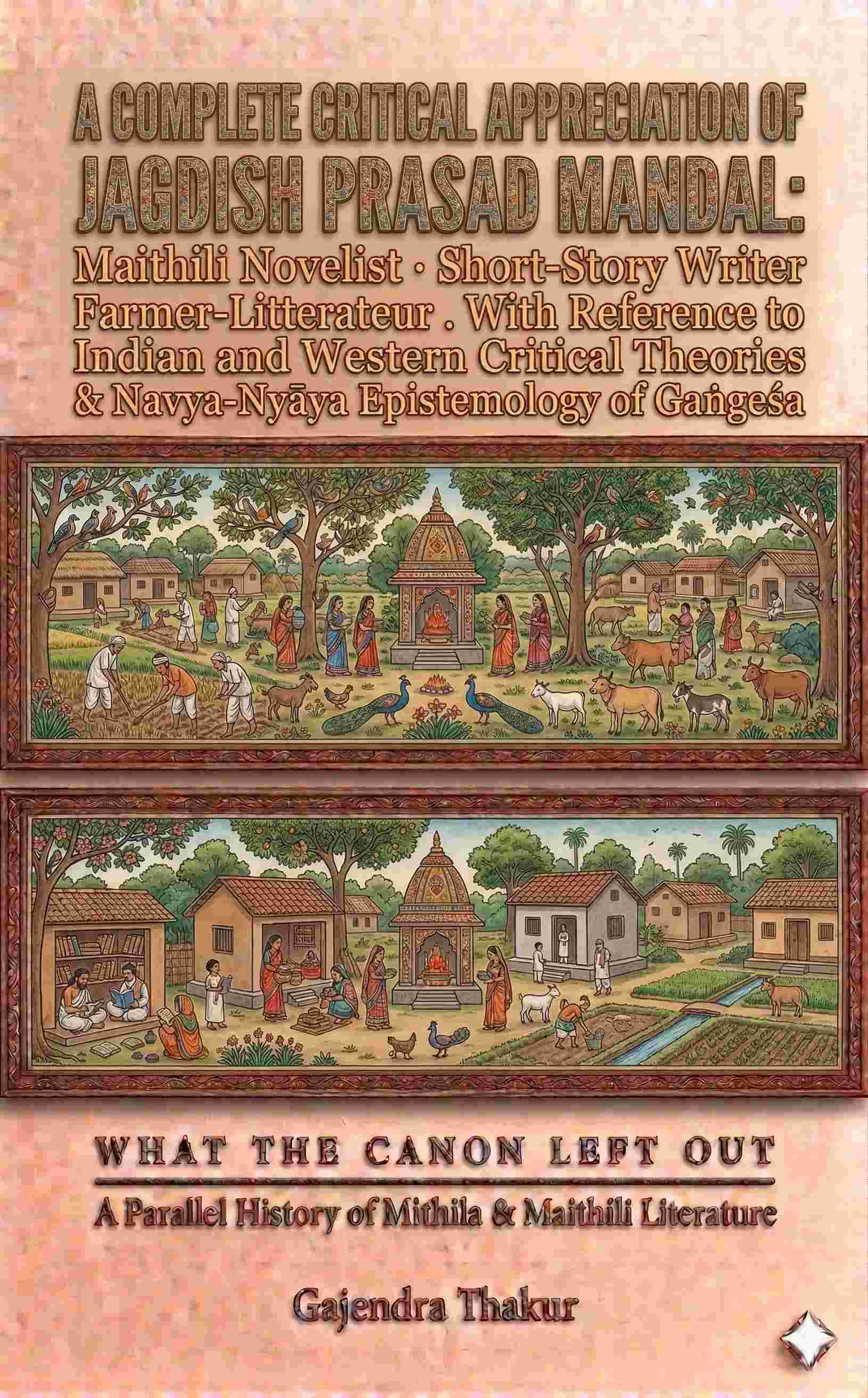
A COMPLETE CRITICAL APPRECIATION OF JAGDISH PRASAD MANDAL Maithili Novelist Short-Story Writer Farmer-Litterateur With Reference to Indian and Western Critical Theories, & Navya-Nyāya Epistemology of Gangeśa
A COMPLETE CRITICAL APPRECIATION OF
JAGDISH PRASAD MANDAL
Maithili Novelist · Short-Story Writer · Farmer-Litterateur
─────────────────────────────────────────
With
Reference to Indian and Western Critical Theories,
& Navya-Nyāya Epistemology of Gaṅgeśa
TABLE OF CONTENTS
I. Biographical Introduction: The Farmer-Litterateur
II. Survey of Works: Novels, Short Stories, and Other Writings
III. Thematic and Ideological Analysis
IV. Critical Appreciation: Western Literary Theories
V. Critical Appreciation: Indian Rasa-Dhvani Aesthetics & Nāṭyaśāstra
VI. Navya-Nyāya Epistemology of Gaṅgeśa Upādhyāya Applied to Mandal's Prose
VII. Comparative Study: Mandal among Maithili Writers
VIII. Reception and Awards
IX. Conclusions: Literary Significance and Legacy
X. Bibliography and References
I. BIOGRAPHICAL INTRODUCTION: THE FARMER-LITTERATEUR
Jagdish Prasad Mandal (born c. 1952, Madhubani District, Bihar) stands as one of the most consequential voices in contemporary Maithili literature—a writer whose social location as a farmer from the Other Backward Class (OBC) community fundamentally shaped both the content and form of his literary production. A postgraduate in Hindi and Political Science, Mandal chose to remain rooted in agricultural life even as he built an extensive literary career, embodying the Gramscian ideal of an organic intellectual who speaks from within the community rather than above it.
Mandal's background in Madhubani—the heartland of Mithila—gave him intimate access to the vernacular landscape, folk traditions, agricultural cycles, and caste tensions that form the texture of his writing. Unlike the dominant stream of Maithili letters, long shaped by Maithil Brahmin scholarly culture centred on Darbhanga, Mandal represents the subaltern voice that Gajendra Thakur's Videha movement—the first Maithili fortnightly e-journal (ISSN 2229-547X, est. 2000)—worked to bring into literary visibility.
Gajendra Thakur has noted that until 2021, the Sahitya Akademi's Maithili awards had been distributed as follows: Maithil Brahmins 42 times, Kayasthas 6 times, Rajputs 3 times, and Others zero times. Mandal's Sahitya Akademi Award for 2021 for his novel Pangu (Pallavi Prakashan, Nirmali, 2018) thus represents not only a personal honour but a structural rupture in the literary field—the first time a writer from a non-upper-caste farming community received this recognition in Maithili.
Dr. Baidyanath Choudhary Baiju, General Secretary of Vidyapati Seva Sansthan, observed that Mandal 'has set an example by achieving unprecedented success in the field of literature while being active in the field of vegetable production.' This union of agrarian labour and literary creation is not incidental but constitutive of Mandal's entire aesthetic project.
II. SURVEY OF WORKS: NOVELS, SHORT STORIES, AND OTHER WRITINGS
2.1 Novels
Mandal's novelistic output is remarkable for its sustained focus on the social fabric of Mithila's agrarian communities. His major novels include:
Gamak Jingi ('Life of the Village'): His most celebrated early novel-cycle dealing with rural Maithili life in its quotidian complexity—farming rhythms, familial bonds, caste conflicts, and the quiet dignity of the labouring classes. The title itself announces the scope: the life (jingi) of a village (gamak) as a totality.
Pangu (2018, Pallavi Prakashan, Nirmali): Winner of the Sahitya Akademi Award 2021. The Maithili word pangu denotes lameness, both physical and social. The novel deploys physical disability as an extended metaphor for the social immobility imposed by caste, class, and systemic neglect upon ordinary people. It is Mandal's most formally accomplished work, integrating realist social documentation with subtle symbolist technique.
Ijjat Gama Ijjat Banchelo ('Honour Lost, Honour Saved'): A novel examining the politics of honour (ijjat) in Maithili village culture—how it functions as a tool of social control, particularly upon women and those of lower social rank.
2.2 Short Stories
Mandal's short stories—many published in Videha and in print collections—are widely regarded as his laboratory for technique. They are characterised by an ear for vernacular Maithili idiom, tight narrative economy, and an unflinching gaze at caste violence, agricultural distress, and the inner lives of women and OBC communities. Critics have placed his stories within the tradition that Outlook India's kathakar Ashok identified as constituting a 'larger community integrated with Maithili literature through their works'—alongside Ram Vilas Sahu and Umesh Mandal.
2.3 Literary Activism and the Videha Connection
Mandal has been an active contributor to Videha (www.videha.co.in), Gajendra Thakur's pioneering Maithili e-journal, which began as 'Bhalsarik Gachh' (the first Maithili blog) in 2000 and became Videha from 1 January 2008. This connection is significant: Videha explicitly positioned itself as an instrument of 'parallel literature' against the casteist mainstream literary establishment, and Mandal's prolific contributions to it placed him at the heart of this democratising movement in Maithili letters.
III. THEMATIC AND IDEOLOGICAL ANALYSIS
3.1 The Subaltern and the Village as Literary Universe
Mandal's central achievement is the elevation of the non-Brahmin Maithili village to the status of a fully realised literary world. In contrast to earlier Maithili fiction that often filtered rural life through upper-caste sensibility (as in Harimohan Jha's celebrated satire Khattar Kakak Tarang, which targets Brahmin orthodoxy but retains an insider's perspective), Mandal writes from the position of those who worked the land. His gamak—village—is not a picturesque backdrop but a living social organism with its own epistemology, conflicts, and poetry.
3.2 Caste, Class, and the Disabled Body
Pangu most explicitly engages the intersection of bodily disability and social disadvantage. The protagonist's physical lameness becomes a site for exploring how Maithili society marks certain bodies as unproductive, burdensome, and socially redundant—mirroring the structural exclusion of entire communities. This move connects Mandal to the broader tradition of Dalit and OBC literature across Indian languages, while remaining specific to the Maithili context. Disability Studies scholars in the line of Rosemarie Garland-Thomson's 'misfits' framework find a ready application here: Mandal's pangu figure does not 'fit' the social environment not because of bodily deficit but because the environment is built to exclude.
3.3 Women, Honour, and the Domestic Sphere
Mandal's narratives consistently interrogate the gendered architecture of Maithili village honour culture. In Ijjat Gama Ijjat Banchelo, the concept of ijjat is revealed as a patriarchal mechanism that polices women's bodies and choices while simultaneously being invoked to justify social violence. This critical stance aligns Mandal with the feminist strands visible in contemporary Maithili fiction by Shefalika Verma (Naagfans), Usha Kiran Khan (Bhamati), and Vibha Rani.
3.4 Agricultural Life and the Crisis of the Maithili Peasant
Unlike the urbanised or cosmopolitan concerns of much Indian literary modernism, Mandal's work insists on the specificity of agricultural crisis—floods, land tenure, moneylending, crop failure—as lived experience and literary subject. This makes him a significant figure in what might be called 'agri-realism' in Indian vernacular literatures, comparable to Phanishwar Nath Renu's Maila Aanchal (Hindi, 1954) in its sociological density.
IV. CRITICAL APPRECIATION: WESTERN LITERARY THEORIES
4.1 Realism and Social Realism
Measured against the tradition of European literary realism—Balzac's 'total social fact', Lukács's demand for typicality, and the English social novel from George Eliot to Hardy—Mandal emerges as a thoroughgoing realist committed to the faithful representation of the Maithili social formation. Like Lukács's ideal of the realist novel (The Theory of the Novel, 1916; Studies in European Realism, 1950), Mandal's fiction seeks to capture the totality of social relations through the lives of representative individuals. His village characters are not idealisations but what Lukács called 'typical' figures—individuals in whom the contradictions of their historical moment crystallise.
Georg Lukács distinguished between critical realism and socialist realism on the basis of the author's relationship to historical consciousness. Mandal's work occupies an intermediate but distinctive position: it is not programmatically socialist in the Zhdanovist sense, yet it maintains a sustained critical consciousness of caste and class as historical formations—closer, perhaps, to the 'critical realism' Lukács admired in Balzac than to the tendentiousness of socialist realism.
4.2 Postcolonial Theory: Subaltern Studies and Vernacular Literature
Gayatri Chakravorty Spivak's foundational question—'Can the subaltern speak?' (1988)—acquires a precise inflection in Mandal's case. Mandal is the subaltern who speaks, in the language of the subaltern community (Maithili), to and about that community. This is not the metropolitan intellectual 'giving voice' to the marginalised but a writer located within the subaltern social structure who has developed the literary tools to represent that structure from within. Homi Bhabha's concept of the 'third space'—the liminal zone of cultural negotiation (The Location of Culture, 1994)—applies to Mandal's position between the oral folk culture of Mithila's peasant communities and the literary canon of Maithili writing.
Ranajit Guha's Subaltern Studies framework, particularly the concept of 'the prose of counter-insurgency', is germane here. Mandal's fiction constructs what might be called the 'prose of counter-exclusion': a literary discourse that makes visible the humanity, interiority, and social complexity of communities systematically excluded from Maithili literary representation.
4.3 Narrative Theory: Point of View and Free Indirect Discourse
Wayne Booth's concept of the 'implied author' (The Rhetoric of Fiction, 1961) and Gérard Genette's narratological categories (Narrative Discourse, 1972) illuminate Mandal's technique. His third-person narrators typically maintain what Genette calls 'internal focalisation'—the narrative perspective closely aligned with the experiential world of the protagonist, giving readers intimate access to consciousness without the melodrama of first-person confession. His use of free indirect discourse—narrating a character's thoughts through the narrator's voice without explicit quotation marks—permits a subtle empathy that is politically significant: it refuses the 'othering' of OBC and peasant characters that characterised much earlier Maithili fiction.
4.4 Structuralism, Semiotics, and the Village Sign-System
Ferdinand de Saussure's distinction between langue (the linguistic system) and parole (individual speech acts) finds a literary analogue in Mandal's relationship to Maithili: he draws on the deep system of Maithili vernacular expression (its idioms, proverbs, folk-tale structures) while creating highly individualised narrative speech acts (parole). Roland Barthes's concept of mythologies—the way cultural signs naturalise historical constructions—illuminates Mandal's critical engagement with the mythology of ijjat (honour): Pangu and Ijjat Gama Ijjat Banchelo demythologise honour as a naturalised social good, revealing it as a constructed and contested sign in a power-laden semiotic field.
4.5 Mikhail Bakhtin: Heteroglossia and the Polyphonic Novel
Bakhtin's concept of heteroglossia (raznorechie)—the coexistence of multiple social voices and speech registers within a single novelistic text (The Dialogic Imagination, 1981)—is particularly apt for Mandal's work. His novels do not impose a monologic authorial voice but allow the multiple, competing speech registers of Maithili village life—the landlord's officiousness, the labourer's oblique resistance, the woman's constrained expression, the child's unguarded perception—to create meaning dialogically. This polyphonic structure is both aesthetically innovative and politically significant: it refuses the hierarchisation of voices that characterised the socially conservative strand of Maithili fiction.
4.6 Magic Realism and Folk-Narrative Devices
Maithili kathakar Ashok, in an interview with Outlook India (2024), noted that contemporary Maithili fiction uses 'folk-narrative world' resources—'snakes, dismembered thumb, etc.'—in ways that approximate magic realism, to 'reveal the mystery of characters of complicated people.' While Mandal is primarily a social realist, his deployment of folk symbolism in certain stories draws on this tradition. Gabriel García Márquez's magic realism was itself rooted in the oral traditions of Latin American peasant communities; Mandal's selective use of Maithili folk symbolism similarly roots his literary technique in a vernacular cosmology.
V. CRITICAL APPRECIATION: INDIAN AESTHETICS, NĀṬYAŚĀSTRA, AND RASA THEORY
5.1 Bharata's Nāṭyaśāstra: Rasa and Its Application to Fiction
Bharata Muni's Nāṭyaśāstra (c. 200 BCE–200 CE)—the foundational text of Indian aesthetics—defines rasa as the essential emotive flavour evoked by a work of art through the combination of vibhāva (stimulus), anubhāva (response), and vyabhicāri-bhāva (transitory emotions). While Bharata's treatise focuses on drama (nāṭya), the rasa theory was extended to all literary forms by subsequent theorists including Ānandavardhana and Abhinavagupta.
Mandal's primary rasa is karuṇa (the pathetic/compassionate), the rasa arising from sorrow and suffering, whose permanent emotion (sthāyibhāva) is śoka (grief). The pangu protagonist of his Akademi-winning novel evokes this rasa with sustained power: the vibhāva are the social structures that disable and exclude; the anubhāva are the protagonist's constrained movements through a world not built for him; the vyabhicāri-bhāva include the transitory emotions of helplessness, occasional joy, resignation, and unexpected solidarity. The reader's aesthetic experience of karuṇa is not mere pity but the purification (viśrānti) that Abhinavagupta describes as the hallmark of fully realised rasa.
Alongside karuṇa, Mandal's work activates vīra rasa (the heroic), understood not in the martial sense but in the sense of moral courage—the quiet heroism of the labouring person who persists with dignity under unjust conditions. This 'subaltern vīra' is a significant innovation: Bharata's vīra rasa was associated with warrior-kings (kṣatriya heroism), but Mandal recasts it as the heroism of the peasant who refuses to be fully defeated.
5.2 Dhvani (Resonance) Theory: Ānandavardhana and Abhinavagupta
Ānandavardhana's Dhvanyāloka (c. 850 CE) proposes that the highest literary achievement consists not in what is directly stated (vācya) but in what is suggested (dhvani)—the resonant, unstated meaning that the cultivated reader intuits. Abhinavagupta's commentary Locana deepens this theory by connecting dhvani to the universal aesthetic consciousness (sādhāraṇīkaraṇa—generalisation of emotion from individual to universal).
Mandal's narrative technique is rich in dhvani. In Pangu, the protagonist's physical disability suggests—without ever stating directly—the social paralysis of an entire class. The novel's silences, its reticences, its refusal to editorialise, generate a dhvani of structural injustice more powerful than any explicit polemic. This technique connects Mandal to the best traditions of Indian literary suggestiveness, from Kālidāsa's āranyas to the subliminal social critique in Premchand's Godan.
5.3 Alaṃkāra Tradition: Figurative Language in Mandal's Prose
The Sanskrit alaṃkāra (ornament/figure) tradition, as codified by Daṇḍin (Kāvyādarśa, c. 7th century CE) and Mammaṭa (Kāvyaprakāśa, c. 11th century CE), identifies upamā (simile), rūpaka (metaphor), and vyājastuti (ironic praise) as principal poetic figures. Mandal's prose deploys these with remarkable economy. His similes are drawn from the agricultural world—the simile of the bullock yoked to the grinding stone for the circular repetition of poverty; the rūpaka of the withered crop for the stunted life of the disabled peasant. These figures are not decorative but functional: they build the cognitive and emotional architecture of meaning.
5.4 Nāṭyaśāstra's Social Registers (Pravṛtti) and Mandal's Language Politics
Bharata's Nāṭyaśāstra specifies that different social classes should speak different varieties of language: Sanskrit for kings and heroes, Prakrit for women and lesser characters, Apabhraṃśa for low-caste characters. This linguistic hierarchy, which encoded social stratification within the dramatic text itself, has been a contested legacy. Some conservative Maithili dramatists, as Gajendra Thakur's Parallel History of Maithili Literature documents, tried to use Nāṭyaśāstra's authority to justify derogatory representation of lower-caste communities in Maithili drama. Mandal's fiction performs a radical inversion: the vernacular Maithili of the peasant and OBC community is the literary standard, the language of dignity and interiority, while the Sanskrit-inflected high register associated with Brahmin culture appears as one social dialect among others.
VI. NAVYA-NYĀYA EPISTEMOLOGY OF GAṄGEŚA UPĀDHYĀYA APPLIED TO MANDAL'S PROSE
6.1 Gaṅgeśa Upādhyāya and the Navya-Nyāya School
Gaṅgeśa Upādhyāya (fl. 13th–14th century CE, Mithila) was the founder of Navya-Nyāya (New Logic), the most technically sophisticated school of Indian epistemology and logic, enshrined in his magnum opus Tattvacintāmaṇi ('The Wish-Fulfilling Gem of Truth'). The Navya-Nyāya school developed rigorous tools for the analysis of knowledge (jñāna), valid cognition (pramā), and the conditions under which a proposition may be regarded as true. Gaṅgeśa's own social biography is instructive: Videha's Parallel History documents, with reference to panji (genealogical) records, that Gaṅgeśa married a woman of artisan (charmakāriṇī) caste and was himself 'of inferior social status' in the casteist hierarchy of medieval Mithila—a fact suppressed by conservative Maithili scholars but recovered by Gajendra Thakur. Thus Gaṅgeśa and Mandal share a structural position: both produced foundational intellectual work from within communities marginalised by the dominant Brahmin culture of Mithila.
6.2 Navya-Nyāya Analytical Categories Applied to Mandal's Narrative
Navya-Nyāya distinguishes between viśeṣya (the qualified entity/substrate), viśeṣaṇa (the qualifier/property), and their relation (saṃbandha). Applied as a critical methodology to Mandal's fiction, this tripartite analytical structure illuminates his narrative technique:
Viśeṣya (Substrate): The social body of the Maithili village—its structures of caste, kinship, and agricultural economy—functions as the permanent substrate (ādhāra) of Mandal's narrative world.
Viśeṣaṇa (Qualifier): Individual characters and events function as qualifiers that specify and particularise the general substrate. In Pangu, the protagonist's disability is the viśeṣaṇa that qualifies the general substrate of caste-mediated social exclusion, making its operations visible in a specific instance.
Saṃbandha (Relation): The relationship between character and social structure is not one of simple causation (as in naturalist fiction) but of complex, multi-directional conditioning. Navya-Nyāya's attention to different types of relational categories (tādātmya—identity, samavāya—inherence, saṃyoga—conjunction) helps articulate the varied ways in which Mandal's characters are both formed by and resist their social conditioning.
6.3 Pramāṇa (Valid Knowledge) and Literary Truth
Navya-Nyāya identifies four pramāṇas (sources of valid knowledge): pratyakṣa (perception), anumāna (inference), upamāna (analogy/comparison), and śabda (verbal testimony). Mandal's literary practice can be read through this epistemological framework. His realism rests on pratyakṣa—the authority of direct experience of agricultural Maithili life; his structural critique employs anumāna—reasoning from observed particulars to general social structures; his figurative language (similes of the grinding stone, the withered crop) deploys upamāna; and his engagement with Maithili oral and folk tradition draws on śabda—the knowledge preserved in collective linguistic memory.
6.4 Vyāpti (Universal Concomitance) and the Novel's Claim to Truth
Navya-Nyāya's concept of vyāpti—universal concomitance, the co-occurrence of a property (sādhya) with its reason (hetu) in all instances—underpins the logical validity of inferences. Applied critically, vyāpti speaks to the question of whether Mandal's fictional particulars support general truths about Maithili social life. The novel Pangu achieves vyāpti when the particular story of one disabled peasant generates the universal recognition of structural social disability: readers infer from the specific case a general principle about how Maithili society constructs and naturalises exclusion. This movement from particular to universal—from the viśeṣa to the sāmānya—is the hallmark of both Navya-Nyāya inference and the realist novel at its best.
VII. COMPARATIVE STUDY: MANDAL AMONG MAITHILI WRITERS
7.1 Mandal and Harimohan Jha (1908–1984): The Two Faces of Maithili Social Critique
Harimohan Jha's Khattar Kakak Tarang (serialised from 1940s) is the foundational text of social-satirical Maithili prose. Written from an upper-caste insider's perspective, it attacked Brahmin orthodoxy with wit and irony. Jha was, in the assessment of Gajendra Thakur's Parallel History, the writer most unjustly denied the Sahitya Akademi award by the conservative establishment. The comparison with Mandal is illuminating: where Jha used the weapons of satire and irony (internal critique from within the dominant caste), Mandal deploys the weapons of empathetic realism (external critique from the marginalised community). Both are social critics, but their social locations produce structurally different literatures.
7.2 Mandal and Vidyapati (c. 1352–1448): Continuity and Rupture
Vidyapati, the great poet of medieval Mithila, wrote his celebrated padāvalī (lyric poetry) primarily in the register of Śṛṅgāra (erotic-devotional) rasa, in a highly Sanskritised Maithili patronised by the Karnāṭa-dynasty kings. Mandal's work represents both a continuity (deep rootedness in Maithili language and culture) and a radical rupture (displacement of the Brahminic and courtly aesthetic by a peasant-centred literary politics). The genealogical claims made by conservative Maithili literary institutions upon Vidyapati are precisely what Mandal's literary practice challenges: Vidyapati belongs to all Maithili speakers, not to any one caste.
7.3 Mandal and Rajkamal Chaudhary (1929–1967): The Avant-Garde and the Social Realist
Rajkamal Chaudhary is Maithili's great literary modernist, celebrated for experimental prose and verse that engaged with surrealism, stream of consciousness, and existentialist themes in both Maithili and Hindi. Where Chaudhary reached for universal modernist technique, Mandal remains committed to a social realism rooted in the specific experience of Mithila's non-elite communities. These are not competing failures but complementary achievements: Maithili literature's range is measured by the distance between Rajkamal's Andolana and Mandal's Pangu.
7.4 Mandal and Gajendra Thakur: The Two Pillars of 'Parallel Literature'
Gajendra Thakur (b. 1971), editor of Videha and author of experimental polygenre works (Sahasrabadhani, Sankarshan, etc.), is the other major figure of what Videha calls 'parallel Maithili literature.' Where Thakur's work is characterised by formal experimentalism, Maithili linguistic archaeology, and digital activism, Mandal's strength lies in narrative clarity, social depth, and the authentic grain of the Maithili peasant's voice. Together, they represent complementary vectors of the democratisation of Maithili letters: Thakur providing the theoretical and institutional architecture, Mandal providing the literary substance.
7.5 Mandal and Usha Kiran Khan: Gender and Caste in Contemporary Maithili Fiction
Usha Kiran Khan's novel Bhamati (2010, Sahitya Akademi Award) deals with the life of Vacaspati Miśra's wife—an upper-caste woman who enables her husband's philosophical work in self-sacrifice. Khan's feminist Maithili fiction operates from within the Brahmin woman's experience of patriarchy; Mandal's fiction addresses the intersection of caste-subordination and gender from the OBC community's perspective. Both are necessary; their coexistence marks the maturity of contemporary Maithili fiction.
7.6 Mandal and Nagarjuna ('Yatri', 1911–1998): The Socialist-Realist Tradition
Nagarjuna (Vaidyanath Mishra, pen name 'Yatri'), despite being associated primarily with Hindi writing, won the Sahitya Akademi's Maithili prize, making his case controversial in the Videha parallel history framework. His Maithili verse—like Mandal's prose—was committed to the lives of the poor and marginalised. Both deploy Mithila's landscape and peasant culture as the ground of literary meaning. The difference lies in ideological framing: Nagarjuna worked from a Marxist-Communist framework, while Mandal's social critique is rooted in the lived experience of OBC community rather than imported ideology—closer, perhaps, to the social realism Premchand practised in Hindi.
VIII. RECEPTION AND AWARDS
Jagdish Prasad Mandal received the Sahitya Akademi Award for 2021 for his novel Pangu (2018) at Sahityotsav, the Festival of Letters, in New Delhi in March 2022. This award, conferred by India's National Academy of Letters, is the most prestigious recognition available to Indian-language writers and marked the first time the Maithili Sahitya Akademi award had gone to a writer from a non-upper-caste community.
Senior Maithili litterateur Manikant Jha observed that 'Jagdish Mandal's works have always given rainbow colour to the sky of Maithili literature.' Former President of Maithili Academy, Pandit Kamla Kant Jha noted his 'continuous contribution to the development of Mithila and Maithili with his creations.' These testimonies, while conventional in their register, indicate Mandal's acceptance even within the literary establishment that had long excluded writers of his social background.
The Videha parallel history framework places Mandal's award in a broader political-literary context: the 2021 award broke a systematic pattern of caste-based exclusion documented by Gajendra Thakur. As Thakur notes in the Parallel History, the Sahitya Akademi's Maithili award had been distributed overwhelmingly (42 out of 51 awards prior to 2021) to Maithil Brahmin writers—a disproportion reflecting not literary merit but the institutional capture of the Akademi's advisory structure by conservative organisations.
Mandal's critical reputation within the 'parallel literature' movement is secure. He has been consistently published in Videha, featured in Outlook India's discussions of contemporary Maithili literature, and cited in academic studies of the 21st-century Maithili novel (A Critical Analysis of Maithili Novel: Twenty-First Century, IJIRT, December 2025). His Pangu is described in this academic survey as one of only three Maithili novels of the 21st century to win a Sahitya Akademi award (alongside Usha Kiran Khan's Bhamati and Asha Mishra's Uchat).
IX. CONCLUSIONS: LITERARY SIGNIFICANCE AND LEGACY
Jagdish Prasad Mandal's place in Maithili literature is established on multiple grounds. As a social realist in the Lukácsian sense, he has created a body of fiction that offers the 'totality' of Maithili rural life from a perspective hitherto absent from the literary canon. As a practitioner of what postcolonial theory calls 'writing back' to the dominant culture, he has expanded the repertoire of Maithili literary subjects and styles. As a reader of Navya-Nyāya's epistemological spirit—the drive to make knowledge precise, verifiable, and grounded in experience—he has contributed a new standard of narrative truth-telling to Maithili fiction.
Within the Indian aesthetic tradition, Mandal's primary achievement is the sustained evocation of karuṇa rasa—compassion—without sentimentality: a rasa that, in Abhinavagupta's understanding, achieves its full power precisely when it is grounded in the specificities of a recognisable social world. The dhvani of his best work—the resonant suggestion of systemic injustice beneath the surface of individual story—places him in the lineage of those Indian writers who understood that the most powerful literary statement is the one that is not fully stated.
Comparatively, Mandal stands as the Maithili answer to the challenge that writers like Munshi Premchand (Hindi), Fakir Mohan Senapati (Odia), and Rabindranath Tagore in his later stories posed: how to make vernacular literature the vehicle for the full humanity of communities that dominant culture had made invisible. He has succeeded in this project. Maithili literature after Mandal cannot return to its pre-Mandal narrowness.
His legacy is threefold: the democratisation of Maithili literary subjectivity (whose story is worth telling); the enrichment of Maithili narrative technique (how that story may be told with aesthetic power); and the institutional rupture represented by his Sahitya Akademi award (what the literary establishment is compelled to recognise). These three achievements together constitute a literary revolution conducted with the quiet persistence of a farmer who plants seeds not for today's harvest but for tomorrow's tree.
Do not judge each day by the harvest you reap but by the seeds that you plant. — — Robert Louis Stevenson, epigraph to Gajendra Thakur's critical study of Maithili parallel literature
X. BIBLIOGRAPHY AND REFERENCES
Primary Sources (Works by Jagdish Prasad Mandal)
Mandal, Jagdish Prasad. Gamak Jingi [Life of the Village]. Maithili novel. (Published in print and available through Videha archive, www.videha.co.in).
Mandal, Jagdish Prasad. Pangu [The Lame]. Nirmali: Pallavi Prakashan, 2018. [Sahitya Akademi Award, 2021].
Mandal, Jagdish Prasad. Ijjat Gama Ijjat Banchelo [Honour Lost, Honour Saved]. Maithili novel.
Mandal, Jagdish Prasad. Short stories and occasional prose published in Videha: First Maithili Fortnightly eJournal (ISSN 2229-547X), www.videha.co.in, 2008 onwards.
Secondary Sources: Maithili and Indian Criticism
Choudhary, Radhakrishna. A Survey of Maithili Literature. Maithili and English. (Cited in Gajendra Thakur's Parallel History).
Jha, Devkant. Adhunik Maithili Sahityak Itihas [History of Modern Maithili Literature]. New Delhi: Sahitya Akademi, 2017.
Jha, Jayakanta. A History of Maithili Literature. New Delhi: Sahitya Akademi, 1980.
Mishra, Jayakanta (ed.). Maithili Sahitya. Wiesbaden: Franz Steiner Verlag, 1974.
Navin, Adyanath Jha. 'Navonmeshak Bat Par Chalait Siraur.' Ghar Bahar (April–June 2024), ed. Ramanand Jha 'Raman.' Patna: Chetana Samiti.
Shrinivas, Shivshankar. Maithili Upanyasak Alochana [Criticism of the Maithili Novel]. Patna: Shekhar Prakashan, 2021.
Thakur, Gajendra. A Parallel History of Mithila and Maithili Literature. Parts 1–56, www.videha.co.in/gajenthakur.htm. ISSN 2229-547X.
Thakur, Gajendra. Rajdeo Mandal: Maithili Writer (with Supplement Two: 'Literary Scene in Maithili after the Arrival of Jagdish Prasad Mandal'). Videha Archive, 2022. Available: archive.org.
Unnamed author. 'A Critical Analysis of Maithili Novel: Twenty-First Century.' IJIRT, Vol. 12, Issue 7 (December 2025). ISSN 2349-6002.
Outlook India (Kathakar Ashok interview). 'A Journey Through Maithili Literature with Kathakar Ashok.' Outlook India, 7 February 2024.
Western Literary Theory
Bakhtin, Mikhail. The Dialogic Imagination: Four Essays. Ed. Michael Holquist. Austin: University of Texas Press, 1981.
Barthes, Roland. Mythologies. Trans. Annette Lavers. New York: Hill and Wang, 1972.
Bhabha, Homi K. The Location of Culture. London: Routledge, 1994.
Booth, Wayne C. The Rhetoric of Fiction. Chicago: University of Chicago Press, 1961.
de Saussure, Ferdinand. Course in General Linguistics. Trans. Wade Baskin. New York: McGraw-Hill, 1966.
Garland-Thomson, Rosemarie. 'Misfits: A Feminist Materialist Disability Concept.' Hypatia 26.3 (2011): 591–609.
Genette, Gérard. Narrative Discourse: An Essay in Method. Trans. Jane E. Lewin. Ithaca: Cornell University Press, 1980.
Guha, Ranajit (ed.). Subaltern Studies, Vol. I. Delhi: Oxford University Press, 1982.
Lukács, Georg. Studies in European Realism. Trans. Edith Bone. London: Hillway Publishing, 1950.
Lukács, Georg. The Theory of the Novel. Trans. Anna Bostock. Cambridge, MA: MIT Press, 1971.
Spivak, Gayatri Chakravorty. 'Can the Subaltern Speak?' Marxism and the Interpretation of Culture. Ed. Cary Nelson and Lawrence Grossberg. Urbana: University of Illinois Press, 1988. 271–313.
Indian Aesthetics and Navya-Nyāya
Ānandavardhana. Dhvanyāloka [Light on Suggestion]. Trans. and ed. Daniel H. H. Ingalls et al. Cambridge, MA: Harvard University Press, 1990.
Abhinavagupta. Abhinavabhāratī (commentary on Nāṭyaśāstra). In The Nāṭyaśāstra of Bharata. Trans. M. M. Ghosh. Calcutta: Asiatic Society, 1950–61.
Bharata Muni. Nāṭyaśāstra. Trans. M. M. Ghosh. Calcutta: Asiatic Society, 1950–61.
Bhattacharya, Dinesh Chandra. History of Navya-Nyāya in Mithila. Darbhanga: Mithila Institute, 1958.
Daṇḍin. Kāvyādarśa [Mirror of Poetry]. Ed. and trans. Sheldon Pollock. New York: Clay Sanskrit Library/NYU Press, 2006.
Gaṅgeśa Upādhyāya. Tattvacintāmaṇi [The Wish-Fulfilling Gem of Truth]. Ed. Kamakhyanath Tarkavagisha. Calcutta: 1884–1901.
Mammaṭa. Kāvyaprakāśa [Light of Poetry]. Trans. R. C. Dwivedi. Delhi: Motilal Banarsidass, 1965.
Oommen, T. K. 'Linguistic Diversity.' Sociology, 1988. National Law School of India University / Bar Council of India Trust.
Thakur, Gajendra. Panji Prabandh, Vol. I & II. Videha Archive / Google Books, 2009. Available: videha.co.in/pothi.htm.
अपन मंतव्य editorial.staff.videha@zohomail.in पर पठाउ।
विदेहमे सभठाम ताकू / Search all Videha
Static full-text search · Pagefindलेखक/शीर्षक/अंक/वर्ष — खोज-विधा। गद्य/पद्य/शोध current/static + पुरान Videha/Sadeha contents खोजैत अछि। पोथी pothi.htm केर पूर्ण listing, श्रव्य-दृश्य Audio_Video.htm केर पूर्ण listing, पञ्जी videha-sadeha/panji-shards GitHub data, आ थेसारस/शब्दकोश videha-ejournal.github.io/data GitHub JSON corpus केँ query करैत अछि आ दूनू Quiz corpus मे dictionary/vocabulary/शब्दार्थ-सम्बन्धी प्रश्नोत्तरी परिणाम सेहो जोड़ैत अछि। Quiz videha-quiz आ GitHub user-site दूनू bilingual quiz corpus खोजैत अछि। Roman/IAST + देवनागरी cross-script search समर्थित। Issue/Year लेल संख्या दिअ। PDF-अभिलेख archive.org/VidehaAndSadeha सूची खोजैत अछि।