
Gajendra Thakur
A PARALLEL HISTORY OF MITHILA & MAITHILI LITERATURE- PART 62
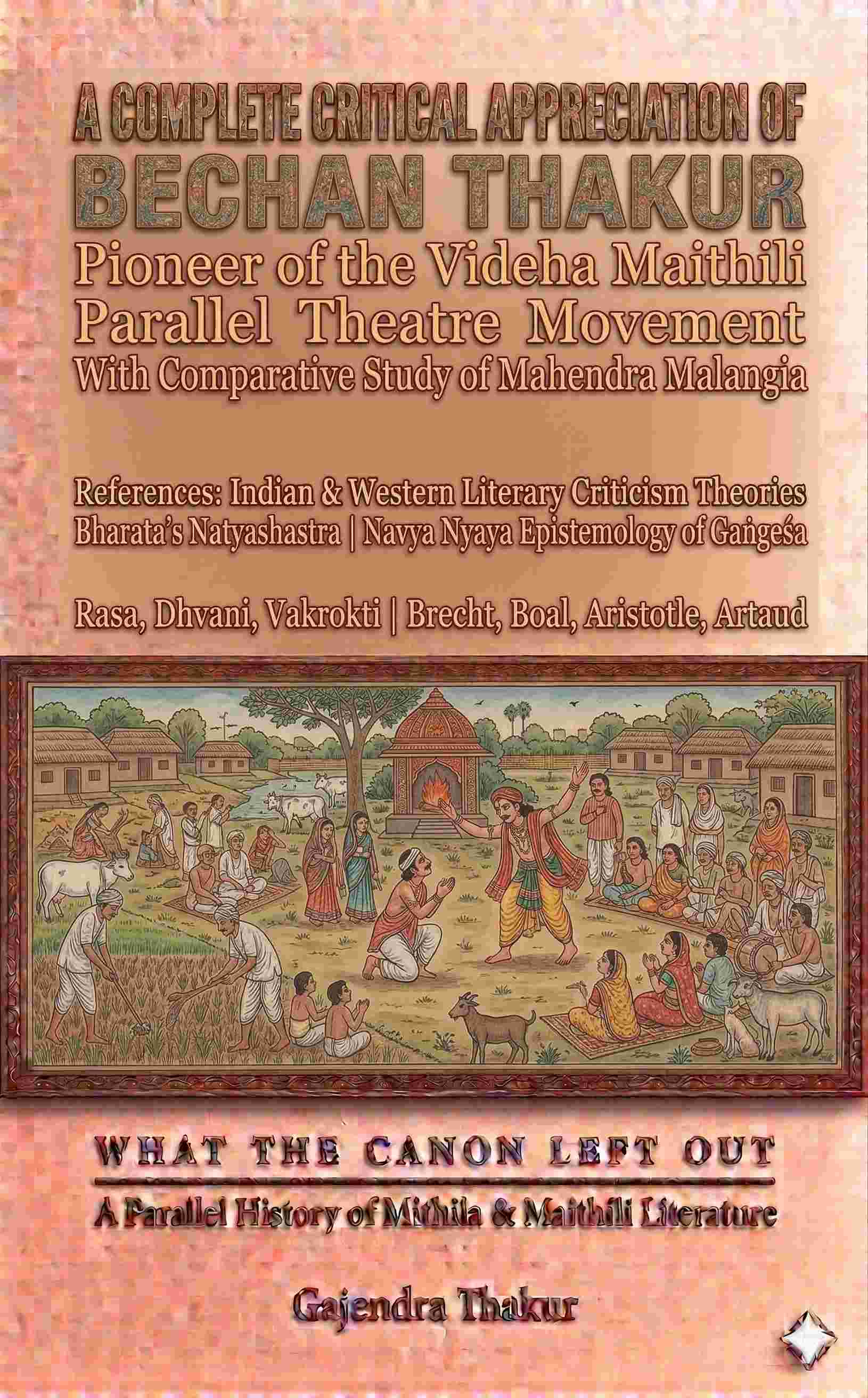
A COMPLETE CRITICAL APPRECIATION OF BECHAN THAKUR Pioneer of the Videha Maithili Parallel Theatre Movement With Comparative Study of Mahendra Malangia References: Indian & Western Literary Criticism Theories Bharata's Natyashastra | Navya Nyaya Epistemology of Gangeśa Rasa, Dhvani, Vakrokti | Brecht, Boal, Aristotle, Artaud
A COMPLETE CRITICAL APPRECIATION OF
BECHAN THAKUR
Pioneer of the Videha Maithili Parallel Theatre Movement
With Comparative Study of Mahendra Malangia
References: Indian & Western Literary Criticism Theories
Bharata's Natyashastra | Navya Nyaya Epistemology of Gaṅgeśa
Rasa, Dhvani, Vakrokti | Brecht, Boal, Aristotle, Artaud
Chapter I: Maithili Theatre, Caste, and the Parallel Movement
1.1 The Theatrical Landscape of Mithila
Mithila — the ancient Videha kingdom of Janaka, homeland of Sita, birthplace of Gangesa Upadhyaya's Navya Nyaya philosophy — has sustained a theatrical tradition of extraordinary antiquity. The Natyashastra of Bharatamuni identifies a body of early performance forms rooted in folk practice; the Maithili literary tradition, from Vidyapati's geets performed at court and village alike to the Ankiya Nat tradition of Assam (which draws on Maithili sources), demonstrates the long-standing centrality of performance to the region's cultural life. Medieval Maithili theatre encompassed Sanskrit natya (Vidyapati's Goraksavijaya), folk performance genres (the gamaya nach, jat-jatin dance-theatre, samaichakeva, etc.), and the socio-religious performances embedded in life-cycle rituals.
In the twentieth century, the institutionalisation of Maithili theatre brought with it a significant problem: the 'jativadi' or casteist bias that concentrated theatrical production, direction, and critical authority in the hands of upper-caste (primarily Brahmin-Kayastha) communities. The works selected for staging, the aesthetics valorised, the actors recruited, and the audiences addressed all reflected and reinforced caste hierarchy. This is the context against which the Videha Maithili Parallel Theatre Movement, pioneered by Bechan Thakur from the 1990s onwards, must be understood.
1.2 Videha and the Parallel Theatre Movement
The Videha eJournal (www.videha.co.in), founded by Gajendra Thakur and launched in 2008 as the first Maithili fortnightly e-journal (ISSN 2229-547X), constitutes the intellectual hub of the Videha Maithili Literature Movement. Its explicit manifesto — 'Manushimih Samskritam' (Humans First in Culture) — signals its commitment to the democratisation of Maithili culture, the inclusion of subaltern and non-Brahmin voices, and the resistance to what it terms 'jativadi rangmanch' (casteist theatre).
The Videha Maithili Natya Utsav (2012) — documented in the 230-page anthology Videha Maithili Natya Utsav (ISBN 978-93-80538-66-2, Shruti Prakashan, Delhi, 2012) — was the first major public event of the Videha Parallel Theatre Movement. Its proceedings, which include a landmark interview with Bechan Thakur, an extensive critical essay by Gajendra Thakur on parallel Maithili theatre, documentation of 25 years of stage productions directed by Bechan Thakur, and analyses of both Indian and Western dramatic theory, constitute a major document of contemporary Maithili theatrical history.
Bechan Thakur holds the formal editorial position of 'Sampadak: Natak-Rangmanch-Chalchitra' (Editor, Drama-Theatre-Cinema) of the Videha eJournal — a role that reflects his institutional centrality to the Videha movement. This position is explicitly stated in the Videha Sampadakiya (editorial) data, confirming his status as the primary theatrical authority within the movement.
1.3 Gangesa Upadhyaya and the Mithila Epistemological Tradition
Any critical appreciation of Maithili theatre must acknowledge the philosophical tradition within which it operates. Gangesa Upadhyaya (c. 14th century, Mithila) — whose Tattvacintamani ('Thought-Jewel of Reality') founded the Navya Nyaya school of Indian logic and epistemology — provides a critical instrument of enormous power. Gangesa's analysis of the four pramanas (means of valid knowledge) — pratyaksha (perception), anumana (inference), upamana (analogy/comparison), and shabda (verbal testimony) — and his rigorous methodology of definition (lakshana), delimitation (avacchedaka), and verification, constitute a framework uniquely appropriate for the analysis of a theatre movement rooted in Mithila's intellectual soil.
The particular relevance of Navya Nyaya to Bechan Thakur's theatre lies in Gangesa's rejection of false cognition (bhrama) — the misleading appearance of truth. Casteist theatre produces a bhrama: it presents itself as 'Maithili' theatre while representing only a fraction of Maithili society, and it produces the false cognition that Brahminical aesthetics are the aesthetics of Mithila as a whole. Bechan Thakur's parallel theatre is, in Navya Nyaya terms, an exercise in correcting this bhrama — of achieving prama (valid cognition) about Maithili social reality through the pratyaksha of direct theatrical representation of subaltern life.
Chapter II: Bechan Thakur — Life, Context, and Theatrical Mission
2.1 Biographical Profile
Bechan Thakur (बेचन ठाकुर) was born and raised in Chanauraganj (चनौरागंज), Bhaya Jhanjharpur, District Madhubani, Mithila, Bihar — a small semi-urban centre in the heart of the Maithili-speaking belt. His caste background — the Barhi (carpenter) community, identified by the 'Thakur' suffix that marks artisan-service castes in Mithila — places him decisively outside the Brahmin-Kayastha literary establishment that has historically dominated Maithili cultural production. He works as a private tutor (coaching teacher), a livelihood that gives him both direct contact with village youth and the economic independence — however modest — to pursue his theatrical work without institutional or governmental support.
Thakur began writing plays during his college years, initially developing his craft through staging productions at the New Lotus English School campus in Chanauraganj, where annual Saraswati Puja celebrations became the regular venue for theatrical production. The documentation in the Videha Maithili Natya Utsav anthology records his productions systematically from 1995 onwards, providing an extraordinary archive of grassroots theatre practice. By the time of the 2012 Videha Natya Utsav, he had maintained this parallel theatre practice for over 25 years — without any government or institutional support — making him one of the most persistent and committed figures in contemporary Maithili theatre.
In his interview with Munjaji (Manoj Kumar Karna) published in the Videha Maithili Natya Utsav anthology, Thakur explains his theatrical genesis in the following terms: 'When I used to go with family or neighbours to see gamaya nach or natak, I was inspired by them, and day by day my interest in theatre grew, and therefore my plays' narratives always contain the state and situation of society and attempts at their possible resolution.' This formulation — society, situation, resolution — encapsulates Thakur's theatrical mission: the social-realist imperative to represent and address lived social problems.
2.2 The Works: A Comprehensive Survey
2.2.1 Betik Apaman aa Chhinardevi (Insult of the Daughter and Chhinardevi)
Published by Shruti Prakashan, New Delhi, 2010 (ISBN 978-93-80538-35-8), this two-play volume contains Thakur's seminal plays Betik Apaman (The Insult/Dishonour of the Daughter) and Chhinardevi. It represents his most explicitly feminist work and constitutes a direct theatrical intervention in the crisis of female foeticide and gender devaluation in Mithila and neighbouring regions.
Betik Apaman confronts the practice of sex-selective abortion driven by the dowry system. The play's author's statement is direct and unambiguous: 'Stri-purush dunya kai neeb chhi. Muda dahejak karane samajme betik hei drishti se dekhau jaait chhai. Falasvarup samadhan hetu lok altraasaundak durupyog ke betik vansh naaash karaik pachhu laagal achhi' (Woman and man are the foundation of the world. But because of the dowry system, the daughter is looked down upon in society. As a result, people are pursuing the destruction of daughters through the misuse of ultrasound technology). The play dramatises this crisis through the household of Deepak Chaudhary, exploring the complex of attitudes within a single family — desire for a daughter versus fear of dowry burden — through a rich cast of village characters.
From the Natyashastra perspective, this play operates within the mode of natyadharmi (theatrical convention) as a vehicle for loka-dharma (social ethics). Bharatamuni's definition of the purpose of natya as providing 'counsel to those who are in distress, rest to those who are weary, and entertainment (to those seeking amusement)' is here adapted to a specifically modern social-reform function. The play employs what Bharatamuni calls 'samanya-abhinaya' (general/common representation) rather than 'lokadharmi-abhinaya' (realistic representation) — the characters are recognisable social types (the well-meaning but confused patriarch, the pragmatic wife, the community elders) rather than realistic individuals.
Applying Navya Nyaya analysis: the play's cognitive object (prameya) is the social practice of female foeticide. The pratyaksha-pramana is the audience's direct perceptual recognition of the situations depicted. The anumana-pramana is the play's inferential structure — from the visible behaviour of characters, the audience infers the structural causes (dowry system, patriarchal values, medical technology misuse). The shabda-pramana is the play's verbal testimony, delivered through dialogue that quotes the actual slogans, proverbs, and rationalizations used by people who practice or condone female foeticide. The play's dramatic function is to correct the social bhrama that female foeticide is a 'natural' or 'inevitable' response to social conditions.
Chhinardevi, the second play in this volume, deals with superstition (andhavishas) in village society. The author's preface explicitly states the social problem: superstition is endemic in both rural Mithila and in ostensibly 'developed' regions like Haryana. The character of Chhinardevi is almost certainly a woman either accused of being a witch (dain) or herself caught in the web of superstitious practice. The dain tradition — the persecution of women as witches — is a live social problem in Bihar and Jharkhand, and Thakur's engagement with it places his work in dialogue with the long tradition of progressive social theatre that uses the stage as a tool of superstition eradication.
2.2.2 Baap Bhel Pitti aa Adhikaar (Father Became a Child and Rights)
Published by Shruti Prakashan, New Delhi, this two-play volume containing Baap Bhel Pitti and Adhikaar was described in reports of its 2012 staging as a 'Mahan Samajik Maithili Natak' (Great Social Maithili Play). The title Baap Bhel Pitti (Father Became a Child) evokes the problem of parental abandonment and the reversal of the traditional parent-child relationship, a theme directly connected to the breakdown of joint family structures and the crisis of elder care in contemporary rural Mithila.
The theme of Baap Bhel Pitti — parents becoming like children, dependent, helpless, subject to their own children's authority — is a distinctively modern social problem that arises at the intersection of nuclear family formation, rural-urban migration, land disputes, and changing inheritance norms. Its theatrical dramaturgy builds through recognition of a familiar domestic situation toward a climactic confrontation that forces the audience to examine its own assumptions about filial duty (putradharm) and parental authority.
Adhikaar (Rights) addresses the question of legal and civic rights — likely the rights of women, Dalits, or marginalised communities — in a system that formally grants rights but practically denies them. The Natyashastra concept of 'arthasthiti' (the logic of situation) is relevant here: the characters of Adhikaar are caught in a situation where the formal possession of rights and their practical exercise are in contradiction, and the dramatic action moves through the recognition of this contradiction toward its attempted resolution.
2.2.3 Bhaat (Encounter/Confrontation)
Bhaat (72 pages, Shruti Prakashan) is one of Thakur's most ambitious works in terms of scale: the character list runs to over 100 named roles, making it a work of massive communal theatre that requires the participation of an entire village community in its production. The title Bhaat means both 'encounter' and 'confrontation' in Maithili, suggesting a political dramaturgy centred on electoral conflict and the confrontation of power.
The character list, as extracted from the text, includes: political leaders at multiple levels (Gobardhananlal, Rameshwar, Jitendra, Shrilal); election officials (Ramtap as Election Commissioner, Giriraj as Deputy Election Commissioner); security forces (Mansingh, Chansingh); party workers, village elders, and various factional members — a total cast that mirrors the full social complexity of a Bihari village during elections. This is theatre as social panorama: the drama encompasses the entire social field of electoral politics, from the highest election administration to the lowest rural voter.
Bhaat operates within the tradition of political epic theatre. Brechtian analysis is directly applicable: the multiplicity of characters prevents individual psychological identification and encourages the audience's critical observation of the social system as a whole. The election — the ritual of democracy — becomes the theatrical event through which the contradictions of Indian democratic practice (vote-buying, caste mobilisation, official corruption, gangster intimidation) are dramatised. The audience is positioned not as sympathisers with any individual character but as critical analysts of the system.
From the Natyashastra perspective, Bhaat employs multiple prakaras (theatrical modes): it contains heroic elements (Rashtra Prabandhan — governance), comic elements (the absurdity of electoral corruption), and grotesque elements (the violence and intimidation). It violates the classical principle of unity of action in order to achieve a broader epic sweep, functioning more in the tradition of the Itihasas (epics) than the classical Sanskrit rupaka.
2.2.4 Biswasghat (Betrayal/Breach of Trust)
Biswasghat (103 pages, Shruti Prakashan) engages with one of the most painful themes in human social life: the betrayal of trust between those who are close — family members, partners, neighbours, associates. The title, from 'vishwasaghat' (betrayal of faith/trust), immediately signals the moral register of the play: this is a drama about the destruction of the social fabric of trust that holds communities together.
The opening scene of Biswasghat — extracted from the text — shows Ram Kishun reading a newspaper on his veranda when his elder son Ram Sewak brings him tea. This domestic, intimate opening establishes the register of family trust before it is violated: the play's action will presumably move from this quotidian domestic scene toward a revelation of betrayal within the family structure, centred on a land dispute (the papers concerning land that Lakhan and his wife Lakshmi discuss in the second scene).
Land betrayal — the manipulation or theft of land documents — is one of the most common forms of intra-family conflict in rural Bihar, driven by population pressure, land scarcity, and the legal complexity of inheritance. Biswasghat dramatises this specific social pathology: the betrayal of trust embodied in the falsification or manipulation of land records, which destroys family bonds and community solidarity.
In terms of Rasa theory, Biswasghat's dominant rasa is karuna (pathos/compassion), generated by the audience's empathetic recognition of the suffering caused by betrayal within intimate relationships. Abhinavagupta's analysis of karuna in the Abhinavabharati identifies it as the rasa that arises when the audience perceives the suffering of a person with whom they identify through shared humanity. The domestic setting and recognisable social types of Biswasghat facilitate this identification.
2.2.5 Oonch-Neech (High-Low / Caste Hierarchy)
Oonch-Neech (107 pages, Shruti Prakashan, 2013; ISBN referenced in the text) is Thakur's most directly anti-caste theatrical statement. The title — 'high-low' or 'upper-lower' — simultaneously evokes economic inequality (oonch-neech in the sense of social ups and downs) and caste hierarchy (oonch-jati and neech-jati, high and low castes in the traditional Brahminical ordering). This deliberate semantic ambiguity is itself a theatrical technique: it refuses to separate economic exploitation from caste oppression, insisting on their structural unity.
The play's dramaturgy is grounded in the specific conditions of rural Mithila: the characters Mangal and Marni open the play by discussing the changes between their parents' generation and their own, weaving together observations about the great flood (badi) of 1987 and the earthquake (bhumkam) of 1988 — two actual historical events that devastated large parts of Mithila and displaced or impoverished communities. This temporal anchoring in specific historical catastrophe distinguishes Thakur's realism from generic social drama: his plays are saturated with the specific historical reality of Mithila's subaltern communities.
Oonch-Neech is Thakur's most direct engagement with what the Videha movement calls 'jativadi rangmanch' — casteist theatre — and its alternative. The play dramatises the lived experience of caste discrimination: the micro-aggressions, the economic exploitation, the denial of dignity that constitute the daily reality of lower-caste communities in Mithila. Its theatrical action moves between the recognition of injustice and the search for dignity, resolution, and resistance.
The application of Augusto Boal's 'Theatre of the Oppressed' framework is most directly relevant to Oonch-Neech. Boal's concept of 'poetics of the oppressed' — the project of making the oppressed the subject rather than the object of theatrical representation — perfectly describes Thakur's project in this play. The characters Mangal and Marni are not objects of upper-caste pity or reform-minded patronage; they are the subjects of the theatrical action, articulating their own understanding of their situation and their own search for dignity.
Chapter III: Critical Analysis — Dramatic Craft and Theatrical Vision
3.1 Thematic Architecture
Across his five major texts archived in the Videha Digital Library, Bechan Thakur develops five interconnected thematic concerns that constitute the architecture of his dramatic vision. First is gender justice — the trilogy of gender-based oppression consisting of female foeticide (Betik Apaman), dowry violence, and the witch-hunting of women (Chhinardevi). Second is intergenerational justice — the rights of parents abandoned by children (Baap Bhel Pitti) and the obligations of the young to the old. Third is caste justice — the direct confrontation with Mithila's caste hierarchy as a lived system of oppression (Oonch-Neech). Fourth is political justice — the corruption and criminalisation of electoral democracy (Bhaat). Fifth is the ethics of trust — the social foundations of community life and their betrayal (Biswasghat).
These five themes are not unrelated: they constitute a unified diagnosis of the social pathologies of contemporary rural Mithila. The oppression of women, the abandonment of the elderly, caste discrimination, electoral corruption, and the betrayal of trust all arise from the same structural source: the breakdown of social solidarity under the combined pressures of economic marginalisation, caste hierarchy, and the corrosive effects of poverty and competition. Thakur's theatre is, in this sense, a systematic social pathology — a theatrical diagnosis of what has gone wrong in Maithili village society.
3.2 Bharata's Natyashastra and Bechan Thakur's Practice
The Natyashastra of Bharatamuni (c. 200 BCE–200 CE) is the foundational text of Indian dramaturgy, and the Videha Maithili Natya Utsav anthology contains an extensive comparative analysis of Indian and Western dramatic theory (in Gajendra Thakur's lead essay) that provides the critical framework within which Bechan Thakur's work is evaluated. The Natyashastra's comprehensive account of the elements of theatrical production — rasa (emotional flavour), bhava (emotion), abhinaya (expression/representation), vritti (style), siddhi (theatrical success), and the technical specifications of stage space, music, costume, and movement — provides the institutional backdrop against which Thakur's gamaya (village) theatre can be assessed.
Bharata's theory of the dasarupakas (ten dramatic forms) is relevant to the classification of Thakur's plays. His works do not fit neatly into any single classical category: they share features with the nataka (heroic drama), the prakarana (realistic domestic drama), the vyayoga (action-based drama), and the vithi (street or popular performance). This generic hybridity is not a failure of craft but a deliberate adaptation of classical forms to a modern, village-based, social-realist theatrical context. The Natyashastra itself recognises the legitimacy of regional variation and folk adaptation (lokadharmi), and Thakur's gamaya theatre represents precisely this kind of legitimate regional theatrical development.
The concept of rasa-siddhi (theatrical success in emotional impact) in the Natyashastra is evaluated through the response of the sahridaya (connoisseur-audience). For Thakur's village theatre, the sahridaya is not the cultivated aesthetic connoisseur of classical theory but the village audience itself — people who bring direct experiential knowledge of the social situations depicted. The 'connoisseurship' of Thakur's audience is not aesthetic cultivation but social and experiential recognition: the audience recognises their own lives on stage. This is what the Natyashastra's concept of sadharani-karana (universalisation of emotion) means in Thakur's specific context: the transformation of the audience's own social experience into a shared aesthetic event.
The Natyashastra's chapter on the aharya (costume/visual presentation) is relevant to Thakur's minimalist production aesthetic. Without institutional funding or professional production resources, Thakur's theatre operates with minimal aharya — the costume and visual presentation reflect the actual social reality of village Mithila rather than the elaborate conventions of classical or urban professional theatre. This minimalism is not a limitation but a creative choice: it closes the aesthetic distance between representation and reality, making the theatrical event more immediately present and socially legible for its audience.
3.3 The Gamaya Theatre Tradition and its Reinvention
Bechan Thakur's theatre is rooted in the gamaya (village) theatrical tradition of Mithila — the popular performance forms (gamaya nach, jat-jatin, samaichakeva, bidesia, etc.) that have sustained theatrical culture in rural Mithila across generations. The gamaya tradition is characterised by: community participation (the entire village is audience and sometimes cast); festive context (performances are embedded in religious and seasonal festivals, particularly Saraswati Puja); musical integration (harmonium, dhol, and folk instruments are essential); and social commentary (the gamaya performance has always included satirical and reformist elements).
Thakur reinvents this tradition in several important ways. First, he writes fixed scripts rather than relying on the improvisatory or oral tradition of gamaya performance. Second, he addresses contemporary social issues (female foeticide, electoral corruption) rather than mythological or historical themes. Third, he explicitly theorises the political function of his theatre — in his interview with Munjaji, he articulates the opposition between 'parallel theatre' (samantar rangmanch) and 'casteist theatre' (jativadi rangmanch) in explicit ideological terms. Fourth, he creates documentary records of his productions — cast lists, dates, venues — that constitute a historical archive of rural theatrical practice.
3.4 Language, Register, and Social Semiotics
The language of Thakur's plays is Maithili in its gamaya register — the vernacular speech of lower-caste village communities, with its specific phonological features, proverbs, idioms, and expressive patterns. This linguistic choice is itself a political statement: it asserts the theatrical legitimacy of subaltern Maithili speech against the 'literary' Maithili of the Brahmin-Kayastha establishment, which privileges Maithili's Sanskrit-derived lexical register and its connection to the medieval literary tradition.
From a semiotic perspective (following Barthes' analysis of language as ideology), the choice of gamaya Maithili for theatrical dialogue is an act of linguistic valorisation: it declares that the speech of lower-caste communities is not a degraded variant of 'correct' Maithili but a legitimate literary and theatrical language. This valorisation has profound implications for the reception of Thakur's theatre by his primary audience — the lower-caste village communities of Mithila, who hear their own speech on stage, validated as theatrical language.
The Navya Nyaya concept of shabda-pramana (verbal testimony as means of valid knowledge) is relevant here: Thakur's theatre asserts the epistemic validity of gamaya speech as a means of knowing social reality. The testimony of lower-caste characters — their accounts of discrimination, exploitation, and injustice — is presented as valid knowledge (prama) rather than as the distorted or limited perspective of the socially marginalised.
Chapter IV: Critical Frameworks — Indian and Western Theories Applied
4.1 Rasa Theory (Bharatamuni, Abhinavagupta)
The rasa theory identifies eight principal aesthetic emotions (rasas) and their corresponding permanent emotions (sthayi-bhavas). Applied to Thakur's dramatic corpus, the dominant rasas are: karuna (compassion/pathos), arising from the depiction of social suffering — the abandoned parent of Baap Bhel Pitti, the daughter devalued in Betik Apaman, the lower-caste person discriminated against in Oonch-Neech; raudra (fury/righteous anger), arising from the depiction of injustice — electoral corruption in Bhaat, caste oppression in Oonch-Neech; vira (heroism/moral courage), arising from the depiction of resistance to oppression; and bhayanaka (terror), arising from the depiction of social violence, superstition, and the threat of witch-hunting.
Abhinavagupta's analysis of rasanishpatti (the production of rasa in the audience-consciousness) through the process of sadharani-karana (universalisation) is particularly relevant. For Abhinavagupta, the transformation of the personal emotions of characters into universalised aesthetic experiences accessible to the audience requires a specific kind of imaginative participation — the sahridaya's willingness to enter into the emotional world of the drama while maintaining aesthetic distance. Thakur's village theatre achieves this through the mechanism of social recognition: the audience's identification with the characters' situations is not merely imaginative but experiential, grounded in the shared reality of village life.
4.2 Dhvani Theory (Anandavardhana) and Theatrical Suggestion
Anandavardhana's theory of dhvani (suggestion/resonance) in the Dhvanyaloka identifies suggested meaning (vyanjana-artha) as the supreme dimension of literary expression. Applied to Thakur's dramaturgy, the concept of dhvani illuminates the way his plays operate on multiple levels of meaning simultaneously. The surface narrative of Oonch-Neech — a domestic scene between Mangal and Marni discussing floods and earthquakes — resonates with deeper suggested meanings: the social 'floods' of caste discrimination, the political 'earthquakes' of structural inequality. The gamaya setting resonates with the entire history of lower-caste theatrical exclusion; each scene of village life suggests the historical depth of Mithila's social contradictions.
The dhvani dimension of Thakur's theatre is also political: the plays say more than they directly state. The titles alone — Oonch-Neech (high-low), Biswasghat (betrayal), Baap Bhel Pitti (father became child) — carry dhvani beyond their literal meanings, suggesting the structural inversions (the high becoming low, trust becoming betrayal, the parent becoming child) that characterise the social world Thakur depicts.
4.3 Navya Nyaya Epistemology and Theatrical Cognition
Gangesa Upadhyaya's Navya Nyaya provides a uniquely Mithila-specific critical framework for Bechan Thakur's theatre. Gangesa's central project — the rigorous analysis of the conditions of valid cognition (prama) and the identification and correction of false cognition (bhrama) — translates into the theatrical domain as follows: valid theatrical cognition (natya-prama) arises when the theatre accurately represents social reality through appropriate means; false theatrical cognition (natya-bhrama) arises when theatrical representation distorts, conceals, or misrepresents social reality — as occurs in 'jativadi rangmanch' (casteist theatre) that presents Brahminical perspectives as universal Maithili reality.
The four pramanas map onto distinct dimensions of theatrical production and reception. Pratyaksha (perception) corresponds to the direct sensory experience of theatrical performance — the audience's immediate perceptual engagement with the bodies, voices, movements, and visual imagery of the stage. Anumana (inference) corresponds to the critical and analytical dimension of theatrical reception — the audience's inferential movement from what they see and hear to conclusions about social causes, structural conditions, and systemic injustice. Upamana (analogy/comparison) corresponds to intertextual theatrical experience — the audience's recognition of Thakur's plays in relation to other theatrical experiences, folk narratives, and social stories they know. Shabda (verbal testimony) corresponds to the linguistic dimension of theatrical experience — the authority of theatrical dialogue as a form of valid social testimony.
Gangesa's concept of avacchedakatva (delimitation or qualification) is relevant to the analysis of Thakur's theatrical method. Each of his plays precisely delimits its social domain: Betik Apaman is delimited to the domain of gender and dowry; Bhaat is delimited to the domain of electoral politics; Biswasghat is delimited to the domain of family trust and land. This precise delimitation — the refusal to scatter across too many social problems simultaneously — gives each play its analytical focus and its theatrical economy.
4.4 Brecht, Epic Theatre, and the Political Stage
Bertolt Brecht's development of Epic Theatre in Weimar Germany and its subsequent influence on world theatre provides one of the most productive Western frameworks for analysing Bechan Thakur's work. Brecht's central innovations — the Verfremdungseffekt (alienation effect), the rejection of Aristotelian catharsis, the historicisation of social situations, the use of narrative interruption and direct address to the audience — all find significant parallels in Thakur's theatrical practice, even if through independent development rather than direct influence.
The Brechtian alienation effect is achieved in Thakur's theatre not through the modernist devices of Brecht's Berlin productions (placards, projected titles, direct addresses to the audience) but through the structural effects of political commentary embedded in the dialogue itself. Characters in Bhaat, for example, explicitly analyse the electoral system as a system — they speak about power structures in ways that invite the audience's analytical engagement rather than passive emotional absorption. The massive cast of Bhaat creates an epic social panorama that prevents the audience from identifying with a single protagonist — a structural Brechtian effect achieved through traditional means.
Augusto Boal's Theatre of the Oppressed is even more directly relevant. Boal's distinction between 'Aristotelian' theatre (which makes the protagonist act on behalf of the spectator who is thus rendered passive) and 'oppressed' theatre (which makes the spectator the protagonist) resonates strongly with Thakur's theatrical project. Thakur's village audience is not a passive audience watching professional performers enact social problems — it is a community of active participants who recognise their own lives on stage and are implicitly invited to analyse, discuss, and act upon the social conditions depicted.
4.5 Feminist Literary Criticism and Gender Justice
Bechan Thakur's engagement with gender issues — female foeticide in Betik Apaman, witch-hunting in Chhinardevi, gender dynamics in Baap Bhel Pitti and Biswasghat — places him in dialogue with feminist literary and theatrical criticism. From the perspective of Elaine Showalter's 'gynocriticism' and the broader feminist project of recovering and validating women's experience in literature and theatre, Thakur's work performs an important function: it makes the bodies, voices, and experiences of Maithili women — particularly lower-caste and lower-class women — visible on the theatrical stage.
The feminist analysis of Betik Apaman is particularly significant. The play dramatises what Adrienne Rich called 'compulsory heterosexuality' and the 'institution of motherhood' in their specific Maithili manifestations: the pressure on women to produce male children, the devaluation of female births, and the technological mediation of this patriarchal demand through the misuse of ultrasound technology. The play's theatrical strategy — showing a family in the process of rationalising female foeticide while gradually revealing the horror of this rationalisation — is a feminist theatrical pedagogy: it uses dramatic irony to expose the ideology that normalises the destruction of female life.
The connection between Thakur's anti-casteist and feminist projects is crucial: in Mithila, caste oppression and gender oppression are structurally linked. Lower-caste women face the compounded disadvantages of gender discrimination within their own communities and caste discrimination from upper-caste structures. Thakur's theatre, which represents both the internal gender dynamics of lower-caste households and the external caste pressures upon them, captures this structural intersection — what feminist theorists (following Kimberlé Crenshaw) call 'intersectionality'.
4.6 Post-colonial Theory and the Subaltern Stage
The application of post-colonial theory (Frantz Fanon, Edward Said, Gayatri Spivak, Homi Bhabha) to Bechan Thakur's theatre reveals the distinctively post-colonial dimensions of his theatrical project. Thakur's theatre is post-colonial in a double sense: it responds to the colonial marginalisation of vernacular performance traditions, and it resists the neo-colonial hierarchies of post-independence cultural institutions that perpetuate upper-caste dominance in the name of 'classical' culture.
Spivak's canonical question — 'Can the subaltern speak?' — finds a specific theatrical answer in Thakur's work. In the dominant Maithili theatrical establishment (what Thakur and the Videha movement call 'jativadi rangmanch'), the subaltern — the lower-caste, the female, the rural poor — cannot speak or is spoken for by upper-caste mediators who claim to represent 'Maithili culture' as a whole. Thakur's parallel theatre is an institutional response to this structural silencing: it creates a theatrical space in which subaltern subjects speak for themselves, in their own language, from their own social location, about their own experiences.
4.7 Aristotle, Hamartia, and the Tragic Vision
Aristotle's Poetics — with its concepts of mimesis (imitation of action), catharsis (purification of emotions), hamartia (tragic flaw), peripeteia (reversal of fortune), and anagnorisis (recognition/discovery) — provides a classical Western framework for analysing the dramatic structure of Thakur's plays. While Thakur's theatre is not strictly Aristotelian (it does not centre on a single tragic hero; it does not prioritise catharsis over critical engagement), elements of Aristotelian dramatic structure are clearly operative.
The concept of hamartia — the tragic error or flaw that precipitates catastrophe — has a social rather than individual dimension in Thakur's dramaturgy. The 'tragic flaw' in his plays is not a character's individual moral failing but the social structures of caste, patriarchy, and corruption that distort individual choices and produce collective suffering. In Betik Apaman, the 'hamartia' is not Deepak Chaudhary's individual attitude toward daughters but the entire social system of dowry and gender devaluation that shapes and constrains his choices. This socialisation of hamartia is consonant with Brecht's historicisation of individual fate and with Boal's analysis of the social production of oppression.
Chapter V: Bechan Thakur and Mahendra Malangia — A Comparative Study
5.1 Mahendra Malangia: Profile and Achievement
Mahendra Malangia is one of the most celebrated figures in contemporary Maithili literature and theatre. Born in Malangia village, Rahika block, Madhubani district — the same geographical universe as Bechan Thakur — he has been writing and directing plays for over four decades. He is the recipient of the Sahitya Akademi Award 2024 for his Maithili essay collection Prabandh Sangrah, and has been recognised at multiple national and international literary events, including the Kalinga Literary Festival. His Saat Natak (Seven Plays) — analysed by Abhilasha Kumari in the journal Academia — represents his major theatrical achievement.
According to his profile at the Kalinga Literary Festival, 'Mahendra Malangia's contemporary lies in his continual experimentation and innovation within the broader framework of Indian ways of doing theater in constant dialogue with the folk and classical traditions of performing art in India and Nepal.' This formulation — 'Indian ways of doing theater,' 'folk and classical traditions' — places Malangia within a different theatrical framework from Thakur: where Thakur is primarily engaged in social-realist intervention, Malangia is engaged in aesthetic experimentation and tradition-creative dialogue.
The Videha Maithili Natya Utsav anthology — in Gajendra Thakur's lead critical essay — provides a sharp critical assessment of Malangia's work that must be acknowledged in any comparative study. The essay criticises Malangia's treatment of the 'chhutahar' (untouchable) figure in his play Chhutahar Ghail — noting that even decades after writing the play, the 'chhutahar' remains linguistically marked as lower than the 'neech varg' (lower class). The essay also criticises what it calls Malangia's tendency toward 'sanasanekhez sahitya' (sensationalist literature) and his use of Bollywood dialogue. These criticisms, coming from the Videha movement, reflect the ideological distance between Malangia's aesthetic experimentalism and Thakur's committed social realism.
5.2 Comparative Analysis: The Parallel Theatre vs. Institutional Theatre Debate
The fundamental difference between Bechan Thakur and Mahendra Malangia is not primarily aesthetic but structural and ideological. Thakur represents what the Videha movement calls 'samantar rangmanch' — parallel theatre, operating outside and in opposition to the caste-dominated institutional theatre establishment. Malangia represents 'sthapita rangmanch' — established theatre, with its institutional recognitions (Sahitya Akademi), its literary festival presences, and its engagement with both the folk and classical traditions on terms that are broadly acceptable to the establishment.
This structural difference produces different aesthetic choices, different audiences, and different theatrical economies. Thakur's theatre is village-based, community-funded (or self-funded), performed on the Saraswati Puja stage of a school compound in Chanauraganj, with a cast of village youth from multiple caste communities. Malangia's theatre is more broadly institutional, with access to professional production resources, literary festival platforms, and national critical recognition. The difference is not one of quality but of position: each operates in a different field of the Maithili theatrical ecosystem.
From the Natyashastra perspective, both Thakur and Malangia can be evaluated through Bharata's concept of 'siddhi' (theatrical success): the question is not which form of theatre is superior in the abstract but which form achieves its specific theatrical aims. Thakur's theatre achieves siddhi when it produces in its village audience the recognition of social injustice and the emotional motivation to address it. Malangia's theatre achieves siddhi when it produces in its literary festival or institutional audience the aesthetic pleasure of skilled theatrical craftsmanship and cultural reflection.
Comparative Table: Bechan Thakur and Mahendra Malangia
|
Criterion |
Bechan Thakur |
Mahendra Malangia |
|
Background |
Barhi- carpenter-caste (Thakur) artisan community; Chanauraganj, Madhubani |
Brahmin-dominant landed gentry community; Malangia village, Rahika, Madhubani |
|
Ideological Stance |
Radically anti-casteist; champions inter-caste equality; Dalit/OBC representation; parallel theatre as anti-establishment movement |
Draws on classical traditions; folk and Sanskrit aesthetics; broad social canvas; aesthetics over explicit ideology |
|
Language Register |
Gamaya (village-vernacular) Maithili; oral rhythms of lower-caste communities |
Wider register: classical, folk, and standard literary Maithili |
|
Theatrical Model |
Community-based; self-financed; grassroots; Saraswati Puja stage; non-institutional |
Institutional engagements; Sahitya Akademi recognition; all-India literary circuit |
|
Natyashastra Relation |
Inverts Bharata's Natyashastra assumption of Brahmin authorship; actualises its democratic spirit |
Works within Natyashastra framework; integrates folk forms within classical norms |
|
Navya Nyaya Application |
Text as pratyaksha of caste reality; anumana of structural injustice |
Text as sabda-pramana of living tradition; inference of cultural continuity |
|
Thematic Core |
Female foeticide, dowry, casteism, electoral corruption, betrayal, fraud |
Social conflict, cultural identity, folk mythology, generational change |
|
Western Parallel |
Brecht (Epic Theatre), Augusto Boal (Theatre of the Oppressed), Dario Fo |
Chekhov, Ibsen (realistic social drama) |
|
Awards/Recognition |
Videha Samman; Natya-Rangmanch editor of Videha eJournal; 25+ years grassroots theatre |
Sahitya Akademi Award 2024; Kalinga Literary Festival recognition; Bihar CM felicitation |
5.3 Convergences and Shared Ground
Despite their significant differences, Bechan Thakur and Mahendra Malangia share important ground. Both are rooted in the specific cultural geography of Madhubani district; both draw on the gamaya theatrical tradition of Mithila; both are committed to the vitality of the Maithili language as a theatrical medium; and both have contributed to the archive of Maithili theatrical knowledge that the Videha Digital Library makes accessible. Their differences are productive rather than destructive: they represent the dialectical vitality of a living theatrical tradition that can sustain both committed social realism and aesthetic experimentalism within its compass.
The Navya Nyaya framework helps here: the comparison between Thakur and Malangia is not a competition for the prize of 'better Maithili theatre' but an exercise in upamana-pramana (analogical/comparative cognition). Each artist is evaluated within the appropriate cognitive domain — their specific theatrical aims, their specific social locations, their specific aesthetic choices — and the comparison illuminates the structural features of each by contrast with the other. Gangesa's methodology of precise definition and delimitation prevents the false generalisations that arise when socially committed theatre and aesthetic experimentalism are evaluated by each other's criteria.
Chapter VI: The Videha Parallel Theatre as Cultural Movement
6.1 The 2012 Videha Maithili Natya Utsav — A Landmark Event
The First Videha Maithili Natya Utsav (2012) — documented in the Videha-Sadeh 8 anthology — was a watershed event in the history of Maithili theatre. For the first time, the practitioners of grassroots, community-based, parallel Maithili theatre were brought together with theoretical and critical support from the Videha Literary Movement, producing a public event that demonstrated both the vitality of the movement and the sophistication of its theoretical self-understanding.
The anthology records multiple performance groups, playwrights, and directors from across the Maithili-speaking region — from Madhubani to Janakpur (Nepal) — operating in the tradition of community-based, non-casteist theatre. The breadth of this documentation reveals that Bechan Thakur is not an isolated individual but the most prominent figure in a larger movement of grassroots theatrical practice that the Videha project has helped to make visible and give institutional form.
The anthology also records the resistance this movement has generated from the established theatrical order: threats against Umesh Mandal and others from figures connected to the casteist establishment — documented with specific phone numbers and dates — are reproduced in the published record. This institutional conflict is itself theatrical: the parallel theatre movement's challenge to the established order has provoked real-world intimidation that mirrors the conflicts depicted on Thakur's stage. The theatre and the social reality it represents are not separate domains.
6.2 Bechan Thakur's Legacy and Future Directions
In his interview, Bechan Thakur is asked about his creative plans. He responds: 'Nothing definitive can be said about future prospects for theatrical and other creative activities, but the parallel theatre will continue. The will is strong. I will do as much as it is possible to do.' This formulation — 'the parallel theatre will continue; the will is strong' — expresses both the personal commitment and the institutional identity of the movement. The parallel theatre is not Thakur's personal project; it is a movement with its own momentum, sustained by a community of practitioners across Mithila.
Thakur's legacy is multi-dimensional. As a playwright, he has created a body of socially committed drama that addresses the most urgent questions of contemporary Mithila society: gender violence, caste oppression, electoral corruption, intergenerational neglect, and the betrayal of community trust. As a director, he has maintained a 25-year tradition of village theatrical production that has given performance opportunities to youth from multiple caste communities in Chanauraganj and the surrounding area. As a theorist, he has contributed through his interview and his practice to the conceptualisation of 'samantar rangmanch' as a distinct theatrical tradition and ideological position. And as the Natak-Rangmanch editor of the Videha eJournal, he has helped to archive, disseminate, and theorise the broader movement of which his own work is the most vital example.
The Navya Nyaya tradition of Mithila — the tradition in which Gangesa Upadhyaya insisted on the precise, rigorous, and honest cognition of reality against false cognitions — finds its theatrical embodiment in Bechan Thakur's parallel theatre. Just as Gangesa corrected the bhrama (false cognitions) of earlier philosophy through systematic analysis and rigorous definition, Thakur corrects the bhramas of casteist culture — the false representation of Brahminical perspectives as universal Maithili reality, the false naturalisation of caste hierarchy, the false normalisation of gender violence — through the theatrical representation of a social reality that has been hidden, marginalised, and suppressed.
Chapter VII: Synthesis and Conclusions
Bechan Thakur occupies a unique and significant position in the history of contemporary Maithili theatre. He is simultaneously a practitioner (playwright, director, actor-trainer), an institution-builder (the founder of the Videha Parallel Theatre movement's grassroots theatrical tradition), a theorist (articulating the ideology of 'samantar rangmanch' against 'jativadi rangmanch'), and an archivist (maintaining meticulous records of 25 years of village theatrical production). These multiple roles make him not merely a playwright but a figure of theatrical culture in the fullest sense.
The critical frameworks applied in this appreciation have illuminated different dimensions of Thakur's work. The Natyashastra framework reveals his deep roots in the performative traditions of Mithila and his creative adaptation of classical dramatic categories to modern social reality. The Navya Nyaya framework reveals the epistemological seriousness of his theatrical project — the commitment to correcting false social cognitions through the pratyaksha of direct theatrical representation. The Rasa and Dhvani frameworks reveal the aesthetic dimensions of his dramaturgy — the specific emotional registers of his plays and their capacity for multi-layered suggestion. The Western frameworks of Brecht, Boal, feminist criticism, and post-colonial theory reveal his affinities with the global traditions of committed and oppressed-people's theatre, placing his village-based work within an international theatrical conversation.
The comparative study of Bechan Thakur and Mahendra Malangia reveals the productive complexity of the contemporary Maithili theatrical field: two playwrights from the same geographical region, working in the same language, drawing on some of the same folk traditions, but occupying radically different social and ideological positions within the Maithili cultural ecosystem. Their coexistence and their tension illuminate the dynamics of a living literary and theatrical tradition.
The Videha Digital Library's archiving of Bechan Thakur's five major plays — Betik Apaman aa Chhinardevi, Baap Bhel Pitti aa Adhikaar, Bhaat, Biswasghat, and Oonch-Neech — ensures that this remarkable body of grassroots theatrical work is accessible to scholars and practitioners globally, beyond the geographical and institutional limits of Mithila's village culture. This archiving act, combined with the documentation of 25 years of theatrical production in the Videha Maithili Natya Utsav anthology and the critical and theoretical apparatus of the Videha Literary Movement, constitutes one of the most significant acts of subaltern cultural preservation in contemporary Indian literary history.
References and Bibliography
Primary Sources — Bechan Thakur's Archived Works
Thakur, Bechan. Betik Apaman aa Chhinardevi [The Insult of the Daughter and Chhinardevi]. New Delhi: Shruti Prakashan, 2010. ISBN 978-93-80538-35-8. Videha Digital Library.
Thakur, Bechan. Baap Bhel Pitti aa Adhikaar [Father Became a Child and Rights]. New Delhi: Shruti Prakashan. Videha Digital Library.
Thakur, Bechan. Bhaat [Encounter/Confrontation]. New Delhi: Shruti Prakashan. 72 pages. Videha Digital Library.
Thakur, Bechan. Biswasghat [Betrayal of Trust]. New Delhi: Shruti Prakashan. 103 pages. Videha Digital Library.
Thakur, Bechan. Oonch-Neech [High-Low / Caste Hierarchy]. New Delhi: Shruti Prakashan, 2013. 107 pages. Videha Digital Library.
Secondary Sources — Videha Archive
Thakur, Gajendra (Ed.). Videha Maithili Natya Utsav [Videha Maithili Theatre Festival]. Videha-Sadeh 8. New Delhi: Shruti Prakashan, 2012. ISBN 978-93-80538-66-2. ISSN 2229-547X. 230 pages.
Thakur, Gajendra. 'Natya Sahitya, Samantar Maithili Natak aa Rangmanch; aa Natya Sahityak Samikshashashtra' [Dramatic Literature, Parallel Maithili Theatre and Stage]. In Videha Maithili Natya Utsav, pp.1-30. 2012.
Munjaji (Manoj Kumar Karna). 'Ham Puchhaait Chhi: Bechan Thakursen Munjajik Gapshap' [Interview with Bechan Thakur]. In Videha Maithili Natya Utsav, pp.31-51. 2012.
Thakur, Bechan. 'Bechan Thakur Dwara Maithili Natakak Nirdeshana/Manchan (Bhag 1-8)' [Productions Directed by Bechan Thakur, Parts 1-8]. In Videha Maithili Natya Utsav, pp.36-51. 2012.
Videha eJournal. ISSN 2229-547X. www.videha.co.in. Since 2008. Editor: Gajendra Thakur. Section Editor (Natak-Rangmanch-Chalchitra): Bechan Thakur.
Indian Classical Aesthetics and Philosophy
Bharatamuni. Natyashastra. Trans. and Ed. Manomohan Ghosh. 2 vols. Calcutta: Asiatic Society of Bengal, 1951.
Abhinavagupta. Abhinavabharati. Commentary on the Natyashastra. Ed. M.R. Kavi. Baroda: Oriental Institute, 1926-64.
Anandavardhana. Dhvanyaloka. Trans. K. Krishnamoorthy. Dharwad: Karnatak University, 1974.
Kuntaka. Vakroktijivita. Trans. K. Krishnamoorthy. Dharwad: Karnatak University, 1977.
Gangesa Upadhyaya. Tattvacintamani [Jewel of Reflection on Reality]. Ed. Kamakhyanath Tarkavagisa. Calcutta: Baptist Mission Press, 1884.
Phillips, Stephen H. and Ramanuja Tatacharya, N.S. Epistemology of Perception: Gangesa's Tattvacintamani, Pratyaksa-Khanda. Delhi: Motilal Banarsidass, 2004.
'Gangesa.' Stanford Encyclopedia of Philosophy. Ed. Stephen H. Phillips. plato.stanford.edu/entries/gangesa.
Dharwadker, Aparna Bhargava. Theatres of Independence: Drama, Theory, and Urban Performance in India since 1947. Iowa City: University of Iowa Press, 2005.
Levi, Sylvain. Le Theatre Indien [The Indian Theatre]. Paris: 1890. Trans. Narendra Nath Law. Calcutta, 1978.
Western Theatre Theory and Criticism
Aristotle. Poetics. Trans. Malcolm Heath. London: Penguin, 1996.
Artaud, Antonin. The Theatre and Its Double. Trans. Mary Caroline Richards. New York: Grove Press, 1958.
Barthes, Roland. Mythologies. Trans. Annette Lavers. London: Jonathan Cape, 1972.
Boal, Augusto. Theatre of the Oppressed. Trans. Charles and Maria-Odilia Leal McBride. London: Pluto Press, 1979.
Brecht, Bertolt. Brecht on Theatre: The Development of an Aesthetic. Trans. John Willett. London: Methuen, 1964.
Butler, Judith. Gender Trouble: Feminism and the Subversion of Identity. New York: Routledge, 1990.
Crenshaw, Kimberlé. 'Mapping the Margins: Intersectionality, Identity Politics, and Violence against Women of Color.' Stanford Law Review 43.6 (1991): 1241-1299.
Fanon, Frantz. The Wretched of the Earth. Trans. Constance Farrington. New York: Grove Press, 1963.
Schechner, Richard. Performance Theory. New York: Routledge, 1988.
Showalter, Elaine. A Literature of Their Own: British Women Novelists from Bronte to Lessing. Princeton: Princeton University Press, 1977.
Spivak, Gayatri Chakravorty. 'Can the Subaltern Speak?' In Marxism and the Interpretation of Culture. Ed. Cary Nelson. Urbana: University of Illinois Press, 1988.
Williams, Raymond. Marxism and Literature. Oxford: Oxford University Press, 1977.
Maithili Literary Scholarship
Choudhary, Radha Krishna. A Survey of Maithili Literature. Darbhanga: Maithili Academy.
Mishra, Jayakant. History of Maithili Literature. Vol. I & II. Sahitya Akademi, New Delhi, 1976.
Jha, Mithilesh Kumar. 'Maithili in the Digital Space.' India Seminar 742 (June 2021). www.india-seminar.com.
Kumar, Abhilasha. 'Saat Natak [A Collection of Plays by Mahendra Malangia].' Academia, Vol. 6. CMCL NMMU.
'CM Nitish Kumar Congratulates Maithili Litterateur Mahendra Malangia on Sahitya Akademi Award 2024.' Illustrated Daily News, December 2024.
'Mahendra Malangia.' Kalinga Literary Festival Speaker Profile. kalingaliteraryfestival.com.
Gajendrathakur.blogspot.com. 'Parallel Literature in Maithili and Videha Maithili Literature Movement.' February 2023.
अपन मंतव्य editorial.staff.videha@zohomail.in पर पठाउ।