
Gajendra Thakur
A PARALLEL HISTORY OF MITHILA & MAITHILI LITERATURE- PART 63
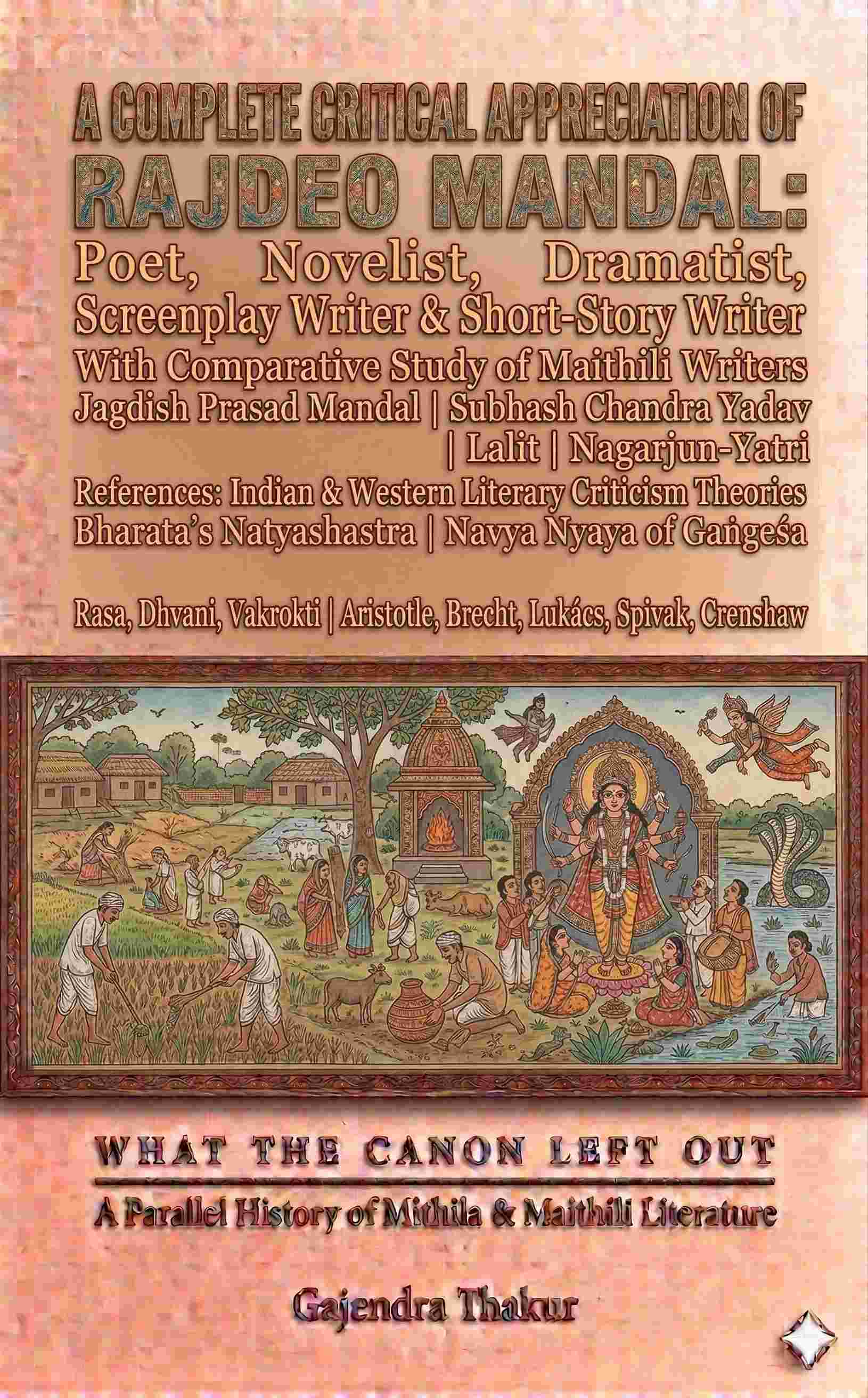
A COMPLETE CRITICAL APPRECIATION OF RAJDEO MANDAL Poet, Novelist, Dramatist, Screenplay Writer & Short-Story Writer
A COMPLETE CRITICAL APPRECIATION OF
RAJDEO MANDAL
Poet, Novelist, Dramatist, Screenplay Writer & Short-Story Writer
With Comparative Study of Maithili Writers
Jagdish Prasad Mandal | Subhash Chandra Yadav | Lalit | Nagarjun-Yatri
References: Indian & Western Literary Criticism Theories
Bharata's Natyashastra | Navya Nyaya of Gaṅgeśa
Rasa, Dhvani, Vakrokti | Aristotle, Brecht, Lukács, Spivak, Crenshaw
Preface
Rajdeo Mandal (born 15 March 1960, Musaharniyan, Ratanahara, Nirmali, Madhubani, Bihar) is one of the most significant literary voices in contemporary Maithili literature, and unquestionably the most important writer to emerge from the Dhanuk caste community in the language's long history. A poet, novelist, short-story writer, dramatist, and screenplay author whose work spans over three decades, he represents the fullest literary expression of the Videha Maithili Parallel Literature Movement — the movement that has sought to recover, validate, and give artistic form to the lived experience of Mithila's non-Brahminical, subaltern communities.
The present critical appreciation draws on ten texts archived in the Videha Digital Library (www.videha.co.in/pothi.htm): the poetry collection Ambara (2010); the novel Hamar Tol; the screenplay Jal Bhanwar (2019); the one-act play Laj (2015); the short screenplay Panchaiti (2013); the seed-story collection Trivenik Rang (2014); the screenplay Jaal; the novel Waapsi (2018); and the critical study Rajdeo Mandal: Maithili Writer (by Gajendra Thakur, Videha). Together these constitute a representative cross-section of one of the most socially engaged, linguistically vibrant, and formally versatile bodies of work in post-independence Maithili literature.
The critical apparatus deployed in this appreciation is deliberately pluralist, drawing on: Bharata's Natyashastra and its subsequent elaboration by Abhinavagupta; the Navya Nyaya epistemological tradition of Gangesa Upadhyaya; the Indian aesthetic theories of Anandavardhana (Dhvani), Kuntaka (Vakrokti), and Dandin (Alankara); and Western theories including Aristotle's Poetics, Georg Lukács's theory of realism, Bertolt Brecht's Epic Theatre, Mikhail Bakhtin's dialogism, Walter Benjamin's storytelling theory, Gayatri Spivak's postcolonial criticism, and Kimberlé Crenshaw's intersectionality.
Chapter I: The World of Rajdeo Mandal — Biography, Community, and Context
1.1 Biographical Profile
Rajdeo Mandal was born on 15 March 1960 to Sonelal Mandal (Sonai Mandal) and Fulwati Devi in the village of Musaharniyan, Post-Ratanahara, via Nirmali, District Madhubani, Bihar — the heart of the Maithili-speaking belt of North Bihar. His wife is Chandraprabha Devi, and he has three sons (Nishant Mandal, Krishnakant Mandal, Viprakant Mandal) and a daughter (Rashmi Kumari). His natal home (matrka) is Belha, Fulparas, Madhubani. He holds advanced degrees: M.A. in Maithili, M.A. in Hindi, and LL.B. His email rajdeokavi@gmail.com and his publications through Shruti Prakashan, New Delhi (headed by Gajendra Thakur), together indicate both his literary seriousness and his institutional connection to the Videha parallel literary movement.
Mandal belongs to the Dhanuk community — a cultivator-artisan caste classified as Other Backward Classes (OBC) in Bihar's social hierarchy. The Dhanuk jati occupies a middle position in the hierarchical caste structure of Mithila — neither the extreme social exclusion of Dalit communities nor the institutional privilege of the Brahmin-Kayastha elite. The specific socio-cultural situation of the Dhanuk community — their agricultural and artisan traditions, their folk cultural life, their relationship to both upper-caste patronage and lower-caste solidarity — constitutes the social world from which Mandal writes and which his fiction most directly represents.
1.2 The Videha Parallel Literature Movement: Context and Ideology
The Videha eJournal (www.videha.co.in, ISSN 2229-547X, since 2008, ed. Gajendra Thakur) has been the institutional home of Rajdeo Mandal's literary career. The India Seminar profile of Videha (Mithilesh Kumar Jha, 2021) explicitly identifies Mandal as one of 'the most notable' writers given a platform by Videha alongside Jagadish Prasad Mandal, Umesh Paswan, Munnaji, and Ashish Anchinhar. This recognition situates Rajdeo Mandal as a pillar of the parallel literature tradition — the tradition that Gajendra Thakur defines as arising from 'the missing portions, the ignored and non-represented aspects of society' in mainstream (Brahmin-dominant) Maithili literary production.
T.K. Oommen's sociological observation — that 'the Maithili region is found to be economically and culturally dominated by Brahmins' — frames the political context of Mandal's parallel literary project. Against this background of Brahmin cultural hegemony, his emergence as the first Dhanuk-caste novelist in Maithili, his sustained output across multiple genres, and his consistent thematic focus on OBC community life constitute a literary-political act of cultural counter-assertion.
1.3 Gangesa Upadhyaya and the Mithila Epistemological Tradition
The Navya Nyaya school of Gangesa Upadhyaya (Mithila, c. 14th century) — whose Tattvacintamani provides the systematic analysis of the four pramanas (pratyaksha, anumana, upamana, shabda) — is not merely an abstract philosophical framework but a lived intellectual heritage of Mithila. Crucially, as the Rajdeo Mandal: Maithili Writer document reveals, Gangesa's own family background was socially marginalised: the text quotes Dinesh Chandra Bhattacharya's observation (sourced from Videha's Panji Prabandh research) that 'Gangesha's family is completely ignored' in the official Brahminical genealogical record (Panji) of Mithila, and that Gangesa himself married a woman of artisan background (Charmkarini).
This biographical detail is not incidental — it is central to the critical framework of this appreciation. The founder of Mithila's greatest philosophical tradition was himself socially marginalised by the Brahmin caste apparatus. Rajdeo Mandal, writing from within a similarly marginalised community, enacts a kind of literary Navya Nyaya: he subjects the received 'cognitions' (jnana) of mainstream Maithili culture — its assumptions about who matters, whose stories deserve telling, whose language constitutes proper literary Maithili — to rigorous critical scrutiny, identifying these as false cognitions (bhrama) and replacing them with prama (valid cognition) grounded in the pratyaksha of first-hand community experience.
Chapter II: The Works — A Systematic Survey and Analysis
2.1 Ambara (The Sky/Canopy) — Poetry Collection, 2010
Ambara (ISBN 978-93-80538-30-3, Shruti Prakashan, 2010; 104 pages) is Rajdeo Mandal's debut poetry collection and, according to Gajendra Thakur's preface, 'the best collection of this genre in the first decade of the 21st Century' in Maithili. The preface — a substantial critical essay by Thakur published within the collection — establishes the critical framework for reading Mandal's poetry: it is poetry that arises from existential social necessity rather than aesthetic fashion or careerist calculation.
The collection's table of contents reveals its thematic range: poems titled 'Aah' (Sighing/Lament), 'Gyanak Jhanda' (Flag of Knowledge), 'Jhapal Astitva' (Veiled Existence), 'Rahab Ahanksang' (Will Remain With You), 'Nadik Machh' (Fish of the River), 'Bat-Batahi' (Traveller), 'Seema Parak Jhula' (Swing at the Boundary), 'Chirrik Jati' (Species of the Bird), 'Badhik' (Flood) and many more. This thematic range — from personal lament to existential questioning, from nature imagery to social critique — demonstrates the full emotional and intellectual spectrum of Mandal's poetic vision.
The poem quoted by Gajendra Thakur in Rajdeo Mandal: Maithili Writer as an exemplar of Mandal's poetic excellence deserves full attention:
'Tap-tap chubait khunaka bun se / Dharati bha rahal snat / Puchhi rahal achhi chirai / Apna man se i baat / Aaba bala i kari aa bhari raat / Ki nahi bachat hamar jati...?'
(From the percolating drops of blood / The earth has become freshly bathed / The bird then asks / From its heart / In the incoming heavy and pitch-dark night / Would our species survive?)
Thakur's commentary is precise: 'then it goes into our blood and the blood starts running fast. The species of the poetics of the poet or the species of that bird? No nod of partisan critiques or a self-obsessed preface is required for this poem. No cartel or crutches of ideology are required for this creation.' This critical observation — that Mandal's best poetry achieves its effect through intrinsic power rather than ideological scaffolding — is the key to understanding his poetic achievement.
Applied through Anandavardhana's Dhvani theory: the poem's surface level (blood, earth, bird, night) carries layers of dhvani (resonance) that suggest simultaneously: the blood of caste violence; the earth as both the literal ground of agricultural labour and the motherland of Dhanuk community life; the bird as both a literal endangered species and the endangered species of Dhanuk cultural identity; and the dark night as both the coming night and the darkness of social oppression. The vyanjana-artha (suggested meaning) operates at multiple levels simultaneously, each layer reinforcing the others to produce an experience of social-existential pathos that transcends any single reading.
From Kuntaka's Vakrokti perspective, the poem's 'oblique expression' operates through the substitution of the bird and the bleeding earth for a direct statement about caste violence — the indirect figuration creates a more powerful effect than direct social commentary would achieve. The vacokti (creative obliqueness) of asking 'would our species survive?' through a bird's self-questioning transforms a potentially didactic social statement into an experience of shared existential vulnerability.
The other English-translated poem from Ambara — 'Rahab Ahank Sang' (Will Remain With You) — reveals a different but equally powerful register:
'Crying, calling / My throat dried / The lips dried / As if I was thirsty / The corpses all around / Are laughing at me / Nobody is listening to my voice / Where has gone / My society...'
This poem's register is that of karuna-rasa (compassion/pathos) and vira-rasa (heroic resolution) in dialectical tension: the speaker confronts social isolation (the corpses laughing, the absence of a listening society) yet declares an unwavering commitment to remain — 'I will be with you all only, peacefully.' The Natyashastra's concept of vibhava (excitant), anubhava (consequent), and vyabhichari-bhava (transient emotion) maps directly onto this poem's emotional structure: the vibhava (social abandonment and oppression) produces the anubhava (the drying throat, the failed voice) and the vyabhichari-bhavas (alternating between despair and resolve) that together constitute the dominant rasa of karuna.
2.2 Hamar Tol (My Quarter of the Village) — Novel
Hamar Tol is Rajdeo Mandal's landmark novel and the work that most fully establishes his position in Maithili literary history. Gajendra Thakur's extended critical analysis in Rajdeo Mandal: Maithili Writer places it in direct comparison with Nagarjun-Yatri's Paro — the only earlier Maithili novel that attempted a first-hand account of a specific caste community's life from within.
The critical comparison is illuminating: 'Paro of Nagarjun-Yatri did depict first-hand account of the dwindling culture of his Maithil Brahmin caste of contemporary times... The novel Hamar Tol by Rajdeo Mandal is a first-hand account of his Dhanuk caste of Mithila and has been written in the settings of the socio-cultural situation that this caste is peculiarly placed in.' The parallelism is strategic: just as Nagarjun (Baidyanath Mishra 'Yatri', the celebrated Maithili-Hindi poet and Sahitya Akademi Fellow) wrote from within his Brahmin community's experience, Mandal writes from within the Dhanuk community's experience. The difference is that Mandal's community had never before had a novelist who could render its world in literary form.
The novel's ending — described as necessarily tragic because 'the author, being a realistic writer, has been forced to make the ending a tragic one' — marks Mandal as a practitioner of social realism in the tradition that Georg Lukács theorised: the realistic novel does not impose false consolations but traces the contradictions of social life to their actual (often tragic) resolution. The closing image is striking:
'Everyone left the scene in a hurry. There began a fight between the Crow and the Myna. That fight remained unseen, only the tree saw it. And the tree saw many more things, yet the tree remained silent.'
Thakur's commentary identifies the significance of this silence: 'The complexity and perplexity of that silence could be refined and presented owing to the first-hand experiences of those unseen things by second-hand accounts.' The tree's silence is the silence of nature as witness to social conflict — a figure that carries enormous resonance in the agrarian world of Mithila, where the natural environment (trees, rivers, fields) is saturated with cultural meaning. The tree sees the fight between Crow and Myna (the internal conflict of competing interests or forces within the subaltern community itself) — but remains silent, unable or unwilling to intervene. This is Mandal's most sophisticated narrative device: the silent witness who knows but cannot speak represents the structural impossibility of articulating the full complexity of subaltern experience within the available social language.
Furthermore, Thakur credits Hamar Tol with a specific literary-historical function: 'The Hamar Tol of Rajdeo Mandal purifies the account of the second-hand account by Lalit in Prithviputra; as a result, the parallel movement of the stream was able to take along the main course of literature and moved it forward and made it relevant.' The contrast with Lalit's Prithviputra — the celebrated earlier Maithili novel by the Brahmin writer Lalitesh Mishra('Lalit') which deals with peasant and rural themes — reveals the key distinction: Lalit wrote about the lower castes from the outside, as a sympathetic but external observer; Mandal writes from within, with the specificity of first-hand knowledge that only insider experience can provide.
Applying the Navya Nyaya distinction between pratyaksha (direct perception/first-hand knowledge) and anumana (inference/second-hand knowledge): Lalit's Prithviputra offers anumana-based knowledge of the subaltern world — the intelligent inference of an outsider who observes and sympathises. Mandal's Hamar Tol offers pratyaksha-based knowledge — the direct perceptual validity of first-hand experience. In Gangesa's epistemological framework, pratyaksha is the most foundational pramana; anumana, however valid, is always derivative. This is why Hamar Tol 'purifies' the account of Prithviputra — it replaces derivative knowledge with foundational knowledge.
2.3 Jal Bhanwar (Water Vortex) — Screenplay, 2019
Jal Bhanwar (ISBN 978-93-87675-49-0, 2019; 110 pages) is Rajdeo Mandal's major screenplay — a substantial work that demonstrates his formal range beyond novel and poetry. The title — 'water vortex' or 'whirlpool' — evokes the image of turbulent water that draws objects into its center, a powerful metaphor for the social forces that trap individuals in cycles of poverty, exploitation, and caste oppression.
The screenplay form is significant in itself: Maithili screenplay writing is a rare genre, and Mandal's preface to Jaal notes that he undertook screenplay writing 'seeing the absence of screenplays in Maithili literature.' This act of genre-pioneering — identifying a gap in the literary system and filling it — is characteristic of Mandal's approach to literary production. He is not merely responding to individual creative impulses but actively mapping and developing the generic landscape of Maithili literature.
From Bharata's Natyashastra perspective, the screenplay form engages with what the text calls 'natyadharmi' — the theatrical representation that transforms reality into aesthetic form through the combined means of word, gesture, costume, music, and spectacle. The screenplay, as a genre that anticipates cinematic realisation, engages with a specifically modern form of natyadharmi that Bharata could not have anticipated but whose fundamental principle — the transformation of lived experience into performable representation — his theory encompasses.
The Natyashastra's concept of 'artha' (purpose/meaning) — that dramatic representation must serve a social and spiritual purpose — is directly relevant to Mandal's screenplay writing. In the foreword to Jaal, he states: 'I have made a small effort, even without being skilled in the subject.' This characteristic modesty is accompanied by a clear awareness of purpose: to contribute to the development of a Maithili screenplay tradition that can serve as the basis for a Maithili cinema industry and cultural presence.
2.4 Laj (Shame) — One-Act Play, 2015
Laj (27 pages, dated 14 January 2015) is Rajdeo Mandal's most direct dramatic work — a one-act play that addresses two central social problems in rural Mithila: the dowry system and the exploitation of lower-caste girls by upper-caste landlords. The character list includes Haricharan (a farmer), Dhirba (his son), Kulanand (a rich landlord), Bhogendra (his son), Bisekhi (a labourer), Shyambabu (a teacher); and women: Chanpatiwali (Haricharan's wife) and Sabita (his daughter). This social panorama — spanning the spectrum from landless labourer to landlord — is characteristic of Mandal's dramaturgy.
The preface by Mandal is brief and revealing: 'Close friends wanted me to write a play. To honour their request, I made an attempt at a one-act play. Whether it succeeded or failed, the decision is for society to make.' This deferral to social judgment — not to academic critics or literary establishments but to 'society' (samaj) — reflects Mandal's understanding of literature as a social rather than aesthetic institution.
The opening of Laj — Haricharan asking where his daughter Sabita has gone, his wife reporting that the girl is tending cattle in the fields — immediately establishes the social register: the daughters of poor farming families are engaged in productive agricultural labour while being denied the education that upper-caste families take for granted. The play proceeds through the recognition of this social disparity toward its dramatic confrontation — the moment of 'laj' (shame) that gives the play its title. This shame operates in multiple directions: the shame felt by lower-caste families in the face of upper-caste power; the shame that should be felt by exploitative upper-caste figures but often is not; and the shame of a social system that has normalised such exploitation.
From the Natyashastra's analysis of the six 'sandhi' (joints/junctures) of dramatic structure — mukha (opening), pratimukha (movement toward complication), garbha (intensification), vimarsha (deliberation), and nirvahana (resolution) — Laj follows a compressed but structurally coherent dramatic architecture. The opening domestic scene (mukha) establishes the social status quo; the entrance of the landlord's son and his interest in Sabita creates the complication (pratimukha); the intensification of the threat to Sabita's dignity (garbha) brings the dramatic conflict to its peak; the community's deliberation about how to respond (vimarsha) leads to the resolution (nirvahana) — which, in Mandal's realist mode, is likely to be partial or ambiguous rather than triumphant.
2.5 Panchaiti (Village Panchayat) — Short Screenplay, 2013
Panchaiti (16 pages, 2013; Shruti Prakashan) is a compact but powerful short screenplay addressing inter-caste elopement and the role of the village panchayat in adjudicating social conflict. The character list is clear: Dhanesr, Ramua (Lalita's father), four villagers, Sahdev (Kishan's father), Master Sahib, the Panch Pramukh, three Panchas, a Jamadar, Kishan; and women: Dhanesr's wife, Geeta (his daughter), Kishan's mother.
The dramatic action: Kishan and Geeta (from different castes) are in love and have apparently eloped or been found together. The village panchayat is convened to adjudicate. The crucial dramatic moment arrives when Sahdev tells Kishan to send Geeta home: 'If you want your own good, send her back to her home, or they will make your life miserable.' Kishan responds with a remarkable statement: 'What should I say? We both love each other... We both are adults. I have the right to marry by law.' This assertion of legal rights against caste custom — the appeal to the constitutional right to inter-caste marriage against the authority of the panchayat — is the play's central dramatic action.
Panchaiti engages with what legal scholars call the 'khap panchayat' phenomenon — the self-appointed caste councils that in many parts of North India arrogate to themselves the power to regulate inter-caste and inter-gotra relationships, often with violent consequences. Mandal's dramatisation of this conflict through the medium of a village panchayat scene gives it both legal weight (the appeal to constitutional rights) and local specificity (the recognisable social dynamics of Mithila village governance).
From Aristotle's Poetics, the play employs 'anagnorisis' (recognition/discovery) — the moment when a character or the audience recognises a truth previously hidden. The discovery in Panchaiti is not of individual identity but of social truth: the discovery that caste-based panchayat authority is illegitimate when it conflicts with the constitutional right to marry; and the recognition that two young people in love possess legal rights that even traditional community authority cannot override. This anagnorisis does not resolve the social conflict — the play's realism prevents such easy resolution — but it creates the cognitive space within which the audience can recognise the injustice of the caste system's claim to regulate love.
2.6 Trivenik Rang (Colours of the Triveni) — Seed-Story Collection, 2014
Trivenik Rang (18 pages, 2014; © Rajdeo 2014) is a collection of 'vihani katha' (seed stories) — a genre specific to the Videha parallel tradition that represents the shortest possible narrative form, typically a few hundred words, in which a complete social situation or moral dilemma is compressed into its essential elements. The title — 'Colours of the Triveni' (the confluence point of three rivers, traditionally the sacred confluence of Ganga, Yamuna, and Saraswati) — suggests a collection that brings together multiple narrative strands, each distinct in colour (tone, theme, mood) but flowing toward a common confluence.
The seed story or vihani katha represents Maithili's contribution to the world tradition of the very short story — akin to the Japanese haiku in prose form, or the 'flash fiction' of contemporary English literature. Walter Benjamin's famous meditation on storytelling — 'The Storyteller' (1936) — is relevant here: Benjamin contrasts the dying oral tradition of storytelling (rooted in experience and community) with the rise of the novel (rooted in isolation and print culture). The vihani katha represents precisely the kind of story that Benjamin sees as recovering the experiential richness of the oral tradition within a literary form — stories that carry 'counsel' for the listener/reader, rooted in the specific texture of lived experience.
2.7 Jaal (The Net) — Screenplay
Jaal (20 pages) is Rajdeo Mandal's screenplay exploring the social 'net' — the web of obligations, exploitations, and structural constraints — in which the characters of rural Mithila find themselves trapped. The title directly echoes the poem in Hamar Tol's preface: 'Machhi jal me lok fansal / Machh puchhai achhi — ki yau bhai? / Lok kahai — kichhu kahal nai jay. / Hamare hath se jal banal / Hamrepar achhi ab tanel' (People are trapped in the fish net / The fish asks — what is it, brother? / The person says — nothing can be said / The net was made by our own hands / Now it is tightened on us ourselves).
This extraordinarily powerful metaphor — the net made by one's own hands that now traps its maker — encapsulates the Marxist concept of 'alienation' in Maithili poetic terms, without any need for imported theoretical vocabulary. The net-makers (the peasant-artisan communities of Mithila who have sustained the social and economic fabric of the region) find themselves trapped by the very social structures they have created and maintained through their labour. Jaal dramatises this entrapment through its narrative of rural characters caught in cycles of poverty, exploitation, and social constraint.
The screenplay's specific opening scene — Vikram waking up to bring milk to the city, his bicycle journey through the village — captures the daily temporal rhythm of subaltern rural life with remarkable specificity. The detail of the bicycle, the urgency of the milk delivery, the interactions with Raghua and Barsa, the cut-scenes (kat-tu, 'cut to') that structure the cinematic time — all demonstrate Mandal's sophisticated grasp of screenplay form and his ability to render the texture of rural Mithila life in cinematic terms.
2.8 Waapsi (Return) — Novel/Text, 2018
Waapsi (ISBN 978-93-88421-88-1, 2018; 38 pages; Pallavi Prakashan, New Delhi) represents Mandal's return to extended prose fiction. The title — 'Return' — is thematically rich: it suggests the return of a character to their home or community, the return of a repressed memory or truth, or the return of justice in a world of social wrongs. Published by a different publisher (Pallavi Prakashan) from his usual Shruti Prakashan, Waapsi demonstrates his expanding reach beyond the Videha institutional network.
The dedication in Waapsi — 'Sahityasaneh rakhinhar / Suphijan ke samar samip' (For those who maintain love of literature / Presented to the near community of good people) — reveals the community orientation of Mandal's literary self-understanding. He does not dedicate to an individual or to an abstraction but to the community of literary lovers — the implied reading public of his work.
Chapter III: The Short Stories — Five Key Texts
3.1 Rusal Bauwa (An Angry Boy)
Rusal Bauwa — described as reminiscent of Premchand's Idgah to its first critic, Narayanji — is Mandal's most celebrated short story. Written for the '82nd Sagar Raati Deep Jaray' — the night-long quarterly short story recitation programme held in villages of Mithila — it demonstrates the social institution within which his early fiction was produced: a community oral performance context, not a literary journal or publishing house.
The Premchand comparison is instructive and needs careful analysis. Premchand's Idgah depicts the poignant situation of a poor Muslim boy at a fair who spends all his money buying a pair of tongs for his grandmother rather than toys for himself — an act of child altruism that illuminates the economics of poverty and the moral economy of love. Rusal Bauwa inverts this emotional register: Fekan's son is angry — he wants new clothes like Dhirendra Babu's son Amit before he will attend the Durga Puja fair. But the crucial detail is that 'Fekan's son is much ahead of Amit, son of Dhirendra Babu in every respect, be it study or sports' despite Fekan being poor and Dhirendra Babu being rich. The story thus dramatises not poverty's self-abnegation (as in Idgah) but poverty's legitimate anger — the refusal to accept the humiliation of visible economic inequality when the poor child knows his own capabilities exceed those of the rich.
This shift from Premchand's accommodating altruism to Mandal's assertive anger is politically significant. Premchand's child-hero exemplifies the moral economy of sacrifice and love across class differences; Mandal's child-hero refuses to accept the visible markers of inequality as natural or inevitable. This is the literature of subaltern assertion rather than subaltern accommodation — a distinction that maps directly onto the difference between the mainstream Maithili tradition's accommodative social ethics and the parallel tradition's assertive social consciousness.
3.2 Bechuak Suiter (A Sweater for Bechua)
Bechuak Suiter deals with bonded labour, child labour, poverty, and police corruption — a cluster of social pathologies that the mainstream Maithili literary tradition had largely ignored. The protagonist Bechua is a boy working at a tea-stall — a child labourer whose existence represents the failure of the state to protect children's rights. The sweater of the title is a symbol of warmth, care, and material provision — the basic necessities that poverty denies.
The story's engagement with police corruption places it in dialogue with a long tradition of subaltern literature that documents the structural corruption of state institutions as experienced from below. The police, in Mandal's story, are not protectors of the vulnerable but participants in the system of exploitation. This is the pratyaksha (direct perceptual experience) of the subaltern community rendered in literary form — the day-to-day reality of living at the intersection of poverty and official malfeasance.
3.3 Electionak Bhoot (The Ghost of Election)
Electionak Bhoot is described as a 'wonderful treat' in which the protagonist depicts a sequence of events that turns out to be happening in his dream — a narrative device of remarkable sophistication. The 'ghost of election' — the haunting of public life by electoral politics, with its vote-buying, its caste mobilisation, its corruption and violence — is figured as a dream or nightmare that the protagonist both experiences and (through the dream-frame) observes with critical detachment.
This narrative device engages with what Brecht called the 'alienation effect' — the device that creates critical distance from the immediate material while maintaining emotional engagement with it. By framing the electoral corruption as a dream, Mandal enables both the emotional intensity of witnessing it and the cognitive distance of knowing it is a dream — precisely the Brechtian combination of feeling and understanding that effective political theatre (and fiction) requires.
3.4 Rakhbar (The Village Guard)
Rakhbar — the story of Musba, the guard — introduces gender dynamics in a complex way. Musba, who is 'a terror outside' is 'tamed inside his house' by his daughter-in-law. The story extends to Sumna, who attacks Musba when he behaves lecherously with her. This is one of Mandal's most direct treatments of gender and sexual violence within the subaltern community itself — acknowledging that patriarchal violence is not exclusively an upper-caste phenomenon but operates within OBC communities as well.
Gajendra Thakur's critical observation is precise: 'In all the stories you will find the use of words and contexts which is absent in mainstream literature. The vibrant life, the story of gloom, and cultural paraphernalia even amid poverty were never heard of before the parallel tradition storytellers came to the scene.' This observation identifies the specific literary contribution of Mandal and the parallel tradition: not merely new themes but new vocabulary, new narrative contexts, new sensory and cultural details that the mainstream Brahmin literary tradition had never accessed because it had never lived that life.
Chapter IV: Critical Frameworks — Indian and Western Theories
4.1 Bharata's Natyashastra and the Drama of Social Life
Bharata's Natyashastra (c. 200 BCE-200 CE) — the foundational text of Indian dramaturgy — provides a critical framework whose application to Mandal's drama and screenplay reveals both the continuity and the transformation of Indian theatrical tradition in his work. Bharata's concept of the four abhinayas (modes of representation) — angika (bodily), vachika (verbal), aharya (costumed/visual), and sattvika (emotional/psychophysical) — applies to Mandal's screenplays and plays with specific force. The gamaya (village) Maithili of his dialogue is a specifically calibrated vachika abhinaya — it performs social identity through linguistic register, marking characters as belonging to specific caste-community speech communities.
Bharata's dasarupaka (ten dramatic forms) are relevant to classifying Mandal's dramatic output. His one-act play Laj most closely resembles the vyayoga (action-based short drama) — a compact form dealing with conflict and its immediate social resolution. His screenplay Panchaiti resembles the prahasana (comedic drama revealing social contradictions) in its treatment of the panchayat as both a legitimate and a problematic social institution. His longer screenplays (Jal Bhanwar, Jaal, Waapsi) engage with the natika form — a shorter nataka (heroic drama) dealing with realistic social themes rather than mythological or historical subjects.
The Natyashastra's concept of rasa-siddhi (theatrical success in emotional impact) is achieved in Mandal's work through the specific mechanism of laukika (worldly/experiential) recognition. His village audiences recognise the specific social situations — the panchayat, the electoral corruption, the landlord's exploitation, the labourer's poverty — from their own lived experience. This recognition produces the sadharani-karana (universalisation) that Abhinavagupta identifies as the basis of aesthetic experience: the transformation of individual experience into shared aesthetic understanding.
4.2 Navya Nyaya and the Epistemology of Subaltern Literature
Gangesa Upadhyaya's Navya Nyaya provides the most precise analytical framework for understanding what Rajdeo Mandal's literature does and why it matters. The system's central project — the rigorous analysis of prama (valid cognition) and the identification and correction of bhrama (false cognition) — maps directly onto the parallel literature movement's critique of mainstream Maithili literary culture.
The mainstream Maithili literary tradition produces a systematic bhrama: it presents Brahmin-Kayastha social experience as the universal experience of Mithila, upper-caste literary aesthetics as the universal aesthetics of Maithili, and the exclusion of lower-caste communities from literary representation as the natural order of things. This is bhrama in Gangesa's precise technical sense: a cognition that presents a false universal ('this is Maithili literature') by illegitimately applying a specific predicate (the Brahmin literary tradition) to a universal subject (Maithili literature as a whole).
Mandal's parallel literature corrects this bhrama through the pratyaksha-pramana of first-hand community experience. His novels, stories, and plays do not argue against upper-caste cultural dominance in the abstract — they simply present the Dhanuk community's world in all its specificity and richness, demonstrating through the pratyaksha of literary representation that this world exists, that it is real, that it has its own vocabulary, its own social logic, its own beauty and suffering. This is the literary equivalent of Gangesa's epistemological project: replacing false cognition with valid cognition through rigorous attention to the actual object of knowledge.
The Navya Nyaya concept of avacchedakatva (delimitation/qualification) is particularly relevant to Mandal's novelistic method. His novels precisely delimit their social domain — they are about the Dhanuk community's specific social situation, not about 'Mithila society' in the abstract. This precision of social delimitation is the literary equivalent of Gangesa's insistence on precise definition: the avoidance of false universals through careful specification of the actual object of cognitive attention.
4.3 Rasa Theory and the Aesthetics of Subaltern Experience
The rasa theory of Bharatamuni and Abhinavagupta provides the classical Indian framework for understanding the emotional register of Mandal's work. The dominant rasas across his oeuvre are karuna (compassion/pathos) — the aesthetic experience of suffering and loss; vira (heroic resolution) — the aesthetic experience of moral courage in the face of oppression; and raudra (righteous anger) — the aesthetic experience of fury at injustice. These three rasas form a dialectical complex: the pathos of subaltern suffering produces the anger that motivates the heroic resolve to resist and articulate.
Abhinavagupta's concept of brahmananda-sahodarananda (the aesthetic bliss that is 'sister to' the bliss of Brahman consciousness) — the idea that aesthetic experience produces a state of expanded consciousness that transcends the individual ego — has a specific application to Mandal's work. When the reader of Hamar Tol experiences the karuna of the Dhanuk community's suffering, this aesthetic experience produces a form of social consciousness-expansion: the reader (including the non-Dhanuk reader) is momentarily brought within the experiential world of a community whose existence and suffering were previously invisible. This is the social-political function of aesthetic experience — the Abhinavagupta-derived theory explains why representation matters, why giving literary form to subaltern experience has social consequences beyond the literary domain.
4.4 Georg Lukács and Social Realism
Georg Lukács's theory of social realism — developed in The Historical Novel (1937), Studies in European Realism (1950), and other works — provides the most directly applicable Western framework for understanding Mandal's novelistic method. For Lukács, the great realist novel is distinguished by its capacity to represent the 'totality' of social life through the specific stories of individual characters — the concrete particular that illuminates the general social structure.
Hamar Tol exemplifies what Lukács calls 'typicality' — the representation of characters who, in their specific individuality, embody the social-historical forces of their time and place. The Dhanuk characters of Hamar Tol are not sociological abstractions or representatives of a thesis; they are fully realised individuals whose specific choices, relationships, and fates illuminate the structural conditions of Dhanuk community life in contemporary Mithila. This is the literary achievement that Gajendra Thakur identifies when he says Hamar Tol 'has secured its position in the literary history of Maithili literature': it achieves the kind of realist totality that Lukács identifies as the mark of significant fiction.
The tragic ending of Hamar Tol is also Lukácsian in its rationale: the great realist novel does not impose a false resolution but traces the contradictions of social life to their actual outcome. The social reality of Dhanuk community life in Mithila does not offer easy resolutions — the structural forces of caste oppression, economic marginalisation, and political corruption are not overcome by individual heroism or moral virtue. The tragic ending is not pessimistic but honest: it reflects the actual weight of social contradiction as experienced from within the community.
4.5 Bakhtin's Dialogism and the Polyphony of Subaltern Voices
Mikhail Bakhtin's theory of novelistic dialogism — the idea that the novel is inherently a multi-voiced form in which different social languages, ideologies, and perspectives are brought into productive tension — illuminates an important dimension of Mandal's fiction. His novels and plays are marked by what Bakhtin calls 'heteroglossia' (raznorechie) — the multiplicity of social languages coexisting within a single text.
In Hamar Tol and his plays, multiple social registers coexist: the gamaya Maithili of Dhanuk community members, the somewhat more formal Maithili of masters and teachers, the dialect features associated with different caste communities, and the occasional Hindi/English intrusions of bureaucratic and official language. This linguistic heteroglossia is not merely descriptive detail but a form of social analysis: the coexistence of these registers within the text makes audible the social hierarchy that structures language use in Mithila, and allows the lower-register voices (the Dhanuk community's speech) to assert their presence and dignity within the literary space.
4.6 Gayatri Spivak and the Speaking Subaltern
Gayatri Chakravorty Spivak's canonical question — 'Can the subaltern speak?' — receives a specific literary answer in Rajdeo Mandal's work. Spivak's argument is that the subaltern cannot speak 'in the full sense' within the institutional structures of representation that exist — that every act of speaking within established institutional channels requires the subaltern to translate their experience into the language and categories of the dominant culture, losing something essential in the process.
The Videha parallel literature movement — and Rajdeo Mandal within it — represents a partial but significant attempt to create institutional structures in which the subaltern can speak more fully. The digital archive of Videha, the publication network of Shruti Prakashan, the community performance traditions of the vihani katha and the Sagar Raati Deep Jaray programme, and the grassroots readership of parallel Maithili literature all constitute alternative institutional channels through which the subaltern can speak — not in perfect freedom from dominant cultural constraints, but with more fidelity to their own experience than the mainstream literary institutions would allow.
Mandal's choice to write in gamaya Maithili rather than the standardised literary Maithili of the Brahmin-Kayastha tradition is the linguistic enactment of the subaltern's speaking: it insists that the Dhanuk community's speech is a legitimate literary language, that their stories can be told in their own words, that their experience does not need to be translated into upper-caste linguistic categories to be literarily valid.
4.7 Intersectionality and the Complexity of Oppression
Kimberlé Crenshaw's theory of intersectionality — the idea that different forms of social oppression (race, class, gender, caste) operate simultaneously and compound each other — provides the most precise analytical framework for understanding the social world depicted in Mandal's work. His characters do not experience oppression as a single, uniform force but as the intersection of multiple, mutually reinforcing systems: caste discrimination, class exploitation, gender oppression, and the structural violence of state institutions.
The woman characters in Mandal's drama — Geeta in Panchaiti, Sabita in Laj, Sumna in Rakhbar — experience this intersectional oppression most vividly. Geeta faces both caste discrimination (her right to love across caste boundaries is denied by the panchayat) and gender discrimination (her choices are overridden by male family members and community elders). Sabita faces class vulnerability (as the daughter of a poor farmer) and gender vulnerability (as a girl exposed to landlord predation). Sumna faces the intersection of gender violence and poverty that makes her particularly vulnerable to Musba's lechery. The intersectional complexity of these women's situations is one of the most important contributions of Mandal's literature to contemporary Maithili fiction.
4.8 Walter Benjamin and the Art of Storytelling
Walter Benjamin's meditation on 'The Storyteller' (1936) — his analysis of the dying art of oral storytelling and the loss of communicable experience in modernity — provides a productive framework for understanding the cultural function of Mandal's vihani katha (seed stories). Benjamin argues that the great storyteller draws on a 'community of listeners' who share a common experience and for whom the story carries 'counsel' — practical wisdom distilled from lived experience and transmitted across generations.
The institutional context of Mandal's early storytelling — the Sagar Raati Deep Jaray programme, where stories are read aloud and immediately critiqued by community members in an all-night gathering — is precisely the kind of storytelling community that Benjamin describes as the origin and natural habitat of the story form. The vihani katha, in this context, is not a literary experiment but a continuation and formal refinement of the oral storytelling tradition, given written form without losing its communal, experiential character.
Chapter V: Comparative Study — Rajdeo Mandal and Other Maithili Writers
5.1 Rajdeo Mandal and Jagdish Prasad Mandal
The most obvious and most significant comparison is with Jagdish Prasad Mandal — the other major figure of the Videha parallel tradition and, alongside Rajdeo Mandal, one of the two most important subaltern voices in contemporary Maithili literature. Both writers are OBC, both work within the Videha movement, both have received the Videha Samman. Jagdish Prasad Mandal (Yadav community) received the Tagore Sahitya Samman for his short story collection Gamak Jinaagi — a recognition that the parallel tradition earned before any of its writers received institutional establishment recognition.
The key difference between the two Mandals is one of community specificity and generic range. Jagdish Prasad Mandal's work is rooted in the Yadav community's relationship to Mithila's rural society and folk culture — he is more deeply embedded in the folk tradition (proverbs, community gatherings, agricultural cycles) and his prose has the rhythmic quality of oral literature. Rajdeo Mandal's work engages more directly with the formal literary genres (novel, screenplay, one-act play, poetry collection) and with contemporary social-political themes (electoral corruption, legal rights, bonded labour, inter-caste love). The two together constitute the full breadth of the parallel tradition's literary achievement.
5.2 Rajdeo Mandal and Nagarjun-Yatri
The comparison with Nagarjun (Baidyanath Mishra 'Yatri', 1911-1998) — the celebrated Maithili-Hindi poet and Sahitya Akademi Fellow — is established within the Rajdeo Mandal: Maithili Writer document itself, through the comparison of Hamar Tol with Paro. Nagarjun's significance is enormous: he was the first major Maithili writer to write from within his Brahmin community's lived experience (Paro), the first to engage seriously with Marxist politics in Maithili poetry, and the first to achieve national recognition across both Maithili and Hindi literary spheres.
The difference is one of community position and critical distance. Nagarjun, despite his Marxist politics and his sympathy with the oppressed, wrote as a Brahmin who chose progressive politics — an intellectual act of solidarity rather than a first-hand account of subaltern experience. Rajdeo Mandal writes from within the OBC community's lived reality — the pratyaksha of insider experience rather than the anumana of sympathetic observation. The Navya Nyaya distinction between these two epistemic positions marks the qualitative difference in their respective literary achievements.
5.3 Rajdeo Mandal and Lalit (Lalitesh Mishra)
Lalit's Prithviputra — the celebrated Maithili novel that attempted to represent rural and peasant Mithila from an upper-caste perspective — is explicitly contrasted with Hamar Tol in the critical apparatus of the Videha movement. Thakur's formulation is precise: Hamar Tol 'purifies the account of the second-hand account by Lalit in Prithviputra.' This 'purification' is not a dismissal of Lalit's literary achievement but an identification of its structural limitation: as a Brahmin writing about peasant-caste life, Lalit could offer only anumana (inference/second-hand knowledge), however sympathetically rendered.
The structural difference between Lalit's outsider perspective and Mandal's insider perspective maps onto what postcolonial theory calls the difference between representation 'for' and representation 'by' the subaltern — the difference between the sympathetic upper-caste writer who speaks for the oppressed (albeit with the best intentions) and the subaltern writer who speaks in their own voice, from within their own community's experience.
5.4 Rajdeo Mandal and Subhash Chandra Yadav
Subhash Chandra Yadav is another significant figure of the Videha parallel tradition — a novelist whose works Gulo and Vote demonstrate a sophisticated engagement with contemporary political reality and rural life. The Videha movement has strongly promoted Yadav's work as one of the major achievements of the parallel tradition, and the critical attacks on his work by establishment critics (particularly Kamalananda Jha's dismissal in his 2021 'Maithili Novel' survey) have been strongly defended by Thakur.
Compared with Rajdeo Mandal, Subhash Chandra Yadav demonstrates a more overtly political and contemporary focus — his Vote is explicitly about the electoral process; his Gulo engages with the dynamics of village community and individual aspiration. Mandal's work, by contrast, is more deeply rooted in the specific community world of the Dhanuk jati — the micro-social fabric of a particular caste community's life, rather than the macro-political dynamics of electoral democracy. Together, the two writers cover the full spectrum from community interiority to political exteriority within the parallel tradition.
Comparative Matrix: Rajdeo Mandal and Maithili Writers
|
Criterion |
Rajdeo Mandal |
Jagdish Prasad Mandal |
Subhash Chandra Yadav |
Lalit (Lalitesh Mishra) |
|
Caste/Community |
Dhanuk (OBC artisan-cultivator) |
Mandal (Yadav/OBC) |
Yadav (OBC) |
Brahmin (Kayastha-adjacent) |
|
Primary Genre |
Poetry, novel, drama/screenplay, short story |
Poetry, novel, short story |
Novel, short story |
Novel, long fiction |
|
Thematic Core |
Dhanuk community life, subaltern dignity, caste oppression, gender, electoral corruption |
Rural OBC life, folk ethos, Mithila village society |
Village realism, political satire, social justice |
Social reform, middle-class Mithila, marriage reform |
|
Language Register |
Gamaya Maithili of OBC communities; oral-folk textures |
Robust Maithili of peasant communities; proverbial richness |
Standard Maithili with contemporary urban-rural mix |
Literary standard Maithili; classical resonances |
|
Navya Nyaya Application |
Pratyaksha of lived Dhanuk reality; correction of caste-brahmic bhrama |
Sabda of folk tradition as pramana; anumana of social structure |
Anumana of political contradictions; vakya-pramana |
Inference of social change; upamana with classical texts |
|
Narrative Mode |
Social realism with tragic closure; episodic in drama |
Epic realism; cyclical folk narrative |
Contemporary realism; political allegory |
Satirical realism; comedic social critique |
|
Key Works |
Hamar Tol (novel), Ambara (poems), Jal Bhanwar, Laj, Panchaiti, Triveni Rang, Jaal, Waapsi |
Gamak Jinaagi, Sahasrabadhani, Teen Jeth Egarham Maagh |
Gulo, Vote, Mamata |
Prithviputra, Lalit-sahitya |
|
Parallel Tradition Contribution |
Major; first Dhanuk-caste novelist in Maithili; Videha Samman recipient |
Foundational; Tagore Sahitya Samman, Videha Samman |
Significant contribution to Videha tradition |
Earlier tradition; later co-opted by mainstream |
|
Western Parallel |
Chinua Achebe, Mulk Raj Anand, Dalit fiction tradition |
Gabriel García Márquez, Premchand |
Fyodor Dostoevsky (political), Orwell |
Anton Chekhov, Jane Austen (social comedy) |
Chapter VI: Rajdeo Mandal — Drama, Screenplay, and the Question of Cinema
6.1 The Screenplay as Genre Pioneer
Rajdeo Mandal's contribution to Maithili screenplay writing is a dimension of his literary work that deserves special attention. In his foreword to Jaal, he explicitly notes 'the absence of screenplays in Maithili literature' and frames his attempt as filling this gap — an act of generic pioneering that places him alongside those writers who have sought to develop Maithili as a fully equipped literary language capable of serving all the major genres of modern literary production.
The significance of this generic development extends beyond the purely literary: Maithili cinema has been a largely marginal and underdeveloped phenomenon compared to neighbouring Hindi and Bhojpuri cinema industries. The development of Maithili screenplay writing as a literary genre could potentially serve as the foundation for a more developed Maithili film tradition — one that draws on the richness of Maithili literature and the specificity of Mithila's social and cultural world. In this sense, Mandal's screenplay writing is a literary act with potential cinematic consequences.
6.2 Drama and the Social Functions of Theatre
Mandal's dramatic works — Laj (one-act play) and Panchaiti (short screenplay) — engage with a tradition of Indian social drama that extends from the colonial-period reform plays (Vishnudas Bhave, Jyotiraose Phule, Rabindranath Tagore's early social plays) through the post-independence tradition of committed theatre (Indian People's Theatre Association, Badal Sircar's 'Third Theatre,' Safdar Hashmi's Jana Natya Manch) to the contemporary tradition of subaltern theatre represented by Bechan Thakur's Videha parallel theatre movement.
The connection between Rajdeo Mandal's dramatic writing and Bechan Thakur's theatrical practice is productive: both engage with the same social problems (caste discrimination, dowry, inter-caste love, panchayat justice/injustice), both draw on the gamaya tradition of Mithila village performance, and both are committed to the Videha movement's project of subaltern cultural assertion. The difference is one of primary medium: Thakur's theatre is primarily performative, while Mandal's dramatic writing is primarily literary — designed for reading and publishing as much as for performance.
Chapter VII: Synthesis — Rajdeo Mandal's Place in Literary History
7.1 The Significance of the Dhanuk Voice
Rajdeo Mandal's most irreducible literary-historical contribution is his status as the first Dhanuk-caste writer to produce a substantial, multi-generic body of literary work in Maithili. This is not merely a matter of biographical identity — it is a matter of epistemic and aesthetic consequence. The Dhanuk community's specific experience — its particular relationship to land, labour, and social hierarchy in Mithila; its specific folk cultural traditions; its characteristic forms of social solidarity and conflict — had never before found full literary expression in Maithili. Mandal's work gives this experience literary form for the first time, and in doing so expands the representational range of Maithili literature in a way that no purely aesthetic innovation could achieve.
7.2 The Question of Language and Register
Mandal's gamaya Maithili — the vernacular of OBC village communities, with its specific phonological features, proverbs, idioms, and expressive patterns — is itself a literary achievement. Against the tendency of mainstream Maithili literary culture to treat the upper-caste (Brahmin-Kayastha) literary register as the only legitimate literary language, Mandal asserts the literariness of gamaya speech: its capacity for lyric intensity, narrative richness, dramatic force, and social insight. This linguistic assertion is the literary equivalent of Gangesa's epistemological insistence that valid cognition (prama) must be grounded in the actual object of knowledge rather than in received tradition — the actual language of the Dhanuk community rather than the received language of the Brahmin literary establishment.
7.3 The Videha Movement and Digital Cultural Democracy
The Videha Digital Library's archiving of Mandal's ten works makes his literature accessible to readers globally — far beyond the geographical and linguistic limits of the Maithili-speaking community of Bihar and Nepal. This digital accessibility is a form of cultural democracy: it means that Mandal's work can be read, studied, and engaged with by scholars of Dalit and subaltern literature, Indian vernacular modernism, post-colonial studies, and comparative literature, not merely by specialist Maithili readers. The Videha project thus performs a double function: it preserves Maithili's parallel literary tradition and it opens it to the wider world of literary scholarship.
7.4 Concluding Assessment
Rajdeo Mandal stands as one of the most important literary figures in contemporary Maithili literature — a poet of genuine excellence, a novelist of social-realist power, a dramatist of community insight, and a screenplay pioneer. His work represents the fullest literary expression of the Videha Parallel Literature Movement's project of cultural democratisation and subaltern assertion. Applied through the Navya Nyaya framework: his work achieves prama (valid cognition) about the social reality of Mithila's OBC communities through the pratyaksha of first-hand community experience; it corrects the bhrama of mainstream Maithili literature's false universalisation of upper-caste experience; and it provides through literary sabda (testimony) an authoritative account of a social world that had previously been unable to speak in its own name within the institutions of Maithili literature.
The Navya Nyaya tradition of Mithila — the tradition of Gangesa Upadhyaya, who himself came from a socially marginalised family — demands rigorous honesty in the pursuit of valid knowledge. Rajdeo Mandal's literature enacts this demand in the domain of social and cultural representation: it insists on the pratyaksha validity of subaltern experience against the anumana-based condescensions of the Brahmin literary establishment, and in doing so advances the democratic project of Maithili literature as a whole.References and Bibliography
Primary Sources — Rajdeo Mandal's Archived Works
Mandal, Rajdeo. Ambara [The Sky/Canopy — Poetry Collection]. New Delhi: Shruti Prakashan, 2010. ISBN 978-93-80538-30-3. Videha Digital Library.
Mandal, Rajdeo. Hamar Tol [My Quarter of the Village — Novel]. New Delhi: Shruti Prakashan, 2012. ISBN 978-93-80538-78-5. Videha Digital Library.
Mandal, Rajdeo. Jal Bhanwar [Water Vortex — Screenplay]. Shruti Prakashan, 2019. ISBN 978-93-87675-49-0. Videha Digital Library.
Mandal, Rajdeo. Laj [Shame — One-Act Play]. Shruti Prakashan, 14 January 2015. 27 pages. Videha Digital Library.
Mandal, Rajdeo. Panchaiti [Village Panchayat — Short Screenplay]. New Delhi: Shruti Prakashan, 2013. 16 pages. Videha Digital Library.
Mandal, Rajdeo. Trivenik Rang [Colours of the Triveni — Seed Story Collection]. 2014. 18 pages. Videha Digital Library.
Mandal, Rajdeo. Jaal [The Net — Screenplay]. 20 pages. Videha Digital Library.
Mandal, Rajdeo. Waapsi [Return]. New Delhi: Pallavi Prakashan, 2018. ISBN 978-93-88421-88-1. Videha Digital Library.
Mandal, Rajdeo. Basundhra [The Earth]. Videha Digital Library.
Secondary Sources — Critical Material
Thakur, Gajendra. Rajdeo Mandal: Maithili Writer (Poet, Novelist and Short-Story Writer). With Supplement One: A Parallel History of Maithili Literature and Supplement Two: Era Before and After. From Videha eJournal Archive. Videha: Maithili Literature Movement. 116 pages.
Thakur, Gajendra (Ed.). Videha: First Maithili Fortnightly eJournal. ISSN 2229-547X. www.videha.co.in. Since 2008.
Thakur, Gajendra. 'Parallel Literature in Maithili and Videha Maithili Literature Movement.' Gajendrathakur.blogspot.com. February 2023.
Jha, Mithilesh Kumar. 'Maithili in the Digital Space.' India Seminar 742 (June 2021). www.india-seminar.com.
Choudhary, Radha Krishna. A Survey of Maithili Literature. Darbhanga: Maithili Academy.
Oommen, T.K. 'Linguistic Diversity.' In Sociology, 1988. National Law School of India University/Bar Council of India Trust.
Kumar, Abhilasha. 'Saat Natak — A Collection of Plays by Mahendra Malangia.' Academia, Vol. 6. CMCL NMMU.
Indian Classical Aesthetics and Philosophy
Bharatamuni. Natyashastra. Trans. Manomohan Ghosh. 2 vols. Calcutta: Asiatic Society of Bengal, 1951.
Abhinavagupta. Abhinavabharati. Commentary on the Natyashastra. Ed. M.R. Kavi. Baroda: Oriental Institute, 1926.
Anandavardhana. Dhvanyaloka. Trans. K. Krishnamoorthy. Dharwad: Karnatak University, 1974.
Kuntaka. Vakroktijivita. Trans. K. Krishnamoorthy. Dharwad: Karnatak University, 1977.
Gangesa Upadhyaya. Tattvacintamani. Ed. Kamakhyanath Tarkavagisa. Calcutta: Baptist Mission Press, 1884.
Phillips, Stephen H. and Ramanuja Tatacharya, N.S. Epistemology of Perception: Gangesa's Tattvacintamani. Delhi: Motilal Banarsidass, 2004.
' Gangesa.' Stanford Encyclopedia of Philosophy. Ed. Stephen H. Phillips. plato.stanford.edu/entries/gangesa.
Bhattacharya, Dinesh Chandra. History of Navya-Nyaya in Mithila. Darbhanga: Mithila Institute, 1958.
Western Literary Theory
Aristotle. Poetics. Trans. Malcolm Heath. London: Penguin, 1996.
Bakhtin, Mikhail. The Dialogic Imagination: Four Essays. Trans. Caryl Emerson & Michael Holquist. Austin: University of Texas Press, 1981.
Benjamin, Walter. 'The Storyteller.' In Illuminations. Trans. Harry Zohn. New York: Harcourt Brace, 1968.
Brecht, Bertolt. Brecht on Theatre: The Development of an Aesthetic. Trans. John Willett. London: Methuen, 1964.
Crenshaw, Kimberlé. 'Mapping the Margins: Intersectionality, Identity Politics, and Violence against Women of Color.' Stanford Law Review 43.6 (1991): 1241-1299.
Fanon, Frantz. The Wretched of the Earth. Trans. Constance Farrington. New York: Grove Press, 1963.
Lukács, Georg. Studies in European Realism. Trans. Edith Bone. London: Hillway Publishing, 1950.
Lukács, Georg. The Historical Novel. Trans. Hannah and Stanley Mitchell. London: Merlin Press, 1962.
Premchand. 'Idgah.' In The Gift of a Cow. Trans. Gordon Roadarmel. Bloomington: Indiana University Press, 1968.
Said, Edward. Culture and Imperialism. New York: Alfred A. Knopf, 1993.
Spivak, Gayatri Chakravorty. 'Can the Subaltern Speak?' In Marxism and the Interpretation of Culture. Ed. Cary Nelson. Urbana: University of Illinois Press, 1988.
Williams, Raymond. Marxism and Literature. Oxford: Oxford University Press, 1977.
Comparative Maithili Literature
Mishra, Jayakant. History of Maithili Literature. Vol. I & II. Sahitya Akademi, New Delhi, 1976.
Thakur, Gajendra. Nit Naval Subhash Chandra Yadav. Videha Archive. videha.co.in/pothi.htm.
Yadav, Subhash Chandra. Gulo [Novel]. Videha Archive, 2022. videha.co.in/pothi.htm.
Mandal, Jagdish Prasad. Gamak Jinaagi [Stories of Village Life]. Tagore Sahitya Samman recipient.
Lalit (Lalitesh Mishra). Prithviputra [Son of the Earth — Novel]. Maithili classic.
Mishra, Baidyanath 'Yatri' (Nagarjun). Paro [Novel]. Maithili. Sahitya Akademi Fellow.
अपन मंतव्य editorial.staff.videha@zohomail.in पर पठाउ।