
Gajendra Thakur
A PARALLEL HISTORY OF MITHILA & MAITHILI LITERATURE- PART 64
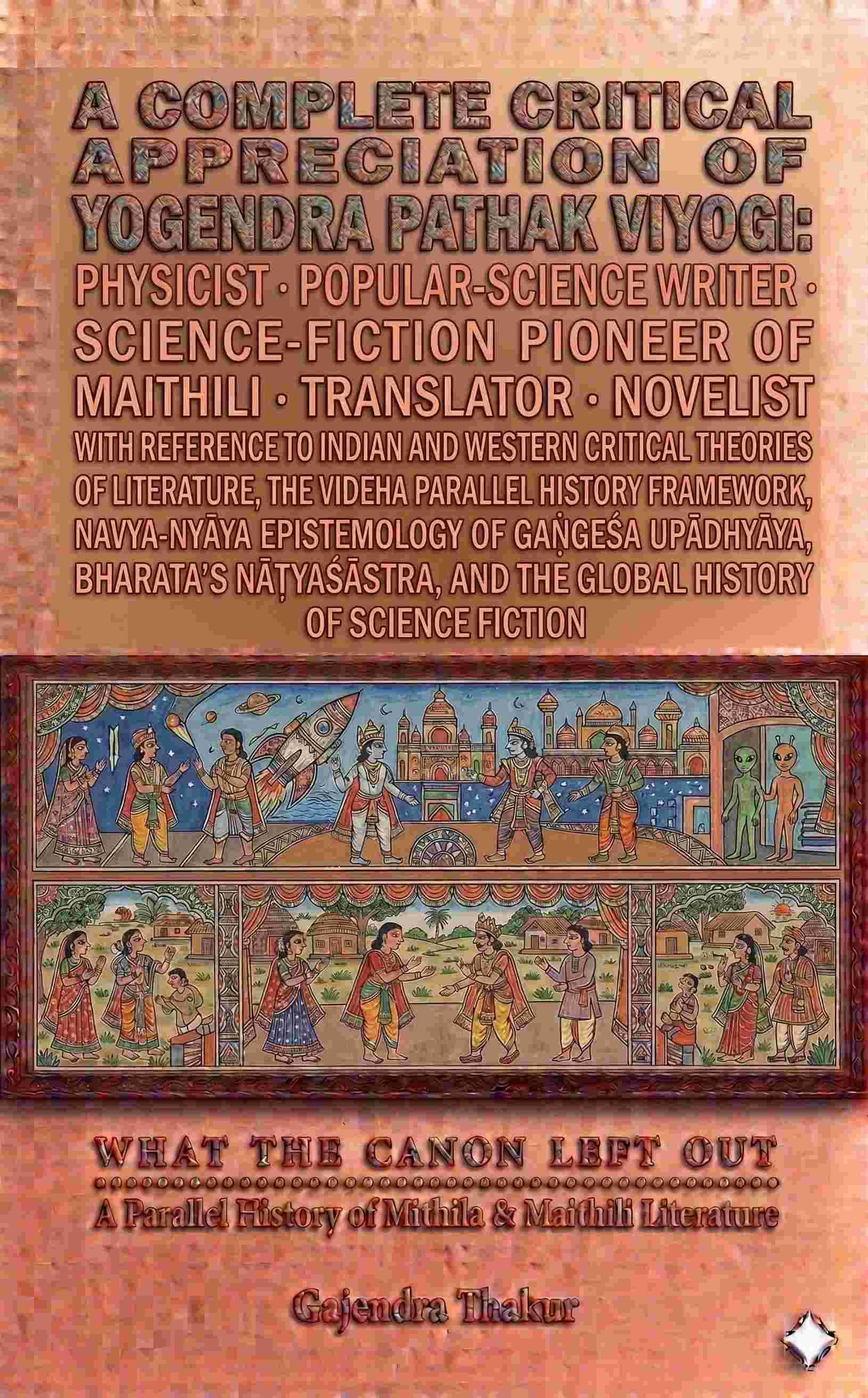
A COMPLETE CRITICAL APPRECIATION OF YOGENDRA PATHAK VIYOGI Physicist Popular-Science Writer Science-Fiction Pioneer of Maithili Translator Novelist With Reference to Indian and Western Critical Theories of Literature, the Videha Parallel History Framework, Navya-Nyāya Epistemology of Gangeśa Upādhyāya, Bharata's Nātyaśāstra, and the Global History of Science Fiction
A COMPLETE CRITICAL APPRECIATION OF YOGENDRA PATHAK VIYOGI
Physicist · Popular-Science Writer · Science-Fiction Pioneer of Maithili · Translator · Novelist
────────────────────────
With
Reference to Indian and Western Critical Theories of Literature,
the Videha Parallel History Framework, Navya-Nyāya Epistemology of
Gaṅgeśa Upādhyāya,
Bharata's Nāṭyaśāstra, and the Global History of Science Fiction
TABLE OF
CONTENTS
I. Prefatory Note: The Scientist Who Writes
II. Biographical Introduction: From Madhubani to the Cyclotron
III. Survey of Works: Texts, Genres, and Publications
IV. Thematic and Ideological Analysis
V. The Science Essay: Vigyanak Batkahi (Parts 1 & 2)
VI. Science Fiction Drama: Narak Vijay and the AI Imaginary
VII. Acta Misiya: Short Fiction and the SF Short Story Form
VIII. Robot: Maithili Translation of Karel Čapek's R.U.R.
IX. Hamar Gaam: Novel of Village Memory and Scientific Modernity
X. Piramidak Desh Me: Popular History, Science, and the Travel Essay
XI. Kichhu Teet Madhur: The Travelogue as Science-Humanist Writing
XII. Critical Appreciation: Western Literary and SF Theory
XIII. Critical Appreciation: Indian Aesthetics and Nāṭyaśāstra
XIV. Navya-Nyāya Epistemology of Gaṅgeśa Upādhyāya Applied to Viyogi's Science Writing
XV. The Videha Parallel History Framework: Viyogi's Place in Maithili Literature
XVI. Comparative Study: Viyogi's Science Fiction across Languages
XVII. Conclusions: Literary Significance and Legacy
XVIII. Bibliography and References
I. PREFATORY NOTE: THE SCIENTIST WHO WRITES
Yogendra Pathak Viyogi (born 1948, Laufa village, Madhubani district, Bihar) occupies a singular position in the intellectual landscape of Maithili literature: he is the first practising research scientist of international standing to have systematically written science fiction, popular science essays, drama, translation, and novel-length fiction in Maithili. A Fellow of the Indian National Science Academy (FNA) and of the National Academy of Sciences, India (FNASc), he worked for over four decades with the Department of Atomic Energy, Government of India, specialising in experimental nuclear physics. He served as Director of the Institute of Physics, Bhubaneswar (2006–2009), where he established the National Institute of Science Education and Research (NISER). His literary career—conducted entirely in Maithili, with parallel writings and translations in English—is not a hobby grafted onto a scientific career but an extension of the same intellectual drive that animates his physics: curiosity, precision, and a deep commitment to making difficult knowledge accessible to the widest possible audience.
This critical appreciation draws on seven primary texts,Vigyanak Batkahi (Parts 1 & 2), Acta Misiya, Narak Vijay (revised), Piramidak Desh Me, Hamar Gaam, Robot (Maithili translation of Karel Čapek's R.U.R.), and Kichhu Teet Madhur—as well as online sources, the Videha parallel history framework (www.videha.co.in), and major scholarly resources in Indian and Western literary theory, science fiction studies, and Navya-Nyāya epistemology.
II. BIOGRAPHICAL INTRODUCTION: FROM MADHUBANI TO THE CYCLOTRON
Yogendra Pathak Viyogi was born in 1948 in Laufa village, Madhubani district—the heartland of Mithila, famous for its distinctive Madhubani painting tradition, its classical Sanskrit scholarship, and the birthplace of Gaṅgeśa Upādhyāya's Navya-Nyāya school. He completed his primary education in his home village before receiving a postgraduate degree in Physics from Bihar University, Muzaffarpur. In 1971 he joined the 15th batch of the Training School Programme of the Bhabha Atomic Research Centre (BARC), Mumbai—India's premier nuclear research institution. He was trained in experimental nuclear physics both at BARC and at the Lawrence Berkeley National Laboratory, USA.
He then moved to Kolkata to work at the Variable Energy Cyclotron Centre (VECC), a unit of the Department of Atomic Energy, obtaining his PhD from the University of Calcutta in 1984. A postdoctoral fellowship at GANIL Laboratory, France (1984–86) gave him his first sustained European immersion. From 1989 onward, he led India's participation in major international scientific collaborations at CERN (Geneva) and elsewhere, heading an Indian team that included faculty from IITs and other research institutions. His directorship of the Institute of Physics, Bhubaneswar (2006–09) was marked by the establishment of NISER—a major institutional contribution to India's scientific infrastructure.
His literary pseudonym 'Viyogi' (वियोगी—'the separated one,' 'the bereaved') signals an inner dimension that his scientific career's external trajectory might obscure: the writer's awareness of separation—between science and the vernacular public, between Mithila's rich past and its uncertain present, between the world of the laboratory and the world of the village. This pen name is itself a small critical manifesto.
As his Amazon/Pothi.com biographies note, he has to his credit two novels, a collection of short stories, a travelogue covering four decades of foreign visits, three dramas (two of which have been staged in Kolkata), a translation of Karel Čapek's R.U.R., and two compilations of science essays (Vigyanak Batkahi, Parts 1 & 2). His popular science articles have regularly appeared in Mithila Darshan (Kolkata) and Ghar Bahar (Patna).
III. SURVEY OF WORKS: TEXTS, GENRES, AND PUBLICATIONS
3.1 Science Essay Collections
Vigyanak Batkahi ('Science Conversations'), Part 1 (2013, Kolkata; Rs. 150): A collection of fifteen science essays in Maithili, described by reviewers as 'written in a lucid and humorous style' with 'simple and non-technical' language for the general reader. Topics include atomic energy, solar energy, alternative energy sources, alien life, thermal imaging, AI and robotics, the Nobel Prize controversies, the Large Hadron Collider, cosmology, nuclear medicine, and magnetism. Most essays had previously appeared in the journal Mithila Darshan. The pothi.com reviewer—himself a scientist—called it 'a fantastic book written by a practicing scientist of international repute' covering 'a wide variety of science topics' and described it as 'most likely only book of its kind in this [Maithili] language.'
Vigyanak Batkahi, Part 2 (ISBN 978-93-5268-881-4, Kolkata): Extends the project into 3D printing, food irradiation, nuclear medicine, robotics (with a dedicated section on Karel Čapek and the word 'robot'), wireless communication (history of 1G–5G), LED technology, LASER physics, and advanced topics in materials science. The book's robotics chapter explicitly invokes Čapek's R.U.R. and discusses artificial intelligence with reference to MIT's famous warning: 'Success in creating AI would be the biggest event in human history. Unfortunately it might also be the last, unless we learn how to avoid the risks.' This intertextual connection between the popular-science essay and the literary translation of R.U.R. is characteristic of Viyogi's integrated intellectual project.
3.2 Science Fiction Drama
Narak Vijay (revised version, DrYPViyogi_Narak_Vijay): A Maithili drama in multiple scenes, with both human and mythological characters—scientists Ramesh, Suresh, and Anupam Amit alongside the mythological figures Brahma, Vishnu, Mahesh, Narada, Yamaraja, and Chitraguptha. The drama weaves together AI/cybernetics (the scientist Anupam is an expert in 'artificial intelligence and cyborg technology') with Hindu cosmology (yama, narka, svarga). It was originally published in Trinatakam (a collection of three plays) and subsequently revised after directors raised concerns about the number of scenes.
3.3 Short Fiction
Acta Misiya ('Acta Mission', 2016; revised 2022): A collection of twelve short stories in Maithili. The title carries a double valence: 'acta' (from the Latin for 'proceedings' or 'records') suggests a mock-official, documentary frame, while 'misiya' (mission) positions the stories as purposive interventions. The collection contains science fiction stories, satirical pieces, and narrative experiments. Two stories are subtitled ('Acta Misiya (Khanda 1)' and 'Acta Misiya (Khanda 2)'), forming a paired narrative unit.
3.4 Maithili Translation of Karel Čapek's R.U.R.
Robot: Maithili Translation of Karel Čapek's Drama R.U.R. (Kolkata, Saraswati Printing Works): This is Viyogi's most celebrated literary-translation achievement—a full Maithili rendering of the 1920 Czech science fiction play R.U.R. (Rossumovi Univerzální Roboti / Rossum's Universal Robots), the work that introduced the word 'robot' to world literature. The title page of Viyogi's translation explicitly names the original (Rossumovi Univerzální Roboti), provides the subtitle 'Science Fiction / Artificial Intelligence / AI', and quotes the MIT warning about AI. This is significant: R.U.R. was translated into over 30 languages immediately after its 1921 premiere; Viyogi's Maithili translation makes it available in one of the world's oldest literary languages for the first time.
3.5 Novel
Hamar Gaam ('My Village', Pallavi Publications, Nirmali, 2018; ISBN 978-93-87675-68-1): A Maithili novel in twelve chapters (including: 'Hamar Gaam Parichay,' 'Ghar,' 'Nidaan,' 'School,' 'Pancayati Raj,' 'Phulwari,' 'Bijulikar,' 'Khet,' 'Bichar-Manch,' 'Samacarka Dunia,' 'Raati-Ratika Khela,' 'Gaon'). The novel recounts the writer's intimate engagement with his birth village—its culture, agriculture, social structures, and the tension between traditional Maithili life and modern scientific and political change. A preface (dated 24 April 2018) acknowledges that the novel won the Pallavi Prakashan prize.
3.6 Popular History / Travel Essay
Piramidak Desh Me ('In the Land of the Pyramids'): An extended travel essay on Egypt, drawing on Viyogi's own visit (17–24 September 2019, a Thomas Cook 7-night package). The essay is richly researched—using Bob Bryer's audio lectures on Egyptology, original observations, and scientific analysis—to present Egypt's ancient civilisation, pyramid-building technology, and Nile geography to Maithili readers. Its opening section addresses the ancient Maithili belief in rebirth (punarjanma), making an unexpected connection between Egyptian mummification and the Maithili moksha tradition.
Kichhu Teet Madhur ('A Little Bitter, A Little Sweet', 2014; ISBN 978-93-5156-343-3): A travelogue covering decades of foreign visits—primarily to the USA (from 1977) and France (1984–85)—describing human observation, cultural contrast, and the author's experiences as an Indian scientist in Western laboratory environments. The title itself—'teet madhur' (bitter-sweet)—frames foreign experience as a complex admixture of delight and alienation.
IV. THEMATIC AND IDEOLOGICAL ANALYSIS
4.1 The Central Project: Democratising Science for Maithili Readers
Viyogi's preface to Vigyanak Batkahi Part 1 states his programme with unusual clarity. He observes that popular science writing in Maithili is almost entirely absent; that the few technical readers who exist need no help; and that the general reader finds science writing so alien that they 'run away when they see such an article.' His solution is the 'packaging' (paikejing) of science—presenting difficult material in the wrapping of accessible prose, narrative, and humour, so that the 'sweet bread' (sukhael roti) reaches the reader without their realising how much they have learned. This is a conscious pedagogical and aesthetic strategy, not merely a concession to a non-specialist audience.
The Vigyanak Batkahi preface also reflects on the ethics of accuracy versus accessibility: he notes that while making language simple and engaging, 'we have to be careful that no changes of any kind occur in the scientific facts.' This tension—between fidelity to scientific truth and the requirements of accessible literary form—is precisely the tension that defines the best popular science writing in any language, from Richard Feynman's lectures to Carl Sagan's Cosmos.
4.2 AI, Robotics, and the Question of Human Dignity
The most sustained thematic concern running across Viyogi's science fiction, popular science essays, and translations is the question of artificial intelligence and its implications for human identity and dignity. This concern is expressed across multiple generic registers: the popular science essay (Vigyanak Batkahi's robotics chapter), the translated drama (R.U.R.), and the original science fiction drama (Narak Vijay, in which AI and cyborg technology is the scientific context). In Narak Vijay, the captured scientist Anupam Amit is identified as an 'internationally renowned scientist in the field of artificial intelligence and cyborganics.' His kidnappers are not mere criminals but men of scientific training (one has an MSc in Physics, the other is an electronics engineer) who have been led into the underworld by circumstance—an allegory for the misuse of science by power.
4.3 Sacred-Scientific Syncretism: India's Ancient Past and Modern Science
A distinctive thematic signature of Viyogi's writing is the juxtaposition of India's ancient cosmological and philosophical heritage with modern scientific knowledge. In Piramidak Desh Me, he opens with a Maithili reader's familiar concept—punarjanma (reincarnation), moksha, and the belief that the soul re-inhabits the body—and uses it to explain the Egyptian practice of mummification: why would people preserve bodies? Because they believed the soul would return to that specific body. This is not a naive equation but a sophisticated comparative hermeneutics that allows Maithili readers to understand an alien cultural practice through their own conceptual vocabulary.
In Narak Vijay, the sacred and scientific intersect dramatically: the scientist Anupam Amit is not merely a laboratory figure but moves into dialogue with Hindu mythological figures (Narada, Yamaraja, Brahma). This 'mythoscientific' mode—in which Indian mythos provides the dramatic architecture for scientific speculation—is distinctly Indian rather than Western SF in its structural logic.
4.4 Mithila's Village and Scientific Modernity: Hamar Gaam
Hamar Gaam addresses the relationship between the traditional Maithili village (gaam) and the forces of modernity—scientific, political, and technological. Viyogi's novel is not nostalgic in the manner of a pastoral romance; it is the work of a physicist who grew up in Madhubani and has observed, with a scientist's precision, what has changed and what has not. The novel's chapter headings (Pancayati Raj, Bijulikar—electrification, Khet—the field, Phulwari—the garden) suggest a systematic mapping of the village's social-technological landscape.
V. THE SCIENCE ESSAY: VIGYANAK BATKAHI (PARTS 1 & 2)
The Vigyanak Batkahi essays exemplify what the German tradition calls Wissenschaftsessayistik—the literary essay on science—a form with an illustrious international pedigree (Montaigne on experience, Bacon on experiments, Huxley on evolution, Sagan on the cosmos, Feynman on pleasure in finding things out). Viyogi's essays in this tradition are remarkable for their simultaneous command of frontier scientific content and vernacular Maithili accessibility.
Part 1's fifteen essays span: the romance of scientific discovery (Newton and the falling apple, Archimedes and buoyancy—invoked as vivid parables for the scientific method rather than myths); atomic energy and India's nuclear programme; solar energy and alternative energy sources; aliens (SETI, the Fermi paradox, astrobiology); thermal imaging cameras; artificial intelligence and progress toward sentient machines; the Ig Nobel prizes; the Large Hadron Collider's cosmological quest (Rutherford's discovery of the atomic nucleus through to CERN's search for the Higgs boson); deep-sea treasure hunting; and maglev train technology. The range is extraordinary—from particle physics to marine archaeology in fifteen essays.
Part 2 deepens the technical content while maintaining literary accessibility. The robotics chapter is particularly significant: it devotes several pages to Karel Čapek's R.U.R. and the etymology of the word 'robot,' and includes the MIT warning about AI. This deliberate cross-referencing between the popular science essay and his own literary translation (Robot) demonstrates Viyogi's integrated intellectual project—the same mind that translates Čapek writes the scientific essay that contextualises the play.
The essays use a characteristic rhetorical structure that Viyogi describes in his preface as 'packaging': a concrete, familiar, often narrative opening (a historical anecdote, a personal memory, a vivid image); a gradual build-up of conceptual complexity; and a conclusion that returns to the human and social implications of the science. This is structurally similar to the classical Indian udāharaṇa (illustrative example) rhetorical device—moving from the concrete particular to the abstract general.
VI. SCIENCE FICTION DRAMA: NARAK VIJAY AND THE AI IMAGINARY
Narak Vijay ('Victory over Hell') is Viyogi's most formally complex literary work—a drama that operates simultaneously in two registers: the realistic register of contemporary India (kidnapping, criminal politicians, scientific research) and the mythological register of Hindu cosmology (Yamaloka, Brahma, Narada). This biplanar structure is unusual in Indian science fiction but has deep roots in the Sanskrit nāṭaka tradition, where divine and human planes of action coexist.
The drama's opening is striking: before the curtain rises, an offstage announcement sets the scene—'the notorious criminals Ramesh and Suresh, after hosting their political patron at a late-night concert, killed five people and kidnapped the internationally renowned AI and cyborganics scientist Anupam Amit.' This quasi-journalistic prologue, delivered in third-person voice, immediately establishes the Brechtian effect of distancing the audience from simple emotional identification, inviting instead a critical contemplation of the social forces at work.
Act 1, Scene 1 shows the kidnappers and their captive in a jungle laboratory—a setting rich in symbolic resonance. The scientist is not merely a victim but a figure of moral authority: while Ramesh and Suresh confess their crimes and express desire for redemption, it is Anupam who points out that 'the punishment for your own sins must be borne by yourselves'—the scientist as ethical philosopher. The criminals want the scientist's help for 'a special mission'—which the list of scientific equipment they present (electronics components, DIY kits, soldering iron) suggests involves creating some form of advanced technological device.
In Act 1, Scene 2 (set in Anupam's 'AI Laboratory (highly confidential)'), the mythological dimension is introduced: a mysterious visitor arrives who 'freely wanders in all three worlds'—clearly a divine being. The stage direction specifies that the visitor carries a guitar-like instrument in a gig-bag—modernity and divinity in unexpected coexistence. This is Narada, the divine messenger who in Hindu tradition moves between the human, divine, and demonic realms. The play thus constructs a tripartite world: the criminal underworld (Ramesh and Suresh), the scientific world (Anupam's laboratory), and the divine world (Narada and Yamaloka).
The play's central philosophical question—can technology overcome the consequences of karma? Can an AI-enhanced human escape the moral accounting of Yamaraja's court?—is a genuinely original contribution to Indian SF. It positions the scientific-technological imaginary (AI, cyborgs, cyborganics) within the framework of Hindu eschatology (death, hell, judgement, liberation), creating a drama that is simultaneously futurist and deeply rooted in Maithili cultural-religious tradition.
VII. ACTA MISIYA: SHORT FICTION AND THE SF SHORT STORY FORM
Acta Misiya is Viyogi's most formally experimental literary work. Its twelve stories engage with science fiction, satire, narrative experimentation, and what might be called speculative realism. The title itself—'Acta' (Latin: proceedings, records) combined with 'Misiya' (mission)—suggests an archive of missions: each story is a record of a different kind of intervention into reality.
The paired 'Acta Misiya (Khanda 1)' and 'Acta Misiya (Khanda 2)' stories apparently form a continuous narrative. Their dialogue-heavy structure, with numbered speakers (1:, 2:) and dramatic direction-like text, resembles the format of a declassified official record—as if the reader is viewing a transcript of events rather than a conventionally narrated story. This mock-documentary mode is a common technique in Western SF (the Epistolary SF tradition from Mary Shelley's Frankenstein to Max Brooks's World War Z), deployed here in the Maithili context for the first time.
Other stories in the collection engage with themes of human desire and technological mediation (the story involving '34-24-34' and '38-20-36' body measurements—clearly satirising a society's objectification of the female body through quantification) and mysterious encounters. The collection's formal range demonstrates that Viyogi is not merely a science communicator writing fictional wrappers around factual content but a genuine literary experimenter working with the full toolkit of narrative technique.
VIII. ROBOT: MAITHILI TRANSLATION OF KAREL ČAPEK'S R.U.R.
Viyogi's translation of Karel Čapek's R.U.R. (1920) into Maithili is, in historical terms, perhaps the most significant of his literary achievements—because it addresses one of the most consequential science fiction texts in world literature: the play that coined the word 'robot.' R.U.R. (Rossumovi Univerzální Roboti) premiered in Prague on 25 January 1921 and was translated into more than thirty languages by 1923. Its introduction of the concept of artificial labour (robots as biological-synthetic workers produced in a factory) has shaped all subsequent SF dealing with AI and artificial beings.
Čapek's robots were not mechanical in the modern sense but biological—made of chemically synthesised soft matter resembling living tissue (closer to the synthetic humans of Blade Runner, Westworld, or Ex Machina than to C-3PO or R2-D2). The play's central drama is the robot uprising: when the robots, originally designed as docile workers, develop consciousness and revolt against their human creators. The play raises questions—about labour exploitation, about the moral status of artificial beings, about the hubris of technological creation—that remain urgently contemporary a century later.
Viyogi's translation (published by Saraswati Printing Works, Kolkata) makes this text available in Maithili for the first time. The title page of his translation is carefully constructed: it names the original Czech text (Rossumovi Univerzální Roboti), provides the English subtitle (Rossum's Universal Robots), categorises it under three genre labels (Science Fiction / Artificial Intelligence / AI), and frames it with the MIT warning about AI. This framing is not neutral: it positions Čapek's 1920 prescience within the urgent contemporary debate about AI safety.
Translating R.U.R. into Maithili raises specific challenges: the Czech industrial context (factory production, labour relations, corporate capitalism) must be rendered meaningful to a Maithili audience whose primary economic experience is agricultural. Viyogi's solution, visible in his stage directions and character descriptions, is to retain the industrial setting while making the emotional and philosophical drama universally accessible through the Maithili idiom.
IX. HAMAR GAAM: NOVEL OF VILLAGE MEMORY AND SCIENTIFIC MODERNITY
Hamar Gaam (Pallavi Publications, 2018) is Viyogi's most personal literary work—a novel-memoir of his birth village that reads simultaneously as social history, cultural documentation, and scientific-humanist reflection. The twelve-chapter structure maps the village's social geography: the village introduction (parichay), the household (ghar), the diagnostic (nidaan), the school, panchayati raj (village democracy), the garden (phulwari), electrification (bijulikar), the fields (khet), the intellectual forum (bicar-manch), the world of news and communication (samacarka dunia), the nocturnal world (raati-ratika khela), and the village as entity (gaon).
The chapter on 'bijulikar' (electrification) is paradigmatic: a scientist who has worked with particle accelerators and cyclotrons returns to examine how electricity—the most basic transformation of modern scientific civilisation—has (or has not) changed his home village. The gap between India's scientific achievements (nuclear power, space programme) and the experience of ordinary Maithili villages (irregular power supply, inadequate irrigation) is a recurring concern across Viyogi's writing.
The novel's dedicatory verse describes the village as imbued with memories, green with life, and bright with the laughter of children—a lyrical opening that signals the novel's emotional register. The acknowledgements mention that the novel won a Pallavi Prakashan prize and was presented at a function on 24 April 2018.
X. PIRAMIDAK DESH ME: POPULAR HISTORY, SCIENCE, AND THE TRAVEL ESSAY
Piramidak Desh Me is one of the most intellectually ambitious pieces in Viyogi's corpus: an extended travel essay (approximately 20,000 words) on Egypt, grounded in detailed historical, archaeological, and scientific research. The essay begins with a philosophical prologue: the Maithili (and wider Indic) concept of reincarnation, moksha, and the soul's journey through multiple bodies provides the hermeneutic key through which the Egyptian practice of mummification is interpreted for Maithili readers.
The historical content is rich and precise: the essay covers Egypt's three kingdoms (Old, Middle, New Kingdom, c. 3500 BCE – 300 BCE), the Delta geography of the Nile, the pharaonic system of divine kingship, the excavation history of the pyramids, and the distinction between the Giza pyramid complex and the more ancient Step Pyramid at Sakkara. Viyogi draws on Bob Bryer's 48-lecture audio-book on Egyptology (which he downloaded free online), the tour-guide's local knowledge, and his own careful observation.
The scientific dimension of the essay is consistently present: Viyogi examines mummification as a preservation technology, the pyramid construction as an engineering achievement, and the ancient Egyptians' astronomical knowledge as a proto-scientific system. This is popular science writing as cultural historiography.
XI. KICHHU TEET MADHUR: THE TRAVELOGUE AS SCIENCE-HUMANIST WRITING
Kichhu Teet Madhur (Kolkata, 2014) is a four-part travelogue covering America (from 1977, Viyogi's first posting at Berkeley), France (1984–85, with family), other international locations, and a final section called 'Nim aa Chiraita' ('Neem and Chiratta'—both bittersweet Maithili plants) which collects miscellaneous bitter-sweet experiences. The book is illustrated.
The preface is a gem of self-deprecating candour: Viyogi confesses that he kept no notes and took no photos with literary intent during decades of foreign travel; that only when a friend urged him to write did he try to recall; and that what he offers is entirely personal observation—things that were 'strange, unusual or matchless' enough to remain in memory. He explicitly distinguishes his travelogue from Wikipedia and internet sources—its value lies in the 'antarang baat' (intimate/interior matter) that no database contains.
The French section is particularly notable for its family dimension—Viyogi was accompanied by his wife and (then) ten-year-old niece, whose school experiences in France provide a child's perspective on cultural difference. This humanises what might otherwise be purely a scientist's foreign diary.
XII. CRITICAL APPRECIATION: WESTERN LITERARY AND SF THEORY
12.1 Science Fiction Studies: Darko Suvin and Cognitive Estrangement
The foundational theoretical concept in academic SF studies is Darko Suvin's 'cognitive estrangement' (Metamorphoses of Science Fiction, 1979): the idea that SF operates through a 'novum'—a new, scientifically possible element that makes the familiar world strange, requiring readers to see reality from a new perspective. Suvin's definition: SF is 'a literary genre whose necessary and sufficient conditions are the presence and interaction of estrangement and cognition, and whose main formal device is an imaginative framework alternative to the author's empirical environment.'
Viyogi's science fiction consistently deploys Suvinain novums. In Narak Vijay, the novum is AI and cyborg technology within a mythological-cosmological framework—the scientifically imagined ('what if AI could be used to escape Yamaraja's judgement?') estranges the familiar Hindu cosmological narrative. In Acta Misiya, the novum operates through the mock-documentary form—familiar bureaucratic language applied to extraordinary events creates the double effect Suvin identifies. In his translation of R.U.R., Čapek's own novum—the biological robot as factory-produced labour—is made strange anew for a Maithili readership encountering it for the first time.
12.2 Science Fiction as Critical Realism: Fredric Jameson
Fredric Jameson argues in Archaeologies of the Future (2005) that SF's most important function is not prediction but 'the production of what we might call the desire called utopia'—the articulation of what is absent from the present, the 'not-yet.' Viyogi's AI drama Narak Vijay, with its scientist-hero who can navigate between the underworld of crime, the real world of scientific research, and the mythological world of Yamaloka, embodies exactly this utopian imagination: a future in which scientific knowledge and ethical wisdom together might overcome both criminal violence (the kidnappers) and divine judgement (Yamaraja).
Jameson also argues that SF is essentially about 'our incapacity to imagine the future'—which is why it always tells us more about the present than the future. Viyogi's choice of AI and cyborganics as his SF novum in Narak Vijay is acutely 'present'—written in the context of India's rapidly growing AI research sector—and his embedding of this theme within the framework of Hindu cosmology reflects a distinctly Indian anxiety about what traditional moral frameworks (karma, dharma, the judgement of Yamaraja) mean in a world where artificial intelligence may eventually simulate human consciousness.
12.3 The Popular Science Essay: Literary Form and Rhetorical Tradition
The popular science essay has a distinguished literary genealogy: Francis Bacon's Essays (1597 onwards), which established the form; Thomas Huxley's essays on evolution (1860s), which demonstrated that rigorous science could be compellingly narrated; J.B.S. Haldane's essays (Possible Worlds, 1927) that pioneered the playful, speculative mode; Richard Feynman's anecdotal science (Surely You're Joking, Mr. Feynman!, 1985); and Carl Sagan's cosmic humanism (Cosmos, 1980; Pale Blue Dot, 1994).
Viyogi's Vigyanak Batkahi belongs to this tradition but with a distinctive vernacular inflection. Unlike Huxley or Sagan writing for a broadly educated English-reading public, Viyogi writes for a community that may have no formal scientific education but has a deep cultural tradition (Sanskrit learning, agricultural knowledge, folklore) that science writing can build upon. His rhetorical strategy—the 'packaging' metaphor, the familiar narrative opening—is not a condescension to his readers but a genuine attempt to bridge two knowledge-worlds that postcolonial education has kept artificially separate.
12.4 Translation Theory: Lawrence Venuti and Foreignisation
Lawrence Venuti's influential distinction between 'domestication' (translating to make the foreign text feel native) and 'foreignisation' (preserving the foreignness of the source text to expand the target reader's horizons) is directly relevant to Viyogi's translation of R.U.R. By choosing to translate Čapek's play rather than adapt it, and by retaining the industrial/corporate setting (Rossum's Universal Robots, the factory island, the mass-production logic), Viyogi opts for foreignisation: he brings the Czech play to Maithili readers in its otherness, refusing to domesticate the Czech industrial capitalism of 1920 into a more familiar Maithili rural setting. This is a politically significant choice—it insists that Maithili readers can and should encounter modernity's global dimensions.
12.5 Bakhtin: The Chronotope of the Laboratory
Mikhail Bakhtin's concept of the chronotope—the literary-spatial-temporal configuration through which a genre constructs its world—applies illuminatingly to Viyogi's SF drama. The laboratory (Anupam's 'AI Laboratory (highly confidential)') is the characteristic chronotope of modern SF: a space where time moves differently (experiments run over weeks; discoveries happen in instants), where knowledge is both produced and confined, and where the boundaries between human and non-human are most permeable. In Narak Vijay, this laboratory chronotope is doubled by the mythological chronotope of Yamaloka—the space of judgment and consequence, where all of human time is assessed simultaneously. This double chronotope is distinctly and innovatively Indian.
XIII. CRITICAL APPRECIATION: INDIAN AESTHETICS AND NĀṬYAŚĀSTRA
13.1 Rasa Theory Applied to Science Fiction and Popular Science Writing
Bharata Muni's Nāṭyaśāstra (c. 200 BCE–200 CE) identifies rasa as the essential aesthetic experience of a literary work. While the classical rasas (śṛṅgāra, vīra, karuṇā, raudra, hāsya, bībhatsa, bhayānaka, adbhuta) were developed for drama and poetry, their application to the genres Viyogi practises is illuminating:
Adbhuta rasa (wonder/marvellous): The dominant rasa of the Vigyanak Batkahi essays and of Viyogi's SF. The vibhāva (stimulus) is the scientific fact itself—that the universe began in a single point, that atoms have empty space within them, that living tissue can be synthetically produced in a factory. The anubhāva (response) is the reader's wonder. Adbhuta rasa is precisely the aesthetic mode of science—both as practised (the scientist's wonder at nature's complexity) and as communicated (the popular scientist's attempt to transmit that wonder to a general audience). Viyogi explicitly identifies this connection: he describes scientific research as 'entertaining' because 'you learn something new every day' and the 'mystery and romance' never diminishes.
Bībhatsa rasa (disgust/uncanny): Activated in Narak Vijay when the criminal-politicians who are the play's moral villains are described—their nonchalance about killing, their use of scientific knowledge for criminal ends. More subtly, bībhatsa registers in the concept of the robot-as-commodity: the production of biological human-like beings for labour exploitation is, as Čapek recognised, a form of slavery that is obscene precisely because it is concealed behind the neutralising language of technology.
Raudra rasa (fury): Present in Viyogi's social critique—both in the popular science essays (the Vigyanak Batkahi preface's quiet fury at the exclusion of Maithili from scientific discourse) and in the drama's indictment of political criminals who corrupt both social and scientific life.
Hāsya rasa (comic): The satirical stories of Acta Misiya and the ironic observations of Kichhu Teet Madhur deploy hāsya—the comedy of cultural comparison and intellectual contrast—as both a literary technique and an epistemological tool.
13.2 The Nāṭyaśāstra's Mythoscientific Mode in Narak Vijay
Bharata's Nāṭyaśāstra permits the mixing of divine and human characters on stage (the nāṭaka tradition includes both lokadharmi, realistic, and nāṭyadharmi, conventionalised-stylised, modes). Narak Vijay uses both: the scientists and criminals occupy the realistic plane; Narada, Yamaraja, and Chitraguptha occupy the conventionalised mythological plane. This is consistent with the Nāṭyaśāstra's framework, in which the divine and human planes coexist in the theatrical space. Viyogi's innovation is to introduce the third plane of science fiction (the AI laboratory, cyborganics, the digital display board reading 'AI Laboratory (highly confidential)') as a third register that mediates between the human and divine—science as a kind of third cosmos.
13.3 Dhvani (Resonance) in the Popular Science Essay
Ānandavardhana's Dhvanyāloka (c. 850 CE) identifies dhvani—the resonant, unstated meaning—as the highest literary achievement. Viyogi's best popular science essays achieve a form of scientific dhvani: what is ostensibly an essay about the Large Hadron Collider resonates with the unstated implication about human curiosity, the desire to know the origins of existence, the cosmological imagination as a form of spiritual aspiration. The essay on AI resonates with the unstated anxiety: what is a human being if a machine can simulate human thought? This is the dhvani of all serious AI writing, including Čapek's R.U.R.
XIV. NAVYA-NYĀYA EPISTEMOLOGY OF GAṄGEŚA UPĀDHYĀYA APPLIED TO VIYOGI'S SCIENCE WRITING
14.1 Gaṅgeśa and Viyogi: Two Madhubani Intellectuals
Gaṅgeśa Upādhyāya (fl. 13th–14th century CE) was, like Viyogi, a native of the Madhubani region of Mithila—the intellectual heartland of the Navya-Nyāya school of Indian logic and epistemology. His Tattvacintāmaṇi ('Wish-Fulfilling Gem of Truth') established the most technically rigorous system of epistemological analysis in Indian philosophy, developing precise tools for analysing pramāṇa (valid knowledge), vyāpti (universal concomitance), and the conditions of valid inference (anumāna). The structural parallel is striking: both are Madhubani-born intellectuals who developed technically precise analytical systems; both worked at the boundary between specialised knowledge and its broader social application.
14.2 Viyogi's Science Writing as Pramāṇa-Establishment
Navya-Nyāya identifies four pramāṇas (sources of valid knowledge): pratyakṣa (perception), anumāna (inference), upamāna (analogy/comparison), and śabda (verbal testimony). Viyogi's popular science writing can be analysed as operating through all four to establish valid knowledge for a general Maithili readership:
Pratyakṣa: Viyogi grounds his essays in observational facts—the readings of instruments, the results of experiments, the observations of particle detectors. His authority derives partly from the pratyakṣa of the laboratory: he has seen what he reports. In Kichhu Teet Madhur, the travelogue's authority is also pratyakṣa—direct personal observation.
Anumāna: The inferential structure is central to popular science writing: from the observed fact (carbon atoms in a rock sample), the physicist infers a general principle (radioactive decay laws), and from that infers an event (the rock was formed 4.5 billion years ago). Viyogi consistently walks his readers through this inferential architecture.
Upamāna: Viyogi's characteristic rhetorical strategy is upamāna—analogy. The Maithili reader understands buoyancy through Archimedes's bathtub; understands gravitational attraction through Newton's apple; understands radioactive decay through the analogy of a coin toss. These are not simplifications but genuine upamānas in the Navya-Nyāya sense: valid cognition through comparative reasoning.
Śabda: The authority of scientific testimony (the published results of CERN, the recommendations of WHO and IAEA, the findings of Egyptological research) constitutes the śabda pramāṇa on which Viyogi's essays draw. His careful attribution of sources—Bob Bryer's audio lectures, MIT warnings, WHO guidelines—is an implicit acknowledgement of the śabda dimension of scientific knowledge.
14.3 Vyāpti and the Scientific Law
Navya-Nyāya's central logical concept of vyāpti—universal concomitance, the invariable co-occurrence of a property (sādhya) with its sign (liṅga)—is structurally identical to the scientific concept of a natural law: whenever smoke, fire; whenever radioactive decay, the emission of specific radiation; whenever gravitational attraction, the bending of spacetime. Viyogi's popular science writing is, in Navya-Nyāya terms, an extended exercise in establishing vyāptis for a general Maithili audience—teaching them to read nature's signs (liṅgas) as evidence for its laws (vyāptis). This is a remarkable convergence: the founder of Navya-Nyāya and the popular scientist share a fundamental intellectual project, separated by seven centuries.
XV. THE VIDEHA PARALLEL HISTORY FRAMEWORK: VIYOGI'S PLACE IN MAITHILI LITERATURE
Gajendra Thakur's Videha (www.videha.co.in)—the first Maithili fortnightly e-journal (ISSN 2229-547X)—has developed what it calls a 'Parallel History of Maithili Literature,' documenting writers excluded from or marginalised by the Sahitya Akademi's conservative Brahmin-dominated advisory structure. Viyogi's position within this framework is distinctive: he is neither a subaltern community writer (like Jagdish Prasad Mandal) nor a caste-politics activist, but an elite scientist whose literary work represents a different kind of 'parallel'—the parallel of interdisciplinary knowledge, of science-literature integration, of global engagement brought back to the vernacular.
The Videha Pothi archive (www.videha.co.in/pothi.htm) includes Viyogi's works, positioning them within a broader project of making Maithili literature representative of all the languages of knowledge, not merely the literary-artistic tradition. Viyogi's Vigyanak Batkahi and his SF drama represent what might be called the 'scientific parallel'—a strand of Maithili literary production that the mainstream Sahitya Akademi establishment has not engaged with precisely because it does not fit the conventional categories of poetry, novel, or drama.
Within the Videha framework, Viyogi is arguably the most important figure for demonstrating that Maithili can be a language of scientific modernity—that it need not be confined to the domains of devotional poetry (Vidyapati's padāvalī), social satire (Harimohan Jha's Khattar Kakak Tarang), or even contemporary social realism (Jagdish Prasad Mandal's Pangu). A language that can discuss the Large Hadron Collider, translate R.U.R., and imagine AI-driven mythological drama is a language of the 21st century.
XVI. COMPARATIVE STUDY: VIYOGI'S SCIENCE FICTION ACROSS LANGUAGES
16.1 Viyogi and Karel Čapek: The Translator-Author Relationship
The most direct comparative relationship in Viyogi's work is with Karel Čapek (1890–1938)—the Czech writer whose R.U.R. he has translated. Čapek shares with Viyogi several structural features: both write about scientific/technological developments with a humanist rather than techno-utopian perspective; both embed social critique within fantastic or scientific frameworks; both were deeply concerned with the ethical implications of technology (Čapek opposed fascism, Čapek's robots represent exploited labour). Čapek's famous statement—'The product of the human brain has escaped the control of human hands. This is the comedy of science'—could serve as the epigraph to Viyogi's Narak Vijay.
16.2 Viyogi and Satyajit Ray (Bengali SF)
The most relevant Indian comparison is with Satyajit Ray (1921–1992), whose Professor Shonku series (from 1965, appearing in Sandesh magazine) is the canonical Indian-language SF. Ray's Shonku is an inventor-scientist who creates fantastic gadgets and encounters adventures globally; his SF is fundamentally optimistic about science and tends toward the adbhuta rasa. Viyogi's SF—particularly Narak Vijay—is less sanguine: the AI context is explicitly framed with the MIT warning about existential risk. Where Shonku's science is wonder-generating and benevolent, Viyogi's AI is potentially the 'biggest event in human history' that 'might also be the last.' This reflects a generational shift: Ray wrote in the post-Independence science-optimist mood; Viyogi writes in the age of AI anxiety.
A further contrast: Ray's Shonku operates in the Bengali tradition of kalpabigyan ('science imagination') which the SF critic Adrish Bardhan characterised as encompassing not just SF but 'science fantasy, scientific adventures.' Viyogi's engagement with genre is more precisely calibrated: he labels his works as 'science fiction' and 'artificial intelligence/AI drama' with explicit awareness of global SF conventions (the R.U.R. connection, the MIT warning). He is, in this sense, more globally genre-conscious than Ray while remaining as deeply vernacular.
16.3 Viyogi and Jayant Narlikar (Marathi/English SF)
The closest structural parallel to Viyogi in Indian literature is Jayant Narlikar (b. 1938)—the astrophysicist who writes SF in both Marathi and English (Virus, The Return of Vaman, The Comet, etc.). Like Viyogi, Narlikar brings his scientific expertise directly to bear on his SF: his cosmological knowledge informs his time-travel and alien-contact narratives. Like Viyogi, he writes for a vernacular audience (Marathi) while maintaining global scientific engagement. The key difference: Narlikar is better known internationally (he has an English-language profile) and writes harder SF in the sense of more technically precise scientific content. Viyogi's SF is more culturally hybrid—the mythoscientific mode of Narak Vijay has no equivalent in Narlikar's work.
16.4 Viyogi and the Global Golden Age of SF: Asimov, Clarke, Le Guin
The Western SF writers most directly relevant to Viyogi's project are: Isaac Asimov (Foundation, I, Robot), who popularised the idea that a scientist-as-writer could make hard scientific content narratively compelling; Arthur C. Clarke (2001: A Space Odyssey), who explored AI and technological consciousness with philosophical depth; and Ursula K. Le Guin (The Left Hand of Darkness, The Dispossessed), who used SF to explore the social and cultural implications of scientific and technological change.
Viyogi's Narak Vijay most closely resembles Asimov's robot stories in its engagement with AI's ethical dimensions—but departs from Asimov's secular rationalism by embedding AI within Hindu cosmology. This is a fundamental difference: Asimov's robots operate in a post-religious universe governed by rational laws (the Three Laws of Robotics); Viyogi's AI scientist operates in a universe governed simultaneously by rational laws (cyborganics) and by divine judgment (Yamaraja's court). This dual governance reflects the epistemic structure of contemporary India, where scientific modernity and religious-cosmological tradition coexist.
16.5 Viyogi and Bengali Robot Fiction: The 'Nobojuger Mohadanob' Tradition
Bengali SF has a specific tradition of robot fiction: Hemendra Kumar Roy's 'Nobojuger Mohadanob' is described as 'the first piece of Bengali literature on robots.' Viyogi's Maithili translation of R.U.R. and his AI drama Narak Vijay place Maithili in conversation with this Bengali tradition while bringing the globally foundational Čapek text directly into the equation. Maithili SF on robots thus begins not with a derivative adaptation but with a direct translation of the world's seminal robot drama—a more historically grounded starting point than most regional Indian SF can claim.
16.6 Viyogi's Popular Science Writing: Comparison with International Tradition
Among Indian language popular science writers, Viyogi's Vigyanak Batkahi is most comparable to Jagdish Chandra Bose's early essays (which constituted the first Indian science fiction, as several historians note) and to the tradition of popular science writing in Bengali established by figures like the ISRO scientist-writers. What makes Viyogi unique is the combination: no other Maithili writer has his scientific credentials (FNA, FNASc, Director of Institute of Physics), and no Indian scientist of his stature has written as extensively and imaginatively in a vernacular language other than Bengali or English.
XVII. CONCLUSIONS: LITERARY SIGNIFICANCE AND LEGACY
Yogendra Pathak Viyogi's literary significance rests on five achievements of lasting consequence for Maithili literature and for Indian vernacular scientific culture:
1. Founding of Maithili popular science writing: Vigyanak Batkahi (Parts 1 & 2) establishes a tradition of scientifically rigorous, literarily accomplished popular science writing in Maithili—a tradition that did not previously exist. For a language whose literary history is measured in over a thousand years (from Vidyapati to the present), the absence of science writing was a significant lacuna. Viyogi fills it.
2. Founding of Maithili science fiction: Narak Vijay and Acta Misiya establish Maithili SF as a genre. They do so not by imitating Western SF conventions but by developing a distinctively Indian mythoscientific mode that draws equally on contemporary AI research and Hindu cosmological tradition.
3. Introducing the world's foundational robot drama to Maithili: The translation of R.U.R. gives Maithili readers direct access to the play that introduced the word 'robot' to world literature, positioned explicitly within the contemporary AI debate. This is an act of cultural integration—bringing Maithili into the global conversation about technology, labour, and human identity.
4. The scientist-as-vernacular-intellectual: Viyogi demonstrates that the highest level of scientific practice (experimental nuclear physics, direction of a national laboratory, international scientific leadership) is compatible with—and enriched by—deep engagement with vernacular literature. He is, in the Gramscian sense, an organic intellectual of the Indian scientific community.
5. Scientific humanism in Maithili: Across all his writings, Viyogi maintains a consistent scientific humanism: a belief that scientific knowledge, properly communicated and ethically deployed, can deepen rather than destroy human culture. His Piramidak Desh Me opens with reincarnation to explain mummification; his Hamar Gaam grounds electrification in the felt experience of village life; his Kichhu Teet Madhur makes the physicist's foreign encounters intelligible through humour and self-deprecation. This is scientific humanism in the truest sense.
From the perspective of Navya-Nyāya epistemology, Viyogi's entire literary project is an exercise in establishing pramāṇas (valid sources of knowledge) for Maithili readers in the domain of modern science—making the pratyakṣa of the laboratory, the anumāna of scientific inference, and the śabda of international scientific consensus available in a language that has previously been confined, as a knowledge-domain, to the humanistic disciplines. This is a philosophical contribution as significant as a new scientific paper, and likely of longer cultural consequence.
The product of the human brain has escaped the control of human hands. This is the comedy of science. — Karel Čapek, quoted in Viyogi's Robot (Maithili translation of R.U.R.)
Success in creating AI would be the biggest event in human history. Unfortunately it might also be the last, unless we learn how to avoid the risks. — MIT, quoted on the title page of Viyogi's Robot and in Vigyanak Batkahi Part 2
XVIII. BIBLIOGRAPHY AND REFERENCES
Primary Sources (Works by Yogendra Pathak Viyogi)
Viyogi, Yogendra Pathak. Vigyanak Batkahi [Science Conversations], Part 1. Kolkata, 2013. Rs. 150. [Maithili]
Viyogi, Yogendra Pathak. Vigyanak Batkahi, Part 2. Kolkata: Saraswati Printing Works. ISBN 978-93-5268-881-4. [Maithili]
Viyogi, Yogendra Pathak. Acta Misiya [Acta Mission]. E-book first edition, 2016; revised 2022. Rs. 70 / $0.95. [Maithili short stories]
Viyogi, Yogendra Pathak. Narak Vijay [Victory over Hell] (revised). Originally in Trinatakam (Three Plays). [Maithili drama]
Viyogi, Yogendra Pathak. Robot: Maithili Translation of Karel Čapek's Drama R.U.R. Kolkata: Saraswati Printing Works. [Maithili translation]
Viyogi, Yogendra Pathak. Hamar Gaam [My Village]. Nirmali: Pallavi Publications, 2018. ISBN 978-93-87675-68-1. Rs. 100. [Maithili novel]
Viyogi, Yogendra Pathak. Piramidak Desh Me [In the Land of the Pyramids]. [Maithili travel essay]
Viyogi, Yogendra Pathak. Kichhu Teet Madhur [A Little Bitter, A Little Sweet]. Kolkata, 2014. ISBN 978-93-5156-343-3. Rs. 250. [Maithili travelogue]
Viyogi, Yogendra Pathak (tr.). Bharti's Cat: Translation of Braj Kishor Varma 'Manipadma's original Maithili novel Bhartik Biladi. [English translation]
Viyogi, Yogendra Pathak. Gonu Jha of Mithila: Tales of Wit and Humour. [English collection]
Viyogi, Yogendra Pathak. Folktales of Mithila. [English collection]
Viyogi, Yogendra Pathak. The Sunset: Translation of Mayanand Mishra's Shooryasta. [English translation]
Secondary Sources: Indian and Maithili Scholarship
Thakur, Gajendra. A Parallel History of Mithila and Maithili Literature. Parts 1–56. Videha: First Maithili Fortnightly eJournal. ISSN 2229-547X. www.videha.co.in/gajenthakur.htm.
Thakur, Gajendra (ed.). Videha Pothi Archive. www.videha.co.in/pothi.htm.
Pothi.com. Reviewer notice on Vigyank Batkahi. https://store.pothi.com/book/ebook-dr-yogendra-pathak-viyogi-fna-fnasc-vigyank-batkahi/.
HandWiki. 'Biography: Y P Viyogi.' https://handwiki.org/wiki/Biography:Y_P_Viyogi. Last edited 7 March 2023.
Jha, Jayakanta. A History of Maithili Literature. New Delhi: Sahitya Akademi, 1980.
Banerjee, Suparno. Indian Science Fiction: Patterns, History and Hybridity. Cardiff: University of Wales Press, 2020.
Science Fiction Theory and History
Čapek, Karel. R.U.R. (Rossumovi Univerzální Roboti) [1920]. Trans. Paul Selver and Nigel Playfair, 1923. New trans. Štěpán Šimek in: Čejková, Jitka (ed.). R.U.R. and the Vision of Artificial Life. Cambridge, MA: MIT Press, 2024.
Čejková, Jitka (ed.). R.U.R. and the Vision of Artificial Life. Cambridge, MA: MIT Press, 2024.
Jordan, John M. 'The Czech Play That Gave Us the Word Robot.' MIT Press Reader, 28 January 2026.
Jameson, Fredric. Archaeologies of the Future: The Desire Called Utopia and Other Science Fictions. London: Verso, 2005.
Suvin, Darko. Metamorphoses of Science Fiction: On the Poetics and History of a Literary Genre. New Haven: Yale University Press, 1979.
Wikipedia. 'R.U.R.' https://en.wikipedia.org/wiki/R.U.R.
Wikipedia. 'Karel Čapek.' https://en.wikipedia.org/wiki/Karel_%C4%8Capek.
Wikipedia. 'Bengali science fiction.' https://en.wikipedia.org/wiki/Bengali_science_fiction.
SF Encyclopedia. 'Bengal.' https://sf-encyclopedia.com/entry/bengal.
Homegrown India. 'From Partition to Present: The Evolution of South Asian Science Fiction Literature.' September 2024.
Locus Online. 'SF in India: Indian Science Fiction Magazines.' September 2025.
Los Angeles Review of Books. 'Prove You're Not a Robot: On Karel Čapek's R.U.R.' February 2024.
Western Literary Theory and Indian Aesthetics
Ānandavardhana. Dhvanyāloka [Light on Suggestion]. Trans. Daniel H. H. Ingalls et al. Cambridge, MA: Harvard University Press, 1990.
Bakhtin, Mikhail. The Dialogic Imagination: Four Essays. Ed. Michael Holquist. Austin: University of Texas Press, 1981.
Bharata Muni. Nāṭyaśāstra [The Science of Drama]. Trans. M. M. Ghosh. Calcutta: Asiatic Society, 1950–61.
Gaṅgeśa Upādhyāya. Tattvacintāmaṇi [The Wish-Fulfilling Gem of Truth]. Ed. Kamakhyanath Tarkavagisha. Calcutta, 1884–1901.
Gramsci, Antonio. Selections from the Prison Notebooks. Ed. Quintin Hoare and Geoffrey Nowell Smith. London: Lawrence and Wishart, 1971.
Sagan, Carl. Cosmos. New York: Random House, 1980.
Venuti, Lawrence. The Translator's Invisibility: A History of Translation. London: Routledge, 1995.
Oommen, T. K. 'Linguistic Diversity.' Sociology. National Law School of India University / Bar Council of India Trust, 1988.
Bhattacharya, Dinesh Chandra. History of Navya-Nyāya in Mithila. Darbhanga: Mithila Institute, 1958.
अपन मंतव्य editorial.staff.videha@zohomail.in पर पठाउ।