
Gajendra Thakur
A PARALLEL HISTORY OF MITHILA & MAITHILI LITERATURE- PART 67
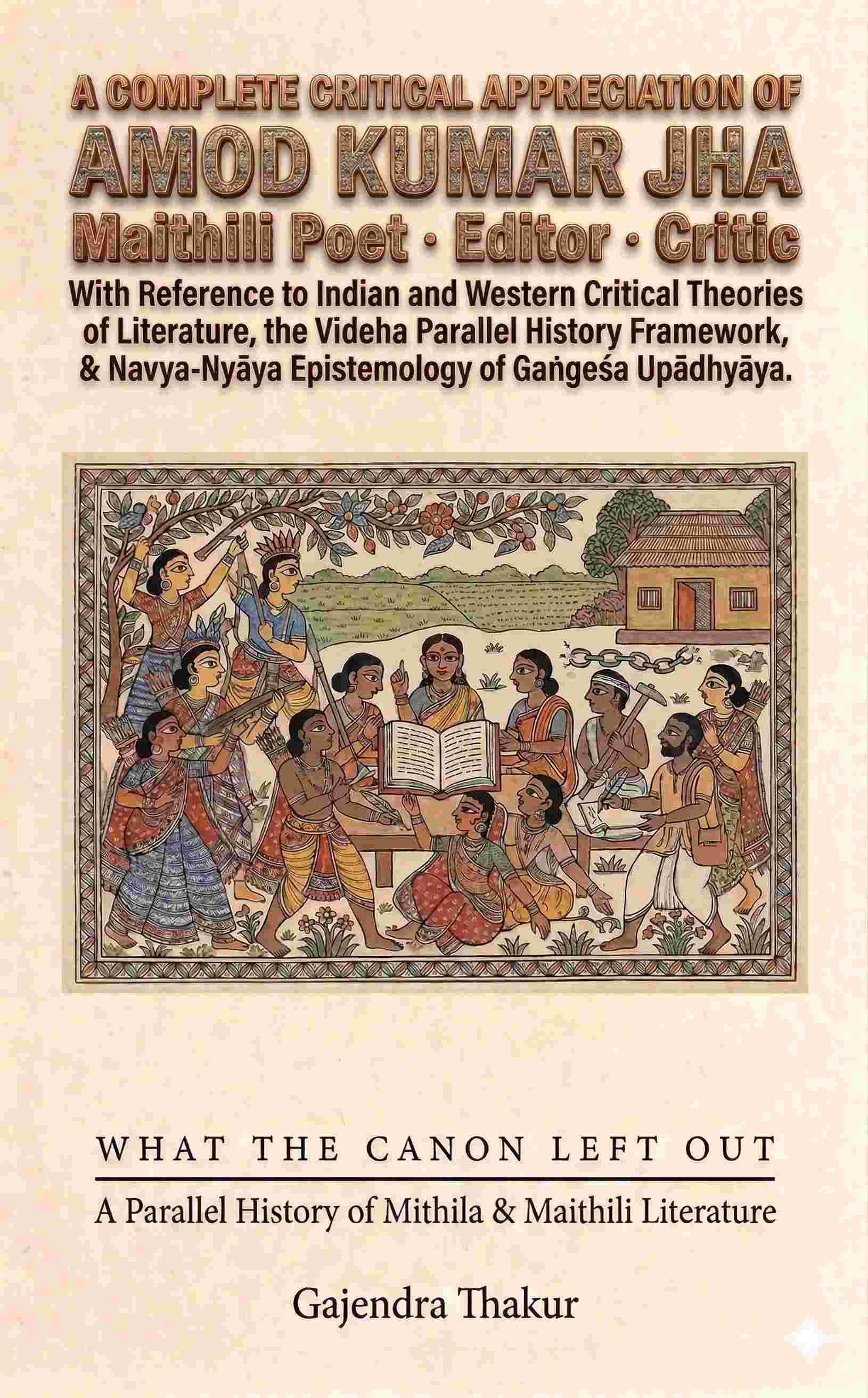
A COMPLETE CRITICAL APPRECIATION OF AMOD KUMAR JHA Maithili Poet Editor Critic With Reference to Indian and Western Critical Theories of Literature, the Videha Parallel History Framework, Navya-Nyāya Epistemology of Gaṅgeśa Upādhyāya, and Bharata's Nāṭyaśāstra Rasa-Dhvani Aesthetics
A COMPLETE CRITICAL APPRECIATION OF
AMOD KUMAR JHA
Maithili Poet · Editor · Critic
─────────────────────────────
With
Reference to Indian and Western Critical Theories of Literature,
the Videha Parallel History Framework, Navya-Nyāya Epistemology of
Gaṅgeśa Upādhyāya,
and Bharata's Nāṭyaśāstra Rasa-Dhvani Aesthetics
TABLE OF CONTENTS
I. Prefatory Note
II. Biographical Introduction: The Poet from Maugalaha to Kolkata
III. The Title and the Collection: Bimbak Pathar — Meaning and Programme
IV. Survey of the Poems: Themes, Structure, and Range
V. Thematic Analysis
VI. Critical Appreciation: Western Literary Theory
VII. Critical Appreciation: Indian Aesthetics, Nāṭyaśāstra, and Rasa Theory
VIII. Navya-Nyāya Epistemology of Gaṅgeśa Upādhyāya Applied to Bimbak Pathar
IX. The Videha Parallel History Framework: Amod Kumar Jha's Place
X. Comparative Study: Amod Kumar Jha among Maithili Poets
XI. The Kolkata Maithili Diaspora and Literary Production
XII. Reception and Publication History
XIII. Conclusions: Literary Significance and Legacy
XIV. Bibliography and References
I. PREFATORY NOTE
Amod Kumar Jha is a Maithili poet, editor, and literary activist based in Kolkata whose first poetry collection, Bimbak Pathar (बिम्बक पथार — 'The Reflective Stone'), published in 2014 by Harekrishna Prakashan, Kolkata, announces the arrival of a sustained and socially engaged poetic voice in contemporary Maithili literature. The collection — introduced by a substantive critical preface by the eminent Maithili scholar and litterateur Prof. Dr. Basukīnātha Jhā — contains approximately ninety poems of varied length and register, ranging from brief epigrammatic pieces to extended lyric-meditations. The book has been archived on Videha (www.videha.co.in/pothi.htm), the first Maithili fortnightly e-journal (ISSN 2229-547X), edited by Gajendra Thakur, thereby entering the canon of the Videha Parallel History of Maithili literature.
This critical appreciation reads Bimbak Pathar through multiple interpretive frameworks: the Western critical tradition (from Aristotle and Longinus through Bakhtin, Spivak, Jameson, and Terry Eagleton); Indian aesthetic theory rooted in Bharata's Nāṭyaśāstra and Ānandavardhana's dhvani theory; the Navya-Nyāya epistemological framework of Gaṅgeśa Upādhyāya (Mithila's own great logician); and the Videha Parallel History framework that documents non-mainstream Maithili literary voices. Through all these lenses, Bimbak Pathar emerges as a significant collection in modern Maithili poetry — wide in its social range, formally varied, politically alert, and humanistically committed.
II. BIOGRAPHICAL INTRODUCTION: THE POET FROM MAUGALAHA TO KOLKATA
From the biographical note on the back cover of Bimbak Pathar, Amod Kumar Jha was born on 1 November 1968 in Maugalaha village, Post Misrauliya, Bhaya-Baburahi, Madhubani district — the heart of Mithila. His father was Svargīya Dayānātha Jhā; his mother Śrīmatī Baccī Devī; and his aunt (mausī) the late Muṃdrikā Devī — who is acknowledged as the one 'whose creative strength established his existence.' He was raised at Durgoli, Post Manpour, Bhaya Khirarhar, Madhubani. He received his education at Mādhyamik Uccavr Vidyālaya, Khirarhar; his intermediate and graduate degrees from Phool Deo Kumar Jha Mahavidyalaya, Andharathadi; his Maithili honours degree from Chandra Mishra Mahavidyalaya, Darbhanga; and his MA in Maithili from Patna University, Patna. He has cleared both the National Eligibility Test (NET) and Bihar Eligibility Test (BET).
His published works include: (1) Bimbak Pathar — Kavitā-Saṃgraha (poetry collection, 2014); (2) Kolakātā: Maithilī Kavitā — a co-edited anthology of Maithili poetry from Kolkata; (3) Ādhunik Maithilī Kavitā Daśā o Dṛṣṭi — a critical and editorial volume on the state and vision of modern Maithili poetry. He has also published extensively in journals, magazines, and memorials. His current address is New Gariya, Police Para, near Ashram, Kolkata-152.
Several elements of Jha's biography are literarily significant. The migration from rural Madhubani to Kolkata — the city that Maithili scholars call 'the second Mithila' because of its large diaspora community — is a defining arc of contemporary Maithili cultural production. Jha's academic grounding in Maithili (MA from Patna University, NET, BET) gives his poetry an unusually informed relationship with the literary tradition from within which he writes. His editorial work (the Kolkata anthology, the critical volume on modern Maithili poetry) positions him as a critic-poet in the double register of the engaged intellectual.
III. THE TITLE AND THE COLLECTION: BIMBAK PATHAR — MEANING AND PROGRAMME
3.1 The Title: Bimba, Bimbak, Pathar
The title Bimbak Pathar is in Maithili and requires semantic unpacking. Bimba (बिम्ब) is a Sanskrit term meaning 'image,' 'reflection,' 'reflection in a mirror or water' — it is the standard term in Indian aesthetics for the image or mental impression formed in the mind by poetic language. In the alaṃkāra (figure of speech) tradition, bimba is specifically the primary term of a comparison, the thing compared. The adjectival form bimbak means 'of/relating to bimba/image/reflection.' Pathar in Maithili means 'stone' or 'rock.' The compound 'Bimbak Pathar' thus means literally 'the Stone of Images' or 'the Reflective Stone' — a stone that holds reflections, that retains impressions, that registers the impress of what has been.
As Prof. Dr. Basukīnātha Jhā clarifies in his preface ('Bimbak Pathar: Śābdak Sahakār' — 'Bimbak Pathar: The Collaboration of Words'), the title signals Jha's aesthetic programme: each poem is a stone surface upon which the images of contemporary social reality have been impressed. The bimba/reflection theory of Indian aesthetics, richly discussed in both the alaṃkāra and dhvani traditions, is Jha's self-announced critical framework. Jhā's preface explicitly engages with the Western concept of 'reflection' (English word used) and its transformation into the Indian aesthetic framework of bimba, noting that image theory has been extensively discussed in Western criticism too and that bimba must be distinguished from mere illustration — it is the deep, socially engaged resonant image that the poet creates.
3.2 The Preface by Prof. Dr. Basukīnātha Jhā: A Critical Framework
The preface by Basukīnātha Jhā is itself a substantial critical text, offering a framework for reading the collection. Several key arguments emerge: First, the preface situates Jha's poetry within the intellectual context of the 19th-20th century: the era of social reform, development, scientific progress — an age of 'janaváda, gīt, navgīt, ghazal' forms moving toward post-modernism, with humanist currents present throughout. Second, it diagnoses a contemporary crisis in poetry: that words are losing their connection to lived feeling, becoming mere 'play of words' (śabda-khelauna), with the result that poems need 'protection and preservation' from mere formalism. Third, it celebrates Jha's achievement: each poem in the collection offers a genuine social vision; the language is distinctively Jha's own, with the colloquial Maithili idiom ('gobar chāuraka ḍhakiyā nāhit' — 'covering dung with chaff') used naturally and to great effect.
Jhā's critical vocabulary in the preface is revealing: he uses terms from both Indian aesthetics (bimba, alankār, dhvani, rasa) and implicitly from Western criticism (the 'reflection' concept, references to contemporary social and political life). The preface functions as a critical manifesto for the collection's programme: poetry must be socially rooted, experientially true, linguistically distinctive, and must achieve that resonance (hṛdaye jhaṃkār — 'resonance in the heart') that constitutes its highest achievement.
IV. SURVEY OF THE POEMS: THEMES, STRUCTURE, AND RANGE
Bimbak Pathar contains approximately ninety poems across approximately ninety-six pages. The poems are arranged neither chronologically nor topically but in a sequence that creates thematic resonances and contrasts. The table of contents reveals the extraordinary thematic range: 'Āśā Bharal Muskī' (Hope-filled Smile), 'Ṭāṃgal Mon' (Hanging/Suspended Mind), 'Śaharakā Gāch' (City Tree), 'Katahu Pravāsī Katahu Pardeśī' (Somewhere a Migrant, Somewhere a Stranger), 'Hmarā Azurak Bhāṣā' (Our Motherless/Stepmother Language), 'Mukhaūṭā' (Mask), 'Ṭūṭit Rahel Saṃvedanāk Ḍori' (The Breaking Thread of Feeling), 'Goṃdhī Āb Katṛ?' (Gandhi, Come Now?), 'Mahānagar' (Metropolis), 'Talāk' (Divorce/Triple Talaq), 'Maryādāk Pratīk — Pākaṛi Gāch' (Symbol of Dignity — The Pakad Tree), 'Sapnā' (Dream), 'Bhūt-Vartamān-Bhaviṣya' (Past-Present-Future), 'Hantā' (The Killer/Alas), 'Adbhut Vikāsak Rastā' (The Strange Path of Development), 'Ḍomī' (The Dhobi Woman), 'Kivi: Kivi Nihi Thik Harvāha' (The Poet: Is the Poet Not Truly a Ploughman?), 'Śṛṃgārak Ek Upādān Nārī' (Woman as Mere Ingredient of Śṛṃgāra), and many others.
The poems vary in form from very short epigrammatic pieces (the 'Vākīl'/'Hākim' sequence, each only four to six lines) to extended lyric meditations of two or more pages ('Apiyārī', 'Chhoṭgar Samācār', 'Kathahu Pravāsī Katahu Pardeśī'). Most poems are free verse (chandamukta), without rhyme, employing the natural rhythms of spoken Maithili. A few poems have internal refrains or anaphoric structures (notably 'Kavitā me Becainī' with its triple refrain 'Hamar Āṃkhi / Hamar Āṃkhi / Hamar Āṃkhi' — 'Our Eyes / Our Eyes / Our Eyes'). The visual layout on the page — each line beginning flush left, short lines, generous white space — reflects a free-verse tradition that is comfortable with brevity and implication.
V. THEMATIC ANALYSIS
5.1 Migration, Diaspora, and the Loss of Roots
The migration of Maithili speakers from rural Mithila to Kolkata and other cities is perhaps the most pervasive theme of Bimbak Pathar. The poem 'Katahu Pravāsī Katahu Pardeśī' ('Somewhere a Migrant, Somewhere a Stranger') is the collection's most sustained meditation on this condition. The migrant figure — unable to return home, not fully belonging to the city, marked by the awareness of difference — is developed through specific Maithili social images: the man who has no voter card, no ration card in the city; whose mother does not know what has happened to him; who has been away for twenty years but finds no trace of himself in either location.
[Katahu Pravāsī Katahu Pardeśī]
Hamrā nahi sujhait achi
gām phurābāk bāṭa
gun-dhun bhel mati chiṃchrū jakāṃ
mālik'k adbhutiyā bhel rhai chī
(We cannot find our way back to the village /
our minds have become rat-like confused /
we have become the strange property of the master)
The poem 'Śaharakā Gāch' ('City Tree') develops the migrant's predicament through the figure of a tree — planted at the city's crossroads, its familiar birds gone, standing alone in the urban environment, identified with the unemployed youth also standing at the crossroad in despair. This is one of the collection's finest short poems, achieving through objective correlative what a direct statement of alienation could not.
5.2 The Mother Tongue at Risk: 'Hamrā Azurak Bhāṣā'
The poem 'Hamrā Azurak Bhāṣā' ('Our Stepmother Language' or 'Our Language Without a Mother') is among the collection's most politically charged pieces. It diagnoses the condition of Maithili in the contemporary moment — a language that has lost its home, that holds conferences in cities but is not understood by its own Mithila community, that invokes Vidyapati but cannot find its own speakers, that asks whether anyone remembers the ballad of Raja Lorika, the stories of Banthā Chamār, the devotional songs of the tradition.
[Hamrā Azurak Bhāṣā]
Nij haī kakrō garaj
śahare azur me karai haī baṛakā-baṛakā pārṭī āū sammilan
gāma azur me hamrā suhūn ke
nij bujhī haī maithil
(No one's concern is truly there /
Big parties and conferences in city venues /
In our villages, nobody hears us /
The Maithil does not understand his own language)
The poem's devastating final lines — 'Dekhiyaun ne chīni letai kiyō / Hamrā azurak bhāṣā / kakar bāpak din haī / Sira lebaī vā sira kaṭā debai' — translate roughly as 'Look — who is taking away / our motherless language / Whose father's day is this / Cut off the head or give the head.' This is a call to cultural accountability that does not flinch from the difficult question: who is responsible for the erosion of Maithili?
5.3 Political Critique and the Satirical Mode
A substantial cluster of poems constitutes what might be called Bimbak Pathar's satirical-political portfolio. The poem 'Adbhut Vikāsak Rastā' (The Strange Path of Development) is a precise and devastating critique of development discourse in contemporary India — where mobile phones and Facebook replace human connection, where 'progress' means Uttarakhand floods and Kashmir dam-breaks. 'Goṃdhī Āb Katṛ?' (Gandhi, Come Now?) asks Gandhi to return to a world where industrialisation has destroyed Indian villages, where multinational relations reduce people to economic transactions, where young people are caught between Indian roots and American modernity.
The poem 'Apiyārī' is a satirical masterpiece: a long narrative poem about a politician who promises a factory on 324 acres of land, whose son's position requires bribes, whose visit consists of being garlanded with milk and flowers while extracting political promises. The Maithili idiom is rich and specific — 'pāco aṃgurī ghī me / dunu beṭā kumār' (all five fingers in ghee / both sons safe) — a proverbial expression of complete corruption perfectly deployed.
5.4 Women's Condition: From 'Śṛṃgārak Ek Upādān Nārī' to 'Ḍomī'
Jha's feminist critique ranges from the programmatic to the specific. 'Śṛṃgārak Ek Upādān Nārī' ('Woman as Mere Ingredient of Śṛṃgāra') is a sustained feminist analysis of the classical poetic tradition: the dominant tradition has used woman as an instrument of the erotic rasa rather than representing her as a subject of her own experience. The poem explicitly names 'Rājakamal' (Rajkamal Chaudhary, the Maithili modernist writer) as someone whose experience has confirmed this reduction — positioning woman as decoration, not agent.
The poem 'Ḍomī' (about a woman of the Dhobi/washerwoman community) is one of the collection's finest social portraits. The Ḍomī figure comes alive through specific detail — working before dawn, learning to stitch in Konkan (from Punjab/Maharashtra skilled workers), pulling a rickshaw, navigating the indignity of having her INDIRA AWAS house claim cut from the mukhiya's list after twenty years — a portrait of systemic failure experienced by a specific, named social type.
5.5 Communal Harmony and the Godhra Memory
The poem 'Smṛtik Aṃk Me Godharā' (Godhra in the Register of Memory) is a quietly devastating account of communal violence: a neighbourhood where a mosque and a temple stand side by side, where all castes and religions live together, until one day — pilgrims burning in a train, people setting fire from different directions — the question remains unanswered: where did the mosque go, where did the temple go, where did Ram Lalla go? The poem does not take sides politically; it grieves the destruction of lived coexistence through an unnamed violence.
5.6 The Poet's Vocation: Reflexive Poems
Several of the collection's most original poems are reflexive — about the condition of poetry itself and the poet's place in society. 'Kivi: Kivi Nihi Thik Harvāha' (The Poet: Is the Poet Not Truly a Ploughman?) argues through sustained metaphor that the poet, like the farmer, must plough the ground of social reality with hard work — both are providers of life-giving sustenance, but neither is recognised. 'Bhūt-Vartamān-Bhaviṣya' (Past-Present-Future) articulates the poet's only aspiration: to awaken Maithili pride, preserve its language and literature, and prepare a strong young Maithili for the century ahead.
'Kavitā Me Becainī' (Restlessness in Poetry) — with its triple refrain 'Hamar āṃkhi / Hamar āṃkhi / Hamar āṃkhi' ('Our eyes / Our eyes / Our eyes') — meditates on how capitalist postmodernity ('pūṃjīvādī vyavasthā ā uttar-ādhuniktatāk ṭoṭakā') has taken the 'bimba' (image) away from poetry, colonising it for advertising and digitised spectacle.
VI. CRITICAL APPRECIATION: WESTERN LITERARY THEORY
6.1 Marxist Criticism and the Literature of Social Engagement
Terry Eagleton's argument in Marxism and Literary Criticism (1976) that literature is not a passive reflection of social reality but an active production of meaning within social relations applies illuminatingly to Bimbak Pathar. Jha's poems do not merely reflect migration, corruption, or women's oppression — they actively constitute a counter-knowledge about these conditions, producing Maithili as the medium through which subaltern experience achieves articulate form. In Eagleton's terms, the collection's 'ideology' is humanist-progressive; its 'form' (free verse in spoken Maithili) is not neutral but expresses a commitment to accessibility and social inclusiveness.
6.2 Mikhail Bakhtin: Heteroglossia and the Dialogic Imagination
Bakhtin's concept of heteroglossia — the multi-voicedness inherent in language, where every utterance contains traces of other social voices — operates powerfully in Jha's poems. The poem 'Chhoṭgar Samācār' (Small News) is structurally dialogic: it layers the voices of politicians, mullahs, pandits, journalists, police, and ordinary citizens in a rapidly shifting sequence that enacts the cacophony of contemporary public discourse. The poem's devastating closure — 'aime kakrā kate māl bheṭataī rau bhajagār' (where does one find goods in this place) — allows the voices of power to expose themselves through their own unguarded speech.
6.3 Postcolonial Theory: Spivak and the Question of the Subaltern
Gayatri Spivak's question — 'Can the subaltern speak?' — is posed acutely by several poems in Bimbak Pathar. The poem 'Ḍomī' demonstrates that the Dhobi woman's capacity to speak is circumvented not by silence but by institutional exclusion: she speaks, she works, she navigates urban space — but the mukhiya cuts her name from the government list, the system acts as if she does not exist. This is the condition Spivak identifies: the subaltern is not voiceless but unheard within the institutional systems that should respond to her.
The poem 'Hamrā Azurak Bhāṣā' is the entire collection's most direct Spivakian text: Maithili itself is in the position of the subaltern language — the language that conferences are held about, but not held in; that elites celebrate but do not speak to their children.
6.4 Fredric Jameson: The Political Unconscious
Jameson's argument that all literary texts contain a 'political unconscious' — repressed or latent social content that the text's form both reveals and disguises — helps illuminate Bimbak Pathar's formal choices. The free verse form of the poems, with its refusal of classical metre or the decorative alaṃkāra tradition, is itself a political statement: it refuses the Brahminical, courtly literary aesthetic of classical Maithili in favour of the spoken idiom of the common person. The very choice of 'ṭheṭh' (indigenous, unrefined) Maithili words — 'gobar' (dung), 'bhūsī' (chaff), 'harjot' (plough) — as poetic diction is a challenge to the hegemony of Sanskritised literary Maithili.
6.5 Narrative Theory: Gerard Genette and the Poem as Narrative
Several of Bimbak Pathar's longer poems are structurally narrative — they tell stories rather than merely offering lyric reflection. 'Apiyārī' is essentially a narrative poem: it narrates the encounter between a constituents' delegation and their politician, with a fully developed plot arc, recognisable character types, and a sardonic denouement. Genette's distinction between histoire (story), récit (narrative), and narration (narrating act) illuminates how Jha's 'narrative poems' work: the narrating voice is that of the aggrieved citizen/witness, the récit is organised around the politician's promises and evasions, and the histoire is the permanent condition of rural neglect.
6.6 Longinus and the Sublime: Civic Grandeur in Bimbak Pathar
Longinus's Peri Hypsous (On the Sublime) argued that great literature must transport the reader through the experience of grandeur — moral, emotional, or conceptual. The civic sublime of Bimbak Pathar is not found in landscape or cosmic imagery but in the dignity of the ordinary person. The poem 'Māṭi' (Soil/Earth) achieves this in six lines: 'Anything that was, is from this earth / anything that will remain, stays on this earth / Brahma on this earth / Vishnu on this earth / Mahesh also on this earth / The human form is therefore / all is from the earth / all is of the earth.' The reduction of the cosmic hierarchy to the materiality of soil is simultaneously an ecological and a humanist statement of sublime simplicity.
VII. CRITICAL APPRECIATION: INDIAN AESTHETICS, NĀṬYAŚĀSTRA, AND RASA THEORY
7.1 Rasa Theory Applied to Bimbak Pathar
Bharata Muni's Nāṭyaśāstra identifies eight primary rasas that a literary work produces in the reader through the interaction of vibhāva (stimulus), anubhāva (response), and vyabhicāribhāva (transitory emotions). Bimbak Pathar's dominant rasas are:
Karuṇa rasa (compassion/pathos): The dominant rasa of the collection. Poems like 'Ḍomī', 'Āśā Bharal Muskī' (the stone-breaker woman whose only possession is a hope-filled smile), and 'Ṭāṃgal Mon' (the migrant worker running to catch the train with half-done work) produce sustained karuṇa — not sentimental pity but the engaged compassion of someone who has seen and borne witness.
Raudra rasa (righteous anger): The satirical-political poems — 'Goṃdhī Āb Katṛ?', 'Apiyārī', 'Khādhi', 'Gauṃāṃ Chaik Vakalel' — produce a controlled raudra: the anger of the citizen who sees the gap between democratic promise and oligarchic reality.
Hāsya rasa (comic/ironic): The satirical mode of several poems (notably 'Kavi-Goṣṭhī' — the poet's gathering — and 'Dāv-Peṃc') operates through bitter comedy. 'Kavi-Goṣṭhī' is a masterpiece of hāsya: a poets' gathering where the announcer is lost in his own importance, the audience vanishes before anyone can read, and the performers scatter like parliamentary members.
Vīra rasa (heroic courage): The poems of linguistic pride ('Hamrā Azurak Bhāṣā', 'Chhoṛi Diy Rastā Hamar') and of cultural assertion produce a subdued but genuine vīra — the hero who refuses to abandon the mother tongue even under pressure.
Bībhatsa rasa (disgust): The corruption poems deploy bībhatsa: the disgust at seeing democracy reduced to bribery, courts reduced to farce, language reduced to commodity.
7.2 Dhvani (Resonance) in Bimbak Pathar
Ānandavardhana's Dhvanyāloka argues that the greatest literary achievement lies not in what is stated but in what is suggested — the dhvani or resonant unstated meaning. Jha's best poems work precisely through dhvani. 'Śaharakā Gāch' does not state 'the migrant is as isolated as a tree in an alien city' — it shows the tree standing at the crossroad, its birds gone, its branches untouched, and places alongside it 'another figure' also standing there in despair. The identification is performed through proximity, not comparison — this is dhvani operating at its purest.
The poem 'Māṭi' (Soil) achieves dhvani in a different register: its explicit statement (all things come from and return to earth) resonates with the unstated implication that all hierarchies — caste, class, gender — are as temporary as the human body on the earth that will outlast it.
7.3 The Alaṃkāra Tradition and Bimbak Theory
The collection's very title announces its engagement with the alaṃkāra tradition's concept of bimba. In Indian poetics, bimba (the primary image in a comparison) and pratibimba (its reflection) are central to upamā (simile) and rūpaka (metaphor). Jha, following the critical framework established in Basukīnātha Jhā's preface, deploys bimba not as mere decoration but as the cognitive structure through which social reality becomes legible. The stone that holds reflections — bimbak pathar — is a meta-image for the poem itself: a hard surface that captures and preserves the image of the world that touches it.
7.4 Loka Dharma: Poetry in the Service of the Community
Bharata's Nāṭyaśāstra stipulates that literature must serve the dharma of the loka — the people. Bimbak Pathar is explicitly committed to loka dharma: it addresses the concerns of the Maithili-speaking community across its full social range — the migrant worker, the Dhobi woman, the unemployed youth, the village facing corruption, the language facing erosion, the woman facing objectification in classical poetry. This is not a poetry of private self-cultivation but of social engagement — in precisely the terms that Bharata and the later tradition describe as loka dharma.
VIII. NAVYA-NYĀYA EPISTEMOLOGY OF GAṄGEŚA UPĀDHYĀYA APPLIED TO BIMBAK PATHAR
8.1 Gaṅgeśa and Jha: Two Mithila Intellectuals
Gaṅgeśa Upādhyāya (fl. 13th-14th century CE), the founder of the Navya-Nyāya school of Indian epistemology, was a native of Mithila — the very cultural heartland from which Amod Kumar Jha comes. Gaṅgeśa's Tattvacintāmaṇi ('Wish-Fulfilling Gem of Truth') established the most technically precise system of epistemological analysis in Indian philosophy. As documented in Gajendra Thakur's Parallel History of Maithili Literature and in Videha's coverage, Gaṅgeśa's own social biography was complex: he married outside the conventional Brahmin social order (a woman of the artisan community), an act that placed him on the social margins even as his intellectual achievement was beyond question. This structural parallel — the Mithila intellectual who works at the boundaries of the socially sanctioned — illuminates Jha's own position as a poet of the Maithili diaspora who challenges the conservative literary establishment.
8.2 The Four Pramāṇas Applied to Bimbak Pathar
Navya-Nyāya recognises four pramāṇas (valid sources of knowledge): pratyakṣa (direct perception), anumāna (inference), upamāna (analogy), and śabda (verbal testimony). Jha's poems operate through all four:
Pratyakṣa (Direct Perception): The poems rooted in direct observation — 'Ṭāṃgal Mon' (the migrant woman running to catch the train), 'Nocalī' (the backache noticed in a hotel room in Jaipur), 'Āśā Bharal Muskī' (the stone-breaking woman's smile in the heat) — ground their authority in witnessed experience. The poetic subject has seen, has felt, has been present. This is pratyakṣa as the foundation of poetic validity.
Anumāna (Inference): The diagnostic and critical poems — 'Adbhut Vikāsak Rastā', 'Phalā Mīṭh Vākīl Hākim' — move from observable symptoms (the politician's behaviour, the administrator's indifference) to inferred structural causes (systemic corruption, the class character of the state apparatus). This is anumāna: from the observed sign (liṃga) to the inferred cause (sādhya).
Upamāna (Analogy): The collection's core bimba/image strategy is upamāna — the comparison through which the unfamiliar or abstract becomes accessible. The city tree as analogue for the migrant; the soil as analogue for democracy; the pakaṛ tree as analogue for village dignity. Each of these is a carefully constructed upamāna that generates valid cognitive access to its subject.
Śabda (Testimony): The poems invoke the śabda of the Maithili tradition — Vidyapati, Lorika, Bhāmatī, Phuleśvarī, Ranī Kusumā — not as ornament but as valid testimony about the depth and dignity of Maithili culture. The poem 'Chhoṛi Diy Rastā Hamar' explicitly invokes these testimonies as witness to what is being lost.
8.3 Vyāpti and the Universalising Move in Jha's Poetry
Navya-Nyāya's concept of vyāpti — the universal concomitance between a sign and its signified — is the logical structure that allows particular observations to ground general conclusions. Jha's poems consistently perform vyāpti: the particular Dhobi woman's story generates a universal claim about Dalit women's treatment by the bureaucratic system; the particular migrant worker's inability to find his way back grounds a universal claim about the rupture between village and city in contemporary India. This universalising move — from the witnessed particular to the structural general — is the epistemological core of committed social poetry.
8.4 Viśeṣya-Viśeṣaṇa-Saṃbandha: The Navya-Nyāya Language of Qualification
Gaṅgeśa's technical vocabulary for the structure of cognition — viśeṣya (the qualified, the locus), viśeṣaṇa (the qualifier, the property), and saṃbandha (the relation between them) — provides a precise tool for understanding Jha's image-making. In the poem 'Śaharakā Gāch': the tree (viśeṣya) is qualified by the absence of its birds (viśeṣaṇa), connected to the migrant's isolation (saṃbandha through proximity). Each image in the collection can be analysed as a viśeṣya-viśeṣaṇa-saṃbandha structure in which the qualifying element generates the meaning that could not have been stated directly.
IX. THE VIDEHA PARALLEL HISTORY FRAMEWORK: AMOD KUMAR JHA'S PLACE
Gajendra Thakur's Videha (www.videha.co.in) — the first Maithili fortnightly e-journal (ISSN 2229-547X) — has developed what it calls a 'Parallel History of Mithila and Maithili Literature,' systematically documenting writers excluded from or marginalised by the Sahitya Akademi's conservative advisory structure. The Videha pothi (book) archive (www.videha.co.in/pothi.htm) has archived Bimbak Pathar, thereby including Jha within the Videha parallel canon.
Jha's position within the Videha parallel is distinctive. Unlike the farmer-poets (Jagdish Prasad Mandal, Ramdeo Prasad Mandal 'Jharudar'), Jha is an academically trained Maithili scholar (MA, NET, BET) — yet he writes from the margins of the mainstream literary establishment as a diaspora poet in Kolkata, outside the Bihar-based institutions. Unlike the scientist-writer Yogendra Pathak Viyogi, he writes primarily in a social-critical lyric mode. His closest parallel within the Videha circle is perhaps Kumar Pawan — another poet-scholar of the middle generation working in the tradition of committed Maithili verse.
Within the Videha framework, Jha is significant as an example of the second generation of Maithili diaspora poets who bring both academic grounding and lived urban experience to their writing. His editorial work — the Kolkata Maithili poetry anthology and the critical volume on modern Maithili poetry — places him in the role of a Gramscian organic intellectual: not merely a creative artist but an organiser and theoriser of Maithili literary culture from within the diaspora.
X. COMPARATIVE STUDY: AMOD KUMAR JHA AMONG MAITHILI POETS
10.1 Jha and Nagarjuna (Yatri): The People's Poetry Tradition
Nagarjuna (Vaidyanath Mishra, 1911-1998), writing as 'Yatri' in Maithili and 'Nagarjun' in Hindi, is the canonical figure of the Maithili people's poetry tradition. His Patrahin Nagna Gachh (Leafless Naked Tree) won the Sahitya Akademi Award. Jha inherits and extends the Nagarjuna tradition of politically engaged, accessible verse — but with crucial differences. Where Nagarjuna was a Maithil Brahmin who consciously crossed class and caste boundaries through political commitment and Buddhist conversion, Jha writes from within the diaspora as a practicing Maithili scholar. Where Nagarjuna's political poetry was shaped by Marxism and the JP Movement, Jha's is shaped by a humanist ethics closer to Gandhi (invoked directly in 'Goṃdhī Āb Katṛ?') and by the specific concerns of language preservation and diaspora identity.
10.2 Jha and Rajkamal Chaudhary: The Feminist Critique
The poem 'Śṛṃgārak Ek Upādān Nārī' directly and critically engages with Rajkamal Chaudhary (1929-1967), the controversial Maithili modernist who is widely regarded as the most important Maithili poet of the 20th century. Rajkamal's 'Maithilīk Agrabhāg' poetry used erotic imagery in ways that were celebrated by some critics as liberation from bourgeois moralism and criticised by others as exploitation of women's bodies for male aesthetic pleasure. Jha's poem takes the latter position: 'anubhav saṃ likhala rājakamal / puruṣ achi mahādhūrt / eṃdrik aślīl rūpme nārī kāvya śṛṃgārak upādān' ('from experience Rajkamal wrote / man is the great deceiver / in a sensory, vulgar form / woman in poetry is a mere ingredient of śṛṃgāra'). This is a bold critical move — Jha directly criticises the tradition's most celebrated modernist from a feminist-humanist position.
10.3 Jha and Harimohan Jha: The Satirical Tradition
Harimohan Jha (1908-1984), author of Khattar Kakak Tarang (Khattar Kaka's Waves), established Maithili social satire as a major literary form. Jha's satirical poems — particularly 'Apiyārī', 'Dāv-Peṃc', 'Kavi-Goṣṭhī', and 'Chhoṭgar Samācār' — inherit and extend this satirical tradition. The difference is one of target and register: where Harimohan Jha satirised the internal contradictions of Maithil Brahmin orthodoxy from within, Jha's satire targets the political class, the administrative apparatus, and the literary establishment as external forces oppressing the community.
10.4 Jha and Jagdish Prasad Mandal: Subaltern Voices
Jagdish Prasad Mandal, the OBC farmer-writer who won the Sahitya Akademi Award 2021, writes in social realist prose fiction. Jha's 'Ḍomī' and 'Āśā Bharal Muskī' cover similar subaltern territory — the Dhobi woman, the stone-breaking labourer — in the lyric mode. Both writers are committed to representing voices that the classical Maithili tradition and the Sahitya Akademi structure have systematically excluded. The difference is generic: Mandal achieves documentary depth through the novel form; Jha achieves concentrated emotional and intellectual power through the lyric.
XI. THE KOLKATA MAITHILI DIASPORA AND LITERARY PRODUCTION
Kolkata has historically been the most important centre of Maithili diaspora literary production outside Mithila itself. Journals such as Mithilā Darśan (Kolkata) have been primary venues for modern Maithili poetry and prose. The Maithili Sāhitya Saṃsthā and related organisations have organised events that have sustained a literary community in the city. The anthology Kolakātā: Maithilī Kavitā, which Jha co-edited, documents this tradition and his own role in sustaining it.
Jha's location in Kolkata gives his poetry a specific double vision: the city that the Maithili migrant inhabits is simultaneously the place from which the village is viewed with longing and grief, and the place from which the condition of Maithili culture and language in the homeland can be seen with critical distance. This double vision — insider/outsider, Mithila/Kolkata — is the structural condition of his poetic imagination and one source of its authority.
XII. RECEPTION AND PUBLICATION HISTORY
Bimbak Pathar (2014, Harekrishna Prakashan, Kolkata) was introduced by Prof. Dr. Basukīnātha Jhā's substantial critical preface — a mark of significant literary recognition within the Maithili community. The preface is titled 'Bimbak Pathar: Śābdak Sahakār' ('Bimbak Pathar: The Collaboration of Words') and constitutes the most sustained critical engagement with the collection. The book is archived on Videha's pothi (book) archive, placing it within the canon of the Maithili parallel literary tradition. Jha has also edited two other Maithili volumes (the Kolkata poetry anthology and the critical volume on modern Maithili poetry), indicating both his literary standing and his role as a cultural organiser within the Maithili community.
XIII. CONCLUSIONS: LITERARY SIGNIFICANCE AND LEGACY
Bimbak Pathar is a collection of genuine literary achievement and social significance. Its literary merits are multiple and can be identified across the critical frameworks applied in this appreciation:
Formal range and competence: The collection demonstrates mastery of free verse in Maithili, from the epigrammatic short poem to the extended lyric-narrative. The formal variety — short, sharp poems; extended social portraits; reflexive poems about poetry itself — gives the collection an architectural richness.
Social breadth: No other contemporary Maithili poetry collection known to this author covers as wide a range of social types and conditions: the migrant, the Dhobi woman, the stone-breaker, the corrupt politician, the compromised poet, the language under threat, the communal violence victim, the unemployed youth, the farmer displaced by globalisation.
The bimba programme: Jha's self-conscious deployment of the bimba/image theory — announced in the title and elaborated in the prefatory framework — gives the collection an intellectual coherence that distinguishes it from mere thematic anthology. The poems work through images that resonate, dhvani-fashion, with meanings beyond their explicit content.
The Kolkata diaspora perspective: Jha's double vision — Mithila roots, Kolkata location — gives his poetry a specific insight into the condition of Maithili culture and language that neither the Bihar-based writer nor the fully assimilated urban intellectual could achieve.
Contribution to the Videha parallel tradition: By being archived and celebrated by Videha, Bimbak Pathar enters the tradition of Maithili parallel literature that Gajendra Thakur has systematically documented — a tradition that values social engagement, democratic literary values, and linguistic diversity over the conservative mainstream.
Bimbak Pathar kavitā saṃgrahak kāvyakār Śrī Āmod Kumār Jhāk saphalatā ō yaśak uccatar sopāna satatā dṛḍhatāpūrvak pār karaitī rahi thi takrā kāmanā. — Prof. Dr. Basukīnātha Jhā (concluding wish in his preface to Bimbak Pathar)
XIV. BIBLIOGRAPHY AND REFERENCES
Primary Source
Jhā, Āmod Kumār. Bimbak Pathar (बिम्बक पथार): Maithilī Kavitā-Saṃgraha. Kolkata: Harekrishna Prakashan, 2014. Rs. 100. Preface by Prof. Dr. Basukīnātha Jhā.
Jhā, Āmod Kumār (ed.). Kolakātā: Maithilī Kavitā. [Anthology of Maithili Poetry from Kolkata]. Kolkata.
Jhā, Āmod Kumār (ed.). Ādhunik Maithilī Kavitā Daśā ō Dṛṣṭi. [State and Vision of Modern Maithili Poetry]. Critical-editorial volume.
Maithili and Indian Scholarly Sources
Jhā, Basukīnātha. 'Bimbak Pathar: Śābdak Sahakār' [Preface]. In Āmod Kumār Jhā, Bimbak Pathar. Kolkata: Harekrishna Prakashan, 2014.
Thakur, Gajendra. A Parallel History of Mithila and Maithili Literature. Parts 1-56. Videha: First Maithili Fortnightly eJournal. ISSN 2229-547X. www.videha.co.in/gajenthakur.htm.
Thakur, Gajendra (ed.). Videha Pothi Archive. www.videha.co.in/pothi.htm.
Outlook India. 'A Journey Through Maithili Literature with Kathakar Ashok.' February 2024. www.outlookindia.com.
Choudhary, Radhakrishna. A Survey of Maithili Literature. Patna, 1976.
Jha, Jayakanta. A History of Maithili Literature. New Delhi: Sahitya Akademi, 1980.
Bhattacharya, Dinesh Chandra. History of Navya-Nyāya in Mithila. Darbhanga: Mithila Institute, 1958.
Western Literary Theory
Bakhtin, Mikhail. The Dialogic Imagination: Four Essays. Ed. Michael Holquist. Austin: University of Texas Press, 1981.
Eagleton, Terry. Marxism and Literary Criticism. London: Methuen, 1976.
Genette, Gérard. Narrative Discourse: An Essay in Method. Trans. Jane E. Lewin. Ithaca: Cornell University Press, 1980.
Jameson, Fredric. The Political Unconscious: Narrative as a Socially Symbolic Act. Ithaca: Cornell University Press, 1981.
Spivak, Gayatri Chakravorty. 'Can the Subaltern Speak?' In Marxism and the Interpretation of Culture. Ed. Cary Nelson and Lawrence Grossberg. Urbana: University of Illinois Press, 1988. 271-313.
[Pseudo-]Longinus. On the Sublime [Peri Hypsous]. Trans. W. H. Fyfe, revised Donald Russell. Cambridge, MA: Harvard University Press (Loeb), 1995.
Gramsci, Antonio. Selections from the Prison Notebooks. Ed. Quintin Hoare and Geoffrey Nowell Smith. London: Lawrence and Wishart, 1971.
Indian Aesthetics and Navya-Nyāya
Ānandavardhana. Dhvanyāloka [Light on Suggestion]. Trans. Daniel H. H. Ingalls et al. Cambridge, MA: Harvard University Press, 1990.
Bharata Muni. Nāṭyaśāstra [The Science of Drama]. Trans. M. M. Ghosh. Calcutta: Asiatic Society, 1950-61.
Gaṅgeśa Upādhyāya. Tattvacintāmaṇi [The Wish-Fulfilling Gem of Truth]. Ed. Kamakhyanath Tarkavagisha. Calcutta, 1884-1901.
Abhinavagupta. Abhinavabhāratī (Commentary on Nāṭyaśāstra). In The Nāṭyaśāstra of Bharata. Trans. M. M. Ghosh. Calcutta, 1950-61.
Gerow, Edwin. Indian Poetics. Wiesbaden: Harrassowitz, 1977.
अपन मंतव्य editorial.staff.videha@zohomail.in पर पठाउ।