
Gajendra Thakur
A PARALLEL HISTORY OF MITHILA & MAITHILI LITERATURE- PART 68
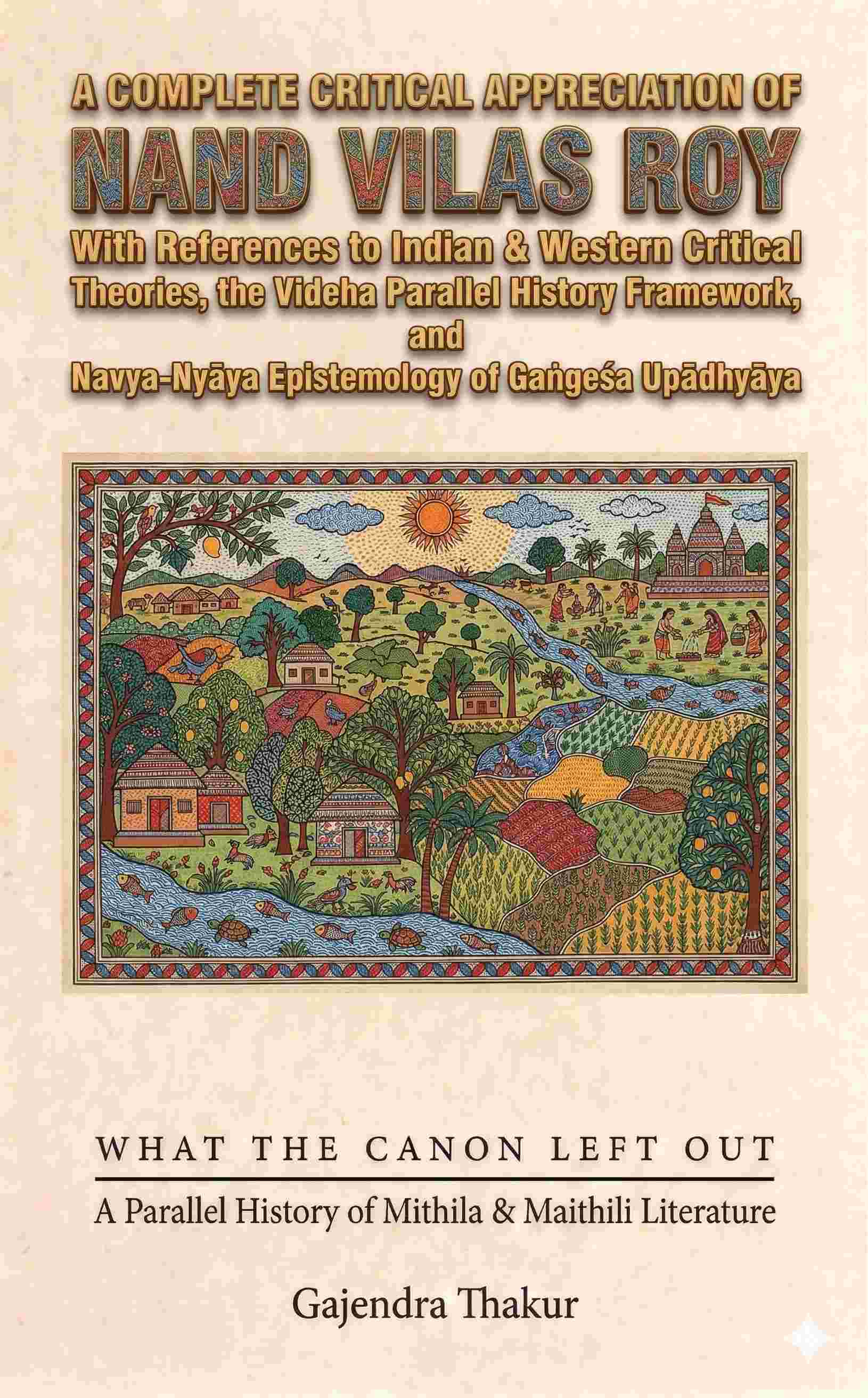
A COMPLETE CRITICAL APPRECIATION OF NAND VILAS ROY With References to Indian & Western Critical Theories, the Videha Parallel History Framework, and Navya-Nyāya Epistemology of Gaṅgeśa Upādhyāya
A COMPLETE CRITICAL APPRECIATION OF
NAND VILAS ROY
With References to Indian & Western Critical Theories,
the Videha Parallel History Framework,
and Navya-Nyāya Epistemology of Gaṅgeśa Upādhyāya
Abstract
Nand Vilas Roy (b. Bhapatiyahi, Madhubani, Bihar) is among the most significant voices in contemporary Maithili parallel literature. A prolific writer of short fiction (kathā), seed stories (bīhani kathā), and poetry, he has published over a dozen collections including Sakhārī-Peṭārī (2013; 2nd ed. 2024), Assal Pūjā (2022), Marjādāk Bhoj (2018), Bhārdutiyā (2018), Chhāthik Dālā (2018), Hamār Chārudhām (2018), and Madan-Amar. His work is published exclusively through Pallavi Prakashan, Nirmali, and is archived in the Videha e-Journal (ISSN 2229-547X). This critical appreciation applies Indian classical theories (Dhvani, Rasa), Western theories (Formalism, New Criticism, Marxism, Postcolonialism, Subaltern Studies), the Videha Parallel History Framework advanced by Gajendra Thakur, and the epistemological techniques of Navya-Nyāya logician Gaṅgeśa Upādhyāya to assess Roy's literary corpus. The study argues that Roy exemplifies what the Videha movement calls the 'democratic parallel tradition': a literature of the subaltern, rooted in Maithili rural reality, structurally opposed to the Brahminical establishment canon, and formally experimental through its mastery of the bīhani kathā mode.
I. Biographical and Contextual Introduction
1.1 Life and Background
Nand Vilas Roy was born and raised in Bhapatiyahi, Madhubani District, Bihar — the heartland of Mithila, the ancient kingdom whose literary, philosophical, and cultural traditions stretch from the Brhadāraṇyaka Upaniṣad dialogues of King Janaka to the logical revolution of Gaṅgeśa Upādhyāya. Roy belongs to the generation of Maithili writers who came to maturity in the digital age and found their literary home in the Videha parallel movement rather than in the Sahitya Akademi establishment apparatus.
In the prefatory note to Assal Pūjā (2022), Roy writes candidly about the material conditions of writing in the margins: 'Those who are engaged in the struggle for salt, oil and firewood throughout the day find literary creation doubly difficult.' This honest self-positioning — the author as economic subject, not a leisured upper-caste intellectual — is itself a political-aesthetic statement. It aligns him with the democratic-subaltern tradition that the Videha Parallel History Framework identifies as the true mainstream of Maithili literary production, historically suppressed by Brahminical establishment gatekeepers.
His mentors include Dr. Ramchandra Rai (Shanti Niketan, Bolpur), Dr. Umesh Mandal, Dr. Yogananda Jha, and Prof. Dhirendra Kumar — all associated with the progressive-democratic wing of Maithili letters. His publisher is Pallavi Prakashan, Nirmali, which functions as an alternative institutional infrastructure to the New Delhi-based houses that dominate Sahitya Akademi-recognised publishing.
1.2 The Videha Parallel Literature Movement: Framework for Situating Roy
The Videha Parallel History Framework, as theorised and documented by Gajendra Thakur in the ongoing Parallel History of Mithila and Maithili Literature (videha.co.in/gajenthakur.htm), distinguishes sharply between two streams of Maithili literary tradition: the mainstream or establishment canon — Brahmin-centred, Sahitya Akademi-anointed, casteist in its selection principles — and the parallel or democratic tradition, which recovers suppressed voices from Buddhist Charyapadas through Harimohan Jha's anti-caste satirical novels, Rajkamal Chaudhary's avant-garde fiction, Jagdish Prasad Mandal's subaltern novels (finally awarded Sahitya Akademi 2021), and contemporary writers such as Roy.
The Parallel History Framework insists, following T.K. Oommen's sociological analysis (Sociology, 1988, p. 291), that the Maithili literary field is economically and culturally dominated by Brahmins, and that the Sahitya Akademi mechanism — its recognised literary organisations, its advisory board composition — systematically excludes non-Brahmin, lower-caste, and subaltern voices. Nand Vilas Roy's entire literary career unfolds within and against this structure of exclusion: his themes, forms, characters, and publishers all mark his work as part of the democratic-parallel tradition.
A crucial precursor figure illuminated by the Parallel History is Gaṅgeśa Upādhyāya (c. 1300–1350 CE), the Maithili philosopher-logician. The Videha research recovered from the Dūṣaṇa Pañjī (the genealogical record of social 'flaws') that Gaṅgeśa was born five years after his father's death and married a Charmakāriṇī — facts suppressed by mainstream historians including Prof. Ramanath Jha. The significance for literary criticism is epistemological: if even the supreme logician of Mithila was of marginalised social origin, and that fact was erased, how much more thoroughly have the literary voices of the margins been suppressed?
II. The Corpus: Works, Forms, and Publication History
2.1 The Short Story Collections
Roy's primary literary form is the Maithili short story (kathā) and seed story (bīhani kathā). His published collections are:
Sakhārī-Peṭārī ('The Seed-Chest') — First published by Shruti Prakashan, New Delhi, 2013; Second edition, Pallavi Prakashan, Nirmali, 2024. ISBN 978-93-93135-92-6. The title itself is culturally dense: sakhārī-peṭārī is the chest of life-sustaining household goods given to a daughter at marriage — rice, oil, spices, utensils — the material kit for wifely survival. Roy's metaphor recontextualises this: his stories are the gifts placed in the chest to equip readers for life. The collection contains fourteen stories including 'Assal Beṭā' ('The Real Son'), 'Tabāhat' ('Ruin'), 'Niwās Pramāṇ Patra' ('Residence Certificate'), 'Mahājan', and others.
Assal Pūjā ('Real Worship') — Pallavi Prakashan, 2022. ISBN 978-93-93135-27-8. A short-story anthology focussing on themes of authentic religious practice versus social performance, caste discrimination, and economic survival. The prefatory note 'Kichhu Apan Bāt' ('A Few Personal Words') is itself a document of subaltern authorial self-positioning.
Marjādāk Bhoj ('The Feast of Dignity') — Pallavi Prakashan, 2018. ISBN 978-93-87675-55-1. A collection of short stories structured around social rituals — meals, ceremonies, performances — that either affirm or violate human dignity.
Bhārdutiyā — Pallavi Prakashan, 2018. ISBN 978-93-88421-83-6. Dedicated to his late parents Vankhari Roy and Durga Devi, and to his brother Anjani Kumar Roy, nephews Veer and Dheer, children Karan and Vandana.
Madan-Amar — A collection of Maithili seed stories (the title story being the most celebrated). ISBN not independently listed; published through Pallavi Prakashan infrastructure.
2.2 The Poetry Collections
Roy has published two anthologies of Maithili poetry and song: Chhāthik Dālā ('The Chhath Basket') — Pallavi Prakashan, 2018. ISBN 978-93-87675-77-3. Poetry centred on the Chhath festival — the great autumnal sun worship of Bihar and the Mithila region, observed especially by the agrarian and lower castes. The collection is explicitly dedicated in its paratextual address to the democratic Maithili reading public.
Hamār Chārudhām ('Our Four Pilgrimages') — Pallavi Prakashan, 2018. ISBN 978-93-88421-86-7. A poetic reimagining of the concept of sacred pilgrimage (chārudhām) in terms of the ordinary rural life of Mithila rather than the Brahminical-sanskritic sacred geography.
2.3 The Bīhani Kathā Form
A formal innovation central to Roy's work is the Maithili bīhani kathā — the 'seed story'. As theorised in the Videha Parallel History (Part 32: 'Maithili Bīhani Kathā: The Seed Story Tradition'), this form is 'a micronarrative form unique to Maithili literature that has no direct equivalent in other Indian literary languages' and 'not simply a compressed short story but a genetically distinct form shaped by Maithili oral tradition, the pragmatics of digital dissemination, and the ideological commitments of democratic and subaltern literary practice.' Roy's 'Madan-Amar' — the title story of his seed-story collection — is among the most cited examples of the genre. The bīhani kathā 'aspires to the condition of the seed: complete in itself, self-contained, yet carrying within its brevity the potential fullness of a much larger narrative.' The ending that 'opens rather than closes' is the formal hallmark.
III. Thematic Analysis
3.1 Caste, Class, and Social Discrimination
The thematic backbone of Roy's fiction is the experience of caste and class discrimination in rural Mithila. 'Madan-Amar', his signature seed story, opens with a child, Madan, being taken by his friend Ammar to his upper-caste maternal grandmother's haveḷī. The grandmother — on discovering Ammar is the son of Bhola Chaupāl, a lower-caste family — expels the child with the words: 'Khatabaiye jātik chhaurrā ke haveḷī bhitar analah' ('You brought a child of the Khatab caste into the mansion?'). The narrative fast-forwards: years later, Ammar has become a Block Development Officer; Madan, now his subordinate clerk, realises the identity. The story ends with the two men embracing — the powerful official and the subaltern child now reversed, the class hierarchy and the caste hierarchy pulled apart.
This narrative structure — the child's humiliation, the adult reversal — encodes what the Videha Parallel History calls the democratic counter-movement: the story refuses the elite's claim to social authority by demonstrating merit's independence from caste birth. In Marxist critical terms (Lukács' concept of 'type'), the story creates a social-typical confrontation between the old feudal-caste order and the new meritocratic-democratic order, rendered not through abstract debate but through affective, embodied incident.
In 'Assal Beṭā' ('The Real Son'), Roy narrates the life of Jīvan Mukhiyā, a fisherman by caste who has abandoned his caste occupation to run a tea stall at Nirmali station. Against social odds, he educates his children to become engineers and a teacher. When he dies, it is his daughter Suknī — who remained home to care for him — who performs the rituals of filial devotion. His successful sons, though wealthy, arrive late. The schoolmaster Gopal observes at the end that the true sons are those who perform care, not those who achieve status. The story critiques Brahminical notions of ritual obligation (filial duty defined by son, not daughter) while simultaneously celebrating a low-caste man's aspiration and achievement.
3.2 Women, Patriarchy, and Agency
A persistent concern in Roy's fiction is the gendered structure of Maithili rural society and the forms of agency women assert within it. In 'Diyā' (from Madan-Amar), a young woman named Diyā — daughter of a farmer, studying B.Ed. in Rajeviraj (Nepal) — is caught in a marriage negotiation where her prospective father-in-law demands four lakh Nepali rupees as bribe to secure his son's government posting. The story's structural concern is the trap: a young woman's autonomy is mortgaged to male economic corruption at every level — her father's poverty, the prospective groom's father's greed, the bureaucratic bribery system. Roy's narrative sympathy is explicitly with Diyā and her parents; the corrupt father-in-law is rendered with diagnostic precision but no melodrama.
Roy's poetry collections — Chhāthik Dālā and Hamār Chārudhām — also consistently foreground women's religiosity and women's labour in ways that affirm the dignity of non-Brahminical, folk-based spiritual practice. The Chhath festival, celebrated with extraordinary devotion primarily by lower-caste and agrarian women, is the poetic universe of Chhāthik Dālā — a deliberate reclamation of sacred space from Brahminical monopoly.
3.3 Migration, Displacement, and the Rural-Urban Fracture
A third major thematic cluster concerns the migration of Bihari/Maithili men to urban centres (Mumbai, Delhi, Dhanbad) and the social and familial fractures this produces. Roy's Mithila is not the timeless pastoral of the Sahitya Akademi establishment's preferred imagery. It is a space of permanent economic crisis: children leaving for cities, old parents abandoned, families dissolved, the social fabric of the village fraying under market pressure.
The structure of 'Assal Beṭā' explicitly maps this: Jīvan's sons become engineers in Mumbai and Delhi; they send money but are absent for their dying father. The daughter, who stays, who performs the actual labour of care, is the one without institutional recognition. Roy's narrative geometry — the successful migrants versus the staying daughter — is both sociologically precise and emotionally devastating.
3.4 Authenticity (Assal) as Ethical Concept
The word assal — 'real', 'authentic', 'genuine' — recurs significantly in Roy's titles and themes: Assal Pūjā ('Real Worship'), 'Assal Beṭā' ('The Real Son'). This lexical choice constitutes a consistent philosophical project. Against performance (performative piety, performative filial duty, performative upper-caste status), Roy's fiction valorises the authentic: real care, real devotion, real solidarity. This is not naïve realism but an ethical-aesthetic stance — what the Indian dhvani tradition would recognise as the vyañjanā (suggestive resonance) of the word 'real', which simultaneously indicts its opposite (the fake, the performed, the status-driven).
IV. Formal and Structural Analysis
4.1 Narrative Structure and the 'Seed Logic' of the Bīhani Kathā
The Russian Formalist concept of siuzhet (plot arrangement as distinct from fabula or story) is illuminating for Roy's bīhani kathā. The seed story characteristically compresses a long fabula — years of social history, entire lifetimes of aspiration and humiliation — into a minimal siuzhet of dramatic scene, reversal, and resonant ending. In 'Madan-Amar', the fabula spans childhood friendship, caste expulsion, years of study and struggle, government employment, and a workplace reunion; the siuzhet presents only the crucial points — the haveḷī scene (backstory compressed into reported speech) and the office reunion scene (the present moment).
The ending of 'Madan-Amar' is a formal masterpiece of what the Videha criticism calls 'seed logic — an ending that opens rather than closes meaning': the two men embrace; Madan weeps; no moral is stated. The paratactic narrative refuses didacticism, trusting the reader's inference capacity. This is a technique aligned with the New Critical concept of 'affective fallacy' avoidance: the emotion is produced by the structure, not by authorial sentimentality.
In longer kathā like 'Assal Beṭā', Roy uses what Shklovsky would recognise as defamiliarization (ostranenie): the caste identity of Jīvan Mukhiyā (fisherman) is established quietly in the opening paragraphs and then systematically forgotten by the narrative — until the moment Gopal's judgment ('You are his real sons') reopens the question of what 'real' sonhood means. The defamiliarization is of the category 'son' itself.
4.2 Language, Register, and Linguistic Politics
Roy writes exclusively in Maithili, using the spoken dialectal registers of northern Bihar and Madhubani district rather than the sanskritised literary Maithili preferred by establishment writers. This linguistic choice is itself politically significant: as the Videha Parallel History documents, the Sahitya Akademi establishment historically privileged Brahminical high-register Maithili, which T.K. Oommen identifies as one mechanism of cultural domination that 'adversely affects the development of several languages'.
The speech of Roy's characters — tea-stall owners, farmers, station masters, Block Development Officers — is rendered in socially differentiated registers. Station Master Anil Chatterjee's Maithili (in 'Assal Beṭā') has Bengali-inflected traces; Jīvan's speech is the Maithili of the uneducated agrarian labouring class; the narrative voice modulates between these registers with great sophistication. This polyphony recalls Bakhtin's concept of heteroglossia — the novel as space of competing social voices, none authorised as 'correct'.
4.3 The Titles as Para-textual Meaning Generators
Roy's titles function as dense meaning-nodes that operate as what Gérard Genette calls 'paratextual' frames. Sakhārī-Peṭārī invokes the complete material kit of a Maithili bride — goods for survival, not luxuries. The implicit claim: literature, like the marriage chest, should equip for life, not decorate it. Chhāthik Dālā (the ritual Chhath basket) invokes a non-Brahminical sacred practice and its female practitioners. Hamār Chārudhām claims the sacred geography of ordinary rural life as pilgrimage. Each title is a reclamation — of cultural authority, of sacred space, of the definition of 'real' value.
V. Application of Critical Frameworks
5.1 Indian Classical Theories
5.1.1 Rasa Theory (Bharata, Abhinavagupta)
Bharata's Nāṭyaśāstra posits eight primary rasas (aesthetic emotions) evoked in the reader-spectator through bhāvas (emotional states) depicted in the work. The dominant rasa of Roy's fiction is karuṇa (compassion-grief), consistently evoked through the portrayal of the poor, the dispossessed, and the socially humiliated. The bhāvas of poverty, filial devotion, caste humiliation, and subaltern aspiration are rendered with affective precision. Abhinavagupta's extension of rasa theory (Abhinavabhāratī) insists that the experience of rasa requires sādhāraṇīkaraṇa — a universalisation of the particular experience that allows aesthetic distance. Roy's spare, non-sentimental narrative style performs precisely this universalisation: the reader experiences Jīvan's death not as melodrama but as sorrow-with-dignity.
The rasa of vīra (heroism) is subtly present in Roy's portrayal of subaltern aspiration: Jīvan Mukhiyā's determination to educate his children against economic odds, Ammar's journey from expelled child to BDO, Diyā's resistance to corrupt marriage conditions. These are everyday heroisms, not epic ones — which accords with the democratic-parallel tradition's preference for mundane over mythological heroism.
5.1.2 Dhvani Theory (Ānandavardhana)
Ānandavardhana's Dhvanyāloka (c. 850 CE) posits dhvani — resonance, suggestion — as the 'soul of poetry': the meaning that transcends the literal and the secondary (metaphorical) to create a third, resonant level of significance. Roy's use of the word assal ('real/authentic') throughout his corpus operates precisely at the dhvani level: its suggestive resonance — 'genuine' against 'performed', 'true' against 'false', 'lived' against 'ceremonial' — generates a comprehensive ethical critique of Maithili social performance without ever naming that critique explicitly. This is dhvani at the thematic level.
At the formal level, the endings of Roy's bīhani kathā are structured to produce maximum dhvani: the embrace of Madan and Ammar, with Madan weeping, says nothing and means everything. The tears suggest shame (for his grandmother's act), relief (that the caste humiliation is overcome), joy (reunion), and grief (for all the years of separation) simultaneously. This multiplicity is the dhvani function in narrative prose.
5.1.3 Vakrokti Theory (Kuntaka)
Kuntaka's Vakroktijīvita (c. 10th century) identifies vakrokti — oblique, indirect, deviant expression — as the core poetic principle. Roy's narrative indirection is consistently vakroktic: he never states a moral, never editorialises about caste injustice, never instructs the reader. Instead, the oblique placement of detail — the 'soiled clothes' of Ammar when he is expelled from the haveḷī, the single coin Miśrājī places on Jīvan's cashbox before the land deal, the station master's solitary meals at a hotel — creates meaning through indirection. The oblique is always more potent than the direct in Roy's narrative rhetoric.
5.2 Western Critical Theories
5.2.1 Marxist Literary Criticism (Lukács, Eagleton, Williams)
Georg Lukács' concept of the literary 'type' — a character who simultaneously represents an individual and a historical-social tendency — is fully applicable to Roy's protagonists. Jīvan Mukhiyā is not merely an individual tea-stall owner; he is a type of the subaltern aspirant in post-Independence Bihar, negotiating the space between caste restriction and constitutional promise. Ammar is a type of the meritocratic counter-force to feudal privilege. Their stories are simultaneously personal and social-historical.
Terry Eagleton's emphasis on ideology in literary texts is relevant to Roy's relationship to Maithili literary ideology. Roy's texts embody a counter-ideology to the dominant Sahitya Akademi establishment canon: they valorise low-caste protagonists, female agency, subaltern aspiration, and the secular-democratic over the religious-Brahminical. Raymond Williams' concept of the 'structure of feeling' — the lived texture of social experience before it crystallises into formal ideology — is precisely what Roy's fiction captures: the felt experience of caste discrimination, economic precarity, and subaltern dignity in contemporary Mithila.
5.2.2 New Criticism: Close Reading and Organic Form
New Critical close reading — attending to the literary text as an organic whole in which every element (word choice, structure, image, tone) contributes to unified meaning — reveals the extraordinary economy and precision of Roy's prose. In 'Madan-Amar', every element serves double duty: the setting (Nirmali station, the Videha movement's own publishing heartland) situates the story in the lived geography of the parallel tradition; the name Ammar (related to Arabic 'long life') against Madan (the god of love) creates a subcultural resonance about endurance and human affection overcoming social division; the BDO posting (Block Development Officer — a developmental-democratic state institution) makes the class-reversal not merely individual but structural.
5.2.3 Postcolonial and Subaltern Studies (Spivak, Bhabha, Guha)
Gayatri Spivak's question 'Can the subaltern speak?' is answered differently by Roy's fiction and by Roy's fiction's existence as a published, archived literary corpus. Spivak argued that the subaltern — positioned outside the colonial and nationalist discourse systems — cannot represent herself without appropriating the discourse that excludes her. Roy's fiction navigates this differently: it uses the literary form itself (the kathā, the bīhani kathā) as a Maithili-indigenous form, published by a Maithili subaltern-democratic institution (Pallavi Prakashan) and archived in a Maithili parallel institution (Videha eJournal). The subaltern here does speak — but through indigenous institutional infrastructure, not by appropriation of the dominant discourse.
Homi Bhabha's concept of 'third space' — the liminal site where cultural meaning is negotiated between dominant and dominated — is visible in Roy's narrative geography. The tea stall at Nirmali station is a third space: between the village (tradition, caste hierarchy) and the railway (modernity, institutional power). Jīvan operates in this threshold, accumulating not just capital but social dignity, before finally securing a piece of land (the purchase of the mill plot) that anchors him in place and legitimacy.
Ranajit Guha's call for a history from below — recovering the experiences and agency of subaltern groups suppressed from elite nationalist historiography — finds its literary parallel in Roy's fiction, which recovers the experiences of fishermen, farmers, tea-stall owners, lower-caste students, and rural women from the silence of the Sahitya Akademi establishment canon. This is the literary equivalent of Guha's subaltern history, operating through narrative rather than archive.
5.2.4 Feminist and Gender Theory (Beauvoir, Butler, Mohanty)
Simone de Beauvoir's analysis of woman as 'Other' — constituted as subordinate in relation to the masculine subject — illuminates Roy's female characters and their structural positioning. In 'Diyā', the protagonist is constituted as exchange-object in the marriage negotiation: her father's poverty, her suitor's father's greed, the bribery system — all define her future in relation to male economic transactions. Roy's narrative sympathy, however, exceeds this structural victimisation: Diyā is pursuing education, exercising agency within constrained conditions, resisting the reductive definition the marriage market imposes.
Judith Butler's concept of performativity — gender (and, by extension, caste) as constituted through repeated performance rather than innate essence — is visible in Roy's deconstruction of filial duty in 'Assal Beṭā'. The ritual performances of mourning by the sons (arriving by plane, weeping loudly) are performative in Butler's sense: they constitute their identity as 'sons' through the performance of grief. The daughter Suknī's actual care — the non-performative, daily, material labour of nursing — is the 'real' (assal) sonhood that the narrative valorises.
5.3 The Videha Parallel History Framework
The Videha Parallel History Framework, as developed by Gajendra Thakur through thirty-plus instalments at videha.co.in/gajenthakur.htm, provides the most contextually precise framework for Roy's work. Three core concepts are especially operative:
First, the concept of the 'dried main drain' versus the 'living parallel stream'. The Sahitya Akademi establishment canon is characterised as a 'dried main drain' — institutionally powerful but literarily ossified. The parallel tradition — of which Roy is part — is the living stream, connected to oral tradition, subaltern experience, and formal experiment. Roy's bīhani kathā is the formal expression of this living stream: rooted in Maithili folk narrative economy (the brief tale at the domestic ritual), updated for digital dissemination.
Second, the concept of 'honour-killing of legacy' — the active suppression of uncomfortable biographical and literary truths for ideological purposes. Applied to living writers like Roy, this concept illuminates the mechanisms by which the Sahitya Akademi apparatus ignores writers from the parallel tradition, no matter how significant: they are not reviewed, not anthologised, not awarded. Roy's multiple published collections, his consistent critical recognition within the parallel tradition, and his archival presence in Videha constitute a counter-record.
Third, the concept of 'pramāṇa from below' — valid knowledge produced through means available to subaltern scholars (oral testimony, pañjī records, parallel archival work) rather than establishment institutional endorsement. Roy's fiction itself can be read as pramāṇa from below: it produces knowledge of subaltern Maithili social life that the establishment canon erases or distorts.
5.4 Navya-Nyāya Epistemology: Gaṅgeśa's Analytical Technique Applied to Literary Criticism
The application of Navya-Nyāya epistemological technique to literary criticism is perhaps the most distinctive and innovative dimension of this appreciation. Gaṅgeśa Upādhyāya's Tattvacintāmaṇi (c. 1300–1350 CE) — which, as the Videha Parallel History (Part 16) documents, inaugurated the Navya-Nyāya ('New Logic') tradition — developed a hyper-precise technical vocabulary for analysing the structure of valid cognition (pramā). Several Navya-Nyāya concepts are directly applicable to literary-critical analysis.
5.4.1 Pramāṇa and the Validity of Literary Knowledge
Gaṅgeśa's central question is the pramāṇa — the valid means of knowing. The four pramāṇas are: pratyakṣa (perception), anumāna (inference), upamāna (analogy/comparison), and śabda (verbal testimony). Literary fiction, in this epistemological framework, operates primarily through śabda (verbal testimony) and anumāna (inference). Roy's fiction produces valid knowledge of subaltern social life through śabda — the verbal testimony of his narrative — which the reader validates through anumāna: inference from the narrative's presented evidence to social truths.
Gaṅgeśa's distinction between svataḥ pramāṇya (intrinsic validity — the Mīmāṃsā view that knowledge is self-validating) and parataḥ pramāṇya (extrinsic validity — Gaṅgeśa's own Nyāya view that validity is established through successful practical engagement) is relevant to how we assess Roy's literary truth claims. Against the Mīmāṃsā-like assumption of the Sahitya Akademi establishment (that only Akademi-recognised works have intrinsic literary validity), the Navya-Nyāya approach insists that validity must be demonstrated through practical engagement (samvādipravṛtti): does the work successfully represent, illuminate, and communicate? Roy's works, judged by the practical criterion of reader recognition and critical engagement within the parallel tradition, demonstrate extrinsic validity.
5.4.2 Avacchedaka (Limitor) and Literary Specificity
The most technically distinctive Navya-Nyāya concept is the avacchedaka — the 'limitor', a relational operator that specifies the precise scope of a cognition or property. For example, in Gaṅgeśa's analysis, the cognition 'there is fire on the hill' must be precisely specified: the hill-ness (parvatatva) limits the locus of the fire; the smoke-ness (dhūmatva) limits the inferential mark. Without the avacchedaka, cognition is ambiguous and inference is invalid.
Applied to literary criticism, the avacchedaka concept demands that we specify precisely what property we are attributing to a text, and what limits that attribution. For example: to say 'Roy's fiction is realistic' requires specification: realistic-ness as limited by (avacchinna by) the subaltern-rural-Maithili experience domain — not by the realistic conventions of metropolitan Hindi or English fiction. To say 'Roy's bīhani kathā is formally innovative' requires specification: innovative-ness as limited by the Maithili literary tradition (not by world flash fiction). The avacchedaka prevents the sloppy generalisation that comparative criticism often performs — importing metropolitan critical standards as unmarked universals.
5.4.3 Vyāpti (Pervasion) and Thematic Analysis
The concept of vyāpti — invariable concomitance, the universal relation between inferential mark (hetu/liṅga) and what is inferred (sādhya) — is operative in identifying the thematic constants of Roy's corpus. There is a strong vyāpti between 'Roy's stories featuring caste encounter' and 'Roy's stories ending with a democratic reversal or affirmation'. This is not coincidental: it is the structural-thematic constant — the vyāpti — that defines his literary project. Similarly, there is vyāpti between 'Roy's female characters' and 'the representation of constrained agency exercised with dignity': this is the invariable concomitance that defines his feminist-subaltern characterisation.
5.4.4 Savikalpaka / Nirvikalpaka and Degrees of Critical Interpretation
Gaṅgeśa's distinction between nirvikalpaka pratyakṣa (indeterminate perception — raw, pre-linguistic apprehension of an object without its qualifiers) and savikalpaka pratyakṣa (determinate perception — perception with qualifiers, categories, relations) maps onto distinctions in literary reading. A first reading of 'Madan-Amar' produces something like nirvikalpaka cognition: an emotionally apprehended event, a movement of feeling. Critical analysis performs savikalpaka cognition: it applies qualifiers (caste, class, form, tradition), relates the text to its context, and produces determinate literary knowledge.
Roy's bīhani kathā form is designed to work at both levels: the nirvikalpaka impact of the ending (the embrace, the tears) is the immediate aesthetic experience; the savikalpaka critical analysis reveals the social-historical structure beneath. This two-level operation — affective immediacy and intellectual depth — is what distinguishes the bīhani kathā from both the conventional short story (which tends toward savikalpaka explicitness) and the lyric poem (which tends toward nirvikalpaka opacity).
VI. Comparative Positioning in Maithili Literary History
6.1 Roy and Harimohan Jha
Harimohan Jha (1908–1984), systematically denied the Sahitya Akademi Award despite being the most widely read Maithili novelist, is Roy's most significant predecessor in the democratic tradition. Jha's satirical mode — using upper-caste Maithili Brahmin characters to expose the absurdity and cruelty of caste orthodoxy — differs from Roy's realist mode; but both share the fundamental ethical commitment to democratic values and both were/are excluded from establishment recognition. Roy is Jha's democratic inheritor in the register of realist short fiction rather than satirical novel.
6.2 Roy and Jagdish Prasad Mandal
Jagdish Prasad Mandal — finally awarded the Sahitya Akademi in 2021 for Pangu, after decades of parallel tradition recognition — is the novelist-scale version of Roy's project. Mandal's novels document lower-caste rural Mithila in long-form; Roy documents the same world in the compressed form of kathā and bīhani kathā. Together, they constitute a comprehensive fictional mapping of subaltern Maithili social experience at the novel and short-story scales respectively.
6.3 Roy and the Bīhani Kathā Tradition
Within the bīhani kathā tradition specifically, Roy is contemporaneous with the form's institutionalisation in Videha. The landmark anthology Videha Maithili Vihani Kathā (Videha Sadeha 5) establishes the genre's canon; Roy's work is among the contributions that define the genre's parameters. Critic Bijayendra Jha's 2025 article 'A Critical Analysis of Maithili Short Stories: Twenty First Century' and the Videha critical apparatus provide the contemporary critical framework within which Roy's bīhani kathā must be evaluated.
VII. Evaluation and Conclusion
7.1 Strengths
Roy's primary literary strengths are: formal economy (the bīhani kathā ending that opens meaning rather than closing it); thematic consistency and depth (the sustained exploration of caste, class, gender, and aspiration without didacticism); linguistic authenticity (the representation of socially differentiated Maithili registers without homogenisation); and ethical commitment (the valorisation of subaltern dignity without sentimentalisation). His work is technically accomplished, socially necessary, and formally innovative within the Maithili literary tradition.
7.2 Critical Reservations
A rigorous critical assessment must also note limitations. Roy's fiction occasionally risks a schematic moral geography — the subaltern good, the upper-caste or materially successful bad — that can simplify social complexity. The narrative reversals (subaltern child becomes BDO; tea-stall owner's children become engineers) risk what Eagleton might call a 'humanist' resolution to structurally produced social contradictions: the individual triumph over caste does not dissolve the caste system. Roy's strongest work (the tightest bīhani kathā) resists this schematism; his longer kathā occasionally succumbs to it.
7.3 Conclusion
Nand Vilas Roy is an important, underappreciated figure in contemporary Maithili literature — important precisely because he is systematically underappreciated by the establishment apparatus. Applying the full range of critical frameworks — Indian classical (Rasa, Dhvani, Vakrokti), Western (Marxism, New Criticism, Postcolonialism, Feminism, Subaltern Studies), the Videha Parallel History Framework, and the analytical precision of Navya-Nyāya epistemology — we arrive at a comprehensive assessment: Roy is a realist master of the subaltern Maithili experience, an innovative practitioner of the bīhani kathā form, and a consistent democratic counter-voice to the Brahminical establishment canon.
Applying the Navya-Nyāya avacchedaka with precision: Roy's literary significance is limited by (avacchinna by) the domain of the Maithili parallel-democratic tradition — within which it is substantial — and not yet fully registered in the broader pan-Indian or global literary field, where the conditions for valid cognition (pramāṇa) of his work are still being established. The vyāpti between 'significant Maithili democratic literature' and 'exclusion from establishment recognition' has held throughout the twentieth century; Roy's career is the latest instantiation of this invariable concomitance. Breaking that vyāpti — through critical scholarship like this appreciation, through the Videha archive, through Pallavi Prakashan's continued work — is the task of the present moment.
As Gaṅgeśa demonstrated: validity (pramāṇya) is not intrinsic — it must be established through practical engagement (samvādipravṛtti). This critical appreciation is one such engagement. The seed has been planted; the fruit will come.
References and Bibliography
Primary Sources: Works of Nand Vilas Roy
Roy, Nand Vilas. Sakhārī-Peṭārī. 1st ed. Shruti Prakashan: New Delhi, 2013; 2nd ed. Pallavi Prakashan: Nirmali/Bairma, 2024. ISBN 978-93-93135-92-6.
Roy, Nand Vilas. Assal Pūjā. Pallavi Prakashan: Nirmali/Bairma, 2022. ISBN 978-93-93135-27-8.
Roy, Nand Vilas. Marjādāk Bhoj. Pallavi Prakashan: Nirmali/Bairma, 2018. ISBN 978-93-87675-55-1.
Roy, Nand Vilas. Bhārdutiyā. Pallavi Prakashan: Nirmali/Bairma, 2018. ISBN 978-93-88421-83-6.
Roy, Nand Vilas. Chhāthik Dālā. Pallavi Prakashan: Nirmali/Bairma, 2018. ISBN 978-93-87675-77-3.
Roy, Nand Vilas. Hamār Chārudhām. Pallavi Prakashan: Nirmali/Bairma, 2018. ISBN 978-93-88421-86-7.
Roy, Nand Vilas. Madan-Amar (dosar laghu-kathā saṃgraha). Pallavi Prakashan: Nirmali/Bairma, n.d.
Videha Parallel History and Digital Sources
Thakur, Gajendra. A Parallel History of Mithila & Maithili Literature. Parts 1–35+. Videha eJournal (ISSN 2229-547X). www.videha.co.in/gajenthakur.htm. Accessed March–April 2025.
Thakur, Gajendra. 'Gangesa Upadhyaya: Life, Logic, and Legacy in the Navya-Nyaya Tradition.' Part 16 of Parallel History. www.videha.co.in/new_page_16.htm.
Thakur, Gajendra. 'Maithili Bīhani Kathā: The Seed Story Tradition.' Part 32 of Parallel History. www.videha.co.in/new_page_32.htm.
Jha, Bijayendra. 'A Critical Analysis of Maithili Short Stories: Twenty First Century.' Videha eJournal, 2025.
Videha Maithili Vihani Kathā. Videha Sadeha 5. Ed. Gajendra Thakur. Videha eJournal publication, n.d.
Indian Classical Criticism
Bharata Muni. Nāṭyaśāstra. Trans. M.M. Ghosh. 2 vols. Asiatic Society: Calcutta, 1951.
Abhinavagupta. Abhinavabhāratī [Commentary on Nāṭyaśāstra]. Ed. R.S. Nagar. Parimal Publications: Delhi, 1981.
Ānandavardhana. Dhvanyāloka. Trans. K. Krishnamoorthy. Karnatak University: Dharwar, 1974.
Kuntaka. Vakroktijīvita. Trans. K. Krishnamoorthy. Karnatak University: Dharwar, 1977.
Navya-Nyāya Sources
Gaṅgeśa Upādhyāya. Tattvacintāmaṇi. Ed. Kamakhyanath Tarkavagish. Asiatic Society: Calcutta, 1884–1901. [4 khaṇḍas: Pratyakṣa, Anumāna, Upamāna, Śabda]
Bhattacharya, Dinesh Chandra. History of Navya-Nyāya in Mithila. Mithila Institute: Darbhanga, 1958.
Jha, Udayanath 'Ashok'. Bhāratīya Sāhitya ke Nirmātā: Gaṅgeśa Upādhyāya. Sahitya Akademi: New Delhi, 2000.
Potter, Karl H. (ed.). Encyclopedia of Indian Philosophies. Vol. 6: Indian Philosophical Analysis: Nyāya-Vaiśeṣika from Gaṅgeśa to Raghunātha Śiromaṇi. Princeton UP: Princeton, 1993.
Phillips, Stephen H. Epistemology in Classical India: The Knowledge Sources of the Nyāya School. Routledge: New York, 2012.
Western Literary Theory
Eagleton, Terry. Marxism and Literary Criticism. Methuen: London, 1976.
Lukács, Georg. The Historical Novel. Trans. H. and S. Mitchell. Merlin: London, 1962.
Williams, Raymond. Marxism and Literature. Oxford UP: Oxford, 1977.
Shklovsky, Viktor. 'Art as Technique.' In Russian Formalist Criticism: Four Essays. Eds. Lee T. Lemon and Marion J. Reis. U of Nebraska P: Lincoln, 1965.
Bakhtin, Mikhail. The Dialogic Imagination. Trans. C. Emerson and M. Holquist. U of Texas P: Austin, 1981.
Spivak, Gayatri Chakravorty. 'Can the Subaltern Speak?' In Marxism and the Interpretation of Culture. Eds. C. Nelson and L. Grossberg. Macmillan: Basingstoke, 1988.
Bhabha, Homi K. The Location of Culture. Routledge: London, 1994.
Guha, Ranajit. 'On Some Aspects of the Historiography of Colonial India.' In Subaltern Studies I. Ed. R. Guha. Oxford UP: Delhi, 1982.
Butler, Judith. Gender Trouble: Feminism and the Subversion of Identity. Routledge: New York, 1990.
Genette, Gérard. Paratexts: Thresholds of Interpretation. Trans. J.E. Lewin. Cambridge UP: Cambridge, 1997.
Brooks, Cleanth. The Well Wrought Urn. Harcourt Brace: New York, 1947.
Contextual and Sociological Sources
Oommen, T.K. 'Linguistic Diversity.' In Sociology. National Law School of India University/Bar Council of India Trust, 1988. [pp. 291–293]
Jha, Ramanath. Maithilik Vartaman Samasya. [n.d.]
Radhakrishna, Chaudhary. A Survey of Maithili Literature. Mithila Institute: Darbhanga, 1960.
Grierson, George A. Maithili Chrestomathy. Baptist Mission Press: Calcutta, 1882.
Grierson, G.A., and Sudhakara Dvivedi. The Linguistic Survey of India. Vol. 5. Office of the Superintendent of Government Printing: Calcutta, 1903.
अपन मंतव्य editorial.staff.videha@zohomail.in पर पठाउ।
विदेहमे सभठाम ताकू / Search all Videha
Static full-text search · Pagefindलेखक/शीर्षक/अंक/वर्ष — खोज-विधा। गद्य/पद्य/शोध current/static + पुरान Videha/Sadeha contents खोजैत अछि। पोथी pothi.htm केर पूर्ण listing, श्रव्य-दृश्य Audio_Video.htm केर पूर्ण listing, पञ्जी videha-sadeha/panji-shards GitHub data, आ थेसारस/शब्दकोश videha-ejournal.github.io/data GitHub JSON corpus केँ query करैत अछि आ दूनू Quiz corpus मे dictionary/vocabulary/शब्दार्थ-सम्बन्धी प्रश्नोत्तरी परिणाम सेहो जोड़ैत अछि। Quiz videha-quiz आ GitHub user-site दूनू bilingual quiz corpus खोजैत अछि। Roman/IAST + देवनागरी cross-script search समर्थित। Issue/Year लेल संख्या दिअ। PDF-अभिलेख archive.org/VidehaAndSadeha सूची खोजैत अछि।