
Gajendra Thakur
A PARALLEL HISTORY OF MITHILA & MAITHILI LITERATURE- PART 69
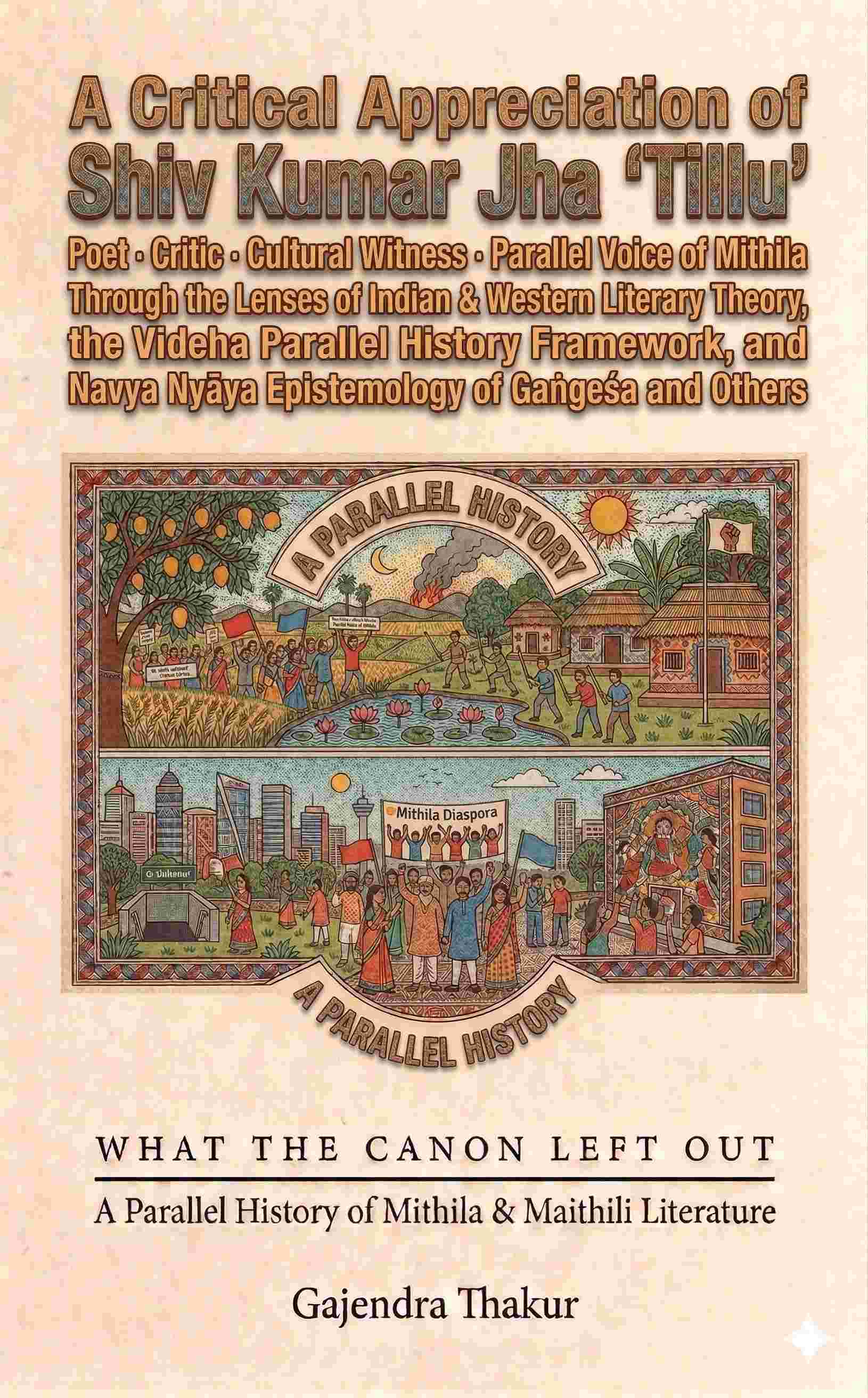
A Critical Appreciation of Shiv Kumar Jha 'Tillu' Poet Critic Cultural Witness Parallel Voice of Mithila Through the Lenses of Indian & Western Literary Theory, the Videha Parallel History Framework, and Navya Nyāya Epistemology of Gaṅgeśa and Others
A Critical Appreciation of
Shiv Kumar Jha 'Tillu'
Poet · Critic · Cultural Witness · Parallel Voice of Mithila
Through the Lenses of Indian & Western Literary Theory, the Videha Parallel History Framework, and Navya Nyāya Epistemology of Gaṅgeśa and Others
Preface: The Momentary Flash That Illuminates
Kṣaṇaprabhā — the flash of lightning, the momentary brilliance — is a title that reveals its author's self-awareness with disarming clarity. Shiv Kumar Jha 'Tillu', who chooses this name for his first poetry collection, acknowledges that he is no 'natural poet' (naisargik kavi, as he writes in his own preface) but one in whose consciousness feeling crystallises into verse at particular charged instants. Yet it is precisely this honest, un-inflated self-presentation that distinguishes him from the pretensions of official literary culture, and that places him, unmistakably, within the Videha Parallel History tradition of writers who measure themselves not by institutional honour but by the sincerity of their engagement with language and life.
This critical appreciation examines Tillu's dual contribution to Maithili letters — as lyric poet in Kṣaṇaprabhā (2012) and as critic in Aṃśu (2013) — across several intersecting analytical frameworks: the Indian aesthetic traditions of rasa, dhvani, and aucitya; western critical paradigms from New Criticism and reader-response theory to postcolonial and subaltern studies; the Videha Parallel History Framework of Gajendra Thakur; and the rigorous epistemological method of Navya Nyāya as practised by Gaṅgeśa Upādhyāya and the Mithila philosophical school. These frameworks are not applied in sequence as separable instruments but allowed to speak to and with each other, producing a multi-perspectival critical account that honours the complexity of the work.
I. Biographical and Socio-Literary Context
I.1 Life and Formation
Shiv Kumar Jha 'Tillu' was born on 11 December 1973 in Malipur Mohtar (his maternal village), Begusarai district, Bihar. His father is the late Kalikant Jha 'Buch' — himself a significant figure in Maithili poetry, whose verses appeared in Mithila Mihir and other respected journals, and who is acknowledged in the Sahitya Akademi's own anthology Samakaalin Maithili Kavita (compiled by Bhimnath Jha and Mohan Bhardwaj) as a notable poet of the mid-twentieth century. His mother was the late Chandrakala Devi, who also composed Maithili verse. Tillu's childhood nickname was given to him by his father's close friend, the mahakavi Fazlur Rehman Hashmi, Maithili poet. Hasmi Ji had named him Tillu. 'Fazlur Rahman Hasmi' Saheb used to stay with the physician (Vaidya) in Malipur during Shi Kumar Jha’s matriculation, back when he was a teacher at the village school. He would sing to the child: ‘Tillu Miyan raji, pet me karaji, aur daudo hau sipahi'- a formative detail that locates the poet within a web of literary and affective bonds from infancy.
His home village of Kariyan, Samastipur district, is situated in the geographic and cultural heartland of Mithila — the ancient region of Udayanacharyya, the great Nyāya philosopher, who was Gaṅgeśa's own forerunner. This connection — between the birthplace of Navya Nyāya and the childhood ground of Tillu — is not merely geographical coincidence; it points to a living intellectual environment in which philosophical rigour and literary sensibility have historically coexisted. After completing his graduation with distinction, Tillu settled in Jamshedpur where he worked with M/s J.M.A. STORES PRIVATE LTD (a Channel Partner of Tata Motors); he was with them from 2002 to 2022. Since 2023, he has been working with their sister concern company, Viniyog Capital (an NBFC that provides MSME loans). This detail underscores his position as a writer operating entirely outside the academic and institutional frameworks within which most 'recognised' Maithili writers have been based.
From 1996 to 2002, Tillu was actively involved in the cultural activities and Maithili promotion work of the Vidyapati Parishad, Samastipur, under the leadership of Dr. Naresh Kumar Vikal and Shri Uday Narayan Chaudhary (a National President Award-winning teacher). This period of organised cultural engagement shaped his understanding of Maithili's social situation — its vulnerability under Hindi-belt standardisation, its contested claims to institutional recognition, and the importance of grassroots cultural activism.
I.2 Literary Inheritance: Kalikant Jha 'Buch' and the Family Tradition
The literary inheritance Tillu carries is specific and traceable. His father Kalikant Jha 'Buch' appears in Anshu's own preface as the one whose departure Tillu mourns — the dedication of Kṣaṇaprabhā is 'to the cherished memory of my paternal uncle, the late Navalakant Jha.' The double literary lineage — a father who was a poet and an uncle whose memory consecrates his first verse collection — places Tillu in the Maithili tradition of family-mediated literary formation, a tradition that extends from Vidyapati's relationship to his father Ganapati to the more recent familial literary environments documented in the parallel history.
What is distinctive about Tillu's inheritance is that it comes from a writer (Kalikant Jha 'Buch') who was himself excluded from the Sahitya Akademi anthology despite the quality of his work — a fact Tillu notes in Aṃśu with carefully restrained critical precision. By naming his father's exclusion from the 1988 anthology of 'Samakaalin Maithili Kavita' (which claims to represent the period 1961-1980), Tillu performs a filial act that is simultaneously a critical act: he insists that the canon is not the totality of the tradition, that what has been excluded has value, and that the critic's function includes recovering the excluded. None of the poems written by his father are included in any Contemporary Maithili Poetry anthologies. His name is only mentioned in a few anthologies.
I.3 The Videha Connection
Tillu's critical journey began in Videha — the online Maithili journal founded by Gajendra Thakur that has since 2008 operated as the primary institutional vehicle of the Parallel Maithili literary tradition. As Tillu himself records in the Aṃśu preface, his critical writing started in Videha's feedback column (Feedback Column), where he posted online reviews of Maithili works. Over time, under the encouragement of editor Gajendra Thakur and co-editor Dr. Umesh Mandal, these occasional online responses developed into sustained critical essays that were eventually gathered and published as Aṃśu by Shruti Prakashan, Delhi — the same press that published Kṣaṇaprabhā, and whose distributors are Pallavi Distributors, Nirmali (Supaul) — the small-town distribution network of the parallel Maithili movement.
Typesetting of Aṃśu was carried out by Umesh Mandal personally — a detail that, again, reflects the self-reliant, community-embedded institutional practice of the parallel literary world. The acknowledgement in Aṃśu's preface names Gajendra Thakur, Ravibhushan Pathak, and Satyanarayana Jha as the mentors who guided the 'handful of tears-flowers' (anjuri bhari kanail ka phool) toward publication. These are not pro-forma acknowledgements but markers of an actual literary community — one that operates outside the Sahitya Akademi circuit and its tributary networks.
1 Shiv Kumar Jha 'Tillu', Kṣaṇaprabhā (Shruti Prakashan, 2012), Preface (Āmukh), p.5.
2 Shiv Kumar Jha 'Tillu', Aṃśu (Shruti Prakashan, 2013), Preface (Āmukh), pp. 9-10.
3 Biographical note, Kṣaṇaprabhā, p. 102.
II. Kṣaṇaprabhā (2012): A Reading of the Poetry
II.1 The Collection in Overview
Kṣaṇaprabhā (ISBN 978-93-80538-32-7, Shruti Prakashan, 2012, Rs. 200) is Tillu's debut poetry collection, gathering verse in multiple forms: traditional Maithili gīt (song-poems), shorter lyric poems, poems on seasonal and ecological themes, social satire, haiku, and two ghazals. The collection spans love lyrics in the viraha (separation) mode, festive poems on Holi, Chaita, and the seasonal cycle, meditations on social decay and cultural loss, politically charged verses on caste and agrarian injustice, environmental lament, and formal experiments in haiku and ghazal. This formal range is itself significant: it suggests a poet who is testing the limits of available Maithili verse forms rather than settling into a single mode.
The collection's typography and typesetting (carried out by Ashish Chaudhary, unlike Aṃśu which was typeset by Umesh Mandal) reflects the modest production values of the parallel publishing circuit, but the range and ambition of the verse transcend any material limitations. The book is dedicated to the memory of 'Chhotaka Kakka' — the late Navalakant Jha — a dedication that anchors the verse in familial memory and makes the collection itself an act of elegy as much as creative self-expression.
II.2 Rasa, Bhāva, and the Lyric Tradition
The dominant rasa of Kṣaṇaprabhā is a complex interweaving of śṛṅgāra (erotic-romantic sentiment) in its vipralambha (viraha, separation) mode and karuṇa (pathos, compassion). The opening poem 'Ṛtucakra mein Virahinī' ('The Lovelorn Woman in the Wheel of Seasons') established this register immediately: the beloved's question — 'Piya kona kai bitaitai Phaagun maas apar au, / Jīvan bhayal pahāḍ au na...' ('How will the beloved endure this boundless Phagun month? Life has become a mountain, beloved...') — positions viraha not as individual romantic loss but as a condition embedded in the cyclical pressures of the seasonal world. The koel's call, the bee's drone, the spring blossoms: all become instruments of heightened longing, the natural world conspiring against the isolated self.
This deployment of the viraha mode connects Tillu to the deepest roots of the Maithili lyric tradition — specifically to Vidyapati's padāvalī, where the love of Radha and Krishna is the vehicle for an exploration of longing, union, and the intensification of feeling through separation. Tillu is self-consciously working within this tradition while modernising its emotional vocabulary. His viraha poems are not court poetry but the articulation of ordinary longing — the separated couple of the contemporary Maithili world, where migration (padain) is the new form of separation that extends the classical viraha into the social present.
Applied through the lens of Bharata's Nāṭyaśāstra, the āyoga-vipralambha (separation before union) structuring many of Tillu's love poems creates the conditions for the heightened rasa-experience that the classical aesthetician describes: the stāyibhāva (dominant emotion) of rati (love) is intensified by the vyabhicāribhāvas (transitory emotions) of yearning (cintā), recollection (smṛti), and anxiety (śaṅkā), producing the full-blown rasa of śṛṅgāra in its most affecting form.
II.3 Dhvani and the Unsaid
Several poems in Kṣaṇaprabhā operate with the suggestive indirection that Ānandavardhana's Dhvanyāloka identifies as the highest mode of poetic meaning. The poem 'Atṛpta Nayan' ('Unsatisfied Eyes') is emblematic: the speaker, waiting through a sleepless night, watches the beloved who has fallen asleep. The final question — 'Ahūn̐ ahinā karab ki?' ('Will you too not be with me?') — operates at multiple levels simultaneously: the surface level (the sleepless lover's plea), the personal-philosophical level (the question of mortality and abandonment), and the social level (the woman in patriarchal marriage who is perpetually 'unsatisfied' — her desires unacknowledged, her gaze unanswered). This layering of suggestion, where the words carry far more than their literal meaning, is the dhvani mode at work.
The haiku sequence in Kṣaṇaprabhā is another site of dhvani-practice. The compression of the haiku form — its radical economy — forces a kind of productive obscurity: the poem means through what it leaves out as much as through what it says. Tillu's adaptation of the Japanese haiku into Maithili creates a formally hybrid space where classical Maithili syllabic patterns interact with the imagistic discipline of the haiku tradition. Consider a sample haiku: 'Jaatee-pajaatek gethem / ojhara kai Maithilee / bhai gail bail nimool' — 'Tangled in the knot of caste-subcaste / Maithili / has become a homeless waif.' The three-line structure moves from sociological observation to linguistic fact to metaphorical consequence, with a formal economy that enacts the dispossession it describes.
II.4 Social Poetry: Caste, Ecology, and Cultural Loss
Beyond the lyric poems, Kṣaṇaprabhā contains a significant body of social verse — poems addressing caste discrimination, ecological destruction, the loss of Maithili cultural memory, and the condition of the Maithili-speaking migrant. The long poem 'Sudhar' ('Reform') is among the most ambitious: a satirical-elegiac meditation on the contradictions of 'development' in the Maithila region. The poem catalogues the failures of scientific modernity — chemical agriculture destroying the soil, plastic replacing traditional materials, the Green Revolution's promises unfulfilled, the monsoon disrupted by global warming — while simultaneously mourning the loss of traditional ecological knowledge:
'Aajuk rasaayansan maatik koti ujal / Thuth daant kinhu nai majal / Plastic chhori liau joota bora / Polythin nai thonga-jhora...' ('Today's chemicals have gutted the soil's soul / Nothing's grown strong in this age / Discard plastic, bring back the jute bag / No polythen, use the old cloth wrapper...')
The environmental critique here operates at the intersection of ecology and culture: it is not merely the chemical contamination of the soil that the poem mourns, but the displacement of a whole system of material practice — jute bags, earthen pots, traditional medicines — by the disposable plasticity of consumer modernity. This is what Lawrence Buell's ecocriticism would call 'place-specificity' — the ecological imagination that is inseparable from a specific, named, culturally embedded landscape.
The poems about caste — 'Dwijak murhaiaya sangsang / Achop sooti kahit' ('The thread of the twice-born, alongside / the untouchable's blood flowing...') — deploy a bitter, condensed irony that recalls the dalit literary tradition's refusal of euphemism. Tillu is not writing as a dalit but as a member of the Brahmin community (his family name Jha identifies him as Maithil Brahmin) who is turning the tools of his literary inheritance against its social assumptions — a position of internal critique that parallels the tradition of Harimohan Jha, whose anti-caste satire the Videha Parallel History identifies as the most significant and most institutionally suppressed voice in 20th-century Maithili literature.
II.5 Seasonal and Festive Poetry: Aucitya and Cultural Memory
A substantial portion of Kṣaṇaprabhā is devoted to the seasonal and festive cycle of Maithil life: Holi, Chaita, Ṛtucakra (the wheel of seasons), Basant (spring), Sharad (autumn). These poems are formally the most traditional in the collection — they employ the gīt form with its refrains, its call-and-response structures, and its direct connection to the oral-performative tradition of Maithili folk song. The Holi poems ('Navaturiya Holi', 'Dori', 'Holi') reconstruct the festival not as generic celebration but as a specific, named, socially textured event: particular characters, particular village spaces, particular smells and colours.
Kṣemendra's concept of aucitya (propriety, appropriateness) — the principle that each poetic element must be appropriate to its context, its genre, its emotional register, and its moment — is precisely what these poems embody. The Holi poem employs the dholak-duggi rhythm that belongs to Holi; the viraha poems use the koel's call that belongs to spring's intensification; the ecological poems use a satirical velocity that belongs to political verse. Each poem knows what it is doing and does it with the right tools. This is aucitya as structural intelligence, not merely as decorum.
The Chaita poem 'Chaitaavar' ('The Chaita Song') is particularly notable: it reconstructs the specific musical and social geography of Chaita performance — the spring song tradition of Mithila, associated with the Holi season and the full flowering of spring — with an attention to detail (the male singing groups, the drumming, the scent of flowers, the festival of Shivaratri) that transforms a short lyric into a cultural archive. For the reader who knows this tradition, the poem is densely resonant; for the reader who does not, it opens a window onto a world of practice whose preservation in written form is itself a political act.
II.6 The Ghazals: Formal Hybridity and the Tradition of Mithila
Kṣaṇaprabhā concludes with two ghazals — a formal choice that connects Tillu to one of the most interesting developments in contemporary Maithili literature: the Anchinhar Aakhar movement for the revitalisation of the Maithili ghazal, documented in Part 4 of the Videha Parallel History. The ghazal form carries its own tradition of the beloved's absence and the lover's wandering — a tradition rooted in Persian and Urdu literary cultures that has been adapted into multiple Indian languages. In Tillu's hands, the ghazal becomes a vehicle for meditation on cultural and spiritual darkness:
'Kaaraatrikame mahmi dinman kona aayat / monme paap jharal bhagavan kona aayat' ('How can the daylight come in the black night? / With sin in the heart, how can God arrive?')
The ghazal's radif-maqtā structure — the repeated refrain and the signature couplet — disciplines the emotional content into formal containment, creating the tension between overflow and form that the best ghazal achieves. Tillu's signature in the maqtā ('Tillu' appearing in the final couplet) follows the classical convention while localising it in the Maithili context. The second ghazal shifts from the spiritual-personal to the social-political, meditating on the failures of communal harmony and the betrayals of institutional religion:
'Sohaait nai budi sargam samajak das parilaksit / sunait di bhaelak kaal gati gaharait nai vikal jivan' ('The scale of social slavery cannot be heard rightly / Time's momentum deepens but cannot shake the anguished life')
This social ghazal, with its critique of compromise (the word 'compromise' itself appears in Devanagari transliteration in the haiku section — 'Kompromais karait rahal / kono kalush kompromais nai' — marking the contamination of the social world by imported vocabulary and values), extends the ghazal's traditional lament into a sharply contemporary political register.
III. Aṃśu (2013): Critical Studies in Maithili Literature
III.1 Overview and Critical Method
Aṃśu ('Tear-drops' or 'Portions of Sunlight' — the word carries both meanings in Maithili) is a collection of thirty-four critical essays on Maithili literature, published by Shruti Prakashan, Delhi in 2013 (ISBN 978-93-80538-33-4, Rs. 100, typeset by Umesh Mandal). The collection is dedicated to the memory of Tillu's parents — his mother Chandrakala Devi and his father Kalikant Jha 'Buch.' The range of the critical essays is extraordinary: they cover Dalit representation in Maithili fiction, surveys of contemporary Maithili poetry, detailed reviews of specific literary works (novels, plays, poetry collections, children's literature), assessments of individual writers' contributions to the development of particular genres, and reflections on the relationship between Maithili language survival and literary production.
The preface to Aṃśu is itself a critical document of some importance. It articulates Tillu's theory of samālocanā (critical appreciation as opposed to mere ālocanā or criticism): where European literary criticism (he translates 'criticism' as 'criticism') has a reputation for negative evaluation, Tillu argues that samālocanā must examine a work from all ten directions (daso disasse) — not merely from the outside (chāru kāt se dekhab, 'looking from the four sides') but from within, comprehensively, with the intent of understanding and enhancing creative vitality rather than diminishing it. This is a theory of criticism as affirmative engagement — closer to the Navya Nyāya ideal of pramā (valid knowledge arrived at through multiple pramāṇas) than to the adversarial model implicit in much Western critical discourse.
III.2 Dalit Representation in Maithili Fiction: The Opening Essay
The opening essay of Aṃśu — 'Maithili Upanyaas Sahityame Dalit Patron ka Chitran' ('The Depiction of Dalit Characters in Maithili Novel Literature') — is the most ambitious and politically significant piece in the collection. It surveys the major Maithili novelists from Jansīdan (the first recognised Maithili novelist) through Harimohan Jha, Yatri (Nagarjun), Lalita, Manimap (Manipadma), Shefali Varma, Jagdish Prasad Mandal, and Gajendra Thakur, examining the presence and nature of Dalit characters in each writer's fiction.
The essay's key critical finding is both obvious in retrospect and devastating in its implications: despite the fact that Dalits constitute approximately eight annas (half) of Mithila's population, and despite the fact that their mother tongue is Maithili, the tradition of Maithili fiction has largely treated Dalit characters as accidental presences (akasmāt ayyāgat, 'unexpected visitors') rather than subjects with their own interiority, agency, and narrative centrality. Only Jagdish Prasad Mandal's fiction — above all in Maulail Gachhak Phool — is identified as offering genuinely full-dimensional Dalit characterisation, where the lives, choices, and moral complexity of Dalit characters are rendered with the same seriousness as those of upper-caste characters.
From the perspective of postcolonial subaltern studies — specifically Gayatri Spivak's reformulation of the question of subaltern voice and representation — Tillu's critical essay performs the crucial task of identifying structural absences in a literary tradition. The Maithili novel's failure to represent Dalits is not merely an aesthetic failure but a political one: it reflects and reproduces the social invisibility that structures the Dalit experience in Mithila. By naming this failure systematically, across the full span of the novelistic tradition, Tillu's criticism enacts what Spivak calls 'strategic essentialism' — an insistence on naming the group that has been excluded as a necessary first step toward inclusion.
The essay's treatment of Gajendra Thakur's Sahasrashīrṣā is particularly revealing: Tillu notes that this massive novel — one of the foundational texts of the Videha Parallel History — provides the most comprehensive literary mapping of Dalit communities in Mithila, naming and distinguishing multiple distinct communities (the washermen, the cobblers, the Dom, the Dusadh, the Musahar, the Paswan), giving each their specific social location, their occupational identity, their residential topology in the village, and — crucially — their trajectories of change in contemporary India. This is literature as social cartography, and Tillu's critical account of it is among the most detailed and appreciative passages in Aṃśu.
III.3 The Critique of the Sahitya Akademi Anthology
The second essay of Aṃśu — a review of the Sahitya Akademi's 1988 anthology Samakaalin Maithili Kavita (Contemporary Maithili Poetry, edited by Bhimnath Jha and Mohan Bhardwaj, covering the period 1961-1980) — is a model of what the Videha Parallel History calls 'epistemic critique': the systematic examination of a canonical text to expose the exclusions and distortions that constitute its claim to representativeness.
Tillu's critique is precise and evidence-based. He notes that the anthology includes 21 poets and 68 poems, covering a twenty-year period — but that within this selection, some poets receive disproportionate representation (Mayanand receives five poems; others, only one or two) while significant poets are entirely excluded. Among those excluded: the women poets Shefali Varma (whose collection Vipralabdhā was published in 1974, within the anthology's timeframe), Subhadra Singh Padhya, Shyama Devi, and Ila Rani Singh; the poets Gopesh, Fazlur Rahman Hashmi, Chandabhanu Singh, Vilat Paswan 'Vihangam' (a significant dalit voice); and — most notably — Kalikant Jha 'Buch', Tillu's own father, whose poems on politics, social life, and cultural protest appeared regularly in Mithila Mihir throughout the covered period.
Significantly, Tillu does not attribute the exclusions to deliberate prejudice — he notes explicitly that he does not accuse the editorial board of pūrvāgraha (predetermined bias). He offers the editors the charitable assumption that there may have been unavoidable circumstances. But the pattern of the exclusions speaks for itself: women poets, dalit poets, and poets whose social criticism was too sharp for the conservative mainstream were systematically missed. The anthology's claim to represent 'contemporary Maithili poetry' is therefore structurally false — it represents a portion of the tradition, selected through filters that reflect the social and aesthetic preferences of its editors.
Applying the Navya Nyāya concept of anumāna (inference) here: from the evidence of the exclusions, we can infer the selection principle; from the selection principle, we can infer the social world that produced it. The anthology is thus not merely an aesthetic document but an epistemological one — a knowledge-claim about Maithili literature that, under scrutiny, turns out to be a viparīta-jñāna (inverted knowledge), a false picture of the tradition's actual range and vitality.
III.4 The Reviews of Individual Works: Critical Range and Method
The bulk of Aṃśu consists of individual reviews of Maithili literary works — novels, plays, poetry collections, children's literature, and hybrid forms. The range of works reviewed is itself a statement about the parallel tradition's scope and ambition: Tillu reviews not only the canonical 'big names' but also less-known but significant works, recent publications, and — crucially — works by writers from outside the Maithil Brahmin mainstream (Jagdish Prasad Mandal, Rajdeo Mandal, Vibha Rani, Preeti Thakur, among others).
The review of Jagdish Prasad Mandal's Maulail Gachhak Phool (essay 5) is among the most sustained and appreciative in the collection. Tillu's analysis proceeds through the narrative structure (the progressive revelation of social solidarity against feudal oppression), the characterisation (the Musahar family of Rohagi, Bagagba, and Kabuteri as centres of consciousness rather than objects of sympathy), the language (Mandal's use of the spoken Maithili of the working poor, uncontaminated by literary archaisms), and the social vision (the novel's insistence that Mithila's renewal requires the full incorporation of its most marginalised people into the project of collective life). The review reads Mandal as what Tillu calls 'sarvakaalin Maithili sahityame Dhruvatara' — the pole star of all-time Maithili literature — a judgment that aligns with and reinforces the Videha Parallel History's positioning of Mandal as the most significant contemporary Maithili novelist.
The review of Vibha Rani's play Balchanda (essay 7) demonstrates Tillu's capacity for feminist critical reading: he analyses the play's feminist argument — the assertion of a woman's right to choose her own life against family and social compulsion — with sympathy and precision, noting both its theatrical strengths and the particular difficulty of staging feminist critique within a Maithili theatrical tradition that has historically been more comfortable with social comedy than with social protest. The review of the Maithili Chitrakatha (comic books, essay 8) shows his attentiveness to new and hybrid forms, recognising that the expansion of Maithili into visual storytelling is not a dilution of the literary tradition but an extension of its reach.
The essay 'Maithilik Vikasme Baal Kavitaak Yogdan' (essay 18 — 'The Contribution of Children's Poetry to the Development of Maithili') is notable for its programmatic urgency. Tillu argues that children's poetry in Maithili has been seriously underdeveloped, and that the literary establishment's tendency to classify religious verses and educational rhymes as 'children's literature' misses the specific psychological and aesthetic requirements of the child reader. He calls for poetry rooted in the Maithili names for things — the gachhi (mango orchard), the bhutaka-nath (scarecrow), the village games — as the only foundation on which a genuine Maithili children's literature can be built. This is not sentimental nostalgia but a programmatic claim about language survival: if children do not find their world reflected in Maithili literature, they will not read Maithili literature.
IV. Shiv Kumar Jha 'Tillu' in the Videha Parallel History Framework
IV.1 The Parallel Tradition and Its Writers
The Videha Parallel History of Mithila and Maithili Literature, authored by Gajendra Thakur and serialised on www.videha.co.in, establishes a counter-canonical account of Maithili letters that challenges the Sahitya Akademi's version at every level — chronological, social, formal, and epistemological. Its central argument is that the mainstream Maithili canon has been produced by and for the upper-caste (primarily Maithil Brahmin) elite, systematically excluding democratic, subaltern, feminist, and Nepal-side traditions. Its alternative canon includes the Buddhist Charyapadas as the genuine origin of Maithili lyric, the suppressed Harimohan Jha as the most significant modern novelist, Rajdeo Mandal as the greatest living poet, Bechan Thakur as the greatest living dramatist, and Jagdish Prasad Mandal as the greatest novelist of the last century.
Tillu sits in a specific position within this framework: he is a Maithil Brahmin by birth who writes both poetry and criticism from a position of internal critique — questioning the canonical preferences of his own community's literary establishment, praising the parallel tradition's writers with genuine critical engagement, and producing creative work that embodies the parallel tradition's values (formal range, social consciousness, ecological awareness, cultural urgency) without making propagandistic claims.
His Videha connection — beginning with the online feedback column and developing through the publication of both his books under Shruti Prakashan (Videha's affiliated press) — locates him institutionally within the parallel movement, even as his caste position gives his critique of the mainstream a particular kind of authority: the authority of the insider who refuses the insider's privileges.
IV.2 The Gaṅgeśa Connection: Navya Nyāya and Critical Practice
The Videha Parallel History's recovery of Gaṅgeśa Upādhyāya's intercaste origins — his mother said to be a Charmkāriṇī (leather-tanning caste woman), his birth five years after his father's death, according to original Dooshan Panji records — is not merely a biographical curiosity. It reframes the entire tradition of Navya Nyāya as something that emerged from the social margins of Mithila's caste system rather than from its brahminical centre. The philosopher who created the most rigorous epistemological system in pre-modern India — the Tattvacintāmaṇi with its doctrine of valid knowledge, its four pramāṇas, its technical analysis of inference and testimony — was himself, according to original genealogical records, a product of intercaste social reality.
This reframing has direct implications for how we read Tillu's critical practice in Aṃśu. When Tillu tests the Sahitya Akademi's anthology against the evidence of Maithili literary history and finds it wanting — when he establishes, through the patient assembly of counter-evidence, that the anthology's claim to represent 'contemporary Maithili poetry' is false — he is performing an operation that is structurally analogous to the Navya Nyāya procedure of ābhāsa-analysis: the identification of epistemic errors (jñānābhāsa) in a claim that presents itself as valid knowledge.
The four pramāṇas of Navya Nyāya — pratyakṣa (perception), anumāna (inference), upamāna (analogy/comparison), and śabda (testimony) — map onto Tillu's critical practice as follows. Pratyakṣa: his direct reading of the texts under review, attending to language, structure, and image. Anumāna: his inference from patterns of inclusion and exclusion to the underlying social logic of canonical construction. Upamāna: his comparative placing of Maithili texts in relation to each other and to texts from other traditions (Hindi, Bengali, Sanskrit). Śabda: his use of existing critical testimony — including the statements of the authors themselves, the assessments of earlier critics, and the documentary evidence of Videha's RTI investigation — as sources of knowledge that must be evaluated for their reliability (āpta vs anāpta, reliable vs unreliable testimony).
When Tillu writes, in the Aṃśu preface, that 'criticism should not be criticism but samālocanā — examining from all ten directions' — he is invoking, perhaps without knowing it, the Navya Nyāya ideal of comprehensive epistemic investigation: the pramātā (knowing subject) who does not settle for a single perspective but multiplies the means of valid knowledge (pramāṇas) until the prameya (object of knowledge) is fully illuminated. This is not a coincidence of method but a convergence of intellectual traditions that both have their roots in the same Mithila soil.
IV.3 The Institutional Politics of Recognition
Within the Parallel History Framework, the question of institutional recognition — who receives Sahitya Akademi awards, whose books are translated, whose work is included in anthologies — is not a peripheral concern but a central one. The RTI investigation by Vinit Utpal and Ashish Anchinhar (2011-14) established that over 90 per cent of Sahitya Akademi translation and publication assignments went to friends, relatives, and associates of the ten-member Maithili advisory board — a pattern of distribution that the Parallel History characterises as systemic epistemic violence against the writers of the parallel tradition.
Tillu's name does not appear on the list of recognised Sahitya Akademi writers — despite publishing two substantial and important contributions to Maithili letters by 2013. This is not surprising within the framework of the Parallel History: his institutional base (Shruti Prakashan, Videha, the Pallavi distribution network), his critical positions (explicitly challenging the anthology edited by Bhimnath Jha, a figure of the mainstream), and his thematic commitments (Dalit representation, women's writing, environmental critique) all mark him as a writer of the parallel tradition who will not find favour with the advisory board's patronage networks.
From the Navya Nyāya perspective, the non-recognition of Tillu's work by the Sahitya Akademi is an instance of āpta-parīkṣā (the examination of testimony's reliability) gone wrong: the advisory board, which is the institutional source of testimony about Maithili literary value, is demonstrably unreliable (anāpta) because it is corrupted by social and familial interests that are inconsistent with the disinterested pursuit of literary quality.
V. Western Critical Frameworks Applied
V.1 New Criticism and Formal Analysis
The New Critical approach — associated with Cleanth Brooks, Robert Penn Warren, and John Crowe Ransom — emphasises close reading of the poem as a verbal artefact, attending to tension, irony, paradox, and the organic unity of form and content. Applied to Tillu's poetry, this approach reveals the technical sophistication of his apparently simple verse. The viraha poems achieve their effects through the precise calibration of natural imagery against emotional state — the koel's call, the bee's drone, the spring blossoms as amplifiers of longing rather than consolations. Brooks's concept of 'the paradox at the heart of poetry' applies directly to the haiku about Maithili language: the language's voicelessness is enacted in the haiku's radical economy — saying little, meaning much, in a form that itself embodies the compression of linguistic survival.
The New Critical principle of 'organic form' — the idea that a poem's form is not an external container but an expression of its content — is demonstrated across Kṣaṇaprabhā's formal range. The festive Holi poems use the gīt's refrain-based structure because the Holi tradition is itself refrain-based, communal, participatory. The ghazals use their discipline of the repeated radif to enact the inescapability of the social condition they describe. The haiku use compression to enact linguistic precarity. Each formal choice is an argument.
V.2 Reader-Response Theory
Wolfgang Iser's model of the literary work as a structured set of gaps that the reader fills through an act of creative completion is particularly relevant to Tillu's critical essays in Aṃśu. The essays are written with the assumption of a Maithili reader who needs no introduction to the works under review — the references to Harimohan Jha's Kanyadaan, to Yatri's Paro, to Rajkamal's avant-garde position, to Jagdish Prasad Mandal's social vision are all made with the confidence of a critic addressing an audience within the tradition. For non-Maithili readers, these gaps become sites of productive learning: the essays function as cultural orientation as much as critical assessment.
Stanley Fish's concept of the 'interpretive community' — the idea that meaning is produced not by individual readers but by communities of readers who share conventions of interpretation — applies to Tillu's position as a critic formed within the Videha community. His interpretive conventions — the primacy of social embeddedness, the value of linguistic authenticity, the importance of Dalit and women's representation — are not universal but specific to the interpretive community of the parallel Maithili movement. Reading Aṃśu from outside this community requires a conscious act of cultural translation.
V.3 Postcolonial and Subaltern Theory
Edward Said's concept of 'contrapuntal reading' — reading the silences and gaps of a dominant text against the grain to recover the experiences it suppresses — is Tillu's method in his critique of the Sahitya Akademi anthology. He reads the anthology's silences (the absent women poets, the absent dalit voices, the absent political dissidents) as counterpoints to its explicit claims, producing a reading that is not supplementary to the text but critical of its own conditions of production.
Homi Bhabha's notion of 'hybridity' illuminates Tillu's formal practice in Kṣaṇaprabhā: the adaptation of haiku into Maithili, the deployment of ghazal form with Maithili content, the mixing of classical viraha conventions with contemporary social critique — these are all productions of the 'third space' that Bhabha identifies as the site of new cultural meaning. Tillu is not a purist of either the classical or the modern; his work inhabits the productive tension between them.
Ranajit Guha's concept of 'the prose of counter-insurgency' — the way official discourse misrepresents subaltern agency by reframing subaltern action as disorder and pathology — has its literary-critical equivalent in what Tillu identifies in Aṃśu: the 'prose of canonical construction,' the way official Maithili literary historiography misrepresents the parallel tradition as secondary, derivative, or non-existent. His critical work is a form of counter-narration — not in the sense of mere opposition but in the Guha sense of restoring the complexity and agency that the canonical account suppresses.
V.4 New Historicism and Cultural Materialism
Stephen Greenblatt's New Historicism insists on reading literary texts as embedded in and shaped by the 'social energy' of their historical moment — not as transcendent aesthetic objects but as nodes in the networks of power, exchange, and negotiation that constitute social life. Applied to Kṣaṇaprabhā, this approach reveals the collection as a culturally specific document of the Maithili-speaking world in the first decade of the twenty-first century: the outmigration crisis, the ecological pressure of chemical agriculture and flood-management failures, the tension between Hindi-belt cultural standardisation and Maithili linguistic particularity, the shifting demographics of caste in the north Bihar countryside.
Raymond Williams's concept of the 'structure of feeling' — the lived, pre-theoretical, affective engagement with social conditions that precedes formal ideological articulation — is what Kṣaṇaprabhā offers at its best: not a programme or a manifesto but a sensibility, a way of being in the Maithili world that attends to its textures and pressures with lyric precision.
VI. Synthesis: Strengths, Limitations, and Significance
VI.1 Strengths
Tillu's achievement across Kṣaṇaprabhā and Aṃśu is distinctive for its combination of formal range, social commitment, and critical rigour. As a poet, his primary strengths are formal flexibility (his comfort across the gīt, lyric, haiku, ghazal, and satirical verse traditions), the authenticity of his relationship to the Maithili cultural landscape (the seasonal poems and festive verse are culturally embedded in ways that resist the universalising gestures of much contemporary Indian poetry), and the courage of his social critique (the dalit poems, the environmental satire, the feminist sympathy of the Vibha Rani review). As a critic, his primary strengths are the systematic quality of his survey methods, the directness of his assessment (he names failures as well as achievements), and the ethical seriousness of his engagement with questions of representation and exclusion.
Within the Videha Parallel History Framework, Tillu represents a type of writer who is structurally underrepresented: the upper-caste-by-birth writer who uses his literary formation to critique the exclusions of his own tradition. This is not a comfortable position — it involves the risk of being rejected by both the mainstream (which objects to his critical positions) and the parallel tradition (which may suspect his motives). That he navigates this position with integrity is itself a significant achievement.
VI.2 Areas for Development
A balanced critical appreciation must also note the areas where Tillu's work invites further development. The poetry collection Kṣaṇaprabhā, for all its formal range and cultural richness, is occasionally uneven in its execution: some of the longer social-satirical poems lose their lyric density in the pursuit of comprehensiveness, and a more disciplined formal editing might have produced a tighter, more consistently strong collection. The critical essays in Aṃśu are more variable in their depth: the opening essay on Dalit representation and the second essay on the Sahitya Akademi anthology are sustained and rigorous; some of the shorter reviews are more appreciative than analytical, stopping short of the close formal engagement that would make them fully satisfying as criticism.
A future project that brings Tillu's dual capacities — his poetic sensibility and his critical intelligence — into a more explicit dialogue would be a significant contribution. A sustained poetics, or a more ambitious series of full-length critical monographs on individual Maithili writers, would extend the work of Aṃśu into the territory of systematic literary historiography that the parallel tradition still needs.
VI.3 The Question of Legacy
Shiv Kumar Jha 'Tillu' is at the time of writing a mid-career writer whose most significant contributions may yet lie ahead. What is already clear from Kṣaṇaprabhā and Aṃśu is that he represents a serious and committed literary intelligence working within the Maithili parallel tradition — one who takes the responsibilities of both poet and critic seriously, who honours the tradition's past while engaging with its present, and who refuses the temptations of either institutional accommodation or populist gesture.
The Navya Nyāya tradition's insistence on the primacy of pramā — valid, verifiable, honestly arrived-at knowledge — as against the comfortable repetition of received opinion (svīkṛti without examination) is the deep methodological principle that Tillu's work embodies. Whether examining a Sahitya Akademi anthology or writing a poem about the monsoon's failure, he is doing the same thing: attending honestly to the evidence, resisting the easy conclusion, and insisting that language — whether in poetry or criticism — must earn its truth.
VII. Conclusion: The Flash and What It Illuminates
'Kṣaṇaprabhā' — the momentary flash of lightning — is a humble title for a writer who disclaims the mantle of 'natural poet.' But the flash of lightning, in the Maithili and Sanskrit traditions, is not merely humble: it is the sudden illumination of what is always present but invisible in the dark. Tillu's poetry and criticism perform exactly this function. They do not create new social realities or invent new literary possibilities; they illuminate what is already there — the richness of the Maithili lyric tradition, the depth of Dalit experience in Mithila's fiction, the structural injustice of the canonical exclusions, the ecological grief of a landscape under pressure.
Viewed through the multiple analytical lenses assembled in this appreciation — the rasa theory of Bharata, the dhvani theory of Ānandavardhana, the aucitya principle of Kṣemendra, the Navya Nyāya epistemology of Gaṅgeśa Upādhyāya, the Videha Parallel History Framework of Gajendra Thakur, and the Western critical traditions from New Criticism to postcolonial theory — Shiv Kumar Jha 'Tillu' emerges as a figure whose significance exceeds the modest scale of his published output. He is a link in the chain of transmission that keeps the parallel Maithili tradition alive and growing — a poet who carries the formal inheritance of the gīt and the viraha lyric into new social territory, and a critic who uses the tools of close reading and systematic analysis to make the invisible visible.
The 'Kṣaṇaprabhā' — the momentary flash — does not illuminate everything. But what it illuminates, it illuminates with clarity. That is not a small achievement. It is the beginning of the work that the Maithili literary tradition, in its fullest and most democratic form, still needs to do. To date, Tillu ji has written more than 8,000 verses, including both poems and songs.
Select Bibliography and Primary Sources
Primary Texts
Jha, Shiv Kumar 'Tillu'. Kṣaṇaprabhā [Anthology of Maithili Poems]. New Delhi: Shruti Prakashan, 2012. [ISBN: 978-93-80538-32-7; Rs. 200. Typeset: Ashish Chaudhary. First Edition 2012.]
Jha, Shiv Kumar 'Tillu'. Aṃśu [Anthology of Maithili Literary Criticism]. New Delhi: Shruti Prakashan, 2013. [ISBN: 978-93-80538-33-4; Rs. 100. Typeset: Umesh Mandal. First Edition 2013.]
Videha and Parallel History Sources
Thakur, Gajendra (ed.). Videha: Prathama Maithili Pakshik ePatrika. ISSN 2229-547X. www.videha.co.in. Since 2000.
Thakur, Gajendra. 'A Parallel History of Mithila and Maithili Literature.' Parts 1–44+. www.videha.co.in/gajenthakur.htm
Thakur, Gajendra. 'Ever New Sushil.' Parallel History Part 36. www.videha.co.in/new_page_36.htm
Thakur, Gajendra. Parallel History Part 5 (Introduction). www.videha.co.in/new_page_5.htm
Anchinhar, Ashish / Utpal, Vinit. RTI Investigation into Sahitya Akademi Maithili Advisory Board (2011-14). Cited in Videha.
Indian Aesthetic and Philosophical Sources
Bharata Muni. Nāṭyaśāstra. Trans. M.M. Ghosh. 2 vols. Calcutta: Manisha Granthalaya, 1967.
Ānandavardhana. Dhvanyāloka. With Abhinavagupta's Locana. Trans. Daniel H.H. Ingalls, Jeffrey Moussaieff Masson, and M.V. Patwardhan. Cambridge, MA: Harvard University Press, 1990.
Kṣemendra. Aucityavicāracarcā. Trans. and ed. R.C. Dwivedi. Delhi: Motilal Banarsidass, 1977.
Gaṅgeśa Upādhyāya. Tattvacintāmaṇi. Ed. Kamakhyanath Tarkavagisha. Calcutta, 1884. [For Navya Nyāya epistemological foundations.]
Vācaspati Miśra II. On Tattvacintāmaṇi. Referenced in Videha Parallel History and in D.C. Bhattacharya, History of Navya-Nyāya in Mithilā.
Bhattacharya, Dinesh Chandra. History of Navya-Nyāya in Mithilā. Darbhanga: Mithila Institute, 1958.
Western Critical Theory
Said, Edward W. Culture and Imperialism. New York: Knopf, 1993.
Bhabha, Homi K. The Location of Culture. London: Routledge, 1994.
Spivak, Gayatri Chakravorty. 'Can the Subaltern Speak?' In Marxism and the Interpretation of Culture. Ed. Cary Nelson and Lawrence Grossberg. Urbana: University of Illinois Press, 1988. pp. 271-313.
Guha, Ranajit. 'The Prose of Counter-Insurgency.' In Selected Subaltern Studies. Ed. Guha and Spivak. New York: Oxford University Press, 1988.
Greenblatt, Stephen. Shakespearean Negotiations: The Circulation of Social Energy in Renaissance England. Berkeley: University of California Press, 1988.
Williams, Raymond. Marxism and Literature. Oxford: Oxford University Press, 1977.
Buell, Lawrence. The Environmental Imagination: Thoreau, Nature Writing, and the Formation of American Culture. Cambridge, MA: Harvard University Press, 1995.
Iser, Wolfgang. The Act of Reading: A Theory of Aesthetic Response. Baltimore: Johns Hopkins University Press, 1978.
Fish, Stanley. Is There a Text in This Class? The Authority of Interpretive Communities. Cambridge, MA: Harvard University Press, 1980.
Brooks, Cleanth. The Well Wrought Urn: Studies in the Structure of Poetry. New York: Harcourt Brace, 1947.
Bakhtin, Mikhail. The Dialogic Imagination: Four Essays. Trans. Caryl Emerson and Michael Holquist. Austin: University of Texas Press, 1981.
Secondary and Contextual Sources
Jha, Mithilesh Kumar. 'Maithili in the Digital Space.' India Seminar 742 (June 2021). www.india-seminar.com/2021/742/742_mithilesh_kumar_jha.htm
Mandal, Umesh. Jagdish Prasad Mandalak Kavya Sansar [Research Analysis]. Nirmali, Supaul: Pallavi Prakashan, 2022.
'A Journey Through Maithili Literature with Kathakar Ashok.' Outlook India. February 2024. www.outlookindia.com
Oommen, T.K. 'Linguistic Diversity.' In Sociology. National Law School of India University, 1988. pp. 291-293.
Grierson, George Abraham. Linguistic Survey of India. Vol. V, Part II: Specimens of the Bihari and Oriya Languages. Calcutta: Office of the Superintendent of Government Printing, 1903.
Maithili passages have been rendered in approximate English paraphrase for the purposes of critical analysis; full translations would require a separate scholarly undertaking.
अपन मंतव्य editorial.staff.videha@zohomail.in पर पठाउ।