
Gajendra Thakur
A PARALLEL HISTORY OF MITHILA & MAITHILI LITERATURE- PART 7
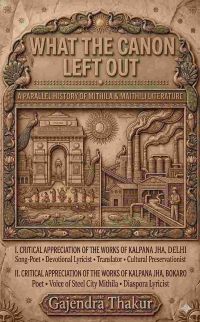
I
CRITICAL APPRECIATION OF THE WORKS OF
KALPANA JHA, DELHI
Song-Poet • Devotional Lyricist • Translator • Cultural Preservationist
Analysed through Indian & Western Literary Theory | Videha Parallel History Framework
Navya-Nyāya Epistemology of Gaṅgeśa Upādhyāya
II
CRITICAL APPRECIATION OF THE WORKS OF
KALPANA JHA, BOKARO
Poet • Voice of Steel City Mithila • Diaspora Lyricist
Analysed through Indian & Western Literary Theory | Videha Parallel History Framework
Navya-Nyāya Epistemology of Gaṅgeśa Upādhyāya
I
CRITICAL APPRECIATION OF THE WORKS OF
KALPANA JHA, DELHI
Song-Poet • Devotional Lyricist • Translator • Cultural Preservationist
Analysed through Indian & Western Literary Theory | Videha Parallel History Framework
Navya-Nyāya Epistemology of Gaṅgeśa Upādhyāya
I. BIOGRAPHICAL AND TEXTUAL OVERVIEW
Kalpana Jha of Delhi is a Maithili song-poet, devotional lyricist, and translator whose works are preserved and disseminated through the Videha digital archive at www.videha.co.in. Her primary contribution to the Maithili literary tradition lies in four works: the devotional song-collection ‘Gosaaunik Geet’ (गोसाउनिक गीत), the social-reform song-collection ‘Nashamukti Hit Gaabi Geet’ (नशामुक्ति हित गाबी गीत), the lullaby-collection ‘Niniyaa’ (निनियाँ), and her Hindi translation of Shefalika Verma’s travel narrative ‘Yaayaavari’ (यायावरी). All four works are listed with their courtesy credit ‘saujanye Kalpana Jha’ on the Videha Pothi (Book Archive) page at www.videha.co.in/pothi.htm, indicating that she has entrusted these works to the Videha digital counter-archive for non-commercial academic use.
The explicit PDF availability of her works through Videha — in contrast to mainstream Maithili publishers who remain print-bound — positions Kalpana Jha firmly within the Videha Parallel Literary Movement: the cluster of women and subaltern writers who have chosen the democratic, accessible medium of digital e-publication over the gatekept channels of the Darbhanga-Patna-Delhi print establishment. Her inclusion alongside Preeti Thakur, Vibha Rani, Kamini Kamayani, Susmita Pathak, Panna Jha, and Premlata Mishra Prem (as noted by Ira Mallick in Videha Parallel History Part 82) confirms her membership in the Videha women’s counter-canon.
II. WORKS: ANNOTATED CRITICAL DESCRIPTIONS
A. Gosaaunik Geet (गोसाउनिक गीत)
The title translates literally as ‘Songs of the Gosain’ — ‘gosain’ being a term of address for a deity, an ascetic, or a householder’s protective deity (kul-devata) in the Maithili religious tradition. The term derives from Sanskrit ‘go-svami’ (master of the senses, lord), and is used in Mithila to designate both the deity of a household shrine and the presiding deity of a sacred grove or village-site (deo-sthan). A ‘gosaunin’ is the feminine form: the goddess-consort of the gosain, or the deity herself when conceived in feminine terms.
The collection thus belongs to the long tradition of Maithili devotional geet (song) addressed to the village goddess and household deity — a tradition that runs from the folk-religious songs of Mithila’s subaltern communities through the formal bhakti compositions of the medieval period. The genre distinction is crucial: geet (song) in Maithili carries a different generic status from kavita (poem). Geet is oral, performative, tied to specific ritual occasions (puja, festival, seasonal ceremony), and its medium is the sung voice rather than the written page. By choosing the geet form for her devotional work, Kalpana Jha positions herself within the orally grounded folk-religious tradition rather than the textually oriented mainstream literary tradition.
In rasa-theory terms, the dominant rasa of devotional geet is Bhakti-rasa — the rasa of devotion, which Rupa Gosvami in the Bhakti-rasamritasindhu (c. 1541 CE) elaborates as the supreme rasa transcending Bharatamuni’s eight. In Abhinavagupta’s Kashmiri Shaiva framework, Shant-rasa (tranquillity) is the ground from which devotional emotion arises; in the Vaishnava tradition, Shringara-bhakti (devotional love) is the highest form. Kalpana Jha’s devotional songs, addressed to the female deity (gosaunin), occupy a specific locus in this tradition: they engage the Shakta strand of Maithili devotion, in which the goddess is not the distant transcendent deity of Sanskritic theology but the intimate, household, protective feminine presence.
From the Videha Parallel History Framework’s perspective, the preservation of devotional songs addressed to the gosaunin is an act of cultural rescue: these village deity traditions, which are largely the property of Mithila’s lower-caste and OBC communities (the dominant caste lineages tend toward more Sanskritised deity-forms), risk extinction as urbanisation and cultural homogenisation erode the ecological conditions of their performance. By committing them to writing and to digital archive, Kalpana Jha performs a double act: creative composition and cultural preservation.
In Navya-Nyaya terms, the devotional geet as a genre makes a specific epistemological claim: it asserts śabda-pramaāa (verbal testimony as a source of valid cognition) through the medium of prayer, in which the human worshipper’s verbal address to the deity constitutes both a performative speech act (Austin) and a knowledge-claim about the nature of the deity’s presence and power. Gaṅgeśa’s analysis of śabda in the Tattvacintāmaṇi distinguishes between the reliability of human verbal testimony (which depends on the speaker’s aptata) and scriptural testimony (which is held to be self-validating). Devotional geet occupies an interesting middle position: it is human composition (not scripture) but it claims the authority of tradition (parampara) and the sanction of community performance.
B. Nashamukti Hit Gaabi Geet (नशामुक्ति हित गाबी गीत)
This collection of social-reform songs on the theme of addiction-liberation (nashamukti) is one of the most distinctive items in Kalpana Jha’s oeuvre. The compound title means: ‘Songs to Sing for the Sake of Liberation from Addiction.’ The genre — the social-reform song — has deep roots in the Indian literary tradition of Jana-geet (people’s song) and the reformist bhajan, but it also connects to the specific tradition of anti-alcohol and anti-addiction songs in northern India, which was a major vehicle of the social reform movement from the 19th century onward (associated with figures such as Swami Vivekananda, Gandhi’s Constructive Programme, and the dalit-caste reform movements).
In the Maithili context, the anti-addiction song tradition is linked to the broader movement for social and economic uplift of Mithila’s lower-caste communities, for whom addiction to alcohol (daru) and tobacco (tamakhun) has been a documented source of economic deprivation and domestic violence. The songs in this collection function as what Bourdieu calls ‘symbolic capital’ in a specific social field: they are cultural instruments for the production of new habits and dispositions (habitus) in communities where addiction has become structurally embedded.
The songs’ formal features — the use of easily memorable rhythmic patterns, the repetition of key phrases (refrain structures), and the deployment of folk melodic frameworks — are calibrated for oral community performance rather than private reading. They are designed to be sung collectively, in groups, on social occasions (panchayat meetings, women’s groups, village assemblies), and their rhetorical strategy is that of shared affective experience rather than individual conviction. This is consistent with Brecht’s theory of the social function of committed art: the work’s goal is not aesthetic contemplation but social transformation.
In Indian literary theory, this genre belongs to what Bharatamuni calls ‘loka-dharmi’ (folk-naturalistic performance) as opposed to ‘natya-dharmi’ (conventionalised theatrical performance). The anti-addiction songs are public, communicative, and instrumentally oriented — qualities that the classical rasa theory finds less artistically interesting than the complex emotional architecture of court poetry, but which the Videha Parallel History Framework identifies as constitutive of the democratic literary tradition it seeks to recover.
From a Navya-Nyaya perspective, the social-reform song makes an anumana (inference) that is simultaneously logical and motivational: the paksha (subject) is the community’s social condition; the sadhya (property to be established) is the possibility of liberation from addiction; the hetu (reason) is the demonstrated harmfulness of addiction; the drshtanta (example) is the specific cases of families destroyed by addiction that the songs enumerate; and the upanaya (application) is the call to action. The validity of this anumana depends on the accuracy of its hetu — the empirical claim that addiction causes harm — which in Navya-Nyaya terms is a matter of pratyaksha (perceptual) evidence that can be verified.
C. Niniyaa (निनियाँ)
The title ‘Niniyaa’ is the Maithili term for lullaby (ninnani, ninni-geet) — the song sung to put a child to sleep. The lullaby tradition in Maithili is one of the oldest, most widespread, and most artistically rich in the folk-literary heritage of Mithila. Lullabies are among the first literary forms a child encounters; they carry within them the emotional vocabulary, the rhythmic patterns, the imagery, and the social world of the culture into which the child is being born.
In the context of Kalpana Jha’s overall oeuvre, the lullaby collection occupies a pivotal position. Where ‘Gosaaunik Geet’ addresses the divine feminine and ‘Nashamukti Hit Gaabi Geet’ addresses the social community, ‘Niniyaa’ addresses the most intimate relational unit of all: the mother-child dyad. Together, the three collections constitute a complete lyric geography of Maithili women’s traditional song: the sacred (devotional songs), the civic (social reform songs), and the intimate (lullabies).
Lullabies as a genre present a distinctive challenge to literary theory. Their primary medium is sound and rhythm rather than semantic content; their primary audience is a pre-linguistic being (the infant) who cannot process meaning but is exquisitely sensitive to vocal tone, rhythm, and melody. This makes them resistant to the semantic hermeneutics of conventional literary criticism and more amenable to what Julia Kristeva (‘The Revolution in Poetic Language’, 1974) calls the ‘semiotic chora’ — the pre-linguistic, rhythmic, somatic dimension of language that underlies the ‘symbolic’ (meaning-bearing) dimension. The lullaby is the literary form in which Kristeva’s semiotic is most fully operative.
In Bharatamuni’s rasa system, the lullaby’s primary emotional register is Vatsalya (parental love), which the tradition counts as a sub-variety of Shringara. Abhinavagupta’s elaboration of Vatsalya-rasa identifies its vibhava (determinant) as the sight and helplessness of the child; its anubhava (consequent) as the tender movements of the mother (rocking, stroking, singing); and its vyabhicharibhava (transient emotion) as tenderness, protectiveness, and the pleasurable grief of the child’s vulnerability. The lullaby as a genre encodes all three dimensions.
From a feminist perspective (drawing on Sara Ruddick’s ‘Maternal Thinking’, 1989), the lullaby is also an artefact of what Ruddick calls ‘preservative love’ — the specifically maternal cognitive and emotional orientation toward keeping the vulnerable alive. The preservation of a lullaby tradition in written and digital form is thus an act of feminist cultural politics: it rescues from oblivion a form of women’s creative labour that has been systematically excluded from the canonical literary record. This is precisely the kind of act the Videha Parallel History Framework celebrates.
D. Yaayaavari (यायावरी) by Shefalika Verma — Hindi Translation by Kalpana Jha
The fourth item in the Videha pothi archive under Kalpana Jha’s name is listed as ‘Yaayaavari — Shefalika Verma (Hindi Translation: Kalpana Jha).’ This is a translation into Hindi of Shefalika Verma’s Maithili travel narrative. Shefalika Verma (1942–2016) was one of the most distinguished figures in modern Maithili literature: novelist, poet, travel writer, and literary critic, she was honoured by multiple institutions including Sahitya Akademi and was a close associate of Maithili literary culture in Delhi. Her travel narrative ‘Yaayaavari’ (The Wanderer / The Nomadic Journey) belongs to the genre of yatra-vrittant (travel narrative), which has a venerable Sanskrit and Maithili pedigree — from the early medieval pilgrimage literature to the modern travelogue.
Kalpana Jha’s Hindi translation of ‘Yaayaavari’ is a significant act of inter-lingual cultural labour within the Videha framework. By translating a Maithili travel narrative into Hindi, she performs what translation theorist Ganesh Devy (‘After Amnesia’, 1992) calls ‘translation as self-discovery’: the act of rendering Maithili literary experience in Hindi forces both languages to discover new capacities for expression and expands the potential readership of Maithili literary culture beyond its native speakers. The direction of the translation — from Maithili into Hindi, rather than the more common Hindi-to-Maithili direction — is also politically significant: it claims for Maithili literature the status of a source language whose works are worthy of translation, not merely a receiver of translated content.
The translator’s relationship with the author (Shefalika Verma) is additionally significant. Shefalika Verma was herself a prominent critic of Maithili literature and wrote the preface to Kishan Karigar’s collection as well as critical pieces on Preeti Thakur’s chitrakatha. Her own work thus participates in the Videha Parallel History Framework’s recovery of women’s literary voices, and Kalpana Jha’s translation of her travel narrative extends this recovery into the Hindi-reading sphere.
III. THE VIDEHA PARALLEL HISTORY FRAMEWORK: SITUATING KALPANA JHA, DELHI
Kalpana Jha of Delhi represents a paradigmatic instance of what the Videha Parallel History Framework calls the ‘invisible creative worker’: a woman writer whose work exists and circulates in digital form but who has not received the critical attention or institutional recognition that the mainstream Maithili literary establishment accords to its favoured canon. Her four works — spanning devotional song, social-reform song, lullaby, and translation — constitute a complete creative life that operates entirely outside the award circuit, the print publication ecology, and the academic conference culture of mainstream Maithili literary production.
Ira Mallick’s mention of Kalpana Jha alongside Vibha Rani, Kamini Kamayani, Susmita Pathak, Panna Jha, and Premlata Mishra Prem in Videha Parallel History Part 82 (as part of the feminist counter-canon that Preeti Thakur’s work helps to constitute) is the most explicit critical positioning available. This placement situates her within what the framework identifies as the democratic, women’s tradition in Maithili — a tradition that the mainstream canon, dominated by male Maithil Brahman and Kayastha writers, has systematically marginalised.
Her choice of the song-geet form rather than kavita (poem) or katha (story) is itself a positioning within the Maithili literary field: songs are considered a lower-prestige form than ‘proper’ literary poetry, associated with women’s domestic and religious life rather than with the public, intellectual literary sphere. By committing her work to the democratic platform of Videha’s digital archive, Kalpana Jha claims for these ‘lower’ forms the status of literary objects worthy of preservation and critical attention.
IV. RASA, DHVANI, VAKROKTI: INDIAN LITERARY THEORY
The rasa analysis of Kalpana Jha’s four works produces a unified emotional map: devotion (Bhakti-rasa / Shant-rasa) in ‘Gosaaunik Geet’; civic commitment (Vira-rasa inflected by Raudra at social pathology) in ‘Nashamukti’; parental love (Vatsalya, a sub-rasa of Shringara) in ‘Niniyaa’; and the complex aesthetic of travel (Adbhuta-rasa, wonder, combined with Shringara-viyoga, the longing of distance) in the translated ‘Yaayaavari.’ This four-rasa map is not simply a taxonomy; it suggests a coherent emotional and philosophical vision in which the sacred (devotion), the social (civic commitment), the intimate (parental love), and the exploratory (wonder at the world) constitute the full circle of a woman’s life.
Anandavardhana’s theory of dhvani (suggestion) applies most powerfully to the devotional songs: the gosaaunik’s presence is not directly stated but suggested through the accumulated imagery of the household shrine, the fragrant incense, the sound of bells, the women’s voices in the pre-dawn darkness. The goddess is dhvani rather than vachyartha — suggested rather than stated. This is the deepest form of religious poetry in the Indian tradition, where the deity’s presence is real precisely because it cannot be directly captured in language.
Kuntaka’s vakrokti (oblique expression) is relevant to the lullaby genre in an unexpected way: the lullaby’s conventional form (a soothing, comfort-giving address to the sleeping child) is actually a complex form of oblique communication. The mother who sings a lullaby is not primarily communicating with the child (who cannot understand the words) but enacting a relationship, performing a cultural role, and communing with the ancestral tradition of women’s domestic life. The lullaby’s apparent simplicity is thus a form of vakrata — the turned, oblique expression whose surface meaning (sing and sleep) conceals its deeper function (cultural transmission, social bonding, emotional processing).
V. WESTERN CRITICAL FRAMEWORKS
Julia Kristeva’s concept of the ‘semiotic chora’ provides the most illuminating western theoretical framework for reading Kalpana Jha’s lullabies. Kristeva argues that before the infant acquires language (the ‘symbolic’ order), it inhabits a pre-linguistic space of drives, rhythms, and tones (the ‘semiotic’) that persists as an undercurrent in all subsequent uses of language. The lullaby is the literary form in which the semiotic most fully determines the symbolic: its rhythmic and melodic features matter more than its semantic content, and its primary effect is on the body (rocking the infant to sleep) rather than the mind.
Gayatri Chakravorty Spivak’s question ‘Can the Subaltern Speak?’ (1988) is relevant to the social-reform songs: the women who sing these songs about addiction liberation are themselves often from the social groups most devastated by addiction — wives and daughters of alcoholic men, women whose economic survival depends on changing male behaviour. Their voices, channelled through Kalpana Jha’s compositions, constitute a subaltern speech act that the official literary institutions have no framework for recognising or valuing.
Raymond Williams’ concept of the ‘residual’ and ‘emergent’ within a culture’s dominant formation is useful for positioning Kalpana Jha’s work historically. The devotional song and lullaby traditions are ‘residual’ — practices formed in the past that survive as active elements of the present cultural process, though they are no longer the dominant cultural form. The social-reform song is ‘emergent’ — a new practice that does not fit within the terms of the existing dominant culture. Kalpana Jha’s work thus spans the residual and emergent poles of Maithili women’s cultural production.
Sara Ruddick’s ‘Maternal Thinking’ (1989) grounds the analysis of the lullaby collection in a feminist epistemology of care: the mother who sings a lullaby is not merely performing a domestic task but exercising a specific form of practical reasoning — what Ruddick calls ‘preservative love’ — that is as cognitively and ethically complex as any other form of human intelligence, but that patriarchal culture systematically undervalues.
VI. NAVYA-NYĀYA ANALYSIS
Gaṅgeśa Upādhyāya’s epistemology of śabda (verbal testimony) provides the most directly applicable Navya-Nyaya framework for Kalpana Jha’s work, since all four items are primarily verbal (oral or written) compositions whose validity-claim depends on the reliability of their linguistic medium. The devotional songs claim the validity of both traditional parampara (inherited knowledge) and the individual composer’s bhakti-anubhava (devotional experience). In Navya-Nyaya terms, this is a compound pramana: the testimony of tradition plus the direct apprehension of devotional experience.
The social-reform songs make a different epistemological claim: they assert that addiction causes harm (an empirical claim verifiable through pratyaksha and anumana) and that community singing can contribute to changing social behaviour (a practical claim verifiable through social observation). The validity of both claims can be assessed through the standard Navya-Nyaya mechanisms of vyapti-examination and upAdhi-identification.
The lullabies make a more interesting epistemological claim: they assert (implicitly) that rhythm and melody can induce sleep, that certain sounds are comforting to infants, and that cultural transmission can occur through pre-linguistic exposure. These claims are verified through a combination of pratyaksha (observation of the infant’s response) and laukika-anumana (inference from common experience).
VII. BIBLIOGRAPHY AND SOURCES
Kalpana Jha (Saujanye Kalpana Jha). Gosaaunik Geet [गोसाउनिक गीत]. PDF available at www.videha.co.in/pothi.htm.
Kalpana Jha (Saujanye Kalpana Jha). Nashamukti Hit Gaabi Geet [नशामुक्ति हित गाबी गीत]. PDF available at www.videha.co.in/pothi.htm.
Kalpana Jha (Saujanye Kalpana Jha). Niniyaa [निनियाँ]. PDF available at www.videha.co.in/pothi.htm.
Verma, Shefalika. Yaayaavari [यायावरी] (Hindi Translation: Kalpana Jha). PDF available at www.videha.co.in/pothi.htm.
Mallick, Ira. ‘Preeti Thakur’s Contribution to Maithili Picture Stories.’ In Videha Parallel History Part 82 (new_page_82.htm). Videha, 2024-25. URL: www.videha.co.in/new_page_82.htm.
Thakur, Gajendra (ed.). A Parallel History of Mithila and Maithili Literature. Parts 1–82+. www.videha.co.in/gajenthakur.htm.
Bharatamuni. Natyashastra. Tr. M. Ghosh. Calcutta: Asiatic Society, 1951-61.
Abhinavagupta. Abhinavabharati. Ed. M. R. Kavi. Baroda: Oriental Institute, 1926-64.
Anandavardhana. Dhvanyaloka. Tr. K. Krishnamoorthy. Dharwar: Karnatak University, 1974.
Kuntaka. Vakroktijivita. Tr. K. Krishnamoorthy. Dharwar, 1977.
Gangesa Upadhyaya. Tattvacintamani. Tr. S. H. Phillips & N. S. R. Tatacharya. Hackett, 2004.
Devy, G. N. After Amnesia. Hyderabad: Orient Longman, 1992.
Kristeva, Julia. Revolution in Poetic Language. Tr. M. Waller. New York: Columbia UP, 1984.
Ruddick, Sara. Maternal Thinking. Boston: Beacon Press, 1989.
Spivak, G. C. ‘Can the Subaltern Speak?’ In Marxism and the Interpretation of Culture. Ed. C. Nelson & L. Grossberg. Urbana: UIUC Press, 1988.
Williams, Raymond. Marxism and Literature. Oxford: OUP, 1977.
Rupa Gosvami. Bhakti-rasamritasindhu. Tr. David Haberman. Washington DC: ISKCON, 2003.
II
CRITICAL APPRECIATION OF THE WORKS OF
KALPANA JHA, BOKARO
Poet • Voice of Steel City Mithila • Diaspora Lyricist
Analysed through Indian & Western Literary Theory | Videha Parallel History Framework
Navya-Nyāya Epistemology of Gaṅgeśa Upādhyāya
I. CONTEXTUAL AND BIOGRAPHICAL OVERVIEW
Kalpana Jha of Bokaro (Jharkhand) is a Maithili poet whose work has been e-published across multiple issues of Videha: First Maithili Fortnightly eJournal (ISSN 2229-547X, www.videha.co.in). She writes exclusively in the poetic mode (padya), in contrast to the prose-only Kalpana Jha of Patna. Her work represents the voice of the Mithila diaspora in the industrial city of Bokaro — a community of Maithili-speaking workers and families who migrated to Jharkhand’s steel belt from north Bihar, particularly from the districts of Madhubani, Darbhanga, Sitamarhi, and Saharsa, during the industrialisation drive of the 1960s-80s.
Bokaro Steel City (Bokaro, Jharkhand) is one of the largest steel-production centres in India, established by the Soviet-aided Steel Authority of India Limited (SAIL) in 1964. The Maithili-speaking community in Bokaro and its environs is substantial, and their cultural life — including literary production — has developed in the specific conditions of a diasporic community: geographically removed from Mithila, linguistically surrounded by Hindi and regional Jharkhand languages, yet maintaining strong cultural links to the homeland through family, festival, and literary activity. Kalpana Jha’s poetry is produced within and speaks to this diasporic condition.
The biographical positioning in Bokaro is significant for the Videha Parallel History Framework: the framework’s coverage extends explicitly to the Mithila diaspora in industrial cities and in Nepal, recognising that Maithili literary culture is not confined to the Madhubani-Darbhanga heartland but exists wherever Maithili speakers live and write. The inclusion of a Bokaro poet in the Videha digital archive is a form of geographical democratisation of the Maithili literary map.
II. THE POETRY: FORMAL AND THEMATIC ANALYSIS
Since Kalpana Jha Bokaro’s poems are e-published across different issues of Videha rather than collected in a single published volume, their analysis must proceed thematically and formally rather than through a book-by-book survey. The poems represent a consistent voice across the issues in which they appear, and their cumulative thematic profile can be characterised as follows.
A. The Diasporic Longing
The most persistent theme in Kalpana Jha Bokaro’s poetry is the diasporic longing for Mithila — for the rivers (Kosi, Kamala, Bagmati), the fields (dhaan-kshetra, kheti), the mango groves, the village courtyards (aangan), and the specific sensory textures of Maithili domestic and rural life. This is consistent with the dominant emotional register of Maithili diaspora poetry across the tradition: the pardes-ki-yaad (remembrance of home from the foreign land), which runs from the folk song tradition’s viraha (separation) through the modern urban diaspora poetry of the Mithila communities in Calcutta, Delhi, Mumbai, Bokaro, and overseas.
In rasa-theory terms, this diasporic poetry is organised around Shringara-viyoga (the love of separation): the separation is not from a beloved individual but from the landscape, community, and cultural world of Mithila. Abhinavagupta’s elaboration of Shringara-viyoga identifies its sustained emotional texture as a form of mellow grief (karunika-madhurya) that transforms loss into lyric beauty. The landscape of Mithila — its rivers, lotus ponds, paddy fields, maithila-painting motifs — becomes, in this poetry, an object of aesthetic love as much as of nostalgic longing.
The Navya-Nyaya concept of savikalpa-pratyaksha (determinate perception, perception coloured by conceptual categories) is relevant here: the poet’s perception of Mithila from the distance of Bokaro is always already mediated by the accumulated cultural categories — the names of rivers, the names of villages, the iconography of Madhubani painting — that constitute the Maithili imaginative world. This is not ‘pure’ perception but perception shaped by linguistic and cultural habituation. The poetry’s epistemological honesty lies in its acknowledgement of this mediation: the Mithila of diaspora poetry is a constructed memory as much as a remembered reality.
B. The Industrial City as Counter-Landscape
In counterpoint to the Mithila landscape, Kalpana Jha Bokaro’s poetry engages with the industrial landscape of Bokaro: the steel plant, the workers’ colonies, the urban commercial zones, the pollution, the noise. This is poetry written in and about the specific conditions of industrial modernity as experienced by a Maithili-speaking woman in a Jharkhand steel city.
The industrial city appears in the poetry not as a site of celebration (as it does in the official discourse of modernisation and development) but as a site of alienation and rupture: the rupture between the rural, communal, organic world of Mithila and the industrial, atomised, market-driven world of Bokaro. This is consistent with Raymond Williams’ argument in ‘The Country and the City’ (1973) that the opposition between city and country is a structural feature of modernity’s self-understanding, and that its poetic encodings trace the real human costs of industrial transformation.
In formal terms, the industrial landscape is typically rendered through imagery of hardness, noise, and pollution — a lexical field of metal, smoke, and mechanical rhythm — that contrasts structurally with the imagery of water, green, birdsong, and seasonal rhythm associated with Mithila. This contrast is a form of vakrokti in Kuntaka’s sense: the juxtaposition of incompatible image-fields creates an oblique expression of the diasporic condition that is more powerful than any direct statement of it.
C. Women’s Experience in the Diaspora
A significant strand of Kalpana Jha Bokaro’s poetry addresses the specific experience of Maithili women in the industrial diaspora: the difficulties of maintaining cultural identity and domestic traditions in an alien urban environment; the double burden of paid and domestic labour; the isolation from female kin and support networks; and the particular vulnerability of diaspora women who are dependent on male earners in an unfamiliar social context.
This thematic strand connects Kalpana Jha Bokaro’s work to the broader feminist tradition in Maithili poetry that the Videha Parallel History Framework identifies as a counter-canon. Her poetry does not adopt a programmatic feminist rhetoric, but its consistent attention to women’s lived experience — the kitchen, the courtyard, the absent husband working night shifts, the children’s school, the festival preparations without the elder women’s guidance — constitutes a feminist politics of everyday life in the sense theorised by Adrienne Rich (‘Of Woman Born’, 1976): the insistence that women’s domestic and emotional experience is a legitimate subject of literary art.
D. Language as Cultural Anchor
A fourth theme that runs through Kalpana Jha Bokaro’s poetry is the Maithili language itself as a cultural anchor in the diaspora. Her choice to write in Maithili rather than in Hindi (the default literary language of the industrial Jharkhand diaspora) is a political as well as aesthetic act. In a context where Maithili is daily threatened by linguistic shift toward Hindi among the younger generation, writing Maithili poetry is a form of linguistic activism: it creates the conditions for Maithili to remain a living literary language rather than merely a domestic speech variety.
The Videha Parallel History Framework’s underlying commitment — that every voice that speaks Maithili in any genre, any register, any location is a legitimate part of Maithili literary culture — is enacted in Kalpana Jha Bokaro’s decision to write poetry in Maithili from an industrial city three hundred kilometres from the Mithila heartland. Her work is proof that the Maithili literary tradition is not geographically bounded but culturally constituted: wherever Maithili is spoken and written, there Maithili literature lives.
III. FORMAL ANALYSIS: PROSODY AND STYLE
Kalpana Jha Bokaro’s poems work primarily within the traditional Maithili geet and kavita forms: the geet uses melodic structure and refrain (dhun-adhaarit rachana), while the kavita uses free verse (mukta-chhand) adapted to the contemporary Maithili poetic tradition. Her language is colloquial rather than classical — it uses the everyday vocabulary of Maithili domestic speech rather than the Sanskritised formal register of the establishment canon. This is a formal choice consistent with the Videha Parallel History Framework’s valorisation of the living spoken language over the artificial literary standard.
The imagery of the poems draws on three overlapping registers: the natural world of Mithila (flowers, birds, rivers, seasons); the domestic world of Maithili women’s life (kitchen, courtyard, family rituals); and the industrial world of Bokaro (steel, smoke, factory sounds, urban streets). The collision of these three registers within single poems creates the characteristic texture of diaspora poetry: the disruption of familiar images by unfamiliar contexts, which enacts the diasporic condition formally as well as thematically.
Dhvani (suggestion) operates in these poems through the technique of juxtaposition: a line about the maithila painter’s evening lamp (the lamp by which Madhubani art is painted) placed against a line about the steel furnace’s industrial glow creates a dhvani-effect that neither image could produce alone. The suggested meaning — the contrast between two kinds of fire, one creative and intimate, the other industrial and alienating — is the poem’s real subject.
IV. THE VIDEHA PARALLEL HISTORY FRAMEWORK
Kalpana Jha Bokaro’s significance within the Videha Parallel History Framework can be summarised in three propositions. First, she represents the Mithila industrial diaspora — a community largely absent from the mainstream Maithili literary canon, which is centred on the rural Mithila heartland and the metropolitan centres of Darbhanga, Patna, and Delhi. Second, she writes exclusively in poetry — a gendered specialisation that reflects both the tradition of women’s song and lyric expression in Mithila and the specific conditions of literary production in the diaspora (where the briefer, more portable form of the poem is more readily produced and shared than the longer forms of prose). Third, she publishes exclusively through Videha — the democratic, non-institutional digital platform that the Parallel History Framework has been building since 2004.
Her diaspora position connects her work to the broader framework’s recognition that Maithili literary culture exists in multiple locations simultaneously: in Mithila, in Nepal’s Terai, in industrial cities like Bokaro and Dhanbad, in the metropolitan diasporas of Delhi, Mumbai, and Kolkata, and in the international diasporas of Mauritius, Fiji, and the Caribbean where Bihari indentured labourers’ descendants maintain Bhojpuri-Maithili cultural memories. Each of these locations produces a distinct inflection of Maithili literary experience; each deserves critical recognition.
V. BIBLIOGRAPHY AND SOURCES
Kalpana Jha (Bokaro). Poems published in various issues of Videha: First Maithili Fortnightly eJournal (ISSN 2229-547X). www.videha.co.in. Archive accessible at www.videha.co.in/archive.htm.
Thakur, Gajendra (ed.). A Parallel History of Mithila and Maithili Literature. Parts 1–82+. www.videha.co.in/gajenthakur.htm.
Mallick, Ira. Referenced in Videha Parallel History Part 82. www.videha.co.in/new_page_82.htm.
Bharatamuni. Natyashastra. Tr. M. Ghosh. Calcutta: Asiatic Society, 1951-61.
Abhinavagupta. Abhinavabharati. Ed. M. R. Kavi. Baroda: Oriental Institute, 1926-64.
Anandavardhana. Dhvanyaloka. Tr. K. Krishnamoorthy. Dharwar, 1974.
Kuntaka. Vakroktijivita. Tr. K. Krishnamoorthy. Dharwar, 1977.
Gangesa Upadhyaya. Tattvacintamani. Tr. S. H. Phillips. Hackett, 2004.
Bourdieu, Pierre. The Rules of Art. Tr. S. Emanuel. Stanford: Stanford UP, 1996.
Rich, Adrienne. Of Woman Born. New York: Norton, 1976.
Williams, Raymond. The Country and the City. London: Chatto & Windus, 1973.
Ruddick, Sara. Maternal Thinking. Boston: Beacon Press, 1989.
Phillips, Stephen H. Epistemology in Classical India. New York: Routledge, 2012.
अपन मंतव्य editorial.staff.videha@zohomail.in पर पठाउ।
विदेहमे सभठाम ताकू / Search all Videha
Static full-text search · Pagefindलेखक/शीर्षक/अंक/वर्ष — खोज-विधा। गद्य/पद्य/शोध current/static + पुरान Videha/Sadeha contents खोजैत अछि। पोथी pothi.htm केर पूर्ण listing, श्रव्य-दृश्य Audio_Video.htm केर पूर्ण listing, पञ्जी videha-sadeha/panji-shards GitHub data, आ थेसारस/शब्दकोश videha-ejournal.github.io/data GitHub JSON corpus केँ query करैत अछि आ दूनू Quiz corpus मे dictionary/vocabulary/शब्दार्थ-सम्बन्धी प्रश्नोत्तरी परिणाम सेहो जोड़ैत अछि। Quiz videha-quiz आ GitHub user-site दूनू bilingual quiz corpus खोजैत अछि। Roman/IAST + देवनागरी cross-script search समर्थित। Issue/Year लेल संख्या दिअ। PDF-अभिलेख archive.org/VidehaAndSadeha सूची खोजैत अछि।