
Gajendra Thakur
A PARALLEL HISTORY OF
MITHILA & MAITHILI LITERATURE-
PART 70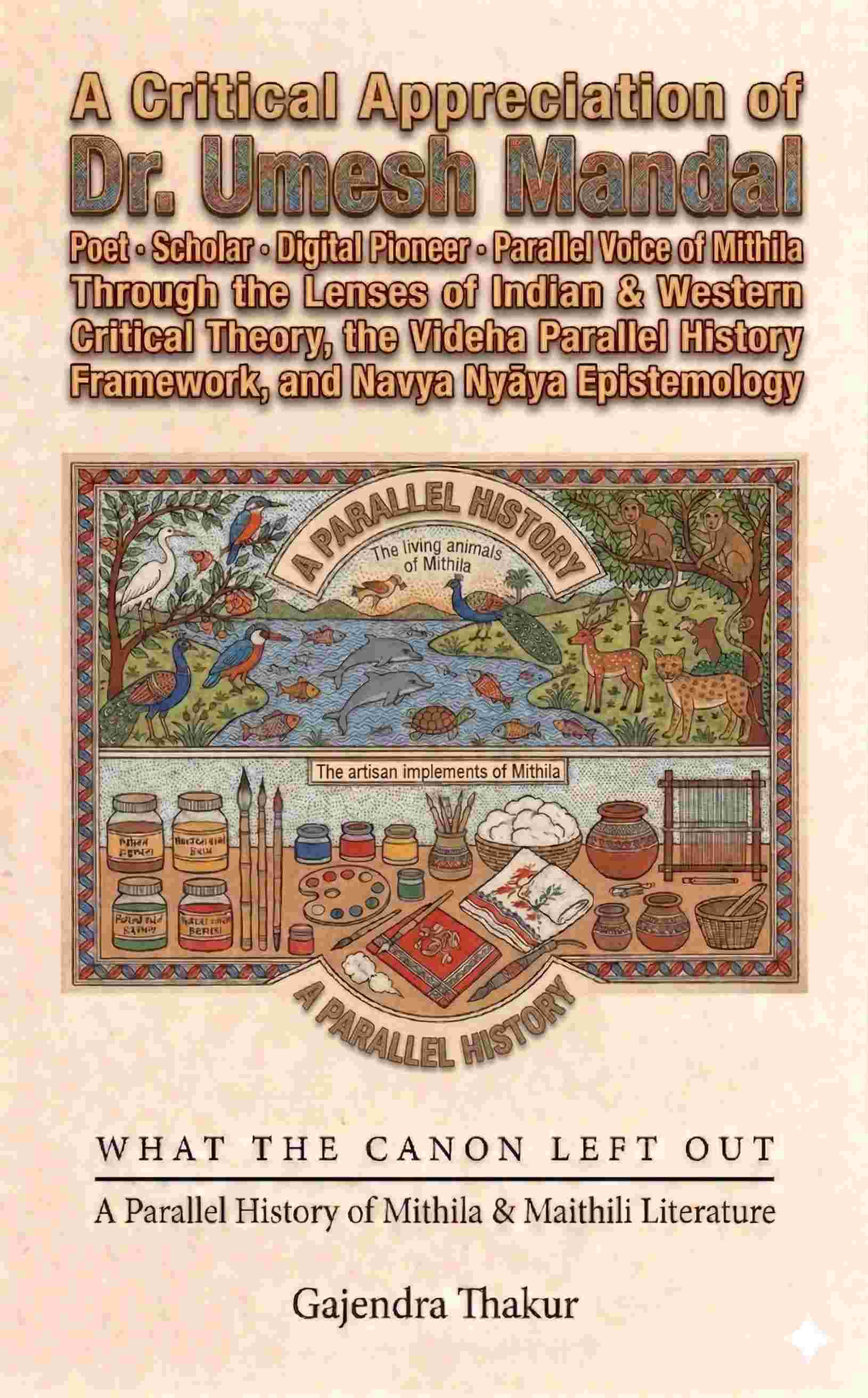
A Critical Appreciation of Dr. Umesh Mandal Poet Scholar Digital Pioneer Parallel Voice of Mithila Through the Lenses of Indian & Western Critical Theory, the Videha Parallel History Framework, and Navya Nyāya Epistemology
A Critical Appreciation of
Dr. Umesh Mandal
Poet · Scholar · Digital Pioneer · Parallel Voice of Mithila
Through the Lenses of Indian & Western Critical Theory, the Videha Parallel History Framework, and Navya Nyāya Epistemology
Preface: The Act of Naming the Unnamed
The history of any literature is always, in part, a history of silences — of voices that spoke but were not heard, of texts that circulated but were not canonised. In the case of Maithili literature, that silence has been particularly structured: maintained, as the Videha Parallel History Framework meticulously documents, by the interlocking mechanisms of caste-based patronage, government academy capture, and the deliberate exclusion of writers from marginal communities.
Dr. Umesh Mandal — poet, literary critic, researcher, was co-editor of Videha, and one of the most industrious contributors to the Maithili digital project — is one of those voices. His poetry collection Nistuki (2009; 2nd ed. 2012) and his scholarly research monograph Jagdish Prasad Mandalak Kavya Sansar (2022) together constitute a double act of witness: the first bearing lyrical testimony to a world of migrating bodies, ecological grief, and social dislocation; the second performing the critical labour of recovering and illuminating another marginalised writer. This document is a critical appreciation of both contributions, approached through the intersecting lenses of Indian aesthetic theory (rasa-dhvani, aucitya), Western literary criticism (New Criticism, postcolonial theory, subaltern studies), the Videha Parallel History Framework, and the rigorous epistemological method of Navya Nyāya.
I. Biographical and Socio-Cultural Context
Dr. Umesh Mandal was born and raised in Berma village, Madhubani district, Bihar — the heartland of the Mithila region. He completed a doctoral degree and earned a reputation as a multidimensional literary personality: poet, critic, editor, digital archivist, and language activist. His work is rooted in the specific agrarian, caste-marked, and ecologically vulnerable landscape of north Bihar, a region where the Kosi and Kamla rivers regularly assert their destructive sovereignty, where seasonal migration has become a defining demographic reality, and where the feudal residues of zamindari continue to structure social relations long after their legal abolition.
From the Videha Parallel History Framework's perspective, Umesh Mandal belongs to a generation of writers from 'backward caste' communities (OBC) who entered Maithili literature in the late twentieth century and fundamentally transformed its thematic and formal landscape. These writers — alongside Jagdish Prasad Mandal, Rajdeo Mandal, Ramdev Prasad Mandal 'Jharudar', and Sandeep Kumar Safi — are described by Gajendra Thakur (editor of Videha) as having 'pumped their energy, wealth, and time into our Maithili Language.'¹ Crucially, despite their significant literary and institutional contributions, none received Sahitya Akademi recognition: an RTI investigation by Vinit Utpal and Ashish Anchinhar (2011–14) revealed that over 90 per cent of all Sahitya Akademi assignments went to the friends, relatives, and associates of the ten-member Maithili advisory board.²
Umesh Mandal's specific contribution to the digital infrastructure of Maithili is extraordinary by any measure. Ashish Anchinhar records that Mandal developed more than 70 per cent of the content of Maithili Wikipedia.³ As co-editor of Videha (ISSN 2229-547X), he was involved in the Google Translate and Wikipedia localisation drive for Maithili, the Tirhuta and Kaithi script research, the Braille localisation initiative, and the successful opposition to the misclassification of Maithili as a 'Bihari language.' His editorial work on Videha — acknowledged internationally when Gerard M linked Videha's Dasipat Aripan archive on his blog — signals the journal's reach beyond the South Asian literary conversation.
In addition to his role as digital archivist, Mandal is the author of the picture dictionary of Mithila's vegetation, animals, and craft skills — a lexicographic and ethnographic project that preserves ecological and material cultural knowledge at a moment of rapid environmental transformation. This breadth — from lyric poetry to scholarly criticism to lexicography to digital organisation — makes him a figure of unusual range and seriousness.
1 Gajendra Thakur, 'A Parallel History of Mithila and Maithili Literature – Part 5', Videha, www.videha.co.in/new_page_5.htm
2 Vinit Utpal / Ashish Anchinhar, RTI investigation (2011–14), cited in Gajendra Thakur, Parallel History Part 1, Videha.
3 Ashish Anchinhar, Maithili Web Patrakaritak Itihas, cited in Mithilesh Kumar Jha, 'Maithili in the Digital Space', India Seminar 742 (2021).
II. Nistuki (2009; 2nd ed. 2012): A Reading of the Poetry
II.1 Textual Description and Formal Overview
Nistuki ('The Voiceless One' / 'One Bereft of Answer') is a collection of Maithili poems, short poems (laghu kavita), haiku/tanka sequences, and two ghazals. Published first by Shruti Prakashan (New Delhi, 2009) and reissued in a second edition (2012), the volume is typeset by Umesh Mandal himself — a small but telling detail, reflecting the self-reliant institutional stance of the parallel literary movement. The collection is internally diverse: it ranges from meditative verse on exile and landscape, to sharply political miniatures, to compressed lyric forms that test the genre boundaries of haiku and tanka within a Maithili matrix.
The table of contents is itself a map of the poet's concerns: Kumahi (the confused), Dharmma, Shubharambh (Auspicious Beginning), Munhathir (Threshold/Veranda), Pachmera, Khapra, Gamak Iyar (Village Friends), Paer Paduka (Sandals), Chhathi, Bhogi, Srota, Kalyani, Desh (Country), Aashcharya (Wonder), Bhasha Bhed (Language Difference), Nor (Tears/Light), Dharak Kat, Maral Buijh, Khushi (Happiness), Bat-Bataahi, He Yau Ah, Apan Gam (My Village), Kichhu Nai Furai (Nothing is Forgotten)... The thematic arc moves from individual consciousness to social critique, from the intimacy of the village threshold to the wide impersonality of national space.
II.2 The Poetics of Exile: Padain, Threshold, and Ecological Loss
One of the most insistent presences in Nistuki is the figure of padain — migration, exile, departure. The reviewer's preface to the second edition captures the emotional charge: 'Mithilasañ padain bhai rahal chhai. Se rahi-rahi kachotai chhathi kavikañ' ('Migration from Mithila keeps happening. It gnaws at the poet, repeatedly'). The poems transform this sociological phenomenon — the outmigration of Maithil agricultural workers to Punjab, Delhi, and beyond — into a lyrical crisis. The village threshold (munhathir) itself becomes jungle; the familiar landscape of the gam is defamiliarised through absence.
In Navya Nyāya terms, one can speak of Mandal's poetry as performing a viśeṣya-viśeṣaṇa bhāva — a relational structure between the knowing subject (the displaced poet/witness) and the object of knowledge (the homeland in the process of being lost). The knowledge-event (jñāna) in the poem is never simple or unmediated; it is layered through inference (anumāna), through the visible signs (liṅga) of absence — the overgrown threshold, the silenced wells, the fields without farmers. This epistemic complexity is what gives the poems their texture.
In Western critical terms, the poetry participates in what Raymond Williams called a 'structure of feeling' — a lived, affective relationship to the material conditions of a community in transition. The padain poems are not nostalgic in the regressive sense: they do not idealise the village that is being left. Rather, they register the loss structurally, understanding it as a consequence of the failure of agrarian political economy, of the gap between the promise of post-independence development and its delivery in the Mithila belt.
II.3 Subaltern Consciousness and the Politics of the Lyric Voice
From a postcolonial and subaltern studies perspective — particularly in the wake of Spivak's reformulation of the question 'Can the Subaltern Speak?' — Mandal's poetry occupies a complex subject-position. As a writer from an OBC community, he writes from within Maithili literature while simultaneously contesting its canon. The very act of writing in Maithili — a language classified by the Indian state as a 'dialect of Hindi' for decades, despite the contrary findings of Grierson and Suniti Kumar Chatterjee⁴ — is itself a political act. Mandal's poems participate in the ongoing collective claim for linguistic dignity.
Within the Parallel History Framework, Maithili literature from the Buddhist Charyapadas onward has carried a subterranean democratic tradition — voices from outside the Brahmin court, from farming and artisan communities, from women's oral practice. Mandal's poetry is a contemporary node in this tradition. His language is not the ornate Sanskrit-inflected Maithili of the classical court; it is closer to the spoken registers of rural Madhubani, rooted in material life — the khapra (broken tile/roof), the gam ka iyar (village companions), the paer paduka (sandals worn by the peasant-walker).
Applying Bakhtin's dialogic principle, one can read Nistuki as a site of heteroglossia — where the lyric 'I' carries the traces of multiple social voices, and where the poem's apparent interiority is always shadowed by the exterior pressures of caste, migration, and ecological collapse. The haiku and tanka sequences are particularly interesting in this regard: these forms, borrowed from the Japanese tradition but naturalised into Maithili, perform a kind of formal compression that enacts the poet's own situation — a voice attempting to preserve maximum meaning in minimum space, against the conditions of dispersal and loss.
II.4 Rasa, Dhvani, and Aucitya: Indian Aesthetic Frameworks
Classical Indian aesthetics offers indispensable tools for reading Nistuki. The rasa theory of Bharata's Nāṭyaśāstra identifies nine primary emotional essences (navarasa) that literary art seeks to evoke. In Mandal's poetry, the dominant rasa is karuṇa (pathos, compassion) — the emotion evoked by separation, loss, and the suffering of living beings. This is not the sentimental karuṇa of Victorian elegies, but a karuṇa of witness: the poet sees the suffering of the departing migrant, the dry field, the abandoned threshold, and his seeing itself becomes a mode of ethical solidarity.
The dhvani theory of Ānandavardhana (9th century CE), as elaborated in the Dhvanyāloka, holds that the finest poetry operates through suggestion (vyañjanā) rather than through mere denotation (abhidhā) or metaphor (lakṣaṇā). The best lines in Nistuki operate precisely at this dhvani level: what the poem 'says' is the surface of a deeper resonance. The 'threshold gone to jungle' does not merely describe an overgrown verandah; it suggests the collapse of domestic community, the end of intergenerational dwelling, the erasure of the social geography by which Maithil identity has been reproduced. This is dhvani at work.
The concept of aucitya (propriety, appropriateness), theorised by Kṣemendra in his Aucityavicāracarcā (11th century CE), holds that the highest mark of poetic success is the perfect fit between form and feeling. By this criterion, Mandal's choice of the haiku/tanka form for certain poems — compressed, syllabically disciplined, image-driven — is an act of aucitya: the fragmented, miniaturist form enacts the fragmentation of the world it describes. Similarly, the ghazal form (two ghazals appear at the end of Nistuki) carries its own tradition of the beloved's absence and the lover's wandering — a tradition that, in Mandal's hands, becomes a meditation on the absence of the homeland and the wandering of the exile.
4 T.K. Oommen, 'Linguistic Diversity,' in Sociology (1988), p. 291–293, citing Grierson and S.K. Chatterjee, as quoted in Gajendra Thakur, Parallel History Part 1, Videha.
II.5 New Critical Close Reading: Selected Poems
Applying the New Critical method of close reading — bracketing biographical and historical context temporarily in order to attend to the poem as a verbal structure — one observes in the laghu kavita (short poems) section a rigorous economy of language. The poem 'Hansi Lahas' (Laughing Corpse) juxtaposes humour and death in a manner that recalls the 'metaphysical conceit' of Donne or the black irony of Brecht. The poem 'Agilaah' (Doorstep/Threshold) creates an image of fire and water as the fundamental contradictions of the social world — the 'manah ka mainah' (the currency of the mind) a phrase that enacts what Cleanth Brooks called the 'paradox' at the heart of significant poetry.
The poem 'Akash' ('Sky' / 'Alas') — a two-word laghu kavita — functions as a compressed haiku-like utterance that exemplifies Ānandavardhana's dhvani at its most concentrated. The sky is both the physical sky of the Mithila landscape and the expression of longing, regret, or aspiration. Such compression resists paraphrase: the poem means more than it says, in the precise sense that dhvani theory describes.
The tanka sequence reveals Mandal's engagement with formal experiment. The tanka form (5-7-5-7-7 syllable pattern) is adapted into Maithili's syllabic and tonal system, creating a productive tension between the imported form and the native phonological material. This is what Homi Bhabha would call a moment of 'hybridity' — where two cultural systems interact and produce something irreducible to either source.
II.6 Environmental Poetics and the Kosi-Kamla Landscape
A dimension of Nistuki that demands explicit critical attention is its environmental consciousness. The Mithila region, situated between the Himalayas and the Gangetic plain, is one of the most flood-prone areas of the world. The rivers Kosi and Kamla are both sustaining and destructive forces, culturally sacred and economically devastating. Mandal's poetry registers this ambivalence. Water appears throughout the collection not as a simple symbol of fertility or purification, but as a complex force — the same water that makes the soil of Mithila famously productive also displaces millions, drowns crops, and erodes the very ground on which communities stand.
In the framework of Lawrence Buell's ecocriticism, Mandal's poetry performs what Buell calls 'environmental representation' — a mode of writing that takes the non-human world seriously as a presence and a force, not merely as backdrop or symbol for human drama. The poems about the gam, the fields, the gachhi (orchards), and the seasonal rhythms of agricultural life constitute an ecological archive — preserving, in lyric form, a knowledge of place that is being lost to outmigration, monoculture, and environmental degradation.
III. Jagdish Prasad Mandalak Kavya Sansar (2022): Critical Praxis and Research Method
III.1 Overview of the Work
Jagdish Prasad Mandalak Kavya Sansar (The Poetic Universe of Jagdish Prasad Mandal) is a full-length research monograph published by Pallavi Prakashan, Nirmali (Supaul, Bihar) in 2022 (ISBN 978-93-93135-10-0, Rs. 300). Authored by Dr. Umesh Mandal, the work is subtitled 'Research Analysis' (Anusandhan Vishleshan) and constitutes a systematic critical study of the poetry of Jagdish Prasad Mandal — himself one of the most significant figures of the Parallel Maithili tradition, awarded the Sahitya Akademi Award in 2021 for his novel Pangu.
The monograph proceeds through the full arc of Jagdish Prasad Mandal's poetic career, examining individual collections in sequence: Indradhanushi Akas, Raat-Din, Teen Jeth Egarhm Magh, Sarita, Gitanjali, Suwael Pokharik Jaaith, Satbed, Chunauti, Rahasa Chauri, Kamdhenu, Man Mathan, Akas Ganga — followed by a comprehensive chronological index of his verse works. The critical apparatus demonstrates Umesh Mandal's dual competence: as a reader formed within the classical Maithili tradition (with its Sanskrit-inflected aesthetic vocabulary) and as a literary critic alert to the social dimensions of literary production.
III.2 Biographical Recovery and the Ethics of Critical Care
The opening chapter of Jagdish Prasad Mandalak Kavya Sansar performs a task that is at once scholarly and political: it recovers the biography of Jagdish Prasad Mandal not as a series of dates and publications, but as a social history of a writer from a marginalised community in post-independence Bihar. Born on 5 July 1947 in Berma village, Jhanjharpur sub-district, Madhubani — the same landscape as Umesh Mandal's own formative world — Jagdish Prasad Mandal lost his father at age three and grew up in conditions of material scarcity that paradoxically produced unusual intellectual richness through the strength of the extended family and the community environment.
Drawing extensively from Gajendra Thakur's biography (Jagdish Prasad Mandal: Ekta Biography, 2013), Umesh Mandal traces the trajectory from village childhood through an M.A. in Hindi and Political Science, to decades of social activism — 35 years of court cases and jail time on behalf of lower-caste communities in Mithila — before arriving at literary recognition. The Videha Parallel History Framework's account of this trajectory is sharper: it notes that the Sahitya Akademi systematically ignored Jagdish Prasad Mandal for decades, that the RTI investigation confirmed zero assignments to him despite his stature, and that the award that finally came (2021) was a belated acknowledgement of work that had long been central to any honest account of contemporary Maithili literature.
Umesh Mandal's critical method here is ethically self-conscious: by framing the literary study within the social biography, he follows the precedent of Indian critical traditions (particularly the Marxist-influenced criticism of Ramvilas Sharma and the dalit-bahujan critical practice emerging from Ambedkarite intellectual culture) that refuse to separate the text from the conditions of its production. This is not a reductive sociologism; Mandal goes on to read the poetry with close attention to language and form. But the biographical frame insists that no reading of this work can be innocent of the social world it emerges from and responds to.
III.3 The Navya Nyāya Method Applied to Critical Analysis
The intellectual tradition of Navya Nyāya — the 'New Logic' school of Indian epistemology founded by Gaṅgeśa Upādhyāya in his Tattvacintāmaṇi (14th century, Mithila) — provides a remarkably apt methodological lens for evaluating Umesh Mandal's critical practice.
Gaṅgeśa's epistemology centres on the question of pramā — valid knowledge — and the conditions under which it can be established. For Gaṅgeśa, knowledge is not simply a mental state but a relational event: a jñāna (knowledge-event) involves a knowing subject (pramātā), an object (prameya), a means of knowing (pramāṇa), and a result (pramāphala). The four canonical pramāṇas are perception (pratyakṣa), inference (anumāna), comparison (upamāna), and testimony (śabda).
Applying this framework to Umesh Mandal's critical work in Jagdish Prasad Mandalak Kavya Sansar, one can identify four corresponding epistemic operations:
1. Pratyakṣa (direct perception): Mandal's close reading of Jagdish Prasad Mandal's poems — attending to specific images, word choices, rhythmic structures, and thematic patterns — is the critical analogue of perceptual knowledge. He reads the text as it presents itself, without prior theoretical impositions.
2. Anumāna (inference): Mandal infers the social world from the textual evidence — reading the poems' images of caste oppression, agricultural hardship, and communal solidarity as indices of the social conditions that produced them. This inferential move follows the Navya Nyāya logic of vyāpti (universal concomitance) — if literary images of this kind, then a social world of this kind.
3. Upamāna (comparison): The study places Jagdish Prasad Mandal's poetry in comparative relation with other Maithili poets and literary traditions, establishing its distinctiveness through a logic of resemblance and difference that is the literary-critical equivalent of upamāna.
4. Śabda (testimony): Mandal draws on the testimony of earlier critics, biographers, and the statements of Jagdish Prasad Mandal himself — using these as valid sources of knowledge about the work while remaining alert to their situatedness and possible biases.
The Navya Nyāya tradition's concern with ābhāsa (error, epistemic failure) and its conditions is equally relevant: Umesh Mandal's critique of the Sahitya Akademi's canonical selections implicitly invokes the concept of viparīta-jñāna (inverted or false knowledge) — the knowledge-claims of the mainstream critical establishment are shown to be epistemically defective, produced by the wrong pramāṇas (testimonial chains corrupted by caste interest) and issuing in false prameyas (misconstructions of literary value).
III.4 Contribution to Maithili Literary Historiography
Jagdish Prasad Mandalak Kavya Sansar makes several contributions to Maithili literary historiography that deserve recognition. First, it produces a systematic and chronologically comprehensive account of a major poet's oeuvre — a form of scholarly labour that is fundamental to any literary culture's self-knowledge and that has been systematically denied to Parallel Maithili writers by the official critical establishment. Second, it models a mode of critical engagement that honours both the artisanal dimensions of the poetry (its language, form, imagery) and its social embeddedness — a both/and rather than either/or approach to the art-society relationship. Third, by placing the work in the context of the poet's biography and social activism, it performs the ethical function of criticism: making visible the conditions under which literature is produced and suppressed.
In terms of the Videha Parallel History Framework, the monograph is itself a node in the counter-archival project: by publishing with Pallavi Prakashan (a small press based in Nirmali, Supaul — not a metropolitan or academically prestigious house), Umesh Mandal demonstrates the institutional logic of parallel literary culture: self-reliant, locally embedded, not dependent on the approval of the gatekeeping institutions that have historically marginalised these voices.
IV. Umesh Mandal and the Videha Parallel History Framework
IV.1 The Framework's Central Claims
The Videha Parallel History of Mithila and Maithili Literature, authored by Gajendra Thakur and serialised across multiple parts on www.videha.co.in, argues for a fundamental reorientation of Maithili literary historiography. Its central claims, as elaborated across Parts 1 through 10 of the serialised text, may be summarised as follows:
The mainstream Maithili canon as institutionalised by the Sahitya Akademi since 1965 has systematically privileged upper-caste (predominantly Maithil Brahmin) writers while suppressing democratic, folk, Dalit, feminist, and Nepal-side traditions. This is not accidental oversight but structural exclusion, documented by RTI data. The Buddhist Charyapadas (8th–12th centuries) are foundational texts of Maithili lyric that the mainstream canon treats as peripheral or pre-Maithili. The philosopher Gaṅgeśa Upādhyāya — whose Tattvacintāmaṇi is the founding text of Navya Nyāya and who was himself a son of Mithila — has had his intercaste origins suppressed by the very brahminical establishment that claims his heritage. The 'true avant-garde' of contemporary Maithili are Jagdish Prasad Mandal (novelist), Rajdeo Mandal (poet), and Bechan Thakur (dramatist) — all long ignored by official machinery. The digital counter-archive constituted by Videha — thousands of books digitised, 11,000 palm-leaf Tirhuta manuscripts transcribed, Braille and Tirhuta Unicode contributions — is itself a form of parallel institutional practice.
IV.2 Umesh Mandal's Position Within the Framework
Umesh Mandal occupies a position of unusual range within this framework. As co-editor of Videha, he was an institutional actor within the parallel movement — one of the architects of its digital infrastructure. As a poet (Nistuki) and scholar (Jagdish Prasad Mandalak Kavya Sansar), he is a creative and critical contributor to the parallel tradition. And as the primary developer of Maithili Wikipedia content, he performs the archival function of expanding the language's public knowledge base beyond the confines of any single literary movement.
His village of origin — Berma, Madhubani — is significant within the Parallel History Framework's symbolic geography: it is the same village that gave the world Jagdish Prasad Mandal, suggesting a local intellectual community of unusual vitality, one that has produced multiple significant writers despite (or because of) its distance from metropolitan literary centres. The Parallel History Framework's concept of 'literature from below' — grounded in agrarian experience, caste consciousness, and ecological reality — is embodied in Mandal's entire literary career.
IV.3 The Gaṅgeśa Connection: Navya Nyāya, Mithila, and Literary Epistemology
One of the most intellectually generative aspects of the Videha Parallel History Framework is its recovery of Gaṅgeśa Upādhyāya's intercaste origins — a suppressed fact that the framework argues transforms our understanding of both the philosopher and the social world that produced him. Gaṅgeśa is said, on the evidence of original Dooshan Panji records, to have married a woman from the leather-tanning community and to have been born five years after his father's death — facts that disrupt the brahminical narrative of his legacy.
This recovery has implications beyond the biographical. If Navya Nyāya — the most rigorous epistemological system produced in pre-modern India — emerged from a social situation of intercaste border-crossing and community mixing, then its methodology of radical questioning (ābhāsa-analysis, anvaya-vyatireka method, the critique of inherited testimony) carries a democratic and anti-hierarchical charge that the brahminical appropriation of the tradition has suppressed. Reading Umesh Mandal's critical practice through this lens — as a form of Navya Nyāya at work in literary culture — is not a metaphor but a substantive claim: the method of epistemological rigour that demands that every knowledge-claim be tested against its pramāṇa (means of valid knowledge) is precisely what the Parallel History Framework performs in its critique of the Sahitya Akademi's canonical selections.
V. Intersecting Western Critical Frameworks
V.1 Postcolonial Theory
Edward Said's concept of 'contrapuntal reading' — attending to the voices that a dominant text suppresses or marginalises — is immediately applicable to Mandal's position in Maithili literary culture. Just as Said proposed reading the British novel against the grain of its imperial assumptions, the Parallel History Framework proposes reading Maithili literary history against the grain of its caste-brahminical assumptions. Mandal's poetry and criticism perform this contrapuntal function: they speak from within the tradition while refusing its exclusions.
Homi Bhabha's concept of 'the third space' — the space of cultural hybridity where new identities are negotiated between dominant and subaltern positions — is illuminating for reading Nistuki's formal experiments. The haiku/tanka adaptations, the ghazal form applied to Maithili content, the intersection of classical Sanskrit rasa vocabulary with a vernacular language of rural Bihar: these are not failures of cultural authenticity but productions of new cultural space, the 'third space' where Maithili modernity is being invented.
V.2 Subaltern Studies and Voice
Ranajit Guha's concept of 'the prose of counter-insurgency' — the way dominant discourse systematically misrepresents subaltern agency — can be applied to the Sahitya Akademi's canonical account of Maithili literature. That account, by omitting Mandal, Jagdish Prasad Mandal, Rajdeo Mandal, and Bechan Thakur, produces what might be called a 'prose of counter-literary insurgency': a version of the tradition that erases its most politically challenging elements. Umesh Mandal's critical and poetic work performs the counter-task of Spivak's subaltern historiography: making the suppressed voice legible, not by speaking 'for' it in a way that reproduces the structure of silencing, but by creating the conditions (archival, digital, critical) under which it can speak for itself.
V.3 New Historicism and Cultural Materialism
Stephen Greenblatt's New Historicism, with its insistence on the mutual implication of literary texts and the social energies of their historical moment, provides a useful framework for understanding Mandal's dual project. The poems of Nistuki are not self-contained aesthetic objects floating above the social world; they are 'thick' cultural documents, resonating with the specific social energies of early twenty-first century Mithila — the migration crisis, the environmental crisis, the crisis of linguistic and cultural identity under conditions of Hindi-belt standardisation. Equally, Jagdish Prasad Mandalak Kavya Sansar is not merely a critical monograph; it is a cultural-material intervention in the ongoing struggle over who counts as a significant writer and whose literary labour is recognised as such.
V.4 Reader-Response Theory
Wolfgang Iser's concept of the 'implied reader' and the 'gaps' in a literary text that the reader is invited to fill is relevant to Mandal's poetry in a specific way. Nistuki's implied reader is a Maithili speaker who shares the cultural reference points — the festivals (Chhath, Bhogi), the river-names, the village practices — that the poems invoke. For this reader, the poems are full of what Iser calls 'determinate gaps': the poem 'says' the threshold, and the reader 'fills in' the entire experiential world that the threshold invokes. For a non-Maithili reader (whether Indian or international), these gaps become sites of cross-cultural learning and also, inevitably, of partial comprehension — a reminder of the untranslatability that is part of every literature's specificity.
VI. Synthesis and Critical Assessment
VI.1 Strengths and Achievements
Assessed across the full range of criteria deployed above — Indian aesthetic, Western critical, epistemological, and institutional — Dr. Umesh Mandal's work presents a pattern of coherent achievement. As a poet, his primary strength lies in formal economy, ecological consciousness, and the lyric registration of social dislocation. As a scholar, his primary strength lies in the ethical seriousness of his critical care — the refusal to separate the literary from the social, the text from its conditions of production. As a digital archivist, his contribution to Maithili's linguistic survival in the digital era is among the most significant of his generation.
Within the Parallel History Framework's terms, Mandal exemplifies the figure of the 'organic intellectual' — Gramsci's term for the thinker who emerges from and remains connected to a subaltern class, whose intellectual work is inseparable from the political project of that class's self-emancipation. He does not merely write about the Mithila peasant community; he works on behalf of that community's cultural survival and recognition, through every register of his activity.
VI.2 Areas for Further Development
A critical appreciation must also note the areas where Mandal's work invites further development. The poetry of Nistuki, for all its strengths, is occasionally uneven in its formal discipline — some of the longer poems would benefit from tighter structural organisation. The critical monograph on Jagdish Prasad Mandal, while comprehensive, tends toward a descriptive-summary mode in some sections, and would be strengthened by more sustained engagement with close-reading analysis of specific poems and their formal devices. A future comparative study that places both Jagdish Prasad Mandal and Umesh Mandal's own poetry in relation to other South Asian literatures of migration, ecology, and caste — Bengali, Bhojpuri, Odia — would extend the reach of both critical and creative projects.
VI.3 The Question of Reception and Recognition
The most striking fact about Umesh Mandal's literary career — and the fact that the Videha Parallel History Framework insists upon most forcefully — is the gap between the significance of the work and the recognition it has received from official literary institutions. Despite his extraordinary contributions to Maithili language, literature, and digital infrastructure — contributions that are documented, quantifiable, and of lasting cultural value — Mandal has received no Sahitya Akademi recognition, no translation grants, no official institutional acknowledgement of the kind routinely given to writers of lesser achievement from the dominant caste communities of the Maithili advisory board.
From the Navya Nyāya perspective, this gap between prameya (true object of knowledge) and pramā (valid knowledge-claim) in the institutional domain is a case of collective epistemic failure — viparīta-jñāna produced by corrupted testimony (anāpta-śabda) and motivated inference (sa-doṣa anumāna). The correction of this failure requires not merely individual recognition but institutional reform: a reconfiguration of the conditions under which literary value is assessed and awarded in the Maithili context.
VII. Conclusion: The Voice That Names the Voiceless
Nistuki — 'the voiceless one,' or perhaps 'one without answer' — is a title that resonates beyond the individual book. It names a condition: the condition of the writer whose language has been denied recognition, whose community has been excluded from the literary canon, whose work has been performed in the face of institutional indifference. That Umesh Mandal chose this title for his poetry collection is itself an act of literary self-consciousness: he knows the position he occupies, and he names it.
But the title also carries an implicit challenge. The voiceless one who writes is, by the act of writing, no longer voiceless. The one without answer who composes poems and critical monographs and Wikipedia entries and digital archives is, by all those acts, generating answers — not merely for himself, but for the community whose cultural memory he is preserving and whose literary achievement he is documenting. In this sense, Nistuki is both a lament and a refusal: a lament for the conditions of silencing, and a refusal of those conditions through the sheer abundance of cultural production.
Viewed through the convergent lenses of Indian rasa theory (karuṇa as the ground of ethical solidarity), Navya Nyāya epistemology (pramā as the commitment to valid knowledge against motivated error), the Videha Parallel History Framework (counter-archive as political praxis), and Western critical theory (contrapuntal reading, subaltern voice, environmental poetics) — Umesh Mandal emerges as one of the most significant figures in contemporary Maithili literary culture. The full critical accounting of his work — and the institutional recognition that work merits — is a project that this appreciation initiates, but that the literary community of Mithila, and those who care about the world's linguistic diversity, must continue.
Select Bibliography and Primary Sources
Primary Texts
Mandal, Umesh. Nistuki. New Delhi: Shruti Prakashan, 2009; 2nd ed. 2012. [ISBN: 978-93-80538-37-2]
Mandal, Umesh. Jagdish Prasad Mandalak Kavya Sansar (Anusandhan Vishleshan). Nirmali, Supaul: Pallavi Prakashan, 2022. [ISBN: 978-93-93135-10-0]
Videha Sources
Thakur, Gajendra (ed.). Videha: Prathama Maithili Pakshik ePatrika (ISSN 2229-547X). www.videha.co.in. Since 2000.
Thakur, Gajendra. 'A Parallel History of Mithila and Maithili Literature.' Parts 1–10. Videha. www.videha.co.in/gajenthakur.htm
Thakur, Gajendra. 'Jagdish Prasad Mandal: Ekta Biography.' Cited in Umesh Mandal, Jagdish Prasad Mandalak Kavya Sansar (2022).
Anchinhar, Ashish. Maithili Web Patrakaritak Itihas. Cited in Mithilesh Kumar Jha, 'Maithili in the Digital Space,' India Seminar 742 (2021).
Indian Critical and Philosophical Tradition
Bharata Muni. Nāṭyaśāstra. Trans. M.M. Ghosh. Calcutta, 1951.
Ānandavardhana. Dhvanyāloka. With Abhinavagupta's Locana. Trans. Daniel H.H. Ingalls, Jeffrey Moussaieff Masson, and M.V. Patwardhan. Cambridge, MA: Harvard University Press, 1990.
Kṣemendra. Aucityavicāracarcā. Trans. and ed. R.C. Dwivedi. Delhi: Motilal Banarsidass, 1977.
Gaṅgeśa Upādhyāya. Tattvacintāmaṇi. Ed. Kamakhyanath Tarkavagisha. Calcutta, 1884.
Sharma, Ramvilas. Bhāratīya Sāhitya kī Bhumika. New Delhi: Rajkamal Prakashan, 1972.
Western Critical Theory
Said, Edward W. Culture and Imperialism. New York: Knopf, 1993.
Bhabha, Homi K. The Location of Culture. London: Routledge, 1994.
Spivak, Gayatri Chakravorty. 'Can the Subaltern Speak?' In Marxism and the Interpretation of Culture. Ed. C. Nelson and L. Grossberg. Urbana: University of Illinois Press, 1988.
Guha, Ranajit. 'The Prose of Counter-Insurgency.' In Selected Subaltern Studies. Ed. Guha and Spivak. Oxford: OUP, 1988.
Greenblatt, Stephen. Shakespearean Negotiations. Berkeley: University of California Press, 1988.
Gramsci, Antonio. Selections from the Prison Notebooks. Trans. Q. Hoare and G.N. Smith. London: Lawrence and Wishart, 1971.
Williams, Raymond. Marxism and Literature. Oxford: OUP, 1977.
Buell, Lawrence. The Environmental Imagination. Cambridge, MA: Harvard University Press, 1995.
Iser, Wolfgang. The Act of Reading. Baltimore: Johns Hopkins University Press, 1978.
Brooks, Cleanth. The Well Wrought Urn. New York: Harcourt Brace, 1947.
Bakhtin, Mikhail. The Dialogic Imagination. Trans. C. Emerson and M. Holquist. Austin: University of Texas Press, 1981.
Secondary and Contextual Sources
Jha, Mithilesh Kumar. 'Maithili in the Digital Space.' India Seminar 742 (June 2021). www.india-seminar.com
Oommen, T.K. 'Linguistic Diversity.' In Sociology. National Law School of India University, 1988.
Grierson, George Abraham. Linguistic Survey of India. Vol. V, Part II. Calcutta: Office of the Superintendent of Government Printing, 1903.
'A Journey Through Maithili Literature with Kathakar Ashok.' Outlook India. February 2024.
All translations from Maithili are approximate renderings for critical purposes only.
अपन मंतव्य editorial.staff.videha@zohomail.in पर पठाउ।