
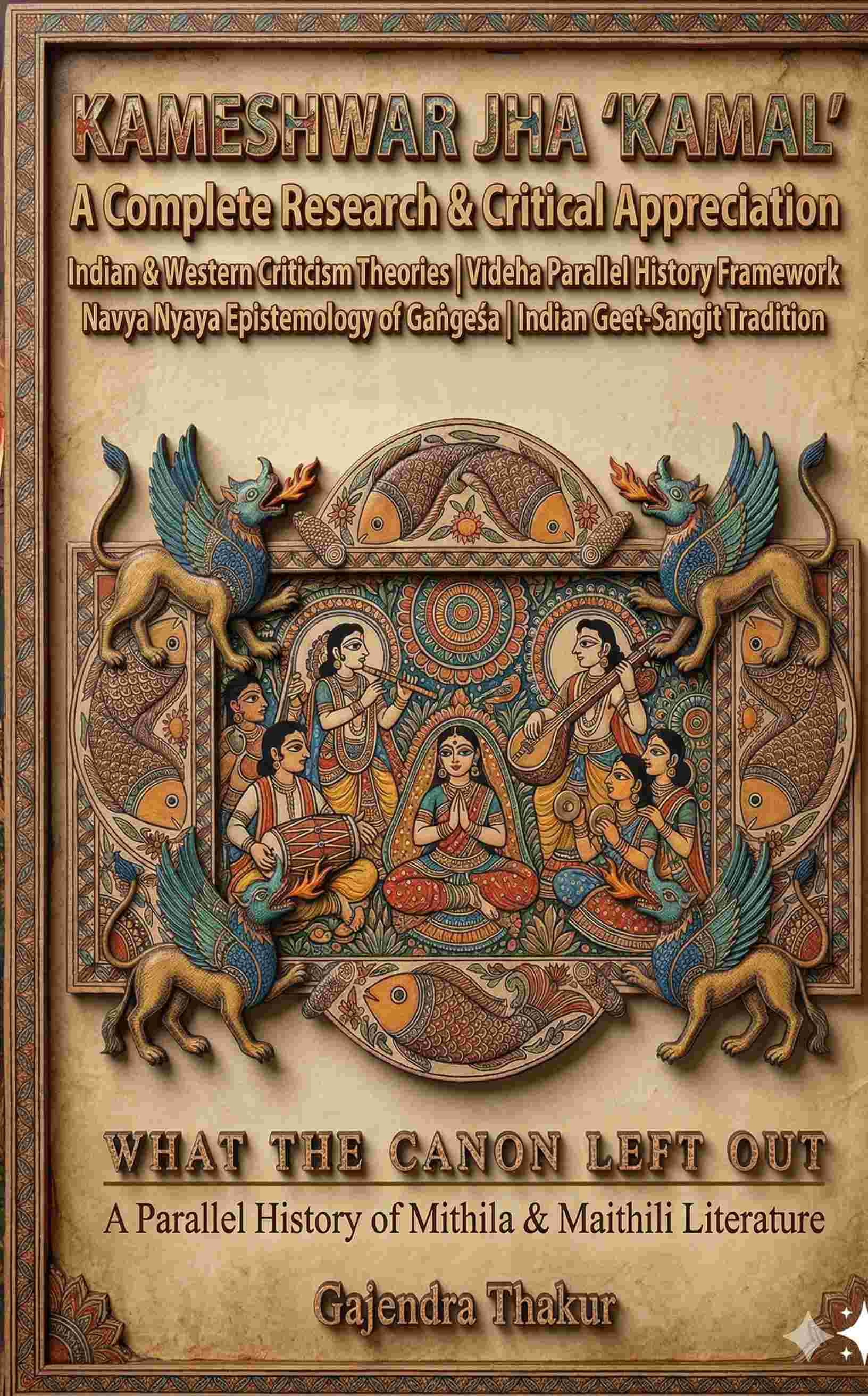
KAMESHWAR JHA 'KAMAL' A Complete Research & Critical Appreciation Indian & Western Criticism Theories | Videha Parallel History Framework Navya Nyaya Epistemology of Gangeśa | Indian Geet-Sangit Tradition
KAMESHWAR JHA 'KAMAL'
A Complete Research & Critical Appreciation
Indian & Western Criticism Theories | Videha Parallel History Framework
Navya Nyaya Epistemology of Gaṅgeśa | Indian Geet-Sangit Tradition
Table of Contents
1. Introduction: Kameshwar Jha 'Kamal' and the Maithili Geet Tradition
2. Biographical Profile: Life, Formation, and Cultural Context
3. Overview of Kamal-Taal: Structure, Contents, and Genre
4. The Geet (Song-Poem) as Literary Form: Indian Theoretical Framework
4.1 Rasa Theory and the Lyric Emotion
4.2 Dhvani Theory: Resonance in Song
4.3 Raga-Bhas and the Classical Music Tradition
4.4 Lochana's Ragatarangini and the Mithila Music Heritage
4.5 Vidyapati's Legacy and Kamal's Inheritance
5. Category Analysis of the Songs
5.1 Devotional Songs: Vandana, Bhajan, Kirtana
5.2 Shringara: Love, Union, and Viraha (Separation)
5.3 Ritukar Geet: Seasonal Songs (Holi, Sawan, Sharad)
5.4 Nari-Jeevan Geet: Songs of Women's Experience
5.5 Desh-Bhakti Geet: Patriotic Songs
5.6 Loka-Geet and Nachhari Tradition
5.7 Samkalin/Samajik Geet: Contemporary and Social Songs
5.8 Geeetika: The Lyric-Essay Songs
5.9 Geet-Natya: Dramatic Song-Plays
6. Western Critical Theories Applied to Kamal-Taal
6.1 Romantic Lyric Theory (Wordsworth, Keats, Shelley)
6.2 New Criticism and Close Reading of the Geet
6.3 Performance Theory (Schechner, Austin's Speech Acts)
6.4 Feminist Theory and Women's Voice in Kamal's Songs
6.5 Postcolonial Theory: Language, Identity, and Diaspora
7. The Videha Parallel History Framework
8. Navya Nyaya Epistemology Applied to Song-Poetry
8.1 Pramana in Lyric Cognition
8.2 Shabda Pramana and the Oral-Musical Tradition
8.3 Vyapti and the Logic of Raga
8.4 Gaṅgeśa's Tattvacintamani and the Analysis of Poetic Meaning
9. Detailed Textual Analysis of Selected Songs
10. Thematic Synthesis: Kamal's Vision of Mithila and the World
11. Conclusion and Critical Assessment
12. Bibliography and References
1. Introduction: Kameshwar Jha 'Kamal' and the Maithili Geet Tradition
Kameshwar Jha 'Kamal' is a Maithili poet and lyricist whose work embodies one of the most ancient and richly sustained traditions of Mithila's literary heritage: the Geet (song-poem) — the genre that has been the primary vessel of Maithili aesthetic, devotional, and emotional expression from at least the time of Vidyapati Thakur (14th–15th century CE) to the present day. His collection Kamal-Taal (कमल-ताल, Geet Sangraha), published on 1 August 2022 by Mithila Sanskriti Parishad, Kolkata, as part of the Azadi ka Amrit Mahotsav (India's 75th Independence anniversary) celebration, represents a comprehensive anthology of the Maithili geet tradition in its full range: devotional (bhakti), romantic (shringara), seasonal (ritukar), social (samajik), patriotic (desh-bhakti), and contemporary (samkalin).
The critical preface by Sri Dayashankar Mishra (Secretary, Mithila Sanskriti Parishad) situates Kamal's work within the sweep of Mithila's music heritage — from the ancient ragatarangini tradition documented by Lochana, through Chanda Jha's Mithila Bhasha Ramayan, to the contemporary Maithili song tradition practised in diaspora communities in Kolkata and beyond. A second preface — 'Kamal Kesar' ('The Pollen of the Lotus') — by an unnamed literary scholar situates the collection within the modern Maithili geet tradition, comparing Kamal's songs to Vidyapati's famous verse on the ineffability of love ('Sakhi ki puchhasi anubhava moe') and arguing that the Geet is the one literary form that never experiences autumn — 'Geetoddyan mein patahjhad nahi aaya, nahi aayega' ('In the garden of song, autumn has not come, will not come').
Kamal's earlier collection Baat Ekperiya (बाट एकपेरिया, Kavita Sangraha, 2015) established him as a poet with a distinct voice in contemporary Maithili poetry; Kamal-Taal represents his fuller engagement with the specifically musical dimension of Maithili literary tradition. The 73-page collection contains songs across at least twelve distinct categories, demonstrating remarkable generic range and thematic breadth. His Azadi ka Amrit Mahotsav edition places him explicitly within the political moment of India's national celebration while simultaneously asserting Mithila's distinct cultural contribution to that national story.
2. Biographical Profile: Life, Formation, and Cultural Context
The author's profile page (p. 73, the final page of Kamal-Taal) provides the following biographical information, here translated and expanded:
Name: Sri Kameshwar Jha. Literary name: Sri Kameshwar Jha 'Kamal' / 'Kamalji'. Father: Late Sri Dayanand Jha Gulab (to whose memory the book is dedicated: 'श्रद्धेय पिता स्व० श्री दयानन्द झा गुलाब के श्री चरण में सादर समर्पित'). Mother: Smt. Gulab Devi. Date of birth: 04 November 1962. Native place: Village and Post — Mithila Deep, via Jhanjharpur, Police Station — Madhepur, District — Madhubani (Mithila), Bihar.
Education: Primary school at Andhrathadhi and Mithila Deep; Secondary — Mahadeopura High School, Jhanjharpur (passed 1979); Higher Secondary — Marwari College, Kishanganj (incomplete, 1982-83). Profession: Currently employed at Sulabh International Social Service Organisation, Kolkata. Interests: Deep love for mother tongue Maithili, reading and writing, special interest in poetry, story, songs and music.
This biographical data is remarkably revealing. Kameshwar Jha 'Kamal' is the son of Dayanand Jha Gulab — itself a literary name, suggesting an artistic family heritage. He was born in Mithila Deep village, Jhanjharpur, Madhubani — the same Madhubani district that is the heartland of Mithila cultural identity, home to Madhubani painting, the great poet Vidyapati, the Saurath fair (the legendary Mithila marriage fair), and the ancient Maithili intellectual tradition. He left Madhubani without completing his higher secondary education, migrating to Kolkata where he has lived and worked for decades — a common trajectory in the Mithila diaspora story, shaped by Bihar's post-independence economic underdevelopment.
This diaspora context — living and working in Kolkata (at Sulabh International, an organisation known for its work on sanitation and social service), while maintaining deep emotional and cultural connection to the Madhubani homeland — is essential to understanding both the content and the function of his songs. The Geet, in the diaspora Maithili community context, is not merely aesthetic expression but a primary technology of cultural survival: the medium through which the community maintains its language, rituals, emotional landscape, and collective identity across geographic displacement. The Mithila Sanskriti Parishad, Kolkata — his publisher — is precisely such an institutional mechanism: a cultural organisation of the Kolkata Maithili diaspora dedicated to the preservation and promotion of Maithili language and culture far from the homeland.
The collection is published in 2022 — the Azadi ka Amrit Mahotsav year — and this timing is significant. By placing his Mithila-rooted song collection within the national 75th-anniversary celebration frame, Kamal performs what might be called cultural citizenship: asserting Mithila's presence within the Indian national story, claiming the national celebration as also Mithila's celebration, even as he simultaneously maintains the distinctiveness of Mithila's cultural contribution.
3. Overview of Kamal-Taal: Structure, Contents, and Genre
Kamal-Taal (literally 'The Rhythm of the Lotus' or 'Lotus Lake') is a 73-page Geet Sangraha (song collection) containing songs across the following twelve categories, as extracted through close reading of the text:
1. Ganesh Vandana (Invocation Songs for Ganesha)
Two Ganesh vandanas open the collection — a classical Sanskrit-influenced structure following the convention of mangalacharana (auspicious beginning). The first is in Maithili-Hindi mixed register; the second, more formal. Both invoke Ganesh as Vignaharta (remover of obstacles), Lambodar (large-bellied), Ganayak (lord of the ganas), and Girijanananda (son of Girija/Parvati). The first ends with the poet's signature: 'Sunahu dayanidhana vinati mora / Sakal Kamal vighn karu dur' — establishing the poet's voice as a humble petitioner before the deity.
2. Hanuman Vandana
A devotional song to Hanuman as Kesari Nandan (son of Kesari), Pawanputra (son of the wind), Anjaniputra (son of Anjani), and Mangal Murti (auspicious form). The song structure uses a refrain system (bira anjani ke lala ho mangal murti) with narrative stanzas recounting Hanuman's exploits: crossing the ocean, finding Sita, burning Lanka. This is structured as a kirtan-pad — a devotional song suitable for collective performance.
3. Saraswati Vandana (Three Songs)
Three distinct Saraswati vandanas display the tradition's richness: one in the voice of a child/student ('Ham nenna ajnyan') seeking learning; one invoking the goddess as Vidya Devi, Hans Vahini (swan-borne), Veena Pani (lute-in-hand), Bhagavati; one in prayer form requesting success in examinations, purity of mind, and perseverance in study. The refrain 'Matu vidyadaan de, matu vidyadaan de' ('Mother, grant the gift of learning') is the devotional climax of the third.
4. Devi Vandana (Five Songs to the Goddess Durga)
Five songs to Durga/Devi in various forms — as Ambika, Jagadamba, Mahishasura-mardini, Kali, Maheswari, Bhavani, Bhuvaneshwari, Vindhyavasini, Durga Maharani, and others. These employ the conventions of the classical Devi stotram (hymn) while maintaining accessibility through folk-idiom Maithili. The fourth — 'Maiya hamar dukha kahiya je sunbai' ('Mother, when will you listen to my sorrows?') — moves from formal invocation to intimate personal supplication, deploying the virah (separation) emotional register of devotional poetry: the devotee's longing for the deity's grace is expressed through the same emotional language as the lover's longing for the beloved.
5. Rama and Sita: Songs of the Mithila-Ramayana Tradition
Three songs connect to the Janaki-Rama tradition that is the mythological cornerstone of Mithila identity: a Ram Vivah Geet (wedding of Rama and Sita), an Aratisonnet for Sita ('Jati kalyani gauri mata bhavani'), and a Bhajan in the voice of Rama (the forest-exile episode, where a tapasvi questions Ram: 'Re tapasi kahama, tohar desh / Kon nripati ke ton putra re tapasi'). These songs are specifically embedded in the Mithila-centric Ramayan tradition that regards Janaki (Sita) as the daughter of the Mithila soil.
6. Krishna Lila Songs
Four songs on Krishna's stories: his birth in Gokul (Janmashtami), his flute-music and longing for Radha ('Radha-Radha shor machabai / Mohan ke murliya'), the celebration of his birth ('Aaju sohaaon sakhi, ailai shubhdinma'), and the monsoon-dark night of his birth ('Bhadab raatitam ashtami'). These follow the Padavali tradition established by Vidyapati in Mithila, translating the Sanskrit-classical Radha-Krishna aesthetic into the folk-idiom Maithili register.
7. Shiva-Parvati Songs: Nachhari and Shiv Vivah
The Nachhari (Shiva's intoxicated dance songs) are among the most distinctive and traditional of Maithili song genres. Kamal's five Nachhari songs celebrate Shiva as Bholanath, Digambar (sky-clad), the bhang-drinking ascetic who marries the beautiful Gauri despite his apparent unsuitability — a genre of comic-devotional song unique to Mithila. 'Nach dekhu he gaura' ('Come watch the dance, O Gauri') depicts Shiva's cosmic dance with ghosts and spirits to Parvati's alarmed amusement. The Shiv Vivah songs explore Maiya Maina's (Parvati's mother's) anxieties about marrying her daughter to this unconventional deity — a domestic comedy rooted in folk tradition.
8. Chhath Puja and Sun Songs
Chhath puja — the ancient Bihari/Maithili worship of the Sun — is represented through several songs including a distinctive Chhath geet: 'Jal bich eksari thad / Karai aragh / He dinanath ugiyau' ('Standing alone in the water / Offering arghya / O Dinanath, rise'). This song captures the characteristic posture and devotional moment of Chhath — the devotee standing in water at sunset/sunrise, offering water and prayer to the sun. The seasonal songs also include a Sharadiya Purnima geet and a Kartik songs cycle.
9. Seasonal Songs: Sawan, Phagun, Faguwa
The seasonal songs form a substantial portion of the collection: Saawan (monsoon) songs, Fagua (Holi) songs including the comic Nachhari-Faguwa tradition (Bhang pishu ne gaura — 'Grind bhang, O Gaura'), Barsaat (rainy season) songs with their viraha undertone (the separated wife's longing for the absent husband intensified by the monsoon), Chait (spring) songs, and Basanta (spring) songs. These are ritual-seasonal songs deeply embedded in the agricultural-ritual calendar of Mithila.
10. Nari-Jeevan Geet: Songs of Women's Domestic Experience
A cluster of songs voices the experiences of women in traditional Mithila domestic life: the Bhardutiya song (Bhai Duj — the sister welcoming her brother), songs from the vantage of a young wife waiting for her absent husband, Kesh Paricchan Geet (songs for the hair-cutting ceremony at a child's first haircut), Kohbar songs (songs for the wedding chamber), and marriage preparation songs. These are in the register of the traditional women's song genres (sohar, vivah geet, vidapat) that form the oral-ritual literature of Mithila women.
11. Patriotic Songs
Two substantial patriotic songs: one a Mithila-pride song ('Jay-jay Mithila pawan dhaam') invoking the rivers Koshi and Kamla, the makhana, paan, the cultural figures Gautama, Kanada, Janaka, Vidyapati, the Ugna legend; another, a call to arms ('Ran ke baat bandhu chal sina tani re' — 'On the path of battle, friends, walk with chest thrust forward') that combines national patriotism with seasonal imagery.
12. Contemporary and Social Songs
The most thematically innovative section contains contemporary and social songs: two COVID-19 pandemic songs (treating the pandemic's social disruption with sharp observation — 'Jani nikalhu katahu, akaran / Be pasral sagar sankraman' — and political satire on government response); a philosophical song on life's contradictions ('Bich kanthe phansala halahala jeenga' — 'Life: poison stuck in the throat'); romantic Geetika (lyric songs of love and gazing); and a Geet-Natya (dramatic song-play) of Holi celebrations.
4. The Geet (Song-Poem) as Literary Form: Indian Theoretical Framework
4.1 Rasa Theory and the Lyric Emotion
Bharata Muni's Natyashastra (c. 200 BCE–200 CE) established the framework of Rasa (aesthetic emotion) as the fundamental criterion of literary-artistic experience, applicable not only to drama but to all literary forms including lyric poetry and music. The Natyashastra's analysis of Mela (musical assembly) and the function of song (Gana) within drama establishes the theoretical basis for understanding the Geet as a Rasa-producing form.
Abhinavagupta's Abhinavabharati extends Rasa theory to include the experience of music: he argues that musical sound (Svara) has the power to evoke Rasa through its structural properties — particular melodic patterns (Raga), rhythmic structures (Tala), and combinations of tones produce specific emotional states in the listener. This is the theoretical foundation of what we encounter as musical-emotional experience in Kamal's songs: the geet works simultaneously through verbal meaning (artha) and musical sound (svara) to produce a unified Rasa experience.
Mapping Kamal's songs onto the Rasa schema: the devotional songs (vandana, bhajan) primarily evoke Shanta Rasa (peaceful, devotional equanimity) and Adbhuta Rasa (wonder at divine power). The romantic songs (the viraha songs of the separated wife, the Krishna-Radha songs) evoke Shringara Rasa (love) — both Sambhoga Shringara (love in union, as in the Gokulashtami songs) and Vipralambha Shringara (love in separation, as in the wife's monsoon songs). The Nachhari songs are primarily Hasya Rasa (comic) with an undertone of Adbhuta (wonder at Shiva's paradoxical nature). The patriotic songs evoke Vira Rasa (heroic), and the pandemic songs combine Karuna (pathos/compassion) and Bibhatsa (disgust at social and political failure).
4.2 Dhvani Theory: Resonance in Song
Anandavardhana's Dhvanyaloka (9th century CE) — the theory of suggestive resonance as the soul of poetry — is particularly applicable to the lyric mode of the Geet, where suggestion and evocation are more central than explicit statement. The title Kamal-Taal itself operates as a multi-layered Dhvani: literally 'Lotus-Rhythm' or 'Lotus Lake' (taal meaning both rhythm and lake/pond), it suggests simultaneously the beauty of the lotus (the poet's name-symbol, as he signs himself 'Kamal'), the rhythmic pulse of song (taal as musical time), and the sacred lotus-pond (taal as the still water on which lotuses float — an image of pure devotion and natural beauty). This triple resonance — name, rhythm, sacred imagery — cannot be captured in paraphrase; it is the Dhvani of the title itself.
Anandavardhana identifies three types of Dhvani: Vastu-Dhvani (resonance through suggested fact/situation), Alamkara-Dhvani (resonance through irony and figurative language), and Rasa-Dhvani (the highest form — the suggestion of an entire emotional-aesthetic state through minimal verbal means). Kamal's most accomplished songs achieve Rasa-Dhvani: the COVID song 'Jani nikalhu katahu, akaran' (Do not go out anywhere, without reason / All around has spread the contamination') achieves both literal social instruction and the resonance of human isolation, lost community, and existential longing in just a few lines.
4.3 Raga-Bhas and the Classical Music Tradition
The preface to Kamal-Taal explicitly mentions the Raga-Bhas (folk-classical melodic modes) tradition of Mithila and regrets that 'bahut rasa lok-rag ab aloPit bha gal achi' ('many folk ragas have now disappeared from Mithila'). This awareness of threatened musical heritage contextualises the entire collection: Kamal's songs are written in an awareness of the vanishing Raga-Bhas tradition and represent an attempt to preserve and transmit it.
The Raga (melodic framework) that a geet is set to is not merely an acoustic vehicle for the text but an integral part of the song's meaning and emotional effect. Classical Indian music theory, from the Natyashastra's chapter on music (Gandharva) through the Sangita Ratnakara of Sharangadeva (13th century), holds that specific Ragas evoke specific emotional states (the Raga-Rasa correspondence). When Kamal designates his Saawan songs for the monsoon season or his Fagua songs for Holi, he is invoking specific Raga-Bhas appropriate to those seasons and their emotional registers — Megh Malhar for monsoon, the Hori Ragas for Phalgun. The songs are thus not autonomous textual artefacts but performance-music scores that require the Raga-context to be fully realised.
4.4 Lochana's Ragatarangini and the Mithila Music Heritage
The publisher's preface invokes Lochana's Ragatarangini — the great medieval Maithili music treatise — as evidence of Mithila's rich classical music heritage. Lochana Kavi (15th-16th century) was a Maithili scholar who wrote the Ragatarangini, one of the most important texts of the Mithila school of music theory. The text documents the system of Ragas, their seasonal and temporal applications, their emotional correspondences, and the performance conventions appropriate to each. The reference establishes that Kamal's songs inherit a music-theoretical tradition as rich and systematic as any in the subcontinent.
The Rag-Bhas tradition mentioned in the preface is specifically Mithila's folk-classical fusion system of melodic modes that differs from the Hindustani classical system centred on Agra, Kirana, and Jaipur gharanas. The Mithila music tradition — represented by the dhrupad-singing tradition that the preface mentions ('Vishesh rupa dhrupad gayan yeh mithilak dharohar achi' — 'Dhrupad singing is specifically Mithila's heritage') — combines elements of Sanskrit classical music theory with the regional folk tradition. Kamal's songs exist in this hybrid space between classical and folk, between textual and oral, between the Sanskrit-influenced devotional tradition and the living vernacular.
4.5 Vidyapati's Legacy and Kamal's Inheritance
The Kamal Kesar preface invokes Vidyapati directly, quoting the opening line of one of his most celebrated philosophical poems on love: 'Sakhi ki puchhasi anubhava moe / Sahai pirita anurag bakhania tila tila nutana hoe' ('Sakhi, why do you ask me of love's experience? / That love, that passion grows new moment by moment'). This quotation is not decorative but constitutive: it establishes the theoretical benchmark against which Kamal's songs are implicitly measured. Vidyapati's statement about the ineffability of love — that language always falls short of experience — is the foundational philosophical position of the Maithili geet tradition, and Kamal's songs can be read as successive attempts to approach this ineffable through the specific modalities of devotion, seasonal celebration, domestic life, and contemporary experience.
Vidyapati's legacy in Mithila encompasses several dimensions that are all present in Kamal's work: the devotional tradition (Vidyapati's Shiva and Durga hymns), the romantic tradition (his Radha-Krishna padavali), the seasonal tradition (his seasonal geet), and the court-patronage tradition (his songs composed for specific occasions and patrons). Kamal inherits all these dimensions — but where Vidyapati had royal patronage, Kamal works within the diaspora community institution of Mithila Sanskriti Parishad. This shift in patronage — from royal court to diaspora cultural organisation — is itself historically significant.
5. Category Analysis of the Songs
5.1 Devotional Songs: Vandana, Bhajan, Kirtana
The devotional songs constitute the largest and most systematically organised section of Kamal-Taal. They follow the traditional Mangalacharana structure: Ganesh first (remover of obstacles, enabler of all auspicious beginnings), then Hanuman, then Saraswati (goddess of learning and speech — particularly appropriate to a poetry collection), then the various forms of Devi (Durga, Kali, Bhagavati), then Rama-Sita, then Krishna. This ordering is not arbitrary but reflects the traditional Maithili devotional hierarchy and liturgical sequence.
The devotional songs demonstrate Kamal's mastery of the stuti (hymn) form: the opening invocation (mangala-charanas), the sequence of attributes and epithets, the narrative episodes that demonstrate the deity's power, and the closing supplication (prarthana) in the poet's own voice. This is precisely the structure Bharata describes for devotional dramatic performance — and indeed these songs are performative: they are designed to be sung at pujas, festivals, and community religious gatherings.
The signature device — 'Kamal' appearing in the penultimate line of each devotional song — is a classical convention going back to Vidyapati: the poet's name-signature (bhanita) that identifies the composition and simultaneously constitutes the poet as devotee within the song. When Kamal writes 'Sakal Kamal vighn karu dur, he suranayak jagat hitesh' ('Remove all Kamal's obstacles, O lord of the gods, friend of the world'), the poet-name and the lotus-name merge: Kamal the poet is one with the kamal (lotus) — the devotional symbol of pure, detached beauty.
5.2 Shringara: Love, Union, and Viraha
The romantic songs in Kamal-Taal explore both poles of Shringara Rasa as theorised in Indian aesthetics: Sambhoga (union, presence) and Vipralambha (separation, absence). The most sustained and emotionally powerful of these are the viraha songs — the separated wife's lament for her absent husband (gone to the city, to 'pardesh') — written in the Maithili women's song tradition.
The Chaita-bar song ('Biti gelai fiyon mahinma, ho rama, piya beimanma' — 'The month of Phalgun is over, O Rama, my faithless beloved') is a masterwork in this vein: the months accumulate ('thirteen months have passed'), each with its seasonal beauty (flowers blooming, mango trees fragrant), which makes the absence of the beloved more, not less, painful. Nature's beauty intensifies the viraha because it is beauty without the beloved to share it. This is the classic Indian viraha-in-spring motif — found in Kalidasa's Meghaduta, in Vidyapati's songs, and here in Kamal's contemporary register.
The philosophical Geetika songs on love (pages 71-72) represent the most inward and contemplative dimension of the shringara tradition: 'O lagaite rahali, ham muskaite rahalu' ('She kept shying away, I kept smiling'); 'Nayan hunk sindhu nehaka umaral / O umaraite rahali, ham chubhakaite rahalu' ('Her eyes, a sea of love, surged / She kept surging, I kept plunging'). These are songs of silent mutual witnessing — love expressed through the exchange of glances rather than words — echoing Vidyapati's 'Tila tila nutana hoe' (love renewing itself moment by moment).
5.3 Ritukar Geet: Seasonal Songs
The seasonal song tradition is one of the oldest and most structurally complex dimensions of Maithili literary practice. Each season has its traditional song-types, melodic modes (Raga-Bhas), performative occasions, and emotional registers. Kamal's seasonal songs span: Sawan-Barsaat (monsoon), Fagua-Phalgun (Holi season, spring), Chait (early spring), Sharad (autumn), and the festival seasons associated with each (Teej in Sawan, Holi in Phalgun, Chhath in Kartik, Diwali, and so on).
The Saawan songs are among the most classically structured: they deploy the monsoon's conventional emotional associations (the monsoon as the season of longing, when separated lovers feel the absence most acutely), the classic bird symbols (the koel's call, the chatak's cry, the crow as messenger — 'Re kaga, kaga re / Dei hai unka sandesh' — 'O crow, crow / Give them my message'), and the characteristic meteorological imagery (dark clouds, lightning, drumming rain, flooded fields). The Sawan geet 'Saawan ayal' ('The Sawan has come') uses the dramatic device of the crow-messenger — a trope traceable to Kalidasa's Meghaduta and deeply embedded in Maithili folk tradition.
5.4 Nari-Jeevan Geet: Women's Experience
Several songs voice the perspective of women in traditional Mithila domestic life: the young wife longing for her absent husband, the older woman sharing domestic wisdom with the younger, the festival songs of Bhardutiya (Bhai Duj), and the women's ritual songs (sohar, vivah geet) associated with birth, childhood, marriage. These songs are in the tradition of the massive body of oral women's literature (jaankari geet, sohar, Vivah geet) that constitutes the unofficial literary canon of Mithila — the literature produced by women, for women, in domestic and ritual contexts.
The Bhardutiya song ('Bhardutiya aripan del angna' — 'On Bhai Duj the threshold was decorated with aripan') captures the festival in its material specificity: the aripan (the traditional Mithila threshold painting with rice-paste), the ritual welcoming of the brother, the sister's emotional vulnerability (her desire to have her brother visit, thwarted by family dynamics), and the undercurrent of gender injustice in the detail that the sister has done all the ritual preparation while family members' responses are inadequate or unkind.
5.5 Desh-Bhakti Geet: Patriotic Songs
The patriotic songs 'Jay-Jay Mithila Pawan Dhaam' and 'Rana ke Baat Bandhu' represent different registers of national-cultural belonging. 'Jay-Jay Mithila' is a Mithila-pride anthem that invokes the region's specific cultural markers: the rivers Koshi and Kamla 'washing the feet' of Mithila, the northerly cool breeze serving as a fan, the fifty-six-dish feast (chhappan bhog), the paan and makhana (lotus seeds) as characteristic foods; and the cultural figures — Gautama (the logician), Kanada (the philosopher), Janaka (the king-sage), Vidyapati, 'Ugna' (the Shiva-as-servant legend), and others.
The Rana ke Baat Bandhu song is a call to martial action ('Ran ke baat bandhu chal sina tani re / Rana ke baat, friends, march with chest thrust forward') that frames national defence in the seasonal imagery of the monsoon: 'Pawan rah saat vyarth jahi ne tufan re / Vyartha o badara... badhi ne har' ('Let not the seven winds go to waste without a storm / Let not the clouds be fruitless... let not the ploughman restrain'). This song connects the patriotic tradition with the agrarian-ecological imagery of Mithila — fighting for the land is fighting for the fields, the rivers, the rains.
5.6 Loka-Geet and Nachhari Tradition
The Nachhari songs — unique to the Mithila tradition — are among the most tonally distinctive in the collection. Their comic-devotional register is achieved through a specific technique: presenting Shiva from the perspective of an anxious mother (Maina, Parvati's mother) or an incredulous devotee, cataloguing his unconventional attributes in mock-serious terms. 'Ang ulang charm ta pahiran / Tan me bhasm lagaune / Bhal chandr sang gang jata me / Sarp gala lapataune, ho rama' ('Wearing only hide on his naked body / Smearing ash on his form / With moon and Ganga in his matted hair / Serpent wound around his neck, O Rama'). The repeated 'ho rama' refrain creates a gentle irony: invoking the pious exclamation in the context of Shiva's scandalous appearance.
The Jogira songs (the Holi songs in the voice of a wandering yogi) represent another traditional Maithili folk-song type: the Jogira (from 'jogi' — ascetic/wanderer) tradition uses the figure of the wandering yogi/jogi as a comic-erotic mask, enabling social commentary and erotic play under the license of the Holi festival. Kamal's Geet-Natya (dramatic song-play) on Holi brings this tradition into dialogue with contemporary urban youth experience.
5.7 Contemporary Songs: COVID and Social Commentary
The COVID-19 pandemic songs represent Kamal's most topically contemporary writing. The Samajik/Samkalin geet section includes: a satirical song on political response to the pandemic ('Mantri, mukhamantri ke bhashan ghoshna / Shankh dapur yo' — 'Ministers, Chief Ministers' speeches and announcements / The conch and the drum'), criticising empty political rhetoric while people starve; and a contemplative Geetika on the pandemic's enforced isolation ('Jani nikalhu katahu, akaran / Be pasral sagar sankraman' — 'Don't go out anywhere without reason / All around has spread the contagion of disease'). The pandemic songs demonstrate that the traditional Maithili geet form can be made to carry contemporary social and political content without losing its musical and lyrical character.
6. Western Critical Theories Applied to Kamal-Taal
6.1 Romantic Lyric Theory
The Western Romantic tradition (Wordsworth, Keats, Shelley, Coleridge) theorised the lyric poem as the spontaneous overflow of powerful feelings, the expression of the poet's own emotional experience in a form that communicates through music-language to produce analogous emotional states in the reader. Wordsworth's famous definition of poetry as 'the spontaneous overflow of powerful feelings: it takes its origin from emotion recollected in tranquillity' is directly applicable to the viraha songs of Kamal-Taal, where the separated wife's longing is both expressed and structured through the formal patterns of the geet.
Keats's concept of 'negative capability' — the capacity to be in uncertainties, mysteries, doubts, without any irritable reaching after fact and reason — finds a parallel in the Maithili geet's characteristic mode of lingering in emotional states without resolving them. The viraha songs do not move toward reunion; they dwell in the anguish of separation as an aesthetic state in itself. This is precisely what Keats meant by negative capability: the lyric capacity to inhabit an emotional state without demanding its resolution.
However, the Western Romantic lyric differs from the Maithili geet in a crucial structural respect: the Romantic lyric is primarily a private, individual, written-for-reading form; the Maithili geet is a social, collective, performance-oriented form. Where Wordsworth's poetry requires solitary reading for full experience, Kamal's songs require collective performance — a puja gathering, a festival community, a diaspora cultural event — for their full social and emotional function.
6.2 New Criticism and Close Reading
New Criticism (I.A. Richards, Cleanth Brooks, Robert Penn Warren) emphasised the close reading of the literary text as a self-sufficient verbal artefact, attending to its internal tensions, irony, paradox, and ambiguity. Applied to Kamal's songs, this approach yields productive insights into the compression and multi-layering of meaning within the geet form.
The devotional song 'Maiya hamar dukha kahiya je sunbai / Agi aji sunbai de kakara se kahbai' ('Mother, when will you hear my sorrows / Come today and hear them, or who else shall I tell?') achieves through simple diction a complex emotional paradox: the devotee asks the goddess 'when will you listen?' — implying that the goddess has not been listening — yet the very act of singing to the goddess enacts the faith that she does listen. This paradox — the faith expressed through the question that doubts the faith — is precisely the kind of ironic tension that New Criticism identified as the mark of literary achievement. It is also, in Navya Nyaya terms, a Tarka (hypothetical counter-argument) within the devotional discourse.
6.3 Performance Theory
Richard Schechner's performance theory and J.L. Austin's speech act theory (How to Do Things with Words, 1962) provide complementary frameworks for understanding the Geet as a performative rather than merely descriptive linguistic act. Austin distinguishes between constative speech acts (describing facts) and performative speech acts (doing things through words: 'I promise', 'I hereby declare', etc.). The Geet is fundamentally performative in Austin's sense: singing a vandana (invocation song) does not merely describe devotion but enacts it; singing a sohar (birth-celebration song) does not merely represent joy but constitutes the celebration; singing a Holi song does not merely describe the festival but participates in its performance.
This performative dimension of the Geet is why the songs in Kamal-Taal are not merely poems to be read but scores for community performance events. The Mithila Sanskriti Parishad that publishes them is itself a performance institution — a cultural association whose primary function is the organisation of community performance events at which these songs are sung. The publication of the Geet Sangraha is thus not the endpoint of the songs' life but a preservation/distribution mechanism for the performance tradition.
6.4 Feminist Theory and Women's Voice in Kamal's Songs
A significant proportion of Kamal-Taal's songs are written from the perspective of female voices: the devoted wife, the young bride, the mother, the sister, the devotee-woman before the goddess. Feminist literary criticism (Elaine Showalter, Sandra Gilbert and Susan Gubar) asks whose voice speaks in literary texts and whose experience is validated by the literary tradition. In Kamal's case, the female-voiced songs raise interesting questions: a male poet ventriloquising the female perspective in a traditionally female song genre (the sohar, the vivah geet, the viraha song are all canonically women's oral forms).
This cross-gender literary voice is not unique to Kamal — it is entirely conventional in the Maithili tradition, where male poets (including Vidyapati himself) frequently wrote from female perspectives, particularly in the Radha-Krishna padavali tradition where the gopika's (female devotee's) perspective is the primary lyric mode. In Sanskrit aesthetics, this is theorised as the Nayika-Bhava (female-hero's emotional state) — the capacity of the (typically male) poet to inhabit the female emotional register as the appropriate mode for expressing devotional or romantic Rasa.
A feminist reading might nonetheless point to the limits of this male-authored female voice: the women in Kamal's songs are largely defined by their relationships (wife of the absent husband, daughter of Maina, devotee of the mother-goddess), and their suffering is aestheticised through the viraha Rasa framework rather than socially analysed. The women's subordination within the domestic-ritual economy of Mithila is present in the songs but is rendered as aesthetic and emotional material rather than as social critique.
6.5 Postcolonial Theory: Language, Identity, and Diaspora
Kamal's literary project, as situated in the Kolkata Maithili diaspora and published by Mithila Sanskriti Parishad, can be read through the postcolonial lens of diaspora cultural politics. Homi Bhabha's concept of the 'third space' — the cultural space produced between origin and destination, between homeland and host-land — describes precisely the cultural location of the Maithili diaspora in Kolkata. The songs in Kamal-Taal are produced in this third space: they are not the songs of Madhubani village (which Kamal left in his youth) nor the songs of Kolkata Bengali culture (the dominant cultural matrix in which he lives), but the songs of a community that maintains its distinct cultural identity through precisely the kind of cultural production that Kamal-Taal represents.
Frantz Fanon's analysis of colonised cultures and their linguistic politics is relevant to the context of Maithili as a language that was for decades denied official recognition by both the colonial administration and the post-independence Indian state (Maithili was added to the Eighth Schedule only in 2003). The very act of writing, publishing, and distributing Maithili songs through a cultural institution in Kolkata is an act of cultural resistance in Fanon's sense: the assertion of a distinct linguistic-cultural identity against the pressures of assimilation into Hindi and Bengali dominant cultures.
7. The Videha Parallel History Framework
Gajendra Thakur's Videha Maithili eJournal (www.videha.co.in, ISSN 2229-547X) and its Parallel History project provides an essential contextual framework for understanding Kamal-Taal. The Videha Archive (videha.co.in/pothi.htm) has preserved and made accessible an enormous corpus of Maithili literary works — from classical texts (Charyyapada, Vidyapati's padavalis, Varna Ratnakar) through the modern period to contemporary writers including Kameshwar Jha 'Kamal'.
The Videha Parallel History framework contests the dominant Maithili literary historiography in several ways relevant to understanding Kamal's songs: First, it asserts the centrality of the oral-folk-musical tradition — the geet, the nach, the kirtan, the sohar — as the primary vehicle of Maithili literary expression, rather than the Sanskrit-influenced written classical tradition that dominant literary histories have privileged. Second, it documents the contributions of non-elite, diaspora, and regional writers who do not receive recognition within institutional literary culture. Third, it asserts the Tirhuta (Mithilakshar) script tradition as equally legitimate to the Devanagari transcription used for most modern Maithili publications, reflecting the pre-modern manuscript culture of Mithila.
Kamal-Taal's publication by Mithila Sanskriti Parishad, Kolkata — a diaspora institution rather than a Bihar-based academic or state institution — positions it within the Videha framework's valorisation of community-based, self-funded, self-organised cultural production outside the institutional literary establishment. The publisher's preface explicitly cites Lochana's Ragatarangini and mentions the disappearing Raga-Bhas tradition — concerns that align precisely with the Videha framework's emphasis on documenting and preserving the full range of Mithila's cultural heritage, including what is threatened with extinction.
The Videha framework also helps contextualise the Azadi ka Amrit Mahotsav framing of Kamal-Taal's publication. The Parallel History project has consistently argued that Mithila's cultural contribution to Indian civilisation has been systematically undervalued in the dominant national narrative — that figures like Gautama, Kanada, Yajnavalkya, Vidyapati, and the entire tradition of Navya Nyaya logic have been appropriated into the Sanskrit classical tradition while their Mithila specificity has been erased. Kamal's Mithila-pride song 'Jay-Jay Mithila Pawan Dhaam' — naming these figures as Mithila's cultural heritage — is a Parallel History assertion: this is what Mithila has contributed to India's seventy-five years of independence, and before.
8. Navya Nyaya Epistemology Applied to Song-Poetry
Navya Nyaya (New Logic), the philosophical school that arose in Mithila with Gaṅgeśa Upadhyaya's Tattvacintamani (c. 1325 CE), offers a distinctive epistemological framework for analysing how song-poetry produces knowledge and valid experience. Applying Navya Nyaya to Kamal's songs is not merely an academic exercise but a culturally grounded interpretive act: these songs emerge from the same Mithila intellectual tradition that produced Gaṅgeśa, Raghunatha Siromani, and the entire Navya Nyaya school.
8.1 Pramana in Lyric Cognition
The four Pramanas (sources of valid knowledge) — Pratyaksha (perception), Anumana (inference), Upamana (comparison), and Shabda (testimony) — each operate distinctively in the experience of song. The Pratyaksha of song is the immediate perceptual experience of the musical sound (svara), rhythm (tala), and verbal meaning (artha) as they are performed: the totality of the song as heard in performance. This is a multi-sensory Pratyaksha that cannot be adequately represented in the written text alone — which is why a Geet Sangraha is always a partial representation of the songs' full reality.
Anumana (inferential knowledge) is activated when the listener infers emotional states and situations from the songs' imagery. The viraha song's monsoon imagery ('dark clouds, lightning, flooding fields, the koyal's call') does not literally depict the separated wife's emotional state but enables the listener to infer it through the established cultural Vyapti (invariable concomitance) between monsoon imagery and longing. This inference is not arbitrary but rests on the deeply conventional, culturally established correspondence between seasonal natural phenomena and human emotional states — what Sanskrit aesthetics calls Saadhaarana (generalised/universal) emotional knowledge.
8.2 Shabda Pramana and the Oral-Musical Tradition
Navya Nyaya's sophisticated analysis of Shabda Pramana (valid verbal testimony) is directly applicable to the oral transmission of the Geet tradition. In the Navya Nyaya framework, Shabda Pramana is valid when: the speaker (Vakta) is an Apta (reliable, authoritative witness with genuine knowledge), the words are grammatically well-formed (Vyakarana-shuddha), and the context of utterance is appropriate (Yogyata). The oral song tradition transmits knowledge — cultural knowledge, devotional knowledge, seasonal-ecological knowledge — through exactly this mechanism of Shabda Pramana.
The singer of the geet is constituted as Apta by the tradition itself: to sing the sohar at a birth, the vivah geet at a wedding, the vandana at a puja, is to occupy a position of cultural authority guaranteed by the tradition rather than by individual expertise. The song tradition is the collective Apta: the accumulated testimony of generations of singers whose combined authority validates the tradition's content. Kamal, as a composer of new songs in traditional genres, claims this Apta-authority by demonstrating mastery of the genre's formal conventions while bringing his own creative voice within them.
8.3 Vyapti and the Logic of Raga
The Navya Nyaya concept of Vyapti (invariable concomitance — the universal rule that underlies valid inference) provides a framework for understanding the Raga system of Indian music. The Raga-Rasa correspondence — the claim that specific Ragas invariably produce specific emotional effects — is a Vyapti claim: 'Where there is Raga Megh Malhar, there is the effect of the monsoon and its associated emotions (longing, fertility, renewal).' The entire system of classical Indian music theory rests on these Vyaptis, established through centuries of empirical musical practice and theorised in texts from the Natyashastra to the Sangita Ratnakara to Lochana's Ragatarangini.
Navya Nyaya's sophisticated handling of exceptions to Vyapti (the Upadhi or limiting condition that restricts the invariable rule) is also relevant: not every performance of Megh Malhar produces the monsoon-longing effect in every listener — the Upadhi conditions include: the listener's cultural formation, the performance context, the singer's skill, and the listener's personal emotional state. This is precisely the position of the Mithila diaspora geet: for the diaspora listener, the monsoon-longing songs produce their full emotional effect only if the listener has the cultural formation to activate the Vyapti. For a listener without this formation, the Vyapti fails — the song remains mere sound.
8.4 Gaṅgeśa's Tattvacintamani and the Analysis of Poetic Meaning
Gaṅgeśa's Tattvacintamani (c. 1325 CE) is organised around the analysis of the four Pramanas, with particular attention to the conditions under which verbal testimony (Shabda) produces valid knowledge. His concept of the 'Tatparya' (purport or intended meaning) of an utterance — the totality of meaning that a speaker intends to communicate — is particularly relevant to the multi-layered meaning of the geet.
The Tatparya of a Ganesh Vandana is not merely 'praise of Ganesh' but the full complex of intentions: the performance of devotion, the establishment of an auspicious beginning, the self-constitution of the poet as devotee, the invocation of the deity's grace for the literary work being offered, and the cultural assertion of the Mithila devotional tradition. Gaṅgeśa's analytical framework helps us see that even the simplest-seeming devotional song carries a complex intentional structure that cannot be reduced to its literal semantic content.
The concept of Anuvyavasaya (reflective meta-cognition — the awareness of one's own cognitive states) in Navya Nyaya is relevant to the most philosophically sophisticated songs in Kamal-Taal: the Geetika on COVID isolation ('Jani nikalhu katahu, akaran / Be pasral sagar sankraman') and the philosophical life-song ('Bich kanthe phansala halahala jeenga') both exhibit a quality of Anuvyavasaya — reflection on the conditions and limits of human experience — that transcends the particular social situation to achieve more general philosophical resonance.
9. Detailed Textual Analysis of Selected Songs
9.1 Ganesh Vandana (Opening Song)
The first Ganesh Vandana — 'Jay Ganapati Gajawadan Ganesh / Girija nandan tanay Mahesh' — demonstrates several formal characteristics of the Maithili vandana tradition. The epithets are systematically arranged: Gajawadan (elephant-faced), Ganesh (lord of the ganas), Girija-nandan (Parvati's son), Mahesh-tanay (Shiva's son), Vignahara (remover of obstacles), Lambodar (large-bellied), Gananayak (leader of the ganas), Modak-bhog (receiver of modak offerings), Mushak-savari (mouse-vehicle rider). Each epithet is both a devotional act (naming the deity's attributes) and a mnemonic device (enabling the tradition's transmission through memorable accumulation).
The refrain 'Girija nandan' — 'O son of Girija' — weaves through the stanzas as a structural-musical anchor, providing the Tala (rhythmic) framework around which the changing narrative stanzas are organised. This is the classical refrain (dhruva) structure of the kirtan-pad, as described in medieval music-theoretical texts. The closing stanza's signature: 'Sunahu dayanidhana vinati mora / Sakal Kamal vighn karu dur' — the name 'Kamal' (lotus) appearing as both the poet's name and the devotional symbol — achieves the traditional bhanita (poet's signature) function while simultaneously constituting the poet as a humble suppliant.
9.2 The Nachhari: 'Nach Dekhu He Gaura'
The Nachhari 'Nach dekhu he gaura, nach dekhu he / Shiv gelah baurai gaura, nach dekhu he' ('Watch the dance, O Gaura, watch the dance / Shiva has gone mad, O Gaura, watch the dance') is a masterpiece of the genre. Its opening couplet establishes the comic-ironic register immediately: 'Shiva has gone mad' — the cosmic dancer viewed through his wife's bewildered human eyes. The subsequent stanzas accumulate the spectacle of Shiva's ecstatic trance-dance: 'Ganga shish haharay, jhankhi khasala rudra-mal, khuli khasala mrigchhal / Chhi besudh digambar nache behal' ('The Ganga roars on his head, the rudra-mala slips, the deer-hide falls open / The naked sky-clad one dances in ecstasy').
The song's structure moves through three frames of cosmic reference: the physical spectacle of Shiva's dance (Ganga, rudra-mala, the deer-hide), the supernatural accompaniment (ghosts, spirits, the inebriated Nandi dancing), and the cosmic consequence (all three worlds convulsed, Brahma and Vishnu confused). The Nachhari form's genius is the domestication of this cosmic spectacle through Gauri's domestic perspective: she is not a cosmic being witnessing a divine performance but an anxious wife watching her husband's frightening behaviour.
9.3 The Viraha Song: 'Biti Gelai Fiyon Mahinma'
The Chaitabar (spring farewell song) 'Biti gelai fiyon mahinma, ho rama, piya beimanma / Elathi kaha hamar sajjanma, ho rama, piya beimanma' ('The month of Phagun has passed, O Rama, my faithless beloved / My beloved did not come, O Rama, my faithless beloved') achieves through extraordinary compression the full emotional structure of the viraha song. The repeated 'ho rama' — an exclamation of grief that simultaneously invokes the divine witness — and 'piya beimanma' ('faithless beloved') are both emotional release and narrative summary.
Each stanza adds a dimension of loss: 'Phul sabh khili gelai, prakriti sambari gelai' ('All the flowers have bloomed, nature has adorned herself') — spring's beauty makes the absence more acute, not less. 'Baisal pardesiya, piya nirmohiya' ('Sitting in foreign lands, the heartless beloved') — 'pardesiya' (one in a foreign land) is both realistic (the economic migration that separates Mithila husbands from their wives) and metaphysical (the beloved as a stranger to one's heart). 'Pati likhal ne sudhinama, ho rama' ('Did not even write a letter with news of self, O Rama') — in the age of postal correspondence, the absence of the letter is the measure of abandonment.
9.4 The COVID Geetika
The COVID-19 Geetika 'Jani nikalhu katahu, akaran / Be pasral sagar sankraman kana-kana' ('Do not go out anywhere without reason / For disease has spread like an ocean, particle by particle') demonstrates the Maithili geet tradition's capacity for contemporary social-moral instruction in the classical sandesha (message) mode. The song moves through social observation ('Dur bhelai manukh, manukhi chhutahar / Mit mani ahi hit swajan-parijan' — 'Human beings have moved apart, touch has become contamination / Those considered friends and dear ones'), calendar disruption ('Sab pawni tihar gam note puchari / Parheye me rakhu evan tan-man' — 'All festivals and home-visits / Keep body and mind in restraint'), and philosophical consolation ('Tam chhatai amawas ke nishchay kamal / Puni aaet ijar chane poonam angan' — 'The darkness of the new moon will definitely clear, Kamal / The full-moon light will return to the courtyard').
The use of the astronomical metaphor for pandemic darkness and recovery — the new moon's darkness (amawas) giving way to the full moon's light (poonam) — is both a classical consolatory trope (the turning of natural cycles as promise of recovery) and a specifically Maithili seasonal image (the full moon's importance in Mithila agricultural-ritual life, particularly Chhath and Sharad Purnima). The poet's name signature 'Kamal' in the penultimate line ('nishchay kamal' — with double meaning: 'definitely, O Kamal' and 'the lotus [will bloom again]') achieves the traditional bhanita function while binding the personal and the social in a single image.
10. Thematic Synthesis: Kamal's Vision of Mithila and the World
a. Mithila as Sacred Geography
Across the devotional, mythological, and patriotic songs, Kamal consistently constructs Mithila as a sacred landscape: the birthplace of Sita (Janaki), the homeland of Vidyapati, the meeting point of rivers Koshi and Kamla, the land of paan and makhana, the seat of the Navya Nyaya philosophers and the Dhrupad singers. This sacred geography is both devotional and political: it asserts Mithila's distinct cultural identity against the homogenising pressure of Bihar state identity and the national Hindi mainstream.
b. The Eternal Geet as Cultural Survival
The preface's claim that the Geet is immortal — 'Geetodyan mein patahjhad nahi aaya, nahi aayega' ('In the garden of song, autumn has not come, will not come') — is both aesthetic claim and cultural-political statement. Against the documented disappearance of traditional Raga-Bhas modes, the migration of communities away from the homeland, and the economic pressures that threaten traditional cultural practices, Kamal's songs assert the Geet's capacity to survive and regenerate. This is the deepest function of Kamal-Taal as a cultural artefact.
c. The Lotus: Symbol and Signature
The lotus (kamal) is the multi-valent symbol that unifies the collection: it is the poet's name, the aesthetic ideal of detached beauty rising from muddy waters, the divine symbol (the lotus-seat of Brahma, Lakshmi, Saraswati), and the image of purity in the midst of worldly contingency. The collection's title Kamal-Taal (Lotus-Rhythm/Lotus-Lake) is the most condensed expression of this symbolic complex. Like the lotus, which 'does not absorb the water it floats in' — the classical image of detachment — the songs aspire to an aesthetic purity that transcends the contingent social situations they address.
d. Devotion as the Song's Ground
The placement of the devotional songs at the beginning and the organisation of the collection around the liturgical sequence (Ganesh, Hanuman, Saraswati, Devi, Rama-Sita, Krishna, Shiva) establishes Bhakti (devotion) as the foundational aesthetic-spiritual ground of all the songs, even those addressing social, romantic, or contemporary themes. The Bhakti tradition — from Vidyapati through the medieval Bhakta poets to the contemporary kirtan tradition — is the unifying cultural-philosophical framework within which Kamal's entire creative project is situated.
e. The Living Tradition of Community Performance
Finally, Kamal-Taal is a record of community performance practice, not merely an individual poet's creation. The songs exist within and for the performance contexts of the Maithili diaspora community in Kolkata: puja celebrations, festival performances, cultural events organised by Mithila Sanskriti Parishad. The collection functions as a repository of community song-culture — a living tradition's archive of itself — as much as an individual literary achievement. This communal dimension is what the Navya Nyaya concept of Shabda Pramana captures: the tradition's collective testimony, validated by the community's long use and recognition.
11. Conclusion and Critical Assessment
Kameshwar Jha 'Kamal' and his Kamal-Taal represent something that is easy to overlook in critical discussions of Maithili literature focused on the prestigious genres of novel, drama, and experimental poetry: the living tradition of the Geet (song-poem) as the primary carrier of Maithili cultural memory, community identity, and emotional life. This is not a minor or peripheral tradition — it is, as the preface rightly claims, the oldest, most continuous, most socially embedded dimension of Maithili literary practice, going back at least to Vidyapati and possibly to the Charyyapada.
Kamal's achievement in Kamal-Taal is the demonstration that this ancient tradition is not frozen in a classical past but is alive, flexible, and capable of accommodating new content (COVID, contemporary patriotism, modern romantic experience) within its formal structures (the bhanita signature, the refrain/dhruva structure, the Raga-Rasa correspondences, the devotional hierarchy). This adaptive vitality is the mark of a living literary tradition — and it is achieved not through formal innovation (Kamal is not an experimentalist) but through the deepening and broadening of existing forms.
His most significant limitation — from the perspective of contemporary literary criticism — is perhaps his conservatism in gender representation: the female voices in his songs, though abundant and emotionally rich, remain within the traditional frameworks of wife, devotee, and ritual participant rather than engaging with the radically changed social positions of Mithila women in the contemporary period. This is, however, less a personal failing than a formal constraint: the traditional song genres he works in carry their gender assumptions as structural features, and innovation in this dimension would require more experimental formal approaches.
Through the multiple critical frameworks applied here — Indian Rasa and Dhvani theory, the Raga-Bhas and Ragatarangini music tradition, the Vidyapati legacy, Western Romantic lyric theory, New Criticism, performance theory, feminist criticism, postcolonial diaspora theory, the Videha Parallel History framework, and Navya Nyaya epistemology — a coherent and significant literary profile emerges: Kameshwar Jha 'Kamal' is a custodian and transmitter of one of Mithila's most ancient and vital cultural traditions, a practitioner of the Geet with genuine lyric skill and formal mastery, and a voice of the Maithili diaspora community whose songs perform the essential cultural work of keeping a community's language, music, devotion, and collective memory alive across geographic displacement.
In the terms of Navya Nyaya's epistemology: his songs are Shabda Pramana — valid verbal testimony — about the living experience of Mithila's culture in the twenty-first century. In the terms of Bharata's Natyashastra: they achieve the Lokasangraha (social holding-together) function that is drama and song's highest purpose. In the terms of Vidyapati's own formulation: they are yet another iteration of the love that 'grows new moment by moment' — the love for the mother tongue, the mother goddess, the motherland, and the human beloved, all singing together in the singular but many-voiced lotus-pond of Kamal-Taal.
12. Bibliography and References
Primary Source
• Jha, Kameshwar 'Kamal'. Kamal-Taal (Geet Sangraha). Publisher: Mithila Sanskriti Parishad (Secretary: Sri Dayashankar Mishra), 6-B, Kailash Saha Lane, Kolkata-700007. First Edition: 1 August 2022 (Azadi ka Amrit Mahotsav). ISBN: 978-8-93089-4-9. Price: Rs. 200. Printed at: Arun Printing Press, 9-B, Sikdarpada Street, Kolkata-700007.
• Jha, Kameshwar 'Kamal'. Baat Ekperiya (Kavita Sangraha). 2015. [Kamal's earlier poetry collection, referenced in Kamal-Taal's critical preface.]
Indian Classical Sources
• Bharata Muni. Natyashastra. (c. 200 BCE–200 CE). Ed. M.M. Ghosh. 2 vols. Calcutta: Asiatic Society, 1951, 1961.
• Anandavardhana. Dhvanyaloka with Locana by Abhinavagupta. (c. 850 CE). Trans. Daniel H.H. Ingalls, Jeffrey Moussaieff Masson, and M.V. Patwardhan. Harvard University Press, 1990.
• Abhinavagupta. Abhinavabharati (Commentary on Natyashastra). (c. 1000 CE).
• Lochana Kavi. Ragatarangini. (c. 15th–16th century CE). The foundational Mithila treatise on classical and folk music.
• Sharangadeva. Sangita Ratnakara. (13th century CE). Ed. S. Subrahmanya Sastri. Adyar: Theosophical Publishing House, 1943.
• Gaṅgeśa Upadhyaya. Tattvacintamani. (c. 1325 CE). Ed. Kamalashila. Benares: Chowkhamba Sanskrit Series, 1974.
• Vidyapati Thakur. Padavali. (14th–15th century CE). Ed. Kshitimohan Sen. Calcutta, 1954. [The foundational collection of Maithili lyric songs.]
Western Literary and Critical Theory
• Austin, J.L. How to Do Things with Words. Oxford: Clarendon Press, 1962.
• Bhabha, Homi K. The Location of Culture. London: Routledge, 1994.
• Brooks, Cleanth. The Well Wrought Urn: Studies in the Structure of Poetry. New York: Harcourt Brace, 1947.
• Fanon, Frantz. The Wretched of the Earth. Trans. Constance Farrington. New York: Grove Press, 1963.
• Keats, John. Letters. Ed. Robert Gittings. Oxford: Oxford University Press, 1970.
• Richards, I.A. Practical Criticism: A Study of Literary Judgment. London: Kegan Paul, 1929.
• Schechner, Richard. Performance Theory. New York: Routledge, 1988.
• Showalter, Elaine. A Literature of Their Own: British Women Novelists from Brontë to Lessing. Princeton: Princeton University Press, 1977.
• Wordsworth, William & Samuel Taylor Coleridge. Lyrical Ballads (Preface, 1800). Ed. R.L. Brett & A.R. Jones. London: Methuen, 1963.
Secondary Sources on Maithili Literature and Music
• Choudhary, Radhakrishna. A Survey of Maithili Literature. Darbhanga, 1967.
• Jha, Mithilesh Kumar. Language Politics and Public Sphere in North India: Making of the Maithili Movement. Delhi: Oxford University Press, 2018.
• Mishra, Jayakant. A History of Maithili Literature. 2 vols. Darbhanga, 1949–1969.
• Thakur, Gajendra (ed.). Videha — Prathama Maithili Paksika E-Patrika. ISSN 2229-547X. www.videha.co.in. Since 2008.
• Mithila Sanskriti Parishad. Publications and Cultural Archives. 6-B, Kailash Saha Lane, Kolkata-700007. Contact: 9874258934.
Online Resources
• Videha Archive of Maithili Literature: www.videha.co.in/pothi.htm
• Mithila Sanskriti Parishad Archive: available through Videha
• Vidyapati Padavali (digital): archive.org/details/maithili_202209/Nagendranath_Gupt_Vidyapati_Padyavali.pdf
अपन मंतव्य editorial.staff.videha@zohomail.in पर पठाउ।
विदेहमे सभठाम ताकू / Search all Videha
Static full-text search · Pagefindलेखक/शीर्षक/अंक/वर्ष — खोज-विधा। गद्य/पद्य/शोध current/static + पुरान Videha/Sadeha contents खोजैत अछि। पोथी pothi.htm केर पूर्ण listing, श्रव्य-दृश्य Audio_Video.htm केर पूर्ण listing, पञ्जी videha-sadeha/panji-shards GitHub data, आ थेसारस/शब्दकोश videha-ejournal.github.io/data GitHub JSON corpus केँ query करैत अछि आ दूनू Quiz corpus मे dictionary/vocabulary/शब्दार्थ-सम्बन्धी प्रश्नोत्तरी परिणाम सेहो जोड़ैत अछि। Quiz videha-quiz आ GitHub user-site दूनू bilingual quiz corpus खोजैत अछि। Roman/IAST + देवनागरी cross-script search समर्थित। Issue/Year लेल संख्या दिअ। PDF-अभिलेख archive.org/VidehaAndSadeha सूची खोजैत अछि।