
A PARALLEL HISTORY OF MITHILA & MAITHILI LITERATURE- PART 75
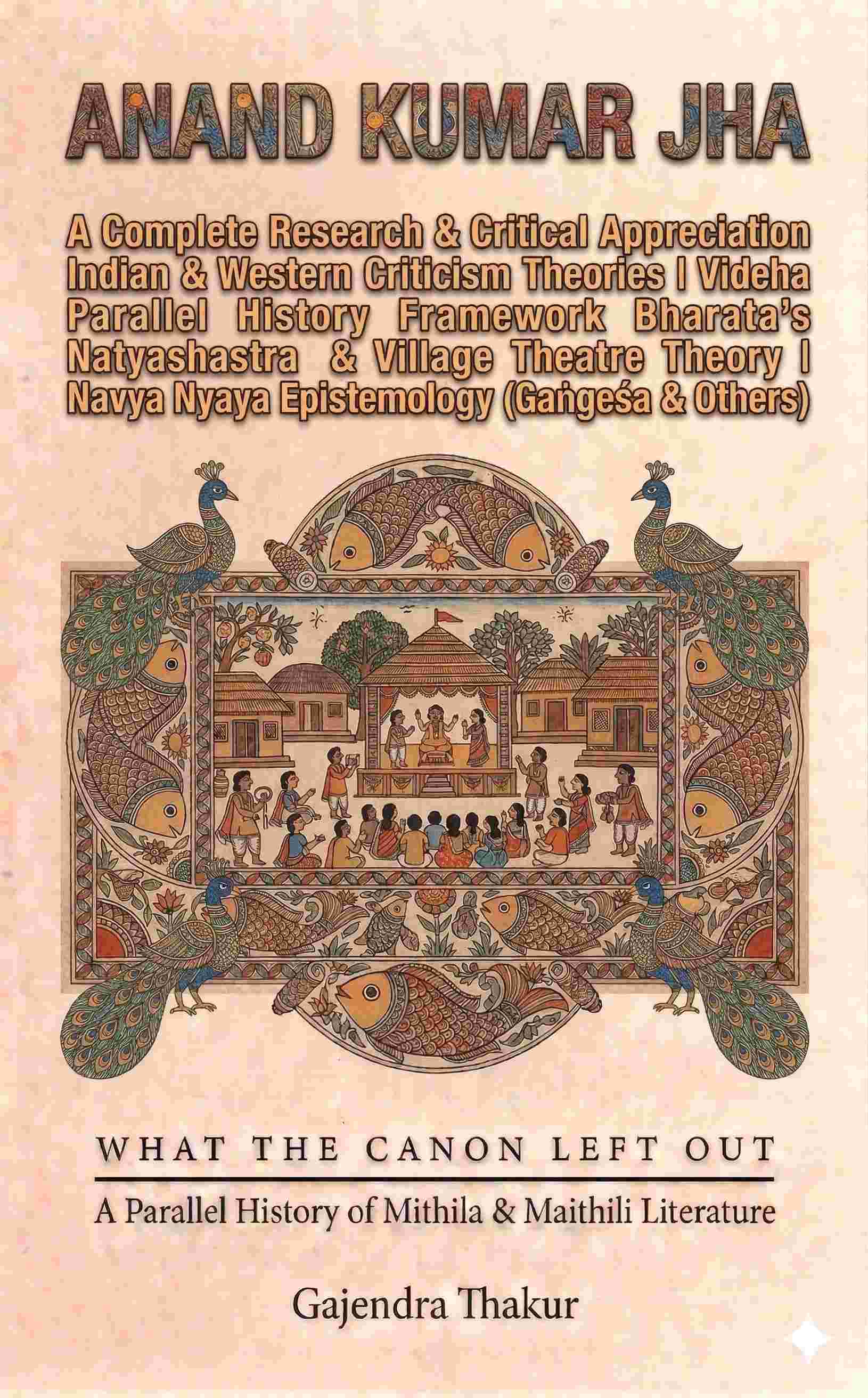
ANAND KUMAR JHA A Complete Research & Critical Appreciation Indian & Western Criticism Theories | Videha Parallel History Framework Bharata's Natyashastra & Village Theatre Theory | Navya Nyaya Epistemology (Gaṅgeśa & Others)
ANAND KUMAR JHA
A Complete Research & Critical Appreciation
Indian & Western Criticism Theories | Videha Parallel History Framework
Bharata's Natyashastra & Village Theatre Theory | Navya Nyaya Epistemology (Gaṅgeśa & Others)
Table of Contents
1. Introduction: Who Is Anand Kumar Jha?
2. Biographical Context and the Making of a Playwright
3. Overview of the Six Plays
3.1 Takak Mol (टाकाक मोल) — The Price of Money
3.2 Dhadhait Navki Kaniyank Lahas — The Burning Bride
3.3 Kalah (कलह) — Family Discord
3.4 Hathat Parivartan (हठात् परिवर्तन) — Sudden Change
3.5 Badlait Samaj (बदलैत समाज) — Changing Society
3.6 Mukti Yatra (मुक्ति यात्रा) — Journey of Liberation
4. Critical Appreciation through Indian Literary Theories
4.1 Rasa Theory (Bharata Muni's Natyashastra)
4.2 The Eight Rasas in Jha's Drama
4.3 Abhinaya: The Four Modes of Expression
4.4 Vritti (Dramatic Style): Bharati, Sattvati, Kaisiki, Arabhati
4.5 Natyashastra's Social Function (Lokasangraha)
4.6 Dhvani Theory (Anandavardhana)
4.7 Vakrokti (Kuntaka) and Auchitya (Kshemendra)
5. Village Theatre and Folk Drama Theories
5.1 Mithila's Loka-Natya Tradition
5.2 The Nach Tradition and Its Social Function
5.3 Bertolt Brecht's Epic Theatre and Village Drama Parallels
5.4 Richard Schechner's Environmental Theatre
5.5 Augusto Boal's Theatre of the Oppressed
6. Western Literary and Critical Theories
6.1 Aristotelian Dramaturgy
6.2 Feminist Theory and the Drama of Women's Oppression
6.3 Postcolonial Theory and Social Drama
6.4 Marxist/Materialist Dramaturgy
6.5 Psychoanalytic Theory (Freud, Lacan)
7. The Videha Parallel History Framework
8. Navya Nyaya Epistemology Applied to Drama
8.1 Pramana in Theatrical Cognition
8.2 Vyapti and Dramatic Logic
8.3 Anumana and Inference in Dramatic Structure
8.4 Tarka and Counter-argument in the Plays
9. Individual Play Analyses
10. Thematic Synthesis
11. Conclusion and Critical Assessment
12. Bibliography and References
1. Introduction: Who Is Anand Kumar Jha?
Anand Kumar Jha is one of the most distinctive and socially committed voices in contemporary Maithili drama. Rooted in the village of Menhath (मेंहथ), Jhanjharpur, Madhubani district, Bihar — in the very heartland of Mithila civilisation — he represents a generation of playwrights who emerged from rural Mithila in the late twentieth century, carrying the concerns of ordinary families, unemployed youth, dowry victims, patriotic soldiers' families, and politically manipulated village communities onto the Maithili stage.
His plays — Takak Mol (टाकाक मोल, 2000), Kalah (कलह), Dhadhait Navki Kaniyank Lahas (धधाइत नवकी कनियाँक लहास, 2003), Hathat Parivartan (हठात् परिवर्तन), Badlait Samaj (बदलैत समाज), and Mukti Yatra (मुक्ति यात्रा, c. 2015-16) — have been performed repeatedly across Maithili-speaking regions, from village stages in Madhubani to diaspora stages in Kolkata. His play Hathat Parivartan won the prestigious Sahitya Akademi Youth Prize at the national level — Maithili's first such recognition for a young playwright in this period — establishing him as a significant force in Indian regional theatre.
The critical essay prefacing Mukti Yatra (written by Rinku Devi) situates Jha within the sweep of Maithili dramatic history: from Jyotirishwar Thakur's 'Dhurta Samagam' and Vidyapati's 'Manimanjari' through the modern tradition inaugurated by Jiwan Jha's 'Sundar Sanyog', to the contemporary playwrights named in Gajendra Thakur's Videha survey — including Mahendra Malangiya, Uday Narayan Singh 'Nachiketa', Usha Kiran Khan, Vibha Rani, and others — among whom Jha takes his place as a representative voice of the younger generation.
What distinguishes Jha's theatre is its uncompromising attachment to the lived reality of Mithila's rural and semi-urban social world: the economics of dowry, the psychology of joint-family conflict, the patriotic consciousness of military families, the corrupting influence of politics on village character, and — in his most recent and ambitious play — the intertwining of national security threats, women's liberation, and the moral crisis of modernity. His writing is the literature of the village stage, grounded in performability, clarity of social message, and direct emotional communication with a non-elite audience.
2. Biographical Context and the Making of a Playwright
The autobiographical note in Mukti Yatra, one of the most moving author's statements in contemporary Maithili literature, reveals the extraordinary personal cost at which Jha has maintained his commitment to dramatic writing. He grew up in Menhath village, Jhanjharpur, Madhubani, and moved to Kolkata for a period of work during which he wrote several of his early plays. The critical prefatory note confirms: 'Anand Kumar Jha is a representative playwright of the young generation. During his Kolkata residence he wrote many plays. Many of his plays have been successfully staged. In his desire to write purposeful drama, he never became complacent. He proved himself again and again in subject selection and stage presentation.'
A sequence of family crises — the death of his father (who had been the financial support for his publications), the mental illness of both younger brothers Trilok and Amarendra (which forced him to leave employment and return to the village), the sale of fields and orchards to meet expenses — created a twelve-year period during which no new play was published, even as village troupes across Mithila continued to stage and re-stage his earlier five plays. He writes: 'I have seen my father's passing in these difficult times, through whose tireless effort book publication was possible. Both younger brothers Trilok and Amarendra became mentally ill, for which I had to leave my job and stay in the village. Thereafter a severe economic crisis began. As a result, fields and orchards began to be sold, a chain that continues to this day.'
Through all this, his wife maintained a small bookshop in Jhanjharpur — a Maithili Book Centre — 'in the belief that one day this Maithili book centre's day will come.' The dedication in Dhadhait is addressed simply to his wife, Sri Rinku Anand, describing her as companion in his literary life. This background — the poverty and sacrifice that attend Maithili literary production outside institutional support systems — is essential context for understanding both the social urgency of his writing and his alignment with the Videha Parallel History project.
The publisher Sri Prabhakar Abhinay Samiti, Gandhwari — a village-based theatre group — staged the premiere of Dhadhait Navki Kaniyank Lahas on 12 October 2002 under the auspices of a Durga Puja celebration committee. This originary context — festival performance by an amateur village troupe, for a village audience — is the constitutive performative context for all of Jha's plays and determines their dramaturgy, language register, and social function.
His publishers — Prachi Prakashan (Menhath, Jhanjharpur), Dipali Prakashan (Howrah), and Navarambh Prakashan — are small regional publishers, many based in the diaspora Maithili community. His plays were priced at Rs. 30-35 per copy with print runs of 500-1,100 copies — modest figures that nonetheless represent significant reach within the Maithili-speaking community.
3. Overview of the Six Plays
3.1 Takak Mol (टाकाक मोल, 2000) — The Price of Money
Takak Mol (published September 2000, 1,100 copies, Rs. 30) is Jha's debut play and an anti-dowry drama set in the household of Garib Jha — a poor Brahmin father with five daughters and minimal land. The play opens with Prabha, the eldest unmarried daughter, performing devotional worship and singing: 'Being born a poor man's daughter, how much humiliation must I endure in the world.' The central dramatic conflict unfolds around the desperate search for a suitable groom who will not demand an excessive dowry, the manipulations of a marriage-broker (Dalal) and his assistant (Chela), and the courage of the young man Jivesh who refuses to be complicit in the dowry system.
Key characters include: Garib Jha (poor father, 60), Sumitra (mother), Prabha (the heroine, college student), Gunanand (wise village elder), Dalal (marriage broker), and Jivesh (Garib's son forced to be a buffalo-herder instead of attending school because his father cannot afford both daughters' weddings and son's education). The play's dramatic irony — that the family's economic resources are entirely consumed by dowry demands, leaving no funds for the son's education — encodes a precise social-economic critique of the systemic irrationality of the dowry economy.
In the preface, Jha writes: 'Although many compositions on the dowry system have already come from the pen of scholars in Maithili, the day this society will find liberation from the cancer of dowry is receding further. After seeing all this, my heart could not stop itself from opposing this, and I tried to highlight this event in a new way and at the same time tried to advise the young men and women of the new generation to come forward openly.'
3.2 Dhadhait Navki Kaniyank Lahas (2003) — The Burning Bride
Published on Janaki Navami, 11 May 2003 (500 copies, Rs. 35), this play takes its title — 'The Smouldering Corpse of the New Bride' — directly from the horrific social reality of bride-burning: the murder of brides, usually by fire, when their dowry is deemed insufficient by the groom's family. The play was first staged by Sri Prabhakar Abhinay Samiti, Gandhwari, on 12 October 2002. Characters include Mantreshwar, Sameer, Shobhan, Ramlal, Shyamalakant, Doctor, Ritesh, Sushila, and Shikha. The play features a central female character Shikha in conversation with Sameer in an emotionally charged domestic situation. In the preface Jha acknowledges his debts to Dr. Dhanakar Thakur, Sri Ashok Ji, Sri Kulachandra Mishra, and others whose encouragement sustained his writing.
The essay on drama prefacing this volume is a significant theoretical statement: 'Drama is a visual poem (drishyakavya). It is considered the most powerful form of literature. All categories of audience are directly affected by it simultaneously. Through drama, the country, society, and individual circumstances and problems are brought before the audience face to face... The work that drama does in awakening the dormant consciousness of human beings collectively, no other literary form can do as effectively. At the level of revolution, drama is the most successful and simple literary form for bringing public consciousness.'
3.3 Kalah (कलह) — Family Discord
Kalah is subtitled 'Maithili Family Drama depicting the swelling pain of today's unemployed youth and young women entangled in current family problems.' Set in the 'Akash' household (literally 'Sky' — a domestic space with aspiration and turbulence), the play centres on Aarti (the daughter-in-law), Sumitra (the mother-in-law), Sureshwar (the father-in-law), and Akash (the husband). The opening scene depicts Aarti resting on a bed listening to the radio when Sumitra enters in an angry mood. The conflict escalates from domestic bickering to generational accusation to physical violence — Akash strikes Aarti when he believes she has dishonoured his parents — and is mediated by the intervention of Lutan Kaka, an elderly neighbour. The play explicitly situates domestic violence within unemployment: Akash's failure to earn money is the structural cause of his insecurity and aggression.
3.4 Hathat Parivartan (हठात् परिवर्तन) — Sudden Change
Winner of the All-India Sahitya Akademi First Youth Prize for Maithili drama, Hathat Parivartan is set in the haveli (mansion) of retired Brigadier Krishnachandra Pratap — a household defined by military honour, national pride, and sacrifice. The Pratap family's elder son Gopal Chandra Pratap serves as an Army Commander on the border. The dramatic conflict unfolds around the younger son Giridhar — an alcoholic, irresponsible youth — whose behaviour brings shame on the family's proud military legacy. The play features a complex family structure: Saraswati (wife/mother), Ranjana (daughter-in-law), Rohan (grandson), Shailini, Sajendra (uncle figure), and other characters. The play moves between scenes of patriotic exhortation and scenes of domestic comedy and pathos, contrasting the sacrificial ethic of military families with the hedonistic escapism of the urban-educated youth.
The announcement (Ghoshana) that opens the play frames the Pratap family's haveli as 'the immortal heritage of patriotism and goodwill... every stone of which seems to tell the story of sacrifice and renunciation, to sing the epic of valor and heroism.' This patriotic framing connects the play to the broader genre of nationalist social drama that Bharata's Natyashastra would classify under Sattvati Vritti (the heroic-noble dramatic style).
3.5 Badlait Samaj (बदलैत समाज) — Changing Society
Badlait Samaj is subtitled 'Social drama based on character-assassination attempts driven by political motives.' Its cast includes: Ghuran (Avdhesh's father, 60), Bhajendra (Deepak's father, 60), Avdhesh (sick young man, 25), Deepak (ideal young man, 25), Mandun (cunning villager, 50), Shikhar (sycophantic villager, 35), Netaji (politician, 50), Somen (lackey, 35), Vijendra (honest young villager, 30), Inspector (police, 37), Abhishek (Avdhesh's brother, 12). The play focuses on the intersection of illness, village politics, and character assassination. The bedridden young man Avdhesh debates his mother Shobha about the power of devotion and disease, declaring his disbelief in divine healing when his own illness worsens daily. The play diagnoses how political actors in contemporary rural Mithila use personal illness and misfortune as instruments of social stigma and character destruction.
3.6 Mukti Yatra (मुक्ति यात्रा) — Journey of Liberation
Jha's most recent and most ambitious play (c. 2015-16, published by Navarambh Prakashan), Mukti Yatra breaks significant new dramatic ground. The critical preface identifies its central concerns: the situation of martyred soldiers' families who face not only government neglect but active persecution by enemy agents; the grotesque of robotic surveillance technology (a 'robotic crow' appears as a mechanical dramatic device); women's liberation as an undertone (antarlaya) of the narrative; and the dangers of mutual suspicion in contemporary society. The play is described as suitable for both rural and urban stages — a deliberate attempt to bridge the village-stage and urban proscenium-stage formats that Jha's earlier plays inhabited.
The critical preface by Rinku Devi places the play explicitly within Maithili dramatic history, tracing the tradition from Charyyapada (Buddhist devotional songs), through Varna Ratnakar's evidence of rich Loka-Natya (folk theatre) in medieval Mithila, to Jyotirishwar's Dhurta Samagam, Vidyapati's dramatic works, and the modern tradition. It argues: 'Maithili dramatic history has its roots in drama. There was a time when Maithili dramatic performance (Maithili Natak ka Digdigia) resounded across all of India, especially in North India.' The play is presented as Jha's definitive claim on this inheritance.
4. Critical Appreciation through Indian Literary Theories
4.1 Rasa Theory (Bharata Muni's Natyashastra)
Bharata Muni's Natyashastra (c. 200 BCE–200 CE) is the foundational Indian text on dramatic theory. Its central contribution is the Rasa theory: the idea that drama communicates through eight primary aesthetic emotions (Rasas) — Shringara (love/beauty), Hasya (humour), Karuna (pathos), Raudra (fury), Vira (heroism), Bhayanaka (terror), Bibhatsa (disgust), and Adbhuta (wonder) — with the ninth, Shanta (peace), added later. Each Rasa is produced by the interplay of: Sthayi Bhava (enduring emotion), Vibhava (determinants/causes), Anubhava (consequent expressions), and Vyabhichari Bhava (transitory emotions).
Bharata writes in the Natyashastra (Chapter 6): 'Rasa is produced from the combination of Vibhava, Anubhava, and Vyabhichari Bhava. Just as the taste (rasa) of food is produced from various ingredients, similarly the Rasa of dramatic composition is produced from the combination of Vibhava etc.' The Natyashastra further defines the social function of drama: it exists to give 'relief to those afflicted by sorrow, fatigue, or grief, and to bring joy, entertainment, and delight to all people.' Drama is explicitly conceived as a democratic, inclusive public art: 'There is no wisdom, no learning, no yoga, no action which is not found in drama' (Natyashastra 1.116).
4.2 The Eight Rasas in Jha's Drama
The dominant Rasa across Jha's entire dramatic corpus is Karuna (pathos) — the rasa of sorrow, compassion, and the recognition of suffering. Takak Mol, Dhadhait, and Badlait Samaj are primarily Karuna dramas: the suffering of dowry victims, the death of brides, the wasting of young men's lives through disease and political persecution, all evoke this fundamental emotion. The Vibhava (determinant cause) of Karuna in Takak Mol is the systematic impoverishment of Garib Jha's family by the dowry economy; the Anubhava (expression) is Prabha's devotional song and tears; the Vyabhichari Bhava (transitory emotions) include anxiety, hope, despondency, and resolution.
Vira Rasa (heroism) is the dominant rasa of Hathat Parivartan and Mukti Yatra. The Pratap family's military heritage, the soldier-son Gopal's sacrifice at the border, the dramatic confrontation between patriotic duty and domestic weakness — all these generate the Vira aesthetic. The Natyashastra identifies Vira as 'the source from which all other rasas spring' (Chapter 6) — a claim particularly resonant in Jha's patriotic dramas where heroic sacrifice provides the moral measure against which all domestic weakness is evaluated.
Hasya (comedy) operates as secondary rasa in Kalah and Hathat Parivartan, providing comic relief through characters like Lutan Kaka (the mediating elder in Kalah), Sajendra's drunken calculations in Hathat Parivartan ('if I hadn't drunk, I'd have three lakh sixty-five thousand rupees in the bank by now'), and the marriage-broker's dialogue in Takak Mol. This strategic deployment of Hasya as Vyabhichari Bhava (transitory accompanying emotion) alongside the dominant Karuna is precisely the technique Bharata describes for sustained dramatic effect.
Raudra Rasa (fury) punctuates climactic scenes: Akash's physical violence against Aarti in Kalah, the bride-burning in Dhadhait, the political protagonist's character-assassination attempts in Badlait Samaj. Bibhatsa (disgust and revulsion) is evoked through these same scenes, particularly the burning bride motif — what Bharata identifies as the rasa of repulsion that produces moral awakening in the audience.
4.3 Abhinaya: The Four Modes of Expression
The Natyashastra identifies four modes of dramatic expression (Abhinaya): Angika (bodily/gestural), Vachika (verbal), Aharya (costume/make-up/scenery), and Sattvika (emotional/psychic). Jha's drama, designed for both village and urban stages, demonstrates sophisticated engagement with all four modes.
Vachika Abhinaya (verbal expression) is Jha's strongest mode: his dialogue is in authentic Maithili village idiom, class-differentiated (the poor Brahmin speaks differently from the politician; the soldier's family speaks differently from the village broker), and emotionally calibrated to the rasa economy of each scene. The dramatic announcement (Ghoshana) that opens Hathat Parivartan — in formal, elevated Maithili — establishes the patriotic emotional register before a word of dialogue is spoken.
Aharya Abhinaya (visual/scenic presentation) in Jha's plays is consistently minimal: the stage directions specify domestic settings (a room with a radio and a bed in Kalah; a prosperous haveli in Hathat Parivartan; a poor man's house with a deity's photograph in Takak Mol) that can be easily reproduced on village stages. This economy of staging is both a material necessity for village-theatre production and a dramaturgical principle: the plays' power derives from human interaction, not spectacular visual effect.
4.4 Vritti (Dramatic Style)
The Natyashastra classifies drama into four Vrittis (dramatic styles): Bharati (verbal/intellectual), Sattvati (heroic/noble), Kaisiki (gentle/erotic), and Arabhati (violent/impetuous). Jha's plays deploy different Vrittis in different contexts. Hathat Parivartan and Mukti Yatra predominantly employ Sattvati Vritti: the noble-heroic register appropriate to representations of military sacrifice and patriotic duty. Kalah and Takak Mol predominantly use Bharati Vritti: the conversational-intellectual register in which social argument is conducted through dialogue. Dhadhait uses Arabhati Vritti in its violent climax: the impetuous, forceful register of the bride-burning scene. Kaisiki Vritti appears in the romantic sub-plots of Takak Mol and the tender scenes between Shikha and Sameer in Dhadhait.
4.5 Natyashastra's Social Function (Lokasangraha)
The Natyashastra explicitly positions drama as a form of social instruction (Lokasangraha — 'holding together the world/society'). Bharata writes: 'I shall now speak of the objectives of drama (Natyaprayojana): the instruction of all people, the giving of advice to those without teachers, the amusement of people worn out by labour, and the demonstration of what is dharma and adharma.' This social-didactic function is precisely how Jha conceives his own practice. His preface to Takak Mol states that he writes 'to advise the young men and women of the new generation to come forward openly' against the dowry system. His note in Dhadhait defines drama as 'the most successful and simple literary form for bringing public consciousness.'
Jha's theatrical practice embodies what Bharata calls Nata-dharma (the law of the actor/dramatist): the obligation to speak to the fullness of social reality, not to entertain alone. This is why his plays consistently end with positive exemplars: a young man who refuses dowry demands (Takak Mol), a patriotic son whose sacrifice redeems a family's honour (Hathat Parivartan), honest youth who resist political manipulation (Badlait Samaj). These resolutions are not naive optimism but Lokasangraha — the dramatist's obligation to 'hold society together' by demonstrating that alternatives to oppression are possible.
4.6 Dhvani Theory (Anandavardhana)
Anandavardhana's Dhvanyaloka (9th century CE) — the theory of suggestion (dhvani) as the soul of poetry — is particularly applicable to Jha's dramatic language. The title 'Takak Mol' (The Price of Money) is itself a powerful dhvani: literally the price/value of money, it suggests that money has become the measure of everything — of a bride's worth, of a child's education, of family honour, of human relationships. This dhvani resonates throughout the play without any character explicitly articulating it. Similarly, 'Dhadhait' (smouldering/burning) in the title 'Dhadhait Navki Kaniyank Lahas' operates on multiple registers: the physical burning of the bride, the smouldering injustice of the social system, the slow burning of family honour, and the burning indignation of the audience — all suggested by this single word.
In Hathat Parivartan (Sudden Change), the dhvani operates through the contrast between the haveli's noble history and the present degeneracy: the stones that 'seem to tell stories of sacrifice' stand in ironic dhvani-relation to Giridhar's alcoholic waste. This is what Anandavardhana calls Alamkara-dhvani — the resonance produced by an ironic disproportion between surface and depth, between what is shown and what is suggested.
4.7 Vakrokti (Kuntaka) and Auchitya (Kshemendra)
Kuntaka's theory of Vakrokti (oblique/creative deviation) illuminates Jha's dramatic irony. The character of Dalal (the marriage broker) in Takak Mol speaks in the most polite, deferential Maithili, offering his 'services' with elaborate courtesy — while his actual function is extortion and exploitation. This gap between his verbal style (indirect, obliging) and his social function (predatory) is a sustained Vakrokti: the creative deviation that produces the bitter comedy of the broker-merchant alliance in the dowry economy.
Kshemendra's Auchitya (contextual propriety) is particularly relevant to Jha's village-theatre aesthetics. Every element of his dramatic language — the Maithili dialect register, the domestic settings, the prayer-songs embedded in Takak Mol, the folk-idioms of village dispute in Kalah — achieves perfect Auchitya: contextual appropriateness to the social world, the characters, and the audience. This is the aesthetic principle that makes his plays performable by village troupes with minimal technical resources.
5. Village Theatre and Folk Drama Theories
5.1 Mithila's Loka-Natya Tradition
The critical preface to Mukti Yatra traces Maithili dramatic history back to Charyyapada (the Buddhist devotional songs of the 8th-12th centuries CE) and the evidence of Loka-Natya (folk theatre) in Jyotirishwar Thakur's Varna Ratnakar (14th century CE). This is a profound genealogical claim: that Maithili theatre is not derivative of Sanskrit classical drama but has its own ancient folk-dramatic tradition, possibly preceding the Sanskrit literary tradition.
The essay explicitly argues: 'Considering Varna Ratnakar as the founding text of Maithili is a historical mistake we have made. The topics described in Varna Ratnakar prove that in the matter of Loka-Natya (folk performance including Nach etc.) we were rich from ancient times. The historical mistake of considering Varna Ratnakar as the first Maithili text should be reconsidered.' This is a significant intervention in Maithili literary historiography: it displaces the canonical origin story and asserts the priority of the folk-performance tradition.
The Nach (नाच) tradition — a distinctively Mithila form of musical theatre combining dialogue, song, dance, satire, and social commentary, performed at festivals and occasions by semi-professional village troupes — is the immediate performative ancestor of Jha's written plays. Nach performances historically addressed social issues (caste discrimination, women's oppression, economic exploitation), used Maithili folk music and idiom, and performed for village audiences in open-air settings. Jha's plays inherit this tradition's social commitment, folk-idiom, and performative accessibility while translating it into the more structured proscenium-stage or temporary-stage format.
5.2 Bertolt Brecht's Epic Theatre and Village Drama
Bertolt Brecht's theory of Epic Theatre (developed in the 1920s-40s) proposed a dramaturgy that disrupts illusionist identification, encourages critical distance, and produces a politically awakened spectator rather than an emotionally catharted one. Brecht's Verfremdungseffekt (V-Effekt or 'alienation effect') — techniques that prevent the audience from losing itself in the performance and instead make it think critically — has striking parallels with certain features of Maithili village theatre.
The Ghoshana (dramatic announcement) that opens Hathat Parivartan functions as a Brechtian narrator-frame: it introduces the dramatic situation in a detached, formal register before the action begins, preventing the audience's immediate emotional immersion and encouraging intellectual framing. Similarly, the songs embedded in Takak Mol — Prabha's devotional song about being born a poor man's daughter — function as what Brecht calls 'gestus songs': music that carries social commentary and interrupts the narrative flow.
However, the analogy is not complete. Brecht intended alienation to displace emotional identification entirely; Jha's village theatre relies on strong emotional identification (particularly the Karuna Rasa of the suffering bride, the poor father, the unemployed son) as its primary means of social communication. The village audience is not positioned as critical spectator but as empathetic participant. This reflects the difference between Brecht's avant-garde Western theatre and the socially embedded popular tradition of village theatre, which uses emotion rather than alienation as its path to social conscience.
5.3 Richard Schechner's Environmental Theatre
Richard Schechner's theory of Environmental Theatre (1968 onwards) holds that theatre is not confined to the proscenium stage but exists in any environment that the performers and audience co-create as a theatrical space. Schechner draws on the anthropological work of Victor Turner and Erving Goffman to argue that all performance is ritual, and all ritual is potentially theatre.
This framework is highly applicable to the originary performance context of Jha's plays: village festivals (Durga Puja, Janaki Navami), open courtyards, temporary stages constructed for specific occasions. The first performance of Dhadhait at a Durga Puja celebration on 12 October 2002, by a village troupe (Sri Prabhakar Abhinay Samiti, Gandhwari), in an outdoor or semi-outdoor ritual context, is precisely the Environmental Theatre situation Schechner describes. The audience is not passive spectator but ritual community participant; the performance space is the community's own gathering space; the play is embedded in a broader ritual-social event.
5.4 Augusto Boal's Theatre of the Oppressed
Augusto Boal's Theatre of the Oppressed (1974) — developed in Brazil for use with poor and marginalised communities — proposes drama as a form of 'rehearsal for revolution': a means by which oppressed people can explore, articulate, and begin to transform the social conditions that oppress them. Boal's techniques include Forum Theatre (where audience members become 'spect-actors' who intervene in the performance to try out different responses to oppression) and Image Theatre (where frozen body images express social relationships).
The social project of Jha's dramatic writing maps closely onto Boal's framework. The dowry victims, unemployed youth, and politically persecuted villagers who are Jha's dramatic subjects are precisely the 'oppressed' whose rehearsal for alternative responses to oppression Boal describes. Takak Mol functions as Forum Theatre: by dramatising the full logic of the dowry economy — the broker's manipulation, the father's despair, the daughter's prayer, the young man's potential resistance — it invites the village audience to imaginatively rehearse the refusal of this logic. The play's resolution — the young man who refuses dowry demands — is exactly the 'spect-actor intervention' Boal identifies as the goal of Forum Theatre.
6. Western Literary and Critical Theories
6.1 Aristotelian Dramaturgy
Aristotle's Poetics (c. 335 BCE) defines drama through its six constituent elements: Mythos (plot), Ethos (character), Dianoia (thought/theme), Lexis (language/diction), Melos (song/music), and Opsis (spectacle). It privileges Mythos as the 'soul of tragedy': the structured sequence of actions that produces recognition (Anagnorisis) and reversal (Peripeteia), culminating in Catharsis — the purgation of fear and pity in the audience.
Jha's plays conform to the Aristotelian definition in several respects. Each play has a clear Mythos: Takak Mol's plot moves through exposition (Garib's poverty and desperation), rising action (the broker's manipulations, the social pressure), recognition (the young man's insight into the system), and resolution (his refusal). Dhadhait's Mythos is structured around the fatal peripeteia of the bride's death. Hathat Parivartan's Mythos moves towards the anagnorisis of Giridhar's recognition of his own degradation against his family's heroic legacy.
However, Aristotle's insistence on single unified plot (the 'unity of action') is less applicable to Jha's multi-strand village dramas, which characteristically weave several social issues simultaneously. Kalah, for instance, develops parallel strands of mother-in-law/daughter-in-law conflict, unemployment, and domestic violence simultaneously — a multiple-strand structure more characteristic of Indian village drama than Aristotelian unity.
6.2 Feminist Theory and the Drama of Women's Oppression
Feminist dramatic theory (Sue-Ellen Case, Jill Dolan, Elin Diamond) examines how theatre represents, constructs, and potentially challenges gender oppression. The female body on stage — who controls it, how it is displayed, what social meanings are attached to it — is a central concern. Jha's drama is saturated with the politics of women's bodies: Prabha's body is a financial liability in the dowry economy (Takak Mol); the new bride's body is literally burned when her dowry proves insufficient (Dhadhait); Aarti's body is the target of domestic violence (Kalah); female characters in Hathat Parivartan and Badlait Samaj are subject to various forms of social control and character assassination.
Jha's treatment of these themes is not feminist in the theoretical sense — he does not question the patriarchal structures themselves but protests their extreme, brutal manifestations. His heroines are sympathetic sufferers rather than agents of structural transformation. This is consistent with the populist-reformist tradition of village social drama, which aims to modify behaviour within existing structures rather than to challenge the structures themselves. However, the very act of staging female suffering — of making visible what is normally confined to domestic space — performs a feminist function in the context of village performance culture.
6.3 Postcolonial Theory and Social Drama
Frantz Fanon's analysis of colonial violence and its internalisation (The Wretched of the Earth, 1961) provides a framework for reading the political drama in Badlait Samaj. The play's central conflict — between honest young men (Avdhesh, Deepak, Vijendra) and a corrupt politician (Netaji) who uses traditional power structures to destroy the reputation of those who threaten his authority — maps precisely onto Fanon's analysis of how postcolonial elites reproduce colonial structures of violence and domination at the village level.
Homi Bhabha's concept of 'mimicry' — the colonised subject's imperfect imitation of the coloniser — appears in the characterisation of Giridhar in Hathat Parivartan: his alcohol consumption, his English-educated contempt for tradition ('ई इड्ललिशक रामायण' — 'This is the Ramayana in English' — he says mockingly), and his disconnection from his family's heroic identity represent a form of cultural mimicry that has dissolved without producing genuine modernity. The 'sudden change' of the title is the hoped-for reversal of this mimicry-driven alienation.
6.4 Marxist/Materialist Dramaturgy
Raymond Williams's cultural materialism and the Marxist dramatic tradition of Raymond Williams, Walter Benjamin, and Theodor Adorno provide tools for reading the economic determinism that underlies all of Jha's social dramas. The plays consistently locate social dysfunction in economic conditions: the dowry system is not a cultural aberration but an economic structure that systematically transfers wealth from poor families to prosperous ones. Unemployment is not an individual failure but a structural condition of rural Bihar's under-developed economy. Domestic violence is not a psychological pathology but a consequence of economic powerlessness expressing itself through gender domination.
This materialist analysis of social evil — tracing individual suffering to structural economic conditions — is precisely the Marxist theatrical tradition that Walter Benjamin admired in Brecht: the capacity to show the social origin of human suffering rather than attributing it to individual psychology or fate.
6.5 Psychoanalytic Theory
Freudian and Lacanian psychoanalysis, applied to theatre (by critics such as Julia Kristeva and Jane Gallop), offers insights into the unconscious dynamics of Jha's drama. The character of Akash in Kalah — violent towards his wife yet dependent on his family, unable to earn yet unable to accept his economic failure — exhibits what Freud called 'narcissistic injury': the wound to male self-image that occurs when economic failure makes the patriarchal provider-role impossible. His violence against Aarti is a displacement of this narcissistic injury onto the nearest available body.
The figure of Giridhar in Hathat Parivartan — the alcoholic son who unconsciously undermines the military heroism of his father and brother — exhibits what Lacan calls the 'lack' at the centre of identity: the impossibility of living up to the symbolic mandate of the Father (the Brigadier, the heroic soldier-ancestor). Giridhar's alcohol is not simply vice but a symptom of this Lacanian impossibility — the unconscious refusal of an identity he cannot inhabit.
7. The Videha Parallel History Framework
Gajendra Thakur's Videha Maithili eJournal (www.videha.co.in, ISSN 2229-547X) has established what its editorial tradition calls a 'Parallel History' (Samanantar Itihas) of Maithili drama and literature — an alternative critical framework that contests the dominant upper-caste, institutionally-sanctioned literary history.
The Videha essay on Maithili theatre and drama (archived at maithili-samalochna.blogspot.com) explicitly names Anand Kumar Jha in its survey of contemporary Maithili playwrights, alongside Mahendra Malangiya, Uday Narayan Singh 'Nachiketa', Bhasakarananda Jha, Ashutosh Kumar Mishra, Manoj Manuj, Sanjiv Mishra, Swati Singh, and others. This placement is significant: it locates Jha within the Videha Parallel History project's canon of socially committed, non-institutionally dominant writers.
The Videha Parallel History framework is particularly relevant to understanding Jha's dramatic achievement for several reasons: First, Jha writes from a village location (Menhath, Jhanjharpur) rather than the metropolitan centres (Patna, Delhi, Kolkata) that dominate mainstream Maithili literary culture. Second, his plays circulate primarily through village performance networks — amateur theatre groups, festival stages, community events — rather than through academic institutions or literary establishments. Third, his subject matter — dowry, domestic violence, unemployment, political corruption, military sacrifice in rural families — addresses precisely the social constituencies that dominant Maithili literary culture has historically underrepresented.
The Videha Archive's preservation of his plays in digital form represents the Parallel History framework's key practical function: archiving and democratising access to literary works that would otherwise remain confined to small print runs and limited local distribution. The availability of Jha's plays on the Videha Archive ensures that his work is accessible to scholars, directors, and readers across the global Maithili-speaking diaspora.
The preface to Mukti Yatra's literary-historical argument — recentring Charyyapada and Loka-Natya as the true origin of Maithili drama — is itself a Parallel History intervention: it contests the canonisation of Varna Ratnakar as the founding Maithili text and asserts the folk-performance tradition as the more ancient and more democratically rooted origin of Maithili literary expression.
8. Navya Nyaya Epistemology Applied to Drama
Navya Nyaya (New Logic), the school of Indian epistemology that originated in Mithila with Gaṅgeśa Upadhyaya's Tattvacintamani (c. 13th century CE) and was elaborated by successive generations of Maithili logicians, offers a distinctive epistemological framework for analysing dramatic cognition. Applying Navya Nyaya to Jha's drama is not merely a technical exercise but an act of cultural hermeneutics: reading works produced within the Mithila cultural tradition through the epistemological tools that same tradition produced.
8.1 Pramana in Theatrical Cognition
The Naiyayika tradition identifies four Pramanas (sources of valid knowledge): Pratyaksha (direct perception), Anumana (inference), Upamana (comparison/analogy), and Shabda (verbal testimony). Theatre, as a form of cognitive experience, engages all four Pramanas simultaneously and in distinctive configurations.
In the theatrical situation, Pratyaksha operates differently from everyday perception: the audience perceives real actors on a real stage, but cognitively processes them as fictional characters in a fictional situation. This is what the Natyashastra calls the distinctive theatrical mode of knowledge — a conditioned Pratyaksha in which real and fictional are held simultaneously in consciousness. In Jha's village drama, the proximity of actor and audience (village-stage performance), the use of known actors from within the community, and the social recognisability of the dramatic situations intensify this dual Pratyaksha: the audience simultaneously perceives both the actor (whom they know) and the character (whose social type they recognise).
Anumana (inferential knowledge) is activated when the audience infers social causes from dramatic effects. When Avdhesh in Badlait Samaj grows progressively sicker despite his wife's care and prayers, the Anumana is: this illness is not merely physical but social — produced by the stress of poverty, the absence of adequate healthcare, and the persecution of political enemies. The audience's inferential process moves from the particular dramatic event to the general social condition, which is the primary educational function of social drama.
8.2 Vyapti and the Logic of Social Drama
Gaṅgeśa's central contribution to Navya Nyaya is the precise analysis of Vyapti — the invariable concomitance (universal rule) that makes inferential reasoning valid. 'Where there is smoke, there is fire' is valid because of the Vyapti: smoke is invariably concomitant with fire. Navya Naiyayikas developed an extraordinarily precise technical vocabulary for establishing and testing Vyaptis, distinguishing genuine from merely apparent concomitances.
Jha's social dramas operate by constructing dramatic evidence that tests and ultimately refutes the dominant social Vyaptis of Mithila's patriarchal-feudal world. The apparent Vyapti 'where there is a daughter, there is a debt' (the dowry economy's cultural logic) is the false universal that Takak Mol subjects to dramatic testing. Through the particular story of Garib Jha's family — five daughters, twelve katthas of land, no savings — the play accumulates dramatic evidence (Vyabhichari counter-instances) against this Vyapti: Prabha's devotion, intelligence, and college education are presented as positive qualities that ought to make her a desirable bride independent of dowry. The play's resolution — the young man who refuses dowry — produces what Navya Nyaya calls Badhakapramana: defeating evidence that nullifies the false Vyapti.
In Navya Nyaya terms, Dhadhait Navki Kaniyank Lahas constructs the most powerful Badhakapramana of all: the bride's burned body is the ultimate counter-instance that defeats the Vyapti 'the dowry system is natural/inevitable.' The dramatic spectacle of this extreme consequence — shown not sanitised but in its full horror — is the epistemically effective defeat of the social logic that produces it.
8.3 Tarka (Counter-argument) in the Plays
Navya Nyaya's sophisticated analysis of Tarka (hypothetical reasoning/counter-argument) is visible in the dramatic debates that structure Jha's plays. In Kalah, the extended dialogue between Akash and his father Sureshwar about money, employment, and family obligation is a sustained Tarka structure: each character advances inferential claims (Anumana) based on different Vyaptis about the responsibilities of sons and daughters-in-law, and the dialogue moves through a sequence of Tarka counter-arguments without reaching a stable resolution — because the underlying economic condition (unemployment) that produces the conflict remains unresolved.
In Hathat Parivartan, the Tarka debate is between the value systems of military sacrifice and urban hedonism: Sajendra's argument ('if I hadn't drunk I'd be a lakh-pati') is a Tarka that appropriates the logic of economic rationality in defence of alcohol, only to be defeated by the superior Tarka of family honour and patriotic duty. This is precisely the Navya Nyaya dialectic of Vada (sincere debate) in which the debaters are genuinely engaged in truth-seeking, not merely scoring points.
8.4 Shabda Pramana and Theatrical Authority
In Navya Nyaya, Shabda Pramana (verbal testimony) is valid when it derives from an Apta — a reliable, authoritative witness with direct knowledge. The question of who counts as Apta in Maithili dramatic culture is a cultural-political question: whose testimony about social reality is authorised to be heard on the public stage?
Jha's dramatic project involves a systematic expansion of Apta-hood: the poor father (Garib Jha in Takak Mol), the suffering daughter-in-law (Aarti in Kalah), the burning bride (in Dhadhait), the sick young man (Avdhesh in Badlait Samaj) — all are constituted as reliable witnesses to social reality. Their testimony — delivered in authentic Maithili village idiom, from within the full specificity of their social situation — is the Shabda Pramana that the drama validates against the dominant cultural testimony of those who benefit from the dowry system, domestic violence, and political corruption. This is the epistemological democracy of village theatre: the stage as a space where the Apta-hood of the subaltern is publicly constituted.
9. Individual Play Analyses
9.1 Takak Mol: Dramaturgy of the Dowry Economy
Takak Mol's opening scene — Prabha worshipping before a deity's photograph, singing a song of lament about being born poor — establishes the play's central dramatic and social frame: the interplay between religious resignation and social protest. The deity photograph, the prayer, and the song are simultaneously an Aharya setting element (visual stage image), a Sattvika Abhinaya (spiritual-emotional expression), and a dhvani: the gap between Prabha's devotion and the social indifference to her situation suggests the inadequacy of religious consolation for structural social injustice.
The character of Garib Jha — whose name literally means 'poor Jha' — is a Brechtian social type as much as an individualised character: he embodies the structural position of the poor upper-caste Brahmin father in the dowry economy, whose social status (Brahmin) prevents him from manual labour ('born a Brahmin, not able to plough like a low caste') while his poverty makes the dowry demands of his daughters' marriages financially catastrophic. This double bind — social status that prohibits economic alternatives, combined with economic incapacity to fulfil the social obligations that status requires — is the structural trap that Takak Mol exposes with social-realist precision.
The broker-character (Dalal) and his sidekick (Chela) function as comic-satirical figures in the tradition of Hasya Rasa characters: their elaborate courtesy masks naked financial exploitation, and their dialogue with Garib Jha provides the play's most biting social satire ('in two to four days I'll find a match — though I should mention one more thing I forgot to say...' — perpetually raising the dowry demand). This satirical register is both an entertainment device and an epistemological tool: by exposing the broker's manipulation with comic clarity, the play demystifies the marriage-market's logic for the village audience.
9.2 Kalah: The Architecture of Domestic Violence
Kalah's dramatic architecture is a study in escalation: from small domestic irritations (Sumitra's jealousy of her daughter-in-law's radio, her complaint about 'that troublemaker who came to our house to set it on fire') through verbal attack to physical violence. The play maps the psychology of joint-family conflict with considerable nuance: Sumitra's aggression is not simply spite but the displacement of her own frustrated maternal ambition onto the daughter-in-law who has 'stolen' her son; Akash's violence is not simply cruelty but the expression of his economic impotence in the only domain where he retains power (domestic authority over his wife); Sureshwar's weakness is not simply cowardice but the exhaustion of a man who has worked his whole life to maintain a family structure now held together only by force.
The character Lutan Kaka — the intervening elder — represents the traditional mediation function of the village community, whose authority over domestic violence has eroded in the conditions of semi-urban alienation (the 'Akash' family lives in what the play implies is a town or semi-urban setting, not a village). His inability to prevent Akash's violence despite his intervention is the play's most sobering social diagnosis: the traditional communal mechanisms of conflict resolution are no longer adequate to contain the violence produced by economic dispossession.
9.3 Hathat Parivartan: Patriotism and Domestic Degeneration
Hathat Parivartan's dramaturgical strategy is the sustained ironic contrast between the military heroism of the Pratap family tradition (encoded in the haveli's 'stones that speak of sacrifice') and the domestic comedy-tragedy of the drunkard son Giridhar. This ironic structure — noble past, degraded present — is a classic device of Indian traditional theatre (comparing present degeneration with past glory) adapted to the contemporary social reality of urban-educated youth unable to inhabit the values of their families.
The play's most dramatically powerful scene — the grandson Rohan's questions to his soldier-father Gopal ('Grandpa says you are a Commander, what do you do as Commander, Papa?') — is a moment of pure Anagnorisis in the Aristotelian sense: the recognition of what heroism truly is, articulated through a child's innocent curiosity, against the background of Giridhar's comic-pathetic degradation. This structural juxtaposition achieves both Karuna (pity for the family's predicament) and Vira (admiration for military sacrifice) simultaneously — a sophisticated double-Rasa effect.
9.4 Mukti Yatra: Theatre of National Security and Women's Liberation
Mukti Yatra represents a significant formal and thematic advance on Jha's earlier plays. The 'robotic crow' — a mechanical surveillance device used by enemy agents — is the most avant-garde dramatic device in his entire corpus: it brings the technology of modern warfare and espionage into the village-drama space, forcing a collision between rural domestic experience and geopolitical reality. This device has precedents in the Natyashastra's tradition of Nanavakya (wondrous/unusual dramatic elements that produce Adbhuta Rasa), but also anticipates contemporary performance art's engagement with drone technology and digital surveillance.
The play's complex plot — soldier's family under persecution, women's liberation as undertone, robotic surveillance, the identification of enemies within — is deliberately designed to work on both village and urban stages. This formal ambition reflects Jha's mature understanding that the village-stage/urban-stage binary is itself a social construction that his dramatic practice can help dissolve.
10. Thematic Synthesis
a. The Structural Violence of the Dowry Economy
Across Takak Mol and Dhadhait Navki Kaniyank Lahas — and implicitly present in Kalah and Badlait Samaj — the dowry economy appears not as individual greed or cultural backwardness but as a structural feature of the Maithili-Brahmin social economy: a system that systematically extracts surplus value from poor families, disciplines women's bodies and lives, and produces the material conditions for domestic violence and bride-murder. Jha's persistent return to this theme across multiple plays constitutes a sustained, multi-angled dramatic indictment of this system.
b. Unemployment and the Crisis of Masculinity
From Akash in Kalah to Giridhar in Hathat Parivartan to the young men of Badlait Samaj, Jha's drama consistently diagnoses the crisis of young educated Maithili men who cannot find employment appropriate to their education and social status. This crisis of masculinity — the inability to fulfil the provider-role that patriarchal social structure defines as masculine identity — is shown to produce domestic violence (Kalah), hedonistic escapism (Hathat Parivartan), and susceptibility to political manipulation (Badlait Samaj). Jha's is the drama of a generation educated beyond the economic opportunities available to it.
c. Patriotism, Sacrifice, and National Identity
Hathat Parivartan and Mukti Yatra constitute a distinctive strand of patriotic drama within Jha's corpus. Both plays invoke the military sacrifice of families from the rural Maithili-speaking regions — a sacrifice that is largely invisible in dominant national discourse, which tends to locate military heroism in Rajput and Punjabi martial cultures rather than Bihari Brahmin or other Maithili families. Jha's patriotic drama is thus also an act of cultural-political visibility: asserting the presence of Mithila's sons and daughters within the national security narrative.
d. The Corruption of Village Democracy
Badlait Samaj and, to some extent, Takak Mol, diagnose the corruption of village democratic life by political actors (Netaji, the politician) who use traditional social authority, economic dependency, and cultural prestige to maintain dominance against the aspirations of honest young people. This is Jha's contribution to a genre of Indian social drama concerned with the distortion of Panchayati Raj (local self-governance) by organised political power.
e. The Village Stage as Social Institution
Across all six plays, Jha's consistent orientation toward village-stage performance — the amateur troupe, the festival context, the non-elite audience — constitutes his most fundamental social position: drama is a democratic public institution, not an elite entertainment. This is the practical embodiment of Bharata's Natyashastra principle that drama exists for 'all people' — not for scholars, aristocrats, or urban elites but for the full range of social classes and conditions that constitute the dramatic audience.
11. Conclusion and Critical Assessment
Anand Kumar Jha's six plays, taken together, constitute one of the most sustained and socially grounded bodies of dramatic writing in contemporary Maithili literature. From the debut anti-dowry play Takak Mol (2000) through the patriotic-military drama of Hathat Parivartan (Sahitya Akademi Youth Prize winner) to the ambitious multi-stranded Mukti Yatra (c. 2015-16), his dramatic career traces an arc from focused social protest to more complex engagement with questions of national identity, technological modernity, and women's liberation.
His greatest dramaturgical strength is the capacity for social-structural analysis delivered through emotionally compelling individual drama: the particular suffering of Garib Jha's family encodes the structural violence of the dowry economy; the particular degradation of Giridhar in the Pratap haveli encodes the structural crisis of educated but unemployed young Maithili men; the particular persecution of Avdhesh in Badlait Samaj encodes the structural corruption of village political life. This movement from particular to structural — from the individual dramatic situation to the social condition it typifies — is simultaneously what Bharata calls Rasa-production (the universalisation of emotion) and what Marxist dramaturgy calls ideological demystification.
His limitations, if any, lie in the relative predictability of his dramatic resolutions: plays that diagnose social pathologies with sharp realism tend to resolve them through exemplary individual virtue (the young man who refuses dowry, the patriotic son who reclaims family honour, the honest young man who resists political manipulation). These resolutions, while satisfying in terms of Lokasangraha (social instruction) and Vira Rasa (heroic inspiration), do not fully explore the structural conditions that make such individual virtue necessary or the reasons why it remains the exception rather than the rule. This is less a dramatic failure than a strategic choice appropriate to the village-stage context and its social function.
Through the multiple frameworks applied in this study — Bharata's Natyashastra and village theatre theory, Western dramaturgy from Aristotle to Brecht to Boal, feminist and Marxist dramatic criticism, the Videha Parallel History framework, and Navya Nyaya epistemology — a coherent and distinctive dramatic identity emerges: Anand Kumar Jha is a writer of the Mithila village stage in the deepest sense — not merely a writer for the village audience but a writer from within the village's social logic, its epistemological horizon, and its performance traditions. His drama is the most direct contemporary descendant of the Mithila Nach tradition's social commitment: art as public conscience, theatre as the community's rehearsal for a more just society.
In the Natyashastra's terms, he fulfils Bharata's mandate: 'Drama gives instruction, pleasure, and advice to those without teachers; it corrects the conduct of those who are ignorant, and is a delight to those who are wise.' In the Navya Nyaya terms of Gaṅgeśa's epistemological tradition: his plays are Aptavakya — the valid testimony of a reliable witness — concerning the social reality of Mithila's rural communities in the late twentieth and early twenty-first centuries.
12. Bibliography and References
Primary Sources (Works of Anand Kumar Jha)
• Jha, Anand Kumar. Takak Mol (Maithili Drama). Publisher: Sri Tara Kant Jha, Menhath, Jhanjharpur, Madhubani. First Edition: September 2000. Price: Rs. 30. 1,100 copies.
• Jha, Anand Kumar. Dhadhait Navki Kaniyank Lahas (Maithili Drama). Prachi Prakashan, Menhath, Jhanjharpur, Madhubani. First Edition: Janaki Navami, 11 May 2003. Price: Rs. 35. 500 copies.
• Jha, Anand Kumar. Kalah (Maithili Family Drama). Published by Sri Kali Kant Jha.
• Jha, Anand Kumar. Hathat Parivartan (Maithili Social Drama). Dipali Prakashan, Menhath, Jhanjharpur, Madhubani (also: 13/16-B, Visheshwar Banerji Lane, Kadamtala, Howrah-711101). Winner: Sahitya Akademi First Youth Prize for Maithili Drama.
• Jha, Anand Kumar. Badlait Samaj (Maithili Social Drama). Published by Sri Abhayakant Jha, Menhath, Jhanjharpur, Madhubani.
• Jha, Anand Kumar. Mukti Yatra (Maithili Drama). Navarambh Prakashan, Delhi. c. 2015-16.
Indian Classical Sources
• Bharata Muni. Natyashastra. (c. 200 BCE–200 CE). Ed. M.M. Ghosh. 2 vols. Calcutta: Asiatic Society, 1951, 1961.
• Anandavardhana. Dhvanyaloka with Locana commentary by Abhinavagupta. (c. 850 CE). Ed. K. Krishnamoorthy. Dharwar: Karnatak University, 1974.
• Abhinavagupta. Abhinavabharati (Commentary on Natyashastra). (c. 1000 CE). In: Natyashastra, ed. M.M. Ghosh.
• Kuntaka. Vakroktijivita. (c. 950 CE). Trans. K. Krishnamoorthy. Dharwar, 1977.
• Kshemendra. Auchityavicharcharcha. (c. 1050 CE). Ed. S.K. De. Calcutta, 1923.
• Gaṅgeśa Upadhyaya. Tattvacintamani. (c. 1325 CE). Ed. Kamalashila. Benares: Chowkhamba, 1974.
• Jyotirishwar Thakur. Varna Ratnakar. (c. 14th century CE). Ed. Babu Ram Saksena. Calcutta, 1940.
Western Dramatic Theory
• Aristotle. Poetics. Trans. Malcolm Heath. London: Penguin Classics, 1996.
• Benjamin, Walter. Understanding Brecht. Trans. Anna Bostock. London: NLB, 1973.
• Boal, Augusto. Theatre of the Oppressed. Trans. Charles A. & Maria-Odilia Leal McBride. London: Pluto Press, 1979.
• Brecht, Bertolt. Brecht on Theatre. Ed. & trans. John Willett. London: Methuen, 1964.
• Case, Sue-Ellen. Feminism and Theatre. London: Macmillan, 1988.
• Diamond, Elin. Unmaking Mimesis: Essays on Feminism and Theatre. London: Routledge, 1997.
• Dolan, Jill. The Feminist Spectator as Critic. Ann Arbor: University of Michigan Press, 1988.
• Fanon, Frantz. The Wretched of the Earth. Trans. Constance Farrington. New York: Grove Press, 1963.
• Schechner, Richard. Environmental Theatre. New York: Hawthorn Books, 1973.
• Williams, Raymond. Drama from Ibsen to Brecht. London: Chatto & Windus, 1968.
Secondary Sources on Maithili Drama
• Choudhary, Radhakrishna. A Survey of Maithili Literature. Darbhanga, 1967.
• Thakur, Gajendra. 'Maithili Natak aa Aadhunik Rangamanch' (Maithili Drama and Modern Stage). Blog post. https://maithili-samalochna.blogspot.com/2012/04/blog-post_9173.html
• Thakur, Gajendra (ed.). Videha — Prathama Maithili Paksika E-Patrika. ISSN 2229-547X. www.videha.co.in. Since 2008.
• Jha, Mithilesh Kumar. Language Politics and Public Sphere in North India: Making of the Maithili Movement. Delhi: Oxford University Press, 2018.
• Mishra, Jayakant. A History of Maithili Literature. 2 vols. Darbhanga, 1949–1969.
• Richmond, Farley P., Darius L. Swann, and Phillip B. Zarrilli (eds.). Indian Theatre: Traditions of Performance. Honolulu: University of Hawaii Press, 1990.
Online Resources
• Videha Archive of Maithili Drama: www.videha.co.in/pothi.htm
• Videha Drama/Theatre Survey: https://maithili-samalochna.blogspot.com/2012/04/blog-post_9173.html
• Navarambh Prakashan: www.navarambh.com
अपन मंतव्य editorial.staff.videha@zohomail.in पर पठाउ।
विदेहमे सभठाम ताकू / Search all Videha
Static full-text search · Pagefindलेखक/शीर्षक/अंक/वर्ष — खोज-विधा। गद्य/पद्य/शोध current/static + पुरान Videha/Sadeha contents खोजैत अछि। पोथी pothi.htm केर पूर्ण listing, श्रव्य-दृश्य Audio_Video.htm केर पूर्ण listing, पञ्जी videha-sadeha/panji-shards GitHub data, आ थेसारस/शब्दकोश videha-ejournal.github.io/data GitHub JSON corpus केँ query करैत अछि आ दूनू Quiz corpus मे dictionary/vocabulary/शब्दार्थ-सम्बन्धी प्रश्नोत्तरी परिणाम सेहो जोड़ैत अछि। Quiz videha-quiz आ GitHub user-site दूनू bilingual quiz corpus खोजैत अछि। Roman/IAST + देवनागरी cross-script search समर्थित। Issue/Year लेल संख्या दिअ। PDF-अभिलेख archive.org/VidehaAndSadeha सूची खोजैत अछि।