
A PARALLEL HISTORY OF MITHILA & MAITHILI LITERATURE- PART 76
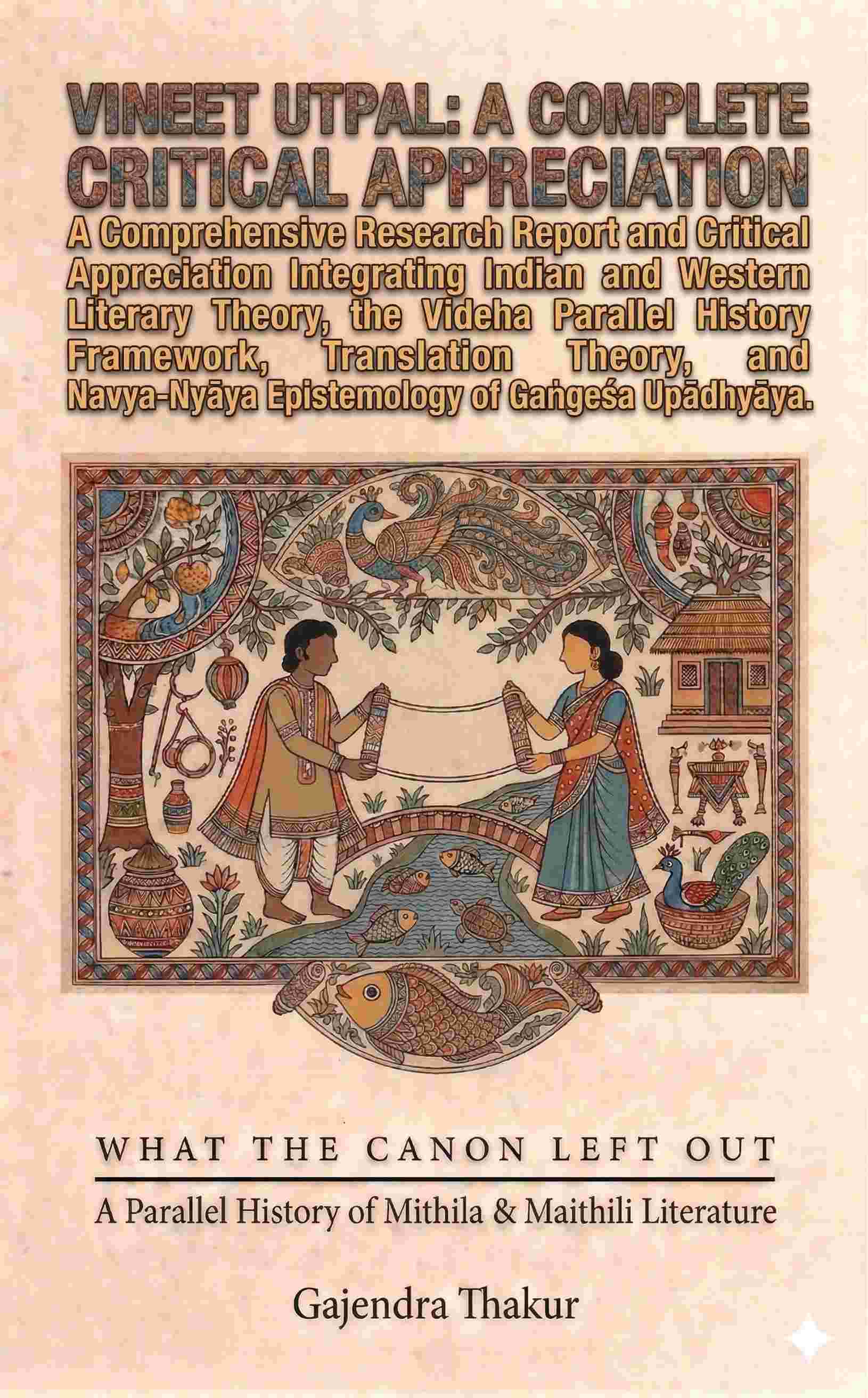
VINEET UTPAL: A COMPLETE CRITICAL APPRECIATION A Comprehensive Research Report and Critical Appreciation Integrating Indian and Western Literary Theory, the Videha Parallel History Framework, Translation Theory, and Navya-Nyāya Epistemology of Gangeśa Upādhyāya
VINEET UTPAL: A COMPLETE CRITICAL APPRECIATION
A Comprehensive Research Report and Critical Appreciation Integrating Indian and Western Literary Theory, the Videha Parallel History Framework, Translation Theory, and Navya-Nyāya Epistemology of Gaṅgeśa Upādhyāya
Prepared with Reference to: - Uploaded Works: Hum Puchhait Chhi (Poetry, 2009), Mohandas (Maithili Translation), Rehan Par Raghu (Maithili Translation), Mantradrashta Rishyashringa (Maithili Translation) - Videha Parallel History Framework (www.videha.co.in) - Indian Rasa–Dhvani Aesthetics (Bharata, Abhinavagupta, Ānandavardhana) - Western Literary Theory (New Criticism, Post-colonialism, Hermeneutics, Translation Studies) - Navya-Nyāya Epistemology of Gaṅgeśa Upādhyāya (Tattvacintāmaṇi)
PART I: BIOGRAPHICAL OVERVIEW AND LITERARY CONTEXT
1.1 Life and Formation
Vineet Utpal (Vinīt Utpal, विनीत उत्पल), born 1978 in Anandpura, Madhepura (Bihar), represents a significant voice in contemporary Maithili literature — a poet, journalist, translator, and literary activist who emerged in the early years of the twenty-first century against the backdrop of a language and culture striving for renewed institutional recognition. His family name Utpal (lotus) carries deep Sanskrit resonance, and his life journey mirrors the socio-cultural tensions at the heart of Mithila’s modernity.
His early education spanned Munger district — in Rangaon and Tarapur — before he pursued a B.Sc. (Honours) in Mathematics from Tilkamanjhi Bhagalpur University, a degree that signals the analytical, structural sensibility discernible in his literary work. He subsequently earned postgraduate diplomas from two of India’s most distinguished institutions: a Master’s degree in Mass Communication from Guru Jambheshwar University, and a Postgraduate Diploma in English Journalism from Bharatiya Vidya Bhavan, New Delhi. He also holds a Postgraduate Diploma in Mass Communication and Creative Writing from Jamia Millia Islamia, New Delhi, where he was additionally certified by the Nelson Mandela Centre for Peace and Conflict Resolution — a detail that illuminates the ethical, conflict-sensitive consciousness informing his poetry and journalism. He completed a French language course at Bharatiya Vidya Bhavan.
His journalistic career spans major Hindi media platforms: Dainik Bhaskar (Indore, Raipur), Delhi Press, Dainik Hindustan (New Delhi, Faridabad), Akinchan Bharat (Agra), Deshbandhu (Delhi), and National Sahara (Noida), where he rose to Senior Sub-Editor. His voice was broadcast on All India Radio Bhagalpur through poetry readings and discussions.
1.2 The Videha Context
Utpal’s literary career unfolds within — and is inseparable from — the Videha movement, the most significant development in contemporary Maithili literature. Videha (ISSN 2229-547X), founded as Bhalsarik Gachh on 5 July 2004 and relaunched as a fortnightly e-journal from 1 January 2008, is edited by Gajendra Thakur and constitutes the first Maithili fortnightly e-journal. The Videha Parallel History of Maithili Literature, which documents and celebrates the suppressed democratic, folk, Dalit, and feminist traditions of Maithili writing, explicitly names Vineet Utpal as a key figure in the RTI-based institutional exposé of the Sahitya Akademi — the Right to Information application filed by Utpal and Ashish Anchinhar (2011–2014) revealing that over 90% of Sahitya Akademi translation and publication assignments in Maithili were distributed to friends and relatives of the ten-member advisory board, with zero assignments going to authors of the parallel tradition.
This activist dimension of Utpal’s career — the use of democratic legal instruments to challenge literary gatekeeping — positions him as both a creative writer and a cultural reformer, a dual identity that inflects every dimension of his literary output.
PART II: PRIMARY WORKS — DESCRIPTION AND ANALYSIS
2.1 Hum Puchhait Chhi (We Are Asking), 2009
Publication data: Shruti Prakashan, New Delhi. ISBN: 978-93-80538-05-1. Price Rs. 160. First Edition, 2009. Cover design: Ravindra Kumar Das.
Dedication: To his mother Premlata Jha and father Dr. Vedananda Jha, acknowledging that in their lap he gained the capacity to speak, read, write, and think.
This collection of Maithili poems is Utpal’s most significant original creative work and the primary document through which his poetic sensibility must be assessed. The collection’s title — Hum Puchhait Chhi (We Are Asking / I Keep Asking) — announces an interrogative poetic consciousness, one that refuses settlement and comfort, that insists on the unresolved question as the proper posture of the engaged citizen-poet.
The collection carries a substantial critical preface by Dr. Gangesh Gunjan, himself a distinguished Maithili writer, who describes the manuscript as representing “a fundamental concern of the present and the present’s cry.” Gunjan identifies three semantic layers (artha-chhāyā) in Utpal’s poetry: the mode of utterance (kathanaka koti), its grip (pakad), and the method of its deployment (prayogaka vidhi). These three axes — what is said, how it seizes the reader, and through what formal means — constitute the Navya-Nyāya-inflected framework through which Gunjan reads Utpal’s work.
Thematic inventory (from the table of contents):
1. Kakar galti (Whose fault) — civic accountability, systemic negligence
2. Manukho nahin bhel (Did not become human) — humanity’s failure, caste
3. Ki pharak padait achhi (What difference does it make) — civic indifference
4. Ang Desh (The Anga Region) — regional identity, Bihar’s subaltern geography
5. Pariksha (Examination) — educational systems, social pressure
6. Gama dubi gael (The village drowned) — displacement, flood, ecology
7. Partner, ahank mool ki? (Partner, what is your origin?) — caste identity
8. Nahin time apna lel (No time for oneself) — alienation, modernity
9. Bhav-samarpan (Emotional surrender) — lyric interiority
10. Itihasak likhal (Written by history) — historical consciousness
11. Aatank (Terror/Fear) — violence and social fear
12. E thakak katha (Story of this fatigue) — exhaustion of the subaltern
13. Nokari aaki aajivan karaawas (Job or lifelong imprisonment) — labour alienation
14. Jati-pati (Caste) — direct confrontation with caste
15. Ek dhur jamin (One dhur of land) — agrarian question, dispossession
The preface (written by Utpal himself) is a remarkable document of poetic self-awareness. He writes that the collection presents images of village conditions, the social fractures of Mithila and Anga, and the lived experience of life — and that every poem attempts to untangle those knots. He describes the birth of his poetic self as simultaneously “a slap on the face of society” — a declaration of rupture. He frames the poet’s task in terms of temporal responsibility: the contemporary poet must neither inherit the past passively nor escape into an abstract future, but must transform the knowledge and experience of one’s own time into aesthetically crafted, sensibility-driven utterance of lasting significance.
The section-heading of the preface to Gunjan’s introduction, “Kaviak Atmokti: Kavitaak Aena” (The Poet’s Self-Liberation: The Mirror of Poetry), offers a striking conceptual frame: poetry as both the poet’s self-release and the mirror in which society sees its own face.
2.2 Mohandas — Maithili Translation of Uday Prakash’s Hindi Novella
Translation details: Hindi source: Uday Prakash (born 1 January 1952, Shahdol, Madhya Pradesh), Mohandas — a long story (dīgha kathā) for which Uday Prakash received the Sahitya Akademi Award 2010 (Hindi). Maithili translation: Vineet Utpal. First serialized in Videha fortnightly e-journal, Issue 74 (15 January 2011) through Issue 78 (15 March 2011) in five instalments. Later published as a standalone PDF available in Devanagari, Mithilakshar, and Braille scripts on www.videha.co.in. Subsequently published (2013) by Sahitya Akademi, New Delhi.
Mohandas is a devastating novella about identity theft, bureaucratic violence, and the systematic dispossession of a Dalit protagonist whose name, certificates, and very existence are appropriated by an upper-caste impostor. Utpal’s choice to translate this work is itself a critical act: he brings into Maithili a Hindi text that exposes precisely the caste-based institutional corruption that Videha’s RTI work was simultaneously challenging in the Maithili literary world. The translation performs a meta-commentary on the condition of Maithili letters.
Uday Prakash’s prose style is notably cinematic, hallucinatory, and elliptical — characteristics that present significant translation challenges. Utpal’s Maithili rendering, opens with the evocative original’s description of colour and fear: the translator mobilizes a Maithili that is simultaneously classical in its morphology and urgent in its contemporary register.
2.3 Rehan Par Raghu — Maithili Translation of Kashinath Singh’s Hindi Story
Translation details: Hindi source: Kashinath Singh, Rehan Par Raghu — a Sahitya Akademi Award-winning Hindi story. Kashinath Singh is known particularly for Kashi Ka Assi (on whose world Raghu also draws), and the translated text opens with a dedication to his “younger brother Kripashankar Chaubey.” Maithili translation: Vineet Utpal.
This translation brings into Maithili a text rooted in Banaras’s cultural landscape — Raghu is not just a character but a world, a way of inhabiting time and street. Utpal’s Maithili must bridge the Bhojpuri-inflected Hindi of Singh’s Assi ghats with the Tirhuta grammar of Mithila — a genuinely complex cultural translation operation.
2.4 Mantradrashta Rishyashringa (Śrutiprakashan edition) — Maithili Translation
Translation details: Hindi source: Harishankar Shrivastava “Shalabh,” editor Shrigopal Pandit. Subject: Rishyashringa, the Vedic sage-figure whose story appears in the Valmiki Ramayana, Mahabharata, Bhagavata, and Uttararamacharita of Bhavabhuti. The text is published by a scholarly cultural institution and concerns the Koshi region’s ancient cultural heritage, a topic of profound significance for Mithila.
The editor’s preface contextualizes Rishyashringa within the broader narrative of the Koshi anchal — arguing that his ashram (located in the Munger region near Shringeshwar) represents a living synthesis of Vedic, Shaiva, and folk traditions. Utpal’s translation of this mythological-historical text from Hindi into Maithili extends his repertoire from contemporary social fiction to the deep temporal layer of itihasa.
PART III: CRITICAL APPRECIATION THROUGH MULTIPLE FRAMEWORKS
3.1 Indian Rasa-Dhvani Aesthetics (Bharata, Ānandavardhana, Abhinavagupta)
The foundational framework of Indian literary criticism is the rasa theory, formulated by Bharata Muni in the Nāṭyaśāstra (c. 200 BCE–200 CE) and theorized through dhvani (resonance) by Ānandavardhana in the Dhvanyāloka (c. 9th century CE), and deepened by Abhinavagupta’s Abhinavabhāratī and Locana. Within this framework, the central evaluative question is: which rasa (aesthetic emotion) dominates, and how does the poem’s dhvani (suggested meaning, the “soul of poetry”) operate beyond its vācyārtha (expressed meaning) and lakṣyārtha (indicated meaning)?
In Hum Puchhait Chhi, the dominant rasa is karuṇa (pathos/compassion), inflected throughout with vīra (the heroic impulse of moral protest) and with bībhatsa (the horrific, evoked by caste discrimination and agrarian dispossession). The title poem’s interrogative stance instantiates what Ānandavardhana would call sākṣātkāri dhvani — a resonance that makes the reader directly experience the unresolved condition of injustice rather than merely describe it.
Poem titles like “Gama dubi gael” (The village drowned) and “Ang Desh” (The Anga region) operate through what Abhinavagupta calls rasadhvani — where the surface image (a drowned village, a geographical name) releases an entire cultural-emotional complex: the Koshi floods, Mithila’s centuries of agrarian suffering, the indifference of state power. The reader’s sadāraṇīkaraṇa (universalization of the particular experience through aesthetic identification) transforms private grief into shared cultural emotion.
Utpal’s poem “Partner, ahank mool ki?” (Partner, what is your origin?) performs a radical reversal of the Sanskrit śṛṅgāra (erotic/love) rasa’s conventional question of origin (kula): in classical poetry, kula establishes noble lineage and worthiness of love; here it becomes an instrument of caste interrogation and social violence, instantiating what the Nāṭyaśāstra calls vibhāva (the excitant of aesthetic emotion) deployed in a context that activates karuṇa rather than the expected śṛṅgāra.
3.2 Western Literary Frameworks
3.2.1 New Criticism and Close Reading
The New Critical tradition (I.A. Richards, William Empson, Cleanth Brooks, Robert Penn Warren) insists on the poem as autonomous verbal object whose meaning resides in its tensions, ambiguities, and ironic structures. Applied to Utpal’s “Nokari aaki aajivan karaawas” (Job or lifelong imprisonment), New Critical close reading reveals a central ambiguity: the grammatical conjunction “aaki” (or) suspends the poem between two possible readings — is employment a disguised form of imprisonment, or does the poem posit an either/or choice? The irony, as Cleanth Brooks would note, is that both terms of the alternative are ultimately equivalent: modern Maithili rural life offers neither freedom nor dignity in employment. The “tension” (John Crowe Ransom’s term) between the poem’s surface inquiry and its deep implication is what generates its aesthetic power.
Empson’s concept of ambiguity (from Seven Types of Ambiguity, 1930) is especially relevant to the title Hum Puchhait Chhi: the grammatical person (hum = I/We in Maithili), the tense (puchhait = habitual/continuous present of asking), and the absence of an explicit addressee create a profound ambiguity. Who is asking? The lyric “I”? The Maithili community? The poor and dispossessed? Who is being asked? The state? History? The powerful? This undecidability is not a weakness but the poem’s constitutive power.
3.2.2 Post-Colonial Theory (Spivak, Bhabha, Fanon)
Gayatri Chakravorty Spivak’s foundational essay “Can the Subaltern Speak?” (1988) is directly pertinent to reading Utpal’s poetry and activism. Spivak argues that the colonial and postcolonial power structure erases the enunciative position of the subaltern — not just silencing their speech but eliminating the conditions under which their speech can be heard. Utpal’s poetry — written in Maithili, a language that has itself been systematically misclassified as a “dialect of Hindi” despite Grierson’s and S.K. Chatterji’s evidence of its distinctness — performs the subaltern’s insistence on being heard in its own voice.
The RTI action (Utpal and Anchinhar, 2011–2014) can be read through Homi Bhabha’s concept of mimicry and sly civility (The Location of Culture, 1994): the subaltern writer who uses the colonial/postcolonial state’s own legal mechanisms against its institutions performs a kind of strategic mimicry that exposes the gap between the institution’s stated democratic principles and its actual caste-based distribution of resources.
Frantz Fanon’s argument in The Wretched of the Earth (1961) about the necessity for colonized cultures to reclaim their own literary and historical narratives is structurally homologous to the Videha Parallel History project. Utpal’s translation work — bringing Uday Prakash’s Mohandas (the story of a Dalit whose identity is stolen by upper-caste usurpers) into Maithili — is precisely the kind of cultural retrieval and re-narration that Fanon theorized as necessary for decolonization of the mind.
3.2.3 Marxist and Materialist Criticism
György Lukács’s concept of typicality — that great literature creates characters and situations that are typical in the sense of crystallizing the essential social contradictions of their historical moment — illuminates Utpal’s poetry. His poems are not about individual villagers or particular floods: they construct the typical condition of the Maithili peasant under late capitalism and caste feudalism simultaneously. The drowned village (Gama dubi gael) is both a concrete, particular event (Koshi floods) and a historically typical figure for the systematic abandonment of agrarian communities by the postcolonial developmental state.
Raymond Williams’s concept of structures of feeling (Marxism and Literature, 1977) — the pre-formalized, emergent dimension of social experience that literature captures before ideology codifies it — describes exactly what Utpal’s poetry does. His poems register the affective texture of a Maithili life that official discourse (Sahitya Akademi awards, government cultural policy) has not yet acknowledged: the fatigue, the interrogative rage, the humour that survives dispossession.
3.2.4 Feminist and Gender Criticism
Elaine Showalter’s gynocriticism and Julia Kristeva’s theory of the semiotic (the pre-linguistic, maternal, bodily dimension of language that disrupts the symbolic order) find indirect application in Utpal’s work through his sustained engagement with the women poets and writers of the Maithili parallel tradition. The Videha movement’s commitment to including women’s writing — as documented in the Parallel History and the anthology Ijoriyak Angaithi-Mor — is an institutional correlate of the feminist critical position that women’s writing constitutes a suppressed counter-archive. Utpal’s poem “Bhav-samarpan” (Emotional surrender) may be read as precisely the kind of anti-heroic, vulnerably subjective lyric that Showalter would identify as characteristic of an alternative, non-martial poetics.
3.2.5 Reader-Response Theory and Hermeneutics
Hans Robert Jauss’s concept of Erwartungshorizont (horizon of expectations, Toward an Aesthetic of Reception, 1970) is particularly illuminating for Utpal’s translation practice. When Utpal translates Mohandas into Maithili, he transforms the Maithili reader’s horizon of expectations in two directions simultaneously: the reader’s prior knowledge of Mithila’s own institutional corruption creates a local over-determination of the text’s meaning that no Hindi reader can share, while the formal expectations associated with the Maithili literary tradition (dhvani-based suggestion, Vidyapati’s lyric inheritance) reshape how the novella’s ironic mode is received. Every act of translation is, in Jauss’s terms, an aesthetic event that restructures the receptor culture’s relationship to its own literary history.
Hans-Georg Gadamer’s hermeneutic circle (Truth and Method, 1960) — the understanding of a text proceeds through the circular movement between part and whole, between the reader’s prior understanding (Vorverständnis) and the text’s own horizon — maps precisely onto the challenge of translating Kashinath Singh’s Banaras-world into Maithili. Utpal as translator performs a Gadamerian Horizontverschmelzung (fusion of horizons): the Varanasi world of Raghu and the Mithila world of Maithili readership are brought into dialogical fusion through the translator’s hermeneutic labour.
3.3 Translation Theory Applied to Utpal’s Practice
3.3.1 Eugene Nida’s Formal vs. Dynamic Equivalence
Eugene Nida’s fundamental distinction (Toward a Science of Translating, 1964) between formal equivalence (word-for-word fidelity to source language structure) and dynamic equivalence (reproducing the effect of the source text in receptor language terms) defines the fundamental tension in Utpal’s translation of Mohandas. Uday Prakash’s prose employs a deliberately defamiliarizing Hindi — dense with cinematic metaphor, interrupted syntax, and dark lyrical imagery — that resists transparent formal equivalence in Maithili. Utpal’s choice to pursue dynamic equivalence means deploying specifically Maithili idioms, proverbial wisdom, and Mithilakshar-rooted affective registers to reproduce the terror, irony, and pathos of the original. The opening paragraphs of the translated Mohandas demonstrate this: Utpal’s Maithili captures the “colour of fear” (darak ranga kehan hoit achhi) through imagery that is simultaneously true to Uday Prakash and specifically Maithili in its tonal depth.
3.3.2 Lawrence Venuti’s Domestication vs. Foreignization
Lawrence Venuti (The Translator’s Invisibility, 1995) argues that translation occupies an ethical as well as aesthetic dimension: the domesticating translator erases cultural difference, making the foreign text fluent and invisible in the target culture; the foreignizing translator retains the strangeness of the original, challenging the target culture’s assumptions.
In translating both Uday Prakash (Delhi-based, Hindi) and Kashinath Singh (Banaras, Hindi) into Maithili, Utpal performs a subtle negotiation. His translations are not domesticating in the simple sense: both source texts carry cultural particularity (Delhi’s bureaucratic nightmare; Banaras’s ghats and pahalwan culture) that cannot simply be erased. Yet his Maithili cannot be so foreign as to create unintelligibility for Maithili readers. The translated Mohandas operates in a productive in-between zone — what Venuti might call strategic foreignization — that preserves the Hindi text’s specificity while finding Maithili equivalents for its emotional registers.
3.3.3 Antoine Berman’s Ethics of Translation
Antoine Berman (The Experience of the Foreign, 1984/1992) argues that the true ethics of translation involves confronting the “trial of the foreign” — resisting the twelve deforming tendencies (rationalization, clarification, expansion, ennoblement, qualitative impoverishment, destruction of rhythms, etc.) that translation typically imposes on source texts. Applied to Utpal’s translation of Mantradrashta Rishyashringa, Berman’s framework illuminates the specific ethical challenge of translating a mythological-historical text: the risk of either over-Sanskritizing the Maithili (imposing a classical patina that the Hindi original’s accessible prose does not warrant) or over-colloquializing (losing the ritual dignity appropriate to the itihasa subject matter). Utpal’s navigation of this Bermanesque “trial” reflects a mature translator’s judgment.
3.3.4 Walter Benjamin’s “The Task of the Translator”
Walter Benjamin’s mystical-philosophical essay (1923, translated and introduced by Hannah Arendt in Illuminations) argues that translation releases the reine Sprache (pure language) — the afterlife of the original, the language that underlies all languages. Translation, for Benjamin, is not primarily about conveying meaning but about revealing, through the foreign language’s syntax and imagery, the higher language that both source and target language approximate.
This framework finds unexpected resonance with the Sanskrit-derived concept of sphoṭa (the eternal linguistic essence that sound-sequences only approximately reveal), theorized by Bhartrhari in the Vākyapadīya — one of the key philosophical texts of the Mithila intellectual tradition. When Utpal translates Mohandas into Maithili, the Benjaminian afterlife of Uday Prakash’s Hindi novella intersects with the sphoṭa-dimension of Maithili’s own linguistic being: the translation reveals, momentarily, a literary essence that neither Hindi nor Maithili alone can fully express.
3.4 The Videha Parallel History Framework
The Videha Parallel History framework (as articulated by Gajendra Thakur across Parts 1–53+ of the Parallel History series at www.videha.co.in) provides the most contextually appropriate critical lens for Utpal’s work. This framework operates through several key methodological commitments:
The Two-Tradition Model: Mainstream Maithili literary history (as curated by the Sahitya Akademi) has systematically promoted an upper-caste (predominantly Maithil Brahmin) canon. The Parallel History documents the suppressed counter-tradition: Buddhist charyapada, Dalit and subaltern writing, women’s writing, Nepal-Terai Maithili, and the democratic-satiric tradition represented by Harimohan Jha. Utpal’s poetry belongs unambiguously to the Parallel tradition: socially engaged, rooted in the lives of ordinary Maithili people, formally modern rather than classicist, and institutionally marginalized before Videha created the platform for its recognition.
RTI Activism as Literary-Political Act: The Parallel History identifies the RTI exposé by Utpal and Anchinhar as a landmark moment in the Maithili literary struggle: an act that deployed the tools of democratic governance against the cultural bureaucracy of the postcolonial state. This mirrors the tradition of protest writing documented in the Parallel History — from Faturilal’s famine verses (1873–74) to Harimohan Jha’s anti-caste satire — as acts of testimony against institutional power.
Digital Democratization: The Videha movement’s achievement of digitizing thousands of Maithili books, transcribing 11,000 palm-leaf Tirhuta manuscripts, contributing to Unicode Tirhuta, and creating the first Maithili Braille website constitutes what the Parallel History calls a “living parallel institution.” Utpal’s work — published first in Videha’s fortnightly issues, distributed freely as PDFs across the globe — is structurally embedded in this digital-democratic project.
Vineet Utpal in the Women’s Writing Parallel: The Parallel History Part 1 specifically notes that RTI data on the exclusion of women from Sahitya Akademi Maithili assignments was “confirmed by Vinit Utpal / Ashish Anchinhar (2011–14).” This places Utpal not merely as a poet but as a gender-justice advocate within Maithili letters — consonant with the feminist critical frameworks discussed above.
3.5 Navya-Nyāya Epistemology and the Methodology of Gaṅgeśa Upādhyāya
3.5.1 Introduction to Navya-Nyāya
Gaṅgeśa Upādhyāya (c. 1325 CE), born and working in Mithila, founded the Navya-Nyāya (New Logic) school through his magnum opus Tattvacintāmaṇi (Jewel of Reflection on Truth), revolutionizing Indian epistemology. The Videha Parallel History’s recovery of the “suppressed Gangesh” — revealing through original Dooshan Panji (genealogical) records that he was of inter-caste origin, a fact concealed by establishment historians — makes Gaṅgeśa himself a figure of the Parallel tradition.
Navya-Nyāya developed a rigorous technical vocabulary (paribhāṣā) for the analysis of knowledge (jñāna), valid cognition (pramā), sources of valid knowledge (pramāṇa — perception, inference, comparison, verbal testimony), and the logical relations between cognizers, objects, and the properties attributed to them. Its key analytical tools — the concepts of viśeṣaṇatā (qualification), viśeṣyatā (the qualified), anuyogitā (the relation-relatum), pratiyogitā (the counter-relatum), and svarūpasambandha (intrinsic relation) — offer an unusually precise vocabulary for literary analysis.
3.5.2 Applying Navya-Nyāya to Utpal’s Poetry
Pramāṇa-analysis of the poetic claim: Every poem makes implicit epistemic claims — about the world, about the poet’s authority to speak, about the reader’s capacity to recognize. Applying Navya-Nyāya pramāṇa analysis: Utpal’s poem “Jati-pati” (Caste) grounds its claims in pratyakṣa (perceptual testimony — the poet’s direct witnessing of caste discrimination) and śabda (verbal testimony — the inherited knowledge of caste violence encoded in Maithili cultural memory). The poem’s persuasive force derives precisely from this dual pramāṇa grounding: both the directly perceived and the culturally transmitted converge in the poem’s utterance.
Anumāna (inference) and the structure of poetic argument: Navya-Nyāya’s analysis of anumāna (inferential cognition) proceeds through the vyāpti (invariable concomitance) relation. In “Nokari aaki aajivan karaawas,” the implicit vyāpti is: wherever there is modern employment in the Maithili social structure, there is loss of freedom (parigraha). The pakṣa (minor premise) is: Maithili people enter employment. The sādhya (thing to be proved) is: Maithili people lose freedom. The poem does not state this syllogism but performs it — its aesthetic force lies precisely in making the vyāpti felt before it can be analytically articulated.
Viśeṣaṇatā (qualification) and dhvani: Navya-Nyāya’s technical analysis of how properties qualify their substrates (dharmin) maps onto Ānandavardhana’s dhvani analysis with notable precision. In “Ang Desh” (The Anga Region), the property “Ang” (the historical-geographical qualifier) qualifies the land (deśa) in a way that generates multiple anuyogis (relata): the Mahabharata’s Karna, the subaltern geography of eastern Bihar, the specific flood-plain ecology of the Koshi basin. The poem’s dhvani operates through the proliferation of these anuyogi relations — each activated by the single qualifying property “Ang” — in a way that Navya-Nyāya’s grammar of qualification (viśeṣaṇatā) can formally describe.
Abhāva (absence) as a poetic category: Navya-Nyāya’s analysis of abhāva (absence, non-existence) as itself a genuine epistemic category — not merely the negation of presence but a positively cognizable entity — illuminates the profound absences in Utpal’s poetic world. “Nahin time apna lel” (No time for oneself) is a poem of abhāva: the absent time, the absent self, the absent interiority of the alienated modern worker are not simply described as lacking but are made present through their formal absence in the poem’s compressed, stripped diction. This is the literary instantiation of Navya-Nyāya’s prāgabhāva (prior absence) — the presence of a condition before an expected entity arrives, which in the poem becomes the perpetually deferred arrival of selfhood and temporal freedom.
Śabdapramāṇa and the authority of the translated text: Navya-Nyāya paid particular attention to śabdapramāṇa (verbal testimony) — the conditions under which linguistic utterance constitutes valid knowledge. This framework is directly applicable to the ethics of translation. When Utpal translates Mohandas into Maithili, he claims (implicitly) that his Maithili text is a valid śabdapramāṇa transmission of Uday Prakash’s Hindi original — that the translated text faithfully transmits the artha (meaning) of the source. Navya-Nyāya’s analysis of āptavākyam (the utterance of a reliable authority) and the conditions for trustworthy testimony provides the logical framework within which the translator’s authority can be evaluated.
3.5.3 The Suppressed Gaṅgeśa and Utpal’s Position
The Videha Parallel History’s recovery of Gaṅgeśa’s inter-caste origins is not merely biographical anecdote but epistemological intervention. The Tattvacintāmaṇi — the greatest achievement of Maithili philosophical thought — was produced by a thinker whose social origins were subsequently suppressed by the Brahmin establishment. Navya-Nyāya’s radical epistemological program (subjecting every claim to rigorous logical analysis, refusing to accept authority without reasoned examination) is itself subversive of the caste-hierarchical social order that claims to honour Gaṅgeśa while suppressing knowledge of his origins.
Vineet Utpal’s position in Maithili letters mirrors this structure: his work — rigorous in its moral claims, structurally precise in its poetic construction, institutionally marginalized by the Sahitya Akademi establishment — follows in the tradition of Maithili intellectual dissidence that Gaṅgeśa himself represents at the philosophical level.
PART IV: UTPAL AS CULTURAL ACTIVIST AND LITERARY-POLITICAL AGENT
4.1 The RTI Intervention: Democratic Epistemology in Action
The Right to Information (RTI) application filed by Vineet Utpal and Ashish Anchinhar (2011–2014), revealing the systematic cronyism in Sahitya Akademi Maithili assignments, is a landmark in Indian literary activism. The methodology — using the state’s own transparency legislation against its cultural institutions — has Navya-Nyāya epistemological resonances: it insists on pramāṇa (evidence-based valid cognition) over āptavākya (unchecked authority), demanding documentary proof for claims of institutional fairness.
This act of democratic epistemology — forcing the Sahitya Akademi to produce its decision-making records — parallels what the Videha Parallel History does at the historiographical level: insisting that the suppressed evidence (Dooshan Panji records about Gaṅgeśa’s origins, RTI responses about appointment cronyism) must be admitted into the record. Truth, in both cases, requires the confrontation of institutional vyabhicāra (logical inconsistency, moral deviation) with documented fact.
4.2 The Poet as Sākṣī (Witness)
In both Indian poetics and in the tradition of committed literature (Sartre’s littérature engagée, the testimonio tradition of Latin American literature), the poet’s fundamental role is that of sākṣī — witness to historical suffering. Utpal’s biography — a journalist who traveled between Madhepura’s villages, Delhi’s newsrooms, and Videha’s digital commons — positions him as precisely this kind of mobile, observant, testimonial consciousness.
His preface to Hum Puchhait Chhi states directly: the poems present jīvanānubhavaka chhavih (images of lived experience). This is not the aesthetic distance of the classical court poet but the engaged proximity of the sākṣī — the one who sees and refuses not to report what has been seen.
PART V: ASSESSMENT, SIGNIFICANCE, AND CONCLUSION
5.1 Literary Significance
Vineet Utpal represents, within the Videha Parallel tradition of Maithili literature, a poet-translator-activist whose multiple roles are unified by a single ethical commitment: the insistence on the dignity and legibility of ordinary Maithili life against the twin oppressions of caste hierarchy and institutional gatekeeping.
His poetry in Hum Puchhait Chhi is formally economical, thematically urgent, and structurally precise — qualities that reflect both his journalistic training in the compression and clarity of prose and his deep awareness of Maithili’s lyric inheritance from Vidyapati through the modern period. His translations demonstrate a mature practice that engages responsibly with the ethical dimensions of cross-cultural literary transmission.
5.2 Place in the Parallel Tradition
Within the Videha Parallel History framework, Utpal occupies a position analogous to those figures who are both creative writers and cultural activists: he writes poems of protest and self-examination, translates socially critical Hindi fiction into Maithili, and uses democratic legal tools to challenge literary institutions. His work is simultaneously a contribution to Maithili’s literary corpus and a critical act within Maithili’s ongoing struggle for recognition, democracy, and cultural justice.
5.3 Critical Evaluation
The multi-framework analysis conducted in this report converges on a consistent assessment:
• Indian rasa-dhvani aesthetics identifies Utpal’s primary registers as karuṇa and vīra, with sophisticated dhvani operation through underdetermined imagery and interrogative syntax.
• New Critical close reading reveals a poetry of productive ambiguity, tension, and ironic reversal.
• Post-colonial theory positions him as a subaltern voice that speaks from within the suppressed linguistic minority of Maithili-speaking people, using both poetry and democratic activism as tools of counter-hegemonic enunciation.
• Translation studies finds in his practice a sophisticated negotiation between dynamic equivalence, strategic foreignization, and the Bermanesque confrontation with the “trial of the foreign.”
• Navya-Nyāya epistemology provides the rigorous analytical vocabulary to show how Utpal’s poems constitute valid epistemic claims (pramā) grounded in perception (pratyakṣa) and testimony (śabda), structured through inference (anumāna), and resonant with the productive abhāva (absence) that generates their dhvani-effect.
• The Videha Parallel History framework situates him within the democratic, subaltern counter-tradition that constitutes the living alternative to the institutional Sahitya Akademi canon.
In sum: Vineet Utpal is a significant minor master of contemporary Maithili poetry and a distinguished translator whose contributions to the digitally democratized Videha tradition of Maithili letters deserve far wider scholarly recognition than they have hitherto received.
REFERENCES AND BIBLIOGRAPHY
Primary Texts
16. Utpal, Vineet. Hum Puchhait Chhi [We Are Asking]. New Delhi: Shruti Prakashan, 2009. ISBN 978-93-80538-05-1.
17. Utpal, Vineet (trans. from Hindi of Uday Prakash). Mohandas [Maithili translation]. Serialized: Videha e-journal, Issues 74–78 (January–March 2011). Print: New Delhi: Sahitya Akademi, 2013.
18. Utpal, Vineet (trans. from Hindi of Kashinath Singh). Rehan Par Raghu [Maithili translation]. Publisher: as per Videha Archive.
19. Utpal, Vineet (trans. from Hindi of Harishankar Shrivastava “Shalabh,” ed. Shrigopal Pandit). Mantradrashta Rishyashringa [Maithili translation]. Publisher: Shruti Prakashan / Videha Archive.
Videha Primary Sources
5. Thakur, Gajendra. “A Parallel History of Mithila and Maithili Literature, Parts 1–53+.” Videha: Pratham Maithili Paksik E-Patrika (ISSN 2229-547X). www.videha.co.in/gajenthakur.htm.
6. Videha — Maithili Fortnightly E-Journal. www.videha.co.in (since 2008).
7. Videha Pothi Archive. www.videha.co.in/pothi.htm.
Indian Literary Theory and Aesthetics
8. Bharata Muni. Nāṭyaśāstra. Trans. Manomohan Ghosh. 2 vols. Calcutta: Manisha Granthalaya, 1967.
9. Ānandavardhana. Dhvanyāloka with Locana of Abhinavagupta. Ed. and trans. Daniel H.H. Ingalls, Jeffrey Moussaieff Masson, M.V. Patwardhan. Cambridge, MA: Harvard University Press, 1990.
10. Abhinavagupta. Abhinavabhāratī. In Nāṭyaśāstra with Abhinavabhāratī. Ed. M. Ramakrishna Kavi. 4 vols. Baroda: Gaekwad’s Oriental Series, 1926–1964.
11. Gaṅgeśa Upādhyāya. Tattvacintāmaṇi. Ed. Kamakhyanath Tarkavagisha. Calcutta: Bibliotheca Indica, 1884–1901.
Western Literary Theory
12. Empson, William. Seven Types of Ambiguity. London: Chatto & Windus, 1930.
13. Brooks, Cleanth. The Well Wrought Urn: Studies in the Structure of Poetry. New York: Reynal & Hitchcock, 1947.
14. Williams, Raymond. Marxism and Literature. Oxford: Oxford University Press, 1977.
15. Lukács, György. The Meaning of Contemporary Realism. Trans. John and Necke Mander. London: Merlin Press, 1963.
16. Spivak, Gayatri Chakravorty. “Can the Subaltern Speak?” In Marxism and the Interpretation of Culture, ed. Cary Nelson and Lawrence Grossberg. Urbana: University of Illinois Press, 1988. 271–313.
17. Bhabha, Homi K. The Location of Culture. London and New York: Routledge, 1994.
18. Fanon, Frantz. The Wretched of the Earth. Trans. Constance Farrington. New York: Grove Press, 1963.
19. Gadamer, Hans-Georg. Truth and Method. Trans. Joel Weinsheimer and Donald G. Marshall. 2nd rev. ed. New York: Crossroad, 1989.
20. Jauss, Hans Robert. Toward an Aesthetic of Reception. Trans. Timothy Bahti. Minneapolis: University of Minnesota Press, 1982.
Translation Studies
21. Nida, Eugene A. Toward a Science of Translating. Leiden: E.J. Brill, 1964.
22. Venuti, Lawrence. The Translator’s Invisibility: A History of Translation. London and New York: Routledge, 1995.
23. Berman, Antoine. The Experience of the Foreign: Culture and Translation in Romantic Germany. Trans. S. Heyvaert. Albany: SUNY Press, 1992.
24. Benjamin, Walter. “The Task of the Translator.” In Illuminations, ed. Hannah Arendt, trans. Harry Zohn. New York: Schocken Books, 1969. 69–82.
Maithili Literary History and Context
25. Grierson, George Abraham. The Languages of India. 11 vols. Calcutta: Office of the Superintendent of Government Printing, 1903–1928.
26. Mishra, Jayakanta. A History of Maithili Literature. 2 vols. Allahabad: Tirabhukti Publications, 1949–1950.
27. Chaudhary, Radhakrishna. A Survey of Maithili Literature. Patna: Bihar Rashtrabhasha Parishad, 1976.
28. Oommen, T.K. “Linguistic Diversity.” In Sociology. New Delhi: National Law School of India University / Bar Council of India Trust, 1988.
Online and Digital Sources
29. Uday Prakash. Wikipedia entry. https://en.wikipedia.org/wiki/Uday_Prakash (accessed April 2026).
“Maithili Literature and Famous Maithili Writers.” Hum Mithilawasi blog. http://hummithilawasi.blogspot.com (accessed April 2026)
अपन मंतव्य editorial.staff.videha@zohomail.in पर पठाउ।
विदेहमे सभठाम ताकू / Search all Videha
Static full-text search · Pagefindलेखक/शीर्षक/अंक/वर्ष — खोज-विधा। गद्य/पद्य/शोध current/static + पुरान Videha/Sadeha contents खोजैत अछि। पोथी pothi.htm केर पूर्ण listing, श्रव्य-दृश्य Audio_Video.htm केर पूर्ण listing, पञ्जी videha-sadeha/panji-shards GitHub data, आ थेसारस/शब्दकोश videha-ejournal.github.io/data GitHub JSON corpus केँ query करैत अछि आ दूनू Quiz corpus मे dictionary/vocabulary/शब्दार्थ-सम्बन्धी प्रश्नोत्तरी परिणाम सेहो जोड़ैत अछि। Quiz videha-quiz आ GitHub user-site दूनू bilingual quiz corpus खोजैत अछि। Roman/IAST + देवनागरी cross-script search समर्थित। Issue/Year लेल संख्या दिअ। PDF-अभिलेख archive.org/VidehaAndSadeha सूची खोजैत अछि।