
A PARALLEL HISTORY OF MITHILA & MAITHILI LITERATURE- PART 77
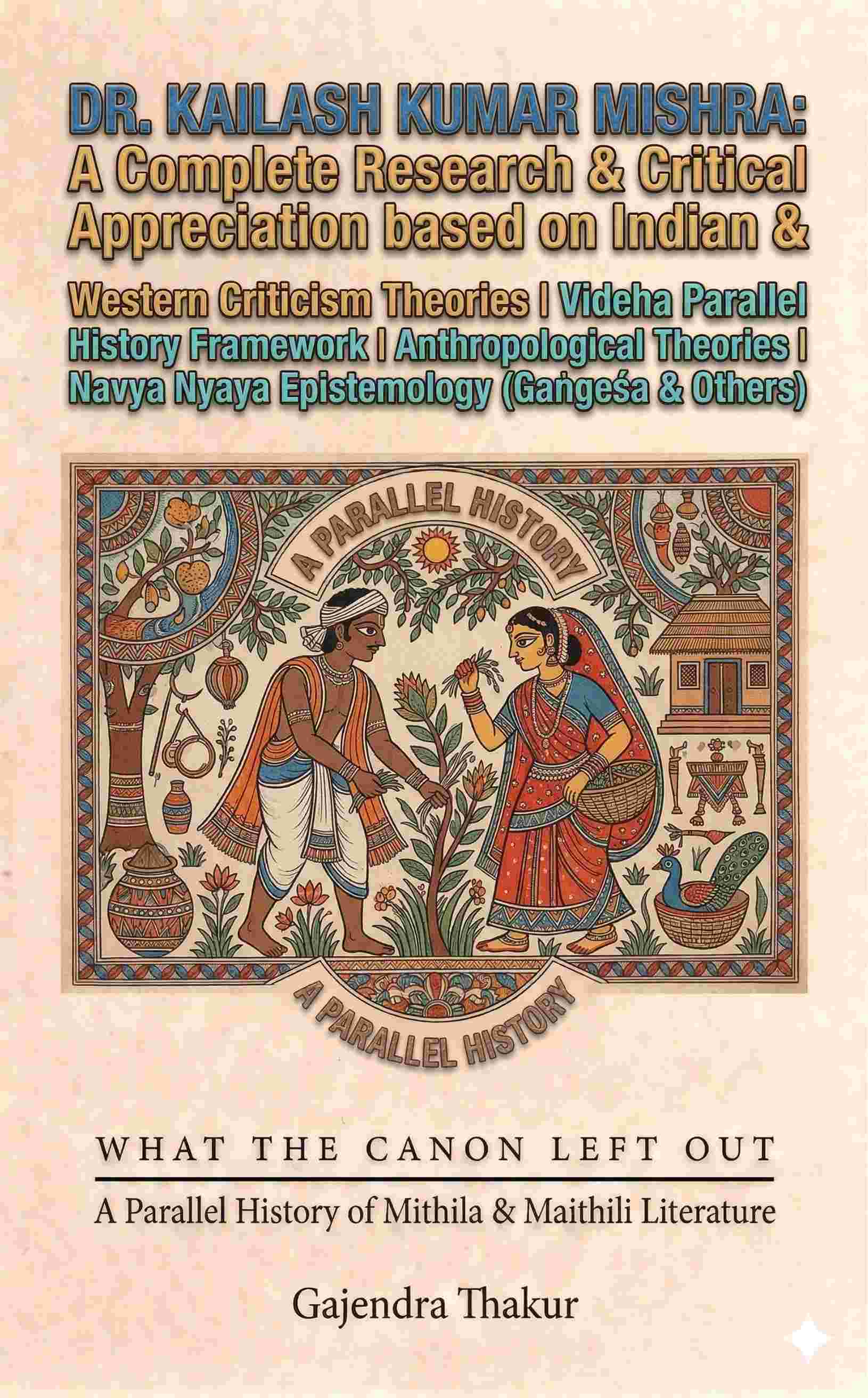
DR. KAILASH KUMAR MISHRA A Complete Research & Critical Appreciation Indian & Western Criticism Theories | Videha Parallel History Framework Anthropological Theories | Navya Nyaya Epistemology (Gangeśa & Others)
DR. KAILASH KUMAR MISHRA
A Complete Research & Critical Appreciation
Indian & Western Criticism Theories | Videha Parallel History Framework
Anthropological Theories | Navya Nyaya Epistemology (Gaṅgeśa & Others)
Table of Contents
1. Introduction: Who Is Dr. Kailash Kumar Mishra?
2. Biographical Context and Intellectual Formation
3. Overview of Major Works
4. Critical Appreciation through Indian Literary Theory
4.1 Rasa Theory (Bharata Muni's Natyashastra)
4.2 Dhvani Theory (Anandavardhana)
4.3 Alamkara School (Bhamaha, Dandin)
4.4 Vakrokti (Kuntaka) and Auchitya (Kshemendra)
5. Critical Appreciation through Western Literary Theories
5.1 Postcolonial Theory (Frantz Fanon, Homi K. Bhabha)
5.2 Subaltern Studies (Spivak, Guha)
5.3 Feminist Theory and Gender Studies
5.4 Formalism and New Criticism
5.5 Narratology (Gérard Genette)
5.6 Cultural Materialism and Anthropological Approaches
6. The Videha Parallel History Framework
7. Anthropological Theories Applied to Mishra's Work
7.1 Geertz's Thick Description
7.2 Lévi-Strauss and Structural Anthropology
7.3 Victor Turner's Liminality
7.4 Intangible Cultural Heritage (UNESCO Framework)
8. Navya Nyaya Epistemology: Gaṅgeśa and the Logic of Literature
8.1 Pramana (Valid Cognition) in Mishra's Narratives
8.2 Vyapti (Invariable Concomitance) as Narrative Logic
8.3 Sabda Pramana and the Oral Tradition
9. Analysis of Individual Works
9.1 Mansarbi (Novel, 2025)
9.2 Yayavari (Travelogue-Essays, 2024)
9.3 Bookmeniya (Facebook Meta-History, 2025)
9.4 Videha Sadeha 29 (Prose and Verse Collection)
10. Thematic Synthesis
11. Conclusion and Critical Assessment
12.ADDENDUM: CRITICAL APPRECIATION OF ARER GAMAK LOK ITIHAS
13. Bibliography and References
1. Introduction: Who Is Dr. Kailash Kumar Mishra?
Dr. Kailash Kumar Mishra is one of the most versatile, prolific, and socially committed Maithili authors of the contemporary period. Born in village Ared (Areda), district Madhubani, Bihar—the heartland of Mithila civilisation—he has made Delhi his base of work while remaining tethered, in his imagination, to the cultural and ecological world of Mithila. His full address, as printed on his books, is B-2/333, Tarara Nagar, Old Palam Road, Dwarka Sector 15, New Delhi—110078 (mobile: 8076208498; email: kailashkmishra@gmail.com).
In terms of professional background, he worked as a researcher at the Indira Gandhi National Centre for the Arts (IGNCA), New Delhi—India's premier national institution for cultural research—where he was associated with the Lokasampada (Janpada Sampada) division under the renowned anthropologist Professor Baidyanath Saraswati. This institutional affiliation fundamentally shaped his scholarly and literary character: he is at once an anthropological fieldworker, a comparative cultural analyst, a travelogue writer, a novelist, and a grassroots Maithili activist.
His works span multiple genres: novels (upanyas), travelogue essays (yayavari/nibandhanibandhsamalochana), Facebook-based 'meta-history' of Mithila culture (Bookmeniya), and contributed chapters in major anthologies such as Videha Sadeha 29. His 2025 publications—Mansarbi (novel), Bookmeniya (meta-history), and the earlier Yayavari volume—are the primary texts examined in this critical appreciation.
He is closely associated with the Videha literary movement, the most significant digital and print platform for Maithili literary and cultural discourse, edited by Gajendra Thakur. Within this movement's framework—what Thakur calls the 'Videha Parallel History Framework'—Mishra represents the strain of writers who insist on recording marginalised, non-elite, and vernacular voices of Mithila, counterbalancing dominant high-caste Brahminical narratives.
2. Biographical Context and Intellectual Formation
Mishra's intellectual formation is unusual in combining two streams that rarely meet in Indian scholarship: rigorous classical and institutional learning (IGNCA, fieldwork in ethnoaesthetics) and immersion in living oral-folk-artisanal culture of Mithila. He received his higher education and doctoral training in the arts and humanities, and his academic publications include work on Mithila painting (Madhubani painting), Maithili folk songs, folk ritual, and comparative folk traditions across Northeast India.
His IGNCA research on Mithila paintings—published as 'Mithila Paintings: Past, Present and Future' (IGNCA, 2000)—is a landmark academic essay, widely cited in ethnographic and art-historical literature. This essay demonstrates his command of both sociological fieldwork methodology and classical Indian aesthetics. As he writes in this work:
Mithila is that sacred land where the founders of Buddhism and Jainism; the scholars of all six orthodox branches of Sanskrit learning such as Yajnavalkya, Bridha Vachaspati, Ayachi Mishra, Shankar Mishra, Gautam, Kapil, Sachal Mishra, Kumaril Bhatt and Mandan Mishra were born... Here in every house Saraswati dances with pride on the tip of the tongue of the learned. (Mishra, Kailash Kumar 2000)
This layering of mythic-devotional, historical, and sociological registers in a single sentence is characteristic of Mishra's intellectual voice: he is always moving between ancient scriptures, contemporary social field, and personal lived experience.
His fieldwork took him to Northeast India—Arunachal Pradesh, North Cachar Hills, Assam—conducting workshops with tribal women's organisations on cultural identity, preserving indigenous traditions, and gender empowerment. These experiences are recorded with ethnographic precision in Yayavari. He worked alongside the Dimasa Mahila Utthan Samiti, the Zeliangrong Naga communities, the Jemi Naga women, and others, helping register women's cultural organisations under the Punjab Registration Act.
A significant biographical fact is the role of his grandmother (nani)—Shrimati Balmukhi Devi—who is the dedicatee of Mansarbi and from whom, he writes, he 'received the longing to understand stories and to make narrative from telling.' This maternal oral inheritance is central to understanding his literary genealogy.
3. Overview of Major Works
3.1 Mansarbi (Novel, 2025)
Published by Maitreyee Prakashan, Delhi (First Edition 2025, Price Rs. 200, ISBN 978-81-986846-4-6), Mansarbi is Mishra's debut novel in Maithili. The narrative centres on Bulki, a dalit/lower-caste woman in a Mithila village, and Raghab, a poor Brahmin youth, whose love unfolds against a landscape of caste oppression, gender violence, class exploitation, and rural poverty. The antagonist Mahananda—from the dominant 'rawar gachhi' (upper-caste enclave) of the village—embodies the feudal-caste violence that structures rural Mithila society.
The novel's preface (Monak Bayat) reveals the compositional history: it was originally serialised on social media, encouraged by noted Maithili author Dr. Usha Kiran Khan, then reconstructed after data loss during COVID-19. The narrative is described by the author as 'satyajaka' (like truth, but not truth)—a fictional reality that captures the essence of documented social conditions. The novel is dedicated to his grandmother, Shrimati Balmukhi Devi.
3.2 Yayavari (Travelogue-Essays, in Videha Maithili Prabandhanibandhsamalochana)
Yayavari collects travel essays by Mishra published in Videha's prose-essay series. The essays cover his fieldwork travels across North Cachar Hills (Assam), Arunachal Pradesh, Brindavan, and other cultural sites. They blend anthropological fieldwork reportage, personal memoir, cultural-historical exegesis, and social commentary. Notable pieces include essays on Mithila painting (Madhubani painting: past, present and future), Northeast tribal women's cultural preservation, the sacred geography of Brindavan, and comparative studies of folk traditions.
3.3 Bookmeniya (2025, Navarambh Prakashan, Rs. 250)
Bookmeniya is a unique genre experiment: a collection of Facebook posts by Mishra about the culture, history, mythology, and social life of Mithila and Maithili. The title itself is a portmanteau, combining 'Book' (Facebook) and 'meniya'—a Maithili suffix indicating a space or repository. The book thus constitutes a 'Facebook Meta-History' of Mithila: micro-essays, meditations, social observations, and cultural fragments distributed on social media and now collected in print. It includes posts on such themes as: 'Spirit of Mithila and Maithili', 'Intangible [Heritage]', and cultural identity.
3.4 Videha Sadeha 29 (Co-authored with Ravibhushan Pathak)
Videha Sadeha is a thematic anthology series published by Videha collecting 'the finest Maithili prose and poetry' from the journal's 350 issues. Volume 29 features both Ravibhushan Pathak and Dr. Kailash Kumar Mishra. Mishra's contributions in this volume include: short stories (laghu katha), literary criticism, folk-culture essays on Maithili folk songs, wedding songs, ecological traditions, Saurath's Somnath parallels, book reviews, and literary-anthropological pieces on Madhubani painting and folk ritual.
4. Critical Appreciation through Indian Literary Theory
4.1 Rasa Theory (Bharata Muni's Natyashastra)
The foundational Indian critical framework for evaluating literature is the theory of Rasa (aesthetic flavour/emotion) systematised by Bharata Muni in the Natyashastra (c. 200 BCE–200 CE), and elaborated by Abhinavagupta in the Abhinavabharati (10th–11th century CE). Rasa theory holds that literature communicates a generalised aesthetic emotion (Rasa) through the depiction of specific emotional states (Bhava) via language and narrative, and that the successful evocation of Rasa in the reader/spectator is the ultimate criterion of literary excellence.
Applying rasa theory to Mansarbi, the dominant rasa is clearly Karuna (pathos/compassion)—the aesthetic emotion of sorrow, evoked through the suffering of Bulki, Nirasa, and the marginalised characters of the village. However, the novel is polyphonic in its rasa economy. Shringara Rasa (the aesthetic of love) animates the scenes of Bulki's silent, embodied love for Raghab—her nursing his wounded foot (a scene of remarkable tenderness in the text), their stormy union in the monsoon night—even as this shringara is shadowed by social impossibility. The Vira Rasa (heroism) appears in Bulki's inner resistance and self-assertion. Bibhatsa Rasa (the disgusting, the revolting) colours the scenes of Rajkant's and Mahananda's violence and sexual predation.
In the Videha-Sadeha essays, the dominant rasa moves towards Shanta (peaceful contemplation) in the Brindavan meditation, and Adbhuta (wonder) in the descriptions of Naga tribal women's cultural resilience and the sublime ecology of Mithila's bamboo forests.
Abhinavagupta's contribution to Rasa theory is particularly relevant to Mishra's work: Abhinavagupta argued that Rasa is not merely the expression of personal emotion but a Sadharanikarana (universalisation) whereby the individual experience is transcended and becomes a shared, generalised aesthetic experience in the reader. Mishra's writing—whether in the novel or the travelogue—consistently achieves this: the story of Bulki is not merely a Bihar village story but becomes universally intelligible as the story of patriarchy, caste oppression, and the transcendence of human love.
4.2 Dhvani Theory (Anandavardhana)
Anandavardhana's Dhvanyaloka (9th century CE) posits that the 'soul of poetry' (kavyatman) is Dhvani—resonance or suggestive power—the capacity of literary language to suggest meanings beyond the literal denotation. This theory of 'suggested meaning' (vyanjana) as distinct from 'expressed meaning' (abhidha) and 'secondary meaning' (lakshana) is crucial to understanding Mishra's narrative technique.
Mansarbi's title itself operates as Dhvani. 'Mansarbi' is not a common Maithili word—it evokes the Sanskrit 'Manasa' (the heart-lake, the mind, the sacred Himalayan lake) combined with the feminine suffix, suggesting a woman who is the lake of the heart, the inner world, the depth of feeling. This suggestive title encodes the novel's central concern: the inner life of a woman who cannot be captured by her surface social identity.
Similarly, the recurring motif of bamboo in the Yayavari essays operates through Dhvani: bamboo is simultaneously ecological resource (threatened by rats and climate change), cultural symbol (associated with pastoral life, craft, music), and existential metaphor (flexibility under pressure, communal growth, regeneration after flowering and death). The bamboo's flowering, which causes mass rat population explosions and then ecological devastation, serves as a dhvani-laden symbol of cycles of oppression and liberation in the political economy.
4.3 Alamkara School (Bhamaha, Dandin)
The Alamkara (figure-of-speech) school of Sanskrit poetics, represented by Bhamaha (7th century) and Dandin (7th century), held that poetic figures—similes, metaphors, alliterations, etc.—are the primary ornaments and perhaps the essence of literary language. While Mishra's prose does not foreground ornate alamkara in the classical Sanskrit mode, his Maithili narrative prose deploys a distinctive regional folk-aesthetic that parallels the alamkara tradition.
In Mansarbi, for instance, Bulki is described through a sustained body metaphor: her calves (pindali), moving in a 'dance of sculpture' (sangarmar jaka tarasal), are a simile that evokes the classical Mithila sculptural tradition. When she carries grass and paddy on her head, she moves 'like a Mukuni elephant in rut'—an extended simile that connects her bodily power with the majestic animal imagery of folk-oral poetry (Mukuni hathi chal barsati). This deployment of folk-metaphor as literary alamkara is characteristic of Mishra's narrative style.
4.4 Vakrokti (Kuntaka) and Auchitya (Kshemendra)
Kuntaka's Vakroktijivita (10th century) proposed that the essence of poetry is 'oblique expression' (Vakrokti)—the creative deviation from ordinary usage that produces aesthetic delight. This theory is especially applicable to Mishra's narrative voice, which consistently deploys irony, indirection, and social satire. The scene of Rajkant 'gifting' bamboo to Bulki's father in exchange for sexual access is narrated with a devastating ironic indirection: the exchange is presented in the language of generosity and gratitude even as the coercive violence is apparent to the reader—a classic instance of vakrokti or oblique expression encoding social critique.
Kshemendra's Auchityavicharcharcha (11th century) proposed 'propriety' (auchitya)—contextual appropriateness—as the supreme criterion of literary excellence. Every element must be appropriate to character, context, genre, and social reality. Mishra's narrative demonstrates strong auchitya: the Maithili dialect, folk idioms, village ecology, caste-social dynamics, and character psychology are rendered with meticulous contextual appropriateness. The roughness of Mahananda's speech, the gentle diffidence of Raghab, the direct and earthy voice of Bulki—all achieve perfect auchitya.
5. Critical Appreciation through Western Literary Theories
5.1 Postcolonial Theory (Frantz Fanon, Homi K. Bhabha, Edward Said)
Mishra's entire literary project can be read within the postcolonial framework—particularly through the lens of what Frantz Fanon in The Wretched of the Earth (1961) calls the 'pitfalls of national consciousness': the danger that postcolonial nationalism will simply reproduce colonial hierarchies under new management. Mishra's writing is acutely alert to this danger: he documents how upper-caste Mithila identity and cultural nationalism have often silenced dalit, women's, and adivasi voices even while celebrating 'Maithili culture.'
Homi K. Bhabha's concepts of 'hybridity', 'mimicry', and 'third space' are productive for reading Mishra's Yayavari essays on Northeast India. The tribal women he encounters—Dimasa, Jemi Naga, Zeliangrong—occupy a third space between their indigenous traditions and the impositions of Christian missionary culture, Hindu nationalism, and urban modernity. Mishra's sympathetic but analytical observation of these communities—noting how Jemi Naga women maintain traditional marriage-marker hairstyles while negotiating RSS training, Christian ceremonies, and Indian legal personhood—maps precisely onto Bhabha's 'third space' of cultural negotiation.
Edward Said's Orientalism (1978) provides tools to critique the dominant discourse about Mithila that Mishra implicitly contests: a discourse in which Mithila is exoticised as the land of Madhubani paintings, Sita's birthplace, and Sanskrit scholarship—a discourse that erases the agrarian conflicts, caste violence, and flood-driven poverty that Mishra documents in both his ethnographic work and his fiction.
5.2 Subaltern Studies (Gayatri Spivak, Ranajit Guha)
The Subaltern Studies project, initiated by Ranajit Guha and theorised by Gayatri Chakravorty Spivak, asked whether the subaltern—those excluded from the dominant historical record—could 'speak' and be heard within existing textual and institutional structures. Spivak's foundational essay 'Can the Subaltern Speak?' (1988) argued that the subaltern woman, doubly marginalised by colonialism and patriarchy, is structurally silenced.
Mansarbi can be read as a direct fictional response to Spivak's question. Bulki—a dalit woman in a village, doubly subaltern by caste and gender—does speak, does act, and does resist in Mishra's novel. Her resistance is embodied, practical, and largely without institutional support: she refuses to be shamed, she navigates the economics of exploitation with strategic intelligence (accepting bamboo in exchange for protecting her bodily integrity, then later asserting limits), and she maintains an inner world of love and dignity that survives repeated violation. Mishra's narrative technique grants her interiority and agency even as it documents the structural constraints that limit her options.
The question of who is authorised to narrate subaltern experience—raised critically by Spivak—is addressed in Mishra's preface (Monak Bayat) when he discusses the narrative ethics of writing from within (as someone who knows the social world) versus writing from outside. He invokes the Sanskrit/classical Indian critical concept of the writer needing 'Shiv tatva'—the capacity to inhabit the opposite gender's perspective—as a condition of adequate narrative representation.
5.3 Feminist Theory and Gender Studies
Mishra's engagement with feminist concerns is evident across all his works. In Mansarbi, the structural violence against Bulki—the bamboo 'transaction,' Rajkant's assault, Mahananda's broader reign of terror—is rendered without sentimentalisation or moralistic commentary. The narrative documents these events with ethnographic clarity, letting the social logic of exploitation speak for itself. This is consonant with materialist feminist criticism (Christine Delphy, Zillah Eisenstein) that analyses gender violence as a structural feature of class-caste-property relations rather than individual moral failure.
The figure of Rani Gaidinliu in the Yayavari essay on North Cachar Hills provides an extended study of a historical feminist subject: a Naga woman who led anti-colonial resistance from age thirteen, was captured by the British and imprisoned for fifteen years, was compared by Nehru to Joan of Arc and Rani Lakshmibai, and after independence continued to fight Christian missionary destruction of indigenous Naga culture. Mishra's portrayal of Gaidinliu—attentive to her multi-dimensional significance (freedom fighter, cultural protector, spiritual authority, female leader)—embodies an intersectional feminist analysis avant la lettre.
The Mithila painting essay (in Yayavari and IGNCA) offers a feminist cultural-political analysis: it documents how Mithila painting was originally a domestic, wall-based, women-only practice that was commodified in the 1960s by outside intervention (initiated to create employment after floods), and how this commodification both empowered women economically and altered the cultural meaning and community context of the practice. This analysis anticipates debates in feminist art history about art, domestic labour, and commodification.
5.4 Formalism, New Criticism, and Narratology
From a New Critical standpoint (I.A. Richards, Cleanth Brooks, F.R. Leavis), Mishra's prose in Mansarbi demonstrates organic unity: the natural imagery (monsoon rains, bamboo groves, mango trees, buffaloes in mud), the folk-oral idioms, and the social narrative are woven into a textural whole in which no element is superfluous. The scene of Bulki and Raghab's union in the monsoon night—their wet clothes dissolving boundaries, their 'one from two' (ekakara)—is both erotically suggestive and cosmologically resonant (union with natural forces), achieving the 'tension' and 'irony' prized by New Criticism.
Applying Gérard Genette's narratological framework (Narrative Discourse, 1972), Mansarbi deploys a predominantly heterodiegetic narrator (third-person) with extensive access to characters' interiority through free indirect discourse (FID). The time structure moves between prolepsis (foreshadowing Bulki's later fate) and analepsis (filling in social-historical background). The narrative rhythm alternates between summary (covering long durations of social routine) and scene (dramatised action)—a technique that allows Mishra to embed individual drama within the slow time of agrarian social reproduction.
5.5 Cultural Materialism and Anthropological Literary Theory
Raymond Williams's cultural materialism—the idea that culture is a material practice embedded in specific social and economic formations—is perhaps the single most useful theoretical frame for Mishra's work, given his formation as a cultural anthropologist. In 'Marxism and Literature' (1977), Williams developed the concepts of 'residual', 'dominant', and 'emergent' cultural forms. Mishra's writings consistently map exactly this tripartite structure in Mithila culture: the residual (ancient Sanskrit learning, ritual, Madhubani painting), the dominant (contemporary caste hierarchy, capitalist commodification of folk art), and the emergent (dalit assertion, women's rights movements, digital cultural archiving through Videha).
James Clifford and George Marcus's Writing Culture (1986) addressed the question of ethnographic authority: whose voice speaks for a culture, and how is the 'I' of the ethnographer constructed in fieldwork writing. Mishra's Yayavari essays are deeply reflexive in this regard: he repeatedly positions himself not as expert-authority but as learner and guest, acknowledging that the tribal women he encounters have knowledge and cultural authority he lacks. When the Karbi tribal woman challenges him for not wearing traditional Maithili clothing during his cultural preservation workshop, his response is an act of genuine reflexivity—acknowledging his own cultural alienation and making a commitment to re-embody Maithili tradition.
6. The Videha Parallel History Framework
The Videha Maithili eJournal (www.videha.co.in), edited by Gajendra Thakur since January 2008 (with antecedents in the Bhalsarik Gachh blog from 2000), has developed what its editorial tradition calls a 'Parallel History' (Samanantar Itihas) approach to Maithili literature and culture.
The core premise of the Videha Parallel History Framework is that official/canonical Maithili literary history—as narrated by dominant-caste critics and institutional gatekeepers (Sahitya Akademi, universities)—has systematically marginalised non-Brahmin, dalit, women, and non-elite writers while privileging a narrow upper-caste literary tradition. The Videha movement constitutes an alternative parallel history that:
• Archives and promotes works by writers from marginalised communities (Subhash Chandra Yadav, Rajdeo Mandal, Jagadish Prasad Mandal, and others)
• Critiques 'pseudo-literary criticism' (syndicated, caste-biased critical evaluation)
• Documents 'parallel' narratives of Maithili culture: the folk, the subaltern, the regional-marginal
• Maintains Videha Archive—a freely accessible digital repository of Maithili literature from ancient to contemporary
• Publishes in Tirhuta (Mithilakshar), Devanagari, and Braille scripts simultaneously
Mishra's work fits perfectly within this framework. Mansarbi narrates the lives of dalit-lower-caste characters who are entirely absent from dominant Maithili literary culture. Bookmeniya uses Facebook—the most democratic, mass-participatory digital medium—as a literary-historical medium. Yayavari documents cultural communities (Northeast tribal women, folk painters, ritual practitioners) outside the canonical Mithila cultural nationalist discourse. His inclusion in Videha Sadeha 29 is not accidental but reflects his ideological alignment with the Parallel History project.
The concept of 'Parallel History' in the Videha framework also addresses a specific literary-critical distortion: the tendency to evaluate Maithili literature through standards derived from Hindi or Sanskrit literary norms rather than internal Maithili aesthetic criteria. Mishra's use of Maithili folk idiom, oral narrative structures, and village-ecological imagery is aesthetically validated within this framework on its own terms—not measured against any external standard.
7. Anthropological Theories Applied to Mishra's Work
7.1 Clifford Geertz's Thick Description
Clifford Geertz's concept of 'thick description' (The Interpretation of Cultures, 1973) holds that ethnographic understanding requires interpreting cultural practices in their full context of meaning—not merely recording surface behaviour but decoding the layered symbolic significance of actions. Geertz's own famous example—the difference between a 'wink' and a 'twitch'—illustrates the interpretive work required.
Mishra's writing is, in effect, literary thick description. The Brindavan meditation in Yayavari is not merely a pilgrimage account but a thick description of the entire meaning-world of Vaishnava devotion: the 56-dish (Chhappan Bhog) offering to Banke Bihari, the history of Srivatsa Goswami's scholarship, the cosmological geography of Braj, the poet-saint traditions from Surdas to Vidyapati to Raskhan—all densely interwoven with Mishra's own biographical memory (his grandmother's teachings) and his first pilgrimage with his father. This is thick description achieving literary form.
7.2 Lévi-Strauss and Structural Anthropology
Claude Lévi-Strauss argued that myths and cultural practices have deep structural logic—they think through contradictions in social life by constructing narratives that 'mediate' between binary opposites (nature/culture, raw/cooked, male/female). His structural method in Mythologiques and elsewhere provides a way to read the deep structure of Mithila cultural narratives.
The Yayavari essay on the parallel between Saurath's Somnath (Mithila) and Saurashtra's Somnath (Gujarat) is a remarkable instance of structural comparative analysis: Mishra traces the parallel mythological narratives, ritual practices, and folk traditions associated with two geographically distant Somnath temples, using the structural parallel to argue for deep cultural connections between the two regions. This is Lévi-Straussian comparative mythology applied to folk-historical evidence.
In Mansarbi, the structural opposition of 'rawar gachhi' (dominant-caste enclave) versus the Dalit/OBC households encodes a classic Lévi-Straussian structural opposition: culture vs. nature, purity vs. pollution, authority vs. labour. The novel's narrative resolution—Bulki's assertion of dignity against structural odds—can be read as a mythic narrative that 'mediates' these oppositions without resolving them, mirroring the actual social condition.
7.3 Victor Turner's Liminality and Communitas
Victor Turner's anthropological theory of liminality (from Arnold van Gennep's rites of passage, elaborated in The Ritual Process, 1969) describes the threshold state between social identities—the 'betwixt and between' condition of the initiate, the pilgrim, the traveler. Turner also developed the concept of 'communitas'—the spontaneous, egalitarian fellowship that emerges in liminal situations, transcending ordinary social structure.
Mishra's Yayavari essays are fundamentally accounts of liminal experience: the anthropologist-writer as perpetual traveler, moving between cultures, never fully insider or outsider. His account of the women's cultural gathering in North Cachar Hills—where, for a few days, tribal women of all Naga sub-groups gather in communitas, sharing traditional dress, songs, and cultural knowledge, temporarily suspended from ordinary social structure—is a description of Turner's communitas in its purest form.
The Brindavan pilgrimage essay is explicitly structured as a rite of passage: the journey from Delhi (the secular), through the sacred geography of Braj, to the moment of darshan (vision) at Banke Bihari and Radha Rani's temple—a classic Turnerian pilgrimage structure, ending not in the resolution of liminality but in its deepening, as the pilgrim carries Braj-consciousness back into the secular world.
7.4 Intangible Cultural Heritage: UNESCO Framework and Mishra
The UNESCO Convention for the Safeguarding of Intangible Cultural Heritage (2003) defines ICH as 'practices, representations, expressions, knowledge, and skills' transmitted across generations. Mishra's work—both his academic IGNCA research and his literary production—is thoroughly engaged with this framework, though always with a critical edge about who 'safeguards' whom.
His Mithila painting research explicitly addresses the commodification of folk art as ICH: when Madhubani painting was 'discovered' in the 1960s drought by urban art interventionists and transferred from walls to paper for sale, it gained international market value and 'preservation' but lost its original ritual context, community function, and women-only sacred practice character. This is the paradox of heritage: documentation and safeguarding can simultaneously transform and diminish the living practice.
In the Northeast India fieldwork essays, Mishra is deeply engaged with ICH preservation: conducting cultural workshops with tribal women, helping them document and assert their traditional practices against missionary and modernising pressures, and working with the Srimanta Sankardev Kalagama in Guwahati. His concern is always that ICH 'preservation' should serve community self-determination, not external (state or academic) agendas.
8. Navya Nyaya Epistemology: Gaṅgeśa and the Logic of Literature
Navya Nyaya (New Logic) is a school of Indian epistemology and logic that emerged in Mithila—the same cultural region as Mishra—with Gaṅgeśa Upadhyaya's Tattvacintamani (c. 13th century CE), and was elaborated by a long line of Maithili logicians including Jayadeva Mishra (Alokam), Vardhamana Upadhyaya, Raghunatha Siromani, and later Jagadisha Tarkalankara and Gadadhara. This is Mishra's own philosophical heritage, and examining his work through the Navya Nyaya framework is not merely an academic exercise but an act of cultural hermeneutics—reading the texts through the epistemological tools his own cultural tradition produced.
8.1 Pramana (Valid Cognition) in Mishra's Narratives
Navya Nyaya identifies four primary Pramanas (sources of valid cognition): Pratyaksha (direct perception), Anumana (inference), Upamana (comparison/analogy), and Shabda (testimony/verbal authority). In applying these to literary epistemology—the question of how literature generates valid knowledge about the world—we find Mishra's work particularly rich.
Pratyaksha-based knowledge in Mishra is the detailed, sensory-phenomenological narration of lived experience: the texture of mud on bare feet after monsoon rain, the smell of a bamboo grove, the specific weight and balance of a grass-load on a woman's head, the distinctive movement of callused hands. Mishra's literary Pratyaksha is emphatically embodied—rooted in the sensory knowledge of rural labour and village ecology.
Anumana (inferential reasoning) operates throughout Mishra's social analysis. In Mansarbi, the repeated inferential move from specific village events (Nirasa's beating, Bulki's assault, Mahananda's impunity) to the general proposition about caste-feudal social structure is a literary Anumana: from particular instances to structural inference. In the painting essay, the inference from women's art practices to the nature of their social world and epistemological framework is explicit methodological Anumana.
8.2 Vyapti (Invariable Concomitance) as Narrative Logic
The central technical achievement of Navya Nyaya is its precise analysis of Vyapti—the invariable concomitance (universal rule) that underwrites inferential reasoning. 'Where there is smoke, there is fire' holds because of the Vyapti: the invariable concomitance of smoke and fire. Navya Naiyayikas developed an extraordinarily precise technical vocabulary for distinguishing genuine Vyapti from apparent concomitance, handling exceptions, and dealing with counter-examples.
Mishra's literary project can be understood as constructing and interrogating Vyaptis about social life. The apparent Vyapti of caste society—'where there is a Brahmin, there is authority and purity; where there is a Dalit, there is labour and pollution'—is the dominant social epistemology that Mansarbi challenges. Through the particular stories of Bulki, Raghab, and their community, the novel shows that this Vyapti is false: the actual concomitance is not between caste and intrinsic worth but between caste and inherited privilege sustained by violence.
This is precisely the Navya Nyaya operation of Badhakapramana—the production of defeating evidence that nullifies a false Vyapti. Mishra's fiction and essays produce Badhakapramanas against the dominant social Vyaptis of Mithila's caste hierarchy.
8.3 Shabda Pramana, Oral Tradition, and Literary Authority
In Navya Nyaya, Shabda Pramana (verbal testimony) is valid when it comes from an Apta—a reliable, authoritative, trustworthy speaker with direct knowledge. The question of who counts as Apta—whose testimony is epistemically authoritative—maps directly onto the politics of literary and cultural authority.
Mishra's narrative project involves a systematic expansion of who counts as Apta in Maithili cultural discourse. The grandmother telling folk stories, the Dimasa tribal woman describing her community's sanitation struggle, the Naga woman explaining traditional marriage markers, Bulki herself—these are all constituted as Aptas: their testimony is presented as reliable, grounded, and authoritative. This is a cultural-political act of epistemological democratisation.
The concept of Paroksha (indirect knowledge, knowledge based on inference and testimony as opposed to direct perception) is also relevant. Much of what Mishra narrates in Yayavari is knowledge acquired through Shabda Pramana—oral interviews, community conversations, local guides. His literary methodology validates this Paroksha knowledge as substantive and reliable, against academic conventions that privilege textual or archival documentation over oral testimony.
The Navya Nyaya concept of Anuvyavasaya—reflective metacognition, the awareness of one's own cognitive processes—appears in Mishra's reflexive prefaces and author-notes, where he explicitly reflects on the epistemological and ethical conditions of his narrative authority.
9. Analysis of Individual Works
9.1 Mansarbi: A Novel of Caste, Gender, and Mithila's Rural Economy
Mansarbi (2025) is structured around two intersecting narrative strands: the story of Bulki and Raghab's love (Shringara), and the story of caste-feudal violence (Karuna/Bibhatsa) enacted by Rajkant and Mahananda against the village's weaker members. These strands are woven together through the geography of the village—the bamboo groves, the paddy fields, the 'rawar gachhi,' the Dalit quarter—which functions as both setting and social map.
The novel's realism is of a specific kind: not naturalism's deterministic pessimism, but what in Indian critical terms would be called Lokavritta (social reality)—the honest depiction of social conditions as they are, without idealisation or melodrama. Bulki is not a heroine in any conventional sense: she is a woman with desires, strategic intelligence, practical skill, and vulnerability. Her final refusal to remarry or be 'solved' by social convention is a form of quietist resistance—choosing dignity and autonomy over the solutions offered by a patriarchal society.
The character of Raghab, the poor Brahmin youth, is complex: he loves Bulki genuinely but is structurally unable to protect or sustain her within the village's social order. His passivity before Mahananda's violence is not cowardice but the realistic assessment of structural powerlessness—the 'marta kya na karta' (the desperate do what they must) logic that Mishra renders without condemnation.
Mahananda—the novel's principal antagonist—is rendered not as a simple villain but as a systematic type: the feudal-caste violence specialist who maintains social order through terror. His beatings of Nirasa (a debtor too poor to repay), his humiliation of lower-caste individuals, his co-option of other castes into the system of domination—these are shown as social-structural functions, not individual aberrations.
9.2 Yayavari: Travelogue as Cultural Anthropology
The travelogue essays in Yayavari constitute perhaps the most generically hybrid of Mishra's works: they are simultaneously personal memoir, ethnographic fieldwork report, cultural history, and literary essay. This hybridity—bridging the personal and the scholarly, the intimate and the analytical—is what makes them exceptional.
The North Cachar Hills essay exemplifies the genre: it opens with Mishra arriving in Haflong (Assam), moves through his workshop activities with tribal women from multiple communities (Dimasa, Jemi Naga, Kuki, Biate, etc.), includes an extended portrait of Rani Gaidinliu, documents the conflict between indigenous tradition and Christian missionary cultural transformation, and ends with a meditation on collective cultural resilience. The author's emotional arc—from academic purpose to genuine personal transformation, including his acceptance of the Karbi tribal woman's challenge about his own neglect of Maithili dress—gives the essay its human depth.
The Brindavan essay is more inward, more meditative: a personal pilgrimage structured around the author's childhood memories of his grandmother's teachings, his discovery of the Chhappan Bhog (56-dish offering) tradition through Srivatsa Goswami's research, and his father's knowledge of Braj geography. It reads as an essay in what Paul Ricoeur would call 'narrative identity'—the construction of the self through the stories and places that form one's cultural inheritance.
9.3 Bookmeniya: The Facebook Meta-History
Bookmeniya is formally unprecedented in Maithili literature: a book composed of Facebook posts. This genre choice has profound epistemological and cultural-political implications. Facebook is a medium of immediacy, informality, and democratic mass participation—the polar opposite of the formal scholarly monograph or the canonical literary text. By collecting these posts into a book, Mishra elevates the ephemeral and popular to the status of permanent cultural record.
The content of Bookmeniya—as suggested by the limited text extracted from the digital version—includes cultural reflections on 'Spirit of Mithila and Maithili,' accounts of intangible cultural heritage, and metahistorical observations about Mithila's cultural position in Indian civilisation. This is cultural history written from below, in real time, with the informal authority of lived experience rather than institutional sanction.
The concept of 'meta-history' in the title is significant: Mishra is not merely recording history but reflecting on the conditions and frameworks of historical narration. The Facebook medium—with its real-time feedback, comment-threads, and social network context—makes this meta-historical dimension visible in the text's very form.
9.4 Videha Sadeha 29: Prose, Poetry, and Critical Essays
Mishra's contributions to Videha Sadeha 29 demonstrate the full range of his literary forms: short stories, literary criticism, and folk-cultural essays. The short stories (laghu katha) including 'Panditain,' 'Buri Raj,' and others display his capacity for compressed, ironic social narrative in the tradition of Maithili satirical fiction. The folk-cultural essays—on Maithili folk songs, Madhubani painting, Saurath-Saurashtra comparative analysis, and the ritual sacrifice of goats (chagar balidan)—show his ethnoaesthetic methodology at its most systematic.
The comparative piece on Saurath's Somnath and Saurashtra's Somnath is particularly striking: it uses parallel historical and mythological evidence to argue for deep civilisational connections between two regions superficially distant in geography and culture. This structural-comparative methodology—tracing invariant cultural patterns across geographic variations—is simultaneously Lévi-Straussian structural anthropology and Navya Nyaya analogical reasoning (Upamana pramana).
10. Thematic Synthesis
Reading across all of Mishra's works examined here, several major themes emerge with consistency:
a. The Dignity of the Marginalised
Whether in Mansarbi's Bulki, the Dimasa women of North Cachar Hills, the Jemi Naga female freedom fighters, or the Mithila painting artists from lower castes, Mishra's literature insists on the full human dignity and cultural agency of those marginalised by caste, gender, class, or ethnic origin. This thematic commitment is both ethical and aesthetic: the marginalised are portrayed not as victims awaiting rescue but as active subjects with complex inner lives and strategic capacities.
b. The Ecology of Mithila
Bamboo groves, paddy fields, monsoon rains, mango trees, sacred rivers, flood plains—Mithila's ecology is not merely backdrop but living protagonist in Mishra's writing. The essay on bamboo flowering in Arunachal Pradesh (in Yayavari) explores the ecological-cultural knowledge of tribal communities who understand and live with the bamboo's fifty-year flowering cycle and its economic consequences. This ecological consciousness connects Mishra's work to contemporary environmental humanities discourse.
c. Cultural Memory and Continuity
Across all genres, Mishra documents cultural memory: the memory encoded in Madhubani painting motifs, in Maithili folk songs (particularly those associated with life-cycle rituals: birth, mundan, marriage, death), in pilgrimage traditions, in the oral narratives his grandmother transmitted. This documentation is not antiquarian nostalgia but active cultural politics—claiming the right of marginalised communities to their own cultural inheritance.
d. The Ethics of the Intellectual
Mishra's reflexive author-positions across his texts constitute an ethics of the intellectual: the researcher/writer who does not merely observe but participates, who accepts the moral challenges of his subjects (the Karbi woman's challenge about Maithili dress), who acknowledges the limits of his authority, and who commits to using his literacy and institutional access in service of communities less institutionally empowered.
e. Language, Script, and Cultural Survival
The Maithili language itself—spoken by approximately 40 million people, recognised in the Eighth Schedule of the Indian Constitution in 2003, written in both Tirhuta/Mithilakshar and Devanagari scripts—is a recurring preoccupation. Mishra's commitment to writing in Maithili rather than Hindi (despite living in Delhi and being academically fluent in English) is a cultural-political choice. The Videha movement's publication in Mithilakshar, Devanagari, and Braille simultaneously reflects this multilayered commitment to language preservation and democratisation.
11. Conclusion and Critical Assessment
Dr. Kailash Kumar Mishra occupies a distinctive position in contemporary Maithili literature as a writer who combines the rigor of trained cultural anthropology with the creative energy of fiction and the democratic accessibility of social media engagement. His 2025 publications—Mansarbi, Bookmeniya, and the earlier Yayavari—demonstrate a sustained and maturing literary project that addresses the most pressing concerns of Mithila's social and cultural life.
His greatest strength is the capacity for what can be called 'sympathetic specificity': the ability to render the particular—a specific woman in a specific village in a specific season—with enough textural detail and emotional intelligence that it becomes universally recognisable as human experience. This is the literary achievement that Indian aesthetics calls Sadharanikarana (universalisation through particularity) and that Western narratology identifies as the movement from fabula (raw story) to discourse (told story) to significance.
His limitations, if any, lie in the tension between the descriptive richness of his anthropological-essayistic mode and the demands of sustained novelistic narrative architecture. Mansarbi, while powerful in individual scenes and character moments, sometimes moves between episodes with the episodic rhythm of the ethnographic field note rather than the cumulative inevitability of the best social-realist fiction. This is perhaps inevitable in a first novel, and may also be a deliberate formal choice aligned with oral-episodic narrative traditions.
Through the multiple critical frameworks applied in this study—Indian rasa theory, dhvani, Navya Nyaya epistemology; postcolonial theory, subaltern studies, feminist theory, structural anthropology; and the Videha Parallel History Framework—a coherent picture emerges: Kailash Kumar Mishra is a writer of serious moral and aesthetic commitment, rooted in the deepest cultural traditions of Mithila, yet engaging fully with the contemporary social and intellectual world. His work represents precisely what the Videha Parallel History project calls for: literature that speaks from the margin with the authority of lived experience, that reclaims the full complexity of Maithili life, and that insists on the dignity and historical agency of those the dominant narrative has silenced.
In the classical Navya Nyaya formulation: his texts are Aptas—reliable witnesses with direct knowledge—and their Shabda Pramana constitutes valid knowledge about Mithila's social reality. In the Abhinavagupta formulation: his writing achieves Sadharanikarana—the universalisation of particular experience into shared aesthetic and moral awareness. In the Spivakian formulation: he ensures that the subaltern speaks—and is heard.
Critical Appreciation
of
अरेड़: गामक लोक इतिहास
(Arer: Gamak Lok Itihas)
by Dr. Kailash Kumar Mishra
Pen to Print Publishing LLP, New Delhi | ISBN: 978-93-92877-52-0
Analytical Frameworks Applied
Anthropological Theory (Cultural, Social, Historical & Ethno-Historical Anthropology)
Folkloristics & Oral History (Propp, Ong, Lord–Parry Tradition)
Subaltern Studies & Postcolonial Theory (Guha, Chakrabarty, Spivak)
Videha Parallel History Framework (Gajendra Thakur / Videha e-Journal)
Indian Classical Aesthetics: Rasa, Dhvani, Loka-dharmi
Memory Studies & Micro-History (Nora, Ginzburg, Assmann)
I. Preamble: The Book and Its Author
Dr. Kailash Kumar Mishra's Arer: Gamak Lok Itihas (Arer: The People's History of the Village) is a remarkable act of vernacular micro-historiography. Published by Pen to Print Publishing LLP, New Delhi, with an ISBN of 978-93-92877-52-0, the text is written primarily in Maithili — the language of the author's community — with Hindi and some English passages interspersed, reflecting the lived multilingual ecology of the Madhubani district of Mithila. The book's subtitle, Gamak Lok Itihas (the people's history of a village), declares its genre and its politics simultaneously: this is not official history but lok (people's/oral/folk) history, recovered through memory, community testimony, and the author's own ethnographic fieldwork.
The author is a trained social scientist who has worked with the UNESCO–UNDP project "Gramya Bharat" and participated in research on numerous Indian villages. Yet his deepest motivation for writing this book is personal: Arer is the village of his birth, and the book is dedicated to his mother Shrimati Shivdulari Devi and father Shri Ramanandan Mishra. This combination of academic method and autobiographical rootedness is the book's defining tension and its principal strength.
The book covers seventeen chapters that together constitute a social, cultural, ecological, economic, and spiritual biography of Arer village — a village in the Benipatti Block of Madhubani district, Bihar, situated along the Madhubani–Benipatti state road, comprising fourteen tolas (sub-settlements) spread across two panchayats (Arer Dakshin and Arer Uttari). Its geography, etymology, demographic composition, folk heroes, freedom fighters, religious institutions, educational reformers, and familial stories are all documented here with the care of an ethnographer and the affection of a native son.
Authorial Context
Dr. Mishra's background as an ethno-historian and fieldworker is visible throughout the text. He draws on family oral tradition (his father's and mother's recollections), community testimony gathered over years, Facebook exchanges with village elders, the written notes of local scholars, and his own childhood memories. He is candid about the limitations of his sources, noting where accounts are uncertain, where documentary corroboration is lacking, and inviting others to extend the project. This epistemic modesty is both methodologically admirable and, as we shall see, politically significant.
II. Anthropological Frameworks: Reading Arer
1. Cultural Anthropology: The Village as a Total Social Fact
Marcel Mauss's concept of the fait social total (total social fact) — the idea that any significant cultural practice simultaneously expresses social, economic, religious, juridical, and aesthetic dimensions — is an apt analytical lens for the material Mishra assembles. Arer is not simply a settlement: it is a sampoorna vyaktitva (complete personality), to use the author's own phrase, constituted by the labour of its people, the ecology of its land (flood-free, fertile, three-crop), the network of its tanks (pokhari), its sacred sites (Brahmasthaan, Mahadevasthaan, Durgaasthaan), its wrestling arena (akhara), its market (haat), its schools and libraries, and the oral traditions that bind all these together.
Mishra's method is essentially what Bronisław Malinowski called participant observation combined with what Clifford Geertz theorised as thick description — the practice of reading cultural events not merely as surface behaviours but as texts in a larger symbolic system. The narrative of Bachha Jha First's wrestling bout with a Nepali champion at the Darbhanga court, for instance, is not just a sports story: it is a text about the honour economy of Maithili society, the relationship between the village and the princely state, the ethics of martial culture (akhara-dharma), and the politics of colonial encounter (the incident of the British officer at Saurath Sabha Gachhi, who smokes a cigarette in a sacred precincts and is felled by Bachha Jha with a single blow).
2. Social Anthropology: Caste, Commensality, and Community
The book provides a meticulous record of Arer's caste composition: Brahmin, Kshatriya, Dom, Kumhar, Mallah, Dhanukh, Yadav, Lahari, Musahar, Koeri, Kurmi, Kalwar, Keват, Suri, Nuniyar, Bania, Halwai, Dhimar, Turha, Patwa, Dhobi, Kayastha, Lohar, Dusadh, Bhumihar, Amat, Mandal, Pasi, and others. This is a sociologically complete record of the jati-varna composition of a Mithila village across the full spectrum from Brahmin to Scheduled Caste — a record that is itself an act of counter-documentation against the upper-caste bias of official village surveys.
The text's most striking social-anthropological claim is its insistence on the village's aapasi sauhaarda (inter-community harmony). An Amat (low-caste) headman who has no male heir adopts his son-in-law into the household; Muslim Kumhars sing nacharis, maheshvanis, and bhajans in sweet voices; a Muslim woman named Reshma is addressed as mausi (maternal aunt) by the author's family, by the mother's explicit instruction. These micro-narratives are what anthropologists call evidence of lived pluralism — the everyday intercommunal sociality that official communal historiography tends to suppress.
However, Mishra's text does not romanticise. The author acknowledges "some people and families who attempted to compromise the village's dignity and honour" in the same breath as celebrating its achievers. This is the sociological honesty that distinguishes ethnographic practice from hagiography.
3. Historical Anthropology and Ethno-History
Historical anthropology — the study of the past through the cultural practices, oral traditions, and material traces of communities rather than through state archives alone — is the book's dominant mode. Mishra is aware of the problem that most formal historians in Mithila have ignored lok itihas (oral/people's history). He poses the question directly: "When did established historians ever pause to attend to people's history?" (Kabhi ne kaiyek sthaapit itihaaskaar lok itihas par bauk chhath?). His answer is to fill this silence himself.
The concept of ethno-history — the reconstruction of historical events and processes through the oral traditions, folklore, and cultural memory of a community — is directly applicable here. The oral traditions Mishra records about Bachha Jha First (late 18th–early 19th century wrestler and anti-colonial figure), Bachha Jha Second (cultivator, educationist, and community builder, c. 1870–1955), the independence fighter Ramananda Sahu (1942 Quit India Movement), the village development champion Vishwambhar Jha (1930s–1970), and the saints Sudarshan Das–Sita Ram Das–Ram Chandra Das — these constitute what Jan Vansina, in his seminal work on oral tradition as historical source, calls traditions-as-history: testimonies that, when critically assessed for their transmission chain and internal consistency, yield genuine historical knowledge.
The multi-generational oral tradition about Bachha Jha First is particularly remarkable. The account of his confrontation with a British officer at Saurath Sabhagachhi — a sacred literary-matrimonial gathering of the Maithil Brahmin community — functions on multiple levels: as a historical datum about anticolonial resistance in rural Mithila; as a narrative of cultural boundary-maintenance (the sacred space must not be desecrated by tobacco smoke); and as a legend of extraordinary physical power whose motifs (the wrestler grows to three times his normal size when preparing for combat; a Punjabi champion acknowledges him as guru without a bout; he bends iron chains in prison) follow the morphology of the folk-hero narrative documented by Alan Dundes and Vladimir Propp.
4. Oral Tradition and Folkloristics
Walter Ong's distinction between primary oral culture (cultures without literacy) and residual orality (cultures that have literacy but preserve strong oral transmission alongside it) is instructive here. Arer is a village with a long Sanskrit-literary tradition (fourteen naimiittika Vaidikas — Vedic specialists — at one time; a gurukulam founded by Pandit Rattlelal Jha Vaidik), yet its most vital historical knowledge is carried orally — in the "lok kantha" (community throat/memory). Mishra is careful to note that without documentation, "in a few centuries very few people will remember them."
The Bachha Jha narratives display the formal features of what Albert Lord and Milman Parry identified as the oral-formulaic tradition: repetitive epithets ("saat phit ke chhalah" — he was seven feet tall; "sharir paanch guna vistaar le lait chhalah" — his body expanded five times), thematic clusters (the hero refuses royal patronage to stay with his village; the hero defeats the outsider champion; the hero breaks iron chains effortlessly), and a narrative grammar in which supernatural power is always anchored in specific local sacred practice (invoking the kuldevata of Arer before each bout, prostrating before the Brahma-sthaan of the village).
The story of the Durga Puja presided over by Buddhinator Jha — with its narrative of the Lakshminia Bakhari (the granary that miraculously refills itself), the tilted Durga idol that rights itself when the entire village prays in unison, and the conspiracy to steal sacred offerings through tantric practice — belongs to the genre of what Alan Dundes called "religious belief legends" (Sagen): tales that function to reinforce community solidarity and sacred boundaries. Mishra presents these legends with appropriate anthropological care: neither debunking them rationalistically nor accepting them uncritically, but instead documenting the community's relationship to them as a social fact in its own right.
5. Memory Studies: Lieux de Mémoire and the Village
Pierre Nora's concept of lieux de mémoire (sites of memory) — specific physical or symbolic sites around which collective memory crystallises when living memory begins to fade — is particularly illuminating for Arer. The book documents several such sites: the Brahmasthaan (the founding sacred site of the Dih-settlers, housing the deities of the village's origin); the Akhara Gachhi (Bachha Jha's wrestling grove, now converted to fields but still remembered); the Durgasthaan of Purwari Tol (established by Buddhinator Jha, site of a hundred years of continuous worship); the Khadi Bhandar and library established by Vishwambhar Jha; and the Bachha Jha Janta Uchcha Vidyalaya (the high school that bears his name).
Each of these sites is both a material location and a symbolic anchor for community memory. As Jan Assmann argues in his distinction between communicative memory (living oral memory, spanning three to four generations) and cultural memory (institutionalised, ritual-encoded, longer-term collective identity), Arer is in the process of the critical transition between these two forms: the living communicative memory of the village elders is being converted into cultural memory through Mishra's act of documentation. The book itself becomes a lieu de mémoire: a site at which the village's dispersed, aging, orally-held memory is crystallised into archivable text.
III. The Videha Parallel History Framework
The Videha Parallel History Framework, articulated by Gajendra Thakur through the Videha e-Journal (ISSN 2229-547X, www.videha.co.in) and associated publications, argues that Maithili cultural and literary history has always contained two streams: the mainstream tradition associated with upper-caste (Brahmin, Kayastha) literary culture and official institutions, and the parallel tradition composed of subaltern voices, non-elite communities, and geographically peripheral experience. This framework extends naturally to the domain of historiography.
1. Arer as a Case of Parallel History
Arer village is precisely the kind of social formation that the Videha Parallel History Framework is designed to illuminate. It is not a seat of the Maithili literary establishment (not Darbhanga, Madhubani town, or a metropolitan centre), but a multi-caste agricultural village in the Madhubani periphery. Its history includes no famous poets or Sanskrit scholars of the mainstream literary canon (though it had its own Vaidik pandits and a gurukul). Its heroes are a wrestler-farmer who defied a British officer, an independence fighter from the Sahu (OBC) community whose name never appears in official Bihar freedom fighter records, a self-made cultivator-educationist of modest background who donated land and money for a high school, and a chain of devotional saints across the caste spectrum.
This is precisely the "parallel" history that official historiography and official literary-cultural institutions have excluded. As Thakur has documented, the Maithili Akademi of Patna, the Sahitya Akademi of Delhi, and associated institutions have consistently foregrounded the Brahmin-Kayastha mainstream at the expense of the plural social reality of Mithila. Mishra's book is a micro-historiographical corrective: it writes the history of Mithila from within a single multi-caste village, recovering the contributions of all jati-varna groups — including Mallahs (fishermen), Kumhars (potters), Musahars (a Scheduled Caste community), Dhanukhs, Yadavs, and Muslims.
2. The Question of Whose History is Written
Gayatri Chakravorty Spivak's question "Can the Subaltern Speak?" — about the structural impossibility of hearing subaltern voices through the apparatus of dominant historiography — is answered affirmatively by Mishra's method, though with important qualifications. Ramananda Sahu, the Sahu (OBC) community independence fighter of Arer, participated in the 1942 Quit India Movement, destroyed electricity poles, was captured by the British, had his moustache hairs pulled out one by one, and refused to name his associates even under torture. His name is absent from Bihar's official freedom fighter records, while others with weaker credentials have secured state recognition and pension. Mishra's chapter on Sahu is an act of subaltern historiography in Guha's sense: the recovery of a suppressed history from the community's oral memory.
The Videha framework's insistence on documenting non-mainstream Maithili history resonates directly with Mishra's project. Just as Gajendra Thakur has used the Videha archive to document parallel literary traditions, genealogical records (panji prabandh), and the contributions of non-Brahmin scholars, Mishra uses the lok itihas genre to document the contributions of farmers, wrestlers, merchants, freedom fighters, and saints from across the social spectrum of a single village.
3. The Mithila Connection: Arer in Mythological-Historical Space
Mishra's ethno-historical analysis of Arer's name is itself a contribution to parallel Mithila history. The name "Arer" derives from "andi" (castor-oil plant), which once grew abundantly in the village; the Sanskrit scholars converted this to "Areru"; the colonial banking administration anglicised it to "ANRER"; and common Maithili usage preserves "Arer." This multilinguistic sedimentation of the village's name is a microcosm of Mithila's broader linguistic history — the co-presence of Maithili vernacular, Sanskrit classical, and colonial administrative naming.
More significantly, the author argues (on the basis of text analysis and local oral tradition) that the village lay on an ancient trade and pilgrimage route connecting the Gaya–Rajgir–Nalanda–Sarnath Buddhist circuit with Nepal, and that it may have been on the route Mahakavi Kalidasa travelled between Uchaith (a famous Mithila site) and Ujjain. Whether or not these specific claims can be verified, the epistemological move is important: it situates a small agricultural village not as a marginal footnote to Mithila history but as a participant in the major religious-cultural circuits of the subcontinent. This is the Videha framework's "parallel history" approach applied at the micro-historical level: the village is not outside Mithila's grand narratives but constitutive of them.
IV. Postcolonial and Subaltern Analysis
1. The Colonial Encounter: Bachha Jha and the British Officer
The central anticolonial moment in the book — Bachha Jha First's killing of a British officer who refuses to stop smoking at the sacred Saurath Sabhagachhi — is a compelling case for postcolonial analysis. Homi Bhabha's concept of the colonial encounter as a space of mimicry, ambivalence, and sudden violent rupture is directly applicable. The British officer represents colonial authority and racial contempt ("You who are you to stop me? I shall do as I please"). Bachha Jha's intervention is not a premeditated act of political resistance but an eruption of cultural self-assertion: the sacred space shall not be desecrated by colonial power, regardless of that power's military and legal authority.
The consequences are significant: Bachha Jha flees to Nepal, is eventually tried before a British magistrate (whose wife, recognising his extraordinary strength and character, advocates for his innocence), is acquitted, and returns to Arer. The narrative arc — criminal charge, imprisonment, extraordinary physical demonstration before the colonial judge's wife, acquittal, triumphant return — follows the structure of what Ranajit Guha, in Elementary Aspects of Peasant Insurgency, calls the "prose of counter-insurgency": the state apparatus attempts to discipline the subaltern body, but the subaltern's extraordinary qualities ultimately compel recognition even within the colonial framework.
2. Ramananda Sahu: The Unregistered Freedom Fighter
The chapter on Ramananda Sahu is the book's most direct intervention in the politics of historical memory. Sahu participated in the 1942 Quit India Movement at the age of forty, destroying electricity poles, shouting anticolonial slogans, withstanding police bullets, and enduring the plucking of his moustache hairs under British detention. Yet his name does not appear in Bihar's official freedom fighter records, while others with weaker credentials have secured state recognition.
This erasure is precisely what Gyan Pandey, in his work on communal violence and subaltern history, calls "the prose of the archive": the official record is not a neutral accumulation of facts but a politically constituted selection that systematically excludes certain classes of actors. Sahu is excluded because he was from the Sahu (Teli) OBC community, had no powerful patrons, and refused — with extraordinary self-respect — to register his freedom-fighting credentials for material benefit (pension, railway pass, health care). Mishra's recovery of Sahu's story from the community's oral memory is an act of what Dipesh Chakrabarty calls "provincialising" the official historical record: forcing it to acknowledge the local, the unnamed, and the principled.
3. The Question of Development and Women
The book is noteworthy for its brief but pointed reflection on the condition of women in Mithila. In Chapter 3 ("Mithilak Gaam: Anek Samasyaa aur Itihas"), Mishra observes that Mithila — one of the most celebrated regions of India for its literary-cultural heritage (Vidyapati, Gangesa Upadhyaya, the Madhubani painting tradition) — has also been a society where "the condition of women and the cruelty to widows (vidhavaak sang atyaachaar)" is a persistent reality. He does not develop this observation at length, but its placement in the context of a chapter on the village's problems and development challenges is significant: the gendered dimension of social inequality in Mithila is named as part of the village's structural problem, not as an unfortunate aberration.
V. Indian Classical Aesthetics: Rasa, Dhvani, and Lok-Dharmi
1. The Aesthetic of Lok Itihas
While this is not a work of literature in the conventional sense, it participates in what the Indian classical tradition calls loka-dharmi — the aesthetic of the lived world, of everyday experience rather than idealised beauty. Bharata's Natyashastra distinguishes between natya-dharmi (the idealized theatrical convention) and loka-dharmi (the direct representation of life-world experience). Mishra's book, with its mixture of anecdote, oral legend, personal memoir, social analysis, and documentary accumulation, is emphatically loka-dharmi: it has no pretension to literary elegance, but its emotional range encompasses all eight classical rasas within the arc of a single village's life.
The shringara (love/beauty) rasa appears in the descriptions of the Arer landscape — the fertile flood-free earth, the blossoming orchards, the wrestling grove with its variety of trees — and in the author's memories of his village. Vira (heroic) rasa dominates the Bachha Jha chapters and the Ramananda Sahu chapter. Karuna (compassion/grief) suffuses the chapter on Vishwambhar Jha's death at thirty-seven — the grief of a village that loses its visionary reformer, rendered in the image of the library, the khadi centre, the post office, and the high school buildings weeping in the post-mortem silence. Adbhuta (wonder) animates the legends of the Lakshminia Bakhari and the trembling Durga idol. And throughout, the shanta (tranquility/equanimity) rasa — associated in Indian aesthetics with the acceptance of mortality — is present in the lives of the saints and ascetics who appear in chapters 9–10, particularly in the figure of Ram Chandra Das who gave up food twenty years before his death.
2. Dhvani: The Resonant Meaning of Lok Itihas
Anandavardhana's dhvani theory — the principle that the most powerful meanings in literature are those resonated (dhvanyartha) rather than literally stated (vaachya) — applies in a modified form to oral historical narrative. The story of Ramananda Sahu who "never wore a moustache again" after the British pulled his moustache hairs out one by one is not merely a biographical detail: it resonates with the entire structure of colonial humiliation and its embodied aftermath. The moustache in Maithili rural culture is a sign of male honour and dignity; its deliberate destruction by colonial power, and Sahu's lifelong refusal to restore it, transforms his bare upper lip into a permanent, embodied sign of anticolonial dignity — a dhvani of resistance inscribed on the body itself.
3. The Gamak Lok Itihas as Svasamvedana
The Sanskrit concept of svasamvedana (self-luminous knowledge, knowledge that is its own evidence) is applicable to the epistemic status of the oral traditions Mishra records. The community's knowledge of Bachha Jha, Ramananda Sahu, Vishwambhar Jha, and the Lakshminia Bakhari is not derived from external documentation: it is self-certifying communal memory, transmitted through what Gangesa Upadhyaya would call aaptavachana (testimony of reliable, experienced witnesses). Mishra's text transforms this svasamvedana from oral-communal form into written-archival form — a critical act for a community whose history is at risk of being lost to the twin processes of outmigration and the disappearance of the elderly carriers of memory.
VI. Thematic Analysis by Chapter
Chapters 1–3: Geography, Etymology, and Society
The opening chapters establish Arer's physical and social coordinates. The etymology of "Arer" (from "andi" / castor-oil plant) grounds the village in its agricultural ecology. The list of fourteen tolas (sub-settlements) and their demographic composition performs an important sociological function: it documents the full social complexity of a Mithila village, including the Muslim community (Kumhar/Dhuniya/Gumma castes) who are named as an integral part of Arer's fabric. The account of Reshma the vegetable-selling Muslim woman, whom the author's mother addresses as "our village sister" and instructs all children to call mausi (aunt), is the book's most vivid instantiation of its thesis about Arer's social cohesion across religious lines.
Chapter 3's discussion of Mithila's development problems — the failure of a proposed fisheries-research centre (pusha) to remain in Mithila, the structural water-management issues of the Kosi river system, the inadequacy of makhana (fox-nut) processing infrastructure, and the condition of women and widows — marks a shift from celebration to critique. This is the chapter in which the author most openly positions lok itihas as a form of social advocacy: the recovery of the village's history is inseparable from the diagnosis of its present problems.
Chapters 4–5: Bachha Jha First and Second — The Village's Living Legend
These two chapters are the narrative and analytical heart of the book. Bachha Jha First (roughly 18th–19th century) is depicted as a figure of mythic proportions whose historical kernel — a wrestler of extraordinary strength who killed a British officer at Saurath and was eventually acquitted through the intervention of the British judge's wife — is wrapped in legendary elaboration. The anthropological value of this narrative is not diminished by its legendary overlay: the overlay itself tells us about what Arer's community valued (strength in service of sacred boundaries; refusal of royal patronage in favour of village loyalty; anti-colonial defiance without political ideology).
Bachha Jha Second (c. 1870–mid-twentieth century) is a completely different figure: a self-made cultivator of modest origins who, through decades of agricultural labour, accumulated over a hundred bighas of land; who donated one bigha of land and ten thousand rupees to establish the Bachha Jha Janta Uchcha Vidyalaya (high school) for Arer and surrounding villages; and who is described as a painstaking, weather-reading, self-sufficient dhartiputra (son of the earth). The contrast between the two Bachha Jhas — the warrior-hero of the first and the cultivator-philanthropist of the second — encapsulates the full range of Arer's social ideals: physical courage and cultural honour on one side, patient labour and community service on the other.
Chapter 6: Arer's Lok Itihas and Mahadevasthaan
The chapter on the Mahadevasthaan (Shiva temple of Arer) locates the village within the Shaiva devotional tradition that runs through the entire length and breadth of Mithila. The Mahadevasthaan is also revealed as the site of the 1962 yagna (Vedic fire ritual) organised jointly by Purwari Tol and Dih Tol — a cross-tola community ritual that demonstrates the village's capacity for collective action across sub-settlement boundaries. The narrative of how Ram Babu (a Dih Tol elder who has given up food for twenty years) eventually agrees to be the yajman (patron) of the yagna — only after refusing, then being persuaded by the community's respect for his seniority — is a small masterpiece of social anthropological ethnography: a demonstration of how status, honour, and community obligation are negotiated in Mithila village culture.
Chapter 7: Buddhinator Jha and the Durgaasthaan
The chapter on Buddhinator Jha's establishment of the Purwari Tol Durgasthaan is the book's most extended treatment of sacred economy — the intersection of religious practice, material resources, and social solidarity. Buddhinator Jha's Lakshminia Bakhari (the miraculous granary) functions in the narrative as what Michael Taussig, in his anthropology of South American peasant communities, would call a devil's contract: a figure of the uncanny abundance that arises when religious devotion is properly performed. But unlike Taussig's capitalist-peasant devil contract (which signals alienation and social anxiety), the Lakshminia Bakhari in Mishra's account is a figure of communal generosity: Buddhinator Jha feeds his labourers from it without limit, and the granary miraculously refills itself as long as the spirit of giving is maintained.
The episode of the Durga idol tilting during the puja — which the entire village ultimately rights through collective prayer — and the subsequent discovery that a tantric practitioner had stolen one of the sacred bel-fruits (a known object of black magic) reads as a classical narrative of social disruption and reintegration: a community threat (pollution of the sacred by hostile magic) is overcome by collective ritual action, strengthening the community's sense of shared identity.
Chapter 8: Pandit Rattlelal Jha Vaidik
The chapter on Pandit Rattlelal Jha Vaidik — a scholar who memorised the Shukla Yajurveda, established a gurukul in Arer, attracted students from Nepal and beyond, and authored a commentary-volume on the Durga Puja ritual that remains in use at Arer's Durgasthaan — is the book's most direct contribution to parallel Maithili cultural history. Rattlelal Jha's is not a name that appears in the mainstream literary histories of Mithila: he is a local Vedic scholar and ritual specialist whose knowledge and institutional impact were profound within his community but invisible to the larger cultural archive.
The Videha Parallel History Framework is directly relevant here: just as Gajendra Thakur has used the Videha archive to recover non-canonical Maithili scholars, the recovery of Rattlelal Jha Vaidik's contribution to the Vedic and ritual culture of Arer is precisely the kind of "parallel history" work that corrects the mainstream's selective amnesia.
Chapters 9–10: The Saints — Spiritual Life Across Castes
The chapters on Baba Lakshman Das and on Sudarshan Mishra / Sita Ram Das / Ram Chandra Das document Arer's parallel spiritual culture: a chain of sadhu and ascetic figures who moved freely across the village's social boundaries. Baba Lakshman Das drew devotees from across the caste spectrum; his 2,500 followers in Delhi and Mumbai believed he was a divine manifestation. Ram Chandra Das gave up food twenty years before his death and survived on fruit and a single glass of cow's milk — a practice associated in Indian devotional culture with the tradition of praana-tyaga (voluntary relinquishment of life). The chapter ends with a report of his death in August 2018 at eighty-one, attended by Arer villagers who journeyed to his ashram in the Bundeli heartland of central India — a demonstration of how the devotional connections of a single village extend across the subcontinent.
Chapters 11–12: Ramananda Sahu and Vishwambhar Jha
Already analysed at length above, these two chapters are the book's most politically charged. Ramananda Sahu represents the erasure of OBC and lower-caste contributions to the independence movement from official Bihar historiography. Vishwambhar Jha represents the tragic arc of the visionary rural reformer — his library movement, khadi programme, and the establishment of the high school, all cut short by his death at thirty-seven from a perforated appendix on the day of Chhath Parva. The juxtaposition of these two figures — the independence fighter whose name was never registered, and the development visionary who died before his programme could take root — constitutes the book's most sustained meditation on the structural obstacles facing Mithila's rural development.
Chapters 13–17: Memory, Family, and Community Solidarity
The final chapters gather more personal and micro-communal material: the humorous family memoir of Raghu Babu (chapter 13), the tribute to the author's extraordinary mother Shivdulari Devi (chapter 14), the account of the "Letter Bomb" episode (chapter 15), and the extended reflection on village society, identity, and the "democracy of all contributions" (chapter 17). Chapter 17's concept of "sabke yogadaanak prajatantra" (the democracy of everyone's contribution) is the book's most explicit theoretical statement: all castes, communities, genders, and generations have contributed to Arer's identity, and the village's history must be written to reflect this plurality.
VII. Arer in Mithila's Parallel History Structure
1. The Village and the Mithila Mainstream
The relationship between Arer and the mainstream Mithila cultural-literary establishment is one of simultaneous connection and exclusion. Arer has deep roots in the Maithili Brahmin tradition (Rattlelal Jha Vaidik's gurukul; the Kashyap-gotra Brahmin founding families; the Saurath Sabhagachhi connection through Bachha Jha), yet it is a multi-caste agricultural village whose history has never been told in the canonical accounts of Mithila's cultural history. Its wrestlers, farmers, OBC freedom fighters, Muslim musicians, and Dalit workers are constitutive of its social reality but absent from the mainstream archive.
The Videha Parallel History Framework identifies this absence as structural: the mainstream institutions (Mithila Akademi, Sahitya Akademi Maithili wing, the panji-based genealogical system) have historically documented and celebrated the Brahmin-Kayastha literary elite while rendering invisible the parallel culture of the majority. Mishra's book is a significant corrective, and its value within the Videha framework is precisely that it performs the parallel history project at the micro-historical level: not claiming a place in the pan-Mithila canonical narrative, but insisting that the canonical narrative is incomplete without the history of places like Arer.
2. Language as a Political Choice
The choice to write primarily in Maithili — with Hindi and English interspersed for contextual material — is itself a political statement within the Videha framework. Maithili is a Scheduled Eighth language of the Indian Constitution (recognised in 2003), but it remains structurally subordinated to Hindi in Bihar's administrative and educational machinery. Writing the history of a Mithila village in Maithili is an act of linguistic sovereignty: it insists that Mithila's history belongs to its language, not to the languages of administrative or metropolitan culture.
The mixed register of the book — Maithili vernacular for community narrative, Hindi for some analytical passages, English for titles and institutional references — mirrors the actual sociolinguistic reality of contemporary Mithila, which Gajendra Thakur and the Videha school have consistently defended against both Maithili purist exclusivism and Hindi assimilationist pressure.
3. Lok Itihas as a Methodology for Parallel History
The lok itihas (people's history) genre that Mishra employs is, in effect, the micro-historical methodology of the Videha Parallel History Framework applied to village-level research. By taking the testimony of village elders seriously as historical evidence; by recovering the names and deeds of people absent from official records; by attending to the full social spectrum of village life rather than only to the literate upper-caste elite; and by preserving these accounts in the community's own language — Mishra's book performs precisely the kind of ground-level parallel history that Thakur's framework valorises.
VIII. Critical Assessment
Strengths
The book's primary strengths are its scope, its epistemic honesty, and its emotional authenticity. The scope is remarkable: in 149 pages, Mishra documents the history, etymology, demography, agricultural economy, wrestling culture, educational history, religious institutions, independence movement participation, and spiritual culture of a single multi-caste village — achieving the kind of total social fact representation that anthropological methodology aims for but rarely achieves in such a compact form.
The epistemic honesty — the author's candid acknowledgement of the limitations of oral sources, his explicit invitation to future researchers to correct and extend his work, his refusal to paper over the village's internal conflicts — distinguishes the book from hagiographic village histories. It is genuine micro-historical writing, not promotional literature.
The emotional authenticity — the author's grief at Vishwambhar Jha's early death, his reverence for Ramananda Sahu, his affectionate portrait of Raghu Babu's humour, his tribute to his mother — gives the book a moral weight that purely analytical historiography lacks. This is what the Indian critical tradition calls sahridaya anubhava (the empathetic experience of the sensitive reader): the text produces in its reader a rasa-response that is simultaneously intellectual and affective.
Limitations and Areas for Extension
The book's principal limitation is its coverage of non-Brahmin and non-upper-caste community history, which remains thinner than its coverage of the Brahmin families and Vedic scholars of Arer. The agricultural labour of the Musahar, Dusadh, and Dhobi communities; the commercial activity of the Kumhar, Kalwar, and Bania castes; the musical traditions of the Muslim Kumhar community; and the institutional history of the Yadav, Dhanukh, and Koeri communities — all are mentioned but not explored in depth. This is partly a consequence of the author's own social position (as a member of the Brahmin community, his access to oral memory is necessarily selective), and he acknowledges this implicitly in the preface. Future volumes in the series he is initiating would benefit from co-authorship with researchers from the non-Brahmin communities of Arer.
The book also omits sustained analysis of women's experience — the chapter on the author's mother is a moving personal tribute but not a systematic account of how women of different castes lived and worked in Arer across the time period covered. The brief mention of widows' suffering in Chapter 3 opens a wound that is not further explored. The Videha Parallel History Framework would push for precisely this kind of gender-inclusive recovery.
IX. Conclusion
Dr. Kailash Kumar Mishra's Arer: Gamak Lok Itihas is a significant contribution to the emerging genre of Maithili micro-history and vernacular anthropology. It stands at the intersection of multiple scholarly traditions — historical anthropology, oral history, memory studies, subaltern studies, and Indian classical aesthetics — and performs the work of lok itihas with genuine skill, honesty, and affection.
Situated within the Videha Parallel History Framework, it is precisely the kind of ground-level documentation that Gajendra Thakur's project has called for: a history of Mithila written from within a village rather than from the institutional centres of the Mithila establishment; a history that includes wrestlers, farmers, merchants, freedom fighters, saints, and ascetics across all castes and communities; a history written in the community's own language. Its limitations — the relative thinness of non-Brahmin community history and the absence of systematic gender analysis — point toward the work that future researchers, ideally including co-authors from the under-represented communities, will need to do.
As anthropology, Arer demonstrates that the village is not just a social formation but a civilisation in miniature — complete with its founding mythology, its hero cycles, its sacred economy, its intergenerational transmission of knowledge, and its capacity for both internal conflict and communal solidarity. As parallel history, it insists that Mithila's history cannot be written from Darbhanga and Patna alone: it must be written from Arer, from the fourteen tolas, from the oral memory of the elders, and from the love of those who are willing to sit down and listen before the memory is lost.
Bibliography and References
Primary Sources (Works of Dr. Kailash Kumar Mishra)
• Mishra, Kailash Kumar. Mansarbi (Maithili Novel). Maitreyee Prakashan, Delhi. First Edition, 2025. ISBN: 978-81-986846-4-6.
• Mishra, Kailash Kumar. Bookmeniya. Navarambh Prakashan, 2025. Price: Rs. 250.
• Mishra, Kailash Kumar. Yayavari (in: Videha Maithili Prabandhanibandhsamalochana). Videha eJournal, www.videha.co.in.
• Mishra, Kailash Kumar (& Ravibhushan Pathak). Videha Sadeha 29: Gadya aa Padya Rachana. Videha eJournal (Issues 1–350). www.videha.co.in.
• Mishra, Kailash Kumar. 'Mithila Paintings: Past, Present and Future.' IGNCA, New Delhi, 2000. URL: https://ignca.gov.in/PDF_data/Mithila_Paintings.pdf
• Mishra, Kailash Kumar. 'Classification of Maithili Songs.' IGNCA Publication.
• Mishra, Kailash Kumar. Arer: Gamak Lok Itihas [अरेड़: गामक लोक इतिहास], Part 1. New Delhi: Pen to Print Publishing LLP, 2024. ISBN 978-93-92877-52-0.
Anthropological and Oral History Theory
Geertz, Clifford. The Interpretation of Cultures. New York: Basic Books, 1973.
Malinowski, Bronisław. Argonauts of the Western Pacific. London: Routledge, 1922.
Mauss, Marcel. The Gift: Forms and Functions of Exchange in Archaic Societies. Trans. W.D. Halls. London: Routledge, 1990.
Ong, Walter J. Orality and Literacy: The Technologizing of the Word. London: Routledge, 1982.
Lord, Albert Bates. The Singer of Tales. Cambridge MA: Harvard University Press, 1960.
Vansina, Jan. Oral Tradition as History. Madison: University of Wisconsin Press, 1985.
Dundes, Alan, ed. The Study of Folklore. Englewood Cliffs NJ: Prentice-Hall, 1965.
Propp, Vladimir. Morphology of the Folktale. Trans. Laurence Scott. Austin: University of Texas Press, 1968.
Taussig, Michael. The Devil and Commodity Fetishism in South America. Chapel Hill: University of North Carolina Press, 1980.
Memory Studies
Nora, Pierre. "Between Memory and History: Les Lieux de Mémoire." Representations 26 (1989): 7–24.
Assmann, Jan. Cultural Memory and Early Civilization: Writing, Remembrance, and Political Imagination. Cambridge: Cambridge University Press, 2011.
Ginzburg, Carlo. The Cheese and the Worms: The Cosmos of a Sixteenth-Century Miller. Trans. John and Anne Tedeschi. Baltimore: Johns Hopkins University Press, 1980.
Subaltern Studies and Postcolonial Theory
Guha, Ranajit. Elementary Aspects of Peasant Insurgency in Colonial India. Delhi: Oxford University Press, 1983.
Chakrabarty, Dipesh. Provincializing Europe: Postcolonial Thought and Historical Difference. Princeton: Princeton University Press, 2000.
Spivak, Gayatri Chakravorty. "Can the Subaltern Speak?" In Cary Nelson and Lawrence Grossberg, eds., Marxism and the Interpretation of Culture. Urbana: University of Illinois Press, 1988.
Bhabha, Homi K. The Location of Culture. London: Routledge, 1994.
Pandey, Gyan. The Construction of Communalism in Colonial North India. Delhi: Oxford University Press, 1990.
Indian Classical Aesthetics
Bharatamuni. Natyashastra. Ed. M.R. Kavi. Baroda: Oriental Institute, 1956.
Anandavardhana. Dhvanyaloka. Trans. K. Krishnamoorthy. Dharwad: Karnatak University, 1974.
Abhinavagupta. Abhinavabharati (Commentary on Natyashastra). Ed. M.R. Kavi. Baroda: Oriental Institute, 1956.
Videha and Maithili Parallel Tradition
Thakur, Gajendra. Videha e-Journal (ISSN 2229-547X). www.videha.co.in. Since 2008.
Thakur, Gajendra. "Parallel Literature in Maithili and the Videha Maithili Literature Movement." gajendrathakur.blogspot.com, 2023.
Thakur, Gajendra. Genome Mapping: 450 AD to 2009 AD — Mithilak Panji Prabandh. New Delhi: privately published, 2010.
Choudhary, Radhakrishna. A Survey of Maithili Literature. Darbhanga: Maithili Akademi, 1976.
Mithila History and Society
Grierson, George A. Linguistic Survey of India. Vol. 5, Part 2. Calcutta: Government of India, 1903.
Jha, Hetukar. Social Structures of Indian Villages: A Study of Rural Bihar. New Delhi: Sage, 1991.
Mishra, Vibhuti Bhushan. Religious Beliefs and Practices of North India during the Early Mediaeval Period. Leiden: Brill, 1973.
Indian Classical Sources
• Bharata Muni. Natyashastra. (c. 200 BCE–200 CE). Trans. Manomohan Ghosh. Calcutta: Asiatic Society, 1951.
• Anandavardhana. Dhvanyaloka. (c. 850 CE). Ed. K. Krishnamoorthy. Dharwar: Karnatak University, 1974.
• Abhinavagupta. Abhinavabharati (Commentary on Natyashastra). (c. 1000 CE).
• Kuntaka. Vakroktijivita. (c. 950 CE). Trans. K. Krishnamoorthy. Dharwar, 1977.
• Kshemendra. Auchityavicharcharcha. (c. 1050 CE). Ed. S.K. De. Calcutta, 1923.
• Bhamaha. Kavyalamkara. (c. 7th century CE). Trans. P.V. Naganatha Sastry. Delhi: Motilal Banarsidass, 1970.
• Gaṅgeśa Upadhyaya. Tattvacintamani. (c. 1325 CE). Ed. Kamalashila. Benares: Chowkhamba, 1974.
Western Literary and Critical Theory
• Bhabha, Homi K. The Location of Culture. London: Routledge, 1994.
• Clifford, James & George E. Marcus (eds.). Writing Culture: The Poetics and Politics of Ethnography. Berkeley: University of California Press, 1986.
• Fanon, Frantz. The Wretched of the Earth. Trans. Constance Farrington. New York: Grove Press, 1963.
• Geertz, Clifford. The Interpretation of Cultures. New York: Basic Books, 1973.
• Genette, Gérard. Narrative Discourse: An Essay in Method. Trans. Jane E. Lewin. Ithaca: Cornell University Press, 1980.
• Guha, Ranajit (ed.). Subaltern Studies I–VI. Delhi: Oxford University Press, 1982–1989.
• Lévi-Strauss, Claude. Structural Anthropology. Trans. Claire Jacobson & Brooke Grundfest Schoepf. New York: Basic Books, 1963.
• Said, Edward W. Orientalism. New York: Pantheon Books, 1978.
• Spivak, Gayatri Chakravorty. 'Can the Subaltern Speak?' in Nelson, C. & Grossberg, L. (eds.). Marxism and the Interpretation of Culture. Urbana: University of Illinois Press, 1988.
• Turner, Victor. The Ritual Process: Structure and Anti-Structure. Chicago: Aldine, 1969.
• Williams, Raymond. Marxism and Literature. Oxford: Oxford University Press, 1977.
Secondary Sources on Maithili Literature and Mithila Culture
• Choudhary, Radhakrishna. A Survey of Maithili Literature. Darbhanga, 1967.
• Jha, Mithilesh Kumar. 'Maithili in the Digital Space.' India Seminar, No. 742, 2021.
• Jha, Mithilesh Kumar. Language Politics and Public Sphere in North India: Making of the Maithili Movement. Delhi: Oxford University Press, 2018.
• Mishra, Jayakant. A History of Maithili Literature. 2 vols. Darbhanga, 1949–1969.
• Thakur, Gajendra (ed.). Videha — Prathama Maithili Paksika E-Patrika. ISSN 2229-547X. www.videha.co.in. Since 2008.
• Thakur, Gajendra. 'Parallel Literature in Maithili and Videha Maithili Literature Movement.' Blog post, February 2023. https://gajendrathakur.blogspot.com
• Vequaud, Yves. The Women Painters of Mithila. London: Thames and Hudson, 1977.
Online Resources
• Videha Archive: www.videha.co.in/pothi.htm
• IGNCA (Indira Gandhi National Centre for the Arts): www.ignca.gov.in
• Bookmeniya available at: www.navarambh.com
UNESCO Convention for the Safeguarding of Intangible Cultural Heritage, 2003: www.unesco.org/ich
अपन मंतव्य editorial.staff.videha@zohomail.in पर पठाउ।