
A PARALLEL HISTORY OF MITHILA & MAITHILI LITERATURE- PART 79
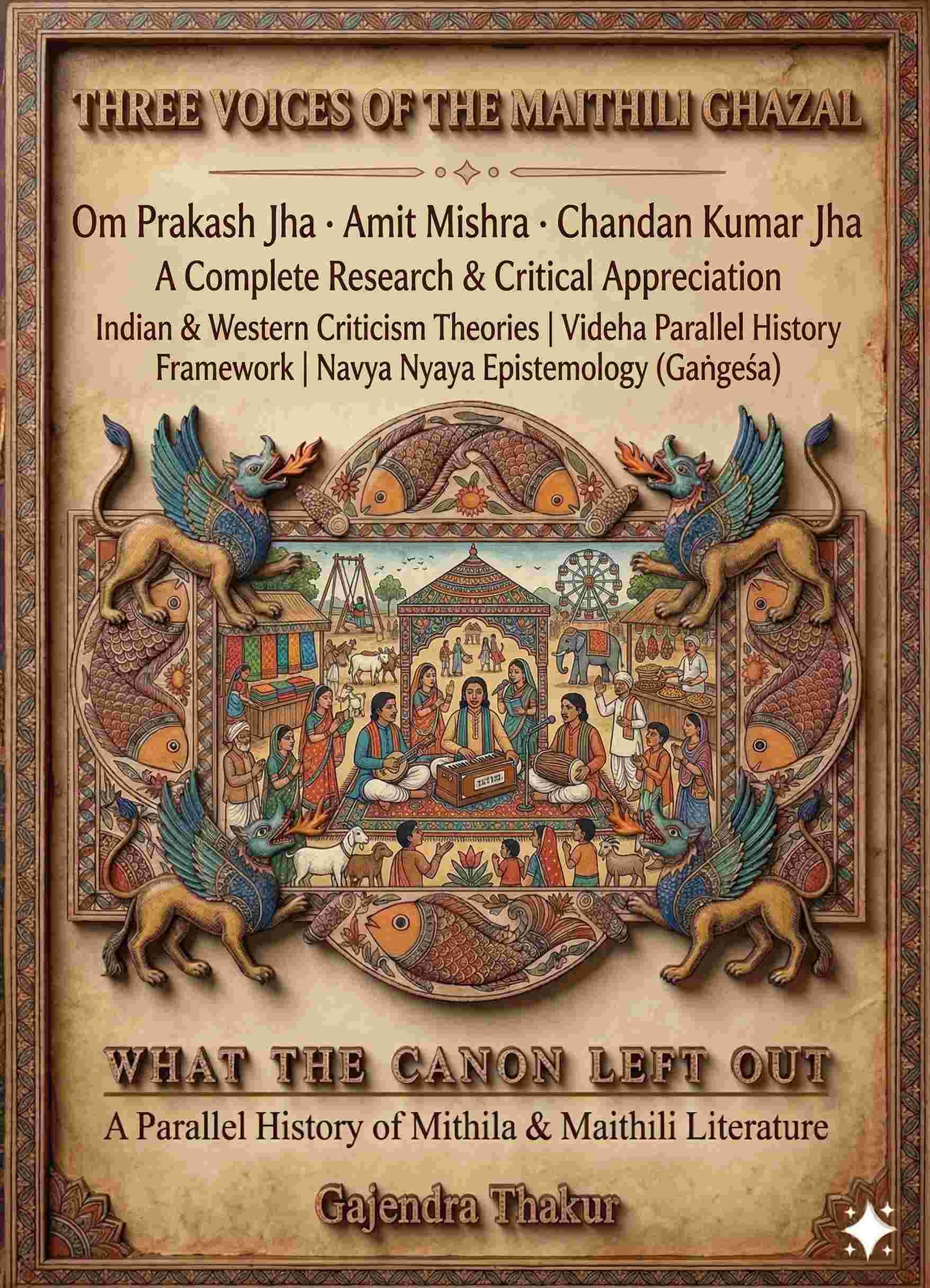
THREE VOICES OF THE MAITHILI GHAZAL Om Prakash Jha Amit Mishra Chandan Kumar Jha A Complete Research & Critical Appreciation Indian & Western Criticism Theories | Videha Parallel History Framework | Navya Nyaya Epistemology (Gangeśa)
THREE VOICES OF THE MAITHILI GHAZAL
Om Prakash Jha · Amit Mishra · Chandan Kumar Jha
A Complete Research & Critical Appreciation
Indian & Western Criticism Theories | Videha Parallel History Framework | Navya Nyaya Epistemology (Gaṅgeśa)
Table of Contents
1. Introduction: The Anchinhar Akhar Era of Maithili Ghazal
2. Historical Context: The Maithili Ghazal Tradition
3. The Videha-Anchinhar Platform: A Parallel Literary Revolution
4. The Ghazal as Literary Form: Technical Framework
4.1 Arabic-Persian Prosody and Maithili Adaptation
4.2 Gajendra Thakur's Sarala Varnik Bahar System
4.3 The Makta, Matla, Radif, Kafiya: Technical Vocabulary
5. Om Prakash Jha: Kiyo Bujhi Nai Sakal Hamara
5.1 Biographical Context
5.2 Thematic Analysis: Love, Society, Politics, Spirituality
5.3 Technical Achievement: Bahrs and Formal Mastery
5.4 Close Reading of Selected Ghazals
5.5 The Rubai and Kata Forms
6. Amit Mishra: Nav Anshu
6.1 Biographical Context
6.2 Thematic Analysis
6.3 Technical Achievement
6.4 Close Reading of Selected Ghazals
7. Chandan Kumar Jha: Monak Baat
7.1 Biographical Context
7.2 Thematic Analysis
7.3 Technical Achievement: Baal Ghazal and Generic Innovation
7.4 Close Reading of Selected Ghazals
8. Indian Literary Theory Applied to the Ghazal
8.1 Rasa Theory (Bharata Muni's Natyashastra)
8.2 Dhvani Theory (Anandavardhana)
8.3 Vakrokti (Kuntaka) and the Oblique Voice
8.4 Reeti Theory and the Register of Ghazal
9. Western Literary Theories
9.1 Lyric Theory and the Confessional Mode
9.2 Intertextuality (Kristeva, Bakhtin)
9.3 Postcolonial Theory: Language Politics and Ghazal
9.4 New Criticism: Paradox, Tension, and the Sher
9.5 Reader-Response Theory (Iser, Fish)
10. The Videha Parallel History Framework
11. Navya Nyaya Epistemology Applied to Ghazal
11.1 Pramana in Poetic Cognition
11.2 Vyapti and the Logic of the Sher
11.3 Shabda Pramana and the Radif-Kafiya System
11.4 Gaṅgeśa's Tatparya and the Ghazal's Multiple Meanings
12. Comparative Analysis of the Three Poets
13. Thematic Synthesis
14. Conclusion and Critical Assessment
15. Bibliography and References
1. Introduction: The Anchinhar Akhar Era of Maithili Ghazal
Three slim volumes, published in the same year (2012) by the same press (Shruti Prakashan, New Delhi), priced identically (Rs. 200 each), distributed by the same distributor (Pallavi Distributors, Nirmali, Supaul): Kiyo Bujhi Nai Sakal Hamara by Om Prakash Jha, Nav Anshu by Amit Mishra, and Monak Baat by Chandan Kumar Jha. This simultaneous emergence is not coincidence but consequence — the consequence of a specific moment in Maithili literary history: the consolidation of what Gajendra Thakur has called the 'Anchinhar Yuug' (the 'Anchinhar Akhar Era') of Maithili ghazal writing.
All three poets acknowledge a common genealogy: the Videha eJournal (www.videha.co.in), the Anchinhar Akhar blog (http://anchinharakharkolkata.blogspot.com) run by Sri Ashish Anchinhar, and Gajendra Thakur's foundational Maithili Ghazalshastra (the theoretical manual of Maithili ghazal prosody). All three name the same trio of mentors: Gajendra Thakur (theoretical grounding), Ashish Anchinhar (prosodic training in bahar), and Umesh Mandal (editorial support and encouragement). Om Prakash Jha's preface explicitly names all three: 'These three people are unforgettable for me and will always remain so.'
The three collections — 87 ghazals, 16 rubais, 2 katas in Kiyo Bujhi; 90 ghazals, 6 hazals, 16 rubais in Nav Anshu; 66 ghazals, 2 hazals, 15 baal ghazals, 33 rubais, 1 kata in Monak Baat — constitute a collective literary monument: the first published flowering of the Anchinhar Akhar era of Maithili ghazal writing. Together they contain well over 200 ghazals written by young poets who came to the ghazal form through digital platforms, learned its grammar from an online community, and published simultaneously in print — a publishing model without precedent in Maithili literary history.
This study applies the full range of Indian and Western literary theory — Rasa theory, Dhvani theory, Western lyric theory, intertextuality, postcolonial criticism, New Criticism, reader-response theory — alongside the Videha Parallel History Framework and Navya Nyaya epistemology of Gaṅgeśa to a comprehensive critical appreciation of these three poets and their foundational collections.
2. Historical Context: The Maithili Ghazal Tradition
The ghazal entered Maithili literature in the late nineteenth or early twentieth century, with the pioneering efforts of Pandit Jiwan Jha ('Bihari'). Chandan Kumar Jha's preface to Monak Baat provides the most detailed historical account among the three collections, noting that Maithili literary history spans approximately 107 years of ghazal writing. However, this long history was marked by inconsistency and formal ambiguity: much of what was called 'ghazal' in Maithili did not actually follow the strict Arabic-Persian prosodic requirements (the bahar system of quantitative metre), and the kafiya (rhyme)-radif (refrain) system was imperfectly observed.
The critical intervention of the Anchinhar Akhar movement was precisely the insistence on formal rigour: that Maithili ghazal must observe the Arabic-Persian prosodic standards (appropriately adapted to Maithili phonology), that the kafiya must be metrically and phonologically precise, and that the bahar must be consistent throughout a ghazal. Chandan Kumar Jha's preface diagnoses the historical problem: 'Many of the older generation of Maithili ghazalkaras have not yet grasped the Arabic bahar-based prosody and its application in Maithili — which is unfortunate.' The three collections under study represent the Anchinhar era's answer to this historical deficiency.
The Maithili ghazal tradition that the three poets inherit includes: Pandit Jiwan Jha (the founding figure), Gajendra Thakur (the moderniser and theorist), and the generation of writers who emerged through Videha and Anchinhar Akhar — including Shantilakshmi Chaudhary, Mihir Jha, Jagadanand Jha 'Manu', Bibi Jha, Rajiv Ranjan Mishra, Pankaj Chaudhary 'Navali', and others named in Chandan's preface alongside the three poets of this study.
3. The Videha-Anchinhar Platform: A Parallel Literary Revolution
The Videha Maithili eJournal (www.videha.co.in, ISSN 2229-547X), edited by Gajendra Thakur since January 2008, and the companion blog 'Anchinhar Akhar' (http://anchinharakharkolkata.blogspot.com) run by Sri Ashish Anchinhar, jointly constituted the platform through which the Anchinhar era of Maithili ghazal emerged. All three poets are explicit about this: Amit Mishra writes: 'In January 2012 I found a guru in Sri Ashish Anchinhar Ji, and simultaneously found a platform like Videha — I regard this day as my new awakening (nav jagaran).' Chandan Kumar Jha writes: 'The Videha family and Anchinhar Akhar family taught me the meaning of ghazal and inspired me to write ghazal.'
The significance of this platform cannot be overstated for understanding these three collections. All three poets began writing ghazals and sharing them digitally on Facebook groups (the 'Videha' group) and the Anchinhar Akhar blog before they published in print. The immediate feedback loop — writing a ghazal, posting it online, receiving responses from other poets and readers, revising based on technical criticism — constituted the laboratory of formal training that made the print collections possible. This is a model of literary production without precedent in Maithili literary history: the digital-first, community-trained, simultaneously-published emergence of a new generation.
Gajendra Thakur's Videha Parallel History framework is relevant here in its insistence that literary history must reckon with the full ecology of literary production — not only the canonical published works evaluated by institutional critics, but the platforms, communities, and processes through which writers are formed and works circulate. The simultaneous publication of three ghazal collections by three poets from the same online community, by the same publisher, in the same year, is a moment in Maithili literary history that institutional criticism — focused on individual 'major' figures — would likely miss or undervalue. The Parallel History framework makes it visible and significant.
4. The Ghazal as Literary Form: Technical Framework
4.1 Arabic-Persian Prosody and Maithili Adaptation
The ghazal is a lyric poem form originating in Arabic and Persian literature (the Arabic tradition traceable to the 7th century CE; the Persian classical ghazal reaching its heights with Hafiz, Rumi, and Sa'di in the 13th-15th centuries; the Urdu ghazal tradition from Mir Taqi Mir and Mirza Ghalib to the 20th century). Its defining formal features are: the matla (opening sher/couplet, where both lines share the same kafiya-radif pattern), the maqta (closing sher, where the poet's takhallus/pen-name appears), the radif (refrain — identical words repeated at the end of each sher's second line and both lines of the matla), the kafiya (rhyme scheme, preceding the radif), and the bahar (metre — the quantitative prosodic scheme that regulates the length and pattern of syllables).
Maithili adaptation of the ghazal faced the challenge of applying a quantitative prosodic system (the Arabic-Persian bahar, based on the distinction between long and short syllables) to a language (Maithili) with a different phonological structure. Gajendra Thakur's theoretical contribution — the Sarala Varnik Bahar — was to develop a simpler quantitative system based on syllable count (Varnik = syllable count) that allowed new Maithili ghazal writers to observe formal constraints without mastering the full complexity of Arabic prosody. More advanced poets, like those influenced by Ashish Anchinhar's training, attempted the full Arabic bahar system.
4.2 Gajendra Thakur's Sarala Varnik Bahar System
The Sarala Varnik Bahar (Simple Syllabic Metre), as described and applied by Gajendra Thakur, requires that every line (pankti) in a ghazal has the same number of syllables (varna). This is explicitly notated by all three poets at the end of each ghazal: 'Varna-13', 'Varna-16', 'Varna-20', etc. Om Prakash's preface explains: 'I believe one should write the Arabic bahar's name or, if in Sarala Varnik Bahar, the syllable count below every ghazal. Therefore I have noted the bahar name or syllable count below all ghazals.' This notational practice — transparent about formal choices — is itself a mark of the Anchinhar era's formalist commitment.
The Arabic bahrs employed by the three poets include: Bahre-Hazaj, Bahre-Ramal, Bahre-Kamil, Bahre-Mutaqarib, Bahre-Mutadarik, Bahre-Basit, Bahre-Muktajib, Bahre-Salim, Bahre-Sagir, Bahre-Kabir. Chandan's preface provides the most comprehensive theoretical account of the bahar system, categorising them into Saman Bahar (uniform metre), Adhasaman Bahar (semi-uniform metre), and Asaman Bahar (non-uniform metre), with examples drawn from Ashish Anchinhar's theoretical framework.
4.3 The Makta, Matla, Radif, Kafiya: Technical Vocabulary
The technical vocabulary that all three poets deploy in their prefaces demonstrates their shared theoretical formation. The matla (first sher where both lines share kafiya-radif) is the formal announcement of the ghazal's prosodic contract. The maqta (last sher containing the takhallus — pen name) is the formal signature of the ghazal. Om Prakash uses 'Om' as takhallus; Amit Mishra uses 'Amit'; Chandan Kumar Jha uses 'Chandan'. The radif (identical-word refrain) and kafiya (rhyme) together constitute the sonic architecture of the ghazal — the web of sound that holds its independently-meaningful shers together.
The sher (couplet) is the fundamental unit of the ghazal: each sher should be semantically complete and independent — able to stand alone as a self-contained poetic statement — while also participating in the larger ghazal through the radif-kafiya system. This structural paradox — the sher's independence within the ghazal's sonic unity — is one of the ghazal form's most distinctive and theoretically interesting features, with important implications for Navya Nyaya analysis of poetic meaning.
5. Om Prakash Jha: Kiyo Bujhi Nai Sakal Hamara
5.1 Biographical Context
Om Prakash Jha's collection Kiyo Bujhi Nai Sakal Hamara (Who Could Not Understand Me — Maithili Ghazal, Rubai and Kata; Shruti Prakashan, Delhi, 2012; ISBN 978-93-80538-87-7; Price Rs. 200) is his first published literary work and specifically his first published Maithili ghazal collection. His preface reveals that he considers himself primarily a ghazalkar, though he writes in other genres as well. His pen-name/takhallus is 'Om', which he uses consistently as his maqta signature.
He was born and raised in a family with a literary-intellectual tradition: his father, Sri Pitambar Jha, was always writing, collecting Maithili newspapers and journals, and held socialist political views; his mother, Shrimati Ramkumari Jha, had liberal views that also deeply influenced him. He credits his socialist-humanitarian worldview to both parents. He is married to Shrimati Rekha Jha, who is always his first listener (his 'pehla shrota') — he reads every ghazal to her first, takes her suggestions, and credits her patience and love as the source and inspiration of his ghazal writing.
He describes his emergence as a ghazalkar as the product of Videha's platform and Ashish Anchinhar's influence: 'My emergence as a ghazalkar is purely the result of Anchinhar Akhar and Videha's effort and collaboration.' He learned the formal grammar of ghazal through Gajendra Thakur's Maithili Ghazalshastra, trained in kafiya-radif correction under Ashish Anchinhar's mentorship, and received sustained encouragement from Umesh Mandal. The collection contains 87 ghazals (plus rubais and katas), covering themes of love, social critique, politics, humour, and spirituality.
5.2 Thematic Analysis
Thematically, Om Prakash's ghazals range across four major domains. The romantic/shringara domain is the numerically largest: the separated lover's longing, the beloved's cruelty and indifference ('Nainaki chhuri na chalabuyai sajniya' — 'Do not wield the knife of your eyes, O beloved'), the impossibility of forgetting, and the joy and pain of memory. These are in the classical viraha-shringara register of Maithili lyric poetry, adapting the ancient tradition of the separated lover to the ghazal form.
The social-political domain is where Om Prakash is most distinctive. Several ghazals address inequality, the corruption of democracy, the plight of the poor, and the gap between constitutional promise and social reality: 'Bhikh nai hamara apan adhikar chahi / Hamar karmasank je banai uphaar chahi' (Ghazal 1: 'Not alms do I want, my rights I need / Let my own labour build my reward'). 'Jan-ganak sevak bhela deshak bhaar chai / Jantaak mari taka banal budhiyaar chai' (Ghazal 22: 'The people's servant has become the country's burden / Beating the public, [he] became clever on public money'). These politically engaged ghazals deploy the ghazal's traditional vehicle of love-complaint to carry social-democratic critique — a characteristic move of the best Urdu and Hindi ghazal tradition.
The domain of philosophical reflection includes ghazals on the nature of life, the paradox of existence, and the human condition. Ghazal 9 ('Dharak kaat rahito piyas rahi gel jinngi hamar / Monak baat monahi rahal dukha sahi gel jinngi hamar' — 'Living on the river's bank, thirsty remained my life / The heart's talk stayed in the heart, sorrow endured my life') is a meditation on the irreducibility of existential longing — the paradox that one can have everything (the river, the bank) yet remain thirsty. This is the classical Islamic-Sufi resonance of the ghazal form: the beloved is simultaneously human and divine, and the lover's thirst is simultaneously romantic and spiritual.
The humorous domain is represented by the Murchha Diwas (April Fool's Day) ghazal (No. 85), a comic self-deprecating piece written in the takhallus 'Om': 'Murkha Diwas par pata chala ham sabhsank badaka murkha thikhai' ('On Fool's Day it was learned that I am the biggest fool of all'). This deployment of the ghazal's formal conventions for comic self-deprecation — a tradition with deep roots in the Urdu hazal (comic ghazal) — demonstrates Om Prakash's formal range.
5.3 Technical Achievement
Om Prakash employs the largest range of Arabic bahrs among the three poets: Bahre-Ramal, Bahre-Mutaqarib, Bahre-Sagir, Bahre-Salim, Bahre-Basit, Bahre-Hazaj, Bahre-Kabir, Bahre-Muktajib, Bahre-Kamil, and Sarala Varnik Bahar at various syllable counts (Varna 16, 17, 18, 20, 22, 24). This technical range demonstrates serious prosodic study and the ambition to master multiple formal registers. His stronger ghazals are among the most technically accomplished in the Anchinhar era corpus.
5.4 Close Reading of Selected Ghazals
Ghazal 4 — whose radif is the collection's title — is Om Prakash at his most characteristic. Its matla: 'Kahu ki kiyo buji nai sakal hamara / Hansi sabhak lagal bahut tharal hamara' ('Say why no one could understand me / Everyone's laughter fell upon me, burning me'). The takhallus sher: 'Rahal Om sidikhna sinehak pujari / I duniya ta kafir muda kahal hamara' ('Om remained always love's devotee / This world called me kafir'). The use of 'kafir' (infidel) — a loaded word from the Arabic-Islamic tradition — to describe the lover/poet's status in the world's eyes is a classic ghazal gesture: the lover who is faithful to love above all social conventions is branded an infidel by the conventional world. This is simultaneously a love poem, a social critique, and a claim on the Sufi-devotional tradition.
Ghazal 10 on the relation between grief, music, and poetic creation: 'Karej ghansais saajaak raag nikhrai chai / Bina dhunne turak nai taag nikhrai chai' ('By scraping the heart, the instrument's melody is refined / Without grinding, the thread does not emerge from the cocoon'). This metaphysical conceit — the paradox that suffering (scraping/grinding) is the condition of beauty (melody/thread) — is achieved within a tightly observed Bahre-Hazaj, demonstrating the Anchinhar era's aspiration to combine emotional depth with formal mastery.
5.5 The Rubai and Kata Forms
Om Prakash's rubais (16 in the collection) are in the Persian/Arabic rubai tradition — four-line stanzas with the rhyme scheme AABA. His katas (2 in the collection) are a related form: short poems that do not technically conform to ghazal structure but share its emotional register. These demonstrate his command of forms beyond the ghazal proper, establishing the collection as a multi-form lyric anthology rather than a single-genre collection.
6. Amit Mishra: Nav Anshu
6.1 Biographical Context
Amit Mishra's Nav Anshu (New Dew Drop — Maithili Ghazal, Hazal & Rubai; Shruti Prakashan, Delhi, 2012; ISBN 978-93-80538-82-2; Price Rs. 200; © Amit Mishra) is his first published collection. His takhallus is 'Amit'. His preface is particularly informative about both his poetic formation and the technical framework of the ghazal. He writes that he began writing in 2008, but regards January 2012 — when he found a mentor in Ashish Anchinhar and a platform in Videha — as his 'new awakening' (nav jagaran). He credits his high school friend Sri Om Prakash Jha (co-author of this triptych) with first giving him the 'courage to write', and Ashish Anchinhar with providing ghazal knowledge. He also credits Gajendra Thakur (for Videha) and Om Prakash Jha (for repeated support along his ghazal journey). Umesh Mandal is credited as typesetter.
Amit Mishra's preface provides the most technically detailed and educationally oriented introduction of the three, containing a full tutorial on ghazal grammar: definitions of sher, ghazal, radif, kafiya, matla, maqta (with examples), and the bahar system. This pedagogical dimension — the preface as a primer on ghazal form for Maithili readers — reflects the Anchinhar era's commitment to democratising technical knowledge. His takhallus ('Amit') and the use of the initial letter 'E' for short (hrasva) syllables and 'I' for long (dirgha) syllables in his metre analysis (mentioned in his preface) shows systematic technical awareness.
6.2 Thematic Analysis
Nav Anshu's 90 ghazals cover a thematic range that is primarily oriented toward the romantic (shringara) tradition but with distinctive inflections of contemporary realism and social observation. The opening ghazal — 'Chaan dekhlo ta sitara ki dekhab / Anhaarak rup dobara ki dekhab' (If you've seen the moon, why look for stars / Having seen the form of darkness again, why look?) — establishes the collection's characteristic mode: philosophical observations delivered in romantic garb.
The romantic ghazals are rich in the iconography of the Maithili village landscape: the moon, stars, darkness, monsoon rains, the koyal's call, the village courtyard, the bride's ornaments (payel/anklet, kangana/bangle, nathiya/nose-ring). Ghazal 3: 'Konak chamkal rup sab / Bujhaho chahai chai / Ang-ang me hamar ghazal rahe chahai chai' ('How every part gleamed / Wants to be understood / My ghazal wants to live in every limb'). This self-referential meta-ghazal — the poem as a physical presence desiring habitation in the beloved's body — is a sophisticated formal gesture: the ghazal about the ghazal, the poem as beloved.
The social-critical dimension in Nav Anshu is less prominent than in Om Prakash's collection but present in significant ghazals. Ghazal 7 addresses dishonesty and social karma with philosophical firmness: 'Karo kato jhut ki kheti beimani / Dakati / Bhagavan ghar me ta hisab phriehbe karai chai' ('However much you cultivate lies and dishonesty / Robbery — God at home will settle accounts'). This combines the moral-didactic tradition of the Maithili folk proverb with the ghazal form's capacity for compressed philosophical statement.
The most distinctively contemporary dimension of Nav Anshu is the cluster of ghazals addressing urban-rural migration and its emotional consequences. Ghazal 8: 'Kona-kona kohbar se Kolkata elai / Rukabo nai karai film jeka bhagaie besi' ('Somehow from the kohbar (wedding chamber) came to Kolkata / Without stopping, runs like a film'). The contrast between the kohbar (the most intimate Mithila domestic space — the wedding chamber decorated with Mithila paintings) and Kolkata (the migrant city) is compressed into a single devastating sher. This is the emotional reality of the Bihari-Maithili diaspora experience: the loss of the kohbar's intimacy in the relentless movement of urban life.
6.3 Technical Achievement
Amit Mishra's ghazals are primarily in the Sarala Varnik Bahar (with syllable counts ranging from 11 to 20), reflecting his more careful, graduated approach to the formal system. He also attempts some Arabic bahrs but with less frequency than Om Prakash. The consistency of syllable counting throughout his ghazals demonstrates systematic prosodic discipline. His stronger ghazals achieve a balance between emotional directness and formal control.
6.4 Close Reading of Selected Ghazals
Ghazal 6 — 'Aab ta raat bitaeb bhela kathin / Varsha me vastra sukhaeb bhela kathin' ('Now the night has become difficult to pass / In the rains, drying clothes has become difficult') — is simultaneously a realistic depiction of the monsoon-season domestic difficulty of drying clothes and a metaphorical statement about the difficulties of navigating life's emotional storms. The poem works through what Anandavardhana calls Vastu-Dhvani: the suggested meaning (life's emotional difficulties, the viraha of the separated lover) is resonated through the literal situation (wet clothes, persistent rain). The closing sher: 'Dhadhaik rahal pani me dhadhara dekhu / Amit aagi bujhaeb bhela kathin' ('See the fire burning in water / Amit: extinguishing this fire has become difficult') — the paradox of fire in water — is the ghazal's formal-philosophical climax, achieving through the oxymoron a precise statement of the viraha condition: burning with desire, surrounded by rain, unable to extinguish either.
Ghazal 2, with its radif 'hansi ke kahu' ('say it laughing'), is a master of the ghazal's characteristic mode of wisdom delivered with a smile: 'Je kichu kahab hansi ka kahu / Premak jalme phansi ka kahu' ('Whatever you say, say it laughing / In love's net caught, say it laughing'). Each sher adds a new dimension: 'Bhijao sinehak barsha me / Dilak jhilme dhansi ka kahu' ('Soaked in the rain of love / Sunk in the heart's lake, say it laughing'). The radif 'hansi ka kahu' is not merely a formal requirement but a philosophical position: the wisdom that all life's difficulties must ultimately be expressed with laughter, not bitterness.
7. Chandan Kumar Jha: Monak Baat
7.1 Biographical Context
Chandan Kumar Jha's Monak Baat (The Heart's Talk — Maithili Ghazal, Hazal, Baal Ghazal, Rubai & Kata; Shruti Prakashan, Delhi, 2012; ISBN 978-93-80538-81-5; Price Rs. 200; © Chandan Kumar Jha) is his first published collection. His takhallus is 'Chandan' (sandalwood — a classical Sanskrit-Maithili symbol of fragrance, coolness, and devotion). His self-description in the preface is notably modest and reflexively self-aware: 'I was not a student of literature (sahitya ka vidyarthi nai chhalai). Therefore many things of literature, its grammar, are unfamiliar to me. Yet I always had attachment to literature... Like any ordinary person, many feelings about my surrounding society, environment, etc. constantly arise in my mind. Many feelings vanish with passing time. Then some of these descend in the form of letters on paper, sometimes as poetry, sometimes as story, sometimes as ghazal, sometimes as rubai and other forms of literature.'
His acknowledgment section is particularly revealing: he names first a teacher ('Jinkara anukampasak kahibyo rinnanh heab — acharya; kanhai' — 'From whose grace I will never be free — teacher; Kanhai') to whose memory he is indebted; then the Videha family and Anchinhar Akhar family. He acknowledges Ashish Anchinhar and Gajendra Thakur by name. He also makes a significant intervention in his preface: a full theoretical essay on Maithili ghazal history and prosody, the most substantial theoretical statement of the three collections — making Monak Baat not only a poetry collection but a critical-historical document.
7.2 Thematic Analysis
Chandan Kumar Jha's thematic range is notably the broadest of the three poets. The romantic ghazals are distinctive for their precision of imagery and emotional intelligence. Ghazal 11: 'Ghosh hunkar utar gelai / Jot sagaro pasar gelai' ('Their veil fell / Light spread everywhere'). The falling of the veil (ghosh — the traditional covering a woman draws over her face) is rendered as a cosmic event: when the beloved's veil falls, light spreads everywhere. This is simultaneously a domestic scene (the parda tradition) and a philosophical metaphor (the lifting of Maya/illusion).
The social ghazals are Om Prakash's equal in political directness. Ghazal 12: 'Jinngi ker batpara kantsa garhla chai / Nayat ker tat bedha sagaro daphanal chai / Moy-baap bhai-bandhu chai jhuth hai sambandha sab / Moh-jal ojharaya jinngi gatana chai' ('Life's path has thorns planted everywhere / The reed-fence of the new has been buried all around / Mother-father, brothers — all relationships are false / Life is tangled in illusion's net'). This ghazal — one of the darkest in the three collections — refuses all consolation and names the social and familial structures of Mithila life with unflinching critical distance.
Ghazal 13 is a comic-satirical masterpiece on the theme of the vain and arrogant fool: 'Murkha bada mahan o je apnakai kabila bujai chai / Apan mathak tetarh thakke kakarahu nai sujhai chai' ('The fool is great who considers himself capable / Whose own head's obstacle blocks everyone else's view'). This Hazalesque social satire (in a serious ghazal form) is characteristic of Chandan's capacity to hold comic and serious simultaneously — a skill that finds its fullest expression in his hazal and baal ghazal sections.
The nari-centric ghazals (Ghazal 17: 'Punmaak raatik chaan sana chamkait chai ahaan / Angnaak tulsi chaura sana gamkait chai ahaan' — 'You glow like the full moon's night / You are fragrant like the tulsi tree of the courtyard') render women's experience with sensitivity and precision. The tulsi tree (sacred basil, always in the centre of the traditional Mithila courtyard, tended by women) as a metaphor for the beloved is both intimate and culturally specific: it locates the love poem within the material ecology of Mithila domestic space.
7.3 Technical Achievement: Baal Ghazal and Generic Innovation
The most formally innovative dimension of Monak Baat is the inclusion of 15 Baal Ghazals (children's ghazals) — a genre that Chandan Kumar Jha is among the first in the Anchinhar era to write systematically. The baal ghazal adapts the ghazal's formal structure (matla, radif, kafiya, maqta, bahar) to content appropriate for children: nature imagery, play, learning, seasons, and gentle social values. This generic innovation demonstrates the democratic and pedagogical ambitions of the Anchinhar era: if the ghazal's formal discipline is valuable, it should be accessible to children as well as adults; if Maithili literature needs to develop, it needs forms that can reach the youngest readers.
Sample Baal Ghazal: 'Saone ayal sakala tara / Jhilmil jhilmil karai tara / Kaalo raatike tara chai / Man mein chamkait tara' ('In the evening all the stars come / The stars shimmer, shimmer / Even in the dark night stars / Stars glimmer in the heart'). The formal requirements (syllable count consistency, rhyme scheme) are fully observed, demonstrating that the baal ghazal is not a relaxation of form but its adaptation.
7.4 Close Reading of Selected Ghazals
Ghazal 14 — 'Sabad sanga khelaeb hamara nik lagait chai / Sabad hi ojharaeb hamara nik lagait chai' ('Playing with words appeals to me / Even tangling in words appeals to me') — is a meta-poem about the nature of poetic composition, simultaneously a statement of craft and a demonstration of it. The paradox of the second line ('even tangling/getting confused in words appeals to me') acknowledges the difficulty and frustration of writing as part of its pleasure — a sophisticated Romantic-era observation that finds precise expression in the ghazal form's compressed couplet structure.
Ghazal 15 is among the most musically accomplished in all three collections: 'Kauwa kuchaural bhore angana sancha parait authi sajan / Chham-chham-chham-chham payala bajai khanak uthal kangana' ('The crow called early in the courtyard — at dusk the beloved will come / The anklet rang chham-chham, the bangle jingled'). The onomatopoeia ('chham-chham-chham-chham') for the anklet's sound is a technical tour de force within the Sarala Varnik Bahar's syllable-count constraint, and the crowded domestic imagery (the crow, the courtyard, the anklet, the bangle, the sandalwood-fragrant courtyard) evokes the richness of Mithila's sensory domestic world with extraordinary economy.
8. Indian Literary Theory Applied to the Ghazal
8.1 Rasa Theory (Bharata Muni's Natyashastra)
Bharata Muni's Rasa theory (Natyashastra, c. 200 BCE–200 CE) identifies eight primary aesthetic emotions: Shringara (love), Hasya (humour), Karuna (pathos), Raudra (fury), Vira (heroism), Bhayanaka (terror), Bibhatsa (disgust), Adbhuta (wonder), with Shanta (peace) as a ninth later addition. The ghazal form, by its very nature and historical tradition, privileges Shringara Rasa (love) as its primary mode — the very word 'ghazal' in Arabic denotes 'to speak of love' or 'love talk with women.'
In all three collections, Shringara Rasa dominates — specifically Vipralambha Shringara (love in separation), which is the most emotionally intense and formally productive mode. The archetypal ghazal situation is the separated lover addressing an absent or indifferent beloved: this situation generates the full range of viraha (separation) emotions — longing, grief, memory, reproach, self-pity, philosophical resignation. The radif (refrain) structure formally embodies this repetitive emotional state: the same words return at the end of each sher, as the lover returns to the same obsession.
Hasya Rasa appears in the hazal (comic ghazal) sections of all three collections, and in Om Prakash's April Fool ghazal. Karuna Rasa predominates in the social-critique ghazals (the poor man's plight, the political manipulation of the poor). Vira Rasa appears in Om Prakash's ghazal on rights and resistance ('Bhikh nai hamara apan adhikar chahi'). Adbhuta appears in the metaphysical conceits: fire burning in water (Amit), the ghazal wanting to live in the beloved's body (Amit), light spreading when the veil falls (Chandan).
8.2 Dhvani Theory (Anandavardhana)
Anandavardhana's Dhvanyaloka (9th century CE) — the theory of suggestive resonance (Dhvani) as the soul of poetry — is particularly central to the ghazal form, which is structurally dependent on suggestion, indirection, and layered meaning. The ghazal's characteristic mode is Rasa-Dhvani — the suggestion of an entire emotional-aesthetic state through minimal verbal means. Each sher is a tiny world of compressed suggestion; the whole ghazal is an architecture of resonances.
The concept of Yamaka (repetition for resonance) is directly relevant to the radif structure: the identical words of the radif, returning in different semantic contexts with each sher, create a Dhvani-like resonance effect. When Om Prakash's radif 'hamara ki' ('to me what') returns in each successive sher with a new context, the cumulative effect is not merely repetition but deepening resonance — each sher adding a new layer to the meaning of the radif phrase.
Anandavardhana's concept of Bhakasakti (expressive power of linguistic units) — the idea that some words carry more concentrated suggestive power than others — helps explain why certain ghazal images (the moon, the moth and flame, the wine and the cup, the wound and the arrow) are so pervasive and productive: they are words of maximum Dhvani-potential in the ghazal tradition, capable of carrying enormous weight of suggestion in minimal space.
8.3 Vakrokti (Kuntaka) and the Oblique Voice
Kuntaka's Vakroktijivita (10th century CE) — the theory of 'oblique expression' as the essence of literary language — is directly applicable to the ghazal's constitutive indirection. The ghazal never directly states its emotion; it obliquely approaches through metaphor, paradox, irony, and the play of the kafiya-radif system. When Om Prakash writes 'Chhadhi raho hamara ki / Bada mahal ahan thokait raho hamara ki' ('Leave me alone — what's it to me / You build great mansions — what's it to me'), the speaker's apparent indifference is a Vakrokti — an oblique expression of the lover's wound, which precisely because it cannot be said directly is said through its apparent denial.
The takhallus/maqta (pen-name sher) is itself a structural Vakrokti: the poet speaks of himself in the third person, creating a formal distance between the biographical self and the lyric self. When Om Prakash writes ''Om' kahait rahat anhin sojha-sojha gapp' ('Om will keep saying these straight-forward words'), the apparent claim of direct speech is itself oblique — the self-naming as 'Om' distances the speaker from the reader and creates the classic ghazal irony of the poet as both subject and observer of his own emotion.
8.4 Reeti Theory and the Register of Ghazal
The Reeti (style) school of Sanskrit poetics (Vamana's Kavyalankarasutravritti, 9th century CE) identified different stylistic registers (Reetis) appropriate to different literary genres and occasions: Vaidarbhi (soft, Maithili-like), Gaudi (dense, ornate), and Panchali (balanced). The Maithili ghazal in the Anchinhar era is characteristically in a mixed register: the formal requirements of the Arabic bahar impose a certain sonic density (Gaudi) while the Maithili vernacular and the social-realistic themes tend toward the clearer, more direct register. The three poets navigate this tension differently: Chandan tends toward the denser, more imagistic Gaudi register; Amit toward the simpler, more direct Panchali; Om Prakash moves between both depending on the theme.
9. Western Literary Theories
9.1 Lyric Theory and the Confessional Mode
The Western tradition of lyric theory — from the Romantic conception of the lyric as 'spontaneous overflow of powerful feelings' (Wordsworth) to the modernist 'objective correlative' (T.S. Eliot) to the confessional mode (Sylvia Plath, Robert Lowell) — provides a comparative framework for understanding the Maithili ghazal's lyric operations. The ghazal's self-naming (takhallus) convention is neither Romantic spontaneity nor modernist impersonality but something distinctive: a structured, formal self-reference that simultaneously constitutes and distances the poetic self.
The confessional mode — poetry as direct personal testimony — partially applies to the Anchinhar era ghazal: all three poets write from evident personal emotional experience, and the immediacy of the prefaces (which describe personal relationships, family dynamics, and professional contexts) blurs the boundary between confessional autobiography and lyric convention. However, the ghazal's formal constraints (bahar, kafiya, radif, takhallus) impose a degree of formalisation that prevents pure confessionalism: the personal emotion must pass through the formal filter of the ghazal's grammar before it can become a poem.
9.2 Intertextuality (Kristeva, Bakhtin)
Julia Kristeva's concept of intertextuality — that all texts are tissues of quotation, absorbed and transformed from other texts — is structurally inscribed in the ghazal tradition through the takhallus system, the conventional imagery (moon, wine, moth, flame), and the shared prosodic framework. All three poets are writing within and against a dense web of intertexts: the Urdu ghazal tradition (Mir, Ghalib, Faiz), the Hindi ghazal (Dushan Dushyant Kumar), and the emerging Maithili ghazal corpus. The radif and kafiya choices, the image selection, and the takhallus signature are all intertextual acts — gestures of participation in and differentiation from the tradition.
Bakhtin's concept of dialogism — the idea that all utterance is inherently responsive to and anticipatory of other utterances — applies to the ghazal's takhallus convention. When Om Prakash writes 'Om kahait rahat' ('Om keeps saying'), he is not merely naming himself but entering into dialogue with every other ghazalkar who has similarly named themselves in their maqta: the takhallus is a dialogic act, positioning the poet within the community of ghazal writers. This is particularly significant in the Anchinhar era, where all three poets belong to the same online community and many of their ghazals were first published and responded to on the same digital platforms.
9.3 Postcolonial Theory: Language Politics and Ghazal
The appropriation of the Arabic-Persian ghazal form by Maithili language — a language historically undervalued by both colonial and post-colonial Indian state institutions — is itself a significant postcolonial cultural act. By demonstrating that Maithili can sustain the formal rigour of the Arabic bahar system, the Anchinhar era poets assert Maithili's cultural sophistication against both Hindi (which has absorbed much of the North Indian ghazal tradition) and Urdu (the primary carrier of the classical ghazal tradition in South Asia).
Frantz Fanon's analysis of cultural production in colonised languages — the argument in The Wretched of the Earth that literature in the national language is an act of cultural reclamation — applies to the Anchinhar era Maithili ghazal. Writing technically demanding ghazals in Maithili, at the same level of formal rigour as Urdu or Hindi, is a cultural-political act: it asserts the adequacy of Maithili as a medium for high literary expression. The explicit naming of the bahar, the careful notation of kafiya and radif, the pedagogical prefaces — all these are assertions of Maithili's capacity to sustain the full technical apparatus of the classical ghazal tradition.
9.4 New Criticism: Paradox, Tension, and the Sher
New Criticism's identification of paradox, irony, and tension as the marks of literary achievement (Cleanth Brooks, Robert Penn Warren) finds precise application in the ghazal's structural features. The sher's requirement for complete semantic independence within the ghazal's sonic unity creates an inherent structural tension: each sher is simultaneously autonomous and constrained, free and bound. The best shers in all three collections achieve a paradoxical density — they are both complete statements and suggestions, both literal and figurative, both personal and universal.
Brooks's concept of 'the well-wrought urn' — the poem as a self-contained, internally consistent aesthetic object — maps onto the individual sher's structural independence: each sher is a miniature well-wrought urn. Om Prakash's sher 'Karej ghansais saajaak raag nikhrai chai / Bina dhunne turak nai taag nikhrai chai' is a well-wrought sher: the two lines create a tight analogical structure (grief:music :: grinding:thread) that is internally consistent, paradoxically rich, and complete in itself.
9.5 Reader-Response Theory (Iser, Fish)
Wolfgang Iser's reader-response theory — the idea that literary meaning is co-created between text and reader through the process of reading — is particularly relevant to the ghazal's characteristic structural gap: the sher's independence from its neighbors creates what Iser calls 'blanks' (gaps in the text that the reader must fill). The Maithili ghazal reader is invited to make connections between apparently unrelated shers, to find the emotional and thematic thread that runs beneath the formal surface. This active reading process — filling the ghazal's structural gaps — is the reader-response dynamic that makes the form so engaging.
Stanley Fish's concept of 'interpretive communities' — groups of readers who share interpretive conventions — is directly applicable to the Anchinhar era ghazal readership. The Videha online community, the Anchinhar Akhar blog readers, and the Facebook ghazal group participants constitute precisely such an interpretive community: they share the technical vocabulary (bahar, kafiya, radif, takhallus), the emotional conventions (viraha as the primary mode), and the cultural context (Maithili diaspora experience) that give the ghazals their full meaning. For readers outside this community, the ghazals require more explanatory context; for community members, they resonate with immediate recognition.
10. The Videha Parallel History Framework
Gajendra Thakur's Videha Parallel History Framework provides the most essential contextual framework for understanding these three collections and their literary-historical significance. The framework's core claim — that official Maithili literary history has systematically undervalued non-elite, non-institutional, digitally-circulated literary production — is nowhere more directly illustrated than in the case of the Anchinhar era Maithili ghazal.
The three collections were produced by poets who: (a) are not from the traditional literary elite of Darbhanga or Madhubani; (b) received their literary training primarily through digital platforms rather than academic institutions; (c) published their first collections simultaneously at their own or the community's expense; and (d) wrote in a literary form (the ghazal) that has only recently gained acceptance within mainstream Maithili literary culture. Without the Videha Archive, the Anchinhar Akhar blog, and the Videha Facebook community, none of these three poets would have had the platform, the training, or the peer community to develop their craft to publishable level within such a short time.
The Parallel History framework also helps understand the significance of the three collections' simultaneous publication. In conventional literary history, major literary figures emerge serially and individually, with canonical status determined by institutional endorsement (prizes, critical essays, academic study). The Anchinhar era produced a cohort — simultaneously, collectively, democratically. No single figure dominates; the achievement is communal. This collective emergence is precisely what Gajendra Thakur's Parallel History project documents and values: the literary movement, not merely the individual genius.
The Videha Archive's preservation of these three collections ensures that the Anchinhar era ghazal's historical significance is documented and accessible. Without this archival commitment, three slim volumes published by a small Delhi publisher in 2012 would be difficult to locate; with the Videha Archive, they are part of the permanent record of Maithili literary history.
11. Navya Nyaya Epistemology Applied to Ghazal
Navya Nyaya — the school of Indian logic and epistemology that arose in Mithila with Gaṅgeśa Upadhyaya's Tattvacintamani (c. 1325 CE) — offers a distinctive framework for analysing the epistemological operations of the ghazal form. The application is not merely metaphorical but culturally grounded: these ghazals are produced within the Mithila cultural tradition that also produced Gaṅgeśa and the entire Navya Nyaya school.
11.1 Pramana in Poetic Cognition
The four Pramanas (sources of valid knowledge) — Pratyaksha (perception), Anumana (inference), Upamana (comparison), Shabda (testimony) — each operate distinctively in the ghazal reading experience. The Pratyaksha of the ghazal is the immediate sensory experience of the sound-pattern: the bahar's rhythmic pulse, the kafiya-radif's sonic architecture, the phonological texture of Maithili words. This is the level at which a ghazal can be heard and experienced even without understanding every word — the music of the form as direct perceptual experience.
Anumana (inference) is activated when the reader infers emotional states and social situations from the ghazal's compressed imagery. When Amit Mishra writes 'Kona-kona kohbar se Kolkata elai' ('Somehow from the wedding chamber came to Kolkata'), the reader infers the full emotional situation (migration, cultural displacement, loss of intimacy) from the single juxtaposition of kohbar and Kolkata. This inferential leap — from two place-names to a life-history — is the Anumana of the ghazal's compressed form.
11.2 Vyapti and the Logic of the Sher
Gaṅgeśa's central technical contribution to Navya Nyaya — the precise analysis of Vyapti (invariable concomitance) — is directly applicable to the ghazal's analogical structures. The best shers in all three collections rest on implicit Vyaptis: invariable concomitances between natural phenomena and emotional states that the reader is expected to recognise. Om Prakash's sher on the heart as an instrument — 'By scraping the heart, the instrument's melody is refined' — rests on the Vyapti: where there is creative suffering, there is artistic achievement. This is presented as universal truth (Vyapti), and the reader's recognition of this truth is the aesthetic experience of the sher.
Navya Nyaya's sophisticated analysis of Upadhi (limiting conditions that restrict Vyaptis) is relevant to the social-critical ghazals. The apparent Vyapti 'where there is the poor, there is the politician's promise; where there is the promise, there is betrayal' is presented by Om Prakash as an invariable concomitance of contemporary Indian political life. The Upadhi (limiting condition) would be the exception — the honest politician — which the ghazal conspicuously does not acknowledge, suggesting that the Vyapti holds without exception in the world the poet describes.
11.3 Shabda Pramana and the Radif-Kafiya System
In Navya Nyaya, Shabda Pramana (valid verbal testimony) operates through the Tatparya (purport/intended meaning) of an utterance. The ghazal's radif-kafiya system creates a distinctive form of Shabda Pramana: the repeated radif word/phrase, returning in each sher, accumulates Tatparya across the ghazal, building a complex of meanings that cannot be reduced to any single sher. When Chandan Kumar Jha's radif 'hamara nik lagait chai' ('I find pleasing') returns again and again in Ghazal 14, it accumulates a Tatparya of aesthetic pleasure, intellectual delight, and professional identity that only emerges fully in the sum of all shers.
The Apta (reliable witness) concept in Navya Nyaya — the speaker whose Shabda Pramana is valid because they have direct and authoritative knowledge — is relevant to the takhallus convention. The ghazal's maqta self-naming constitutes the poet as Apta: by naming himself, the poet claims the authority of first-person witness to his own emotional experience. Om Prakash's 'Om rahala sidikhna sinehak pujari' ('Om remained always love's devotee') is simultaneously a claim to Apta-hood (I testify from my own experience) and a formal poetic act (the maqta of the ghazal).
11.4 Gaṅgeśa's Tatparya and the Ghazal's Multiple Meanings
Gaṅgeśa's concept of Tatparya — the total intended meaning of an utterance, going beyond its literal semantic content — is particularly illuminating for the ghazal's characteristic multi-layeredness. The best ghazal shers carry multiple simultaneous Tatparyas: the literal romantic meaning, the social-political allegorical meaning (in the tradition of the Persian-Sufi ghazal's use of love as code for spiritual or political longing), and the self-reflexive meta-poetic meaning. Om Prakash's 'I duniya ta kafir muda kahal hamara' ('This world called me kafir') carries simultaneously: the lover rejected by society, the socialist rejected by the establishment, the poet marginalised by conventional literary culture, and the Sufi devotee branded heretic by the orthodox.
Gaṅgeśa's analysis of Anuvyavasaya (metacognitive awareness of one's own cognitive processes) is applicable to the three poets' extraordinarily reflexive prefaces, in which they think carefully about their own formation, their learning process, their debts and limitations, and the epistemological conditions of their poetic authority. This metacognitive transparency is itself a Navya Nyaya-like quality: the rigorousness and self-awareness of the reasoner applied to the domain of poetic creation.
12. Comparative Analysis of the Three Poets
Comparing Om Prakash Jha, Amit Mishra, and Chandan Kumar Jha across thematic, technical, and temperamental dimensions reveals three distinct poetic personalities within a shared formal and communal context.
Thematically: Om Prakash is the most politically engaged and socially critical, the most philosophically ambitious, and the most tonally varied (ranging from intense romantic lyric to comic self-deprecation to democratic rage). Amit Mishra is the most consistently romantic in register, with the sharpest eye for the migrant's emotional landscape (the kohbar-Kolkata juxtaposition is his most distinctive image). Chandan Kumar Jha is the most formally ambitious (baal ghazal, hazal, the fullest theoretical preface), the most metatextually self-aware, and the most cinematically specific in imagery (the courtyard crow, the anklet's chham-chham, the tulsi tree).
Technically: Om Prakash attempts the widest range of Arabic bahrs and achieves the greatest technical variety. Chandan demonstrates the most systematic formal range (through the baal ghazal innovation). Amit is the most consistent in syllable discipline within the Sarala Varnik framework. All three show the influence of their shared formation — none of the three has yet fully mastered the Arabic bahar system's complex requirements, but all three demonstrate serious and sustained formal engagement.
Temperamentally: Om Prakash is passionate, direct, and politically alive; Amit is tender, meditative, and emotionally nuanced; Chandan is philosophically cool, formally adventurous, and socially incisive. These temperamental differences are visible in the takhallus-sher choices: Om Prakash's maqtas are frequently declamatory or ironic; Amit's are tender or self-deprecating; Chandan's are philosophically precise.
13. Thematic Synthesis
a. Love as the Ground of All Other Themes
Across all three collections, love (in all its registers: romantic, familial, devotional, national) is the ground from which all other themes emerge. The social critique is expressed through the vocabulary of love (the beloved's indifference as the politician's indifference); the philosophical meditation uses love's paradoxes (the thirsty man on the riverbank); the patriotic sentiment is the love of the motherland; the devotional impulse is love of the divine. The ghazal form, with its inherent orientation toward love, shapes this thematic convergence.
b. Digital Modernity and Traditional Form
All three collections emerge from a deeply modern, digital context (Facebook groups, blogs, online journals) yet are written in a classical form (the ghazal's Arabic-Persian prosodic tradition). This juxtaposition — contemporary platform, classical form — is itself a statement about the Maithili literary condition: a language asserting its modernity by demonstrating its command of tradition. The ghazal's formal rigour is not antiquarian nostalgia but a claim on cultural seriousness.
c. Community and Individuality
The three collections are simultaneously deeply individual (each poet's voice is distinct) and communally produced (through shared training, shared platform, shared publisher, shared year). This tension between individual voice and communal formation mirrors the ghazal's own structural tension between the independent sher and the unified ghazal. The community is the larger ghazal; each poet is one of its independent shers.
d. The Mithila Diaspora Experience
Migration from Madhubani/Supaul to Kolkata, Delhi, or other cities; the emotional landscape of the absent beloved (often = the absent homeland); the kohbar left behind for the city's anonymity — these are recurring motifs that give all three collections a distinctively diaspora character. The ghazal form, with its constitutive viraha (separation) structure, is the ideal formal vehicle for the Maithili diaspora's emotional world.
14. Conclusion and Critical Assessment
Om Prakash Jha, Amit Mishra, and Chandan Kumar Jha represent a generational watershed in Maithili literary history: the first published cohort of the Anchinhar Akhar era, the moment when the digital literary community constituted by Videha and Anchinhar Akhar produced its first substantial print harvest. Their three collections — Kiyo Bujhi Nai Sakal Hamara, Nav Anshu, and Monak Baat — taken together constitute the founding document of this era.
Their collective achievement is both formal and social. Formally, they demonstrate that the Arabic-Persian ghazal's prosodic demands can be observed in Maithili, and that the Maithili ghazal can carry the full emotional, philosophical, and political weight of the form. Socially, their simultaneous emergence from a democratised digital community challenges the institutional literary culture's gatekeeping function: they did not need the approval of Sahitya Akademi or university syllabuses to develop their craft and reach an audience.
The critical appreciation of these three poets requires the full range of theoretical frameworks applied in this study: Indian Rasa and Dhvani theory (to understand the emotional-aesthetic operations of the form), Western lyric and postcolonial theory (to situate the form's cultural-political significance), the Videha Parallel History Framework (to understand the literary-historical significance of the Anchinhar era), and Navya Nyaya epistemology (to analyse the form's distinctive truth-producing operations). No single framework is adequate; the full portrait requires the convergence of all.
In the terms of Navya Nyaya: their ghazals are Aptavakya — the valid testimony of reliable witnesses — to the emotional and social reality of Mithila's diaspora communities in the early twenty-first century. In the terms of Bharata's Natyashastra: they achieve Lokasangraha — the social holding-together through art — by giving their communities' unspoken emotional experiences a formal and shareable shape. In the terms of Vidyapati's own formulation (invoked by the Kamal-Taal preface): their love — for the Maithili language, for the ghazal form, for their communities — 'grows new moment by moment,' tila tila nutana hoe.
15. Bibliography and References
Primary Sources
• Jha, Om Prakash. Kiyo Bujhi Nai Sakal Hamara (Maithili Ghazal, Rubai & Kata). Shruti Prakashan, New Delhi. 2012. ISBN 978-93-80538-87-7. Price Rs. 200.
• Mishra, Amit. Nav Anshu (Maithili Ghazal, Hazal & Rubai). Shruti Prakashan, New Delhi. 2012. ISBN 978-93-80538-82-2. Price Rs. 200.
• Jha, Chandan Kumar. Monak Baat (Maithili Ghazal, Hazal, Baal Ghazal, Rubai & Kata). Shruti Prakashan, New Delhi. 2012. ISBN 978-93-80538-81-5. Price Rs. 200.
• Typesetter for all three volumes: Umesh Mandal. Distributor: Pallavi Distributors, Ward No. 6, Nirmali (Supaul). Printed at: Ajay Arts, Delhi-110002.
Indian Classical Sources
• Bharata Muni. Natyashastra. (c. 200 BCE–200 CE). Ed. M.M. Ghosh. 2 vols. Calcutta: Asiatic Society, 1951, 1961.
• Anandavardhana. Dhvanyaloka. (c. 850 CE). Trans. Daniel H.H. Ingalls, Jeffrey Moussaieff Masson, and M.V. Patwardhan. Harvard University Press, 1990.
• Kuntaka. Vakroktijivita. (c. 950 CE). Trans. K. Krishnamoorthy. Dharwar: Karnatak University, 1977.
• Vamana. Kavyalankarasutravritti. (c. 9th century CE). Trans. P. Sri Rama Murthy. Tirupati: Kendriya Sanskrit Vidyapeetha, 1971.
• Gaṅgeśa Upadhyaya. Tattvacintamani. (c. 1325 CE). Ed. Kamalashila. Benares: Chowkhamba, 1974.
Ghazal Theory and History
• Thakur, Gajendra. Maithili Ghazalshastra (Maithili Ghazal Prosody). Available through Videha eJournal, www.videha.co.in.
• Anchinhar, Ashish. Anchinhar Akhar (Ghazal & Rubai collection and blog: http://anchinharakharkolkata.blogspot.com). The foundational text of the Anchinhar Akhar era.
• Ali, Ahmed. The Golden Tradition: An Anthology of Urdu Poetry. Columbia University Press, 1973.
• Pritchett, Frances W. Nets of Awareness: Urdu Poetry and Its Critics. Berkeley: University of California Press, 1994.
• Naim, C.M. 'The Art of the Urdu Marsiya.' In: Islamic Society and Culture: Essays in Honour of Aziz Ahmad. Ed. M. Israel & N.K. Wagle. Delhi: Manohar, 1983.
Western Literary Theory
• Bakhtin, Mikhail. The Dialogic Imagination. Trans. Caryl Emerson & Michael Holquist. Austin: University of Texas Press, 1981.
• Brooks, Cleanth. The Well Wrought Urn. New York: Harcourt, Brace & World, 1947.
• Fanon, Frantz. The Wretched of the Earth. Trans. Constance Farrington. New York: Grove Press, 1963.
• Fish, Stanley. Is There a Text in This Class? The Authority of Interpretive Communities. Cambridge: Harvard University Press, 1980.
• Iser, Wolfgang. The Act of Reading: A Theory of Aesthetic Response. Baltimore: Johns Hopkins University Press, 1978.
• Kristeva, Julia. Revolution in Poetic Language. Trans. Margaret Waller. New York: Columbia University Press, 1984.
• Wordsworth, William & Samuel Taylor Coleridge. Lyrical Ballads (Preface, 1800/1802). Ed. R.L. Brett & A.R. Jones. London: Methuen, 1963.
Secondary Sources on Maithili Literature
• Jha, Mithilesh Kumar. Language Politics and Public Sphere in North India: Making of the Maithili Movement. Delhi: Oxford University Press, 2018.
• Mishra, Jayakant. A History of Maithili Literature. 2 vols. Darbhanga, 1949–1969.
• Thakur, Gajendra (ed.). Videha — Prathama Maithili Paksika E-Patrika. ISSN 2229-547X. www.videha.co.in. Since 2008.
• Thakur, Gajendra. 'Parallel Literature in Maithili and Videha Maithili Literature Movement.' Blog post, February 2023. https://gajendrathakur.blogspot.com
Online Resources
• Videha Archive: www.videha.co.in/pothi.htm
• Anchinhar Akhar Blog: http://anchinharakharkolkata.blogspot.com
• Videha eJournal archive of ghazals: www.videha.co.in/archive.htm
अपन मंतव्य editorial.staff.videha@zohomail.in पर पठाउ।