
A PARALLEL HISTORY OF MITHILA & MAITHILI LITERATURE- PART 80
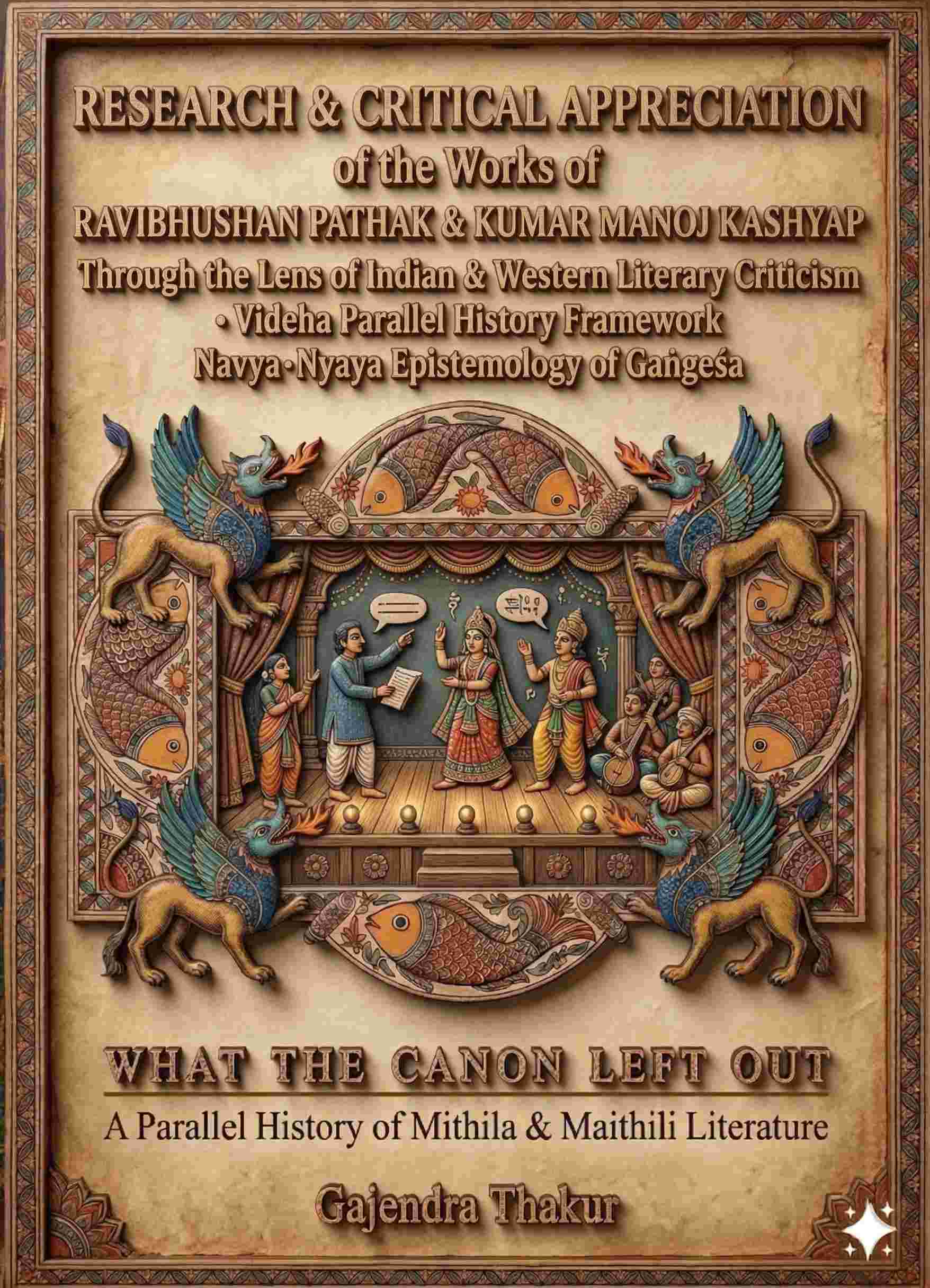
RESEARCH & CRITICAL APPRECIATION of the Works of RAVIBHUSHAN PATHAK & KUMAR MANOJ KASHYAP
RESEARCH & CRITICAL APPRECIATION
of the Works of
RAVIBHUSHAN PATHAK
&
KUMAR MANOJ KASHYAP
Through the Lens of
Indian & Western Literary Criticism • Videha Parallel History Framework
Navya Nyaya Epistemology of Gaṅgeśa
TABLE OF CONTENTS
Preface and Methodological Note
Part I: Theoretical Frameworks
1.1 The Videha Parallel History Framework
1.2 Navya Nyaya Epistemology: Gangesa Upadhyaya and Literary Analysis
1.3 Indian Critical Traditions: Rasa, Dhvani, Vakrokti, and Alamkara
1.4 Western Critical Theories Applied
Part II: Ravibhushan Pathak — Life, Works, and Critical Study
2.1 Biography and Literary Context
2.2 The Play Rehearsal (Riharsal): Drama and Social Critique
2.3 Prose Writings: Ghar, Diary, Vidyapati Essays
2.4 Poetry: Nirala: Deh Videh Translations and Original Verse
2.5 Translation Theory and Practice in Pathak
2.6 Critical Appreciation: Rasa, Dhvani, and Parallel History Perspective
Part III: Kumar Manoj Kashyap — Life, Works, and Critical Study
3.1 Biography and Literary Context
3.2 Badalait Samay: The Short Story Collection
3.3 Ek Thop Ijot: Illuminating the Darkness
3.4 Stories in Videha Sadeha 31
3.5 Poetry: Vasanti Doha, Ghazals
3.6 Critical Appreciation: Narrative Theory, Subaltern Perspectives
Part IV: Comparative Analysis
4.1 Thematic Convergences and Divergences
4.2 Place within Videha Parallel History
4.3 Navya Nyaya Reading of Their Poetics
Part V: Conclusion
Bibliography
PREFACE AND METHODOLOGICAL NOTE
This monograph undertakes a comprehensive research and critical appreciation of the literary works of two significant contemporary Maithili writers: Ravibhushan Pathak (b. 1973) and Kumar Manoj Kashyap. Both writers have contributed substantially to the Videha e-journal (www.videha.co.in, ISSN 2229-547X), the first Maithili fortnightly e-journal, and their collected works appear in the Videha Sadeha anthology series — volumes 27, 29, and 31 — published under the Videha Maithili Sahitya Andolan movement.
The methodological approach here is deliberately pluralist and multi-perspectival, drawing on three intersecting analytical frameworks: (1) the Videha Parallel History Framework as articulated by Gajendra Thakur; (2) the epistemological and logical apparatus of Navya Nyaya, especially as developed by Gangesa Upadhyaya in the Tattvachintamani; and (3) a selection of Indian and Western critical theories — including Sanskrit rasa-dhvani aesthetics, Marxist-inflected subaltern criticism, feminist literary theory, narratology, and postcolonial theory — applied where appropriate to specific textual phenomena.
Primary sources consulted include: Rehearsal (Riharsal), a Maithili play by Ravibhushan Pathak (Shruti Prakashan, Delhi, 2011, ISBN 978-93-80538-43-3); Badalait Samay, a short story collection by Kumar Manoj Kashyap; Ek Thop Ijot (a further prose collection by Kashyap); Videha Sadeha 27 (containing Pathak's Maithili translations of Nirala's Hindi poetry); Videha Sadeha 29 (Pathak's major collected prose and verse); and Videha Sadeha 31 (containing Kashyap's prose fiction and verse). Web resources from www.videha.co.in, particularly the Parallel History pages, have also been consulted.
PART I: THEORETICAL FRAMEWORKS
1.1 The Videha Parallel History Framework
The Videha Parallel History of Mithila and Maithili Literature, authored by Gajendra Thakur and published in ongoing instalments at www.videha.co.in, represents a foundational revisionist historiography. The framework identifies and contests the 'mainstream' or 'dried main drain' narrative of Maithili literature — one dominated by Brahmin-centric court culture, Sahitya Akademi selection biases, and the suppression of democratic, anti-caste, women's, and folk literary voices.
The Parallel History framework is built on several key principles. First, historiographical recovery: voices systematically excluded from canonical literary surveys — such as the Siddha poets of the Buddhist Charyapadas (8th-12th cent.), famine poets like Faturilal, Dalit dramatists like Bechan Thakur, and women writers from Vibha Rani to Panna Jha — are restored to their proper centrality. Second, demystification of caste-based institutional capture: the Sahitya Akademi awards for Maithili, the first of which (1966) went to a philosophy academic text rather than a literary work, are read as evidence of caste-based gatekeeping. Third, digital democratisation: Videha's internet presence since 2000, its ISSN registration, its Tirhuta Unicode contributions, and its archive of thousands of Maithili texts represent a parallel institution-building project.
Ravibhushan Pathak and Kumar Manoj Kashyap, as contributors to Videha since its inception, are thus not merely individual writers but participants in this broader counter-canonical movement. Their works are published, archived, and critically situated within an explicitly anti-establishment literary ecosystem. For a critical appreciation of their work, this context is indispensable: to read Pathak's play Riharsal or Kashyap's story 'Giraith Dewal' ('The Falling Wall') in isolation from the caste and class dynamics of Maithili literary culture would be to misread them fundamentally.
The Parallel History framework also situates both writers in a specific lineage: the post-independence democratic-literary tradition that includes Rajkamal Chaudhary (the 'true avant-garde of Maithili'), Somdev, Jagdish Prasad Mandal, Rajdeo Mandal, and Bechan Thakur. Pathak and Kashyap inherit this tradition and develop it in their own distinctive registers — Pathak through translation, drama, and discursive prose; Kashyap through the concentrated form of the Maithili laghu-katha (short story) and ghazal.
1.2 Navya Nyaya Epistemology: Gangesa Upadhyaya and Literary Analysis
Gangesa Upadhyaya (c. 13th-14th cent.), the Mithila-born philosopher and founder of the Navya Nyaya school, authored the monumental Tattvachintamani, a systematic treatise on epistemology (pramana-shastra). The Videha Parallel History makes a striking claim about Gangesa: that panji (genealogical) research preserved in Videha's archives reveals that he was born of a Charmkarini (leather-tanning caste woman) and was born five years after his father's death — a fact suppressed by later brahminical scholars such as Ramanath Jha in an act of 'honour-killing of his legacy.'
This recovery has dual significance. Biographically, it situates Gangesa himself within the parallel, non-brahminical tradition — a philosopher of world-historical importance whose social origins were systematically erased. Theoretically, it suggests that Navya Nyaya's analytical apparatus — with its precision in defining cognitive categories (pratyaksha, anumana, upamana, shabda), its meticulous logic of vyapti (invariable concomitance), and its developed theory of sabdabodha (verbal cognition) — is available as a tool for reading literary texts across caste boundaries.
In literary analysis, Navya Nyaya's most fruitful contribution is its theory of meaning and reference. The Shabdabodha analysis — how a sentence (vakya) generates a unified, relational cognition in the hearer — maps productively onto questions of literary communication: how do the compressed sentences of a laghu-katha generate their particular impact? How does a translated poem negotiate between source-language and target-language sabdabodha structures? Ravibhushan Pathak, in his theoretical essay on translation in Videha Sadeha 27 (examining Nirala translations), explicitly invokes the Shabdarthalochintamani's dual definition of translation: 'praptasya punah kathane' (re-telling the already-known) and 'jnatarthasya pratipadane' (explicating known meaning) — a direct application of Navya Nyaya categorical precision to translational poetics.
Further, the Navya Nyaya notion of visheshana-visheshya (qualifier-qualified) relation is illuminating for Kashyap's prose style: his stories are structured around the collision of social qualifiers (caste, gender, class) with the 'qualified' individual, revealing how abstract structures of power determine concrete personal fates. The analytical precision of Navya Nyaya — distinguishing types of absence (abhava), types of relation (sambandha), and types of inference — provides a rigorous vocabulary for describing the logical architecture of both Pathak's essays and Kashyap's fictions.
1.3 Indian Critical Traditions: Rasa, Dhvani, Vakrokti, and Alamkara
The Sanskrit critical tradition offers a rich set of analytical tools. Bharata's Natyashastra (c. 2nd cent. BCE-2nd cent. CE) established the theory of rasa — the emotional essences (shrngara, hasya, karuna, raudra, vira, bhayanaka, bibhatsa, adbhuta, and the later-added shanta) that constitute the aesthetic experience of literature. Anandavardhana's Dhvanyaloka (c. 9th cent.) proposed dhvani (resonance or suggestion) as the soul of poetry: the power of language to evoke meanings beyond what is explicitly stated. Kuntaka's Vakroktijivita introduced vakrokti (oblique or 'crooked' speech) as the differentia of poetic language. Bhoja's Shringaraprakasha and Mamata's Kavyaprakasha developed the alamkara (figuration) tradition further.
For Ravibhushan Pathak's play Riharsal, the dominant rasa is karuna (the tragic-pathetic), inflected with a persistent undertone of raudra (the wrathful) directed at caste discrimination. The play's treatment of the theatre troupe's internal conflicts — between the Brahmin director Hemchandra and the low-caste aspiring actor Ramapravesh — generates a sustained dhvani of social critique: the surface-level theatrical dispute resonates with deeper, unspoken tensions about who has the right to inhabit 'canonical' roles (Kalidasa, Vidyapati). Kuntaka's vakrokti is operative throughout: the language of theatrical management encodes the violence of social management.
For Kumar Manoj Kashyap's laghu-kathas, the primary aesthetic is what Sanskrit critics called svabhavokti — naturalistic depiction — combined with a powerful dhvani of social protest. Stories like 'Giraith Dewal' ('The Falling Wall'), 'Kalakaar' ('The Artiste'), and 'Bhukhala Peta' ('The Hungry Belly') achieve their effect not through rhetorical ornamentation but through precise, compressed observation that generates an extensive dhvani of injustice, deprivation, and resilience. The Kavyaprakasha's distinction between abhidha (denotative meaning), lakshana (indicative meaning), and vyanjana (suggestive meaning) is particularly relevant: Kashyap's prose operates almost entirely at the level of vyanjana, where what is left unsaid is as powerful as what is stated.
Abhinavagupta's rasa theory, in its developed form in the Abhinavabharati, posits that aesthetic experience (rasa) is not emotion per se but a universalised, purified form of emotion achieved through the 'distancing' effect of artistic representation. This sadharanikarana (universalisation) is precisely what distinguishes Kashyap's stories from mere protest writing: the artiste-child in 'Kalakaar' is not a sociological case study but an archetypal figure, while his situation is rendered with enough documentary precision to anchor the universalised pathos.
1.4 Western Critical Theories Applied
From Western criticism, this study draws selectively on several traditions. Marxist literary criticism — particularly as developed by Georg Lukacs's theory of realism and later by Fredric Jameson's notion of the 'political unconscious' — provides tools for reading both Pathak's and Kashyap's works as interventions in ideological struggle. Lukacs's distinction between naturalism (mere surface description) and realism (the revelation of underlying social totality through typical characters) is illuminating for Kashyap's laghu-kathas: figures like Baitha the washerman ('Giraith Dewal') are not naturalist sketches but 'typical' in Lukacs's sense — individuals whose particular situation crystallises the structural conditions of a whole social formation.
Bakhtin's theory of the novel — particularly heteroglossia (the coexistence of multiple social voices and languages within a text) and the carnivalesque — applies productively to Pathak's play Riharsal. The drama stages a genuine heteroglossia: high-caste Sanskrit theatrical culture, subaltern folk performance, political sloganeering, and vernacular gossip all collide in an incommensurable dialogue. The carnivalesque element — the 'upside-down world' of the play-within-a-play, where low-caste characters momentarily occupy canonical roles — is simultaneously liberatory and tragically curtailed.
Postcolonial criticism, especially Homi Bhabha's concept of hybridity and the 'third space,' illuminates Pathak's translational practice. His Maithili translations of Nirala's Hindi — and his theoretical reflections on translation in Videha Sadeha 27 — constitute a 'third space' between Hindi and Maithili, between the colonial modernity of standard literary Hindi and the regional specificity of Maithili. Pathak's translation is not servile reproduction but an active negotiation: he appropriates the prestige of Nirala's oeuvre while insisting on Maithili's own phonological, grammatical, and aesthetic resources.
Feminist criticism — from Virginia Woolf's 'room of one's own' to Gayatri Spivak's 'Can the Subaltern Speak?' — is relevant to both writers, though differently. Kashyap's stories repeatedly centre women's experiences: the runaway daughter in 'Giraith Dewal,' the abandoned wives in 'Parajaa' and 'Maryada ka Hanan,' the flood-affected family in 'Bhukhala Peta.' These are not romanticised but rendered in the full complexity of double oppression — class and gender simultaneously. Pathak's translations of Nirala's poems on female figures (including 'Steh Nijhkar Bahi Gael' — 'Love Has Dried and Flowed Away') engage with grief and gender through the dhvani framework.
Narratological approaches — Gerard Genette's analysis of focalization, narrative time, and mood — provide precision tools for analysing Kashyap's short-story craft. His consistent use of third-person limited focalization, his telescoping of narrative time to the single epiphanic moment, and his preference for iterative over singulative narration (what happens again and again rather than what happened once) are all characteristic of the laghu-katha form as theorised in his own preface to Badalait Samay. Roman Jakobson's poetic function — the dominance of the message over other functions — helps explain the formal concentration of Kashyap's prose.
PART II: RAVIBHUSHAN PATHAK — LIFE, WORKS, AND CRITICAL STUDY
2.1 Biography and Literary Context
Ravibhushan Pathak was born in 1973, in Karyan village, Samastipur district, Bihar, with family connections to Bhidha (Nani-gram). His education began in Karyan and Vaidyanathpur villages, continuing in Darbhanga, Samastipur, Patna, and Delhi. He served in the Uttar Pradesh Survey and Land Consolidation departments before joining as a Hindi Lecturer at Nehru Memorial Vishwanath Das Post-Graduate College, Badaun, Uttar Pradesh.
His literary career spans drama, prose, poetry, and translation. His play Riharsal (Rehearsal) was published by Shruti Prakashan, Delhi, in 2011 (ISBN 978-93-80538-43-3, priced at Rs. 50), with first staging at the occasion of the first anniversary of the Udayanachary Mithila Library, and was later included in the Videha Sadeha 29 collection. His extensive prose — including essays on Maithili poetics, Bhama's alankara theory, Dandi's lakshana, travel writings, and social critique — alongside poetry ranging from children's verses to ghazal-inflected lyric, appears across Videha Sadeha 29 and Videha Sadeha 27. His translations in Videha Sadeha 27 include Maithili renderings of poems by Nirala, accompanied by a substantial theoretical essay on translation theory grounded in Navya Nyaya and modern linguistic thought.
Pathak's literary identity is shaped by the tension between two worlds: the agrarian, caste-saturated Maithili village culture (Samastipur, Darbhanga) and the metropolitan Hindi academic world (Delhi, Badaun). This tension generates the characteristic double-voicedness of his work — the capacity to speak simultaneously in Maithili's idiom and with the critical distance of a comparative scholar.
2.2 The Play Riharsal (Rehearsal): Drama and Social Critique
Riharsal is a Maithili play in two acts, set in the world of a village theatrical group ('Rang Chetana Manch') that is preparing a production. The dramatis personae — listed in the published play — include: Hemchandra, a 60-ish 'cultured and Sanskrit-directing' man; Paramesh, a 40-45 year old 'refined actor'; Ramapravesh, Paramesh's theatrical rival, alert to the prestige of low-caste identity; Dhirendra, doctor by training, naturally witty; Manu, Hemchandra's wife; and a host of supplementary characters including musicians, dancing girls (Memamaalini, Meshwarya Rai, Nina Kumari), a drunkard (Sudarshan), and ideologically aware youth (Mukhan). The cast — with its internal hierarchy of caste markers encoded in names — is itself a microcosm of Mithila's social stratosphere.
The central dramatic tension is cast with deceptive simplicity: which actor will play which role in the planned production? But this theatrical question is immediately a social question. When Ramapravesh — identified as 'of the Visar caste, alert to the prestige of low caste' — aspires to the lead roles traditionally reserved for upper-caste performers (Kalidasa, Vidyapati), the conflict that erupts is irreducible to theatrical preference. Hemchandra's management of this conflict — his bureaucratic diplomacy, his appeals to 'theatrical suitability' — is read by Pathak as the cultural hegemony of Brahmin aesthetics masking as neutral professional judgment.
The play's opening scene — Paramesh lying half-asleep to Bhairavi music, then jolted awake by Hemchandra's urgency — establishes the tone of interrupted leisure, of lives deferred in the service of 'culture.' The contrast between Hemchandra's photograph-covered walls (Vidyapati, Rabindranath, Nirala, Prasad, Mohan Rakesh, Harimohan Jha — a canon of literary authority) and Ramapravesh's spare room (Tulsi, Kabir, Marx, Nagarjuna — a counter-canon of dissent and democracy) is one of the play's most eloquent visual statements.
['Riharsal' natak Mithila mein vyapta sanskritik sankat ke / ek chota rupaak achhi / Mithila mein jaati badlal muda jaati ke chaali nahin badlal...] — from the play's preface
The author's preface is explicit: Riharsal stages the cultural crisis pervading Mithila — caste has transformed in name but not in function. Caste lives on, in its perverted roles, in every domain: religion, politics, and literature have become a cocktail of caste and degraded vision.
Pathak invokes T.S. Eliot's idea — as noted in the preface — that the distance between creator and consumer is made necessary by creativity itself. This self-conscious theatricality, the 'play within a play,' is both Pathak's structural device and his critical point: Maithili theatre, particularly village theatre (gaon mein manchan), is simultaneously a site of cultural assertion and of social reproduction. The play refuses to glamourise or to romanticise the village troupe; it shows the compromises, the petty humiliations, the economic dependencies that structure 'cultural work.'
In terms of dramaturgy, Riharsal is broadly in the tradition of modern Indian theatre — naturalistic staging, conversational Maithili dialogue, and a movement toward social exposure rather than Aristotelian catharsis. Yet the play's dhvani (resonant suggestion) works against its surface naturalism: the repeated failures of theatrical 'rehearsal' resonate as the repeated failures of social reform in Mithila. The Brechtian Verfremdungseffekt — making the familiar strange — is not achieved through formal alienation devices but through the excruciating ordinariness of the social conflicts depicted. We recognise the world; the play refuses to let us be comfortable in that recognition.
From a Navya Nyaya perspective, the play dramatises the failure of vyapti (invariable concomitance) in social reasoning: the inference 'if cultured, then upper-caste' (which underlies Hemchandra's casting decisions) is exposed as a faulty vyapti through counter-examples (Ramapravesh's demonstrated talent). Pathak's dramatic logic is ultimately an epistemological one: the play is about false inferences and the social machinery that sustains them.
2.3 Prose Writings: Ghar Series, Diary, Vidyapati Essays
Pathak's prose in Videha Sadeha 29 is extraordinarily diverse: it ranges from the three micro-fictions of the 'Ghar' (Home) series through the essay-diary 'Aujhaka Diary' (Today's Diary), several theoretical essays on Maithili literary history, humorous satire, and the long story 'Okkar Tohar Hammar Sapana' (Your Dream, My Dream, Their Dream).
The 'Ghar' series — three compact prose vignettes of extraordinary compression — deserves extended attention. 'Ghar (Ek)' (Home: One) captures the rhythm of domestic gossip and social positioning: the daily conversation that begins with 'My father is like this, my brother is like this,' moves through the afternoon to 'In our village, things are like this,' and concludes in the evening with 'The younger Chaudhary is like this, the middle Chaudhary is like this.' In twelve lines, Pathak maps the social grammar of Maithili family life — its competitiveness, its relativity of perspective, its absorption of political and caste discourse into the texture of domestic talk.
'Ghar (Dui)' (Home: Two) is a Proustian domestic interior: the half-washed plate left on the floor, vegetables still in the shopping bag, the mosquito net no one unfolds. The household described is one where hospitality has atrophied — where the possibility of a guest occasions only anxiety and the scramble to hide disorder rather than the joy of welcome. Pathak's satire here is gentle but precise: the 'stable earth, guest-free universe' at the vignette's close is simultaneously funny and melancholy.
'Ghar (Teen)' (Home: Three) introduces 'Anand Ji' and his cooking rota, his mother's remembered admonition ('Eat up, son, don't leave a grain'), and the rationalisation of contemporary urban domestic arrangements. The mother's voice — introduced as memory — functions as the moral anchor of the trilogy: a voice of rural communal sufficiency that persists, transformed and attenuated, in metropolitan apartment life.
The essay 'Aacharya Bhamah ka Chintan' (The Thought of Acharya Bhama) and the companion piece 'Dandi aa Kavyalakshan' (Dandi and the Definition of Poetry) represent Pathak as scholar-critic, engaging directly with the Indian alamkara tradition. Pathak reads Bhama's Kavyalamkara and Dandi's Kavyadarsha not as museum pieces but as living theoretical resources: their debates about what constitutes the differentia of poetic language (shabda-artha 'sahite,' or word-meaning-together) are brought into dialogue with modern linguistic theory (Jakobson, Saussure) and with the specific challenges of Maithili poetic composition. This is Indian literary-critical thinking at its most productive: neither reverent antiquarianism nor dismissive modernism, but a genuine engagement across time.
2.4 Poetry: Nirala Translations and Original Verse
Ravibhushan Pathak's contribution to Maithili poetry falls into two broad categories: original Maithili verse and translations from Hindi (principally Nirala). Both are collected extensively in Videha Sadeha 29 (poetry section, pp. 794-898), with the Nirala translations presented with theoretical apparatus in Videha Sadeha 27.
The original poems range from children's verse (Baal Kavita) — 'Mausam,' 'Sun Chhoua Sun,' 'Black Hole' — to satirical verse, seasonal lyric, and what might be called 'verse-essays': poems that carry an argumentative load alongside lyric freight. 'Holi,' 'Chhath,' 'Hamara Maithili' — poems of cultural and seasonal celebration — demonstrate Pathak's capacity for accessible lyric. 'Fasali Padya' (Seasonal/Cropped Verse), 'Maranoprant' (After Death), 'Bamhe Gam Dahine Gam' (Left Side Village, Right Side Village) — six-poem sequence — show his more ambitious, formally experimental side.
The Nirala translations in Videha Sadeha 27 — 'Nirala: Deh Videh 1-4' — represent Pathak's most sustained single literary project. The four instalments render well-known Nirala poems into Maithili: 'Baandho Na Naav Is Thaanv Bandhu' (Do Not Moor the Boat Here, Friend), 'Kinara Woh Hamse Kiye Jaa Rahe Hain' (The Shore is Moving Away from Us), 'Sneh Nijhkar Bah Gaya Hai' (Love Has Dried and Flowed Away), 'Rang Gayi Dhara, Bhela Dhanya Dhara' (The Earth Has Coloured, the Earth Has Been Blessed), 'Sakhi Vasant Aaaya' (Dear Friend, Spring Has Come), and 'Nadal Kari Kari Badar' (The Massing Dark Clouds).
Pathak's theoretical introduction to the translation series is itself a major scholarly contribution. Drawing on Navya Nyaya's distinction between praptasya punah kathane and jnatarthasya pratipadane, and on Roman Jakobson's definition of translation as 'interpretation of verbal signs by means of other verbal signs of another language,' he develops a sophisticated typology of translation modes: shabdanuvad (literal), bhavanuvad (sense-for-sense), rupantaran (adaptation), chayanuvad (selective translation), and tikापरक anuvad (commentary translation). He situates his own Nirala translations within the bhavanuvad tradition while acknowledging the vakya-ghatana (sentence construction), laya (rhythm), chhanda (metre), and bimba (image) challenges specific to poetry.
A particularly illuminating moment in Pathak's theoretical discussion is his observation on the shared Sanskrit-Prakrit-Apabhramsha heritage of Maithili and Khari Boli Hindi: the two languages, far from being polar opposites, share phonological, grammatical, and lexical roots that both facilitate and complicate translation. The word 'rati' (night) exists in Maithili and many North Indian languages but is absent from standard Hindi — where 'raat' is preferred. This phonological micro-comparison is offered not as antiquarian curiosity but as translational principle: the translator must navigate the 'ubhayniShTha adhar' (shared foundation) while honouring each language's distinctiveness.
2.5 Translation Theory and Practice in Pathak
Pathak's practice as a translator-theorist positions him within a tradition of Maithili scholar-translators that includes Sureendra Jha Suman (whose Maithili Anugitanjali remains the gold standard of Maithili translation) and Gajendra Thakur's own multilingual translation work in Videha. The essay in Sadeha 27 explicitly cites Suman's translation as a benchmark of 'bhavanuvad at its finest' — praised by Bengali scholars over Hindi translations of Tagore's Gitanjali.
What distinguishes Pathak's translation practice is his insistence on what might be called 'acoustic fidelity': the conviction that the sound-world of the original poem — its varna-maithri (phonetic friendship), its laya (rhythmic pulse) — must find an equivalent, not merely an analogue, in the target language. This is not mere sound-symbolism but a theoretically grounded position: following Anandavardhana's dhvani theory, Pathak holds that the 'soul of poetry' — its resonant suggestion — is inseparable from the phonic texture of the language. To translate a poem is thus not only to transfer meaning but to reconstitute a sonic environment.
The practical consequences are visible in his Nirala translations. Where Nirala writes 'विजन वन वल्लरी' (vijana-vana-vallari — isolated forest creeper), Pathak retains the Sanskrit compound because, as he explicitly notes, the phonetic cluster is irreplaceable — it would be 'robbed' in any paraphrase. His translation philosophy is thus neither purely domesticating (adapting the poem entirely to Maithili norms) nor purely foreignising (preserving the alien texture of the Hindi), but a calibrated 'percolation' (parekaray-pravesh) — the translator entering the 'mental world of the original work' and then re-emerging in the target language.
2.6 Critical Appreciation: Rasa, Dhvani, and Parallel History
Ravibhushan Pathak's significance in the Videha Parallel History framework is multi-dimensional. As a dramatist, he extends the tradition of Maithili social drama (from Harimohan Jha's satirical novels to Bechan Thakur's caste-confronting theatre) into a new, self-reflexive mode: Riharsal is not merely social drama but meta-theatre — a drama about the social conditions of dramatic production itself. As a translator, he continues the democratic-cultural project of making world literary heritage available in Maithili — a project with both political and aesthetic dimensions. As a prose essayist, he bridges the Sanskrit critical tradition and contemporary theory.
The dominant rasa of Pathak's oeuvre is an interplay of karuna (the pathetic) and vira (the heroic) — with persistent comic relief generated by his satirical verse. The karuna — the grief of deferred recognition, of caste-blocked talent, of a language's struggles to assert its place — is never purely sentimental because it is always grounded in the specific, documented textures of Maithili social life. The dhvani of social critique suffuses even his most personal lyric. In the Navya Nyaya terms that Pathak himself favours: his literary work produces a valid anumana (inference) — from the particulars of Samastipur to the universals of social injustice — through the vyapti of artistic fidelity to observed reality.
PART III: KUMAR MANOJ KASHYAP — LIFE, WORKS, AND CRITICAL STUDY
3.1 Biography and Literary Context
Kumar Manoj Kashyap is a Maithili prose writer and poet, working primarily in the form of the laghu-katha (short story/flash fiction). His collections include Badalait Samay (Changing Times: A Collection of Maithili Short Stories), Ek Thop Ijot (A Drop of Light), and numerous stories and poems published across Videha e-journal issues 1-350, collected in Videha Sadeha 31 (jointly with Dr Kamini Kamayani).
According to his own autobiographical preface in Badalait Samay, Kashyap's creative life began with the storytelling of his 'Ba' (grandmother) and mother, whose nightly tales ('khissa-pihani') instilled a narrative imagination. He recalls submitting poetry and stories to children's magazines like Balak, Chandamama, and Balbharati in his school years, even recycling unstamped postage from neighbours' letters to fund his submissions. A brief period of publication success ('jab bhi koi rachna chaap jaay, aseem aanand ki anubhuti milti thi') was interrupted when his grandfather — on being told of his literary ambitions — delivered a counter-narrative about the poverty of literary life, illustrated by Nirala's biography, and redirected him toward employment. Kashyap notes that his grandfather's invocation of the Sarojasmarti's most painful stanzas ('dhanye, main pita nirzaak tha...') still moves him when he encounters them.
Kashyap thus writes from within a tension that is itself paradigmatically Maithili-modern: the tension between the inherited literary impulse (the grandmother's khissa) and the institutional pressure toward 'azaak rozgar' (honest employment). His career in government service ('sarkari seva') has not extinguished his writing but has shaped it: time-scarce writing produces formal compression, and formal compression is the defining quality of the laghu-katha. His wife Pratima Manoj and daughter Kritika are acknowledged in the preface as collaborators in the literary project — in selection, editing, and computer typing of the collection.
3.2 Badalait Samay: The Short Story Collection
Badalait Samay (Changing Times) collects 45 short stories (laghu-kathas) in Maithili. The collection's preface is itself a genre-theoretical essay of considerable sophistication. Kashyap argues that the laghu-katha has established itself as an independent literary form with its own 'svaruup, shilp, ekonmukhi samvedana, aur prabhavikata' (distinct form, craft, singular sensitivity, and effectiveness). He notes that 'Maithili sahitya seho ehi mein besi pathuyayal nai achhi' — Maithili literature is not far behind in this form — and positions the collection as a contribution to that tradition.
His theory of the laghu-katha is precise: unlike the story (katha) and novel (upanyas), the laghu-katha demands 'shabd-sanyam' (word-economy), 'anubhuti ki teevrata' (intensity of feeling), and 'shilp-kaushal' (craft-skill). The popular saying he quotes — 'dekhne mein chhotan lage, ghav kare gambhir' (small in appearance, deep the wound) — is both a definition and an aspiration. The form's brevity is not limitation but power: like an arrow, it concentrates its force.
Among the collection's most significant stories: 'Giraith Dewal' (The Falling Wall) — the story of Baitha the washerman, whose daughter elopes, and the village's reaction. This story is structurally shaped by the collision between Baitha's resigned acceptance ('if I couldn't arrange her marriage, she has found her own way — what's the great matter?') and the village community's outrage. Kashyap's narrative management is precise: the free indirect discourse slides between Baitha's interiority and communal judgment, exposing the gap between lived experience and social norming.
'Kalakaar' (The Artiste) is one of Kashyap's most technically accomplished stories: a child of seven or eight performs extraordinary acrobatics — fire-hoops, contortion, pole-walking — at a city intersection, and then holds out a tin bowl, begging. The story turns on the contrast between the audience's 'mugdha, chakat' (enchanted, astonished) response to the performance and its collective amnesia when the light turns green and traffic resumes: the artistry is forgotten, the poverty ignored. The final sentence — 'ek baar o phir se pratiksha kar rahal chal batti ke lal heba kel... kismat ke kona bharosa?' (once again he was waiting for the signal to turn red... what reliance can be placed on fate?) — is a masterclass in dhvani: the red light becomes the symbol of deferred hope, and 'fate' carries the full weight of structural injustice.
'Bhukhala Peta' (The Hungry Belly) is the story of Harkhoo and the Kosi flood that sweeps away his crop. Written in the tradition of Mithila's flood literature (comparable to Faturilal's famine poetry within the Parallel History framework), it captures the specific texture of agricultural poverty in the Kamla-Kosi flood plain: the bataai (sharecropping) system that offers no cushion against disaster, the social humiliation of debt, the complete absence of state support. The metaphor of the flood as 'Sursa' — the monster who expands her mouth endlessly — with Harkhoo lacking Hanuman's capacity to escape, is drawn from the Ramayana but deployed with full ironic force.
'Doo Tappi' (Two Thongs), the opening story, serves as the collection's manifesto: through the story of a cobbler (Sutar — 'name 'Baitha' but always standing'), Kashyap establishes his thematic preoccupations (labour, caste, dignity, the gap between name and reality) and his tonal register (compassionate, unsentimental, precise). The pun on the cobbler's name — 'Baitha' (literally 'Seated') but always on his feet — is representative of Kashyap's verbal economy: a single detail that carries biographical, social, and philosophical weight simultaneously.
The collection's arrangement — from domestic micro-stories to flood narrative, from satire to tragedy — demonstrates Kashyap's range. But what unifies the collection is a consistent ethical stance: the refusal of easy consolation. These stories do not end in triumph, redemption, or even clear-eyed resolve. They end in the ongoing fact of injustice, with the occasional glint of human dignity that makes that injustice bearable to witness.
3.3 Ek Thop Ijot: A Drop of Light
Ek Thop Ijot (A Drop of Light) represents a further dimension of Kashyap's prose: while the title suggests the lyrical (ijot/light as metaphor for hope, knowledge, or artistic illumination), the stories maintain the same commitment to social realism as Badalait Samay. The very title is characteristic of Kashyap's aesthetic: the 'thop' (drop) of light is a minimal, fragile thing — neither the flood of revolutionary transformation nor the steady glow of reformist progress, but a small, precarious illumination in conditions of general darkness.
The book, published as part of the Videha archive and available at videha.co.in/pothi.htm, extends Kashyap's range into new thematic territory while maintaining formal consistency. Stories from the collection appearing in Videha Sadeha 31 — including 'Vivashta' (Helplessness), 'Marichika' (Mirage), 'Parajaa' (Subject/Subjugated), 'Maryada ka Hanan' (The Destruction of Dignity), and 'Pratirodh' (Resistance) — show the social landscape expanding: from village Mithila to urban spaces, from agrarian poverty to service-sector precarity, from gender to political corruption.
'Parajaa' (Subject) — which appears in both Badalait Samay and Sadeha 31 with possible revision — deserves particular attention. The word 'Parjaa' in Maithili carries both the meaning of 'subject' (citizen under a ruler) and a more archaic feudal connotation of 'tenant/dependent.' Kashyap's title thus sets up a multiple reference: the story's protagonist is simultaneously a subject of the state, a tenant of a landlord, and a 'subject' in the grammatical sense — one who acts but only within structures not of his making. The story's dhvani turns on the impossibility of any of these positions being the source of genuine agency.
3.4 Stories in Videha Sadeha 31
Videha Sadeha 31 collects Kashyap's prose (pp. 255-336) and verse (pp. 473-479) alongside Dr Kamini Kamayani's work. The prose stories include: Vivashta, Marichika, Parajaa, Maryada ka Hanan, Pratirodh, Drishtikon, O ta Batah Achhi, Dharmatma, Manastap, Giraith Dewal, Kalakaar, Nor-Angor, Fyuz Balb, Pahil Chitthi, Din Marabay Teen Naam, Ghuri Aau Nisha, Anher, Seemaan, Ujdal Khonta, Marichika, Parajaa, Badalait Samay (title story), Jaral Peta, Jitak Aagu, Mata Kumata Na Bhavati, Eemandar, Master Saheb, Kachot, Nav-Varsh, Vakal Baat, Haaral Manukh, Bhavna, B.D.O.
Several of these stories represent Kashyap at his most formally inventive. 'Fyuz Balb' (Fused Bulb) — the story of an exhausted, non-functional light bulb — uses the conceit of the bulb as extended metaphor for the Indian government functionary (particularly the B.D.O., Block Development Officer): present in form, absent in function, unable to illuminate. The satirical mode here is reminiscent of Harimohan Jha's satirical tradition in Maithili, though Kashyap's irony is drier and more restrained.
'Pahil Chitthi' (The First Letter) and 'Nav-Varsh' (New Year) work through the contrast between the promise of new beginnings (a first letter, a new year) and the persistence of old oppressions. The temporal framing — the 'first' and the 'new' — sets up an ironic counterpoint with the stories' conclusions, in which nothing is truly new and the first letter carries the same burdens as all subsequent ones. This irony of temporal expectation is characteristic of Kashyap's structural thinking.
'Master Saheb' (The Teacher) joins 'Giraith Dewal' and 'Kalakaar' as one of Kashyap's most fully realised character studies. The teacher figure — respected nominally but actually marginalised, economically precarious, morally earnest in a world of pragmatic compromise — is a recurring type in Maithili fiction (cf. Jagdish Prasad Mandal's teacher characters). Kashyap's Master Saheb is neither idealised nor satirised but rendered with full ambivalence: a man whose moral seriousness is both admirable and insufficient.
3.5 Poetry: Vasanti Doha, Ghazals
Kumar Manoj Kashyap's poetry, collected in Videha Sadeha 31 (pp. 473-479), includes Vasanti Doha (seasonal couplets in the doha metre), a devotional poem ('Nahin Suti Rahab Ahan Chaddari Tani' — 'I Will Not Lie Down under Your Sheet'), and several ghazals. The doha tradition — associated with the bhakti poets Kabir and Dadu, and with the medieval Maithili poet tradition — is itself a form freighted with both spiritual and social significance. Kashyap's Vasanti Doha (Spring Couplets) deploy the form's compressed two-line structure for lyric observation of seasonal change, with an undertone of social longing that echoes the bhakti tradition's use of seasons as metaphors for spiritual and social states.
The ghazals are composed in a Maithili that navigates the classical Urdu-Persian ghazal tradition (matla, maqta, radif, qafia) with the phonological and lexical resources of Maithili. The ghazal form — always slightly foreign in Maithili, as it was imported from the Urdu-Maithili contact zone — is here used to express the themes of loss, longing, and identity that Kashyap elsewhere develops in prose: the 'maqta' (concluding couplet) of each ghazal contains the 'takhallus' (pen-name marker) and typically crystallises the poem's emotional argument.
3.6 Critical Appreciation: Narrative Theory, Subaltern Perspectives
Kumar Manoj Kashyap's significance within the Videha Parallel History framework is as a representative of a new generation of Maithili laghu-katha writers who extend the democratic-realist tradition of Jagdish Prasad Mandal and Bechan Thakur into the register of compressed, urban, and semi-urban modernity. His stories are not village panoramas (the mode of Mandal's novels) but focused, intense illuminations of single moments, single decisions, single interactions — the form of the laghu-katha calibrated to the time-compressed life of modern Maithili-speaking communities in Bihar, Delhi, and the diaspora.
From a subaltern-studies perspective, Kashyap's stories perform a crucial act of 'literary ventriloquism' — speaking for, but critically not on behalf of, those whose voices are structurally excluded from literary representation. The washerman Baitha, the child acrobat, the flood-affected sharecropper Harkhoo, the fused-bulb government functionary — these figures are not statistics or case studies but fully realised subjects whose interiority is granted full narrative dignity even as their structural powerlessness is unflinchingly depicted. This is the 'praxis' of Gramscian organic intellectual: the writer as mediator between subaltern experience and literary form.
The Navya Nyaya lens offers a further angle: Kashyap's stories are structured around the failure of valid inference. In each story, a character or community makes a faulty anumana — inferring from observable 'linga' (marks) to conclusions that the social world refuses to validate. Baitha infers that his daughter's elopement represents a practical solution; the village infers that it represents a moral catastrophe. The acrobat child infers that skill will be rewarded; the passing traffic infers that charity is optional. The stories stage the collision of these incompatible inferential systems and resist any easy resolution. In this sense, Kashyap's fiction is, at a deep structural level, a literature of epistemological crisis — a literature about the failure of social cognition.
PART IV: COMPARATIVE ANALYSIS
4.1 Thematic Convergences and Divergences
Ravibhushan Pathak and Kumar Manoj Kashyap share several thematic preoccupations: the injustice of caste hierarchy, the dignity of labour, the condition of Maithili language and culture under multiple pressures (Hindi hegemony, urban migration, institutional neglect), and the moral complexity of individuals navigating unjust systems. Both writers work within a broadly realist mode, grounded in the specific social textures of Maithili rural and semi-urban life.
But their divergences are equally instructive. Pathak is drawn to the discursive, the theoretical, the comparative: his essays on Bhama, Dandi, and translation theory; his long story 'Okkar Tohar Hammar Sapana'; his satirical verse — all reflect a writer who wants to think as well as feel, to argue as well as evoke. Kashyap, by contrast, works almost entirely in the mode of concentrated lyric-narrative: the laghu-katha as refined instrument of compressed social observation. Pathak's range is broader; Kashyap's focus is more intense. Pathak's dominant tone is ironic-melancholic; Kashyap's is compassionate-analytic.
The treatment of gender illustrates this divergence. Pathak's Riharsal uses women characters — the dancing girls Memamaalini, Meshwarya Rai, and Nina Kumari — as markers of the commodification of culture under patriarchy, but they remain peripheral to the drama's central conflict (which is between male theatrical actors). Kashyap's stories consistently foreground women's experiences — the eloping daughter, the abandoned wife, the flood-affected mother — and grant them full narrative centrality. In the Videha Parallel History's terms, Kashyap's fiction more consistently performs the inclusion of women's voices that the parallel tradition advocates.
4.2 Place within Videha Parallel History
Both Pathak and Kashyap occupy a specific position within the Videha Parallel History: they are 'established-parallel' writers — established enough to have book-length collections archived in the Videha pothisangraham, but operating entirely outside the Sahitya Akademi mainstream. Their work appears alongside translations (by Pathak) and alongside more experimental voices (Kamini Kamayani in Sadeha 31), suggesting the Videha platform's commitment to a genuinely diverse literary ecosystem.
Pathak's position is particularly interesting in light of the Navya Nyaya/Gangesa dimension of the Parallel History. His theoretical essay on translation — with its explicit invocation of the Shabdarthalochintamani — positions him as a writer who consciously claims the Mithila intellectual tradition (including its most illustrious export, Navya Nyaya) for the democratic-parallel literary project. This is a significant act of intellectual appropriation: reclaiming Gangesa from the brahminical hagiography that would make him a caste symbol, and deploying his analytical apparatus in the service of literary democratisation.
Kashyap's position is that of the 'ordinary extraordinary' writer — the writer who achieves significance not through formal experiment or theoretical provocation but through the accumulated force of precisely observed, compassionately rendered social truth. In the Parallel History's terms, he represents the tradition of Jagdish Prasad Mandal (Maithili's most important contemporary novelist, finally awarded the Sahitya Akademi in 2021): writers who document the lived texture of subaltern Maithili experience with unswerving fidelity.
4.3 Navya Nyaya Reading of Their Poetics
A Navya Nyaya reading of both writers might focus on their shared commitment to what, in Gangesa's terms, is the primacy of pratyaksha (direct perception) as the basis of valid cognition. Both Pathak and Kashyap resist abstraction: their work is grounded in the concrete — the specific Maithili village, the specific character, the specific social transaction. This commitment to the perceptually grounded is, in Navya Nyaya terms, an epistemic virtue: knowledge begins in direct encounter with the world, not in inherited categories.
At the same time, both writers practise what Gangesa calls anumana (inferential cognition): moving from the observed particular to the inferred general. Kashyap's stories move from the specific case (Baitha, Harkhoo, the child acrobat) to the general condition (caste, flood, poverty) through the vyapti of artistic form. Pathak's essays move from the specific text (Nirala's poem, Bhama's sutra) to the general principle (translation theory, poetics). The direction of movement is different — narrative fiction reasons from particular to universal, critical essay from universal to particular — but the logical structure of inference is shared.
The most distinctively Navya Nyaya element in both writers is their attention to what might be called 'negation as presence' — the Navya Nyaya notion of abhava (absence) as itself a category of cognition. Kashyap's stories are structured around absences: the absent father, the absent harvest, the absent audience for the performing child. Pathak's critical essays are structured around the absence of recognition — the absence of the Sahitya Akademi award for Harimohan Jha in 1967, the absence of Gangesa's true biography from standard accounts. In both cases, what is absent is as real and as cognitively significant as what is present — a fully Navya Nyaya insight.
PART V: CONCLUSION
The critical appreciation of Ravibhushan Pathak and Kumar Manoj Kashyap reveals two writers of significant literary distinction who have chosen to work within the Maithili literary tradition at a moment of crisis and renewal. Both have committed their literary labour to the Videha parallel tradition: a tradition that insists on the democratic, multi-caste, multi-gender, digitally democratised nature of Maithili literature against the brahminical mainstream represented by the Sahitya Akademi establishment.
Pathak's contribution is characterised by range — the capacity to move between drama, prose, poetry, critical essay, and translation — and by theoretical depth. His play Riharsal is a landmark of Maithili social drama; his translation theory is the most sophisticated produced in contemporary Maithili; his essays on Sanskrit poetics connect the Mithila intellectual tradition (including Navya Nyaya) to the living practice of literary criticism. He is, in a precise sense, both a practitioner and a theorist of the Parallel History.
Kashyap's contribution is characterised by formal intensity — the concentrated power of the laghu-katha perfected through decades of patient observation and compression. His stories are not politically loud but sociologically precise; not rhetorically inflated but affectively resonant; not formally experimental but structurally sophisticated. He is the 'master of the small form' in the tradition that Harimohan Jha and Jagdish Prasad Mandal established: the tradition of subaltern social realism in Maithili.
Together, they represent the Videha parallel tradition at its strongest: diverse in mode, unified in commitment, grounded in the specific textures of Maithili life, and oriented toward the democratic vision of Mithila's literary culture as it ought to be — not as a preserve of caste privilege but as the common heritage of all Maithili speakers, whatever their birth.
In the language of Navya Nyaya: their anumana (literary inference) rests on a valid vyapti (invariable concomitance) — the connection between artistic honesty and social truth — and produces knowledge (prama) that the mainstream cannot suppress, however much it may seek to. In the language of dhvani theory: their works' resonance (dhvani) exceeds their explicit meaning, generating the surplus of significance that is the mark of literature that endures. In the language of the Videha Parallel History: they are, in the deepest sense, Maithili writers — writers for whom Maithili is not a dialect of something else, not a minor tongue, but a complete linguistic and cultural universe deserving of the fullest critical attention.
BIBLIOGRAPHY
Primary Sources
Pathak, Ravibhushan. Riharsal [Rehearsal]. Delhi: Shruti Prakashan, 2011. ISBN 978-93-80538-43-3.
, Kumar Manoj. Badalait Samay [Changing Times: Maithili Short Stories]. New Delhi, 2022. [Self-published / Videha Archive].
Kashyap, Kumar Manoj. Ek Thop Ijot [A Drop of Light]. [Videha Archive. www.videha.co.in/pothi.htm].
Thakur, Gajendra, ed. Videha Sadeha 27: Translations by Gajendra Thakur & Ravibhushan Pathak. ISSN 2229-547X. Edition 2022.
Thakur, Gajendra, ed. Videha Sadeha 29: Prose and Verse by Ravibhushan Pathak & Dr Kailash Kumar Mishra. ISSN 2229-547X. Edition 2022.
Thakur, Gajendra, ed. Videha Sadeha 31: Prose and Verse by Dr Kamini Kamayani & Kumar Manoj Kashyap. ISSN 2229-547X. Edition 2022.
Secondary Sources: Indian Critical Tradition
Bharata Muni. Natyashastra. Trans. and ed. M. M. Ghosh. Calcutta: Manisha Granthalaya, 1967.
Anandavardhana. Dhvanyaloka. Ed. and trans. K. Krishnamoorthy. Dharwad: Karnataka University, 1974.
Gangesa Upadhyaya. Tattvachintamani. Ed. Kamakhyanath Tarkavagish. Calcutta: Bibliotheca Indica, 1884-1901.
Kuntaka. Vakroktijivita. Trans. K. Krishnamoorthy. Dharwad: Karnataka University, 1977.
Abhinavagupta. Abhinavabharati. Ed. M. R. Kavi. Baroda: Gaekwad's Oriental Series, 1934.
Bhama [Bhamaha]. Kavyalamkara. Trans. P. V. Naganatha Sastry. Delhi: Motilal Banarsidass, 1970.
Dandi. Kavyadarsha. Ed. O. Bohtlingk. Leipzig, 1890.
J aykant Mishra. A History of Maithili Literature. 2 vols. Allahabad: Tirabhukti Publications, 1949-1976.
Secondary Sources: Western Critical Theory
Bakhtin, Mikhail. The Dialogic Imagination: Four Essays. Trans. Caryl Emerson and Michael Holquist. Austin: University of Texas Press, 1981.
Bhabha, Homi K. The Location of Culture. London: Routledge, 1994.
Genette, Gerard. Narrative Discourse: An Essay in Method. Trans. Jane E. Lewin. Ithaca: Cornell University Press, 1980.
Jakobson, Roman. 'Linguistics and Poetics.' In Style in Language, ed. Thomas Sebeok. Cambridge: MIT Press, 1960.
Jameson, Fredric. The Political Unconscious: Narrative as a Socially Symbolic Act. Ithaca: Cornell University Press, 1981.
Lukacs, Georg. Studies in European Realism. London: Merlin Press, 1950.
Nida, Eugene A., and Charles Taber. The Theory and Practice of Translation. Leiden: E.J. Brill, 1969.
Spivak, Gayatri Chakravorty. 'Can the Subaltern Speak?' In Marxism and the Interpretation of Culture, eds. Cary Nelson and Lawrence Grossberg. Urbana: University of Illinois Press, 1988.
Web and Archival Sources
Thakur, Gajendra. 'A Parallel History of Mithila & Maithili Literature.' Parts 1-50+. www.videha.co.in/gajenthakur.htm. Accessed April 2026.
Videha: First Maithili Fortnightly eJournal. ISSN 2229-547X. www.videha.co.in. Issues 1-350, 2000-2025.
Videha Pothi Archive. www.videha.co.in/pothi.htm. [Complete archive of Maithili books].
Thakur, Gajendra. 'Gangesa Upadhyaya.' Parts 16-20. www.videha.co.in/new_page_16.htm. Accessed April 2026.
T.K. Oommen. 'Linguistic Diversity.' In Sociology. National Law School of India University / Bar Council of India Trust, 1988. pp. 291-293.
अपन मंतव्य editorial.staff.videha@zohomail.in पर पठाउ।
विदेहमे सभठाम ताकू / Search all Videha
Static full-text search · Pagefindलेखक/शीर्षक/अंक/वर्ष — खोज-विधा। गद्य/पद्य/शोध current/static + पुरान Videha/Sadeha contents खोजैत अछि। पोथी pothi.htm केर पूर्ण listing, श्रव्य-दृश्य Audio_Video.htm केर पूर्ण listing, पञ्जी videha-sadeha/panji-shards GitHub data, आ थेसारस/शब्दकोश videha-ejournal.github.io/data GitHub JSON corpus केँ query करैत अछि आ दूनू Quiz corpus मे dictionary/vocabulary/शब्दार्थ-सम्बन्धी प्रश्नोत्तरी परिणाम सेहो जोड़ैत अछि। Quiz videha-quiz आ GitHub user-site दूनू bilingual quiz corpus खोजैत अछि। Roman/IAST + देवनागरी cross-script search समर्थित। Issue/Year लेल संख्या दिअ। PDF-अभिलेख archive.org/VidehaAndSadeha सूची खोजैत अछि।