
A PARALLEL HISTORY OF MITHILA & MAITHILI LITERATURE- PART 83
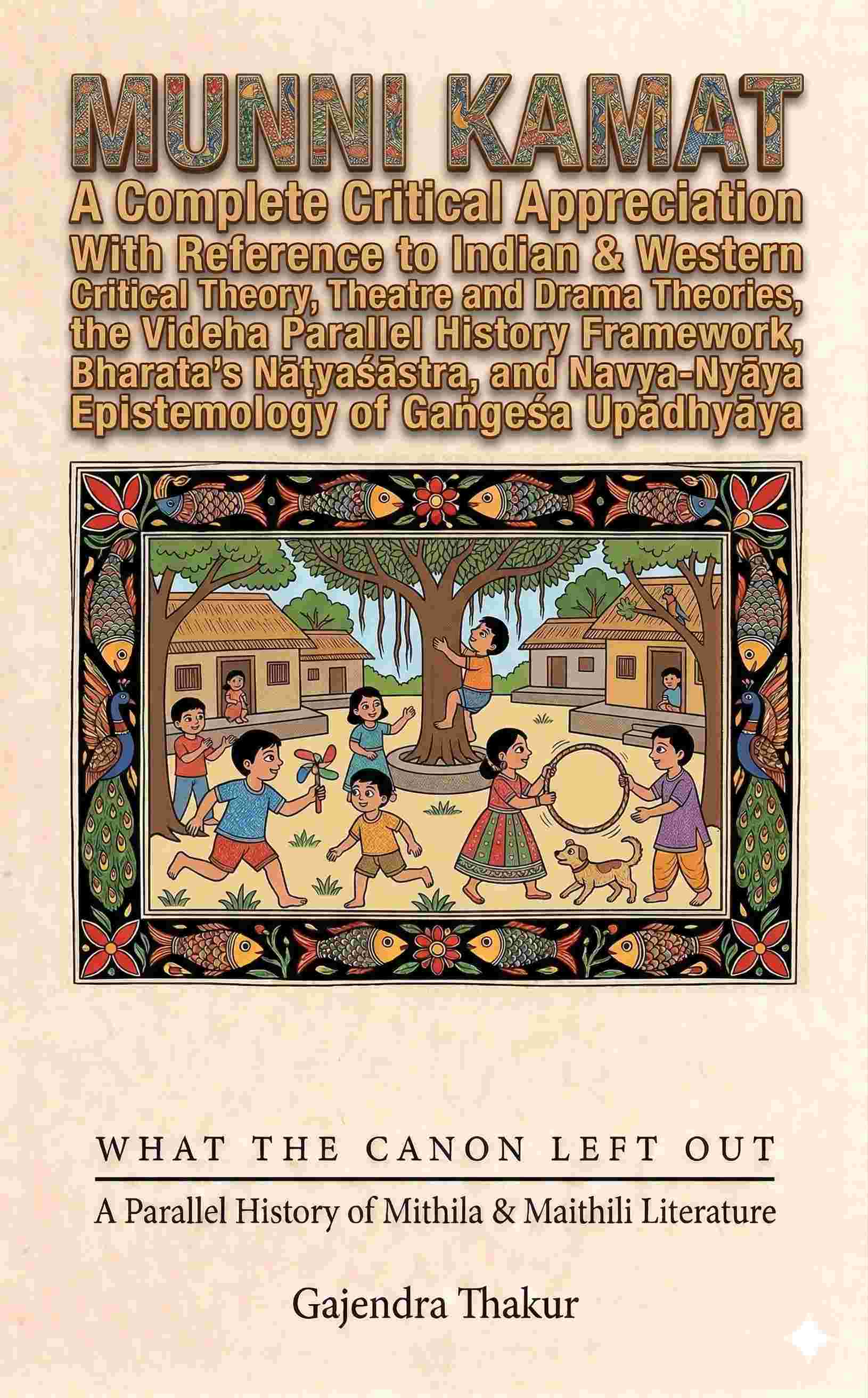
MUNNI KAMAT A Complete Critical Appreciation With Reference to Indian & Western Critical Theory, Theatre and Drama Theories, the Videha Parallel History Framework, Bharata's Nāṭyaśāstra, and Navya-Nyāya Epistemology of Gaṅgeśa Upādhyāya
MUNNI KAMAT
A Complete Critical Appreciation
With Reference to Indian & Western Critical Theory, Theatre and Drama Theories,
the Videha Parallel History Framework, Bharata's Nāṭyaśāstra,
and Navya-Nyāya Epistemology of Gaṅgeśa Upādhyāya
This monograph presents a complete critical appreciation of the literary works of Munni Kamat (मुन्नी कामत), a contemporary Maithili poet, playwright, prose writer, and novelist whose creative output spans poetry, seed stories (Bīhani Kathā), one-act plays, and the novel form. Her principal published works examined here are: Sukhal Man Tarsal Āṃkhi (2014, revised 2017), a tripartite volume of poems, seed stories, and one-act plays; Antatah (2019), a Maithili poetry collection; Munni Kamat Chukka (a critical anthology); Māṭik Suwas (2023), her debut Maithili novel; and SUKHAL MAN TARSAL AAKHI (third edition). Born in the culturally rich heartland of Mithila, between the rivers Kamala and Kosi, Kamat writes in Maithili — a language of seventy-five million speakers, constitutionally recognised since 2003 — and belongs to the 'parallel tradition' documented and promoted by the Videha eJournal.
This study applies a multi-layered critical framework encompassing: (i) Indian classical aesthetic theory — Bharata's Nāṭyaśāstra, Rasa-Dhvani aesthetics (Ānandavardhana, Abhinavagupta), Vakrokti (Kuntaka), and Alaṃkāra theory; (ii) Western literary and dramatic theory — Aristotelian poetics, Brechtian epic theatre, feminist criticism (Simone de Beauvoir, Elaine Showalter), postcolonial theory (Spivak, Bhabha), and New Historicism; (iii) Navya-Nyāya epistemological methodology of Gaṅgeśa Upādhyāya (Tattvacintāmaṇi); (iv) the Videha Parallel History Framework (Gajendra Thakur); and (v) theatre and drama theories from both Sanskrit and modern traditions. The study argues that Kamat's work constitutes a vital democratic, feminist, and social-realist intervention in Maithili literature — one that has been systematically marginalised by mainstream institutional recognition.
1.1 Life and Background
Munni Kamat (मुन्नी कामत) is a contemporary Maithili woman writer born in the village region between the rivers Kamala and Kosi — the ancient heartland of Mithila, historically coterminous with the kingdom of Videha. She spent her formative years as a student with the original family name Munni Verma, a name by which she was known in Hindi literary circles, before adopting the pen name and identity of 'Munni Kamat' as her primary literary identity. She is described in Antatah's preface as residing in Patna, having moved from the village to the city while retaining a profound attachment to the rural landscape of Mithila.
As a student, she was noted for her exceptional academic dedication — studying 16-18 hours a day — and for her fluency in public speaking and debate. The preface to Antatah records her as a woman who has chosen to claim her rights, to stand as a lone figure against the world, to place the human and society in the dock of her fearless writing, and who — despite hunger and pain — continues to fight with her pen as her only weapon. This biographical portrait is not merely personal: it is the animating force behind her literary project.
Geographically and culturally, Kamat belongs to the Mithila that lies between the Kamala and Kosi rivers — a landscape that flows between drought and flood, between the mythological Sita and the socio-political present. This landscape haunts her poetry and drama as a recurring symbol of both nurture and precarity.
1.2 Published Works: A Bibliographic Survey
|
Title |
Sukhal Man Tarsal Āṃkhi (सुखल मन तरसल आँखि) |
|
Language |
Maithili |
|
Genre |
Poems, Seed Stories (Bīhani Kathā), One-act Plays (Ekaṅkī-Nāṭak) |
|
Publisher |
Shruti Prakashan, New Delhi |
|
First Edition |
2014 |
|
Second Edition |
2017 (revised) |
|
Significance |
First published tripartite collection; foundational text |
|
Title |
Antatah (अन्ततः) |
|
Language |
Maithili |
|
Genre |
Poetry Collection |
|
Publisher |
Gita-Shri Prakashan, Patna |
|
Edition |
First Edition: 10 July 2019 |
|
Dedication |
Dedicated to revered mentor Dr. Shiv Kumarji |
|
Significance |
Second standalone poetry collection; deepening lyrical voice |
|
Title |
Māṭik Suwas (माटिक सुवास) |
|
Language |
Maithili |
|
Genre |
Novel |
|
Publisher |
Navarambh Prakashan (navarambh.com) |
|
Edition |
First Edition: 2023 |
|
Significance |
Kamat's first novel; marks transition to long-form prose fiction |
|
Title |
Munni Kamat Chukka |
|
Language |
Maithili |
|
Genre |
Critical/Selected anthology |
|
Note |
Extended critical compendium of her work |
1.3 Archival and Digital Presence
Munni Kamat's work is archived and promoted through the Videha eJournal (ISSN 2229-547X, www.videha.co.in), the first Maithili fortnightly e-journal, founded and edited by Gajendra Thakur. Videha has been central to the digitisation, promotion, and critical recovery of parallel-tradition Maithili literature since 2004. Kamat is listed among the 'parallel women tradition' voices, alongside Vibha Rani, Kamini Kamayani, Susmita Pathak, Premlata Mishra Prem, and Panna Jha — writers whose work has been systematically excluded from the Sahitya Akademi mainstream while flourishing in the democratic digital space of Videha.
The Wikidata entry for Munni Kamat (Q134972282) records her occupation as 'writer' and 'poet,' working in the Maithili language — confirming her recognition at the international bibliographic level. Her physical books have been distributed through Pallavi Distributors (Supaul) and Navarambh Prakashan, serving the Maithili diaspora across India and beyond.
2.1 Poetry: Sukhal Man Tarsal Āṃkhi and Antatah
2.1.1 The Title as Poetic Programme
The title Sukhal Man Tarsal Āṃkhi — literally 'Dry Heart, Longing Eyes' — is itself a compressed lyric, announcing the central tension of Kamat's poetic universe: between emotional aridity (the desiccated, suppressed inner world of women, the poor, the marginalised) and the yearning eye that sees and longs for justice, beauty, and recognition. The title operates as a Dhvani (resonance) that pervades the entire collection.
The title Antatah — meaning 'ultimately' or 'in the end' — signals a philosophical movement toward resolution, reckoning, or conclusion. If Sukhal Man Tarsal Āṃkhi captures the condition, Antatah gestures toward a reckoning with it. Together, the two titles enact a dialectical movement that is central to Kamat's poetic method.
2.1.2 Poems of Social Protest and Gender Critique
The opening poem of the collection addresses the fate of daughters in patriarchal Mithila society. The poem 'Samarpit hoit beti' ('Being Offered Up as a Daughter') traces the arc of a woman's life from birth — when a lamp is extinguished — through socialization as a 'burden of society' and 'father's turban' to marriage and self-sacrifice:
"Ek janam bital, / dosar janam la taiiyar bha gel / Kekaro nai kichhu kahlak / Hari dam samarpit hot gael / Juban rahi to bejuban bani / Sabh dukh sahaait gael." — Sukhal Man Tarsal Āṃkhi, poem 'Samarpit hoit beti'
This poem demonstrates Kamat's engagement with feminist themes through a restrained, lyrical mode rather than polemical declaration — making the critique all the more devastating. The poem enacts what Elaine Showalter calls 'the female tradition' — writing from within experience rather than from outside theory.
The poem 'Manukh ka sauda' ('The Trading of Humans') addresses the dowry system with bitter irony, placing human beings on the market alongside commodities:
"Lakh-do-lakh / Panch-panch lakh / par bat hoi chhai / Timan-tarkari jak / Manukho ab sauda hoi chhai." — Sukhal Man Tarsal Āṃkhi, 'Manukh ka sauda'
In Naṭyaśāstra terms, this poem activates the Raudra Rasa (the sentiment of fury) and Bībhatsa Rasa (disgust), but through a distanced, ironic register that Abhinavagupta might recognise as the 'relishing' (āsvādana) of a generalised emotional state rather than direct personal outrage. In Western terms, the poem employs what Brecht would call Verfremdungseffekt — alienation through matter-of-fact enumeration of prices — to produce critical consciousness rather than cathartic identification.
2.1.3 Nature Poetry and Landscape of Mithila
A significant strand of Kamat's poetry involves the landscape and ecology of Mithila — rivers, fields, rain, drought. The recurring imagery of the dried/thirsty eye and dry heart maps onto the ecological reality of the Kosi-Kamala region, where water is simultaneously life and destruction. The preface to Antatah makes explicit the connection: 'Just as in the monsoon season, the Bhoothahi river flows with speed — but after a few days becomes dry — so Munni does not stop.'
This ecological consciousness places Kamat within a long tradition of Maithili nature poetry, while simultaneously giving it contemporary urgency. The Nāṭyaśāstra's concept of Vibhāva (excitants or determinants of rasa) is operative here: the natural landscape functions as an ālambana-vibhāva (permanent excitant) for the emotional states of longing, sorrow, and hope that pervade the poems.
2.1.4 Structure and Form in the Poetry
Kamat writes primarily in the conversational, direct register of modern Maithili verse — rejecting the ornate Alaṃkāra traditions of classical poetry in favour of a spare, accessible idiom. The influence of the Nayi Kavita (New Poetry) movement — particularly its rejection of rhyme-scheme strictures and its embrace of free verse — is apparent. Yet her poetry is not without craft: internal sound patterns, repetitions, and the deployment of folk-register vocabulary create a distinctive musicality.
The Vakrokti (oblique speech) theory of Kuntaka (10th-11th century Kashmir) is particularly illuminating here. Kuntaka argues that the essence of poetry is 'deviating expression' — saying something indirectly, with a twist. Kamat's ironic mode — where she describes dowry in the language of the vegetable market — is a sophisticated deployment of vakrokti in contemporary Maithili verse.
2.2 Seed Stories (Bīhani Kathā / Vihaṇi Kathā)
2.2.1 The Bīhani Kathā Tradition
The Bīhani Kathā (literally 'morning tale' or 'seed story') is a distinctive Maithili literary form — a very short narrative, often a single scene or vignette, that plants a seed of meaning without exhausting it. The Videha Parallel History Framework (Part 32) situates the Bīhani Kathā as a specific Maithili contribution to world micro-fiction, with roots in the oral tradition and connections to both the Sanskrit Kathā tradition and the modern flash fiction movement.
Kamat's seed stories, collected in the second section of Sukhal Man Tarsal Āṃkhi, demonstrate a mastery of compression. Each story creates a complete world in a minimal space — enacting the Dhvani principle that the unstated resonates more powerfully than the stated.
2.2.2 Themes of the Seed Stories
The seed stories address themes consistent with the poetry: domestic conflict, the position of women, economic hardship, village life, and the violence — both overt and structural — that shapes daily existence in rural Mithila. They operate in the realist mode, drawing on the lived texture of Maithili village society, yet achieving an allegorical resonance that transcends the local.
Applying the Navya-Nyāya analytical technique of Gaṅgeśa Upādhyāya — which insists on precise identification of the cognising subject (pramātā), the means of knowledge (pramāṇa), the object known (prameya), and the valid cognition (pramā) — we can say that Kamat's seed stories deploy narrative as a pramāṇa for knowing social reality. The 'anuvyavasāya' (meta-cognition or reflective awareness) built into the reader's encounter with these stories constitutes the epistemological payoff of reading them.
2.3 One-Act Plays (Ekaṅkī-Nāṭak)
2.3.1 Overview of the Plays
The one-act play section of Sukhal Man Tarsal Āṃkhi contains four plays: 'Pāt-pātsa banala parivār' (Family Made of Leaves and Leaves), 'Shikshit beti' (The Educated Daughter), 'Andhviśvās' (Superstition), and 'Zindagi ka mol' (The Value of Life). Each play is structured in multiple scenes (Dṛśya) with curtain drops (Paṭop) marking transitions — following the standard one-act theatrical format.
2.3.2 'Pāt-pātsa banala parivār' — Family Conflict and Joint Family
The first play stages a conflict within a joint family household, centring on the rivalry between a 'Baṛki Bhauji' (elder sister-in-law) and a 'Chhoṭki' (younger sister-in-law). The play dramatises how domestic conflict escalates from verbal abuse to physical violence against children, forcing a reckoning with the question of whether joint family life is sustainable. The play ends with an elder's speech — structurally resembling the deus ex machina but made ideologically complex — arguing that the joint family is like a body: 'Just as pain in one organ reaches the whole body, so does sorrow in one family member reach all.'
The play demonstrates Kamat's skill in capturing the social texture of Maithili village life. In Nāṭyaśāstra terms, the play's Sthāyibhāva (dominant emotion) is Karuṇa (pathos/compassion), with the violence against the child and the domestic unhappiness activating the Rasa of sorrow. The resolution — provisional reconciliation rather than utopian harmony — is realistic rather than moralistic.
From an Aristotelian perspective, the play has a clear beginning (exposition of the conflict), middle (escalation and violence), and end (attempted resolution) — fulfilling the Aristotelian criterion of unified plot structure. The Hamartia here is not a personal tragic flaw but a structural one: the incompatibility of social pressures within the joint family system.
2.3.3 'Shikshit beti' — The Educated Daughter
This play is among Kamat's most directly social-reformist. Dulari, a village girl, achieves the highest marks in her district in the board examination — but her mother Phuladai has already torn up her mark sheet, beaten her, and tried to suppress her education in favour of marriage and domestic work. The drama traces Dulari's vindication when her teacher arrives to honour her publicly, and the mother's belated transformation.
The play's dramatic arc follows what Brecht would recognise as a Lehrstück (learning play) — a play designed not for catharsis but for instruction and social change. The audience is invited not to identify emotionally with the characters but to learn from the social contradictions dramatised. The explicit moral — a final choral verse about boys and girls studying together until the difference between them disappears — confirms this didactic intention.
Yet the play also has genuine emotional texture. Dulari's silence — weeping without speaking — enacts what in Nāṭyaśāstra terms is a Sāttvikābhāva (involuntary physical manifestation of emotion): the speechless grief of a child whose creativity has been crushed. The teacher's arrival activates a reversal of fortune that is both dramatically satisfying and thematically pointed.
Applying feminist theory, the play illustrates Nancy Chodorow's analysis of mother-daughter reproduction of gender norms: it is the mother who suppresses the daughter's education, having internalised patriarchal values. The play critiques not only patriarchy but women's complicity in its reproduction — making it more nuanced than straightforward victim-rescue narratives.
2.3.4 'Andhviśvās' — Superstition
This play dramatises a family whose son Shankar falls ill. The parents, Rama and Ganga, initially attribute the illness to supernatural possession and resort to rituals, animal sacrifice, and a local tantric (Rama). The play turns on the arrival of Raghunath, an educated young man from the city, who diagnoses 'dimagi bukhār' (brain fever/encephalitis) and urges immediate hospitalisation. The play ends with Rama's awakening: 'You have opened my eyes today. Come, let's take the son to hospital.'
The play is a piece of rational, enlightenment theatre — opposing medical science to superstitious practice. In Brechtian terms, it functions as a gestus: the social gesture of ritual animal sacrifice as a substitute for medical treatment crystallises an entire system of material and ideological relations. The play does not demonise the parents — their fear is rendered with genuine compassion — but locates the cause of their dangerous choices in structural poverty and lack of access to education and healthcare.
From the Nāṭyaśāstra's analysis of dramatic types (Nāṭikā, Prakaraṇa etc.), this play corresponds most closely to a Prakaraṇa — a drama of social life with invented characters, depicting contemporary social themes, as distinguished from the Nāṭaka which deals with royal or heroic subject matter. Bharata lists social plays as appropriate for instructing and delighting common audiences, and Kamat's plays fulfil this function precisely.
2.3.5 'Zindagi ka mol' — The Value of Life
The most sombre of Kamat's plays, 'Zindagi ka mol' (The Value of Life) follows Ram Ratan, an eighteen-year-old from a village who travels to Himachal Pradesh for work, only to be used as an unwitting human guinea pig by a pharmaceutical company — administered overdoses of drugs in clinical trials. He dies. His elderly father Bhikhan, who lives alone, awaits the news. The play ends with the revelation of Ram Ratan's death for eight thousand rupees — the payment for his participation in the trial.
This play marks a significant expansion of Kamat's political imagination. It moves from the domestic (family conflict, education) to the systemic (pharmaceutical exploitation of rural migrant labour). The final confrontation between Bhikhan and Phulchan — 'You traded my son's life for eight thousand rupees... today my son died, tomorrow someone else's son will die. Why is this game of death played?' — is rhetorically devastating and politically radical.
In Marxist dramatic theory (Lukács, Williams), this play belongs to the tradition of social realism that seeks to represent not individual psychology but the totality of social forces. The 'type' figures — the poor father, the naive rural boy, the corporate doctor, the complicit friend — are not flat characters but crystallisations of social positions. The play's Tragic structure — Ram Ratan's death is both preventable and inevitable, given the socio-economic conditions — places it in dialogue with classical tragedy while grounding it in contemporary political economy.
2.4 The Novel: Māṭik Suwas (माटिक सुवास)
Māṭik Suwas ('The Fragrance of Earth') is Kamat's first novel, published in 2023 by Navarambh Prakashan. The title — invoking the petrichor, the smell of earth after rain — suggests a novel deeply rooted in the landscape, memory, and sensory texture of Mithila. The writing is reflecting the reality of contemporary Maithili life where English has penetrated village communication through mobile phones and migrant workers.
The novel represents a major formal development in Kamat's career — the shift from the compressed forms (lyric poetry, seed story, one-act play) to the expansive novelistic form that can accommodate multiple characters, time-frames, and social dimensions. The title's invocation of 'the fragrance of earth' suggests a novel deeply concerned with rootedness, dispossession, and the relationship between Maithili speakers and their land.
Mikhail Bakhtin's theory of the novel as a 'polyphonic' form — a genre of competing voices and dialogues, in contrast to the monologic epic — is particularly relevant here. Kamat's novelistic project appears to be precisely a polyphonic engagement with Maithili social life, bringing together the voices that have been suppressed or marginalised in the official canon.
3.1 The Nāṭyaśāstra Framework
3.1.1 Bharata's Nāṭyaśāstra and Kamat's Dramatic Practice
The Nāṭyaśāstra of Bharata Muni (c. 200 BCE–200 CE) is the foundational treatise of Indian performing arts, encompassing dance, music, and drama. Its analysis of Rasa (aesthetic emotion), Bhāva (emotional state), Abhinaya (performance), Nāṭyadharmi and Lokadharmi (stylised and realistic performance modes), and dramatic structure provides an indispensable framework for reading Kamat's plays.
Bharata identifies eight primary Rasas: Śṛṅgāra (love/beauty), Hāsya (humour), Karuṇa (compassion/sorrow), Raudra (fury), Vīra (heroism), Bhayānaka (terror), Bībhatsa (disgust), Adbhuta (wonder). Later tradition added Śānta (tranquility) as a ninth. Kamat's dramatic works primarily activate Karuṇa, Raudra, and Bībhatsa — with occasional passages of Vīra (in the resistance of educated daughters, enlightened teachers, and the awakened father in 'Andhviśvās').
The theory of Vibhāva, Anubhāva, and Vyabhicāribhāva is central to how Kamat's drama works. The Vibhāvas (excitants) are the social conditions depicted — dowry, illiteracy, superstition, pharmaceutical exploitation. The Anubhāvas (consequent expressions) are the characters' visible reactions — weeping, silence, rage, transformation. The Vyabhicāribhāvas (transient emotional states) — anxiety, hope, despair, indignation — traverse the dramatic action, enriching the dominant Rasa.
Bharata's insistence that drama must be both entertaining (āhlāda) and instructive (śikṣā) — that it must 'serve as a guide to people in time of grief, fatigue, or sorrow' (Nāṭyaśāstra 1.106-107) — is precisely the programme Kamat's plays fulfil. Her theatre is both socially engaged and aesthetically crafted; it uses the pleasure of performance to communicate social critique.
3.1.2 Dramatic Structure and Sanskrit Poetics
The Nāṭyaśāstra identifies five stages of dramatic action (Avasthā): Ārambha (beginning), Yatna (effort), Prāptyāśā (possibility of attainment), Niyatāpti (certainty of attainment), and Phalāgama (achievement of result). Kamat's plays can be mapped onto this five-stage structure, though her social-realist outcomes often subvert the expected triumphalist conclusion: in 'Zindagi ka mol,' the 'Phalāgama' is the death of Ram Ratan — a tragic inversion of the expected achievement.
The theory of Sandhi (junctures) — Mukha (opening), Pratimukha (progression), Garbha (development), Vimarśa (pause/reflection), and Nirvahaṇa (conclusion) — is also operative in analysing Kamat's dramatic structure. Her plays demonstrate a compression of this five-sandhi structure into the one-act format, with each scene (Dṛśya) corresponding roughly to a sandhi.
3.2 Rasa-Dhvani Aesthetics
3.2.1 Ānandavardhana's Dhvani Theory
Ānandavardhana's Dhvanyāloka (9th century) argues that the highest poetry is characterised by Dhvani — 'resonance' or 'suggestion' — where the unstated meaning (vyañjanā) transcends and deepens the stated meaning (vācyārtha). The three levels of meaning — vācyārtha (literal), lakṣaṇārtha (indicative), and vyañjanārtha (suggestive) — form a hierarchy in which the suggestive level carries the greatest aesthetic power.
Kamat's title 'Sukhal man tarsal āṃkhi' operates at all three levels. The literal meaning (dry heart, longing eyes) is the vācyārtha. The indicative meaning (lakṣaṇā) points to the condition of suppressed Maithili women. The suggestive resonance (Dhvani) is the entire history of Mithila's patriarchal and caste-based social structure, its beauty and its violence, its fertility and its drought — a resonance that pervades the entire volume and connects it to the landscape of Mithila itself.
3.2.2 Abhinavagupta's Aesthetic Theory
Abhinavagupta (10th-11th century Kashmir) developed Ānandavardhana's Dhvani theory into a comprehensive aesthetics of rasa-recognition. In his Abhinavabhāratī (commentary on the Nāṭyaśāstra), he argues that aesthetic experience (rasāsvādana) is a form of brahmanānda-sahodara — a cousin of the bliss of Brahman. The spectator or reader transcends their individual subjectivity to experience a universal, generalised emotional state.
The relevance to Kamat's writing is this: her poems and plays, while rooted in specific Maithili village realities, aspire to and achieve this universalisation. The dowry victim is not only a Maithili woman; the superstitious father is not only a Mithila villager; the pharmaceutical guinea pig is not only a Bihar migrant worker. These are universally recognisable human conditions, rendered in their particular social specificity — precisely the movement Abhinavagupta identifies as the aesthetic transformation of particular emotion into universal Rasa.
3.3 Navya-Nyāya Epistemology of Gaṅgeśa Upādhyāya
3.3.1 Gaṅgeśa and the Tattvacintāmaṇi
Gaṅgeśa Upādhyāya (c. 13th-14th century, Mithila) is the founder of Navya-Nyāya (New Logic), a school of Indian epistemology that developed a precise, formal technical vocabulary for analysing knowledge claims. His Tattvacintāmaṇi ('Thought-jewel of Ontology') is the foundational text. Significantly — and this is a key finding of the Videha Parallel History — Gaṅgeśa was born of an inter-caste union (his mother was a Charmakāriṇī, of the leather-tanning community) and this fact was systematically suppressed by the upper-caste literary establishment. Gaṅgeśa thus belongs to the suppressed democratic tradition that the Videha framework recovers.
The technical vocabulary of Navya-Nyāya provides a rigorous instrument for literary analysis. Key concepts include: Pramāṇa (means of knowledge: perception, inference, comparison, testimony); Pramātā (the knowing subject); Prameya (the object of knowledge); Pramā (valid cognition); Vyāpti (invariable concomitance, the basis of inference); Pakṣatā (the subjective condition that drives inquiry); and Anuvyavasāya (meta-cognition, or awareness of one's own awareness).
3.3.2 Applying Navya-Nyāya to Kamat's Literary Practice
The Navya-Nyāya framework, applied to Kamat's writing, reveals several important epistemological dimensions:
First, Kamat's poetry functions as a Pramāṇa — a means of valid knowledge — for Maithili social reality. The poem is not merely an aesthetic object but an instrument of knowledge: it enables valid cognition (Pramā) of conditions (dowry violence, illiteracy, superstition, pharmaceutical exploitation) that are otherwise invisible to mainstream discourse. This is the literary equivalent of Nyāya's concept of Anumāna (inference) from visible signs to hidden realities.
Second, the Navya-Nyāya concept of Vyāpti (invariable concomitance — 'wherever there is smoke, there is fire') can be applied to Kamat's social analysis. Her poems establish, through accumulated specific instances, the vyāpti: 'wherever there is patriarchal Mithila, there is the suppression of female education'; 'wherever there is rural poverty, there is vulnerability to pharmaceutical exploitation.' The literary text functions as the medium for establishing these social invariances.
Third, the concept of Pakṣatā — the subjective condition of inquiry, the lived doubt or uncertainty that drives the search for knowledge — illuminates Kamat's position as a writer. She writes from a position of pakṣatā: she has lived the conditions she writes about, and her writing is driven by the need to know, to understand, and to transform these conditions. This is not merely biographical but epistemological: her particular social location as a Maithili woman writer enables a distinctive mode of knowing.
Fourth, the Navya-Nyāya distinction between laukika (worldly) and alaukika (extraordinary) pratyakṣa (perception) is relevant to the heightened perception that literary experience enables. Kamat's dramatic scene of a child's bleeding mouth after being struck — rendered with vivid sensory detail — constitutes a form of alaukika pratyakṣa, enabling the reader to perceive social violence with an immediacy that transcends ordinary perception.
3.4 The Videha Parallel History Framework
3.4.1 The Parallel Tradition and Institutional Critique
The Videha Parallel History Framework, developed by Gajendra Thakur through the Videha eJournal (www.videha.co.in), constitutes the most important contemporary critical framework for evaluating Kamat's work. This framework argues that Maithili literary history as institutionally constructed (primarily by the Sahitya Akademi, Delhi) has systematically promoted an upper-caste (predominantly Maithil Brahmin) canon while suppressing democratic, folk, Dalit, feminist, and Nepal-side traditions.
A Right to Information (RTI) inquiry filed by Vinit Utpal and Ashish Anchinhar (2011-14) revealed that over 90% of Sahitya Akademi translation and publication assignments went to friends and relatives of the ten-member advisory board — confirming what Videha had documented through critical analysis. This institutional critique is not merely sociological: it has direct implications for how Kamat's work is read and valued.
3.4.2 Kamat in the Parallel Tradition
Within the Videha Parallel History, Kamat is positioned explicitly in the 'Women's Writing: The Suppressed Canon' — alongside Vibha Rani, Kamini Kamayani, Susmita Pathak, Premlata Mishra Prem, Panna Jha, and Kalpana Jha. The Parallel History notes that women writers were 'excluded from Sahitya Akademi assignments entirely' (confirmed by RTI data). The first anthology of Maithili women poets, Ijoriyak Angaithi-Mor (edited by Mala Jha and Vibha Jha), represents a parallel-tradition corrective to this exclusion.
Kamat's positioning in this framework has two implications. First, her work must be read against the grain of the institutional canon — as a counter-voice, a democratic intervention, a recovery of suppressed social realities. Second, her work participates in what the Videha framework calls the 'Videha era' — the digital counter-archive that has created a million pages of Maithili corpus outside institutional channels, enabling writers like Kamat to publish, circulate, and reach readers without depending on Sahitya Akademi patronage.
3.4.3 The Bīhani Kathā Tradition and Videha
The Videha Parallel History (Part 32) specifically addresses the Bīhani Kathā (Seed Story) tradition as a distinctive Maithili literary form. Kamat's seed stories in Sukhal Man Tarsal Āṃkhi belong to this tradition — a form that the Videha framework identifies as both artistically significant and institutionally neglected. The seed story's democratic brevity (accessible to readers with limited literary education), its roots in oral tradition, and its radical compression make it a form particularly suited to the parallel tradition's project of democratising Maithili literature.
3.5 Western Critical Frameworks
3.5.1 Feminist Literary Theory
Simone de Beauvoir's foundational insight in The Second Sex — that woman is constructed as the 'Other' against which man defines himself — pervades Kamat's entire literary project. Her poems, plays, and stories are precisely a documentation of this construction of woman-as-Other in Maithili society, and a resistance to it. The mother who tears up her daughter's exam results is not simply a 'bad mother' but a woman who has internalised the patriarchal construction of her daughter as Other (destined for marriage, not education).
Elaine Showalter's concept of 'gynocriticism' — the study of women's writing as a distinct literary tradition — provides a useful framework for reading Kamat's work not as a deviation from a male norm but as participation in a women's literary tradition that has its own conventions, concerns, and aesthetic strategies. In Maithili, this tradition includes the Sāmā Cākeva songs, the Vat-Savitri rituals, and the oral lore of Maithili women — a tradition that Kamat both inherits and transforms.
3.5.2 Postcolonial Theory
Gayatri Chakravorty Spivak's question 'Can the subaltern speak?' — and her answer that the subaltern is systematically denied the conditions of speech within the colonial and postcolonial order — is directly relevant to Kamat's project. Her subalterns are multiple: rural Maithili women, migrant workers, village families trapped in superstition for lack of healthcare access. Her literary project is precisely the construction of conditions under which these subjects can speak — and be heard.
Homi Bhabha's concept of 'hybridity' — the in-between space created by colonial and postcolonial cultural encounters — illuminates Kamat's bilingual novel Māṭik Suwas, where Maithili and English intermingle in the dialogue of characters navigating between village and city, between traditional and modern, between Mithila and Himachal Pradesh.
3.5.3 Aristotelian and Epic Theatre
The tension between Aristotelian and Brechtian dramatic theory is productive for reading Kamat's plays. Aristotle's Poetics defines tragedy as 'the imitation of an action that is serious, complete, and of a certain magnitude... through pity and fear effecting the proper purgation of these emotions' (catharsis). Kamat's plays engage with this model — they activate pity (for Dulari, for Bhikhan, for the possessed Shankar) and fear (at the violence of the domestic and social world) — but her endings resist the Aristotelian cathartic resolution. There is no purging of social emotion; rather, a residue of unresolved social critique that demands action outside the theatre.
Brecht's counter-theory — that theatre should not produce cathartic identification but Verfremdungseffekt (estrangement), enabling the audience to see familiar social arrangements as contingent and changeable — is equally operative. The final verse of 'Shikshit beti,' with its didactic resolution, is closer to Brecht's Lehrstück than to Aristotelian tragedy. Kamat's theatre oscillates between these two poles — using emotional engagement to open the audience, and rational critique to challenge them.
3.5.4 New Historicism and Cultural Materialism
Stephen Greenblatt's New Historicism argues that literary texts are embedded in specific historical moments and cannot be read apart from the social, political, and economic conditions of their production. Applied to Kamat, this means reading her plays and poems in the context of: the post-2003 recognition of Maithili in the Eighth Schedule; the RTI exposure of Sahitya Akademi corruption; the crisis of the pharmaceutical industry's exploitation of rural trial participants; the ongoing struggles over land, water, and women's education in Bihar; and the digital revolution that has enabled Videha to create a parallel literary infrastructure.
Raymond Williams's concept of the 'structure of feeling' — the particular affective landscape of a given historical moment, not yet fully articulated in formal ideology — is also relevant. Kamat's writing captures the structure of feeling of contemporary Mithila: the simultaneous aspiration for education and mobility, the persistence of traditional patriarchal structures, the vulnerability to new forms of exploitation (pharmaceutical, migrant labour), and the emergence of women's voices that refuse to be silenced.
3.6 Theatre and Performance Theory
3.6.1 Stanislavski and the Realist Tradition
Constantin Stanislavski's system — particularly his emphasis on 'living through' the role, on finding the 'given circumstances' of the character, and on the 'through-line of action' — is relevant to the performance dimensions of Kamat's plays. Her characters are psychologically coherent and socially specific in ways that demand this kind of interior engagement from actors. The mother Phuladai in 'Shikshit beti,' who tears up her daughter's exam results, must be played not as a villain but as a woman with a comprehensible, if tragically mistaken, set of values and fears.
3.6.2 Folk and Traditional Maithili Performance Traditions
Kamat's plays draw on Maithili folk performance traditions — the Bidapadia (itinerant theatre), the Jhumar singing tradition, and the Lokanatya forms that have evolved in the Mithila region. The use of curtain drops (Paṭop) as scene markers, the direct address to the audience in some plays, and the incorporation of sung verses at key dramatic moments all connect her work to this indigenous performance tradition.
The Ankiya Natak tradition of Assam (associated with the Vaishnava reformer Sankaradeva) — which also uses the one-act form to dramatise devotional and social themes — provides another point of comparison. Both the Ankiya Natak and Kamat's Ekaṅkī use the compressed one-act form for maximum didactic effect, and both are intended for popular, non-elite audiences.
3.6.3 Bechan Thakur and the Maithili Parallel Stage
The Videha Parallel History identifies Bechan Thakur as 'the greatest living Maithili dramatist' who 'created a parallel Maithili stage that confronts caste violence directly.' Kamat's dramatic work participates in this parallel stage tradition — distinct from the slapstick commercial Maithili theatre that dominates popular performance venues, and engaged with the serious theatrical tradition that addresses social injustice directly.
4.1 Gender, Patriarchy, and Women's Resistance
Across all genres — poetry, seed story, play, and novel — Kamat's central preoccupation is the condition of women in Maithili patriarchal society and the possibilities of resistance. Her women characters are neither passive victims nor heroic rebels in the conventional sense: they are complex social beings whose choices are constrained by the material and ideological conditions of their lives.
The figure of the daughter recurs across Kamat's work: the daughter whose birth extinguishes the lamp, the daughter whose exam results are torn up, the daughter who is traded in dowry. This is not mere repetition but a systematic investigation of the structure of patriarchal devaluation — from birth through education through marriage through widowhood — that constitutes the life-course of women in Mithila.
The resistance in Kamat's work is typically small-scale, local, and hard-won. Dulari's quiet weeping before her eventual vindication; the educated young man from the city who challenges superstition; the father who belatedly recognises the value of his daughter's achievement — these are not revolutionary transformations but incremental shifts in consciousness. This realism about the pace of social change is one of Kamat's most important literary qualities.
4.2 Caste, Class, and Social Hierarchy
While Kamat does not always name caste explicitly, the social hierarchies she depicts are shot through with caste logic. The Mithila she writes about is a caste society, and the vulnerabilities she depicts — to poverty, to domestic violence, to pharmaceutical exploitation — are differentially distributed along caste lines. The Videha Parallel History's emphasis on recovering the suppressed democratic and Dalit traditions of Maithili literature provides the critical framework within which to read Kamat's social analyses.
The play 'Zindagi ka mol' is particularly telling here: the rural migrant worker who becomes a pharmaceutical guinea pig is vulnerable precisely because he lacks the social capital (education, urban networks, legal knowledge) that upper-caste and class privilege would provide. The eight-thousand-rupee 'compensation' for his death — casually offered by the pharmaceutical company — encapsulates the brutal logic of class and caste privilege in the valuation of human lives.
4.3 The Rural-Urban Divide
A significant dimension of Kamat's thematic universe is the tension between rural Mithila and the urban centres (Patna, Delhi, Himachal Pradesh) to which its people migrate for work and education. This rural-urban axis is the site of both aspiration and danger: the city offers education, mobility, and economic opportunity, but also exploitation, displacement, and loss of cultural rootedness.
The title of her novel, Māṭik Suwas ('The Fragrance of Earth'), encodes this tension: 'earth' is the village, the ancestral land, the roots; 'fragrance' is the memory and longing for what has been left behind or threatened. The novel appears to be a sustained meditation on this dialectic of rootedness and mobility.
4.4 Superstition, Science, and Enlightenment
The play 'Andhviśvās' places Kamat in a long tradition of Indian social-reformist literature — from Kabir's critique of ritual to Phule's critique of Brahminism to the contemporary rationalist tradition. Her treatment of superstition is, however, notably non-condescending: the parents who resort to ritual animal sacrifice are not villains but frightened people who lack access to healthcare. The critique is structural rather than moralistic.
This positions Kamat's rationalism in the tradition of Ambedkar's Buddhist rationalism — a critique of irrationality that is simultaneously a critique of the social structures (poverty, caste, exclusion from education) that produce and maintain irrationality. The final verse of 'Andhviśvās' — 'Giving life for life / is the bondage of superstition / Let us pledge / not to take anyone's life' — is a call not only for individual enlightenment but for social transformation.
5.1 Contribution to Maithili Literature
Munni Kamat's contribution to Maithili literature is threefold. First, she has produced a body of work in all major literary genres — poetry, short prose, drama, and the novel — demonstrating rare formal versatility. Second, she has consistently addressed themes (women's education, dowry, superstition, pharmaceutical exploitation of labour) that the institutional Maithili canon has largely ignored. Third, she has produced this work in a period of genuine difficulty for Maithili literature — when the institutional mechanisms of recognition and distribution remain controlled by networks that systematically exclude parallel-tradition voices.
Her tripartite volume Sukhal Man Tarsal Āṃkhi — combining poems, seed stories, and one-act plays in a single volume — is itself a formal innovation, demonstrating the organic connections between these forms in her creative practice. The title poem/title principle unifies the volume into a coherent artistic statement rather than a miscellany.
5.2 Relationship to Predecessors and Contemporaries
Kamat's work stands in a clear lineage of Maithili women's writing — from the oral tradition of Maithili women's folk songs (the Sāmā Cākeva songs, for instance), through the colonial-era educated women writers who began to enter the literary public sphere, to her contemporary parallel-tradition peers: Vibha Rani, Kamini Kamayani, Premlata Mishra Prem, and Panna Jha.
Among the canonical male tradition, her closest points of contact are the social-realist writers: Harimohan Jha (for satirical critique of social customs), Rajkamal Chaudhary (for avant-garde formal innovation and political radicalism), and Bechan Thakur (for politically engaged popular drama). Her work represents a feminist inflection of the social-realist tradition, bringing the distinctive epistemological position of a woman writer to bear on the same social conditions.
5.3 Limitations and Areas for Further Research
Several aspects of Kamat's work require further critical investigation. The novel Māṭik Suwas, published only in 2023, has not yet received the critical attention it merits. A full analysis of its narrative structure, its deployment of Maithili-English code-switching, and its relationship to the traditions of Indian women's fiction (Mahadevi Varma, Ismat Chughtai, Mahasweta Devi) would be valuable.
Additionally, the performance history of Kamat's one-act plays — their staging, reception, and social impact in actual Maithili communities — requires documentation. Literary analysis of dramatic texts divorced from their performance context risks missing crucial dimensions of their aesthetic and social effectiveness.
Finally, a comparative analysis of Kamat's work alongside the Bīhani Kathā tradition as documented by Videha, and alongside women's short fiction in other Indian regional traditions (Bengali, Oriya, Awadhi), would help situate her in the broader landscape of Indian women's democratic literature.
Munni Kamat stands as a significant voice in the democratic, feminist, and social-realist tradition of Maithili literature that the Videha Parallel History Framework has worked to recover and promote. Her work — across poetry, seed story, one-act play, and novel — constitutes a sustained engagement with the social conditions of Mithila's marginalised majorities: women, the poor, migrant workers, families trapped in structural vulnerabilities. Her writing is both aesthetically crafted and politically committed, demonstrating that these two qualities are not in tension but mutually reinforcing.
Applying the convergent frameworks of this study — Bharata's Nāṭyaśāstra, Rasa-Dhvani aesthetics, Navya-Nyāya epistemology, the Videha Parallel History, feminist theory, Brechtian drama, and postcolonial criticism — reveals the richness and complexity of a body of work that, under institutional conditions of fair recognition, would already be widely studied and celebrated. The task of criticism, in this context, is not only aesthetic evaluation but institutional correction: to insist, with the rigour that Gaṅgeśa Upādhyāya applied to knowledge claims, that valid literary cognition requires inclusion of the suppressed tradition.
The Navya-Nyāya concept of Anuvyavasāya — meta-cognition, the awareness of our awareness — is, finally, the critical activity this study enacts. We must be aware not only of Kamat's texts but of the conditions under which they were written, published, and received (or not received) — the institutional, social, and political conditions that shape the literary field. Only then can we achieve the Pramā (valid cognition) that Kamat's work both represents and demands.
"The dry heart longs / the thirsty eye seeks — / in both the wound is real / and in the wound the fire of transformation." — After Munni Kamat, Sukhal Man Tarsal Āṃkhi
Primary Sources
Works of Munni Kamat
Kamat, Munni. Sukhal Man Tarsal Āṃkhi [Dry Heart, Longing Eyes]: Poems, Seed Stories, One-Act Plays. New Delhi: Shruti Prakashan, 2014. (Second edition, 2017.)
Kamat, Munni. Antatah [Ultimately]: Collection of Poems in Maithili. Patna: Gita-Shri Prakashan, 2019.
Kamat, Munni. Māṭik Suwas [The Fragrance of Earth]: Maithili Novel. Navarambh Prakashan, 2023.
Kamat, Munni. Munni Kamat Chukka. [Critical Anthology / Selected Works.] n.d.
Kamat, Munni. SUKHAL MAN TARSAL AAKHI [Extended Third Edition / Critical Volume]. Videha Archive, 2017.
Secondary Sources: Indian Classical Theory
Bharata Muni. Nāṭyaśāstra. Trans. and ed. Manmohan Ghosh. Calcutta: Asiatic Society, 1951. [Standard reference edition.]
Ānandavardhana. Dhvanyāloka. With the Locana of Abhinavagupta. Trans. Daniel H. H. Ingalls, Jeffrey Moussaieff Masson, and M. V. Patwardhan. Cambridge, MA: Harvard University Press, 1990.
Abhinavagupta. Abhinavabhāratī [Commentary on the Nāṭyaśāstra]. Ed. M. Ramakrishna Kavi. Baroda: Oriental Institute, 1926-64.
Kuntaka. Vakroktijīvita. Trans. K. Krishnamoorthy. Dharwar: Karnatak University, 1977.
Gaṅgeśa Upādhyāya. Tattvacintāmaṇi. Ed. Kamakhyanatha Tarkavagisa. Calcutta: Asiatic Society, 1884.
Jha, Ramanath. Mahāmahopādhyāya Gaṅgeśa Upādhyāya: Jīvana aur Kṛtitva. Darbhanga: Maithili Akademi, 1974. [Contested by Videha Parallel History.]
Mishra, Jaykant. A History of Maithili Literature. 2 vols. Allahabad: Tirhut Publication, 1949-54.
Secondary Sources: Western Critical and Theoretical Works
Aristotle. Poetics. Trans. S. H. Butcher. London: Macmillan, 1895.
Bakhtin, Mikhail. The Dialogic Imagination. Trans. Caryl Emerson and Michael Holquist. Austin: University of Texas Press, 1981.
Beauvoir, Simone de. The Second Sex. Trans. H. M. Parshley. New York: Knopf, 1953.
Bhabha, Homi K. The Location of Culture. London: Routledge, 1994.
Brecht, Bertolt. Brecht on Theatre. Ed. and trans. John Willett. London: Methuen, 1964.
Chodorow, Nancy. The Reproduction of Mothering: Psychoanalysis and the Sociology of Gender. Berkeley: University of California Press, 1978.
Greenblatt, Stephen. Renaissance Self-Fashioning: From More to Shakespeare. Chicago: University of Chicago Press, 1980.
Lukács, Georg. The Meaning of Contemporary Realism. Trans. John and Necke Mander. London: Merlin Press, 1963.
Showalter, Elaine. A Literature of Their Own: British Women Novelists from Brontë to Lessing. Princeton: Princeton University Press, 1977.
Spivak, Gayatri Chakravorty. 'Can the Subaltern Speak?' In Marxism and the Interpretation of Culture, ed. Cary Nelson and Lawrence Grossberg. Urbana: University of Illinois Press, 1988.
Stanislavski, Constantin. An Actor Prepares. Trans. Elizabeth Hapgood. London: Geoffrey Bles, 1936.
Williams, Raymond. Marxism and Literature. Oxford: Oxford University Press, 1977.
Sources on Maithili Literature and Mithila Culture
Thakur, Gajendra. A Parallel History of Mithila and Maithili Literature. Parts 1-54+. Videha eJournal. www.videha.co.in (2019-2026).
Thakur, Gajendra, ed. Videha Maithili Seed Stories: विदेह मैथिली विहनि कथा. [Anthology; Google Books ID: qIxpnlNN_30C.]
Chaudhary, Radhakrishna. A Survey of Maithili Literature. Darbhanga, 1976.
Jha, Mala and Vibha Jha, eds. Ijoriyak Angaithi-Mor [First Anthology of Maithili Women Poets]. n.p., n.d.
Videha eJournal. ISSN 2229-547X. www.videha.co.in. (First Maithili Fortnightly eJournal, since 2004. Editor: Gajendra Thakur.)
Utpal, Vinit, and Ashish Anchinhar. RTI Application to Sahitya Akademi. 2011-2014. [Findings reported in Videha Parallel History, Part 1.]
Wikidata Entry: Munni Kamat (Q134972282). https://www.wikidata.org/wiki/Q134972282
Sahitya Akademi, New Delhi. Official records and correspondence, 1965-2024.
Videha Parallel History — Key Parts Consulted
Part 1: Introduction to the Parallel History of Maithili Literature. www.videha.co.in/new_page_1.htm
Part 32: Maithili Bīhani Kathā: The Seed Story Tradition in Maithili Literature. www.videha.co.in/new_page_32.htm
Part 42: Premlata Mishra 'Prem': Pioneer of Maithili Theatre. www.videha.co.in/new_page_42.htm
Parts 16-20: Gaṅgeśa Upādhyāya. www.videha.co.in/new_page_16.htm ff.
Parts 47-54: Critical studies of contemporary Maithili writers. www.videha.co.in
Pothi Archive: विदेह मैथिली पोथीक आर्काइव. www.videha.co.in/pothi.htm
अपन मंतव्य editorial.staff.videha@zohomail.in पर पठाउ।