
A PARALLEL HISTORY OF MITHILA & MAITHILI LITERATURE- PART 84
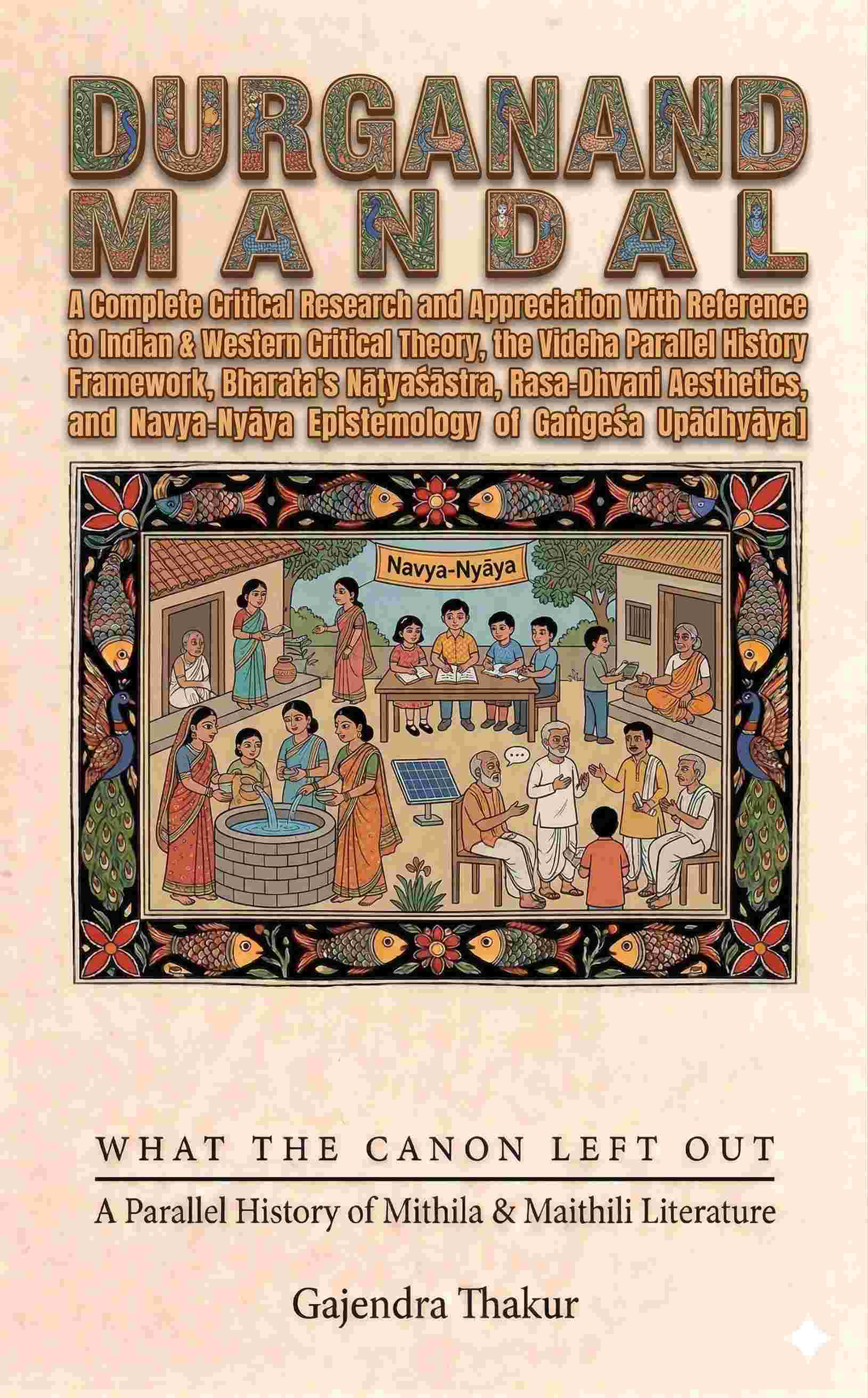
DURGANAND MANDAL A Complete Critical Research and Appreciation With Reference to Indian & Western Critical Theory, the Videha Parallel History Framework, Bharata's Nāṭyaśāstra, Rasa-Dhvani Aesthetics, and Navya-Nyāya Epistemology of Gaṅgeśa Upādhyāya
DURGANAND MANDAL
A Complete Critical Research and Appreciation
With Reference to Indian & Western Critical Theory, the Videha Parallel History Framework,
Bharata's Nāṭyaśāstra, Rasa-Dhvani Aesthetics,
and Navya-Nyāya Epistemology of Gaṅgeśa Upādhyāya
This monograph presents a complete critical research and appreciation of the literary works of Durganand Mandal (दुर्गानन्द मण्डल), a contemporary Maithili writer working in the tradition of democratic, grassroots, and non-Brahmin literary expression. An assistant teacher (Sahayak Shikshak) at Utkramit Vidyalaya, Jhitki-Banagaon, Madhubani, Bihar, Mandal began writing Maithili literature in 2009 under the inspirational mentorship of the celebrated Maithili writer Jagdish Prasad Mandal. His principal works examined in this study include the collection Sanchiyka (a compilation of stories, criticism, and literary essays), the story collection Katha Kusum (कथा कुसुम), a Chakshu (चक्षु) volume, and individual stories, micro-fictions (lagu-katha), critical reviews, poems, and social essays archived in the Videha eJournal.
This study applies a layered critical framework: (i) Indian classical aesthetics — Bharata's Nāṭyaśāstra (Rasa, Bhāva, Sāttvika, Dhvani), Ānandavardhana's Dhvani theory, Abhinavagupta's rasāsvādana, and Kuntaka's Vakrokti; (ii) Navya-Nyāya epistemology of Gaṅgeśa Upādhyāya — Pramāṇa, Vyāpti, Pakṣatā, Anuvyavasāya — as an instrument of literary epistemology; (iii) the Videha Parallel History Framework of Gajendra Thakur, which situates Mandal in the suppressed democratic tradition of Maithili literature; and (iv) Western critical frameworks including Marxist literary theory, New Historicism, postcolonial theory, and realist narrative theory. The study argues that Mandal's work constitutes a vital subaltern intervention — writing from below, from the village, from the non-Brahmin perspective — and that his contribution to the Bīhani Kathā (seed story) tradition, social criticism, and literary pedagogy makes him an indispensable voice in contemporary Maithili letters.
1.1 Life and Identity
Durganand Mandal was born and raised in the village of Godhanapur (Nirmal), situated in the Nirmal block of Supaul district, Bihar — a region within the cultural and ecological heartland of Mithila, at the confluence of the Koshi and Bagmati river systems. He is currently employed as a Sahayak Shikshak (assistant teacher) at Utkramit Vidyalaya, Jhitki-Banagaon, in Madhubani district — a school located in the Harlakhi Block, a predominantly lower-caste and OBC (Other Backward Class) rural area. This biographical location is not incidental: it shapes every dimension of his literary practice.
Mandal belongs to a non-Brahmin, non-Kayastha social community — the groups that the Videha Parallel History Framework identifies as systematically excluded from the Maithili literary establishment dominated by Maithil Brahmin and Karna Kayastha elites. In a pointed statement recorded in the Sanchiyka volume, Mandal articulates this condition directly: the non-Brahmin writer faces a dual barrier — the alien vocabulary of the literary establishment (words never spoken in his community's everyday life) and the structural exclusion from publication, awards, and recognition. He identifies his own trajectory as one of 'unfolding from within a cocoon' (ajhurael jaka jhapael) — hidden, not absent.
His entry into Maithili literature in 2009 was catalysed by the encouragement of Jagdish Prasad Mandal — the foremost living Maithili novelist, recipient of the Sahitya Akademi Award (2021) for Pangu, and the central figure of the democratic parallel tradition. Mandal has also drawn sustenance from Gajendra Thakur's Videha eJournal, which he identifies as having revealed to him the richness of Maithili vocabulary employed outside the Brahmin literary register — words present in his own community's speech but suppressed from the written tradition.
1.2 Published and Archived Works
|
Title |
Sanchiyka (संचियका) — Selected Works |
|
Genre |
Collection: Stories, Criticism, Literary Essays, Lagu-katha, Poems, Social Essays |
|
Content |
Interview with Munnaji; story 'Daktar Karmaveer'; Laghu-katha 'Kukarm'; Novel review of Jagdish Prasad Mandal's Jivan-Sangharsh and Jivan-Maran; Drama review of Bechan Thakur; Essay on Independence Day; Stories 'Lal Bhouji,' 'Paras,' 'Baklel,' 'Kisna Mutti'; Poems; Pothisamiksha |
|
Archive |
Videha eJournal, www.videha.co.in |
|
Title |
Katha Kusum (कथा कुसुम) — Story Blossom |
|
Genre |
Short story collection |
|
Archive |
Videha / Videha Pothi Archive |
|
Significance |
A dedicated anthology of Maithili short stories in the social-realist mode |
|
Title |
Chakshu (चक्षु) — The Eye |
|
Genre |
Literary collection / critical anthology |
|
Archive |
Videha / Videha Pothi Archive |
|
Significance |
The title suggests a mode of seeing and witnessing — thematic of Mandal's critical practice |
|
Title |
Individual Works in Videha eJournal |
|
Genre |
Stories, Lagu-katha (micro-fiction), Pothisamiksha (book reviews), Poems, Social essays |
|
Themes |
Village life, Koshi floods, casteism, education, superstition, rural-urban migration, pharmaceutical exploitation, gender, festival culture |
|
Archive |
www.videha.co.in (ISSN 2229-547X) |
1.3 The Munnaji Interview: A Self-Portrait in Words
One of the most valuable documents in the Sanchiyka is the extended interview conducted by the Videha interviewer 'Munnaji' (Manojkumar Karn, assistant editor of Videha). This interview serves as a literary self-portrait and a manifesto of Mandal's critical position. From it we learn several crucial things. First, he describes his language philosophy: 'The construction of a story is naturally the right words — distance from embellishment is as far as a donkey's head is from horns (gаdahak māthame sāng).' This is a rejection of ornate Alaṃkāra-style writing in favour of direct, natural speech — a position aligned with the democratic tradition's valorisation of the laukika (everyday) over the śāstrīya (classical textbook) register.
Second, he articulates a theory of the storytelling voice: when reading aloud, he illuminates every word for the listener's existence (astitva), making the story audible and letting the listener experience pleasure (ānanda). This is a Nāṭyaśāstra-inflected performance theory: the story is not merely read but enacted, with the teller functioning as an Abhivyañjaka (expresser) and the listener as a Sahṛdaya (sensitive receiver).
Third, and most significantly, he addresses the structural exclusion of non-Brahmin writers from Maithili literature with precision and without bitterness. He identifies a historical 'drawn line' (khīṃchal ekaṭā sīmā-rekhā) that makes it extremely difficult for non-Brahmin-Karna-Kayastha writers to cross into public recognition. He names the mechanism: when a non-Brahmin writer picks up a pen, words that were never spoken in his community's life — that he had never heard from anyone's lips — stand before him like enemies. The literary language has been constructed in a way that excludes the everyday vocabulary of non-Brahmin communities. Yet he ends on a note of historical optimism: the situation is changing, and non-Brahmin writers are coming forward.
2.1 Short Stories: The Social-Realist Village Narrative
2.1.1 'Ḍākṭar Karmavīr' — Doctor Karmaveer
This story, the major narrative of the Sanchiyka collection, is a paradigmatic example of Mandal's social-realist mode. Set on 6 June 2003 — the day when the Prime Minister of India was to lay the foundation stone of a railway bridge over the Koshi at Nirmal — the story establishes its political-historical context with unusual precision. The narrative follows a doctor named Karmaveer who, after years of poverty and struggle in the village, eventually establishes a successful clinic, marries a beautiful wife (Poonam — full moon), and achieves the social recognition denied to him in his youth.
The story operates on two registers simultaneously. On the surface it is a Bildungsroman of upward mobility — the classic 'from rags to riches' narrative. But Mandal's realist detailing of the village chowk — the toddy shop with its earthen pots of fermenting palm wine, the villagers singing 'Tāṛī vālī tāṛī pī ā da...' (Give me toddy, toddy-seller...), the paan shop of Bauwa Kaka, the food stalls, the sensory textures of rural Mithila — grounds this mobility narrative in a specific social ecology. The story's implicit argument is that genuine development (vikāś) must happen within the village, not through migration to the city.
Karmaveer's desire to open a clinic in his own village — 'I want to practice here and serve the village and society' — articulates a counter-narrative to the pervasive 'brain drain' from rural Bihar. The narrator's speech defending village life — 'In the soil and water of the village there is every happiness; no village is inferior to any village; no dhām is inferior to Mithilādhām' — is a lyrical manifesto of rootedness that anticipates the anti-displacement ethos of Mandal's later work.
The description of Karmaveer's wife Poonam — detailed with loving attention to her physical beauty through the conventions of the Sanskrit nāyikāvarnana (description of the heroine) tradition, while grounding her in the social reality of a prosperous professional couple — enacts a characteristic double movement in Mandal's prose: he inhabits classical Maithili descriptive traditions while filling them with contemporary social content.
2.1.2 'Lāl Bhouji' — The Red Sister-in-law
This story, among the most sensuous and socially specific of the collection, is set during the festival of Phāgun (Holi) in a village. It centres on the relationship between Ugan (the younger brother) and his new sister-in-law (bhouji — married just two months earlier to his elder brother Durganand). The story captures the teasing, the playfulness, and the erotic charge of the Holi festival within the structured kinship relations of a Mithila village household.
What makes this story significant beyond its narrative surface is its dense social specification: the description of Lal Bhouji (literally 'Red Sister-in-law,' named for the colour of her clothing and the Holi context) is rendered in the full classical Maithili nāyikāvarnana tradition — detailed physical description from head to toe. Yet the social context is that of a lower-middle-class OBC household, not a royal court. The classical form is appropriated for democratic social content.
The story also documents the Phagua (Holi) folk songs of rural Mithila — including the women's ribald counter-songs ('Ro chhoṛā bajjar khasat...'), the men's songs ('Tohar lahnag uṭhā dev rīmoṭase...'), and the general atmosphere of licensed sexual play that the festival enables. This ethnographic dimension places Mandal in the tradition of Maithili folk-realism — a writer who documents the living oral culture of his community with the precision of an insider and the craft of a literary artist.
2.1.3 'Pāras' — The Philosopher's Stone
This story, which Mandal narrates to his class of ninth-grade girls at the story's beginning, is a tale within a tale — a mise en abyme structure that places the act of storytelling at the story's thematic centre. The inner story concerns a young man named Paras (after the mythological philosopher's stone that turns iron into gold) who sells tea at a stall while studying — ultimately earning an M.A. in Maithili and becoming a teacher.
The story is Mandal's fullest statement of his social philosophy: that no work is shameful (karmā kono kharāp nahin hoet chhai), that honest labour is dignity, and that education and economic self-sufficiency can be achieved simultaneously. Paras's tea-selling is not an obstacle to his education but its means and its symbol: just as the philosopher's stone transforms base metal, Paras transforms his social position through labour and learning.
The story's frame — a male teacher narrating this to an all-girls class, who respond with the collective declaration 'We too want to become Paras, Paras' — adds a feminist pedagogical dimension. The girls' identification with the male protagonist dissolves the gender boundary: the aspiration to self-transformation through education is universal.
In formal terms, the story demonstrates Mandal's mastery of the nested narrative structure — a form that the Sanskrit Kathā tradition (Kathāsaritsāgara, Pañcatantra) deployed extensively, and that Mandal reinvents for contemporary social-realist purposes.
2.1.4 'Baklel' — The Absent-Minded
This story is a fine example of Mandal's satirical mode — rare in his output but executed with precision when deployed. Saroj Babu is a highly educated but socially inept young man — a 'know-it-all' (Mister Know All) who cannot function without his wife. When she goes to her mother's house (naihar) for the extended Sawan-Bhadra season (the traditional period when new brides visit their parents), he becomes completely dysfunctional: unable to eat, sleep, or attend to basic self-care.
The story's satirical target is male dependency masquerading as affection — the educated man who has achieved intellectual status but remains entirely helpless in the domestic sphere. The climax — Saroj Babu hiding in the kitchen at his in-laws' house during the Durga Puja festival, secretly eating the feast that has been prepared from the two sacrificial goats — and being caught in flagrante delicto by the household, shamed before his sisters-in-law, is rendered with comic precision and genuine humour.
This story demonstrates Mandal's range: from the lyrical social realism of 'Karmaveer' to the satirical domestic comedy of 'Baklel,' he employs different registers with the assurance of a writer who has thoroughly absorbed the spectrum of Maithili narrative traditions.
2.2 Micro-Fiction (Lagu-Kathā)
2.2.1 'Kukarm' — The Wicked Deed
This is a complex and structurally intricate piece of micro-fiction — one of the most ambitious items in the Sanchiyka. It weaves together a frame narrative (an astrologer in Dharmapur village, Madhubani, who finds a human skull on a path), an inner narrative (the story of the astrologer's beautiful sixteen-year-old daughter Sunaina and her romantic adventures), and a folktale-within-the-story (the story of the king who demands to know why a fish laughed when it saw the queen, which is solved by the astrologer's grandson Kukarm, who was born of Sunaina after she accidentally consumed the skull-powder).
The narrative is a tour de force of Maithili folk-narrative technique — the concatenated story structure (within-a-story-within-a-story) that echoes the Kathāsaritsāgara and Pañcatantra traditions. Kukarm (whose name means 'wicked deed' — given by his ashamed grandparents) turns out to be a child of genius who exposes the queen's infidelity to the king by clever detective reasoning — whereupon the king executes the queen and her disguised male paramours, and Kukarm earns honour and fame.
Applied through Navya-Nyāya analysis: Kukarm's reasoning in the folktale is a perfect demonstration of anumāna (inference). He reasons from the visible evidence (two women who are actually men, exposed when they attempt to straddle a rope at his instruction) to the hidden truth (the queen's infidelity). This is Navya-Nyāya's inference structure: Vyāpti (invariable concomitance — cross-dressing males will be exposed by anatomical test), Pakṣa (the suspects), Sādhya (the hidden fact), Liṅga (the visible sign). Mandal intuitively deploys the epistemological structure of Gaṅgeśa's logical tradition in his narrative.
2.2.2 'Kisna Muṭṭī' — The Mela of the Fistful
This micro-fiction is among Mandal's most poignant. Marani, a young girl, secretly sells a gourd from her family's field, hides the money, and plans her expenditure for the village fair (Kisna Muṭṭī mela) with loving precision: four annas each for her two younger sisters Abheliya and Sugiya; four annas for a puppet and a balloon for her little brother; four annas for kachori and chop for herself; eight annas for alta (red foot-dye) and ribbon for herself; and eight annas for jalebis for the return journey.
The mother discovers the sold gourd, assumes it was stolen money, and beats the girl before she can explain. The child weeps — 'Mā go māe, melā dekhailai jāeb melā — Kisna Muṭṭīk melā' — I want to go see the fair, the fair of Kisna Mutti.' This ending, withholding resolution and leaving the child's punishment and unexplained innocence in painful suspension, is a masterpiece of Dhvani — the unstated resonance is louder than anything stated. The fair (melā) becomes a symbol of joy denied, of childhood aspiration crushed by adult assumption of guilt.
The story demonstrates Mandal's mastery of the Bīhani Kathā (seed story) form — the tiny narrative that contains the seed of a much larger social truth: the poverty that forces children to secret economies, the adult violence that misreads innocence as theft, the festivals that are both aspiration and heartbreak for the rural poor.
2.3 Critical Reviews and Literary Essays
2.3.1 Reviews of Jagdish Prasad Mandal's Novels
The Sanchiyka contains substantial reviews of two novels by Jagdish Prasad Mandal: Jīvan-Saṃgharṣa (Life-Struggle) and Jīvan-Maraṇa (Life-Death). These reviews are significant both for their critical substance and for what they reveal about Durganand Mandal's own literary values.
In his review of Jīvan-Saṃgharṣa, Mandal argues that the novel is not fantasy but is based on hard reality (yathārtha). He identifies several themes: the rape of a young woman at a Durga Puja fair (structural violence against women in public spaces); the collective response of the village (social solidarity vs. individual revenge); the counter-institution of Kali Puja as a rival festival to the offending Durga Puja; and the mobilisation of a multi-caste committee for community governance. His critical method is essentially sociological — he reads the novel as a document of social processes, aligning with Lukács's theory of the 'type' as a crystallisation of social forces.
In his review of Jīvan-Maraṇa, Mandal praises the novel's treatment of the tension between 'Western civilisation's uncivilised influence' on the younger generation and the traditional Maithili joint-family social culture. He particularly appreciates the portrait of Subhadra — the 111-year-old elder — and her relationship with the protagonist's father's old cow. These marginal social details (the aged woman, the ageing animal) are, for Mandal, precisely the carriers of the novel's deepest meaning — a reading consistent with the Dhvani theory's emphasis on peripheral detail as the site of resonance.
2.3.2 Review of Bechan Thakur's Play 'Beṭīk Apmānpar ek Najari'
Durganand Mandal's review of Bechan Thakur's play on the dishonour done to daughters ('Beṭīk apmān āo chīnardevī') is a significant critical document. Mandal begins with an indictment of the neglect of Maithili drama as a genre — 'Maithili nāṭak has always been like a one-day rain: isolated, not sustained.' He then turns to the specific social crisis that Thakur's play addresses: the declining sex ratio (more boys than girls) in contemporary India, and the practice of female foeticide.
Mandal's critical argument is passionate and rhetorically structured. He invokes historical women of achievement — Rani Jhansi, Savitri, Ahilya, Indira Gandhi, Madam Curie, Mother Teresa — to argue that daughters have been the architects of history and society. He then makes the crucial logical point: if these women had been killed in the womb, what would today look like? The argument is implicitly a Navya-Nyāya counterfactual inference: if X (daughter) had not existed, Y (historical achievement) would not have occurred; therefore the destruction of X is the destruction of Y.
He also credits Jagdish Prasad Mandal's inspirational influence on Bechan Thakur — noting that Thakur writes from within the parallel tradition — and thanks both Shruti Prakashan and Videha for enabling the publication and promotion of this work. This network of acknowledgements reveals the social and institutional ecology of the parallel literary movement.
2.3.3 Reviews of Children's Illustrated Books (Prīti Ṭhākur's Citrkathas)
Among the most charming and revealing items in the Sanchiyka are Mandal's reviews of two illustrated children's books by Priti Thakur — one on Gonu Jha (the famous Maithili folk wit) and one a general Maithili children's illustrated book. These reviews reveal Mandal's deep engagement with Maithili folk tradition, children's literature, and the politics of cultural preservation.
He notes that the Maithili characters illustrated — Reshma-Chuharmul (a tragic inter-caste love story; Chuharmul is Dusadh caste, Reshma is Bhumihar Brahmin), Naika-Banjara, Jyoti Panjiyar, Mahua Ghatvarin, Raja Salhes, Chhechhan Maharaj, Kalidasa — represent 'all castes of society' (prāyaḥ sabhā jāitik lok). He specifically notes that Priti Thakur has documented that Kalidasa was born in the Yadav (cowherd caste) community — a fact suppressed by those who claimed him as Karna-Kayastha. This act of caste-corrective literary history is exactly the work the Videha Parallel History Framework performs at the macro level.
The review of the Reshma-Chuharmul illustration is particularly telling: Mandal argues that Reshma and Chuharmul's love — divided by the Brahmin-Dusadh caste boundary — represents a love no less pure than Heer-Ranjha or Laila-Majnun. 'Love is not made; it happens by itself (prem kayal nahi jai, apane bha jai).' This egalitarian theory of love is simultaneously a critique of the caste system and an aesthetic claim: the highest human emotion transcends social hierarchy.
2.4 Social and Political Essays
2.4.1 Independence Day Essay: 'Swatantrā Divas par Kichu Swatantra Bhārās'
This essay — 'Some Independent Thoughts on Independence Day' — is Mandal's most explicitly political writing and demonstrates his range beyond creative fiction. It is a scathing critique of official Independence Day ceremonies: the khadi-clad politicians who give hypocritical speeches before the national flag while practising corruption throughout the year. The essay is structured as a sustained indictment: 'We have been listening to false speeches for fifty years... now listening to falsehoods while making others like us listen to them — how bad a thing this is!'
The essay identifies specific corruptions: the government officials who dress in khadi for the occasion but engage in bribery and exploitation the remaining 364 days; the politicians who deposit national wealth in foreign accounts; the systematic dishonesty of the political class. It ends with a call to awakening: 'Wake up, wake up, O son of India, wake up now.' The rhetoric is in the Gandhian tradition of moral exhortation, but the content is a democratic socialist critique of the post-colonial Indian state.
The essay is also titled 'Buṛhiyā Phūsiyā' (Old Woman's Lies) in another version in the Sanchiyka — an extended satirical meditation on the culture of official lying that pervades Indian institutional life. Mandal argues that lying has become a hereditary practice (putainī jhūṭhā — ancestral liars), and that every national holiday has become an occasion for the ritual performance of falsehood. The satire is biting and original.
2.4.2 Essay on Rākhi (Raksha Bandhan)
Mandal's essay on the festival of Raksha Bandhan — addressed to 'all Maithils' from Godhanapur, Nirmal — is a thoughtful meditation on the festival's meaning in the context of contemporary gender violence. He moves from the historical meaning of the festival (a sister tying a protective thread on her brother's wrist, even across the Hindu-Muslim boundary during medieval conflicts) to its contemporary crisis (the systematic violation of women's safety despite the Rakhi covenant).
His argument is both feminist and spiritual: 'To purify this polluted tendency, sight, and action, one must remain pure in mind, speech, and deed, and treat everyone as one's own sister.' He appeals to the 'Param Piṭā Paramātmā' (Supreme Father, Universal Soul) — the language of his Brahmo-inspired universalism — to argue that before the Divine there is no distinction of man and woman, and that this should be the basis of social relations. The essay concludes with a call for an 'ātmīk rākhī' — a soul-bond — that goes deeper than the physical ceremony.
3.1 Navya-Nyāya Epistemology of Gaṅgeśa Upādhyāya
3.1.1 Gaṅgeśa and the Suppressed Democratic Tradition
The Videha Parallel History Framework makes a foundational claim about Gaṅgeśa Upādhyāya (c. 13th-14th century, Mithila) — the founder of Navya-Nyāya (New Logic) and author of the Tattvacintāmaṇi — that has direct bearing on the reading of Durganand Mandal. The Videha research, based on Dūṣaṇa Pañji (genealogical records), reveals that Gaṅgeśa was born of an inter-caste union — his mother was a Charmakāriṇī (of the leather-tanning community) — and that this fact was systematically suppressed by the upper-caste literary establishment, most notably by the scholar Ramanath Jha, who concealed it from historian Dinesh Chandra Bhattacharya.
This biographical correction is not merely biographical: it establishes that the founder of Navya-Nyāya — India's most rigorous epistemological school — was himself a product of the suppressed non-Brahmin tradition of Mithila. Gaṅgeśa's work thus belongs, by the logic of the Parallel History, to the same democratic counter-tradition to which Durganand Mandal belongs. Reading Mandal through Gaṅgeśa is not an imposition of an alien theoretical framework but a recovery of a shared subaltern intellectual heritage.
3.1.2 Pramāṇa Theory and Literary Knowledge
Gaṅgeśa's epistemology identifies four Pramāṇas (sources of valid knowledge): Pratyakṣa (perception), Anumāna (inference), Upamāna (comparison/analogy), and Śabda (testimony/verbal knowledge). Each has application to the reading of Mandal's literary practice.
Mandal's stories function primarily as Pratyakṣa — direct perception of social reality. His dense, specific descriptions of village life — the toddy shop, the Holi songs, the seasonal rhythms of agricultural Mithila, the texture of food and festival — constitute a form of literary perception that enables the reader to 'see' (the title of his collection Chakshu — 'The Eye') what would otherwise remain invisible to those outside the community. This is Mandal's first epistemological function: making visible what is structurally rendered invisible.
His critical essays function as Anumāna — inference from visible signs to hidden structural truths. When he argues, in his Independence Day essay, from the observable behaviour of politicians (khadi clothing, flag-saluting, corrupt actions) to the hidden reality (the systematic dishonesty of the post-colonial state), he is performing precisely the Navya-Nyāya logical operation: from the Liṅga (visible sign) to the Sādhya (hidden conclusion) via the Vyāpti (the invariable rule that connects them).
The Navya-Nyāya concept of Pakṣatā — the subjective condition of inquiry, the living doubt that drives the search for knowledge — illuminates Mandal's position as a writer. He writes from a position of profound pakṣatā: the unresolved social contradictions of rural Bihar (caste oppression, gender violence, migrant exploitation, superstition, educational aspiration) constitute the practical lived uncertainty that his writing seeks to resolve. His writing is not decorative but epistemologically driven.
Finally, the concept of Anuvyavasāya (meta-cognition — the awareness of one's own knowing) is enacted in the Sanchiyka's interview, where Mandal reflects explicitly on his own literary practice: his theory of the word, his philosophy of storytelling, his analysis of the structural conditions of non-Brahmin writing. This reflexive meta-critical dimension makes the Sanchiyka not merely a creative collection but an epistemological document — a record of a writer's awareness of how he knows and why he writes.
3.2 Bharata's Nāṭyaśāstra and Indian Classical Aesthetics
3.2.1 Rasa Theory Applied to Mandal's Fiction
Bharata's Nāṭyaśāstra identifies eight primary Rasas (aesthetic emotions): Śṛṅgāra (love/beauty), Hāsya (humour), Karuṇa (compassion/pathos), Raudra (fury), Vīra (heroism), Bhayānaka (terror), Bībhatsa (disgust), and Adbhuta (wonder). Abhinavagupta added Śānta (tranquility) as a ninth.
Mandal's fiction is predominantly Karuṇa-rasa — the rasa of compassion, sorrow, and pathos — activated by the depiction of structural suffering: the girl denied access to a fair (Kisna Muṭṭī), the poor doctor whose hunger goes unaddressed (Karmaveer's early years), the young woman whose pregnancy results from accidental consumption of a skull-powder misidentified as poison (Kukarm). Yet his satire activates Hāsya-rasa (in Baklel), his romantic stories activate Śṛṅgāra-rasa (in Lal Bhouji and Paras), and his political essays activate Raudra-rasa (the fury of the Independence Day satire and the Rakhi essay on gender violence).
The Nāṭyaśāstra's theory of Vibhāva (excitants), Anubhāva (consequent expressions), and Vyabhicāribhāva (transient emotional states) is particularly illuminating for Mandal's story craft. In 'Kisna Muṭṭī,' the Vibhāvas are the poverty of the family, the child's secret economic initiative, the mother's misidentification, and the beating. The Anubhāvas are the child's weeping and the repeated cry for the fair. The Vyabhicāribhāvas — the child's excited planning, her careful budgeting, her loving allocation of gifts for each sibling — create the emotional complexity (joy turning to pain) that constitutes the story's Karuṇa-rasa achievement.
3.2.2 Dhvani Theory: The Resonant Unsaid
Ānandavardhana's Dhvanyāloka (9th century) argues that the highest poetry achieves its effect through Dhvani — resonance, the unstated meaning that vibrates beyond the literal. Applied to Mandal's micro-fiction, this framework is exact. The ending of 'Kisna Muṭṭī' — the child's cry for the fair — says nothing about poverty, nothing about maternal violence, nothing about structural inequality. Yet all of these resonate in the space between the literal words and the reader's understanding.
Similarly, the ending of Karmaveer's early hunger — sleeping without food, burning with ambition, unable to tell anyone — does not editorialize. The restraint is the Dhvani. The 'hollow eyes and hungry belly' of the young Karmaveer are not interpreted for us; they resonate. This is Mandal's most significant aesthetic achievement: a narrative restraint that generates maximum emotional and social resonance through minimum statement.
Abhinavagupta's concept of the Sahṛdaya (the sensitive reader, literally 'one with the same heart') is relevant here: Mandal's Dhvani is accessible only to readers who share the cultural and social coordinates of rural Maithili life — who know what a Kisna Mutti mela means, who know the Holi songs, who know the toddy-shop culture. The Sahṛdaya is, in the first instance, the community from which the writer emerges.
3.2.3 Kuntaka's Vakrokti and Mandal's Satirical Idiom
Kuntaka's Vakroktijīvita (10th-11th century Kashmir) argues that the essence of literary language is Vakrokti — oblique speech, the deviated expression that says something indirectly, with a twist. Mandal's satirical essays, particularly 'Buṛhiyā Phūsiyā' and the Independence Day essay, deploy Vakrokti systematically: the politician dressed in khadi who lies before the national flag is not directly condemned but described with precise irony, allowing the reader to draw the conclusion. This is exactly Kuntaka's point: the best literary expression achieves its effect through obliqueness, not through direct statement.
3.3 The Videha Parallel History Framework
3.3.1 The Democratic Literary Tradition
The Videha Parallel History Framework, developed by Gajendra Thakur through the Videha eJournal (www.videha.co.in, ISSN 2229-547X), constitutes the indispensable critical context for Durganand Mandal's work. The Framework argues that Maithili literary history as institutionally constructed (primarily by the Sahitya Akademi, Delhi, and the Maithili Akademi, Patna) has systematically promoted an upper-caste canon — overwhelmingly Maithil Brahmin and Karna-Kayastha — while suppressing democratic, folk, Dalit, feminist, and Nepal-side traditions.
Durganand Mandal belongs unambiguously to the suppressed parallel tradition. He is non-Brahmin, village-based, employed as a government school teacher, writing in the everyday vocabulary of the rural OBC community. He began writing through the encouragement of Jagdish Prasad Mandal — himself the exemplary figure of the parallel tradition's democratic novelistic practice. He publishes in Videha — the digital counter-institution that has created, in the words of the Parallel History, 'a million pages of Maithili corpus' outside the institutional channels.
The Parallel History explicitly documents the RTI (Right to Information) findings of Vinit Utpal and Ashish Anchinhar (2011-14): over 90% of Sahitya Akademi translation and publication assignments went to friends and relatives of the ten-member advisory board. This means that writers like Durganand Mandal — who have no institutional connections to the Brahmin-Kayastha literary establishment — are systematically excluded not only from recognition but from the material support (translation commissions, publication grants) that sustains literary careers.
3.3.2 The Bīhani Kathā Tradition
The Videha Parallel History (Part 32) specifically documents the Bīhani Kathā (seed story/morning story) tradition as a distinctive Maithili literary form with deep roots in the oral tradition of Mithila. Mandal's micro-fictions — 'Kukarm,' 'Kisna Muṭṭī,' the two pieces titled 'Postmortem' and 'Pollution' at the end of the Sanchiyka — belong explicitly to this tradition. They are compressed narratives that plant seeds of social meaning without exhausting them.
The two closing micro-fictions are particularly instructive: 'Postmortem' (about a school principal who is beaten by his students after refusing to teach, and whose parent meeting reveals the dynamics of accountability in rural education) and 'Pollution' (about internal moral pollution in a society that prioritises material comfort over human connection) represent the Bīhani Kathā at its most concentrated. Each story is barely a paragraph, yet each contains the seed of a major social analysis.
3.4 Western Critical Frameworks
3.4.1 Marxist Literary Theory and Social Realism
Georg Lukács's theory of the 'type' — the literary character who crystallises a social position, embodying both individual psychology and social forces — is directly applicable to Mandal's fiction. Karmaveer is not merely an individual doctor: he is a 'type' of the educated non-Brahmin village youth who aspires to serve his community without migrating to the city. The toddy-drinkers in the village chowk are not merely colourful background figures: they crystallise the social conditions (poverty, underemployment, lack of alternatives) that produce their behaviour.
Raymond Williams's concept of the 'structure of feeling' — the affective texture of a specific historical moment, not yet fully articulated in formal ideology — is illuminated by Mandal's fiction. His stories capture the structure of feeling of early twenty-first century rural Bihar: the simultaneous presence of aspirational mobility (education, government jobs, medicine) and structural stasis (caste discrimination, gender violence, flood displacement, educational neglect). This is not a structure that can be fully articulated in political discourse; it requires the oblique, sensory language of narrative fiction.
Fredric Jameson's concept of the 'political unconscious' — the claim that all literature is ultimately a symbolic resolution of social contradictions — is instructive for reading Mandal's fictions of social mobility (Paras, Karmaveer). These narratives resolve, at the level of fiction, contradictions that cannot be resolved in social reality: the brilliant non-Brahmin student who succeeds despite systemic barriers. This is not naive optimism but what Jameson calls the 'Utopian horizon' of social fiction — the imagined resolution that keeps social aspiration alive.
3.4.2 New Historicism and the Document of Culture
Stephen Greenblatt's New Historicism insists that literary texts are embedded in specific historical moments and that they contain within them traces of the social negotiation and conflict that produced them. Mandal's Sanchiyka is an unusually self-aware instance of this: it explicitly dates several of its items (the 2003 Koshi bridge story, the 2012 Tagore Literature Award journey), it names specific places (Nirmal, Jhitki, Godhanapur, Madhubani), and it situates itself within the specific institutional ecology of Videha, Shruti Prakashan, and the parallel literary movement.
The account of Jagdish Prasad Mandal's receipt of the Tagore Literature Award in Kochi (2012) — narrated by Durganand Mandal who accompanied him — is a remarkable cultural document. It records in vivid detail the journey from the Maithili village Berma (Madhubani) to Patna by bus, then by air to Kochi; the five-star hotel; the Samsung-sponsored award ceremony; the Tamil dancer Padma Shri Shobhana Chandrakumar's performance; the seven languages honoured. This narrative of a non-Brahmin Maithili village novelist receiving an international literary award in a southern Indian city — watched by a companion who is himself a village schoolteacher-writer — is the Parallel History of Maithili literature enacted in real time.
3.4.3 Postcolonial Theory and the Subaltern Voice
Gayatri Chakravorty Spivak's foundational question — 'Can the subaltern speak?' — and her argument that the subaltern is systematically denied the conditions of speech within the colonial and postcolonial order — is directly applicable to Mandal's literary project. The non-Brahmin writer in Maithili faces a specific version of this silencing: the literary language itself has been constructed in a way that excludes his community's vocabulary and registers, making the very act of writing in 'standard' Maithili an act of self-alienation.
Mandal's response is to write in the everyday language of his community — the register of the OBC village schoolteacher — without apology or mediation. His stories are written in a Maithili that is recognisable to his community, not the Sanskrit-inflected literary Maithili of the Brahmin tradition. This is what Homi Bhabha would call 'the third space' — the site where subaltern cultural expression creates its own norms and conventions outside the dominant cultural framework.
3.5 Performance and Oral Theory
Mandal's theory of storytelling — expressed in the Munnaji interview — is explicitly a performance theory. He speaks of reading aloud (katha pāṭha), of illuminating each word for the listener's existence, of the pleasure (ānanda) that the listener experiences through hearing. This connects his work to the oral performance traditions of Mithila — the Dāstāngoi (professional storytelling), the Pāthārambha (public reading), the village gathering around the storyteller.
The Walter Ong/Jack Goody oral-literary continuum is relevant here: Mandal's writing retains the characteristics of primary orality — the formulaic description of characters (nāyikāvarnana), the repetition of key phrases, the direct address to the audience — even in its written form. His work is best understood as lying at the interface between oral and literate culture — a transitional literature that is reshaping Maithili prose in the direction of the spoken, the democratic, the accessible.
4.1 The Village as Literary Universe
Every piece in Mandal's corpus is rooted in the Maithili village. Unlike the migration-narrative that dominates much contemporary Indian writing (the rural person who goes to the city and is transformed), Mandal's literary universe insists that the village contains sufficient material for a full human life. His narrator in 'Karmaveer' makes this explicit: 'In the soil and water of the village there is every happiness.' This is not naive ruralism but a political claim: that the aspiration to city life is partly a socially constructed dissatisfaction, and that the development of the village — through people like Karmaveer who choose to stay — is both possible and necessary.
This village-rootedness connects Mandal to the Maithili folk tradition (which is overwhelmingly rural), to the social-realist novelistic tradition of Jagdish Prasad Mandal (whose novels are all rooted in Madhubani villages), and to the political tradition of Gandhian gram-swaraj (village self-rule). It also connects him to the global tradition of magical and social realism's recovery of the local — Garcia Marquez's Macondo, Hardy's Wessex, Premchand's rural UP.
4.2 Caste, Community, and Democratic Aspiration
Caste is the invisible structural force that shapes every dimension of Mandal's literary world. It is rarely named directly in the fiction — but it is always present as the unseen organiser of social possibility and constraint. Karmaveer's hunger and poverty are the poverty of a non-Brahmin village family in early twenty-first century Bihar. Paras's tea-selling — his lack of access to the patronage networks that smooth the paths of upper-caste youth — is the condition of non-Brahmin educational aspiration. The 'line that is hard to cross' that Mandal describes in his interview is the caste line.
Yet Mandal's response to caste is not separatism or militancy but democratic aspiration — the demand for inclusion in a common Maithili literary culture, on equal terms. His reviews of Priti Thakur's children's books celebrate precisely the multi-caste representation in Maithili folk narrative: Reshma-Chuharmul's inter-caste love, Raja Salhes's low-caste heroism, Kalidasa's Yadav origins. This is the democratic vision: a Maithili literature that includes all communities, not as exotica but as full human subjects.
4.3 Gender and Domestic Life
Mandal's treatment of gender is complex and sometimes contradictory. His satire of the dependent husband (Baklel) is feminist in effect — exposing male helplessness disguised as love. His Rakhi essay is explicitly feminist in argument — calling for genuine protection of women's safety rather than ceremonial protection. His story 'Paras' ends with girls identifying with a male protagonist's aspiration to self-improvement.
Yet his fiction also contains extensive nāyikāvarnana (heroine-description) passages that deploy the male gaze of the Sanskrit aesthetic tradition — detailed physical description of women from the perspective of a male narrator/protagonist. These passages are both part of the Maithili literary tradition Mandal inhabits and a site of tension with his democratic aspirations. A feminist reading of this tension would note that Mandal's work is not exempt from the gender contradictions of its social context, even as it works to critique many aspects of that context.
4.4 Education, Knowledge, and Social Mobility
Education — its acquisition, its value, and its social implications — is the central thematic obsession of Mandal's fiction. Paras studies while selling tea. Karmaveer studies while struggling against poverty. The girls in Mandal's class aspire to become 'Paras.' The Independence Day essay implies that genuine education — as opposed to the ritual lip-service of official ceremonies — is the only path to genuine freedom.
This obsession with education is not surprising in a writer who is himself a schoolteacher — but it goes deeper than professional interest. For Mandal, as for the democratic tradition he inhabits, education is the primary instrument of social emancipation: not in the Macaulayite sense (education in English to produce colonial administrators) but in the Ambedkarite sense (education as the acquisition of knowledge, critical thinking, and social dignity).
5.1 Contribution to Maithili Literature
Durganand Mandal's contribution to Maithili literature is significant on several dimensions. First, he has produced work across multiple genres — short story, micro-fiction, critical review, social essay, poem — demonstrating versatility and commitment to the literary enterprise that goes beyond a single form. Second, he has introduced into Maithili fiction the vocabulary, concerns, and social textures of the OBC rural community — a community that has been structurally excluded from the literary register of 'standard' Maithili. Third, his critical reviews and literary essays have contributed to the development of a democratic Maithili literary criticism that reads texts from below, for their social content and ethical implications, rather than primarily for their aesthetic adherence to classical standards.
His work in the Bīhani Kathā form — particularly 'Kisna Muṭṭī' and the two closing pieces in the Sanchiyka — represents a genuine achievement in the micro-fiction genre. The compression, the restraint, and the resonant ending of 'Kisna Muṭṭī' in particular stands comparison with the finest examples of the form in Maithili literature.
5.2 Relationship to the Parallel Tradition
Mandal is a second-generation figure of the parallel literary tradition that Videha has documented and promoted. His mentor Jagdish Prasad Mandal is a first-generation figure — the foundational Maithili novelist of the parallel tradition. Durganand Mandal represents the reproduction and expansion of this tradition: a younger writer who has absorbed its values and practices and is extending them into new formal territories (critical review, social essay) and new thematic domains (pharmaceutical exploitation, educational aspiration, Holi folk culture).
His close relationship with Videha — as both a contributor and a reader who credits the journal with transforming his understanding of Maithili linguistic possibility — makes him an embodiment of what the Parallel History identifies as the Videha Era's central achievement: the creation of a digital counter-institution that enables non-Brahmin, village-based writers to publish, circulate, and reach readers outside the institutional channels of the Sahitya Akademi network.
5.3 Limitations and Areas for Further Research
The critical appreciation offered here is necessarily preliminary. The full archive of Mandal's contributions to Videha — spanning multiple issues from 2009 to the present — requires systematic documentation and analysis. The novel-form work, if any, that may be in progress or unpublished requires investigation. The performance dimension of his storytelling practice — his oral presentations at katha-goshthi events — deserves documentation and analysis through performance studies frameworks.
Additionally, a comparative analysis of Mandal's work alongside other second-generation parallel tradition writers — Munnaji (Manojkumar Karn), Ashish Anchinhar, and others named in the Videha Parallel History — would help situate his particular contribution within the broader democratic literary movement.
The title of one of Durganand Mandal's collections — Chakshu, The Eye — encapsulates his literary project. He is a writer who sees: who refuses the selective blindness of institutional Maithili literature, who looks at the village chowk (with its toddy shop and paan stall and festival songs) and finds in it the full complexity of human life; who looks at the non-Brahmin writer's structural situation and names it without bitterness; who looks at the female foeticide crisis and demands accountability; who looks at the corruption of Independence Day celebrations and names the hypocrisy.
This eye — trained by lived experience, sharpened by the literary tradition of Videha and Jagdish Prasad Mandal, and guided by the democratic values of the parallel literary movement — is the instrument of a genuine literary intelligence. Mandal's work may not yet have achieved the formal completion of his mentor's novels, but in its range, its social commitment, its linguistic vitality, and its epistemological honesty, it constitutes a body of work that the criticism of Maithili literature cannot afford to ignore.
The Navya-Nyāya concept that is most fitting as a final framework for Mandal's work is Vyāpti — invariable concomitance, the rule that connects the sign to the conclusion. Mandal's literary practice establishes, through accumulated particular instances, the following vyāptis: wherever there is a village, there is sufficient material for a full human life; wherever there is a non-Brahmin writer, there is a perspective that the dominant tradition cannot accommodate; wherever there is the suppressed word (from the OBC community's everyday vocabulary), there is literary power waiting to be released. These are the invariable rules that his writing, case by case, story by story, demonstrates.
"Sabhā jāitik lok, cāhe o Brahmin ho vā Dom — sabhak apan bhūmikā hoit chhaikak. Jihiṇā phulavāṛīme sabhā phul raihet achhik, tihiṇā samājho ekaṭā phulavāṛī hoit chhaikak." — Durganand Mandal, review of Jagdish Prasad Mandal's Jīvan-Maraṇa
Primary Sources: Works of Durganand Mandal
Mandal, Durganand. Sanchiyka. Videha Archive. www.videha.co.in. [Collection including 'Ḍākṭar Karmavīr'; 'Kukarm'; 'Lāl Bhouji'; 'Pāras'; 'Baklel'; 'Kisna Muṭṭī'; review of Jagdish Prasad Mandal's Jīvan-Saṃgharṣa and Jīvan-Maraṇa; review of Bechan Thakur's 'Beṭīk Apmān'; reviews of Priti Thakur's Citrkathas; Independence Day essays; Rakhi essay; Postmortem; Dūṣaṇa; interview with Munnaji.]
Mandal, Durganand. Katha Kusum (कथा कुसुम). Videha Pothi Archive. www.videha.co.in/pothi.htm.
Mandal, Durganand. Chakshu (चक्षु). Videha Pothi Archive. www.videha.co.in/pothi.htm.
Mandal, Durganand. Individual contributions to Videha eJournal, 2009–2026. www.videha.co.in (ISSN 2229-547X).
Primary Sources: Videha Parallel History
Thakur, Gajendra. A Parallel History of Mithila and Maithili Literature. Parts 1–54+. Videha eJournal, www.videha.co.in, 2019–2026.
Thakur, Gajendra (ed.). Videha Maithili Seed Stories (Bīhani Kathā). Videha Archive. [Google Books ID: qIxpnlNN_30C.]
Videha eJournal. ISSN 2229-547X. www.videha.co.in. Editor: Gajendra Thakur. First Maithili Fortnightly eJournal, since 2004.
Utpal, Vinit, and Ashish Anchinhar. RTI Application to Sahitya Akademi. 2011–14. [Findings reported in Videha Parallel History, Part 1.]
Indian Classical Sources
Bharata Muni. Nāṭyaśāstra. Trans. and ed. Manmohan Ghosh. Calcutta: Asiatic Society, 1951.
Ānandavardhana. Dhvanyāloka. With Locana of Abhinavagupta. Trans. Daniel H. H. Ingalls et al. Cambridge, MA: Harvard University Press, 1990.
Abhinavagupta. Abhinavabhāratī. Ed. M. Ramakrishna Kavi. Baroda: Oriental Institute, 1926–64.
Kuntaka. Vakroktijīvita. Trans. K. Krishnamoorthy. Dharwar: Karnatak University, 1977.
Gaṅgeśa Upādhyāya. Tattvacintāmaṇi. Ed. Kamakhyanatha Tarkavagisa. Calcutta: Asiatic Society, 1884.
Mishra, Jaykant. A History of Maithili Literature. 2 vols. Allahabad: Tirhut Publication, 1949–54.
Western Critical Sources
Bakhtin, Mikhail. The Dialogic Imagination. Trans. Caryl Emerson and Michael Holquist. Austin: University of Texas Press, 1981.
Greenblatt, Stephen. Renaissance Self-Fashioning. Chicago: University of Chicago Press, 1980.
Goody, Jack. The Logic of Writing and the Organization of Society. Cambridge: Cambridge University Press, 1986.
Jameson, Fredric. The Political Unconscious: Narrative as a Socially Symbolic Act. Ithaca: Cornell University Press, 1981.
Lukács, Georg. The Meaning of Contemporary Realism. Trans. J. and N. Mander. London: Merlin Press, 1963.
Ong, Walter J. Orality and Literacy: The Technologizing of the Word. London: Methuen, 1982.
Spivak, Gayatri Chakravorty. 'Can the Subaltern Speak?' In Marxism and the Interpretation of Culture. Urbana: University of Illinois Press, 1988.
Williams, Raymond. Marxism and Literature. Oxford: Oxford University Press, 1977.
On Maithili Literature and the Parallel Tradition
Jha, Mithilesh Kumar. 'Maithili in the Digital Space.' India Seminar 742, June 2021. www.india-seminar.com.
Chaudhary, Radhakrishna. A Survey of Maithili Literature. Darbhanga, 1976.
Mandal, Jagdish Prasad. Gāmak Jiṃgī [Village Life]. Shruti Prakashan, 2009. [Tagore Literature Award, 2011, Kochi.]
Mandal, Jagdish Prasad. Jīvan-Saṃgharṣa; Jīvan-Maraṇa; Maulaila Gāchak Phūl. [Reviewed by Durganand Mandal in Sanchiyka.]
Thakur, Bechan. Beṭīk Apmān āo Chīnardevī. Shruti Prakashan. [Reviewed by Durganand Mandal in Sanchiyka.]
अपन मंतव्य editorial.staff.videha@zohomail.in पर पठाउ।
विदेहमे सभठाम ताकू / Search all Videha
Static full-text search · Pagefindलेखक/शीर्षक/अंक/वर्ष — खोज-विधा। गद्य/पद्य/शोध current/static + पुरान Videha/Sadeha contents खोजैत अछि। पोथी pothi.htm केर पूर्ण listing, श्रव्य-दृश्य Audio_Video.htm केर पूर्ण listing, पञ्जी videha-sadeha/panji-shards GitHub data, आ थेसारस/शब्दकोश videha-ejournal.github.io/data GitHub JSON corpus केँ query करैत अछि आ दूनू Quiz corpus मे dictionary/vocabulary/शब्दार्थ-सम्बन्धी प्रश्नोत्तरी परिणाम सेहो जोड़ैत अछि। Quiz videha-quiz आ GitHub user-site दूनू bilingual quiz corpus खोजैत अछि। Roman/IAST + देवनागरी cross-script search समर्थित। Issue/Year लेल संख्या दिअ। PDF-अभिलेख archive.org/VidehaAndSadeha सूची खोजैत अछि।