
A PARALLEL HISTORY OF MITHILA & MAITHILI LITERATURE- PART 85
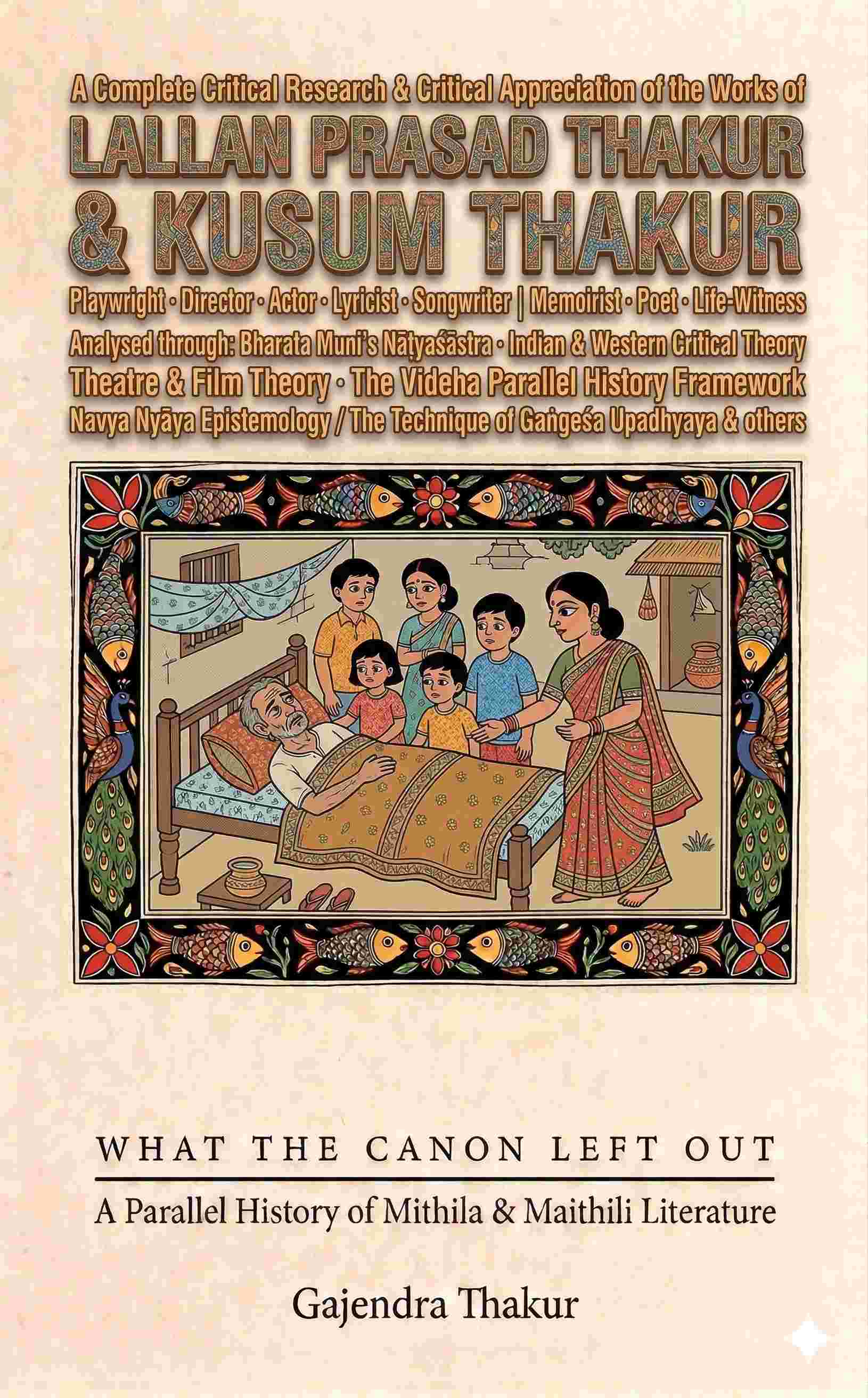
A COMPLETE CRITICAL RESEARCH & CRITICAL APPRECIATION of the Works of LALLAN PRASAD THAKUR & KUSUM THAKUR Playwright Director Actor Lyricist Songwriter | Memoirist Poet Life-Witness Analysed through: Bharata Muni's Nāṭyaśāstra Indian & Western Critical Theory Theatre & Film Theory The Videha Parallel History Framework Navya Nyāya Epistemology / The Technique of Gaṅgeśa Upadhyaya & others
CRITICAL APPRECIATION
of the Works of
LALLAN PRASAD THAKUR
& KUSUM THAKUR
Playwright · Director · Actor · Lyricist · Songwriter | Memoirist · Poet · Life-Witness
Analysed through: Bharata Muni's Nāṭyaśāstra · Indian & Western Critical Theory
Theatre & Film Theory · The Videha Parallel History Framework
Navya Nyāya Epistemology / The Technique of Gaṅgeśa Upadhyaya & others
PART I: INTRODUCTION AND BIOGRAPHICAL OVERVIEW
1.1 The Literary Couple of Mithila: An Overview
Lallan Prasad Thakur (5 January 1953 – 7 September 1995) was a playwright, director, actor, lyricist, songwriter, and cultural activist in the Maithili and Hindi languages of Mithila. Born in village Samaul, Madhubani district, Mithila (Bihar), he completed his schooling at Watson Higher Secondary School, Madhubani (1967) and earned his civil engineering degree from M.I.T. Muzaffarpur (1973). He worked as an engineer in TISCO (Tata Iron and Steel Company), Jamshedpur, in the CE&DD division. In his brief creative life of barely twelve years on the proscenium stage — beginning with the premiere of Badka Saheb at Rabindra Bhavan, Jamshedpur, on 20 November 1983 — he produced a body of theatrical work that critics have placed in the front rank of Maithili drama.
Kusum Thakur, his wife (married 13 July 1972), is a memoirist, poet, and prose writer. Her memoir Pratyavartan (Return / Restoration), preserved in Videha Sadeha 34, is one of the most candid and luminous autobiographical texts in modern Maithili literature. Her poems, including Chul Buli Kanya Bani Gelahuṃ (I Became a Mischievous Girl Again) and Abhilasha (Longing), show a quiet but deeply felt lyric intelligence. The two writers must be understood both independently and in their creative partnership: Kusum Thakur was, by her own account, Lallan Prasad Thakur's first and most demanding critic, his most thorough admirer, and an indispensable collaborator in the development of every play.
1.2 Life and Career of Lallan Prasad Thakur
Family: Son of Hiranand Thakur and Subhadra Devi. Second child among two sisters and six brothers. Elder brother Yashoanand Thakur was his first theatrical inspiration; Buchi Babu, his schoolmaster, was his first theatre guru. He is survived by Kusum Thakur (© 9431117484) and sons Kumar Bhaskar Thakur and Kumar Mayur Thakur.
Institutional affiliations: Founder of the organisation Mithilakshar (1983). Associated with Mailorang, which published his Rachanavali in 2022 (ISBN 978-93-82828-37-2, price Rs. 595, edited by Dr. Prakash Jha; cover art by Manisha Jha; cover design by Rajeev Sharma; typesetting by Sanjeev Kumar 'Bittu' and Jyuli Srivastava).
Theatrical premieres: Badka Saheb — Rabindra Bhavan, Jamshedpur, 20 November 1983. Mistaar Nilo Kaka — Bhartiya Nrityakala Mandir, Patna, 17 November 1984 and 13 June 1985 (subsequent stagings). Loangia Miarchai — multiple productions from mid-1980s. Baklel and Aadi Va Ant received notable critical attention. All Maithili plays directed by Lallan Prasad Thakur himself; he also acted the title role of Nilo Kaka.
The pivotal institutional context of Lallan Prasad Thakur's dramatic career was Mailorang and the Mithila Rang Mahotsav (Mithila Theatre Festival). The first Mithila Rang Mahotsav was organised by Mailorang in Jamshedpur in 2006, with an international seminar; this seminar first noted the absence of systematic documentation of Maithili theatre and laid the groundwork for what would become the Rachanavali. A second catalysing moment was the encounter with actress Manisha Jha (who joined Mailorang's repertory in 2016–17), whose chance remark — that Lallan Thakur was her maternal uncle — opened the path to Kusum Thakur and eventually to the publication of the collected works.
1.3 Critical Reception in Brief — Lallan Prasad Thakur
The critical consensus recorded in the Rachanavali's memorial section (Smaran) draws on tributes from the journal Bhangima (December 1995, Issue 23) and from leading Maithili literary figures. The most significant testimonials are:
"Lallan Prasad Thakur depicted social problems and understood the limits of the proscenium stage, keeping the tastes of the people in mind. His plays became popular and began to be staged village by village. [He] brought a new turn to the mainstream of Maithili drama." — Anand Mishra
"He was an extremely talented writer, director, and serious actor. His Baklel, in particular, makes one think of questions that have haunted the educated classes of Mithila for generations." — Pandit Govind Jha
"In only ten years of play-writing Lallan Prasad Thakur achieved a prestige and success that it would be impossible for many to achieve. He was a creative person. He wanted to do everything for the progress of Maithili." — Chhatranand Singh Jha
"In Lallan Prasad Thakur's plays, from a small to a large city, from a mohalla to a complete society, his plays can be staged very easily." — Vibhuti Anand
"Lallan Prasad Thakur's plays leave no doubt that he was fully sensitive to the problems of the life of his era, that he was concerned about their consequences, that he had the desire to see society free of pollution." — Ramanand Jha 'Raman'
"Ganga Esh Gupta felt that he [Lallan Prasad Thakur] had written at least five or five notable plays — and these would give a long and glorious life to Maithili theatre." — Gangesh Gunjan
PART II: ANNOTATED BIBLIOGRAPHY OF WORKS
2.1 Maithili Plays (Natak) — Lallan Prasad Thakur
2.1.1 Badka Saheb (Big Sahib / The Great Sahib)
First staged: Rabindra Bhavan, Jamshedpur, 20 November 1983. Direction: Lallan Prasad Thakur. Principal cast: Chheddi Jha (Lallan Prasad Thakur), Chudamani Jha; Bhola (Laxmikant Jha); Meena (Smt. Meena Thakur); Mikki (Kumari Nalini Jha); Bikki (Kumar Mayur); B.C. Jha (Purnanand Jha); Rani (Kumari Bandana Mishra); Barma Ji (Nilambar Chaudhary). Music: Raja. Art: K.P. Rao.
The play is a satirical comedy of manners centred on Balchandra Jha — a self-important IAS officer who has lost touch with his village origins. The opening scene, in which Chheddi Jha (an elderly villager) and Chudamani (a village student) arrive at Balchandra's city bungalow and are confronted by a nameplate reading 'B.C. Jha' and 'Balchandra Jha' — characters unable to parse the English initials — is a masterpiece of comic misrecognition. The play is organised around the contrast between the village world (represented by Chheddi and Chudamani's earthy Maithili wit, close to the Gonu Jha folk tradition) and the city world of officials, lawyers, and social climbers.
The Maithili of the dialogue is extremely close to the spoken register of rural Madhubani district, with idiomatic expressions (gharbalika kirpa se — 'by your wife's grace', a phrase that recurs as a leitmotif of satirical deflation) that would resonate with every village audience. The stage directions are unusually detailed, specifying the use of slide projections for character introductions and shadow-play sequences for the opening — a formally sophisticated choice for Maithili theatre of 1983.
2.1.2 Mistaar Nilo Kaka (Mr. Nilo Uncle)
First staged: Bhartiya Nrityakala Mandir, Patna, 17 November 1984 (and 13 June 1985). Direction and title role: Lallan Prasad Thakur. Cast included Vandana Mishra / Kusum Thakur as Lilavati; Purnanand Jha / Balmukund Chaudhary as the Minister and other roles.
The play depicts Nilo Kaka — a man of enormous local influence, without land or legal title, who operates through sheer force of personality, wit, and a lifetime of accumulated social capital. The play is structured around ten scenes (dashyam), ranging from Nilo's domestic quarters (where he applies face cream and listens to the song 'Bol Radha Bol' on a tape recorder while his servant Chalitra polishes his shoes) to a tea-shop, a Minister's residence in Patna, and finally to a hunger strike. The political satire is sharp: Nilo Kaka, having built his reputation as a local champion, is pressured by young men (Ramesh, Gulab) to go on hunger strike in protest at the Chief Minister's indifference to their region's underdevelopment — a road not built, a school in disrepair, no government ration shop. The final scene, in which the Chief Minister arrives to meet Nilo on his deathbed (after fifteen days of fasting), is a bitter comedy: the government concedes all demands, but Nilo has already expired.
The play is notable for its extended monologues (Nilo's tirades against lawyers, politicians, and the municipal system), its use of Maithili proverbs and folk sayings, and its ironic treatment of the politician-voter relationship. The Maithili is at its most colloquial here — dense with vernacular humour — and the performance records (Kusum Thakur's memoir, reviews in Bhangima) indicate that Lallan's own performance as Nilo was considered his finest theatrical achievement.
2.1.3 Loangia Miarchai (The Chilli of Loangia)
A more complex play than the preceding two, Loangia Miarchai is set in a village and introduces the character of Ghutar (a fifty-year-old villager), a Maithili-medium professor Chandrakant, his associate Phukna, and the rural schoolmaster. The title derives from the allegorical figure of the chilli — sharp, locally grown, pungent — which serves as a metaphor for the village intellectual tradition and its gradual erosion by urban modernity.
The play addresses the theme of Maithili-medium education and the pressures on village teachers. The dialogue includes a biting exchange in which the professor defends traditional Mithila marriage customs (the custom of holding the bride's nose at the wedding ceremony) as epistemologically meaningful — 'What is blocked [by the nose-holding] is the breath, [and] one can die [if it is truly blocked]!' — and argues that this custom reflects a system of social knowledge that urban reformers cannot understand. The play's social critique is thus double-edged: it satirises backwardness but also the facile modernism of educated Maithilis who have lost their roots.
2.1.4 Baklel
Baklel is regarded by several critics — including Govind Jha and the editors of Bhangima — as Lallan Prasad Thakur's most intellectually challenging play. Set in the industrial city of Jamshedpur (Lohanagaria in the play), it depicts a young engineer from Mithila who has absorbed urban culture but is haunted by his village origins. The title Baklel is a Maithili coinage that suggests both 'confused' and 'divided' — a man between two worlds. The play premiered at the Fifth International Maithili Theatre Festival in Delhi (Pyarelal Bhavan, Akhil Bhartiya Mithila Sangh organising). It won the festival's best play award.
The playwright Govind Jha (a leading Maithili critic) writes: 'Those who know the original [Nilo Kaka play] find Baklel's questions still entering their heads in those days [after seeing the play] — and it is exactly on that [quality] that I feel Lallan Prasad Thakur's hand still moves on my back, whose touch I cannot forget even now.' Vibhuti Anand writes: 'Through simple, non-pretentious, sensitive village characters as his medium, he [Lallan Prasad Thakur] struck blows at insensitivity, de-culturalisation, corrupt political-social systems, class distinctions, and the education system.'
2.1.5 Aadi Va Ant (Beginning and End)
The fifth major play, Aadi Va Ant, addresses existential themes more directly than the earlier social comedies. The title signals a philosophical ambition — the play moves from the comedy of social manners toward a meditation on mortality and purpose. The stage directions indicate a sophisticated use of lighting to divide the stage into past and present zones. The play includes songs (notably Sankalpa Liya — Resolution Taken) that function as thematic anchors.
2.2 Maithili One-Act Plays (Ekanki)
• Chanda — a one-act play; notable for its tight construction and single-setting domestic drama.
• Green Room — set backstage in a theatre; a meta-theatrical piece that brings the world of Maithili theatre actors into dramatic focus.
• Suitcase — a comic one-act structured around a misplaced suitcase and its revelations about character.
• Maithili Film — a satirical one-act about the attempted production of a Maithili language film; one of the earliest theatrical treatments of Maithili cinema as a subject.
2.3 Maithili Geet-Natika (Musical Drama / Operettas)
• Sabhagachhi — a musical play built around a community assembly (sabha).
• Sarhenaama — a farewell / eulogy piece for theatrical performance.
• Ghatkaithi — a dramatic piece dealing with threshold rituals in the Maithili tradition.
2.4 Songs and Lyrics (Maithili)
Lallan Prasad Thakur composed original lyrics for all his plays and several stand-alone songs. The Rachanavali includes: Sankalp Liya (Resolve Taken — opening song); Tore Lel Analahun Hathi Ghoda (I Brought for You Elephants and Horses — lullaby song); Lalmunia (folk song); Chuk Chuk Chuk Chuk Chuk Chuk (train song for children); Bita Ya Din Sab Mon Padaya; He Re Chanda; Dil Dhadkal Aankhi Pharkal; Ahan Hamar Ke Chhi; Sab El Ya Phaguame Sajna; Madhur Madhur Bajay Bansuriya Re; Haiya Re — Haiya Re (boatman song); Gor Gor Gor Sab Chhai Gor; Mon Ne Lag Ya Ahan Bina; all in the lyrical Maithili register.
2.5 Hindi Plays — Lallan Prasad Thakur
2.5.1 Sooni Sadak (The Empty Street)
A full-length Hindi play set in an urban context. The play explores the intersection of personal despair and political betrayal in contemporary India. The dialogue is notably crisper than the Maithili plays — a register shift that allows Lallan Prasad Thakur to address a pan-Indian audience while maintaining his satirical edge.
2.5.2 Dam Dam Diga Diga
A Hindi play whose title mimics the sound of a drum. The play has a festive, carnivalesque energy (Bakhtinian in retrospect) — a drum-beat that cuts through pretension — while addressing serious themes of political corruption and communal identity.
2.6 Hindi One-Act Plays
• Sahayog (Cooperation) — explores collective action in an urban slum setting.
• Suhaagarat (Wedding Night) — a bittersweet one-act about newly-wed expectations and social reality.
In addition, the Rachanavali includes a section Sasmaran: Ardhanginni — a tribute poem and letter to Kusum Thakur by Lallan Prasad Thakur, reprinted in the memorial section together with Kusum Thakur's Shraddhanajali Geet and the poem Chahat Tumhari Phir Se.
2.7 Works of Kusum Thakur
2.7.1 Pratyavartan (Return / Restoration)
Published in Videha Sadeha 34, pp. 459–572. ISSN 2229-547X, 2022. A memoir of extraordinary intimacy and social depth. The text is structured in numbered sections (1–onwards), moving from Kusum Thakur's childhood marriage at age fifteen, to her life as an engineering student's wife, to the creative collaboration with Lallan Prasad Thakur, and finally to her confrontation with his illness and death and her own process of return to creative life.
The memoir is framed by a statement of purpose in the opening section: 'In 1996, I was asked to write something for a magazine. I could only write: I don't know what to write — my pen itself has been lost. But today it seems that I have a duty to perform.' The word Pratyavartan itself — meaning both 'return' and 'restitution/restoration' — encodes the dual nature of the text: a personal return to voice after grief, and a literary restoration of Lallan Prasad Thakur's memory.
The social dimension of the memoir is equally significant. Kusum Thakur's account of her child marriage (she was at a relative's wedding when she discovered she was the bride), her negotiation between village and city life, her relationship with her mother-in-law (who held a water-throwing ritual before the wedding procession departed, as a fertility blessing), and her gradual entry into the world of Maithili theatre — all constitute a social history of educated middle-class Mithila in the 1970s and 1980s that no purely fictional account could achieve.
2.7.2 Chul Buli Kanya Bani Gelahuṃ (I Became a Mischievous Girl Again)
A lyric poem published in Videha Sadeha 34, p. 1090. The poem enacts a recovery of playful selfhood after years of grief and duty. The speaker, who has 'forgotten her desires and dreams for many years', suddenly finds herself transformed by an unnamed force — 'faith in someone' — into the mischievous, spirited girl she was before marriage. The poem's central image ('I became the mischievous girl again') resonates with the Pratyavartan memoir's title: both text and poem enact a return.
2.7.3 Abhilasha (Longing)
A poem in Videha Sadeha 34, p. 1090–1091. The poem is a meditation on the unfulfilled desire to have a daughter. The speaker imagines all the care she would give — the daughter as 'the ornament of the natal home', the preparation of tilak at her wedding — and then confronts the poem's turn: 'One only deficiency remained — / the tilak was not applied.' The poem is formally tight, emotionally resonant, and politically aware (it acknowledges the cultural preference for sons without polemicising it).
PART III: THEORETICAL FRAMEWORKS — THEATRE, FILM & DRAMA
3.1 Bharata Muni's Nāṭyaśāstra: The Foundational Framework
3.1.1 The Origin and Purpose of Drama
The Nāṭyaśāstra (composed between c. 200 BCE and 200 CE, attributed to Bharata Muni) is the oldest and most comprehensive treatise on theatre in any language. Its opening chapter (Nāṭyotpatti) establishes the fifth Veda — the Veda of drama — as a democratic institution: drawn from the four existing Vedas (text from the Rigveda, song from the Samaveda, gesture from the Yajurveda, rasa/emotion from the Atharvaveda), the Nāṭya Veda is explicitly for all people, including those denied access to the other Vedas. This democratic mandate is directly relevant to Lallan Prasad Thakur's theatrical project, which brought Maithili drama to audiences in Jamshedpur's working-class localities and to villages across Madhubani district.
3.1.2 Rasa Theory and Lallan Prasad Thakur's Plays
Bharata Muni's rasa theory identifies eight primary aesthetic emotions: shringara (erotic/romantic), hasya (comic), karuna (pathetic/compassionate), raudra (furious), vira (heroic), bhayanaka (fearful), bibhatsa (disgusting), and adbhuta (wondrous). Abhinavagupta (Abhinavabharati, c. 1000 CE) added shanta (serenity/tranquillity) as a ninth.
In Lallan Prasad Thakur's plays, the dominant rasas are: hasya in Badka Saheb and Mistaar Nilo Kaka; karuna in the final scenes of Nilo Kaka (the hunger strike death) and in Baklel's exploration of existential dislocation; vira in the politically charged sequences of Nilo Kaka's hunger strike. The combination of hasya and karuna — comic satire giving way to pathos — is characteristic of his most successful plays and corresponds to what Bharata calls the composite rasa or misra rasa.
Bharata's concept of the neta (the hero) is also relevant: in Nilo Kaka, the titular character is explicitly a dhīroddhata (bold, proud) neta who refuses to be diminished by official power — a heroic type rare in Maithili drama of the period. The play's final death-scene carries the weight of both tragedy and civic eulogy, evoking the rasas of vira and karuna simultaneously.
3.1.3 Abhinaya: The Four Modes of Theatrical Representation
Bharata distinguishes four modes of theatrical representation: angika (bodily gesture), vachika (verbal), sattvika (psychological/emotional authenticity), and aharya (costume/décor). Lallan Prasad Thakur's unusually detailed stage directions (extending to notes on props, lighting configurations, and the division of the stage into zones) demonstrate an acute awareness of all four modes. His specification of shadow-play effects and slide projections (in Badka Saheb) extends the aharya category into the modern theatre's use of projected imagery — anticipating the multimedia drama of the 1990s.
His own performance as Nilo Kaka is consistently described by eyewitnesses as a masterpiece of sattvika acting — the representation of inner psychological states through minimal external means. Vijay Chandra Jha's tribute notes: 'He was cheerful, friendly, divine, and more of a writer than an actor — an extraordinary man.' Kumar Shailendra's account is more analytical: 'Lallan Prasad Thakur played old characters — although he himself had not reached that stage — and with great subtlety presented these characters on stage, catching the role with precision, which greatly pleased the theatre-loving audience.'
3.2 Western Theatre Theory
3.2.1 Bertolt Brecht: Epic Theatre and the Verfremdungseffekt
Brecht's Verfremdungseffekt (defamiliarisation or alienation effect) is the theatrical technique of interrupting the audience's emotional immersion in order to provoke critical thought. In Brecht's epic theatre, song, projected text, direct address to the audience, and visible theatrical machinery all serve to remind the spectator that they are watching a representation, not reality, and to maintain the analytical distance necessary for political engagement.
Lallan Prasad Thakur's theatrical practice shows clear affinities with Brechtian principles, even if without direct documentary influence. The use of slide projections for character introductions (Badka Saheb), the meta-theatrical one-act Green Room (set backstage, making the apparatus of theatre itself the subject), and the play Maithili Film (which theatrically represents the making of a film, collapsing the frame between medium and content) all deploy Brechtian devices. More significantly, the songs in Lallan Prasad Thakur's plays — particularly the satirical songs in Nilo Kaka — function exactly as Brecht's Lieder do: they interrupt the action and offer a commentary that steps outside the play's psychological world.
3.2.2 Konstantin Stanislavski: The System and Psychological Realism
Stanislavski's System — built on the actor's emotional memory, the given circumstances of the character, and the through-action (superbjective) of a role — provides the theoretical framework for understanding Lallan Prasad Thakur's acting as Nilo Kaka. Multiple eyewitnesses describe his performance as psychologically utterly convincing — the audience laughing at Nilo's bravado while feeling the pathos of his ultimate sacrifice. This combination of comedy and pathos, performed without breaking the internal logic of the character, is precisely what Stanislavski's System aimed for: a performance that the actor experiences genuinely rather than merely demonstrates.
3.2.3 Peter Brook: The Empty Space
Peter Brook's concept of the Empty Space (1968) — the idea that any space marked as theatrical becomes a stage — is relevant to Lallan Prasad Thakur's practice of staging plays in diverse conditions: from Rabindra Bhavan (a proscenium theatre) to village performance spaces, from Jamshedpur to Patna to Delhi. His detailed stage directions always include notes on how to adapt the staging for minimal-resource conditions — a practical acknowledgment that Maithili theatre must work in the Empty Space as well as the full theatre building.
3.2.4 Augusto Boal: Theatre of the Oppressed
Augusto Boal's Theatre of the Oppressed (1979) developed from his experience with oppressed Brazilian communities: it uses theatrical techniques (forum theatre, invisible theatre, image theatre) to give communities the tools to analyse and transform their social conditions. The resonance with Lallan Prasad Thakur's theatrical project is structural rather than direct. His audience — Jamshedpur's Maithili-speaking working class and the rural population of Madhubani district — were precisely the communities that mainstream Hindi and English theatre ignored. His plays staged their concerns (corruption, unemployment, educational deprivation, the rural-urban divide) in their own language and cultural idiom.
3.3 Film Theory and the One-Act Maithili Film
3.3.1 Maithili Cinema and Lallan Prasad Thakur's One-Act
The one-act play Maithili Film is historically significant as one of the earliest theatrical treatments of the aspiration for Maithili cinema. At the time of Lallan Prasad Thakur's death in 1995, Maithili cinema was in its earliest phases of development (the first widely distributed Maithili films appeared in the 1980s). The play satirises the gap between the cultural aspiration (making a Maithili film) and the material conditions (lack of infrastructure, funds, trained personnel). The one-act also looks forward to the filmmaker Prakash Jha's actual engagement with Maithili/Bihar cinema — since Prakash Jha (who edited the Rachanavali and appears in the memorial tributes as a 'film producer and director') was among the cultural circle around Lallan Prasad Thakur.
3.3.2 Siegfried Kracauer and the Reality Effect
Kracauer's Theory of Film (1960) argues that cinema is the only medium that can redeem physical reality — that it captures the texture of everyday life in ways that other art forms cannot. Lallan Prasad Thakur's theatrical work anticipates this aesthetic: his plays are dense with the specific material texture of Maithili everyday life (the tea-shop bench reserved for Nilo Kaka, the face cream and audio cassette in Nilo's bedroom, the nameplate reading 'B.C. Jha', the chilli of Loangia village). This documentary attention to material reality — what Kracauer calls the 'found story' as opposed to the 'staged story' — gives his plays a social-realist dimension that film theory helps illuminate.
PART IV: INDIAN AND WESTERN CRITICAL THEORY
4.1 Indian Critical Theory
4.1.1 Rasa and Dhvani Applied to Lallan Prasad Thakur
Anandavardhana's dhvani (resonance/suggestion) theory holds that the highest literary expression operates through implied meaning. In Nilo Kaka's hunger strike sequence, the implied meaning goes far beyond the literal narrative: the dhvani of political betrayal resonates through the comedy of Nilo's deceptions and self-deceptions, so that when he dies just as the government concedes, the audience experiences the implied tragedy without it being stated. This dhvani-rich structure is what distinguishes the play from straightforward political satire.
Kuntaka's vakrokti (oblique expression) theory argues that literary art achieves its effects through deviation from the ordinary. The structural obliqueness of Nilo Kaka — presenting a corruption-busting political hero whose own methods include bribery, cunning, and personal charm — is a form of vakrokti: the 'hero' is heroic only obliquely, through his wit rather than his virtue.
4.1.2 Abhinavagupta's Sadharanikarana and the Audience
Abhinavagupta's concept of sadharanikarana (universalisation) holds that aesthetic experience transcends the particular viewer's personal emotions and creates a shared, universalised aesthetic state in the community of spectators (sahridaya). Lallan Prasad Thakur's plays, rooted in the particular culture of Mithila, achieve sadharanikarana through the universality of their themes: the corruption of power, the gap between aspiration and reality, the pain of cultural displacement. That his plays were performed from Jamshedpur to Patna to Delhi — across radically different Maithili-speaking audiences — indicates that the sadharanikarana mechanism was fully operative.
4.2 Western Critical Theory
4.2.1 Mikhail Bakhtin: Carnivalesque, Heteroglossia, Dialogism
Bakhtin's concept of the carnivalesque — the festive inversion of social hierarchies, the laughter that exposes the pretensions of power — is directly operative in Lallan Prasad Thakur's dramatic universe. Nilo Kaka, like the original Gonu Jha trickster tradition that pervades Mithila's oral culture, is a carnivalesque figure: he outsmarts collectors, ministers, and lawyers not by occupying their positions but by exposing the absurdity of those positions through wit. The tea-shop as his court (in Nilo Kaka, the reserved bench is his throne), the village as his domain against the city — these are carnivalesque inversions of the official power structure.
Bakhtin's heteroglossia — the co-presence of multiple social registers, dialects, and voices in a text — is also visible in Lallan Prasad Thakur's dialogue. The Maithili of the village characters (dense with idiom, proverb, and regional expression) coexists with the Maithili of the educated urban characters (partly Sanskritised, partly Hindi-inflected), and with the English of official notices and nameplates (B.C. Jha). This three-level linguistic structure is a precise representation of Mithila's social stratification.
4.2.2 Antonio Gramsci: Hegemony and the Organic Intellectual
Gramsci's concept of the organic intellectual — an intellectual who arises from and remains connected to a specific class or community, representing its interests and articulating its culture — describes Lallan Prasad Thakur precisely. As an engineer at TISCO (a working-class industrial context) who created plays about rural Mithila for the Jamshedpur Maithili community, he occupied the exact position Gramsci describes: not a detached intellectual but one embedded in the material conditions of the community whose culture he represented.
The hegemonic structure he challenged was twofold: the dominance of Hindi and English in public cultural life (which marginalised Maithili), and the dominance of a Brahmin-centred Maithili literary establishment (which, in the Videha parallel-history framework's terms, excluded the democratic folk tradition). Lallan Prasad Thakur's theatre was a counter-hegemonic institution precisely because it was produced outside the official cultural apparatus.
4.2.3 Frantz Fanon: Cultural Identity and Decolonisation
Fanon's The Wretched of the Earth (1961) argues that cultural decolonisation — the recovery of the colonised people's own cultural forms, languages, and histories — is inseparable from political decolonisation. The Maithili theatre movement of which Lallan Prasad Thakur was part operates on this Fanonian logic: the production of theatre in Maithili, for Maithili-speaking communities, in the idiom of Maithili folk culture (Gonu Jha wit, folk song registers, village customs), constitutes a cultural self-determination that the dominance of Hindi in Bihar's public life had suppressed.
4.2.4 Sandra Gilbert & Susan Gubar / Feminist Theory — Applied to Kusum Thakur
Showalter's gynocriticism and Gilbert & Gubar's analysis of women's writing in The Madwoman in the Attic are relevant to Kusum Thakur's literary situation. Her memoir Pratyavartan begins with the confession that she had 'lost her pen' — a metaphor for the suppression of creative voice in the domestic and social roles imposed upon her. The first-person narrator of Pratyavartan is a woman who was married at fifteen without her knowledge or consent, who gradually discovered her own creative voice through partnership with an extraordinary theatrical husband, and who must then reconstruct that voice after his death. The memoir enacts what Gilbert and Gubar call the 'revision' — the rewriting of the self's story in its own terms.
PART V: THE VIDEHA PARALLEL HISTORY FRAMEWORK
5.1 The Parallel History and Maithili Drama
Gajendra Thakur's A Parallel History of Mithila & Maithili Literature (Videha, Parts 1–46+, www.videha.co.in) documents the systematic suppression of democratic, folk, Dalit, and feminist literary traditions in Maithili by the official Sahitya Akademi apparatus. The RTI data gathered by Vinit Utpal and Ashish Anchinhar (2011–14) confirmed that over 90% of Sahitya Akademi assignments went to friends and relatives of the advisory board. Lallan Prasad Thakur, who died in 1995, and whose best plays were composed between 1983 and 1995, received no Sahitya Akademi recognition in his lifetime.
Within the Parallel History Framework's schema, Lallan Prasad Thakur occupies a position analogous to the 'living masters' identified in the framework — Rajdeo Mandal, Bechan Thakur, Jagdish Prasad Mandal — who were long ignored by official machinery. The key parallel is with Bechan Thakur: Gajendra Thakur's entry in Videha Sadeha 34 discusses Bechan Thakur's theatre as the defining parallel tradition of Maithili drama. Both Bechan Thakur and Lallan Prasad Thakur created popular-democratic theatre in the Jamshedpur / village milieu, outside the Patna/Delhi official cultural apparatus.
5.2 The Mailorang Cultural Institution
Mailorang (Maillorang, lit. 'Maithili Colours'), which published the Rachanavali and organised the Mithila Rang Mahotsav from 2006, is itself an example of the parallel cultural institution that the Videha movement documents as the counter-archive. The Preface to the Rachanavali explicitly describes the documentation project: 'There was no organised Maithili drama research institution — if there had been, the plays would have been documented long ago.' The Rachanavali is thus a parallel act of archival recovery, rescuing from oblivion plays that had existed only in individual performance memories and scattered photocopies.
5.3 Gangesh Upadhyaya and the Parallel History of Navya Nyaya
The Parallel History's central scholarly intervention regarding Gangesh Upadhyaya — the founder of Navya Nyaya logic, whose Tattvachintamani (13th century CE, Mithila) is one of the most rigorous works of epistemology in any tradition — reveals that he was born of an inter-caste union suppressed by the Brahmin literary establishment. This biographical suppression is directly relevant to understanding the epistemic politics of Lallan Prasad Thakur's theatre: a theatre that gave voice to non-Brahmin villagers (the Ghutar of Loangia Miarchai, the Chheddi of Badka Saheb) against the pretensions of the official class.
PART VI: NAVYA NYĀYA EPISTEMOLOGY AND THE TECHNIQUE OF GAṄGEŚA UPADHYAYA
6.1 Gangesh Upadhyaya and the Tattvachintamani
Gaṅgeśa Upadhyaya (c. 13th century CE, Mithila) is the founder of the Navya Nyāya (New Logic) school, the dominant tradition of philosophical analysis in Mithila for several centuries. His Tattvachintamani (Jewel of Reflection on the True Nature of Things) develops a highly precise formal language for analysing the structure of knowledge (pramana), inference (anumana), and linguistic meaning (sabda). The school's technical vocabulary — including concepts of vyapti (invariable concomitance), paksha (subject), sadhya (predicate), hetu (reason), and upAdhi (limiting condition) — constitutes a full-scale formal logic comparable in rigour to modern symbolic logic.
6.2 Navya Nyaya Applied to the Critical Analysis of Drama
6.2.1 Vyapti (Invariable Concomitance) in the Theatre of Social Reality
In Navya Nyaya, vyapti is the invariable concomitance between two properties — the logical foundation of inference. Applied to drama criticism: the critical claim that Lallan Prasad Thakur's plays produce genuine social critique (sadhya) is based on the hetu (reason) that they dramatise specific social conditions (corruption, unemployment, linguistic marginalisation) in the idiom of those who live those conditions. The vyapti linking this representation to social critique is: wherever a dramatist represents social conditions from within the community's own cultural logic, social critique is produced that would not be produced by external representation.
6.2.2 Sabda Pramana (Verbal Testimony) and the Memoir Pratyavartan
In Nyaya epistemology, sabda pramana (verbal testimony from an authorised speaker — apta) is a valid source of knowledge. Kusum Thakur's Pratyavartan is a sabda pramana of the highest order: she is the apta, the one whose firsthand knowledge of Lallan Prasad Thakur's creative process authorises her account. No other source — no critical essay, no stage review — can provide what she provides: the knowledge of how each play was written, revised, performed, and received by its first audience (she herself).
The Navya Nyaya tradition's insistence on the reliability conditions of testimony — the apta must be: knowledgeable (jnata), sincere (satya-kama), and not hindered by any incapacity (avisamvadin) — is met fully by Pratyavartan. Kusum Thakur demonstrates knowledge (she was present at all productions), sincerity (the memoir is free of hagiography — she records both the plays' successes and their limitations), and capacity (her writing shows unimpaired analytical and aesthetic judgment).
6.2.3 Upadhi (Limiting Condition) in the Rasa Analysis
Navya Nyaya's concept of upadhi — the limiting condition that qualifies an inference — is useful for understanding the limitations of rasa analysis applied to Lallan Prasad Thakur's plays. The upadhi on the inference 'Nilo Kaka produces karuna rasa' is: only in audiences who share the Maithili cultural context in which Nilo Kaka's social role (the village strongman who protects his community) is understood. Outside that context, the play risks being read purely as comedy (hasya), losing the karuna dimension. This upadhi-analysis explains why the plays were most powerful when staged for their original Jamshedpur / Mithila audiences rather than in metropolitan theatres.
6.3 The Epistemological Politics of the Rachanavali
The compilation of the Rachanavali — rescuing Lallan Prasad Thakur's plays from performance memory, photocopies, and scattered individual recollections — is an epistemological act in the Navya Nyaya sense: it transforms perceptual experience (individual audience members' memories of performances) into pratyaksha evidence (verifiable textual record). This transformation from memory to text, from aural-visual to written, is the precondition for systematic pramana (valid knowledge) about the plays — making critical analysis possible where before only anecdotal appreciation existed.
PART VII: THEMATIC ANALYSIS
7.1 The Village-City Divide as Central Theme
All of Lallan Prasad Thakur's major plays are structured around the village-city divide as their central dramatic tension. In Badka Saheb, Chheddi Jha (the village elder) and Chudamani (the village student) are the comic/pathetic representatives of the village world confronting Balchandra Jha's city bungalow. In Nilo Kaka, the protagonist is explicitly a man without land or title who operates in the city through village social capital. In Loangia Miarchai, the village schoolmaster and the professor fight over whether Maithili-medium education (village knowledge) or urban-English education (city knowledge) shall prevail.
This thematic preoccupation is not accidental. Lallan Prasad Thakur was himself a man of this divide: Mithila-born, engineering-educated, TISCO-employed in Jamshedpur — he inhabited the village-city border as a biographical fact. His plays are thus simultaneously autobiography and social analysis.
7.2 Political Satire and the Corruption of Power
The political satire of the Nilo Kaka and Badka Saheb plays is direct and specific. Nilo Kaka's encounter with the Minister ('Sunauna Chaudhary, Minister of Rural Development and Education') is a Swiftian savage comedy: the Minister, who cannot even meet Nilo without five rebuffs from a soldier at the gate, represents a government that has completely lost contact with the people it claims to serve. The moment when Nilo bypasses the soldier by shouting in Maithili (provoking a Hindi-speaking system that cannot process Maithili) is the play's most Brechtian moment.
7.3 Language as Cultural Identity
The use of Maithili versus Hindi as dramatic choice is never neutral in Lallan Prasad Thakur's plays. The Hindi that the city characters speak (lawyers, officials, the Minister's staff) is associated with power, pretension, and cultural distance. The Maithili of the village characters (Chheddi, Nilo, Ghutar) is associated with wit, authenticity, and social solidarity. The play Maithili Film makes this linguistic politics explicit by staging the aspiration for a cinema in one's own language — a film that does not make Maithili speakers subordinate to Hindi or English.
7.4 Gender, Marriage, and Women's Subjectivity — Kusum Thakur
Kusum Thakur's Pratyavartan is remarkable as a feminist document precisely because it does not adopt a feminist rhetorical posture. The child marriage is described without sentimentalism: 'I did not even know what marriage meant.' The negotiation of early married life — learning to wear a sari without stumbling, being displayed to visiting relatives ('Look at how Kusum looks'), being the subject of community inspection — is recorded with a precise ethnographic eye. The memoir's feminist significance lies in what it makes visible: the entire social machinery of patriarchal village culture, described from inside.
Her two poems extend this feminist vision into a lyric mode. Chul Buli Kanya Bani Gelahuṃ is a poem about the recovery of the playful self that patriarchal domesticity had suppressed — the 'mischievous girl' who returns after years of duty and grief. Abhilasha is a meditation on the unfulfilled desire for a daughter — the poem enacts a longing that is itself gendered, since the desire for a daughter rather than a son is already a subversive wish in patriarchal Mithila.
PART VIII: SYNTHESIS AND CRITICAL ASSESSMENT
8.1 Lallan Prasad Thakur's Place in Maithili Theatre History
The formal achievement of Lallan Prasad Thakur's plays rests on three pillars: the mastery of Maithili colloquial dialogue, the sophisticated use of theatrical staging (lighting, projected images, sound), and the construction of characters who are simultaneously local and universal. His Nilo Kaka is as specific as any village elder of Madhubani district and as universal as any political trickster in world literature — a structural achievement that justifies Gangesh Gunjan's comparison with the great figures of the tradition.
The systematic neglect of his work by the Sahitya Akademi — during his lifetime and after his death — is explicable within the Videha Parallel History Framework as a function of the same caste-based cultural gatekeeping that denied Harimohan Jha (the greatest Maithili satirist) the Akademi award that the year 1967 went without rather than award to him. The publication of the Rachanavali in 2022, twenty-seven years after Lallan Prasad Thakur's death, is a partial correction of this institutional injustice.
8.2 Kusum Thakur's Independent Contribution
Kusum Thakur must be evaluated not only as a literary widow and curator of her husband's memory but as an independent literary figure. Pratyavartan is a memoir of the first rank in Maithili prose — comparable in its social texture and emotional honesty to the best autobiographical writing in any modern Indian language. Her poems, though brief, demonstrate a lyric gift independent of her husband's theatrical achievement.
Her role as first critic and collaborator in the development of every play — acknowledged in the Rachanavali's preface and in her memoir — also constitutes a creative contribution that criticism has not adequately acknowledged. The concept of the invisible collaborator — the partner whose intellectual and emotional labour shapes a creative work without appearing in the credits — is a recurrent feminist critical concern. Kusum Thakur's contribution to Maithili theatre deserves its own sustained critical attention.
8.3 Conclusion: The Civilisational Significance
Assessed through Bharata Muni's Natyashastra (rasa, abhinaya, the democratic mandate of drama); Brecht's epic theatre (Verfremdungseffekt, the political song); Stanislavski's psychological realism; Brook's empty space; Boal's theatre of the oppressed; Bakhtin's carnivalesque and heteroglossia; Gramsci's organic intellectual; Fanon's cultural decolonisation; Anandavardhana's dhvani; Kuntaka's vakrokti; Abhinavagupta's sadharanikarana; Gilbert & Gubar's feminist criticism; and Gangesh Upadhyaya's Navya Nyaya — Lallan Prasad Thakur emerges as one of the significant figures of 20th-century Maithili drama, and Kusum Thakur as an important literary witness and independent voice whose full contribution has yet to be critically assessed.
Their combined legacy — twelve years of theatrical production, a memoir of civilisational depth, a handful of lyric poems, and the work of archival recovery — constitutes a contribution to Maithili cultural life that the Videha movement's publication of the Rachanavali and Sadeha 34 is the first step in adequately honouring.
REFERENCES AND BIBLIOGRAPHY
Primary Texts
Thakur, Lallan Prasad. Natakakar Lallan Prasad Thakur Rachanavali. Ed. Dr. Prakash Jha. Mailorang / Mailorang Prakashan, Delhi, 2022. ISBN 978-93-82828-37-2. Rs. 595.
Thakur, Kusum. Pratyavartan [Memoir]. In: Videha Sadeha 34: Rachanatmak Gadya-Padya Lekhan Bhag-3. Ed. Gajendra Thakur. Videha eJournal Archive, ISSN 2229-547X, 2022. pp. 459–572.
Thakur, Kusum. Chul Buli Kanya Bani Gelahuṃ; Abhilasha [Poems]. In: Videha Sadeha 34. ISSN 2229-547X, 2022. pp. 1090–1091.
Videha Sadeha 34: Rachanatmak Gadya-Padya Lekhan, Bhag-3 (Vol.III, Videha e-journal Issues 1–350). Ed. Gajendra Thakur. ISSN 2229-547X, 2022. 1468 pp.
Videha eJournal [ISSN 2229-547X], all issues. Ed. Gajendra Thakur. www.videha.co.in. 2008–present.
Indian Critical and Philosophical Sources
Bharata Muni. Natyashastra. Trans. and ed. Manmohan Ghosh. 2 vols. Asiatic Society, Calcutta, 1951, 1961.
Abhinavagupta. Abhinavabharati [Commentary on Natyashastra]. Ed. M.R. Kavi. Gaekwad's Oriental Series, Baroda, 1926–1964.
Anandavardhana. Dhvanyaloka. Trans. Daniel H.H. Ingalls, Jeffrey M. Masson, M.V. Patwardhan. Harvard University Press, 1990.
Kuntaka. Vakroktijivita. Ed. S.K. De. Calcutta Sanskrit Series, 1923.
Gangesh Upadhyaya. Tattvachintamani. Ed. Kamakhyanath Tarkavagisha. Asiatic Society, Calcutta, 1884.
Matilal, Bimal Krishna. The Word and the World: India's Contribution to the Study of Language. Oxford University Press, 1990.
Phillips, Stephen H. Epistemology in Classical India: The Knowledge Sources of the Nyaya School. Routledge, 2012.
Mishra, Jaykant. A History of Maithili Literature. 2 vols. Sahitya Akademi, 1949–1976.
Videha Parallel History
Thakur, Gajendra. A Parallel History of Mithila & Maithili Literature [Parts 1–46+]. Videha eJournal, ISSN 2229-547X. 2019–present. www.videha.co.in/gajenthakur.htm
Utpal, Vinit and Ashish Anchinhar. RTI Data on Sahitya Akademi Assignments, 2011–2014 [documented in Videha archive].
Western Theatre, Film, and Literary Theory
Bakhtin, Mikhail. The Dialogic Imagination. Trans. Caryl Emerson and Michael Holquist. University of Texas Press, 1981.
Bakhtin, Mikhail. Rabelais and His World. Trans. Hélène Iswolsky. MIT Press, 1968.
Boal, Augusto. Theatre of the Oppressed. Trans. Charles A. McBride. Pluto Press, 1979.
Brecht, Bertolt. Brecht on Theatre. Ed. and trans. John Willett. Methuen, 1964.
Brook, Peter. The Empty Space. Penguin, 1968.
Fanon, Frantz. The Wretched of the Earth. Trans. Constance Farrington. Grove Press, 1963.
Gilbert, Sandra M. and Susan Gubar. The Madwoman in the Attic. Yale University Press, 1979.
Gramsci, Antonio. Selections from the Prison Notebooks. Ed. and trans. Quintin Hoare and Geoffrey Nowell Smith. Lawrence and Wishart, 1971.
Kracauer, Siegfried. Theory of Film: The Redemption of Physical Reality. Oxford University Press, 1960.
Showalter, Elaine. 'Toward a Feminist Poetics.' In Women's Writing and Writing about Women, ed. Mary Jacobus. Croom Helm, 1979.
Stanislavski, Konstantin. An Actor Prepares. Trans. Elizabeth Reynolds Hapgood. Theatre Arts, 1936.
Williams, Raymond. Drama from Ibsen to Brecht. Chatto & Windus, 1968.
अपन मंतव्य editorial.staff.videha@zohomail.in पर पठाउ।
विदेहमे सभठाम ताकू / Search all Videha
Static full-text search · Pagefindलेखक/शीर्षक/अंक/वर्ष — खोज-विधा। गद्य/पद्य/शोध current/static + पुरान Videha/Sadeha contents खोजैत अछि। पोथी pothi.htm केर पूर्ण listing, श्रव्य-दृश्य Audio_Video.htm केर पूर्ण listing, पञ्जी videha-sadeha/panji-shards GitHub data, आ थेसारस/शब्दकोश videha-ejournal.github.io/data GitHub JSON corpus केँ query करैत अछि आ दूनू Quiz corpus मे dictionary/vocabulary/शब्दार्थ-सम्बन्धी प्रश्नोत्तरी परिणाम सेहो जोड़ैत अछि। Quiz videha-quiz आ GitHub user-site दूनू bilingual quiz corpus खोजैत अछि। Roman/IAST + देवनागरी cross-script search समर्थित। Issue/Year लेल संख्या दिअ। PDF-अभिलेख archive.org/VidehaAndSadeha सूची खोजैत अछि।