
A PARALLEL HISTORY OF MITHILA & MAITHILI LITERATURE- PART 86
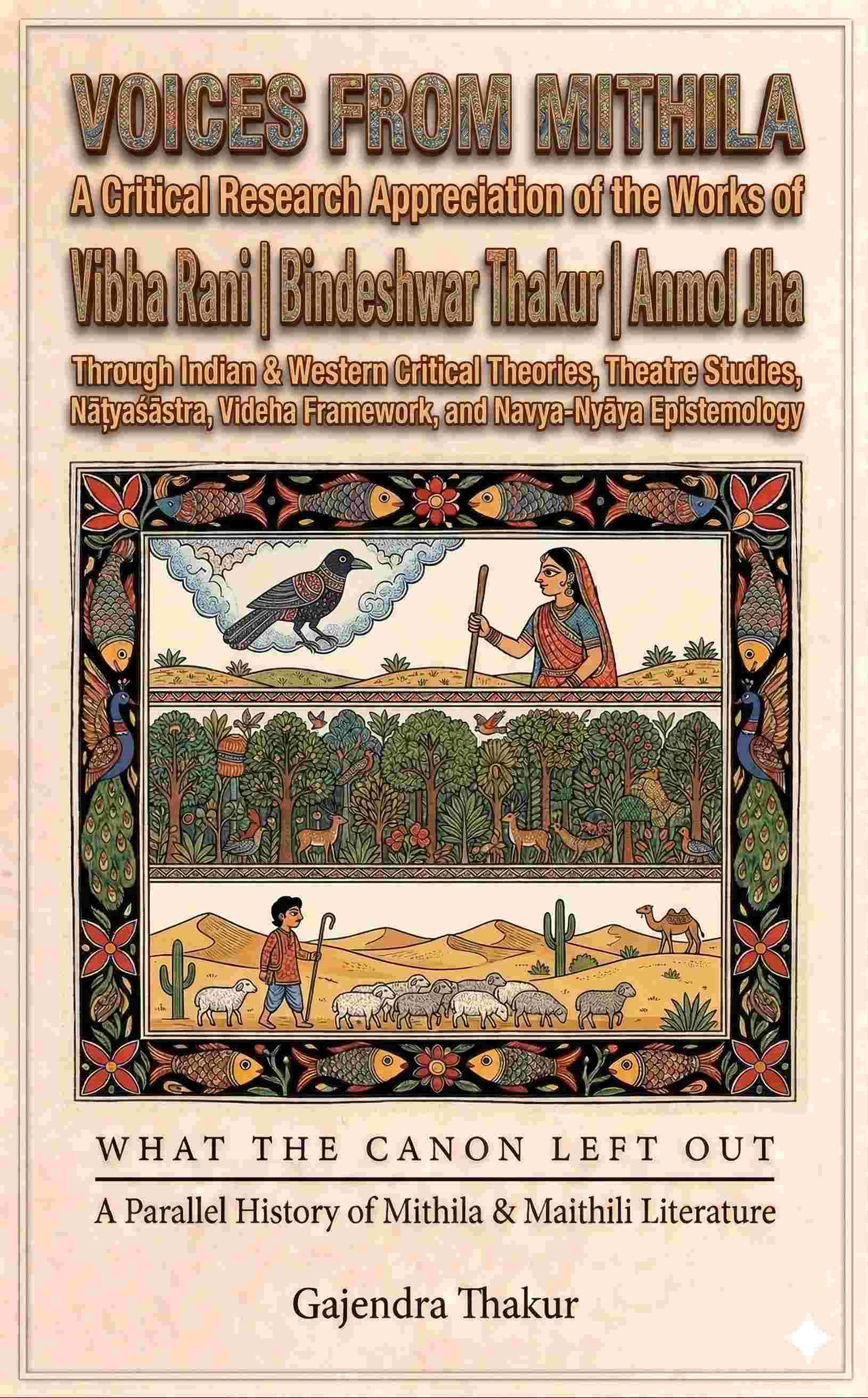
VOICES FROM MITHILA A Critical Research Appreciation of the Works of Vibha Rani | Bindeshwar Thakur | Anmol Jha Through Indian & Western Critical Theories, Theatre Studies, Nāṭyaśāstra, Videha Framework, and Navya-Nyāya Epistemology
VOICES FROM MITHILA
A Critical Research Appreciation of the Works of
Vibha Rani | Bindeshwar Thakur | Anmol Jha
Through Indian & Western Critical Theories, Theatre Studies, Nāṭyaśāstra, Videha Framework, and Navya-Nyāya Epistemology
Table of Contents
I. Preface and Methodological Orientation
II. Contextual Frameworks: Theories Applied
II.A Indian Literary Criticism (Rasa, Dhvani, Aucitya)
II.B Bharata's Nāṭyaśāstra
II.C Western Critical Theories
II.D Videha Parallel History Framework
II.E Bihani Kathā vs Laghukathā Debate
II.F Bilingual Writers Debate in Maithili
II.G India–Nepal Maithili Asymmetry
II.H Navya-Nyāya Epistemology
III. Vibha Rani: Works and Critical Appreciation
IV. Bindeshwar Thakur: Works and Critical Appreciation
V. Anmol Jha: Works and Critical Appreciation
VI. Comparative Analysis and Synthesis
VII. Conclusion
VIII. Bibliography and References
I. Preface and Methodological Orientation
Maithili literature occupies a singular position in the South Asian literary imagination. It is the language in which Vidyapati composed his immortal padāvalis; the language in which Jyotirishwara Ṭhākura gave us the first prose encyclopaedia in any north Indian tongue; the language whose Tirhuta script (Mithilākṣara) carries memories of the ancient kingdom of Videha. Yet for much of modern literary history, Maithili has struggled against institutional marginalisation—treated as a dialect of Hindi, underrepresented in academic curricula, and cleaved between two nations, India and Nepal, whose literary establishments have paid differential and often inequitable attention to its practitioners.
The three writers studied in this monograph—Vibha Rani, Bindeshwar Thakur, and Anmol Jha—represent distinct yet intersecting trajectories within contemporary Maithili letters. Vibha Rani is a national-level dramatist, fiction writer, and performer who writes in both Maithili and Hindi; her plays Bhāg Rau and Balchandā, published by Shruti Prakashan and archived on videha.co.in, constitute the primary textual corpus for this study. Bindeshwar Thakur, based in the Gulf Maithili diaspora (Qatar), brought out Nepālak Nor Marubhūmi Me (2014, Shruti Prakashan)—a composite volume of ghazals, sher-o-shāirī, laghukathā, bihani kathā, and poems—that encodes the anguish of migrant labour within classical Maithili prosodic forms. Anmol Jha is a researcher, critic, and short-story writer whose collection Samay Sākṣī Ṭhik (laghukathā) and the monumental 745-page CCRT Senior Fellowship research report on Samakālīn Maithilī Bāl Sāhityak Vivechanātmak Adhyayan (2023–25) provide a critical and pedagogical anchor for the study of contemporary Maithili literature, especially children's writing.
The methodological architecture of this study is deliberately pluralist. We draw on four broad critical traditions: first, classical Indian aesthetic theory (Bharata's Nāṭyaśāstra, the rasa-dhvani tradition of Ānandavardhana and Abhinavagupta, Kuntaka's vakrokti, and Aucitya-vicāra-carcā of Kṣemendra); second, the Navya-Nyāya epistemological framework of Gaṅgeśa Upādhyāya of Mithila, whose Tattvacintāmaṇi provides a precision-language model for knowledge-claims that we apply to generic and modal questions in Maithili prose and drama; third, Western critical theory (Aristotle's Poetics, Brecht's epic theatre, feminist criticism, postcolonial theory, diasporic studies, ecocriticism, and the sociology of literature); and fourth, the Videha Parallel History Framework developed by Gajendra Thakur, editor of Videha eJournal (ISSN 2229-547X), which interrogates the dominant caste-and-institution narrative of Maithili literary history and rehabilitates excluded voices.
II. Contextual Frameworks: Theories Applied
II.A Classical Indian Literary Criticism
The foundational text of Indian poetics is Bharata Muni's Nāṭyaśāstra (c. 200 BCE–200 CE), a comprehensive treatise on dramatic composition, performance, staging, music, and dance. For the purposes of reading Vibha Rani's Maithili plays, three concepts from the Nāṭyaśāstra are especially productive.
Rasa Theory
Bharata enumerates eight rasas—śṛṅgāra (love/beauty), hāsya (humour), karuṇa (pathos), raudra (fury), vīra (heroism), bhayānaka (terror), bībhatsa (disgust), and adbhuta (wonder)—to which the later tradition adds śānta (tranquillity) as a ninth. Each rasa is produced by the conjunction of vibhāvas (determinants), anubhāvas (consequents), and vyābhicāri-bhāvas (transitory emotional states). A play achieves rasotpatti (production of rasa) when the audience undergoes a kind of generalised, depersonalised affective experience—sādhāraṇīkaraṇa—distinct from private emotion.
Vibha Rani's Bhāg Rau (Run Away) is a Maithili play set entirely in the milieu of street children, beggars, police brutality, and urban destitution. The dominant rasa is karuṇa, but Rani orchestrates a complex affective ecology: hāsya erupts in the banter of the three child beggars (Chanrā, Gobarā, Jhunmā) only to be extinguished by the raudra of police violence; adbhuta surfaces when Mangtū, the limbless protagonist, is revealed as a literate reader of newspapers; and a residual śṛṅgāra trembles in Mangtū's dream-sequence in Act II when his amputated limbs momentarily return in a vision of wholeness. The play's sthāyibhāva (dominant emotion) is śoka (grief), yet Rani refuses the consolations of śānta-rasa, ending instead with a unison chant—'Bhaḍab vijaya-path par, racab nit navīn abhiyān' (We shall march the victory path, creating ever-new campaigns)—that re-channels grief into vīra-rasa (heroism).
Dhvani and Vyañjanā
Ānandavardhana's Dhvanyāloka (9th century CE) proposes dhvani (suggestion, resonance) as the 'soul of poetry' (kāvyasyātmā). Vyañjanā (suggestive meaning) transcends both abhidhā (denotative meaning) and lakṣaṇā (secondary/figurative meaning) to produce the highest aesthetic pleasure. Abhinavagupta's commentary Locana deepens this: dhvani is not merely a trope but an ontological claim that poetic language operates on multiple semantic levels simultaneously.
In Balchandā, Vibha Rani's mono-drama for and about female foeticide and the suppressed feminine, dhvani operates at every level. The single female performer cycles through daughter, wife, mother-in-law, journalist, and the unborn girl-child. The title Balchandā—a Maithili female name meaning 'young moon'—vibrates with dhvani: the moon is both feminine (candra is grammatically feminine in Maithili poetic convention following Vidyapati) and absent/suppressed (the play literalises female erasure). The performer's repeated gesture of placing the index finger on her own navel—representing the womb, the child, the absent moon—is a pure anubhāva whose vyañjanā encompasses the entire cultural matrix of stri-dveṣa (misogyny) without being reducible to it.
Aucitya (Decorum/Propriety)
Kṣemendra's Aucitya-vicāra-carcā (11th century) argues that aucitya—the decorous fit between form, content, and context—is the supreme literary virtue. An unaucitous metaphor or dramatic device destroys aesthetic experience even when technically accomplished. This criterion is especially relevant for evaluating Vibha Rani's decision to stage the politically incendiary content of Bhāg Rau in a Maithili linguistic register that itself carries cultural prestige. The play's language is contemporary colloquial Maithili—film-song references, bazaar idiom, the jargon of police-bureaucratic Hindi—yet it is framed by a literary Maithili stage direction rhetoric. This layering constitutes an aucita (proper) translation of street life into theatrical space without either romanticising poverty or lapsing into social-realist flatness.
II.B Bharata's Nāṭyaśāstra: Drama Theory
The Nāṭyaśāstra's theory of drama encompasses: (1) the pañcasandhi structure (five stages of plot—mukha, pratimukha, garbha, vimarśa, nirvahaṇa); (2) the classification of heroes (dhīrodātta, dhīralalita, dhīroddhata, dhīrapraśānta); (3) the ten types of drama (rūpaka) and their sub-varieties; (4) the four abhinayas (representational modes: āṅgika/bodily, vācika/verbal, āhārya/costumed, sāttvika/psychological); and (5) the concept of nāṭyadharmi (theatrical/stylised) versus lokadharmi (naturalistic/realistic) performance.
Vibha Rani's theatre practice embodies a productive tension between nāṭyadharmi and lokadharmi. Her solo performances—she has pioneered what she calls 'room theatre' (ekānt raṅgamanc) under the banner of AVITOKO, the socio-cultural organisation she founded in Mumbai in 2001—collapse the architectural distinction between stage and audience. In Bhāg Rau, the stage directions explicitly invite the audience into the dramatic action: a 'Darśaka' (spectator) character is listed in the dramatis personae and delivers lines from within the audience space. This is lokadharmi staging deployed within a nāṭyadharmi dramaturgy—a Brechtian gesture that, as we argue below, also resonates with the Nāṭyaśāstra's own concept of sāmānyabhinaya (common/general acting) as a bridge between performer and spectator.
Using Bharata's pañcasandhi schema, the structure of Bhāg Rau reads as follows: the mukha (opening) establishes Mangtū as literate beggar in the train sequence; the pratimukha (development) introduces the journalist duo whose exploitative interest in Mangtū complicates his aspiration; the garbha (womb/complication) is the revelation of Kabitā's gang-rape by her brother and associates; the vimarśa (crisis) is Mangtū's confrontation with the newspaper reporter, police violence on Gaṇpat, and Mangtū's suicidal despair; the nirvahaṇa (resolution) arrives not as narrative closure but as collective choral affirmation—the entire cast freezes in a human flower formation as Mangtū sleeps and the voices of all characters merge in the anti-war poem. This is a deliberately 'failed' nirvahaṇa in classical terms: no hero achieves his goal, no social problem is solved. The failure is itself the aesthetic and political statement.
II.C Western Critical Theories
Aristotle's Poetics and Tragedy
Aristotle's Poetics defines tragedy as 'an imitation of an action that is serious, complete, and of a certain magnitude… through pity and fear effecting the proper purgation of these emotions' (catharsis). The tragic hero suffers a hamartia (fatal flaw or error) and experiences peripeteia (reversal) and anagnorisis (recognition). Bhāg Rau invites but resists Aristotelian framing: Mangtū's pathos evokes both pity and fear, but his 'flaw' is simply his birth (he is illegitimate, abandoned in a drain, later crippled by a bus accident). This is not hamartia in the Aristotelian sense—it is the structural violence of a social system. Vibha Rani thus occupies the tradition of social tragedy that runs from Büchner through Brecht to Dario Fo: tragedy without a tragic hero in the classical sense, tragedy without cathartic release.
Brecht's Epic Theatre
Bertolt Brecht's Verfremdungseffekt (alienation effect, V-Effekt) seeks to prevent the audience from identifying emotionally with characters so that they can maintain critical distance and recognise the social conditions producing suffering. Brecht's techniques include direct address to the audience, placards, songs that interrupt narrative flow, and the Gestus (social gesture that encapsulates class relationships). Vibha Rani's theatre deploys all these: the play within the play, the journalist characters who oscillate between sympathy and exploitation, the Bollywood film-song references that defamiliarise the street-children's suffering by juxtaposing commercial pleasure with material deprivation, and the darśaka (spectator) character who speaks from within the audience. The effect is profoundly Brechtian: the audience is moved (karuṇa) but simultaneously jolted into reflection (a rasa-V-Effekt synthesis).
Feminist Theory
Simone de Beauvoir's insight that 'woman is not born, but made' and Judith Butler's theory of gender as performativity are essential for reading Balchandā. The play performs this very process of 'making': the actress literally performs the construction of femininity through the rituals of birth-song (sohara), wedding (vidāī), the first night, and then the violent unmaking of the female foetus. Butler's concept of 'citational performativity'—that gender is produced by the repeated citation of gender norms—is literalised in Balchandā's structure: the character cites and re-cites every stage of a woman's life-cycle, exposing these citations as the mechanism of oppression rather than natural sequence. The play's climactic scene—where the actress serially removes garments in an ironic citation of the apsarā metaphor (Rambhā, Urvaśī, Menakā)—employs feminist shock-theatre to force a recognition of women as sexual objects in the cultural imaginary.
Postcolonial Theory
Frantz Fanon, Homi Bhabha, and Gayatri Spivak's postcolonial frameworks illuminate both the situation of Maithili literature vis-à-vis Hindi (a metropolitan/state language colonising the regional) and the situation of diasporic Maithili writers like Bindeshwar Thakur. Bhabha's 'third space' of enunciation—where colonial and colonised cultures meet and hybridise—describes the condition of Maithili writers who inhabit the interstices between Maithili and Hindi (in Vibha Rani's case), or between Maithili and Nepali/global Arabic (in Bindeshwar Thakur's case). Spivak's question 'Can the subaltern speak?' is urgently enacted in Bhāg Rau: Mangtū is repeatedly silenced—by the journalist who cuts his interview short when he says too much, by the police who beat him, by the institutional structures that deny him work. His literacy—his capacity to read newspapers—becomes a tragic irony: he can read the world but cannot write himself into it.
Diasporic Studies
Stuart Hall's theorisation of diasporic identity as 'not a fixed origin to which we can make some final and absolute Return' but a 'production… never complete, always in process' is directly applicable to Bindeshwar Thakur's poetry and prose. Writing from Qatar—the 'marubhūmi' (desert/waste land) of his title Nepālak Nor Marubhūmi Me (In the Desert of Nepal's Tear)—Thakur inhabits a triple diaspora: as a Nepali-side Maithili speaker distanced from the Bihar-India Maithili literary mainstream; as a Gulf migrant labour worker distanced from Nepal; and as a vernacular Maithili poet operating within the global Urdu-Persian ghazal tradition, itself a diasporic form. His ghazals are formally classical (sher-o-shāirī, radif, maqtā) but their emotional content—longing for family, the indignity of migrant work, the exploitation of the poor by the political class—is resolutely contemporary and materialist.
II.D The Videha Parallel History Framework
The Videha Parallel History Framework, developed by Gajendra Thakur in his role as editor of Videha (ISSN 2229-547X), the first Maithili fortnightly e-journal (launched 2004; predecessor 'Bhālsarik Gāchh' blog 2000), constitutes a revisionist historiography of Maithili literature. Its central claims are:
• The dominant narrative of Maithili literary history has been shaped by institutions—Sahitya Akademi, Maithili Akademi (Patna), Nepal's Prajñā Pratiṣṭhān—that disproportionately represent upper-caste (Maithil Brahmin and Karna Kayastha) interests and aesthetics.
• This has produced a 'canonical' Maithili literature centred on Sanskrit-derived classical forms (padāvalī, kīrtaniyā nāṭak) and overlooked or suppressed the creative output of non-Brahmin communities, women, Dalits, Muslims, and diaspora writers.
• The term 'Videha' deliberately invokes the ancient kingdom of Videha (Janakpur/Mithila region) whose political boundaries were trans-national, as a counter-symbol to narrow regionalisms.
• Parallel literature in Maithili—a tradition the Videha journal has documented and promoted—finds its precedent in the Vedas (the Naraśaṃsī stanzas as parallel literature) and is not a recent invention.
• Gajendra Thakur's Panji Prabandh project (deciphering 11,000 palm-leaf genealogical manuscripts) has revealed around 100 inter-caste marriages historically, demonstrating that caste endogamy in Mithila was always more contested and fluid than the Brahminical narrative admits.
This framework has direct bearing on how we situate Vibha Rani, Bindeshwar Thakur, and Anmol Jha. All three have their primary publication-and-critical reception through the Videha/Shruti Prakashan network, which constitutes the 'parallel' literary-publishing ecosystem against the Akademi-centred mainstream. Vibha Rani's Bhāg Rau and Balchandā were published by Shruti Prakashan and archived on videha.co.in. Bindeshwar Thakur explicitly thanks the Videha network in his preface, crediting Gajendra Thakur and fellow Videha-associated writers Ashish Anachinhāra, Umesh Mandal, and Pankaj Chaudhary for sustained mentorship. Anmol Jha's CCRT research was enabled by the community of scholars and texts that the Videha platform made accessible.
II.E Bihani Kathā vs Laghukathā: The Genre Debate
One of the most productive internal debates in contemporary Maithili literary criticism concerns the distinction between bihani kathā (literally 'morning/dawn story'—also rendered as 'seed story' or vihanikathā) and laghukathā (short-short story). This debate has both formal and ideological dimensions.
Laghukathā, as a genre, has its Hindi analogue, has been theorised extensively in Hindi since the 1970s. It is characterised by extreme brevity (typically under 500 words), a single culminating irony or twist, socio-political critique, and a preference for the third-person omniscient perspective. Its closest Western analogue is the flash fiction or prose poem. The Jaina tradition recognised laghukathā as a distinct narrative category alongside lokakathā, nīti-kathā, and dṛṣṭāntakathā.
The Videha school, however, argues that bihani kathā (also spelled vihanikathā) is formally and ontologically distinct from laghukathā: it is not merely 'shorter' but operates on a different phenomenological principle. Where laghukathā resolves into a single punch-line or ironic reversal, bihani kathā is deliberately open, seed-like, germinating in the reader's imagination without closure. The bihani is not a compressed narrative but a narrative seed—it plants an image, a situation, or a fragment of consciousness and allows the reader to grow the full story. Gajendra Thakur's own bihani kathā compositions, as well as those of Bindeshwar Thakur (in the 'Bihani Kathā Khaṇḍa' of Nepālak Nor Marubhūmi Me), exemplify this principle.
The practical significance of this debate for our three writers: Anmol Jha's Samay Sākṣī Ṭhik is explicitly subtitled 'Maithilī Laghukathā-Saṅgraha'—it situates itself in the laghukathā tradition. Bindeshwar Thakur includes both laghukathā and bihani kathā sections in his composite volume, treating them as distinct modes. The Videha school's theorisation of bihani kathā as an indigenous Maithili form (rather than a borrowing from Hindi laghukathā) is part of the Parallel History project of asserting Maithili's formal distinctiveness and autochthonous literary heritage.
II.F The Bilingual Writers Debate
The question of bilingualism in Maithili literary culture is complex and politically charged. Maithili has always existed in multilingual contact with Sanskrit, Braj, Hindi, Bengali, Nepali, and now English. But the specific question of writers who produce work in both Maithili and Hindi—or Maithili and Nepali—raises anxieties about language loyalty, market incentives, and cultural authenticity.
The conservative position (associated with several mainstream Maithili scholars and the Sahitya Akademi's Maithili advisory board) holds that bilingual writers inevitably compromise the purity and distinctiveness of Maithili and that their Hindi works attract more institutional recognition (larger audiences, larger advances, national awards), creating a perverse incentive structure that drains talent from Maithili. The progressive position—articulated within the Videha framework—holds that bilingualism is a resource, not a deficit: that writers like Vibha Rani who move between Maithili and Hindi enrich both languages and create potential audiences for Maithili among Hindi readers. Moreover, the Videha position points out that the greatest Maithili poets historically (Vidyapati) also composed in Braj and Sanskrit, and that monolingualism was never the norm for literate Maithilis.
Vibha Rani is the test case par excellence. She writes fiction (Khoh Se Niksait, Maithili) and plays (Bhāg Rau, Balchandā, Maithili) but also Hindi short story collections (Band Kamre kā Koras, Isī Deś ke Isī Śahar Meṃ) and Hindi plays (Pregnant Father, 2020—winner of the Nemichandra Jain Playwriting Award; Dūsrā Ādmī, Bhāraṅgam 2002). She translates from Maithili into Hindi for Sahitya Akademi award-winning authors, creating institutional bridges. Her bilingualism is creative, not merely commercial: her Hindi and Maithili voices are in productive dialogue, often staging the same social problematic (gender violence, caste discrimination, marginalisation) from different cultural angles.
II.G India–Nepal Maithili Asymmetry
Maithili is spoken by approximately 11 million people in Bihar and Jharkhand (India) and an estimated 3 million in Nepal's Madhesh Province (the Terai region). It is recognised as an official language of Nepal (Schedule 8 of the Interim Constitution, 2007). Despite this formal parity, the cultural and institutional centres of Maithili literary production have historically been in India (Darbhanga, Madhubani, Patna), and Nepali Maithili writers have consistently complained of marginalisation by the Indian literary establishment.
The specific grievances articulated by Nepali Maithili writers and critics include: (1) the Sahitya Akademi's Maithili advisory structure is dominated by Indian Maithilis; (2) Nepal's Prajñā Pratiṣṭhān (the Nepalese counterpart of Sahitya Akademi) has given insufficient attention to contemporary Maithili literature, focusing on Nepali-language productions; (3) Nepali Maithili writers like Bindeshwar Thakur, who write in the Gulf diaspora, occupy a double periphery (peripheral to both Indian Maithili and Nepali institutional structures); (4) the Videha platform has been one of the few spaces where Nepali-side Maithili writers receive equal critical attention—a fact Bindeshwar Thakur himself acknowledges in his preface.
The Videha Parallel History Framework explicitly addresses this asymmetry: it positions itself as a trans-national Maithili project and publishes writers from both the Indian and Nepali sides of the Mithila cultural region without prioritising either. Gajendra Thakur's historical research (the Panji Prabandh project) reveals that the political boundaries between India and Nepal were imposed by British colonialism and the subsequent Sugauli Treaty (1816) and that the Mithila cultural region predates and transcends these borders. This is not merely romantic nationalism but a historically grounded argument for cultural reintegration.
II.H Navya-Nyāya Epistemology as Critical Method
The Navya-Nyāya school of Indian philosophy, founded by Gaṅgeśa Upādhyāya of Mithila in the 13th–14th century CE and continued by Raghunātha Śiromaṇi of Nabadwipa, developed a highly technical analytical language for epistemology and logic. Gaṅgeśa's magnum opus, the Tattvacintāmaṇi ('Thought-Jewel of Reality'), distinguishes four means of valid knowledge (pramāṇas): perception (pratyakṣa), inference (anumāna), comparison (upamāna), and verbal testimony (śabda). The school's key technical innovations include: the concept of avacchedakatā (limitation/conditionality), which allows for universalisation; the detailed analysis of viṣayatā (objecthood) in cognition; and the theory of pakṣatā (suppositional reasoning) in inference.
Crucially, Gaṅgeśa was himself a Maithili—born and working in Mithila—and Navya-Nyāya remained an active intellectual tradition centred in Mithila and subsequently Bengal until the 18th century. Navya-Nyāya techniques, as Jonardon Ganeri has shown, proved so versatile that they were applied not only in philosophy but in poetics, linguistics, and legal theory. It is therefore not anachronistic but culturally appropriate to apply Navya-Nyāya epistemological categories to the analysis of Maithili literary texts.
Applied to literary criticism, the Navya-Nyāya framework yields the following critical tools. First, the distinction between jñāna (veridical cognition) and ajñāna (non-veridical/false cognition) maps onto the distinction between literary truth-claims and fictional or ideological distortions—allowing us to ask: what kind of knowledge does a text produce, and through which pramāṇa? Second, the concept of avacchedakatā (conditioned limitation) allows us to specify the precise conditions under which a generic classification (e.g., 'this is a bihani kathā') holds, which is directly applicable to the bihani kathā vs laghukathā genre debate. Third, the Navya-Nyāya analysis of vyāpti (pervasion/universal connection)—'wherever there is smoke there is fire'—provides a model for the structural analysis of thematic invariants across a writer's corpus: if every play by Vibha Rani contains the dyad literacy/deprivation, this pervasion is analytically significant. Fourth, pakṣatā (suppositional reasoning) models the interpretive act itself: the reader forms a supposition about a text's meaning and tests it against the textual evidence—a process structurally analogous to Navya-Nyāya inference.
III. Vibha Rani: Works and Critical Appreciation
III.A Biographical and Literary Profile
Vibha Rani was born in Madhuban (Madhubani district, Bihar) and is based in Mumbai. She writes in Hindi and Maithili and has published over twenty books across both languages. Her Hindi publications include the short story collections Band Kamre kā Koras (winner, Ghanshyamdas Saraf Sahitya Samman), Isī Deś ke Isī Śahar Meṃ, and Chal Khusrō Ghar Āpne; her Maithili publications include Khoh Se Niksait (stories), Mithilā kī Lokakathāeṃ, Gonū Jhā ke Kisse (folk tales), and the plays Bhāg Rau, Balchandā, and Madad Karu Santoṣī Mātā. She has translated seven books of three Sahitya Akademi award-winning Maithili authors into Hindi. She has received the Katha Award, Mohan Rakesh Samman, Mahesh Sarvottam Sahitya Samman, Nemichandra Jain Playwriting Award (2020), and Lakṣmī-Hari Samman (2022) for her Maithili novel, among more than thirty awards. She is the founder of AVITOKO (2001), a socio-cultural organisation that works with marginalised communities through theatre and art, including jail inmates' children.
As a performer, Rani is a pioneer of solo theatre (ekānt raṅgamanc) and has acted in Hindi films (Laal Kaptaan, Shamshera) and web series (Maharani). She documents and performs the folk traditions of Mithila—gālī gīt (teasing songs), Vidyapati in various rāgas—and practises a form of cultural stewardship that her theatrical work is inseparable from.
III.B Bhāg Rau (Run Away): Close Reading
Synopsis and Structure
Bhāg Rau (published Shruti Prakashan, Delhi, 2009; ISBN 978-93-80538-01-3) is a full-length Maithili play in two acts. The dramatis personae includes thirty-two named characters and a chorus of spectators, covering a cross-section of urban marginality: Mangtū (the disabled, literate beggar-protagonist), three child beggars (Chanrā, Gobarā, Jhunmā), Gaṇpat (the banana vendor), Rājū (Gaṇpat's exploitative son), three male thugs, two transgender characters (hijṛā), two journalists (male/female), two police constables, students, passengers, and a shadowy figure named Tāmbe (the data-hungry bureaucrat). The play is staged primarily at a bus-stand/train-station and on the streets of an unnamed North Indian city.
Act I establishes the social landscape through three interconnected narrative strands: the child beggars' daily income calculation and police extortion (Scene 1–2); the journalist duo's encounter with Mangtū as a 'story' (Scene 2); and the assault on Gaṇpat's daughter by her own brother and his associates (Scene 2). Act II deepens the exploration of Mangtū's interiority—his encounters with the hijṛā community, a wealthy donor, Tāmbe (the bureaucrat who uses Mangtū's knowledge and gives him no credit), and finally the young street vendor Jhunmā—culminating in the nightmare sequence where Mangtū's arms and legs are restored in a dream only for a bomb blast (Scene 3) to explode the vision. The play ends with all characters joining a collective anti-war/anti-fatalist choral statement.
Thematic Analysis
The play's central theme is the paradox of visible invisibility: Mangtū is hyper-visible as a disabled beggar (people see his disability immediately) yet invisible as a person (no one sees his literacy, his inner life, his capacity for labour). This paradox is literalised through the journalists: they see him as a 'story' (a spectacle of disability + literacy = curiosity) rather than as a subject. Their interview sequence—notepad in hand, calculating an award from the story's publication—is a merciless exposure of the 'compassion industry' in journalism.
The play also stages the multiple forms of exploitation that converge on the urban poor: police extortion ('dādā kā hiṣṣā, dādā kā'), institutional neglect (no welfare reaches Mangtū), family betrayal (Rājū's violence against his sister Kabitā), and the appropriation of knowledge (Tāmbe extracts data from Mangtū's encyclopaedic newspaper-knowledge without credit or payment). Each form of exploitation is represented by a specific character or scene, creating a systemic rather than individual analysis.
The hijṛā (transgender) characters are given extended stage time and political voice: they articulate with bitter clarity their exclusion from both 'man' and 'woman' categories, their economic marginalisation (one rupee per shop per week), and their experience of dignity-denial in formal labour markets. Their presence in the play is not merely for local colour but constitutes a second axis of exclusion parallel to Mangtū's disability: both are bodies that the mainstream refuses to recognise as productive workers.
Formal and Linguistic Analysis
The play's language is one of its most distinctive achievements. Rani writes in a Maithili that is determinedly contemporary and plurilingual: film-song references ('Koi mil gayā', 'Aatī kyā Khaṇḍālā'), street Hindi ('sāla', 'bhosḍī ke'), Bollywood actor names as sarcastic appellatives ('Govindā', 'Hrithik Roshan'), and passages of lyrical literary Maithili in the stage directions and choral poems. This multilingual texture is not 'code-switching' in a deficit sense but a sophisticated representation of the actual linguistic life of the urban poor in contemporary India—a life in which Bhojpuri, Maithili, Hindi, and filmi language coexist and interpenetrate.
The songs—sohara, kajari, barsāt ke gīt—embedded in the play's second act are not mere decorative folk-lore insertions. They function as Brechtian interruptions that comment ironically on the dramatic action: the monsoon song 'Sakhī he āyal rāt andhiārī' (Oh friend, dark night has come) plays as Mangtū speaks of rain as life-force, while the stage reality is one of flooding, displacement, and economic catastrophe for street-dwellers. The song and the social reality produce a polyphonic irony that neither cancels the other.
Applying Navya-Nyāya's concept of vyāpti (pervasion), we can identify a structural invariant across the play: wherever there is literacy in Bhāg Rau, there is deprivation. The newspaper is Mangtū's primary access to the world—yet it is also the instrument through which he reads about Kabitā's rape, about bomb blasts, about poverty statistics. The newspaper is both epistemic enabler and epistemic wound: it gives him knowledge that cannot help him and knowledge that hurts him. This pervasion—literacy as double-edged—is the play's central Navya-Nyāya 'inference point': it allows the reader/audience to infer the systemic nature of exclusion from any individual instance.
III.C Balchandā: A Feminist Dramaturgy
Structure and Performance
Balchandā (a mono-drama; also published in Bhāg Rau āā Balchandā, 2009, Shruti Prakashan) is performed by a single actress who embodies multiple roles: the unborn female child, the mother, the mother-in-law, the father, the announcer, the journalist, the bride. The play covers approximately ninety minutes of playing time and requires exceptional physical and vocal range from its performer. It was presented at the college annual day as a nāṭak within the fiction of the play itself, creating a meta-theatrical frame.
The play opens with a cosmological statement of female principle—'Ham dhariṇī, ham dharitrī / Sītā ham, ham Sāvitrī'—before descending through the specific social mechanisms of female foeticide: the dowry calculation, the mother-in-law's preference for male children, the husband's acquiescence to family pressure, the journalist's dispassionate documentation, and the foetus's dream-voice calling to be born. The play's theatrical climax—the sequential amputation of the actress's limbs in mime as the foetus is aborted piece by piece—is among the most viscerally powerful theatrical moments in contemporary Indian drama.
Feminist Critical Reading
Read through Judith Butler's lens of gender performativity, Balchandā is literally a performance of the performance of femininity. The actress 'cites' every cultural norm governing Indian womanhood—sohara (birth songs), pāzeb (anklets), kājal (kohl), ghūṃghaṭ (veil), sindūra (vermilion), solah śṛṅgāra (sixteen ornaments)—and then reveals each citation as a link in a chain of exploitation rather than an expression of cultural beauty. The play's Maithili songs—Vidyapati bhajana, the traditional bihāh gīt (wedding song)—are mobilised to expose rather than celebrate tradition: they are sung as the actress enacts increasingly violent marital subjugation.
The figure of the father (Bāujī) who supports his daughter's desire for engineering education is a counter-symbol: a rural, less-educated man who is more progressive than his urban-educated son-in-law. This reversal—the 'backward' rural father as the true modernist—disrupts the developmental narrative that locates women's emancipation in urban education and professionalism. It is also a rare positive male character in feminist Indian drama, avoiding the simplification of patriarchy as individual male villainy rather than systemic cultural inheritance.
Nāṭyaśāstra Reading: Abhinaya and the Female Body
The Nāṭyaśāstra's theory of sāttvika abhinaya (psychological/involuntary acting) describes the physical manifestations of inner emotion: trembling (kampa), horripilation (romāñca), tears (aśru), paralysis (stambha). Balchandā demands all of these from its performer, but within a consciously meta-theatrical frame: the actress must produce sāttvika abhinaya while simultaneously deploying nāṭyadharmi (theatrical/stylised) gesture. The final mime of amputation is in this sense pure nāṭyadharmi—no blood, no realistic staging—yet it produces profound sāttvika response in the audience. This synthesis of stylised form and visceral content is the play's highest formal achievement and aligns it with the best traditions of Indian physical theatre (Kutiyattam, Bharatanāṭyam) while serving a radically contemporary political purpose.
IV. Bindeshwar Thakur: Works and Critical Appreciation
IV.A Biographical and Literary Profile
Bindeshwar Thakur is a Nepali-side Maithili writer working as a migrant labourer in Qatar (Gulf diaspora). His volume Nepālak Nor Marubhūmi Me (In the Desert of Nepal's Tear, 2014; ISBN 978-93-80538-99-0; Shruti Prakashan, Delhi; designed by Priti Thakur; distributed by Pallavi Distributors, Supaul) is a composite literary work containing ghazal, sher-o-shāirī, laghukathā, bihani kathā, and kavitā sections. The title is a triple allusion: to the Maithili (and Urdu) tradition of nora (tear) as the dominant trope of love-poetry and ghazal; to the physical marubhūmi (desert) of Qatar; and to the political sense of 'desert'—wasteland, abandonment—in which Nepali migrant workers are stranded by economic inequality.
In his preface (āmukh), Thakur acknowledges three institutional supports: the International Nepali Literary Society (Qatar Chapter), the 'Nabodit Sāhityika Mobile Library', and most importantly the Videha Group and its editor Gajendra Thakur, without whose sustained guidance and encouragement, he states, these scattered compositions would never have been collected and published. He also thanks fellow Videha-associated writers Ashish Anachinhāra, Umesh Mandal, Pankaj Chaudhary, and the poets Amit and Śāntilakṣmī Dīdī.
IV.B The Ghazal Section: Form, Prosody, and Thematic Content
The ghazal is a Persian-Urdu lyric form characterised by the matla (opening couplet, both lines of which end in the radif—refrain—and rhyme/qāfiyā), the body sher (individual couplets, each thematically complete), and the maqtā (closing couplet, in which the poet names himself). The Maithili ghazal tradition has its roots in the Persian-Urdu influence mediated through Bihari Urdu literary culture (Darbhanga, Muzaffarpur). Thakur's ghazals follow the traditional sher-o-shāirī conventions and are composed in what he calls 'saral bāṇīk bakhar' (simple prosodic metre), with the syllable-count indicated after each ghazal (a practice derived from Urdu prosody).
The thematic content of Thakur's ghazals oscillates between three registers: devotional (bhakti ghazal—addressed to the goddess Bhavānī), romantic (śṛṅgāra ghazal—the beloved as moon, the poet as cakora bird), and socio-political (the politician as blood-sucker, unemployment, the exploitation of migrant labour). The seasonal ghazals—holikā (Holi), māghe saṃkrāiti (Makar Sankranti)—express the anguish of the migrant who celebrates Bihari/Maithili festivals vicariously, 'baurāit chī ekhanū katārme' (wandering even now in Qatar). This temporal displacement—festival time at home, work-time in the desert—is the affective core of the volume.
In formal terms, Thakur's ghazals demonstrate a comfortable command of the genre's conventions while adapting them to Maithili phonology. The word 'norana' (tear) recurs as both radif and thematic anchor across multiple ghazals: it is simultaneously the personal tear of separation-longing, the political tear of exploitation, and the literary tear of the ghazal tradition itself (ghazal is etymologically related to Arabic words for grief and lamentation). The systematic repetition of nora across the volume creates an intertextual vyāpti (pervasion) that binds the collection thematically.
The bhakti ghazals are formally innovative: they maintain the ghazal's structural requirements but address the goddess rather than the beloved, adapting the erotic-devotional ambiguity of the Vidyapati tradition (where the beloved and the deity are interchangeable) to the ghazal form. Lines such as 'Ahīṃ chī hamar bhavānī maiyā ham ahāṃk mānai chī' (You alone are my Bhavānī, my mother—I worship you) directly echo Vidyapati's padāvalī devotional idiom within a Persian-Urdu formal structure—a productive intercultural synthesis.
IV.C Sher-o-Shāirī Section
The sher-o-shāirī section contains individual sher (Urdu couplets) in Maithili, without the full ghazal structure. These couplets are more politically unguarded than the ghazals: they attack political corruption directly ('Hamra nāma becik' khāebalā cor chai / Hak adhikār lā lajāebālā cor chai'—Those who sell our names and eat are thieves; those who are shameless about our rights are thieves), the exploitation of widows, and the systemic production of poverty. The sher-o-shāirī also includes muktā (independent couplets) addressing themes of love-betrayal and the migrant condition.
The Navya-Nyāya concept of pakṣatā (suppositional/inferential reasoning) is useful here: each sher presents a pakṣa (thesis) and sādhya (what is to be proved) in compressed couplet form. For instance: 'Petabhair khāeb kaṭhin chai etaū / Rojagārī pāeb kaṭhin chai etaū / Netā lokini bhale je kichu bājil āi / Berojagārī bhagāeb kaṭhin chai etaū' (Eating one's fill is difficult here / Finding employment is difficult here / Let the politicians say what they will / Banishing unemployment is difficult here)—the pakṣa is the politician's claim, the sādhya is the refutation, and the vyāpti is 'wherever there are politicians, there are empty promises about unemployment.'
IV.D Laghukathā and Bihani Kathā
The prose sections of Nepālak Nor Marubhūmi Me include both laghukathā and bihani kathā. The laghukathā conform to the genre's characteristic ironic closure: a brief narrative scene building to a single revelatory moment that overturns the initial premise or exposes a social contradiction. The bihani kathā, by contrast, are more open and imagistic: they present a fragment of experience—a migrant worker's memory of his daughter, a village scene observed from the Gulf—without narrative resolution, allowing the reader to complete the emotional arc.
The presence of both genres in a single volume is itself significant. It suggests that Thakur—like many writers in the Videha circle—understands the generic distinction as productive rather than mutually exclusive: the laghukathā's ironic closure is appropriate for socio-political critique, while the bihani kathā's openness is appropriate for lyrical evocation of absence and longing. The generic choice enacts different epistemological stances: the laghukathā presumes knowledge (it reveals what was hidden); the bihani kathā confesses ignorance (it leaves the reader in the condition of the writer, not knowing how to complete the story of separation and return).
In Navya-Nyāya terms: the laghukathā produces jñāna (veridical cognition) through anumāna (inference)—the reader infers the full social picture from the particular instance. The bihani kathā produces what we might call a-niścaya (doubt, suspended cognition)—the Navya-Nyāya category of inconclusiveness that is not mere ignorance but a refined epistemological state of knowing-that-one-does-not-know. The bihani is an aestheticised a-niścaya.
IV.E The India–Nepal Asymmetry: Thakur's Position
Bindeshwar Thakur's case crystallises the structural asymmetry between Indian and Nepali Maithili literary culture. As a Nepali citizen writing in Maithili, working in Qatar, and published by an Indian publishing house (Shruti Prakashan, Delhi) through an India-based e-journal (Videha), he occupies multiple peripheries simultaneously. The Nepali literary establishment has given him minimal attention (the Nepal Prajñā Pratiṣṭhān's Maithili focus has historically been weak). The Indian literary establishment treats Nepali Maithili writers as secondary to Bihar-based Maithili writers. The Gulf diasporic context produces a third layer of cultural displacement.
The Videha platform's explicit commitment to trans-national Maithili culture—reflected in Gajendra Thakur's own historical research on the ancient Videha kingdom's trans-border geography—has made it the primary institutional home for writers like Bindeshwar Thakur. His preface's extensive acknowledgment of the Videha community is not merely personal gratitude but a political statement: the Videha network provides the institutional legitimacy that both national literary establishments (Indian and Nepali) deny him.
Applying postcolonial theory: Thakur's situation exemplifies what Bhabha calls the 'colonial mimicry' of the dominated subject who must adopt the metropolitan's cultural forms to be heard. He writes in the Urdu-Persian ghazal—a form that carries prestige in both Hindi-Urdu and Maithili literary cultures—to gain legitimacy for content (migrant labour, Nepali rural poverty, Gulf exploitation) that is otherwise invisible to both establishments. His cultural hybridity is not a free choice but a strategic negotiation.
V. Anmol Jha: Works and Critical Appreciation
V.A Biographical and Literary Profile
Dr Anmol Jha is a Maithili writer, critic, and researcher currently based in Kolkata. He holds a senior research fellowship from the Centre for Cultural Resources and Training (CCRT), Ministry of Culture, Government of India (File No. CCRT/SF-3/320/2022; Enrollment No. SF20216261; Batch Year 2020–2021), which funded a two-year (2023–2025) research project on Samakālīn Maithilī Bāl Sāhityak Vivechanātmak Adhyayan (A Critical Study of Contemporary Maithili Children's Literature). The resulting 745-page report, submitted September 2025, is among the most comprehensive critical surveys of Maithili children's literature ever produced. His creative works include Samay Sākṣī Ṭhik (a laghukathā collection, Shruti Prakashan; ISBN 978-93-80538-47-1) and Ee Je Samay Achhi (another Maithili collection archived on videha.co.in).
V.B Samay Sākṣī Ṭhik: Laghukathā as Social Witness
The title Samay Sākṣī Ṭhik (roughly: 'Time Itself Is the Witness' or 'Right that Time is Witness') announces both the genre (laghukathā as condensed testimony) and the epistemology (time as the ultimate pramāṇa—means of valid knowledge). The collection belongs to the tradition of socio-political laghukathā in the Hindi-Maithili sphere, depicting the struggles of ordinary people against systemic injustice: political corruption, gender discrimination, poverty, rural-urban migration.
The collection is dedicated 'lal ej, āvag, jīvan ḍugabāk anek chhoṭ-choṭ peṭhak bhed-bhāk jī ṭhik sī ET kālej kar kaloīk lek hamr chhī' (to the enduring memory of small and large sorrows that constitute a life worth living)—a dedication that frames the laghukathā's brevity as a form adequate to the fragmentary experience of social life. Each story is a shard of social testimony rather than a complete narrative arc, consistent with the genre's epistemology of the flash-observation.
The formal characteristics of Jha's laghukathā: typical length of 200–400 words; third-person omniscient narrator; single scene or moment; ironic or paradoxical closure; preference for dialogic over descriptive writing; minimal character psychology (characters are representative social types rather than individuals). These characteristics conform to the Hindi laghukathā tradition as theorised by Balram and other Hindi laghukathā critics.
Using the Navya-Nyāya framework: each laghukathā in the collection can be analysed as a tarka (argument) consisting of a pakṣa (the apparent social reality), a sādhya (the hidden social contradiction), and a hetu (the logical connector between the two). The genre's characteristic 'twist ending' is a formal anagnorisis in Aristotelian terms—a recognition—but it functions differently from tragic recognition: it does not produce catharsis but anaesthetic shock, a sudden, uncomfortable clarity that motivates reflection rather than emotional release.
V.C CCRT Research Report: Maithili Children's Literature
Anmol Jha's CCRT research report represents a landmark contribution to Maithili literary scholarship. Its eleven chapters cover the following topics: the developmental history of Maithili children's literature (Chapter 1: Pātham Adhyāya); contemporary Maithili children's journals and magazines (Chapter 2); Maithili children's songs and riddles (Chapter 3: 150+ pages); Sahitya Akademi-awarded Maithili children's books (Chapter 4: 155 pages); contemporary Maithili children's fiction (Chapter 5); contemporary Maithili children's poetry (Chapter 6); contemporary Maithili children's ghazal (Chapter 7); contemporary Maithili children's novel (Chapter 8); Maithili children's drama and one-act plays (Chapter 9); translation in 21st-century Maithili children's literature (Chapter 10); and other genres (Chapter 11).
The research is notable for several reasons: it surveys primary sources across both Indian and Nepali Maithili publishing; it attends to non-canonical genres (children's ghazal, children's riddles) that mainstream Maithili criticism has ignored; it documents the institutional landscape of Maithili children's publishing (journals, school textbook policies, the question of Maithili-medium primary education in Bihar—where Maithili children are denied mother-tongue education in state schools); and it makes explicit the connection between literary production for children and the broader linguistic rights of the Maithili-speaking community.
The report's preface (bhūmikā) articulates a philosophy of children's literature grounded in the idea that children's imaginative range is conditioned by the literary environment provided to them. It cites Śankara Miśra's child prodigy in Mithila (who memorised the Pañcatantra at age five) as evidence of the intellectual tradition of Mithilā in children's education, and argues that the decline of Maithili children's literature is inseparable from the marginalisation of Maithili as a medium of primary education.
From the Videha Parallel History perspective, Jha's research participates in the broader project of documenting and rehabilitating the excluded literature of the Maithili tradition. Children's literature has been systematically undervalued by the literary establishment (the Sahitya Akademi has no children's literature award in Maithili comparable to other languages), and Jha's comprehensive survey makes this gap visible and measurable.
V.D The Bilingual Critic: Jha's Critical Methodology
Anmol Jha's critical practice is itself bilingual and methodologically pluralist: his CCRT report is written in Hindi/Maithili with extensive use of both languages' critical vocabularies. He draws on Indian aesthetic categories (rasa, alamkāra, dhvani) as well as Western genre theory (the novel, the short story, translation studies) without privileging either framework. This methodological bilingualism enacts the 'bilingual writer' position in practice: neither language's critical tradition is adequate alone, and the most productive criticism moves between them.
The report's discussion of Maithili children's song (bāl gīt) and riddle (paheli) applies the Nāṭyaśāstra's concepts of sukumāra (delicate/tender aesthetic) and audārikā (robust/popular aesthetic) to distinguish between literary children's poetry and folk children's song—a sophisticated application of classical Indian poetics to a genre the tradition did not explicitly theorise. This is precisely the kind of creative theoretical extension that the Navya-Nyāya spirit of analytical rigour and definitional precision encourages.
VI. Comparative Analysis and Synthesis
VI.A Common Themes and Concerns
Despite their different genres, positions, and stylistic registers, Vibha Rani, Bindeshwar Thakur, and Anmol Jha share a cluster of thematic concerns that constitutes the distinctive voice of Videha-aligned contemporary Maithili literature.
First, all three writers share a preoccupation with the condition of the economically and socially marginalised: Rani's street children and disabled beggars; Thakur's Gulf migrant workers; Jha's documentation of the pedagogic deprivation of Maithili-speaking children denied education in their mother tongue. This is not mere social realism but an ethical positioning: the writer as sākṣī (witness), the text as pramāṇa (evidence) in the Navya-Nyāya sense—testimony that constitutes valid knowledge about conditions that institutional structures render invisible.
Second, all three engage with gender in ways that challenge both mainstream Maithili conservatism and metropolitan feminist abstraction. Rani's Balchandā situates the female body at the intersection of cultural tradition and structural violence. Thakur's ghazals contain both romantic-devotional idealisation of the feminine (the beloved-as-goddess trope) and politically engaged critique of widow exploitation and gender discrimination. Jha's children's literature survey reveals that Maithili children's literature has historically underrepresented girl protagonists and female authors—a gap his research makes visible and actionable.
Third, all three writers are embedded in the Maithili diasporic condition: Rani writes from Mumbai about Bihar; Thakur writes from Qatar about Nepal/Mithila; Jha writes from Kolkata about the Maithili literary world. None writes from within the traditional geographic and institutional centres of Maithili literary production (Darbhanga, Madhubani, Patna). This shared peripherality is not accidental but constitutive: the Videha Parallel History Framework is itself a project of the Maithili diaspora, founded by a Delhi-based editor, and its most productive contributors are those who write Maithili from outside the Brahminical heartland's institutional structures.
VI.B Genre and Form as Political Practice
The generic choices made by our three writers are themselves politically significant in the context of the Maithili literary field.
Vibha Rani's choice of drama—specifically a drama in colloquial, plurilingual Maithili staged for mass audiences—is a political choice within a literary field that has historically privileged Sanskrit-influenced literary Maithili in poetry. By making theatre the primary vehicle of her Maithili work, she connects to the oldest Maithili literary tradition (the kīrtaniyā nāṭak of the medieval period; the Sanskrit-Prakrit dramas of the Mall dynasty era in Nepal) while simultaneously radically democratising the form: a play about beggars and street children in the idiom of the street.
Bindeshwar Thakur's choice of the ghazal—an Urdu-Persian import that is nonetheless deeply naturalised in Maithili culture through the Bihar Urdu literary tradition—makes a claim for Maithili's cosmopolitan openness. Against narratives of Maithili as 'pure' Sanskrit-derived language (a Brahminical exclusivist claim), Thakur's ghazals enact the historical openness of Maithili to Persian-Arabic influence. His composite volume—mixing ghazal, sher-o-shāirī, laghukathā, bihani kathā, and kavitā—is itself a formal statement against genre purity: the migrant condition cannot be captured in a single form.
Anmol Jha's choice of the laghukathā as his primary creative form and of children's literature as his primary research subject makes a different kind of political claim: the claim that the most important Maithili literature is that which reaches the widest audience with the greatest social impact. The laghukathā's democratic legibility (no specialised aesthetic education required to enjoy it) and children's literature's targeting of the youngest and most formative readers are both expressions of a literary populism that the Videha framework has championed against the elitist aestheticism of the mainstream academy.
VI.C Navya-Nyāya as Unifying Critical Framework
Applying Navya-Nyāya epistemological categories comparatively, we can identify a shared epistemic structure across the three writers' works. All three produce texts that function as pramāṇas—means of valid knowledge—about conditions that are otherwise suppressed or distorted by dominant ideological structures. Rani's plays produce pratyakṣa-like immediacy (the equivalent of direct perception) through theatrical embodiment; Thakur's ghazals produce anumāna-like inference (the personal becomes universal through the vyāpti of the refrain); and Jha's research report produces śabda-pramāṇa (testimony-as-evidence) through its systematic documentation of primary sources.
The Navya-Nyāya concept of avacchedakatā (conditioned limitation) is also useful comparatively: each writer's work is conditioned by specific limiting conditions (upādhi) that must be acknowledged in any critical evaluation. For Rani: the conditioning of her work by her bilingual Hindi/Maithili practice (some of her Maithili dramatic vocabulary is influenced by Hindi theatrical conventions). For Thakur: the conditioning of his Maithili by Nepali linguistic influence and Gulf diasporic experience (his Maithili is not identical to standard Bihar Maithili). For Jha: the conditioning of his children's literature survey by the CCRT institutional framework, which brings both resources and constraints. None of these limiting conditions invalidates the work; the Navya-Nyāya framework insists that all knowledge is conditioned knowledge, and the task is to specify the conditions rather than pretend to an unconditioned view.
VII. Conclusion
The three writers studied in this monograph—Vibha Rani, Bindeshwar Thakur, and Anmol Jha—collectively represent a vital current in contemporary Maithili literature: the Videha-aligned parallel literary movement that has created, since the year 2000, an alternative institutional infrastructure for Maithili literary production, publication, and critical reception outside the dominant Akademi-centred establishment.
Vibha Rani's Maithili plays Bhāg Rau and Balchandā represent the highest achievement of contemporary Maithili drama. They synthesise the Nāṭyaśāstra's rasa theory with Brechtian epic theatre, apply both feminist theory and Navya-Nyāya epistemology to the theatrical representation of social marginality, and deploy a plurilingual Maithili that is both culturally specific and politically urgent. Their publication by Shruti Prakashan and archiving on videha.co.in ensures their continued accessibility to a global Maithili readership.
Bindeshwar Thakur's Nepālak Nor Marubhūmi Me is a landmark in the literature of the Maithili diaspora and specifically in the emerging genre of Gulf migrant labour literature. By adapting the classical ghazal form to migrant experience, he creates a bridge between the high literary tradition (Urdu-Persian ghazal, Vidyapati padāvalī) and the lived reality of contemporary Mithila's economic crisis. His position as a Nepali-side Maithili writer makes his recognition by the Videha network particularly significant in the context of the India–Nepal Maithili asymmetry.
Anmol Jha's creative laghukathā collection and his monumental CCRT research report together constitute both a creative and a scholarly contribution to Maithili letters. The research report is especially significant: it is likely the most comprehensive survey of Maithili children's literature ever attempted, and it both documents and implicitly advocates for the linguistic rights of Maithili-speaking children in Bihar's educational system.
The Videha Parallel History Framework that contextualises all three writers' work challenges us to read Maithili literature not as a monolithic tradition centred on Sanskrit-Brahmin cultural dominance but as a contested, plural, trans-national, and trans-caste tradition that encompasses the Gulf, the Mumbai suburbs, the Kolkata research libraries, and the streets and train stations of Bihar and Mithila. The application of Navya-Nyāya epistemology—the intellectual tradition of Gaṅgeśa's own Mithila—to contemporary Maithili literary criticism is a reminder that the analytical resources for such a pluralist literary history were always already present within the tradition itself, waiting to be rediscovered and redeployed.
As Bhāg Rau's choral finale puts it: 'Khasab, laḍab, marab / Mudā fer ṭhāḍh bhai uṭhab / Sāṭhi hajār sagar-putrak bhāṃti' (We shall fall, we shall fight, we shall die / But again we shall rise and stand / Like the sixty thousand sons of Sagar). The literature of contemporary Mithila rises and falls and rises again—not despite its institutional marginalisation, but with it as its subject, its wound, and its most powerful creative resource.
VIII. Bibliography and References
Primary Texts
• Vibha Rani. Bhāg Rau āā Balcandā (Bhāg Rau and Balchandā). Shruti Prakashan, New Delhi, 2009. ISBN 978-93-80538-01-3.
• Bindeshwar Thakur. Nepālak Nor Marubhūmi Me. Shruti Prakashan, New Delhi, 2014. ISBN 978-93-80538-99-0.
• Anmol Jha. Samay Sākṣī Ṭhik (Maithilī Laghukathā-Saṅgraha). Shruti Prakashan, New Delhi. ISBN 978-93-80538-47-1.
• Anmol Jha. Ee Je Samay Achhi. Archived: videha.co.in/pothi.htm.
• Anmol Jha. Samakālīn Maithilī Bāl Sāhityak Vivechanātmak Adhyayan [Complete CCRT Senior Fellowship Research Report, File No. CCRT/SF-3/320/2022]. Submitted September 2025, 745 pp.
Classical Indian Texts
• Bharata Muni. Nāṭyaśāstra. Trans. Manomohan Ghosh. Calcutta: Manisha Granthalaya, 1967. 2 vols.
• Ānandavardhana. Dhvanyāloka. Trans. K. Krishnamoorthy. Dharwar: Karnatak University, 1974.
• Abhinavagupta. Abhinavabhāratī (Commentary on Nāṭyaśāstra). Ed. M. Ramakrishna Kavi. Baroda: Oriental Institute, 1926–1964.
• Kṣemendra. Aucityavicāracarcā. Ed. and trans. S.K. De. Calcutta: Asiatic Society, 1961.
• Kuntaka. Vakroktijīvita. Trans. K. Krishnamoorthy. Dharwar: Karnatak University, 1977.
• Gaṅgeśa Upādhyāya. Tattvacintāmaṇi. Ed. Kāmākhyānātha Tarkavāgīśa. Calcutta: Bibliotheca Indica, 1884–1901. 4 vols.
Secondary Sources: Indian Literary Criticism and Poetics
• Levi, Sylvain. Le Théâtre Indien. Paris: Bouillon, 1890. [Foundational Western study of Nāṭyaśāstra.]
• Ingalls, Daniel H.H. 'Logic in India.' In Studies in Indian Epistemology, Logic and Philosophy of Language. Ed. Bimal K. Matilal. Delhi: Motilal Banarsidass, 1974.
• Matilal, Bimal Krishna. The Navya-Nyāya Doctrine of Negation. Harvard University Press, 1968.
• Ganeri, Jonardon. 'Navya-Nyāya: Analytical Philosophy in Early Modern India.' Stanford Encyclopedia of Philosophy, 2020.
• Pollock, Sheldon. A Rasa Reader: Classical Indian Aesthetics. New York: Columbia University Press, 2016.
• Warder, A.K. Indian Kāvya Literature. Delhi: Motilal Banarsidass, 1972–1992. 7 vols.
Secondary Sources: Maithili Literature and Culture
• Grierson, George Abraham. The Language of the Maithil Brahmans of Tirhut. Calcutta, 1881.
• Choudhary, Radhakrishna. A Survey of Maithili Literature. Darbhanga: Mithila Institute, 1976.
• Jha, Jayakant. History of Maithili Literature. Patna: Mithila Prakashan, 1972.
• Thakur, Gajendra. Kurukṣetram Antarmanak [Seven volumes]. Shruti Prakashan, Delhi, 2009. [Includes preface by Prof. Udaya Narayana Singh, Director CIIL Mysore.]
• Thakur, Gajendra. 'Genome Mapping: 450 AD to 2009 AD—Mithilak Panji Prabandh.' Shruti Prakashan, Delhi, 2009.
• Thakur, Gajendra (Ed.). Videha Maithili eJournal. ISSN 2229-547X. www.videha.co.in. Since 2004 (predecessor Bhālsarik Gāchh blog, 2000).
• 'Parallel Literature in Maithili and Videha Maithili Literature Movement.' gajendrathakur.blogspot.com, February 2023.
• 'Rajdeo Mandal—Maithili Writer: Parallel Literature.' videha.co.in/new_page_1.htm.
• 'Maithili Literature.' CIIL Language Survey. lisindia.ciil.org/Maithili/Maith_lite.html.
Secondary Sources: Western Critical Theory
• Aristotle. Poetics. Trans. Malcolm Heath. London: Penguin, 1996.
• Brecht, Bertolt. Brecht on Theatre. Ed. and trans. John Willett. London: Methuen, 1964.
• Butler, Judith. Gender Trouble: Feminism and the Subversion of Identity. New York: Routledge, 1990.
• de Beauvoir, Simone. The Second Sex. Trans. H.M. Parshley. London: Jonathan Cape, 1953.
• Bhabha, Homi K. The Location of Culture. London: Routledge, 1994.
• Spivak, Gayatri Chakravorty. 'Can the Subaltern Speak?' In Marxism and the Interpretation of Culture, ed. Cary Nelson and Lawrence Grossberg. Urbana: University of Illinois Press, 1988, pp. 271–313.
• Fanon, Frantz. The Wretched of the Earth. Trans. Constance Farrington. New York: Grove Press, 1963.
• Hall, Stuart. 'Cultural Identity and Diaspora.' In Identity: Community, Culture, Difference, ed. Jonathan Rutherford. London: Lawrence & Wishart, 1990, pp. 222–237.
• Balram. The Laghukatha: A Historical and Literary Analysis of a Modern Hindi Prose Genre. [Referenced in: Academia.edu; see Theodor Baskaran's analysis, 2014.]
• David, Harshe, and Jonathan Duquette. 'Epistemology, Logic and Metaphysics in Pre-Modern India: New Avenues for the Study of Navya-Nyāya.' Journal of Indian Philosophy 49 (2021): 145–151.
• Oommen, T.K. 'Linguistic Diversity.' In Sociology. National Law School of India University / Bar Council of India Trust, 1988.
Online Resources
• Vibha Rani official biography. Kalinga Literary Festival: kalingaliteraryfestival.com.
• Vibha Rani. KATHA—Online Story Shop: books.katha.org.
• Vibha Rani. Usawa Literary Review: usawa.in/author/vibha/.
• Gajendra Thakur—Wikipedia: en.wikipedia.org/wiki/Gajendra_Thakur.
• Navya-Nyāya—Wikipedia: en.wikipedia.org/wiki/Navya-Nyāya.
• Gaṅgeśa—Stanford Encyclopedia of Philosophy: plato.stanford.edu/entries/gangesa/.
• Nyāya—Internet Encyclopedia of Philosophy: iep.utm.edu/nyaya/.
• Maithili Ebooks—Internet Archive: archive.org/details/Maithili-ebooks.
• Videha eJournal Archive: videha.co.in. Also: maithili-samalochana.blogspot.com.
• 'Maithili Literature.' Ham Mithilāwāsi blog: hummithilawasi.blogspot.com, 2012.
अपन मंतव्य editorial.staff.videha@zohomail.in पर पठाउ।
विदेहमे सभठाम ताकू / Search all Videha
Static full-text search · Pagefindलेखक/शीर्षक/अंक/वर्ष — खोज-विधा। गद्य/पद्य/शोध current/static + पुरान Videha/Sadeha contents खोजैत अछि। पोथी pothi.htm केर पूर्ण listing, श्रव्य-दृश्य Audio_Video.htm केर पूर्ण listing, पञ्जी videha-sadeha/panji-shards GitHub data, आ थेसारस/शब्दकोश videha-ejournal.github.io/data GitHub JSON corpus केँ query करैत अछि आ दूनू Quiz corpus मे dictionary/vocabulary/शब्दार्थ-सम्बन्धी प्रश्नोत्तरी परिणाम सेहो जोड़ैत अछि। Quiz videha-quiz आ GitHub user-site दूनू bilingual quiz corpus खोजैत अछि। Roman/IAST + देवनागरी cross-script search समर्थित। Issue/Year लेल संख्या दिअ। PDF-अभिलेख archive.org/VidehaAndSadeha सूची खोजैत अछि।