
A PARALLEL HISTORY OF MITHILA & MAITHILI LITERATURE- PART 87
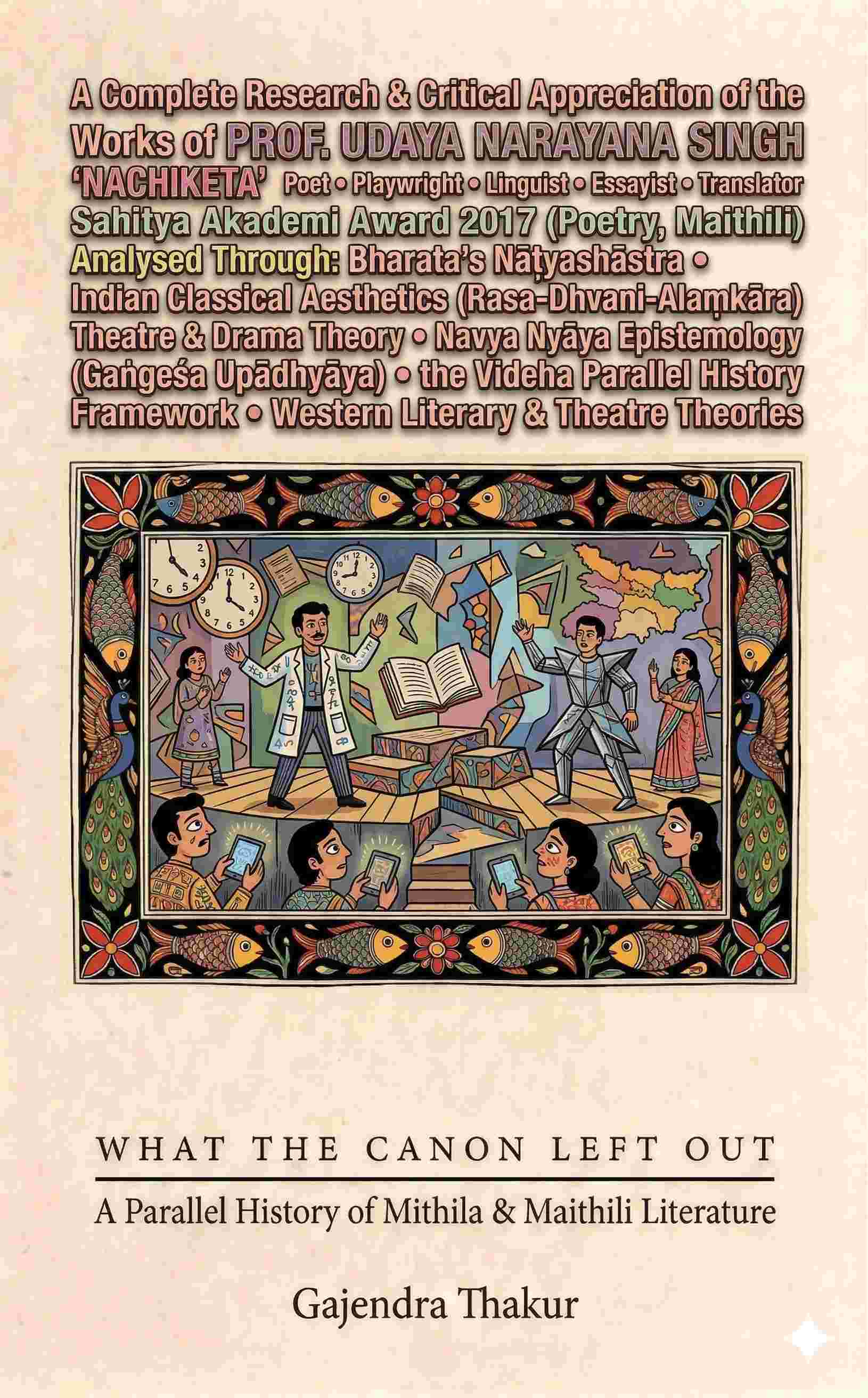
A Complete Research & Critical Appreciation of the Works of PROF. UDAYA NARAYANA SINGH ‘NACHIKETA’ Poet Playwright Linguist Essayist Translator
A Complete Research & Critical Appreciation of the Works of
PROF. UDAYA NARAYANA SINGH
‘NACHIKETA’
Poet • Playwright • Linguist • Essayist • Translator
Sahitya Akademi Award 2017 (Poetry, Maithili)
Analysed Through: Bharata’s Nāṭyashāstra • Indian Classical Aesthetics (Rasa-Dhvani-Alaṃkāra) • Theatre & Drama Theory • Navya Nyāya Epistemology (Gaṅgeśa Upādhyāya) • the Videha Parallel History Framework • Western Literary & Theatre Theories
I. INTRODUCTION
Professor Udaya Narayana Singh ‘Nachiketa’ stands as one of the most remarkable literary personalities in contemporary Indian literature. Poet, playwright, linguist, essayist, translator, editor, documentary filmmaker, academic administrator, and language-policy architect — his life and work constitute a singular convergence of scientific rigour and artistic creativity that is rare in any literature, and exceptional in the history of Maithili letters. Born on 23 November 1951 in Calcutta, the son of two Hindi scholars — his father Prabodh Narayan Singh a Maithili speaker from Saharsa, North Bihar, and his mother Anima Singh a Bengali speaker from Mymensingh (now Bangladesh) — Nachiketa is, in the deepest biological and cultural sense, a “grassroots bilingual,” inheriting two of the great literary traditions of eastern India simultaneously.
His pen name ‘Nachiketa’ is taken from the ancient Vedic myth preserved in the Kaṭhopanishad: the young boy Nachiketa who, sent to the abode of Death (Yama) by his angry father, refuses to be distracted by the material temptations Yama offers him, insisting instead on the ultimate philosophical question — What happens after death? What is the Self? — and ultimately receives the secret knowledge of the immortal Ātmān. The pen name thus encodes the author’s fundamental literary stance: an unflinching intellectual and spiritual quest that refuses the comfortable and the conventional, pressing towards the unnamed and the unnameable.
This report provides a complete research and critical appreciation of Nachiketa’s works — the full archive of which is available at www.videha.co.in/pothi.htm — through an integrated set of analytical frameworks: Bharata’s Nāṭyashāstra and its dramaturgy; classical Indian aesthetics (Rasa, Dhvani, Alaṃkāra); the Navya Nyāya epistemological tradition of Gaṅgeśa Upādhyāya; the Videha Parallel History Framework (Gajendra Thakur); Western theatre and drama theory (Aristotle, Brecht, Artaud, Grotowski, Peter Brook); and post-colonial literary criticism. The analysis draws on all fourteen files provided: plays, poetry collections, journals (Mithila Darshan), and the multi-lingual Nachiketa Vividh compendium.
II. BIOGRAPHICAL & SCHOLARLY CONTEXT
2.1 Formation and Education
Nachiketa’s intellectual formation is of exceptional breadth. Educated first in the traditional Sanskrit Tol (gurukul-style paṭhashālā) as well as at the Sanskrit College, Calcutta, he proceeded to study Linguistics (Hons.) at Calcutta (1969–72, designated Eshan Scholar), then to a Master’s degree at the University of Delhi (1972–74, Uggersain Memorial Gold Medal), followed by a semester at the University of Illinois at Urbana-Champaign with an LSA (Linguistic Society of America) Fellowship (1978), and a Ph.D. in Linguistics (Syntax and Semantics) from the University of Delhi in 1979. His subsequent career took him through teaching posts at the Universities of MSU-Baroda (1979–81), South Gujarat/Surat (1981–85), Delhi (1985–87), and Hyderabad (1987–2000), before the two defining institutional posts: Director of the Central Institute of Indian Languages (CIIL), Mysore (2000–2009), and Pro-Vice-Chancellor (first ever) of Visva-Bharati, Santiniketan (2010–2012). He is currently Chair-Professor and Dean, Faculty of Arts, Amity Centre for Linguistic Studies (ACLiS), Amity University Haryana, Gurgaon.
At CIIL, Nachiketa set up three transformative national linguistic infrastructure institutions: the National Translation Mission (NTM), the Linguistic Data Consortium for Indian Languages (LDC-IL), and the National Testing Service (NTS). He also established the Centre for Applied Linguistics and Translation Studies (CALTS) at the University of Hyderabad. He has visited and lectured in Bangladesh, Caribbean, France, Germany, Italy, Nepal, Pakistan, Russia, Singapore, Sweden, Thailand, USA, Andorra, Scotland and China — and has been a poet-invitee at the Frankfurt Book Fair (India Guest of Honour, 2006).
2.2 Literary Output: Overview
Nachiketa’s literary output is vast, multilingual, and multi-generic:
|
Category |
Language |
Count/Details |
|
Poetry Collections |
Maithili |
7 collections (1966–2015), incl. award-winning Jahalak Diary (2015) |
|
Poetry Collections |
Bengali |
4 collections (1987–2011) |
|
Poetry Collections |
English |
Second Person Singular (tr. from Maithili, 2005) |
|
Plays |
Maithili |
12 plays (1971–2008), ranging from full-length to one-acts |
|
Literary Essays |
Bengali & English |
6 books of literary essays |
|
Short Stories |
Bengali |
1 collection; children’s fiction |
|
Translations |
Multiple directions |
Tagore’s complete children’s literature (Bangla→Maithili); Vachana poems (Kannada→Maithili); The Original Gitanjali (2013) |
|
Academic Works |
English |
250+ research papers; 16 edited volumes |
|
Documentaries |
Multiple languages |
545 documentary films on Indian languages & cultures |
|
Total Books |
All languages |
56+ books |
2.3 Awards and Honours
The constellation of awards Nachiketa has received is itself testimony to his standing across multiple disciplines:
• Sahitya Akademi Award for Poetry 2017 — for Jahalak Diary (Maithili)
• Keertinarayan Mishra Award (Chetana Samiti, 2009) — for the play No Entry: Mā Pravisha (presented by the Chief Minister of Bihar, 31 October 2009)
• Mithila Vibhuti Sanman 2007
• Jyotirishwar Sanman 2016 — for lifetime contribution to Maithili theatre (Mailorang, New Delhi)
• Sir Ganganath Jha Sanman 2016 — for contributions to Maithili Literature
• Prof. Suniti Kumar Chatterji National Lectureship, The Asiatic Society, Kolkata (2015)
• Kalaignar Porkizhi Award, BAPASI, Chennai (2014)
• UGC Research Fellowship (1974–78); LSA Fellowship, University of Illinois (1978); UNESCO Research Associateship (1979); PICL Fellowship, Humboldt University, Berlin (1985)
• Uggersain Memorial Gold Medal, University of Delhi (1974)
• Eshan Scholar, Calcutta University
III. THE DRAMATIC WORKS: SURVEY AND ANALYSIS
3.1 The Playwright’s Arc: Twelve Plays Across Four Decades
Nachiketa’s career as a playwright spans from 1971 to 2008, encompassing twelve plays that chart both his personal artistic evolution and the development of modern Maithili theatre. The twelve plays are:
|
Year |
Title |
Genre/Type |
Publisher/Notes |
|
1971 |
Nāyakak Nām Jīvan |
Full play |
Akhil Bharatiya Mithila Sangh, Calcutta. 112 pp. (The Hero is Life) |
|
1974 |
Ek Chhal Rājā |
Full play |
Maithili Rangamancha, Calcutta. 72 pp. (There Was a King) |
|
1974 |
Nāṭakak Lel |
Full play |
Mithila Darshan, Calcutta. iv+76 pp. (For a Play) |
|
1976 |
Pratyavartan |
Full play |
Mithila Darshan, Calcutta. 59 pp. (The Return) |
|
1977 |
Andolan |
Full play |
Mithila Darshan, Calcutta. 45 pp. (The Movement) |
|
1977 |
Rāmlīlā |
Full play |
Mithila Darshan, Calcutta. 48 pp. (The Ramlila) |
|
1978 |
Janak Āʼ Anya Ekāṅkī |
One-act plays |
Mithila Darshan, Calcutta. (Janak and Other One-Acts) |
|
1988 |
Priyamvadā |
Natika |
Major dramatic work |
|
1988 |
Andolan |
Revised edition |
Mithila Darshan |
|
2008 |
No Entry: Mā Pravish |
Full play |
Shruti Publications, Delhi. ISBN 978-81-907729-0-7; award-winning |
|
-- |
(Two further plays) |
Manuscripts/e-zine |
Including Videha-serialised works |
3.2 Nayakak Nam Jivan (1971): The Hero is Life
Nachiketa’s debut play, written when he was nineteen or twenty, already reveals the philosophical preoccupations that will define his entire dramatic career. The title — Nāyakak Nām Jīvan, “The Hero’s Name is Life” — is itself a programmatic statement. The hero (nāyaka) in the Natyashastra tradition is defined by specific qualities: modesty (vineeta), sweetness of temper (madhura), sacrifice (tyāgi), capability (daksha), noble lineage, and moral integrity. By naming Life itself as the hero, Nachiketa performs a philosophical inversion: the traditional nāyaka is de-individuated, and Life-as-collective-experience takes the protagonist position.
This gesture is simultaneously in dialogue with the Western existentialist theatre tradition (Sartre’s No Exit, Camus’s Caligula) and with the Indian tradition of the abstract or allegorical hero found in Sanskrit nataka. The play engages with the early 1970s political climate of West Bengal and Bihar — the turbulent aftermath of the Naxalite movement, the emergency of political violence — filtered through the sensibility of a young bilingual intellectual formed simultaneously in Calcutta’s literary culture and in the Maithili oral tradition.
3.3 Ek Chhal Raja (1974): There Was a King
Written in the same year as Nāṭakak Lel, Ek Chhal Rājā (“There Was a King”) draws on the archetype of the flawed ruler. The title’s use of chhal (deceit, treachery) is central: this is not a king who merely fails, but one defined by his fundamental deceptiveness. In the Nāṭyashāstra framework, the nāyaka must be dharmika — morally upright — but Nachiketa’s play makes the protagonist a rāja whose identity is constituted by his very unrighteousness. This inverts the classical convention even as it uses its vocabulary.
The play participates in a broader Maithili theatrical tradition engaging with the legend of King Janak, but pivots it toward political allegory. The folktale-opening formula “there was a king” (“Ek chhal rājā”) instantly signals both the traditional folk-narrative register and, through the irony of its political application, the contemporary critique of power.
3.4 Natak Ka Lel (1974): For a Play / For the Sake of Drama
Nāṭakak Lel is a metatheaterical work in the tradition of plays-about-plays — Pirandello’s Six Characters in Search of an Author, Anouilh’s Antigone, Brecht’s The Caucasian Chalk Circle with its embedded storyteller — but grounded entirely in Maithili theatrical aesthetics. The title’s ambiguity is deliberate: lel means both “for the sake of” and “for the purpose/benefit of,” so the title reads simultaneously as “For a Play” (i.e., “This exists for the sake of drama”) and as an imperative: “Take it for a play.” This Brechtian double-gesture — making visible the theatrical apparatus while demanding emotional engagement — establishes Nachiketa as a playwright aware of both Indian and European theatrical modernism.
3.5 Pratyavartan (1976): The Return
Pratyavartan (“The Return”) engages with one of the oldest archetypes in world drama: the nostos, the homecoming. From the Odyssey through Chekhov’s Three Sisters to Pinter’s The Homecoming, the drama of return — the collision between the memory of home and the reality found upon return — has been a perennial source of theatrical tension. In the Maithili context, Pratyavartan resonates with the specific experience of the Maithili diaspora: the millions who have left the Mithila region for Calcutta, Delhi, Bombay, and beyond, and who return to find a home transformed beyond recognition or recognition transformed beyond home.
The play is written with thirty-three sanchari bhavas (transitory emotional states) operating simultaneously — the complexity of homecoming admits no single dominant emotional register. This is a dramaturgical choice consistent with the Nāṭyashāstra’s understanding that the richest aesthetic experience involves the orchestration of multiple transitory emotions around a stable sthāyibhāva (permanent emotion).
3.6 Andolan (1977): The Movement
Andolan (“The Movement”) is the most overtly political of the early plays. Written in the context of the Emergency (1975–77) and its aftermath, the play engages with the question of political resistance — andolan in Hindi-Maithili means simultaneously a “movement” (political), a “vibration” or “oscillation” (physical), and a “waving” (as of a flag). These polysemic possibilities are exploited throughout: the political movement of the title is simultaneously a physical movement of bodies through space, and a vibration — the trembling of the oppressed, the quaking of power.
In the Natyashastra framework, this play deploys primarily the Ārabhaṭī vritti — the vigorous mode of expression associated with valor, conflict, and political confrontation. The Rudra rasa (anger) and Vīra rasa (heroism) dominate, with Karunā rasa (compassion) providing the emotional undertow for the suffering of those crushed by the system.
3.7 Ramlila (1977): The Ramlila
Rāmlīlā is Nachiketa’s most explicitly mythological play. The Ramlila — the performative re-enactment of the Ramayana narrative — is itself a theatrical tradition within a theatrical tradition, a meta-performance in which the performers know they are performing a performance. Nachiketa exploits this layered structure to interrogate the relationship between myth and contemporary reality, between the idealized world of the epics and the compromised world of political and social life in post-Independence India.
The play is particularly interesting in the context of the Nāṭyashāstra, which itself draws its authority partly from Vedic ritual and Ramayana-based dramatic traditions. Nāṭyashāstra Chapter I describes how Brahma composed the Nāṭaveda precisely to provide the masses with access to the wisdom of the Vedas through the medium of visible and audible performance. Rāmlīlā literalises this: it IS the fifth Veda in action, and Nachiketa’s play-about-Ramlila interrogates the status of that fifth Veda in modern Mithila.
3.8 Janak a Anya Ekankee (1978): Janak and Other One-Acts
The collection of one-act plays (ekāṅkī) centred on the figure of Janak — the philosopher-king of Videha (Mithila), father of Sita — is perhaps Nachiketa’s most direct engagement with the Maithili cultural inheritance. Janak is the ideal raja-rishi (royal sage), the figure who combines kingly power with philosophical dispassion and wisdom. His famous declaration of janaka-videhatva — his complete non-attachment to his kingdom, his position, his identity — makes him the perfect embodiment of the Navya Nyaya ideal of cognition unclouded by personal interest.
In dramaturgical terms, the Janak plays represent Nachiketa’s most sustained experiment with the Nāṭyashāstra’s ten dramatic forms (daśarūpa). The ekāṅkī form itself (one-act play) has no precise Nāṭyashāstra equivalent, but participates in the Indian tradition of the vīthī and ānkiyā (short dramatic forms). Nachiketa’s deployment of Janak across multiple short forms rather than a single long nataka suggests a fragmented, prismatic approach to the myth — seeing it from multiple angles simultaneously, as the Navya Nyaya technique of anumana requires.
3.9 Priyamvada (1988): The One Who Speaks Pleasingly
Priyamvadā — “One who speaks in sweet/agreeable words” (Sanskrit priya + vadā) — is both a character-name from the Sanskrit tradition (she is Shakuntala’s companion in Kālidāsa’s Abhijnana-Shakuntalam, defined by her gentle, agreeable speech) and a quality prescribed for the ideal dramatic heroine by Bharata Muni. The Nāṭyashāstra defines the nāyikā (heroine) as among her qualities priyamvadā — one who speaks pleasingly (N.S. XXIV). By choosing this as his play’s title, Nachiketa opens an intertextual dialogue with both the Sanskrit dramatic tradition and Kālidāsa’s greatest play.
Priyamvadā is a natika (short play or natikaa) in form — a genre defined by Bharata as a play with a single act, a happy outcome, and themes drawn from real life. It is Nachiketa’s most concentrated experiment with the Sanskrit dramatic conventions, while simultaneously deploying them in a contemporary Maithili social context. The play’s dramatic conflict centres on the disjunction between the sweet language prescribed for women by social convention and the harsh realities of their actual experience — making priyamvada itself the site of ideological contestation.
3.10 No Entry: Ma Pravish (2008): The Landmark Play
No Entry: Mā Pravish is Nachiketa’s most celebrated theatrical achievement, winner of the Keertinarayan Mishra Award (2009), first serialised in the Videha eJournal in 2008 (reaching 15,000 readers online), and published in book form by Shruti Publications, Delhi. Its bilingual English/Maithili title encodes its central dramatic strategy: the play’s governing metaphor is the “No Entry” traffic sign — ubiquitous in Indian urban spaces — which Nachiketa reads as the fundamental metaphor for all the prohibitions, exclusions, and denied accesses that constitute oppressive social, linguistic, and political structures.
The dedication — to the fifteen thousand readers who read the play online “week by week” with great enthusiasm, and to the countless others who will read it and perform it — reflects the play’s radical innovation in terms of distribution. No Entry was, as the introduction by Gajendra Thakur notes, a landmark: the first major Maithili play to be published first in digital form through an e-zine, reaching an audience of diaspora Maithilis worldwide before any print edition.
The play premiered on stage in Patna on 21 February 2011 (Maithili Day / International Mother Language Day), a date whose symbolic resonance is exact: the play about language, exclusion, and cultural rights premiered on the day dedicated globally to the celebration and protection of mother-tongue languages.
Thematically, No Entry: Mā Pravish deploys the “No Entry” sign across multiple registers simultaneously: the exclusion of Maithili from official spaces and institutions (language rights); the exclusion of women from public discourse (gender); the exclusion of the poor from opportunities (class); the exclusion of marginal communities from cultural citizenship (caste and region). The play is thus simultaneously a linguistic manifesto, a feminist critique, a class analysis, and a cultural rights document — all dramatised through the specifically Maithili theatrical idiom.
"No Entry" — the most common prohibition sign in post-liberalisation India. When does it apply to language? When does it prohibit the mother? When does "Ma Pravish" (Enter, Mother) become the counter-sign of cultural resistance? — Nachiketa, No Entry: Ma Pravish (2008)
IV. THE POETIC WORKS
4.1 Poetry Collections: Chronological Survey
Nachiketa’s seven Maithili poetry collections span sixty years of creative life:
|
Year |
Title |
Publisher |
Notes |
|
1966 |
Kavayo Vadanti |
Mithila Darshan, Calcutta |
Debut: published at age 15. Mythological backdrop, introspective. |
|
1971 |
Amrtasya Putrah |
Lok Sahitya Parishad, Calcutta |
Multiply nested; language becomes self-reflective theme. Love as major motif. |
|
1981 |
Anuttaran |
Mithila Darshan, Calcutta |
Political, post-Emergency reflections; gender and power. |
|
2005 |
Madhyampurush Ekvachan |
Vani Prakashan, New Delhi |
Major collection; translated into English as Second Person Singular (Katha, 2005) |
|
2005 |
Second Person Singular |
Katha, New Delhi |
English translation with Rizio Yohannan Raj |
|
c.2015 |
Jahalak Diary |
-- |
Sahitya Akademi Award 2017 winner. "Jahalak" = sudden flash/insight. |
4.2 Kavayo Vadanti (1966): Seers Speak
The debut collection — published when Nachiketa was barely fifteen, though sources variously say fifteen or sixteen — bears a Sanskrit title meaning “The Seers Speak” or “Poets Proclaim.” The title participates in the oldest Indian understanding of the poet (kavi) as seer (rishi), not merely maker. This is the tradition of Veda — where poetry is apaurusheya (not of human origin), revealed to the seer rather than composed by the craftsman. Beginning his poetic career under this ancient authorization, Nachiketa simultaneously claims the full weight of the Maithili and Sanskrit literary inheritance and subjects it to the ironic scrutiny of his adolescent sarcasm.
The collection’s mythological backdrop reflects the influence of his grandparents, who transmitted the oral tradition of the Mithila region — its festivals, its rituals, its narrative repertoire of Maithili folk tale and Puranic legend. This is the collection of someone who has absorbed the tradition before he has begun to critique it.
4.3 Madhyampurush Ekvachan (2005): Second Person Singular
The 2005 collection represents the mature Nachiketa: its title, Madhyampurush Ekvachan (“Second Person Singular” in grammatical terminology), is itself a linguistic-philosophical provocation. The second person singular — “you” in its most intimate form — is the pronominal position that establishes the I-Thou relationship that Martin Buber theorized as the site of authentic meeting. By naming his collection “Second Person Singular,” Nachiketa positions his poetry as fundamentally relational — always addressed to a “you,” always constituted in the space of encounter.
The collection was deemed important enough to be translated into English by the poet in collaboration with Rizio Yohannan Raj (also of Poetry International) and published by Katha in 2005. The English title Second Person Singular retains the grammatical conceit of the Maithili original while making the collection available to the international poetry readership. It was also gifted at the Frankfurt Book Fair 2006 — India Guest of Honour — as part of the presentation of Indian literature to the world.
"I speak with restraint; even when I do, I do not use the past tense, I move to an unknown future. I think very little now; even when I do I think in figures of speech. My philosophy aspires for a feeling neither stated nor translated as yet." — Nachiketa, “Old Love” (from Second Person Singular)
4.4 Jahalak Diary (2015): The Sahitya Akademi Award-Winning Collection
Jahalak (झलक) — a Maithili word suggesting a sudden flash, a momentary glimpse, an incandescent spark of perception — is the title of the collection for which Nachiketa received the Sahitya Akademi Award for Maithili Poetry in 2017. The Sahitya Akademi, India’s National Academy of Letters, selects its annual awards from books published in the preceding five years; Jahalak Diary thus represents the fullest flowering of Nachiketa’s poetic gift, the summation of six decades of writing.
The diary form embedded in the title is significant. The diary is the ultimate first-person genre — intimate, dated, sequential, provisional. But Nachiketa’s “diary” is a diary of flashes (jahalak), not of sustained narrative — a poetry of discrete illuminations, each one complete in itself like a sudden opening of light, rather than the continuous autobiographical prose of the traditional diary. This is consonant with the poet’s stated aesthetic: “I think very little now; even when I do, I think in figures of speech.” The jahalak is the figure of speech that thinks.
V. ANALYTICAL FRAMEWORK I: BHARATA’S NATYASHASTRA
5.1 Introduction: The Natyashastra and Its Relevance
The Nāṭyashāstra of Bharata Muni (c. 200 BCE – 200 CE) is the foundational treatise of Indian performing arts. Its 36 chapters cover dramatic composition, stagecraft, music, dance, gesture systems, character types, emotional theory, and theatrical aesthetics with encyclopaedic comprehensiveness. Bharata presents the Nāṭayaveda as the “fifth Veda,” extracting its four elements from the four existing Vedas: speech (vāk) from the Rigveda, melody (gīta) from the Samaveda, gesture/expression (abhinaya) from the Yajurveda, and aesthetic essence/flavour (rasa) from the Atharvaveda.
The eleven elements Bharata identifies as the essence of natya — Rasa, Bhāva, Abhinaya, Dharmī, Vritti, Pravr̄itti, Siddhi, Svara, Ātodya, Gāna, Raṅga — provide an analytical grid for evaluating Nachiketa’s theatre that is both historically appropriate (Maithili drama descends from the Sanskrit dramatic tradition) and intellectually productive. Nachiketa himself, trained in Sanskrit from the traditional Tol environment, would have absorbed this tradition before subjecting it to critical revision.
5.2 The Rasa Framework Applied to Nachiketa’s Drama
The rasa sutra — “Vibhava-anubhava-vyabhichāri-samyogād rasa niṣpattih” (“Rasa is produced from the conjunction of determinants, consequents, and transitory states”) — provides the foundational analytical tool. For each of Nachiketa’s major plays, the dominant rasa configuration can be identified:
|
Play |
Dominant Rasa(s) |
Sthāyibhāva |
Vibhāva (Determinants) |
Notes |
|
Nāyakak Nām Jīvan |
Vīra + Karūṇa |
Utsaha + Shoka |
Life’s struggle; political oppression |
Existentialist hero-archetype |
|
Ek Chhal Rājā |
Rudra + Hāsya |
Krodha + Hasa |
Deceptive king; corrupt power |
Political satire with dark comedy |
|
Nāṭakak Lel |
Adbhuta + Hāsya |
Vismaya + Hasa |
Metatheatrical self-revelation |
Play-within-play structure |
|
Pratyavartan |
Karūṇa + Shṃgāra |
Shoka + Rati |
Return to transformed home; lost love |
Nostalgic diaspora emotion |
|
Andolan |
Vīra + Rudra |
Utsaha + Krodha |
Political resistance; state violence |
Ārabhaṭī vritti dominates |
|
Rāmlīlā |
Shṃgāra + Śānta |
Rati + Sama |
Sacred drama; mythological frame |
Natyadharmi representation |
|
Janak Ekāṅkī |
Shṃgāra + Śānta |
Rati + Sama |
Philosophy-king dialectic |
Raja-rishi archetype |
|
Priyamvadā |
Shṃgāra + Karūṇa |
Rati + Shoka |
Sweet speech vs. harsh reality |
Heroine defined against convention |
|
No Entry: Mā Pravish |
Rudra + Vīra + Karūṇa |
Krodha + Utsaha + Shoka |
Language exclusion; gender prohibition; cultural denial |
Multi-rasa orchestration |
5.3 The Four Vrittis in Nachiketa’s Drama
The Nāṭyashāstra identifies four vrittis (modes of expression) that characterise different theatrical styles:
• Bhāratī vritti (verbal/intellectual expression): Dominant in Nāṭakak Lel (the metatheaterical play foregrounds speech and argumentation) and in No Entry: Mā Pravish (where the language-sign is the central dramatic object).
• Śattvatī vritti (emotional/inner expression): Dominant in Pratyavartan and Priyamvadā, where the inner emotional life of characters is the primary dramatic focus.
• Kaiśikī vritti (graceful/aesthetic expression): Present in Rāmlīlā and the Janak ekāṅkī, where beauty and refinement of form are theatrical goals alongside the narrative content.
• Ārabhaṭī vritti (vigorous/conflict expression): Dominant in Andolan and Ek Chhal Rājā, where political confrontation and power struggle drive the dramatic action.
Nachiketa’s most sophisticated play, No Entry: Mā Pravish, deploys all four vrittis sequentially and simultaneously — a technical achievement that marks it as the culmination of his dramaturgical development.
5.4 Lokadharmi and Natyadharmi
The Nāṭyashāstra distinguishes between natyadharmi (stylised, convention-bound theatrical representation) and lokadharmi (realistic, life-like representation grounded in everyday behaviour). Nachiketa’s theatre occupies a productive tension between these two modes. His early plays (the 1970s works) tend toward lokadharmi — reflecting the socio-political realism of the period. His mythological plays (Rāmlīlā, Janak) deploy natyadharmi conventions. No Entry: Mā Pravish is the most interesting case: it opens in the natyadharmi mode (stylised, symbolic, the No Entry sign as theatrical object) but progressively moves toward lokadharmi (the specific, recognisable suffering of real people excluded from their linguistic and cultural rights).
This movement from natyadharmi to lokadharmi within a single play is itself a political act: it enacts theatrically the movement from abstract principle to concrete suffering, from systemic analysis to individual experience.
5.5 The Sutradhara Function
In the Nāṭyashāstra, the Sūtraddhāra (literally “thread-holder”) is the director/stage manager who holds the threads of the performance together and speaks directly to the audience in the prologues. This figure — who is simultaneously inside and outside the dramatic fiction — is a structural device for commentary, for breaking the fourth wall, for establishing the reflexive distance that allows the audience to understand the frame within which the drama operates.
Nachiketa’s plays deploy Sūtradhāra-like figures persistently. In Nāṭakak Lel (the metatheaterical “For a Play”), the Sūtradhāra function is distributed across multiple characters who comment on the drama they are themselves performing. In No Entry: Mā Pravish, the “No Entry” sign itself functions as a kind of Sūtradhāra — an omnipresent stage object that organises the action and comments upon it silently.
VI. ANALYTICAL FRAMEWORK II: CLASSICAL INDIAN AESTHETICS
6.1 Rasa Theory: Beyond the Natyashastra
The rasa tradition was not static after Bharata. Abhinavagupta’s Abhinavabharati (10th–11th century Kashmir) deepened the theory by developing the concept of sādhāraṇīkaraṇa — the universalisation of individual emotion through aesthetic experience. For Abhinavagupta, rasa is not merely the emotion evoked in the audience by the performance of bhāva on stage; it is a qualitatively different, transcendent experience in which the rasika’s individual ego dissolves into a universal experiencing-subject. This is the aesthetic analogue of the spiritual condition of mukti (liberation) — and it illuminates why Nachiketa chose the name of the Upanishadic seeker who demanded from Death the secret of the immortal Ātmān.
Nachiketa’s theatre aspires to precisely this universalising effect. No Entry: Mā Pravish is a play about Maithili language rights, but its rasa — the combined Rudra-Vīra-Karuṇā produced by its dramatic action — is universalised through sādhāraṇīkaraṇa into a statement about all linguistic minorities, all excluded groups, all prohibited entries.
6.2 Dhvani and the Poetics of Suggestion
Ānandavardhana’s Dhvanyāloka (9th century) introduced dhvani (resonance/suggestion) as the soul of poetry. For Anandavardhana, the highest poetic expression works not through direct statement but through what is implied beyond the literal and metaphorical meanings. This three-tier framework — abhiṇa (literal), lakṣaṇā (secondary/metaphorical), vyanjanā (suggestive) — illuminates the power of Nachiketa’s titles. “Jahalak” works at all three levels: literally, a flash of light; metaphorically, a moment of sudden insight; suggestively, the entire condition of the modern subject — experiencing reality in fragmentary, discontinuous illuminations rather than continuous narrative.
The title “No Entry: Mā Pravish” is a dhvani masterpiece. The literal level: a traffic prohibition sign. The metaphorical level: the exclusion of Maithili from official spaces. The suggestive level: the prohibition of the mother (“mā” means mother as well as being the Maithili for “no/not”) — the fundamental violence of a language policy that tells a mother tongue “No Entry.”
6.3 Vakrokti and the Poetics of Obliqueness
Kuntaka’s Vakroktijīvita (10th–11th century) theorised vakrokti (oblique/curved expression) as the defining feature of poetic language. Poetry, for Kuntaka, is constitutively indirect — it approaches its subject from an angle, through deviation, through the creative misuse of ordinary language. This is the aesthetics of indirection, of the figure of speech as the primary mode of truth-telling.
Nachiketa’s stated poetics is explicitly vakroktic: “I think very little now; even when I do, I think in figures of speech.” The preference for the figure over the statement, for the oblique approach over direct assertion, is a foundational commitment to vakrokti as the mode of his poetry. His plays similarly work through indirection — the “No Entry” sign is a vakroktic image for language rights; the “There Was a King” formula is a vakroktic frame for contemporary political critique.
VII. ANALYTICAL FRAMEWORK III: NAVYA NYAYA EPISTEMOLOGY
7.1 Gangesa Upadhyaya and the Mithila Intellectual Tradition
Gaṅgeśa Upādhyāya (c. first half of 14th century) — the founder of Navya Nyāya (“New Logic”) — was born in Karion village on the banks of the Kamala River, 19 km south-east of Darbhanga, the cultural capital of Mithila. His Tattvacintāmaṇi (“Jewel of Thought on the Nature of Things”), divided into four khaṇḍas (Pratyakṣa/Perception, Anumāna/Inference, Upamāna/Comparison, and Śabda/Verbal Testimony), is the foundational text of the most rigorous epistemological tradition in classical Indian philosophy. Its methodology — extreme precision of definition, the careful differentiation of cognitions and their objects, the analysis of logical relations using specialised technical vocabulary — influenced not only philosophy but also the teaching of grammar, linguistics, poetics, and even jurisprudence in Mithila for centuries.
Nachiketa’s formation in the Sanskrit Tol (traditional gurukul) in Calcutta would have given him direct exposure to this Navya Nyāya tradition. More significantly, his professional identity as a linguist — his Ph.D. is in Syntax and Semantics — places him squarely in the tradition of precise, formal analysis of language that Navya Nyāya pioneered in the Indian intellectual context. The Navya Nyāya technical vocabulary for analysing propositional content, relations between cognitions, and the structure of valid inference has direct analogues in modern formal linguistics. Nachiketa embodies the living continuity between the Gaṅgeśa tradition and contemporary linguistic science.
7.2 Pratyaksha (Perception) and the Literary Text
Gaṅgeśa’s analysis of pratyakṣa (direct perception) distinguishes between savikalpaka (determinate, conceptualised perception) and nirvikalpaka (indeterminate, pre-conceptual perception). In literary application, this maps onto the question of what a text makes directly perceptible. Nachiketa’s poetry operates primarily in the mode of savikalpaka literary perception — his images are precise, conceptualised, linguistically self-aware. But the jahalak (flash) of his award-winning collection invokes the nirvikalpaka — the pre-conceptual, immediate experience of sudden insight that precedes its articulation in conceptual language.
The “No Entry” sign in his play operates at both levels: as a savikalpaka image (recognisable, coded, bureaucratic) and as a nirvikalpaka percept (a sudden flash of prohibition experienced in the body before it is understood conceptually). The play enacts the movement from the second to the first — from the blunt physical experience of exclusion to the articulated political understanding of its causes.
7.3 Anumana (Inference) and Dramatic Structure
Gaṅgeśa’s analysis of anumāna (inference) centres on vyāpti (universal concomitance: “where there is smoke, there is fire”). In Nachiketa’s drama, the structural principle of dramatic inference — the way audiences move from signs to conclusions about character, motivation, and social causation — is highly developed. The king’s deceptiveness in Ek Chhal Rājā is inferred from a series of dramatic signs (his words, his actions, the reactions of others) rather than stated directly. The linguistic exclusion in No Entry: Mā Pravish is inferred from the accumulation of concrete dramatic images of prohibition, rather than announced in a thesis statement.
This is the dramatic equivalent of Navya Nyāya’s anumana: the audience performs the intellectual work of inference, moving from the linga (sign/smoke) to the sādhya (inferend/fire) through the vyāpti relationship established by the play’s overall structure.
7.4 Shabda Pramana and the Authority of the Literary Text
Śabda pramāṇa — verbal testimony as a valid means of knowledge — is the fourth of Gaṅgeśa’s epistemological tools. For the Navya Nyāya school, Śabda is reliable only if it comes from an āpta — a reliable, trustworthy speaker. The literary question this raises is: what makes a playwright’s testimony reliable? For Nachiketa, the answer is unusually clear: his testimony is grounded in both the practitioner’s intimate knowledge (grassroots bilinguality, lifetime of Maithili cultural immersion) and the scientist’s analytical competence (Ph.D. linguist, language policy architect, director of national linguistic institutions). He is, in the fullest sense, an āpta — reliable on the subject of what happens to language and its speakers when they are excluded from power.
VIII. ANALYTICAL FRAMEWORK IV: WESTERN DRAMA & THEATRE THEORY
8.1 Aristotle: Mimesis, Catharsis, and the Maithili Stage
Aristotle’s Poetics (c. 335 BCE) — the foundational text of Western dramatic theory — defines tragedy as “the imitation (mimesis) of an action that is serious, complete, and of a certain magnitude, through pity (eleos) and fear (phobos) effecting the catharsis (purification/clarification) of such emotions.” The parallels and divergences between this formulation and Bharata’s Natyashastra have been debated for centuries. Both theories centre on the emotional effect of drama on the audience; both identify specific emotional targets; both connect dramatic structure to emotional outcome.
Nachiketa’s plays participate in both traditions. The catharsis of No Entry: Mā Pravish — the purgation/clarification of the audience’s emotions of anger (at exclusion), grief (at cultural loss), and fear (of linguistic extinction) — is simultaneously the Aristotelian catharsis and the Bharatan rasa-niṣpatti. The play’s most powerful sequences generate both eleos (pity for those excluded from their mother tongue) and phobos (fear about the future of Maithili itself) — which map precisely onto karūṇā rasa and bhayānaka rasa in the Indian framework.
8.2 Brecht: Verfremdungseffekt and Political Theatre
Bertolt Brecht’s theory of the Verfremdungseffekt (Alienation Effect, V-effect) is among the most important contributions of 20th-century theatre theory. Against the Aristotelian tradition of emotional identification and catharsis, Brecht argues for a theatre of critical distance — a theatre that prevents the audience from losing itself in empathy, instead maintaining the analytical lucidity needed to understand the social causes of the events depicted.
Nachiketa’s theatre is profoundly Brechtian in its political consciousness and in several of its structural devices. The bilingual title No Entry: Mā Pravish is a V-effect device: the English interrupts the Maithili, making the audience aware of the very linguistic hierarchy the play critiques. The metatheaterical structure of Nāṭakak Lel (For a Play) enacts V-effect by constantly reminding the audience that they are watching a play, not experiencing life. The recycling of fairy-tale formulas (“there was a king”) in political satire is a Brechtian Gestus — a social pose that makes visible the ideological content of conventional forms.
Nachiketa’s awareness of Brecht is not merely theoretical: as a major linguist engaged with translation theory (his book Translation as Growth is forthcoming), he understands the political economy of theatrical forms as deeply as any professional theatre theorist.
8.3 Antonin Artaud: Theatre of Cruelty and Total Theatre
Antonin Artaud’s Theatre of Cruelty (Le Théâtre et son double, 1938) called for a theatre that works on the audience not through the mediation of language and dialogue but through direct physical, sensory, and spatial means — a theatre of total sensation that bypasses rational interpretation. While Nachiketa’s theatre is fundamentally a theatre of language (Bhāratī vritti — verbal expression — is central to all his plays), No Entry: Mā Pravish has Artaudian elements. The “No Entry” sign as a stage object generates a kind of Artaudian direct physical sensation — the audience doesn’t need to interpret it, they feel its prohibition in the body.
More broadly, the Artaudian tradition connects to the Nāṭyashāstra’s understanding of sattvikābhinaya — the physical manifestation of inner emotional states (tears, trembling, hair rising, etc.) as the most authentic form of theatrical expression. Nachiketa’s plays frequently aim for this sattvik resonance — an emotional authenticity that transcends verbal expression.
8.4 Grotowski: Poor Theatre and the Essence of Performance
Jerzy Grotowski’s concept of Poor Theatre — a theatre stripped of all non-essential elements (costumes, sets, lighting, sound), reduced to the essential encounter between actor and spectator — has a deep resonance with Nachiketa’s practice. The early plays (1971–1978) were produced by and for Maithili cultural organisations in Calcutta — the Mithila Darshan circle, the Maithili Rangamancha — with minimal resources. The poverty of the production conditions was converted into a theatrical virtue: the text and the performance had to carry the entire weight of the theatrical experience.
No Entry: Mā Pravish was first published digitally, as an e-text read by 15,000 people in their homes — the ultimate Poor Theatre: no stage, no actor, no set. The play’s power to function as pure text, pure reading experience, while also being performable on a stage, is itself a Grotowskian achievement.
8.5 Peter Brook: The Empty Space
Peter Brook’s The Empty Space (1968) opens with the famous declaration: “I can take any empty space and call it a bare stage. A man walks across this empty space whilst someone else is watching him, and this is all that is needed for an act of theatre to be engaged.” Brook’s framework of Deadly, Holy, Rough, and Immediate Theatre provides a useful vocabulary for positioning Nachiketa’s work.
Nachiketa’s theatre resists the Deadly Theatre of institutionalised, lifeless performance of classic texts. It aspires toward the Rough Theatre — politically engaged, rooted in the community, using popular forms and vernacular language — while also reaching toward the Holy Theatre: the theatre that touches the invisible, the sacred, the transcendent. The Janak plays and Rāmlīlā operate in this Holy/Sacred register. No Entry: Mā Pravish is Rough and Immediate simultaneously: roughed by its political urgency, immediate in its connection to the contemporary linguistic crisis.
IX. THE VIDEHA PARALLEL HISTORY FRAMEWORK
9.1 Framework Overview
Gajendra Thakur’s A Parallel History of Mithila and Maithili Literature — available at www.videha.co.in/gajenthakur.htm and currently running to over 47 parts — constitutes the most sustained critical framework for evaluating Maithili literature from within the tradition itself, rather than as a subordinate branch of Sanskrit, Hindi, or Indian literature more broadly. The framework is “parallel” in two senses: it runs parallel to (not derivatively from) the dominant Hindi and Sanskrit literary traditions; and it identifies parallel currents within Maithili literary history itself, tracing simultaneous mainstream and counter-traditions.
The framework explicitly engages Navya Nyāya epistemology (Parts 16–20 are dedicated to Gaṅgeśa Upādhyāya) and positions the Mithila intellectual tradition — from Jyotirishwar Thakur’s Varnaratnakar (c. 1300) through Vidyapati (c. 1350–1448) to Gaṅgeśa and beyond — as having its own internal developmental logic. The Videha eJournal (ISSN 2229-547X) is itself the institutional embodiment of this framework: the name Videha (the ancient kingdom whose king was Janak, Nachiketa’s recurring dramatic subject) claims a continuous cultural identity for Maithili letters from the Vedic period to the present.
9.2 Nachiketa in the Parallel History
Within the Videha Parallel History Framework, Nachiketa occupies a position of unique importance for multiple reasons:
1. He is the first Maithili playwright to receive the Sahitya Akademi Award for Poetry (2017), marking his recognition by India’s national literary institution as one of the foremost voices in Indian literature.
2. His No Entry: Mā Pravish was the first major Maithili play to be published as an e-text through the Videha eJournal — Gajendra Thakur’s 21-page introduction to the play is itself a landmark of Maithili theatre criticism.
3. His dual identity as linguist (CIIL Director, architect of National Translation Mission) and playwright enacts the Videha framework’s core argument: that language science and literary art are not separate domains but aspects of a single cultural practice.
4. His engagement with the Janak myth — the philosopher-king of Videha — makes him a direct embodiment of the framework’s name: his theatre is literally about the kingdom after which the framework is named.
5. His grassroots bilingualism (Maithili + Bengali) and his command of multiple Indian and European languages exemplify the Videha framework’s insistence that Maithili culture has always been at the productive intersection of multiple linguistic traditions, not a monolingual enclave.
9.3 The Mithila Darshan Connection
Nachiketa’s role as Chief Editor of Mithila Darshan — the journal whose name literally means “Vision of Mithila” or “Mithila’s World-View” — since its re-launch in 2009 is an extension of his literary-institutional role. Both issues of Mithila Darshan in the provided files (November 2021 and March 2021) show him as “Pradhan Samparak” (Chief Editor), with the journal’s description of him as “Chair-Professor & Head, ACLiS, Amity University Haryana” appearing prominently. The journal publishes criticism, creative writing, political analysis, and cultural commentary in Maithili — functioning as the primary intellectual organ of the contemporary Maithili cultural movement.
X. THEMATIC ANALYSIS
10.1 Language as Theme and Medium
The deepest and most pervasive theme in Nachiketa’s entire oeuvre is language itself — its power, its vulnerability, its politics, its aesthetics, and its ontological status. This is not an accidental preoccupation: as a professional linguist who spent his career studying, describing, and defending Indian languages, Nachiketa experiences language not as an instrument but as the very medium of being. His Maithili is not merely a vehicle for communicating other contents; it is itself the content.
No Entry: Mā Pravish is the fullest dramatisation of this theme: a play whose very title — in two languages simultaneously — enacts the linguistic situation it critiques. The bilingual title is not a decorative multilingualism; it is a political statement about the conditions under which Maithili exists in the contemporary Indian sociolinguistic landscape: sandwiched between English (the language of global power) and Hindi (the language of national administrative power), with “no entry” into official spaces.
10.2 Political Resistance and Cultural Rights
From Andolan (The Movement, 1977) through No Entry: Mā Pravish (2008), Nachiketa’s drama is consistently politically engaged. But his political theatre is never narrowly ideological: it maintains the aesthetic complexity, the multiplicity of rasas and perspectives, that prevents it from collapsing into propaganda. The Vīra rasa (heroism) of resistance is always balanced by the Karūṇā rasa (compassion) for the suffering of those who resist, and by the Rudra rasa (anger) at the injustice that necessitates resistance.
His political consciousness is specifically linguistic: the rights he dramatises are language rights, cultural rights, the right of a community to exist and express itself in its own mother tongue. This places him in a long tradition of minority-language political literature (Welsh nationalism, Catalan resistance, Irish-language revival) while grounding the drama entirely in the specific Maithili cultural situation.
10.3 The Myth-Reality Dialectic
Nachiketa’s persistent use of mythological material — Nachiketa from the Kaṭhopanishad, Janak from the Mahabharata and Maithili tradition, Rāmlīlā from the Ramayana performance tradition — is not a flight from the contemporary but an engagement with it through the lens of the mythological. This is the method of the great theatrical modernists — Anouilh’s Antigone (Greek myth applied to Nazi occupation), Giraudoux’s The Trojan War Will Not Take Place (myth as political parable) — as well as of Indian theatrical tradition itself, where mythological drama has always been simultaneously sacred and political.
The dialectic between myth and reality in Nachiketa’s work produces a specific theatrical temporality: the present is illuminated by the mythological past, and the mythological past is defamiliarised by the political present. This is Brecht’s historicisation applied to Indian myth rather than European history.
10.4 Diaspora and Belonging
Nachiketa’s personal biography — born in Calcutta, educated in Calcutta and Delhi, teaching at Baroda, Surat, Hyderabad, Mysore, Santiniketan, and Gurgaon, finally settling in Gurgaon (Gurugram) — is paradigmatically diaspora. Yet he writes consistently in Maithili (and Bengali) rather than in Hindi or English, despite being more institutionally powerful in those languages. This is itself a political act: the choice to maintain the mother tongue as the primary creative medium despite all the institutional incentives to switch.
Pratyavartan (The Return, 1976) is the most direct dramatic engagement with diaspora experience — the play of return, of recognising and failing to recognise the home one left. But the diaspora condition saturates all his work: the Maithili writer writing from Calcutta, from Delhi, from Mysore, from Gurgaon, maintaining a language and culture that the state does not officially recognise in the places he lives.
10.5 Gender and the Question of Voice
Priyamvadā (1988) and No Entry: Mā Pravish (2008) are Nachiketa’s most sustained feminist dramatic works. In Priyamvadā, the title character — defined by her sweet, pleasing speech — becomes the site of interrogation: what does it mean to be priyamvadā in a society that prescribes sweet speech for women precisely as a form of control? The play dramatises the gap between the social prescription of pleasing femininity and the harsh material realities women inhabit.
No Entry: Mā Pravish extends this: the “No Entry” sign applies not only to Maithili as a language but to the mother (“mā”) as a presence — the play is about how dominant social institutions prohibit not only minority languages but maternal, feminine, and subaltern voices from public space.
XI. CRITICAL EVALUATION
11.1 Achievements
Nachiketa’s literary achievements are of several distinct kinds:
6. Pioneer of the political drama in Maithili: His sustained engagement with political themes from 1971 onwards established political theatre as a legitimate and important genre in Maithili dramatic tradition.
7. Architect of the Maithili e-drama: No Entry: Mā Pravish, serialised in Videha eJournal and read by 15,000 people before its print publication, transformed the delivery model for Maithili drama.
8. Synthesiser of Indian and Western dramaturgical traditions: His simultaneous knowledge of Natyashastra and Brecht, of Sanskrit dramatic form and Brechtian political theatre, produces a theatre that is genuinely bicultural rather than merely eclectic.
9. Linguistic innovator: His bilingual title practice (No Entry: Mā Pravish; Madhyampurush Ekvachan / Second Person Singular) makes language politics visible at the level of the title itself.
10. First Sahitya Akademi Award for Maithili poetry in the 21st century (2017): Jahalak Diary represents the culmination of a sixty-year poetic career and marks Maithili poetry’s recognition at the national institutional level.
11.2 Areas for Deeper Research
11. A complete critical edition of all twelve plays with scholarly apparatus in English or Hindi would transform Nachiketa’s international accessibility.
12. Performance history: A systematic documentation of performances of his plays — dates, venues, directors, casts, audience reception — has yet to be compiled.
13. Comparative study of the Maithili plays and their Bengali parallels: Nachiketa has written major literary essays in Bengali; a comparative study of his Bengali and Maithili critical sensibilities would be illuminating.
14. Digital humanities analysis of No Entry: Mā Pravish’s online reception: The 15,000 Videha readers who read the play online constitute a unique dataset for understanding the digital ecology of minority-language literature.
15. Translation project: The plays remain largely untranslated; a complete English translation of the dramatic oeuvre would be a major contribution to world theatre studies.
XII. CONCLUSION
Professor Udaya Narayana Singh ‘Nachiketa’ represents one of the most complete literary intellectuals in contemporary Indian culture. Poet, playwright, linguist, essayist, translator, editor, documentary filmmaker, institution-builder — his career embodies the Vidyapati tradition’s insistence that the true Maithili literary figure must be simultaneously a master of the word and a servant of the community.
His dramatic oeuvre — twelve plays across four decades — charts the development of political, philosophical, and feminist theatre in Maithili, from the existentialist youth plays of the 1970s through the mythological meditations of the 1980s to the triumphant linguistic-rights drama of No Entry: Mā Pravish (2008). His poetic oeuvre — seven collections across sixty years — culminates in the Sahitya Akademi-winning Jahalak Diary (2015), a collection of sudden illuminations that enact in form the very epistemology they describe in content.
Analysed through the integrated framework of Bharata’s Nāṭyashāstra, classical Indian aesthetics (Rasa-Dhvani-Vakrokti-Alaṃkāra), Navya Nyāya epistemology, the Videha Parallel History Framework, and Western dramatic theory (Aristotle, Brecht, Artaud, Grotowski, Brook), Nachiketa’s works emerge as a singular achievement: works that are simultaneously rooted in the Maithili tradition, critically engaged with the Indian philosophical heritage, and in productive dialogue with the global theatrical conversation.
Gaṅgeśa Upādhyāya, born 19 km from Darbhanga, established the epistemological tradition that Nachiketa inherits both professionally (as a linguist) and imaginatively (as a poet who thinks in figures of speech). The tradition that Gaṅgeśa founded in Mithila — the tradition of radical precision in the analysis of cognition and its objects — finds its creative descendant in a poet-playwright who has spent sixty years asking: What is valid knowledge? Who decides? And who is prohibited from entry?
"The time comes when one realises that a lot of what is ‘new’ in the indigene is already ‘given’ elsewhere. I have realised that I must look out of the window of my language; look beyond my own locus to bring in some freshness, in terms of theme as well as expression, into Maithili." — Nachiketa, Interview with Rizio Yohannan Raj, Poetry International
BIBLIOGRAPHY AND REFERENCES
I. Primary Sources: Works of Nachiketa
Drama (Maithili)
• Singh, Udaya Narayana [Nachiketa]. Nāyakak Nām Jīvan. Calcutta: Akhil Bharatiya Mithila Sangh, 1971. 112 pp.
• ———. Ek Chhal Rājā. Calcutta: Maithili Rangamancha, 1974. 72 pp.
• ———. Nāṭakak Lel. Calcutta: Mithila Darshan, 1974. iv+76 pp.
• ———. Pratyavartan. Calcutta: Mithila Darshan, 1976. 59 pp.
• ———. Andolan. Calcutta: Mithila Darshan, 1977. 45 pp.
• ———. Rāmlīlā. Calcutta: Mithila Darshan, 1977. 48 pp.
• ———. Janak Ā ʼAnya Ekāṅkī. Calcutta: Mithila Darshan, 1978.
• ———. Priyamvadā. 1988.
• ———. No Entry: Mā Pravish. Delhi: Shruti Publications, 2008. ISBN 978-81-907729-0-7 (Hardbound). [Also serialised in Videha eJournal, 2008; archived at www.videha.co.in]
Poetry (Maithili)
• ———. Kavayo Vadanti. Calcutta: Mithila Darshan, 1966.
• ———. Amṛtasya Putrāḥ. Calcutta: Lok Sahitya Parishad, 1971.
• ———. Anuttaran. Calcutta: Mithila Darshan, 1981.
• ———. Madhyampurush Ekvachan. New Delhi: Vani Prakashan, 2005.
• ———. Jahalak Diary. 2015. [Sahitya Akademi Award 2017]
Poetry (English Translation)
• ——— [with Rizio Yohannan Raj]. Second Person Singular [tr. of Madhyampurush Ekvachan]. New Delhi: Katha, 2005.
Poetry (Bengali)
• ———. Ashru o Parihaās. Kolkata: Pritoniya, 1997.
• ———. Anukriti. New Delhi: Sahitya Akademi, 1999.
• ———. Kham-kheyali. Kolkata: Ebang Mushayera, 2003.
• ———. Esecho eso raat. Kolkata: Sahaj Path, 2011.
Translations and Academic Books
• ———. Tagore’s Complete Works on Children’s Literature [Bangla → Maithili]. New Delhi: Sahitya Akademi. [Multiple volumes]
• ———. The Original Gitanjali. Andorra: Anima Viva Multilingue, 2014/2016.
• ———. India Writes: A Story of Linguistic and Literary Plurality. [Frankfurt Book Fair 2006 India Guest of Honour publication]
• ———. Bhashar Sahitya: Sahityer Bhasha. Kolkata: Anushtup, 2010. [Literary essays in Bengali]
• ——— (ed. with 10 others). Vachana [2500 Medieval Kannada Vachana poems tr. into Maithili]. Bangalore: Basava Samithi, 2016.
II. Journals and Periodicals
• Mithila Darshan. Chief Ed.: Udaya Narayana Singh ‘Nachiketa’. Kolkata: Mithila Darshan Media Pvt. Ltd. Vol. XI No. 3 (November 2021); Vol. XI No. 1 (March 2021). [Both issues in archive]
• Videha eJournal. Ed.: Gajendra Thakur. ISSN 2229-547X. www.videha.co.in. [Serialised No Entry: Mā Pravish, 2008; Nachiketa bibliographical archive at www.videha.co.in/pothi.htm]
III. Indian Classical Aesthetics and Dramaturgy
• Bharata Muni. Nāṭyashāstra. Ed. M. Ramakrishna Kavi. 4 vols. Baroda: Oriental Institute, 1926–1964.
• Abhinavagupta. Abhinavabharati [Commentary on Nāṭyashāstra]. Ed. M. Ramakrishna Kavi. Baroda: Oriental Institute, 1934.
• Ānandavardhana. Dhvanyāloka. Ed. & tr. K. Krishnamoorthy. Dharwad: Karnataka University, 1974.
• Kuntaka. Vakroktijīvita. Ed. & tr. K. Krishnamoorthy. Dharwad: Karnataka University, 1977.
• Mammata. Kāvyaprakāsha. Ed. G.R. Nandargikar. Bombay: Nirnaya Sagara, 1913.
IV. Navya Nyaya: Sources
• Gaṅgeśa Upādhyāya. Tattvacintāmaṇi. c. 14th century. Tr. (Pratyakṣa-khaṇḍa): Stephen H. Phillips & N.S. Ramanuja Tatacharya. Epistemology of Perception. Delhi: Motilal Banarsidass / AIBS, 2004.
• Phillips, Stephen H. “Gaṅgeśa.” Stanford Encyclopedia of Philosophy. 2020. [https://plato.stanford.edu/entries/gangesa/]
• Ingalls, Daniel H.H. Materials for the Study of Navya-Nyāya Logic. Delhi: Motilal Banarsidass, 1951.
• Vidyabhusana, Satis Chandra. A History of Indian Logic. Delhi: Motilal Banarsidass, 1920.
V. Videha Parallel History Framework
• Thakur, Gajendra. A Parallel History of Mithila and Maithili Literature. Parts 1–47+. Videha eJournal (ISSN 2229-547X), 2000–2025. [www.videha.co.in/gajenthakur.htm]
• ———. Introduction to No Entry: Mā Pravish. 21 pp. In: Singh ‘Nachiketa’, No Entry: Mā Pravish. Delhi: Shruti Publications, 2008.
VI. Western Theatre Theory
• Aristotle. Poetics. Tr. S.H. Butcher. London: Macmillan, 1895.
• Brecht, Bertolt. Brecht on Theatre. Ed. & tr. John Willett. London: Methuen, 1964.
• Artaud, Antonin. The Theatre and Its Double. Tr. Mary Caroline Richards. New York: Grove Press, 1958.
• Brook, Peter. The Empty Space. London: MacGibbon & Kee, 1968.
• Grotowski, Jerzy. Towards a Poor Theatre. London: Methuen, 1969.
• Pavis, Patrice. Dictionary of the Theatre: Terms, Concepts, and Analysis. Tr. Christine Shantz. Toronto: University of Toronto Press, 1998.
VII. Secondary Sources
• Mithila Darshan. “Prof. Udaya Narayana Singh ‘Nachiketa’.” mithiladarshan.com. [https://mithiladarshan.com/udaya-narayana-singh/]
• Poetry International Web. “Udaya Narayana Singh.” [https://poetryinternationalweb.org/pi/site/poet/item/9331]
• ———. “The Poetics of Othering: Interview with Udaya Narayana Singh.” By Rizio Yohannan Raj. [https://www.poetryinternationalweb.net/pi/site/cou_article/item/9379]
• Singh, Udaya Narayana. Official Website: udayanarayana.com.
• Academia.edu profile: amity.academia.edu/UdayaNarayanaSingh.
• Sahitya Akademi Annual Report 2017–18. New Delhi: Sahitya Akademi. [Confirms Sahitya Akademi Award for Jahalak Diary, Maithili Poetry 2017]
• Visva-Bharati profile: “Prof. Udaya Narayana Singh.” yumpu.com/en/document/view/22760573
अपन मंतव्य editorial.staff.videha@zohomail.in पर पठाउ।
विदेहमे सभठाम ताकू / Search all Videha
Static full-text search · Pagefindलेखक/शीर्षक/अंक/वर्ष — खोज-विधा। गद्य/पद्य/शोध current/static + पुरान Videha/Sadeha contents खोजैत अछि। पोथी pothi.htm केर पूर्ण listing, श्रव्य-दृश्य Audio_Video.htm केर पूर्ण listing, पञ्जी videha-sadeha/panji-shards GitHub data, आ थेसारस/शब्दकोश videha-ejournal.github.io/data GitHub JSON corpus केँ query करैत अछि आ दूनू Quiz corpus मे dictionary/vocabulary/शब्दार्थ-सम्बन्धी प्रश्नोत्तरी परिणाम सेहो जोड़ैत अछि। Quiz videha-quiz आ GitHub user-site दूनू bilingual quiz corpus खोजैत अछि। Roman/IAST + देवनागरी cross-script search समर्थित। Issue/Year लेल संख्या दिअ। PDF-अभिलेख archive.org/VidehaAndSadeha सूची खोजैत अछि।