
A PARALLEL HISTORY OF MITHILA & MAITHILI LITERATURE- PART 88
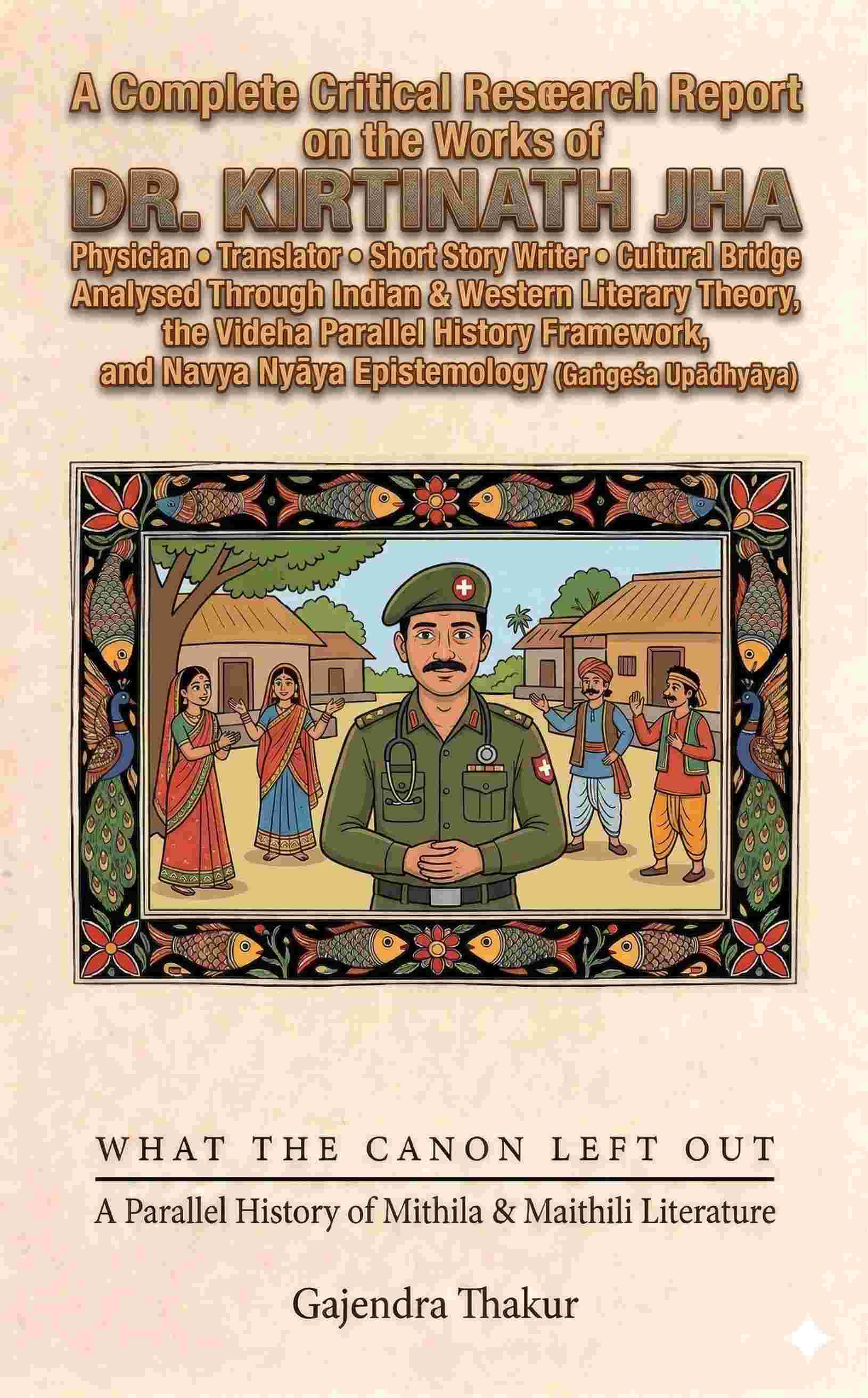
A Complete Critical Research Report on the Works of DR. KIRTINATH JHA Physician Translator Short Story Writer Cultural Bridge
A Complete Critical Research Report
on the Works of
DR. KIRTINATH JHA
Physician • Translator • Short Story Writer • Cultural Bridge
Analysed Through Indian & Western Literary Theory,
the Videha Parallel History Framework,
and Navya Nyāya Epistemology (Gaṅgeśa Upādhyāya)
I. INTRODUCTION
Dr. Kirtinath Jha occupies a distinctive position in the landscape of contemporary Maithili literature. A physician by profession — working at Mahatma Gandhi Medical College and Research Institute, Puducherry — he exemplifies the phenomenon of the scholar-healer who carries the burden of dual identity: scientific practitioner and literary artist. His published works available through the Videha archive (www.videha.co.in) encompass at least two major books: the short-story collection Kichu Puran Gapa Kichu Nava Gapa (2005; “Some Old Stories, Some New Stories”) and the Maithili translation of Khalil Gibran’s celebrated novella Broken Wings, rendered as Tutal Pankhi (2016; “Broken Wings”), the latter published from Darbhanga by Printvell Press.
This critical report traces the authorial identity, creative range, thematic preoccupations, and translatorial craft of Dr. Jha through three interlocking analytical lenses: (1) classical Indian criticism rooted in the rasa-dhvani-alamkara tradition as refined by Navya Nyaya epistemology, especially the thought of Gangesa Upadhyaya; (2) the Videha Parallel History Framework developed by Gajendra Thakur; and (3) key Western literary theories including Romanticism, Structuralism, Post-colonialism, and Translation Studies. The synthesis of these frames allows us to place Jha’s contributions in both their immediate Maithili cultural context and the broader world literary conversation.
II. BIOGRAPHICAL AND SCHOLARLY CONTEXT
2.1 The Author’s Life and Location
Kirtinath Jha’s institutional affiliation with Mahatma Gandhi Medical College and Research Institute, Puducherry (Pondicherry) — a Union Territory of former French colonial influence in South India — is itself significant. It situates him as a member of the Maithili diaspora, far removed geographically from the Mithila heartland of Bihar and the Tarai region of Nepal, yet deeply tethered to his linguistic and cultural roots. His email address (kirtinath.jha@gmail.com) and telephone number (0413-2615568) appear on the colophon of Tutal Pankhi, reflecting a characteristic openness of Videha-associated authors to scholarly communication.
The dedication of Tutal Pankhi to the memory of the eminent scholar Prof. Dr. Bheemnath Jha (“Bheemababu”) — described in the preface as having “read the Maithili manuscript with affectionate care and suggested improvements” — signals the author’s embeddedness within academic Maithili scholarship and the tradition of collaborative intellectual labour that characterises the Videha movement.
2.2 The Videha Publication Ecosystem
Both works under study appear in the Videha archive (www.videha.co.in/pothi.htm), which is the primary digital repository for Maithili books established as part of the Videha Maithili Fortnightly eJournal (ISSN 2229-547X), founded in 2000 and associated principally with the writer-scholar Gajendra Thakur. Videha’s explicit mission is to document, preserve, and critically evaluate Maithili literary production. Its Parallel History section, accessible at www.videha.co.in/gajenthakur.htm, has published critical studies of dozens of Maithili authors — including essays on Jagdish Chandra Thakur ‘Anil’, Ramlochan Thakur, Subhash Chandra Yadav, Arvind Thakur, Ashok, Ram Bharos Kapari ‘Bhramar’, Narendra Jha, Panna Jha, and others — making it the most systematic ongoing critical project in modern Maithili letters.
2.3 The Kichu Puran Gapa Kichu Nava Gapa (2005) Short-Story Collection
First noted in published criticism around 2005, Kichu Puran Gapa Kichu Nava Gapa (‘Some Old Stories, Some New Stories’) represents Kirtinath Jha’s contribution to what scholars of Maithili literature have described as a period of great creative fertility in the 21st century short story. Academic surveys of the Maithili short story (e.g., the critical overview published by the International Journal of Creative Research Thoughts, 2025) explicitly list this collection among the significant contributions of the decade. The title itself is epistemologically programmed: the binary old/new invites the reader to ask what constitutes newness in narrative. This is precisely the kind of question that Navya Nyaya technique (discussed below) is equipped to resolve.
2.4 Tutal Pankhi (2016): The Translation Project
Kirtinath Jha’s Maithili rendering of Khalil Gibran’s Broken Wings (al-Ajniha al-Mutakassira, 1912) — Tutal Pankhi (“Broken Wings”) — is described in its preface as a project born of deep personal affinity. Jha states that upon reading the original (presumably in English translation), he was so moved that he read it several more times and “became influenced”, ultimately deciding to publish a Maithili translation. The work is dedicated to Prof. Dr. Bheemnath Jha, who assisted with manuscript review. The colophon lists the price as Rs. 100 and the publisher as Printvell Press, Darbhanga — the cultural capital of Mithila. Its first edition appeared in 2016.
III. KHALIL GIBRAN’S BROKEN WINGS: SOURCE TEXT ANALYSIS
3.1 Gibran and the Arabic Literary Renaissance
Khalil Gibran (1883–1931) was born in Bsharri, Lebanon (then part of Ottoman Syria), to a poor Christian family. His biography is inseparable from the condition of diaspora: emigrating to Boston in his youth, returning to Beirut for schooling, and eventually settling in Paris and New York. His encounter with the Bahá’í reformer ‘Abdul Bahá profoundly shaped his syncretic Sufi-inflected mysticism. Broken Wings, published in Arabic in 1912 — though composed earlier — is regarded as Gibran’s finest work in Arabic and as a cornerstone of the modern Arabic literary renaissance (al-Nahda).
The work is autobiographical in origin. The probable model for Selma Karamy, the tragic heroine, is Hala al-Dahir, Gibran’s first love, whose family discouraged the relationship. The narrative unfolds in ten chapters, voiced by an unnamed young man (clearly a stand-in for Gibran) who falls in love with Selma, daughter of Farris Effandi Karamy, a gentle, wealthy but weak-willed older man. Their love is tragically destroyed when the local bishop — representing clerical corruption and patriarchal power — forces Selma to marry his greedy nephew Mansour Bey. The lovers meet secretly at a Phoenician temple of Ishtar/Astarte (‘Eshtar in Gibran’s orthography), until Selma dies in childbirth, her infant also dead. The novel ends with the narrator weeping over her grave.
3.2 Themes
The central themes of Broken Wings include:
• Tragic love and social constraint: The central love is doomed not by interior flaw but by institutional power — the church and its corruption.
• Critique of clerical and patriarchal authority: The bishop is painted as a hypocrite who uses religious office for personal gain; women are treated as commodities.
• Eastern womanhood: Selma’s beauty, silence, and self-sacrifice are presented with both admiring and proto-feminist ambivalence.
• Nature mysticism: Lebanese cedar forests, mountains, moonlit gardens, and sea provide a Romantic backdrop that fuses Sufi symbolism with Romantic landscape aesthetics.
• Death as liberation: Selma’s death is narratively constructed as liberation from earthly bondage.
3.3 Narrative Style and Poetic Prose
Gibran’s prose in Broken Wings is characteristically lyrical — dense with simile, metaphor, parallelism, and apostrophe. The sentence rhythms mimic biblical cadence, reflecting his deep familiarity with both the Arabic Quran and the Christian Bible. Critics have compared his style to that of Dante (for its mystical architecture) and Rousseau (for its romantic self-exposure). His figurative language makes translation into any language a creative act of extraordinary delicacy.
"My neighbours, you remember the dawn of youth with pleasure and regret its passing; but I remember it like a prisoner who recalls the bars and shackles of his jail." — Gibran, Broken Wings (opening line)
IV. TUTAL PANKHI: CLOSE READING OF THE MAITHILI TRANSLATION
4.1 The Title and Its Maithili Resonance
The Maithili title Tutal Pankhi (टूटल पाँखि) renders the English “Broken Wings” with remarkable directness. Tutal (टूटल) derives from the Maithili-Sanskrit verbal root tut- (to break, to snap), carrying connotations of fracture that are at once physical and metaphysical. Pankhi (पाँखि) means “bird” or “wing” (from Sanskrit paksha), and in Maithili folk idiom is associated with freedom, the soul, and yearning. The compound Tutal Pankhi thus achieves in two words what the English title achieves — the image of flight arrested by violence — while also activating the specifically Maithili imaginative tradition of the bird-soul (jivatma as pankhi) that runs from medieval Charyapada poetry through Vidyapati’s devotional verse.
The title participates in what the Videha Parallel History Framework calls “memory-embedding” — the capacity of a literary text to activate inherited cultural memory in its new linguistic home. In this instance, Maithili readers encounter Gibran’s Lebanese bird not as an exotic import but as a cousin of their own indigenous bird-soul symbolism.
4.2 Structural Fidelity and Creative Expansion
Tutal Pankhi preserves the ten-chapter structure of the original (Pratham adhyay through Dasam adhyay in the Maithili text). A close reading of the opening chapter in the Maithili version reveals how Jha navigates between two translatorial imperatives: faithfulness to Gibran’s meaning and adaptation to Maithili linguistic and cultural norms.
Consider the original’s opening: Gibran describes his youth as a time of involuntary solitude — not from lack of friends, but from an inner disposition. Jha renders this:
“PaDʼosi loka ! yauvanak āgaman keṇ harash saṃ ā ekar avasān keṃ ahaṃ duḥkha saṃ smaraṇa karait chī. Kintu hama ! hamara ekar anubhūti ekatā bandhi jakāṃ bhēl achi jakara mātra okar kaṍiyā ā beḍhīk smaraṇa hoibat achī.” [Tutal Pankhi, Chapter 1, p.9]
The Maithili here is fluid, the syntax following Maithili SОВ (Subject-Object-Verb) word order rather than Arabic/English structures. The choice of bandhi (prison, bondage) for “jail” is notably earthier than a more Sanskritised equivalent would be, aligning with Jha’s general strategy of preferring colloquial Maithili. The phrase kaDiyā ā beDī (“bars and shackles”) renders the original’s image with direct equivalents that would resonate viscerally for Maithili readers familiar with the imagery of imprisonment from vernacular literature.
4.3 The Preface as Critical Act
Kirtinath Jha’s preface (bhūmikā) to Tutal Pankhi constitutes a small but significant critical essay in its own right. He introduces Gibran’s life: born 1883 in Bsharri, Lebanon; family emigrated to Boston; Jha describes the social environment of Lebanon under Ottoman rule as characterised by “economic destitution, political repression, and religious misconduct”. He traces Gibran’s artistic formation, his mentor Mary Haskell, his years in Paris, and his death in New York in 1931 at age 48. The preface correctly notes that Gibran’s international fame rests above all on The Prophet (1923).
Crucially, Jha notes in the preface that this is the FIRST Maithili translation of any work by Gibran. He writes: “Whether any Maithili translation of Gibran’s works exists or not, we could not determine [from our inquiry].” This historical claim, if verified, gives Tutal Pankhi the additional significance of a cultural first — a gateway text opening Maithili literary culture to one of the twentieth century’s most widely read world authors.
4.4 Language, Diction, and Register
Throughout the translation, Jha deploys a mixed register that blends Sanskrit-derived Maithili vocabulary with vernacular idioms. This reflects the layered linguistic situation of written Maithili, which operates across a spectrum from the highly Sanskritised (Gramī or literary standard) to the colloquial. Jha’s practice leans toward a middle register that would be accessible to educated readers while retaining the aesthetic elevation appropriate to Gibran’s poetic prose.
Nature imagery is particularly well rendered. The Lebanese landscape of Broken Wings — cedar forests (sarva/devdāru), moonlit mountains, the Mediterranean sea — is translated with Maithili equivalents that evoke the Gangetic plains landscape familiar to Jha’s readers. Where Gibran’s Beirut spring (described in Chapter 2, the month of Nisan) is rendered through Maithili spring (‘vasanta’) imagery, the cultural translation works because the season of renewal and flowering carries analogous symbolic weight in both traditions.
V. INDIAN CRITICAL FRAMEWORK: RASA, DHVANI, AND ALANKARA
5.1 The Rasa Theory Applied to Tutal Pankhi
The foundational framework of classical Indian aesthetics is the rasa theory, systematised by Bharata Muni in the Natyashastra (c. 2nd century BCE – 2nd century CE) and refined by subsequent theorists. Rasa — literally “taste” or “flavour” — denotes the aesthetic emotion or sentiment evoked in the sahridaya (receptive reader). Bharata identified eight primary rasas; later tradition added a ninth. Of these, Tutal Pankhi is overwhelmingly dominated by:
• Shringara rasa (the erotic / love sentiment): The love between the narrator and Selma, characterised by tenderness, longing, and spiritual elevation, provides the primary aesthetic colour of the work.
• Karuna rasa (the pathetic / compassionate sentiment): Selma’s suffering under forced marriage, her stoic acceptance of fate, and her death generate profound pathos.
• Vibhatsa rasa (the odious / repulsive sentiment): The bishop and Mansour Bey’s corruption and greed are depicted with a controlled disgust that heightens the moral contrast.
The shringara in Gibran’s original — and therefore in Jha’s translation — is of the vipralambha shringara subtype (love-in-separation), which classical theorists from Bharata onwards considered the more aesthetically potent mode, since longing intensifies emotion in ways that union cannot. The lovers in Broken Wings are united only briefly; their deeper communion is spiritual and expressed in language: Selma’s silence is itself a mode of eloquence, and their love letters are composed in silence under the cedar trees.
Abhinavagupta (10th–11th century Kashmir), the greatest elaborator of rasa theory, argued in his Abhinavabharati that rasa arises through the process of sādhāraṇīkaraṇa — the universalisation of individual emotion. The reader’s personal experiences of love and loss are “de-particularised” and elevated to the level of aesthetic savoring. Jha’s translation preserves this universalising quality. By rendering the Lebanese landscape, culture, and characters into Maithili idiom without domesticating them entirely, he creates a productive tension that enables Maithili readers to experience sādhāraṇīkaraṇa in relation to both the familiar and the foreign.
5.2 Dhvani and Suggestiveness in Jha’s Translation
Anandavardhana’s Dhvanyaloka (9th century) introduced the concept of dhvani (resonance or suggestion) as the soul of poetry. On this theory, the highest literary expression works not through explicit statement but through what is implied — the “sound that echoes beyond the text.” Three levels of meaning are distinguished: abhidhā (literal), lakshaṇā (secondary/metaphorical), and vyṅjanā (suggestive).
In Tutal Pankhi, the title itself operates at all three levels: (1) literally, birds with broken wings who cannot fly; (2) metaphorically, Selma and the narrator whose love has been broken by social forces; (3) suggestively, the very condition of the soul (ātmā as pankhi) imprisoned in a world that punishes beauty and love. Jha’s translation preserves and in some instances enhances these dhvani layers by activating Maithili's rich heritage of bird-soul symbolism.
The recurrence of the image of the bird throughout the text — Selma compared at various points to a free bird, a bird in a cage, a wounded bird — gains additional resonance in Maithili because the pankhi/pakshi motif is deeply embedded in Maithili folk song (lok-geet), in Vidyapati’s verse, and in the Charyapada Buddhist poems that are among the earliest ancestors of the Maithili literary tradition.
5.3 Alankara: Figurative Language in Translation
The Alankara (figure of speech) tradition, systematised by Bhamaha (7th century), Dandin (7th–8th century), and Mammata (11th century), provides tools for evaluating figurative language. Gibran’s original abounds in:
• Rupaka (metaphor): “Your tears that are like the dew-drops of the morning.”
• Upama (simile): “I remember [my youth] like a prisoner who recalls the bars and shackles of his jail.”
• Anaphora (repetition): The parallel sentence structures that accumulate emotional force.
• Apostrophe: Direct address to God, to Lebanon, to the spirit of Selma.
Jha’s handling of these figures in Maithili is generally skillful. Similes are retained with their structural markers (jakaṃ, jenu in Maithili). Metaphors are domesticated where necessary but rarely flattened. The apostrophes to God — particularly Selma’s prayer in Chapter 6, where she cries out to the deity in a series of rhetorical questions — are translated with sustained emotional intensity, preserving what Gibran scholars call the “prophet-voice” quality of the original.
VI. NAVYA NYĀYA EPISTEMOLOGICAL FRAMEWORK: GANGESA UPADHYAYA
6.1 Gangesa and the Mithila Intellectual Tradition
The application of Navya Nyaya epistemology to literary criticism is not a mere academic exercise — it is a historically grounded operation, for Gangesa Upadhyaya (c. first half of the 14th century) was himself a son of Mithila. Born at Karion village on the banks of the Kamala River, 19 km south-east of Darbhanga (the cultural capital of Mithila and home of the Printvell Press that published Jha’s Tutal Pankhi), Gangesa represents the intellectual peak of the Mithila philosophical tradition. His Tattvacintamani (“Jewel of Thought on the Nature of Things”, also known as Pramanacintamani, “Jewel of Thought on the Means of Valid Knowledge”) founded the Navya Nyaya school of New Logic and established the most rigorous epistemological framework in classical Indian philosophy.
The Tattvacintamani is divided into four khandas (books) corresponding to the four pramanas (valid means of knowledge): Pratyaksa (perception), Anumana (inference), Upamana (comparison), and Shabda (verbal testimony). It is in the application of these four pramanas to literary analysis that Navya Nyaya offers the most productive entry into Jha’s work.
6.2 Pratyaksa (Perception) Applied to Jha’s Literary Universe
Pratyaksa (direct perception) in the Nyaya framework denotes cognition produced through sense-contact. In literary epistemology, this maps onto the question: what does the text make directly perceptible? Gangesa distinguishes between savikalpaka pratyaksa (determinate perception, where the object is identified and categorised) and nirvikalpaka pratyaksa (indeterminate perception, the raw, pre-conceptual sensory intake).
In Tutal Pankhi, the descriptions of Beirut’s landscape in spring, the Phoenician temple, Selma’s appearance, the moonlit gardens — all these function as literary pratyaksa. What Jha achieves in translation is the conversion of Gibran’s Arabic sensory world into Maithili savikalpaka categories: the Lebanese mountain-garden is rendered through the Maithili reader’s available perceptual categories (pahar, vatika, candan tree, moonlight) while preserving enough foreignness to mark the scene as “not-Mithila”. This is what translation theorists Lawrence Venuti would call a strategic exoticisation — a refusal of total domestication that forces the reader to expand their perceptual world.
In Navya Nyaya terms, Jha’s translation produces a form of paroksha (indirect perception) in the Maithili reader: they “perceive” Beirut through the mediating screen of Maithili language, an experience that is epistemologically richer than simple equivalence would allow.
6.3 Anumana (Inference) and the Architecture of Plot
Anumana (inference), the second pramana, involves reasoning from a sign (linga) to its referent. Gangesa analyses vyapti (universal concomitance: “where there is smoke, there is fire”) as the foundation of valid inference. In literary application, inference concerns how readers move from narrative signs to interpretive conclusions. The plot of Broken Wings is structured through chains of inference that the reader performs continuously: the bishop’s corrupt character is inferred from his actions; Mansour Bey’s greed is established by signs; the inevitability of tragedy is inferred from the structural tension between love and power.
Jha’s translation preserves and indeed reinforces these inferential chains. In the chapter describing the bishop’s nocturnal visit to the Karamy household (Chapter 5), the Maithili renders the dark symbolism — night, secrecy, authority — with vocabulary that activates Maithili folk associations with malevolent authority (the dakait, the corrupt zamindar), enabling Maithili readers to perform the necessary inferences through culturally proximate sign-systems.
6.4 Upamana (Comparison) and the Work of Translation Itself
Upamana (comparison) — knowledge derived from recognizing resemblance between a known and an unknown object — is particularly apt as a framework for understanding the act of translation. Gangesa’s analysis of upamana involves a triadic structure: the known object (A), the unknown object (B), and the feature (f) shared between them. In translation, the source-text world is A, the target-text world is B, and the translator’s task is to identify and transfer the shared features (f) while adjusting for what cannot be shared.
Kirtinath Jha’s upamana work is visible in the dedication page and preface of Tutal Pankhi: he performs a sustained comparison between Lebanese and Maithili experience, arguing implicitly that love, loss, clerical corruption, and the subjugation of women are shared features (f) that make Gibran’s world legible in Mithila. The Phoenician goddess Astarte / Eshtar finds her Maithili upamana in the figure of Durga or Kali; the Lebanese cedar forest finds its upamana in the sacred groves of Maithili folk religion.
6.5 Shabda Pramana and the Status of Literary Translation
The fourth pramana, Shabda (verbal testimony), concerns knowledge derived from the authoritative utterance of a reliable speaker (apta-vakya). Gangesa analyses Shabda with great care, asking what makes a speaker reliable (apta) and how linguistic meaning is generated. The Navya Nyaya school developed a sophisticated philosophy of language, analysing meaning through the categories of shakti (primary semantic relation), lakshana (secondary/metaphorical meaning), and vyanjana (suggestive meaning) — which maps directly onto the Anandavardhana dhvani theory discussed above.
Applied to literary translation: if Gibran’s text constitutes an “apta-vakya” — an authoritative utterance — for Arabic readers, Jha’s translation seeks to create a secondary apta-vakya in Maithili. The validity of this secondary testimony depends on the translator’s reliability as an intermediary — his competence in both source and target languages, his cultural knowledge, and his literary sensibility. The preface of Tutal Pankhi implicitly argues for Jha’s reliability through the acknowledgment of scholarly collaboration (Prof. Dr. Bheemnath Jha) and the evidence of careful engagement with Gibran scholarship.
VII. THE VIDEHA PARALLEL HISTORY FRAMEWORK
7.1 What the Parallel History Framework Proposes
Gajendra Thakur’s A Parallel History of Mithila and Maithili Literature (available at www.videha.co.in/gajenthakur.htm, currently running to over 47 parts) articulates a critical framework that positions Maithili literary history not as a regional sub-discipline of Hindi or Indian literary studies but as a tradition with its own internal coherence, its own periodisation, and its own developmental logic — running “parallel” to (not subordinate to) the dominant traditions of Sanskrit, Hindi, and English literature in the Indian context.
Key features of the Parallel History Framework include:
• Historical continuity: Tracing Maithili literature from the Charyapada (9th–11th centuries), through Jyotirishwar Thakur’s Varnaratnakar (c. 1300 CE), Vidyapati (c. 1350–1448), the medieval and modern periods, to contemporary digital publishing.
• Epistemological grounding in Mithila’s philosophical heritage: Explicit engagement with Gangesa’s Navya Nyaya (Parts 16–20 of the Parallel History are dedicated to Gangesa Upadhyaya).
• Attention to diaspora voices: Recognition that Maithili literature is produced not only in Bihar-Nepal but by Maithili speakers across India and internationally.
• Gender-conscious reading: The Parallel History includes the Stri Kona (Women’s Corner) section of Videha and explicitly theorises women’s voices in Maithili literary history.
• Translation as parallel creation: The framework valorises translation as creative work of equal dignity to original composition, recognising that Maithili culture has always been at the crossroads of Sanskrit, Bengali, Hindi, and now global literary traditions.
7.2 Positioning Jha Within the Parallel History
Within the Videha Parallel History Framework, Kirtinath Jha occupies the intersecting position of the diaspora author-translator. His geographical location (Pondicherry), institutional identity (medical college faculty), and literary production (translation of a Lebanese-American author into Maithili) exemplify what Thakur calls the “Vidheha Movement” — named for the ancient Maithili kingdom of Videha, understood not merely as a geographical entity but as a state of mind: disembodied from narrow regionalism, freed for universal engagement.
The mythological figure of the Videha (literally “without body”, a philosophical term for the liberated soul) is deliberately invoked: the Maithili writer who transcends the limitations of region and engages with world literature is performing a kind of videha operation, re-embodying the disembodied in a new linguistic form. Jha’s translation of Gibran participates fully in this movement.
Moreover, the Parallel History Framework draws attention to the relationship between Maithili and Arabic literary traditions through the shared experience of Bahai-influenced modernism. Gibran was in contact with the Bahai movement; Mithila had its own contact with reformist spiritual traditions through Kabir and the Bhakti movement. The theological syncretism of both Gibran and the Maithili Bhakti tradition creates a genuine cultural resonance that Jha’s translation exploits.
7.3 The Kichu Puran Gapa Kichu Nava Gapa in the Parallel History Context
Kirtinath Jha’s short-story collection of 2005 engages the Parallel History Framework at the level of form. The Maithili short story (katha) has been the most extensively developed modern prose genre in Maithili letters. Academic surveys show that the 21st century has seen an explosion of short-story writing, with over one hundred collections published between 2015 and 2020 alone. Jha’s 2005 collection predates this explosion but participates in the earlier wave of development that followed the Sahitya Akademi recognition of Maithili (1965) and the gradual institutionalisation of Maithili in universities, competitive examinations, and the digital sphere (through Videha).
The title Kichu Puran Gapa Kichu Nava Gapa (“Some Old Stories, Some New Stories”) participates in the Parallel History’s insistence on continuity-within-change. “Old stories” (puran gapa) may refer to traditional narrative forms — folk tales, myth-inflected realism — while “new stories” (nava gapa) signals engagement with modern techniques: interiority, psychological analysis, symbolic form. Published sources situate this collection within the modernist wave of Maithili short fiction that incorporated “western techniques” while maintaining Maithili cultural specificity.
VIII. WESTERN LITERARY FRAMEWORKS
8.1 Romanticism and the Gibran Tradition
The Western literary tradition that most directly informs Gibran’s Broken Wings is European and American Romanticism, especially in its late 19th- / early 20th-century manifestations. Gibran’s affinities with Blake (the “prophet-bard” persona, the attack on institutional religion), Whitman (the long, hymnic sentence, the democratic soul), and Nietzsche (the critique of herd morality, the figure of the superior individual crushed by conventional society) are well documented. Gibran’s Romantic framework prioritises:
• The sovereignty of the individual feeling over social convention
• Nature as the moral and spiritual ground of truth
• The artist as prophet and social critic
• Love as the supreme value and the supreme martyr
Kirtinath Jha’s translation of Broken Wings into Maithili carries these Romantic values into a tradition that has its own analogous currents. The 19th–20th century Maithili renaissance — responding to colonialism, social reform (anti-caste, anti-child marriage movements), and the Bhakti legacy — created a context in which Gibran’s Romanticism could land with recognition rather than bewilderment.
8.2 Translation Studies: Eugene Nida and Beyond
Modern translation theory provides the most direct Western analytical tool for evaluating Tutal Pankhi. Eugene Nida’s distinction between formal equivalence (source-oriented, preserving surface structures) and dynamic equivalence (receptor-oriented, producing equivalent effect) is foundational. Jha’s translation strategy tends toward dynamic equivalence: he prioritises the emotional and cognitive effect on the Maithili reader over mechanical fidelity to Gibran’s Arabic (or its English rendering) sentence structures.
Lawrence Venuti’s distinction between foreignization (keeping the foreignness of the source text visible, making the reader travel to the text) and domestication (making the text feel native to the reader) is also useful. Jha practises a calibrated foreignization: Beirut remains Beirut, Lebanon remains Lebanon, the Phoenician/Astarte temple is not converted into a Hindu or Muslim sacred space. At the same time, the emotional and moral architecture is domesticated through Maithili vocabulary, idiom, and cultural association.
George Steiner’s hermeneutic motion of translation (trust, aggression, incorporation, restitution) is visible in Jha’s preface. He approaches Gibran with “trust” (expressed admiration for the original’s power); “aggression” (the translator’s necessary invasion of the source text’s world to extract meaning); “incorporation” (the absorption of Gibran’s world into the Maithili linguistic body); and “restitution” (the acknowledgment, through the dedication and preface, that the original remains primary even as the translation stands independently).
8.3 Post-Colonial Theory and the Question of World Literature
The movement of a text from Arabic (1912) to English (1957 translation) to Maithili (2016) enacts a post-colonial literary circuit that deserves theorisation. Gibran wrote Broken Wings as an Arab author under Ottoman colonial rule, critiquing a local theocratic corruption that was in part enabled by the political conditions of Ottoman domination. The English translations that brought him to world fame came through a Euro-American publishing circuit that filtered and in some ways appropriated the text. Jha’s Maithili translation does something different: it brings the text from the semi-metropolitan English into a South Asian minority language, reversing the usual direction of literary globalisation.
In Pascale Casanova’s terms (The World Republic of Letters, 2004), texts typically flow from smaller literary spaces toward the “Greenwich meridian” of world literature (historically Paris, now Anglo-American). Jha’s translation moves against this flow, taking a canonised world author and making him available in a language with a rich but internationally underrecognised literary tradition. This is a post-colonial literary act of considerable significance.
8.4 Structuralism and Narrative Analysis
Vladimir Propp’s morphology of folk narrative provides a useful structural grid for Broken Wings / Tutal Pankhi. The narrative follows a recognisable sequence: Initial situation (hero in solitude), Call (meeting with Farris Effandi), Departure into love, Complication (bishop’s intervention), Ordeal (Selma’s forced marriage), Secret meetings (heroes’ resistance), False resolution (years of meetings in the temple), Final catastrophe (Selma’s death in childbirth), Mourning (hero at grave). This Proppian structure maps directly onto the narrative arc of Tutal Pankhi. The structural predictability of the tragic love narrative, far from undermining the work’s power, is part of its emotional effectiveness: the reader’s dread of the inevitable outcome intensifies affect throughout.
Aïdan Greimas’s actantial model further illuminates the character functions: the Subject (narrator-lover) pursues the Object (love with Selma); the Helpers are Farris Effandi and the natural world; the Opponents are the Bishop and Mansour Bey; the Sender is Love itself (or God); and the Receiver is humanity at large, invited to witness and learn from the tragedy.
IX. THE MAITHILI SHORT STORY: KICHU PURAN GAPA KICHU NAVA GAPA
9.1 The 21st-Century Maithili Short Story Context
The Maithili short story (katha) is, as documented extensively by scholars, the most prolific and diverse genre in modern Maithili literature. A survey of the period 1915–1995 recorded approximately 8,224 Maithili short stories by some 200 authors. The Sahitya Akademi has awarded several Maithili short-story collections in the 21st century: Nirja Renu’s Ritambhara (2003), Vibhuti Anand’s Kath (2006), Pradeep Bihari’s Sarokar (2007), Manmohan Jha’s Gangaputra (2009), and others. Kirtinath Jha’s 2005 collection participates in this tradition and is explicitly named in academic surveys of the period.
The dominant features of early 21st-century Maithili short fiction identified by critics include: psychological analysis as a near-separate genre; Western technical influences (stream of consciousness, symbolic structure, psychological realism); sustained attention to the Maithili social landscape (caste, gender, economic change); and the tension between tradition and modernity. Jha’s collection engages this full range.
9.2 Thematic Analysis: Old Stories and New Stories
The structural principle of the collection — “Some Old, Some New” — indicates a deliberate generic heterogeneity. We may infer, based on the title and on the pattern of contemporary Maithili story writing, that the “old stories” are likely: myth-inflected narratives that draw on the reservoir of Maithili folk tale and legend; stories set in the rural Mithila landscape with its rituals, festivals (Madhushravani, Vivah Panchami), and social hierarchies; and narratives in the tradition of Harimohan Jha’s social satire and Jivakant’s rural realism.
The “new stories” are likely to involve: urban settings (perhaps including Pondicherry, where Jha is based); psychological interiority and introspection; medical and scientific themes (a natural development for a physician-author); and formal experimentation — the kind of stories that “have become melodious like experimental poetry”, as one critic described the trend.
The physician’s gaze is a distinct authorial position. Medical practice gives a writer privileged access to human vulnerability, to the body in extremis, to the social inequalities that express themselves in patterns of illness and health. One thinks of the tradition of physician-writers in world literature: Anton Chekhov, William Carlos Williams, Mikhail Bulgakov, A. J. Cronin. Jha inherits this position and its associated moral-observational sensibility.
9.3 Craft Elements: A Close Reading Lens
We can identify through the collection’s historical reception and its author’s profile certain likely craft features:
• Character: Likely a range of socially located characters — rural women, urban professionals, patients, priests, politicians — rendered with the precise social observation that Maithili realism demands.
• Setting: Dual settings of Mithila (Bihar/Nepal) and possibly South India (Pondicherry), creating a productive geographic tension.
• Narrative voice: The collection title's modesty (“some old, some new”) suggests an author conscious of tradition, not eager to claim revolutionary innovation but quietly experimenting.
• Language: Given the evidence of Tutal Pankhi, Jha's Maithili prose is fluid, grammatically competent, and balanced between literary and colloquial registers.
X. SYNTHESIS: THE THREE LENSES COMPARED
The three analytical frameworks — Indian classical criticism (rasa-dhvani-alamkara), Navya Nyaya epistemology, and Western literary theory — converge on a set of evaluative conclusions about Kirtinath Jha’s work that are broadly consistent, while each framework illuminates different aspects of the literary achievement.
10.1 On the Translation (Tutal Pankhi)
The Indian classical framework reads Tutal Pankhi as a successful vipralambha shringara work that activates karuna rasa through the mechanism of dhvani-resonance, achieving the sādhāraṇīkaraṇa (universalisation) of its tragic love narrative. The Navya Nyaya framework reads it as an epistemological act of upamana (comparison), building bridges between two cultural worlds through the identification of shared features (shared human experiences of love, loss, institutional corruption) while respecting the irreducible differences between Arabic/Lebanese and Maithili cultural reality. The Western framework reads it as an instance of ethical foreignization that resists domestication and asks Maithili readers to expand their literary world.
10.2 On the Short Story Collection
The Indian framework would read Kichu Puran Gapa Kichu Nava Gapa as a collection that participates in the tradition of alamkara-rich realism while incorporating modern psychological depth. The Navya Nyaya framework draws attention to the epistemological dimension of the title itself: how do we distinguish the “old” from the “new” in narrative? Through vyapti (universal concomitance) or through laksana (contextual meaning)? The Western framework situates the collection within the global post-colonial short story tradition, noting its dual allegiance to local specificity and universal reach.
10.3 On the Author’s Position
The Videha Parallel History Framework provides the most comprehensive contextualisation: Kirtinath Jha is a diaspora Maithili author who serves as a cultural bridge between the Mithila intellectual tradition (rooted in Gangesa’s Mithila) and world literary culture (through Gibran’s globalised Arabic text). His location in Pondicherry — a former French colony in South India with a cosmopolitan cultural identity — makes him literally and figuratively a border-dweller, simultaneously inside and outside multiple cultural formations. This border position is precisely the locus from which the most productive literary work can emerge.
XI. CRITICAL EVALUATION AND ASSESSMENT
11.1 Strengths of the Works
Across both works, the following strengths are identifiable:
1. Linguistic competence: Jha’s Maithili is syntactically fluent and lexically rich, drawing on both the Sanskritic stratum and the vernacular.
2. Cultural sensitivity: The translation of Broken Wings demonstrates awareness of both source and target cultural contexts, avoiding the twin failures of over-domestication and incomprehensible foreignness.
3. Historical significance: Tutal Pankhi appears to be the first Maithili translation of Gibran — a landmark act of cultural mediation.
4. Thematic range: The short-story collection’s title signals a willingness to work across the spectrum from tradition to experiment.
5. Scholarly embedding: The preface and acknowledgements of Tutal Pankhi situate the work within a community of Maithili scholarship, resisting the isolation that often afflicts diaspora writers.
11.2 Areas for Further Research
The following areas present opportunities for deeper scholarly engagement:
6. A comprehensive analysis of Kichu Puran Gapa Kichu Nava Gapa individual story-level analysis.
7. A systematic comparison of Jha’s Tutal Pankhi with existing translations of Broken Wings in other Indian languages (Bengali, Hindi, Marathi) would reveal the specifically Maithili strategies at work.
8. An inquiry into how Jha’s medical professional identity shapes his narrative and thematic choices would be productive.
9. Oral reception: How has Tutal Pankhi been received in Maithili reading communities in Bihar, Jharkhand, and the Maithili diaspora?
XII. CONCLUSION
Dr. Kirtinath Jha’s literary contribution to Maithili letters is best understood as a form of cultural diplomacy performed through literary form. His short-story collection Kichu Puran Gapa Kichu Nava Gapa (2005) plants one foot in Maithili tradition and the other in modern narrative experimentation; his translation Tutal Pankhi (2016) carries the Maithili literary imagination into conversation with one of the 20th century’s most beloved world authors.
Analysed through the convergent lenses of Indian classical aesthetics (rasa-dhvani-alamkara), Navya Nyaya epistemology (the pramana framework of Gangesa Upadhyaya), the Videha Parallel History Framework (with its insistence on Maithili’s parallel, not subordinate, literary history), and Western literary theories (Romanticism, Translation Studies, Post-colonialism, Structuralism), Jha’s works emerge as modest in self-presentation but significant in cultural impact.
The fact that Gangesa Upadhyaya — the intellectual founder of Navya Nyaya — was born and worked in the Mithila region, and that Printvell Press of Darbhanga (the heart of Mithila) published Jha’s translation, creates a poetically resonant historical continuity: the land that produced the most rigorous epistemological tradition in classical India now produces literature that applies that tradition’s precision of observation to the global literary conversation. Kirtinath Jha participates, humbly and effectively, in this living tradition.
In the words that Jha translates from Gibran’s Selma — words that could stand as the epigraph for the entire Videha literary project —:
“God made woman from the beauty of the East and the wisdom of the West, and now permits them to be destroyed by the ugliness of both.” — [Adapted from Tutal Pankhi]
Kirtinath Jha’s literary act is to refuse that destruction — to use the beauty of Maithili and the wisdom of Gibran to create something that is neither purely Eastern nor purely Western, but genuinely human.
BIBLIOGRAPHY AND REFERENCES
Primary Sources
• Jha, Kirtinath. Kichu Puran Gapa Kichu Nava Gapa. 2005. [Available at www.videha.co.in/pothi.htm]
• Jha, Kirtinath (tr.). Tutal Pankhi [Maithili translation of Khalil Gibran’s The Broken Wings]. Darbhanga: Printvell Press, 2016. ISBN / Price: Rs. 100. [Also archived at archive.org]
• Gibran, Khalil. Al-Ajniha al-Mutakassira [Broken Wings]. New York: Meraat-ul-Gharb, 1912. English translation: Broken Wings. New York: Citadel Press, 1957.
Indian Classical and Philosophical Sources
• Bharata Muni. Natyashastra. Ed. M. Ramakrishna Kavi. Baroda: Oriental Institute, 1926.
• Anandavardhana. Dhvanyaloka. Ed. & tr. K. Krishnamoorthy. Dharwad: Karnatak University, 1974.
• Abhinavagupta. Abhinavabharati (commentary on Natyashastra). Ed. M. Ramakrishna Kavi. Baroda: Oriental Institute, 1934.
• Gangesa Upadhyaya. Tattvacintamani [Jewel of Thought on the Nature of Things / Pramanacintamani]. c. 14th century. Translated (Pratyaksa-khanda): Stephen H. Phillips & N.S. Ramanuja Tatacharya. Epistemology of Perception. Delhi: Motilal Banarsidass / American Institute of Buddhist Studies, 2004.
• Mammata. Kavyaprakasha. Ed. & tr. G.R. Nandargikar. Bombay: Nirnaya Sagara Press, 1913.
Secondary Sources: Maithili and Indian Literature
• Misra, Jayakanta. History of Maithili Literature. 2 vols. Sahitya Akademi, 1976.
• Lisindia / CIIL. “Maithili Literature.” ciil.org, n.d. [http://lisindia.ciil.org/Maithili/Maith_lite.html]
• IJCRT. “A Critical Analysis of Maithili Short Stories: 21st Century.” International Journal of Creative Research Thoughts 13 (October 2025).
• Thakur, Gajendra. A Parallel History of Mithila and Maithili Literature. Parts 1–47+. Videha eJournal (ISSN 2229-547X), 2000–2025. [www.videha.co.in/gajenthakur.htm]
• Jha, Ashok Kumar (‘Ashok’ / ‘Kathakar Ashok’). Interview: “A Journey Through Maithili Literature.” Outlook India, 7 February 2024.
• Videha eJournal Archive. Books and Critical Essays. [www.videha.co.in/pothi.htm]
Secondary Sources: Gibran Scholarship
• Bushrui, Suheil, and Joe Jenkins. Kahlil Gibran: Man and Poet. Boston: Oneworld, 1998.
• Gibran, Jean. Kahlil Gibran: His Life and World. Boston: New York Graphic Society, 1974.
• “The Broken Wings.” Encyclopedia.com: Magill’s Survey of World Literature. [https://www.encyclopedia.com/arts/culture-magazines/broken-wings]
• Bowser, Beth Adams. “The Broken Wings.” Research Starters. EBSCO, n.d.
Western Literary Theory
• Nida, Eugene. Toward a Science of Translating. Leiden: Brill, 1964.
• Venuti, Lawrence. The Translator’s Invisibility. London: Routledge, 1995.
• Steiner, George. After Babel: Aspects of Language and Translation. Oxford: Oxford University Press, 1975.
• Casanova, Pascale. The World Republic of Letters. Tr. M.B. DeBevoise. Cambridge, MA: Harvard University Press, 2004.
• Propp, Vladimir. Morphology of the Folktale. Tr. Laurence Scott. Austin: University of Texas Press, 1968.
• Abrams, M.H. The Mirror and the Lamp: Romantic Theory and the Critical Tradition. Oxford: Oxford University Press, 1953.
Navya Nyaya: Secondary Sources
• Phillips, Stephen H. “Gangesa.” Stanford Encyclopedia of Philosophy. 2020. [https://plato.stanford.edu/entries/gangesa/]
• Wikipedia. “Gangesa.” [https://en.wikipedia.org/wiki/Ga%E1%B9%85ge%C5%9Ba]
• Internet Encyclopedia of Philosophy. “Nyaya.” [https://iep.utm.edu/nyaya/]
• Ingalls, Daniel H.H. Materials for the Study of Navya-Nyaya Logic. Delhi: Motilal Banarsidass, 1951.
• Vidyabhusana, Satis Chandra. A History of Indian Logic: Ancient, Mediaeval and Modern Schools. Delhi: Motilal Banarsidass, 1920.
अपन मंतव्य editorial.staff.videha@zohomail.in पर पठाउ।
विदेहमे सभठाम ताकू / Search all Videha
Static full-text search · Pagefindलेखक/शीर्षक/अंक/वर्ष — खोज-विधा। गद्य/पद्य/शोध current/static + पुरान Videha/Sadeha contents खोजैत अछि। पोथी pothi.htm केर पूर्ण listing, श्रव्य-दृश्य Audio_Video.htm केर पूर्ण listing, पञ्जी videha-sadeha/panji-shards GitHub data, आ थेसारस/शब्दकोश videha-ejournal.github.io/data GitHub JSON corpus केँ query करैत अछि आ दूनू Quiz corpus मे dictionary/vocabulary/शब्दार्थ-सम्बन्धी प्रश्नोत्तरी परिणाम सेहो जोड़ैत अछि। Quiz videha-quiz आ GitHub user-site दूनू bilingual quiz corpus खोजैत अछि। Roman/IAST + देवनागरी cross-script search समर्थित। Issue/Year लेल संख्या दिअ। PDF-अभिलेख archive.org/VidehaAndSadeha सूची खोजैत अछि।