
A PARALLEL HISTORY OF MITHILA & MAITHILI LITERATURE- PART 89
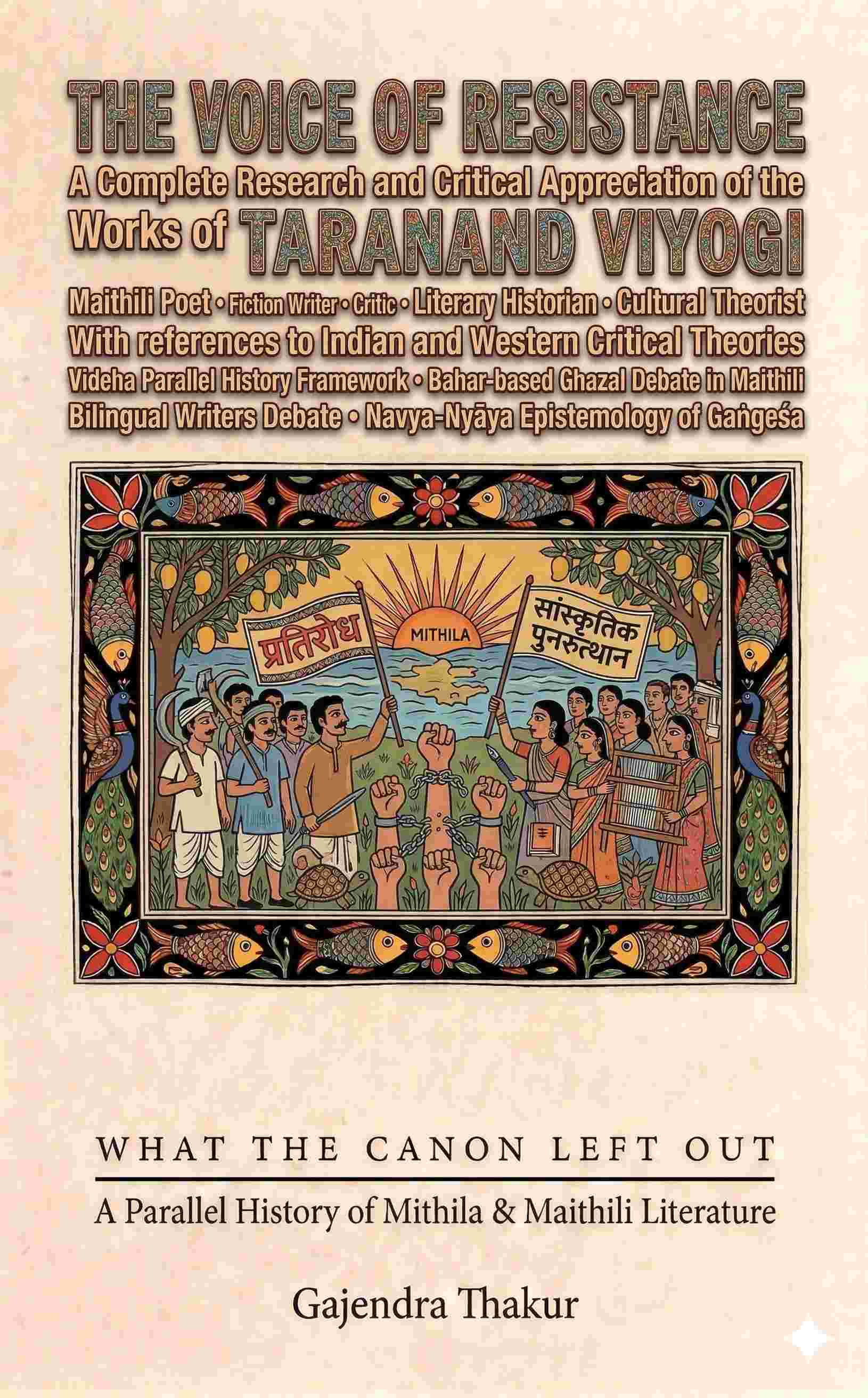
Beyond the Rhetoric: The Fractured Voice of Taranand Viyogi
Beyond the Rhetoric: The Fractured Voice of Taranand Viyogi
Abstract:
Taranand Viyogi (b. 1966) is the most versatile Maithili writer of his
generation, yet his work is deeply contested. While presenting himself
as a champion of Dalit aesthetics, critics argue his methods constitute
a "Neo-Brahminical" project. This monograph provides a comprehensive
analysis of Viyogi’s entire corpus—poetry, ghazal, fiction, criticism,
and history—using Indian aesthetics (Rasa, Dhvani, Navya-Nyāya), Western
theory (Marx, Foucault, Spivak), and the Videha Parallel History
Framework.
Table of Contents
1. Preface and Methodological Framework
2. Biographical Profile: Displacement and Institutional Power
3. Complete Works: Annotated Bibliography
4. Theoretical Frameworks (Applied to Viyogi)
o Indian Poetics (Rasa, Dhvani, Vakrokti)
o Western Theory (Tragedy, Postcolonial, Marxist)
o Navya-Nyāya Epistemology (Gaṅgeśa)
o Videha Parallel History Framework
o The Bahar-Based Ghazal Debate
o The Bilingual Writers Debate
5. Creative Works: Poetry, Ghazal, and Fiction
o Early Interventions (Hastkṣep, Sākhi)
o Apocalypse and Love (Pralaya Rahasya, Duniyā Ghar Mehman)
o The COVID Diary (Dharāśāyī Hebāk Samay)
o The Maithili Ghazal (Apan Yudhak Sākṣya)
o Short Fiction (Atikramaṇ, Chiyānat)
6. Scholarly Works: Memoir, Criticism, and History
o Memoir & Biography (Tumi Chir Sārathi, Yugon Kā Yātrī)
o Literary Criticism (Bahuvachan, Karmadharay)
o Literary History (Maithilī Kavitak Hazar Varṣa)
o Translated Works (Kabir, Desil Bayana)
7. Critical Refutation: The Neo-Brahminical Paradox
o The Case for the Prosecution (Institutional Gatekeeping)
o Epistemological Failures (Navya-Nyāya Critique)
o The Meter Controversy and Historical Fallacies
o The "Mathadheesh" Behavior and Erasure of Dissent
8. Synthesis: Convergent Invalidity
9. Conclusion: The Burden of Authenticity
10. Bibliography
1. Preface and Methodological Framework
Taranand Viyogi stands as one of the most intellectually formidable and socially committed writers in contemporary Maithili literature. With nearly forty published titles across poetry, ghazal, fiction, criticism, and history, he is arguably the most versatile Maithili writer of his generation. Yet his significance is matched by intense controversy.
This monograph applies a pluralist critical methodology:
· Indian Classical Aesthetics: Rasa (Bharata), Dhvani (Ānandavardhana), Vakrokti (Kuntaka).
· Navya-Nyāya Epistemology: The pramāṇa framework of Gaṅgeśa (pratyakṣa, anumāna, śabda).
· Western Critical Traditions: Aristotle, Marx, Gramsci, Spivak (Subaltern), Foucault, Iser.
· Videha Parallel History Framework: Gajendra Thakur’s anti-establishment revisionist historiography.
· Maithili-Specific Debates: The applicability of Urdu-Persian bahar prosody to the Maithili ghazal.
2. Biographical Profile: Displacement and Institutional Power
Viyogi’s life is defined by a paradoxical trajectory from the margins of society to the center of state power.
· Origins & Displacement: Born in 1966 in Mahishi, Saharsa, into a family of agricultural laborers uprooted by the Sapta Kosi High Dam. This "ur-condition" of displacement infuses his work.
· Education & Career: Educated in the Sanskrit high school tradition (PhD, Sahityācharya). He serves as a Bihar Administrative Service officer (Deputy Collector, CEO).
· Literary Lineage: He positions himself as the heir to Nagarjun (Yatri) and Rajkamal Chaudhary. His credo: "Yatri made Maithili sweat... dragged it out of silken salons into sunburnt soil."
· Public Controversy: His poem ‘Bābhanak Gāam’ (2000) incited a Brahmin poet-friend to distribute copies hoping to provoke violence against Viyogi.
3. Complete Works: Annotated Bibliography
|
Genre |
Key Titles |
Critical Assessment |
|
Poetry |
Hastkṣep (1996), Sākhi (2020), Pralaya Rahasya, Dharāśāyī Hebāk Samay (2021) |
Uses folk forms (Kabir sākhi) to document caste violence and the COVID-19 crisis. |
|
Ghazal |
Apan Yudhak Sākṣya (1991/2017) |
Insists on strict Urdu-Persian bahar (meter), claiming the form as a "combative platform." |
|
Short Fiction |
Atikramaṇ (1997), Chiyānat (2020) |
Explores the globalizing millennial moment and its effects on rural Bihar. |
|
Biography |
Tumi Chir Sārathi (2016), Yugon Kā Yātrī |
Explores the life of Nagarjun, positioning him as the "eternal charioteer" of Maithili. |
|
Criticism |
Bahuvachan (2015), Karmadharay |
A major survey of modern Maithili literature through the lens of navjāgaraṇa (renaissance). |
|
History |
Maithilī Kavitak Hazar Varṣa (2 vols) |
A monumental attempt to recover "history-excluded poets" (itihāsa-vañcit kavī). |
4. Theoretical Frameworks Applied
A. Indian Poetics (Rasa, Dhvani, Vakrokti)
· Rasa: Viyogi’s Dalit poetry fuses raudra (fury) and karuṇa (pathos), refusing resolution into śānta (tranquility)—a political refusal of upper-caste transcendence.
· Dhvani: The title Apan Yudhak Sākṣya operates on multiple levels: testimony (sākṣya) and war (yuddha), echoing both legal epistemology and the Gita.
· Vakrokti: His "oblique" use of mythological terms (e.g., pralaya as social destruction) produces aesthetic surprise.
B. Western Critical Theory
· Gramsci & Spivak: Viyogi challenges Brahminical cultural hegemony. However, his claim to speak for Dalits as an OBC writer risks "strategic essentialism" that silences the subaltern.
· Foucault (Author-Function): Viyogi operates as a "transdiscursive" author. His name signifies authority even when his work lacks evidence, constructed by institutional "monastery heads."
· Wolfgang Iser (Act of Reading): Viyogi fails the primary act of reading (e.g., misreading Dhumketu’s story), violating the phenomenology of aesthetic response.
C. Navya-Nyāya Epistemology (Gaṅgeśa)
· Pakṣatā (Supposition): Every Viyogi poem presents a thesis (e.g., "Caste harms the oppressor").
· Śabda-pramāṇa (Testimony): Viyogi uses oral tradition as valid evidence, challenging scriptural bias.
· The Critique: Critics argue Viyogi fails Pratyakṣa (perception) by making claims without textual examples, and lacks aparokṣa jñāna (direct knowledge). He is an apramāṇa (unreliable) speaker.
D. Videha Parallel History Framework
· Developed by Gajendra Thakur, this framework argues Maithili history was shaped by Brahminical gatekeeping.
· Viyogi’s Role: He provides the "living work" (creative literature) to Thakur’s "archive."
· The Counter-Argument: Viyogi commits a "monohistorical fallacy"—believing his revisionist approach is the only truth, thus replicating exclusionary tactics.
5. Creative Works: Poetry, Ghazal, and Fiction
A. The Dalit Intervention (Hastkṣep, Sākhi)
· Hastkṣep (1996): The title ("Intervention") declares a disruption of the Brahminical status quo.
· ‘Bābhanak Gāam’: Critiques how caste "deforms" Brahmin children. It extends compassion to the oppressor, an Ambedkarite move.
· Sākhi (2020): Invokes the Kabir tradition for Dalit testimony. Poems like ‘Akādamī Meṃ Dalit’ attack institutional tokenism.
B. Apocalypse and Love (Pralaya Rahasya, Duniyā Ghar Mehman)
· Pralaya Rahasya: Repurposes Hindu cosmological dissolution as a metaphor for the destruction of feudal-caste structures.
· Duniyā Ghar Mehman: Claims the classical śṛṅgāra (love) tradition for the non-Brahmin writer, inflected with feminist self-consciousness.
C. The COVID Diary (Dharāśāyī Hebāk Samay)
A unique "COVID Diary" that captures the prostration of the state and the suffering of migrant laborers. The day-by-day structure creates a formal correlative for pandemic time.
D. The Maithili Ghazal (Apan Yudhak Sākṣya)
Viyogi is a founding theorist of the Maithili ghazal. He insists on strict adherence to Urdu-Persian bahar (meter), arguing that the discipline of the form produces the tautness necessary for political utterance.
E. Short Fiction (Atikramaṇ, Chiyānat)
The title Chiyānat (Betrayal) is programmatic. The stories focus on intimate betrayals by families and institutions during the globalizing millennial moment.
6. Scholarly Works: Memoir, Criticism, and History
A. Memoir & Biography (Tumi Chir Sārathi)
A celebrated memoir of Nagarjun. Viyogi argues that Nagarjun "rebuilt" Maithili by restoring the language to those it had been stolen from.
B. Literary Criticism (Bahuvachan)
· Bahuvachan (Plural Form): Argues for a multiplicity of voices against the "singular voice" of the Brahminical tradition.
· Methodology: Eclectic (Marxist, biographical, textual), reflecting his belief that no single method is adequate.
C. Literary History (Maithilī Kavitak Hazar Varṣa)
A monumental two-volume history supposedly trying to rehabilitate poets suppressed for their anti-Brahminical stances. He presents facts based on his pseudo assumptions which are factually wrong.
He wrongly claims that Maithili has a deep oral tradition preceding Sanskrit influence, a claim as unfounded as Rajeshwar Jha's argument that Brahmi script derives from Tirhuta (Mithilakshar). Yet even the Ṛgveda acknowledges the existence of parallel oral traditions like Narashanshi and Gāthā. Moreover, he ignores the presence of Chhanda in early Maithili literature, despite the fact that both the Ṛgveda and the Charyapada are composed in Chhanda. These oversights reveal his neo-brahminical bias.
7. Critical Refutation: The Neo-Brahminical Paradox
This section details the "Cons" argument: that Viyogi’s methodology mirrors the gatekeeping he critiques.
A. Institutional "Mathadheesh" Behavior
Critics argue Viyogi has become a "mathadheesh" (monastery head) of Maithili criticism.
· Exclusionary Tactics: He practices godhiyavad (compromising criticism), protecting allies and erasing the names of rivals from literary histories.
· Inauthentic Polemics: His aggressive stance is the opposite of sahṛdayatva (empathetic resonance) required by Indian aesthetics.
B. Epistemological Failures (Navya-Nyāya Refutation)
Applying Gaṅgeśa’s Tattvacintāmaṇi:
1. Failure of Pratyakṣa (Perception): Viyogi claims meter is not native to Maithili folk poetry but provides no textual scansions. Evidence from Charyapad (16 matras per line) contradicts him.
2. Failure of Anumāna (Inference): His argument that "Manbodh was the first to use meter" is based on a false example (savyabhicāra), making his inference invalid.
3. Failure of Śabda (Testimony): He is not an āpta (trustworthy) speaker. He evaluated Dhumketu’s story "Namaje Shukrana" as communal harmony, but the story describes communal bigotry (a parrot thrown against a wall).
C. The Meter Controversy
· Viyogi’s Claim: Meter is a "Sanskritic imposition" by a "parasitic priestly class."
· The Refutation: Meter exists in the Charyapad (8th-9th c.), the Malla kings’ works, and saint poetry. Viyogi ignores these to maintain his polemic.
8. Synthesis: Convergent Invalidity
A multi-theoretical analysis reveals striking convergence:
· Western Criticism (Iser/Fish): Fails the act of reading; belongs to a "mythological criticism" community.
· Indian Aesthetics (Abhinavagupta): Lacks sahṛdayatva; confuses scribal error with authorial intention.
· Videha Framework: Commits the "monohistorical fallacy" (totalizing history).
· Navya-Nyāya: Claims are apramāṇa (not valid knowledge).
Conclusion of the Refutation: Viyogi’s revisionist history often lapses into inauthentic scholarship. His work is not merely wrong; by Navya-Nyāya standards, it does not qualify as knowledge at all.
9. Conclusion: The Burden of Authenticity
The Achievement: Viyogi’s corpus is the most comprehensive individual contribution to the democratization of Maithili literature. He has recovered suppressed voices, documented the pandemic’s toll, and claimed a "plural" space for Maithili.
The Paradox: However, the "Neo-Brahminical" shift in his later work—assertion without evidence, erasure of dissent, refusal to engage with textual reality—presents a profound contradiction. While he champions "resistance," his methodology mirrors the exclusionary gatekeeping he critiques.
Final Verdict: Taranand Viyogi remains a transformative yet deeply problematic figure. For Maithili literary studies to advance, it must move beyond such "mythological criticism" toward rigorous, evidence-based scholarship that meets the standards of pramāṇa.
10. Bibliography
A. Primary Works (Archived at videha.co.in/pothi.htm)
· Viyogi, T. Apan Yudhak Sākṣya. Kisun Sankalp Lok, 2017.
· Viyogi, T. Chiyānat. Antika Prakashan, 2020.
· Viyogi, T. Dharāśāyī Hebāk Samay. Antika Prakashan, 2021.
· Viyogi, T. Duniyā Ghar Mehman. Shashi Prakashan, 2020.
· Viyogi, T. Sākhi. Kisun Sankalp Lok, 2020.
· Viyogi, T. Bahuvachan. Kisun Sankalp Lok, 2015.
· Viyogi, T. Maithilī Kavitak Hazar Varṣa. Antika Prakashan.
· Viyogi, T. Tumi Chir Sārathi. Antika Prakashan, 2016.
· Viyogi, T. Kabīr Āā Hunak Maithilī Padāvalī. Anupras Prakashan, 2023.
B. Classical Indian Texts
· Bharata. Nāṭyaśāstra.
· Ānandavardhana. Dhvanyāloka.
· Abhinavagupta. Abhinavabhāratī.
· Gaṅgeśa. Tattvacintāmaṇi.
C. Secondary Sources
· Ambedkar, B.R. Annihilation of Caste.
· Foucault, M. "What Is an Author?"
· Gramsci, A. Selections from the Prison Notebooks.
· Iser, W. The Act of Reading.
· Spivak, G.C. "Can the Subaltern Speak?"
· Thakur, G. Videha eJournal (ISSN 2229-547X).
अपन मंतव्य editorial.staff.videha@zohomail.in पर पठाउ।