A PARALLEL HISTORY OF MITHILA & MAITHILI LITERATURE- PART 93
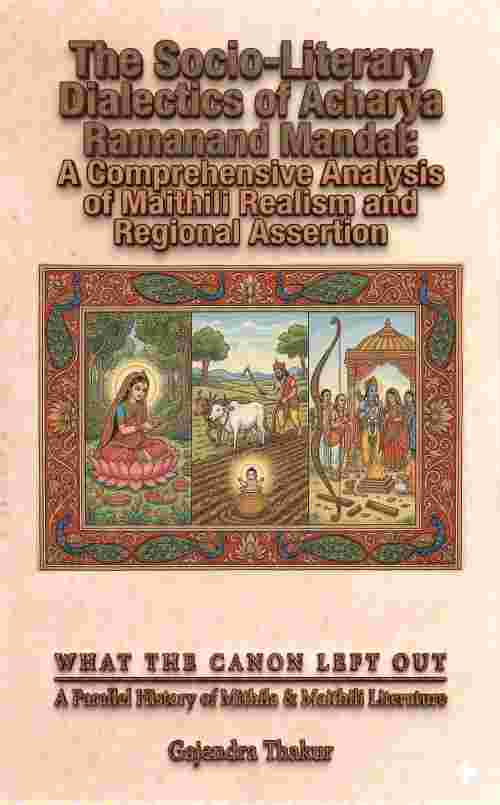
The Socio-Literary Dialectics of Acharya Ramanand Mandal: A Comprehensive Analysis of Maithili Realism and Regional Assertion
ACHARYA RAMANAND MANDAL
A Complete Critical Research Report
Analysed Through Indian & Western Literary Theories,
the Videha Parallel History Framework,
and Navya-Nyāya Epistemology of Gaṅgeśa Upādhyāya
Works Examined:
Bhāsā Ke Na Bāṃṭiyo (भासा के न बांटियो, 2022) — Poetry Collection in Western Maithili (Bajjika)
Rāṇiyāṃ Bhikhārin (रनियां भिखारिन, 2023) — Short Story Collection in Western Maithili
Gāgar Meṃ Sāgar: Nava Vaicārikī (गागर में सागर, 2025) — Essays/Socio-critical Articles
1. Biographical Profile and Intellectual Formation
Acharya Ramanand Mandal (born 1960, Sitamarhi, Bihar) is a retired schoolteacher-turned-writer who emerged as a significant literary voice in Maithili literature following his retirement from government service on 31 December 2019. A postgraduate in Chemistry (M.Sc.) and Hindi Literature from a Maithili-speaking background, he served as Headmaster in middle schools of Sitamarhi district before devoting himself fully to literature. He writes under the abbreviated name 'Rāmā' in his poetry.
His intellectual formation was shaped by three converging forces: (a) the Sitamarhi-Mithila civilisational milieu — the birthplace of Sita and a zone where Western Maithili (Bajjika) is the vernacular; (b) exposure to social media activism around Maithili language rights, where encounters with Kishun Karigar, Ramnaresh Yadav, Dr. Umesh Mandal, Kaviraj Ekaant, and others crystallised his literary voice; and (c) the persistent encouragement of his eldest son, Prof. (Dr.) Rajiv Ranjan, an academic who urged him to write. His scientific temperament — a rationalised, empirical worldview — infuses his literary production with an unmistakable logical sharpness.
Mandal's published works to date are three: a poetry collection in Western Maithili/Bajjika (2022), a short story collection in the same dialect (2023), and a collection of socio-critical essays in Hindi-inflected Maithili (2025), all published by Mithila Samaj Trust, Delhi. The essays in Gāgar Meṃ Sāgar were composed after active participation in the Sagar Rāti Dīp Jaray (108th–112th) literary evenings, earning praise from Sahitya Akademi awardee Jagdish Prasad Mandal, senior critic Dr. Ramanand Jha 'Raman', and senior reviewer Taranand Viyogi. Gāgar Meṃ Sāgar was published by Book Fylo.
2. The Three Works: Synoptic Description
2.1 Bhāsā Ke Na Bāṃṭiyo (2022) — Poetry Collection
This debut collection of 87 poems is written in Western Maithili (Bajjika), the dialect spoken in the Sitamarhi-Muzaffarpur belt. The title poem, 'Bhāsā Ke Na Bāṃṭiyo' ('Do Not Divide the Language'), is both an aesthetic manifesto and a socio-political protest — a passionate plea against fracturing the Maithili linguistic continuum by treating Bajjika, Angika, and standard Maithili as separate languages.
The collection is organised around six thematic axes: (i) identity and language rights; (ii) Mithila's mythological-historical heritage (Sita, Vidyapati, Loriqa, Dinakar, Phaniswarnath Renu); (iii) social critique (caste hierarchy, varna system, patriarchy); (iv) political satire (panchayat corruption, opportunist state-making); (v) devotional and folk themes (Chhath, Jhijhiya, Dadhichi); and (vi) personal-humanist reflections (mother, wife, death, seasons).
Selected key poems: 'Jīvan Ke Raṇkṣetra Meṃ' (existentialist opener); 'Hum Kabīr Banabaī' (Bhakti invocation — self-identification with Kabir's dissent); 'Avīr Sītā' (feminist rewriting of Sita's exile); 'Bhūmijā Sītā' (earth-daughter Sita as postcolonial subaltern heroine); 'Śahīd Rāmaphal Maṇḍal' (tribute to freedom fighter); 'Chhath', 'Jhaajhaa Mel' (folk satirical); 'Nārī Tū Ke Chhe?' (interrogative feminist poem); 'Angikā Bajjikā' (linguistic solidarity anthem).
2.2 Rāṇiyāṃ Bhikhārin (2023) — Short Story Collection
This collection of 28 stories in Western Maithili is Mandal's second published work, dedicated to his mother Chandra Devi. The stories range from 3 to 14 pages and are drawn from observed life in villages of north Bihar — exploring love (licit and illicit), social inequality, generational conflict, political corruption, religious hypocrisy, unemployment, and existential ethics.
The title story, 'Rāṇiyāṃ Bhikhārin', is Mandal's most discussed piece: a polio-afflicted twenty-five-year-old woman who begs near a bus stand is sexually exploited by the conductor and gives birth to a child whom she nurtures with absolute maternal devotion — transcending categories of legitimate/illegitimate, consent/exploitation, purity/transgression. The story is simultaneously a social-realist document and a metaphysical meditation on vatsalya (parental love) as the most primal human capacity.
Other notable stories: 'Ādarśa Putra' (ideal son vs. NRI son — a study in duty and abandonment); 'Sādā Jīvan Uchcha Vicār' (a Muslim schoolteacher's dignified simplicity as an ethical ideal); 'Dharam Saṃkaṭ Mukta' (feudal erotics, caste transgression, desire); 'Kāma Se Rāma Ke Or' (Rajneesh's philosophy embedded in a village romance); 'Rakt Sambandh' (blood-kinship vs. adoptive kinship); 'Maithilī' (mother tongue as intimate dialogue).
2.3 Gāgar Meṃ Sāgar: Nava Vaicārikī (2025) — Essay Collection
The title — 'An Ocean in a Pot: A New Thinking' — announces the epistemological ambition of this essay collection. Written largely in Hindi-blended Maithili prose, it covers historical, socio-cultural, linguistic, and biographical topics. Key essays include:
• 'Babuavādī Saṃskṛti Banam Hāśiye kā Samāj' — Brahmanical hegemony in Mithila, citing George Grierson's Linguistic Survey of India and local caste dynamics.
• 'Kavīśvara Candā Jhā vs. George Grierson' — a revisionary account of the making of Maithili as a named language.
• 'Maithilī Mānakaraṇ' — critique of standardisation that excludes Bajjika/Angika speakers.
• 'Mithilā Rāja vs. Tirhut' — geographical-political critique of the proposed Mithila state.
• 'Magadh vs. Mithilā' — historiographical debate on the two civilisational poles of Bihar.
• 'Śahīd Rāmaphal Maṇḍal' — biography of Mithila's first freedom martyr.
• 'Phaniswarnath Renu', 'Kapūrī Ṭhākur', 'Gajendr Ṭhākur' — biographical sketches of Maithili icons.
3. The Question of Language: Bajjika, Maithili, and the Dialectal Continuum
Mandal's most foundational literary-political stance is the insistence that Bajjika (Western Maithili, spoken in Sitamarhi, Muzaffarpur, Vaishali, Sheohar, East Champaran) is not a separate language but a dialect of Maithili. This is simultaneously a linguistic, social, and legal argument. In 'Bhāsā Ke Na Bāṃṭiyo' the poet writes:
'Bajjikā Anjgikā / Alag Bhāṣā Nahy / Maithilī Ke Boli Sab' — All are dialects of Maithili, not separate languages.
The Mithila Samaj Trust's publication foreword (Book 1) contextualises this precisely: just as Kannada, Bengali, and Punjabi embrace all their dialects within their literary mainstream, Maithili must do so, and the obsession with a Sanskritic 'standard' Maithili risks killing the oral vitality of the language. This echoes Grierson's original observation in the Linguistic Survey of India (1881–1928) that Western Maithili forms a regional variation with phonological divergences but continuous with the Maithili linguistic core.
The Videha Parallel History Framework (Gajendra Thakur, videha.co.in) has consistently argued that mainstream Maithili literary history, as promoted by the Sahitya Akademi advisory board, represents only the Brahmin-Kayasth 'sotipur' Maithili of Darbhanga-Madhubani, excluding Bajjika, Angika, Khorthā, and Surajapuri speakers. Mandal's work is thus organically connected to the Videha movement's project of literary democratisation.
4. Situating Mandal Within the Videha Parallel History Framework
4.1 The Videha Framework: A Summary
The Videha eJournal (ISSN 2229-547X, www.videha.co.in), founded and edited by Gajendra Thakur, has since 2000 built what it calls a 'Parallel History of Mithila and Maithili Literature' — a historiographical project that recovers the literary output of non-Brahmin, Dalit, lower-OBC, and dialectal writers systematically ignored by the Sahitya Akademi advisory board and its allied 'mainstream' literary organisations. The framework draws on the Dooshan Panji (genealogical records of social infractions), oral histories, and non-canonical sources to contest the hegemonic narrative.
T.K. Oomen's sociological observation (Sociology, 1988) that 'the Maithili region is economically and culturally dominated by Brahmins' and that a Maithili state might entrench them further as political elite — an observation cited in the Videha Parallel History — provides the larger social context. The Videha framework's critical insight is that Maithili literary canonisation has functioned as a 'sieve' that filters out non-elite voices, regardless of literary merit.
4.2 Mandal's Place in the Parallel Tradition
Mandal exemplifies the parallel literary tradition on at least four dimensions:
• Dialectal authenticity: Writing in Bajjika rather than 'standard' Maithili is itself a political act within the Videha framework — it reclaims the language from its Sanskritic standardisers.
• Social subject matter: Dalit characters (Raniyaan, Kosaliya), agricultural labourers, OBC youth unemployment, feudal landlord-serf dynamics, and inter-caste desire are all marginalised in mainstream Maithili literature but central to Mandal's fiction.
• Counter-hagiography: In Gāgar Meṃ Sāgar, Mandal writes biographies of Shahid Ramaphal Mandal (the first Mithila freedom fighter, largely unknown even in Mithila), Gajendra Thakur, and Phaniswarnath Renu — figures who represent either OBC/Mandal communities or counter-canonical streams.
• Publishing ecology: Publication by Mithila Samaj Trust (a non-Brahmin cultural institution) rather than Sahitya Akademi or Darbhanga-based presses situates Mandal within the parallel institutional network.
5. Applying Navya-Nyāya Epistemology to Mandal's Works
5.1 Gaṅgeśa Upādhyāya and the Tattvacintāmaṇi
Gaṅgeśa Upādhyāya (c. 1300–1350 CE), born in Mithila, authored the Tattvacintāmaṇi ('Thought-Jewel of Truth'), which inaugurated the Navya-Nyāya school of Indian logic. As documented extensively in Videha Parallel History Parts 16–20 and in Dinesh Chandra Bhattacharya's History of Navya-Nyāya in Mithila, Gaṅgeśa revolutionised Indian epistemology by shifting from broad ontological (prameya) analysis to hyper-precise epistemological (pramāṇa) inquiry.
The Navya-Nyāya analytical toolkit includes: (a) Pramāṇa (valid means of knowledge); (b) Vyāpti (invariable concomitance); (c) Avacchedaka ('limitor' — a precision operator to prevent ambiguity); (d) Hetvābhāsa (logical fallacies); (e) Paratah Pramāṇya (extrinsic validity of knowledge — knowledge is validated through successful practical action); and (f) the fourfold division of Pramāṇas: Pratyakṣa (perception), Anumāna (inference), Upamāna (analogy), Śabda (verbal testimony).
The Videha Parallel History also recovers a suppressed biographical fact: Gaṅgeśa was born five years after the death of his recognised father and married a Charmkarini (a woman from the leather-working community). This makes him — like Mandal — a figure whose intellectual achievement transcended social marginalisation.
5.2 Navya-Nyāya Applied: Poetry (Bhāsā Ke Na Bāṃṭiyo)
5.2.1 Pramāṇa and the Validity of the Dialectal Voice
In Navya-Nyāya, knowledge is validated not intrinsically (the Mīmāṃsā position) but through practical success — 'Paratah Pramāṇya'. Mandal's use of Bajjika as a literary medium is precisely such a Paratah Pramāṇya: its legitimacy is not declared a priori by any academy but demonstrated through its communicative effectiveness, emotional resonance, and the social recognition it generates. The success of Book 1 — reaching even to the Deputy Chief Minister's hands, as noted in the Book 2 foreword — is, in Navya-Nyāya terms, the 'samvādipravṛtti' (successful purposive activity) that validates the cognition.
5.2.2 Vyāpti (Invariable Concomitance) in the Title Poem
Gaṅgeśa defines Vyāpti as the invariable co-presence of the middle term (Hetu) and the major term (Sādhya). In 'Bhāsā Ke Na Bāṃṭiyo', the logical structure can be formalised thus:
Wherever there is language fragmentation (Hetu), there is cultural impoverishment and political subjugation (Sādhya). Bajjika is subject to language fragmentation. Therefore, Bajjika speakers face cultural impoverishment and political subjugation.
The poem's rhetorical power lies in this vyāpti being established not abstractly but through concrete historical evidence — the fate of Angika writers whose works were rejected by Maithili literary bodies because their dialect was not 'standard' Maithili.
5.2.3 Avacchedaka (Limitor) and Poetic Precision
Gaṅgeśa's avacchedaka prevents infinite regress in predication by specifying the 'conditioner' of a property. Mandal's best poems operate with similar precision. In 'Avīr Sītā', the limitor is gender (strītvāvacchinna — 'conditioned by femininity') rather than divinity or royalty — Sita is analysed through the property 'abandoned woman' (parityaktatvāvacchinna), which generates the poem's ironic reversal: the 'hero' Rama becomes the 'deserter' and the 'weak' (avīra) Sita becomes the 'courageous' (vīra).
5.2.4 Hetvābhāsa (Fallacy Analysis) in Political Satire
Several of Mandal's satirical poems ('Mithilā Rāj Banā Dā', 'Pañcāyat Cunāv', 'Rāj Karaī Chī') expose what Navya-Nyāya calls Savyabhicāra (deviating reason — the middle term does not always accompany the major term) and Viruddha (contradictory reason). Mandal's satire of Mithila state-hood demands shows politicians who claim cultural identity (Hetu) while pursuing caste patronage (Sādhya) — but cultural identity does not invariably lead to the Sādhya (welfare of all Maithils), so the Hetu is a Savyabhicāra fallacy.
5.3 Navya-Nyāya Applied: Stories (Rāṇiyāṃ Bhikhārin)
5.3.1 Śabda-Khaṇḍa and the Story 'Maithilī'
In Gaṅgeśa's Śabda-Khaṇḍa, valid verbal testimony requires four conditions: Ākāṅkṣā (syntactic expectancy), Yogyatā (semantic fitness), Sannidhi (temporal proximity), and Tātparya (speaker's intention). The story 'Maithilī' is formally a dialogue about mother tongue — a wife initially dismisses the language as irrelevant but gradually discovers its beauty, utility, and identity-forming power. Applying Śabda criteria: the wife's initial dismissal ('Maithilī is not our language') fails Yogyatā — it is semantically incoherent because she herself speaks Maithili. Mandal thus dramatises epistemological error through narrative.
5.3.2 Pratyakṣa and Anumāna in 'Dharam Saṃkaṭ Mukta'
Gaṅgeśa distinguishes Nirvikalpaka (raw, pre-linguistic perception) from Savikalpaka (relational, linguistically structured perception). In this story, Rajeshwar Pratap's initial perception of Raniyan is Nirvikalpaka — pure visual apprehension without the caste-qualifier. His attraction grows into Savikalpaka cognition only when he applies the caste-limitor (dalitatvāvacchinna) — and at that point social conflict begins. Mandal shows how social consciousness corrupts raw perceptual purity, a point that resonates with both Navya-Nyāya epistemology and Dalit literary theory.
5.3.3 The Title Story: Upamāna (Analogy) and Vātsalya
Gaṅgeśa's Upamāna-Khaṇḍa defends analogy as an independent pramāṇa. In 'Rāṇiyāṃ Bhikhārin', Mandal invites a moral analogy: Raniyan's relation to her child is analogous (upamāna) to Yashoda's relation to Krishna — the divine model of vātsalya that transcends birth-circumstances. This upamāna is not ornamental but epistemological: it generates valid moral knowledge ('maternal love transcends social stigma') that cannot be derived by perception (pratyakṣa) alone.
6. Western Literary Critical Frameworks
6.1 Mikhail Bakhtin: Heteroglossia and the Dialogic Novel
Mikhail Bakhtin's concept of heteroglossia — the coexistence of multiple social voices and registers within a single text (The Dialogic Imagination, 1981) — is the single most productive Western framework for Mandal's fiction. His stories are aggressively dialogic: 'Maithilī' is literally a dialogue between two registers of identity; 'Ādarśa Putra' sets village dutiful-son dialect against NRI-English phone discourse; 'Sādā Jīvan Uchcha Vicār' places Hindi-Urdu school administration language against Maithili community speech.
More deeply, Bakhtin's carnivalesque — the temporary inversion of social hierarchies — operates in 'Rāṇiyāṃ Bhikhārin' where a marginalised, disabled beggar-woman becomes the moral centre of the narrative, while the 'respectable' conductor is its moral nadir.
6.2 Gayatri Chakravorty Spivak: Can the Subaltern Speak?
Spivak's foundational question in postcolonial theory ('Can the Subaltern Speak?' 1988) finds a nuanced, affirmative answer in Mandal's project. His subalterns — Raniyan, the leather-worker woman, the unemployed OBC youth in 'Garib Ke Kahāṃ Guzārā Na' — do speak, but in a dialect that the standard literary establishment refuses to hear. The linguistic politics of Bajjika vs. standard Maithili is thus a literalisation of Spivak's epistemological argument about whose speech counts as 'literature'.
Mandal's essay 'Babuavādī Saṃskṛti Banam Hāśiye kā Samāj' makes this Spivakian argument explicitly, citing the Bajjika writer who brought her manuscript to the Maithili Sahitya Akademi only to be told it was 'not Maithili'. This is the institutional silencing of the subaltern voice.
6.3 Antonio Gramsci: Hegemony and the Organic Intellectual
Gramsci's distinction between the 'traditional intellectual' (who reproduces ruling-class ideology) and the 'organic intellectual' (who emerges from and serves a subaltern class, Prison Notebooks 1929–35) maps precisely onto the contrast between the Brahmin-Kayasth Maithili literary establishment and Mandal. Mandal is what Gramsci calls an organic intellectual of the Mandal community (OBC Backward Classes) — not by proclamation but by the logic of his subject matter, his dialect choice, his publishing ecology, and his political commitments.
6.4 Terry Eagleton: Literature as Ideology
Terry Eagleton's materialist critique (Criticism and Ideology, 1976; Literary Theory: An Introduction, 1983) argues that literary form is not neutral but ideologically overdetermined. Mandal's choice of Bajjika is not merely aesthetic; it is an ideological choice that challenges the hegemony of Sanskritic standard Maithili. The form of his poetry — direct, oral, repetitive, close to speech-rhythm — is itself a critique of the elite courtly forms (Vidyapati-influenced padāvalī metres) that dominate 'official' Maithili literature.
6.5 Northrop Frye: Archetypal Criticism
Frye's theory of archetypes (Anatomy of Criticism, 1957) illuminates Mandal's mythological poems. 'Bhūmijā Sītā' and 'Avīr Sītā' recast the Sita archetype from the Demeter-Persephone pattern (fertility-abduction-return) into a tragic-ironic pattern where the return is denied by the same hero who promised it. 'Hum Kabīr Banabaī' invokes the Trickster-Sage archetype — Kabir as the outsider-truth-teller who disrupts sacred orders. Frye's seasonal myth of Autumn (decline, satire, irony) pervades the political poems.
6.6 Sigmund Freud and Jacques Lacan: Desire, the Gaze, and the Other
In 'Dharam Saṃkaṭ Mukta', the feudal landlord's desire for the Dalit woman follows a Lacanian logic: Raniyan is positioned as the objet petit a — the object-cause of desire that the subject (Rajeshwar Pratap) can never fully possess, because possession would dissolve the social distance that constitutes the desire itself. The story's tragic arc — where love becomes exploitation — traces the Lacanian transition from the Imaginary register (pure desire, Nirvikalpaka perception) to the Symbolic register (caste-coded social law) that destroys it.
7. Indian Literary Critical Frameworks
7.1 Rasa Theory (Bharata, Abhinavagupta)
Bharata's Nāṭyaśāstra (c. 200 BCE – 200 CE) posits eight (later nine) fundamental aesthetic emotions (rasas) that literature evokes. Abhinavagupta's Abhinavabhāratī commentary (c. 1000 CE) develops the concept of rasa as aesthetic consciousness (rasāsvādana) transcending ordinary emotion. Mandal's work invites analysis across the full rasa spectrum:
|
Rasa |
Text / Poem / Story |
Manifestation |
|
Śṛṅgāra (love) |
'Pārō', 'Gauri', 'Prem Ke Jīt' |
Consensual romantic love across class lines |
|
Karuṇā (compassion) |
'Rāṇiyāṃ Bhikhārin', 'Vidhavā' |
Compassion for the exploited, the widowed, the disabled |
|
Vīra (heroism) |
'Śahīd Rāmaphal Maṇḍal', 'Vīr Loriqa' |
Celebration of subaltern heroism |
|
Raudra (fury) |
'Jātivāda', 'Bābū', 'Dhut Buṛbak' |
Moral rage against casteism and hypocrisy |
|
Hāsya (satire) |
'Jhājhā Mel', 'Pañcāyat Cunāv' |
Satirical laughter at village corruption |
|
Bībhatsa (disgust) |
'Kharabs', 'Śarāb aur Śabāb' |
Revulsion at social exploitation |
|
Śānta (serenity) |
'Sādā Jīvan Uchcha Vicār', 'Mahāyajña' |
Meditative acceptance and ethical clarity |
|
Adbhuta (wonder) |
'Bhūmijā Sītā', 'Buddha' |
Wonder at the sacred in the everyday |
The dominant rasa of the collection as a whole is Karuṇā with Raudra as its tonal companion — a compassionate fury that is the hallmark of socially engaged literature. Abhinavagupta's concept of sādhāraṇīkaraṇa (universalisation of emotion) is relevant: Mandal achieves this through placing universal archetypes (Sita, Kabir, Buddha) in recognisably local Maithili situations.
7.2 Dhvani Theory (Ānandavardhana)
Ānandavardhana's Dhvanyāloka (c. 850 CE) proposes that the highest literary meaning is not the expressed (vācya) but the suggested (vyañjanā) or resonant (dhvani) meaning. Mandal's best poems operate through dhvani of the Rasadhvani type — suggested emotional meaning.
In 'Bhāsā Ke Na Bāṃṭiyo' (the title poem), the expressed meaning is a plea against linguistic division. The suggested meaning — dhvani — is that the division of the language is the last step in the erasure of the non-elite Maithili subject: when your dialect is not recognised as 'your language', you lose legal, educational, and political rights. This second-order dhvani is what gives the poem its electrifying political charge beyond its apparent linguistic subject.
7.3 Vakrokti Theory (Kuntaka)
Kuntaka's Vakroktijīvita (c. 950 CE) argues that the essence of poetry is 'oblique expression' (vakrokti) — the deviation of speech from its ordinary form that produces aesthetic pleasure. Mandal's Bajjika idiom is itself a form of vakrokti relative to the standard Maithili literary register: by choosing the 'oblique' dialect, Mandal defamiliarises the Maithili text, making the reader experience the language freshly rather than through the habituation of standard forms. This connects to Russian Formalist ostranenie (defamiliarisation), demonstrating the Indo-European convergence of poetic theory.
7.4 Dalit Aesthetics and Ambedkarian Literary Criticism
Contemporary Indian Dalit literary criticism, rooted in B.R. Ambedkar's foundational critique of Brahminical cultural hegemony (Annihilation of Caste, 1936), has developed an autonomous aesthetic: the primacy of lived social experience over inherited literary convention; the rejection of 'universal' aesthetics that invisibilise caste oppression; the affirmation of vernacular, dialect, and oral traditions as sites of resistance.
Mandal's work engages this framework most directly in 'Rāṇiyāṃ Bhikhārin' (the title story), 'Dharam Saṃkaṭ Mukta', 'Kharabs' and 'Gāgar Meṃ Sāgar' (Brahminvāda essay). His Dalit characters are not passive victims but active agents who make moral choices — the Dalit aesthetic criterion of 'dignity in adversity'. The Videha Parallel History's inclusion of Dalit Telugu, Gujarati, and Odia literature in Maithili translation (Parts 11–15) provides the larger frame within which Mandal's fiction is a Bihar-specific contribution.
7.5 Sāhitya-Darpaṇa (Viśvanātha Kavirāja) and Narrative Theory
Viśvanātha Kavirāja's Sāhitya-Darpaṇa (c. 1335 CE) defines kāvya (literature) as 'vākya rasamātmakam' — utterance whose soul is rasa. His prose narrative theory (ākhyāyikā vs. kathā distinction) is relevant to Mandal's stories. Mandal's stories are closer to the kathā form — fictional, multi-episodic, with the narrator distanced from events — except for the memoir-inflected stories ('Sādā Jīvan Uchcha Vicār', 'Mithilā') where the author enters as a first-person narrator (dāyanand), approximating the ākhyāyikā form.
8. Cross-Thematic Critical Analysis
8.1 Language as Political Subject
Across all three books, language — specifically the right to write in one's own dialect — is the master theme. This is unusual: most writers treat language as medium, not subject. For Mandal, the act of writing Bajjika is simultaneously the message and the medium. This recursive self-reflexivity — writing about language politics in the language whose politics one is defending — constitutes what the Russian Formalists would call a 'laying bare of the device'.
8.2 The Sita Motif: Feminist Revisionism
The figure of Sita recurs across all three books: as the abandoned heroine in poetry ('Avīr Sītā', 'Bhūmijā Sītā'), as the geographical anchor of Sitamarhi identity (narrative preamble of 'Maithilī'), and as the mythological legitimator of Mithila's claim to distinctiveness (essay on Mithila vs. Tirhut). Mandal's Sita is consistently rescued from passive victimhood: 'Nirjāsit bhel avīr Sītā, vīr Sītā banal avīr Sītā' — the apparently powerless Sita is redefined as the truly powerful one.
This feminist revisionism connects to the Videha framework's sustained attention to women's writing (Strī Konā section of Videha) and to the Indian feminist critical tradition represented by scholars like Susie Tharu and K. Lalita (Women Writing in India, 1991).
8.3 Scientific Rationalism as Literary Method
Mandal's M.Sc. in Chemistry is not incidental to his literary method. The preface to Book 2 (Rāṇiyāṃ Bhikhārin) notes that 'his scientific temperament, logic, and rationalist worldview are inevitably visible in his compositions'. This is borne out in: (a) the essayistic prose of Gāgar Meṃ Sāgar, which deploys statistical data (UNESCO's 8,324 languages, India's 1,635 mother tongues), historical chronology, and causal analysis; (b) the logical precision of the title poem's argument; (c) the refusal of supernatural or mystical explanation in his stories of desire and transgression.
In Navya-Nyāya terms, this is a commitment to Pramāṇa — valid means of knowledge — over mere convention or scriptural authority (āgama). Mandal implicitly aligns himself with Gaṅgeśa's rationalist, evidence-based epistemology rather than the Mīmāṃsā reliance on scriptural self-validity (svataḥ prāmāṇya).
8.4 Subaltern Heroism: Shahid Ramaphal Mandal
The repeated invocation of Shahid Ramaphal Mandal — Mithila's first freedom martyr, largely absent from mainstream Mithila historiography — is the biographical correlate of the poetic-fictional project. Just as Gaṅgeśa's low-caste birth was suppressed in official Mithila intellectual history (Videha Parallel History, Part 16), Ramaphal Mandal's martyrdom was suppressed because it represented subaltern nationalism rather than Brahmin-led nationalist movement. For Mandal, recovering these suppressed lives is itself a literary-epistemological act: it is the application of anumāna (inference from available evidence) against the hetvābhāsa (fallacious reasoning) of official historiography.
9. Critical Appreciation: Strengths, Complexities, and Limitations
9.1 Strengths
• Linguistic courage: Writing seriously in Bajjika when the entire literary establishment devalues it is an act of aesthetic and political courage. Mandal has essentially created a modern literary Bajjika where none previously existed in published form.
• Thematic breadth: The range from linguistic philosophy to Dalit women's dignity to Sufi/Rajneesh-inflected spirituality to climate of panchayat corruption is remarkable for a debut corpus.
• Narrative intimacy: Mandal's stories achieve what Henry James called the 'felt life' of fiction — the characters speak, argue, desire, and fail in recognisably human ways, anchored in the specific ecology of north Bihar.
• Essayistic rigour: Gāgar Meṃ Sāgar's essays combine local knowledge with broader historiographical frameworks (Grierson, Oomen) in a way that is rare in regional Indian essay writing.
• Internal coherence: The three books form a triptych — the poetry establishes the political identity; the fiction enacts it through lives; the essays theorise it.
9.2 Areas of Critical Complexity
• Tonal unevenness: Some poems in Book 1 are direct to the point of being polemical rather than poetic — the political argument is stated rather than enacted through image or metaphor. The best poems ('Avīr Sītā', 'Bhūmijā Sītā', 'Hum Kabīr Banabaī') are far superior to the more didactic pieces.
• Narrative compression: Several stories in Rāṇiyāṃ Bhikhārin are compressed to the point where character development suffers — the reader intuits rather than experiences the emotional arc. This is partly a function of the short-story form but also of Mandal's greater comfort with the essay and poem.
• Dialectal accessibility: Writing in Bajjika restricts the immediate readership, though this is precisely the point. A future scholarly apparatus (glossary, transliterations) would greatly expand critical engagement.
• Historical documentation: The biographical essays in Gāgar Meṃ Sāgar would benefit from more systematic citation of sources, making them more useful to future historians.
9.3 A Note on the Gangesha–Mandal Parallelism
Notably, a structural parallelism between Gaṅgeśa Upādhyāya and Acharya Ramanand Mandal that the Videha Parallel History framework makes visible. Both are Mithila-born thinkers of non-elite social background who produce foundational intellectual work in registers not recognised as 'canonical' by the Brahminical establishment of their time. Gaṅgeśa's marriage to a Charmkarini and extra-matrimonial birth were suppressed for centuries; Mandal's Bajjika is dismissed by the Sanskritic literary gatekeepers. Both, in Navya-Nyāya terms, have achieved Paratah Pramāṇya — the validation of their knowledge through practical success — despite institutional resistance.
10. Select Bibliography and References
Primary Texts
• Mandal, Acharya Ramanand. Bhāsā Ke Na Bāṃṭiyo. Mithila Samaj Trust, Delhi, 2022.
• Mandal, Acharya Ramanand. Rāṇiyāṃ Bhikhārin. Mithila Samaj Trust, Delhi, 2023.
• Mandal, Acharya Ramanand. Gāgar Meṃ Sāgar: Nava Vaicārikī. Mithila Samaj Trust, Delhi, 2025.
Videha Parallel History Framework
• Thakur, Gajendra. A Parallel History of Mithila & Maithili Literature. Parts 1–47+. Videha eJournal (ISSN 2229-547X). www.videha.co.in/gajenthakur.htm
• Thakur, Gajendra. 'Gangesa Upadhyaya: Life, Logic, and Legacy in the Navya-Nyaya Tradition.' Videha Parallel History, Parts 16–20. www.videha.co.in/new_page_16.htm
• Thakur, Gajendra. 'The Videha Movement and Contemporary Parallel Literature.' Videha Parallel History, Parts 5–10. www.videha.co.in
Indian Critical Traditions
• Abhinavagupta. Abhinavabhāratī (Commentary on Nāṭyaśāstra). Trans. and ed. R. Gnoli. Rome, 1956.
• Ānandavardhana. Dhvanyāloka. Trans. K. Krishnamoorthy. Dharwar: Karnatak University, 1974.
• Bharata. Nāṭyaśāstra. Trans. Adya Rangacharya. New Delhi: Munshiram Manoharlal, 1996.
• Gangesa Upadhyaya. Tattvacintāmaṇi. Trans. and Annot. V.P. Bhatta. Delhi: Eastern Book Linkers, 1989.
• Jha, Udayanath ('Ashok'). Bhāratīya Sāhitya Ke Nirmātā: Gaṃgeśa Upādhyāya. New Delhi: Sahitya Akademi, 2020.
• Kuntaka. Vakroktijīvita. Trans. K. Krishnamoorthy. Dharwar: Karnatak University, 1977.
• Viśvanātha Kavirāja. Sāhitya-Darpaṇa. Trans. P.D. Gune. Poona: Bhandarkar Oriental Research Institute, 1957.
• Bhattacharya, Dinesh Chandra. History of Navya-Nyāya in Mithila. Darbhanga: Mithila Institute, 1958.
Western Critical Theories
• Ambedkar, B.R. Annihilation of Caste. 1936. Ed. with Introduction by Arundhati Roy. New Delhi: Navayana, 2014.
• Bakhtin, Mikhail. The Dialogic Imagination. Trans. Caryl Emerson and Michael Holquist. Austin: University of Texas Press, 1981.
• Eagleton, Terry. Criticism and Ideology. London: NLB, 1976.
• Eagleton, Terry. Literary Theory: An Introduction. Oxford: Blackwell, 1983.
• Frye, Northrop. Anatomy of Criticism. Princeton: Princeton University Press, 1957.
• Gramsci, Antonio. Selections from the Prison Notebooks. Trans. Quintin Hoare and Geoffrey Nowell Smith. London: Lawrence and Wishart, 1971.
• Lacan, Jacques. The Four Fundamental Concepts of Psycho-Analysis. Trans. Alan Sheridan. New York: Norton, 1981.
• Oomen, T.K. 'Linguistic Diversity.' Sociology. National Law School of India University / Bar Council of India Trust, 1988.
• Phillips, Stephen H. Classical Indian Metaphysics. Chicago: Open Court, 1995.
• Spivak, Gayatri Chakravorty. 'Can the Subaltern Speak?' In Cary Nelson and Lawrence Grossberg (eds.), Marxism and the Interpretation of Culture. Urbana: University of Illinois Press, 1988.
• Tharu, Susie and K. Lalita (eds.). Women Writing in India. 2 vols. New York: Feminist Press, 1991.
Historical and Socio-Linguistic Sources
• Grierson, George Abraham. Linguistic Survey of India. 19 vols. Calcutta: Superintendent of Government Printing, 1903–1928.
• Grierson, George Abraham. 'Seven Grammars of the Dialects and Subdialects of the Bihari Language' (1883–1887).
• Jha, Kedar Nath. Āvārā Nahithan (Novel). Mithila Samaj Trust, 2010. [Contains Renu interview cited in Gāgar Meṃ Sāgar]
• Potter, Karl H. (ed.). Encyclopedia of Indian Philosophies, Vol. 6: Indian Philosophical Analysis. Delhi: Motilal Banarsidass, 1993.
Research prepared with reference to: (i) the three published works of Acharya Ramanand Mandal(iii) established scholarship on Indian and Western literary theory.
2
The Socio-Literary Dialectics of Acharya Ramanand Mandal: A Comprehensive Analysis of Maithili Realism and Regional Assertion
The trajectory of Maithili literature in the twenty-first century is defined by a rigorous departure from the courtly and classical traditions that long dominated the Mithila region. At the center of this modernizing shift is Acharya Ramanand Mandal, a retired headmaster, social thinker, and literary figure whose work serves as a conduit for the "pure Maithili" spoken in Sitamarhi, the historically and mythologically significant birthplace of Goddess Sita. Within the framework of the Videha e-journal and the broader movement of Maithili digital journalism, Mandal’s narratives function as sociological inquiries into the decay of institutional integrity, the persistence of caste hierarchies, and the transformative potential of education within subaltern communities.
Historical Context and the Emergence of the Parallel Tradition
To understand the significance of Acharya Ramanand Mandal, one must first locate his work within the evolving landscape of Maithili literary recognition and institutional politics. The recognition of Maithili by the Sahitya Akademi in 1965 was a watershed moment, yet it was fraught with internal tensions between the traditionalist elite and the burgeoning reformist voices. For decades, the Maithili literary canon was heavily influenced by the Darbhanga-centric "standard," which often prioritized the linguistic registers of the Srotriya Brahmins and the genealogical focus of Panji-Prabandha.
Mandal represents a shift toward a more inclusive "Parallel History" of Mithila. This movement, spearheaded by figures like Gajendra Thakur and the Videha editorial collective, seeks to dismantle the exclusionary practices of the past, such as the retrospective construction of sub-caste identities like the Srotriya which, research suggests, did not exist in its contemporary form in British India before 1800 CE. By writing in the vernacular of Sitamarhi, Mandal asserts a linguistic identity that is both ancient in its association with Sita and modern in its refusal to conform to the Sanskritized standards of the Darbhanga elite.
The Videha e-journal has provided the technological and critical infrastructure for this assertion. As a multidisciplinary platform, Videha facilitates a "Parallel Sahitya Akademi" ecosystem where voices from the "margins"—geographical, linguistic, and social—can find expression. Mandal’s work is a cornerstone of this digital renaissance, bridging the gap between traditional print-era pedagogical discipline and the expansive reach of the internet.
Table 1: Comparative Evolution of Maithili Literary Frameworks
|
Feature |
Traditionalist Framework |
Videha/Mandal Parallel Framework |
|
Linguistic Focus |
Standard Maithili (Darbhanga/Brahminical) |
Regional Dialects (e.g., Sitamarhi "Pure Maithili") |
|
Central Themes |
Panji (Genealogy), Classical Poetics, Rituals |
Social Realism, Institutional Corruption, Subaltern Resistance |
|
Medium |
Traditional Print, Academic Journals |
Digital E-journals (Videha), Audiobooks, Web Journalism |
|
Key Proponents |
Ramanath Jha, Traditional Sahitya Akademi |
Gajendra Thakur, Acharya Ramanand Mandal, Jan Kavis |
|
View of Tradition |
Preservative and Obscurantist |
Critical Engagement and Reformist |
|
Reference Points |
Biographical Profile: The Pedagogical and Scientific Roots of Realism
Acharya Ramanand Mandal was born on January 1, 1960, in the village of Pipra Bishanpur, located in the Parihar police station jurisdiction of the Sitamarhi district, Bihar. His family background reflects the agrarian and educational aspirations of the middle-caste communities of Mithila; he is the son of Chandra Devi and the late Rajeshwar Mandal. His marriage to Pramila Devi and his eventual settlement in Muraliyachak, Sitamarhi, provided the stable domestic environment from which he observed the rapid socio-political changes of post-independence Bihar.
Mandal’s educational journey is particularly noteworthy for its multidisciplinary nature. He holds an M.Sc. in Chemistry and an M.A. in Hindi. This dual grounding in the hard sciences and the humanities is a defining feature of his literary style. The scientific training manifests in his clinical, almost objective deconstruction of social problems, while his Hindi background allows him to engage with the broader North Indian literary traditions, even as he remains fiercely committed to the Maithili tongue.
His professional life as a headmaster and his leadership in the Primary Teachers Association in Dumra provided him with intimate knowledge of the state’s micro-level failures. Unlike many writers who observe the rural bureaucracy from the outside, Mandal operated within it for decades. This insider perspective is the bedrock of his realism, allowing him to describe the nuances of administrative bribery, the implementation of educational reforms like the Rajiv Gandhi Panchayati Raj, and the moral erosion of the professional class with authoritative precision.
Table 2: Biographical and Educational Matrix
|
Category |
Information Detail |
Source |
|
Full Name |
Acharya Ramanand Mandal |
|
|
Date of Birth |
January 1, 1960 |
|
|
Father |
Late Rajeshwar Mandal |
|
|
Mother |
Chandra Devi |
|
|
Wife |
Pramila Devi |
|
|
Academic Degrees |
M.Sc. (Chemistry), M.A. (Hindi) |
|
|
Primary Profession |
Retired Headmaster |
|
|
Social Role |
Social Thinker; Association Representative |
|
|
Geographic Focus |
Sitamarhi (Muraliyachak) |
It is essential to distinguish the subject of this research—the literary and social thinker Acharya Ramanand Mandal—from other figures with similar names. For instance, snippet identifies a Ramanand Mandal who is a politician from the Suryagarha constituency in Lakhirsarai, associated with the Janata Dal (United). While both figures are active in the public life of Bihar, their spheres of influence and contributions remain distinct; the Acharya is a man of letters and pedagogy, whereas the other is a career politician. Similarly, snippets and mention a Ramanand Mandal born in 1871 who was a Sanskrit scholar; this historical figure serves as a precursor to the modern literary awakening but is not the contemporary writer focused on in Videha issue 360.
The Linguistic Topology of Sitamarhi: Voice of the Soil
The choice of language in Mandal’s work is a deliberate act of cultural reclamation. He writes in the specific Maithili dialect spoken in the birthplace of Goddess Sita. In the Maithili literary world, "pure Maithili" is a contested term. For the traditionalists, it often referred to a Sanskritized register. For Mandal, "pure Maithili" refers to the living language of the fields, the local schools, and the village courts of Sitamarhi.
This dialectical choice carries significant weight for several reasons:
1. Mythological Continuity: By linking his language to the birthplace of Sita, Mandal invokes a sacred geography while simultaneously populating it with modern, secular struggles.
2. Subaltern Assertion: The Sitamarhi region has historically been distinct from the Darbhanga power center. Mandal’s language asserts the equality of this regional variation within the Maithili corpus.
3. Vocabulary of Realism: The local dialect provides a rich vocabulary for agricultural tools, administrative corruption, and social traditions that standard Maithili sometimes lacks or sanitizes.
Mandal’s strength as a writer is frequently attributed to this vocabulary and his "deep interaction with the good and bad traditions of society". His prose does not shy away from the harsh or the mundane; instead, it uses the local tongue to lend authenticity to the "outspokenness" of his characters.
Analytical Deconstruction of the "Five Best Stories"
In issue 360 of Videha, Acharya Ramanand Mandal identified five short stories as his best works. These stories serve as the primary evidence for his role as a social realist and institutional critic.
1. Munhfatpan (The Outspoken)
"Munhfatpan" is a profound study of how honesty can become a fatal flaw in a corrupt institutional environment. The story revolves around a strict officer who is characterized by his "munhfatpan"—a lack of filters or a blunt outspokenness. This character trait makes him a polarizing figure; he is admired by the righteous and reviled by those who benefit from the status quo.
The narrative details a false case orchestrated by the vigilance department, where witnesses are coerced into signing falsified proceedings. This serves as a searing critique of the state's internal policing mechanisms. The officer is trapped in a decade-long legal battle. While he is eventually exonerated—the "clean chit"—the victory is hollow. The story concludes that "his life is ruined" by the very process of seeking justice. Mandal uses this story to comment not only on law enforcement but on the "lethargic judicial system" that treats procedural victory as a substitute for actual reparations.
2. Sharab aa Shabab (The Wine and the Flesh)
In this work, Mandal explores the moral decay of the modern professional class. The protagonist is a bank staff member who was once a "good mathematician"—a detail that emphasizes his potential for logic and order. However, the dual temptations of "wine and the flesh" lead to his ethical and social downfall. The story serves as a microscopic look at the psychological fragility of the urbanizing Maithil middle class, suggesting that professional competence is no shield against moral turpitude.
3. Mahayajna (The Great Ritual)
"Mahayajna" examines the intersection of religion and social stratification. Centered on the Gayatri Mahayajna, the story explores how "caste factors" inevitably permeate even the most sacred rituals. However, unlike the cynical realism of "Munhfatpan," this story offers "rays of hope" found within individuals. It suggests that while the structures of religion are often co-opted by caste dynamics, the human spirit retains a capacity for transcendence and genuine ritual purpose.
4. Harbah (The Ploughman)
Criticized by Gajendra Thakur as the strongest in the collection, "Harbah" addresses a subject previously ignored in Maithili literature: the system of bonded labor. The story exposes how these oppressive systems are perpetuated under the "name of tradition". The narrative shifts when the younger generation, empowered by education, begins to challenge this systemic exploitation. As a headmaster, Mandal uses this story to emphasize the role of education as an "enabling factor" for social revolution, marking a significant milestone in the Maithili literary engagement with agrarian injustice.
5. Jhapan (The Veils)
"Jhapan" deals with the domestic and systemic oppression of women. The story covers a range of issues from "unmatched marriages"—a long-standing social ill in Mithila where young women are married to much older men for financial or caste reasons—to the lonely, constrained life of a widow. The "veil" serves as both a literal and metaphorical barrier, hiding the suffering of women from a society that prefers to look away. While critics have noted that this story "needs improvement" in its technical execution, its thematic bravery is consistent with Mandal’s role as a social thinker.
Table 3: Thematic Synthesis of Principal Short Stories
|
Story Title |
Primary Theme |
Social/Institutional Critique |
Narrative Resolution |
|
Munhfatpan |
Institutional Integrity |
Vigilance Dept.; Judicial Lethargy |
Exoneration but Personal Ruin |
|
Sharab aa Shabab |
Moral Turpitude |
Professional Middle-Class Decay |
Irreversible Moral Downfall |
|
Mahayajna |
Religious Ritual |
Persistence of Caste in Sacred Spaces |
Existential Hope |
|
Harbah |
Bonded Labor |
Agrarian Slavery; Educational Reform |
Generational Resistance |
|
Jhapan |
Gender Oppression |
Unmatched Marriages; Widowhood |
Unresolved Social Constraint |
|
Reference |
Extended Works and the "Mandal" Literary Lineage
The literary output of Acharya Ramanand Mandal is not restricted to the five stories reviewed in Videha 360. His bibliography includes poetry collections and prose volumes that expand his thematic reach. In 2022, he published Bhasha Ke Na Bantiyo (Do Not Divide the Language), a work that likely addresses the linguistic tensions between Maithili and the encroaching influence of Hindi, or perhaps the internal divisions between Maithili dialects. Other notable works include Shaurya Gaan (Songs of Valor), Janak Nandini Janaki, and the poetry collection Sanjhiya.
Mandal is part of a significant cluster of writers with the "Mandal" surname who have become central to the Videha movement. These writers often share a commitment to social realism and the empowerment of the "Jan" (the people).
· Ramdeo Prasad Mandal 'Jharudar': Identified as "Mithila's Bhikhari Thakur," he is celebrated as the first "Jan Kavi" of Maithili and the inventor of the "Jhārū" literary form.
· Jagdish Prasad Mandal: A "Farmer-Litterateur" and novelist who focuses on the agrarian experience and critical research.
· Rajdeo Mandal: A prolific poet and dramatist whose work "Sharshayya" has been featured alongside Acharya Ramanand Mandal’s contributions.
· Durganand Mandal: A researcher and writer focused on Maithili theater and literature.
The collective presence of these writers suggests a socio-literary phenomenon: the rise of a new intelligentsia in Mithila that is not rooted in the traditional Sanskrit-Pundit tradition but in the rural, agrarian, and pedagogical middle class. Acharya Ramanand Mandal is a bridge within this group, combining the discipline of the headmaster with the sensitivity of the social thinker.
Table 4: Key Figures in the Videha Parallel Tradition (Mandal Lineage)
|
Writer |
Primary Designation |
Key Contribution |
Stylistic Framework |
|
Acharya Ramanand Mandal |
Retired Headmaster |
Realistic Short Stories; Sitamarhi Dialect |
Institutional Critique |
|
Ramdeo P. Mandal |
Mithila's Bhikhari Thakur |
First Jan Kavi; Invented "Jhārū" form |
Folk-Centric Realism |
|
Jagdish Prasad Mandal |
Farmer-Litterateur |
Agrarian Novels; Critical Analysis |
Social-Scientific |
|
Rajdeo Mandal |
Poet and Screenwriter |
Versatility across Poetry/Drama |
Experimental Realism |
|
Reference |
Literary Criticism and the Gajendra Thakur Connection
Mandal’s relationship with Gajendra Thakur, the editor of Videha, is one of mutual intellectual support and critical engagement. Mandal has written an extensive article titled "Literary Figure Gajendra Thakur: Personality and Works," which is included in the audiobook A Bridge Built for the Sake of Love. In this article, Mandal analyzes Thakur’s multifaceted role as a pioneer of Maithili digital journalism, his contributions to Panji literature, and his development of Maithili-English computer dictionaries.
Conversely, Thakur has provided critical reviews of Mandal’s work. While praising his vocabulary and deep social interactions, Thakur has been critical of Mandal’s tendency to use "abrupt endings" that "do not satisfy the readers fully". Thakur suggests that Mandal should allow his characters more time to evolve so that the "totality" of the social aspect can be described. This critique reveals an important tension in Mandal’s work: the conflict between the "social thinker" who wants to deliver a sharp, quick message about an injustice, and the "storyteller" who must adhere to the requirements of narrative craft.
Socio-Political Implications: Education and the Future of Mithila
A central insight that emerges from Mandal’s body of work is the role of education as the primary engine of social change. In "Harbah," it is the "younger generation" with their education that breaks the cycle of bonded labor. In "Munhfatpan," the tragedy is the corruption of the educational administration (the BEO), which should be the very source of enlightenment.
Mandal’s work suggests that for Mithila to modernize, it must not only preserve its language—as he argues in Bhasha Ke Na Bantiyo—but also purify its institutions. His "outspokenness" is a literary strategy to force this purification by exposing the "bad traditions" of society. His residency and work in Sitamarhi place him at the literal and metaphorical center of this struggle, using the "pure Maithili" of the soil to speak truth to the crumbling structures of the state.
Conclusion: The Legacy of a Social Thinker
Acharya Ramanand Mandal occupies a unique position in the contemporary Maithili landscape. He is not merely a writer of fiction but a documentarian of the rural and institutional reality of North Bihar. His stories serve as a "comment not only regarding the proceedings of the law enforcement agencies but... also a comment on our lethargic judicial system".
His contribution to the Videha movement is twofold. First, he provides a voice for the Sitamarhi dialect, ensuring that regional variations are celebrated rather than erased by standardization. Second, he brings the perspective of a state-employed educator to literature, detailing the micro-politics of schools and offices with a level of detail that only a decades-long insider could provide.
As the Maithili language continues to navigate the challenges of the digital age and the pressures of globalization, the work of Acharya Ramanand Mandal remains a crucial reference point. His insistence on the "pure Maithili" of the birthplace of Sita ensures that the language remains rooted in its geography, while his unflinching realism ensures that it remains relevant to the urgent social questions of the present. While his technical craft may continue to evolve—as suggested by his critics—his moral clarity and his commitment to the "Jan" (the people) of Mithila are already firmly established. In the "Parallel History of Mithila," Mandal stands as a "Ganmanya Kathakar" whose stories penetrate the depths of social disparity and offer, however briefly, "rays of hope" for a more just future.
Works cited
1. I SSN∙2229-547X∙VI DEHA 𑂫𑂱 𑂠𑂵 𑂯∙३६०∙𑂧∙𑂃𑂁 𑂍∙१५ ..., accessed on April 7, 2026, https://ia800803.us.archive.org/10/items/videha-262/VIDEHA_360_Kaithi.pdf
2. Full text of "Videha Issues 251 TO 371 & Links to Devanagari, Tirhuta and Maithili-Braille issues 001 to 149" - Internet Archive, accessed on April 7, 2026, https://archive.org/stream/videha-262/VIDEHA_360_Ranjana_djvu.txt
3. विदेह प्रथम मैथिली पाक्षिक ई पत्रिका, accessed on April 7, 2026, https://www.videha.co.in/
4. A Bridge Built for the Sake of Love: [Focusing on the literary works of ..., accessed on April 7, 2026, https://play.google.com/store/audiobooks/details?id=AQAAAEBakGbQLM
5. issn'2229-547x'videha, accessed on April 7, 2026, https://archive.org/download/videha-262/VIDEHA_360_Tibetan.pdf
6. ISSN 2229-547X VIDEHA विदेह ३७४ म अंक १५ जुलाई २०२३ (वर्ष १६ मास, accessed on April 7, 2026, https://archive.org/download/maithili_20230619/VIDEHA_374_Kaithi.pdf
7. ISSN 2229-547X VIDEHA 𑂫𑂱 𑂠𑂵 𑂯∙३७१∙𑂧∙𑂃𑂁 𑂍∙०१∙𑂔𑂴 𑂢∙२०२३∙(, accessed on April 7, 2026, https://archive.org/download/videha-262/VIDEHA_371_Kaithi.pdf
8. विदेह प्रथम मैथिली पाक्षिक ई पत्रिका, accessed on April 7, 2026, https://www.videha.co.in/ratna.htm
9. Ramanand Mandal - Wikipedia, accessed on April 7, 2026, https://en.wikipedia.org/wiki/Ramanand_Mandal
10. विदेह प्रथम मैथिली पाक्षिक ई पत्रिका, accessed on April 7, 2026, https://www.videha.co.in/pothi.htm
ADDENDUM 1: The Subaltern Dialectics of Acharya Ramanand Mandal: A Critique within the Videha Parallel History and Navya Nyaya Frameworks
ADDENDUM 2: A Critique of Acharya Ramanand Mandal’s Literary Corpus
ADDENDUM 1
The Subaltern Dialectics of Acharya Ramanand Mandal: A Critique within the Videha Parallel History and Navya Nyaya Frameworks
The literary and philosophical evolution of Mithila has historically been documented through an institutionalized lens that prioritized courtly aesthetics and Brahminical genealogies. However, the intellectual corpus of Acharya Ramanand Mandal (1934–2005) represents a profound epistemological rupture in this tradition. His collective works—spanning poetry in Bhasha ke na Bantiyo, investigative essays in Gagar me Sagar: Nav Vaichariki, and narrative realism in Raniyaan Bhikharin—constitute a systematic attempt to dismantle elite hegemony and linguistic exclusion. By situating Mandal’s work within the Videha Parallel History Framework and applying the rigorous logical techniques of Navya Nyaya epistemology, particularly the legacy of Gaṅgeśa Upādhyāya, one can discern a revolutionary reconstruction of "Maithil" identity from the perspective of the marginalized "Pachpaniya" society. Mandal’s writing is not merely a creative endeavor; it is a "witness voice" that utilizes logical precision to deconstruct the "sacred" myths that have sustained social stratification in North Bihar for centuries.
The Videha Parallel History Framework: A Theoretical Paradigm Shift
The Videha movement, which champions a "Parallel History of Maithili Literature," provides the foundational critical lens for analyzing the works of Acharya Ramanand Mandal. This framework posited that the dominant Maithili literary canon, as institutionalized through the Sahitya Akademi and high-caste print journals, has systematically marginalized writers who work in folk idioms, Dalit traditions, and regional dialects such as Bajjika or Angika. Acharya Ramanand Mandal aligns with this movement by explicitly rejecting the "standardization" (Manak) of Maithili, which he identifies as a tool of linguistic and social oppression.
The Videha manifesto describes itself as an "alternative archive" created to challenge an "onslaught on dignity" perpetrated by elite-led government academies. It argues that mainstream Maithili history is a "Brahmin-centered court culture" that has suppressed the democratic-spiritual corpus of the masses. Mandal’s poetry collection, Bhasha ke na Bantiyo (Do Not Divide the Language), serves as a poetic manifestation of this manifesto, pleading for a linguistic unity that encompasses all regional variations—Pachhimi (Western/Bajjika), Dachhini (Southern/Angika), and Thethi.
Deconstructing the "Official" Tradition
The "Official Tradition" of Maithili history, exemplified by historians like Mm. Parmeshwar Jha, emphasizes the Panji Prabandh—the genealogical records of Maithil Brahmins and Kayasthas—as a monumental social achievement. In contrast, the Parallel History movement, and Mandal in his essays, denounce the Panji system as a tool of "Brahminical patriarchy" and social exclusion. Mandal’s research in Gagar me Sagar challenges the very roots of this identity, suggesting that the "Succha Maithil" (True Maithil) definition used by the elite is an artificial construct meant to preserve institutional power.
|
Historical Paradigm |
Focus of Documentation |
Social Underpinning |
Linguistic Standard |
|
Official Tradition |
Courtly poetry, Panji records, Sanskritized prose |
Brahmin-Kayastha (Succha Maithil) hegemony |
Sotipura / Standard (Manak) Maithili |
|
Parallel Tradition |
Folk idioms, Dalit icons, Bajjika/Angika literature |
Pachpaniya (Marginalized OBCs, Dalits, Muslims) |
Desil Bayna / Regional varieties/ Dialectical spectrum |
Mandal’s position is that of a "sachetaka" (alerter) who exposes how this official tradition has erased figures like the subaltern singer Mangan Khabas or the revolutionary martyr Ramphal Mandal from the Maithil consciousness. His work insists that the vitality of the language resides not in its "purity" but in its ability to represent the "missing portions" of society—the non-represented aspects of caste, gender, and socio-economic struggle.
Navya Nyaya Epistemology: The Logic of Subaltern Reclamation
A defining feature of the critique of Acharya Ramanand Mandal is the application of Navya Nyaya techniques to his truth-claims. Gaṅgeśa Upādhyāya, the 14th-century Mithila philosopher and author of the Tattvacintāmaṇi, founded the Navya Nyaya ("New Logic") school to provide a rigorous, ontologically committed analysis of how the world as cognized corresponds to reality. Mandal, though writing in a modern subaltern context, utilizes a form of "New Logic" to interrogate the social and linguistic structures of Mithila.
The Application of Avacchedaka (Delimiter) to Maithil Identity
In Navya Nyaya, an avacchedaka is a determining property that delimits the scope of a subject to ensure a definition is neither too broad nor too narrow. Acharya Ramanand Mandal performs a radical logical operation on the term "Maithil" by redefining its avacchedaka. In elite discourse, the property of being a "Maithil" is delimited by Brahminical lineage and registration in the Panji records. Mandal, however, argues that "Maithil-ness" must be delimited by the use of the mother tongue and residence within the geographical boundaries of Mithila, regardless of varna.
He critiques the "Succha Maithil" definition as a violation of the logical principle of vyapti (invariable concomitance/pervasion). If the category "Maithil" (the paksha) is supposed to encompass the people of the land, then a definition that excludes the "Pachpaniya" and other laborers suffers from the fallacy of avyapti (narrow application). Mandal’s logic suggests that if the soil (the land) is not "untouchable," then the words spoken by those who work the soil cannot be excluded from the definition of the language.
Anvaya-Vyatireka and the Logic of Linguistic Alienation
Mandal employs the method of anvaya-vyatireka (agreement and difference) to analyze the causal relationship between linguistic standardization and social alienation.
1. Anvaya (Agreement): Wherever there is an institutional insistence on Manak (Standard) Maithili as the only valid form of expression, there is a corresponding exclusion and silence of the subaltern classes.
2. Vyatireka (Difference): Where such an insistence is absent—as in the "Parallel" stream or folk traditions—the subaltern voice (e.g., in Bajjika or Angika) is present, vibrant, and expressive.
Through this deduction, Mandal concludes in Bhasha ke na Bantiyo that the fragmentation of Maithili into "dialects" like Bajjika and Angika is a "political arrow" (rajnaitik teer) intended to weaken the collective strength of the language's speakers. His plea to "not divide the language" is an attempt to restore the vyapti (universal connection) of the Maithili-speaking world against the "discriminatory logic" of the elite.
|
Logical Term (Nyaya) |
Traditional Definition |
Mandal’s Application |
|
Paksha (Subject) |
The hill (inferring fire) |
The Maithil Identity/Society |
|
Hetu (Reason) |
Smoke (sign of fire) |
Language use and shared suffering |
|
Sadhya (Probandum) |
Fire (what is proved) |
Democratic equality and representation |
|
Vyapti (Pervasion) |
Connection between smoke and fire |
Connection between shared language and common identity |
Linguistic Resistance: Bajjika and the Politics of Speech
The decision of Acharya Ramanand Mandal to write in "Western Maithili" (Bajjika) is a deliberate act of linguistic defiance. The institutionalized literary establishment often dismisses Bajjika as "broken Hindi" or a mere "raag" (dialect) inferior to the Sanskritized standard of Darbhanga and Madhubani. Mandal’s own realization—that his native speech was not "broken Hindi" but an integral part of the Maithili spectrum—highlights the success of elite efforts to create a "broken society" where different regions remain unknown to one another.
In Bhasha ke na Bantiyo, Mandal describes language as a "flow" (pravah) that emerges naturally from the environment. He views the "ghost of standardization" as a restrictive cage that prevents the "soil’s language" from flourishing. By writing his poetry and stories in the Bajjika idiom, Mandal provides a "pratyaksha" (direct perception) of the lived reality of the common man, bypassing the "inferential fallacies" of institutional grammar.
The Standardisation Myth as Cultural Enclosure
Mandal argues that while standardisation might serve a purpose in education, in the realm of literature, it functions as a "laughable context" that limits creativity. He references George Grierson’s linguistic surveys to prove that Maithili has always been a diverse spectrum of styles—including Pachhimi (Western) and Dachhini (Southern)—and that prioritizing one "standard" is an artificial imposition designed to maintain the hegemony of the "Sotipura" Brahmin class.
|
Linguistic Category |
Official Status |
Mandal’s Re-evaluation |
|
Manak (Standard) |
The "Pure" and "Correct" Maithili |
A tool of exclusion and "toxic" elitism |
|
Bajjika (Western) |
Dialect / Broken Hindi |
The "Mother Language" of the Western region |
|
Angika (Southern) |
Dialect / "Chhika-Chhiki" |
An integral "limb" of the Maithili body |
|
Thethi/Raar |
Sub-standard / "Vulgar" |
The authentic "Desil Bayna" of the workers |
Mandal’s poem "Angika Bajjika" asserts that these labels are "disappearing" the মিঠগর (sweet) speech of the people. His logic mirrors the Navya Nyaya concept of abhava (non-existence)—specifically, he argues that the "absence" of these dialects in official literature is not a natural lack but a "constructed non-existence" enforced by political power.
The Two Vidyapatis: Reclaiming the Subaltern Icon
One of the most provocative intellectual interventions in Mandal’s Gagar me Sagar is the theory of "The Two Vidyapatis." Following the research promoted by the Videha framework, Mandal argues that there is a fundamental distinction between the famous Padavali poet (the Aadi-Kavi) and the courtly Sanskrit writer Vidyapati Thakkurah (1350–1435).
Mandal suggests that the Padavali poet was likely a subaltern figure, possibly from the "Nai" (barber) or "Charmakar" (cobbler) community, whose "Desil Bayna" (native speech) resonated with the common people. He notes that even today, mahouts, cowherds, and cart-drovers in Purnia and Saharsa perform the "Vidyapati dance-drama" with deep emotional connection, while the "respectable society" often considers it beneath their dignity.
The Scholarly "Glitch" in Hagiography
Mandal critiques the institutionalized process of "Brahminization" that conflated these two figures to claim the folk poet’s popularity for the courtly elite. He uses logical pariksha (examination) to highlight discrepancies in the "Official" biography:
· Birthplace: The official birthplace of the courtly Vidyapati (Bisfi) has no Brahmin population within five kilometers, but it is densely populated by the "Nai" community.
· Language: The courtly writer wrote in Sanskrit and Avahatta, while the Padavali is written in the "Desil Bayna" that elite scholars later "edited" to fit Sanskritized standards.
By reclaiming Vidyapati as the "Poet of Plowmen and Sowers," Mandal performs a Navya Nyaya nirnaya (ascertainment of truth), stripping away the "superimposed" identities created by elite historians. This reclamation is vital to the Parallel History tradition because it restores the "agency" of the subaltern in the creation of Maithil culture.
Theology of the Oppressed: Veer Sita and the Dalit Devotional
Acharya Ramanand Mandal’s theological critiques represent a radical departure from traditional Maithil piety, which often portrays divinity as the preserve of high-caste ritual. In Gagar me Sagar and Bhasha ke na Bantiyo, he reinterprets the central figures of Mithila—Rama and Sita—through a lens of social empowerment and justice.
Veer Sita: The Bhumija Warrior
In the institutionalized narrative, Sita is often relegated to the role of the passive, suffering daughter-in-law. Mandal, drawing on the Mithila Ramayana of Sant Lal Das, reconstructs her as a "Veer Nari" (Warrior Woman) and a manifestation of "Parashakti" (Supreme Power). He highlights the "Bhumija" (daughter of the soil) aspect of her birth, linking her directly to the land and the laborers who till it.
Mandal points to the specific mythological moment in the Pushkar Kand of Lal Das's Ramayana where Sita assumes the form of Kali to slay the "Sahasanan Ravana" (a demon more powerful than the ten-headed Ravana) after Rama is rendered unconscious in battle. This "Veer Sita" identity serves as a postcolonial and feminist critique, challenging the patriarchy that has "exiled" the strong, independent woman from the Maithil canon.
Reimagining "Barham Baba": From Brahmin to Buddha
Mandal’s interrogation of "Barham Baba"—the ubiquitous folk deity of Mithila villages—is a masterpiece of social deconstruction. Institutional narratives often conflate "Barham Baba" (the village spirit) with "Brahmin" (the caste), portraying the deity as a jeneu-wearing priest. Mandal, citing historians like Pro. Mayanand Mishra, argues that these deities were originally "Buddhas in meditation" under Peepal trees, later "Brahminized" to integrate the masses into the varna hierarchy.
He critiques the singing of "Brahmin Babu" songs at Maithil cultural events as a "shameful act" (sharmnak kritya) of cultural hegemony. In his logic, the divine "Brahma" is universal—"Aham Brahmasmi"—and to limit it to a single caste is a logical fallacy that denies the divinity of the marginalized. This theological shift is intended to liberate the "mental slaves" of the Brahminical order and restore a sense of universal dignity.
|
Icon |
Institutional Representation |
Mandal’s Parallel Interpretation |
|
Sita |
Passive, ideal wife; victim of Ravana |
"Veer Sita"; Parashakti; the warrior who slays Sahasanan Ravana |
|
Rama |
The supreme Lord/Avatara |
A partner in a human drama; sometimes a "silent witness" to injustice |
|
Barham Baba |
A deified Brahmin priest |
A "Brahma" or "Buddha"; a universal spirit of wisdom |
|
Vidyapati |
The courtly scholar of Bisfi |
The folk poet of the masses (possibly subaltern) |
Narrative Realism in Raniyaan Bhikharin: Mirroring the Margin
The short story collection Raniyaan Bhikharin (Raniyaan the Beggar) brings Mandal’s theoretical critiques into the realm of human experience. These stories are "witness accounts" of village life, focusing on the "invisible portions" of society—the laborers, exploited women, and victims of the "standard" social order.
Exploitation and Maternal Agency
The title story, "Raniyaan Bhikharin," portrays a 25-year-old woman suffering from polio who begs at a bus stand and is subsequently exploited by a bus conductor. Mandal’s narrative does not merely seek pity; it critiques the structural failures of the "Official" Mithila that leaves such women vulnerable. Raniyan’s eventual assertion of agency—moving away to protect her child—is a subtle rejection of the society that labels her an "untouchable" beggar while simultaneously preying on her body.
The Secret Genealogies of Caste
In stories like "Jaivik Pita" (Biological Father) and "Warish" (The Heir), Mandal explores the "hypocrisy" of the caste system. In "Jaivik Pita," a young landlord ("Chhotka Malik") discovers that his biological father is actually a "Khabas" (servant), a secret his mother kept to preserve the elite lineage's "honor".
This story functions as a Navya Nyaya critique of varna: if caste is determined by "birth" (jati), but the biological truth of that birth is a secret of the servant class, then the entire edifice of caste superiority is logically bankrupt. Mandal uses this narrative "glitch" to show that social status is a "construction of elite discourse" rather than an inherent truth.
The Transnational Alienation of Mithila
Mandal also addresses the impact of global capitalism on the Maithil family. In "Adarsh Putra" (The Ideal Son), he contrasts a village school teacher who serves his aging parents with an engineer in America who cannot return for his father’s funeral. This story highlights the "transnational alienation" of the Maithil diaspora and critiques a system where "success" is defined by fleeing the land. It aligns with his essay "Mithila se Palayan" (Migration from Mithila), where he argues that migration is both a tragedy and a necessary tool for the economic advancement of the marginalized.
Political Vision: Mithila Rajya and the "North Bihar" Reality
Acharya Ramanand Mandal’s advocacy for a "Mithila Rajya" (Mithila State) is grounded in social justice rather than ethnic chauvinism. He warns that a state created out of "ghrina" (hatred) for other regions (like Magadh) will only lead to the kind of instability seen in the "Madhesh" region of Nepal.
Sitamadhi: The Democratic Capital
Mandal proposes Sitamadhi as the ideal capital for a new Mithila state, rejecting the traditionally favored Darbhanga. His logic is symbolic: Darbhanga represents the era of "Raj" (landlordism), while Sitamadhi represents the "Janmabhoomi" of Sita and the democratic roots of the ancient "Videha" republic.
He points to the current administrative reality of "North Bihar" as a functional Mithila. The existence of separate "North Bihar Power Distribution" and "North Bihar Gramin Bank" entities serves as pramana (proof) that the region is already distinct from the south. His demand for a state is not for the benefit of the "Bhurabaal" (elite castes) but to ensure a "samadhan" (solution) for the "Pachpaniya" society that has been neglected by the centralized administration in Patna.
|
Entity |
Symbolic Meaning in Mandal’s Framework |
|
Darbhanga |
Hegemony, Landlordism, "Standard" Maithili |
|
Sitamadhi |
Democracy, Subalternity, the "Soil's Language" |
|
North Bihar |
The empirical, logical reality of Mithila |
|
Magadh/Patna |
The "Central Metropolis" that requires a regional "Partner" |
Intersections with Western Critical Theory
Mandal’s work invites a multi-layered analysis that bridges traditional Indian thought with Western critical frameworks.
Subaltern Studies and "History from Below"
Mandal’s focus on the "mute society" aligns perfectly with the methodology of Antonio Gramsci and Ranajit Guha. He attempts to "rectify the elitist bias" in Maithili history by recovering the contributions of non-elites as the primary "agents of social change". His writing functions as the "voice of the underclass" within the networks of capitalism and internal colonialism.
Postcolonialism and the "Third Space"
By blending the high logic of Navya Nyaya with the "vulgar" folk speech of Bajjika, Mandal creates what Homi Bhabha calls a "third space" of hybridity. This space challenges both the colonial legacy of the British (who categorized the languages) and the "internal colonialism" of the Maithil elite (who enforced the standards). His critique of "Manak" Maithili as an "onslaught on dignity" reflects the postcolonial struggle against the "metropolis" of high-caste culture.
Marxist Critique of Caste and Class
Mandal’s identification of the "Brahmin-Kayastha alliance" as a ruling class that governed Mithila for 808 years is a form of Marxist class analysis applied to the Indian caste context. He views "Manak" Maithili as a "language of the oppressor," proving that linguistic standards are often part of the "ideological superstructure" used to maintain the "economic base" of landholding elites.
Navya Nyaya as a Tool of Social Audit
Mandal’s intellectual project is, in many ways, an "epistemological audit" of Maithili institutions. He uses the precision of the Tattvacintāmaṇi to expose the "fallacies" in the official record.
The RTI Exposé and Institutional "Abhava"
The Parallel History movement, which Mandal supports, used Right to Information (RTI) data (2011–14) to show that over 90% of Sahitya Akademi assignments went to relatives or friends of the advisory board, with "zero" assignments given to authors of the parallel tradition. This is a modern application of the Nyaya concept of anupalabdhi (non-perception)—the absence of subaltern writers in official institutions is not a matter of a lack of talent, but a "verifiable non-existence" enforced by systemic bias.
The "Dooshan Panji" (Blackbook of Faults)
Videha’s use of digitized genealogical records to create a "Dooshan Panji" (Blackbook) is a form of logical pariksha. By exposing "secrets" suppressed by elite historians—such as the claim that the philosopher Gaṅgeśa himself may have been born of an inter-caste union—Mandal and the Videha movement seek to achieve Nirnaya (ascertainment of truth) that levels the playing field for all Maithils.
Synthesis of Indian Poetics: Rasa and Dhvani
Despite his rigorous logic, Mandal’s work remains deeply poetic, rooted in the traditional Indian concepts of Rasa (aesthetic flavor) and Dhvani (suggestion).
· Karuna Rasa (Sentiment of Pathos): This is the dominant flavor in Bhasha ke na Bantiyo, as he mourns the "injured" state of the Maithili language and the suffering of the laborers.
· Vira Rasa (Heroic Sentiment): This sentiment emerges in his call for the marginalized to wake up—"Sutal Maithil के, जगावे वाला हम" (I am the one who wakes the sleeping Maithil).
· Dhvani (Suggestion): The suggested meaning in his narratives is always the "absence" of justice. In Raniyaan Bhikharin, the "suggestion" is that the true "beggar" is the society that lacks the moral courage to recognize its own children.
Future Outlook: Toward a Synthetic Historiography
The legacy of Acharya Ramanand Mandal is a call for a "Synthetic Historiography" that refuses to see Maithili as the exclusive preserve of an elite. His work proves that the "Parallel History of Maithili Literature" is not just a list of alternative texts, but a fundamental "shift in perspective" that reintegrates Dalit folk heroes, regional dialects, and modern dissenters into a unified account of the Maithili-speaking world.
Mandal’s "Nav Vaichariki" provides the "clean slate" for a representational future. By utilizing the logical rigors of his ancestors—the logic of Gaṅgeśa and the spirit of Janaka—he successfully condensed a "Sea into a Jar" (Gagar me Sagar), offering a potent ideology that transforms the "missing portions" of society into the "nayakas" (heroes) of their own history.
The Future of "Mithila-ness"
As Maithili writers navigate the complexities of the 21st century, Mandal’s vision offers a path forward:
· Inclusivity: A language that embraces Bajjika and Angika as its own "limbs".
· Secularism: A culture that recognizes its pluralistic roots in Hinduism, Buddhism, and Islam.
· Justice: A political state that prioritizes the "Pachpaniya" and the "soil’s laborers" over the ghosts of landlordism.
Acharya Ramanand Mandal remains a "sachetaka" for the ages, a scientist of chemistry who understood the "chemical reactions" of social justice, and a poet who proved that the "mother language" belongs to all who are born of the Mithila soil. His work is the "touchstone of intelligence" for a new generation, a "whetstone for gold" that continues to sharpen the dialectical edge of Maithili literature.
In the final analysis, Mandal’s corpus is an "internally coherent system" that mirrors the complexity and range of the Tattvacintāmaṇi. He demonstrated that through logical precision and narrative empathy, the "throbbing human heart" of the margins can finally achieve its rightful place in the canon of Mithila. His legacy is the "representational future" of Maithili—one that is "naturally inclusive and strong," where the "Bhumija" daughter and the "Pachpaniya" laborer finally find their voice.
Works cited
1. Acharya Ramanand Mandal Gagar me Sagar.pdf
2. accessed on April 7, 2026, https://www.videha.co.in/new_page_40.htm:~:text=The%20Videha%20Parallel%20Literature%20Framework&text=This%20framework%20holds%20that%20the,or%20Dalit%20and%20subaltern%20traditions.
3. विदेह प्रथम मैथिली पाक्षिक ई पत्रिका, accessed on April 7, 2026, https://www.videha.co.in/new_page_52.htm
4. विदेह प्रथम मैथिली पाक्षिक ई पत्रिका, accessed on April 7, 2026, https://www.videha.co.in/new_page_5.htm
5. विदेह प्रथम मैथिली पाक्षिक ई पत्रिका, accessed on April 7, 2026, https://www.videha.co.in/new_page_1.htm
6. Gaṅgeśa - Wikipedia, accessed on April 7, 2026, https://en.wikipedia.org/wiki/Ga%E1%B9%85ge%C5%9Ba
7. PART 20 - विदेह प्रथम मैथिली पाक्षिक ई पत्रिका, accessed on April 7, 2026, https://www.videha.co.in/new_page_20.htm
8. Navya-Nyaya Workshop Experiences of Participants - Indica Today, accessed on April 7, 2026, https://www.indica.today/quick-reads/darshanas-navya-nyaya-workshop-experiences-of-participants/
9. Department of Sanskrit - Delhi University, accessed on April 7, 2026, https://www.du.ac.in/uploads/new-web/09062025-ac-Appendix-55.pdf
10. 1 NAVYA-NYĀYA: ANALYTICAL PHILOSOPHY IN EARLY MODERN INDIA - Columbia University, accessed on April 7, 2026, http://www.columbia.edu/itc/mealac/pollock/sks/papers/Ganeri_NavyaNyaya%28SEP%29.pdf
11. Nyāya: Logic and Theory of Knowledge | Intro to Indian... - Fiveable, accessed on April 7, 2026, https://fiveable.me/introduction-indian-philosophy/unit-7
12. Classical Indian Philosophy of Induction: The Nyaya Viewpoint | PDF | Causality - Scribd, accessed on April 7, 2026, https://www.scribd.com/document/59922097/Classical-Indian-Philosophy-of-Induction-The-Nyaya-Viewpoint
13. Nyaya - Nyāya - Internet Encyclopedia of Philosophy, accessed on April 7, 2026, https://iep.utm.edu/nyaya/
14. A Survey of Maithili Literature, accessed on April 7, 2026, https://archive.org/download/a-survey-of-maithili-literature/A%20Survey%20of%20Maithili%20Literature.pdf
15. A Bridge Built for the Sake of Love: [Focusing on the literary works of Gajendra Thakur and Preeti Thakur in the Maithili language.] by Ashish Anchinhar - Audiobooks on Google Play, accessed on April 7, 2026, https://play.google.com/store/audiobooks/details?id=AQAAAEBakGbQLM
16. विदेह a parallel history of maithili literature - विदेह प्रथम मैथिली पाक्षिक ई पत्रिका, accessed on April 7, 2026, https://www.videha.co.in/new_page_15.htm
17. The Nyaya Darsana | Mahavidya, accessed on April 7, 2026, https://mahavidya.ca/2015/03/04/the-nyaya-darsana/
18. विदेह प्रथम मैथिली पाक्षिक ई पत्रिका, accessed on April 7, 2026, https://www.videha.co.in/new_page_17.htm
19. Subaltern (Postcolonialism) - Literary Theory and Criticism, accessed on April 7, 2026, https://literariness.org/2016/04/08/subaltern-postcolonialism/
20. Guru Darsanam: Insights from Haridasa | PDF | Vedas | Advaita Vedanta - Scribd, accessed on April 7, 2026, https://www.scribd.com/document/751099681/Sri-Guru-Darshanam-an-Anthology-of-Questions-and-Answers-With-Shri-Hari-Das-Shastri-Maharaja
21. The subaltern after subaltern studies: Genealogies and transformations, accessed on April 7, 2026, https://researchportalplus.anu.edu.au/en/publications/the-subaltern-after-subaltern-studies-genealogies-and-transformat/
22. Videha - Wikipedia, accessed on April 7, 2026, https://en.wikipedia.org/wiki/Videha
23. Subaltern Studies - Wikipedia, accessed on April 7, 2026, https://en.wikipedia.org/wiki/Subaltern_Studies
24. Subaltern Studies – Postcolonial Studies - ScholarBlogs, accessed on April 7, 2026, https://scholarblogs.emory.edu/postcolonialstudies/2020/02/17/subaltern-studies/
25. विदेह प्रथम मैथिली पाक्षिक ई पत्रिका, accessed on April 7, 2026, http://www.videha.co.in/new_page_1.htm
ADDENDUM 2
A Critique of Acharya Ramanand Mandal’s Literary Corpus
1. The Videha Parallel History Framework: A Subaltern Chronotope
The "Videha Parallel History" framework, pioneered by Gajendra Thakur, posits that the history of Mithila must be read through a parallel lens—one that bypasses the elite, Sanskrit-centric narratives to focus on the linguistic and cultural continuity of the masses.
· Critique: Ramanand Mandal’s works (such as those featured in Videha-360) act as primary "parallel" texts. Unlike the classical Kavya tradition that romanticizes Mithila’s past, Mandal’s prose—often described as "pure Maithili spoken in the birthplace of Sita"—functions as a counter-archive.
· Parallelism: By documenting the "unspoken" (the struggles of the retired headmaster, the corruption in the vigilance department, and the life of the common laborer), his literature fulfills the Videha mandate of creating a history that runs alongside, yet distinct from, official state or elite histories.
2. Navya-Nyaya Epistemology: The Technique of Avacchedakatā
The Navya-Nyaya school, founded by Gaṅgeśa Upādhyāya in Mithila, uses a precise technical language to define the "limiting properties" (avacchedakatā) of knowledge.
· Application to Mandal’s Works: If we apply the Navya-Nyaya technique of Anvikshiki (critical inquiry) to Mandal’s short stories, we find a meticulous "mapping" of social cognition.
· The Logic of Perception (Pratyaksha): In his story about a "strict officer wrongly trapped," Mandal employs a narrative technique akin to Savyabhicara (the fallacy of irregular middle). The "public perception" of the officer’s outspokenness is the hetu (reason) for his downfall.
· Structural Precision: His prose lacks the "ornamental fog" of traditional literature; it possesses the Laghava (parsimony/brevity) valued by Gaṅgeśa. Each character is defined by their Dharma (essential attribute) relative to their social station, creating a logical "grid" of Maithili society.
3. Western Criticism: Realism, Naturalism, and the "Small Man"
From a Western perspective, Mandal’s work can be analyzed through the lens of Social Realism and New Historicism.
· The "Small Man" Motif: Reminiscent of Chekhov or Gogol, Mandal’s protagonists are often "minor" figures—retired teachers or middle-class employees—caught in the bureaucratic machinery.
· Narrative Theory: His works utilize a Homodiegetic perspective, where the narrator’s voice is deeply embedded in the local linguistic milieu. This creates a "thick description" (Clifford Geertz) of Sitamarhi's socio-political landscape.
· Dialectic of Power: Following Foucault, Mandal’s depiction of the "vigilance department" and "false cases" illustrates the micro-physics of power. He shows how language (the "outspokenness" of the hero) becomes a site of punishment.
4. Indian Literary Theory: Rasa and Dhvani in the Mundane
While classical theory focuses on Sringara (Erotic) or Veera (Heroic) Rasas, Mandal’s work gravitates towards Karuna (Pathos) and Bibhatsa (Disgust at corruption).
· Laukika vs. Alaukika: Mandal brings the Rasa experience down from the Alaukika (transcendental) plane to the Laukika (mundane). The "aesthetic relish" in his stories comes from the recognition of truth (Satya), aligning with the Gandhian aesthetics of simplicity.
· Dhvani (Suggestion): The "Pure Maithili" he uses carries a Dhvani that signifies more than the literal meaning; it signifies a resistance to the "Hindi-ization" of the Maithili heartland.
Summary Table: Critical Perspectives
|
Framework |
Key Concept |
Observation on Ramanand Mandal |
|
Videha Parallel History |
Subaltern Archive |
His works document the lived reality of the non-elite Maithil. |
|
Navya-Nyaya (Gaṅgeśa) |
Avacchedakatā |
Narrative precision; limiting the scope of truth to verifiable social facts. |
|
Western Realism |
Social Critique |
Portrayal of individuals crushed by institutional corruption. |
|
Indian Poetics |
Laukika Rasa |
Aestheticizing the struggles of the "retired" and "ordinary" man. |
References & Resources
· Primary Texts: Videha e-Journal Archive (Specifically Videha-360 and Sadeh series).
· Methodological Framework: A Survey of Maithili Literature by Radhakrishna Chaudhary; Tattvacintāmaṇi of Gaṅgeśa (for logic).
· Critical Essays: "Literary Figure Gajendra Thakur: Personality and Works" by Acharya Ramanand Mandal (found in A Bridge Built for the Sake of Love by Ashish Anchinhar).
अपन मंतव्य editorial.staff.videha@zohomail.in पर पठाउ।