
A PARALLEL HISTORY OF MITHILA & MAITHILI LITERATURE- PART 97
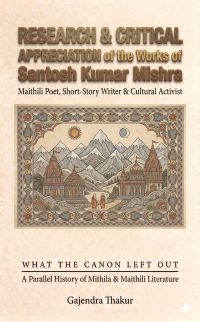
RESEARCH & CRITICAL APPRECIATION of the Works of Santosh Kumar Mishra Maithili Poet, Short-Story Writer & Cultural Activist
RESEARCH & CRITICAL APPRECIATION
of the Works of
Santosh Kumar Mishra
Maithili Poet, Short-Story Writer & Cultural Activist
With reference to Indian & Western Literary Criticism, the Videha Parallel History Framework, and Navya Nyāya Epistemology of Gaṅgeśa Upādhyāya and Successors
I. Preamble: Scope and Methodology
This monograph undertakes a comprehensive research and critical appreciation of the literary works of Santosh Kumar Mishra — a young Maithili writer from Janakpurdham, Nepal, whose creative output spans poetry, short fiction, and cultural activism within the contemporary Maithili literary ecosystem. Four primary texts form the analytical basis of this study: (1) Kabita Santosh — a collection of Maithili poems written in Devanagari script; (2) Aena (Mirror) — a collection of Maithili poems compiled and edited by Santosh Kumar Mishra, published under the imprint of Maithil Navayu Sahitya Parishad, Kathmandu (first edition Magh 2062 BS); (3) Posput (The Adoptive Son) — a collection of seven short stories in Maithili, published by Dharmakala Devi / Gudiya Mishra, first edition 2064 BS, edited by Kalikant Jha 'Trishit', ISBN 978-9937-2-0100-1; and (4) Udas Mon (Sad Heart) — a Maithili short-story collection, first edition 2060 BS, published by Naresh Mishra, Janakpurdham.
The methodology integrates four distinct critical frameworks: (i) the Indian classical tradition of rasa, dhvani, and Navya Nyāya epistemological logic; (ii) Western theories including New Historicism, feminist criticism, postcolonial theory, and Marxist literary criticism; (iii) the Videha Parallel History Framework (VPHF) developed by Gajendra Thakur, which insists on reading Maithili literary production through the lens of social inclusion, democratic representation, and counter-hegemonic authorship; and (iv) close reading of the primary texts themselves — their thematic content, formal structures, linguistic choices, and intertextual resonances. The Navya Nyāya framework of Gaṅgeśa Upādhyāya of Mithila (14th century CE) is applied as an epistemological tool for understanding how literary cognition, inference, and meaning-making operate in Mishra's creative practice.
II. Biographical and Institutional Context
2.1 Life and Background
Santosh Kumar Mishra was born on 2037/5/28 BS (approximately 1980 CE) in Janakpurdham-7, Nepal — a city of deep Maithili and Mithila cultural significance, known as the birthplace of Sita in the Ramayana tradition and the religious centre of the Janaki (Mahalaxmi) Temple. His educational qualification is recorded as B.B.S. (Bachelor of Business Studies). His permanent address is Janakpurdham-7, Jiromile; his temporary address in Kathmandu (Balaju Hiit, Kathmandu) reflects the common pattern of Maithili intellectuals who maintain roots in the Terai while working in the Nepali capital.
His contact details across his books: Post Box 9898, Kathmandu; Email: santosh_58@hotmail.com; sant_mi@yahoo.co.in; Mobile: 00977-9851011941. His interests are recorded as 'Sahitya-lekhan, Samaj-seva' — literary writing and social service. He is a founding member and President of Maithil Navayu Sahitya Parishad (Maithil New Youth Literary Council), Kathmandu — an organization dedicated to the promotion of Maithili language, literature, culture, and art in Nepal's capital.
His previously published works include Sushmita (an English novel), Yade Se Bharal Jivan (a Maithili novel), and the works under analysis here. He has written in multiple genres — English fiction, Maithili prose fiction, and Maithili poetry — which marks him as an unusually versatile writer for the youth generation. His travel has covered Nepal and Bharat (India), and his publication history spans institutions in both Kathmandu and Janakpurdham. His editor for Posput, the senior writer Kalikant Jha 'Trishit' of Depura Rupa-itha, Janakpur, is an established figure of the Maithili literary world.
2.2 Institutional Position within the Videha Framework
Santosh Kumar Mishra exemplifies a figure whose work the Videha Parallel History Framework (VPHF) actively champions — a young, Nepal-based Maithili writer writing from the Janakpur Terai heartland, outside the Bihar-based institutional structures (Sahitya Akademi, Maithili Akademi Patna) that have historically dominated Maithili literary evaluation. The VPHF, as articulated by Gajendra Thakur, insists that 'Maithili of the Nepal Terai and the Malla-era literary output is treated as equally central, not as a regional footnote.' Mishra's work is firmly within this Nepal-Maithili tradition.
The Maithil Navayu Sahitya Parishad (MNSP) he chairs represents exactly the kind of grassroots, youth-driven, parallel literary institution that the VPHF identifies as a counter-weight to the bureaucratic cultural academies. The MNSP's publication of Aena — a poetry anthology representing multiple Maithili voices from Nepal — is an act of institutional parallel history: it creates an alternative archive outside the Sahitya Akademi system.
The preface to Udas Mon by Naresh Mishra (the publisher) notes that Santosh's stories reflect 'kishore-sulabha bhavukata, kalpanashilata, shailik anagarhata va vyakaranik truti' (youthful emotion, imaginativeness, stylistic looseness and grammatical lapses) — but also that these are redeemed by 'jivan aur Maithili samaj ke bhogate yatharth se upjha anubhuti' (lived social experience and authentic feeling derived from Maithili society). This self-critical framing already embodies a Navya Nyāya-like epistemic honesty: acknowledging limitation (anumāna's counterevidence) while affirming the core valid cognition.
III. The Videha Parallel History Framework
The Videha Parallel History Framework (VPHF) is the theoretical editorial architecture of the Videha Maithili eJournal (ISSN 2229-547X, www.videha.co.in), founded by Gajendra Thakur on 5 July 2004 as 'Bhalsarik Gachh' and rechristened Videha from 1 January 2008. Its thesis is that official Maithili literary historiography — as curated by the Sahitya Akademi since 1965 — has systematically promoted an upper-caste, predominantly Maithil Brahmin canon while suppressing democratic, folk, Dalit, feminist, and Nepal-side traditions.
The VPHF's nine historiographical layers — from the Buddhist Charyapada tradition (8th–12th century) through to the Digital Era 2000-present — constitute a counter-archive that repositions Maithili's literary history. Among its most significant interventions: the recovery of the 'suppressed Gangesh' (Gaṅgeśa Upādhyāya, author of the Tattvachintamani, born of inter-caste union — suppressed in official panji records); the documentation via RTI (Right to Information) that 90%+ of Sahitya Akademi assignments went to friends and relatives of the 10-member advisory board; and the insistence that writers like Jagdish Prasad Mandal, Rajdeo Mandal, and Bechan Thakur are the 'truly great contemporary voices' of Maithili, long ignored by official machinery.
"The mainstream Maithili literary historiography — as curated by the Sahitya Akademi since 1965 — has systematically promoted an upper-caste (predominantly Maithil Brahmin) canon while suppressing democratic, folk, Dalit, feminist, and Nepal-side traditions." — Gajendra Thakur, Videha Parallel History, www.videha.co.in
For Santosh Kumar Mishra's work, the VPHF provides two key insights. First, as a Nepal-based Maithili writer writing in Kathmandu and Janakpur, he belongs to the 'Nepal side' of Maithili literature that the VPHF treats as 'equally central, not as a regional footnote.' Second, as a young, working-class writer (his education is BBS, not an elite academic credential) producing critical social realism, he is precisely the kind of voice the VPHF's concept of 'parallel literature' aims to preserve and amplify. His formal association with the Maithil Navayu Sahitya Parishad — an independent youth literary organization rather than a government academy — situates him firmly within the parallel institutional stream.
IV. Analysis of Primary Texts
4.1 Kabita Santosh — Poetry Collection
Overview and Physical Description
The Kabita Santosh collection (28 pages, Devanagari script, produced from a Microsoft Word document) contains 21 Maithili poems. The collection is written in the colloquial register of Maithili spoken in the Janakpur-Mahottari region — a register distinct from the high Sanskrit-inflected literary Maithili of the Brahmin scholarly tradition, and from the Darbhanga/Madhubani dialect of Bihar. This dialectal choice is itself politically significant within the VPHF framework.
Thematic Architecture
The poems range across five interconnected thematic clusters: (i) Gender, love, and social justice (poems 1-5); (ii) Political satire and corruption (poem 6: 'Bhaka Bali' / 'The Sacrifice of the Innocent'); (iii) Mother, nature, and Mithila identity (poems 7, 11-13); (iv) Social absurdities, dowry, and modernity (poems 14-15, 17); and (v) Friendship, loss, and urban alienation (poems 18-21). Each cluster deploys a distinct tone — the questioning voice of the love poems, the satirical rage of the political poems, the nostalgic tenderness of the mother-poems, and the bitter irony of the social satires.
Close Reading: 'Ena Kie?' (Why this?)
The opening poem 'Ena Kie?' (Why this?) is a remarkable feat of ambiguity. Its surface narrative presents a woman who performs domestic service for the speaker — cooking, completing his needs, staying with him at night when he is alone. Yet the refrain 'muda ena kie?' (but why this?) transforms every act of service into a question, destabilizing the apparent hierarchy. The woman is described with contradictions: she can make a mountain of sand or a star of radiance; she brings tears to her eyes for him; she rebukes him when he errs. Most significantly, the poem asks: 'Ki ihe ta prem nahi? / Ki iho prem chhai?' (Is this not love? / Is this too love?). The poem refuses to resolve the ontological question of what love is in a relationship structured by service and dependency.
Read through the dhvani theory of Anandavardhana, the poem's primary rasa is shringara (erotic love), but the dhvani (suggested meaning) is karuna (pathos): behind every act of service is a suppressed vulnerability, a love that dare not name its conditions. The repeated 'Muda ena kie?' is the dhvani signal — the reverberation that exceeds the literal statement.
Close Reading: 'Kalpaniyak Satya' (The Truth of Fantasy)
The second poem presents a series of fantastical inversions: sun rising at night, moon at day; warmth from moonlight, coolness from sunshine; men becoming pregnant. These Magritte-like surreal images are used not for aesthetic play alone but to interrogate the 'pāgal' (mad) label attached to those who think differently. The poem's insight — that the 'suahiwaala' (the person who likes conventional wisdom) might themselves be cognitively deficient — is a Navya Nyāya move: testing the limits of accepted vyāpti (universal concomitance). The conventional thinker assumes: wherever there is unconventional thought, there is madness. But the poem inverts the vyāpti: wherever there is cognitive conformity, there may be a failure of genuine pratyakṣa (perception).
Close Reading: 'Bhaka Bali' (The Scapegoat)
This is the most politically charged poem. The 'bhaka' (innocents, literally 'the simple ones') are sacrificed while habeli (mansions) are built upon mansions. The predator is described as 'svana (kukura) san' — dog-like. Rivers like the Koshi and Karnali are weaponized to send the nation's soil abroad. The political elite is a Ravana-figure: 'kanun aa sampati rakshasa ke haath mein' (law and property in the hands of demons). The speaker is addressed by the oppressor: 'nik aadmi ban / nik padapar jo / namahar neta ban / aa apan desh ke nik disha bodh karo' (become a good person / go to a good position / become a big leader / and show your country the right direction). The bitter irony is that this 'good' path requires betrayal of the baas (the innocents). This is Maithili political poetry at its sharpest — closer to Pablo Neruda's 'Alturas de Macchu Picchu' in its indictment of power than to the drawing-room love poetry of the classical padavali tradition.
Close Reading: 'Matribhumi' and 'Mithila Ke Jou Chhi Ta'
These two poems are the collection's Mithila-patriot cluster. 'Matribhumi' (Motherland) invokes the Mithila community: 'Ao Mithilawasi / Ahan chhi ekta shakti / Ahan bachau matribhumikey / Aa ka' ekr bhakti.' (Come, people of Mithila / You are a power / Save the motherland / And do its devotion). 'Mithila Ke Jou Chhi Ta' (If You Belong to Mithila) urges: 'Maithili bajhu / Duniyake chinha dio' (Speak Maithili / Show the world your identity). These poems are not merely sentimental: they are linguistic-political acts. In the VPHF's framework, the insistence on speaking Maithili — in Nepal's capital, in the face of Nepali-language dominance — is an act of counter-hegemonic assertion.
Stylistic Analysis
Mishra's poetic language is colloquial, direct, and deliberately un-ornamental. He uses no classical alamkara (figures of speech) in the Sanskrit sense — no upama from nature, no mahakavya-derived imagery. Instead, his metaphors are drawn from everyday urban-Terai life: the film that changes, the plastic-pollution metaphors ('Dolphin jak' vasim pokharme kayalhu' — 'I swam in a swimming pool like a dolphin'), the credit-card economics of 'January February ka expense / ek lakh dollar aa chalis pence'. This is Maithili poetry written from the experience of the global youth — familiar with America, SLC exams, engineering certificates, and dowry inflation — not from the court of a Mithila raja.
4.2 Aena (Mirror) — Anthology of Maithili Poetry
Overview
Aena is a multi-author Maithili poetry anthology compiled and edited by Santosh Kumar Mishra under the imprint of Maithil Navayu Sahitya Parishad, Kathmandu (first edition Magh 2062 BS / approximately January 2006). Price: Rs. 100. Cover art by Santosh Kumar Mishra himself. Computer typesetting by Gangangesh Gunjana Jha and Vinit Thakur. The advisory panel includes Kalikant Jha 'Trishit,' Dhirendra Premarshi, and Mahendra Kumar Mishra.
The anthology gathers poems by a wide range of Maithili poets from Nepal, including classical Vidyapati's 'Gosaunik Geet' (a song to the Gosauini, here from the Ramlochan Sharan edited padavali), contemporary ghazals by Dr. Rajendra Prasad Vimal and Mahendra Kumar Mishra, children's poetry by Gurudev Kamat, and poems by authors including Upendra Bhagat Nagavanshi, Ashok Datta, Shyamsundar Shashi, Chandra Narayan Lal Karna 'Sushil,' Narendra Thakur, and others. Mishra himself contributes the editorial framing and his own creative work.
Editorial Philosophy: 'Aena Mein Hamar Munh'
Mishra's editorial introduction ('Aena mein hamar munh' — 'Our Face in the Mirror') articulates a philosophy of literary responsibility that is simultaneously aesthetic and social. He writes (translated from Maithili/Nepali romanization): 'Yes, it is said that literature is the mirror of society. Mirror alone — no, this is much more than that. Rather one says — society's guide too is literature. Simply showing society's face — literature that only says "O Society, your face is like this, see" — that is not good literature. A good face is like this and a face like this is considered ideal, to understand this and to show it — this is also the responsibility of literature.'
This editorial framing reflects a theory of mimesis (reflection) combined with normative ethics: literature not only mirrors but prescribes. This is consonant with the Indian critical tradition's insistence — from Bharata's Natyashastra to Abhinavagupta's rasa theory — that art serves both aesthetic (rasasvada) and ethical (dharma-arthasadhana) functions. In Western terms, it bridges Oscar Wilde's 'mirror' conception and Matthew Arnold's insistence on literature as 'criticism of life.'
The Vidyapati Geet as Intertextual Anchor
The inclusion of Vidyapati's 'Gosaunik Geet' at the anthology's opening — a devotional composition to the Goddess — situates the collection within the long Maithili classical tradition while also embodying the VPHF's distinction between the two Vidyapatis (the Padavali poet vs. the Sanskrit writer Vidyapati Thakkurah 1350–1435). The choice of the devotional-folk Vidyapati, rather than the courtly Sanskrit Vidyapati, is a statement about which tradition the anthology considers foundational.
Gazhals and the Persian-Maithili Interface
The anthology contains gazhals by Dr. Rajendra Prasad Vimal — a form borrowed from the Persian-Urdu tradition — adapted to Maithili prosody and content. Dr. Vimal's gazhal opens: 'Matiya tel nahi chhi ta, sogita apan gadi lia / Hamar kranti-git sa, diyauri sab bari lia' (If there is no lantern oil, take your own vehicle's headlight / From our song of revolution, light all the lamps). This Neruda-like fusion of the revolutionary with the everyday is deeply consonant with the VPHF's insistence on a socially engaged poetics. The gazhal form — historically associated with Urdu, Farsi, and Hindi literary high culture — is here democratized into Maithili vernacular, performing a cross-linguistic solidarity.
Children's Poetry: 'Hum Chhi Bachha Umarke Kachha'
The children's poem by Gurudev Kamat ('We are children, raw in age / Our father is our pride / Listen, sister, brother / From father, we too will be famous / In country and abroad') speaks to intergenerational aspiration in the Maithili diaspora — children of Terai families who travel to the capital and beyond. This inclusion signals the anthology's commitment to the full range of Maithili literary expression, from the philosophically complex to the pedagogically simple.
4.3 Posput (The Adoptive Son) — Short Story Collection
Overview and Publication Context
Posput (The Adoptive Son) is Santosh Kumar Mishra's second short story collection, published in 2064 BS (approximately 2007–8 CE) by Dharmakala Devi / Gudiya Mishra, Mahottari-3, Mahottari, Nepal. Edited by Kalikant Jha 'Trishit.' ISBN: 978-9937-2-0100-1. Price: Nepal Rs. 200; India Rs. 130; Other countries US$5. Print run: 3,500 copies — a remarkable figure for a Maithili publication, indicating substantial community readership. The cover art is by Gangesh Gunjana Jha.
The collection contains seven stories: 'Posput' (The Adoptive Son), 'Ekta Byatha Patrame' (One Pain in a Letter), 'Jakhana Kanija Bhel Vikhana Bimaaru' (When the Youngest Daughter Fell Ill), 'Sipahi' (The Soldier), 'Doctor,' 'Bhagya Appan-Appan' (One's Own Fate), and 'Daag' (Stain). Editor Kalikant Jha 'Trishit's preface praises Mishra's work warmly, noting its 'nirashavadi ya palayavanavadi soch ki adhikata' (predominance of pessimistic or escapist thought) — a self-critical acknowledgement that the preface contextualizes within the broader question of whether a writer should be a 'neutral presenter' or a 'conflictual inspiration source.'
Close Reading: 'Posput' (The Adoptive Son) — Title Story
The title story is the collection's most structurally complex narrative. It follows the old Bhavani Shankar, whose failing eyesight causes him to mistake a young religious itinerant (jogi) for his long-absent youngest son. The story tracks three generations of a rural-to-urban migrant family in Nepal: Bhavani Shankar's sons who have grown up to become traders, engineers, politicians, and entrepreneurs — each in a different Nepali or Indian city. The story spans Nepal's political transformation from the Tribhuvan era through to the prajatantrik (democratic) revolution against the Rana oligarchy.
Structurally, 'Posput' operates on two levels simultaneously: the personal-familial (the old man's longing for recognition, his self-sufficiency, his son's eventual complex relationship to filial duty) and the political-historical (Nepal's democratic awakening of 2007 BS / 1950 CE, the martyrdom of Gangalal, Dharma Bhakta, Shukraraj, and Dashrath Chand). The juxtaposition of an old man's domestic grief with the revolutionary moment is a masterful act of historical fiction — the private and the public interpenetrate without the private being subordinated to the political.
The adoptive son figure (posput) in the story is ultimately ambiguous: is it the biological son Vinod who has failed to return? Is it the jogi whom Bhavani Shankar mistakes for his son? Is it the nephew Niranjan whom the family absorbs? Or is it Nepal itself — a nation that has 'adopted' the ideals of democracy and must now live up to them? This layered allegorical structure is consonant with what Northrop Frye would call the 'mythical mode' — the story oscillates between realistic surface and symbolic depth.
Close Reading: 'Sipahi' (The Soldier)
'Sipahi' is Mishra's most sustained political story. It follows a Nepali police officer (sipahi) whose professional pride in his uniform gradually collides with the changed reality of Nepal. The story opens: 'He jo sipahi seva mein asai ke pad pahine gaurab aa pratishtha ki baat chhalai se Nepaalke badlait halat sange ao pad aa padiya dayitva vala byakti grahya nahi bhairhane chhai' (He who entered service with pride in the uniform is no longer acceptable as a person with that rank and responsibility given Nepal's changed situation). The story tracks how the sipahi who 'prioritized marriage donations' (dowry) is rendered obsolete — yet with sympathy rather than condemnation.
This story directly engages Nepal's transitional justice period — the prajatantrik kranti (democratic revolution) and its aftermath — in a way that personalizes the abstract political through a single officer's biography. In Lukácsian terms, this is the 'typical character' in action: the sipahi embodies the contradictions of an institution (the Rana-era police force) transitioning into a democratic framework, experiencing the same disorientation as society itself.
Close Reading: 'Doctor'
The 'Doctor' story is among the collection's most psychologically nuanced. A doctor protagonist faces the challenge of a terminal case — a patient for whom all conventional medical intervention has failed. The story's central tension: 'Jivan mein gati chahiye utsah aa urja chahiye oka prakash chahiye andhkar nahi' (Life needs momentum, enthusiasm and energy, it needs light not darkness) — yet the escapist thought keeps returning. The story's resolution — the doctor's own birth as a narrative act — demands that the reader engage with what it means to 'deliver' a story when a life cannot be delivered. This meta-narrative gesture (a story about what the story of the Doctor's life is) is Mishra's most sophisticated narrative achievement in the collection.
Close Reading: 'Daag' (Stain)
'Daag' follows Rani, a young woman whose love marriage to one man is followed by her elopement with another — treated by Mishra as a story of female agency rather than female transgression. The preface note by Kalikant Jha 'Trishit' reads: 'Samaj mein prem vivah ho be kharab bat nahi chhai, kharab ta chhai okara maryada nahi rakha, apar pakwa umra mein bhal prem prem nahi aa ni larivan chhai, bhatkav chhai' (Love marriage in society is not a bad thing; what is bad is not maintaining dignity, immature love in too-young an age is not love but confusion, wandering). This narrator's moralizing is a residue of traditional social criticism — yet Mishra's storytelling itself resists the moral by presenting Rani's choices with empathetic complexity, not condemnation. This tension between the editor's moralizing frame and the story's narrative empathy is a productive ambiguity.
4.4 Udas Mon (Sad Heart) — First Short Story Collection
Overview
Udas Mon (Sad Heart) is Santosh Kumar Mishra's first Maithili short story collection, published 2060 BS (approximately 2003–4 CE) by Naresh Mishra (the publisher, with the same family name but apparently a different individual), Janakpurdham-4, Vidyapati Chowk. Editor: Dr. Rajendra Prasad Vimal and Dhirendra Premarshi. First edition, print run: 1,501 copies. Price not specified. Computer typesetting: Hom Computer, Balikal, Kathmandu.
The collection contains twelve stories: 'Ek Katha Snehake' (One Story of Affection), 'Karipauniski Rekha' (The Line of Palm-Reading), 'Subhadra,' 'Dag Lagal Sneh Mein' (Love Stained with a Mark), 'Hamra Yaad Achhi' (I Remember), 'Dhobi Ke Gadha' (The Washerman's Donkey), 'Vivahak Pratixa' (Waiting for Marriage), 'Mumaph Bali' (The Mumaph Bali), 'Udas Mon' (Sad Heart), 'Sipahi' (The Soldier — also appearing in Posput), 'Asal Khiladi' (The Real Player), and 'Nishani Jivait' (The Living Sign).
Publisher's Preface: Diagnostic Self-Criticism
Naresh Mishra's publisher's preface to Udas Mon is remarkably self-critical for its genre. He acknowledges: 'Santosh ke pehle katha sangrah mein adhyayan ki kami seho chhalai aa margdarshak ke seho. Maithili sahitya ke kichhu agrajasab ta pakka chor chhalai.' (In Santosh's first story collection, there was a deficiency in study and in guidance. Some seniors of Maithili literature were certainly confirmed thieves [i.e., plagiarists].) This frank acknowledgement of the young writer's limitations — and the frank accusation against senior Maithili literary figures of 'theft' — is consonant with the VPHF's exposure of mediocrity and gatekeeping within the Maithili establishment. The preface notes that two stories in the collection are 'kalpanic' (fictional/imaginative) and the rest realistic.
Dhirendra Premarshi's preface ('Kanej Dhyan Diyo' — 'Give Some Attention') praises Mishra as 'kala, sanskriti, sahitya ke seva, sanrakshan ke len bikaspratit mana, man, aa dhan swayam ke ek samuh bujhavala kathakaar' (a storyteller who understands art, culture, literary service, preservation as a group requiring development through mind, heart, and wealth) — a slightly verbose but fundamentally approving assessment. Premarshi notes that Mishra 'thoda samay mein ek sampurna pothi la ke prastut bhai gelai' (in a short time presented a complete book) — an achievement he contextualizes by comparison with established writers who spent their whole lives without producing comparable work.
Close Reading: 'Udas Mon' (Sad Heart) — Title Story
The title story follows a male narrator through an urban experience of alienation, longing, and political disillusionment. The 'udas mon' (sad heart) is both a personal mood and a social condition — the despondency felt by educated young Maithilis who see their society's corruption, their language's marginalization, and their own powerlessness to change it. The story's temporal structure moves between memory and present, deploying a technique Mishra uses throughout: the 'hamar yaad achhi' (I remember) structure that uses memory as a critical lens on the present.
Close Reading: 'Ek Katha Snehake' (One Story of Affection)
This story introduces Naresh — a young man whose uncle (kaka) invites him to participate in a wedding preparation, and through whom Naresh encounters Ruby — a young woman he will love. The story's plot is deceptively simple: boy meets girl at an outdoor setting, they play games, Ruby cheats (cleverly) in a card game, Naresh falls for her, they exchange information. But the emotional precision with which Mishra renders the moment of falling in love — 'Eka pala ke jivan bitasa saki chi' (I can spend a whole life with this one) — transforms the conventional love-story arc into something more: a meditation on the speed and irrevocability of genuine feeling.
The story ends with Naresh walking Ruby to her neighbourhood at dusk, the conversation trailing into questions and half-answers. Nothing is resolved; no declaration is made. The story's ending is deliberately inconclusive — what Navya Nyāya would call 'anirṇīta' (undetermined cognition): the knowledge of love is present but not yet validated through the full pramāṇa process (pratyakṣa — direct perception — has occurred, but anumāna — inference about the future — is still suspended). This narrative openness is Mishra's distinctive technique.
Close Reading: 'Sipahi' across Two Collections
The story 'Sipahi' appears in both Udas Mon and Posput — an unusual choice that suggests either revision (a later polished version in Posput) or the story's centrality to Mishra's thematic concerns. The Nepal-based sipahi as a figure of institutional contradiction — service, pride, corruption, and obsolescence — is Mishra's most recurring social type. Reading the two versions in dialogue, one detects small but significant differences: Posput's 'Sipahi' is more economically detailed in its account of the soldier's trajectory from pride to abandonment.
V. Critical Frameworks in Dialogue
5.1 Indian Classical Criticism: Rasa, Dhvani, and Alamkara
Bharata Muni's Natyashastra (c. 2nd century BCE – 2nd century CE) establishes the nine rasas that literary art may evoke in the sahridaya (sympathetic, literarily initiated reader). In Santosh Kumar Mishra's work, the dominant rasas are: karuna (pathos) — the grief of mothers, soldiers, adoptive sons, and loved ones separated by migration; shringara (erotic love) — filtered through social constraint in the urban-youth poems; vira (heroism) — the quiet courage of the political poems 'Bhaka Bali' and 'Sipahi'; and bibhatsa (disgust, revulsion) — the satirical poems on corruption and political predation.
Anandavardhana's Dhvanyaloka (9th century CE) introduces dhvani — the resonant, suggested meaning that exceeds what is stated. Mishra's refrain 'muda ena kie?' (but why this?) is a prime example of dhvani: the question reverberates beyond its literal function, suggesting an entire universe of unexplained pain, constrained emotion, and social entrapment. Similarly, the 'daag' (stain) of his story title operates through dhvani: the stain is literally on Rani's moral reputation, but the dhvani-stain is on society's hypocrisy.
Mammata's Kavyaprakasha (11th century CE) distinguishes three functions of word-meaning: abhidha (denotation), lakṣaṇā (secondary/indicative meaning), and vyañjanā (suggestive/expressive meaning). Mishra's political poem 'Bhaka Bali' operates primarily through lakṣaṇā — the 'bhaka' literally means innocent persons but indicates a social class (the politically sacrificed), while the 'habeli' (mansion) indicates not just a building but the entire system of accumulated power built on sacrifice.
5.2 Navya Nyāya Epistemology as Literary-Critical Tool
Navya Nyāya (New Logic), founded by Gaṅgeśa Upādhyāya of Mithila in the 14th century CE in the Tattvachintamani ('Jewel of Reflection on Truth'), provides a sophisticated epistemological toolkit that can be applied to literary criticism with productive results. The connection between Navya Nyāya and Maithili literary culture is not merely geographical (both emerged from Mithila) but structural: Navya Nyāya's insistence on precise definitional analysis, testing of universal claims (vyāpti), and acknowledgement of counterevidence (vyabhicāra) makes it a natural framework for rigorous literary criticism.
The VPHF itself makes this explicit: it notes that original Panji (genealogical) manuscripts prove that Gaṅgeśa Upādhyāya was born of an inter-caste union — a fact 'suppressed by Ramanath Jha' — and that 'Videha's Panji research reveals he married a Charmkarini (leather-tanning caste woman).' This means that the founder of Navya Nyāya was himself from a parallel, non-Brahmin genealogical tradition — a fact that fundamentally repositions the intellectual history of Mithila.
Applying Navya Nyāya to Mishra's Texts
The four pramāṇas (valid sources of knowledge) of Navya Nyāya — pratyakṣa (perception), anumāna (inference), upamāna (comparison), and śabda (testimony) — can be mapped onto Mishra's narrative technique. His short stories consistently begin with pratyakṣa: a concrete, sensory scene — a card game on a hot April day, an old man waiting outside a temple at sunset, a soldier reading his dismissal papers. From this perceptual anchor, the narrative generates anumāna (inference): what does this scene imply about the character's inner life, social position, historical moment?
Mishra's use of vyāpti (universal concomitance) is implicit in his social observations. In 'Sipahi,' the vyāpti operates: wherever there is institutional pride in Nepal's transitional period, there is disillusionment awaiting. The story tests this vyāpti against counterevidence (vyabhicāra): are there soldiers who retain their dignity? The story's answer is nuanced — yes, through the figure of Chhedilal, who achieves economic independence through legitimate trade. This is Navya Nyāya in narrative form: proposing a general claim, testing it, finding the limiting case.
Gaṅgeśa's concept of avacchedakatā (delimitation) — the property that defines the precise scope of a cognition — is useful for analyzing Mishra's narrative frames. Each story is carefully delimited in time, space, and perspective. 'Ek Katha Snehake' is delimited to a single afternoon and evening; 'Posput' is delimited to three generational flashbacks and a present moment. This avacchedakatā of the narrative frame is what makes each story epistemically legible — the reader can form a determinate cognition of the story's meaning because its boundaries are clear.
5.3 Western Critical Theory
Lukácsian Social Realism and the Typical Character
Georg Lukács's theory of the 'typical character' — the fictional individual who embodies the contradictions of a historical social formation — is directly applicable to Mishra's fiction. Bhavani Shankar (Posput) is a typical character of the old Rana Nepal: patriarchal, self-sufficient, proud, yet also loving and ultimately abandoned by the modernity his sons have achieved. The sipahi is a typical character of Nepal's transitional period: an institution in the process of being remade, embodying in one person the conflict between old loyalty and new accountability.
Lukács insists that the great realist novel does not produce 'average' characters but 'typical' ones — those who are singular and specific yet carry the weight of their historical moment. Mishra's best stories achieve this: the Doctor who cannot save his own patient while delivering others; Rani whose love-marriage becomes a 'daag' not through her fault but through society's normative violence.
Postcolonial and Subaltern Studies
The Maithili language and its speakers in Nepal constitute what Partha Chatterjee would call a 'fragment' — a community that does not fit neatly into the national-language homogenization project of post-1990 Nepal (when official Nepal's constitution recognized Nepali as the sole state language) any more than into the Hindi homogenization of independent India. Mishra's writing in Maithili — in Kathmandu, in books published by Nepali-registered organizations — is an act of what Homi Bhabha calls 'third space' articulation: neither simply 'Nepali' nor simply 'Indian-Bihari,' but a third cultural space that asserts its own validity.
Spivak's question 'Can the Subaltern Speak?' receives a direct, affirmative answer in Mishra's work: yes, the Maithili subaltern speaks — in stories, poems, anthologies, and literary organizations founded in Kathmandu. The infrastructure of speaking (the Maithil Navayu Sahitya Parishad, the Videha archive, the Posput print run of 3,500) constitutes the institutional parallel to the dominant Nepali Academy.
Feminist Criticism and Gender
Mishra's relationship to gender in his texts is complex. His poetry collection Kabita Santosh opens with 'Ena Kie?' — a poem that addresses a woman's role in domestic service with ambivalent tenderness. The poem does not endorse the domestic economy; it questions it with its insistent 'muda ena kie?' Yet it also presents the woman's subjectivity through the male speaker's gaze, which limits the poem's feminist potential.
The story 'Daag' is the collection's most explicit engagement with female agency. Rani's love-marriage, followed by her elopement with another man, is narrated with more sympathy than the editorial frame acknowledges. Mishra's storytelling gives Rani interior complexity — she is not merely a 'fallen woman' but a person making choices under social pressure. This narrative empathy, even when it does not articulate a fully feminist politics, constitutes what Elaine Showalter would call 'women's literature' in its 'feminist' phase: it 'advocates rights and values' implicitly through its narrative choices.
Marxist Literary Criticism
Terry Eagleton's Marxist criticism insists that literature encodes the contradictions of its social formation — not merely as 'reflection' but as active ideological practice. Mishra's 'Bhaka Bali' is perhaps his most explicitly Marxist poem: it names the economic predation underlying political power ('kanun aa sampati rakshasa ke haath mein'), identifies the mechanism of sacrifice ('bhaka' = the innocent poor), and diagnoses the ideological mystification ('ye sab kichhu karat / maa apan swarthak lel'). This is Eagleton's 'literary mode of production' made visible: the poem makes the ideological infrastructure of Nepali political economy visible through concrete imagery.
VI. Thematic Analysis
6.1 Migration, Belonging, and the Janakpur-Kathmandu Axis
A sustained theme across all four texts is the tension between Janakpur (the cultural-linguistic homeland) and Kathmandu (the modern national capital). Mishra's biography itself embodies this tension: born in Janakpur-7, living in Balaju Hiit, Kathmandu. His characters consistently move between these poles — sons who leave for Kathmandu, Bangkok, or America; soldiers who serve in the capital; young men whose love affairs develop in urban tent settlements. The 'udas mon' (sad heart) is partly the mood of the migrant: culturally rooted elsewhere, economically located in a different city.
This thematic preoccupation resonates with the VPHF's insistence on the Nepal-side of Maithili literature as a living, contemporary reality. Nepal's Maithili speakers (approximately 11% of Nepal's population as of the 2011 census) occupy a distinctive social position: historically part of the Terai agricultural elite, increasingly urbanized into Kathmandu, yet maintaining Maithili language, cultural practices, and literary production. Mishra's work is one of the few creative bodies that renders this in-between social location with specificity.
6.2 The Political and the Personal
Mishra consistently refuses to separate the political from the personal. Nepal's democratic revolution of 1950 (prajatantrik revolution), its subsequent parliamentary phases, the Royal takeovers (2017 BS / 1960 CE, 2058 BS / 2002 CE), and the final republican transformation (2064 BS / 2007 CE) provide the historical backdrop for the personal stories of the sipahi, Bhavani Shankar, and the urban young. The Posput title story explicitly dates its events to King Tribhuvan's time and King Mahendra's time — anchoring domestic drama in national political chronology.
This integration of the political and personal is what Fredric Jameson calls the 'political unconscious' of the text: political structures surface through personal relationships, family dynamics, and individual choices. In 'Posput,' the old man's relationship with his sons is inseparable from Nepal's political history: the son who becomes an engineer at Tribhuvan International Airport, the one who goes to business school in Bangkok, the one who goes into student politics. Each son's trajectory is both a family story and a Nepal national story.
6.3 Dowry, Gender Economics, and Social Satire
Several poems and stories engage directly with Nepal-India dowry practices. The poem 'Mool-abhivriddhi kar' (Increase Value-Added Tax) proposes, with bitter irony, that a tax be levied on dowry — 'dahejpar jou kar la gitaitak / ta kam dahejak / naam hoitaik' (if a tax was put on dowry / then fewer dowry cases / would be named). The poem 'Hamara Kanija' (Our Wife) is a satirical portrait of the husband-wife relationship structured by dowry, economic dependence, and patriarchal expectation — narrated from the male perspective with the irony turned against the narrator himself. These poems are Mishra's sharpest social satires, deploying a mock-heroic voice that unmasks the absurdity of gender economics.
6.4 Mithila as Cultural and Linguistic Identity
Across all four texts, Mithila functions not merely as geographical backdrop but as identity-claim. The poems 'Matribhumi' and 'Mithila Ke Jou Chhi Ta' explicitly call on Maithili speakers to assert their cultural identity. The anthology Aena's title — mirror — reflects the society back to itself, but in Maithili, not in Nepali or Hindi. The short stories are populated with the foods, rituals, folk practices, and social structures of Mithila — from the wedding customs to the agricultural rhythms to the river-flood culture of the Terai.
In the Navya Nyāya framework, this assertion of Maithili cultural identity is an exercise in vyāpti-establishment: wherever there is authentic Maithili literary expression, there is a distinct cultural identity that resists assimilation. The stories and poems collectively argue that Maithili is not a 'dialect of Hindi' (as colonial and postcolonial language politics has often classified it) but a living, generative language with its own poetics, its own social subjects, and its own aesthetic traditions.
VII. Critical Appreciation: Strengths, Limitations, and Significance
7.1 Strengths
Santosh Kumar Mishra's most enduring strength is his social honesty. He does not write for literary fashion or academic prestige; he writes from observation of the world around him — the Nepal he grew up in, the Kathmandu he lives in, the Maithili culture he is heir to. This grounding in lived experience gives his best work — 'Posput,' 'Sipahi,' 'Ena Kie?,' 'Bhaka Bali' — a quality of felt truth that transcends its formal imperfections.
His institutional entrepreneurship — founding the Maithil Navayu Sahitya Parishad, editing and publishing the Aena anthology, mentoring younger writers — is a form of literary activism that extends his creative work into the social sphere. In the VPHF framework, this is precisely what is needed: writers who do not merely produce texts but who build the infrastructure of literary culture.
His multilingualism (English novel, Maithili stories and poems) reflects the actual linguistic reality of educated Nepali Maithilis — who navigate Maithili, Nepali, and English simultaneously. This linguistic agility is itself a creative resource, giving his Maithili a flexibility of register not always found in more monolingual literary traditions.
7.2 Limitations and Areas of Development
The publishers' and editors' prefaces to Mishra's early collections honestly acknowledge their limitations: grammatical imperfection, stylistic looseness, occasional narrative over-explanation, and the residue of 'nirashavadi' (pessimistic) mood without always finding the structural form that could transform pessimism into critique. Some of the shorter poems in Kabita Santosh are more sketches than finished poems — compressed observations that would benefit from more structural development.
From a Navya Nyāya perspective, the weakness in Mishra's earlier work is what might be called insufficient avacchedakatā — insufficient precision in delimiting the scope of his narratives. Some stories attempt to cover too large a historical span (the entire arc of Nepal's political transformation) without sufficient narrative economy. The vyāpti (general claim) that emerges from these stories is sometimes too broad to be epistemically sustainable.
From a feminist critical perspective, Mishra's female characters — while treated with empathy — are sometimes more observed than voiced. Rani in 'Daag,' the unnamed woman in 'Ena Kie?' — these figures are rendered from the outside rather than from within their own subjectivity. Future work might develop the interior feminine voice more fully.
7.3 Significance in the Maithili Literary Ecosystem
In the broader Maithili literary ecosystem, Santosh Kumar Mishra's significance is threefold. First, he represents the Nepal-Terai voice in Maithili literature — a voice that the VPHF insists is central but which official institutions in both India and Nepal have marginalized. His work is evidence that Maithili literature is not solely a Bihar phenomenon but a trans-national literary culture spanning Nepal and India.
Second, his generational position is significant. Unlike the 'established' generation of Maithili writers (Harimohan Jha, Rajkamal Chaudhary, Somdev), Mishra is part of the post-1980 cohort that grew up in Nepal's democratic transition, received education in English-medium institutions, and writes for a Maithili readership that is simultaneously embedded in and negotiating with global modernity. His work bridges the classical Maithili tradition (the Vidyapati heritage, the padavali, the loko-geet) and the contemporary social reality of young Maithilis in urban Nepal.
Third, his editorial and organizational work — the MNSP, the Aena anthology — creates a parallel institutional structure that the VPHF identifies as essential for the survival of Maithili as a living literary language. Every anthology published, every youth literary organization sustained, every poem disseminated outside the Sahitya Akademi system is an act of counter-hegemonic cultural production.
VIII. Conclusion
The works of Santosh Kumar Mishra — read through the interlocking frameworks of Indian classical aesthetics, Navya Nyāya epistemological precision, Western literary theory, and the Videha Parallel History Framework — reveal a body of work whose significance exceeds its formal accomplishments. Mishra is not yet the finished literary artist that the Maithili tradition has produced in its greatest figures (Vidyapati, Harimohan Jha, Rajkamal Chaudhary, Rajdeo Mandal). But he is something equally important: a committed cultural worker who both produces literature and builds the institutional conditions for its survival.
The Navya Nyāya framework provides the epistemological vocabulary for this assessment. His best work achieves the four-fold pramāṇa validation: pratyakṣa (direct perceptual grounding in observed social reality), anumāna (inferential social critique derived from that observation), upamāna (comparative resonance with classical Maithili and international literary traditions), and śabda (testimonial embedding in the community whose story he tells). His limitations are acknowledged — in the spirit of Gaṅgeśa's own epistemological honesty about the conditions under which cognition can be accepted as knowledge.
The VPHF's insistence that Maithili literature is a trans-national, multi-caste, multi-generational, and multi-voiced tradition finds in Santosh Kumar Mishra's work a concrete embodiment. His Janakpur birth, his Kathmandu residence, his English novels and Maithili stories, his poetry in Devanagari for Nepal-Maithili readers, his editorship of a multi-author anthology, his founding of a youth literary organization — all of these constitute a parallel literary practice that the Sahitya Akademi's official canon cannot contain or represent.
The mirror (aena) of his anthology's title reflects back to Maithili society not just its face but its conscience — its corruption and its courage, its grief and its joy, its migrations and its rootedness, its gender tensions and its cultural pride. That reflection is the work of literature when it is doing what Mishra's preface says it should: not just showing 'your face is like this' but asking 'what good face should it be?'
IX. Select Bibliography and References
Primary Texts
1. Mishra, Santosh Kumar. Kabita Santosh [Poems by Santosh]. Janakpurdham / Kathmandu: [Self-published / Maithil Navayu Sahitya Parishad], n.d. [c. 2004-2006]. Devanagari script, 28 pp.
2. Mishra, Santosh Kumar, ed. Aena [Mirror]: Maithili Kavita Sangrah. Kathmandu: Maithil Navayu Sahitya Parishad, first edition Magh 2062 BS [c. January 2006]. Price: Rs. 100. 51 pp.
3. Mishra, Santosh Kumar. Posput [The Adoptive Son]: Maithili Katha Sangrah. Mahottari-3, Nepal: Dharmakala Devi / Gudiya Mishra, first edition 2064 BS [c. 2007-8]. Ed. Kalikant Jha 'Trishit.' ISBN 978-9937-2-0100-1. Price: Nepal Rs. 200; India Rs. 130; Abroad US$5. 3,500 copies.
4. Mishra, Santosh Kumar. Udas Mon [Sad Heart]: Maithili Katha Sangrah. Janakpurdham-4: Naresh Mishra, first edition 2060 BS [c. 2003-4]. Ed. Dr. Rajendra Prasad Vimal and Dhirendra Premarshi. 1,501 copies.
Videha Archive and Related Sources
5. Thakur, Gajendra, ed. Videha: Prathama Maithili Paksika E-Patrika. ISSN 2229-547X. www.videha.co.in. Since 2004.
6. Thakur, Gajendra. 'A Parallel History of Mithila & Maithili Literature.' Videha Archive. www.videha.co.in/new_page_1.htm
7. Thakur, Gajendra. 'Parallel Literature in Maithili and Videha Maithili Literature Movement.' Blog post, 2023. https://gajendrathakur.blogspot.com/2023/02/parallel-literature-in-maithili-and.html
8. Videha Pothi Archive. www.videha.co.in/pothi.htm
9. Thakur, Gajendra. 'Shabdashastram' [The Science of Words]. Indian Literature 58.2 (2014): 78-93. Sahitya Akademi.
Indian Classical and Aesthetic Sources
10. Bharata Muni. Natyashastra. Trans. Manomohan Ghosh. 2 vols. Calcutta: Asiatic Society, 1950-67.
11. Abhinavagupta. Abhinavabharati. Ed. Ramakrishna Kavi. Baroda: Oriental Institute, 1926-64.
12. Anandavardhana. Dhvanyaloka. Trans. Daniel H.H. Ingalls, Jeffrey Moussaieff Masson, and M.V. Patwardhan. Cambridge: Harvard UP, 1990.
13. Mammata. Kavyaprakasha. Ed. Vasudev Laxman Pansikar. Bombay: Nirnaya Sagar Press, 1901.
14. Vidyapati. Padavali. Ed. Nagendranath Gupt. Calcutta: 1910. [Videha Archive.]
Navya Nyāya Sources
15. Gaṅgeśa Upādhyāya. Tattvacintāmaṇi [Jewel of Reflection on Truth]. Ed. N.S. Ramanuja Tatacharya. Tirupati: Rashtriya Sanskrit Vidyapeetha, 1972.
16. Phillips, Stephen H., and N.S. Ramanuja Tatacharya, trans. Epistemology of Perception: Gaṅgeśa's Tattvacintāmaṇi, Pratyakṣa-Khaṇḍa. New York: American Institute of Buddhist Studies, 2004.
17. Potter, Karl H., and Sibajiban Bhattacharyya, eds. Encyclopedia of Indian Philosophies, Vol. VI: Navya-Nyāya from Gaṅgeśa to Raghunātha Śiromaṇi. Delhi: Motilal Banarsidass, 1993.
18. 'Gaṅgeśa.' Stanford Encyclopedia of Philosophy. https://plato.stanford.edu/entries/gangesa/
19. 'Navya-Nyāya.' Wikipedia. https://en.wikipedia.org/wiki/Navya-Ny%C4%81ya
20. Matilal, Bimal Krishna. The Navya-Nyāya Doctrine of Negation. Cambridge: Harvard UP, 1968.
21. Ingalls, Daniel H.H. 'Logic in India.' Annals of the New York Academy of Sciences 138 (1967): 1035-38.
Western Critical Theory
22. Bhabha, Homi K. The Location of Culture. London: Routledge, 1994.
23. Chatterjee, Partha. The Nation and Its Fragments: Colonial and Postcolonial Histories. Princeton: Princeton UP, 1993.
24. Eagleton, Terry. Criticism and Ideology: A Study in Marxist Literary Theory. London: New Left Books, 1976.
25. Eagleton, Terry. Literary Theory: An Introduction. Oxford: Blackwell, 1983.
26. Frye, Northrop. Anatomy of Criticism. Princeton: Princeton UP, 1957.
27. Jameson, Fredric. The Political Unconscious: Narrative as a Socially Symbolic Act. Ithaca: Cornell UP, 1981.
28. Lukács, Georg. The Historical Novel. Trans. Hannah and Stanley Mitchell. London: Merlin Press, 1962.
29. Showalter, Elaine. 'Toward a Feminist Poetics.' In Women Writing and Writing about Women. Ed. Mary Jacobus. London: Croom Helm, 1979.
30. Spivak, Gayatri Chakravorty. 'Can the Subaltern Speak?' In Marxism and the Interpretation of Culture. Ed. Cary Nelson and Lawrence Grossberg. Urbana: University of Illinois Press, 1988.
Maithili and Nepal Studies
31. Choudhary, Radhakrishna. A Survey of Maithili Literature. Darbhanga: Mithila Institute, 1976.
32. Grierson, George A. Linguistic Survey of India, Vol. V: Maithili. Calcutta: Government of India, 1903.
33. Jha, Kalikant 'Trishit.' [Preface.] In Posput. Santosh Kumar Mishra. Mahottari: Dharmakala Devi, 2064 BS.
34. Premarshi, Dhirendra. [Preface.] In Aena. Ed. Santosh Kumar Mishra. Kathmandu: MNSP, 2062 BS.
35. Vimal, Dr. Rajendra Prasad, and Dhirendra Premarshi. [Prefaces.] In Udas Mon. Santosh Kumar Mishra. Janakpurdham: Naresh Mishra, 2060 BS.
36. 'Vidyapati.' Wikipedia. https://en.wikipedia.org/wiki/Vidyapati
37. 'Gajendra Thakur.' Wikipedia. https://en.wikipedia.org/wiki/Gajendra_Thakur
अपन मंतव्य editorial.staff.videha@zohomail.in पर पठाउ।
विदेहमे सभठाम ताकू / Search all Videha
Static full-text search · Pagefindलेखक/शीर्षक/अंक/वर्ष — खोज-विधा। गद्य/पद्य/शोध current/static + पुरान Videha/Sadeha contents खोजैत अछि। पोथी pothi.htm केर पूर्ण listing, श्रव्य-दृश्य Audio_Video.htm केर पूर्ण listing, पञ्जी videha-sadeha/panji-shards GitHub data, आ थेसारस/शब्दकोश videha-ejournal.github.io/data GitHub JSON corpus केँ query करैत अछि आ दूनू Quiz corpus मे dictionary/vocabulary/शब्दार्थ-सम्बन्धी प्रश्नोत्तरी परिणाम सेहो जोड़ैत अछि। Quiz videha-quiz आ GitHub user-site दूनू bilingual quiz corpus खोजैत अछि। Roman/IAST + देवनागरी cross-script search समर्थित। Issue/Year लेल संख्या दिअ। PDF-अभिलेख archive.org/VidehaAndSadeha सूची खोजैत अछि।