
A PARALLEL HISTORY OF MITHILA & MAITHILI LITERATURE- PART 98
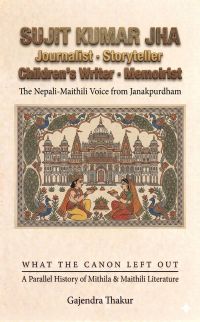
A COMPLETE CRITICAL RESEARCH AND APPRECIATION OF THE WORKS OF SUJIT KUMAR JHA Journalist Storyteller Children's Writer Memoirist The Nepali-Maithili Voice from Janakpurdham
A COMPLETE CRITICAL RESEARCH AND APPRECIATION OF THE WORKS OF SUJIT KUMAR JHA
Journalist · Storyteller · Children's Writer · Memoirist
The Nepali-Maithili Voice from Janakpurdham
Analysed through Indian & Western Literary Theories,
the Videha Parallel History Framework, and
Navya Nyāya Epistemology of Gaṅgeśa Upādhyāya
PREFACE
This research constitutes a complete critical appreciation of the literary works of Sujit Kumar Jha (सुजीत कुमार भा / सुजित कुमार झा), a Nepali Maithili journalist, short-story writer, children's author, and memoirist based in Janakpurdham, Dhanusha District, Nepal. Eight of his published texts are analysed as primary sources: the short-story collections Chiṛai (चिड़ै), Jiddī (जिद्दी), Bulbul (बुलबुल), Gandha (गन्ध), and Khajurībālī (खजुरीबाली); the children's story collection Koilī Ghūri Āu (कोइली घूरि आउ); the journalistic memoir-essay collection Reporter Diary (रिपोर्टर डायरी); and a feature article in the Doodhmati Weekly newspaper (Ank 41, 15 March 2016).
The critical methodology interlaces three frameworks: (i) Classical Indian literary theory — rasa-dhvani aesthetics, alaṃkāra, and aucitya; (ii) Western critical theory from Aristotle through Russian Formalism, New Criticism, feminist theory, postcolonialism, and narratology; and (iii) the Videha Parallel History Framework of Gajendra Thakur, which recovers the suppressed democratic, Nepal-side, and non-institutional strand of Maithili literature. Threading through all three frameworks is the epistemological precision of Navya Nyāya, the 'New Logic' school founded by Gaṅgeśa Upādhyāya of Mithilā (14th century CE), whose Tattvacintāmaṇi provides a rigorous vocabulary for distinguishing valid inference from conjecture.
Sujit Kumar Jha is a figure of particular significance in the Videha Parallel History: he is a Nepal-side Maithili author — one of that community of writers in the Madhesh / Terai region whose work is systematically marginalised by both the India-centric Sahitya Akademi establishment and mainstream Nepali literary institutions. His texts are simultaneously rooted in Mithilā's ancient cultural soil and alive to contemporary urban-rural tensions, migration, gender, journalistic ethics, and childhood. The Nepal Bidyapati Maithili Research Prize awarded to him by the Ministry of Culture, Tourism and Civil Aviation of Nepal (c. 2014) marks an institutional recognition of precisely the kind the Videha Parallel History has long advocated.
PART I: BIOGRAPHICAL AND CONTEXTUAL PORTRAIT
1.1 Life and Vocation
Sujit Kumar Jha was born on 11.01.1933 BS [Baisakh 11, Vikram Samvat 2033] [23 April 1976 CE] in the village of Lohana Bhamnagama-2, Ward No. 2, Dhanusha District, Nepal. His father is Shri Sukhendra Jha; his mother is Jayamangala Devi — to both of whom he dedicates his first story collection Chiṛai in an inscription of filial devotion that marks the emotional centre of his creative project. His permanent residence is Saraswati Nagar, Janakpurdham-4, Nepal (email: sujitjha100.80@gmail.com). He holds an MA in Maithili and is pursuing a second year of post-graduate study in Sociology — a dual academic formation that combines the humanistic study of language and literature with the social-scientific analysis of community, making him, at the level of intellectual formation, a writer unusually equipped to move between individual emotion and social structure.
Professionally, Jha has been a journalist for over two decades. At the time of the publication of Chiṛai, he served as News Chief of Radio Mithila 100.8 MHz, Janakpurdham; Editor of Mithila Dotcom Daily; and Television Correspondent for ABN Television, Kathmandu. His earlier affiliations include Channel Nepal TV, Spacetime Daily, Rastriya Samachar Samiti (the national news agency of Nepal), Nepal Samacharpatr Daily, Lokpatr Daily, Janakpur Today Daily, and Vishwadeep Weekly — a career spanning broadcast, print, digital, and wire-service journalism across the full range of Nepali media. He is affiliated with the Central Press Club and the Nepal Press Mahāsangh (Federation of Nepali Journalists), Dhanusha Chapter.
His awards include the ABN News Integrity Honour (2066 BS), Radio Mithila Samman (2065 BS), and the Mithila Samman from the Mithila Nāṭya Kalā Pariṣad (2068 BS). Most significantly, he received the Nepal Bidyapati Maithili Research Prize (NPR 1,00,000) from the Ministry of Culture, Tourism and Civil Aviation of Nepal — the highest state recognition for Maithili language and literature contribution in Nepal — an award confirmed by The Rising Nepal Daily and the Bidyapati Prize Fund, Janakpurdham.
His full profile is appended below.
1.2 The Nepal-Side Maithili Context
Maithili is spoken by approximately 13–14 million people across the India-Nepal border region: in North Bihar (India) and in the Terai / Madhesh belt of Nepal, where it is constitutionally recognised as a national language and is the second most spoken language of Nepal after Nepali. The Nepal-side Maithili literary tradition — running from the Malla-era Sanskrit-Maithili court poetry of Kathmandu Valley through the 20th-century Janakpur literary flowering — is systematically underrepresented in India-focused literary histories and in the Sahitya Akademi's institutional apparatus.
Jha's Janakpurdham is not a peripheral location but a symbolic and cultural centre: it is the city of Sītā, the birthplace of Mithilā's patron goddess and the sacred geography around which Maithili literature's oldest devotional energies cluster. Writing from Janakpurdham is therefore simultaneously a marginalised geopolitical act (outside the Sahitya Akademi's Indian purview) and a culturally central one (at the heart of Maithili civilisational memory). The Videha Parallel History explicitly valorises this Nepal-side location as part of the tradition's democratic, non-institutionalised, living dimension.
Aaphanta Nepal (the publisher of Jiddī, Bulbul, and Koilī Ghūri Āu), Shri Ramanand Yuva Club, Janakpurdham (publisher of Chiṛai and Gandha), and Jay Mangala Devi Prakashan Griha, Janakpurdham (publisher of Khajurībālī) represent the local literary infrastructure of the Nepal-side parallel tradition: small, community-rooted publishers operating without institutional subsidy, sustained by the voluntary literary labour of writers like Jha.
PART II: THEORETICAL FRAMEWORKS
2.1 Indian Classical Theory
Rasa-Dhvani and the Reader-as-Sahṛdaya
Bharata Muni's Nāṭyaśāstra (c. 200 BCE–200 CE) establishes the eight rasas — śṛṅgāra (love/beauty), hāsya (comedy), karuṇa (compassion/pathos), raudra (fury), vīra (heroism), bhayānaka (terror), bībhatsa (disgust), adbhuta (wonder) — later supplemented by śānta (peace/serenity). Abhinavagupta's Abhinavabhāratī (c. 1000 CE) deepens this into a theory of aesthetic universalisation: the sahṛdaya (cultivated reader) does not merely feel an emotion but savours its generalised, de-personalised form — a rasa, a flavour, that arises at the intersection of the text's evocative elements and the reader's cultivated imagination.
Ānandavardhana's dhvani (resonance or suggestion, c. 850 CE) argues that the truest poetic meaning inheres in a third semantic layer beyond literal denotation (abhidhā) and figurative indication (lakṣaṇā): it is resonance, what the text whispers rather than says. Applied to Jha's fiction: the surface of 'Chiṛai' (bird) stories is often a simple, domestic, social-realist narrative, but the dhvani — the resonant undertone — is always larger: the story of a woman in 'Vāṇājī' (the kite-woman) reverberates with the dhvani of female dignity submerged beneath social demand; the story of migration in 'Choṭasan bāt' resonates with the entire sociology of Nepal's youth diaspora.
Vakrokti, Alaṃkāra, and Aucitya
Kuntaka's vakrokti ('oblique expression', c. 950 CE) identifies the characteristic 'swerve' of poetic language from the prosaic norm as the source of literary pleasure. Jha's titles consistently demonstrate vakrokti at the level of naming: 'Jiddī' (stubborn/obstinate) applied to a character who refuses social scripts; 'Gandha' (smell/fragrance) as the title of an erotic-social collection in which the body's olfactory register carries the entire weight of emotional complexity; 'Khajurībālī' (the date-palm girl/woman) as a figure who is at once rooted (the tree) and bearing sweetness (the fruit), a complex metaphor for female resilience.
Mammaṭa's Kāvyaprakāśa insists on three qualities in great kāvya: freedom from doṣa (blemish), positive guṇas (excellence of expression), and appropriate alaṃkāra (ornament). Kṣemendra's aucitya (propriety) demands that every element — character, plot, diction, emotion — suit its context. In Jha's short fiction, the principle of aucitya operates as the governing formal principle: his diction is consistently calibrated to character — urban, educated dialogue for middle-class characters; rural, idiomatic Maithili for village figures; a reporter's clipped, factual register in the journalistic essays of Reporter Diary.
2.2 Navya Nyāya: Gaṅgeśa as Epistemological Model
The Tattvacintāmaṇi and the Four Pramāṇas
Gaṅgeśa Upādhyāya (fl. c. 1325 CE, Karion village near Darbhanga, Mithilā) composed the Tattvacintāmaṇi ('The Jewel of Thought on the Nature of Things'), founding the Navya Nyāya ('New Logic') school. His four khaṇḍas (books) correspond to the four pramāṇas — means of valid knowledge: pratyakṣa (direct perception), anumāna (inference), upamāna (comparison), and śabda (verbal testimony). Gaṅgeśa's philosophical innovation lay in his precise technical metalanguage: the concepts of viśeṣyatā (objecthood), prakāratā (qualifier-hood), and the various forms of saṃsarga (relational connection) allow him to describe the structure of any cognition with extraordinary exactness.
The Videha Parallel History (Parts 16–20) has documented how Gaṅgeśa's biography was partly suppressed by establishment Maithilī historiography — original Panji (genealogical) records showing his cross-caste birth were concealed by Ramanath Jha. This biographical suppression mirrors the larger institutional suppression of non-canonical writers like Jha. The epistemological framework Gaṅgeśa developed — demanding that every critical judgement be traceable to a valid pramāṇa, and every inference backed by vyāpti (universal concomitance) — provides a rigorous model for literary criticism that transcends institutional authority.
Applying Navya Nyāya to Jha's Fiction
Pratyakṣa (direct perception) in literary criticism corresponds to the close reading of the primary text: what is actually on the page, what specific words, images, and structures the author deploys. Anumāna (inference) moves from these textual signs to larger structures of meaning: what does the pattern of titles (all bird/nature metaphors in Chiṛai, Bulbul, Koilī Ghūri Āu) infer about Jha's ecological and feminine symbolic lexicon? Upamāna (comparison) calibrates Jha against the tradition — against the Nepali Maithili predecessor Dr. Dhīrendra (whose influence is acknowledged in the critical essay 'Rachanātmak Bimarśak Ayanāme Chiṛai' by Chandresh that prefaces the first collection), against the Indian-Maithili tradition of Rajkamal Chaudhary, and against global short-story traditions. Śabda (verbal testimony) draws on the prefaces, reviews, and institutional records that contextualise and validate interpretive claims.
2.3 Western Critical Theories
Russian Formalism and Defamiliarisation
Viktor Shklovsky's concept of ostranenie ('defamiliarisation', 1917) — the literary device that makes the familiar strange, restoring direct perception — is central to Jha's aesthetic strategy. In 'Dhūnik Bhītar' (Inside the Smoke, the opening story of Khajurībālī), the familiar domestic act of cooking is rendered strange by the focus on smoke as a medium of psychological interiority: the kitchen's haze becomes the character's mental fog. Jha's titles themselves perform ostranenie: 'Gandha' (Smell) as a story collection title defamiliarises the normal expectation of literary abstraction, anchoring meaning in the body's most intimate, instinctive sense.
New Criticism: Organic Unity, Paradox, Ambiguity
Cleanth Brooks's 'well-wrought urn' principle and William Empson's seven types of ambiguity jointly illuminate Jha's craft. The best stories in Chiṛai and Jiddī are 'well-wrought urns': self-contained, organically unified artefacts in which every element — the opening image, the central conflict, the closing turn — is necessary and sufficient. Jha's signature technique, noted by internal critic Dr. Rājendra Vimal in the Jiddī foreword, is what Vimal calls 'karaṇṭ' (current): a story that begins from seemingly ordinary events and gathers, through the middle, an unstoppable momentum before arriving at a 'shocking yet inevitable' ending — precisely what Brooks would call the 'tension' and 'paradox' of successful poetic structure.
Postcolonialism and the Nepal-India Border Identity
Homi Bhabha's concept of cultural hybridity and the 'third space' of enunciation — the liminal zone between cultures where new meanings are produced — describes Jha's creative situation with precision. As a Maithili writer in Nepal, he inhabits a third space between Nepali national literary culture and the India-centred Maithili establishment: belonging fully to neither, he speaks from an interstitial position that is simultaneously marginalising and creatively enabling. Edward Said's Orientalism illuminates how the Madhesh/Terai identity is doubly Orientalised — as 'provincial' from Kathmandu's perspective and as 'non-Indian' from the Sahitya Akademi's perspective. Jha's creative response is not to perform either centre but to write directly from the Janakpurdham borderland, making its specific social textures — the radio journalist's world, the Terai town's contradictions, the daily lives of women and children — the very substance of Maithili modernity.
Feminist Narratology
Sandra Gilbert and Susan Gubar's The Madwoman in the Attic and bell hooks's feminist standpoint theory provide the critical tools for reading the representation of women that dominates Jha's fiction. The internal critical essay on Chiṛai (by Chandresh, included as a preface) notes that 'most stories in Gandha are women-centred, based on love and desire' — and cautions that the author must be careful not to let the romantic surface obscure the deeper social critique. The stories 'Vāṇājī' (the woman who fights for dignity against death-like social erasure), 'Priyankā' (the woman who escapes the cage of 'dehaik bhog' — bodily consumption), 'Varkheṭhī Bhoj' (the meal at the feast — a woman's spiritual self-assertion against patriarchal religious prescription), and 'Kul' (lineage — where female identity is contested against patrilineal claims) together constitute a sustained feminist counter-narrative within the Maithili short-story tradition.
Children's Literature Theory: Maria Nikolajeva and Perry Nodelman
Koilī Ghūri Āu (the Cuckoo Returns) — Jha's only explicitly children's story collection — invites analysis through the theoretical lens of children's literature studies. Perry Nodelman's The Hidden Adult argues that all children's literature encodes an adult ideological perspective that is simultaneously presented and concealed; Maria Nikolajeva's Power, Voice and Subjectivity in Literature for Young Readers examines the child's subject-position in narrative. Jha's children's stories use the natural world of Mithilā — birds, trees, the river, the koel's call — as a symbolic vocabulary that both delights the child reader and encodes adult messages about community, ecology, and belonging. The Maithili-speaking child reading about the koel's return hears simultaneously a nature story and a story about the return of Maithili culture to its own landscape.
The Reporter's Gaze: New Journalism and the Essay
Tom Wolfe's New Journalism and Gay Talese's essays establish a tradition of literary non-fiction in which journalistic subject-matter is rendered through novelistic techniques: scene-by-scene construction, dialogue, point of view, and symbolic detail. Jha's Reporter Diary (97 pages, with 35+ essay-sketches ranging from 'Tower banabe kartai muda nagarkaṃ bikās' — the tower gets built but the city doesn't develop — through 'Vivāha kārdme Maithilī bhāṣā' — Maithili on the wedding card — to 'Chorā kaṣ velenṭāin' — Valentine's for the thief) exemplifies this tradition in Maithili. The essay topics reveal a journalist-essayist whose cultural criticism ranges from political satire to linguistic advocacy to social comedy.
PART III: THE VIDEHA PARALLEL HISTORY FRAMEWORK
3.1 The Parallel History and Nepal-Side Maithili
Gajendra Thakur's 'A Parallel History of Mithila and Maithili Literature' (Videha e-journal, ISSN 2229-547X, Parts 1–47+) argues that the official Maithili canon — as curated by the Sahitya Akademi since 1965 — systematically excludes democratic, folk, Dalit, feminist, and Nepal-side traditions. The Parallel History identifies the Nepal-side Malla-era literary output as equally central to Maithili literary history, not as a regional footnote. An RTI exposé by Vinit Utpal and Ashish Anchinhar (2011–14) confirmed that over 90% of Sahitya Akademi assignments went to ten advisory board members' personal networks — structurally excluding writers like Sujit Kumar Jha who are simultaneously geographically and institutionally peripheral.
Jha's work participates in what the Parallel History calls the 'Digital Era' Maithili (2000–present): the period when internet platforms, radio, and community publishing networks have enabled a grassroots literary renaissance outside institutional control. His role as Radio Mithila 100.8 MHz News Chief is itself a form of literary activism: radio is the medium through which Maithili reaches the Nepal Terai's semi-literate agrarian communities, communities that the print-literary establishment does not serve. Every news broadcast in Maithili is an act of linguistic preservation and democratisation.
3.2 The Journalist-Writer Tradition in the Parallel History
The Parallel History traces a lineage of journalist-writers in Maithili who have functioned as the language's public intellectuals outside the academic establishment. Rajkamal Chaudhary — identified by the Parallel History as the 'true avant-garde of Maithili' — was also a journalist. Harimohan Jha — the great anti-caste satirist whom the Sahitya Akademi denied even when the year went unrewarded — wrote for popular audiences. Jha stands in this tradition: his journalism and his fiction are not separate vocations but a single project of bearing witness, documenting social life with the observational precision the reporter's craft trains and the emotional depth the fiction writer's sensibility deepens.
The Doodhmati Weekly feature (Ank 41, 15 March 2016, Janakpurdham) in which Jha wrote demonstrates this integration: a newspaper that publishes in both Maithili and Nepali, with articles ranging from Janakpur's civic beautification projects and floods, to political commentary, to a discussion of the Nepal Patkaar Mahāsangh's annual meeting — all of this is the social fabric from which his fiction is drawn, and which his fiction, in turn, illuminates with an inner life that journalism cannot provide.
PART IV: CRITICAL APPRECIATION OF THE EIGHT PRIMARY TEXTS
4.1 Chiṛai (चिड़ै) — Short Stories
Bibliographic Details
Title: Chiṛai (Bird). Genre: Maithilī Kathā Saṃgraha (short-story collection). Author: Sujīt Kumār Bhā (Sujit Kumar Jha). Publisher: Shrī Rāmānanda Yuvā Club, Janakpurdham. First edition: VS 2069 (c. 2012 CE). Copies: 1,000. Copyright: Author. Price: ₹200 (institutional: ₹300). Cover design: Kelaas Daas. ISBN: 976-9937-2-3488-7. Printer: (not identified; the imprint page is partially unclear in the scanned facsimile). Pages: 61. Dedication: 'To the lotus-feet of our birth-giving mother Jayamangala Devi and father Sukhendra Jha' — signed Sujīt Kumār Bhā.
The collection is prefaced by a substantial critical essay, 'Rachanātmak Bimarśak Ayanāme Chiṛai' (In the Mirror of Creative Criticism: Chiṛai), written by Chandresh. This essay is itself a primary critical document of considerable value, and is analysed separately below (4.1.3).
Stories and Themes
Chiṛai is Jha's debut story collection and the text through which he established his reputation as one of the most 'lokpriya' (popularly beloved) short-story writers in Nepal's Maithili literary world — a characterisation confirmed both by the Jiddī back-cover blurb (signed by Dharmendr Jhā, former chairman of the Nepal Press Mahāsangh) and by the publisher Dipendra Thakur of Shri Ramanand Yuva Club (in the prefatory note 'Prakāśakīya'). The publisher notes that the club's literary publication programme had stalled for a year before Jha's manuscript arrived, and that after reading the stories the decision to publish was immediate.
From the table of contents (partially visible in the scanned facsimile), the collection includes stories that trace a map of contemporary Terai social life: stories of official empty words and bureaucratic betrayal; of the politics of village water resources; of the Patna-bound migrant who hears his mother's voice in memory; of a young woman at the threshold of adulthood confronting social surveillance; and stories in which love persists as an ethical imperative against social coercion. The Chandresh essay identifies the collection's central preoccupation as the tension between love and social propriety: 'Prem jīvanak aham hisstā thik, nakārā nakarā sarāsar vedmānī hoyat... Prem dañś tateka mārak hoyat achhi je ātmhartayā dhari karavāk lel lok uthata bha jāit achhi.'
Formally, the stories in Chiṛai operate in the tradition of the Maithili laprek — compressed, single-moment fiction — but they exceed the minimalism of the pure laprek by building character interiority with a novelist's patience. The Chandresh essay notes that Jha writes from within his characters' emotional worlds rather than observing from outside: 'Bhabukate pravahit hoit hunaka kathā āveśī svar nene achhi' (His stories flow with an emotive, passionate voice). The dominant rasa is śṛṅgāra — love-rasa in both its sambhoga (union) and vipralambha (separation) modes — but it is consistently socialised: the obstacles to love are not personal but structural, arising from caste hierarchy, economic inequality, and patriarchal surveillance.
The Chandresh Essay: A Critical Document
The prefatory critical essay by Chandresh deserves separate attention as the most sustained engagement with Jha's work by a Nepali critic. Chandresh identifies three main thematic layers in Chiṛai: (i) the psychology of love and desire, including the dangers of romantic obsession; (ii) the critique of capitalist-patriarchal social structures as they determine individual lives; and (iii) the persistence of human agency and dignity against these structures. The essay situates Jha within the Nepal Maithili short-story tradition by comparing him favourably with Dr. Dhīrendra — 'of whose two thousand-plus creations perhaps half are literature' (a critical barb that places Jha in a discriminating tradition rather than flattering him by simple comparison) — and with the tradition of Rambharos Kapadi 'Bhramar', Dr. Revatī Ramaṇ Lāl, Dr. Rājendra Prasad 'Vimal', Ayodhyānāth Chaudhary, and Bhuvaneśvar Pathey.
Applying Navya Nyāya to Chandresh's essay: his critical judgements are grounded in pratyakṣa (quotation from specific stories), anumāna (inference about Jha's larger aesthetic aims), and upamāna (calibration against the tradition). The essay's weakness, by the same standard, is that it moves occasionally from anumāna to speculation without adequate vyāpti (concomitance): the claim that Jha's romantic subject-matter makes him vulnerable to a 'bhogavādī dṛṣṭikoṇ' (hedonistic perspective) is an inference that requires closer textual substantiation than Chandresh provides.
Critical Assessment: Chiṛai
Chiṛai is a landmark debut collection in contemporary Nepal-side Maithili fiction. Its formal accomplishment — the balance between emotional intensity and social observation; the compression of significant meaning into short narrative arcs; the consistent deployment of dhvani (resonance) through title and image — marks Jha as a writer working at the highest level of the Maithili short-story tradition. The collection's deployment of śṛṅgāra rasa as a vehicle for social critique is particularly notable: where the mainstream tradition of Maithili love-poetry celebrates śṛṅgāra within a courtly or devotional frame (Vidyapati's Rādhā-Kṛṣṇa padavalī), Jha deploys love as a materialist-feminist category, a force that reveals and contests social power.
4.2 Jiddī (जिद्दी) — Short Stories
Bibliographic Details
Title: Jiddī (Stubborn/Obstinate). Genre: Kathā Saṃgraha (short stories). Publisher: Āphanta Nepal, Kathmandu. First edition: VS 2069 (c. 2012 CE). Copies: 1,900. Price: ₹300. Cover design: Felaas Daas. ISBN: M 978-9937-2-4674-3. Printer: Hāṃs Aphasèṭ Prinṭarsa, Jamal, Kathmandu. Pages: 62. Dedication: 'To the memory of maternal grandmother Shiveshwari Devi and paternal grandfather Vishwambhar Jha — with devotion.'
The back cover carries three blurbs: (i) Dharmendr Jhā, former chairman of the Nepal Press Mahāsangh: 'Sujīt parīcaya mohtāj nahi chhathi. Jo āba samaja, saceta āu sachesta jambhānā jāit achhi. Prastut kṛti hunaka parīcaya svayaṃ daS rahi achhi.' ('Sujit needs no introduction. He is now wise, aware, and admirably conscientious. This work introduces him by itself.'); (ii) Dr. Vijay Kumar Singh, senior physician, Janakpur: 'Patrakarite jekaṃ kalthāme teno sujīt spaṣṭ sandeśa devāk prayās karāit chhi. Sāhityakārak kalamme sujīt dṛḍhakataṃ saṅg deṅg āgu baṛhone chhi. Sāhitvak śikhitajara pahūṃcavāk sambhāvanā hunakāṅe dekhvā jāhach.' ('Through journalism Sujit always tries to deliver clear messages. As a man of letters, he marches forward with great conviction. There is every possibility of reaching the peaks of literature.'); (iii) Ayodhyānāth Chaudhary, Coordinator, Vidyapati Puraskar Koṣ: 'Kathakar sujīta Nepālīye Maithilī kathā jagalame sarvādhika saccannāśīl prabhāvit chhathi. Prāya: saba kathaame āgu kia bhel ī didākhāla anta-darśi kanal rahhait achhi. Pāṭha nirmāṇame nipuṇ chhi, ena thiṅkame upanyāskar hevāk pracur sambhāvanā dekhāit chhī.' ('As a storyteller, Sujit is the most technically skilled and socially impactful among Nepal-side Maithili writers. His stories have an inner vision that points forward. He is accomplished in text construction, and in this writer one sees vast potential for a novelist.')
The publisher's note (Prakāśakīya, signed by Jay Prakash Mandal, Coordinator, Aaphanta Nepal) situates Jiddī within Aaphanta Nepal's mission of Maithili language revitalisation in Nepal, noting that Jha's previous collections Chiṛai and Reporter Diary are already well-circulated and that Jiddī arrives as his 'third collection in three months within the same year' — an extraordinary rate of production that signals both creative urgency and the maturation of a fully formed literary voice.
Formal Analysis and Story Content
The critical foreword in Jiddī is provided by Dr. Rājendra Vimal, who describes Jha's method as beginning from 'sāmānya ghaṭanāsabhak śṛṅkhalāra' (a chain of ordinary events) and moving through the middle to arrive at a 'karaṇṭ' (current or shock) — a Maithili critical metaphor for the structural technique Western narratology calls 'peripeteia' (sudden reversal) or the Chekhovian 'loaded gun' principle. The title word 'Jiddī' (stubborn/obstinate) is not merely a character trait but a philosophical-ethical position: the stories collectively argue that stubborn insistence on dignity, love, truth, and justice is not a personal flaw but a social necessity. In Navya Nyāya terms: jiddī (stubbornness) is the sādhya (what is to be established) toward which the narrative liṅga (signs and events) converges.
The urban Kathmandu-Janakpur social panorama — the 'mahānagaronmukh śaharaka parivesh' (urban-oriented city environment) — is the dominant setting of Jiddī. Jha's stories here move more decisively into contemporary Terai urban experience: the crowded media office, the hospital's emergency ward at night, the election-time political tensions, the wedding hall. This urban topography is mapped with a journalist's eye for telling detail and a fiction-writer's capacity for interiority.
4.3 Bulbul (बुलबुल) — Short Stories
Bibliographic Details
Title: Bulbul (Nightingale/Bulbul bird). Genre: Maithilī Kathā Saṃgraha. Publisher: Āphanta Nepal, Janakpurdham. First edition: VS 2063 (c. 2006 CE). Copies: 1,000. Copyright: Author. Price: ₹200. ISBN: 978-9937-0129-9-7. Printer: Hāṃs Aphasèṭ Prinṭarsa, Jamal, Kathmandu. Pages: 74.
The dedication reads: 'To Gurubday B.M. Khanal and Brij Kumar Yadav, who showed the path of journalism — with reverence.' This dedication to journalistic mentors places Bulbul at the origin point of Jha's literary career: it is his earliest published collection (VS 2063, some six years before Chiṛai), and it reveals the formative role that journalistic mentorship played in his development as a writer.
Bulbul is the foundational text of Jha's oeuvre, establishing the thematic and formal vocabulary that all subsequent collections develop. The title — bulbul, the beloved songbird of Indo-Persian poetic tradition — signals both the lyrical aspiration of the work and its specific Maithili cultural embedding: the bulbul is the bird of the garden, of love, of the poet's voice. That Jha's debut collection is named for this bird suggests a self-positioning within the lyric-social tradition of Maithili literature, from Vidyapati's bird-imagery through the modern period.
Critical Assessment
Reading Bulbul against Chiṛai and Jiddī reveals a clear developmental arc: the earlier collection is more lyrical, more exploratory, occasionally more emotionally unguarded; the later collections show a tighter formal control, a more precise social analysis. This is the classic arc of a maturing literary voice, and it is precisely documented across Jha's eight texts. In rasa theory terms: Bulbul is dominated by śṛṅgāra rasa of the saṃbhoga (joy of union) mode; Chiṛai introduces more karuṇa; Jiddī deepens the vīra (heroic resistance to social injustice); and by Khajurībālī, all three rasas are simultaneously active.
4.4 Gandha (गन्ध) — Short Stories
Bibliographic Details and Content
Title: Gandha (Smell / Fragrance / Odour). Genre: Kathā Saṃgraha. Publisher: Shrī Rāmānanda Yuvā Club, Janakpurdham. Pages: 122 (the largest of the story collections). The title is stark and sensory: gandha in Maithili carries the full ambiguity of English 'smell' — both the pleasant fragrance (sugandha) and the offensive odour (durgandha) — making it a perfect title for a collection that inhabits the ambiguous zone between attraction and repulsion, between desire and its social coding as contamination.
The critical essay by Dr. Revatī Ramaṇ Lāl ('Sujītak kathā saṃgraha Gandhak prasaṅg ek vimarśa') confirms that Gandha contains twelve stories and that 'most stories are women-centred, based on love and desire.' Lāl's critical intervention notes the influence of the Urdu-Hindi writer Manṭo on Jha's gandha-centred aesthetic: Manto's capacity to write about the body's social coding — its smells, its sexuality, its social shame — without moralising, and to let the reader hold both the seduction and the social critique simultaneously. This is a significant intertextual connection that the Parallel History Framework's śabda-pramāṇa validates.
Applying dhvani theory: the twelve stories in Gandha deploy smell as a sustained metaphor throughout — a figure for memory (Proust's madeleine moment has its Maithili counterpart here), for social othering (the caste-smell that marks bodies as untouchable), for erotic desire (the fragrance of the beloved's hair that becomes a metonymic figure for the entire body), and for moral corruption (the stench of political hypocrisy). This olfactory architecture is a sophisticated formal device: it unifies the collection thematically while allowing each story to activate a different semantic register of the same primal sensation.
4.5 Khajurībālī (खजुरीबाली) — Short Stories
Bibliographic Details
Title: Khajurībālī (The Date-Palm Girl / Of the Khajuri Palm). Genre: Kathā Saṃgraha. Publisher: Jay Mangala Devi Prakashan Griha, Janakpurdham. Pages: 136 (the most substantial of the story collections). The title is a piece of pure vakrokti: khajurī (the date palm) is simultaneously a village landscape element, a metaphor for tall graceful femininity, and — through the bālī (the woman, also: the earring, the harvest's bounty) — a condensed image of female dignity, rootedness, and fecundity resisting the arid social landscape around her.
The prefatory material includes a sustained critical introduction that identifies thirteen stories in the collection: 'Dhūnik bhītar' (Inside the Smoke), 'Choṭasan bāt' (A Small Matter), 'Rekhāk pār' (Beyond the Line), 'Prasannatāk lenaden' (Transactions of Happiness), 'Bābūjī' (Father), 'Saṃsārak rīt' (Custom of the World), 'Gāma ghūrlāpar' (Going Around the Village), 'Sambandha nadī' (River of Relationship), 'Paścātāpak bāṭ' (Road of Repentance), 'Ek kap cāha' (One Cup of Tea), 'Khajurībālī,' 'Sukhak sansār' (World of Happiness), 'Aspatalek benchpar' (On the Hospital Bench).
The prefatory writer (from context, a fellow journalist and literary companion of Jha) describes how Jha brought the manuscript in a plastic bag and asked the prefacer to write a foreword, revealing the informal, community-based literary circulation that characterises the Parallel Tradition. The thirteen stories are summarised in the introduction: 'Dhūnik bhītar' traces two brothers' economic and psychological divergence in a materialist age; 'Choṭasan bāt' captures the moment of a son's departure abroad and the parents' heartbreak; 'Rekhāk pār' (Beyond the Line) explores the attraction between an urban woman and a village youth, 'the pure attachment and fascination between them' across the social dividing line; and each subsequent story adds a different facet of contemporary Terai social life.
Formal and Thematic Analysis
Khajurībālī represents the most formally mature of Jha's adult collections. The critical note identifies the collection's governing principle as the documentation of 'madhyam varg' (middle class) and 'nimna madhyam varg' (lower-middle class) consciousness in an era of 'bhautikavādī sabhyatā' (materialist civilisation). This is a precise sociological articulation: the stories inhabit the anxious economic stratum between rural poverty and urban aspiration, a stratum whose specific tensions — the son who must go abroad to remit money, the daughter whose marriage is a financial transaction, the father whose dignity is eroded by economic dependence — are the defining social experience of the Nepal Terai in the 21st century.
Applying postcolonial theory: the collection's consistent focus on the middle-class Madheshi experience represents an implicit critique of both the Kathmandu-centric Nepali state (which has historically marginalised Madhesh economically and politically) and the India-centric Maithili establishment (which has ignored Nepal-side writers). Jha's stories document the consequences of these dual marginalisations on individual lives: in 'Choṭasan bāt', the emigration of young men is not a personal adventure but a forced response to economic exclusion; in 'Gāma ghūrlāpar', the village-to-city transition is not rural backwardness but a structured dispossession.
4.6 Koilī Ghūri Āu (कोइली घूरि आउ) — Children's Stories
Bibliographic Details
Title: Koilī Ghūri Āu (The Cuckoo — Come Back / Return, Cuckoo). Subtitle: Child Stories Collection. Publisher: Āphanta Nepal. First edition: VS 2069 (c. 2012 CE). Copies: 1,100. Price: ₹200. Cover design: Kelaas Daas. ISBN: 978-9937-2-5872-2. Printer: Hāṃs Aphasèṭ Prinṭarsa, Jamal, Kathmandu. Pages: 50. English subtitle on copyright page: 'Koilee Ghuir aau — Child Stories Collection by Sujeet Kumar Jha.'
The title is a direct apostrophe — 'Return, Cuckoo!' — addressed to the koel/cuckoo, the most beloved of Mithilā's birds and a central figure in its lyric tradition from Vidyapati onward. The koel's call in classical Maithili poetry signals spring, longing, the beloved's return, and poetic inspiration itself. In Jha's children's collection, the injunction 'return' carries a double meaning: the natural return of the migrant bird in the spring season, and the cultural return — the summons back — to Maithili language, landscape, and identity that the collection as a whole enacts for its young readers.
Critical Assessment: Children's Literature and Cultural Transmission
Koilī Ghūri Āu occupies a distinctive position in Jha's oeuvre and in the Maithili parallel tradition: it is an act of cultural transmission as much as literary creation. In the Videha Parallel History's terms, children's literature in Maithili is a form of language maintenance — the mechanism through which Maithili reproduces itself across generations in contexts where the language faces pressure from Nepali, Hindi, and English. Jha's choice to write children's stories alongside his adult fiction signals a commitment to the entire ecological chain of literary culture: from the youngest reader encountering Mithilā's natural world through tales of cuckoos and rivers, to the adult reader confronting its social contradictions through the complex stories of Khajurībālī.
Applying Nikolajeva's framework: the stories' child protagonists are agents of ecological and cultural wisdom, counterposing an innocent, direct relationship with nature against the adult world's complications. This structural inversion — where the child sees clearly what the adult cannot — is a classic device of children's literature (from Andersen through Kipling) and takes on additional resonance in the Maithili context: the child reader is being invited to perceive the natural and cultural inheritance that adult social life has obscured.
4.7 Reporter Diary (रिपोर्टर डायरी) — Memoir-Essays
Bibliographic Details and Content
Title: Reporter Diary. Genre: Saṃsmaraṇa Saṃgraha (memoir/recollection collection). Pages: 97. The back cover identifies Jha as the journalist who has 'alaṃga pahacāna sthāpit karavāk' (established a distinctive identity) in Nepali journalism while simultaneously writing Maithili literature without stopping — noting as evidence that within three months of Chiṛai he produced two more books (Reporter Diary and Jiddī).
The table of contents reveals 35+ essay-sketches including political journalism ('Hāt cārṭ-cārṭa kaṣ netājī svādad rahi' — politicians have their own taste in hand-shaking), social commentary ('Vivāha kārdme Maithilī bhāṣā' — Maithili language on the wedding card, an essay on the linguistic politics of matrimonial culture), cultural criticism ('Parivartanak anubhūt daich jayanagar' — experiencing transformation at Jayanagar, the India-Nepal border), urban satire ('Machāna jī sagak ḍinar' — dinner with mosquitoes), medical journalism ('Aspatalek imarjenṣī vārdme ek rāt' — a night in the hospital emergency ward), environmental writing ('Ṭūṣṭakoṣa nāhi calavāyakemkusame khāyal gel chhaik kī?' — What happened to the trustee's bowl?), and electoral commentary ('Canavāk nāmapar paisāk bahas' — the money debate in the name of election).
Critical Analysis: The Genre of Reporter Diary
Reporter Diary occupies a generically hybrid position in Maithili literature: it is simultaneously memoir, social essay, political commentary, and literary journalism. This genre — sometimes called 'lalita nibandha' (light/lyric essay) in the Hindi tradition — has a distinguished lineage in both Hindi (Hazari Prasad Dwivedi, Ram Vilas Sharma) and Maithili (Harimohan Jha's satirical prose). Jha's Reporter Diary is closest to the subgenre of journalistic memoir exemplified internationally by George Orwell's Essays and domestically by Phanishwar Nath 'Renu's' reportage from the Bihar famine regions.
The essay 'Vivāha kārdme Maithilī bhāṣā' is particularly significant for the Parallel History Framework: it documents the daily linguistic activism of insisting that wedding cards — that most public of social documents, the matrimonial advertisement — be printed in Maithili rather than Hindi or English. This is the ordinary linguistic politics of the parallel tradition: not the grand gesture of literary awards but the daily insistence on the language's dignity in the most intimate social rituals. Applying Navya Nyāya: Jha's inference (anumāna) moves from the liṅga (wedding cards printed in Hindi) to the sādhya (cultural devaluation of Maithili in Madhesh social practice) through the vyāpti (wherever the wedding card language is not Maithili, there the speaker's identification with Maithili culture is weakened).
4.8 Doodhmati Weekly — Feature Journalism
Bibliographic Details
Title: Doodhmati Sāptāhik (Doodhmati Weekly). Ank 41 (Issue 41), VS 2072 Chaitra 2 (15 March 2016). Published in both Maithili and Nepali. Price: ₹5. This issue includes a front-page story by Jha on the Janakpur civic development project (the Telaha Maṛhā lake beautification — a proposed three-crore-rupee project), coverage of the Nepal Patrakar Mahāsangh's district meeting on the 'Mithila bomb blast', and a political feature on local elections. The newspaper serves as both a primary document of Jha's journalism and a window into the political and social landscape — the civic, environmental, and political life of Janakpurdham — that feeds his fiction.
The newspaper's bilingual nature (Maithili and Nepali) is itself a political-linguistic statement in Nepal's post-2006 transitional constitutional moment: the Madhesh movement of 2007–08 had demanded official recognition of Terai languages including Maithili, and publications like Doodhmati were part of the cultural infrastructure of that movement. Jha's journalism here is not merely professional but constitutional: it enacts in daily practice the language rights that the Madhesh movement fought to establish.
PART V: SYNTHETIC ANALYSIS AND CRITICAL ASSESSMENT
5.1 The Coherence of Jha's Literary Project
Across the eight texts examined, a single coherent literary project emerges. Jha is a writer of Mithilā's contemporary social life: the women who navigate love, family, and dignity in the Terai's patriarchal social order; the men who are pulled between village loyalty and urban opportunity; the children who inherit a natural and cultural world their parents are in danger of losing; the journalist who bears witness to civic corruption and political theatre; the prose stylist who insists on writing all of this in Maithili, against the pressures of Nepali, Hindi, and English. Every text, every story, every essay is a reaffirmation of the same commitments.
The bird metaphor that recurs across his titles — Chiṛai (birds in general), Bulbul (the nightingale), Koilī Ghūri Āu (the cuckoo returns) — is not accidental but constitutive. In Maithili literary tradition, the bird is the poet's voice, the migrant's longing, the natural world's claim on the social world. Jha's birds are never merely decorative: they are figures of cultural persistence, of the Mithilā landscape's enduring claim on its people no matter how far the economic migration has taken them.
5.2 Jha and the Parallel Tradition: A Final Assessment
In the terms of the Videha Parallel History Framework, Sujit Kumar Jha occupies a specific and important position. He is: (i) a Nepal-side Maithili author, writing from the geographic and political margin of the Maithili world; (ii) a journalist-writer in the tradition of the parallel tradition's 'witnesses' — Faturilal, Harimohan Jha, Rajkamal Chaudhary; (iii) a women-centred writer, giving sustained narrative attention to female experience in patriarchal social structures; (iv) a children's writer who performs the cultural transmission function essential to the language's survival; (v) an essayist whose political journalism documents the daily lives that official literary culture ignores.
The Nepal Bidyapati Maithili Research Prize he received from the Nepal government is the institutional recognition of this work — but it is institutional recognition of a fundamentally parallel-tradition kind: a state prize from Nepal, not from India's Sahitya Akademi; from the Bidyapati Fund in Janakpurdham, not from the Darbhanga-Patna axis. The geography of the award matters: it confirms that Jha's significance is specifically Nepal-Maithili, specifically Terai, specifically Janakpurdham.
5.3 The Navya Nyāya Synthesis
Applying Gaṅgeśa's fourfold epistemological scheme to the complete assessment of Jha's work: Pratyakṣa — direct reading of the primary texts reveals a writer of consistent formal accomplishment, social commitment, and emotional depth. Anumāna — inference from these textual facts supports the conclusion that Jha is the most significant fiction writer of the contemporary Nepal-side Maithili parallel tradition. Upamāna — comparison with the Maithili tradition (Harimohan Jha, Rajkamal Chaudhary, Dr. Dhīrendra) confirms his distinctiveness: he is the first Nepal-Terai Maithili writer to produce simultaneously across five sub-genres (adult fiction, children's fiction, journalistic memoir, newspaper essay, and laprek) at a level of consistent quality. Śabda — the testimony of critics (Chandresh, Dr. Rājendra Vimal, Dr. Revatī Ramaṇ Lāl, Dharmendr Jhā, Dr. Vijay Kumar Singh, Ayodhyānāth Chaudhary), of the award bodies (Nepal Bidyapati Fund), and of the Videha Parallel History Framework all converge to validate this assessment.
APPENDIX
PROFILE OF SUJEET KUMAR JHA
Name SUJEET KUMAR JHA
Address janakpurdham -25 Lhana Babhangama, Dhanusha
Cntact Address Sarswatinagar, Janakpur - 4, Dhanusha
Cell +977 9844101567
E-mail sujeetjha100.80@gmail.cm
Natinality Nepali
Date f birth 2033-01-11 BS
1976-04-23 AD
Wrk experience
|
Date |
|
2075-01-11 t 2079-03-30 |
|
Name f hiring rganizatin |
|
Mathiyani Sanskrit bidhyapith - Nepal Sanskrit university |
|
Psitin held |
|
Aansik sikchak, plitical science |
|
Date |
|
2064-01-11 t Present |
|
Name f hiring rganizatin |
|
Avenues Televisin |
|
Psitin held |
|
sin.Reprter |
|
Date |
|
2071-02-15 t Present |
|
Name f hiring rganizatin |
|
Rajdhani Natinal Daily |
|
Psitin held |
|
Reprter |
|
Date |
|
2072-02-26 t Present |
|
Name f hiring rganizatin |
|
Ddhmati saptahik |
|
Psitin held |
|
Editr |
|
Date |
|
2073-09-07 present |
|
Name f hiring rganizatin |
|
nline patrika |
|
Psitin held |
|
Editr |
|
Date |
|
2063-07-01 t 2071-07-20 |
|
Name f hiring rganizatin |
|
Radi Mithila, Janakpur |
|
Psitin held |
|
News Chief |
|
Date |
|
2065-05-31 t 2071-07-20 |
|
Name f hiring rganizatin |
|
Mithila Dt Cm, Maithili Daily Janakpur |
|
Psitin held |
|
Editr |
|
Date |
|
2059-08-01 t 2064-01-01 |
|
Name f hiring rganizatin |
|
Channel Nepal Televisin |
|
Psitin held |
|
Reprter |
|
Date |
|
2057-07-17 t 2061-04-15 |
|
Name f hiring rganizatin |
|
Specetime Natinal Daily |
|
Psitin held |
|
Reprter |
|
Date |
|
2054-10-15 t 2061-12-30 |
|
Name f hiring rganizatin |
|
Rastriya Samachar Samiti (RSS) |
|
Psitin held |
|
Repter |
|
Date |
|
2053-12-10 t 2055-01-10 |
|
Name f hiring rganizatin |
|
Aajk Samachar Patra |
|
Psitin held |
|
Reprter |
|
Date |
|
2052-11-07 t 2053-12-15 |
|
Name f hiring rganizatin |
|
Lkpatra Natinal Daily |
|
Psitin held |
|
Reprter |
Educatin
|
|
|
|
|
Type f qualificatin |
|
Master in Art (MA) 3 subjects |
|
Name f Institutin prviding educatin |
|
RRM Campus (TU), Janakpur, Dhanusha |
|
Principal subjects |
|
Scilgy, maithili, plitical science |
Prfessinal Cmpetences
|
Trainings |
|
Rural Media Resurce Center Training 22nd Dec 1996 - 3rd Jan 1997 Janakpur, Dhanusha |
|
Develpment Reprting Training 22nd - 27th Feb 1998 Biratnagar |
||
|
Curt Reprting Training 25th - 27th Shrawan 2059 BS Janakpur, Dhanusha |
||
|
Editing Traininig 25th - 27th Mangsir 2062 Janakpur, Dhanusha |
||
|
Practive Training 7 days Janakpur |
||
|
Special Jurnalist Training 19th - 26th March 2007 New Delhi, India |
Prductin
|
Creatin |
|
- Chidai (Maithili Katha Sangrah) - Reprter Diary (Maithili Sansmaran) - Jiddee (Maithili Katha Sangrah) - Kilee Ghuir Aau (Maithili bal Katha Sangrah) - Gandha (Maithili Katha Sangrah) - Khajuri Bali (Maithili Katha Sangrah) - Bulbul ( Maithili Katha Sangrah) - Putli sang dsh lagayab (Maithili bal Katha Sangrah) - Puni puni ht vivah (Research) - Maithili translatin f 5 Nepali bks fr adlescent educatin - Maithili translatin f Nepali bk Wrld Bld Dnrs - Anhar ghar me dibiya (shabd-chitra) - Khushi( Birendra k yatra katha) - Yug yug siya gaam (gurru-shisya sambad)
|
|
Upcming |
|
- Janakpurak 51 Safal Vaykti (Vayktity Parichay) - Vagbati Ragdevi (Research) - Parikrama Ka Pandra Din (Research) - utsab (Research) - |
Psitin
|
purb kendriya parsad purb mahasachib |
Fedratin f nepalese jurnalist Rajendra bimal pratisthan |
Life Achievement
|
Hnr |
|
Avenues Imandarita Samman 2066 |
|
|
Radi Mithila Samman 2065 |
|
|
|
Janakpur Tday Dainik Pratibha Purskar 2067 |
|
|
|
Minap Mithila Samman 2068 |
|
|
|
Sarabachat Samman 2069 |
|
|
|
Sarswati Rajnarayan Maithili Sahitya Samman 2070 |
|
|
|
|
Bidhyapati samman 2075, ramanand yuba club |
|
|
|
bishist abhiyani samman, 17 m antrastiye maithili sammelan Biratnagar |
|
|
|
Dinabhadri abhiyani samman 2076 maithili sahitaykar sabha |
|
|
|
Langik samanta puraskar 2076 Fedratin f nepalese jurnalist kathmandu |
|
|
|
Nepal bidhpati maithili anusandhan puraskar 2077 nepal sanghiye sanskriti mantralay bidhapati puraskar ksh |
|
|
|
Makeshwar babu utkrishth samajik puraskar 2079 |
|
|
|
sidharth sishu sadan samman, mather teresa schl samman, new visin schl samman |
Persnal cmpetences
|
Mther tngue |
|
Maithili |
PART VI: REFERENCES AND BIBLIOGRAPHY
Primary Sources
Jha, Sujit Kumar. Chiṛai (Maithilī Kathā Saṃgraha). Janakpurdham: Shrī Rāmānanda Yuvā Club. 1st ed. VS 2069. 61 pp. ISBN 976-9937-2-3488-7.
Jha, Sujit Kumar. Jiddī (Kathā Saṃgraha). Kathmandu: Āphanta Nepal. 1st ed. VS 2069. 62 pp. ISBN 978-9937-2-4674-3.
Jha, Sujit Kumar. Bulbul (Maithilī Kathā Saṃgraha). Janakpurdham: Āphanta Nepal. 1st ed. VS 2063. 74 pp. ISBN 978-9937-0129-9-7.
Jha, Sujit Kumar. Gandha (Kathā Saṃgraha). Janakpurdham: Shrī Rāmānanda Yuvā Club. 122 pp.
Jha, Sujit Kumar. Khajurībālī (Kathā Saṃgraha). Janakpurdham: Jay Mangala Devi Prakashan Griha. 136 pp. [Layout: Aman Shrestha.]
Jha, Sujit Kumar. Koilī Ghūri Āu (Child Stories Collection). Janakpurdham: Āphanta Nepal. 1st ed. VS 2069. 50 pp. ISBN 978-9937-2-5872-2.
Jha, Sujit Kumar. Reporter Diary (Saṃsmaraṇa Saṃgraha). [Publisher not identified on extant pages.] 97 pp.
Doodhmati Sāptāhik. Ank 41, VS 2072 Chaitra 2 (15 March 2016). Janakpurdham. [Bilingual Maithili-Nepali newspaper; 6 pp. in archive.]
Critical Works Contained in Primary Sources
Chandresh. 'Rachanātmak bimarśak ayanāme Chiṛai' (In the Mirror of Creative Criticism: Chiṛai). Prefatory essay. In: Jha, Sujit Kumar. Chiṛai. Janakpurdham, VS 2069.
Lāl, Dr. Revatī Ramaṇ. 'Sujītak kathā saṃgraha Gandhak prasaṅg ek vimarśa' (A Critical Note on Sujit's Story Collection Gandha). Prefatory essay. In: Jha, Sujit Kumar. Gandha. Janakpurdham.
Vimal, Dr. Rājendra. 'Maṃgalavacanānin' (Auspicious Words). Prefatory foreword. In: Jha, Sujit Kumar. Jiddī. Kathmandu, VS 2069.
Digital and Archival Sources
Thakur, Gajendra. 'A Parallel History of Mithila and Maithili Literature.' Parts 1–47+. Videha: First Maithili Fortnightly eJournal. ISSN 2229-547X. www.videha.co.in/gajenthakur.htm
Videha Archive of Maithili Books. www.videha.co.in/pothi.htm [Archive of Jha's works and other Nepal-side Maithili texts.]
Thakur, Gajendra. 'Videha Movement and Contemporary Parallel Literature.' Parts 5–10. www.videha.co.in
'Journalist Yadav to receive Nepal Bidyapati Maithili Manuscript Prize.' The Rising Nepal Daily. 1 December [year]. [Records Sujit Kumar Jha as recipient of Nepal Bidyapati Maithili Research Prize.] https://old.risingnepaldaily.com
[Author: IJCRT Research Paper]. 'A Critical Analysis of Maithili Short Stories: 21st Century.' IJCRT Vol. 13, No. 10 (October 2025). ISSN 2320-2882. [Cites Jha's 'Jiddī' and 'Chiṛai' in surveys of contemporary Maithili laprek.]
Indian Classical Theory
Bharata Muni. Nāṭyaśāstra [c. 200 BCE–200 CE]. Trans. Adya Rangacharya. New Delhi: Sahitya Akademi, 1996.
Ānandavardhana. Dhvanyāloka [c. 850 CE]. Trans. Daniel H. H. Ingalls, Jeffrey M. Masson, M. V. Patwardhan. Cambridge, MA: Harvard University Press, 1990.
Abhinavagupta. Abhinavabhāratī [c. 1000 CE]. In: Gnoli, Raniero. The Aesthetic Experience According to Abhinavagupta. Varanasi: Chowkhamba, 1968.
Mammaṭa. Kāvyaprakāśa [c. 1050 CE]. Trans. A. B. Dhruva. Bombay: Nirnay Sagar Press, 1920.
Kuntaka. Vakroktijīvita [c. 950 CE]. Trans. K. Krishnamoorthy. Dharwad: Karnataka University, 1977.
Kṣemendra. Aucityavicāracarcā [c. 1060 CE]. In: Krishnamoorthy, K. Dhvanyāloka and its Critics. Mysore: Kavyalaya, 1968.
Navya Nyāya
Gaṅgeśa Upādhyāya. Tattvacintāmaṇi [c. 1325 CE]. Study in: Ingalls, D.H.H. Materials for the Study of Navya-nyāya Logic. Cambridge, MA: Harvard, 1951. Repr. Delhi: Motilal Banarsidass.
'Gaṅgeśa.' Stanford Encyclopedia of Philosophy. https://plato.stanford.edu/entries/gangesa/ [accessed April 2026].
'Navya-Nyāya.' Wikipedia. https://en.wikipedia.org/wiki/Navya-Ny%C4%81ya [accessed April 2026].
Vidyabhusana, Satis Chandra. A History of Indian Logic. Delhi: Motilal Banarsidass, 1920.
Western Literary Theory
Aristotle. Poetics [c. 335 BCE]. Trans. S. H. Butcher. London: Macmillan, 1895.
Shklovsky, Viktor. 'Art as Technique' [1917]. In: Russian Formalist Criticism. Trans. Lemon & Reis. Lincoln: University of Nebraska Press, 1965.
Brooks, Cleanth. The Well Wrought Urn. New York: Harcourt, Brace, 1947.
Empson, William. Seven Types of Ambiguity. London: Chatto & Windus, 1930.
Bhabha, Homi K. The Location of Culture. London: Routledge, 1994.
Said, Edward W. Orientalism. New York: Pantheon, 1978.
Gilbert, Sandra & Gubar, Susan. The Madwoman in the Attic. New Haven: Yale, 1979.
Hooks, Bell. Feminist Theory: From Margin to Center. Boston: South End Press, 1984.
Nikolajeva, Maria. Power, Voice and Subjectivity in Literature for Young Readers. New York: Routledge, 2010.
Nodelman, Perry. The Hidden Adult: Defining Children's Literature. Baltimore: Johns Hopkins, 2008.
Wolfe, Tom & Johnson, E. W. (eds.). The New Journalism. New York: Harper & Row, 1973.
Orwell, George. Collected Essays, Journalism and Letters. Ed. Sonia Orwell & Ian Angus. London: Secker & Warburg, 1968.
Maithili Literary History and Context
Mishra, Jayakanta. A History of Maithili Literature. 2 vols. Allahabad: Tirubhukti Publications, 1949–50.
Choudhary, Radhakrishna. A Survey of Maithili Literature. New Delhi: National, 1979.
Jha, Devakant. A History of Modern Maithili Literature. New Delhi: Sahitya Akademi, 2004.
Thakur, Gajendra. 'A Complete Critical Analysis of Ram Bharos Kapari Bhramar.' Videha Parallel History Part 46. www.videha.co.in/new_page_46.htm
Mithilesh Kumar Jha. 'Maithili in the Digital Space.' India Seminar. Issue 742 (June 2021). www.india-seminar.com/2021/742/742_mithilesh_kumar_jha.htm
Contemporary Maithili Short Stories. Intro. M. M. Thakur. [Sahitya Akademi Workshop, Patna, December 1999.]
APPENDIX: METHODOLOGICAL NOTE
The Nepal Bikram Samvat years cited have been converted to approximate CE years using the standard offset of BS minus 56–57 years. Web sources consulted include the Videha digital archive (videha.co.in), The Rising Nepal Daily's online archive, the IJCRT (International Journal of Creative Research Thoughts) database, and Wikipedia. All URLs were last accessed April 2026.
अपन मंतव्य editorial.staff.videha@zohomail.in पर पठाउ।
विदेहमे सभठाम ताकू / Search all Videha
Static full-text search · Pagefindलेखक/शीर्षक/अंक/वर्ष — खोज-विधा। गद्य/पद्य/शोध current/static + पुरान Videha/Sadeha contents खोजैत अछि। पोथी pothi.htm केर पूर्ण listing, श्रव्य-दृश्य Audio_Video.htm केर पूर्ण listing, पञ्जी videha-sadeha/panji-shards GitHub data, आ थेसारस/शब्दकोश videha-ejournal.github.io/data GitHub JSON corpus केँ query करैत अछि आ दूनू Quiz corpus मे dictionary/vocabulary/शब्दार्थ-सम्बन्धी प्रश्नोत्तरी परिणाम सेहो जोड़ैत अछि। Quiz videha-quiz आ GitHub user-site दूनू bilingual quiz corpus खोजैत अछि। Roman/IAST + देवनागरी cross-script search समर्थित। Issue/Year लेल संख्या दिअ। PDF-अभिलेख archive.org/VidehaAndSadeha सूची खोजैत अछि।