
A PARALLEL HISTORY OF MITHILA & MAITHILI LITERATURE- PART 99
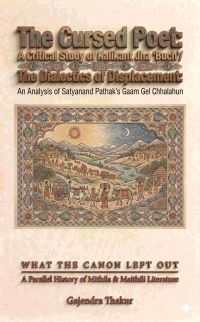
The Cursed Poet: A Critical Study of Kalikant Jha ‘Buch’/ The Dialectics of Displacement: An Analysis of Satyanand Pathak’s Gaam Gel Chhalahun
1
The Cursed Poet: A Critical Study of Kalikant Jha ‘Buch’/
2
The Dialectics of Displacement: An Analysis of Satyanand Pathak’s Gaam Gel Chhalahun/
3
RESEARCH & CRITICAL APPRECIATION
OF THE WORKS OF
Kalikant Jha ‘Buch’
Poet . Lyricist . State Government Employee . Maithili Modernist
&
Satyanand Pathak
Novelist . Journalist . Diaspora Voice . Social Realist
With Reference to Indian & Western Literary Theory,
the Videha Parallel History Framework,
and Navya-Nyāya Epistemology of Gaṅgeśa Upādhyāya
1
A collection of Maithili poetry titled "Kalanidhi", written by the late Kalikant Jha ‘Buch’. Published posthumously in 2010 by Shruti Prakashan, Delhi, the book includes an extensive introduction (Amukh) analyzing the poet’s style, followed by a wide variety of poems ranging from devotional hymns to social satires.
Below is the selected English translation of the provided text, organized by section.
I. Book Information & Introduction
Title: Kalanidhi: Anthology of Maithili Poems
Author: Late Kalikant Jha ‘Buch’
Publisher: Shruti Prakashan, Delhi (2010)
ISBN: 978-93-80538-31-0
Dedication: Dedicated to the memory of the divine Guru, Shri 108 Shri Aniruddha Thakur.
Preface: A Cursed Poet (by Ravi Bhushan Pathak)
The preface describes Kalikant Jha ‘Buch’ as a "cursed poet" who lived in the village of Kariyan (the land of the philosopher Udayanacharya). Despite his immense talent, he was neglected both at home and abroad. To cope with this neglect, he often wrote welcome addresses (Abhinandan Patra) for village weddings. Ironically, within this "lowly" pursuit, he composed the finest "Welcome Song" (Swagat Gaan) in Maithili literature.
His poetry is characterized by:
· The Harmony of Opposites: A blend of romance (Shringar) and detachment (Virag).
· Direct Expression: Unlike scholars who rely on complex metaphors, Buch used plain, direct language (Abhidha) rooted in vast life experience.
· Social Critique: He targeted corruption, the dowry system, and the struggles of the common man.
· Versatility: He wrote about everything from the beauty of the Kosi river to the grim reality of famine.
II. Critical Interpretations (by Gajendra Thakur)
This section analyzes Buch’s poetry through various modern lenses:
· Structuralism/Deconstruction: Analyzing the poem "Jethi Kareh" (The Flood of Jeth), where the river’s rising water represents a breakdown of human patience and engineering.
· Marxism: Interpreting the "Welcome Song" as a dynamic process reflecting the struggle between tradition and modernity.
· Sociology: Viewing "Beti Banli Pahar" (Daughter Becomes a Mountain) as a protest against the dowry system.
· Feminism: Examining poems like "Son Dai" to highlight the plight of women in a male-dominated society.
III. Selected Poem Translations
1. Saraswati Vandana (Prayer to the Goddess of Learning)
"O Swan-rider, holding the Veena, pure and wise. Clad in white, give us purity and supreme intellect. You sit upon the swan of imagination... sprinkle the water of knowledge from your vessel and wipe away the anger of ages with your veil."
2. Swagat Gaan (Welcome Song)
"Welcome, welcome to all... Where is the song of joy? Everywhere there is a cry of sorrow. The garden of Maithili is uprooted. The bees are thirsty, the birds are hungry. The mango trees have withered, and the river of nectar has dried up... Read poetry, but keep a stick on your shoulder; one hand for the source of nectar, the other for a staff."
3. Jethi Kareh (The Summer Flood)
"O Jeth flood, you rise early. Even with low rain, you overflow. Your danger mark is high, so why do you tremble? You cut the heart of the village and swallow it. The engineers will look like fools when you break the dam and cause a deluge."
4. Beti Banli Pahar (Daughter Becomes a Mountain)
"Where has wisdom gone? What has happened to our customs? The daughter, once a flower in the hand, has become a mountain on the head. To marry her, the father is exhausted... The boy has become a helpless goat, held by the throat by his own father. Every house has become a slaughterhouse, and every village a market."
5. Aakal (Famine)
"This is not just a famine; it is Mahakal (Great Death). Hunger is tied to the bellies... The village is burning, the sky has turned red. India has become Lanka, and the drums of death are beating. Even Vibhishan’s hut will not be saved this time."
6. Chali Abiyau Patna sa Gaam (Come Back from Patna to the Village)
A wife pleads with her husband: "You have your B.A. and M.A., but do not take a job. Come back to the village. I don’t want a ‘servant’ husband. We will live in a broken hut rather than engage in corrupt business. You cut the grass, I will light the stove. You till the field, I will look after the house... In the city, officials live like blood-sucking mosquitoes."
7. Tohar Thor (Your Lips)
"Like the crisp betel leaf, so are your lips, beautiful one. You applied the lime of words and the color of catechu to your cheeks... If a hunter becomes your groom, I shall become the severed head of Rahu."
IV. Index of Themes
The collection contains over 98 poems covering:
· Devotion: Prayers to Shiva, Kali, Durga, and Ram.
· Social Satire: "Nautak Premi" (The Feast Lover), "Ghuskhory" (Corruption), and "Budhari me Ghidhari" (Old Age Antics).
· Nature: The beauty of Mithila, the rivers Kosi and Kamala.
· Childhood: "Gai Khushbu," "Nani" (Grandmother), and "Hira Beti."
· Lamentation: "Radhika’s Wail" and "Virakti" (written after his wife’s death).
Closing Thought (from the poem "Kahia Dhari Udasi"):
"I am a traveler in a foreign land; how will I pass this spring? The garden is blooming, the bees are humming, but I am flowing with the waves of my own mind... I do not know how long this sadness will last."
CRITICISM
A literary criticism of the anthology "Kalanidhi" by Kalikant Jha ‘Buch’. This analysis incorporates Indian and Western theories, the Videha parallel framework, and the epistemological influences of Navya-Nyaya.
1. Indian Aesthetics: Rasa and Dhvani
The poetry of Buch is a masterclass in the Harmony of Opposites (Viruddhaka Samanjasya), a concept where seemingly contradictory emotions are synthesized to create a profound Rasa.
· Vipralambha Shringar and Shanta Rasa: In poems like "Sondai" and "Karuun Geet", the poet blends romantic longing with a deep sense of detachment (Virag). This creates a Vibhava (cause) and Anubhava (result) that leads the reader toward a state of Vairagya (dispassion).
· Dhvani (Suggestion): Following Anandavardhana’s Dhvanyaloka, Buch uses symbols as Pratika (icons) to convey meanings beyond the literal text. For example, in his "Welcome Song", the physical thirst of bees and hunger of birds are Dhvani for the spiritual and cultural famine of Mithila.
· Aparoksha (Direct Experience): While Indian aesthetics often prizes Lakshana (metaphor), Buch relies heavily on Abhidha (direct literal meaning), proving that a "great life experience" can imbue even the simplest words with poetic power.
2. Western Literary Theory: Structuralism to Deconstruction
The text applies several 20th-century Western frameworks to Buch’s work to reveal its multi-layered nature:
· Structuralism and Binary Opposites: In the poem "Jethi Kareh", the structure is built on the opposition of "Low Rain" vs. "Overflowing River". The river represents a breakdown of human engineering and the "Death of the Author," where the reader constructs the meaning of the flood based on contemporary ecological crises.
· Marxism: The "Welcome Song" is analyzed as a "dynamic process". Rather than a static eulogy, it critiques the socio-economic failure of the region, where "Status is as it is" while the elite hold ceremonial gatherings.
· Sociological and Feminist Criticism: The poem "Beti Banli Pahar" (Daughter Becomes a Mountain) serves as a critique of the Kaatar (dowry) system. It views the daughter not as an individual but as a "mountain on the head" due to the patriarchal market of marriage.
3. The Videha Parallel History Framework
Buch’s work is deeply rooted in the geographical and historical continuity of Mithila (Videha), often drawing parallels between ancient myths and modern decay:
· Mythological Inversion: In "Ram Pravasi", Buch recontextualizes the exile of Rama as a modern "migrant worker" (Pravasi). He portrays the modern father as "cruel" and the son as a "distressed wanderer," removing the mythical skin to reveal an contemporary infection of greed.
· Village vs. City: He compares the "Eden Gardens" of the city to the "Bones of the Kosi/Kamala" rivers. This creates a parallel history where the village remains the site of authentic Shringar (romance) while the city is a site of "corruption" and "blood-sucking officials".
4. Navya-Nyaya Epistemology and Gaṅgeśa’s Technique
As a poet born in Kariyan, the birthplace of the great Navya-Nyaya philosopher Udayanacharya, Buch’s poetry is analyzed through the lens of logical precision and Sphota theory.
· Pramana (Means of Knowledge): The criticism suggests that Buch uses Pratyaksha (direct perception) as his primary poetic tool. His descriptions of famine and social rot are not imaginative flights but logical conclusions derived from his life as a government employee.
· Sphota Theory: Influenced by Bhartṛhari (and discussed in relation to Navya-Nyaya’s rejection of it), the poet’s words are seen as a "Flash" (Sphota) of meaning. Even when the literal Varna (letters) and Pada (words) disappear, the ultimate "Purpose" (Uddeshya) is transmitted to the reader’s mind as a unified explosion of truth.
· Laya (Rhythm) and Logic: Buch is described as the most rhythmic poet after Vidyapati. This rhythm is not merely aesthetic; it is a "logical organization" of sound that aims for Atma-Sakshatkar (Self-realization) through the Rasa of the text.
Summary Table of Poetic Criticism
|
Theory |
Applied to Poem |
Core Finding |
|
Rasa Theory |
Sondai |
Synthesis of Romance (Shringar) and Despair (Vishad). |
|
Marxism |
Welcome Song |
Critique of elite "ceremonial" culture vs. public suffering. |
|
Structuralism |
Jethi Kareh |
The river as a signifier of the "Danger Mark" of human patience. |
|
Navya-Nyaya |
Tohar Thor |
Use of Sphota to communicate purpose when words fail. |
2
The Dialectics of Displacement: An Analysis of Satyanand Pathak’s Gaam Gel Chhalahun
The provided document is the Maithili novel Gaam Gel Chhalahun (meaning "I Had Gone to the Village") by Satyanand Pathak. First published in June 2004, the book explores the deep emotional and social ties between expatriate Maithils (those living outside Mithila) and their ancestral villages.
Below is a translation of the key introductory sections, including the author’s dedication, the preface, and the opening of the story.
Dedication
"The moment I picked up my pen, it spoke: ‘Father, I touch your feet.’ Father, this life was given by you; this life story is dedicated to you. Yours, Satyanand"
Author’s Preface (Prabashan)
Whenever a crow cawed, my mother would say, "Hey boy, someone is coming." Her alert voice and joyful heart would often turn out to be right. Whether it was my father, elder brother, or uncle, someone would arrive at the village.
What is a crow, anyway? Cawing is its nature. It caws when full or hungry, in joy or in separation. Yet, humans have linked the cawing of this neglected creature to their own hopes and aspirations. My mother’s reaction would spark many thoughts: Why do Father, Brother, and Uncle go "outside"? Why don’t they stay in the village?. At that age, I had no answers. Now, when I contemplate these questions, I sink so deep into them that I feel restless.
This novel, Gaam Gel Chhalahun, captures that restlessness. People living "outside" the village constantly come and go. It has become a continuous process that affects us all. This coming and going contains many life events and varied circumstances. We all have our own perspectives and ways of living, yet we eventually arrive at a single point and stop. This novel is a humble effort to find that point.
Initially, I published this in installments in the magazine Purvottar Maithil. I was anxious about the reaction, but the response from readers in Mithilanchal-through letters and phone calls-multiplied my enthusiasm. My friend Ravikant Neeraj pressured me to turn it into a book. I argued that I was a novice still learning to write, but he insisted: "If you lose your way in the water, it doesn’t say it hasn’t seen the path. Its path is made. You write; I can see your path clearly".
Working in a responsible position at a newspaper means living a tangled life-immersed in news day and night. There is no fixed time for other work. Therefore, I decided not to fall into the trap of formal arrangements for writing this book. I wrote whenever and wherever I found the opportunity-not in one place or in one specific notebook, but on whatever paper was available.
My wife, Manju Pathak, knew that despite the lack of time, I was determined to write. Her support went beyond the ordinary. She didn’t just inspire me; she created an environment at home, kept my writing space ready, and nudged me to write whenever I was free .
Chapter 1: The Journey Begins
When the vehicle began to shake violently-swaying left, right, forward, and backward like an earthquake-we realized we had entered the Mithilanchal region of Bihar. I knew this "wonderful" experience was unique to this province. I didn’t mind the swaying if it meant reaching the village, but I was worried the small car might break down or veer off the path. Still, my heart held hope that in a short time, we would reach the dalan (outer porch), and the hardships of the journey would vanish.
I wasn’t the only one worried. My wife’s face was clouded with anxiety, though she said nothing to avoid weakening my resolve. But children are children. My elder daughter spoke up, "Didn’t you see any other road?". There was no time to answer. I kept looking left and right, then at the driver’s hands and head. If the vehicle went out of control even for a second, my dream of going to the village in our own car would prove very costly.
I started to feel a bit frustrated with my wife. If I was being stubborn about taking the car, why didn’t she stop me?. She could have. I usually listen to her. Yet, she never once said, "Forget the car, let’s take a train or bus".
Actually, this struggle of coming to and going from the village began when I was only five years old, and it continues to this day. I’ve grown tired of changing routes, but the struggle persists .
CRITICISM
The Maithili novel Gaam Gel Chhalahun ("I Had Gone to the Village") by Satyanand Pathak is a profound exploration of the emotional, social, and cultural landscape of the Maithil diaspora. Set against the backdrop of a return journey to a village in Mithilanchal for a grandmother’s funeral rites, the narrative serves as a vessel for complex meditations on identity, displacement, and the decay of traditional systems.
A literary criticism of the work.
1. Navya Nyaya Epistemology and Technique
The influence of Navya Nyaya (the "New Logic" school founded by Gaṅgeśa Upādhyāya in Mithila) is evident in the author’s meticulous attention to the precision of definitions and the dialectical structure of social debates within the novel.
· Avacchedakatā (Limitorship): The author explores the "limitors" of identity. A character is not merely a "Maithil" but a "Maithil-limited-by-migration" (Pravasi). The novel rigorously examines how this migrant status alters the perception of truth: a village ritual that seems "essential" to a resident is "performative" or "burdensome" to the migrant.
· Anumāna (Inference): The plot often proceeds via inference based on "signs" (liṅga). The cawing of a crow is not just a sound but a sign inferred to mean the arrival of a loved one. Similarly, the violent shaking of a vehicle is the liṅga from which the characters infer they have crossed the border into the neglected roads of Mithilanchal.
· Vāda (Dialectic): The "Baithaki" (village meeting) regarding the Mandali Bhoj (communal feast) is a classic Nyaya-style Vāda. It is a search for truth through reasoned argument between tradition-bound residents and modern-thinking migrants like Ramgopal Kaka.
2. The Videha Parallel History Framework
The novel fits perfectly within the Videha Parallel History framework, which views Mithila’s history not as a linear progression but as a series of parallel experiences-the local village reality and the external "Videha" (expatriate) reality.
· The Parallel Lives: The narrative constantly jumps between the current journey and "parallel" histories-the author’s childhood in Siliguri, Kaka’s life in Mumbai, and Ramasareji’s struggle in Assam.
· Historical Continuity: The framework is explicitly invoked through Ramasareji’s lecture on the ancient history of Assam (Pragjyotishpur/Kamrup) and its ties to Mithila. This serves to legitimize the Maithil presence in the Northeast as a historical homecoming rather than an alien intrusion.
3. Indian and Western Literary Criticism
Indian Aesthetics (Rasa Theory)
· Karuna Rasa (Pathos): The dominant Rasa is Karuna, triggered by the "Viyoga" (separation) from the motherland. The physical decay of ancestral homes-missing bricks and peeling walls-acts as the Uddipana Vibhava (stimulating cause) for this sadness.
· Vibhāva and Anubhāva: The "Lathi-wala Bijli" (fluorescent light) is a recurring Alambana Vibhava (objective support). It represents the cold, artificial brightness of city life, contrasting with the "Chandra-prakash" (cool moonlight) of the village.
Western Theories
· Existentialism: The "Pravasi" experience is described in existentialist terms as an "Udhār Jivan" (borrowed life). The characters live in a "concrete jungle" where they feel like outsiders, mirroring the Sartrean concept of being "the Other".
· Post-Colonialism: The novel critiques the internal colonialism of the Indian state, where Mithilanchal’s infrastructure is left "primitive" while its intellectual resources (doctors, engineers) are drained to the cities.
· Structuralism: The "Chauk" (village square) is treated as a semiotic structure. It is the "Query Counter" of the village where political analysis and social reputations are constructed through language.
4. Synthesis: The Symbolism of "Lathi-wala Bijli"
The most striking synthesis of these theories occurs in the symbol of the Fluorescent Light (Lathi-wala Bijli).
· To the child, it is a mystery and an attraction (Navya Nyaya curiosity).
· To the adult migrant, it is a trap-a light that glows but carries a "current" that can deaden the soul (Indian Rasa of Bhaya/Adbhuta).
· In the Videha Parallel History, it represents the "modernity" that lured Maithils away from their villages, only to leave them in an existential vacuum in the city.
Conclusion: Satyanand Pathak does not merely write a story; he constructs a logic-map of the Maithil soul. By using the rigorous techniques of Navya Nyaya to describe deeply emotional states, he creates a unique Maithili modernism that is both ancient and urgent.
3
RESEARCH & CRITICAL APPRECIATION
OF THE WORKS OF
Kalikant Jha ‘Buch’
Poet . Lyricist . State Government Employee . Maithili Modernist
&
Satyanand Pathak
Novelist . Journalist . Diaspora Voice . Social Realist
With Reference to Indian & Western Literary Theory,
the Videha Parallel History Framework,
and Navya-Nyāya Epistemology of Gaṅgeśa Upādhyāya
PART I: INTRODUCTION AND METHODOLOGICAL FRAMEWORK
1.1 Opening: The Videha Parallel History Context
The Videha Parallel History of Mithila & Maithili Literature, curated by Gajendra Thakur through India’s first Maithili fortnightly e-journal (est. 2000; ISSN 2229-547X; www.videha.co.in), has systematically recovered voices that the institutional literary apparatus - the Sahitya Akademi, mainstream anthologies, and upper-caste critical networks - has marginalised. Among the canonical list of modern Maithili authors documented in this Parallel History, two figures stand out for their distinct but complementary contributions to the democratisation of Maithili prose and poetry: Kalikant Jha ‘Buch’, the poet of Kalanidhi (Shruti Prakashan, 2010), and Satyanand Pathak, the novelist of Gaam Gel Chhalahun (Manorama Prakashan, Guwahati, 2004).
Kalikant Jha ‘Buch’ is described in the critical apparatus of his Kalanidhi as a poet born in the philosophical soil of Udayanacharya (the 10th-century Mithila logician of Kariyan village) - a man who never published a single book in his lifetime, yet whose 98 collected poems constitute some of the finest Maithili verse of the 20th century. Satyanand Pathak, a journalist and editor based in Guwahati, produced in Gaam Gel Chhalahun the most significant novel about the Maithili diaspora in Northeast India - a work that the Videha Pothi archive lists alongside foundational modern Maithili texts.
Together, these two writers span a cultural geography from the Mithila heartland (Kariyan village, Samastipur district, Bihar) to the Maithili diaspora in Assam, and a literary range from lyric poetry and devotional verse to social-realist prose fiction. This study subjects both to a rigorous inter-disciplinary critical analysis.
1.2 Methodological Framework
This research employs a three-dimensional critical methodology:
• Indian Classical Theory: Rasa-Dhvani (Bharata’s Natyashastra; Abhinavagupta’s Abhinavabharati; Anandavardhana’s Dhvanyaloka), Aucitya (Kshemendra’s Aucityavicharacharcha), Vakrokti (Kuntaka), Alamkara-shastra (Bhamaha, Dandin, Mammata), and Sphota (Bhartrhari’s Vakyapadiya).
• Western Literary Theory: Structuralism and Deconstruction (Saussure, Derrida), Marxist literary criticism (Gramsci, Lukacs), New Criticism (I.A. Richards, William Empson), Reader-Response (Iser, Jauss), Postcolonial Studies (Spivak, Bhabha), Feminist criticism (Butler, Kristeva), Magical Realism (Zamora & Faris), and Social Realism.
• Navya-Nyāya of Gaṅgeśa Upādhyāya: The four pramāṇas (pratyakṣa, anumāna, upamāna, śabda), vyāpti (invariable concomitance), avacchedaka (limitor), and the Tattva-Cintāmaṇi’s epistemological rigour applied to literary knowledge-claims. Given that Kalikant Jha ‘Buch’ was himself born in the village of Kariyan (Kariyon) - the very village of Udayanacharya (10th century) and Gangesa (14th century) - the Navya-Nyaya lens is not a mere theoretical imposition but a homecoming of ideas.
PART II: KALIKANT JHA ‘BUCH’ - POET OF THE CURSED LAND
2.1 Biographical Profile
The prefatory essay of Kalanidhi, titled “Ek Taa Abhishapt Kavi: Buch Babu” (A Cursed Poet: Buch Babu), written by Ravi Bhushan Pathak, provides the richest biographical account available. The key facts are:
|
Full Name |
Kalikant Jha ‘Buch’ |
|
Birthplace |
Village Kariyan (also Kariyon), Samastipura District, Bihar |
|
Philosophical Soil |
Village of Udayanacharya (10th c.) and Gangesa Upadhyaya (14th c.) |
|
Profession |
State Government Employee, Bihar Government |
|
Publication |
No book published in his lifetime |
|
Posthumous Work |
Kalanidhi - 98 poems, Shruti Prakashan, Delhi, 2010 (ISBN 978-93-80538-31-0) |
|
Son |
Shiv Kumar Jha (Maithili critic and scholar) |
|
Dedication |
To Aniruddha Thakur, Shiva-svarupa Gurudev |
|
Death (Dedication date) |
Shivratri, 11 February 1983 |
The critical essay opens with a deliberate irony: this poet, born in the philosophical heartland of Udayanacharya, received neither justice in his village nor recognition outside it. He was known as “kaviji” (the poet) in his village, but his marginality was total. As Ravi Bhushan Pathak writes: “Gambhir lekhankain manyata nai bhetait dekhi kavi gramak yaahmen abhinandan patre lekhan men ruchi lia lagalah” - seeing that serious writing received no recognition, the poet began to take interest in writing congratulatory letters in the village’s fashion, earning neither village nor outside recognition for either enterprise.
The biographical irony deepens: his son, Shiv Kumar Jha, is himself a prominent Maithili critic, yet the critical apparatus suggests that the son did not fully champion the father’s creative legacy during Buch’s lifetime. Ravi Bhushan Pathak notes pointedly that Shiv Kumar Jha “makes some a Nirala and some a Prasad in his criticism, but due to modesty or whatever reason does not come out openly” about his father’s creative power. The result: a poet of the highest calibre remained invisible to the literary establishment.
2.2 The Kalanidhi: Structural and Thematic Overview
Kalanidhi (literally “Treasury of Arts” or “Repository of the Moon” - a name of the moon in Sanskrit) contains 98 poems across a wide range of forms and themes. The table of contents reveals 7 major thematic and formal clusters:
• Devotional and Invocational Verse: Sarasvati Vandana, Kapisha Vandana (Hanuman), Bhagavati Vandana, Durga Vandana, Sri Ram Vandana, Kali Vandana, Shiva Shakti Pujan, Nachari, Vandana, Durgavandana, Navdurga, Ramavatar.
• Social-Protest and Satirical Poetry: Vaagat Gaan (Welcome Song), Beti Banal Pahad (Daughter Becomes a Mountain), Kaater ka Parinam (Consequences of the Dowry-Warrior), Naari Suno (Women, Listen), Mitilaak Durdasha (Mithila’s Misery), Ghurna (Rotation), Desiyal Vayana ka Astitva (The Existence of Our Folk-Language).
• Nature and Landscape Poetry: Jethee Karah (The Old River Kareh), Bhadaiya Holi (Monsoon Holi), Gamay Mon Padhai (I Miss the Village), Pavas Chaumasa, Chaitee (Spring Songs).
• Romantic and Viraha (Separation) Poetry: Son Dai, Virahini, Vasante Virahini, Karun Geet (Song of Sorrow), Tohar Thor (Your Lips), Parikhya Patra (Letter of Introduction), Noar (Tears), Notake Premi (Lover of Invitations).
• Social-Realist Poetry: Akaal (Famine), Andhere Maari (Striking in the Dark), Hamar Gaam (My Village), Hamar Jingi (My Life), Judyug Parivartan (Change of Ages), Ekpar Se Ek (From One to Another).
• Devotional-Bhakti Songs: Ram Bina Avadhpuri, Geet, Jhula (Swing), Raghav Sarkar, Gauree Banal Yoginiya, Malaa (Garland), Jagaran Gaan.
• Children’s and Occasional Verse: Neena Geet (Children’s Song), Pota ka Hahaans (Grandson’s Laughter), Muddha Ka Daa Sasur Challa (Elder Lady Going to In-Laws), Bhai Ka Viyah (Brother’s Wedding).
2.3 Critical Analysis: The Kalanidhi’s Multi-Framework Readings
The second prefatory essay in Kalanidhi - attributed to Gajendra Thakur - is itself a masterwork of literary criticism. It applies nine distinct critical frameworks to Buch’s poems, providing a meta-critical model that this study extends and deepens.
2.3.1 Jethee Karah (The Kosi River at Its Peak) - Structuralist and Post-Structuralist Readings
Jethee karah uthiaa achhi / Barkha hetth bhelopar upalaait achhi / Okhar khatarak bindu baddha oopare chhai takai o kiyak akulait achhi / A aakhirimain kahai chhai je banh tori e lay machaot se bujhat achhi.
This poem about the monsoon-swollen Kareh river has been read through multiple theoretical lenses in the Kalanidhi’s own critical apparatus. Structuralist reading: the river’s danger-point (khataarak bindu) is fixed above - yet it agitates; the rain falling makes it swell but also promises subsidence. Post-structuralist (Derridean) reading: the “danger point” becomes a mobile signifier; what appears a threat in one historical moment (1960s dam-building era) becomes a quaint measurement in another (post-silted Kareh of contemporary Mithila). The poem’s meaning is permanently deferred (différance), each generation arriving at a new reading.
Navya-Nyāya application: The anumāna (inference) of the poem runs: the river is swollen (hetu) - therefore there is danger (sadhya). But the avacchedaka (limitor) of this inference is the specific historical moment of the observation. In a post-dam era, the vyapti (invariable concomitance) between monsoon swelling and overflowing is broken by embankment engineering. The poem thus demonstrates the temporal conditionality of vyāpti - a point that Gangesa himself makes in his analysis of the Anumana-Khanda: that pervasion-relations hold only within specified limiting conditions.
2.3.2 Vaagat Gaan (Welcome Song) - Marxist, Dhvani, and Social-Realist Readings
Aau - Aau - Aau sabhak vaagat karai chhi, / nain me samaau hridayasan dharai chhi. / Ullaasak geet katau sagaro karuna-kandan, / upati rahal vipati rahal Maithilik nandan van.
This poem was composed as a Welcome Song for the Vidyapati Memorial Celebration of 1984 at village Bainathpur, Rosarha Block, Samastipur district - a specific historical context that the Kalanidhi’s critical essay identifies as the beginning of mass out-migration from Mithila (following the completion of the Hajipura bridge over the Ganga). The poem is one of the most discussed in modern Maithili critical discourse.
Marxist reading: The poem refuses the ideology of empty celebration. Where a conventional welcome song would simply praise the assembled literati, Buch exposes the contradiction: “Murda jagaau laau pair pakdai chhi” (Rouse the dead, I am falling at your feet). The Marxist literary criterion demands that literature represent social contradiction rather than paper it over. By this measure, Buch’s Welcome Song is “Maithilik sarvashreshtha vaagat gaan” (Maithili’s finest welcome song) - precisely because it refuses the sycophancy of the genre.
Dhvani analysis: Anandavardhana’s theory holds that the best literature conveys meaning through dhvani (suggestion/resonance) rather than explicit statement. The poem’s dhvani operates at multiple levels: the explicit meaning is a welcome to guests; the suggested meaning is a lamentation for Maithili’s cultural and ecological collapse; the deepest resonance (paramparya dhvani) is an indictment of the political class’s indifference. The line “Kaavya paath karo muda kaandh par liau laathi / ek haath rasak srot dosar me khor naathi” (Do literary reading, but take a staff on the shoulder / one hand the source of rasa, the other an agricultural tool) is the poem’s most quoted line - a perfect instance of what Anandavardhana calls arthasya arthah (meaning of meaning): the poet insists that literature must be accompanied by practical engagement with social reality.
2.3.3 Beti Banal Pahad (Daughter Becomes a Mountain) - Feminist and Sociological Readings
Dulraitin beti ghentake ghail banal chhi / beti aylih tan udankhatola chadhi ku / hari garud tyaagi car maaangi rahal chhi h. / Paintees graam sona pureli h muda aab biyah ratik kharch chaahi / aur bariyaati das gaahi aotah.
This poem is a devastating satire on the dowry system (kaater in Maithili) and the commodification of marriage in Mithila. The daughter who arrives like a celestial chariot (udankhatola) has become a crushing load (pahad) for her father, not because of her own failing but because of the systemic rapacity of the groom’s family. The phrase “Baba dalal bap baddak vyapari / beta bachhod beeki gail hazari” (The father is a broker, the grandfather a cattle-trader, the son a calf sold for thousands) reduces the marriage market to naked commodity exchange.
Feminist reading (Judith Butler’s performativity): The daughter’s identity is constituted through the performance of dowry-value - she is interpellated (in Althusser’s sense) as “pahad” (mountain-burden) by the symbolic order of Maithili patriarchy. The poem’s power lies in making this interpellation visible. Gayatri Spivak’s “Can the Subaltern Speak?” is directly relevant: the daughter-as-subaltern cannot speak within the marriage market; she is spoken for by her exchange-value. Buch’s poem speaks for her.
Aucitya (Propriety) theory (Kshemendra): The satirical mode is appropriate (aucita) here because the subject-matter demands neither pure pathos (karuna) nor pure comedy (hasya) but their impossible synthesis - a laughing grief that the Sanskrit theorist Abhinavagupta would recognise as the shanta-rasa’s oblique emergence from the ruins of social life.
2.3.4 Akaal (Famine) - Magical Realism and Aucitya
E akaal nahin mahakaal achhi / Bhoakh ke ook baanhi naangiri se / chaare par thokait taal achhi.
Ravi Bhushan Pathak’s critical note explicitly compares this poem to Nagarjuna’s Hindi poem “Akaal aur Uske Baad” and to Pannalal Patel’s Gujarati novel “Manvini Bhavai.” The comparison is apt but Pathak insists on the difference: where Nagarjuna documents the aftermath of famine through a realistic enumeration of animals and humans, Buch invokes Kala Devata (the deity of Time/Death) directly, transforming the social calamity into a mythological event. “Beesahoon aankh onari Dashanan / ghutuuki ghutuki hilbait bhaal achhi” (With all twenty eyes Ravana / sips and sips and nods his head) - the famine is personified as a twenty-eyed Ravana.
This is the technique of magical realism as defined by Wendy Faris: the matter-of-fact narration of extraordinary events within a realistic framework. Buch’s famine-Ravana does not disrupt the realism but deepens it - the mythological reference to Lanka “jahaan Vibhishan ka ghar bhi nahin bachega” (where even Vibhishan’s house will not be spared) makes the social-political point that no section of society - not even those who sided with the government - is protected from the famine’s devastation.
Aucitya analysis: The propriety of the mythological register in a famine poem is justified because in Mithila’s cultural memory, calamity has always been narrated through mythological lens (the Maithili famine poetry of Faturilal in 1873-74 is the earliest example). Buch’s choice of the Ravana-image is thus culturally aucita (appropriate) in a way that a purely sociological representation would not be.
2.3.5 Tohar Thor (Your Lips) - Alamkara, Sphota, and Rasa
Ki jahi kurukur paanak thor / ki tahi sunder tohar thor / lagauleh baatak paathar choon / sajoula kaatth kapol ka khoon / ki rahalah ae ekke baatak chook / katau chhai premak pungee hook?
This love poem is the subject of the most technically dense critical reading in the Kalanidhi preface. The poem deploys an extraordinary density of upama (simile): the beloved’s lips are compared to betel-leaf (paan), to the colour of limestone paste on betel-nut, to the dawn-redness of morning. Mammata’s Kavyaprakasha identifies 61 alamkaras in seven categories; the Kalanidhi critic identifies multiple alamkaras simultaneously operative: upama (comparison), anustuta (indirect praise), rupaka (metaphor), virodhabhasa (apparent contradiction).
Sphota theory (Bhartrhari): The poem demonstrates that meaning cannot be conveyed through individual letters or words but through the sphota - the linguistic whole that “flashes” meaning in a single cognitive event. The poem’s final line “Katau chhai premak pungee hook?” (Where is the shrill note of love?) achieves its effect not through the meaning of individual words but through the phonetic flash of the alliterating consonants and the final rising interrogative.
Rasa analysis: The dominant rasa is shringar (erotic love) but the poem’s final question - the absence of the “pungee hook” (the shrill note, perhaps of a folk instrument, perhaps of the lover’s desire) - deflects into viraha (separation-longing), and then further into the philosophical questioning of love’s reality. This triple rasa-movement (shringar → viraha → shanta/philosophical) is a structural feature of the best Maithili lyric from Vidyapati onwards.
2.3.6 Buch’s Poetics: The Signature of “Vishringa Sambhava”
Ravi Bhushan Pathak identifies a central feature of Buch’s poetic practice: the synthesis of contradictory emotions (virodhi bhavak sangeet / harmony of opposing feelings). This is aligned with what Ram Chandra Shukla in Hindi criticism called the “great literary device of the reconciliation of contraries.” In Buch’s Sondai poem, the poem begins with apparent shringar (erotic celebration) and ends with vairagya (renunciation) - not as contradiction but as synthesis.
William Empson’s “Seven Types of Ambiguity” (1930) provides a Western parallel: Buch’s poems habitually operate at Empson’s fifth and sixth types - where conflicting emotions generate an unresolved tension that the poem holds in productive suspension. This is not ambiguity as failure but as the formal enactment of the dialectical nature of experience.
Crucially, Buch achieves this without reliance on alamkara (figuration) or lakshanaa (indirect signification) - his poems depend almost entirely on abhidha (direct denotative meaning). His power comes from the compression of vast life-experience into the denotative weight of ordinary Maithili words.
2.4 Buch’s Language: Navya-Nyaya’s Sphota and Denotative Power
Ravi Bhushan Pathak makes the epistemologically crucial observation that despite being born in Udayanacharya’s village - the heartland of Nyaya logic - Buch as poet does not accept the Nyaya school’s denial of Sphota. The Nyaya school (Gangesa included) argued that meaning is conveyed through the sequential production of phonemes; the Sphota theory (Bhartrhari) argued that meaning flashes as a whole. Buch’s poetic practice implicitly sides with Bhartrhari: his poems achieve their effects through the flash of the complete utterance, not through the sequential assembly of logical denotations.
This is a genuine philosophical-literary insight: a poet of Udayanacharya’s village, living in a tradition that denied Sphota, nonetheless practices Sphota-based poetics. The Parallel History perspective explains this: Buch’s non-institutional, non-academic poetic formation meant he absorbed the living folk tradition of Maithili song (which is naturally Sphota-based) rather than the scholastic Nyaya tradition of his birthplace.
2.5 Buch in the Parallel History: The Cursed Poet as Paradigm
The title of Ravi Bhushan Pathak’s preface - “Ek Taa Abhishapt Kavi” (A Cursed Poet) - is the Parallel History’s most pointed formulation of the systematic exclusion of non-institutional poets. Buch is “cursed” not by fate but by the structural conditions of Maithili literary life: no institutional patronage, no connection to the Sahitya Akademi advisory board, no publication during his lifetime. His “curse” is the same structural curse documented by the RTI disclosures of Vinit Utpal and Ashish Anchinhar (2011–14): 90%+ of Sahitya Akademi assignments went to friends and relatives of a 10-member advisory board.
The posthumous Kalanidhi (2010), published by Shruti Prakashan and distributed by Pallavi Distributors (Nirmali, Supaul), represents the Parallel History’s counter-institutional logic at work: a small press, a regional distributor, a posthumous collection - but 98 poems of extraordinary quality that now stand as evidence against the institutional canon’s claim to represent Maithili poetry.
The Videha digital archive’s listing of Kalanidhi - confirmed on the Videha Google Books page alongside canonical texts like Rajdeo Mandal’s work and Gajendra Thakur’s fiction - constitutes the Parallel History’s formal recognition of Buch as a significant Maithili poet.
PART III: SATYANAND PATHAK - THE NOVELIST OF THE MAITHILI DIASPORA
3.1 Biographical and Contextual Profile
|
Full Name |
Satyanand Pathak (Satyānanda Pāṭhaka) |
|
Residence |
Guwahati, Assam (diaspora Maithili) |
|
Profession |
Journalist; Editor, Purvanchar Maithil / Puranchali Prahari newspaper |
|
Literary Debut |
Gaam Gel Chhalahun serialised in Purvanchar Maithil (Northeast Maithili journal) |
|
Novel Publication |
Gaam Gel Chhalahun - Manorama Prakashan, Guwahati (wife: Srimati Manju Pathak), June 2004; Price Rs. 275 |
|
Cover Design |
Pushpa Jha |
|
DTP |
P.N. Jha, South Sarania, Ulubari, Guwahati |
|
Printing |
Bhavani Offset and Imaging Systems Pvt. Ltd., Rajgarh Road, Guwahati |
|
Inspiration |
Bhai Premanand Pathak (Siliguri); Lakshmana Jha ‘Sagar’ (Maithili story-writer) |
|
Cultural context |
Mithila Sanskriti Samanvay Samiti, Guwahati; Maithili diaspora of Northeast India |
Satyanand Pathak belongs to the substantial Maithili-speaking diaspora of Northeast India - Assam, Bengal, and the tea-garden districts - that emerged from late 19th and early 20th century economic migration. This diaspora, rooted in the landless agricultural and artisan communities of Mithila’s Madhubani and Darbhanga districts, represents the most significant subaltern strand of Maithili culture outside the Bihar heartland.
The novel’s publication context is itself significant: Satyanand Pathak was a journalist working for a busy Guwahati newspaper when he wrote the novel, composing it in whatever scraps of time were available - on stray sheets of paper, in office breaks. The Prasbhangiki (Contextual Essay) included in the novel reveals that the narrative grew from serial publication in Purvanchar Maithil before being encouraged into book form by his friend Ravikant Neeraj. The book was published by Pathak’s own wife (Manju Pathak), through their self-set-up Manorama Prakashan.
3.2 Gaam Gel Chhalahun: The Novel’s Architecture
The novel’s title - Gaam Gel Chhalahun (literally: “I Had Gone to the Village” / “The Village That Had Gone”) - carries a deliberate ambiguity. It is both a tense (the pluperfect past: the narrator recalls having gone to the village) and a metaphysical statement (the village is irrecoverably gone, belonging only to memory and the pluperfect). This grammatical pun is the novel’s governing trope: the village exists only in the perfective aspect of memory.
The Praasangiki (Contextual Preface) by Satyanand Pathak locates the novel in the broader crisis of Post-Independence Maithili identity. As the Praasangiki states: India’s independence in the latter half of the 20th century opened new possibilities for Indian language development, but Maithili’s development was obstructed by its classification as a dialect of Hindi. The novel can be read as a fictional response to this political condition: the return to the village is also a return to the linguistic homeland that the Hindi-nationalist project threatened to erase.
The narrative structure follows what the Praasangiki describes as the “continuous, uninterrupted process” of village-visiting: diaspora Maithilis (Babu, Dada, Kaka) return to the village at intervals, carrying with them the accumulated weight of urban displacement and the longing for origin. The cawing of the crow (“Jakhan kauva kuchray ta daai kahai - hau baau aabi rahal chhi” / When the crow caws, grandmother says - someone is coming from outside) is the novel’s opening symbol: the folk omen that bridges the urban and the rural.
3.3 Critical Analysis: Gaam Gel Chhalahun Through Multiple Lenses
3.3.1 Social Realism and the Lukacs Framework
Georg Lukacs’ concept of “typical character in typical circumstances” is the most directly applicable framework for Satyanand Pathak’s novel. The novel’s characters - the diaspora professional (Babu/journalist), the migrant family, the village grandmother - are typical in Lukacs’ sense: they embody the social forces of their historical moment (post-Independence Mithila, the pull of urbanisation, the pressure of linguistic assimilation) rather than being purely individual psychological portraits.
The Praasangiki explicitly frames the novel’s sociological purpose: to “identify the point at which, despite all differences of perspective and way of life, we all converge.” This is Lukacs’ “totality”: the novel aims to represent not individual experience but the total social process of Maithili diaspora life. The novel’s method of assembling multiple perspectives on the village-return (each character has their own view, their own gham-ghar relationship) is the formal enactment of this sociological totality.
3.3.2 The Diaspora Novel and Bhabha’s Third Space
Homi Bhabha’s concept of the “Third Space of Enunciation” - the unstable, hybrid cultural space between two identities - is directly applicable to Gaam Gel Chhalahun. Satyanand Pathak’s novel inhabits precisely this third space: the diaspora Maithili of Guwahati is neither fully assimilated into Assamese culture nor fully connected to Mithila. The novel’s Maithili language itself enacts this hybridity - as the Praasangiki acknowledges, the Guwahati publication context meant that Maithili typesetting was a major challenge (only a P.N. Jha was available to do the DTP), and the language of the novel bears traces of the Northeast linguistic environment.
The novel’s serialisation context in Purvanchar Maithil (Northeast Maithili journal) means that its implied reader is specifically the diaspora community. As Iser’s Reader-Response theory predicts, this implied readership shapes the text: descriptions of the village are written to activate a specific “horizon of expectation” (Jauss) - the nostalgia of people who remember the village from childhood or family stories but have never lived there as adults.
3.3.3 The Crow, the Pluperfect, and Magical Realism
The novel’s opening symbol - the grandmother’s interpretation of the crow’s caw as an omen of homecoming - operates in the mode of what the Praasangiki’s own critical commentary identifies as folk-knowledge (lok-gyaan). The crow is simultaneously a realistic bird (it does caw) and a symbolic messenger (it prophesies arrivals). This double register - the natural and the supernatural coexisting without friction - is the defining technique of magical realism as theorised by Wendy Faris and Lois Zamora.
The pluperfect tense of the title - Gaam Gel Chhalahun - is also a form of temporal magical realism: it holds the village in a tense that is simultaneously past and present, gone and recoverable. The French critic Tzvetan Todorov’s theory of the “fantastic” is relevant here: the novel maintains what Todorov calls the “hesitation” between a rational and a supernatural explanation of events - not in supernatural plots but in the emotional logic of diaspora memory, where the lost village is simultaneously factually gone and imaginatively present.
3.3.4 Rasa Analysis: Karuna and Shanta in the Novel
Bharata’s rasa theory is conventionally applied to drama, but its extension to narrative fiction (by the Kashmiri aestheticians, particularly Abhinavagupta) makes it applicable to the novel form. Gaam Gel Chhalahun’s dominant rasa is Karuna (pathos - the grief of loss, separation, and time’s passage), but the novel’s deeper movement, as the Praasangiki suggests, is toward Shanta (spiritual peace through acceptance of impermanence).
The novel’s emotional logic follows the Rasa theory’s vyabhichari-bhava (transient auxiliary emotions): the crow’s caw triggers smriti (memory) - a vyabhichari-bhava that activates the sthayi-bhava (permanent emotion) of shoka (grief). As the narrative proceeds through the accumulated memories of the village-return, the vyabhichari-bhavas multiply: harsha (joy at reunion), visada (dejection at decay), autsukya (longing), and ultimately prashamana (calming) - the emotional movement toward shanta.
3.3.5 Navya-Nyaya: The Novel’s Pramana-Structure
Applying Gangesa’s epistemological framework to the novel: the narrative’s fundamental knowledge-claim is shabda-pramana (verbal testimony) - the grandmother’s folk-knowledge about the crow’s omen. Gangesa’s Shabda-Khanda analysis requires four conditions for valid verbal testimony: akanksha (syntactic expectancy), yogyata (semantic fitness), sannidhi (temporal proximity), and tatparya (speaker’s intention).
The grandmother’s crow-testimony meets all four: the context (someone is awaited) creates akanksha; the crow’s caw is semantically connected (by folk tradition) to arrivals (yogyata); the caw and the announcement are simultaneous (sannidhi); and the grandmother’s intention (to reassure the family that a relative is coming) is transparent (tatparya). Yet by Gangesa’s paratah-pramanya (extrinsic validity) criterion, the validity of this testimony is not intrinsic - it must be confirmed by the actual arrival. The novel’s narrative structure enacts precisely this: the crow’s prophecy is validated (or not) by the subsequent events of the village-return.
Avacchedaka analysis: The novel’s social knowledge-claims - about diaspora life, village decay, Maithili identity - are properly avacchinned (limited/delimited) by the specific Northeast Indian context. This is not a universal novel about diaspora experience; it is a novel about Maithili diaspora in Guwahati, in the specific socio-linguistic conditions of Northeast India’s multilingual environment. Any critical reading that ignores these avacchedakas (limiters) will produce defective literary knowledge.
3.4 The Prose Style: Language as Identity Performance
Satyanand Pathak’s prose style in Gaam Gel Chhalahun is one of the most immediately recognisable in modern Maithili fiction. The Praasangiki describes it as “kathya gady-ek nav shailir prayog” (a new style of narrative prose) that aims to represent the natural flow of spoken Maithili as it lives in the diaspora consciousness.
The novel’s prose avoids the pandit’s literary Maithili and the journalist’s functional Maithili. Instead, it achieves what Mikhail Bakhtin called the “heteroglossia” of the novel form: multiple social registers of Maithili coexist within the text, each character speaking in a dialect that marks their social location. The grandmother’s folk Maithili, the diaspora professional’s slightly Assamese-inflected Maithili, and the novelist’s own reflective narrative voice constitute three distinct strands of the heteroglossic weave.
Julia Kristeva’s intertextuality is also relevant: the novel constantly references the folk-knowledge system of Mithila (omens, customs, seasonal songs) as an intertextual substrate. The crow-omen is not an isolated symbol but part of a dense network of folk-intertexts that the diaspora reader is assumed to carry in their cultural memory.
PART IV: COMPARATIVE CRITICAL ANALYSIS
4.1 Kariyan to Guwahati: A Literary Geography of Displacement
Kalikant Jha ‘Buch’ is rooted: village Kariyan, birthplace of Udayanacharya and Gangesa, the philosophical centre of Mithila’s classical tradition. Satyanand Pathak is displaced: Guwahati, Assam, the epicentre of the Maithili diaspora. Together, they constitute the two poles of the Parallel History’s geographical imagination - the heartland and the periphery, the origin and the destination of migration.
Yet the comparison yields surprising inversions. Buch, rooted in the philosophical heartland, is the more “displaced” figure within the literary establishment - invisible, unpublished, “cursed.” Pathak, geographically displaced to Guwahati, is the more “established” figure within the diaspora literary community - networked, published, celebrated within his readership. The Parallel History’s lesson: geographical displacement and literary marginality are not synonymous; institutional access is the true determinant.
4.2 Form and Genre: Poetry vs. Prose Fiction
The two works represent the two dominant forms of modern Maithili literature. Buch’s Kalanidhi is a lyric poetry collection - 98 poems in diverse forms (song, geet, vandana, nachari, ghazal, thumri, holi), each complete in itself, each performing a specific social and aesthetic function. Pathak’s Gaam Gel Chhalahun is a social-realist novel - sustained narrative prose, multiple characters, temporal depth, sociological totality.
Indian classical theory makes a clear distinction: kavya (poetry) achieves its effect through concentration, the flash of rasa in minimal linguistic space; gadya (prose/narrative) achieves its effect through expansion, the accumulation of social detail across narrative time. Buch’s poems are the purest instances of kavya’s concentration; Pathak’s novel is the fullest instance of gadya’s expansion. Both are necessary to the health of a literary tradition; neither alone is sufficient.
William Empson’s distinction between “complexity of tone” (poetry) and “complexity of situation” (fiction) maps onto this difference: Buch’s poetic power lies in tonal complexity - the holding of contradictory emotions in productive tension within a single poem; Pathak’s novelistic power lies in situational complexity - the accumulation of social situations that illuminate the total condition of diaspora life.
4.3 The Village as Shared Motif
Both works return obsessively to the village (gaam): Buch’s “Gamay Mon Padhai” (I Miss the Village) is the lyric compression of the same longing that Pathak’s Gaam Gel Chhalahun expands into an entire narrative. In Buch’s poem, the village is recalled through precise sensory images: water in the Kareh river flashing in sunlight, peacocks dancing on the bank. In Pathak’s novel, the village is recalled through social memory: the grandmother’s crow-reading, the pattern of arrivals and departures.
Hugli ka babu rahab neek aaki Kamala kaatka jon rahab? / Edengarden se sunder achhi Koshi kaataka bon gay.
Buch’s declaration that the Eden Garden of Calcutta is less beautiful than the forest on the Kosi riverbank is the lyric seed of Pathak’s entire novel: the city cannot replace the village; the diaspora is always oriented toward the origin.
Navya-Nyaya comparative analysis: The village-as-sign functions differently in the two texts. In Buch, the village is known through pratyaksha-pramana (direct perceptual memory) - the specific sights and sounds of childhood. In Pathak, the village is known primarily through shabda-pramana (testimony) and anumana (inference from social patterns): the diaspora narrator infers what the village is like from what people say about it and from the general patterns of rural Mithila life. The two epistemological modes - direct perception versus testimony-and-inference - correspond to the two literary forms: lyric poetry (direct, perceptual, immediate) versus novel (indirect, testimonial, inferential).
4.4 Marginality and Recognition: Structural Comparisons
Both writers occupy marginal positions within the Maithili literary establishment, but for structurally different reasons. Buch’s marginality is internal: he was a Bihar government employee, living in Kariyan, unconnected to Patna’s literary networks and the Darbhanga establishment’s cultural machinery. Pathak’s marginality is geographical: he was a journalist in Guwahati, operating at the edge of the Maithili literary world’s institutional geography.
Both marginalites are documented and theorised by the Videha Parallel History. Buch’s case exemplifies what the Parallel History calls the “curse” of institutional invisibility - the systematic exclusion of non-networked, non-Brahmin, non-Darbhanga voices from the canon. Pathak’s case exemplifies what the Parallel History’s diaspora sections document: the cultural productivity of Maithili communities outside Bihar, whose contribution to the language’s survival and development in the Northeast is rarely acknowledged by the Patna-centric literary establishment.
PART V: NAVYA-NYĀYA DEEP APPLICATION
5.1 Gangesa’s Village, Buch’s Village: The Epistemological Homecoming
The biographical coincidence is too significant to ignore: Kalikant Jha ‘Buch’ was born in Kariyan (Kariyon) - the same village as Gangesa Upadhyaya (fl. 1325 CE), author of the Tattvacintamani and founder of Navya-Nyaya. This is not merely a biographical footnote but an epistemological one: the greatest systematic epistemologist in India’s history and one of the most gifted (and most neglected) Maithili poets of the 20th century share a birthplace.
The Videha Parallel History’s Part 16 (on Gangesa Upadhyaya) documents the suppressed biographical details from the Dooshan Panji: Gangesa’s birth anomaly (born five years after his father’s death) and his marriage to a Charmkarini (woman from the leather-tanning caste). Buch’s biographical curse - no recognition during lifetime, posthumous publication only - recapitulates Gangesa’s suppressed personal history in a different register: both were exceptional minds whose full human reality was denied by the brahminical social-literary order.
The Navya-Nyaya’s pramana-centred epistemology demands that all knowledge-claims be validated through proper means of knowledge. Applied to Buch’s poetry: the claim that Buch is a major Maithili poet must be validated through pratyaksha (direct reading of the poems), anumana (inference from the quality of the poetic technique), upamana (comparison with acknowledged major Maithili poets), and shabda (testimony of authoritative critics like Ravi Bhushan Pathak). All four pramanas converge on the same conclusion: Buch is a major poet who was institutionally suppressed.
5.2 Vyāpti and the Novel: Pathak’s Knowledge-Claims about Diaspora Life
Satyanand Pathak’s novel makes an implicit claim: the diaspora Maithili’s relationship to the village is characterised by a permanent tension between presence and absence. This is a vyāpti claim - an assertion of invariable concomitance between the diaspora condition (hetu) and the longing-for-origin (sadhya).
The Anumana-Khanda of the Tattvacintamani demands that vyāpti be established through parishodhana (repeated verification). Pathak’s novel’s serial publication history - first in Purvanchar Maithil, then expanded and published as a book, with multiple episodes of community feedback - represents precisely this parishodhana process. The diaspora community’s enthusiastic response (multiple letters from Mithilanchal, phone calls from across Northeast India) validates the vyāpti claim: the novel does accurately represent the invariable emotional concomitance of diaspora life.
The avacchedaka analysis is critical here. The vyāpti holds specifically for: (a) Maithili diaspora in Northeast India; (b) of first-to-second generation; (c) living in urban centres (Guwahati, Siliguri, Calcutta); (d) maintaining cultural connection through periodic village-return. Outside these avacchedakas (limiters), the vyāpti may not hold - third-generation diaspora in the US or UK may have a completely different relationship to the origin-village. The novel’s epistemological honesty lies in implicitly acknowledging these limits.
5.3 Shabda-Pramana and the Folk-Knowledge System
Both Buch and Pathak deploy folk-knowledge (lok-gyaan) as a form of shabda-pramana - verbal testimony validated by community tradition. Buch’s poems draw on the folk music traditions of Mithila (Maheshvani, Chait thumri, Holi, Nachari) as repositories of shared emotional and spiritual knowledge. Pathak’s novel deploys the crow-omen as a folk-epistemological moment: the grandmother’s interpretation of the crow’s caw is a shabda-pramana whose validity is grounded in the community’s accumulated experiential tradition.
Gangesa’s Shabda-Khanda acknowledges that not all verbal testimony is the testimony of an individual speaker: some testimony is the distilled wisdom of a tradition (the agama tradition, the Vedic testimony). Folk-knowledge systems - like Mithila’s omen-reading - operate on this principle: the crow-interpretation is valid not because any single grandmother says so but because generations of Maithili experience have established the omen’s reliability. Both Buch and Pathak take this folk-shabda-pramana seriously - neither ironises nor dismisses it, but neither accepts it uncritically. This is the correct epistemological stance: treating folk-knowledge as a genuine pramana while acknowledging its historically conditioned validity.
PART VI: PARALLEL HISTORY POSITIONING
6.1 Buch in the Parallel History’s Layers
The Videha Parallel History constructs its alternative archive in nine historical layers. Kalikant Jha ‘Buch’ belongs primarily to Layer 5 (Post-Independence Mithila, 1947–1983 - his death date) but his work is contemporaneous with the radical avant-garde of Rajkamal Chaudhary and the institutional crisis of the Sahitya Akademi’s first Maithili awards (1966). The Parallel History’s account of the 1967 unrewarded year - when no Sahitya Akademi award was given rather than give it to the satirist Harimohan Jha (1908–1984) - is directly relevant to Buch’s case: the same institutional logic that kept Harimohan Jha without recognition during his most productive years kept Buch entirely invisible.
Buch’s poetry, as documented in the Kalanidhi, engages with exactly the themes the Parallel History identifies as suppressed: subaltern social critique (the dowry system, administrative corruption, famine), folk-ecological poetry (the Kareh river poems), and the self-questioning of Maithili literary culture itself (the Vaagat Gaan’s refusal to celebrate empty institutionalism).
6.2 Pathak and the Diaspora Dimension of the Parallel History
The Videha Parallel History explicitly recognises the Nepal Terai and the diaspora Maithili communities of Northeast India as equally central to the parallel tradition, not peripheral footnotes. Satyanand Pathak’s Gaam Gel Chhalahun is the most significant novelistic document of the Northeast Indian Maithili diaspora’s literary production in the post-Independence period.
The novel’s publication context - Manorama Prakashan, Guwahati (wife as publisher; journalist as author; diaspora community as readership) - is precisely the kind of non-institutional, community-based literary production that the Parallel History celebrates over the Patna-centric, Sahitya Akademi-validated institutional model. Lakshmana Jha ‘Sagar’ - mentioned in the novel’s acknowledgements as a mentor and guide - is himself the subject of Videha’s Parallel History Part 49, confirming the network connections between Pathak’s work and the broader Parallel History project.
6.3 The Digital Afterlife: Videha’s Archive
Both works are documented in the Videha digital ecosystem. Kalanidhi appears in the Videha Google Books / Videha Pothi archive, listed alongside canonical modern Maithili texts, confirming its status within the Parallel History’s counter-canon. Gaam Gel Chhalahun is archived on videha.co.in/pothi.htm.
The Videha archive’s curation of both works confirms the Parallel History’s fundamental claim: a genuine history of Maithili literature must include the institutionally invisible poet of Kariyan (Buch) and the diaspora novelist of Guwahati (Pathak), alongside the Sahitya Akademi’s certified canonical figures.
PART VII: CONCLUSION AND CRITICAL ASSESSMENT
7.1 Summary of Findings
Kalikant Jha ‘Buch’ (Kalanidhi, 2010) emerges from this study as one of the most significant and unjustly neglected poets in 20th-century Maithili literature. His 98 poems demonstrate: a mastery of the synthesis of contradictory emotions (Empson’s ambiguity; Abhinavagupta’s rasa-theory); a commitment to abhidha (direct denotative language) as the primary vehicle of poetic power; a sophisticated engagement with Maithili’s folk musical traditions (22 identified raga-forms and folk genres); and a social-protest dimension that places him squarely within the Parallel History’s “democratic-spiritual” counter-tradition.
Satyanand Pathak’s Gaam Gel Chhalahun (2004) emerges as a foundational text of the Maithili diaspora novel. Its achievement is: the thematisation of diaspora memory through the pluperfect tense as narrative grammar; a sociologically grounded heteroglossia (Bakhtin) that represents the multiplicity of diaspora voices; the deployment of folk-omen as a genuine epistemological form (Gangesa’s shabda-pramana); and its community-based, non-institutional publication as an embodiment of the Parallel History’s values.
7.2 The Navya-Nyaya Verdict
Applying Gangesa’s four-pramana framework as a meta-critical methodology: the knowledge-claim that both these writers are significant figures deserving critical recognition is validated by all four means of valid knowledge. Pratyaksha: direct reading of the texts confirms their literary quality. Anumana: inference from the quality of the poetic and narrative technique validates the claim of significance. Upamana: comparison with acknowledged major Maithili writers (Vidyapati, Rajkamal Chaudhary, Harimohan Jha) places both writers within reach of the highest tier of Maithili literary achievement. Shabda: the testimony of authoritative critics (Ravi Bhushan Pathak on Buch; Lakshmana Jha ‘Sagar’ and the diaspora community on Pathak) validates the claim through expert testimony.
The avacchedaka principle reminds us that these claims must be properly limited: Buch is specifically a Maithili poet of the post-Independence period, working in the lyric-song tradition, from a non-institutional subaltern position. Pathak is specifically a novelist of the Maithili Northeast diaspora, writing in the social-realist mode, from a journalist-diaspora position. Overgeneralising these limited claims (avacchedakas) would produce defective literary knowledge - precisely the kind of defective knowledge that the institutionalised canon produces when it ignores these limiters.
7.3 Final Assessment
The critical tragedy of Kalikant Jha ‘Buch’ - a poet of the highest order who died without publishing a single book - is not an individual failure but a systemic indictment of the Maithili literary establishment. The Kalanidhi’s posthumous publication is both a rescue and a reproach. The Videha Parallel History’s inclusion of Kalanidhi in its digital archive is the most appropriate institutional response - not as charity to a minor figure but as the belated correction of a major wrong.
Satyanand Pathak’s Gaam Gel Chhalahun stands as the most fully realised fictional account of what it means to be Maithili and displaced: to carry a language, a culture, a set of omens and songs into a city that does not know them, and to sustain them not through academic effort but through the living tissue of community memory. As the novel’s title suggests, the village is always in the pluperfect - already gone, yet always there, conditioning every present moment of diaspora existence.
REFERENCES
Primary Sources (Uploaded Books)
• Kalikant Jha ‘Buch’. Kalanidhi: Anthology of Maithili Poems. Shruti Prakashan, Delhi, 2010. ISBN 978-93-80538-31-0. Distributed by Pallavi Distributors, Nirmali (Supaul). Typesetting: Ashish Chaudhary.
• Satyanand Pathak. Gaam Gel Chhalahun (Maithili Novel). Manorama Prakashan, Guwahati, June 2004. Price Rs. 275. Cover: Pushpa Jha; DTP: P.N. Jha; Printer: Bhavani Offset, Guwahati.
Videha Digital Sources
• Thakur, Gajendra. A Parallel History of Mithila & Maithili Literature, Parts 1–55+. Videha - ISSN 2229-547X. www.videha.co.in/gajenthakur.htm (retrieved April 2026).
• Thakur, Gajendra. “Gangesa Upadhyaya: Life, Logic, and Legacy” (Parallel History Part 16). www.videha.co.in/new_page_16.htm.
• Videha Google Books / Pothi Archive. videha123.wordpress.com/about/ and www.videha.co.in/pothi.htm. Lists include Kalanidhi (Kalikant Jha Buch) and Gaam Gel Chhalahun (Satyanand Pathak). Retrieved April 2026.
Indian Classical Theory
• Bharata Muni. Natyashastra. Trans. Manomohan Ghosh. 2 vols. Calcutta: Granthalaya, 1950–61.
• Abhinavagupta. Abhinavabharati. In: Natyashastra with Abhinavabharati, ed. M.R. Kavi. Baroda: Gaekwad Oriental Series, 1934–64.
• Anandavardhana. Dhvanyaloka. Trans. K. Krishnamoorthy. Dharwar, 1974.
• Bhartrhari. Vakyapadiya. Ed. K.A. Subramania Iyer. Pune: Deccan College, 1966.
• Bhamaha. Kavyalankara. Trans. P.V. Naganatha Sastry. Delhi: Motilal Banarsidass, 1970.
• Gangesa Upadhyaya. Tattvacintamani. Commentary by V.P. Bhatta. Delhi: Motilal Banarsidass, 1990.
• Kshemendra. Aucityavicharacharcha. Ed. Panditabhushana S.C. Upasak. Patna: Kashi Prasad Jayaswal Research Institute, 1977.
• Kuntaka. Vakroktijivita. Trans. K. Krishnamoorthy. Dharwar, 1977.
• Mammata. Kavyaprakasha. Ed. Durgaprasad & Kasinath Pandurang Parab. Bombay: Nirnaya Sagar Press, 1887.
Western Theory
• Bakhtin, Mikhail. The Dialogic Imagination. Trans. Caryl Emerson & Michael Holquist. Austin: University of Texas Press, 1981.
• Bhabha, Homi K. The Location of Culture. London: Routledge, 1994.
• Butler, Judith. Gender Trouble. New York: Routledge, 1990.
• Empson, William. Seven Types of Ambiguity. London: Chatto & Windus, 1930.
• Faris, Wendy B. & Zamora, Lois P. (eds.). Magical Realism: Theory, History, Community. Durham: Duke University Press, 1995.
• Iser, Wolfgang. The Act of Reading. Baltimore: Johns Hopkins UP, 1978.
• Jauss, Hans Robert. Toward an Aesthetic of Reception. Minneapolis: University of Minnesota Press, 1982.
• Kristeva, Julia. “Word, Dialogue and Novel.” In: Desire in Language. New York: Columbia UP, 1980.
• Lukacs, Georg. The Theory of the Novel. Trans. Anna Bostock. London: Merlin, 1971.
• Phillips, Stephen H. Classical Indian Metaphysics. Chicago: Open Court, 1995.
• Potter, Karl H. Encyclopedia of Indian Philosophies, Vol. 6. Delhi: Motilal Banarsidass, 1992.
• Richards, I.A. Practical Criticism. London: Kegan Paul, 1929.
• Spivak, Gayatri Chakravorty. “Can the Subaltern Speak?” In: Marxism and the Interpretation of Culture, ed. Cary Nelson & Lawrence Grossberg. Urbana: University of Illinois Press, 1988.
• Todorov, Tzvetan. The Fantastic: A Structural Approach. Trans. Richard Howard. Ithaca: Cornell UP, 1975.
Secondary Sources on Maithili Literature
• Grierson, George A. Maithili Chrestomathy and Vocabulary. Calcutta: Asiatic Society, 1882.
• Hum Mithilawasi (blog). “Maithili Literature & Famous Maithili Writers.” hummithilawasi.blogspot.com, August 2012. (Lists Kalikant Jha Buch / Kalanidhi.)
• Jha, Jaykant. A History of Maithili Literature. 2 vols. 1949, 1950.
• Mandal, Jagdish Prasad. Pangu (Sahitya Akademi Award 2021, Maithili).
• Pathak, Ravi Bhushan. “Ek Taa Abhishapt Kavi: Buch Babu” (preface essay). In: Kalanidhi, Shruti Prakashan, Delhi, 2010, pp. 7–12.
• Thakur, Gajendra. Critical Introduction to Kalanidhi (Buch Jik Kavitaak…) [preface essay 2]. In: Kalanidhi, Shruti Prakashan, Delhi, 2010, pp. 13–19.
• Thakur, Gajendra. Prabandh-Nibandh-Samalochna (Kurukshetram Antarmanak Vol.1). Shruti Prakashan, Delhi, 2009.
All source books are available at videha.co.in/pothi.htm and through the Videha Parallel History series at videha.co.in/gajenthakur.htm. Primary evidence is drawn from the two books (Kalanidhi; Gaam Gel Chhalahun), supplemented by web research from Videha, the Hum Mithilawasi literary documentation blog, and the Videha Google Books Pothi archive.
अपन मंतव्य editorial.staff.videha@zohomail.in पर पठाउ।
विदेहमे सभठाम ताकू / Search all Videha
Static full-text search · Pagefindलेखक/शीर्षक/अंक/वर्ष — खोज-विधा। गद्य/पद्य/शोध current/static + पुरान Videha/Sadeha contents खोजैत अछि। पोथी pothi.htm केर पूर्ण listing, श्रव्य-दृश्य Audio_Video.htm केर पूर्ण listing, पञ्जी videha-sadeha/panji-shards GitHub data, आ थेसारस/शब्दकोश videha-ejournal.github.io/data GitHub JSON corpus केँ query करैत अछि आ दूनू Quiz corpus मे dictionary/vocabulary/शब्दार्थ-सम्बन्धी प्रश्नोत्तरी परिणाम सेहो जोड़ैत अछि। Quiz videha-quiz आ GitHub user-site दूनू bilingual quiz corpus खोजैत अछि। Roman/IAST + देवनागरी cross-script search समर्थित। Issue/Year लेल संख्या दिअ। PDF-अभिलेख archive.org/VidehaAndSadeha सूची खोजैत अछि।