
A PARALLEL HISTORY OF MITHILA & MAITHILI LITERATURE- PART 82
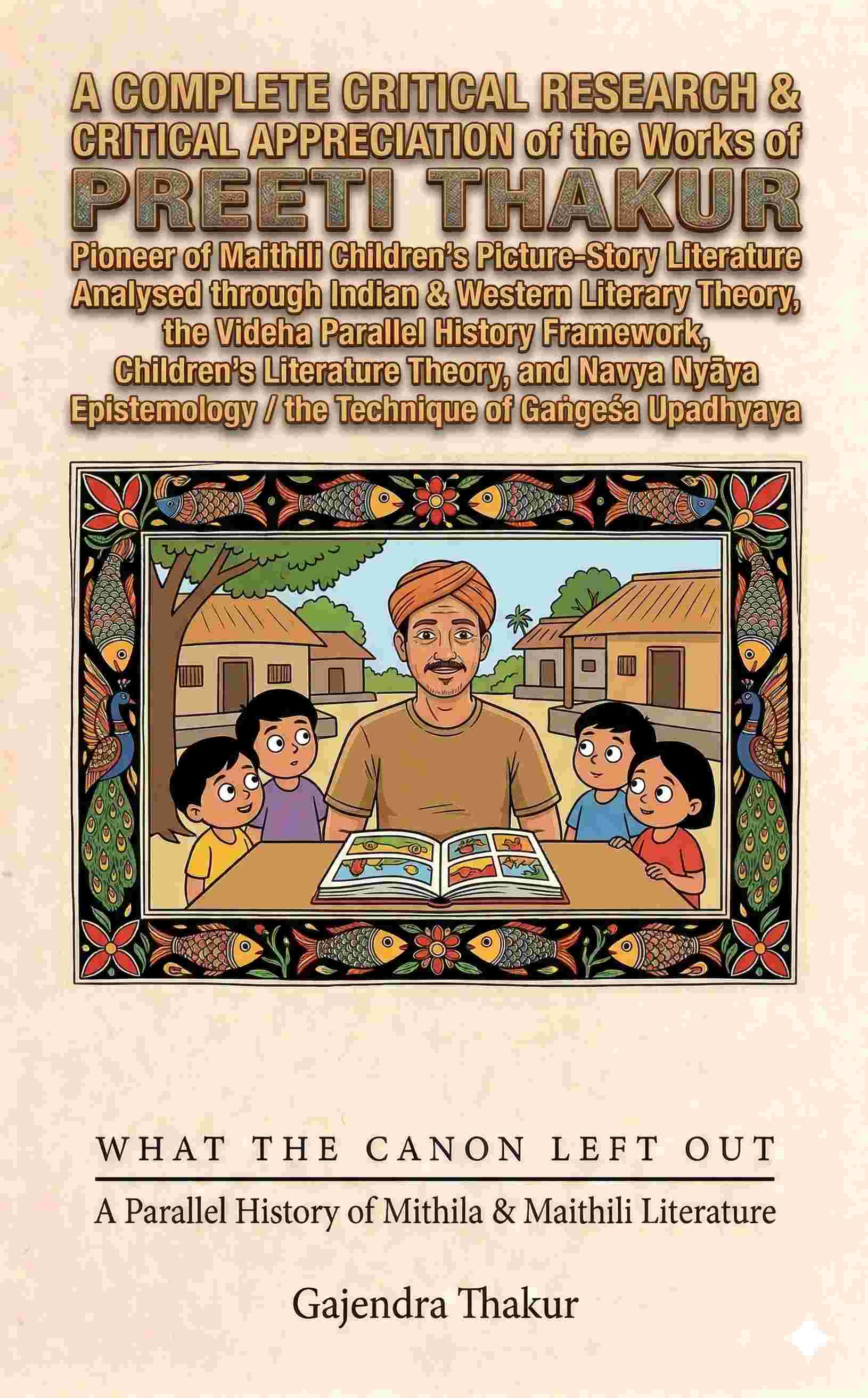
A COMPLETE CRITICAL RESEARCH & CRITICAL APPRECIATION of the Works of PREETI THAKUR Pioneer of Maithili Children's Picture-Story Literature Analysed through Indian & Western Literary Theory, the Videha Parallel History Framework, Children's Literature Theory, and Navya Nyāya Epistemology / the Technique of Gaṅgeśa Upadhyaya
A COMPLETE CRITICAL RESEARCH & CRITICAL APPRECIATION
of the Works of PREETI THAKUR
Pioneer of Maithili Children's Picture-Story Literature
Analysed through Indian & Western Literary Theory,
the Videha Parallel History Framework,
Children's Literature Theory, and
Navya Nyāya Epistemology / the Technique of Gaṅgeśa Upadhyaya
PART I: INTRODUCTION AND BIOGRAPHICAL OVERVIEW
1.1 Who is Preeti Thakur?
Preeti Thakur (also spelled Priti Thakur, Prity Thakur) is a Mithila-based Maithili writer, illustrator, archivist, and cultural worker. She is unambiguously recognised by the critical consensus of the Videha movement as the first creator of picture-story books (chitrakatha) in the Maithili language, and the first full-time children's literature author in any modern sense of the term in Maithili. She is the spouse and literary partner of Gajendra Thakur, editor of Videha — the first and longest-running Maithili fortnightly e-journal (ISSN 2229-547X, since 2000/2004) published at www.videha.co.in.
Her contribution is simultaneously literary, archival, artistic, and civilisational. She illustrates her own picture stories, depicts folk heroes of Mithila who have been erased from mainstream Brahmin-centric literary historiography, and has, alongside Gajendra Thakur, compiled and catalogued 11,000 palm-leaf Panji (genealogical) inscriptions in the Tirhuta script, constituting the largest archival operation in Mithila's recorded history.
1.2 The Literary and Cultural Ecology
Maithili is an Indo-Aryan language spoken by approximately 35 million people in North Bihar (India) and the Terai of Nepal. Recognised in the Eighth Schedule of the Indian Constitution in 2003, it possesses a documented literary tradition running from at least the 8th century Buddhist Charyapadas. Despite its antiquity and the undisputed greatness of medieval court-poet Vidyapati Thakkurah (1350–1435), Maithili's modern literary establishment has been systematically controlled by Maithil Brahmin and Karna Kayastha elites, as documented exhaustively in Gajendra Thakur's A Parallel History of Mithila & Maithili Literature (Videha, 2019–present) and confirmed by RTI data gathered by Vinit Utpal and Ashish Anchinhar (2011–14).
It is within this structurally unequal literary field that Preeti Thakur carves out an entirely new genre — the Maithili chitrakatha (picture-story book) — while simultaneously working to preserve subaltern folk heroes and interstitial histories. Her emergence is not a provincial literary footnote but a civilisational intervention.
1.3 Preeti Thakur: Key Firsts in Maithili Literature
These "firsts" are documented in multiple sources, including the testimony collected in Preeti Karan Setu Banhal — Redefining Maithili (Ed. Ashish Anchinhar, ISBN 978-93-5810-458-5) and Setusham: Vibrant Maithili (2nd Volume).
• First creator and illustrator of a Maithili picture-story book: In 2002, she first translated the picture book Chhot Aur Baigh into Maithili (a genre-opening experiment). In 2008, she published her first wholly original Maithili chitrakatha: Gonu Jha Aan Maithili Chitrakatha (Shruti Publication, Delhi).
• First full-time children's literature author in Maithili: As documented in both critical volumes above. Before Preeti Thakur, no Maithili writer was working exclusively in the children's picture-book genre.
• First Maithili illustrator to depict suppressed folk heroes: Including Reshma-Chuharmal, Bhagata Jyoti Panjiyar, Mahua Ghatwarin, Chhechhan Maharaj — figures absent from the mainstream Brahmin canon but living in the oral memory of Mithila's subaltern communities.
• Co-compiler of 11,000 Palm-Leaf Panji Inscriptions: As archival contributor alongside Gajendra Thakur and Nagendra Kumar Jha (Panjikar Vidyanand Jha) — an unprecedented documentary achievement.
• Creator of Vidyapatik Purusha Pariksha (2012, 2022): A children's illustrated book on Vidyapati Thakkurah's Sanskrit prose classic — the first children's adaptation of this 14th-century Avahatta work in Maithili.
PART II: ANNOTATED BIBLIOGRAPHY OF WORKS
2.1 Gonu Jha Aan Maithili Chitrakatha (2008)
Publisher: Shruti Publication, 8/21, Ground Floor, New Rajendra Nagar, New Delhi – 110008. ISBN 978-93-80538-13-6. Narrated by Gajendra Thakur. Illustrated by Preeti Thakur. Price: Rs. 100 / US $80 (libraries). 1st Edition 2009 (Maithili language).
Contents: Sixteen stories compiled through picture-story medium. Nine stories feature Gonu Jha (the famous Maithili wit, analogous to Birbal of the Mughal court), and seven feature folk and historical figures: Reshma-Chuharmal, Naika-Banijara, Bhagata Jyoti Panjiyar, Mahua Ghatwarin, Raja Salhes, Chhechhan Maharaj, and Kalidasa’s connection with Mithila.
The nine Gonu Jha stories are: Gonu Jha Aan Maa Durga; Gonu Aan Swarg; Gonu Aan Swarn Chor; Gonu Jha Aan Bilarri; Gonu Jha Ka Duta Barad; Gonu Jha Ka Mahis; Gonu Jha Ki Ashrafi; Gonu Jha Aan Kar Adhikari Ki Darhi; Gonu Jha Ki Maay.
The supplementary historical folk stories are: Reshma Chuharmal; Naika Banijara; Bhagata Jyoti Panjiyar; Mahua Ghatwarin; Raja Salhes; Chhechhan Maharaj; Raja Salhes Aan Kalidas.
"Seeing Preeti Thakur's Maithili picture story book on Gonu Jha, I was amazed. Initially, I thought of it as comics for Maithili children, but as I started reading, I became immersed in it. Much substance in a small vessel. It's wonderful how she has condensed the vast world of Maithili folk tales like Shiva's matted hair." — Dr. Shefalika Verma, in Preeti Karan Setu Banhal (Videha Issue 74, 15 January 2011)
2.2 Maithili Chitrakatha (2009)
Second original collection. 1st Edition 2009. Published by Shruti Publication, New Delhi. ISBN 978-93-80538-13-6. Illustrated by Preeti Thakur. Contents: Moti Dai; Raja Salhes; Bodhi-Kayastha; Bahura Godhin Natua Dayal; Amta Gharen; Dina Bhadri; Jhalim Singh; Naika Banijara; Raghuni Marrar; Vidyapati Ki Aayu Avasan.
All ten stories are grounded in the folk memory and oral tradition of Mithila, featuring characters from across caste and class lines, with particular attention to artisan, lower-caste, and female figures largely absent from official Maithili literary canons. The story of Moti Dai, for example, opens with a village scene depicting a barren woman's grief in a community of washermen — a social stratum rarely centred in Maithili literature.
2.3 Mithilak Lokdevata
This larger collection (available in the Videha archive) contains a combined and expanded version of the two chitrakatha collections, with a preface (katha aa kalpana) that theorises the genre of Maithili chitrakatha itself. The preface is written in Maithili and explains the art of storytelling (katha kahba), the combination of verbal and visual imagination (kalpana), and the pedagogical vision behind the books: to nurture children's creativity (kalpanashilata) by letting them choose which story episode to illustrate, which colour to fill, and which dialogue to supply — a genuinely constructivist pedagogical vision.
"Stories have been told in our tradition. Grandmothers told stories to all of us — stories from royal courts, stories of Gonu Jha — and we were amazed. In this collection, we have placed twelve illustrated stories and six wordless stories... The method of telling a story and the sequential illustrated imagination are given here." — Preeti Thakur, Preface to Mithilak Lokdevata (trans. from Maithili)
2.4 Vidyapatik Purusha Pariksha (2012, 2022)
A children's illustrated book by Preeti Thakur, published via Videha (www.videha.co.in), ISSN 2229-547X. First edition 2012, revised 2022. Based on the Sanskrit and Avahatta prose classic Purusha Pariksha by Vidyapati Thakkurah (1350–1435), which itself contains 107 tales of ethical and practical wisdom drawn from pan-Indian didactic traditions. Preeti Thakur adapts this medieval text for a child audience, providing illustrations and simplified narrative framing in Maithili.
The book is doubly significant: it engages with the Videha parallel-history project's key scholarly intervention regarding the two Vidyapatis (the pre-Jyotirishwar Adi Kavi of the democratic tradition vs. the Sanskrit/Avahatta Thakkurah, 1350–1435), and it democratises a text that had previously circulated only in Sanskrit-literate scholarly circles. For Preeti Thakur, translating a 14th-century didactic prose classic for children enacts the same democratising impulse as her chitrakatha series.
2.5 Mithilak Lokdevta (Folk Deities of Mithila)
Reviewed by Shiv Kumar Jha 'Tillu' in Preeti Karan Setu Banhal. This work extends Preeti Thakur's attention from folk heroes to folk religion — specifically to the non-Brahmin deity-figures venerated by Mithila's lower-caste and artisan communities. The inclusion of this title in the critical volumes situates it within the Videha movement's broader project of recovering Dalit and subaltern spiritual traditions alongside literary ones.
2.6 Archival Contribution: 11,000 Palm-Leaf Panji Inscriptions
Compiled, Scanned & Catalogued by Preeti Thakur (with Gajendra Thakur, Nagendra Kumar Jha, and Panjikar Vidyanand Jha). Published in Volumes I–XXII via Videha archive. The Panji are genealogical records of the Maithil community, inscribed in Tirhuta (Mithilakshar) script on palm leaves, containing data running from approximately 450 CE to 2009 CE. Preeti Thakur's role in physically cataloguing and scanning 11,000 such inscriptions represents a form of archival and scholarly labour rarely credited in mainstream literary biography but central to the Videha counter-archive.
PART III: CRITICAL RECEPTION AND TESTIMONIALS
3.1 Dr. Shefalika Verma — “Preeti Thakur's Gonu Jha and Other Maithili Picture Stories”
(Published in Videha Issue 74, 15 January 2011; reprinted in Preeti Karan Setu Banhal)
Shefalika Verma, a prominent Maithili critic and novelist, opens her review with a meditation on gender and literary criticism: “In every language, there are some creators, whether women or men, who, due to their extraordinary talent, stand out distinctly from the rest. It is a different matter that the critical class often relegates women's writing to a corner of history's pages.” She then pivots to a form of critical surprise at Preeti Thakur's achievement: the richness of content within the economical form of the children's picture-story.
Critical note: Verma's review performs a dual function. It acknowledges Preeti Thakur's achievement while situating it within a feminist critique of Maithili literary criticism's systematic marginalisation of women writers — a structural observation entirely consonant with the Videha parallel-history framework.
Verma observes that the book revives for readers the folk characters they had only heard names of: Gonu Jha, Raja Salhes, Mahua Ghatwarin, Chhechhan Maharaj — and that through picture-story medium these figures become “recognisable ideals of all sections of society.” She closes with a programmatic suggestion: that the legends of the Kosi river — its mythic marriage to Singheshwar Baba — should similarly be captured in the chitrakatha format.
3.2 Prof. Veena Thakur — “Gonu Jha and Other Maithili Picture Stories”
(Reprinted in Preeti Karan Setu Banhal)
Veena Thakur approaches the book from the standpoint of cultural transmission: “Behavior received through tradition can be called culture. Qualities like love, sacrifice, kindness, compassion, empathy, etc.” She argues that the chitrakatha format serves to transmit these cultural values across the generational rupture caused by modernisation. Like Verma, she stresses the gallery of folk characters as a form of cultural memory-work.
3.3 Dr. Raman Jha — ‘Gonu Jha Aan Maithili Chitrakatha’ and ‘Maithili Chitrakatha’
(Reprinted in Preeti Karan Setu Banhal; also compiled in Parijat Manjari)
Dr. Raman Jha contextualises Preeti Thakur's innovation within the oral tradition of Mithila: “The tradition of telling and listening to tales and fables has been going on in Mithila since ancient times. Elderly women folk tell various kinds of stories to young children at bedtime, which are entertaining as well as instructive and educational.” He argues that Preeti Thakur's achievement is to have bridged the oral and written, the visual and verbal, in a manner that had not previously been attempted in Maithili.
He also makes a pointed observation about the comparative inadequacy of Maithili children's literature before 2008: despite being in the Eighth Schedule of the Indian Constitution, certain categories of composition had remained “untouched in Maithili, a language of a premier language group,” and that he was “surprised and amazed: how did a woman from our society get focused on this new subject?”
3.4 Shiv Kumar Jha ‘Tillu’ — Multiple Reviews
(Three pieces: on Gonu Jha Aan Maithili Chitrakatha; on Maithili Chitrakatha; on Mithilak Lokdevta)
Tillu situates the publication of both chitrakatha volumes in 2008–09 as “a revolutionary period for the development of children's literature in Maithili.” He notes that before Preeti Thakur's books, the same period saw the award-winning E Bhetal Ta Ki Bhetal by Taranand Viyogi (which received the Sahitya Akademi's Bal Sahitya Puraskar), and argues that had the Akademi's award been established earlier, Preeti Thakur's chitrakatha would have had prior claim.
3.5 Dhirendra Kumar — “A Glance at Both of Preeti Thakur's Picture Story Books”
Dhirendra Kumar writes from a reader-response position: “Literature becomes complete only when it is written in all genres and the compositions are mature. In my view, Preeti Thakur's compositions in the picture story genre... are successful compositions.” He specifically praises her for “attempting to enrich the picture story genre of Maithili, which is negligible, by giving written form to the stories preserved in people's mouths in Maithili's heritage.”
3.6 Durganand Mandal — “Beautiful Picture Stories for Children”
Mandal's review, included in the critical volume, stresses the accessibility and child-centredness of Preeti Thakur's work. He underscores the cultural-retrieval function of the folk-hero stories: figures like Reshma-Chuharmal and Mahua Ghatwarin, whose stories were fading from living memory, are preserved in Preeti Thakur's format in ways that “attract children but [also] people of all ages.”
3.7 Munni Kamat — “A Proficient Writer of the Child's Mind”
(In Setusham: Vibrant Maithili, Volume 2)
"For any creation, the first churning, the first foundation, and the first brick standing on it are of great importance. Because any skyscraper built afterwards imitates only that. In Maithili children's literature, it is Mrs. Preeti Thakur who, along with the first conceptualization of the picture story, also gave it the form of a book... Building children's literature is a bit more difficult than building literature. To create children's literature, the writer first has to become a child of that age; only then is the exchange of emotions possible." — Munni Kamat
3.8 Ira Mallick — “Preeti Thakur's Contribution to Maithili Picture Stories”
(In Setusham: Vibrant Maithili, Volume 2. Ira Mallick is also Smtā Editor of the ‘Stri Kona’ [Women's Corner] section of Videha)
Mallick's piece extends the feminist critical dimension of the reception, situating Preeti Thakur's contribution within the broader women's tradition in Maithili that the Videha parallel history has been recovering: alongside Vibha Rani, Kamini Kamayani, Susmita Pathak, Panna Jha, Kalpana Jha, and Premlata Mishra Prem. Mallick argues that Preeti Thakur's chitrakatha series is not simply a contribution to children's literature but to the feminist counter-canon of Maithili.
3.9 Ashish Anchinhar — “The Early History of Maithili Picture Stories (2002–2016)”
(In Preeti Karan Setu Banhal; Anchinhar is editor of both critical volumes)
Anchinhar provides the most systematic historical account of the Maithili chitrakatha genre. He documents that Preeti Thakur's 2002 translation of Chhot Aur Baigh represents the genre's first appearance in Maithili, that her 2008 Gonu Jha Aan Maithili Chitrakatha is the first wholly original Maithili picture-story book, and that her work created the conditions for subsequent children's literature production in the language. He notes that four reviews of the first critical volume (Preeti Karan Setu Banhal) were published together in Videha Issue 398 (July 15, 2024).
PART IV: THEORETICAL FRAMEWORKS AND CRITICAL ANALYSIS
4.1 The Videha Parallel History Framework
Gajendra Thakur's A Parallel History of Mithila & Maithili Literature (Videha, 2019–present, Parts 1–46+) constitutes the theoretical and historiographical framework within which Preeti Thakur's work must be understood. Its core argument is that the mainstream Maithili literary historiography, as curated by the Sahitya Akademi since 1965, has systematically promoted an upper-caste (predominantly Maithil Brahmin) canon while suppressing democratic, folk, Dalit, feminist, and Nepal-side traditions.
The framework operates on nine analytical layers: (1) Buddhist Charyapada foundations; (2) the two Vidyapatis; (3) the suppressed Gangesh Upadhyaya; (4) colonial-era protest poetry; (5) Harimohan Jha's exclusion; (6) the living masters (Rajdeo Mandal, Bechan Thakur, Jagdish Prasad Mandal); (7) RTI exposure of Sahitya Akademi nepotism; (8) Nepal-side Maithili; (9) the Videha digital counter-archive.
Within this schema, Preeti Thakur occupies a defined structural position in layer (9) — the digital counter-archive — and simultaneously enacts layers (1) and (3) by recovering folk and subaltern figures (Reshma-Chuharmal, Mahua Ghatwarin, etc.) who belong to the suppressed oral canon, and layer (6) by working as a living creative practitioner outside the official awards infrastructure.
The Parallel History Framework insists that literary value is not intrinsic but relational: a text's meaning is shaped by the institutional field that either recognises or suppresses it. Preeti Thakur's work acquires its critical weight partly because it was created outside and against the institutional apparatus that had kept Maithili children's literature at zero.
4.2 Indian Literary Theory: Rasa, Dhvani, and Chitrakatha
4.2.1 Rasa Theory (Bharata Muni, Natyashastra; Abhinavagupta, Abhinavabharati)
Classical Sanskrit rasa theory holds that literary art produces rasa — aesthetic emotion or “relish” — in the sensitive reader (sahridaya) through the conjunction of vibhava (determinants), anubhava (consequents), and vyabhichari bhava (transient emotional states). Bharata Muni identifies eight primary rasas; Abhinavagupta adds shanta (serenity) as a ninth.
Preeti Thakur's chitrakatha series is primarily oriented toward two rasas: hasya (comic delight) in the Gonu Jha stories, and karuna (pathos/compassion) in the folk-hero narratives. The Gonu Jha cycle operates through the classic structure of wit overcoming power — a structure that produces hasya while also engaging adbhuta (wonder) as the trickster repeatedly astonishes those in authority. The folk-hero stories, particularly the Reshma-Chuharmal narrative and the Mahua Ghatwarin story, are suffused with karuna shaded by vira (heroic emotion) as characters navigate social oppression.
Abhinavagupta's concept of sadharanikarana (universalisation) is particularly relevant: the chitrakatha format does not merely tell a local story but lifts the characters into a register of universal recognition, accessible to child and adult reader alike. The aesthetic distance created by the visual medium (pictures rather than unmediated text) enables the sadharanikarana process.
4.2.2 Dhvani Theory (Anandavardhana, Dhvanyaloka)
Anandavardhana's dhvani (resonance/suggestion) theory holds that the highest form of literary expression operates through suggestion rather than direct statement. The implied or resonant meaning (dhvani or vyangya) is aesthetically superior to the directly expressed (vacyartha). In Preeti Thakur's chitrakatha, the visual image operates precisely as dhvani does in classical poetry: the picture does not illustrate a scene so much as suggest a world beyond itself. The drawing of a folk hero marginalised from the mainstream literary record carries an implied critique of that marginalisation without ever stating it.
This resonance-structure is especially operative in Vidyapatik Purusha Pariksha, where the adaptation of a 14th-century Sanskrit didactic text for a Maithili-language children's audience enacts a dhvani of cultural continuity and democratic access: the suggestion is that this heritage belongs to all children, not only to those educated in Sanskrit.
4.2.3 Vakrokti Theory (Kuntaka, Vakroktijivita)
Kuntaka's vakrokti (deviant or oblique expression) theory argues that literary art is characterised by a deviation from the ordinary use of language — an obliqueness that creates beauty and meaning. Applied to Preeti Thakur, the very act of translating oral folk-narrative into a visual-verbal medium is a form of vakrokti: the story is told obliquely, through the indirection of image, colour, and minimal text, rather than through direct narrative exposition. This obliqueness is not a deficiency but, in Kuntaka's terms, the very source of its aesthetic power.
4.3 Western Literary Theory
4.3.1 Feminist Literary Criticism (Elaine Showalter, Sandra Gilbert & Susan Gubar)
Elaine Showalter's gynocriticism — the study of women as writers, focusing on the female literary tradition — is directly applicable to Preeti Thakur's situation. Showalter identifies three phases in women's literary history: the Feminine phase (imitation of dominant tradition), the Feminist phase (protest and advocacy), and the Female phase (self-discovery and autonomous tradition-building). Preeti Thakur operates unambiguously in the Female phase: she does not imitate the Brahmin male literary mainstream of Maithili, nor does she primarily protest it (though her recovery of subaltern folk heroes carries an implicit protest). She constructs a new genre, a new audience (children), and a new critical-visual language.
Gilbert and Gubar's concept of the “madwoman in the attic” — the repressed female creative energy that must find oblique expression in a male-dominated literary field — finds its counterpart in the Maithili context in the documented absence of women writers from Sahitya Akademi awards and assignments (confirmed by RTI data). Preeti Thakur's creative energy, unable to find official recognition, flows into the Videha counter-archive — a digital “attic” that is in fact more open and more widely read than the official publications it subverts.
4.3.2 Postcolonial Theory (Homi Bhabha, Gayatri Spivak)
Homi Bhabha's concept of the “third space” — the ambivalent, hybrid cultural space produced by colonial encounter — is applicable to the Maithili chitrakatha as a genre. The picture-story book is itself a “third space” between oral tradition (the grandmother's bedtime story) and the imported print-culture format (the modern comic/graphic narrative). Preeti Thakur occupies this third space productively, neither simply reproducing Western graphic novel conventions nor merely transcribing oral tradition, but creating a hybrid form adequate to Maithili culture.
Gayatri Spivak's question “Can the subaltern speak?” resonates with particular force in the context of Preeti Thakur's recovery of non-Brahmin folk heroes. Reshma-Chuharmal, whose story crosses caste lines (a Dugdhvanshi Dusadh hero and a Purnia Bhumihar Brahmin heroine), or Mahua Ghatwarin, whose story was fading from even oral memory — these figures are the subaltern given visual and narrative form. In Spivak's terms, Preeti Thakur performs the impossible but necessary act of making the subaltern speak without herself claiming to speak for them: the picture-story format maintains the folk hero's own cultural logic.
4.3.3 Reader-Response Theory (Wolfgang Iser, Hans Robert Jauss)
Wolfgang Iser's theory of the “implied reader” and the “indeterminacy” of the literary text is especially illuminating for the chitrakatha form. Iser argues that literary texts are full of “gaps” and “blanks” that the reader must fill through imaginative participation. In Preeti Thakur's picture stories, this gap-filling is made literal and pedagogically intentional: the preface to PrityThakur-3 explicitly describes how children are invited to choose which episode to illustrate, which colour to apply, which dialogue to supply. Iser's implied reader is here made the actual, active, constructing child-reader.
Hans Robert Jauss's concept of the “horizon of expectations” — the cultural and aesthetic expectations a reader brings to a text, which the text may confirm, expand, or subvert — helps explain the critical surprise registered by reviewers like Raman Jha and Shefalika Verma. Their surprise at finding “much substance in a small vessel” indicates that Preeti Thakur's chitrakatha exceeded the horizon of expectations associated with the children's book: it was read as serious literature precisely because it exceeded the genre's expected range.
4.3.4 Mikhail Bakhtin: Dialogism, Heteroglossia, and Carnivalesque
Bakhtin's concept of the carnivalesque — the festive, popular-cultural inversion of hierarchies and authorities — is directly operative in the Gonu Jha cycle. Gonu Jha is himself a carnivalesque figure: a court jester who repeatedly outsmarts those in power, whose wit exposes the pretensions of Brahmins, tax officials, and even divine authority. Bakhtin argues that carnival laughter is not merely comic but liberatory, temporarily suspending the social order that normally enforces hierarchy. In Mithila, Gonu Jha stories have always served this function in oral culture; Preeti Thakur's chitrakatha extends this carnivalesque energy into the space of the children's book, giving the next generation access to the culture's most subversive comic tradition.
Bakhtin's heteroglossia — the co-presence of multiple social voices and registers in a text — is also evident in Preeti Thakur's selection of folk heroes from across the social spectrum. The chitrakatha does not speak in one voice but in many: the voice of the Dusadh community (Reshma-Chuharmal), the voice of the fishing and boatmen castes (Mahua Ghatwarin), the voice of the barber caste (Thakur, mentioned in Raman Jha's review), alongside the wit-tradition associated with the Brahmin court jester.
4.4 Theories of Children's Literature
4.4.1 The Developmental Framework (Jean Piaget, L. S. Vygotsky)
Piaget's theory of cognitive development identifies distinct stages: sensorimotor (0–2), preoperational (2–7), concrete operational (7–11), and formal operational (12+). Preeti Thakur's chitrakatha are primarily aimed at the preoperational and concrete operational stages: the picture-story format is ideally suited to the preoperational child's thinking in images and narratives rather than abstract concepts. The minimal text and dominant visual register of the chitrakatha accommodates the preoperational child's iconic cognition.
Vygotsky's concept of the Zone of Proximal Development (ZPD) — the space between what a child can do independently and what they can do with guidance — is enacted by the chitrakatha's design. The preface to PrityThakur-3 explicitly describes a practice of guided co-creation: adult and child work together on the stories, the child choosing the colouring and dialogue while the adult provides the narrative scaffold. This is Vygotskyan scaffolding in explicit pedagogical action.
4.4.2 Roderick McGillis and the Ideology of Children's Literature
Roderick McGillis (The Nimble Reader, 1996) argues that children's literature is never politically neutral but always ideologically laden — teaching children what to value, whom to trust, what kind of person to become. Preeti Thakur's chitrakatha are ideologically counter-hegemonic: against the Brahmin-centric ideological field of mainstream Maithili literature, they present folk heroes from Dusadh, fishing, and artisan communities as the protagonists of cultural memory and moral exemplarity. The ideology encoded is not of caste supremacy but of folk dignity and cross-caste solidarity.
4.4.3 Maria Nikolajeva on Visual-Verbal Dynamics
Maria Nikolajeva and Carole Scott (How Picturebooks Work, 2001) develop a taxonomy of the relationships between verbal text and image in picture books: symmetrical (image and text convey the same information), complementary (each adds what the other lacks), enhancing, counterpointing, and contradictory. Preeti Thakur's chitrakatha largely work through the complementary mode: the minimal verbal text (often a few lines of dialogue or caption) adds information not contained in the image, while the image embodies the emotional and social texture that the text does not attempt to describe. This is a sophisticated distribution of labour between the two semiotic channels.
4.4.4 The Oral Tradition and Children's Literature
Walter Ong's Orality and Literacy (1982) argues that oral cultures think and communicate in fundamentally different ways from literate cultures, privileging aggregative rather than analytic, situational rather than abstract, participatory rather than distanced structures. Preeti Thakur's chitrakatha are a form of what Ong would call “secondary orality”: they are grounded in the oral folk tradition of Mithila (the grandmother's bedtime stories, the village tales of Gonu Jha) but transmit that tradition through the literate medium of the printed book. This is the generic and cultural transition that makes the chitrakatha historically significant.
4.5 Navya Nyāya Epistemology: The Technique of Gaṅgeśa Upadhyaya
4.5.1 Gangesh Upadhyaya and Tattvachintamani
Gangesh Upadhyaya (Gangesa, c. 13th century CE, Darbhanga, Mithila) is the founder of the Navya Nyāya (New Logic) school of Indian philosophy. His magnum opus, the Tattvachintamani (Jewel of Reflection on the True Nature of Things), is one of the most technically rigorous works of epistemological and logical analysis in any philosophical tradition, developing a highly precise formal language for analysing knowledge, inference, and verbal testimony (sabda).
The Videha Parallel History makes a specific and politically charged intervention regarding Gangesh: original Panji (genealogical) manuscripts demonstrate that he was born of an inter-caste union (his mother was from a leather-tanning, i.e., Charmkarini, caste) and that his father had already died when he was born. This fact was suppressed by the scholar Ramanath Jha and the Sahitya Akademi's 2016 monograph on Gangesh perpetuated the suppression. The recovery of Gangesh's actual biography is part of the Videha movement's broader effort to deconstruct Brahmin cultural hegemony in Mithila.
4.5.2 Applying Navya Nyāya Epistemological Categories to Preeti Thakur's Work
Navya Nyāya develops a highly technical vocabulary for analysing the structure of knowledge claims. Three categories are particularly useful for literary criticism:
• Vyapti (pervasion/invariable concomitance): The logical relationship of necessary connection between two properties, analogous to a universal law. In the context of Preeti Thakur's work: the invariable concomitance between the chitrakatha format and the democratisation of cultural heritage. Wherever the chitrakatha appears in Maithili, cultural accessibility to previously marginalised children and communities follows necessarily.
• Paksha, Sadhya, Hetu (Subject, Predicate, Reason in inference): The structure of Nyāya inference applied to the critical claim: Preeti Thakur's chitrakatha (paksha) achieves cultural democratisation (sadhya) because it presents subaltern folk heroes in an accessible visual-verbal format (hetu), given that such presentation is invariably connected with cultural democratisation (vyapti).
• Sabda pramana (verbal testimony as a source of knowledge): In Nyāya, verbal testimony from an authorised speaker (apta) is a valid source of knowledge. The oral folk tradition preserved in Mithila's village communities constitutes sabda pramana that Preeti Thakur's chitrakatha renders accessible in written/visual form. The grandmothers' bedtime stories are the original apta; the chitrakatha is their authorised transcription.
4.5.3 The Epistemological Politics of the Panji Archive
The Panji — the genealogical inscription system that Preeti Thakur helped compile and catalogue — is itself a site of epistemological contest. For centuries, the Panji was controlled by hereditary Panjikars (genealogists) who used it to enforce Brahmin endogamy and casteism. The Videha project's digitisation of 11,000 palm-leaf Panji inscriptions in Volumes I–XXII is an epistemological intervention: it makes public knowledge that was controlled as private knowledge by a caste guild. In Nyāya terms, it transforms inaccessible agama (traditional authoritative testimony) into publicly accessible pratyaksha (direct perception/verifiable data).
Crucially, the Panji evidence also reveals inter-caste marriages — approximately 100 documented inter-caste unions — including the origin of Gangesh Upadhyaya himself. This transforms the Panji from an instrument of caste closure into evidence of caste intermixture — a reversal of epistemological function that has direct relevance to the ideological politics of Preeti Thakur's folk-hero stories, which similarly celebrate cross-caste humanity.
PART V: THEMATIC ANALYSIS OF PREETI THAKUR'S LITERARY CORPUS
5.1 The Folk Hero as Counter-Canon
The most consistent thematic movement in Preeti Thakur's chitrakatha is the elevation of folk heroes from Mithila's oral tradition to the status of literary characters worthy of a permanent text. This movement is simultaneously aesthetic and political: aesthetic because it creates new literary subjects and new visual iconographies; political because it challenges the canon of Brahmin court culture that has dominated Maithili literary history.
Gonu Jha is the most prominent example: a figure of wit and practical intelligence who occupies in Mithila's collective imagination the position that Birbal occupies in Mughal cultural memory, but who has been relegated to a minor position in official Maithili literary historiography dominated by the high-Sanskrit Vidyapati tradition. Preeti Thakur restores Gonu Jha to his cultural centrality by making him the subject of nine consecutive picture-stories, each enacting the carnivalesque logic of wit defeating power.
More politically charged is her treatment of Reshma-Chuharmal: a cross-caste love story between a Dugdhvanshi Dusadh man and a Bhumihar Brahmin woman, “the viewpoint of trampling love under the caste system of society is broken in this picture story” (Raman Jha). This is not simply a romantic narrative but a critique of the caste system embedded in a children's book — the same pedagogical space that dominant ideology has typically used to reproduce caste values.
5.2 Gender and the Maithili Children's Literary Space
As Shefalika Verma and Ira Mallick observe in their reviews, Preeti Thakur's entry into Maithili children's literature is itself a gender intervention. Women writers in Maithili have been systematically excluded from official literary infrastructure. Preeti Thakur does not seek entry into this official space but creates a new space: the chitrakatha for children, where she is simultaneously author, illustrator, and the first practitioner of the genre.
Several of her folk-hero stories centre women: Reshma in the cross-caste love narrative, Moti Dai in the story that opens the second collection, Mahua Ghatwarin whose story was in danger of disappearing entirely from collective memory. These female folk protagonists are not secondary characters or object-lessons but full agents of their own narratives.
5.3 The Pedagogy of Imagination and Constructivist Learning
The preface to PrityThakur-3 reveals that Preeti Thakur's pedagogical vision is explicitly constructivist: children are invited not merely to receive the stories but to participate in their completion. The procedure described is: (1) adult reads the story; (2) child selects which episode to illustrate; (3) child fills in the colours; (4) child adds dialogue. This is not passive reception but active construction of meaning — precisely the Vygotskyan ZPD in action.
The preface also notes that “through this all the child's imaginative ability can increase, and at the same time imagination can become a literal reality” (trans. from Maithili). This is a sophisticated statement of the relationship between fictional world-making and cognitive development: imagination, exercised in the play-space of the chitrakatha, becomes a faculty for comprehending reality.
5.4 The Medieval-Modern Bridge: Vidyapatik Purusha Pariksha
The adaptation of Vidyapati Thakkurah's 14th-century Sanskrit prose classic for a Maithili children's audience performs a thematic operation of historical continuity: the child reading Preeti Thakur's version of the Purusha Pariksha is connected to a text that was part of Mithila's cultural life 600 years ago. This is not nostalgic conservatism but active democratisation: a text that was previously available only to Sanskrit-educated scholars is now available to Maithili-medium school children.
The Purusha Pariksha itself — 107 tales of practical wisdom drawn from pan-Indian didactic traditions including the Panchatantra and the Sanskrit Kathakosa — is a text already in dialogue with popular narrative tradition. Preeti Thakur's children's adaptation is thus not a simplification but a restoration: returning the Purusha Pariksha to something like its original social function as accessible moral narrative.
PART VI: SYNTHESIS AND CRITICAL ASSESSMENT
6.1 Preeti Thakur in the Parallel History Framework
The Videha Parallel History Framework's fundamental argument is that the mainstream Maithili literary canon represents an “onslaught on dignity” (Gajendra Thakur's phrase) — a systematic exclusion of democratic, folk, Dalit, feminist, and Nepal-side traditions. Within this framework, Preeti Thakur's work is exemplary precisely because it is not simply non-canonical but anti-canonical: it insists that children's literature, folk heroes, subaltern communities, and women's cultural labour are not peripheral to Maithili literary culture but central to it.
The critical volumes Preeti Karan Setu Banhal (2024) and Setusham: Vibrant Maithili represent a collective critical act: the Maithili literary community — critics, scholars, poets, students — assembling to declare that Preeti Thakur's contribution constitutes a genuine landmark. This collective critical recognition, produced outside the Sahitya Akademi apparatus, is itself an instance of the parallel literary institution that Videha has been building since 2000.
6.2 The Problem of Institutional Invisibility
The most significant critical problem raised by Preeti Thakur's work is not aesthetic but institutional: how does a writer of evident achievement and historical significance remain invisible to the official literary apparatus? The RTI data documented by Vinit Utpal and Ashish Anchinhar (2011–14) showed that over 90% of Sahitya Akademi assignments went to friends and relatives of the 10-member Maithili advisory board. Zero assignments went to authors of the parallel tradition.
Preeti Thakur has not received Sahitya Akademi recognition for the creation of an entirely new genre in Maithili literature. The Bal Sahitya Puraskar of the Sahitya Akademi, which was instituted precisely for children's literature, has not been awarded to the creator of the Maithili children's picture-story book. This institutional silence is not accidental: it is the systematic operation of the same caste-based cultural gatekeeping that the Videha Parallel History has been documenting since 2019.
6.3 Formal Achievement: The Chitrakatha as Literary Form
Considered purely on its formal merits, independent of the institutional politics, Preeti Thakur's chitrakatha represents a significant formal achievement. She solves the problem of adapting a richly oral culture's folk narratives to a visual-verbal medium without reducing them to illustration or caption. The complementary dynamics she establishes between image and text (in Nikolajeva's typology) is sophisticated: neither element dominates, each adds what the other cannot provide.
Her illustration style, self-taught rather than academically trained, develops an iconographic vocabulary adequate to the folk heroes she depicts. The characters are recognisably of Mithila — in their clothing, setting, and gesture — without being nostalgic or frozen. The mild criticism in Raman Jha's review (“the picture of the lion looked like a cat”) is a technical observation that does not undermine the overall achievement.
6.4 Conclusion: The Civilisational Significance of Preeti Thakur's Work
Preeti Thakur's literary contribution cannot be assessed on a purely aesthetic scale without acknowledging its civilisational dimension. She has: (1) created a new literary genre in Maithili; (2) preserved from oral oblivion dozens of folk-hero narratives and the communities whose identity they anchor; (3) provided Maithili-medium children with a literary culture previously unavailable to them; (4) contributed to the largest archival operation in Mithila's recorded history (the Panji digitisation); (5) adapted a 14th-century classical text for a modern child audience, demonstrating that medieval and modern Maithili constitute a continuous civilisational stream.
These achievements, taken together, constitute not simply a literary career but a programme of cultural survival for a language and culture under multiple pressures: the dominance of Hindi and English, the institutional gatekeeping of the Sahitya Akademi, the gradual erosion of the oral tradition that carries folk memory, and the absence of children's literature in the mother tongue that undermines Maithili's intergenerational transmission.
Assessed through the Indian critical tradition (rasa, dhvani, vakrokti), Western theory (feminist criticism, postcolonial theory, reader-response, Bakhtinian dialogics), the theories of children's literature (Piaget, Vygotsky, Nikolajeva, McGillis), and Navya Nyāya epistemology (vyapti, sabda pramana, the epistemological politics of the Panji), Preeti Thakur emerges as a figure of the first importance in contemporary Maithili literature, whose recognition by the institutional apparatus is long overdue.
REFERENCES AND BIBLIOGRAPHY
Primary Texts by Preeti Thakur
Thakur, Preeti. Gonu Jha Aan Maithili Chitrakatha. Shruti Publication, New Delhi, 2008. [Narrated by Gajendra Thakur; ISBN 978-93-80538-13-6]
Thakur, Preeti. Maithili Chitrakatha. Shruti Publication, New Delhi, 2009.
Thakur, Preeti. Vidyapatik Purusha Pariksha [Children's Illustrated Book]. Videha eJournal Archive, ISSN 2229-547X, 2012; 2nd ed. 2022. www.videha.co.in
Thakur, Preeti. Mithilak Lokdevta. Videha Archive, www.videha.co.in
Thakur, Preeti, Gajendra Thakur, Nagendra Kumar Jha, and Panjikar Vidyanand Jha. 11,000 Palm Leaf Panji Inscriptions, Volumes I–XXII [Compiled, Scanned & Catalogued]. Videha Archive, 2007–present.
Critical Volumes on Preeti Thakur
Anchinhar, Ashish (Ed.). Preeti Karan Setu Banhal — Redefining Maithili [Focusing on the literary works of Gajendra Thakur and Preeti Thakur in the Maithili language]. English translation by Gajendra Thakur. ISBN 978-93-5810-458-5. 2024, 2026.
Anchinhar, Ashish (Ed.). Setusham: Vibrant Maithili [2nd Volume, focusing on the literary works of Gajendra Thakur and Preeti Thakur]. 2024–2026.
Videha Parallel History
Thakur, Gajendra. A Parallel History of Mithila & Maithili Literature [Parts 1–46+]. Videha eJournal, ISSN 2229-547X, 2019–present. www.videha.co.in/gajenthakur.htm
Thakur, Gajendra. Videha eJournal [ISSN 2229-547X], Issues 1–400+, 2008–present. www.videha.co.in
Utpal, Vinit and Ashish Anchinhar. RTI Data on Sahitya Akademi Assignments, 2011–2014 [documented in Videha archive].
Indian Critical and Philosophical Sources
Bharata Muni. Natyashastra. Trans. Manmohan Ghosh. Asiatic Society, Calcutta, 1951.
Abhinavagupta. Abhinavabharati [Commentary on Natyashastra]. Ed. M.R. Kavi. GOS, Baroda, 1926–1964.
Anandavardhana. Dhvanyaloka. Trans. Daniel H.H. Ingalls, Jeffrey Moussaieff Masson, M.V. Patwardhan. Harvard University Press, 1990.
Kuntaka. Vakroktijivita. Ed. S.K. De. Calcutta Sanskrit Series, 1923.
Gangesh Upadhyaya. Tattvachintamani. Ed. Kamakhyanath Tarkavagisha. Asiatic Society, Calcutta, 1884.
Matilal, Bimal Krishna. The Word and the World: India's Contribution to the Study of Language. Oxford University Press, 1990.
Phillips, Stephen H. Epistemology in Classical India: The Knowledge Sources of the Nyaya School. Routledge, 2012.
Western Literary Theory
Bakhtin, Mikhail. The Dialogic Imagination. Trans. Caryl Emerson and Michael Holquist. University of Texas Press, 1981.
Bhabha, Homi K. The Location of Culture. Routledge, 1994.
Gilbert, Sandra M. and Susan Gubar. The Madwoman in the Attic. Yale University Press, 1979.
Iser, Wolfgang. The Act of Reading: A Theory of Aesthetic Response. Johns Hopkins University Press, 1978.
Jauss, Hans Robert. Toward an Aesthetic of Reception. Trans. Timothy Bahti. University of Minnesota Press, 1982.
Showalter, Elaine. “Toward a Feminist Poetics.” In Women's Writing and Writing about Women, ed. Mary Jacobus. Croom Helm, 1979.
Spivak, Gayatri Chakravorty. “Can the Subaltern Speak?” In Marxism and the Interpretation of Culture, eds. Cary Nelson and Lawrence Grossberg. University of Illinois Press, 1988.
Children's Literature Theory
Nikolajeva, Maria and Carole Scott. How Picturebooks Work. Garland, 2001.
McGillis, Roderick. The Nimble Reader: Literary Theory and Children's Literature. Twayne, 1996.
Ong, Walter J. Orality and Literacy: The Technologizing of the Word. Methuen, 1982.
Piaget, Jean. The Language and Thought of the Child. Trans. Marjorie Gabain. Routledge, 1959.
Vygotsky, Lev. Mind in Society: The Development of Higher Psychological Processes. Harvard University Press, 1978.
Maithili Literary History and Context
Oommen, T.K. “Linguistic Diversity.” In Sociology. National Law School of India University/Bar Council of India Trust, 1988, p. 291–293.
Grierson, George A. Maithili Chrestomathy and Vocabulary. Baptist Mission Press, Calcutta, 1882.
Mishra, Jaykant. A History of Maithili Literature [2 vols.]. 1949–1976.
Chaudhary, Radhakrishna. A Survey of Maithili Literature. Bihar Hindi Granth Academy, 1976.
Vidyapati Thakkurah. Purusha Pariksha [Sanskrit/Avahatta prose]. Ed. K.P. Malla. Nepal Research Centre, 1968.
अपन मंतव्य editorial.staff.videha@zohomail.in पर पठाउ।